PROBLEM 10-9 (Continued)
Wiggins, Inc.’s Books
Cash ………………………………………………………………
15,000
Machienry (A) …………………………………………………
50,400**
Accumulated Depreciation—Machinery (B) ………
47,000
Machinery (B) ………………………………………….
Gain on Disposal of Machinery …………………
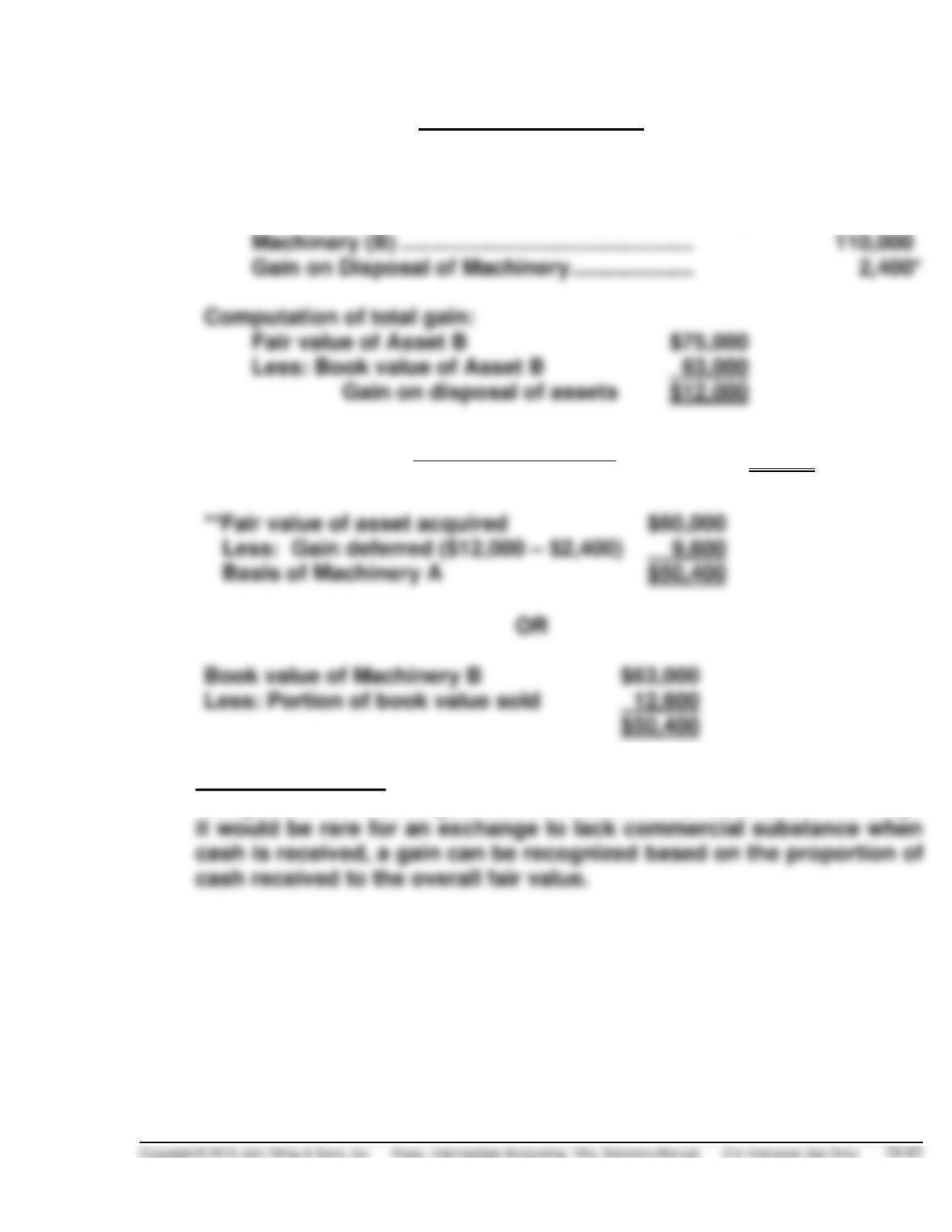
Computation of total gain:
Fair value of Asset B
Less: Book value of Asset B
*Gain recognized =
$15,000
X $12,000 = $2,400
$15,000 + $60,000
**Fair value of asset acquired
$60,000
Less: Gain deferred ($12,000 – $2,400)
9,600
Book value of Machinery B
Less: Portion of book value sold
Note to instructor: This illustrates the exception to no gain or loss
recognition for exchanges that lack commercial substance. Although
PROBLEM 10-10
(a) Has Commercial Substance
Marshall Construction
1.
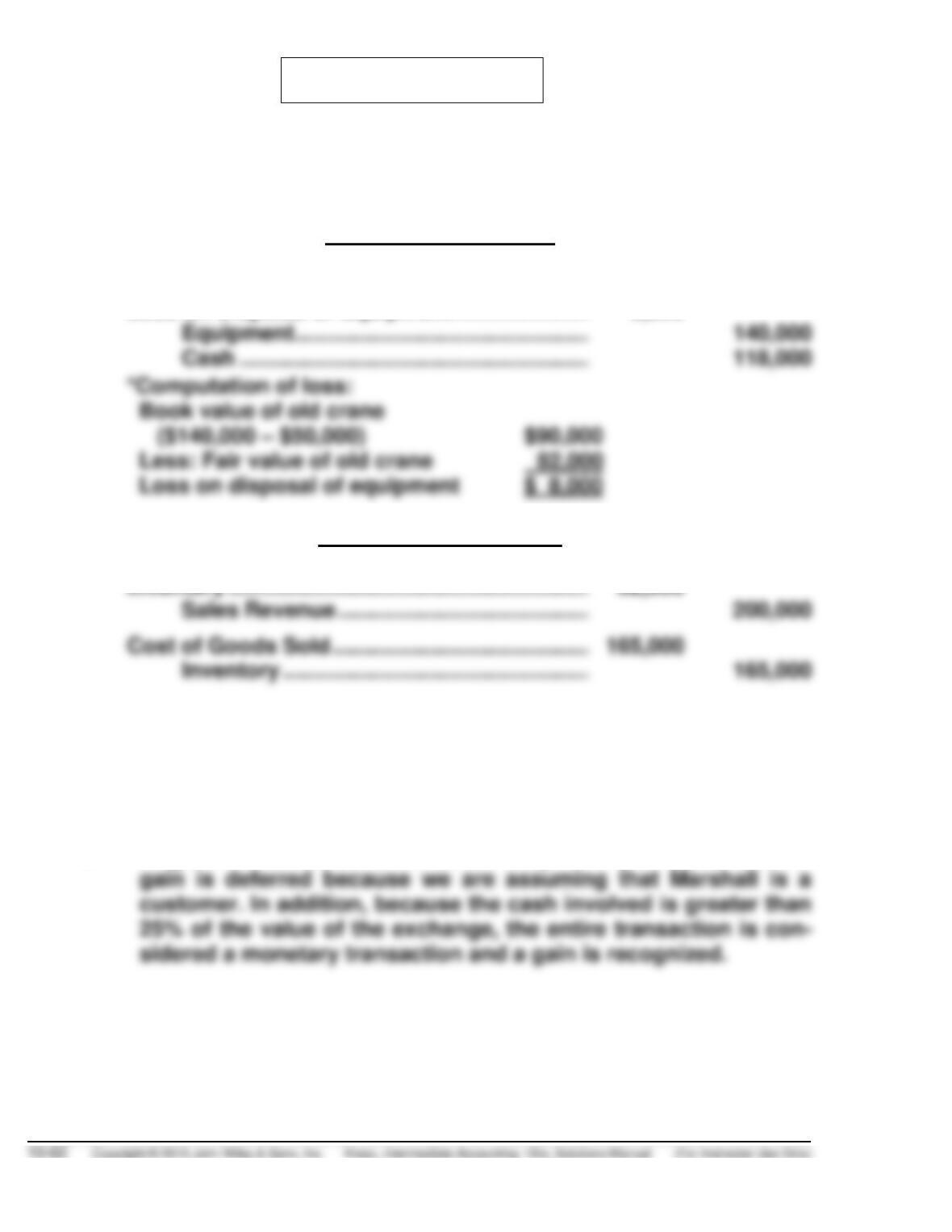
Equipment ($82,000 + $118,000) ………………….
200,000
Accumulated Depreciation—Equipment ……..
50,000
Loss on Disposal of Equipment ………………….
8,000*
Equipment …………………………………………
Cash …………………………………………………
Brigham Manufacturing
2.
Cash …………………………………………………………
118,000
Inventory …………………………………………………..
82,000
Sales Revenue …………………………..………
Cost of Goods Sold ……………………………………
165,000
Inventory …………………………………………..
(b) Lacks Commercial Substance
1. Marshall Construction should record the same entry as in part (a)
above, since the exchange resulted in a loss.
2. Brigham should record the same entry as in part (a) above. No
PROBLEM 10-10 (Continued)
(c) Has Commercial Substance
Marshall Construction
1.
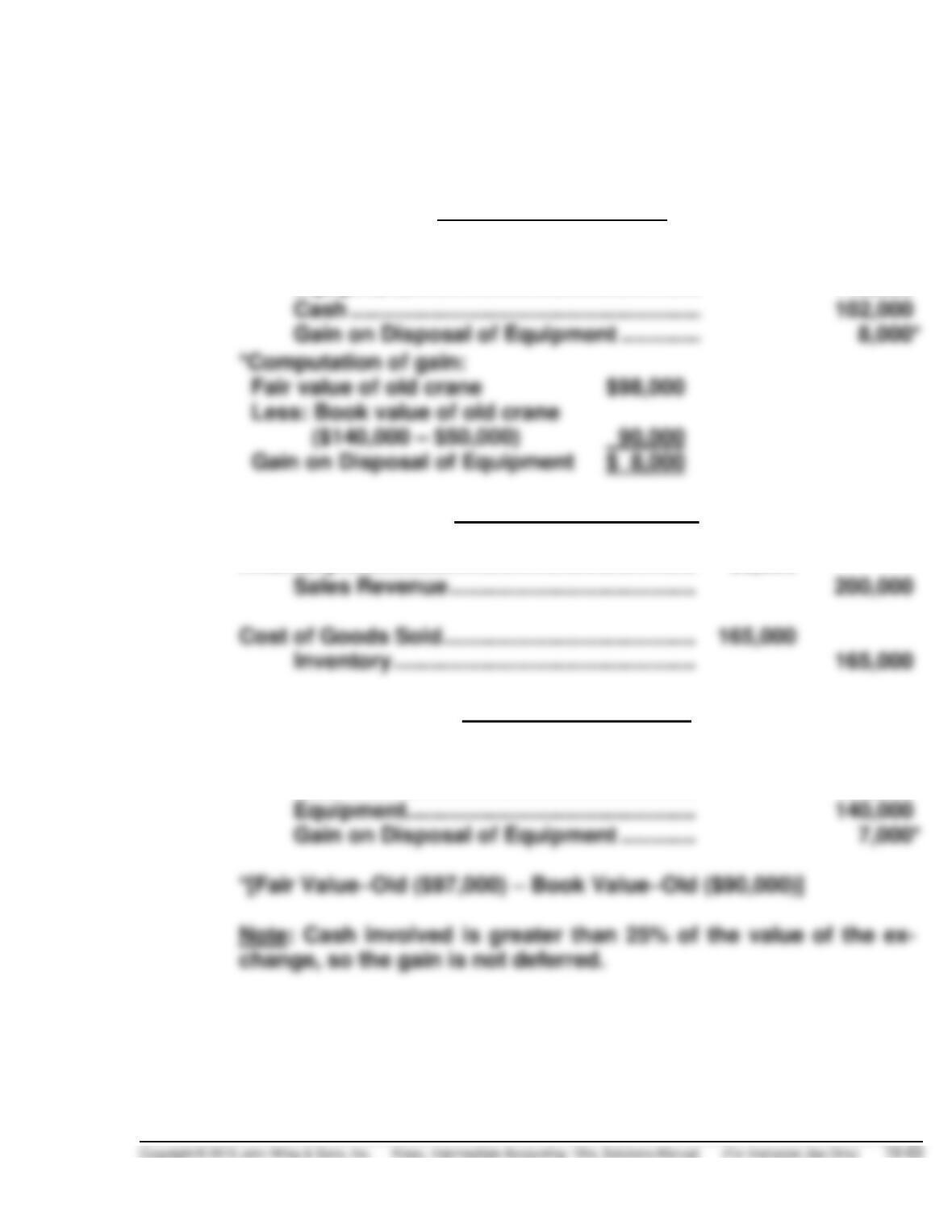
Equipment ($98,000 + $102,000)………………….
200,000
Accumulated Depreciation—Equipment ……..
50,000
Equipment…………………………………………
140,000
Cash …………………………………………………
102,000
Gain on Disposal of Equipment ………….
Brigham Manufacturing
2.
Cash ………………………………………………………..
102,000
Inventory ………………………………………………….
98,000
Sales Revenue ………………………………….
200,000
Cost of Goods Sold …………………………………..
165,000
Inventory ………………………………………….
165,000
(d)
Marshall Construction
1.
Equipment ……………………………………………….
200,000
Accumulated Depreciation—Equipment …….
50,000
Cash ………………………………………………..
103,000
Equipment………………………………………..
140,000
Gain on Disposal of Equipment …………
*[Fair Value–Old ($97,000) – Book Value–Old ($90,000)]
change, so the gain is not deferred.
PROBLEM 10-10 (Continued)
Brigham Manufacturing
2.
Cash ……………………………………………………….
103,000
Inventory ………………………………………………….
97,000
Sales Revenue …………………………..……..
200,000
Cost of Goods Sold …………………………………..
Inventory ………………………………………….
165,000
PROBLEM 10-11
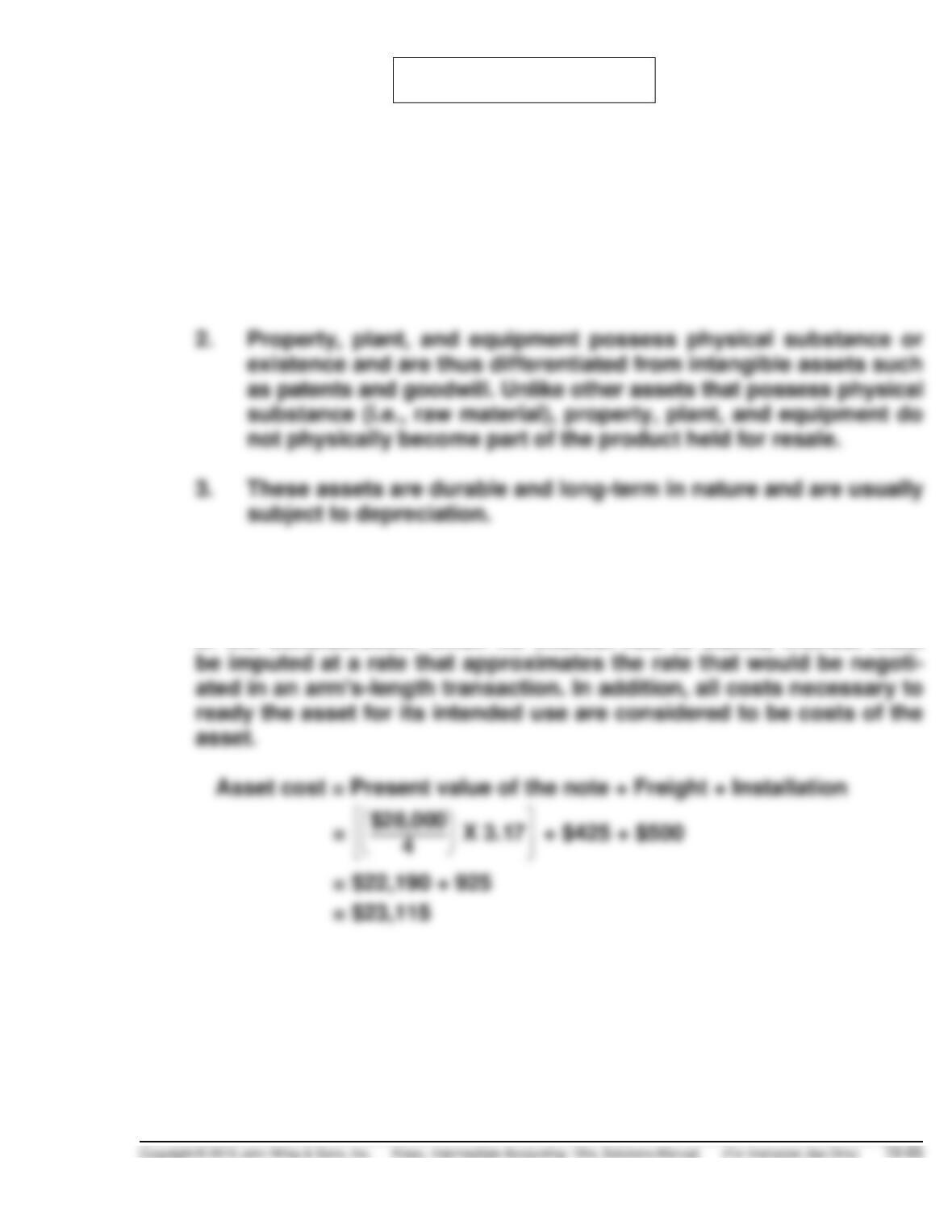
(a) The major characteristics of plant assets, such as land, buildings, and
equipment, that differentiate them from other types of assets are
presented below.
1. Plant assets are acquired for use in the regular operations of the
enterprise and are not for resale.
(b) Transaction 1. To properly reflect cost, assets purchased on deferred
payment contracts should be accounted for at the present value of the
consideration exchanged between the contracting parties at the date
of the consideration. When no interest rate is stated, interest must
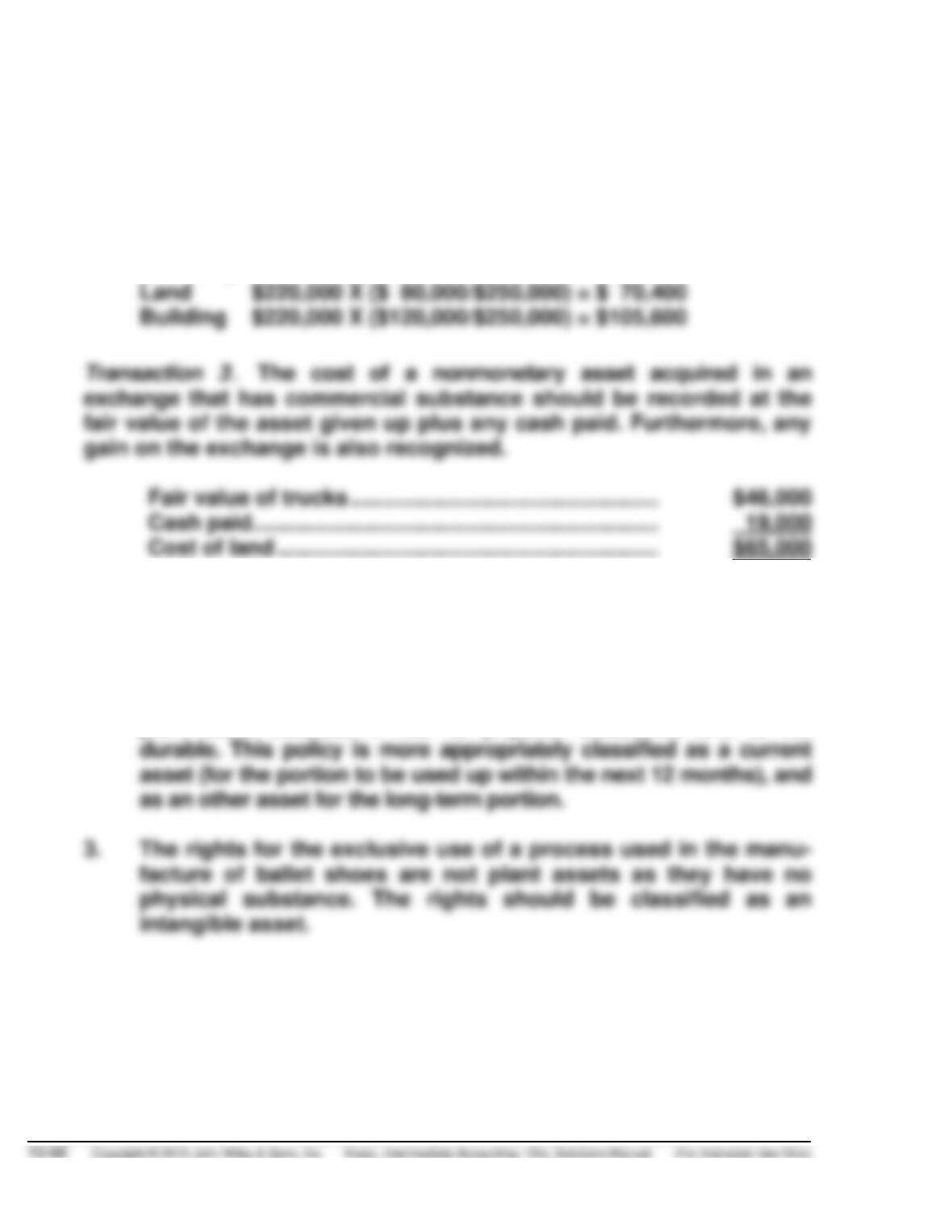
PROBLEM 10-11 (Continued)
Transaction 2. The lump-sum purchase of a group of assets should be
accounted for by allocating the total cost among the various assets
on the basis of their relative fair values. The $8,000 of interest
expense incurred for financing the purchase is a period cost and is
not a factor in determining asset cost.
Inventory $220,000 X ($ 50,000/$250,000) = $ 44,000
(c) 1. A building purchased for speculative purposes is not a plant
asset as it is not being used in normal operations. The building
is more appropriately classified as an investment.
2. The two-year insurance policy covering plant equipment is not a
plant asset because it has no physical substance and is not
TIME AND PURPOSE OF CONCEPTS FOR ANALYSIS
CA 10-1 (Time 20–25 minutes)
Purpose—to provide the student with a problem to decide which expenditures related to purchasing
CA 10-2 (Time 20–25 minutes)
Purpose—to provide the student with a situation involving the proper allocation of costs to self–
CA 10-3 (Time 30–40 minutes)
Purpose—to provide the student with a situation to determine capitalization of interest and to explain in
a memorandum the conceptual basis for interest capitalization.
CA 10-4 (Time 30–40 minutes)
CA 10-5 (Time 20–25 minutes)
Purpose—to provide the student with an understanding of the proper accounting treatment involving
CA 10-6 (Time 20–25 minutes)
Purpose—to provide the student with a case involving allocation of costs between land and buildings,
including ethical issues.
SOLUTIONS TO CONCEPTS FOR ANALYSIS
CA 10-1
(a) Expenditures should be capitalized when they benefit future periods. The cost to acquire the land
should be capitalized and classified as land, a nondepreciable asset. Since tearing down the small
factory is readying the land for its intended use, its cost is part of the cost of the land and should
(b) A gain should be recognized on the sale of the land and building because income is realized
whenever the earning process has been completed and a sale has taken place.
The net book value at the date of sale would be composed of the capitalized cost of the land, the
CA 10-2
(a) Materials and direct labor used in the construction of the equipment definitely should be charged to
the equipment account. It should be emphasized that no gain on self-construction should be
recorded because such an approach violates the historical cost principle. The controversy centers
on the assignment of indirect costs, called overhead or burden, consisting of power, heat, light,
insurance, property taxes on factory buildings, etc. The suggested approaches are discussed below.
(b) 1. Many believe that only the variable overhead costs that increase as a result of the construction
should be assigned to the cost of the asset. This approach assumes that the company will
have the same fixed costs regardless of whether the company constructs the asset or not, so
CA 10-2 (Continued)
CA 10-3
To: Jane Esplanade, President
From: Good Student, Manager of Accounting
Date: January 15, 2014
Subject: Capitalization of avoidable interest on the warehouse
construction project
I am writing in response to your questions about the capitalized interest
costs for the warehouse construction project. This brief explanation of my
calculations should facilitate your understanding of these costs.
Generally, the accounting profession does not allow accrued interest to be
capitalized along with an asset’s cost. However, the FASB made an excep-
To determine the amount capitalized, we must calculate both the actual and
the avoidable interest during 2013. Actual interest is computed by applying
the interest rates of 12%, 10%, and 11% to their related debt. Thus, total
actual interest for this period is $490,000 (see Schedule #1).
CA 10-3 (Continued)
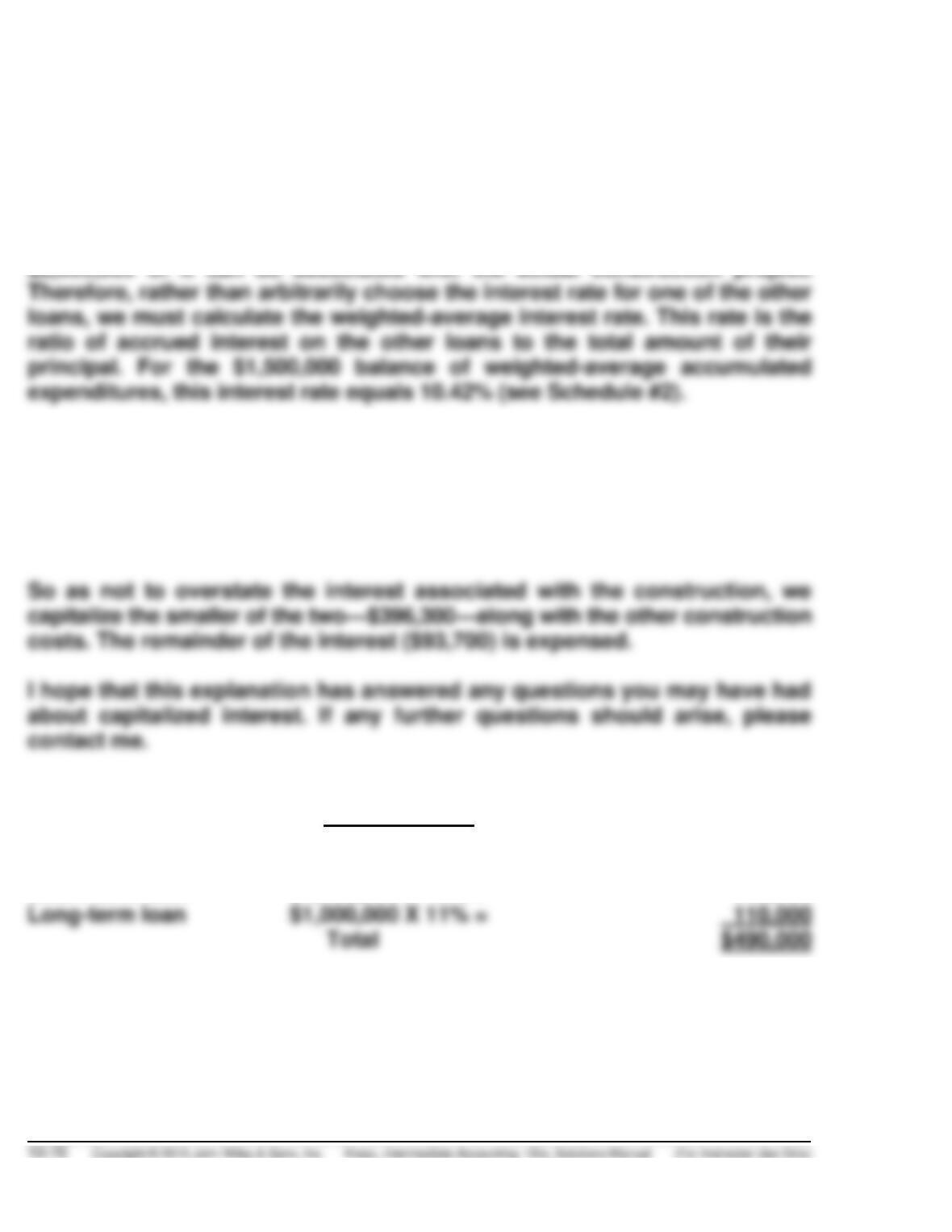
Calculations for avoidable interest are more complex. First, interest can be
capitalized only on the weighted-average amount of accumulated expenditures.
Although total costs amounted to $5,200,000 for the project, an average of
only $3,500,000 was outstanding during the period of construction.
Second, of the total $4,400,000 debt outstanding during this period, only
Third, we compute our avoidable interest as follows: calculate the interest
on the loan directly associated with the construction. Apply the weighted–
average interest rate to the remainder of the weighted-average accumulated
expenditures. Add these products. Avoidable interest for 2013 amounts to
$396,300 (see Schedule #3).
Schedule #1
Actual Interest
Construction loan
$2,000,000 X 12% =
$240,000
Short-term loan
$1,400,000 X 10% =
140,000
Long-term loan
$1,000,000 X 11% =
CA 10-3 (Continued)
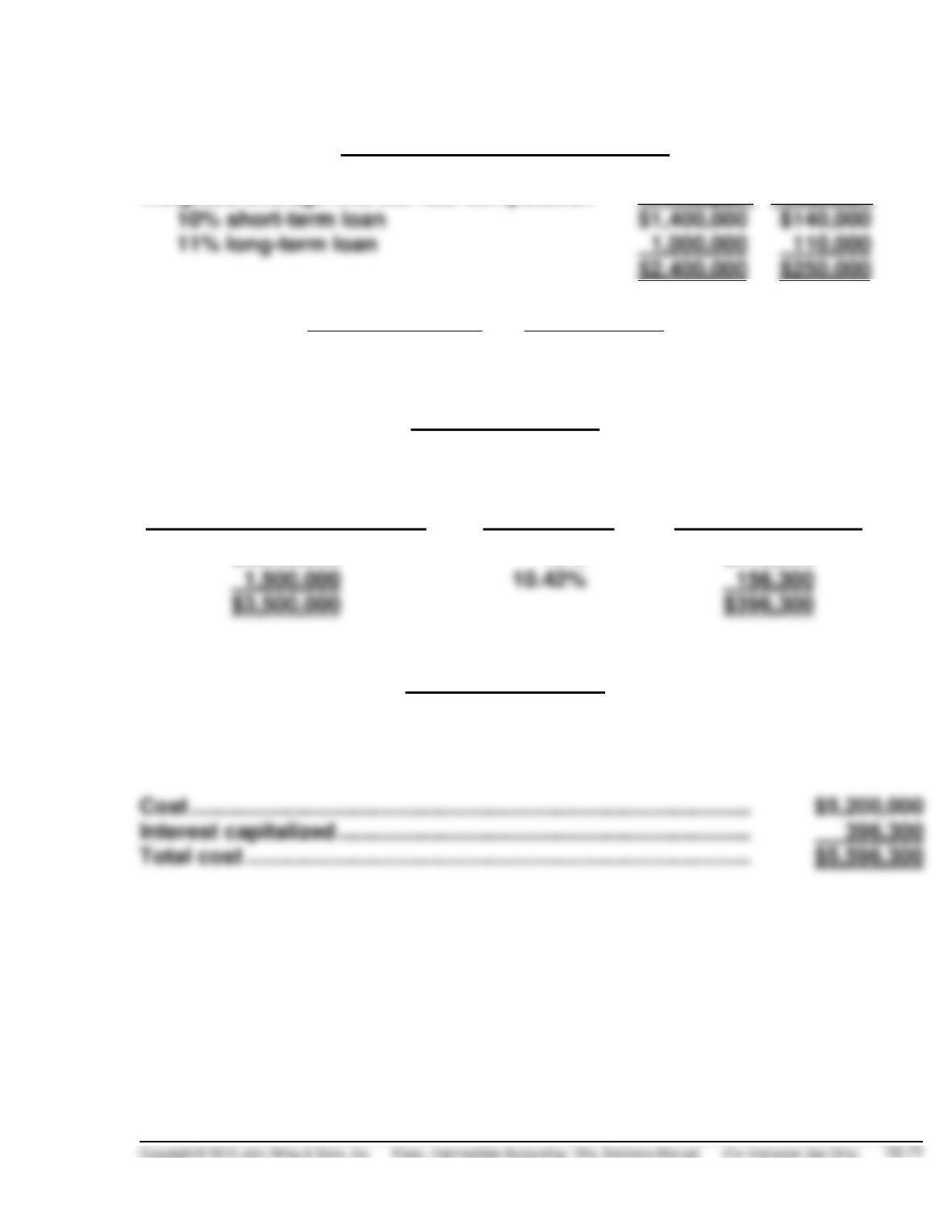
Schedule #2
Weighted-Average Interest Rate
Weighted-average interest rate computation
Principal
Interest
10% short-term loan
$1,400,000
11% long-term loan
$2,400,000
Total Interest
=
$250,000
= 10.42%
Total Principal
$2,400,000
Schedule #3
Avoidable Interest
Weighted-Average
Accumulated Expenditures
X
Interest Rate
=
Avoidable Interest
$2,000,000
12%
$240,000
10.42%
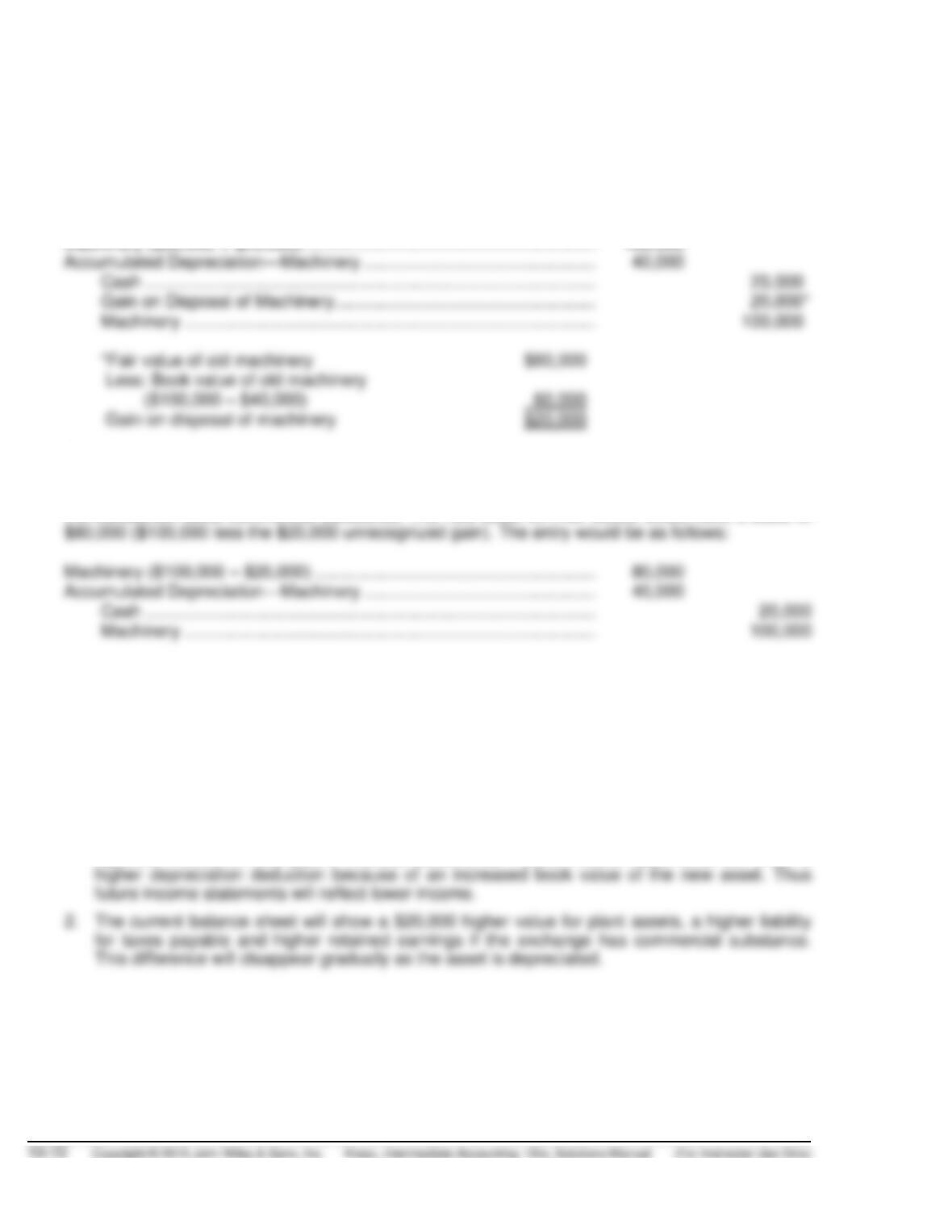
Schedule #4
Interest Capitalized
Because avoidable interest is lower than actual interest, use avoidable
interest.
Cost ……………………………………………………………………………….
Interest capitalized ………………………………………………………….
Total cost …………………………..…………………………………………..
CA 10-4
(a) Client A
Treatment if the exchange has commercial substance
Client A would recognize a gain of $20,000 on the exchange. The basis of the asset acquired
would be $100,000. The entry would be as follows:
(b) Treatment if the exchange lacks commercial substance
Client A would be prohibited from recognizing a $20,000 gain on the exchange. This is because
the transaction lacks commercial substance. The new asset on their books would have a basis of
(c) Memo to the Controller:
TO: The Controller
RE: Exchanges of Assets—Commercial Substance Issues.
Financial statement effect of treating the exchange as having commercial substance versus not.
1. The income statement will reflect a before-tax gain of $20,000. This gain will increase the
reported income on this year’s financial statements. Future income statements will show a
CA 10-4 (Continued)
(d) Client B
Treatment if the exchange has commercial substance
In this situation, the full $30,000 gain would be recognized on this year’s income statement. The
new asset would go on the books at its fair value. The entry is as follows:
Machinery …………………………………………………………………………………..
80,000
Accumulated Depreciation—Machinery …………………………………………..
80,000
Cash ……………………………………………………….…………………………………
20,000
Gain on Disposal of Machinery………………………………………………..
Gain on disposal of machinery $ 30,000
(e) Treatment if the exchange lacks commercial substance
Machinery ($80,000 – $24,000) …………………………..………………………….
56,000
80,000
20,000
Machinery …………………………………………………………………………….
Gain on Disposal of Machinery ………………………………………………..
(f) Memo to the Controller:
TO: The Controller
RE: Asset Exchanges—Commercial Substance
1. The income statement will reflect a before-tax gain of $30,000 if the exchange has commercial
substance. This gain will increase the reported income on this year’s financial statements.
CA 10-5
In general, the inclusion of the $7,500 as part of the cost of the machine is justified because the primary
(1) It may be true that these installation costs could not be recovered if the machine were to be sold.
This is not important, however, because presumably the machine was acquired to be used, not to
(2) Again, the purpose of accounting for plant assets is not to arrive at an approximation of fair
value of the assets each year over the life of the assets. However, even if this were an objective,
the question of which method would come closer to stating current market value at some later date
would revolve around the general trend of the price level over the years involved.
(3) Assuming that the $7,500 could properly be deducted, there would be some tax savings over the
years unless the tax rates applicable to the business were reduced during the following years.
CA 10-6
(a) If the land is undervalued so that a higher depreciation expense is assigned to the building,
management interests are served. The lower net income and reduced tax liability save cash to be
used for management purposes. By contrast, stockholders and potential investors are misled by
FINANCIAL STATEMENT ANALYSIS CASE
JOHNSON & JOHNSON ($ millions)
(a) The cost of building and building equipment at the end of 2009 was
$9,389.
(b) As indicated in footnote number 1 to the financial statements, the
company utilizes the straight-line method for financial statement
(c) The cash flow statement reports the amount of interest paid in cash
($576).
A review of the income statement indicates that Johnson & Johnson
(d) Free cash flow is defined as net cash flows provided by operating
activities less capital expenditures and dividends.
Free cash flow is the amount of discretionary cash flow a company has
For example, the company is able to pay its dividends without resorting
to external financing. Secondly, even if operations decline, it appears
that the company will be able to fund additions to property, plant, and
equipment. Thirdly, the company is using its free cash flow to expand its
operations by acquiring new businesses.
ACCOUNTING, ANALYSIS, AND PRINCIPLES
Accounting
Equipment** ……………………………………………………….
62,000
Accumluated Depreciation—Equipment …………………..
80,000
Equipment ………………………………………………………
Cash ………………………………………………………………
Gain on Disposal of Equipment * ……………………..
*Fair value of old asset
Less: Cost of old asset
Gain on disposal of equipment
**Cash paid
Fair value of old equipment
Analysis
The gain on the disposal increases income, leading to a one-time increase
in the return on assets in the year of the exchange. In essence, the gain
Principles
The concept of commercial substance is a fundamental element in the
accounting for exchanges. If the transaction above lacked commercial
substance, the gain on the exchange would be deferred. That is, if the
PROFESSIONAL RESEARCH
(a) Yes; according to FASB ASC 835-20–05, it is required to capitalize interest
into the cost of assets that meet selected criteria (see (c) below).
(b) According to FASB ASC 835-20–10–1,
. . . the objectives of capitalizing interest are to obtain a measure of
(c) According to FASB ASC 835-20–15–5,
. . . interest shall be capitalized for the following types of assets
(qualifying assets):
a. Assets that are constructed or otherwise produced for an entity’s
own use, including assets constructed or produced for the entity by
others for which deposits or progress payments have been made.
(d) According to FASB ASC 835-20–30–6,
. . . the total amount of interest cost capitalized in an accounting period
shall not exceed the total amount of interest cost incurred by the entity
in that period. In consolidated financial statements, that limitation shall
be applied by reference to the total amount of interest cost incurred by
PROFESSIONAL RESEARCH (Continued)
(e) According to FASB ASC 835-20–50–1,
An entity shall disclose the following information with respect to
interest cost in the financial statements or related notes:
a. For an accounting period in which no interest cost is capitalized, the
PROFESSIONAL SIMULATION
Measurement
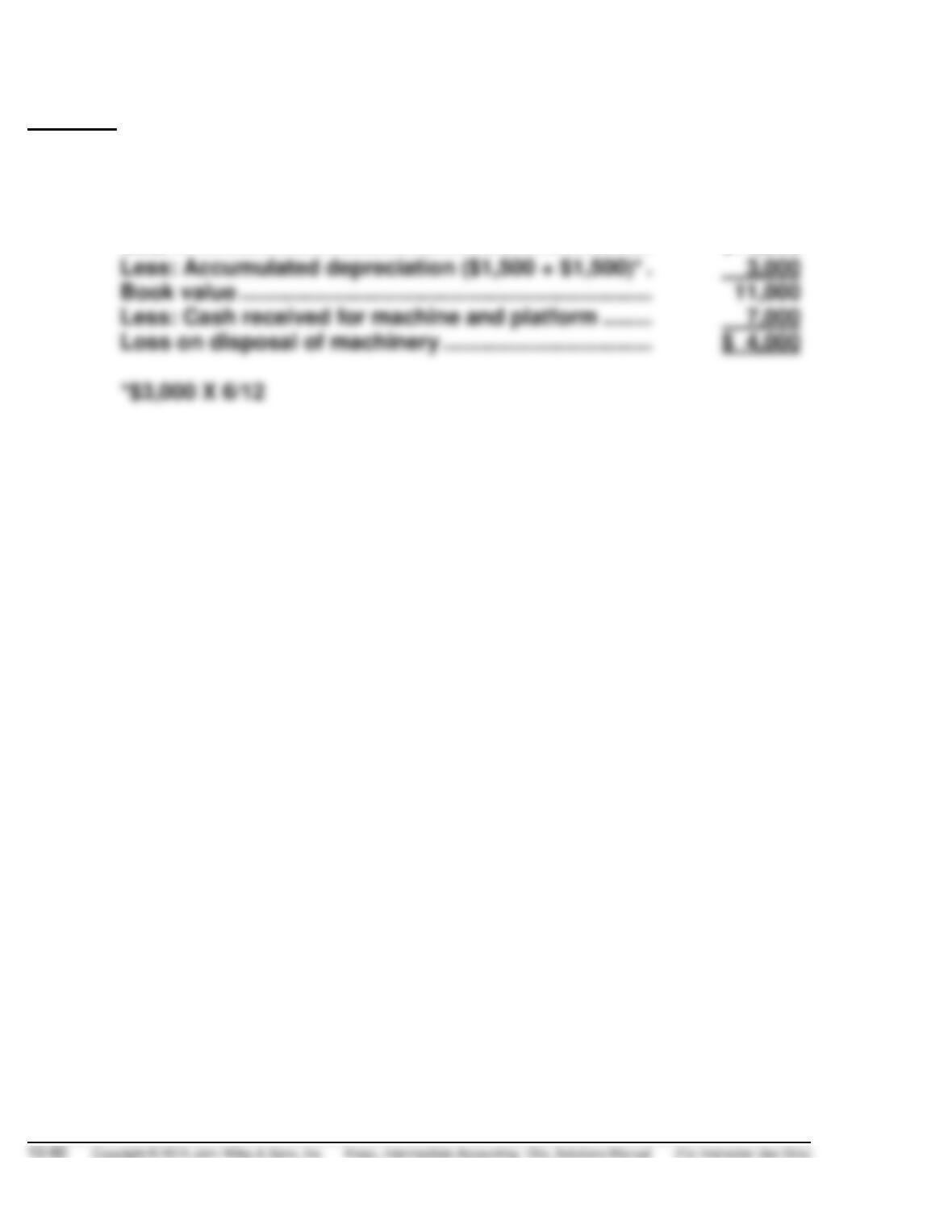
Historical cost is measured by the cash or cash-equivalent price of obtain–
ing the asset and bringing it to the location and condition for its intended
use. For Norwel, this is:
Price ………………………………………………………….
Tax ($12,000 X .05) ……………………………………..
Platform …………………………………………………….
Journal Entry
January 2, 2014
Machinery ………………………………………………….
14,000
Cash ………………………………………………….
14,000
December 31, 2014
Depreciation Expense …………………………………
*Depreciable base: ($14,000 – $2,000) = $12,000
Depreciation expense: $12,000 ÷ 4 = $3,000 per year
Financial Statements
The amount reported on the balance sheet is the cost of the asset less
accumulated depreciation:
Machine ……………………………………………………..
Less: Accumulated depreciation …………………
Book value …………………………………………………
PROFESSIONAL SIMULATION (Continued)
Analysis
The income effect is a gain or loss, determined by comparing the book
value of the asset to the disposal value:
Cost ……………………………………………………………………
$14,000
Less: Cash received for machine and platform ……..