Problem 10-27
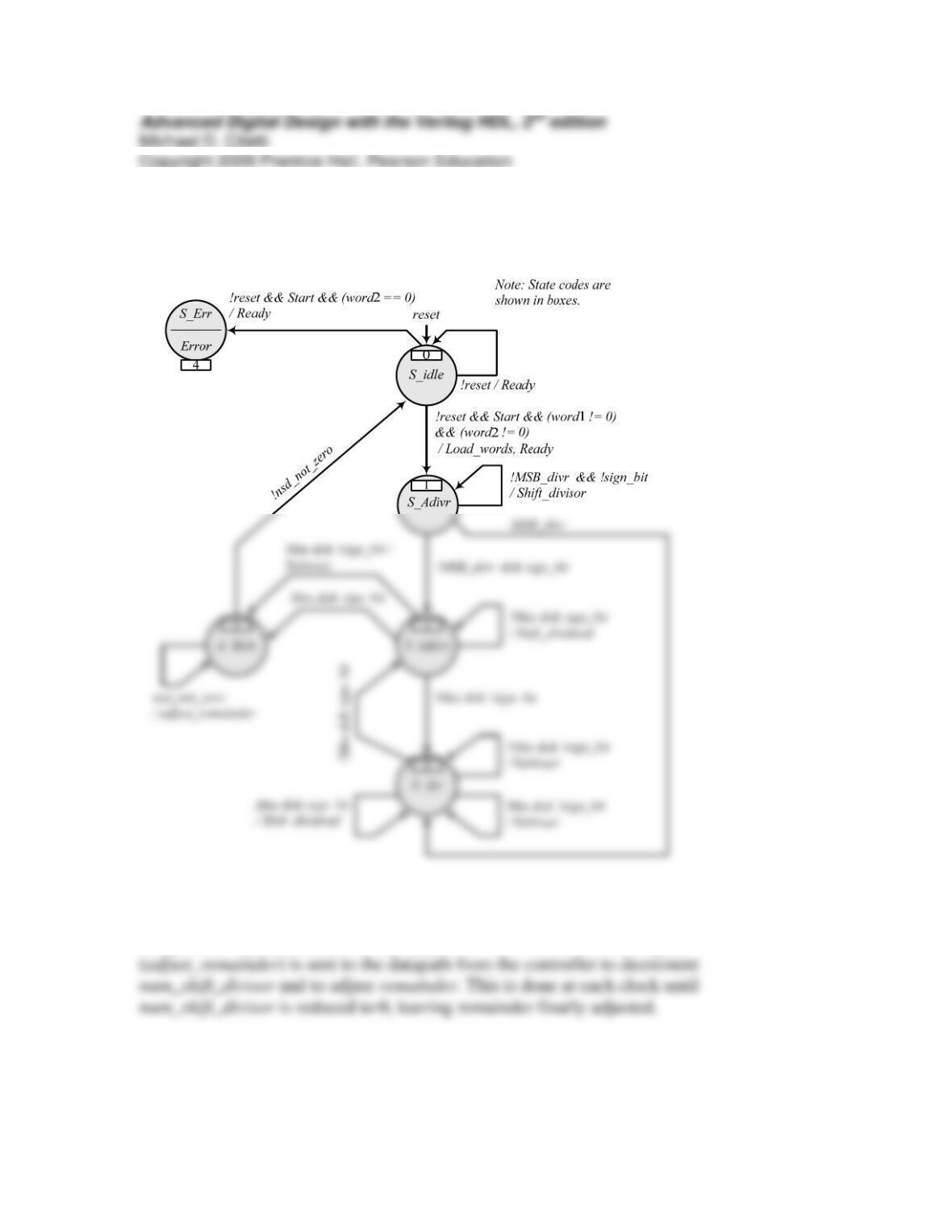
The control unit of the modified machine has the STG shown below:
A new state, A_Rem, is added to the machine. In this state the controller uses
num_shift_divisor to adjust the remainder. A status signal (nsd_not_zero) from the
datapth unit reports whether num_shift_divisor is 0 or not. If not, a signal
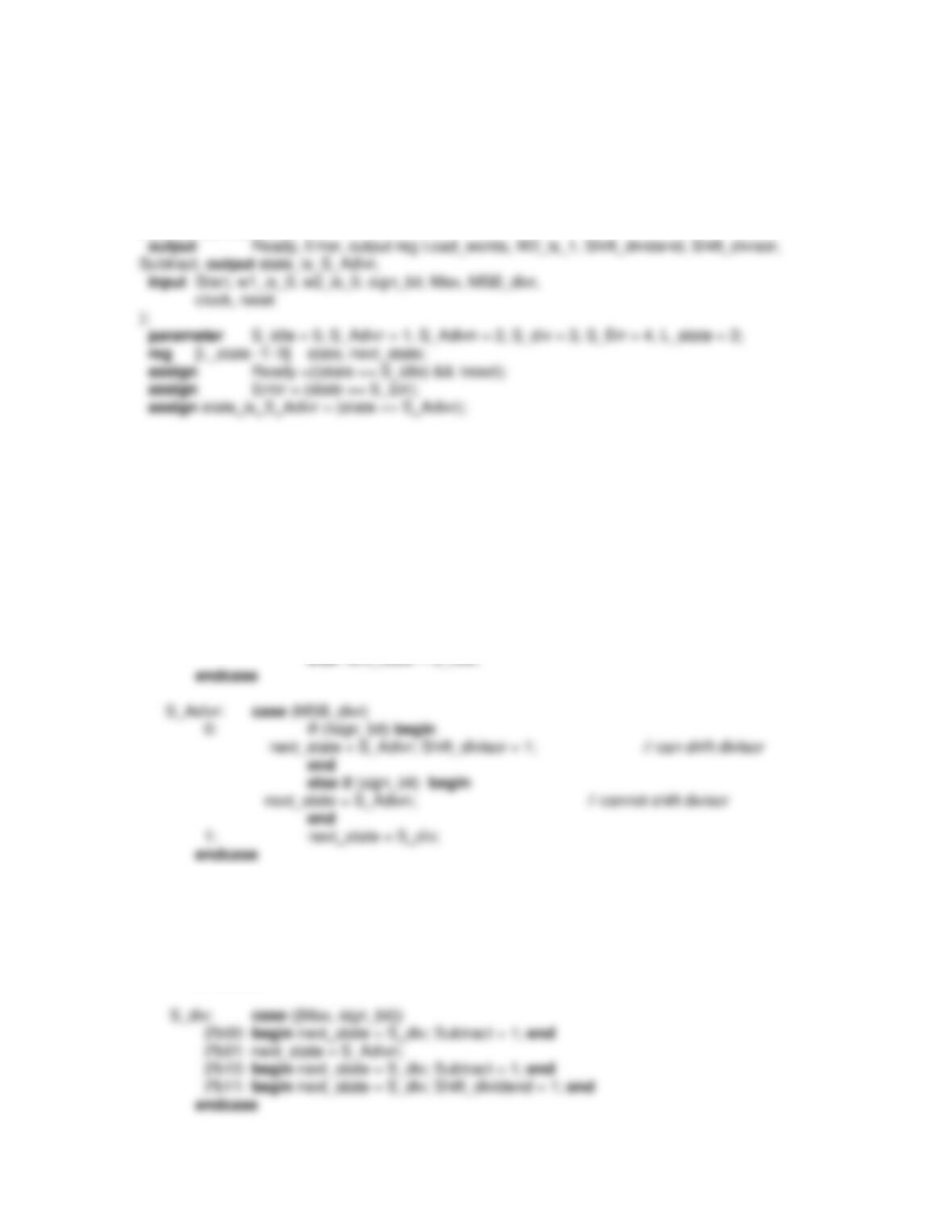
module Prob_10_27_Divider #(parameter L_divn = 8, L_divr = 4)( // Choose L_divr <=
L_divn
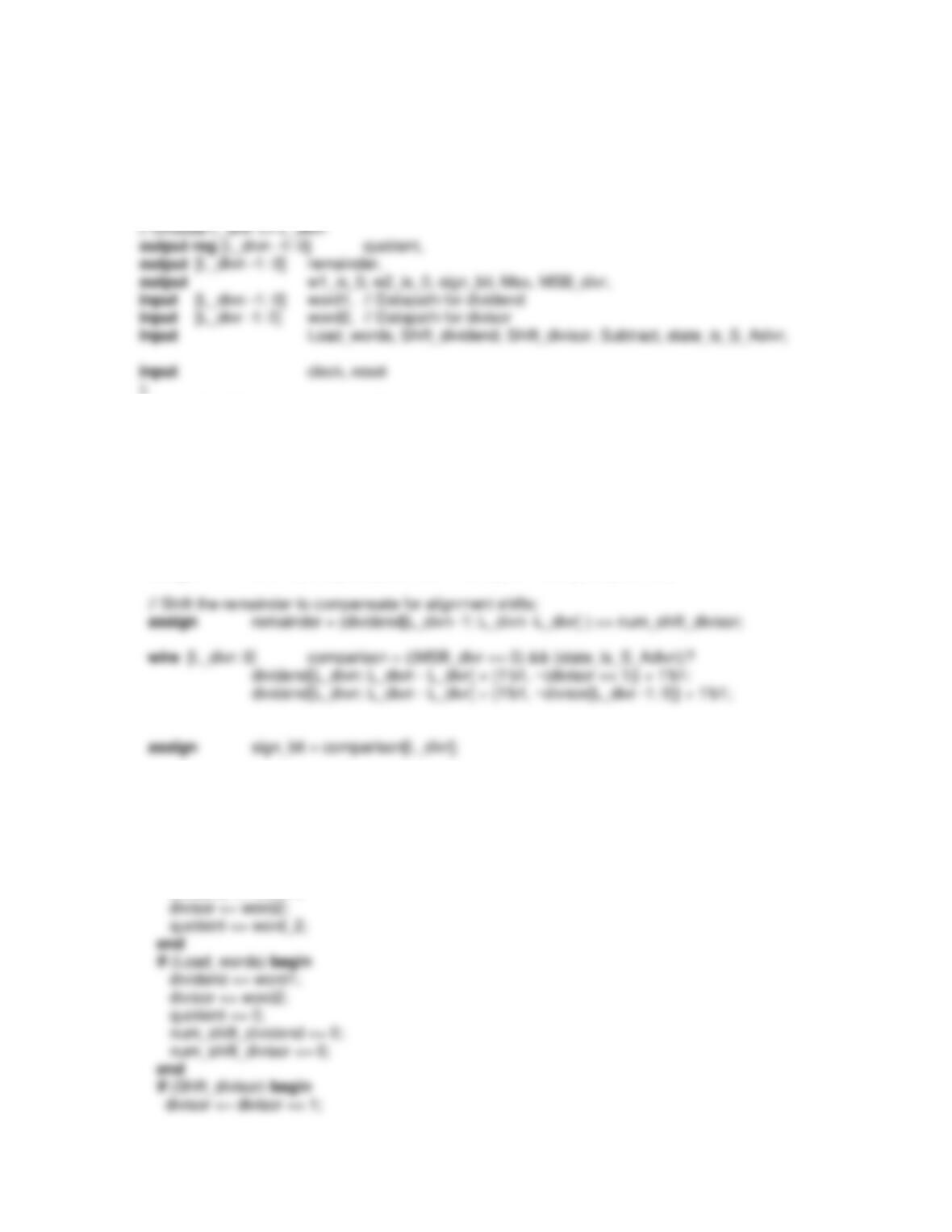
output [L_divn -1: 0] quotient,
Prob_10_27_Control_Unit M0 (
Ready, Error, Load_words, Shift_dividend, Shift_divisor, Subtract, state_is_S_Adivr,
adjust_remainder,
Start, w1_is_0, w2_is_0, sign_bit, Max, MSB_divr, nsd_not_zero,
clock, reset
);
module Prob_10_27_Control_Unit (
output Ready, Error, output reg Load_words, Shift_dividend, Shift_divisor, Subtract,
output state_is_S_Adivr, output reg adjust_remainder,
input Start, w1_is_0, w2_is_0, sign_bit, Max, MSB_divr, nsd_not_zero,
clock, reset
);
parameter S_idle = 0, S_Adivr = 1, S_Adivn = 2, S_div = 3, S_Err = 4, S_A_Rem = 5,
L_state = 3;
reg [L_state -1: 0] state, next_state;
assign Ready =((state == S_idle) && !reset);
assign Error = (state == S_Err);
assign state_is_S_Adivr = (state == S_Adivr);
0: if (!sign_bit) begin
next_state = S_Adivr; Shift_divisor = 1; // can shift divisor
end
else if (sign_bit) begin
next_state = S_Adivn; // cannot shift divisor
end
1: next_state = S_div;
endcase
S_A_Rem: if (nsd_not_zero) begin
next_state = S_A_Rem;
adjust_remainder = 1;
end
else next_state = S_idle;
default: next_state = S_Err;
endcase
end
endmodule
module Prob_10_27_Datapath_Unit #(parameter L_divn = 8, L_divr = 4, L_cnt = 4)(
// Choose L_divr <= L_divn
);
parameter Max_cnt = L_divn-L_divr;
reg [L_divn: 0] dividend; // Extended dividend
reg [L_divr -1: 0] divisor;
reg [L_cnt -1: 0] num_shift_dividend, num_shift_divisor;
// Shift the remainder to compensate for alignment shifts:
// Revise for synthesis:
// assign remainder = (dividend[L_divn -1: L_divn -L_divr] ) >> num_shift_divisor;
end
else begin
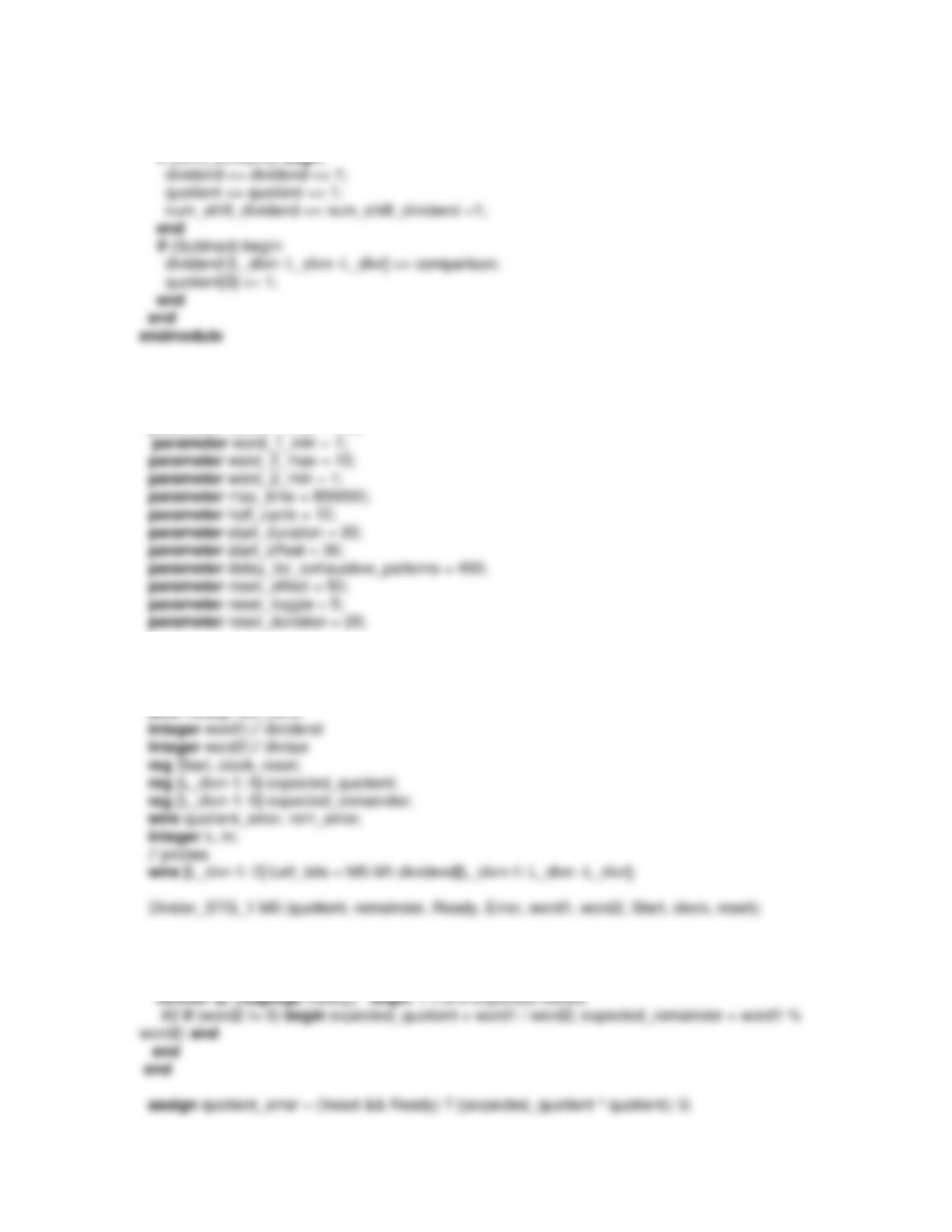
if (Load_words) begin
dividend <= word1;
divisor <= word2;
quotient <= 0;
num_shift_dividend <= 0;
num_shift_divisor <= 0;
end
if (Shift_divisor) begin
divisor <= (divisor << 1);
num_shift_divisor <= num_shift_divisor + 1;
end
if (adjust_remainder) begin
num_shift_divisor <= num_shift_divisor-1;
remainder <= ((dividend[L_divn -1: L_divn -L_divr] ) >> 1);
end
else remainder <= dividend[L_divn -1: L_divn -L_divr];
end
endmodule
module Prob_10_27_test_Divider ();
parameter reset_offset = 45;
parameter reset_toggle = 5;
parameter reset_duration = 20;
Prob_10_27_Divider M0(
.quotient(quotient),
.remainder(remainder),
.Ready(Ready),
.Error(Div_zero),
.word1(word1),
.word2(word2),
.Start(Start),
.clock(clock),
.reset(reset)
);
initial #max_time $finish;
initial begin clock = 0; forever #half_cycle clock = ~clock; end
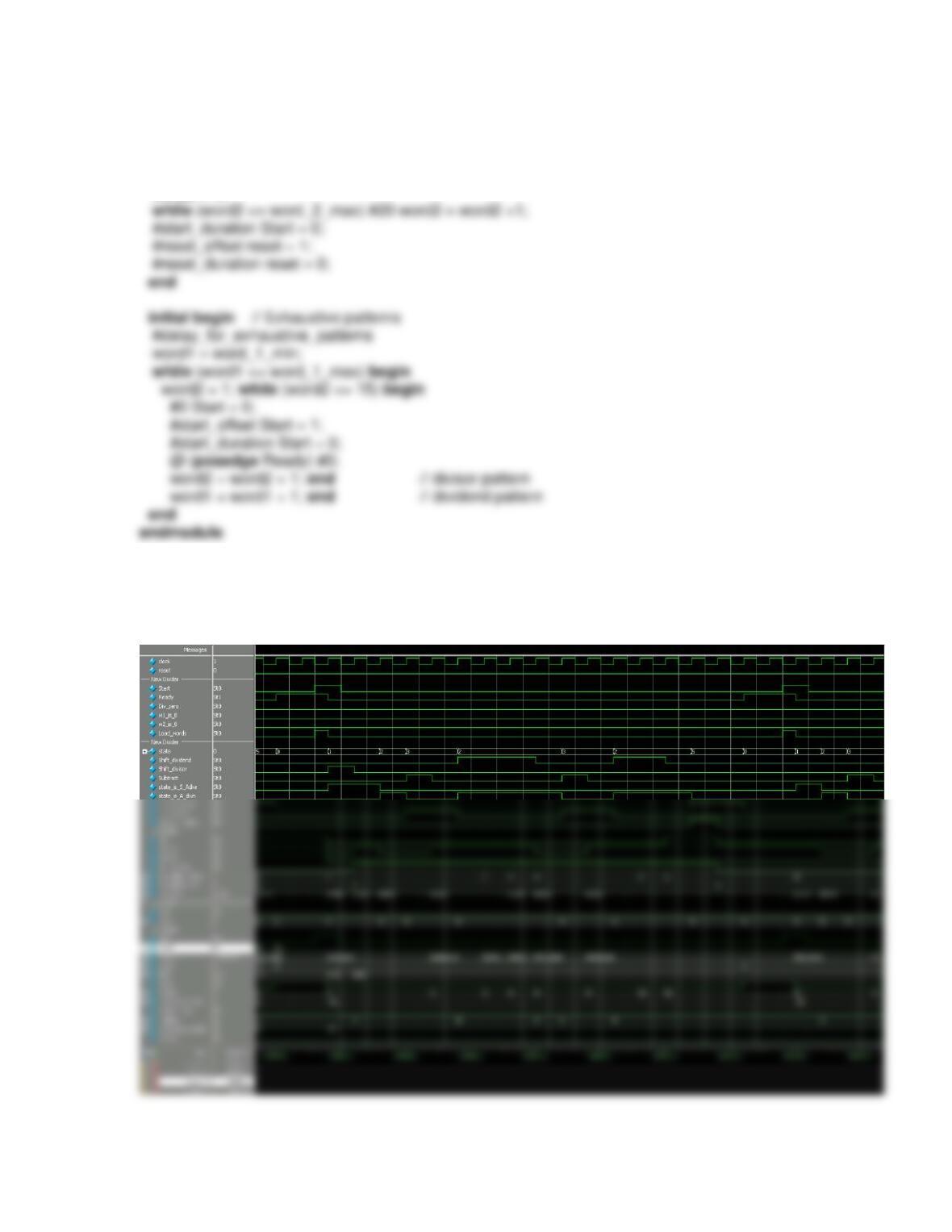
*/
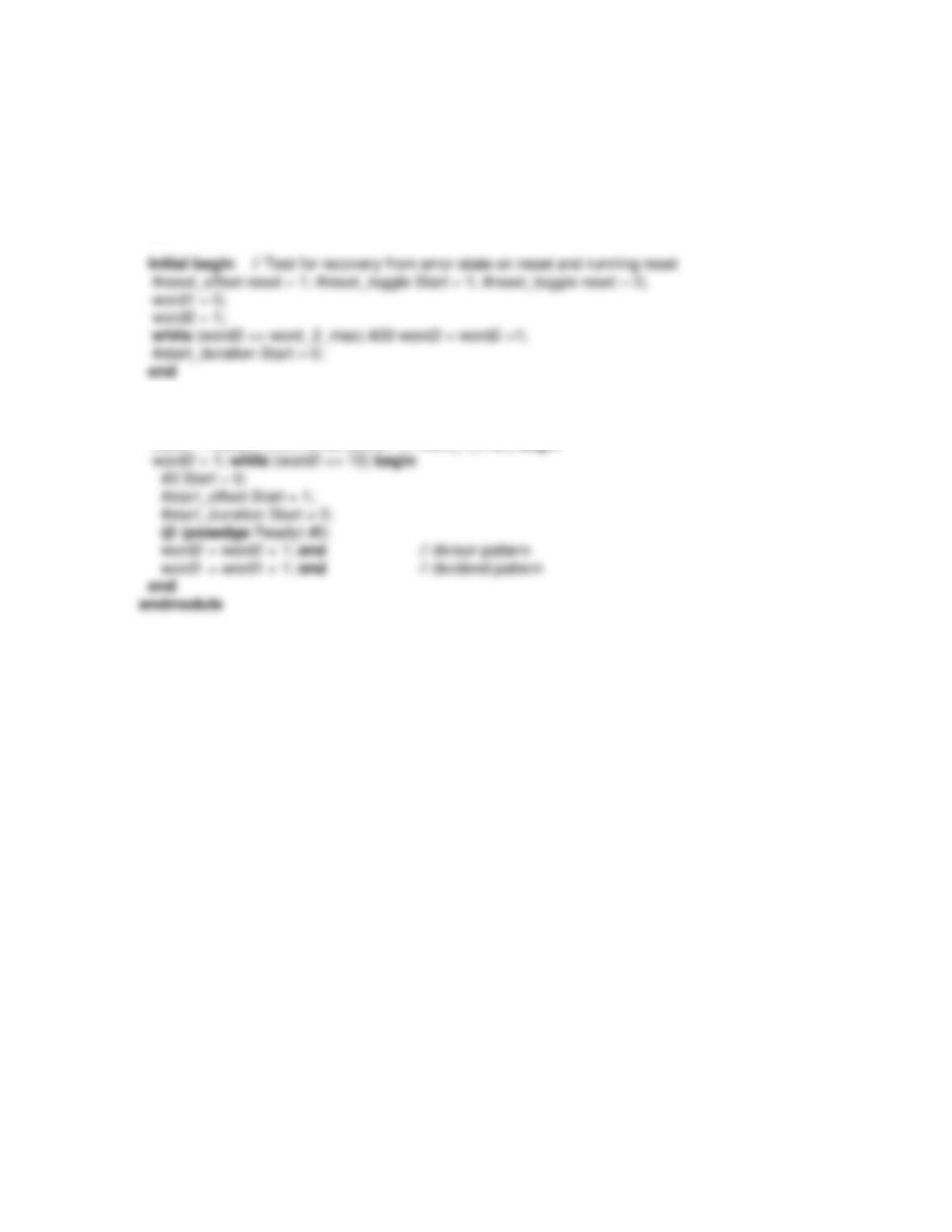
initial begin // Test for recovery from error state on reset and running reset
#reset_offset reset = 1; #reset_toggle Start = 1; #reset_toggle reset = 0;
word1 = 0;
word2 = 1;
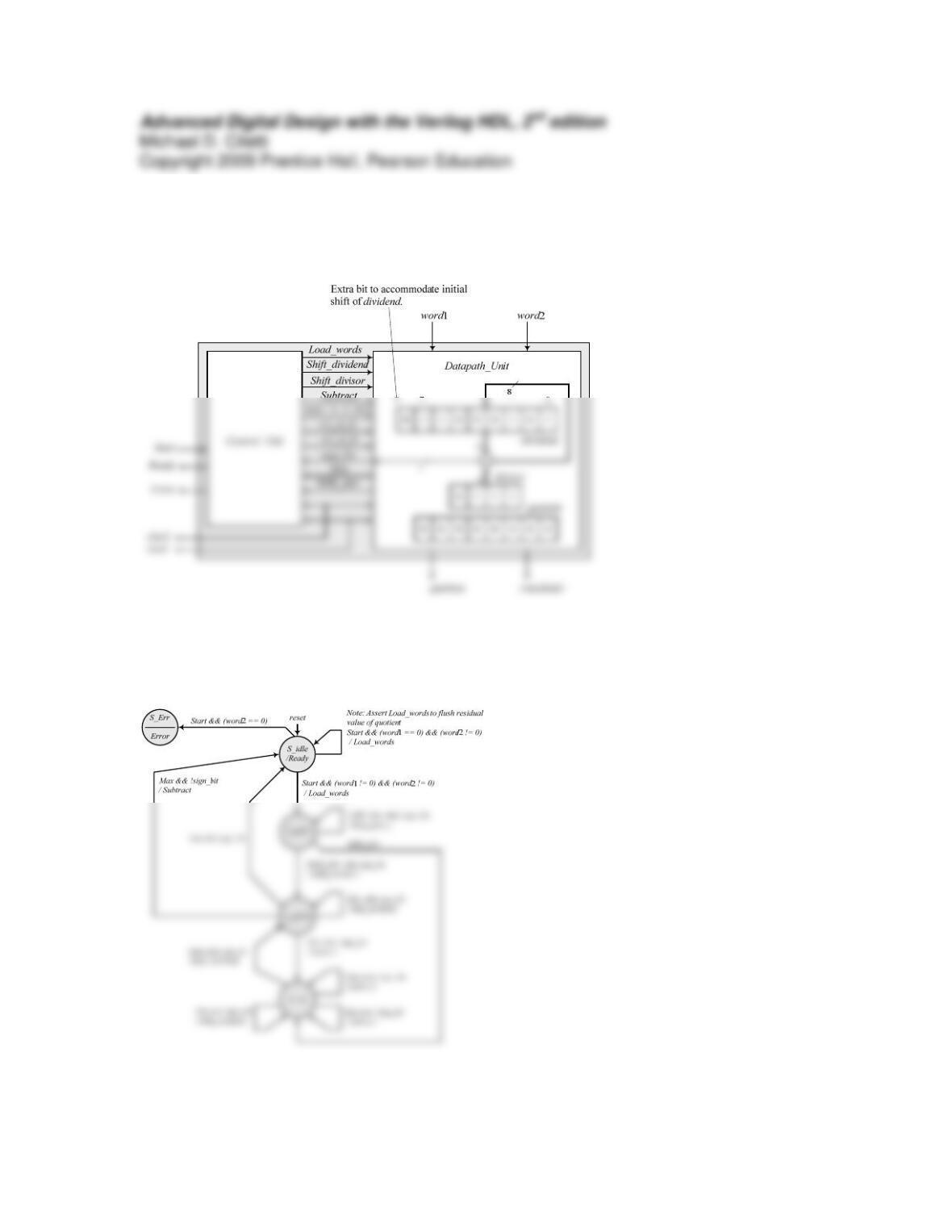
A sample of simulation results is shown below. Note, if Mentor Graphics ModelSim is
being used, be sure to select the radix of the numerical values carefully. Certain values
must be in binary format. This (learning) exercise is left to the student.
Problem 10-28
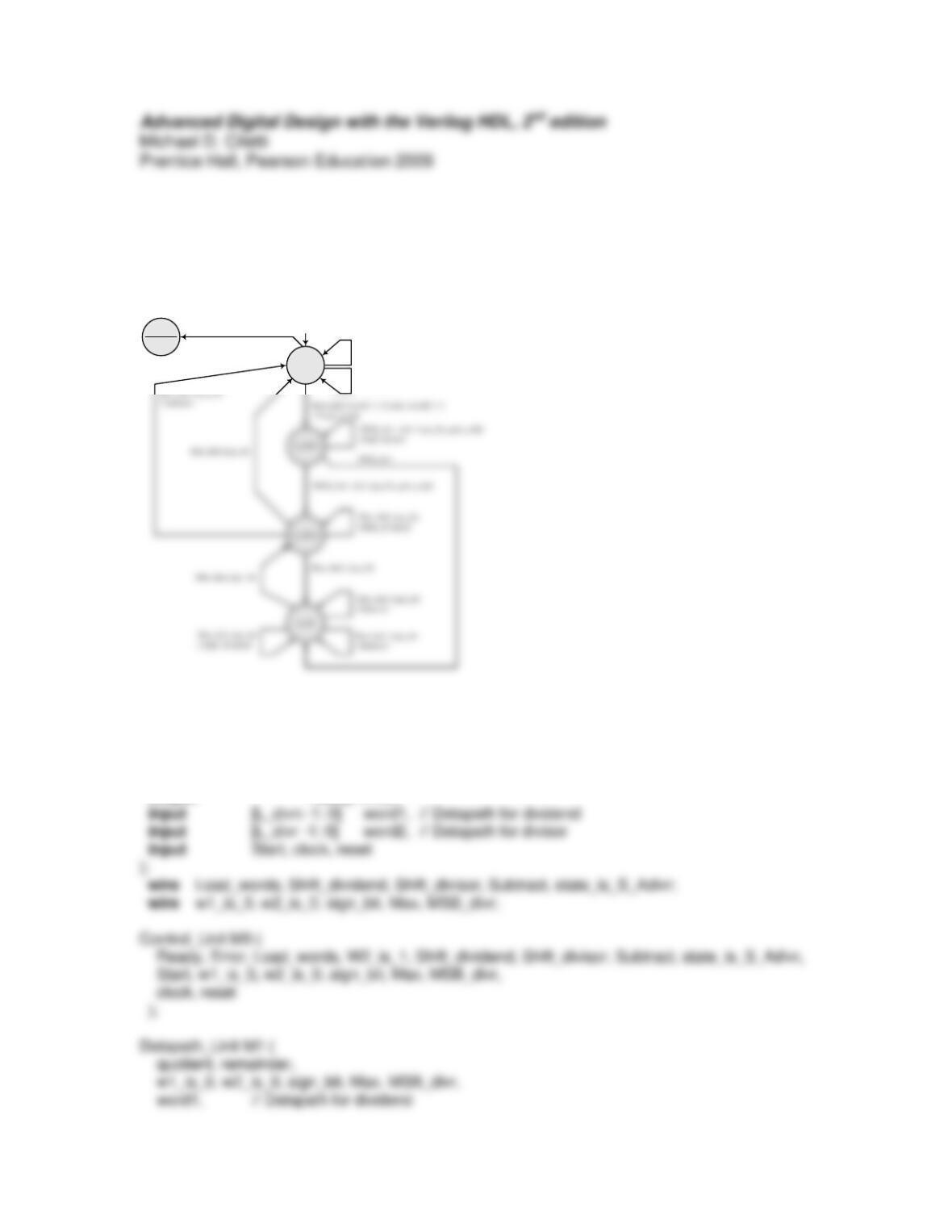
The block diagram for the self-aligning divider described in Example 10.16 is shown
below
The STG diagram below includes Mealy signals to launch shifting and subtacting
coincident with transitions entering and leaving S_Adivn. The machine is to be modified
so that shifting and subtracting occur in the same state, i.e., at the same clock edge.
Problem 10-35
An attempt to divide by 1 can be detected with the machine in S_idle, as shown in the
STG below. The new signal, w2_is_1, is generated by the controller and causes divisor
and dividend to load as before, but also assigns word1 to the quotient.
reset
Start && (word2 == 0)
S_idle
/Ready
S_Err
Error
Start && (word1 == 0) && (word2 != 0)
/ Load_words
Note: Assert Load_words to flush residual
value of quotient
Start && (word1 != 0) && (word2 == 1)
/ Divr_is_1
module Divider_Prob_10_35 #(parameter L_divn = 8, L_divr = 4)( // Choose L_divr <=
L_divn
output [L_divn -1: 0] quotient,
output [L_divn -1: 0] remainder,
output Ready, Error,
word2, // Datapath for divisor
Load_words, W2_is_1, Shift_dividend, Shift_divisor, Subtract, state_is_S_Adivr,
clock, reset
);
endmodule
module Control_Unit (
always @ (posedge clock, posedge reset)
if (reset) state <= S_idle; else state <= next_state;
always @ (state, Start, w1_is_0, w2_is_0, sign_bit, Max, MSB_divr) begin
Load_words = 0; Shift_dividend = 0; Shift_divisor = 0; Subtract = 0; next_state = S_idle;
case (state)
S_idle: case (Start)
0: next_state = S_idle;
1: if (w2_is_0) next_state = S_Err;
else if (!w1_is_0) begin next_state = S_Adivr; Load_words = 1; end
else next_state = S_idle;
S_Adivn: case ({Max, sign_bit})
2’b00: next_state = S_div;
2’b01: begin next_state = S_Adivn; Shift_dividend = 1; end
2’b10: begin next_state = S_idle; Subtract = 1; end
2’b11: next_state = S_idle;
endcase
default: next_state = S_Err;
endcase
end
endmodule
module Datapath_Unit #(parameter L_divn = 8, L_divr = 4, L_cnt = 4)(
);
parameter Max_cnt = L_divn-L_divr;
reg [L_divn: 0] dividend; // Extended dividend
reg [L_divr -1: 0] divisor;
reg [L_cnt -1: 0] num_shift_dividend, num_shift_divisor;
assign MSB_divr = divisor[L_divr -1];
assign w1_is_0 = !(|word1);
assign w2_is_0 = !(|word2);
assign w2_is_1 = (word2 == 1);
assign Max = (num_shift_dividend == Max_cnt + num_shift_divisor );
always @ (posedge clock, posedge reset) // Register/Datapath operations
if (reset) begin
divisor <= 0; dividend <= 0; quotient <= 0; num_shift_dividend <= 0; num_shift_divisor <= 0;
end
else begin
if (w2_is_1) begin
dividend <= word1;
num_shift_divisor <= num_shift_divisor + 1;
end
module test_Divider_STG_1 ();
parameter L_divn = 8;
parameter L_divr = 4;
parameter word_1_max = 255;
parameter word_2_delay = 20;
wire [L_divn -1: 0] quotient;
wire [L_divn-1: 0] remainder;
initial #max_time $finish;
initial begin clock = 0; forever #half_cycle clock = ~clock; end
initial begin expected_quotient = 0; expected_remainder
assign rem_error = (!reset && Ready) ? |(expected_remainder ^ remainder): 0;
initial begin // Test for divide by zero detection
#2 reset = 1;
#15 reset = 0; Start = 0;
#10 Start = 1; #5 Start = 0;
end
initial begin // Exhaustive patterns
#delay_for_exhaustive_patterns
word1 = word_1_min; while (word1 <= word_1_max) begin
Problem 10-38
Divider_STG_0 consists of a controller and a datapath unit. The controller is
implemented as a conventional finite state machine having a level-sensitive cyclic
Divider_STG_0_sub differs from Divider_STG_0 in that it uses the sign bit from twos
complement subtraction to reveal the relative magnitude of the dividend and the divisor,
instead of using a comparator. This machine is synthesizable.
Divider_STG_1 consists of a controller and a datapath unit. The controller is
implemented as a conventional finite state machine having a level-sensitive cyclic
behavior describing the output and the next state, and a cyclic behavior describing the
state transitions. The datapath unit has a single edge-sensitive behavior governing register
Divider_RR_STG is not synthesizable. It uses num_shift_divisor to make a non-static
reference to bits of dividend to make a final adjustment to the remainder to correct for its
Problem 10-39
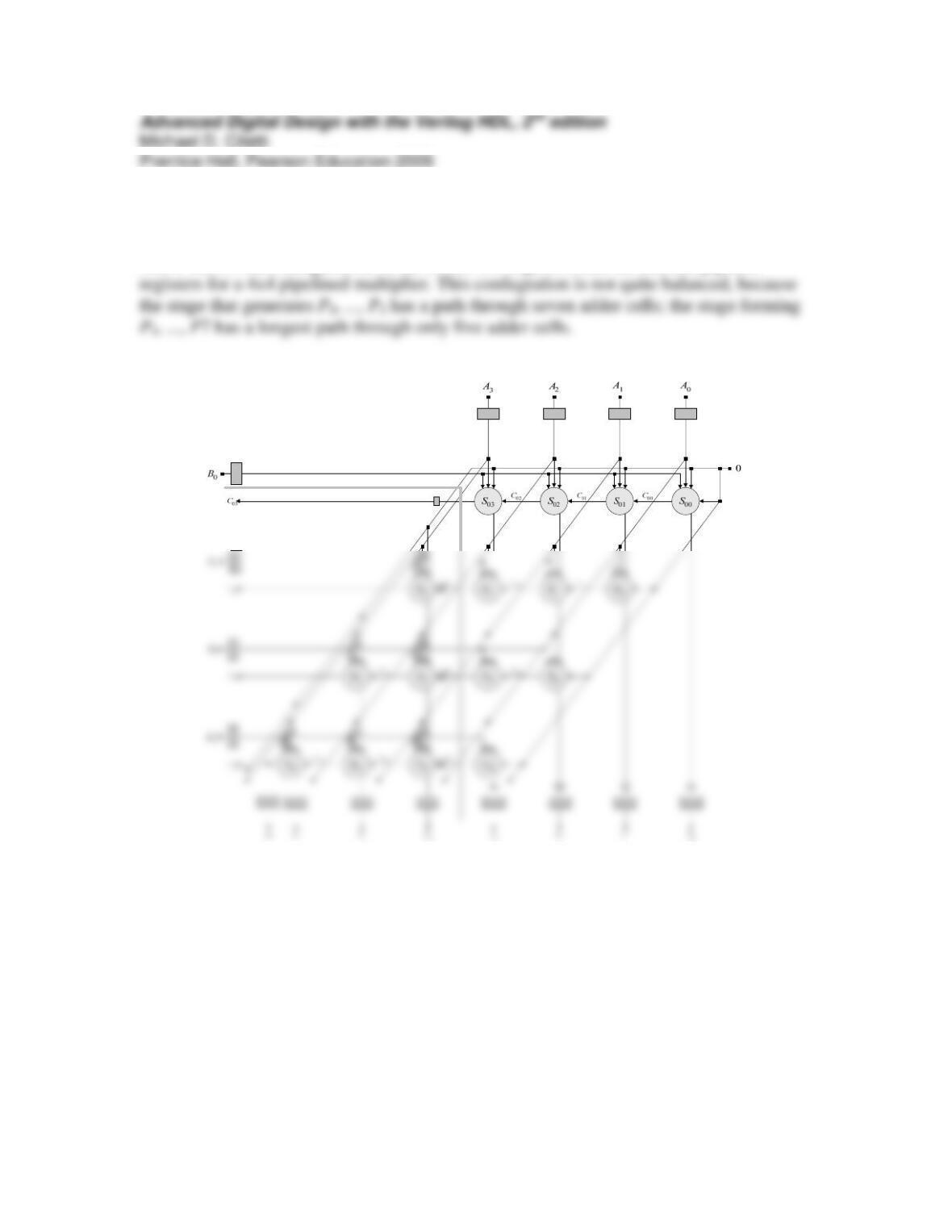
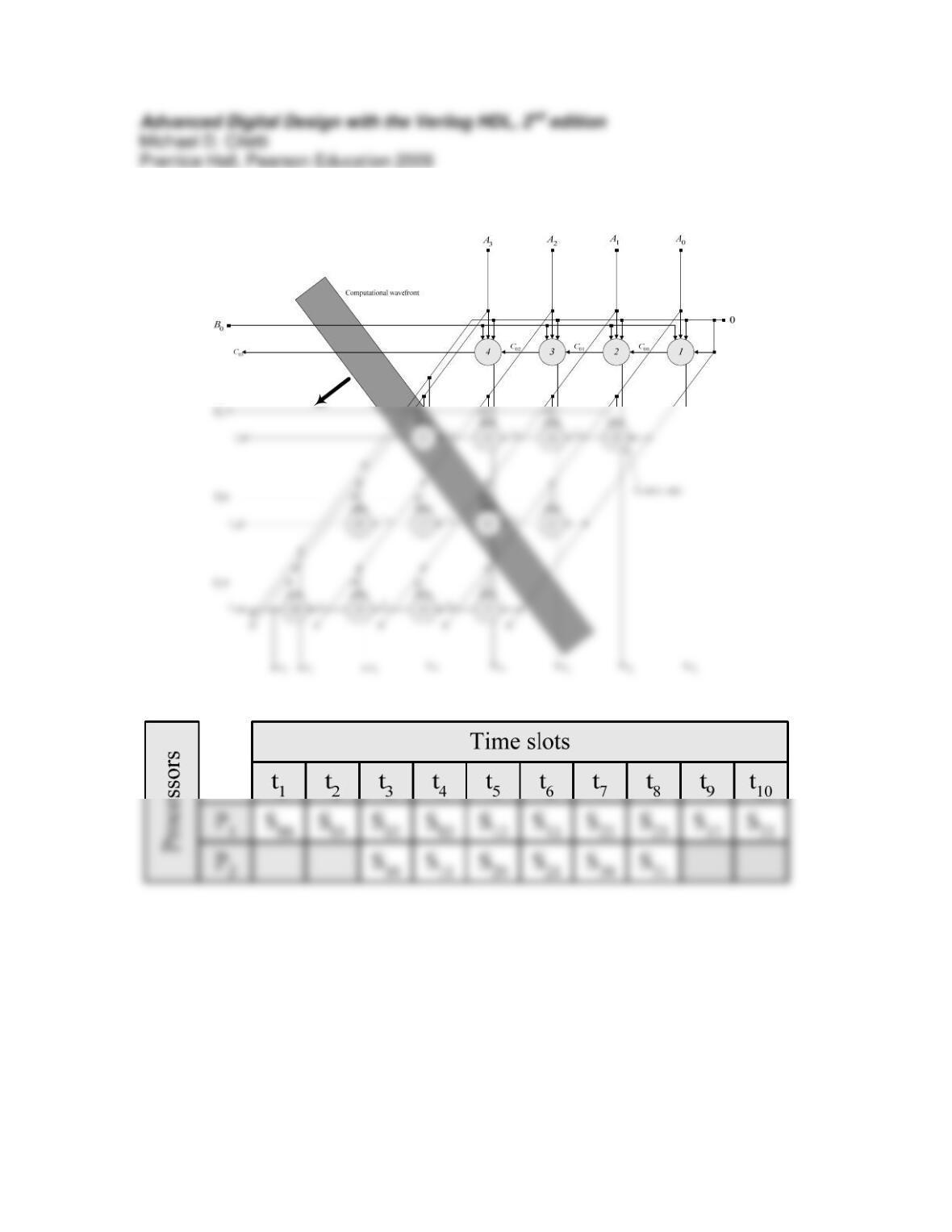
The longest path through the array passes through 10 cells. It is not unique. The figure
below shows one configuration of the cutset, I/O registers, and the internal pipleine
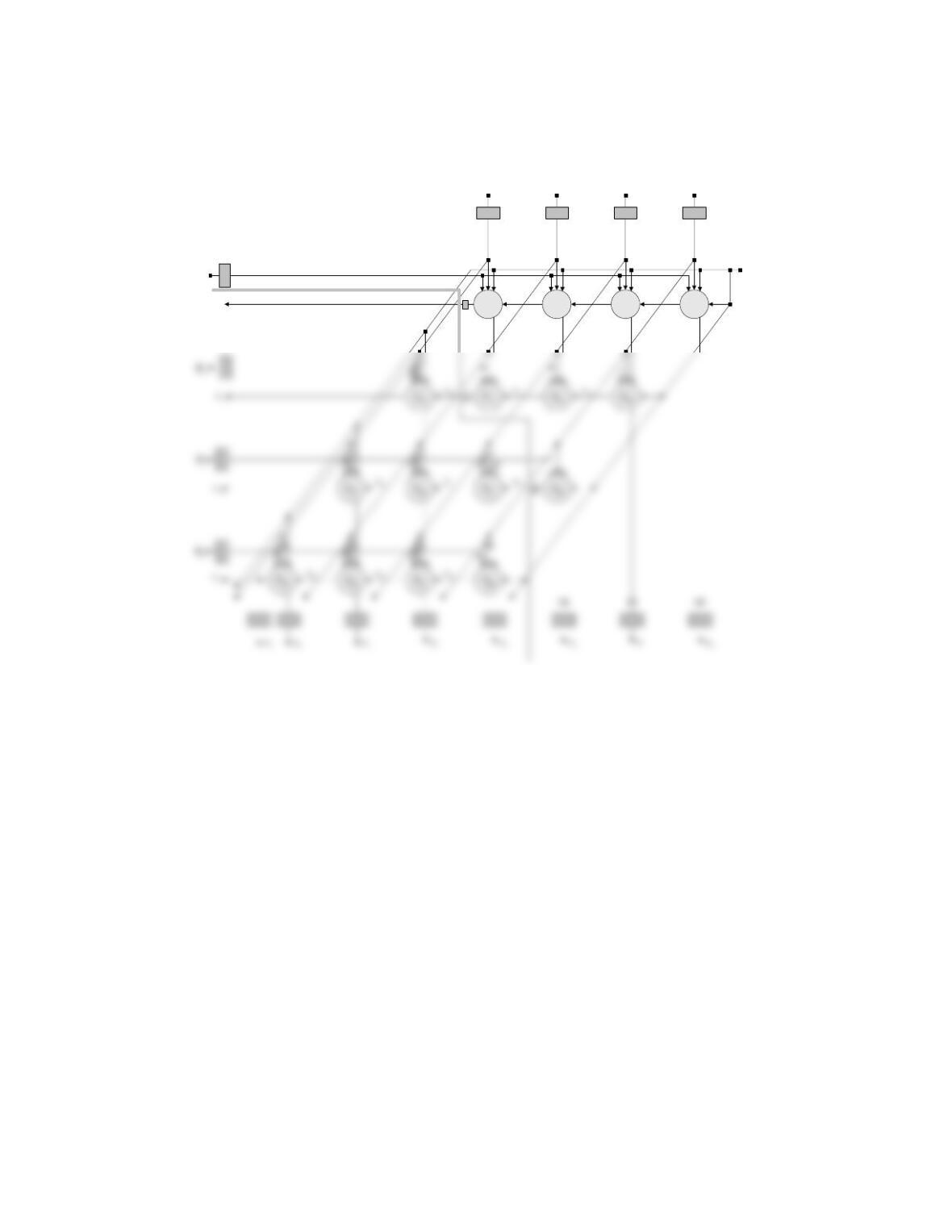
By reconfiguring the cutset we obtain a balanced pipeline, with a longest path through
only five adders:
S00
A1
S02
S03
B0
A3A2A0
0
C00
C01
C02
S01
C03
Problem 10-40
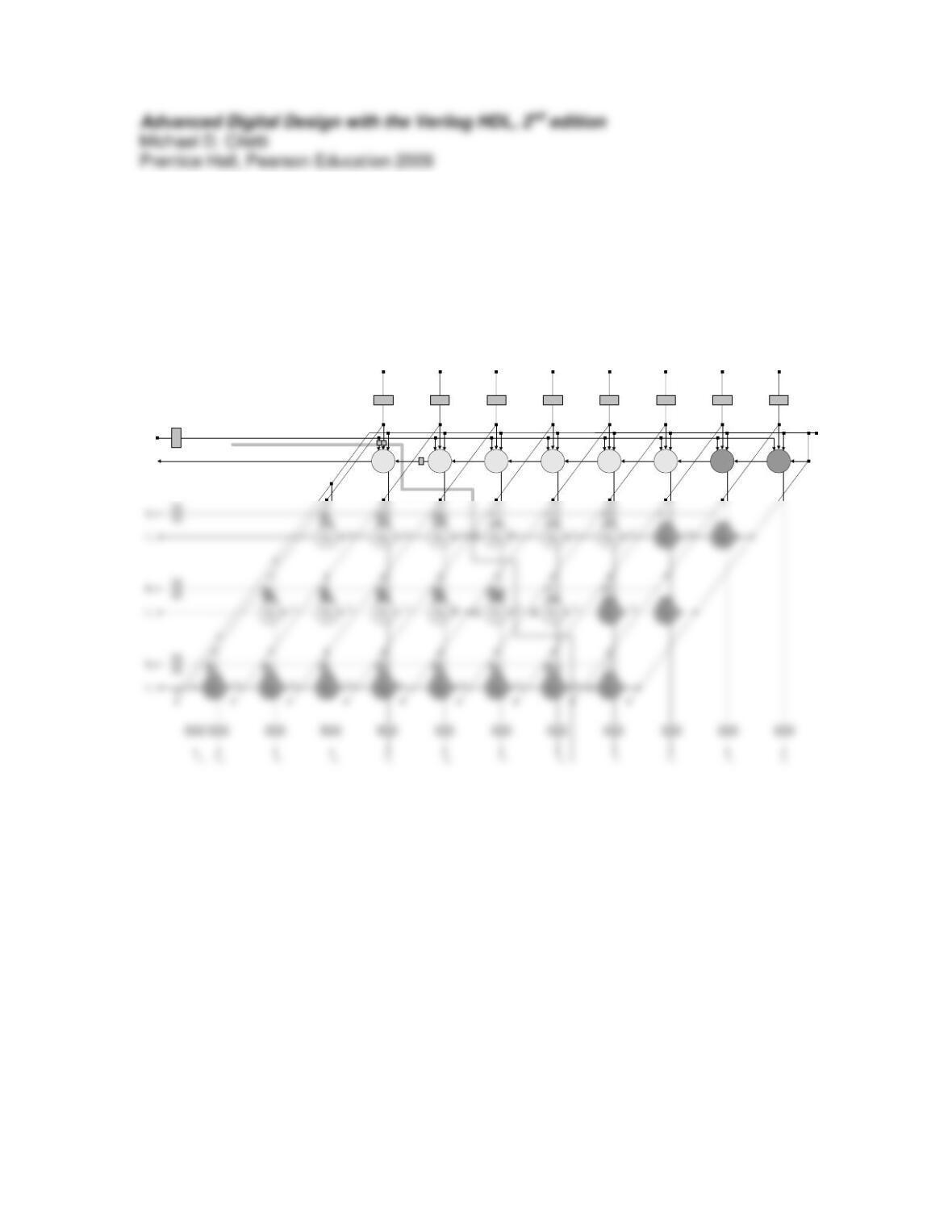
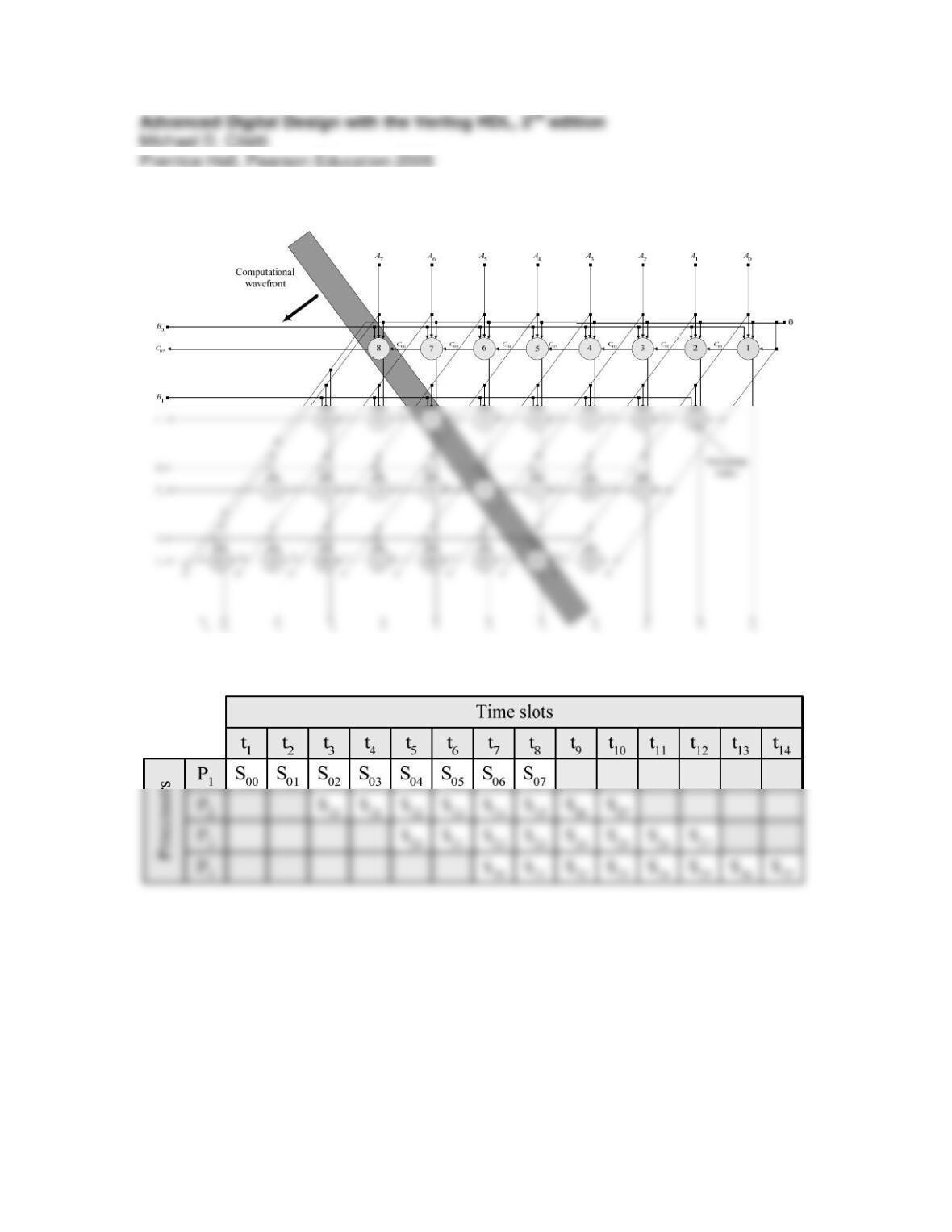
The longest path through the array passes through 14 cells and is not unique. One such
path is illustrated by the darkened cells. The figure below shows the cutset, I/O registers,
and internal pipeline registers for a balanced 4×8 pipelined multiplier. The longest path
through each section of the structure passes through 7 adders.
S00
A1
S02
S03
A3A2A0
0
C00
C01
C02
S01
C03
S04
A5
S06
S07
A7A6A4
C04
C05
C06
S05
C07
B0
Problem 10-41
Reservation Table (See Fig. 10-14):
Problem 10-42
Reservation table: