Problem 10.50
Done without GPS or lasers Two thousand years before, the invention of such tools as the
Global Positioning System (GPS) or laser surveying equipment, Roman engineers were able
to design and construct structures that made a lasting contribution to Western civilization.
For example, one of the best surviving examples of Roman aqueduct construction is the
Pont du Gard, an aqueduct that spans the Gardon River near Nîmes, France. This
aqueduct is part of a circuitous, 50-km-long open channel that transported water to the
Roman Colony at Nîmes from a spring located 20 km away. The spring is only 14.6 m
above the point of delivery, giving an average bottom slope of only 3 × 10⁻⁴. It is obvious
that to carry out such a project, the Roman understanding of hydraulics, surveying, and
construction was well advanced. (See Problem 10.50.)
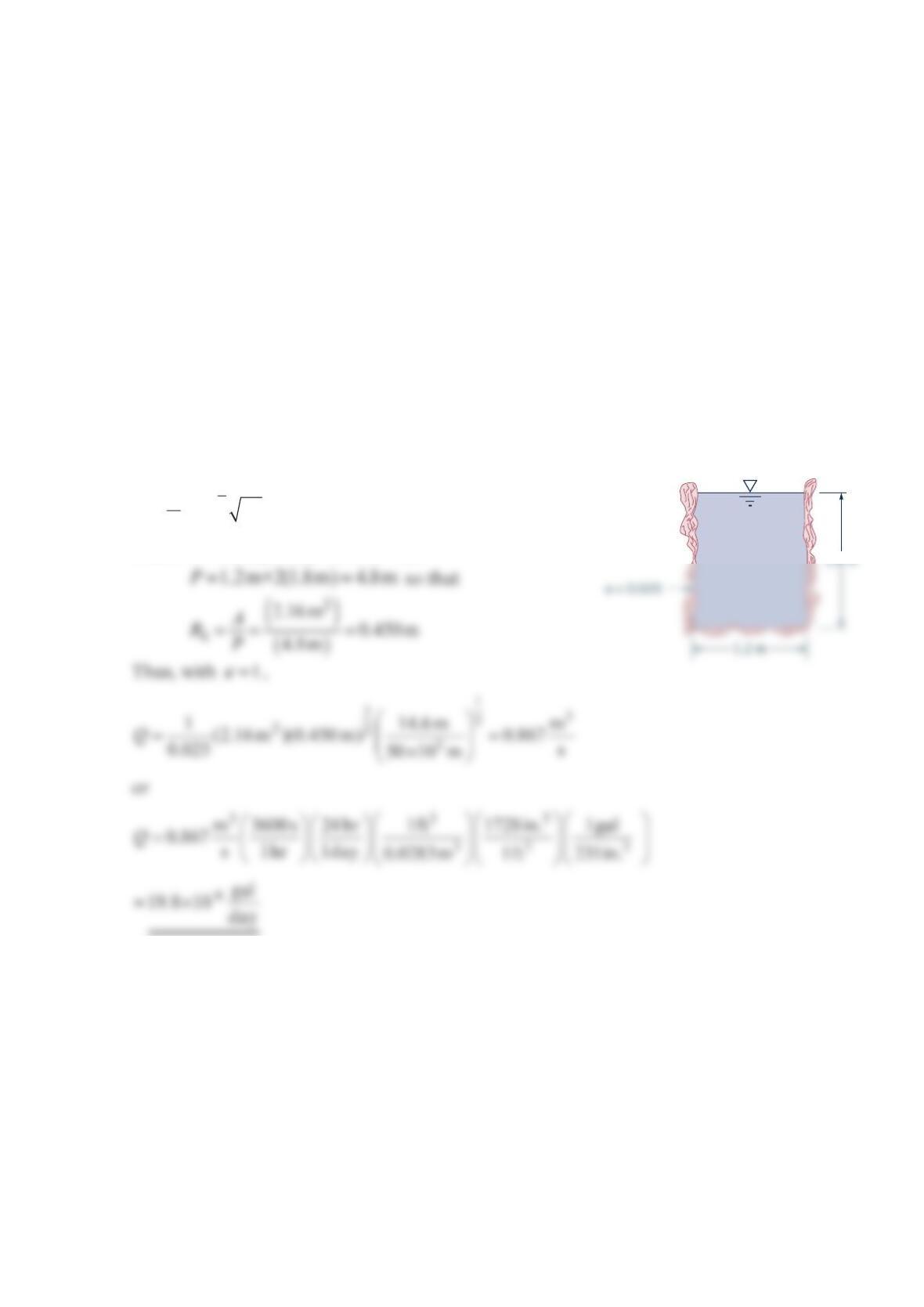
Determine the number of gallons of water delivered per day by a rubble masonry, 1.2-m-
wide aqueduct laid on an average slope of 14.6 m per 50 km if the water depth is 1.8 m .
Solution 10.50
κ
=
2
30h
QARS
n,
where ==
2
1.2 m(1.8m) 2.16 mA and
Problem 10.51
An old, rough-surfaced,
2
-m–diameter concrete pipe with a Manning coefficient of 0.025
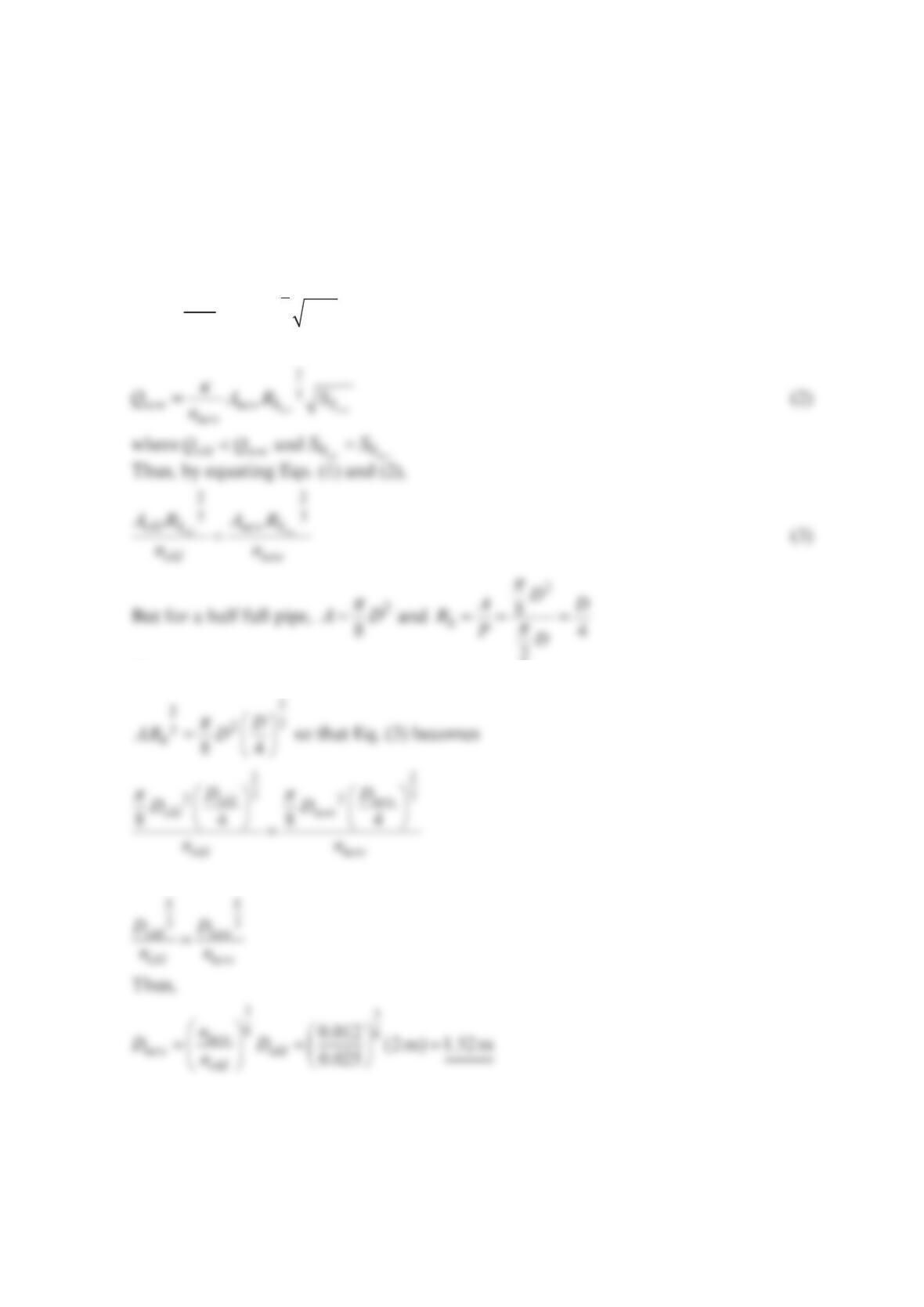
carries water at a rate of 5.0 m3/s when it is half full. It is to be replaced by a new pipe with
a Manning coefficient of 0.012 that is also to flow half full at the same flowrate. Determine
the diameter of the new pipe.
Solution 10.51
2
30
old old
old old h
old
QARS
n
κ
= (1)
and
Thus,
or
Problem 10.52
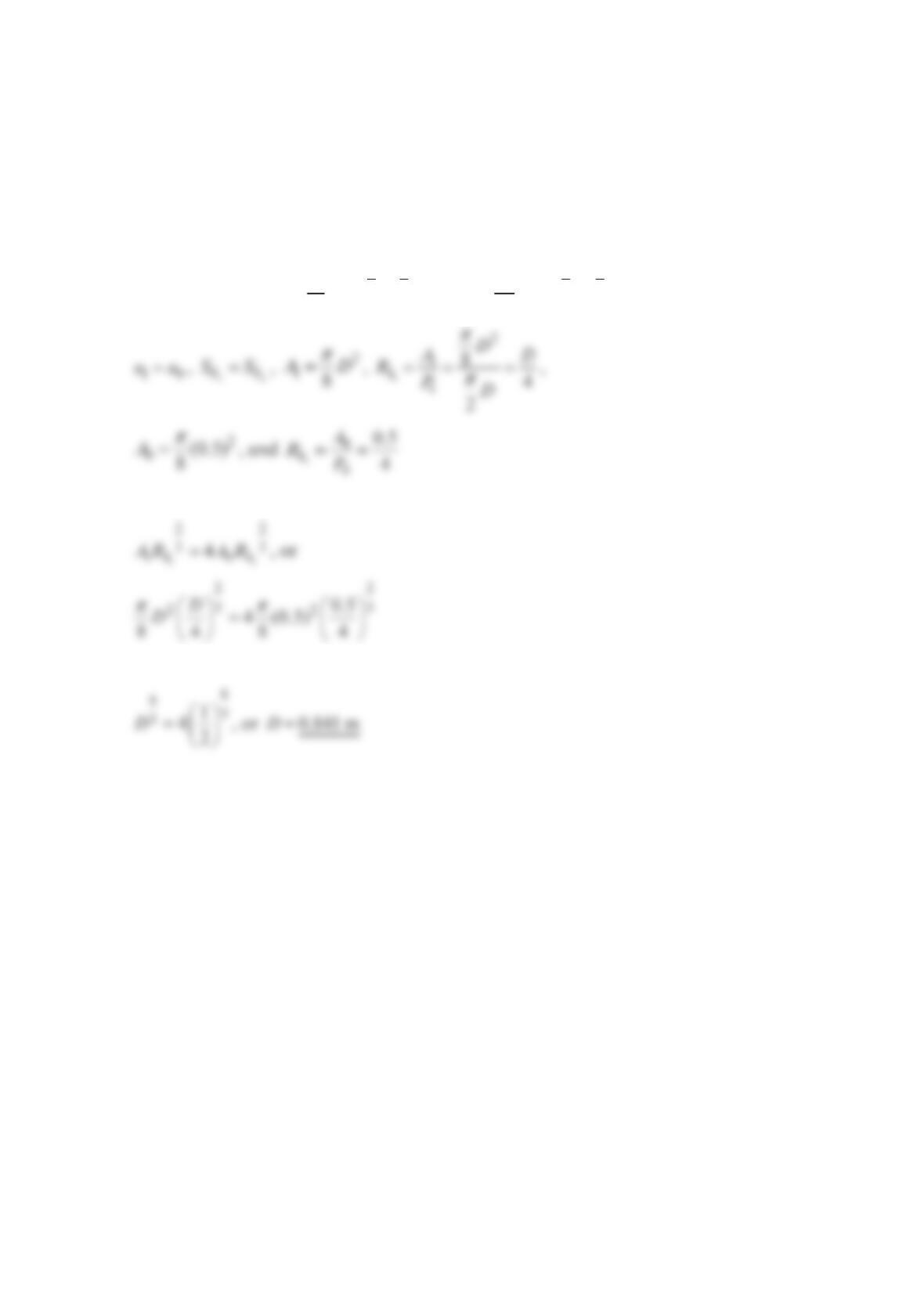
Four sewer pipes of 0.5-m diameter join to form one pipe of diameter D. If the Manning
coefficient,
n
, and the slope are the same for all of the pipes, and if each pipe flows half full,
determine
D
.
Solution 10.52
=
10
4QQ
, where
κ
=11
21
32
110
1
h
QARS
n and
κ
=00
21
32
000
0
h
QARS
n, with (1)
Thus, from Eq. (1)
Hence,
Problem 10.53
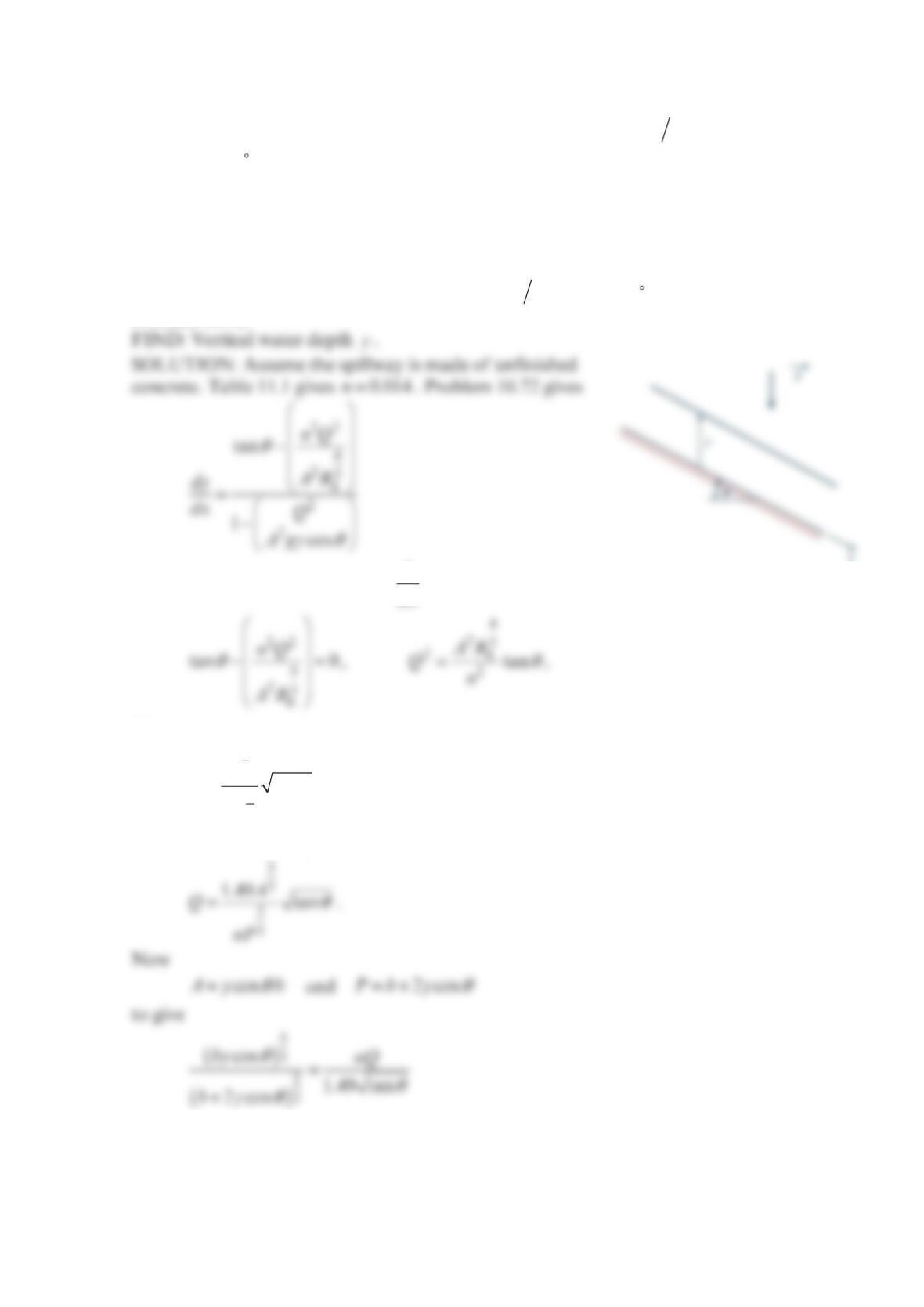
The spillway of a dam is 20.0ft wide and has a flowrate of 3
5000 ft s . The spillway makes
an angle of 30 with the horizontal. Find the vertical water depth down the spillway. See
Problem 10.72.
Solution 10.53
GIVEN: Dam spillway, 20.0ft wide, =3
5000 ft sQ, slope of 30 with horizontal. See
Problem 10.72.
Assuming “uniform flow” where =0
dy
dx , we get
or
θ
=
5
3
2
3
tan
A
Q
nP
.
which is Manning’s equation for SI units. Since we have BG units, we use the equation
or
x
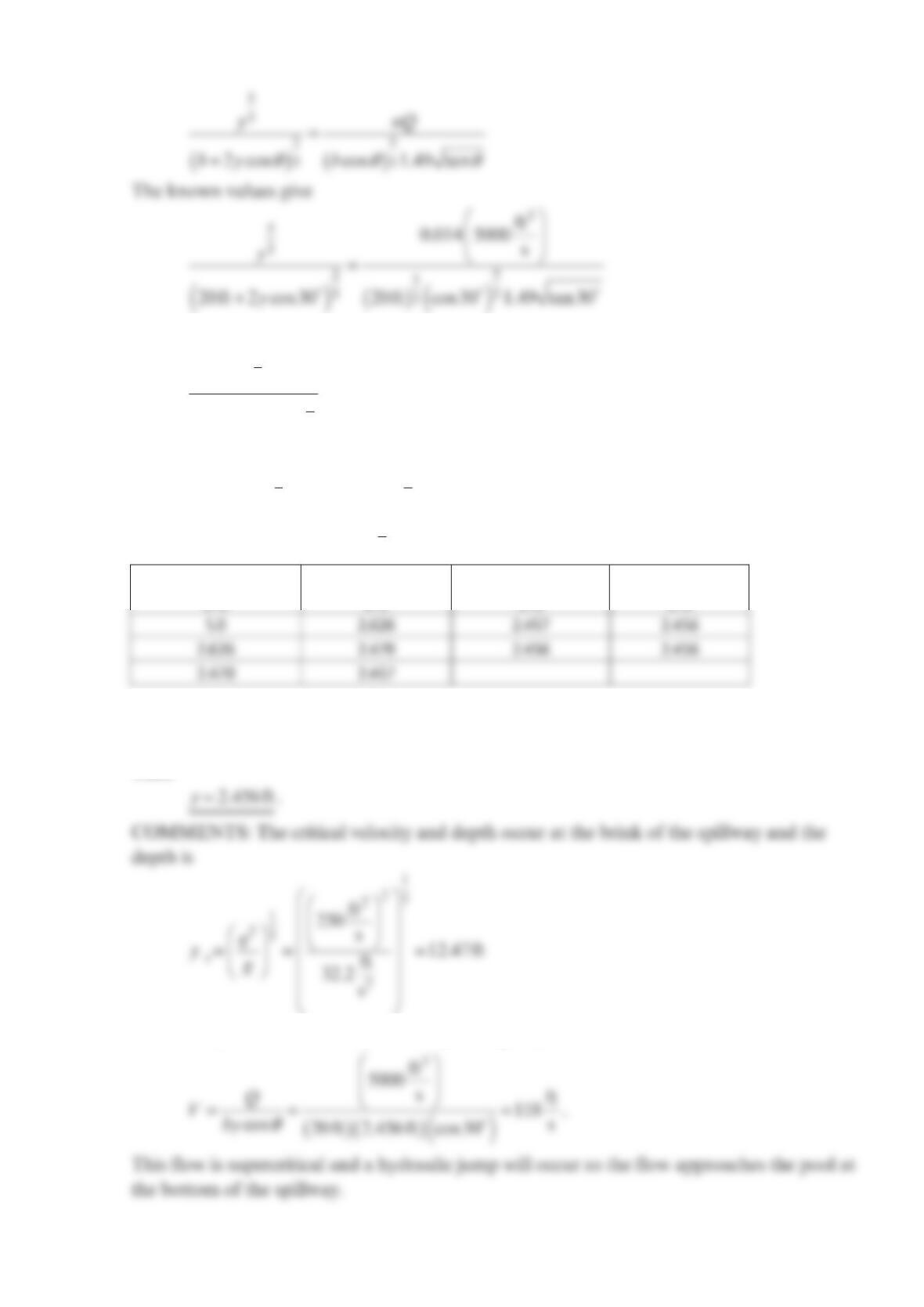
or
()
=
+
5
3
2
3
0.533
20 ft 1.732
y
y
.
Solving for
y
by fixed-point iteration gives
()()
=+
32
55
0.533 20 ft 1.732yy
()
=+
2
5
0.686 20 ft 1.732yy
guess of y calc y guess of y calc y
(ft) (ft) (ft) (ft)
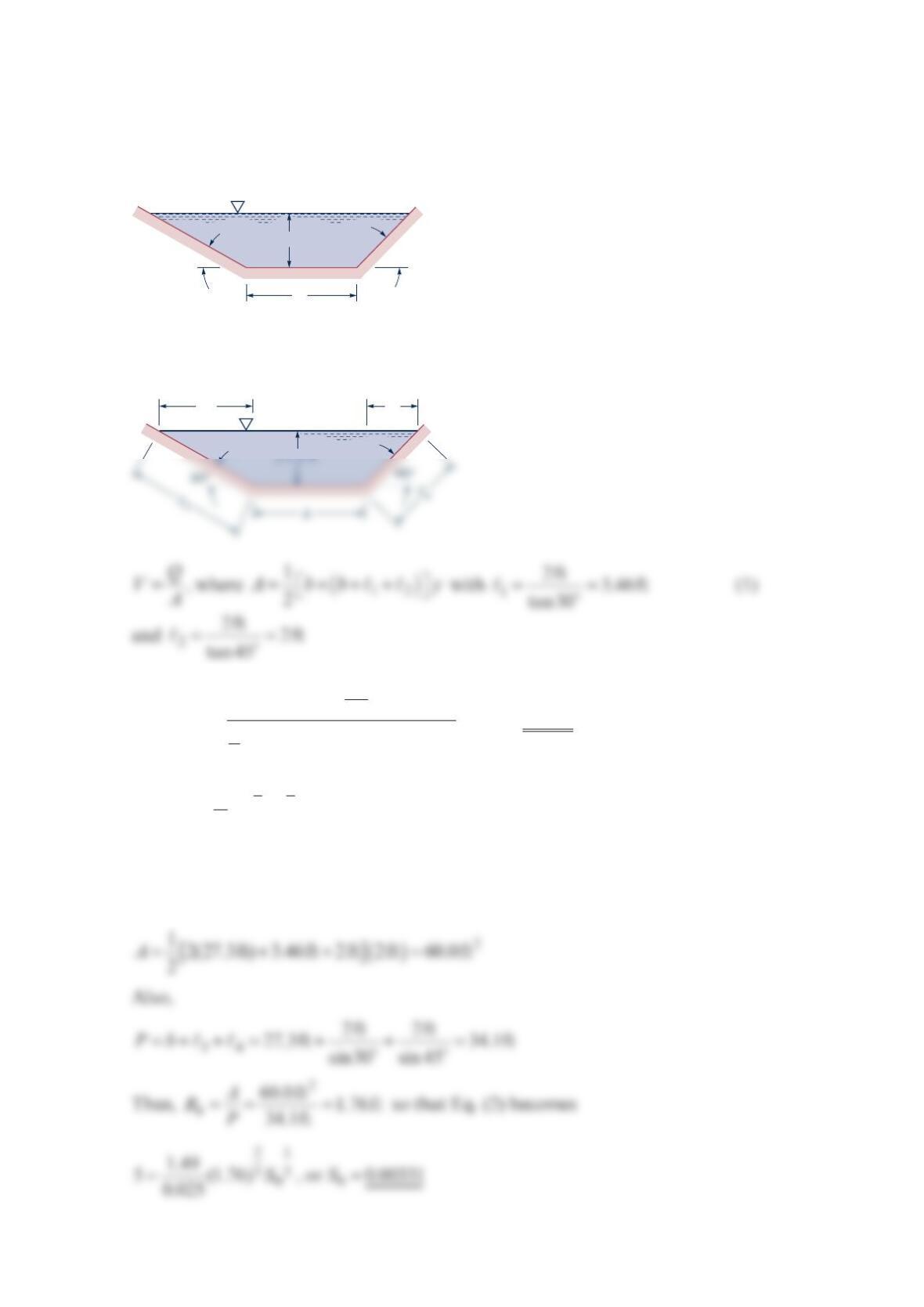
The solution could also be obtained with an equation solver: y = 0.245 ft
Then
The velocity at the normal depth corresponding to
y
is
Problem 10.54
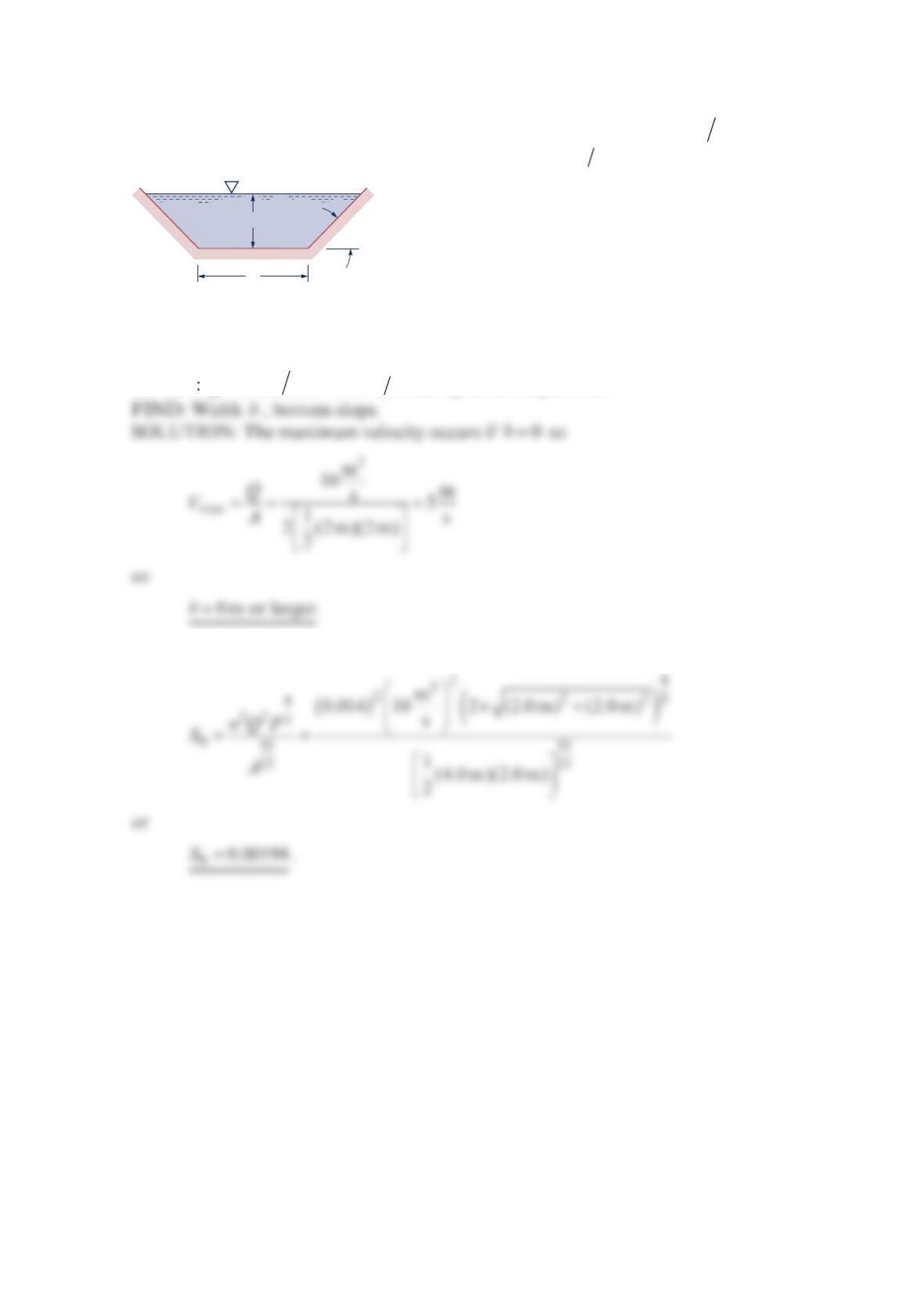
The flowrate in the clay-lined channel =0.025n shown in the figure below is to be
3
300 ft / s . To prevent erosion of the sides, the velocity must not exceed 5ft/s. For this
maximum velocity, determine the width of the bottom, b, and the slope, 0
S.
Solution 10.54
Thus,
()()
=
++ +
3
ft
300 s
5ft 13.46 ft 2 ft 2 ft
2bb
, or =27.3 ftb
Also,
κ
=11
21
32
0h
VRS
n, where =1.49k and from a table of Manning coefficients,
=0.025n (2)
From Eq. (1),
b
2 ft
45°
30°
ℓ
1
ℓ
2
Problem 10.55
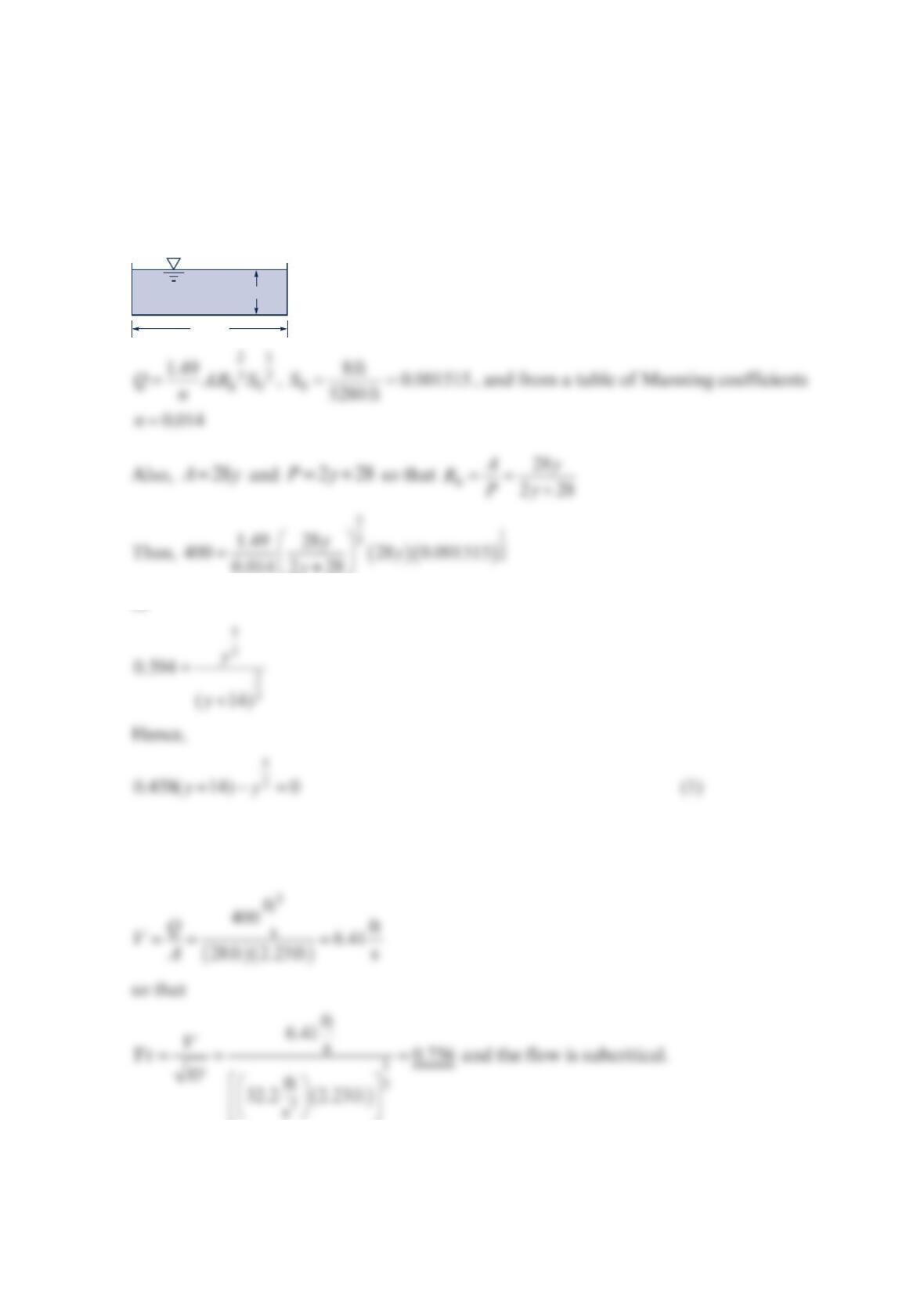
The rate of discharge through the canal in the figure below is to be 3
10 m s . Find the width
b
and the bottom slope. The velocity will not exceed 5.0 m s.
Solution 10.55
GIVEN =3
10 m sQ, ≤5.0 m sV, the figure in the problem.
The slope is found using Manning’s equation with =0.014n
b
2.0 m
45°
Problem 10.56
A rectangular, unfinished concrete channel of
2
8-ft width is laid on a slope of 8ft/mi .
Determine the flow depth and Froude number of the flow if the flowrate is 3
400 ft / s .
Solution 10.56
or
The solution to Eq. (1) is =2.23fty
Thus,
28 ft
y
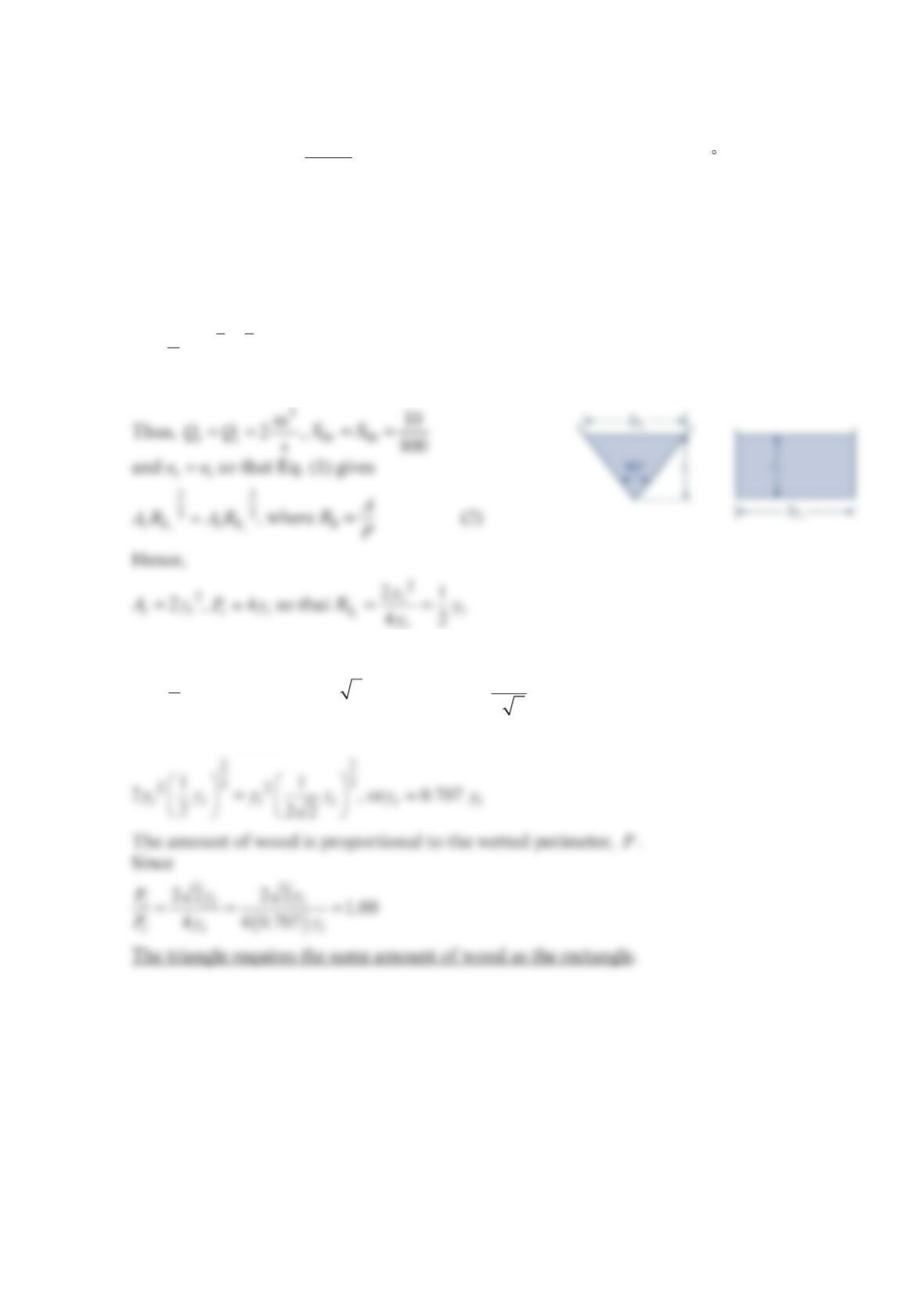
Problem 10.57
An engineer is to design a channel lined with planed wood to carry water at a flowrate of
3
2m /s on a slope of 10 m
800 m . The channel cross section can be either a 90 triangle or a
rectangle with a cross section twice as wide as its depth. Which would require less wood and
by what percent?
Solution 10.57
=
21
32
0
1
h
QARS
n (1)
Let
()
t denote the triangular cross-section and
()
r denote the rectangular cross-section.
Also,
2
1(2 )
2
tttt
A
yy y==
, 2( 2 )
tt
Py= so that 22
t
t
h
y
R
=
Thus, from Eq. (2):
A
R
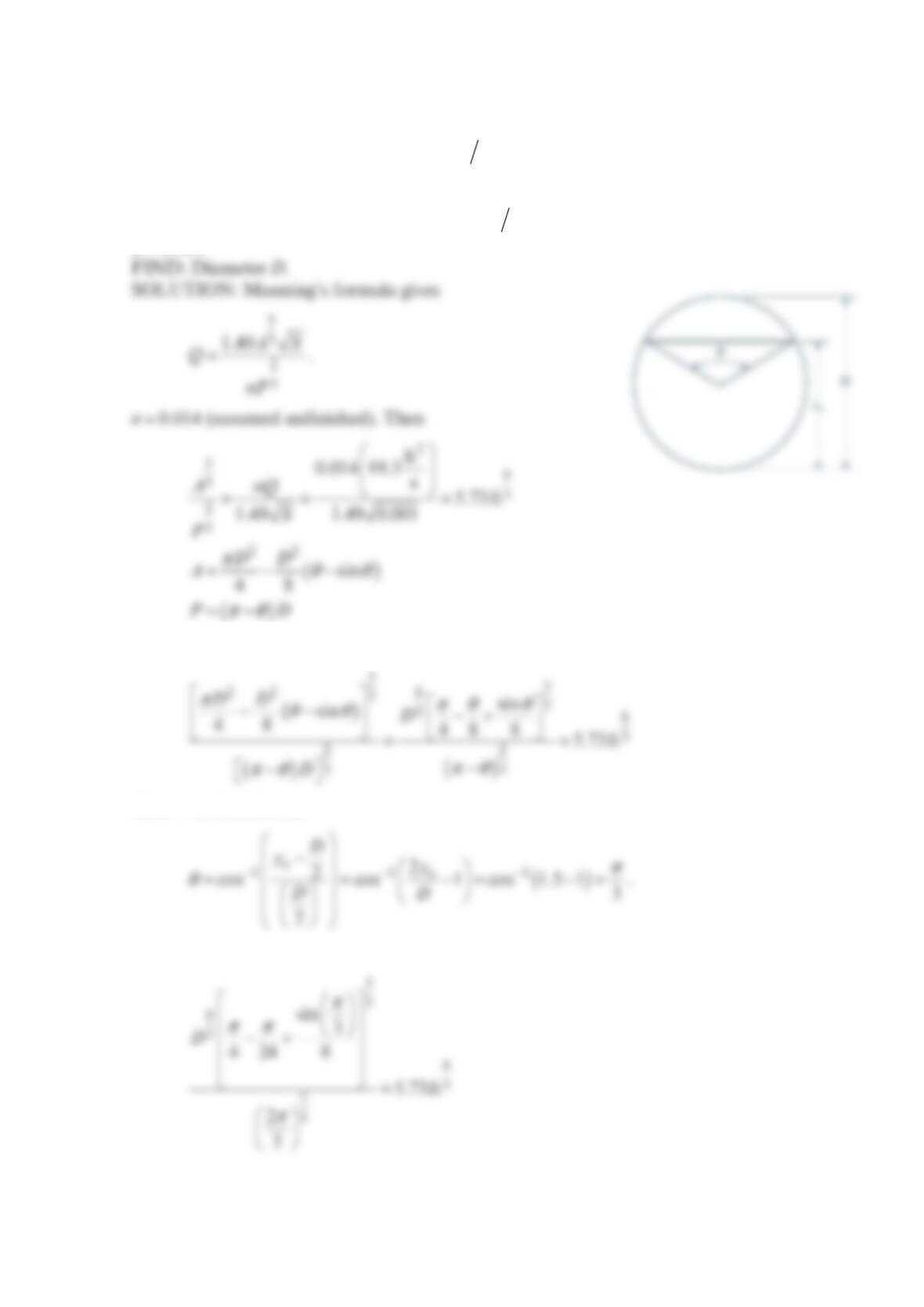
Problem 10.58
Find the diameter required for reinforced concrete pipe laid at a slope of 0.001 and
required to carry a uniform flow of 3
19.3ft s when the depth is 75% of the diameter.
Solution 10.58
GIVEN: Reinforced concrete pipe, =3
19.3ft sQ, =75
n
y
D, D = pipe inside diameter,
=0.001S.
Then
Now
θ
is found from
Then
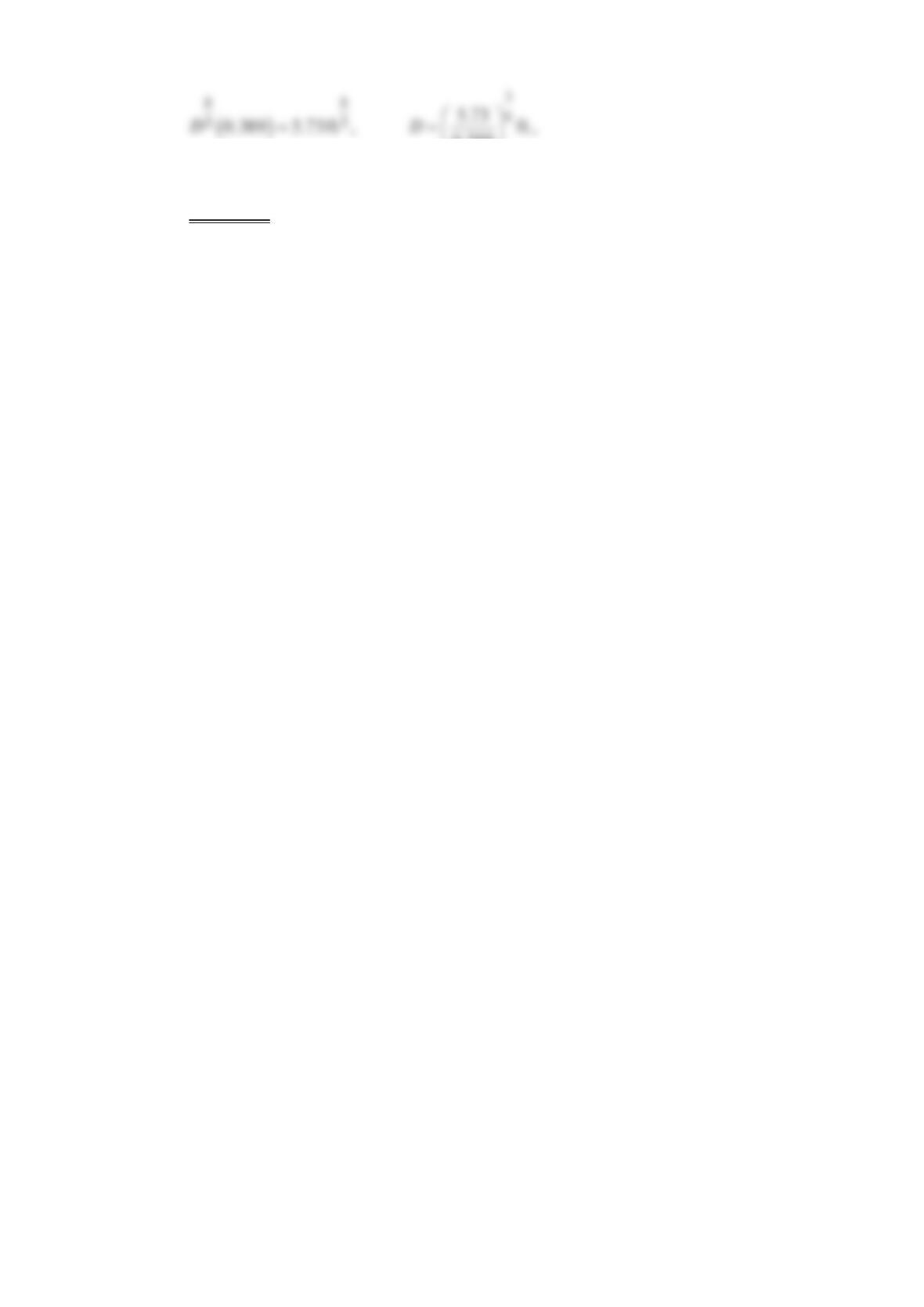
0.389
or
=2.74 ftD.
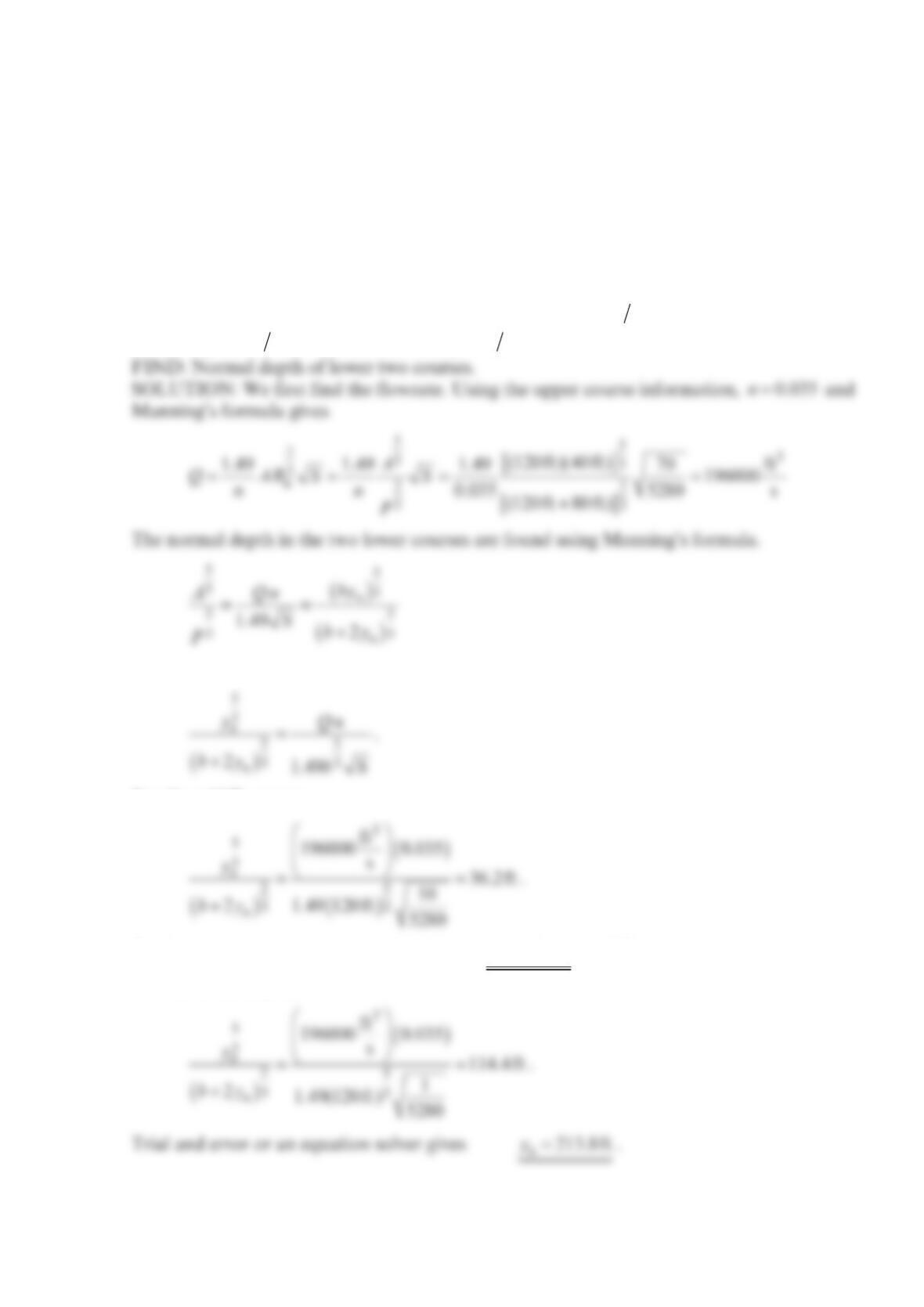
Problem 10.59
A major river is divided into three parts or courses—the upper course, the middle course,
and the lower course. The slope is 70 ft per mile in the upper course, 10 ft per mile in the
middle course, and 1.0 ft per mile in the lower course. All three courses have rectangular
cross sections. The upper course has a normal depth of 40.0 ft . The river width is 120 ft .
Find the normal depths of the middle and lower courses.
Solution 10.59
GIVEN: Major river of three reaches. Upper course: =
070 ft mileS, =40 ft
n
y. Middle
course: =
010 ft mileS. Lower course: =
01ft mileS. River width = 120 ft .
or
For the middle course,
Trial and error or an equation solver gives =82.6 ft
n
y, middle course.
For the lower course,
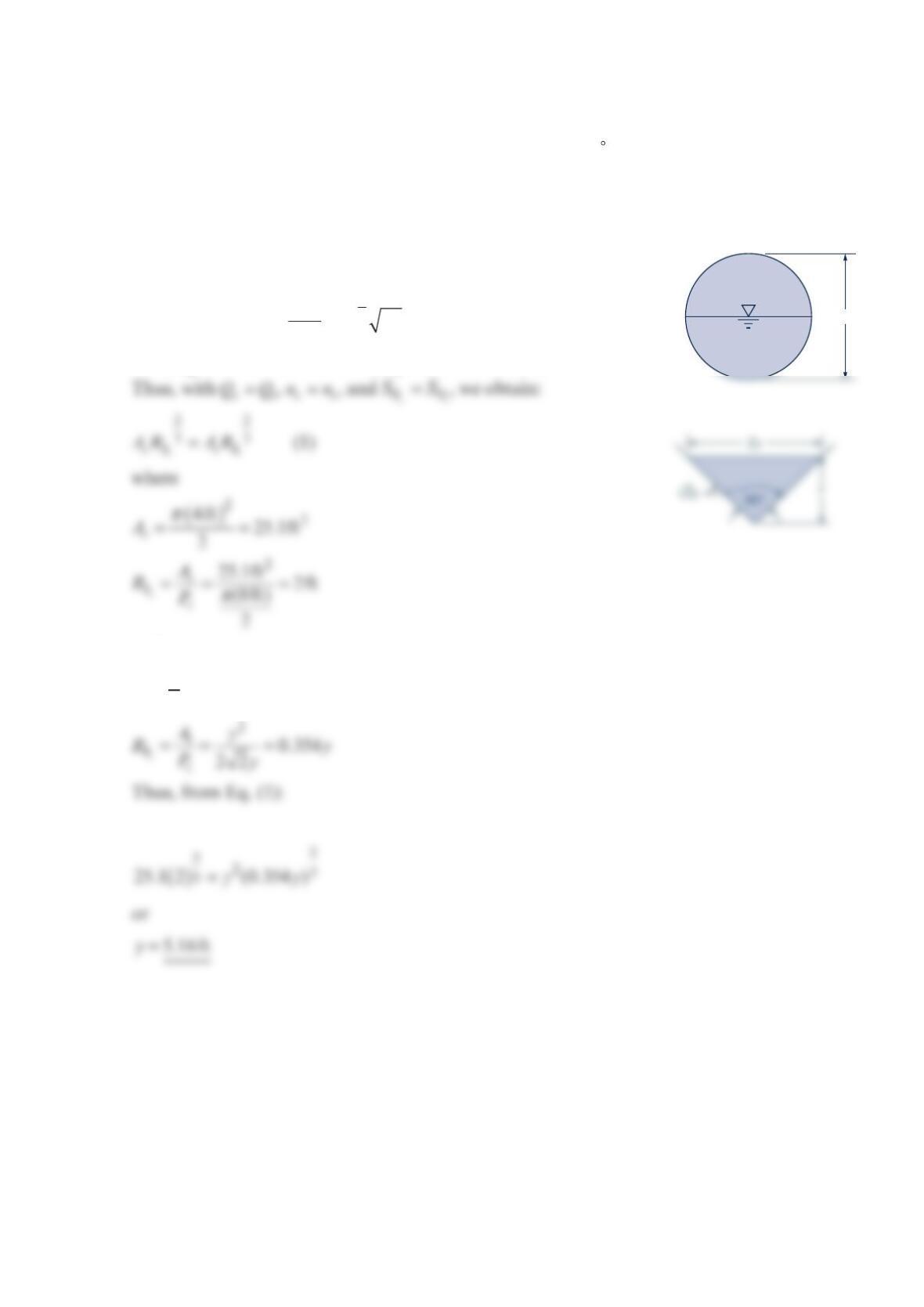
Problem 10.60
An
8
-ft-diameter concrete drainage pipe that flows half full is to be replaced by a concrete-
lined –
V
shaped open channel having an interior angle of 90 . Determine the depth of fluid
that will exist in the –Vshaped channel if it is laid on the same slope and carries the same
discharge as the drainage pipe.
Solution 10.60
For either case =
2
30
1.49
h
QARS
n
Let
()
c denote the circle and
()
t denote the triangle.
and
2
1(2 )
2
t
A
yy y==
8 ft
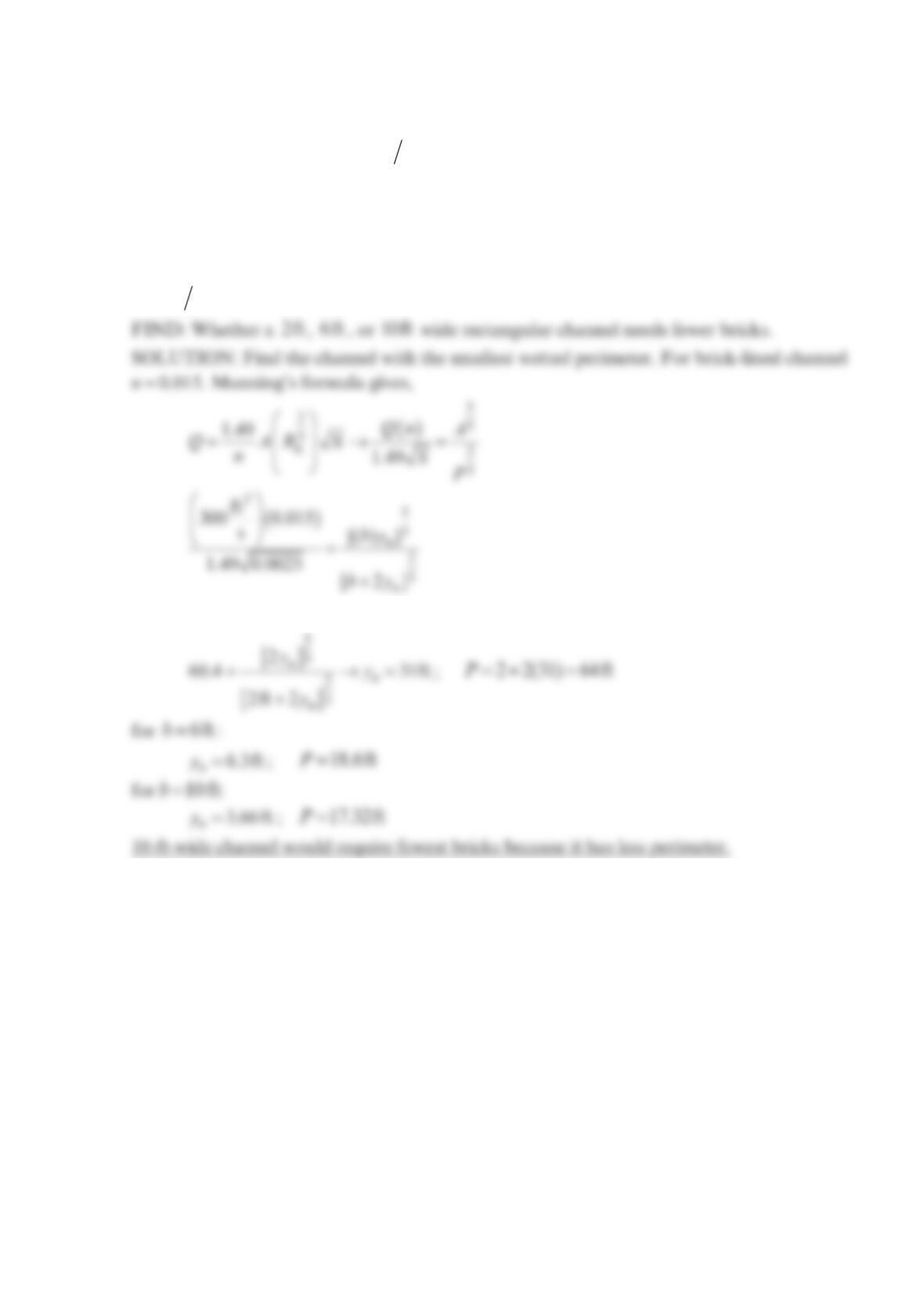
Problem 10.61
A rectangular brick-lined channel has a bottom slope of 0.0025 and is designed to carry a
uniform water flowrate of 3
300 ft s . Would the channel need fewer bricks if the channel
were 2ft wide, 6ftwide, or 10 ft wide? Explain.
Solution 10.61
GIVEN: Rectangular brick-lined channel has a bottom slope of 0.0025 is designed to carry
3
300 ft s .
for =2ftb:
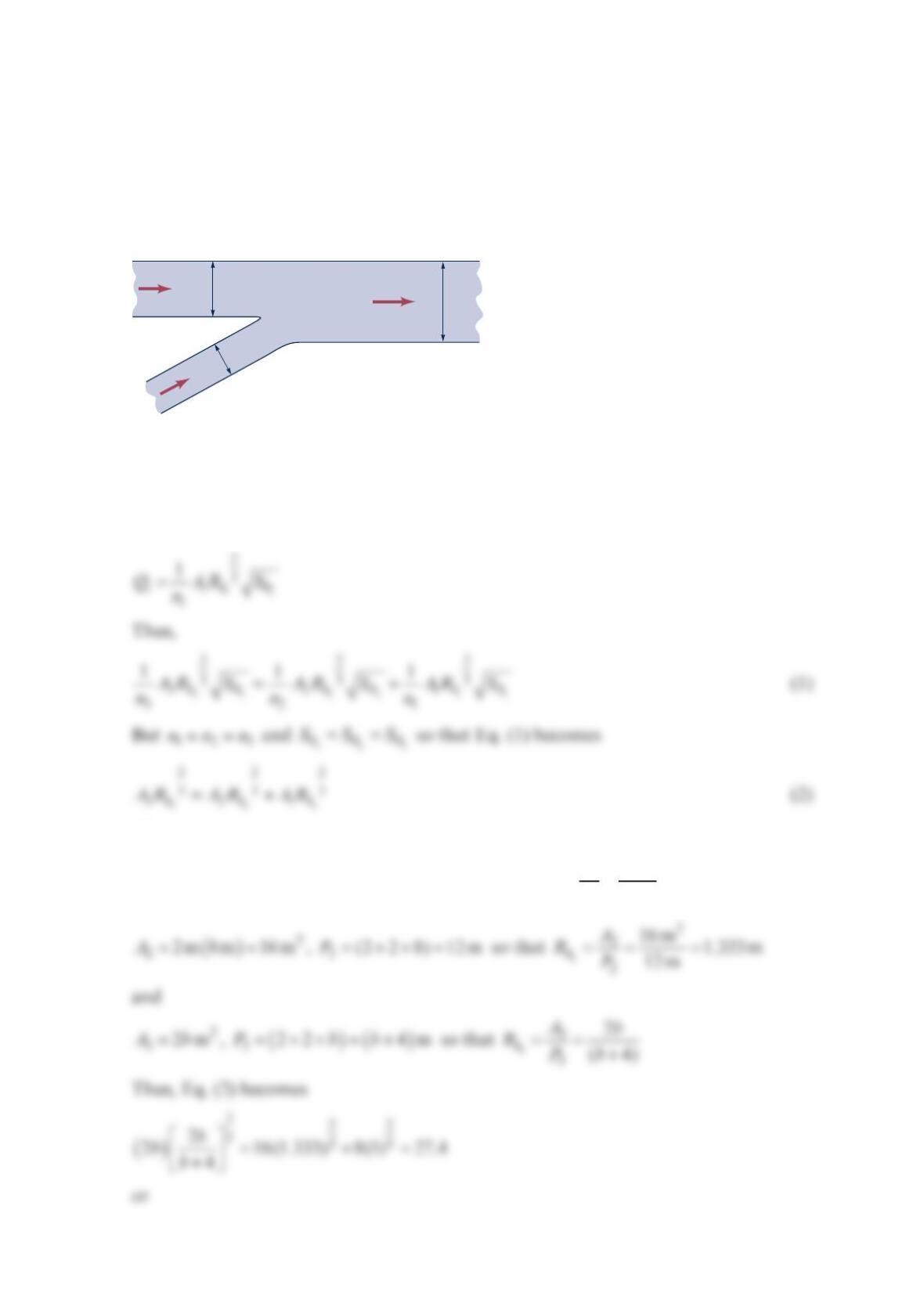
Problem 10.62
Two canals join to form a larger canal as shown in the figure below. Each of the three
rectangular canals is lined with the same material and has the same bottom slope. The
water depth in each is to be 2m. Determine the width of the merged canal,
b
. Explain
physically (i.e., without using any equations), why it is expected that the width of the
merged canal is less than the combined widths of the two original canals (i.e.,
<+=4m 8m 12mb).
Solution 10.62
=+
312
QQQ
where for =1, 2, 3i
where
()
==
2
12m 4m 8mA, =++=
1(2 2 4) 8mP so that == =
1
2
1
1
8m 1m
8m
h
A
RP
8 m
4 m
b
Q2
Q1
Q3
Using a standard root-finding technique gives the solution to Eq. (3):
=10.66 mb
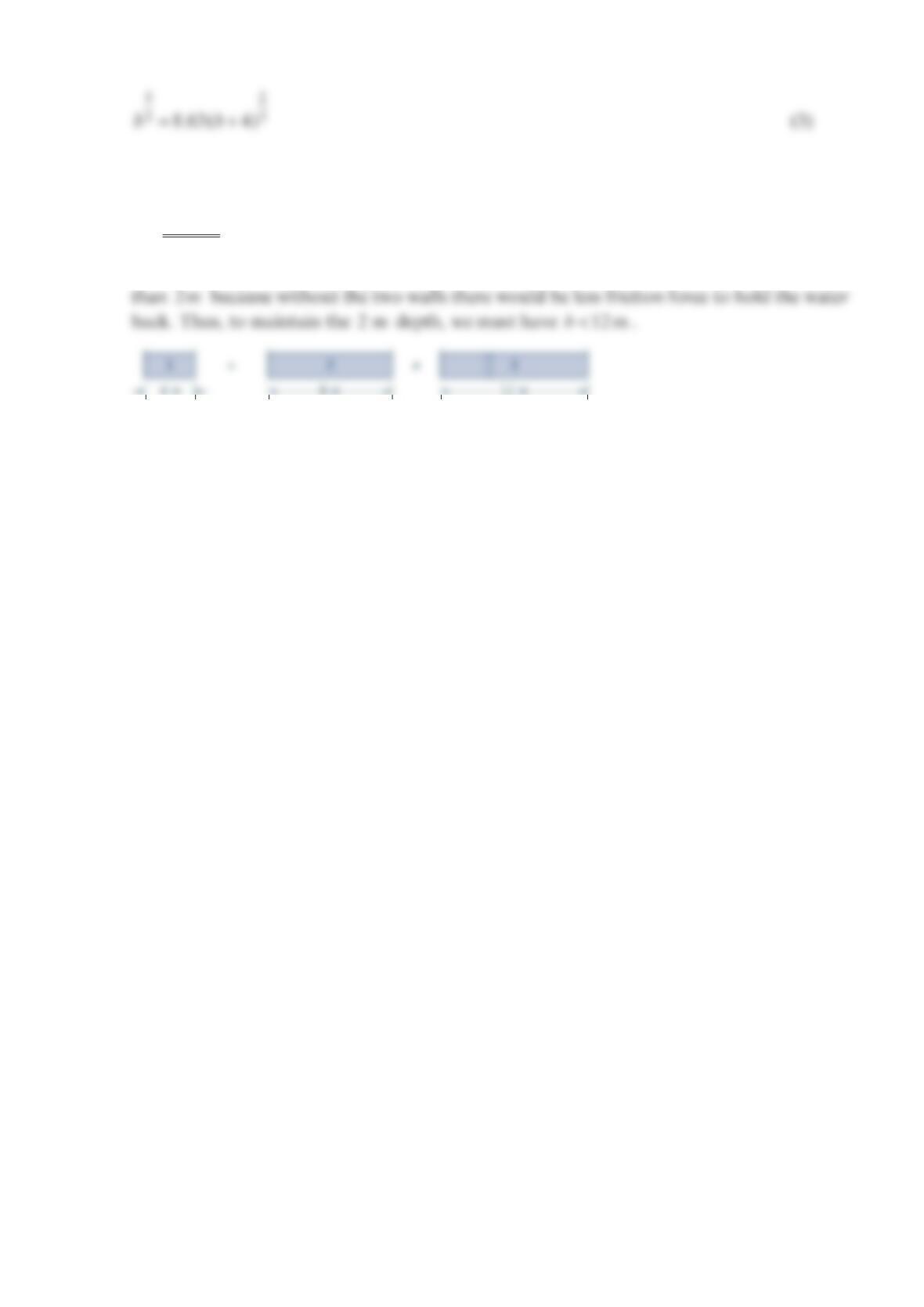
If the two original canals merged to form a 12-m -wide canal, the water depth would be less
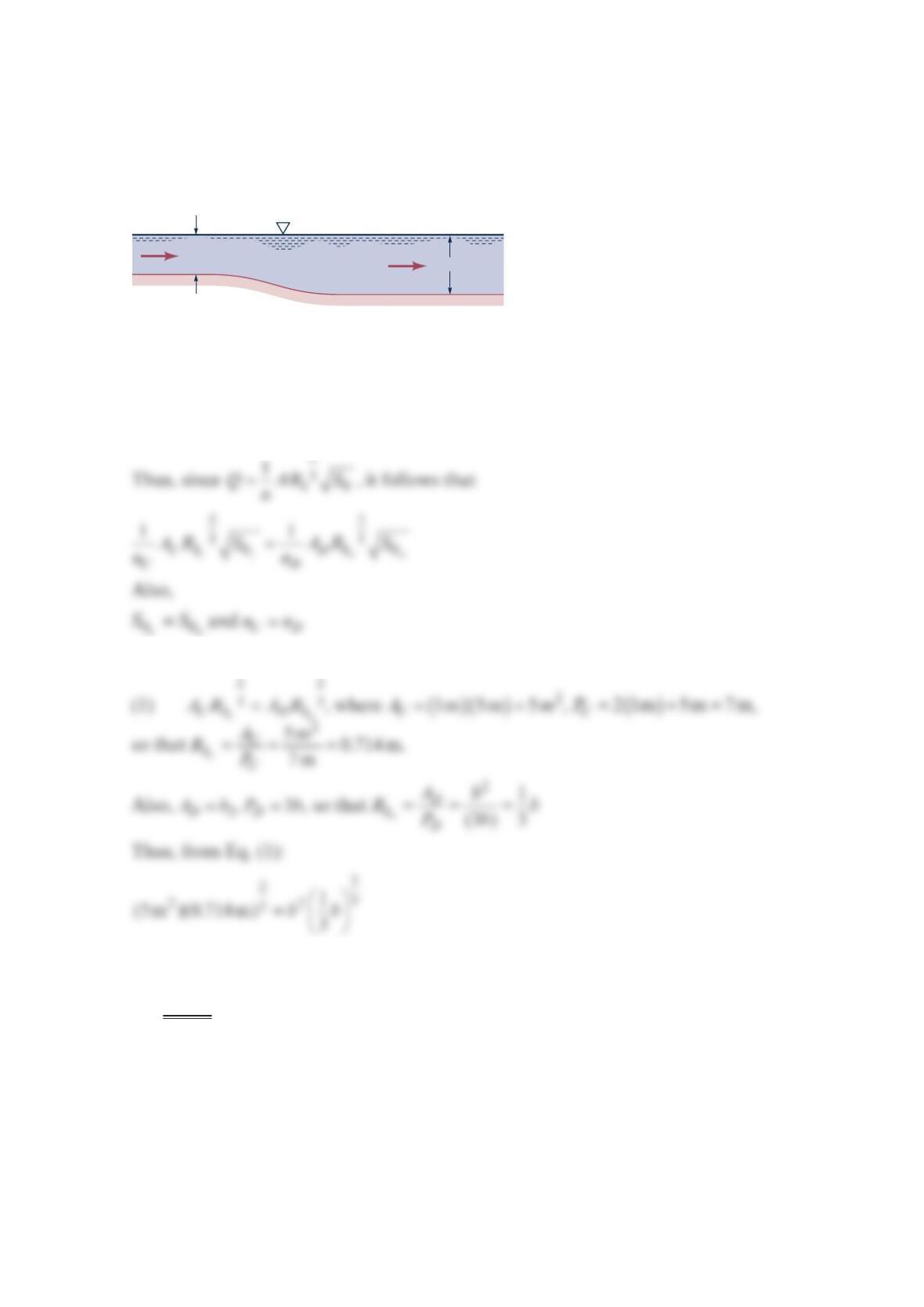
Problem 10.63
Water flows uniformly at a depth of 1m in a channel that is 5m wide as shown in the
figure below. Further downstream, the channel’s cross section changes to that of a square
of width and height
b
. Determine the value of b if the two portions of this channel are
made of the same material and are constructed with the same bottom slope.
Solution 10.63
UD
QQ=, where
()
U and
()
D denote upstream and downstream conditions.
Hence,
or
=2.21mb
1
m
b
Width = 5 m
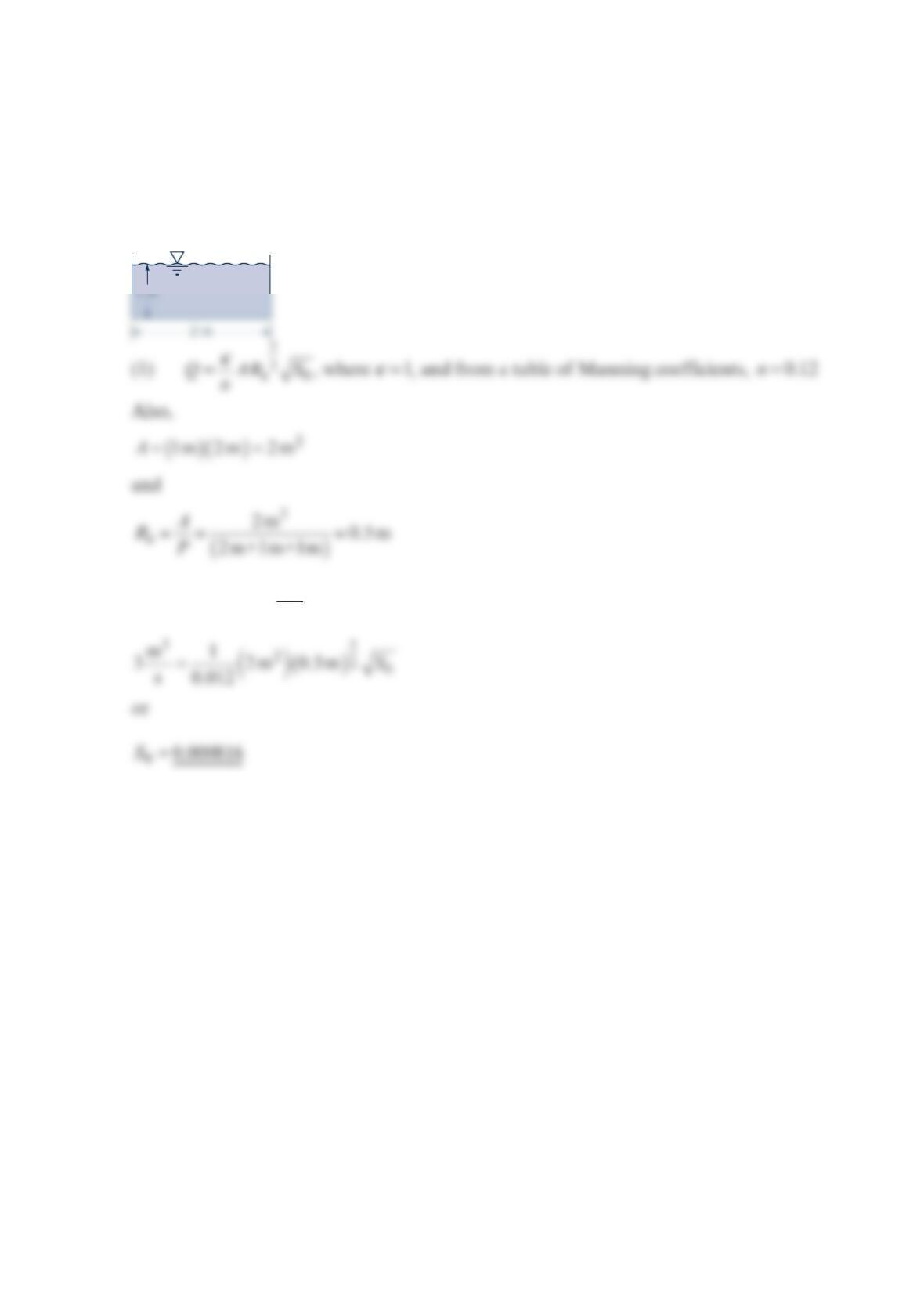
Problem 10.64
Water flows 1m deep in a
2
-m–wide finished concrete channel. Determine the slope if the
flowrate is 3
3m /s .
Solution 10.64
Hence, with =
3
m
3s
Q, Eq. (1) becomes
Problem 10.65
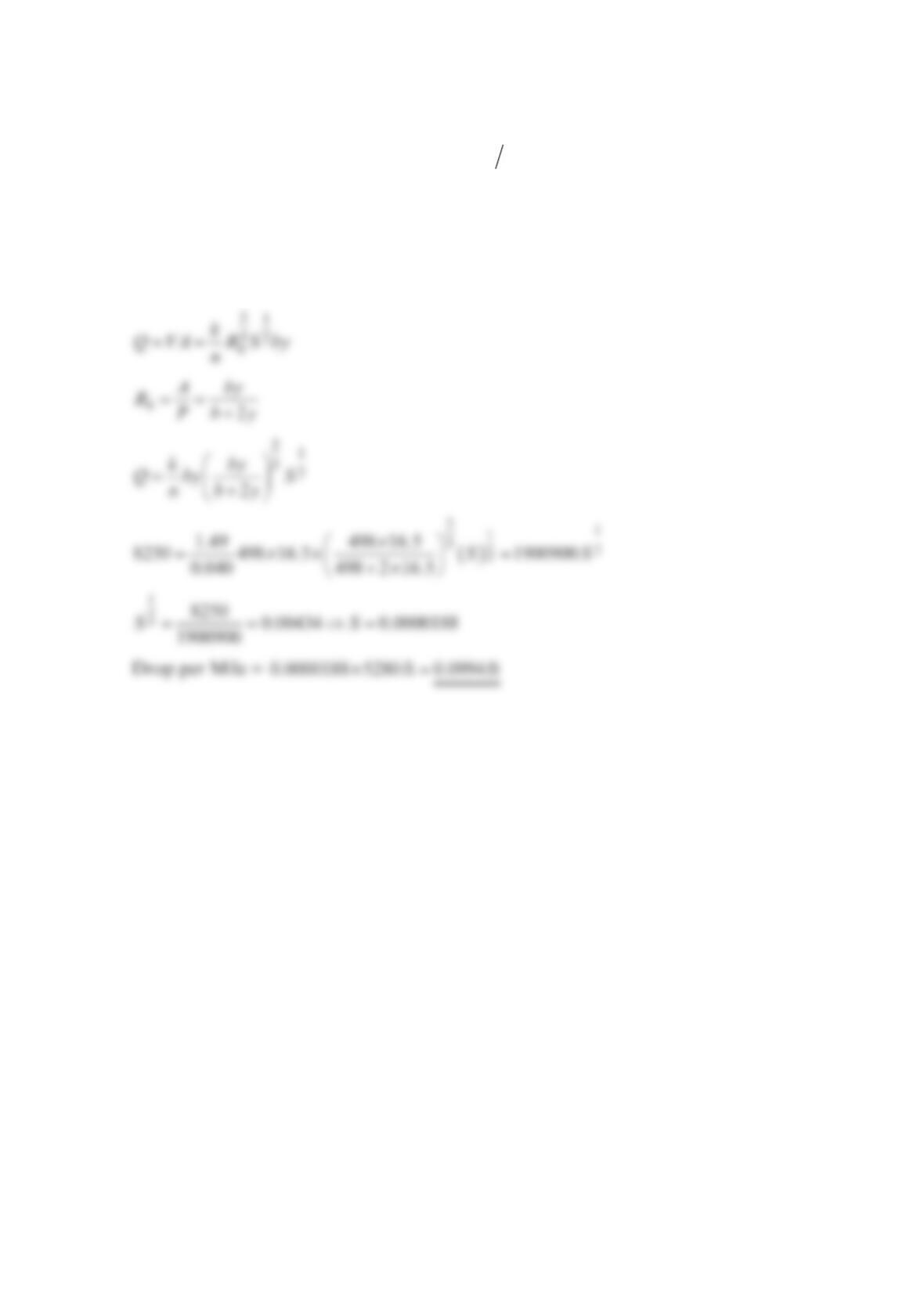
Uniform flow in a sluggish channel having a nearly rectangular cross section that is 498ft
wide and 16.5ft deep carries a flow of 3
8250 ft s . Approximately how much does the water
surface elevation drop along a river mile?
Solution 10.65
Assume that the river is “Sluggish with deep pools” for which =0.040n.
Problem 10.66
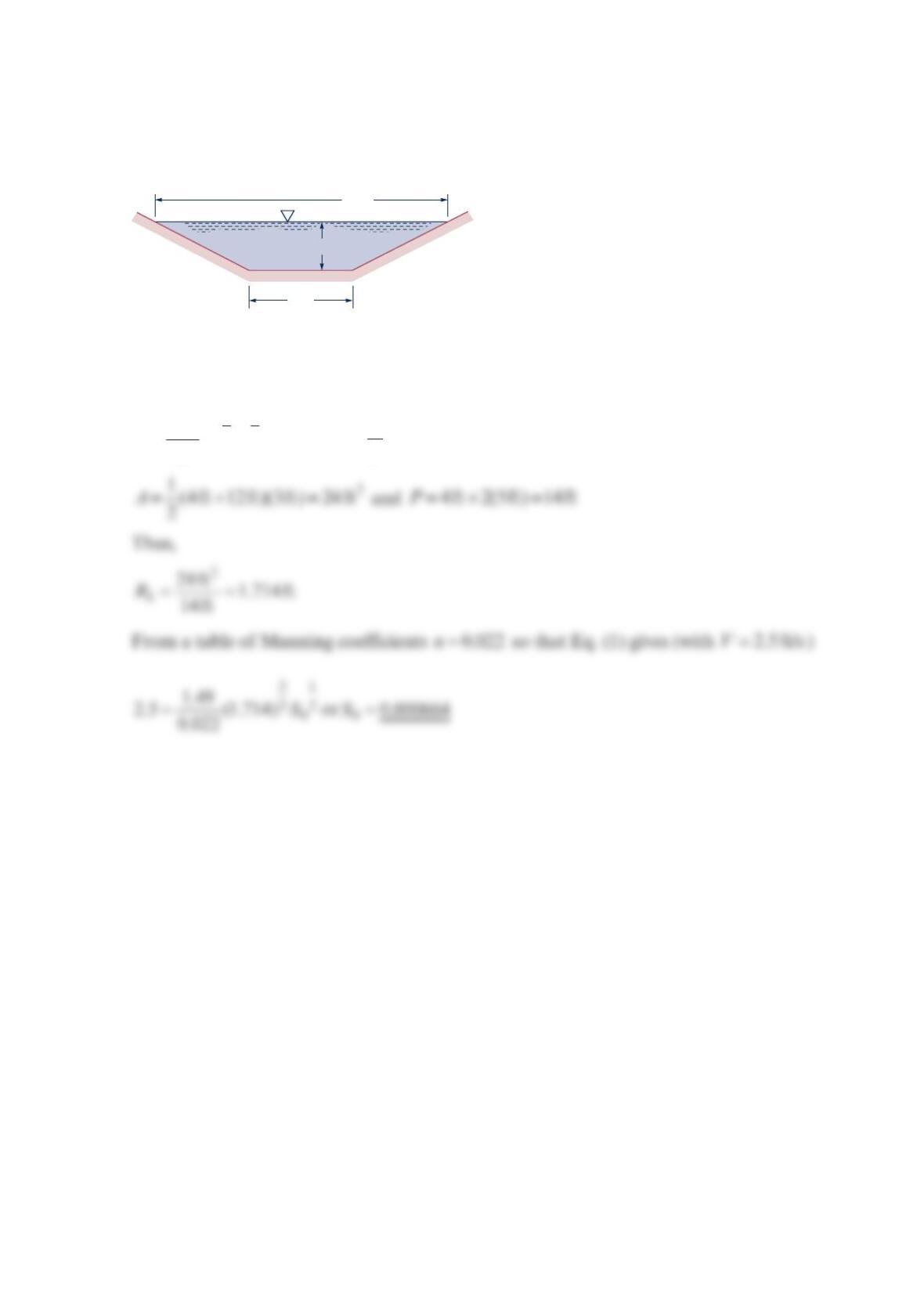
To prevent weeds from growing in a clean earthen-lined canal, it is recommended that the
velocity be no less than 2.5ft/s . For the symmetrical canal shown in the figure below,
determine the minimum slope needed.
Solution 10.66
=
21
32
0
1.49
h
VRS
n, where =
h
A
RP (1)
12 ft
3 ft
4 ft