PROBLEM 10.13
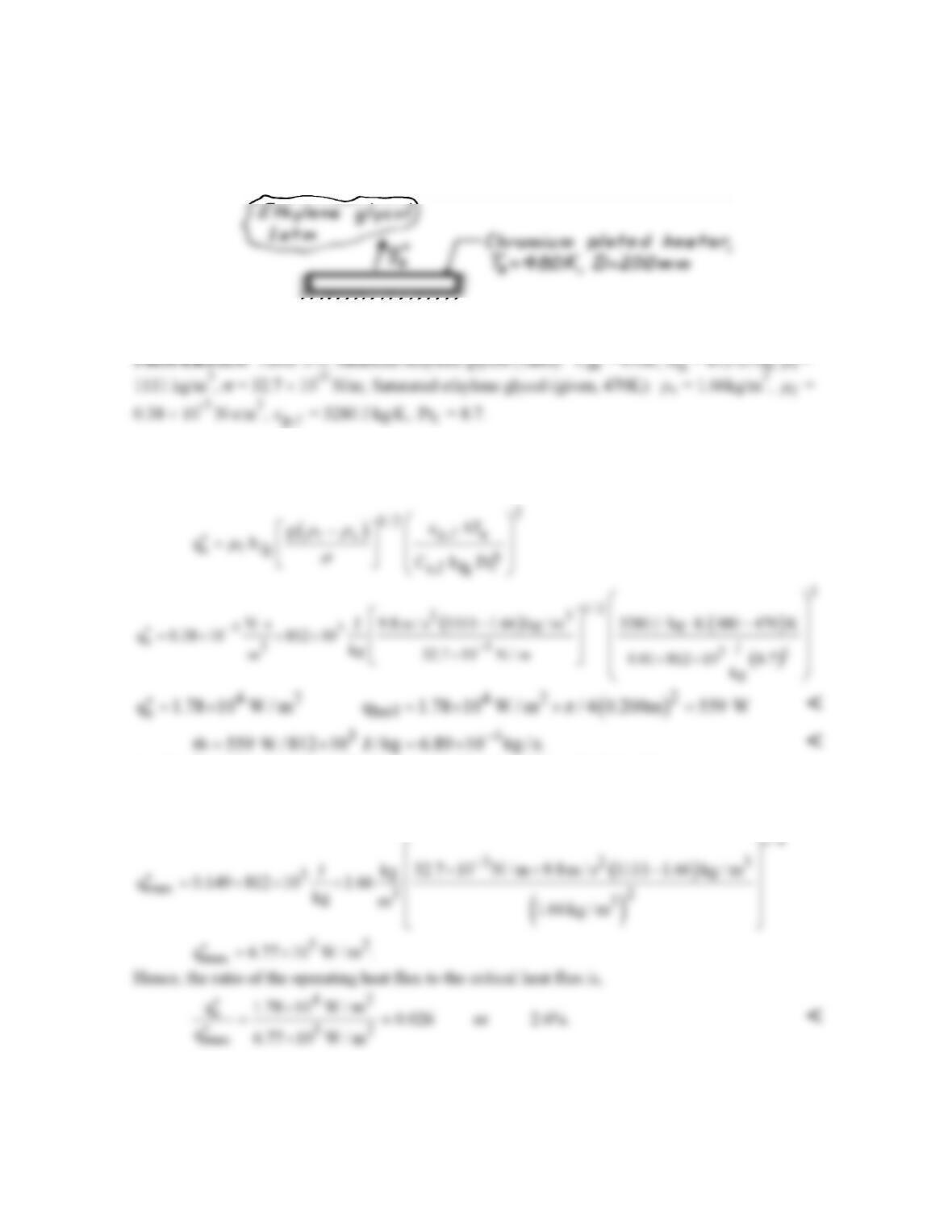
KNOWN: Saturated ethylene glycol at 1 atm heated by a chromium-plated heater of 200 mm
diameter and maintained at 480K.
FIND: Heater power, rate of evaporation, and ratio of required power to maximum power for critical
heat flux.
SCHEMATIC:
ASSUMPTIONS: (1) Nucleate pool boiling, (2) Fluid-surface, Cs,f = 0.010 and n = 1.
ANALYSIS: The power requirement for boiling and the evaporation rate are qboil =
ss
qA
′′
⋅ and
boil fg
m q /h .=
Using the Rohsenow correlation,
For this fluid, the critical heat flux is estimated from Eq. 10.6 with C=0.149,
( )
1/4
2
max fg v v v
q 0.149 h g /
ρs ρ ρ ρ
′′ = −
COMMENTS: Recognize that the results are crude approximations since the values for Cs,f and n
are just estimates. This fluid is not normally used for boiling processes since it decomposes at higher
temperatures.
PROBLEM 10.14
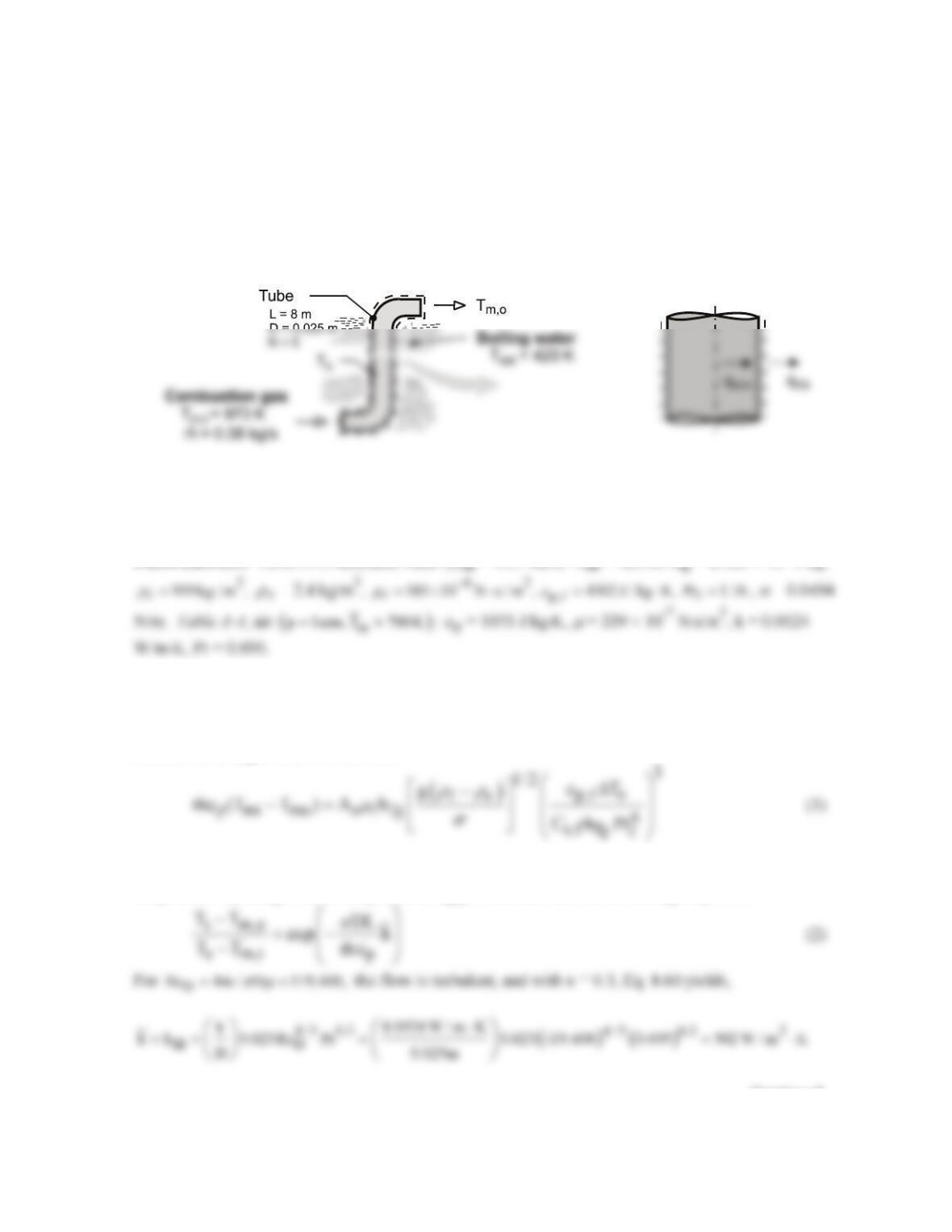
KNOWN: Diameter and length of tube submerged in pressurized water. Water pressure. Flowrate
and inlet temperature of gas flow through the tube.
FIND: Tube wall and gas outlet temperatures for (a) new, scored tube surfaces and (b) aged
conditions with smooth tube walls.
SCHEMATIC:
ASSUMPTIONS: (1) Steady-state, (2) Uniform tube wall temperature, (3) Nucleate boiling at outer
surface of tube, (4) Fully developed flow in tube, (5) Combustion gas is ideal with negligible viscous
dissipation and pressure work, (6) Constant properties, (7) Thin tube wall.
PROPERTIES: Table A-6, saturated water (psat = 4.37 bars): Tsat = 420 K, hfg = 2.123 × 10⁶ J/kg,
ANALYSIS: (a) From an energy balance performed for a control surface that bounds the tube, we
know that the rate of heat transfer by convection from the gas to the inner surface must equal the rate
of heat transfer due to boiling at the outer surface. Hence, from Eqs. 8.34 and 10.5, the energy
balance for a single tube is of the form
where
s,f
C 0.0068=
and n = 1.0 from Table 10.1. The corresponding unknowns are the wall
temperature Ts and gas outlet temperature, Tm,o, which are also related through Eq. 8.41b.
Continued…
PROBLEM 10.14 (Cont.)
Solving Eqs. (1) and (2), we obtain
COMMENTS: (1) The heat rate per tube in part (a) is
p
q mc=
(Tm,i – Tm,o) = 46,100 W, and the
total heat rate is Nq = 230,500 W, in which case the rate of steam production is
steam fg
m q / h 0.109 kg / s.= =
(2) The boiling heat transfer coefficient, hboil =
s
q′′
/(Ts – Tsat), is 2.5 ×
PROBLEM 10.15
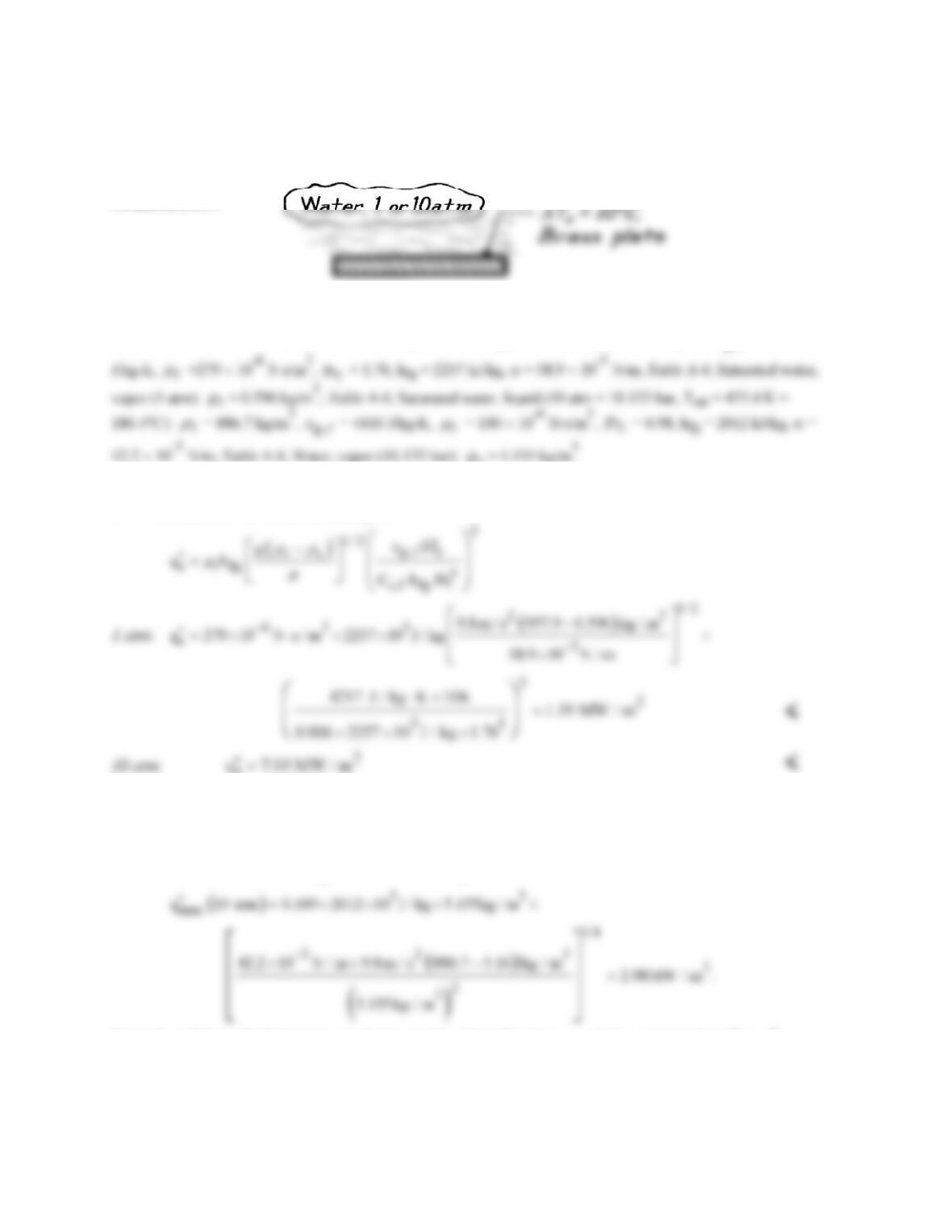
KNOWN: Saturated water boiling on a brass plate maintained at ΔTe = 10°C.
FIND: Power required (W/m2) for pressures of 1 and 10 atm; fraction of critical heat flux at which plate is
operating.
SCHEMATIC:
ASSUMPTIONS: (1) Nucleate pool boiling, (2) ∆Te = 10°C for both pressure levels.
PROPERTIES: Table A-6, Saturated water, liquid (1 atm, Tsat = 100°C):
ρ
= 957.9 kg/m3,
p
,
c = 4217
ANALYSIS: With ∆Te = 10°C, we expect nucleate pool boiling. The Rohsenow correlation with Cs,f = 0.006 and
n = 1.0 for the brass-water combination gives
s
From Example 10.1,
()
2
max
q1atm1.26MW/m.
′′ =To find the critical heat flux at 10 atm, use the
correlation of Eq. 10.6 with C = 0.149,
()
1/ 4
2
max fg v v v
q0.149h g / .
ρs ρ ρ ρ
′′ =−
For both conditions, the Rohsenow correlation predicts a heat flux that exceeds the maximum heat flux, max
q.
′′
Continued…

PROBLEM 10.15 (Cont.)
We conclude that the boiling condition with ∆Te = 10°C for the brass-water combination is beyond the inflection
point P (see Fig. 10.4) where the boiling heat flux is no longer proportional to 3
T∆and the assumptions used to
COMMENTS: As evident from this solution, the Rohsenhow correlation should not be used outside its range of
intended application.
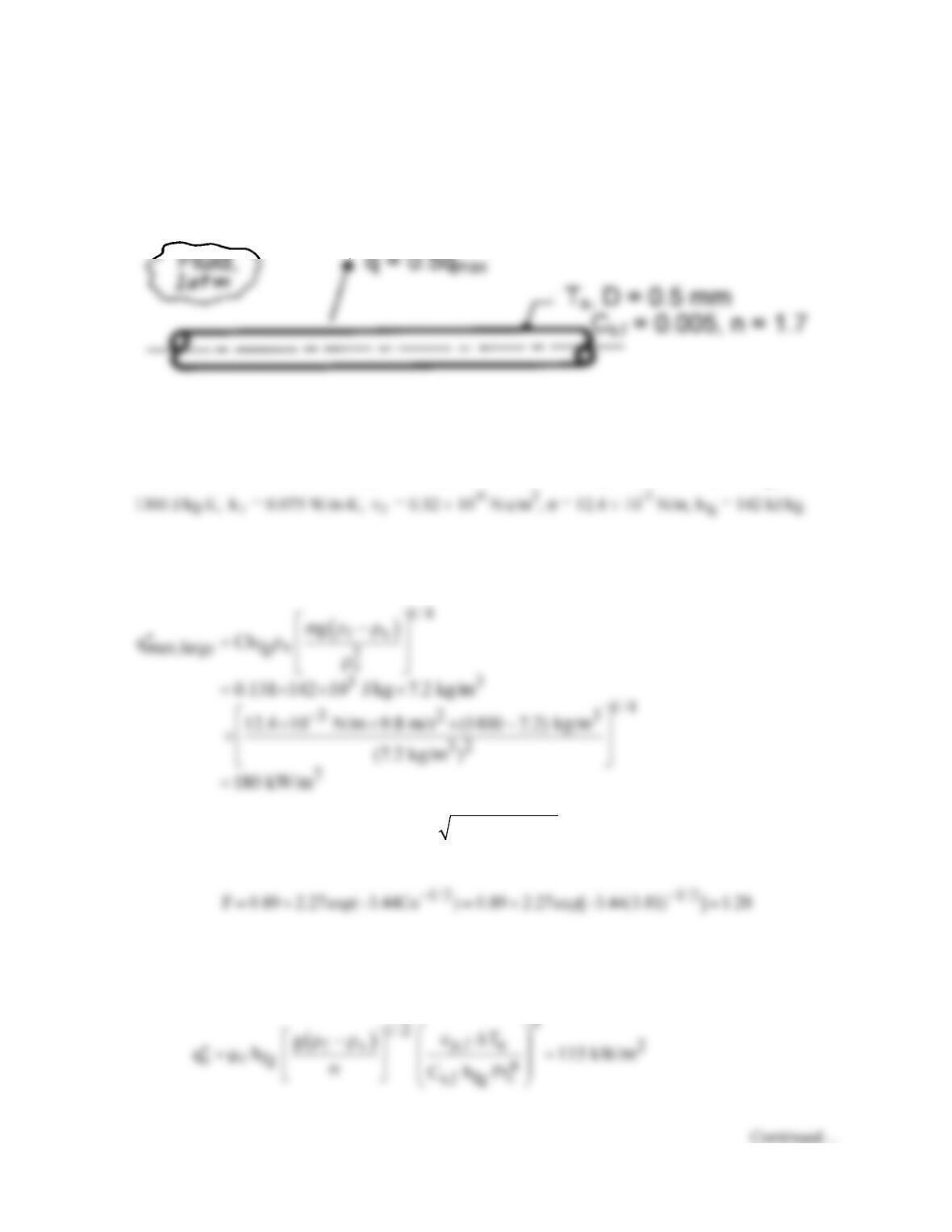
PROBLEM 10.16
KNOWN: Properties of dielectric fluid boiling at 1 atm on a horizontal platinum wire of 0.5 mm
diameter. Nucleate boiling constants. Correction factor for small horizontal cylinders.
FIND: Temperature of wire when heated at 50% of critical heat flux.
SCHEMATIC:
ASSUMPTIONS: (1) Steady–state conditions. (2) Nucleate pool boiling.
PROPERTIES: Dielectric fluid, given: Tsat = 34°C,
ρ
= 1400 kg/m3, ρv = 7.2 kg/m3,
p,
c
=
ANALYSIS: The critical heat flux for a large horizontal cylinder can be estimated using Eq. 10.6,
with C = 0.131.
The Confinement number is given by
v
Co /[g( )] / R 3.81= s ρ −ρ =
, which is in the range of
applicability of the expression for the correction factor, F,
The wire is operated at 50% of the critical heat flux or,
22
s max,large
q 0.5Fq 0.5 1.28 180 kW/m 115 kW/m
′′ ′′
= =×× =
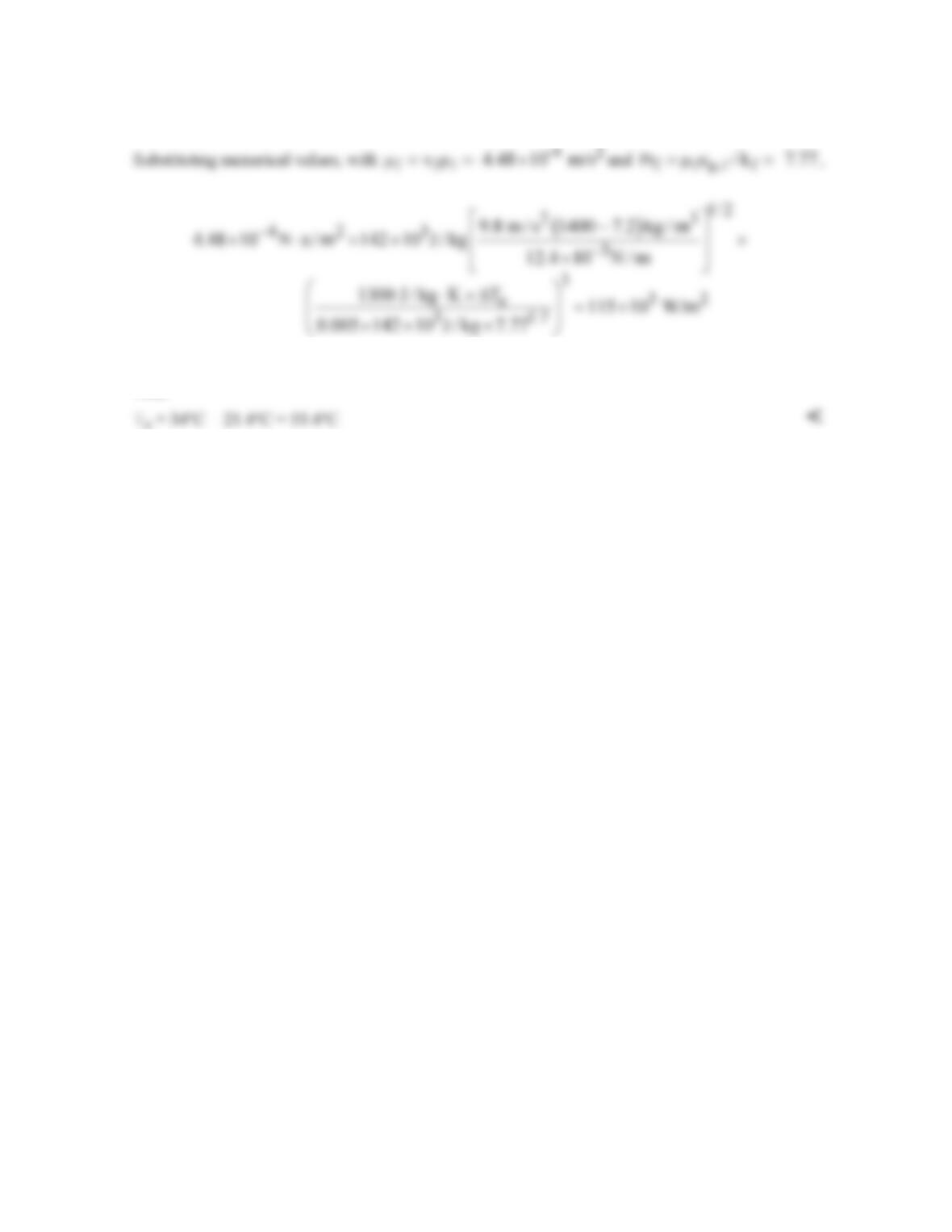
The excess temperature can then be found from Eq. 10.5, the Rohsenow correlation,
PROBLEM 10.16 (Cont.)
e
T 21.4 C∆= °
Thus
COMMENTS: The critical heat flux on the small wire is 28% higher than on a large cylinder.
PROBLEM 10.17
KNOWN: Zuber-Kutateladze correlation for critical heat flux,
max
q.
′′
FIND: Pressure dependence of
max
q′′
for water; demonstrate maximum value occurs at
approximately 1/3 pcrit; suggest coordinates for a universal curve to represent other fluids.
ASSUMPTIONS: Nucleate pool boiling conditions.
PROPERTIES: Table A-6, Water, saturated at various pressures; see below.
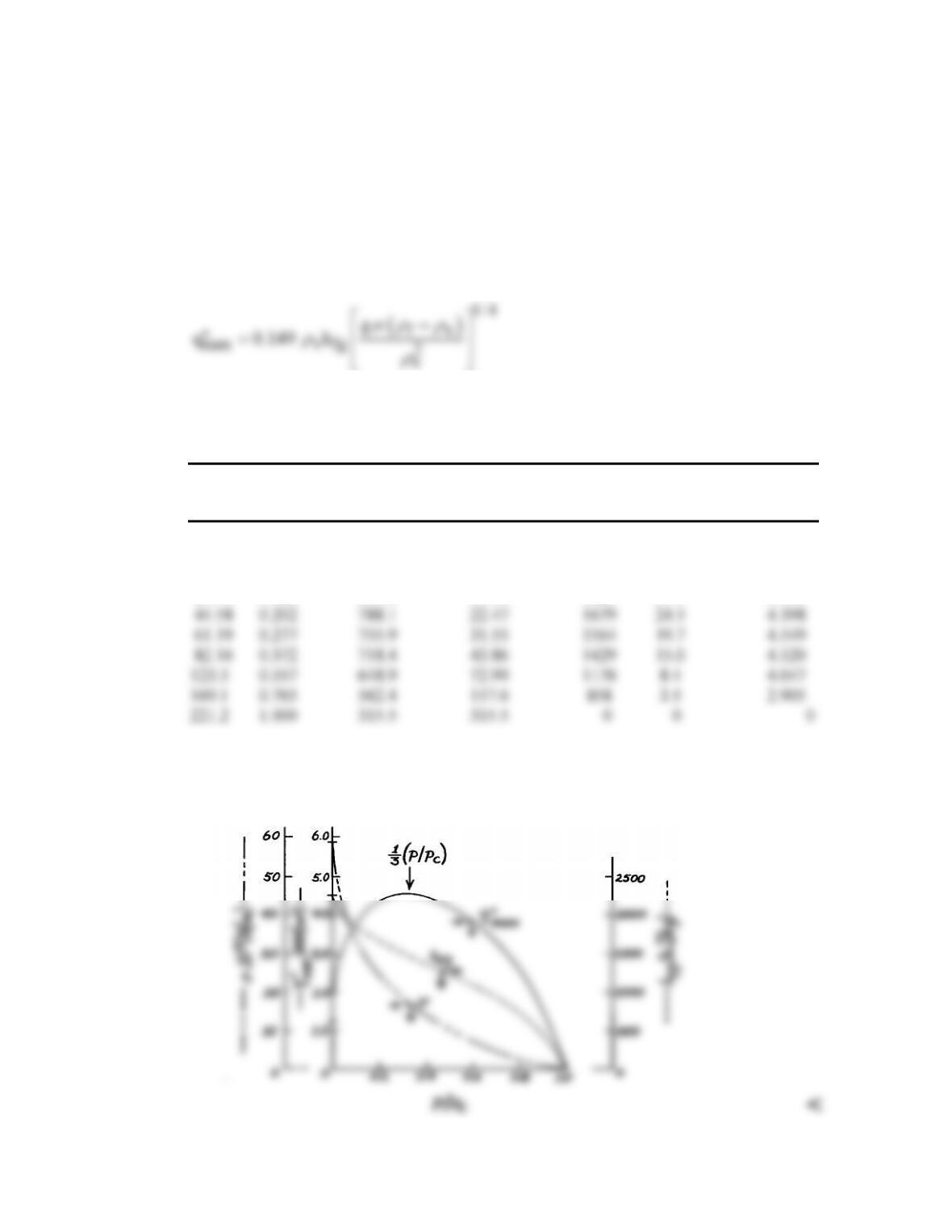
ANALYSIS: The Z-K correlation for estimating the critical heat flux, has the form
where the properties for saturation conditions are a function of pressure. The properties (Table A-6)
and the values for
max
q′′
are as follows:
p p/pc
ρ
v
ρ
hfg s×103
max
q′′
(bars) (kg/m3) (kJ/kg) (N/m) (MW/m2)
1.01 0.0045 957.9 0.5955 2257 58.9 1.258
11.71 0.053 879.5 5.988 1989 40.7 3.138
26.40 0.120 831.3 13.05 1825 31.6 3.935
The
max
q′′
values are plotted as a function of p/pc, where pc is the critical pressure. Note the rapid
decrease of hfg and s with increasing pressure. The universal curve coordinates would be
max
/q
max
q′′
′′
( )
crit c
1/ 3 p vs. p / p .
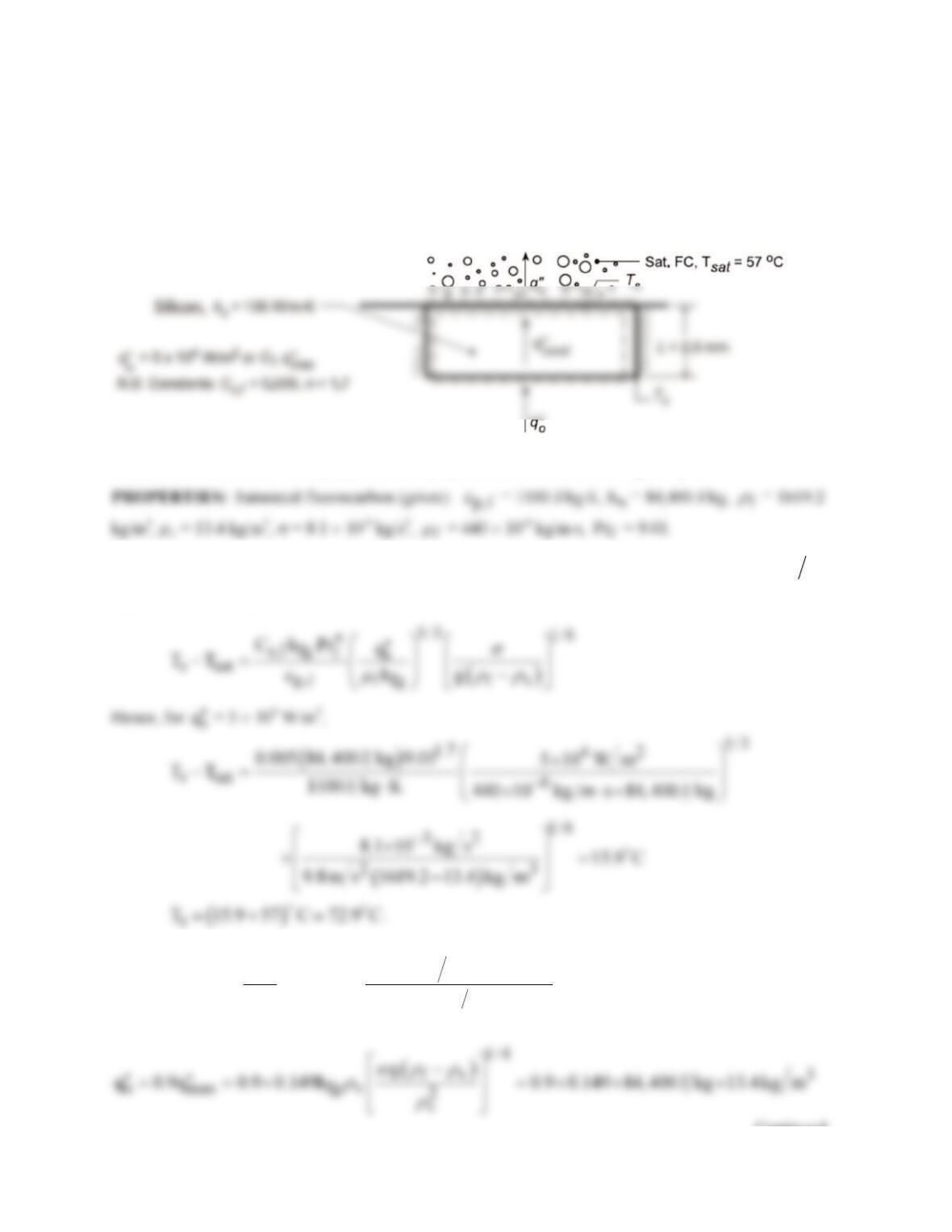
PROBLEM 10.18
KNOWN: Thickness and thermal conductivity of a silicon chip. Properties of saturated fluorocarbon
liquid.
FIND: (a) Temperature at bottom surface of chip for a prescribed heat flux and 90% of CHF, (b) Effect
of heat flux on chip surface temperatures; maximum allowable heat flux.
SCHEMATIC:
ASSUMPTIONS: (1) Steady-state conditions, (2) Uniform heat flux and adiabatic sides, hence one-
dimensional conduction in chip, (3) Constant properties, (4) Nucleate boiling in liquid.
ANALYSIS: (a) Energy balances at the top and bottom surfaces yield
( )
o cond s o s
q q kT T L
′′ ′′
= = −
=
s
q′′
; where Ts and
s
q′′
are related by the Rohsenow correlation,
s
q′′
From Fourier’s law,
42
o
os s
qL 5 10 W m 0.0025 m
T T 72.9 C 73.8 C
k 135 W m K
′′ ××
=+= + =
⋅
<
For a heat flux which is 90% of the critical heat flux (C1 = 0.9), it follows that
Continued…
PROBLEM 10.18 (Cont.)
From the results of the previous calculation and the Rohsenow correlation, it follows that
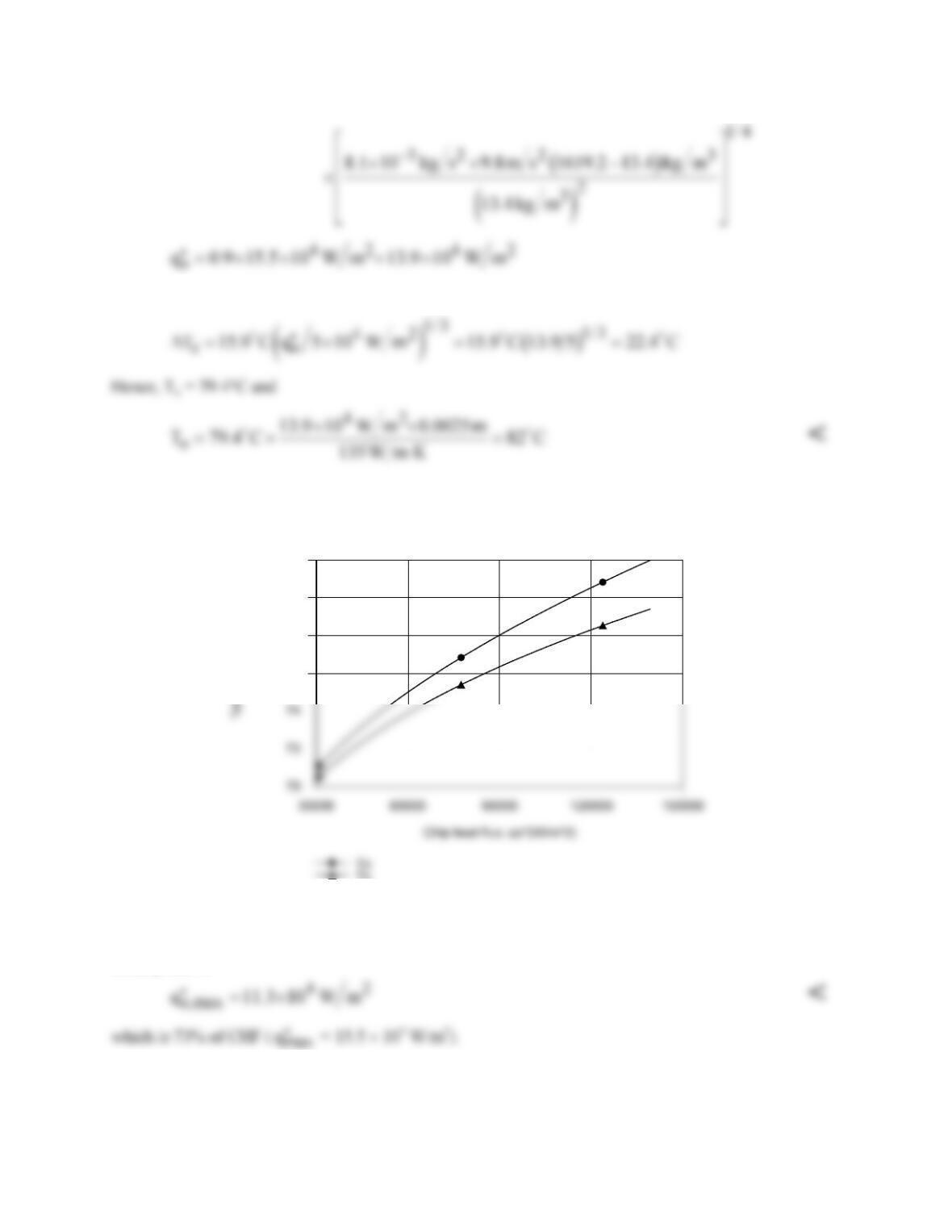
(b) Using the energy balance equations with the Correlations Toolpad of IHT to perform the parametric
calculations for 0.2 ≤ C1 ≤ 0.9, the following results are obtained.
76
78
80
82
Ts
The chip surface temperatures, as well as the difference between temperatures, increase with increasing
heat flux. The maximum chip temperature is associated with the bottom surface, and To = 80°C
corresponds to
COMMENTS: Many of today’s VLSI chip designs involve heat fluxes well in excess of 15 W/cm2, in
which case pool boiling in a fluorocarbon would not be an appropriate means of heat dissipation.
PROBLEM 10.19
KNOWN: Operating conditions of apparatus used to determine surface boiling characteristics.
FIND: (a) Nucleate boiling coefficient for special coating, (b) Surface temperature as a function of heat
flux; apparatus temperatures for a prescribed heat flux; applicability of nucleate boiling correlation for a
specified heat flux.
SCHEMATIC:
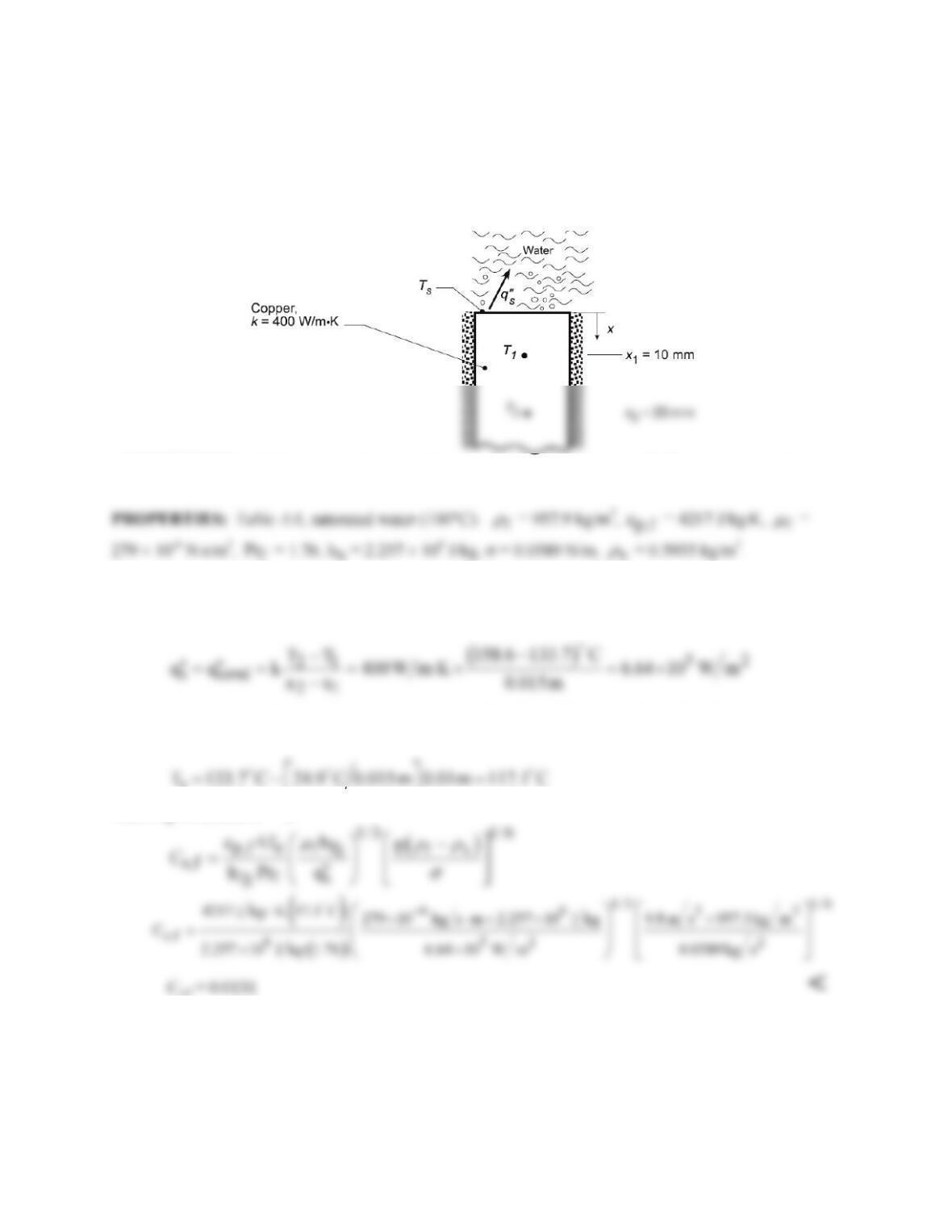
ASSUMPTIONS: (1) One-dimensional, steady-state conduction in the bar, (2) Water is saturated at 1
atm, (3) Applicability of Rohsenow correlation with n = 1.
ANALYSIS: (a) The coefficient Cs,f associated with Eq. 10.5 may be determined if
s
q′′
and Ts are
known. Applying Fourier’s law between x1 and x2,
Since the temperature distribution in the bar is linear, Ts = T1 – (dT/dx)x1 = T1 – [(T2 – T1)/(x2 – x1)]x1.
Hence,
s
From Eq. 10.5, with n = 1,
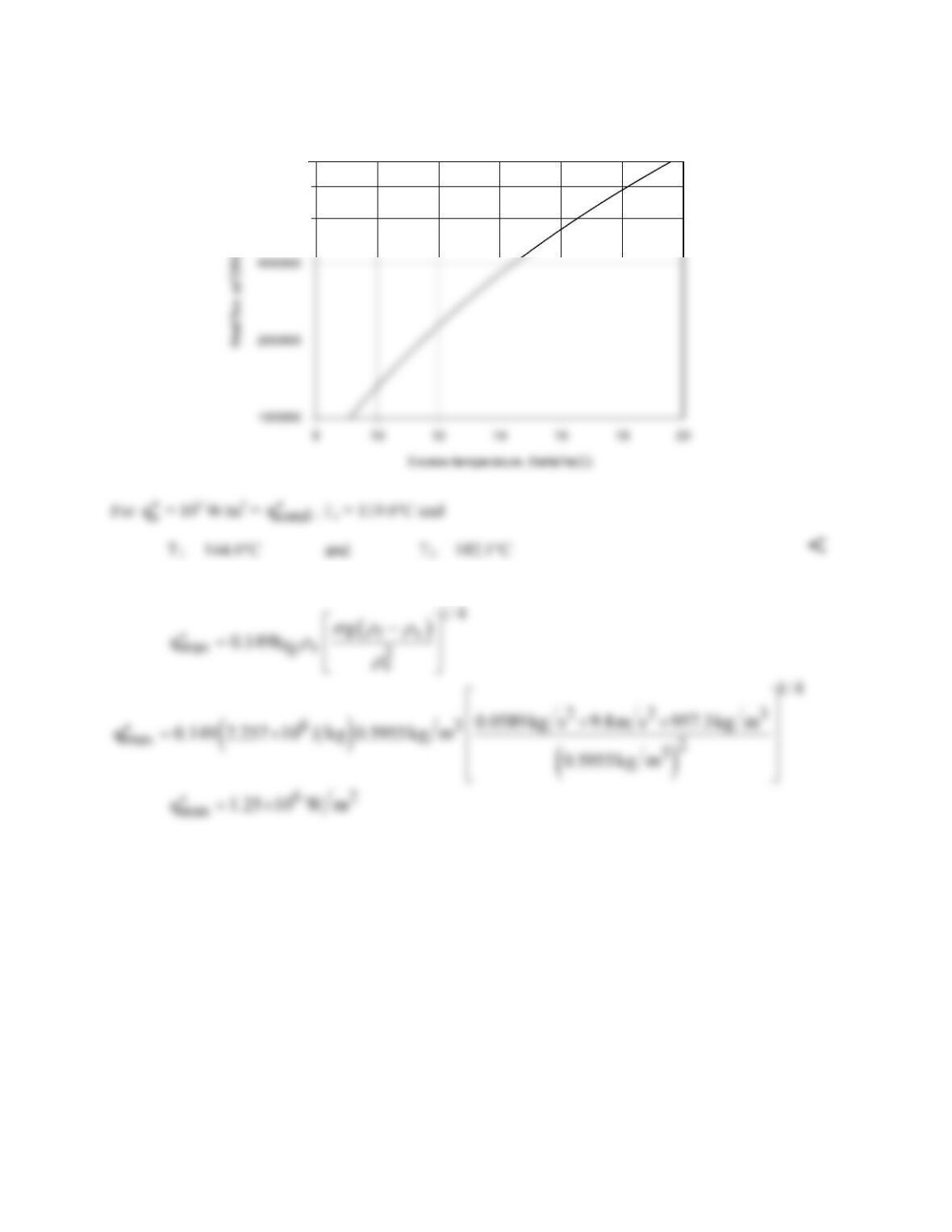
(b) Using the appropriate IHT Correlations and Properties Toolpads, the following portion of the
nucleate boiling regime was computed.
Continued…
PROBLEM 10.19 (Cont.)
600000
800000
1E6
With the critical heat flux given by Eq. 10.6 with C=0.149,
Since
s
q′′
= 1.5 × 10⁶ W/m2 >
max
q′′
, the heat flux exceeds that associated with nucleate boiling and the
foregoing results cannot be used. <
COMMENTS: For
s max
qq
′′ ′′
>
, conditions correspond to film boiling, for which Ts may exceed
acceptable operating conditions.
s
q′′
PROBLEM 10.20
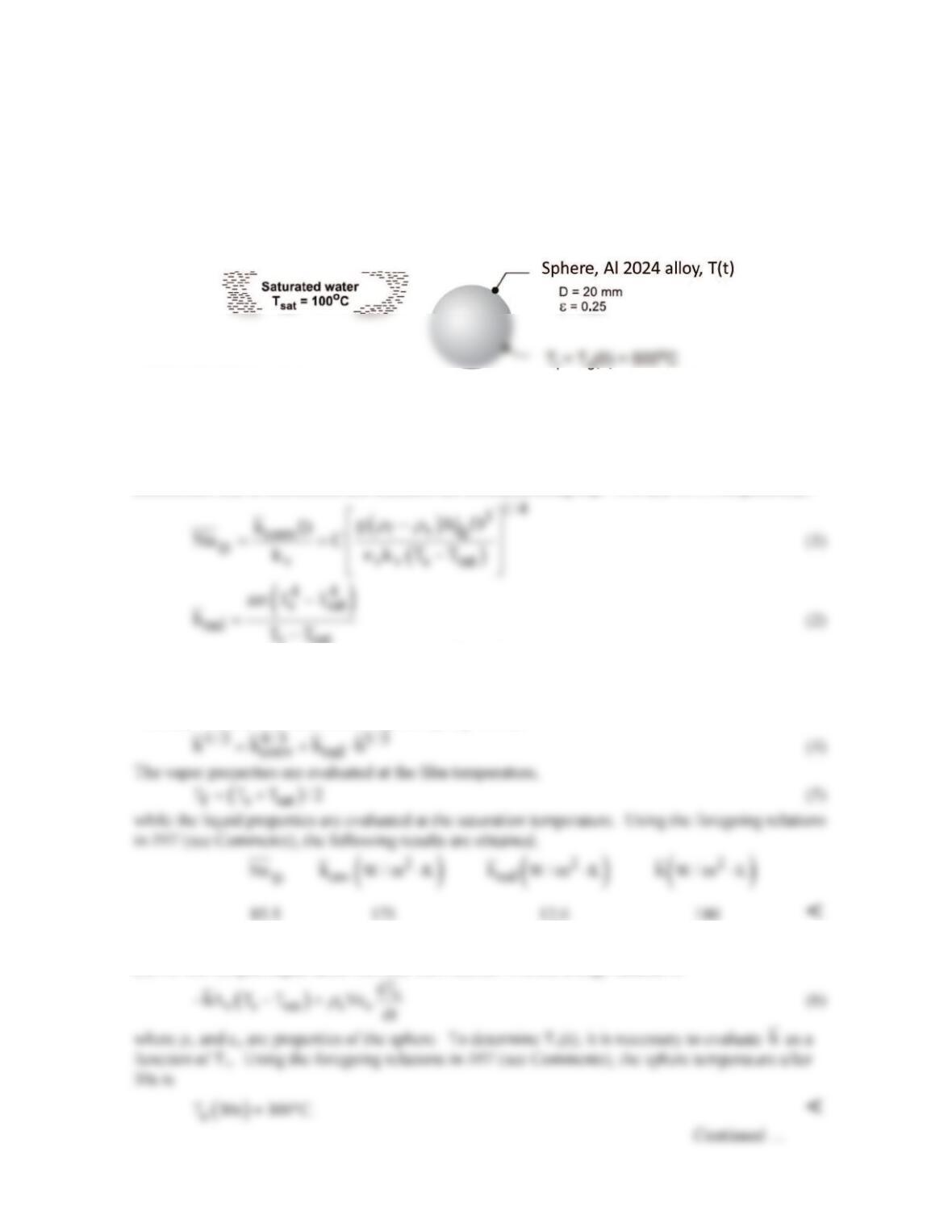
KNOWN: A sphere (aluminum alloy 2024) with a uniform temperature of 500°C and emissivity of
0.25 is suddenly immersed in a saturated water bath maintained at atmospheric pressure.
FIND: (a) The total heat transfer coefficient for the initial condition; fraction of the total coefficient
contributed by radiation; and (b) Estimate the temperature of the sphere 30 s after it has been
immersed in the bath.
SCHEMATIC:
ASSUMPTIONS: (1) Water exposed to standard atmospheric pressure and uniform temperature,
Tsat, and (2) Lumped capacitance method is valid.
PROPERTIES: See Comment 2; properties obtained with IHT code.
ANALYSIS: (a) For the initial condition with Ts = 500°C, film boiling will occur and the
coefficients due to convection and radiation are estimated using Eqs. 10.8 and 10.11, respectively,
where C = 0.67 for spheres and s = 5.67 × 10⁻⁸ W/m2⋅K4. The corrected latent heat is
( )
fg fg p,v s sat
h h 0.8 c T T
′=+−
(3)
The total heat transfer coefficient is given by Eq. 10.9 as
The radiation process contribution is 6.7% that of the total heat rate.
(b) For the lumped-capacitance method, from Section 5.3, the energy balance is
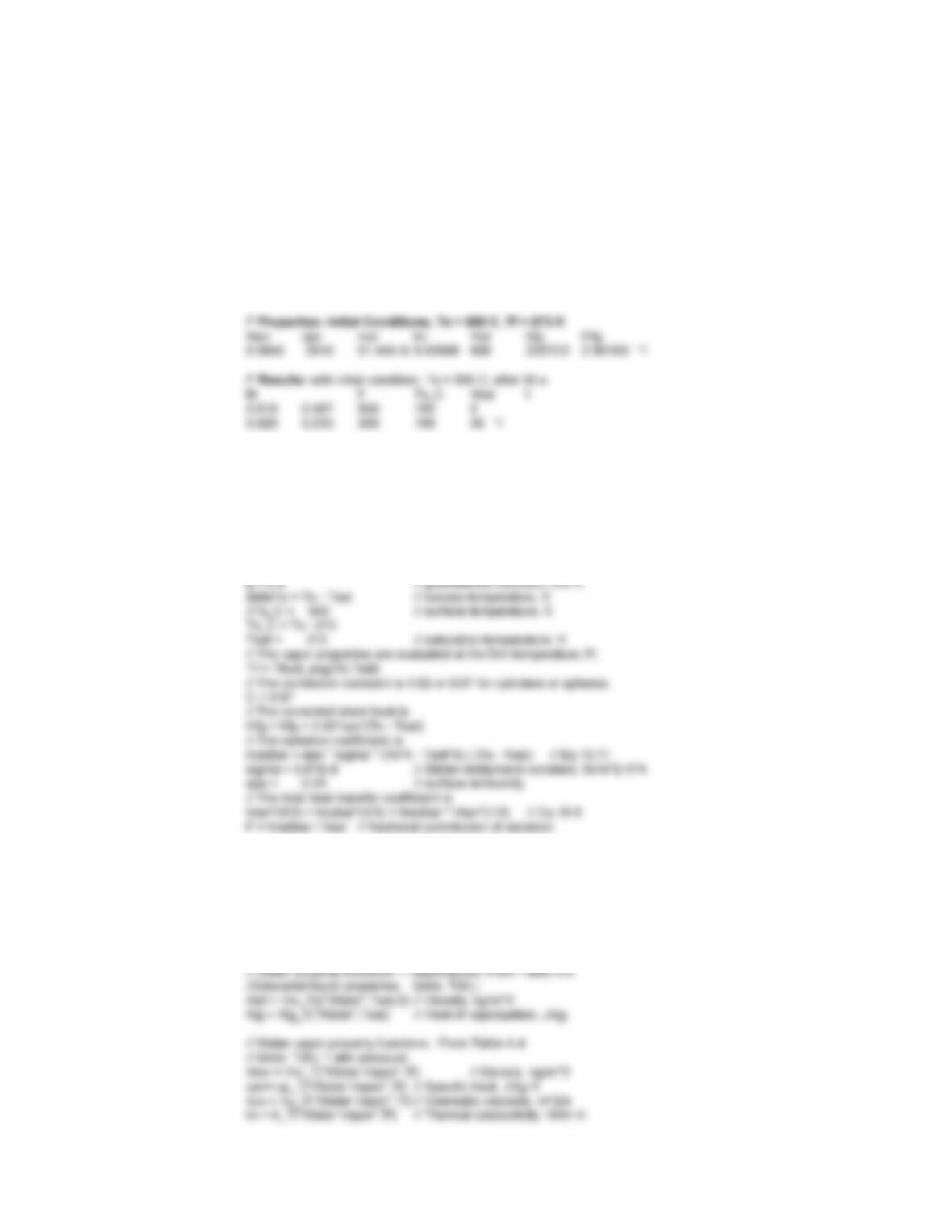
PROBLEM 10.20 (Cont.)
COMMENTS: (1) The Biot number associated with the aluminum alloy sphere cooling process for
the initial condition is Bi = 0.019. Hence, the lumped-capacitance method is valid.
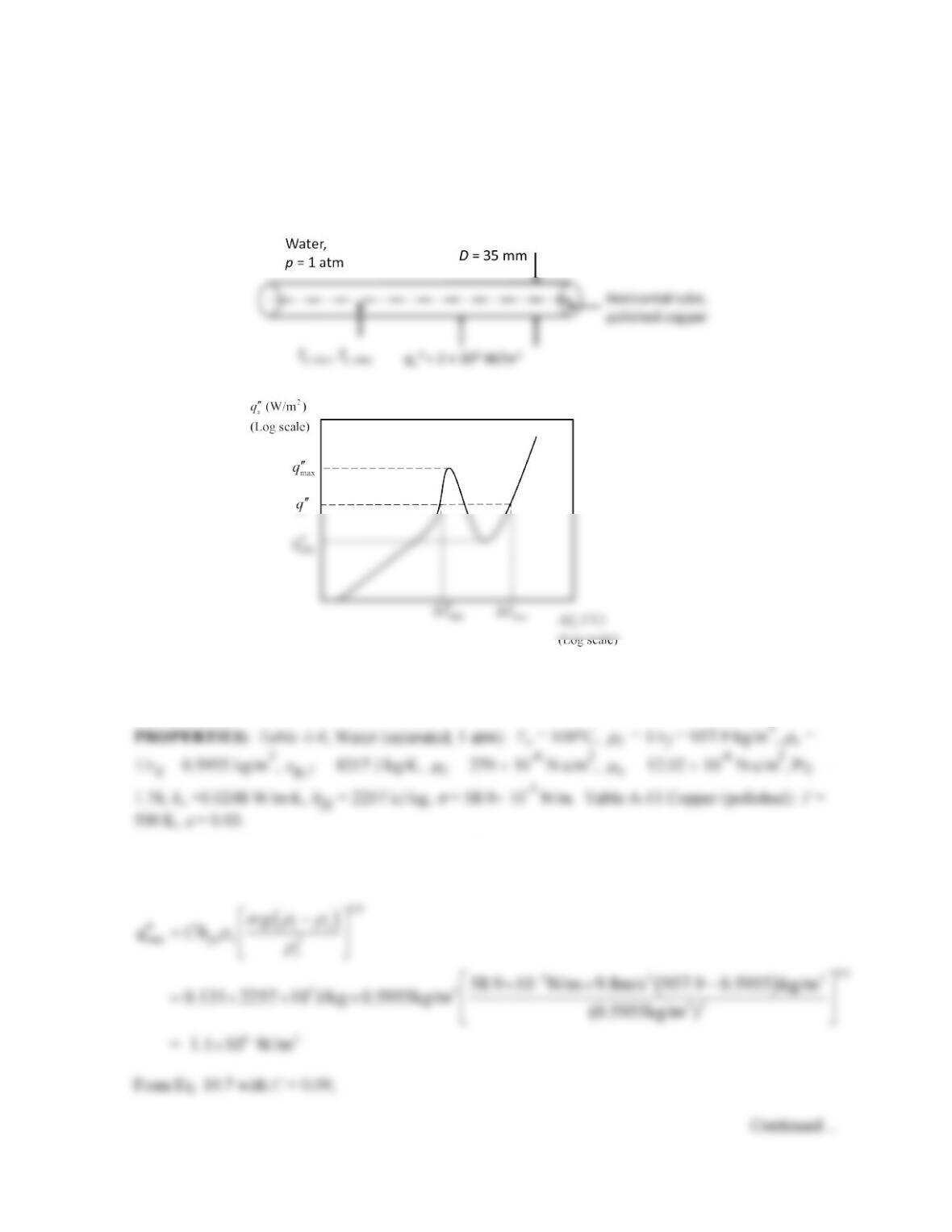
(2) The IHT code to solve this application uses the film–boiling correlation, the water
properties functions, and the lumped capacitance energy balance, Eq. (6). The results for
part (a), including the properties required of the correlation, are shown at the outset of the
code.
/* Results, Part (a): Initial conditions, Ts = 500 C
NuDbar hbar hcvbar hradbar F
85.5 180 171 12.0 0.0667 /*
//LCM analysis, energy balance
–hbar*As*(Ts–Tsat) = rhos * Vol * cps * der(Ts,t)
As = pi*D^2
Vol = pi*D^3/6
/* Correlation description: coefficients for film pool boiling (FPB). Eqs. 10.8, 10.9, and
10.11. See boiling curve, Fig. 10.4. */
NuDbar = NuD_bar_FPB(C,rhol,rhov,h’fg,nuv,kv,deltaTe,D,g) // Eq 10.8
NuDbar = hcvbar * D / kv
// Input variables
D = 0.020
rhos = 2702 // Sphere properties, aluminum alloy 2024
cps = 875
ks = 186
Bi = hbar * D / ks
// Water properties
PROBLEM 10.21
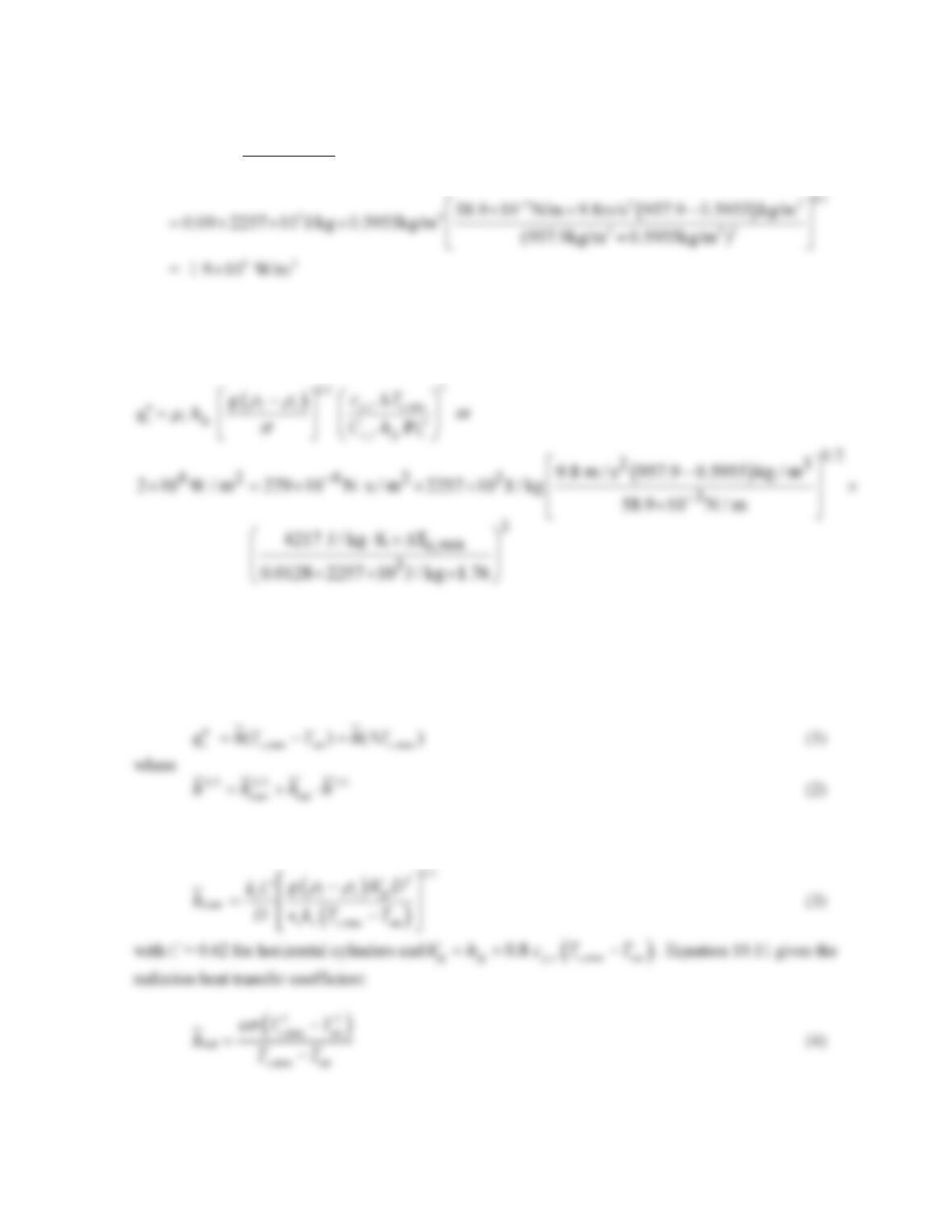
KNOWN: Polished horizontal copper tube of known diameter and heat flux that is exposed to water
at p = 1 atm.
FIND: Minimum and maximum possible surface temperatures.
SCHEMATIC:
ASSUMPTIONS: (1) Steady–state conditions, (2) Water at uniform temperature of Tsat = 100°C, (3)
Long tube, (4) Assume C = 0.09 for calculating the minimum heat flux for horizontal tube.
ANALYSIS: The minimum and maximum heat fluxes are determined in order to discern where on
the boiling curve the process might occur. From Eq. 10.6 with C = 0.131,
PROBLEM 10.21 (Cont.)
( )
( )
1/4
min 2
lv
fg v
lv
g
q Ch
sρρ
ρρρ
−
′′ =
+
Since the specified heat flux is bracketed by the minimum and maximum flux values, the minimum
excess temperature corresponds to nucleate boiling as shown in the schematic. From Eq. 10.5 with Cs,f
= 0.0128 and n = 1,
from which ∆Te,min = Ts,min – Tsat = 5.2°C and Ts, min = 105.2°C. <
The maximum excess temperature corresponds to film boiling as shown in the schematic. For film
boiling, the heat flux is expressed as
Equation 10.8 is used for the convection heat transfer coefficient:
where
s
= 5.67 × 10⁻⁸ W/m2⋅K4 (the Stefan–Boltzmann constant, not the surface tension).
Continued…
PROBLEM 10.21 (Cont.)
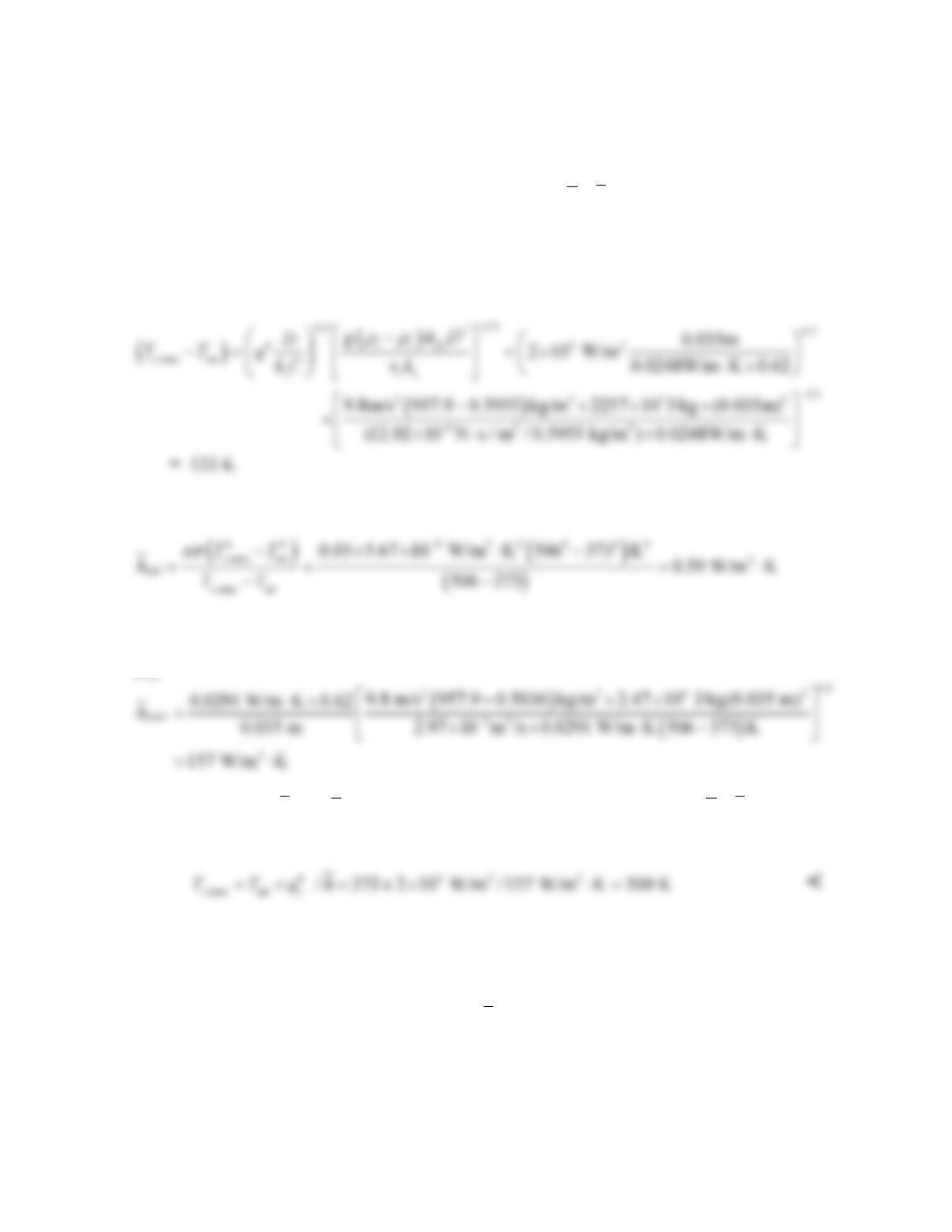
It is challenging to solve for the surface temperature in film boiling because of the non-linear
temperature dependence of radiation. Since the specified heat flux is not much higher than the
minimum heat flux, the surface temperature should be near the low end of the film boiling range, and
we therefore begin by neglecting radiation, that is, we assume
conv
.hh=
This assumption will be
checked later. In keeping with the assumption that the surface temperature is not very high, we will
also neglect the latent heat correction. The vapor properties should be evaluated at the film
temperature, Tf = (Ts,max + Tsat )/2. Since we do not know Ts,max we begin by using the properties at
Tsat. Equations (1) and (3) can be combined and solved for
,max sats
TT−
:
Therefore, Ts,max = 233°C = 506 K. We can now iterate on the solution. From Eq. (4),
Vapor properties are reevaluated at Tf = 439.5 K, which gives
ρ
v = 0.5036 kg/m3,
n
v = 2.97 × 10⁻⁵
m2/s, kv = 0.0291 W/m⋅K, cp,v = 1987 J/kg⋅K. Then from Eq. (5), h′fg = 2.47 × 10⁶ J/kg and from Eq.
(3),
Our assumption that
rad conv
hh
was quite accurate, therefore we continue to use
conv
.hh=
Finally,
Ts,max can be found from Eq. (1):
The surface temperature is reasonably well converged.
COMMENTS: (1) The boiling occurs at a heat flux slightly above the minimum value, so that both
the nucleate and the film boiling occur at relatively low surface temperatures. (2) Further iteration for
the film boiling solution yields Ts,max = 499 K with
conv
h
= 159 W/m2∙K. (3) Vapor property values for
the converged film boiling solution are:
ρ
v = 0.508 kg/m3,
n
v = 2.92 × 10⁻⁵ m2/s, cp,v = 1989 J/kg∙K,
and kv = 0.0288 W/m∙K.
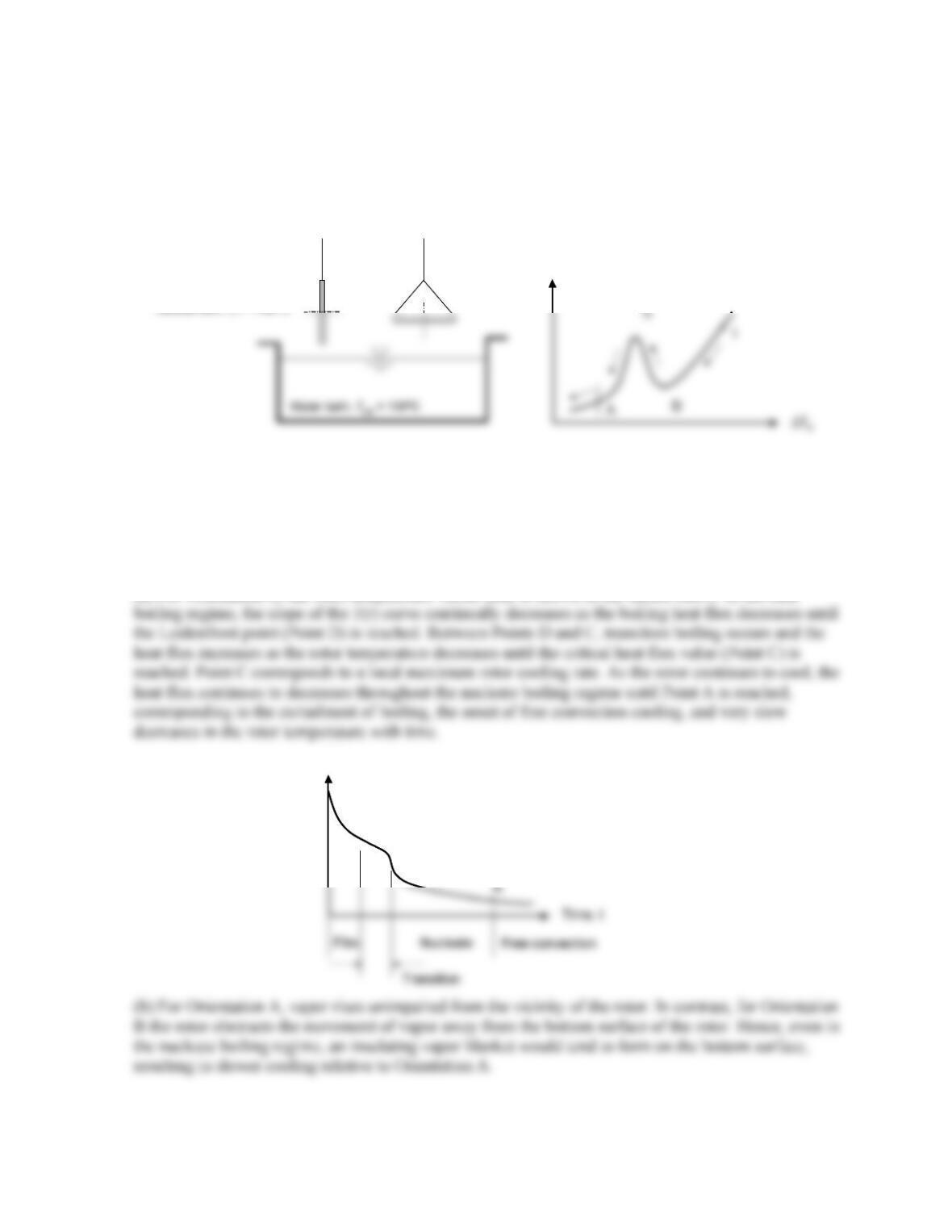
PROBLEM 10.22
KNOWN: Initial temperature of hot rotor, temperature of water quenching bath, rotor orientation.
FIND: (a) Sketch of the rotor temperature versus time for Orientation A, (b) Relative cooling rate of
the rotor for Orientation B.
SCHEMATIC:
ASSUMPTIONS: (1) Lumped capacitance behavior, (2) Constant properties.
ANALYSIS: Assuming lumped capacitance behavior for the rotor, the time rate of change of the
rotor temperature is proportional to the instantaneous heat flux from the rotor surface. In either
orientation, the quenching process begins at an initial rotor temperature associated with film boiling
(see Fig. 10.4 and the RHS schematic).
(a) For Orientation A, the rotor temperature versus time is shown in the sketch below. In the film
COMMENTS: The boiling correlations presented in the text do not apply to the bottom surface of the
rotor.
q
s
“
q
s
“
T(t)
•
•
•
i
D
C
T(t)
•
•
•
i
D
C
Tur bine dis k, T
= 1100°C
Orientation A Orientation B
Tur bine dis k, T
= 1100°C
Orientation A Orientation B
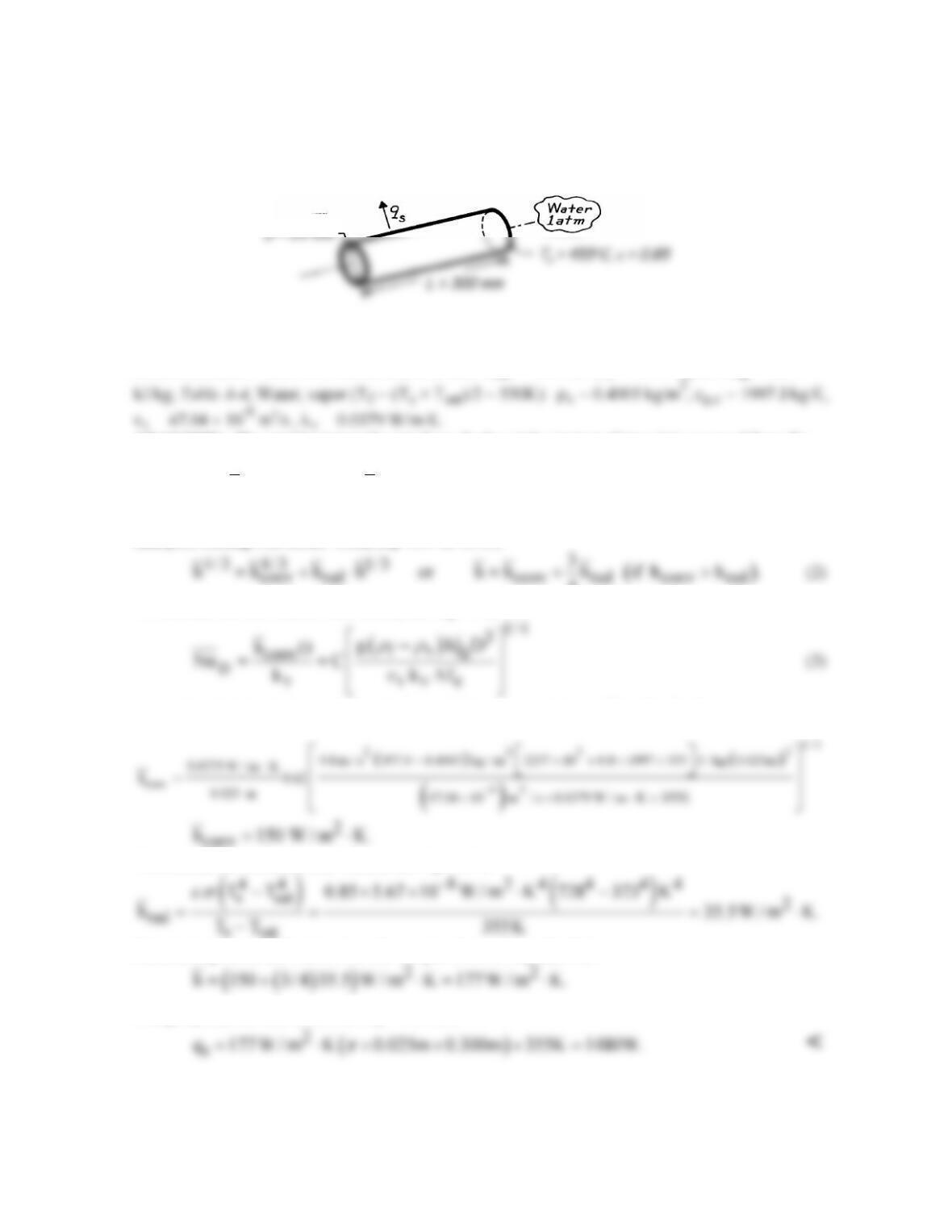
PROBLEM 10.23
KNOWN: Steel bar upon removal from a furnace immersed in water bath.
FIND: Initial heat transfer rate from bar.
SCHEMATIC:
ASSUMPTIONS: (1) Uniform bar surface temperature, (2) Film pool boiling conditions.
PROPERTIES: Table A-6, Water, liquid (1 atm, Tsat = 100°C):
ρ
= 957.9 kg/m3, hfg = 2257
ANALYSIS: The total heat transfer rate from the bar at the instant of time it is removed from the
furnace and immersed in the water is
( )
s s s sat s e
q hA T T hA T= −=∆
(1)
where ∆Te = 455 – 100 = 355K. According to the boiling curve of Figure 10.4, with such a high ∆Te,
film pool boiling will occur. From Eq. 10.9 or 10.10,
4
To estimate the convection coefficient, use Eq. 10.8,
where C = 0.62 for the horizontal cylinder and
( )
fg fg p,v s sat
h h 0.8 c T T .
′=+−
Find
To estimate the radiation coefficient, use Eq. 10.11,
Substituting numerical values into the simpler form of Eq. (2), find
Using Eq. (1), the heat rate, with As = π D L, is
COMMENTS: For these conditions, the combined radiation and convection heat transfer coefficient
is 18% larger than the convection coefficient alone.
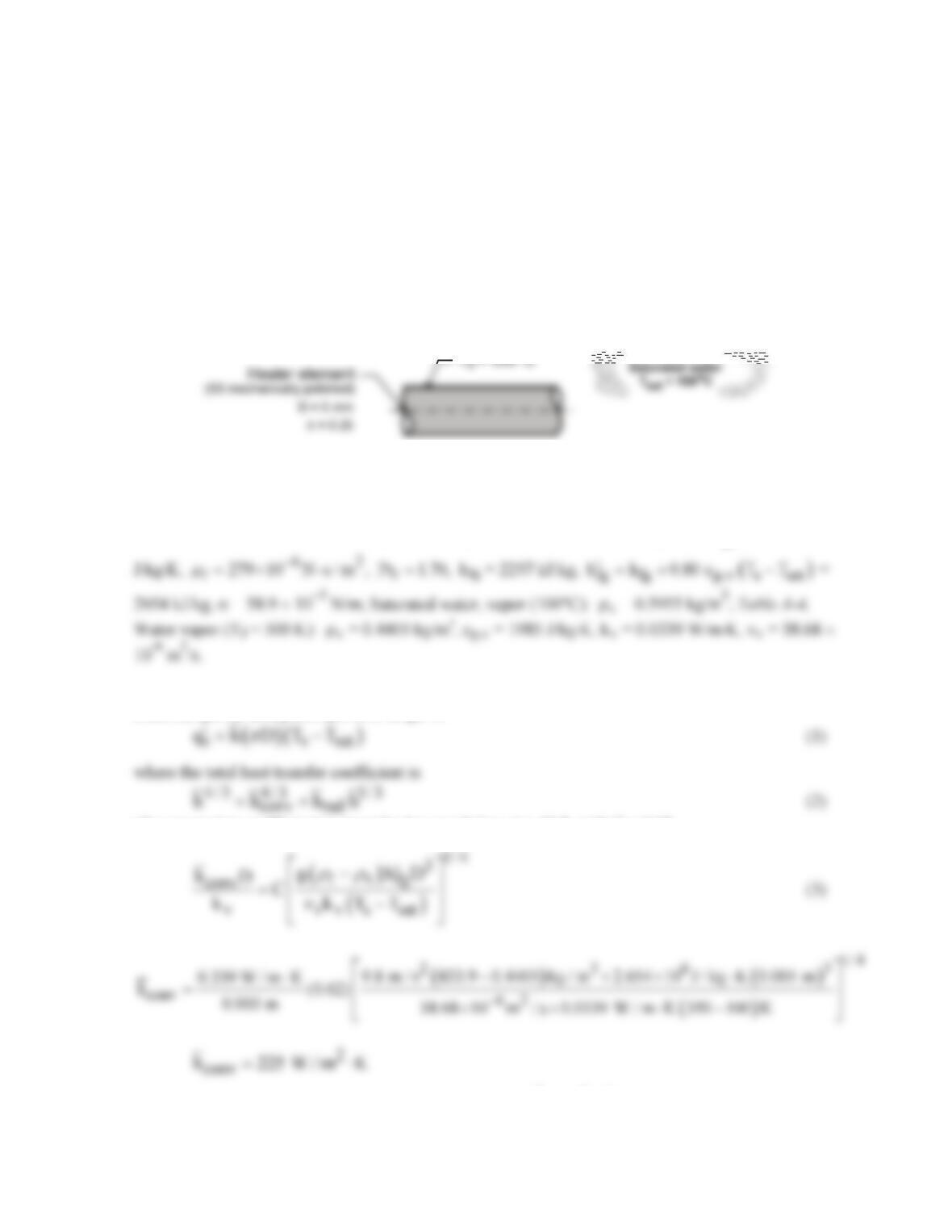
PROBLEM 10.24
KNOWN: Heater element of 5–mm diameter maintained at a surface temperature of 350°C when
immersed in water under atmospheric pressure; element sheath is stainless steel with a mechanically
polished finish having an emissivity of 0.25.
FIND: (a) The electrical power dissipation and the rate of evaporation per unit length; (b) If the
heater element were operated at the same power dissipation rate in the nucleate boiling regime, what
temperature would the surface achieve? Calculate the rate of evaporation per unit length for this
operating condition; and (c) Make a sketch of the boiling curve and represent the two operating
conditions of parts (a) and (b). Compare the results of your analysis. If the heater element is operated
in the power-controlled mode, explain how you would achieve these two operating conditions
beginning with a cold element.
SCHEMATIC:
ASSUMPTIONS: (1) Steady-state conditions, and (2) Water exposed to standard atmospheric
pressure and uniform temperature, Tsat.
PROPERTIES: Table A-6, Saturated water, liquid (100°C):
3
957.9 kg / m ,
ρ
=
p,
c
= 4217
ANALYSIS: (a) Since ∆Te > 120°C, the element is operating in the film-boiling (FB) regime. The
electrical power dissipation per unit length is
The convection coefficient is given by the correlation, Eq. 10.8, with C = 0.62,
The radiation coefficient, Eq. (10.11), with s = 5.67 × 10⁻⁸ W/m2⋅K4, is
Continued …