PROBLEM 10.1
KNOWN: Water at 1 atm with Ts – Tsat = 8°C.
FIND: Show that the Jakob number is much less than unity; what is the physical significance of the
result; does result apply to ethylene glycol?
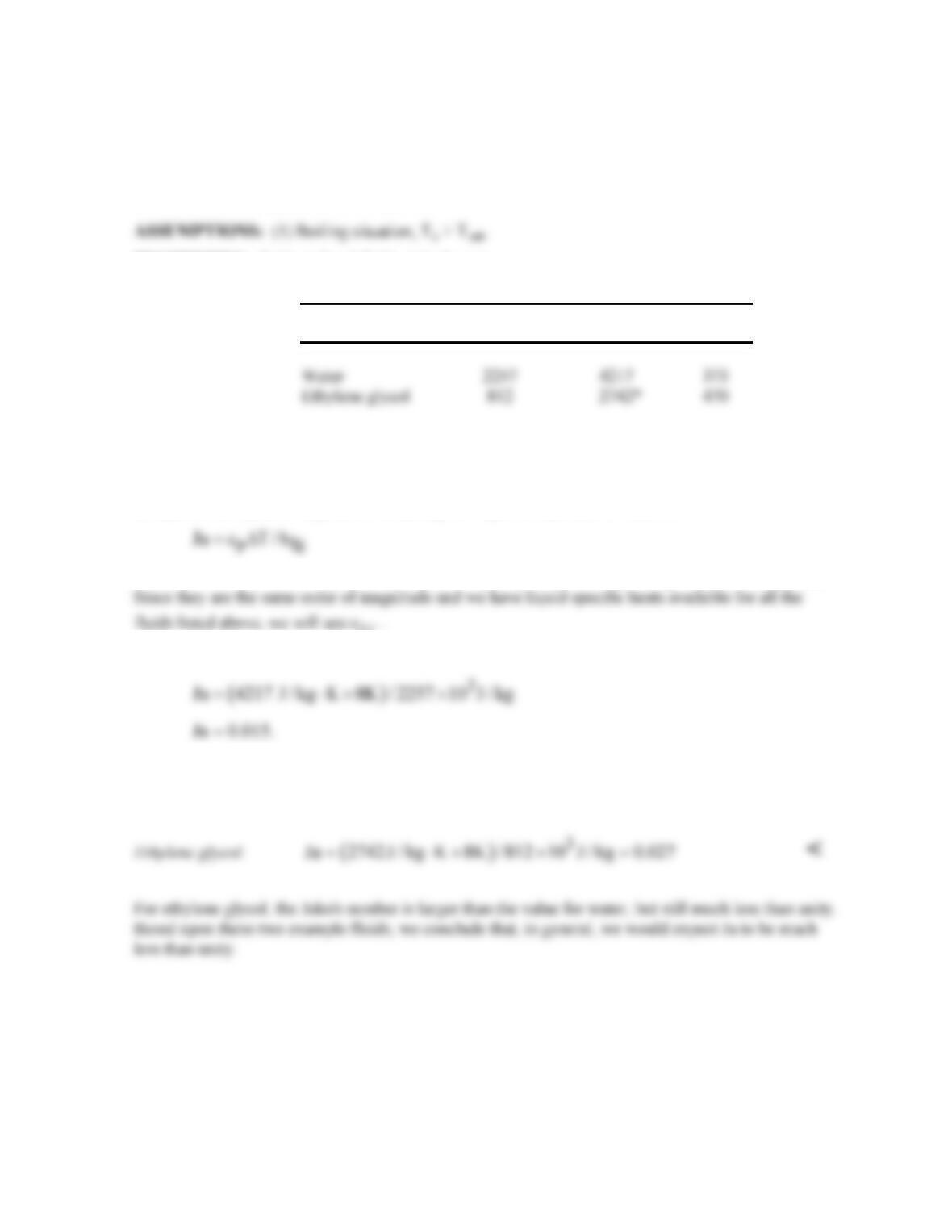
PROPERTIES: Table A-5 and Table A-6, (1 atm):
hfg (kJ/kg) cp, (J/kg⋅K) Tsat(K)
* Estimated based upon value at highest temperature cited in Table A-5.
ANALYSIS: The Jakob number is the ratio of the maximum sensible energy absorbed by the vapor
or liquid to the latent energy absorbed during boiling or condensation. That is,
The Jakob number can be based on the liquid or vapor specific heat depending on the circumstances.
For water with an excess temperature DTs = Te – T∞ = 8°C, find
Since Ja << 1, the implication is that the sensible energy absorbed by the vapor is much less than the
latent energy absorbed during the boiling phase change. Using the appropriate thermophysical
properties for ethylene glycol, the Jakob numbers is:
COMMENTS: We would expect the same low value of Ja for the condensation process since cp,g
and cp,f are of the same order of magnitude.
PROBLEM 10.2
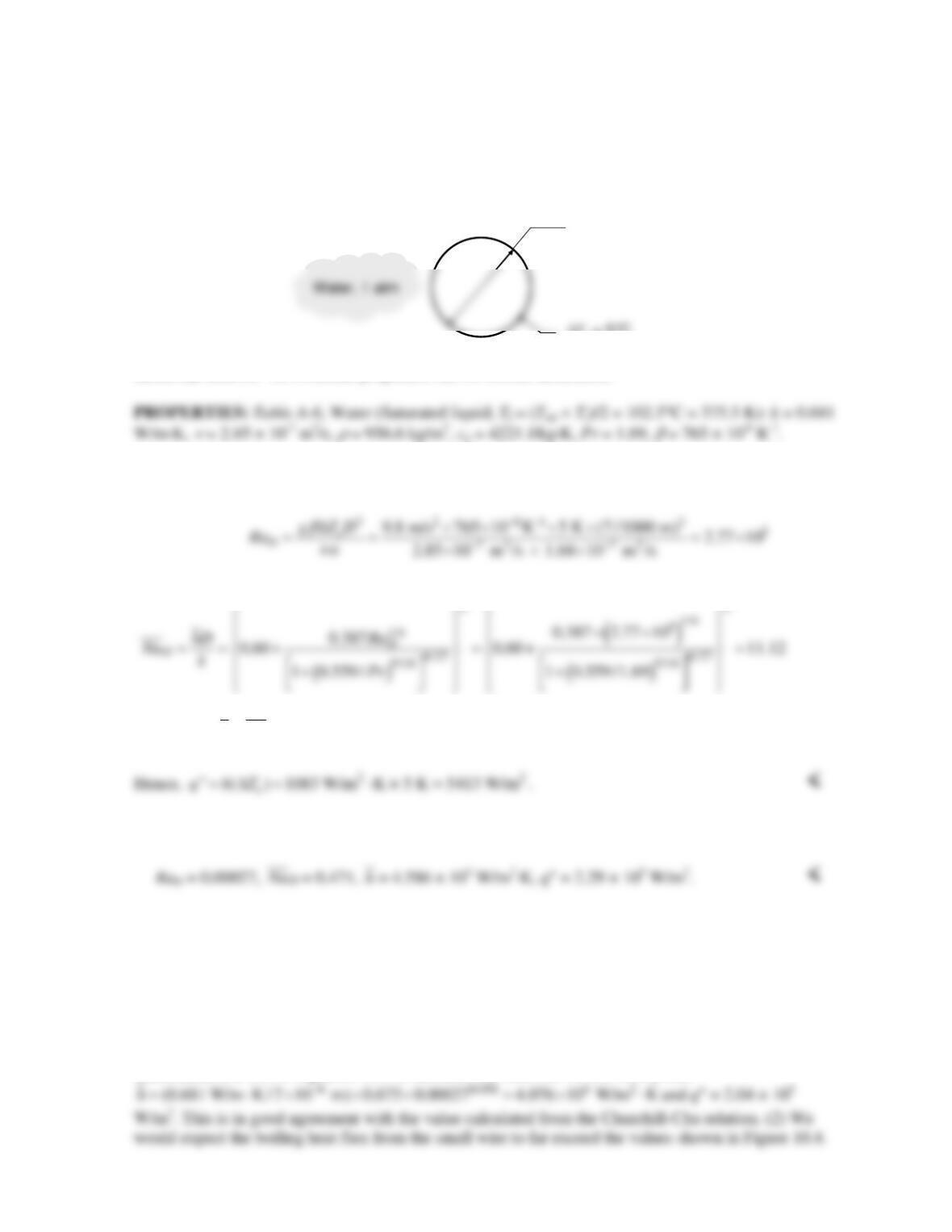
KNOWN: Diameter and temperature of horizontal cylinder or wire.
FIND: Heat flux due to natural convection and comparison with values shown in Figure 10.4
SCHEMATIC:
D= 7 mm, 7mm
DT
e
= 5°C
ASSUMPTIONS: (1) Constant properties, (2) No bubble nucleation.
ANALYSIS: The thermal diffusivity is
α
= k/
ρ
cp = 0.681 W/m·K/(956.6 kg/m3 × 4221 J/kg·K) =
1.68 × 10⁻⁷ m2/s. For the D = 7 mm cylinder, the Rayleigh number is
Using the Churchill-Chu correlation,
from which 2
/ 11.12 0.681 W/m K /(7 /1000 m) 1083 W/m K
D
hNukD==× ⋅ = ⋅.
The preceding calculations may be repeated for the D = 7 mm wire, yielding
From Figure 10.4, the heat flux corresponding to DTe = 5°C is approximately 8,000 W/m2. The heat
flux for the D = 7 mm diameter cylinder is approximately 67% of this value. However, for the D = 7
mm wire, the heat flux is nearly 29 times greater than shown in Figure 10.4 and corresponds to values
associated with vigorous nucleate boiling. Hence, Figure 10.4 is not generally applicable to all
situations involving boiling of water at 1 atmosphere pressure and should be used, with caution, only
in the absence of more detailed information. <
Comments. (1) Use of Equation 9.33 to calculate the heat flux for the wire yields
PROBLEM 10.3
KNOWN: Spherical bubble of pure saturated vapor in mechanical and thermal equilibrium with its
liquid.
FIND: (a) Expression for the bubble radius, (b) Bubble vapor and liquid states on a p-v diagram; how
changes in these conditions cause bubble to collapse or grow, and (c) Bubble size for specified
conditions.
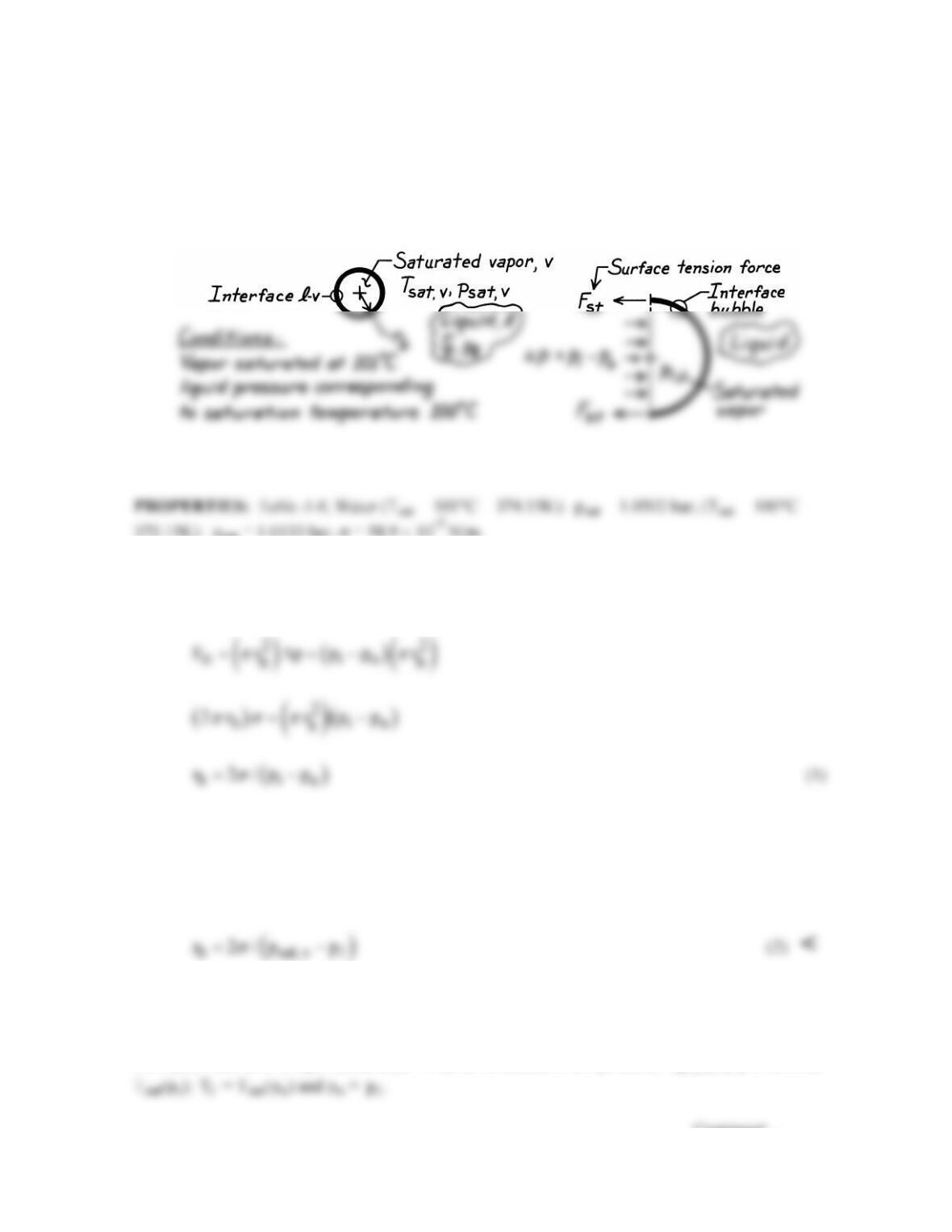
SCHEMATIC:
ASSUMPTIONS: (1) Liquid-vapor medium, (2) Thermal and mechanical equilibrium.
373.15K): psat = 1.0133 bar, s = 58.9 × 10⁻³ N/m.
ANALYSIS: (a) For mechanical equilibrium, the difference in pressure between the vapor inside the
bubble and the liquid outside the bubble will be offset by the surface tension of the liquid-vapor
interface. The force balance follows from the free–body diagram shown above (right),
Thermal equilibrium requires that the temperatures of the vapor and liquid be equal. Since the vapor
inside the bubble is saturated, pi = psat,v (T). Since po < pi, it follows that the liquid outside the
bubble must be superheated; hence, po =
p
(T), the pressure of superheated liquid at T. Hence, we
can write,
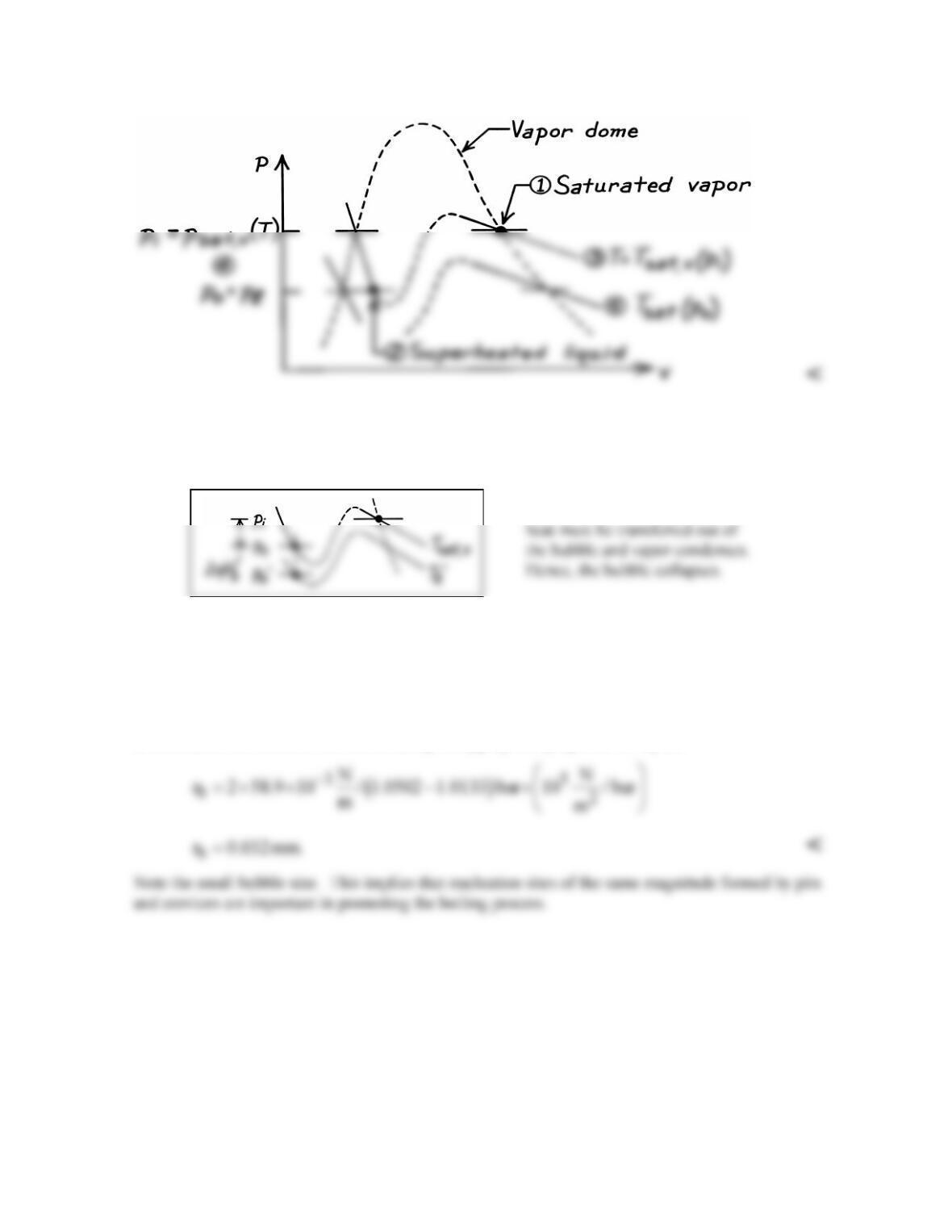
(b) The vapor [1] and liquid [2] states are represented on the following p-v diagram. Thermal
equilibrium requires both the vapor and liquid to be at the same temperature [3]. But mechanical
equilibrium requires that the outside liquid pressure be less than the inside vapor pressure [4]. Hence
the liquid must be in a superheated state. That is, its saturation temperature, Tsat(po) [5] is less than
Continued …
PROBLEM 10.3 (Cont.)
The equilibrium condition for the bubble is unstable. Consider situations for which the pressure of
the surrounding liquid is greater or less than the equilibrium value. These situations are presented on
portions of the p-v diagram
When
o o sat,v
p p ,T T
′′
<<
and
A similar argument for the condition
oo
pp
′>
leads to
sat,v
TT
′>
and heat is transferred into the
bubble causing evaporation with the formation of vapor. Hence, the bubble begins to grow.
(c) Consider the specific conditions
( )
sat,v sat o
T 101 C and T T p 100 C=°==°
and calculate the radius of the bubble using the appropriate properties in Eq. (2).
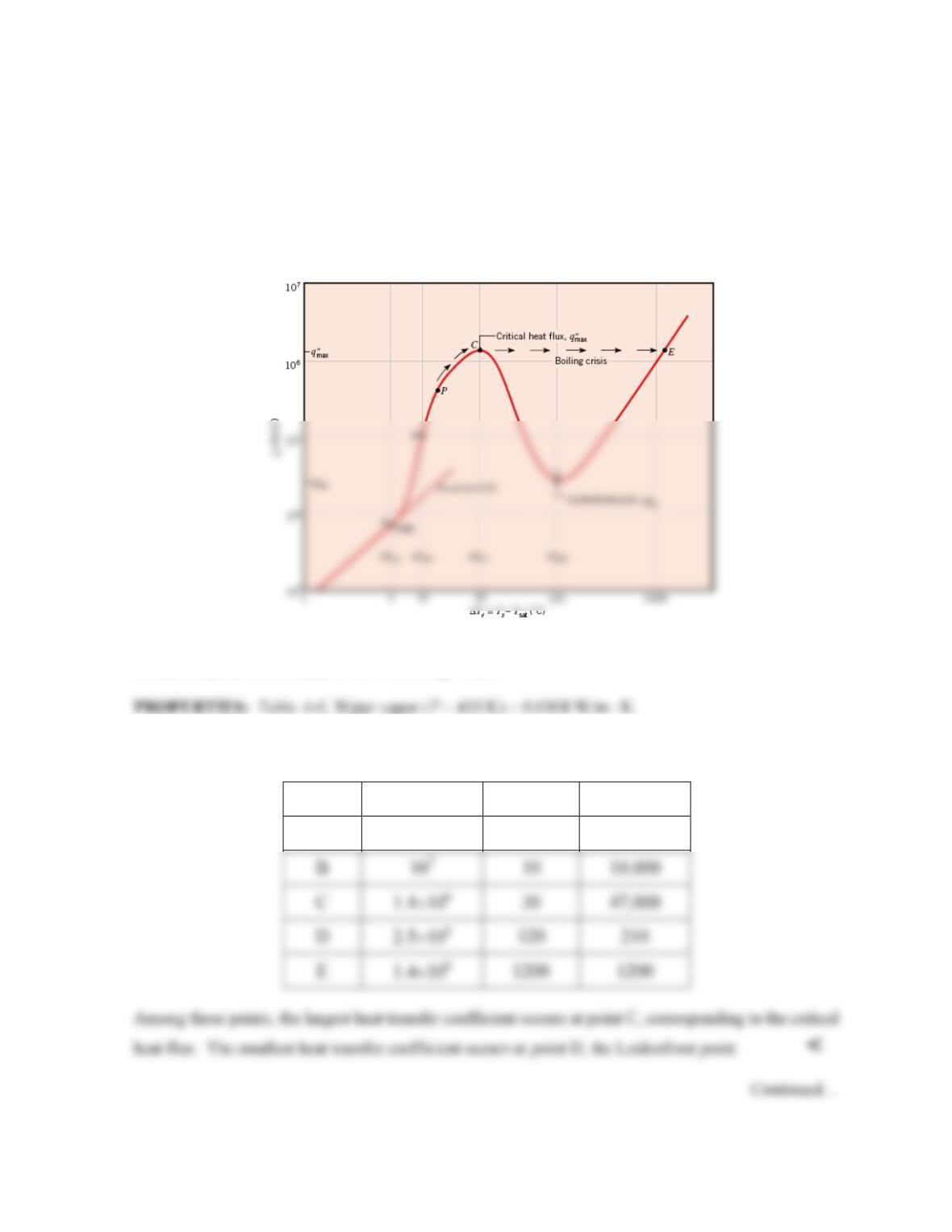
PROBLEM 10.4
KNOWN: Boiling curve of Figure 10.4.
FIND: Heat transfer coefficient associated with Points A, B, C, D, and E. Which points are associated
with the largest and smallest values of h. Thickness of vapor blanket at the Leidenfrost point.
SCHEMATIC:
ASSUMPTIONS: (1) Neglect radiation during film boiling, (2) Surface is flat, (3) Vapor thermal
conductivity can be evaluated at the film temperature.
ANALYSIS: Since h =
s
q′′
/DTe, the values of h can be found by reading
s
q′′
and DTe from the graph.
Point
s
q′′
(W/m2) DTe (°C) h (W/m2 ⋅ K)
A 6700 5 1300
PROBLEM 10.4 (Cont.)
At the Leidenfrost point, if radiation is neglected, heat transfer is due solely to conduction through the
vapor film. The surface temperature is Ts = DTe + Tsat = 120°C + 100°C = 220°C, so the film
temperature is Tf = (220 + 100)°C/2 = 160°C = 433 K. Evaluating the vapor thermal conductivity at
the film temperature, the film thickness is given by
42 4
/ 0.0308 W/m K 120 C / 2.5 10 W/m 1.5 10 m 0.15 mm
ve
kTq
−
′′
=D = ⋅× ° × = × =
<
COMMENTS: (1) Section 10.4.4 describes how to account for radiation heat transfer in film
boiling. From Eq. 10.11, assuming
ε
= 1 to maximize the effect of radiation, and using Ts = 220°C
PROBLEM 10.5
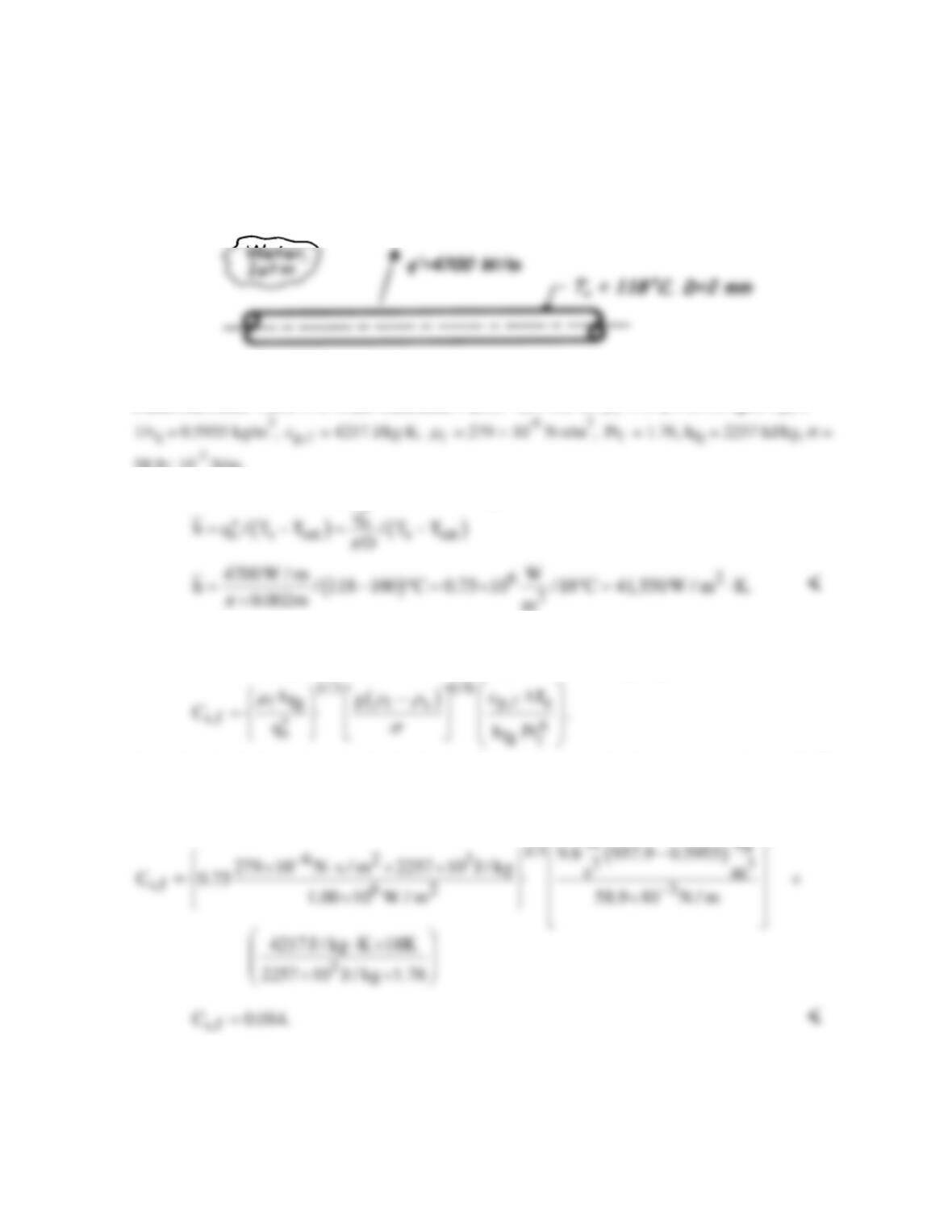
KNOWN: Long wire, 2 mm diameter, reaches a surface temperature of 118°C in water at 1 atm while
dissipating 4700 W/m.
FIND: (a) Boiling heat transfer coefficient and (b) Correlation coefficient, Cs,f, if nucleate boiling
occurs.
SCHEMATIC:
ASSUMPTIONS: (1) Steady-state conditions, (2) Nucleate boiling.
PROPERTIES: Table A-6, Water (saturated, 1 atm): Ts = 100°C,
ρ
58.9× 10⁻³ N/m.
ANALYSIS: (a) For the boiling process, the rate equation can be rewritten as
Note the heat flux is below max
q,
′′ and nucleate boiling does exist.
(b) For nucleate boiling, the Rohsenow correlation may be solved for Cs,f to give
Assuming the liquid-surface combination is such that n = 1 and substituting numerical values with DTe
= Ts –Tsat, find
1/6
COMMENTS: By comparison with the values of Cs,f for other water-surface combinations of Table
10.1, the Cs,f value for the wire is large, suggesting that its surface must be highly polished. Note that
the value of the boiling heat transfer coefficient is much larger than values common to single-phase
convection.
PROBLEM 10.6
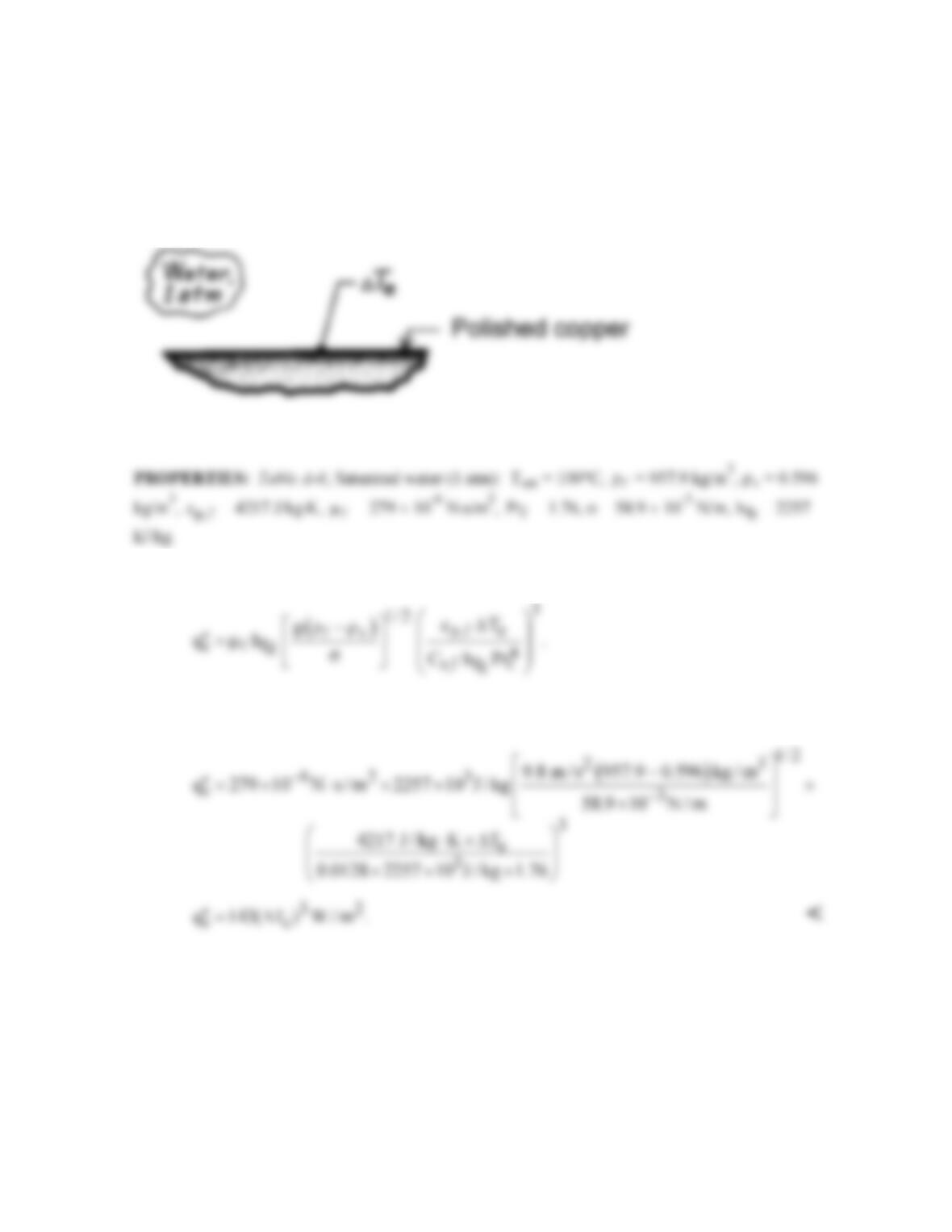
KNOWN: Saturated water at 1 atm boiling on large, horizontal, polished copper plate.
FIND: Nucleate boiling heat flux over excess temperature range 5ºC ≤ DTe ≤ 30ºC. Compare with
Figure 10.4. Find excess temperature corresponding to critical heat flux.
SCHEMATIC:
ASSUMPTIONS: (1) Steady–state conditions. (2) Nucleate pool boiling.
ANALYSIS: The nucleate pool boiling heat flux can be estimated using the Rohsenow correlation.
From Table 10.1, find for this liquid-surface combination, Cs,f = 0.0128 and n = 1, and substituting
numerical values,
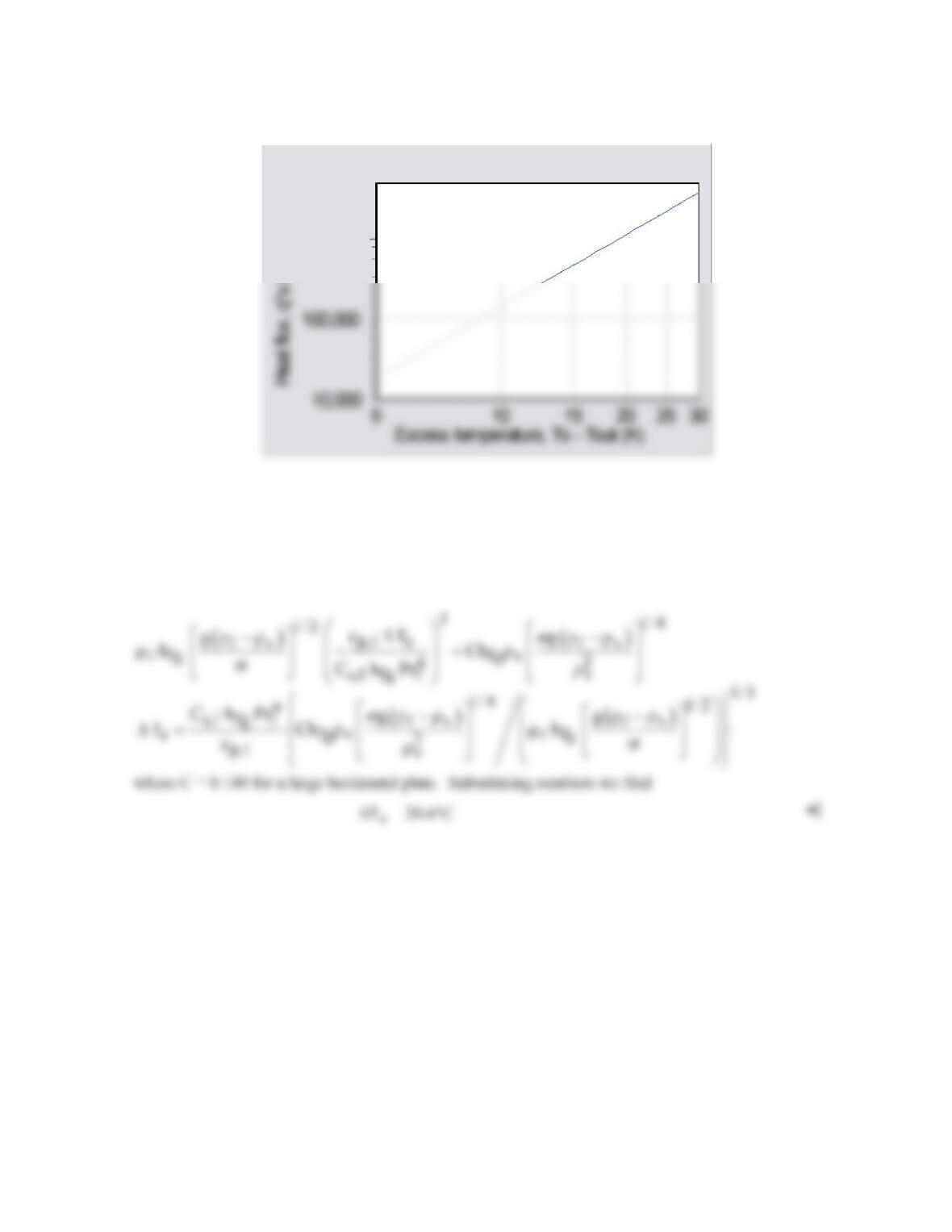
This is plotted below.
Continued…
PROBLEM 10.6 (Cont.)
1,000,000
Compared with Figure 10.4, we see that this curve is a straight line on a log–log plot. The heat flux is
higher than in Figure 10.4, especially for the higher values of excess temperature.
To find the excess temperature corresponding to the critical heat flux, we equate Eqs. (10.5) and
(10.6) and solve for DTe.
COMMENTS: (1) The correlation and Figure 10.4 do not agree extremely well. The error is worst
near ONB (70% error at DTe = 5ºC) and CHF (170% error at DTe = 30ºC). Since the correlation is a
straight line on a log-log plot, it doesn’t reproduce the curvature at the two ends of the curve. Since
the correlation isn’t accurate near CHF, it does not do an excellent job of predicting DTe, which
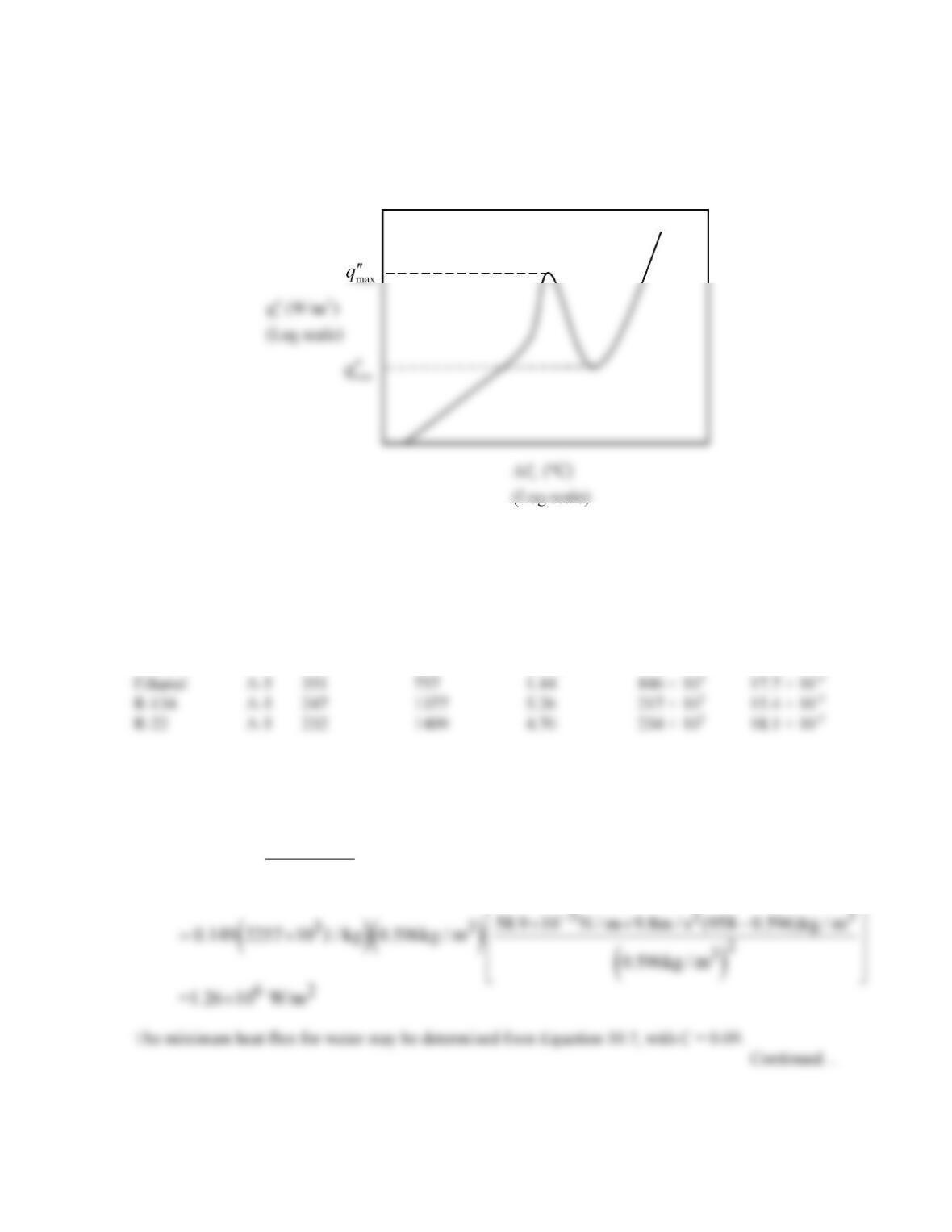
appears to be around 30°C from Figure 10.4. (2) Figure 10.4 is a typical boiling curve. The boiling
curve will shift as different boiling surfaces and geometries (and, in turn, different values of Cs,f) are
considered.
PROBLEM 10.7
KNOWN: Boiling of water, ethanol, R-134a, or R-22 on large, horizontal surface (p = 1 atm).
FIND: Ratio
max min
/qq
′′ ′′
for each fluid, and which fluid has largest critical heat flux.
SCHEMATIC:
ASSUMPTIONS: (1) Steady–state conditions. (2) Constant properties.
PROPERTIES:
Fluid Table Tsat (K) ρl (kg/m3) ρv (kg/m3) hfg (J/kg) s(N/m)
Water A-6 373 958 0.596 2257 × 103 58.9 × 10⁻³
ANALYSIS: The maximum heat flux for water may be determined from Equation 10.6, with C =
0.149.
lv
max fg v 2
v
g( )
q Ch
s ρ −ρ
′′ = ρ
ρ
PROBLEM 10.7 (Cont.)
( )
1/ 4
lv
min fg v 2
lv
g( )
q Ch
s ρ −ρ
′′ = ρ
ρ +ρ
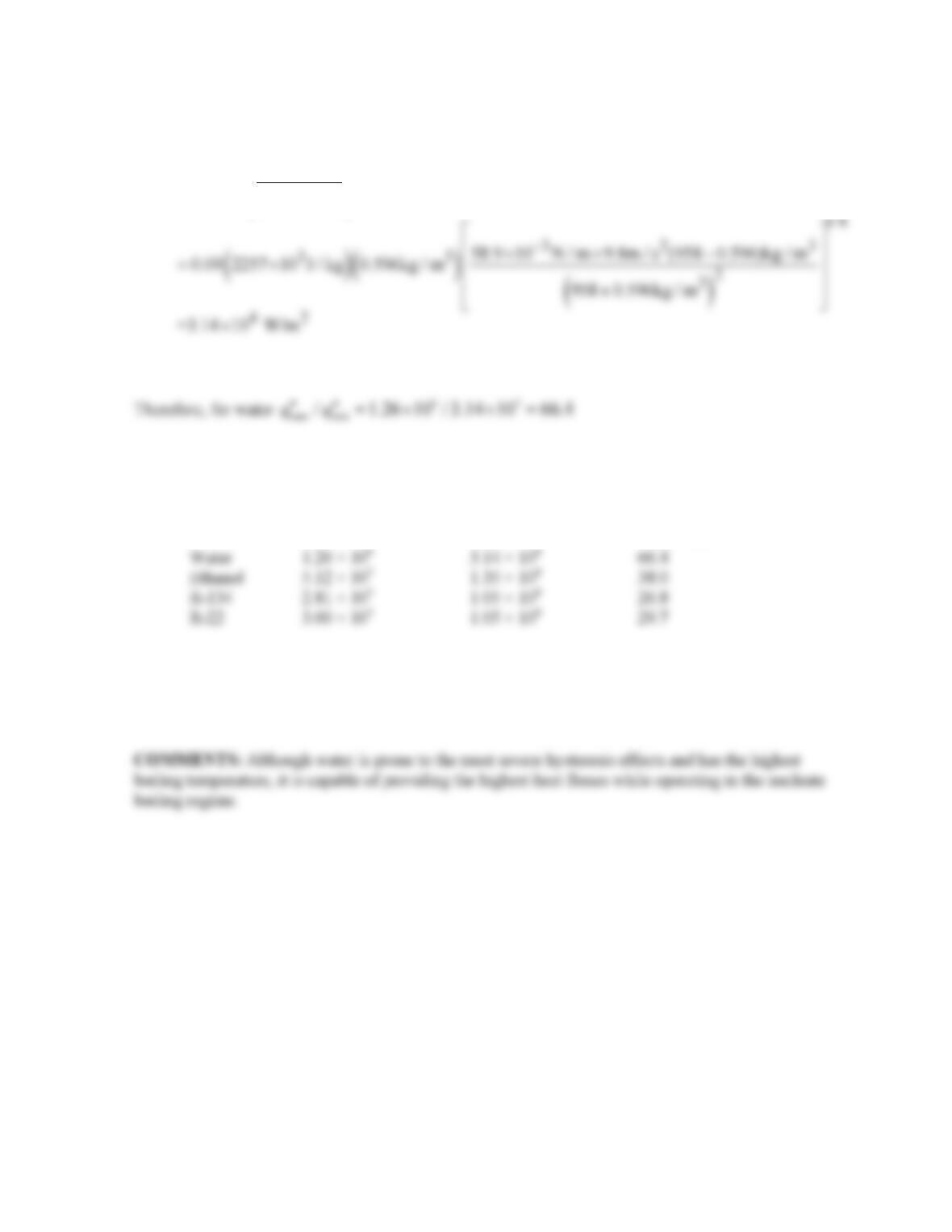
The calculations may be repeated for the other fluids and the results are shown in the table below. <
Fluid
2
max (W/m )q′′
2
min (W/m )q′′
max min
/qq
′′ ′′
R-134 is characterized by the smallest value of
max min
/qq
′′ ′′
, while water has the largest maximum heat
flux. <
PROBLEM 10.8
KNOWN: Diameter of copper pan. Initial temperature of water and saturation temperature of
boiling water. Range of heat rates (1 ≤ q ≤ 100 kW).
FIND: (a) Variation of pan temperature with heat rate for boiling water, (b) Pan temperature shortly
after start of heating with q = 8 kW.
SCHEMATIC:
Water
TC
i o
= 20
T = 100 C
sat o
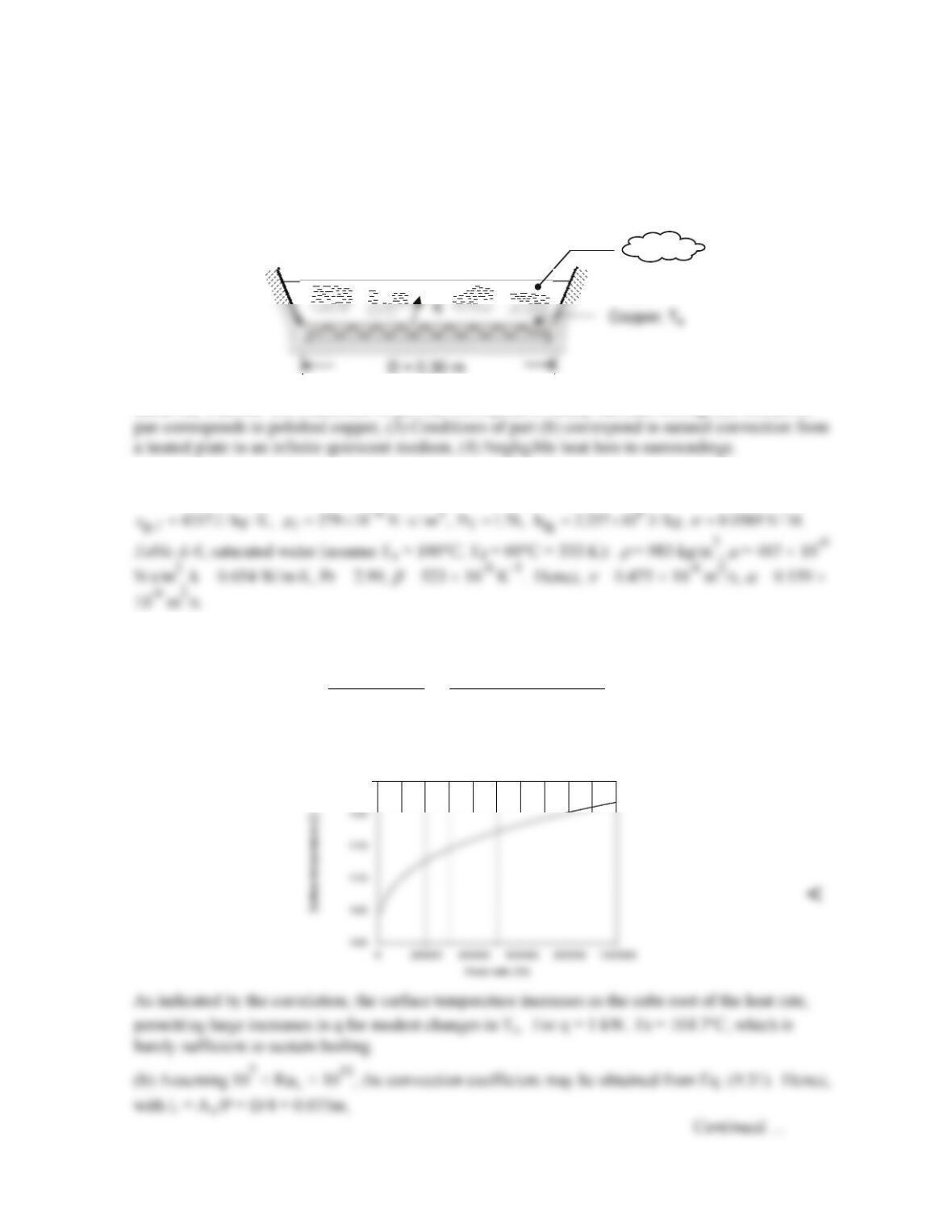
ASSUMPTIONS: (1) Conditions of part (a) correspond to steady nucleate boiling, (2) Surface of
PROPERTIES: Table A-6, saturated water (Tsat = 100°C):
3
957.9 kg / m ,
ρ
=
3
0.60 kg / m ,
ν
ρ
=
ANALYSIS: (a) From Eq. (10.5),
( )
1/3
n
s,f fg s fg s
e s sat 1/ 2
p,
C hPr q/ hA
T TT cg/
ν
m
ρρs
D=− = ×
−
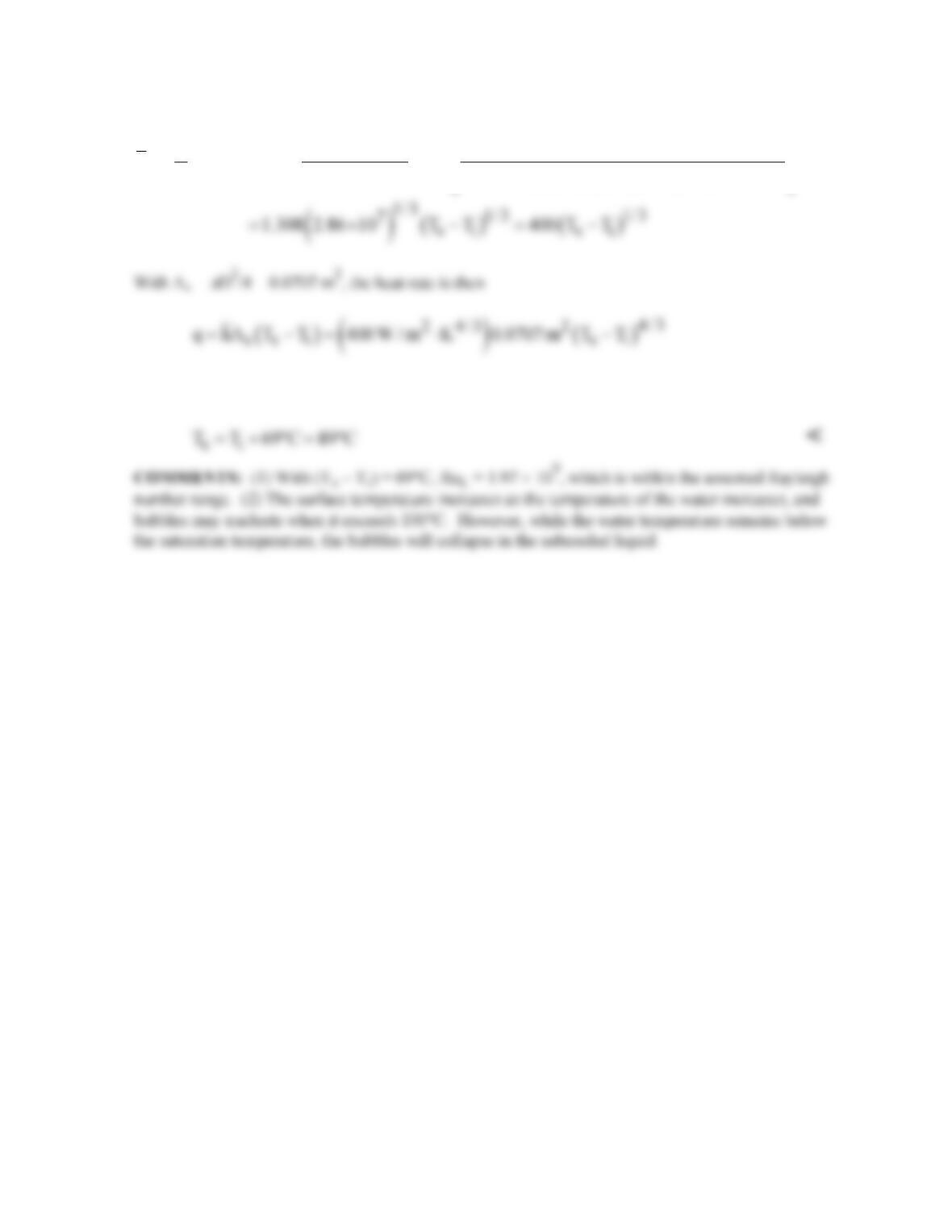
For n = 1.0, Cs,f = 0.0128 and As =
p
D2/4 = 0.0707 m2, the following variation of Ts with qs is
obtained.
125
PROBLEM 10.8 (Cont.)
( )( )
1/3
3
2 61
1/3 si
L12 4 2
9.8 m / s 523 10 K T T 0.075m
k 0.654 W / m K
h 0.15 Ra 0.15
L 0.075m 0.475 0.159 10 m / s
−−
−
×× −
⋅
= = ××
With q = 8000 W,
PROBLEM 10.9
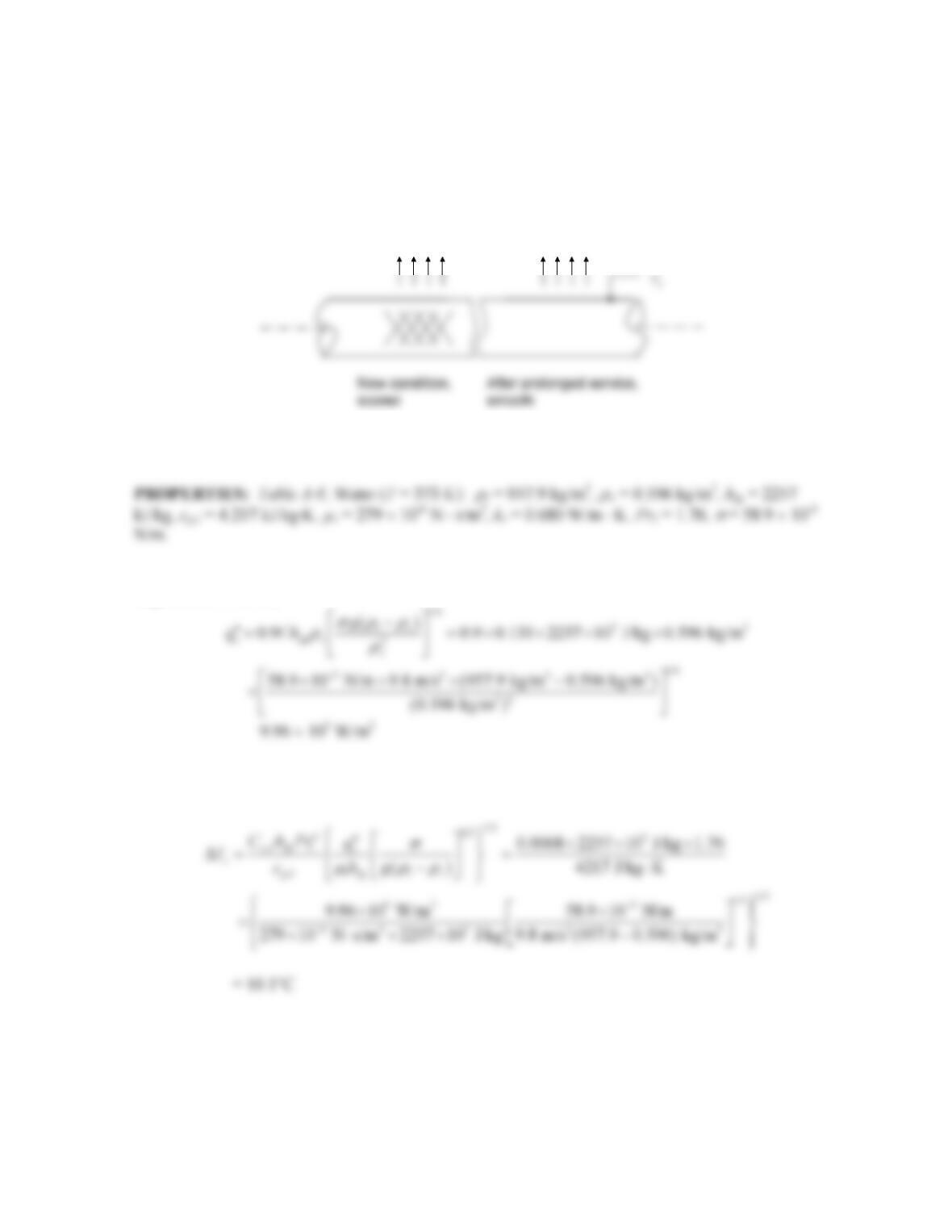
KNOWN: Water at atmospheric pressure boiling on horizontal copper tube. Heat flux is 90% of
critical value.
FIND: Tube surface temperature under scored conditions and conditions similar to a polished surface.
SCHEMATIC:
ASSUMPTIONS: (1) Steady–state, (2) Uniform tube wall temperature, (3) Nucleate boiling at outer
surface of tube, (4) Constant properties.
ANALYSIS: The heat flux is 90% of the critical heat flux given by Eq. 10.6, thus with C = 0.131 for a
large horizontal tube,
The nucleate boiling heat flux is given by Eq. 10.5, with Cs,f = 0.0068, n = 1.0 for a scored copper
surface. Solving for the excess temperature,
Thus, for the scored surface
Ts = DTe + Tsat = 10.1°C + 100°C = 110.1°C <
Continued…
q= 0.9 CHF
″
q= 0.9 CHF
″q= 0.9 CHF
″
q= 0.9 CHF
″

PROBLEM 10.9 (Cont.)
After the surface degrades to conditions similar to a polished surface, the value of Cs,f becomes
0.0128. Recognizing that DTe is proportional to Cs,f, DTe = 10.1°C(0.0128/0.0068) = 19.1°C. Hence,
after prolonged service,
COMMENTS: (1) A scored surface provides nucleation sites that enhance nucleate boiling, resulting
in a smaller excess temperature relative to a smooth surface, for the same heat flux.
PROBLEM 10.10
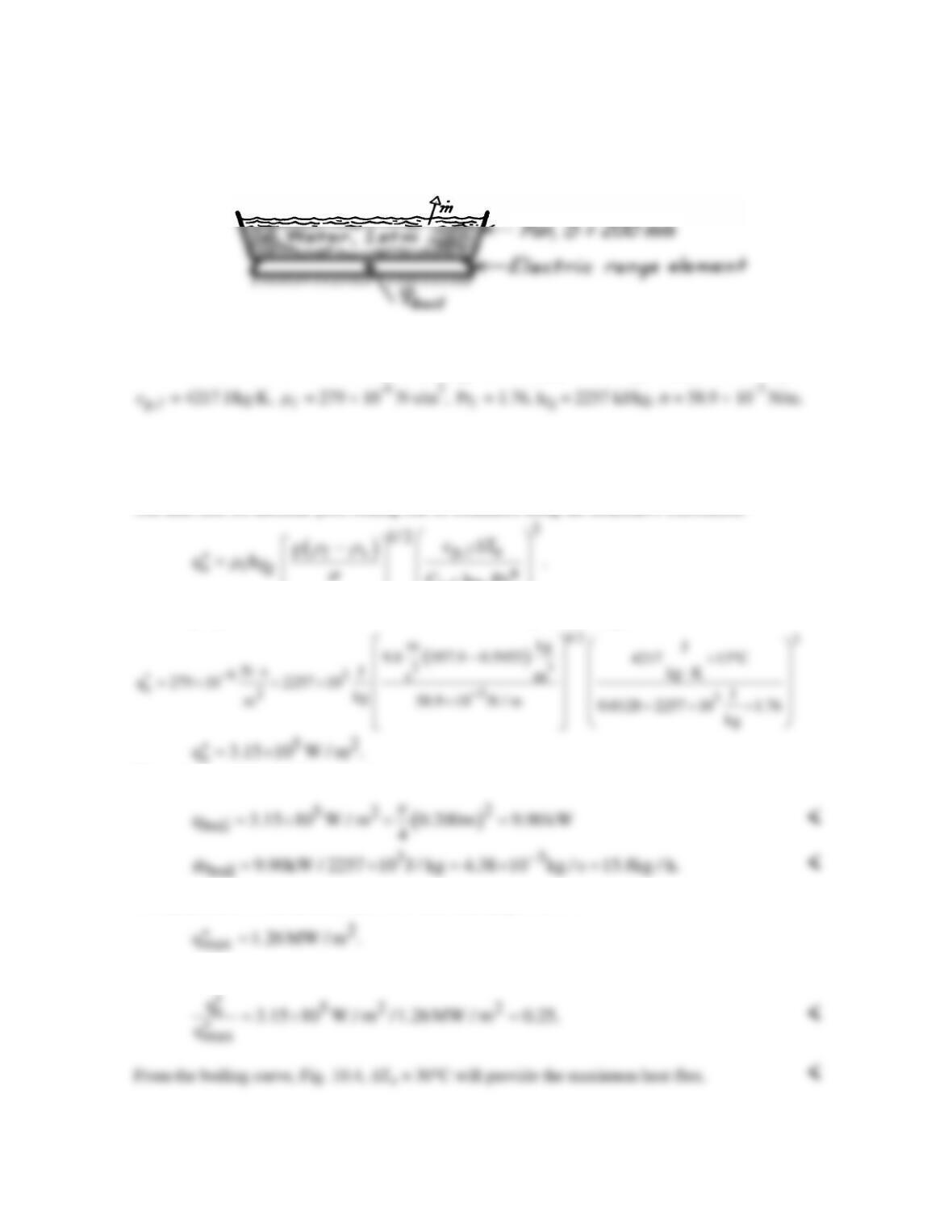
KNOWN: Copper pan, 200 mm diameter and filled with water at 1 atm, is maintained at 113°C.
FIND: Power required to boil water and the evaporation rate; ratio of heat flux to critical heat flux;
pan temperature required to achieve critical heat flux.
SCHEMATIC:
ASSUMPTIONS: (1) Nucleate pool boiling, (2) Copper pan is polished surface.
PROPERTIES: Table A-6, Water (1 atm): Tsat = 100°C,
ρ
= 957.9 kg/m3,
v
ρ
= 0.5955 kg/m3,
ANALYSIS: The power requirement for boiling and the evaporation rate can be expressed as
follows,
boil s s boil fg
q q A m q /h .
′′
=⋅=
The heat flux for nucleate pool boiling can be estimated using the Rohsenow correlation.
s,f fg
C h Pr
Selecting Cs,f = 0.0128 and n = 1 from Table 10.1 for the polished copper finish, find
The power and evaporation rate are
The maximum or critical heat flux was found in Example 10.1 as
Hence, the ratio of the operating to maximum heat flux is
PROBLEM 10.11
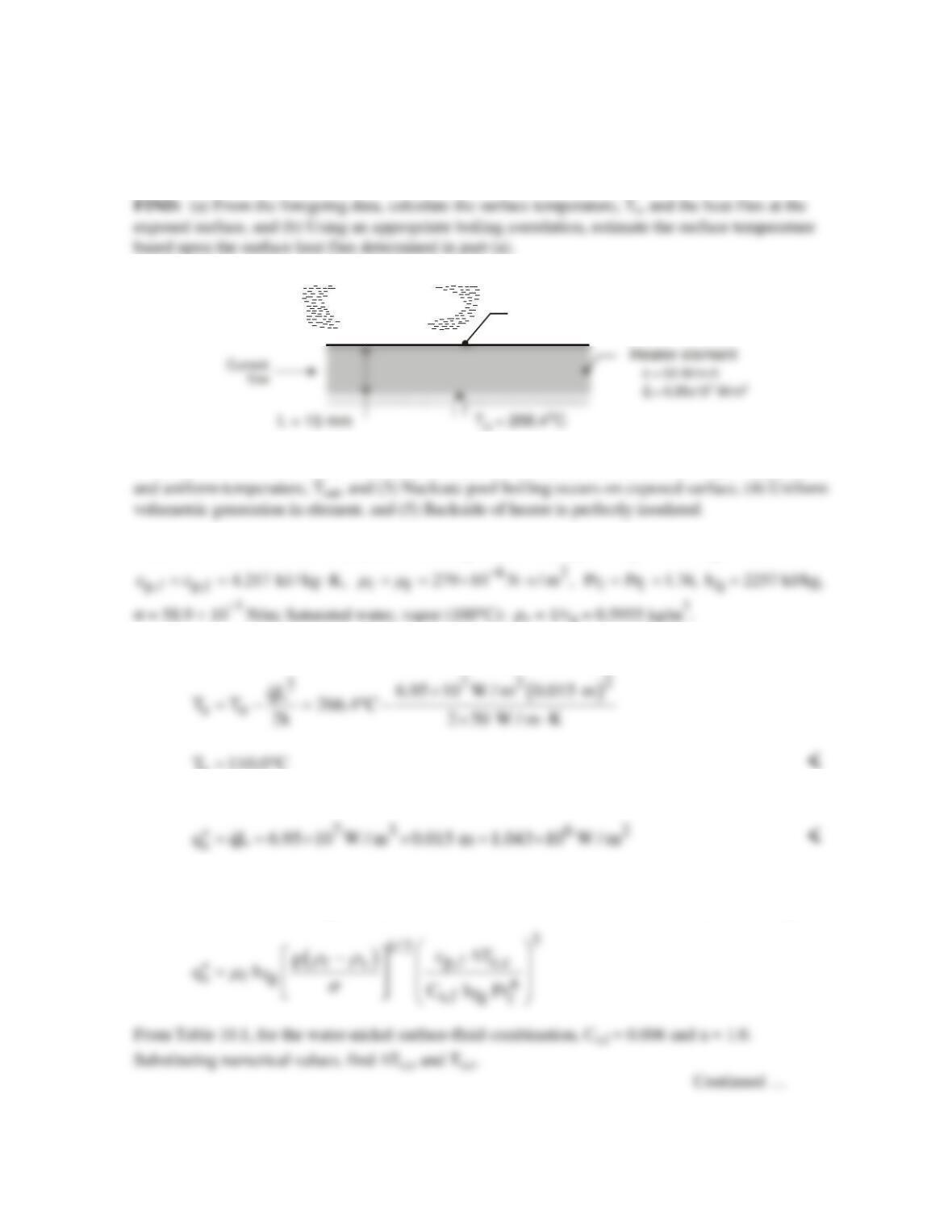
KNOWN: Nickel–coated heater element exposed to saturated water at atmospheric pressure;
thermocouple attached to the insulated, backside surface indicates a temperature To = 266.4°C when
the electrical power dissipation in the heater element is 6.950 × 10⁷ W/m3.
SCHEMATIC:
Saturated water
T = 100 C
sat
o
Nickel-coated surface, Ts
ASSUMPTIONS: (1) Steady-state conditions, (2) Water exposed to standard atmospheric pressure
PROPERTIES: Table A-6, Saturated water, liquid (100°C):
3
f
1/ v 957.9 kg / m ,
ρ
= =
ANALYSIS: (a) From Eq. 3.48, the temperature at the exposed surface, Ts, is
s
T 110.0 C= °
<
The heat flux at the exposed surface is
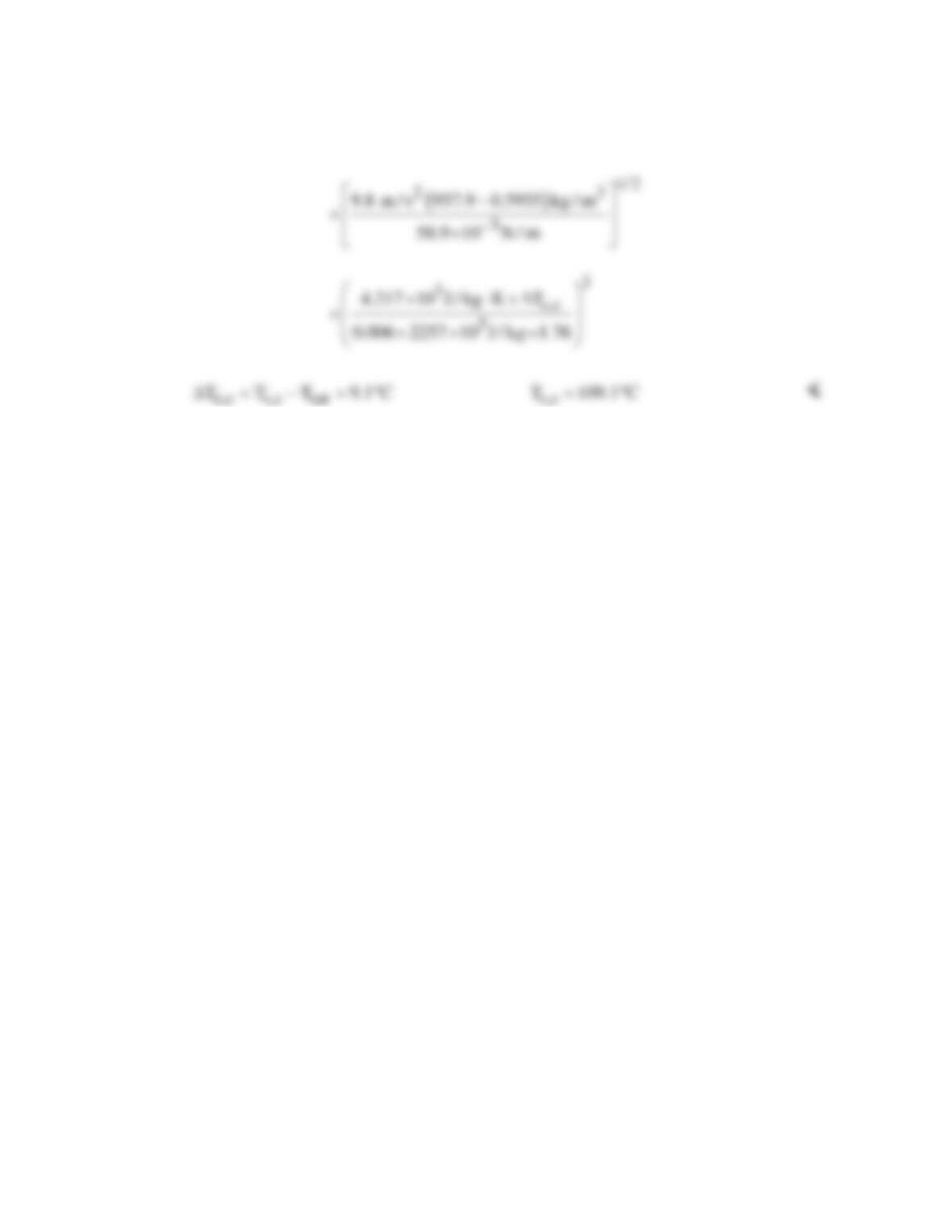
(b) Since DTe = Ts – Tsat = (110 – 100)°C = 10°C, nucleate pool boiling occurs and the Rohsenow
correlation, Eq. 10.5, with
s
q′′
from part (a) can be used to estimate the surface temperature, Ts,c,
PROBLEM 10.11 (Cont.)
62 6 2 3
1.043 10 W / m 279 10 N s / m 2257 10 J / kg
−
× =× ⋅ ××
COMMENTS: From the experimental data, part (a), the surface temperature is determined from the
conduction analysis as Ts = 110.0°C. Using the traditional nucleate boiling correlation with the
experimental value for the heat flux, the surface temperature is estimated as Ts,c = 109.1°C. The two
approaches provide excess temperatures that are 10.0 vs. 9.1°C, which amounts to nearly a 10%
difference.
PROBLEM 10.12
KNOWN: Diameter and thickness of copper disk. Thickness of nickel coating. Applied heat rate and
pressure of water above the disk.
FIND: Maximum disk temperature without and with the nickel coating.
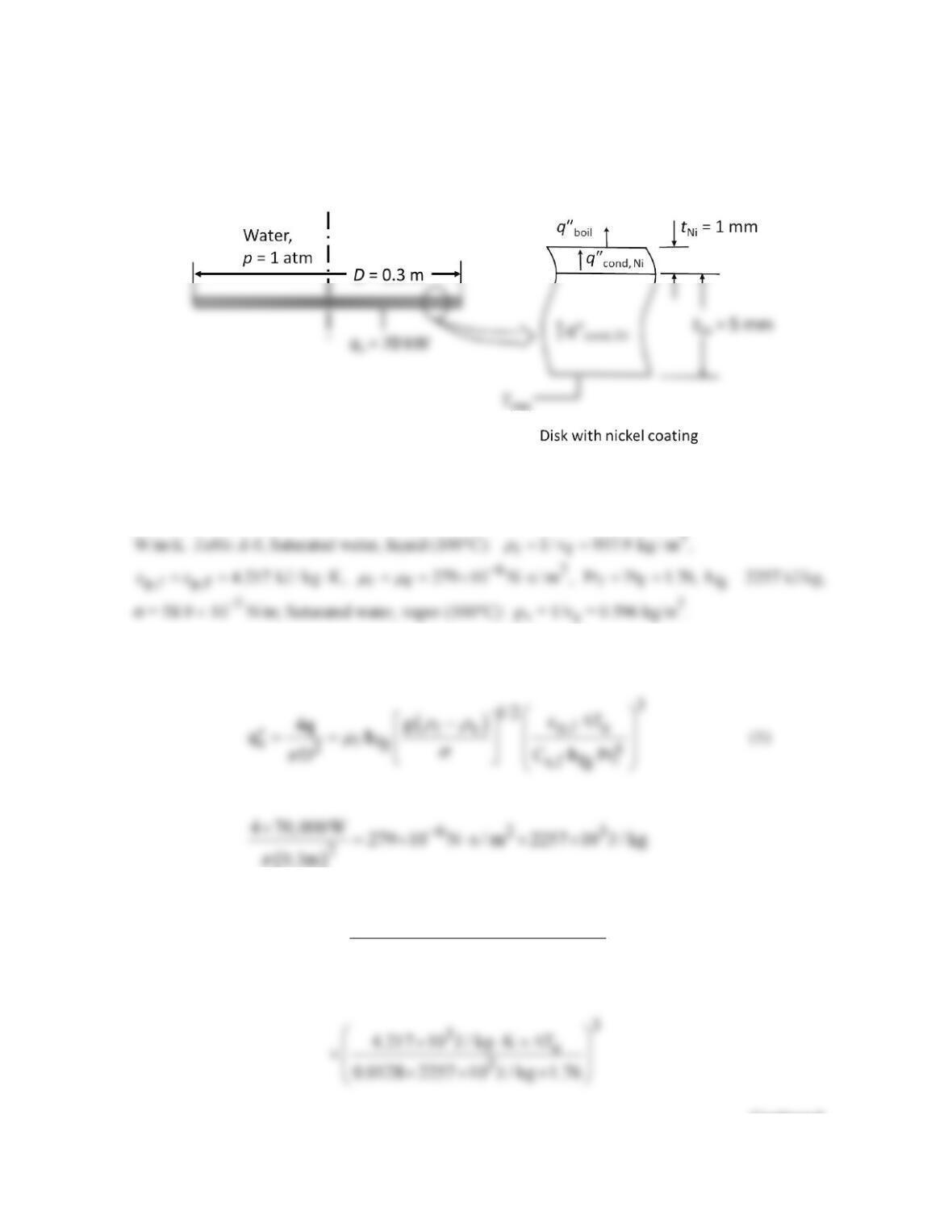
SCHEMATIC:
ASSUMPTIONS: (1) Steady-state conditions, (2) Water at atmospheric pressure, (3) Nucleate pool
boiling occurs on exposed surface, (4) Negligible contact resistance between copper and nickel.
PROPERTIES: Table A-1, copper (400K): k = 393 W/m∙K. Table A-1, nickel (400K): k = 80.2
ANALYSIS: No coating. From Eq. 10.5 with Cs,f = 0.0128 and n = 1, the temperature of the surface
exposed to the water is found as follows.
( )
1/ 2
23
3
9.8 m / s 957.9 0.5955 kg / m
58.9 10 N / m
−
−
×
×
Continued…
PROBLEM 10.12 (Cont.)
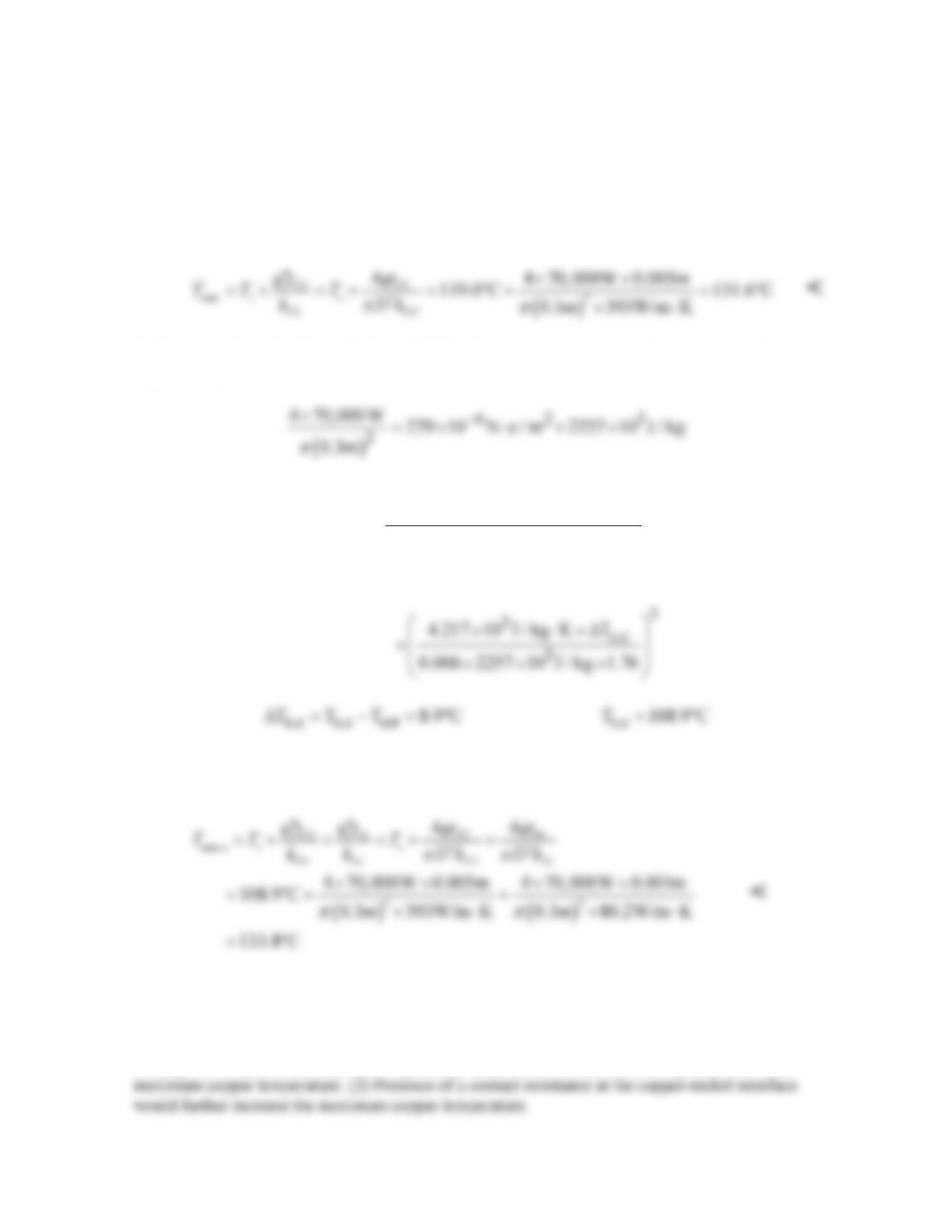
e s sat s
T T T 19.0 C T 119.0 CD=− = ° = °
Accounting for conduction within the copper disk,
With coating. From Eq. 10.5 with Cs,f = 0.006 and n = 1, the temperature of the coating surface
exposed to the water is found as follows.
( )
1/ 2
23
3
9.8 m / s 957.9 0.5955 kg / m
58.9 10 N / m
−
−
×
×
Accounting for conduction within the nickel coating and copper disk,
The coating does not reduce the maximum copper temperature. <
COMMENTS: (1) The excess temperature is reduced by more than 50% by adding the nickel
coating. However, the nickel poses a significant conduction resistance, resulting in an increased