45
Chapter 10: The Demand for Money and the Price
Level
Chapter Summary:
In the equilibrium theory of the business cycle explained in previous
chapters, money has played an important role. This contrasts with the demand
side theories of the business cycle in which monetary factors explain much, if not
all of the variability in real GDP. This chapter provides a framework by which
alternative theories of the business cycle can be examined, and their results
compared to the equilibrium model of ch.8. The chapter begins with a
description of money and the definitions of monetary aggregates M1 and M2.
Demand for money based is described as a function of the price level, nominal
Chapter Outline:
I. Concepts of Money
II. The Demand for Money
A. The Interest Rate and the Demand for Money
III. Determination of the Price Level
A. The Nominal Quantity of Money Supplied Equals the Nominal
Quantity Demanded
B. A change in the Nominal Quantity of Money
Teaching Tips:
1. An interesting development in the evolution of money is the use of currencies
in the virtual reality worlds created by internet gaming. In this case, virtual
money is being used to buy virtual goods. The fact that this virtual currency is
now trading for real currency provides an example of how technological change
2. The shape of the money demand curve in figure 10.1 is unlike any other
demand curve the student has studied: it slopes upward! Make sure students
3. Asking students to articulate their own reasons for holding currency can be a
productive way to help them relate to the theory of money demand. A quick
4. Early in their lives my grandparents (and many others, I suspect) used an
“envelope” budgeting system. They literally put cash from their paychecks into
an envelopes marked “food”, “rent”, “entertainment” and so on. When they
Answers to review questions, pg. 254
1. If you keep your wealth in a portfolio of assets, the major transaction costs
will be in the transfer of wealth from one account to another. The costs of
2. a. An increase in the nominal interest rate raises the opportunity cost of
holding money; demand will decrease.
b. An increase in real transactions costs makes it more difficult to convert
3. a. A one time doubling will reduce the real wage only if nominal wages are
constant. If nominal wages also double, then the real wage will not change.
4. The quantity theory of money cannot be supported by theoretical arguments
alone. The theory suggests that changes in money demand can affect the price
level even when the nominal money stock is fixed. The quantity theory then
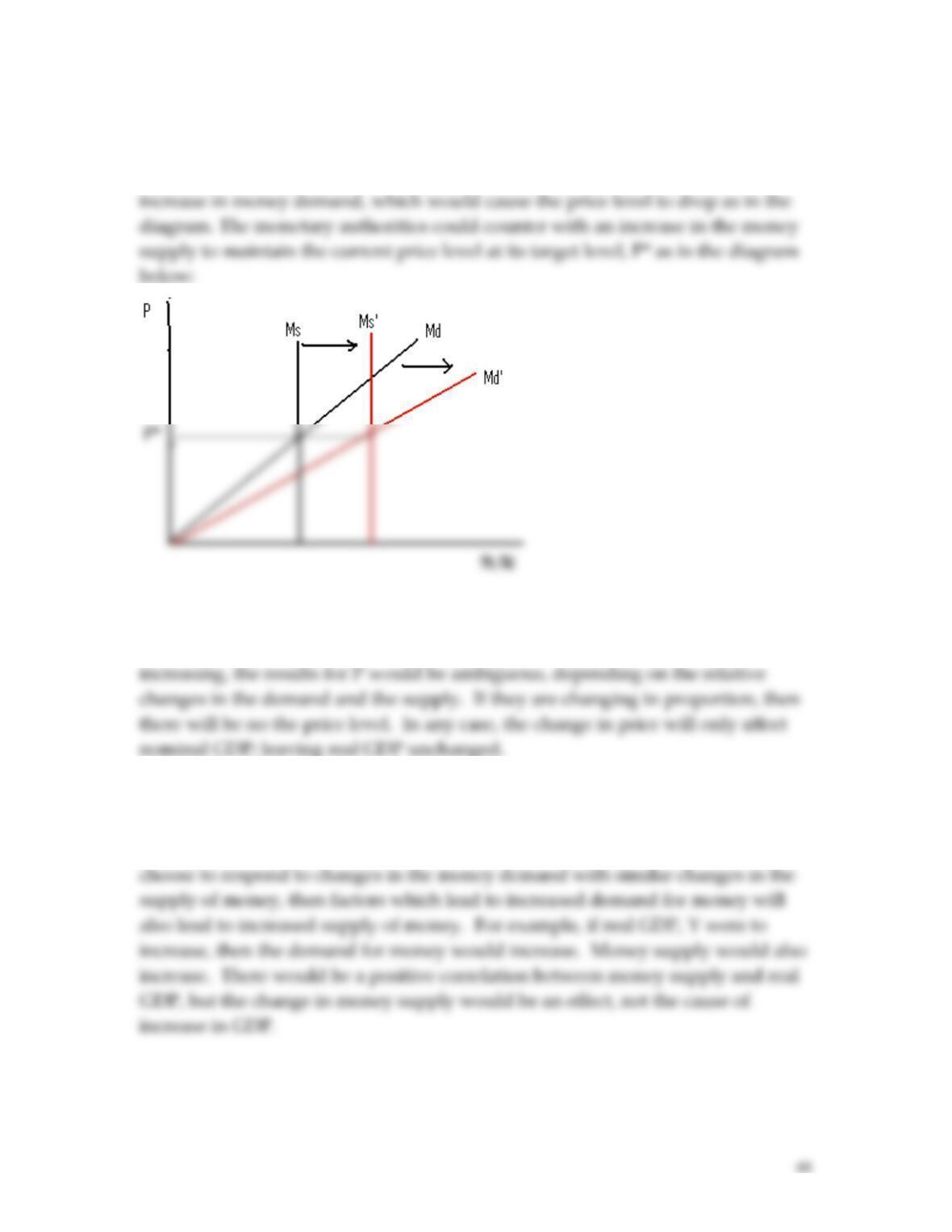
5. A favorable productivity shock increases the demand for labor resulting in a
higher level of employment and output. A higher level of output generates an
6. Increases in money supply tend to raise prices, while increases in the demand
for money have the opposite effect. If both supply and demand for money were
7. “Endogenous money” implies that changes in the demand for money will
cause predictable changes in the supply of money. In that case, the supply of
money is determined by factors within the model. If the monetary authorities
49
Answers to problems for discussion, pg. 255–257
8. The answers to of these questions are true.
a. True. One reason is that more production in an agricultural society is for
home use, not to be sold on the market. The division of labor and structure of
production is not as complex, resulting in fewer transactions for a given level of
production. Fewer transactions means less demand for money.
c. True. If the elderly are more dependent on income from their assets,
which are “liquidated” during their retirement. They will have a higher ratio of
monetary transactions to income.
9. See graph:
a. The large triangles show that the cash balance is 12,000 at the first of each
month and gradually falls to zero by the end of the month. (The graph shows the
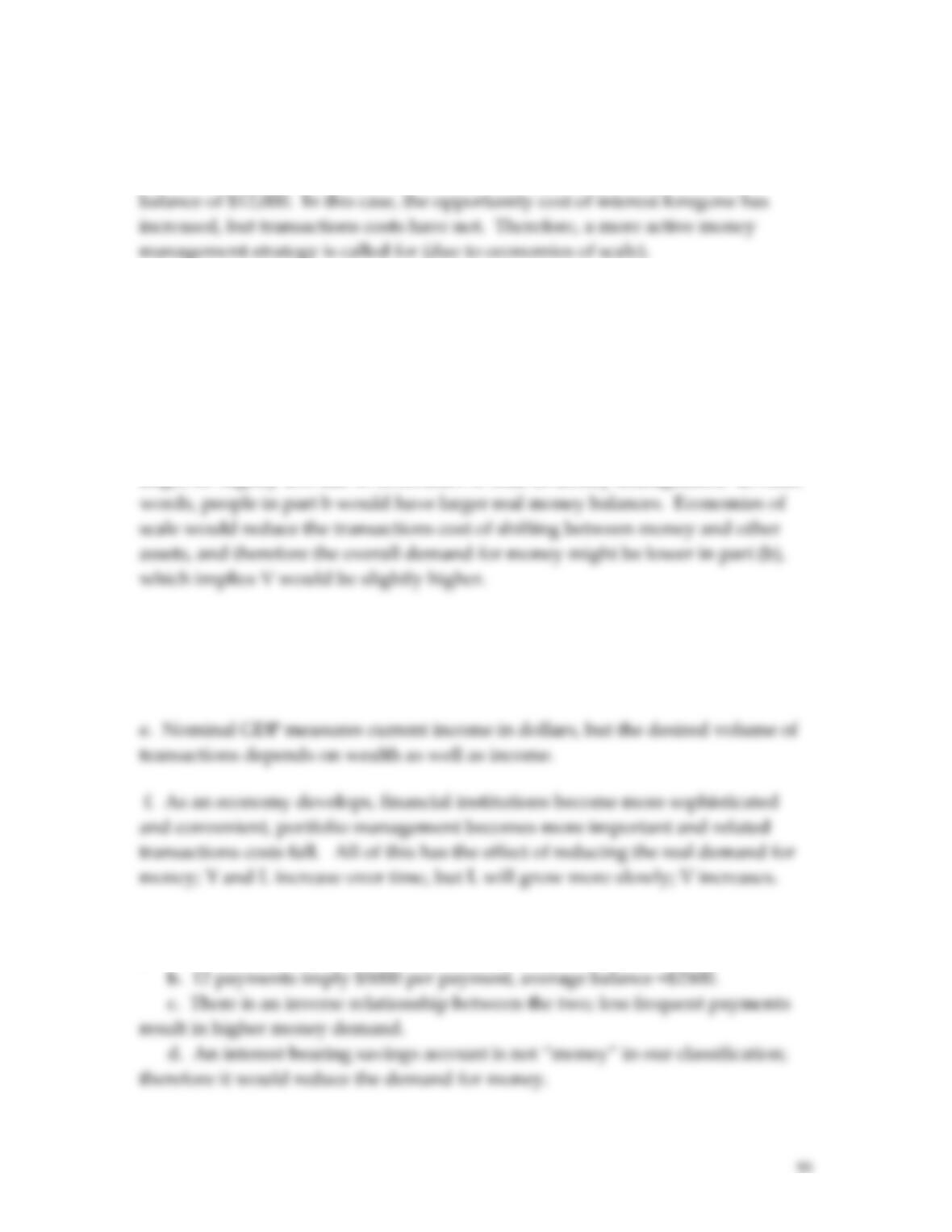
b. See the smaller triangles in the graph. Average money holdings fall to
$3000.
c. The higher level of consumption would result in an average monthly
10. One way to approach these problems is to refer to an equation for velocity
such as this: V=Y/L, where Y is real GDP and L is real money demand.
a. Higher values for i reduce real money demand; V increases.
b. An increase in Y leads to an increase in V.
c. Similar to (b); there will be an increase in V. The change in V in this case
might be slightly less due to economies of scale in money management. In other
d. Since P does not change the demand for real money balances, there should be
no change in velocity. (However, inflation would have an effect on money
demand and velocity because it would reduce L).
11. a. 24 payments imply $2500 per payment. Assuming a constant rate of
purchasing this implies an average money balance of approximately $1250.
51
12. a. Your assumptions about the timing of the shopping trip will affect your
answer; if you shop on the first day of the month and once every seven or eight days
following, your average balance will be approximately $1900. Comparing this to
13. a. It may be treated as an increase in real income, just as if prices had fallen.
b. The income effect is positive on both consumption and leisure.
c. The effects would be similar.
14. a. The price level should fall to 1/10 of its current level. The interest rate will not
change.
b. There is no change in any real variable.
15. a. There is a direct relationship between denomination and P.
b. The demand for “big ticket items” like jewelry and cars may increase.
These purchases will be easier to transact in large denomination bills.
c. No obvious relationship.