Problem 10.67
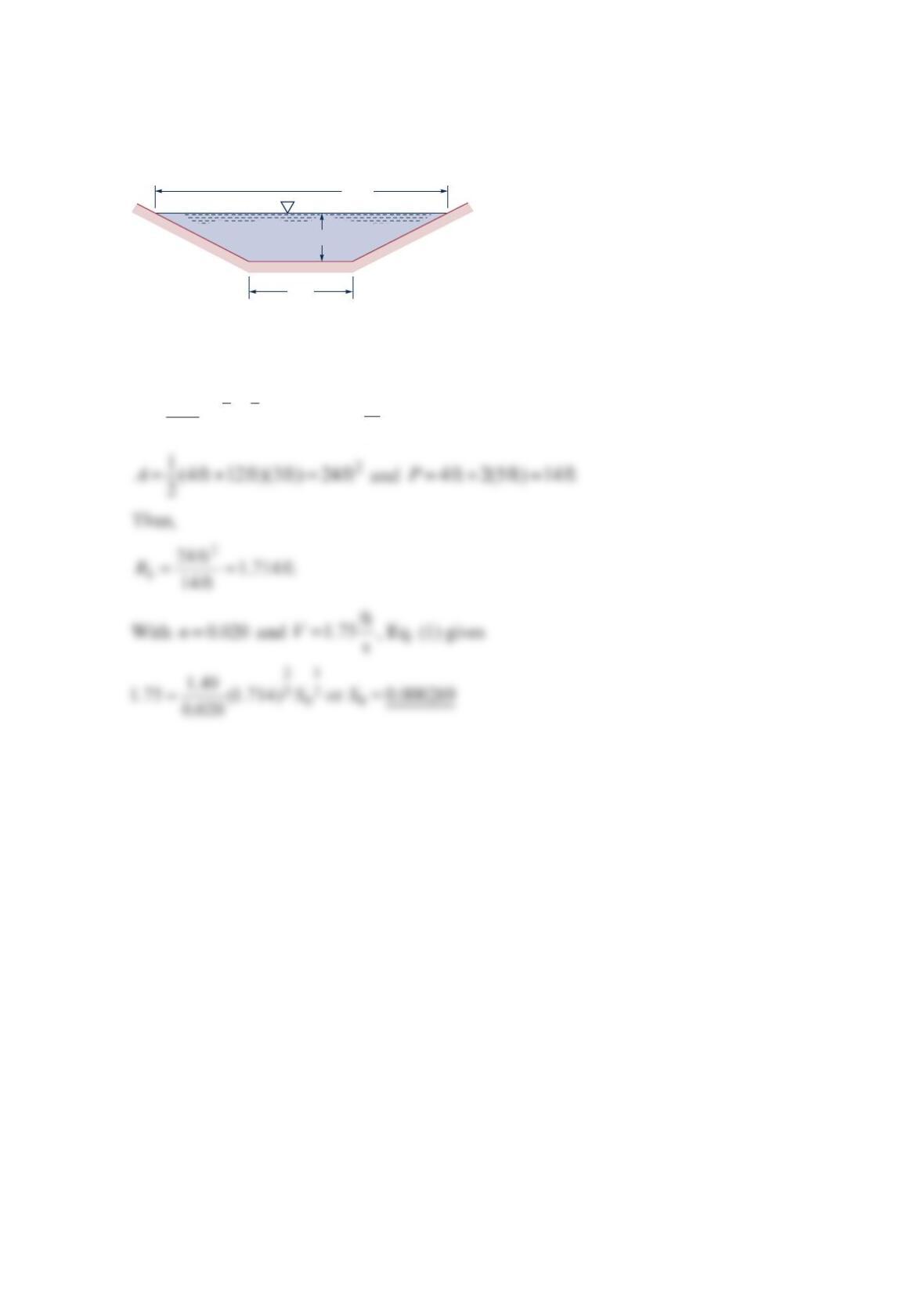
The symmetrical channel shown in the figure below is dug in sandy loam soil with =0.020
n
.
For such surface material, it is recommended that to prevent scouring of the surface, the
average velocity be no more than 1.75 ft/s. Determine the maximum slope allowed.
Solution 10.67
=
21
32
0
1.49
h
VRS
n, where =
h
A
R
P (1)
12 ft
3 ft
4 ft
Problem 10.68
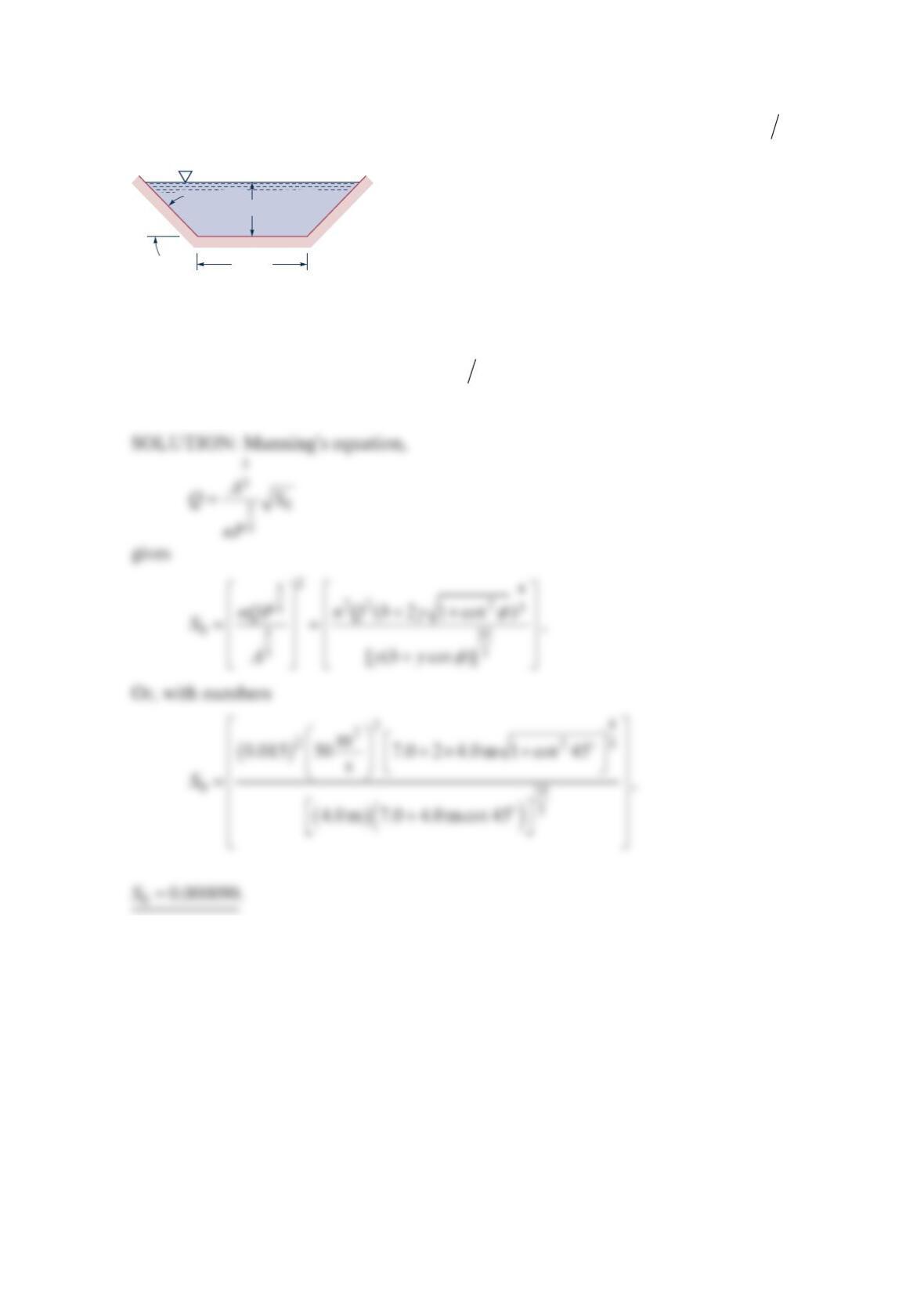
The figure below shows a cross section of an aqueduct that carries water at 3
50 m s. The
value of Manning’s
n
is 0.015. Find the bottom slope.
Solution 10.68
GIVEN: Trapezoidal aqueduct, =3
50 m sQ, =0.015
n
, the figure in the problem.
FIND: Slope 0
S.
7.0 m
4.0 m
45°
Problem 10.69
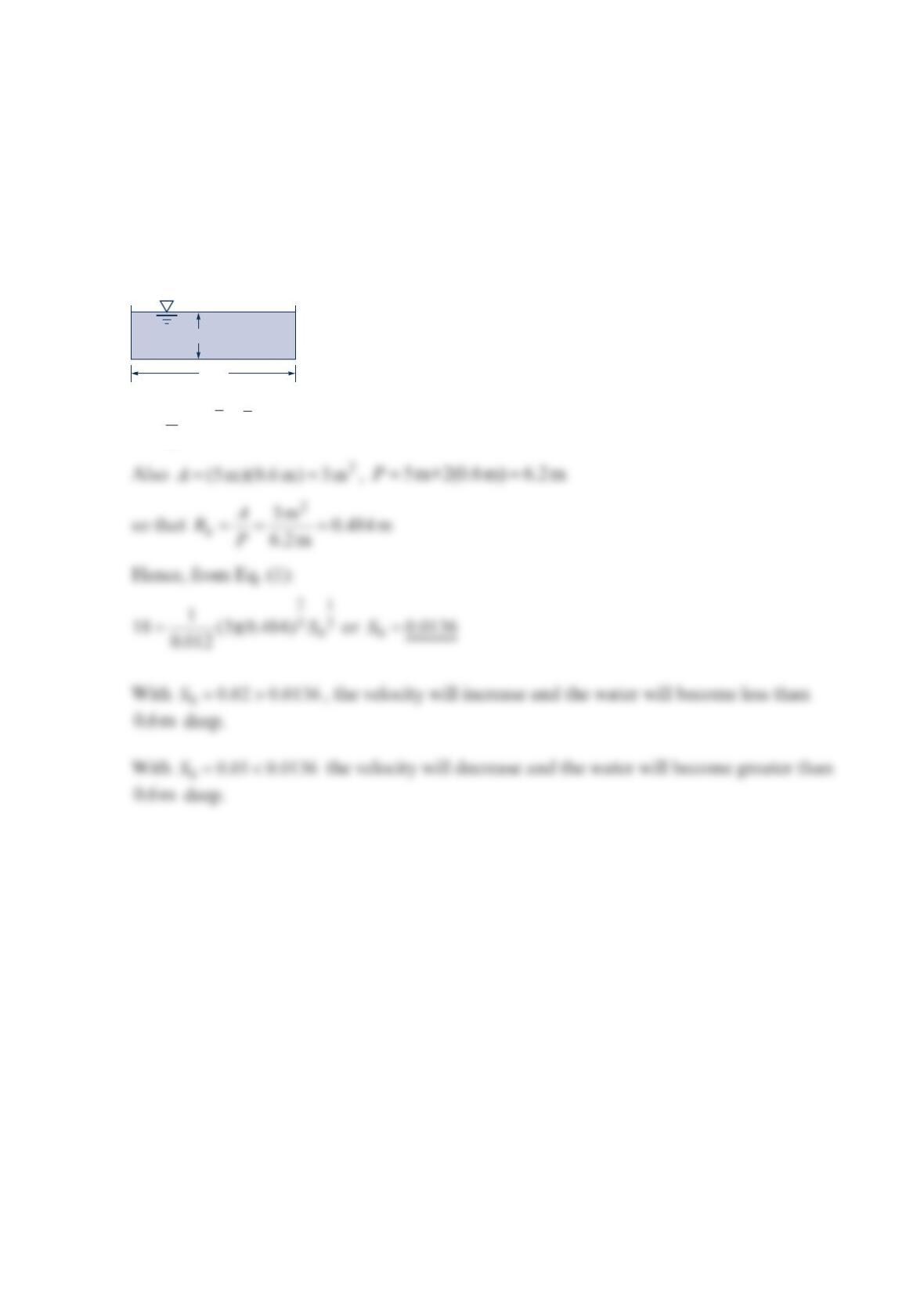
The depth downstream of a sluice gate in a rectangular wooden channel of width 5m is
0.60 m . If the flowrate is 18 m3/s, determine the channel slope needed to maintain this
depth. Will the depth increase or decrease in the flow direction if the slope is (a) 0.02 ; (b)
0.01?
Solution 10.69
=
21
32
0
1
h
QARS
n, and from a table of Manning coefficients, =0.012n (1)
5 m
0.6 m
Problem 10.70
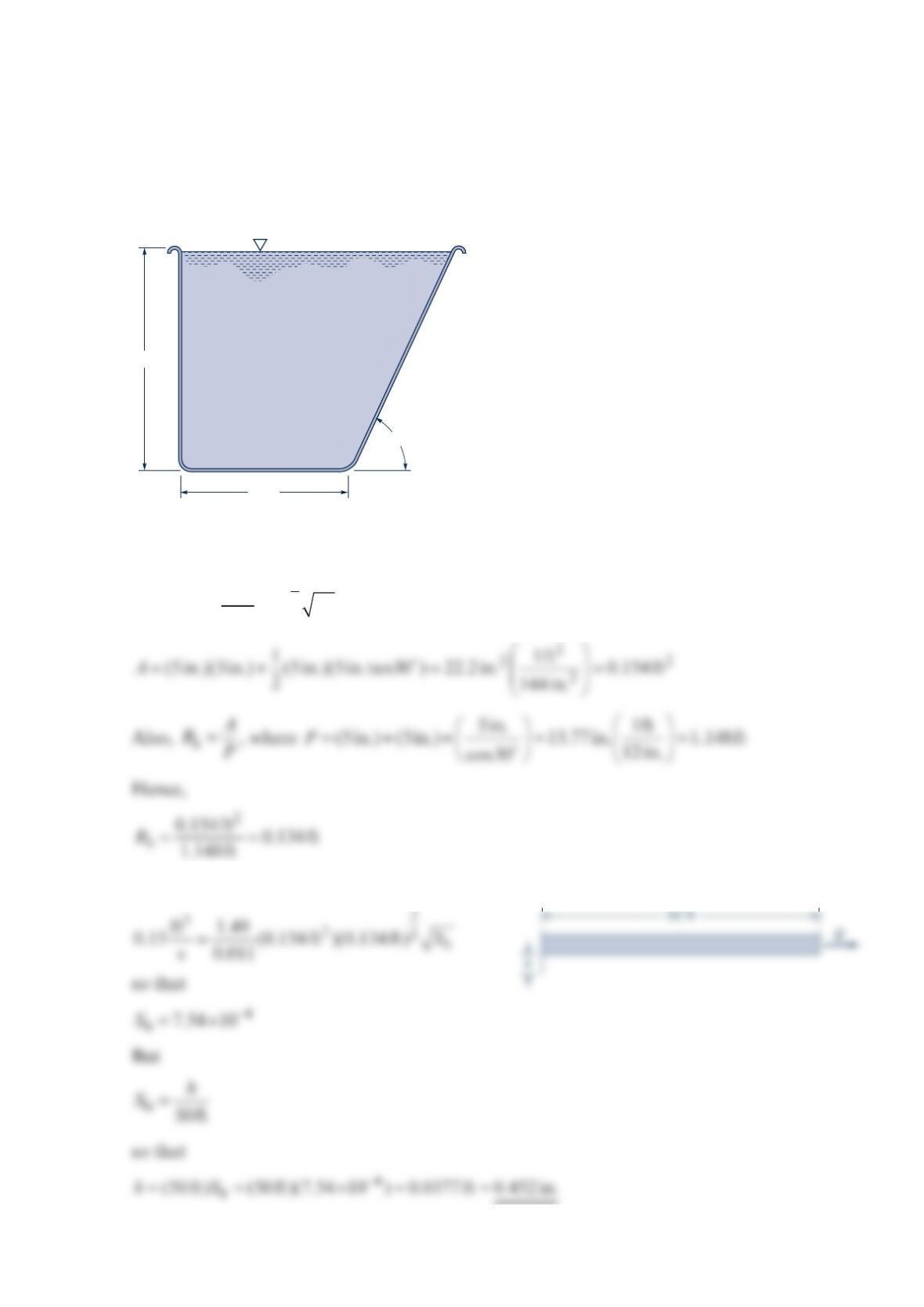
A 50-ft- long aluminum gutter (Manning coefficient =0.011n) on a section of a roof is to
handle a flowrate of 3
0.15ft / s during a heavy rainstorm. The cross section of the gutter is
shown in the figure below. Determine the vertical distance that this gutter must be pitched
(i.e., the difference in elevation between the two ends of the gutter) so that the water does
not overflow the gutter. Assume uniform depth channel flow.
Solution 10.70
(1) =
2
30
1.49
h
QARS
n, where, =0.011n, and
Thus, from Eq. (1)
60°
3 in.
5 in.
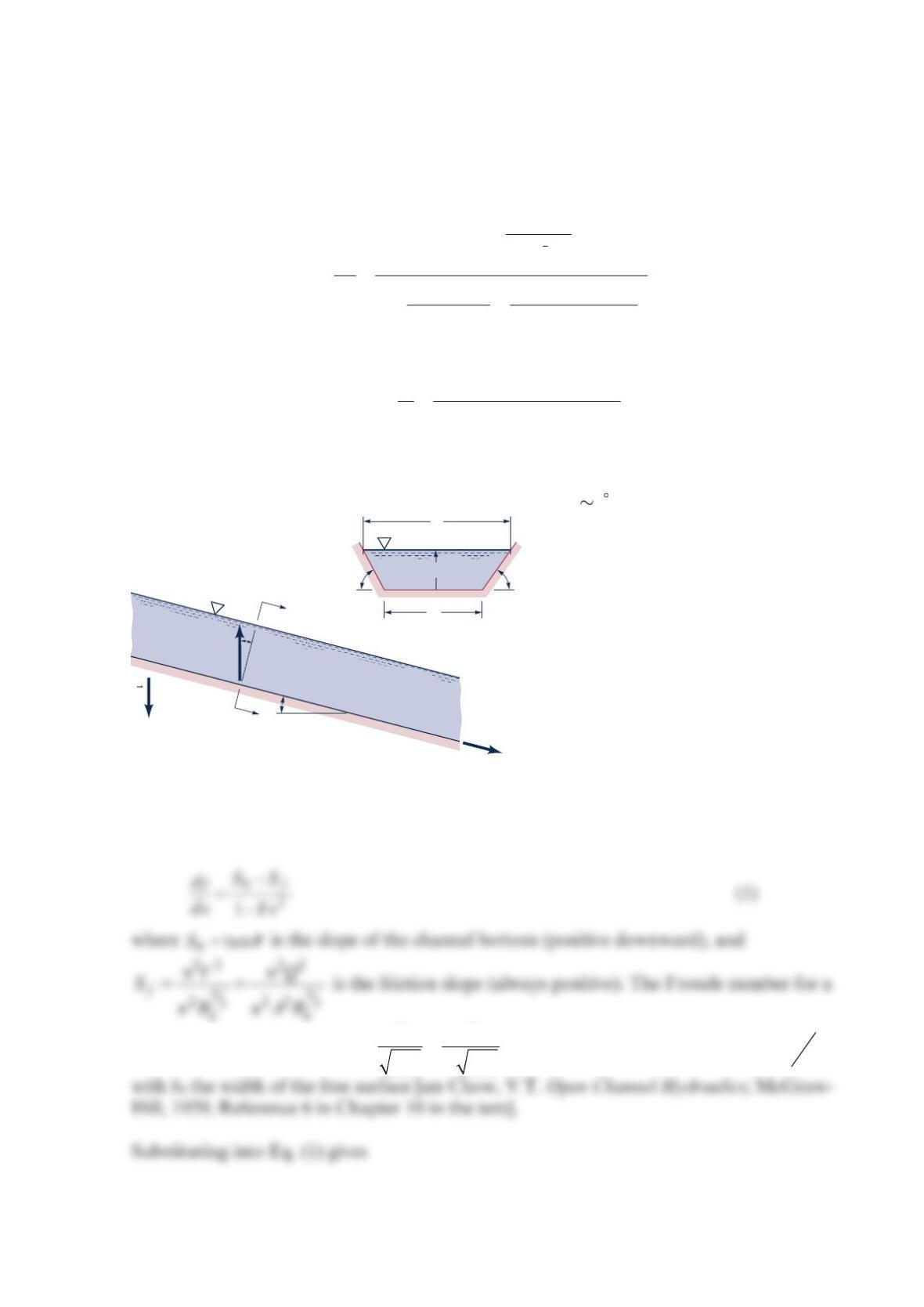
Problem 10.71
Consider the flow down a prismatic channel having a trapezoidal cross section of base
width
b
and top width
θ
φ
+2coscotby . The channel bottom makes an angle
θ
with the
horizontal, and
y
is the vertical fluid depth. (See the figure below) Show that
θ
κ
θ
φ
θ
φ
θ
−
=
+
−
+
4
3
22
22
2
2
tan
2cos cot
1cos cot
cos
h
nQ
AR
dy
dx Qby
by
Agy
.
Note that the average fluid velocity is given by
()
θθ
φ
== +cos cos cot
QQ
VAy by
Discuss the form of the equation for small values of
θ
(1
θ
).
Solution 10.71
For gradually varied flow
nonrectangular channel is
F
r
hh
VQ
gy A gy
== where h
y
is the hydraulic depth:
0
hA
yb
=,
b
A
A
x
y
Section A–A
y cos
θ
θ
θ
ϕϕ
g
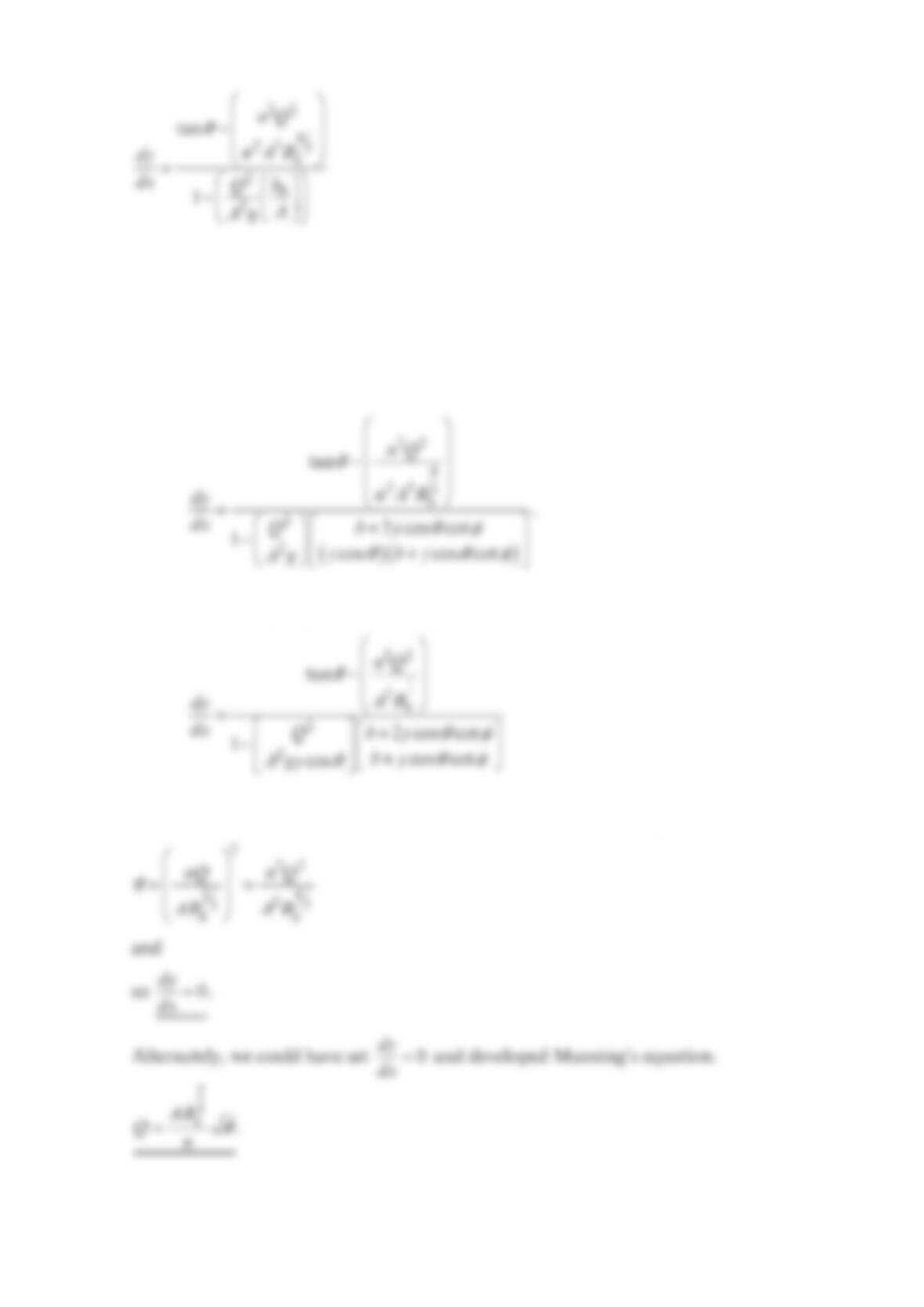
Now we note that
θ
φ
=+
02( cos ) cotbb y
and the area of the trapezoid is
()
θθ
φ
=+cos cos cot .Ay by
Substituting these expressions for 0
b and one A gives
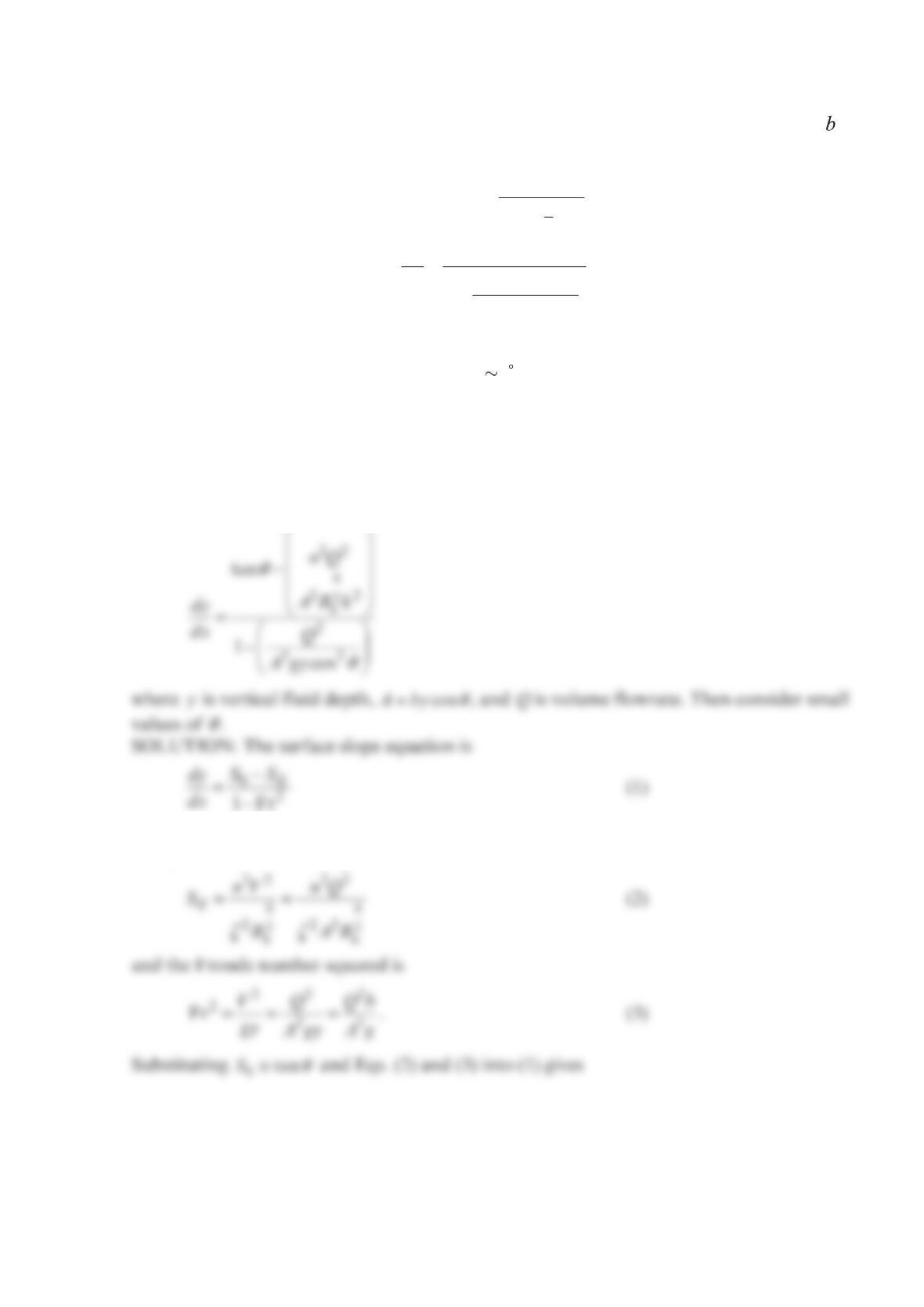
If we set
κ
=1.0 (using SI units), we get
For small values of
θ
, tan
θθ
≈ and cos 1
θ
=. Then from Manning’s equation
Problem 10.72
Consider the flow down a prismatic channel having a rectangular cross section of width .
The channel bottom makes an angle
θ
with the horizontal. Show that
θ
θ
−
=
−
22
4
22
3
2
22
()
tan
1(cos)
h
nQ
AR k
dy
dx Q
Agy
where
y
is the vertical fluid depth, =cos
A
by
θ
, and Qis the volume flowrate. Discuss the
form of the equation for small values of
θ
(1
θ
).
Solution 10.72
GIVEN: Flow down rectangular cross section channel of width
b
. Channel bottom makes
an angle
θ
with horizontal.
SHOW:
where 0
S
is the slope of the channel bottom with the horizontal and E
S is the slope of the
energy grade line. Manning’s equation gives
A
θ
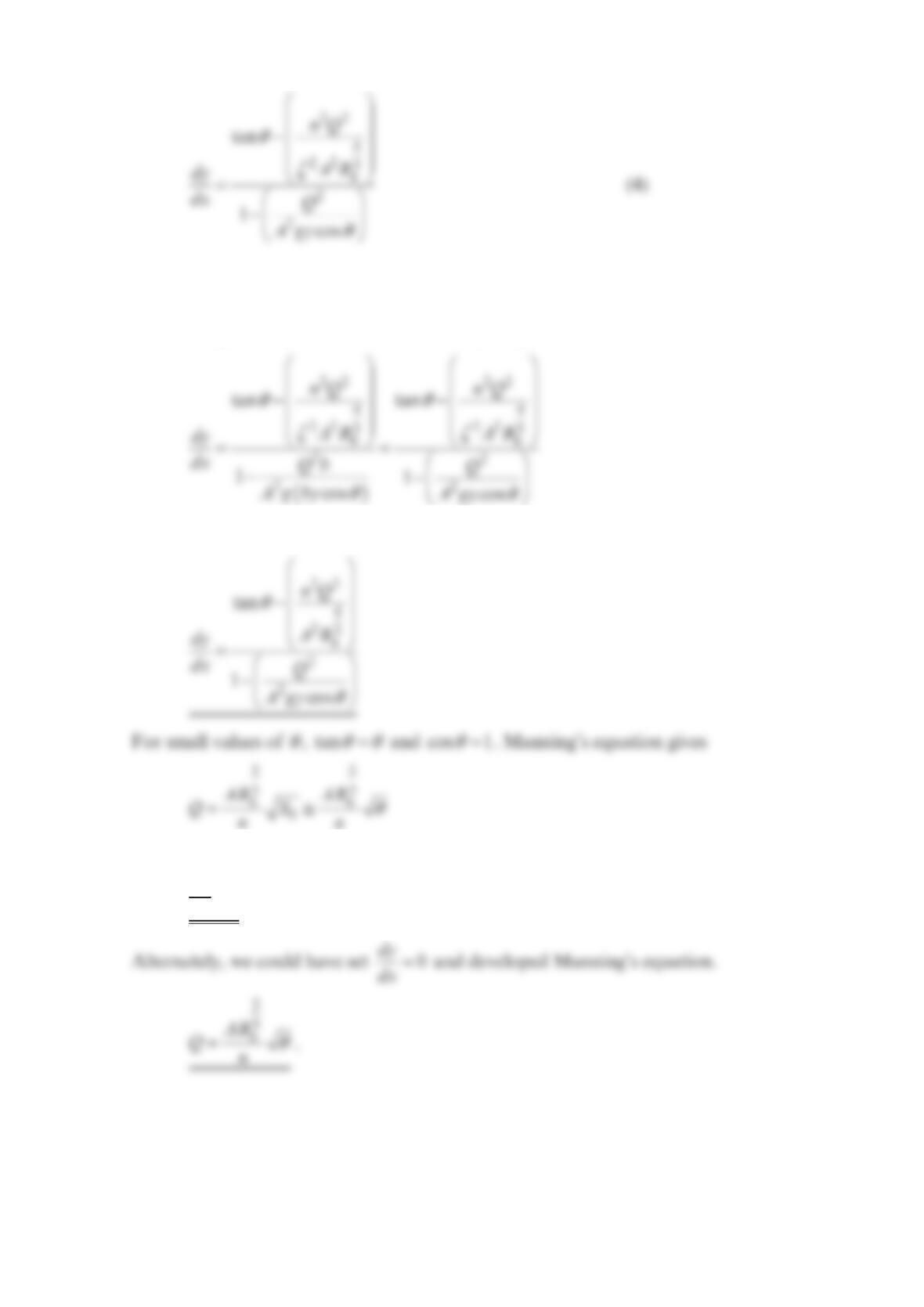
Now
cosAby
θ
=.
Substituting this expression for one A in Eq. (4) gives
If we set 1.0
ζ
= (using SI units),
and
0
dy
dx ≈.
Problem 10.73
Water flows at (15) in a 3-ft- wide rectangular clean-earth irrigation canal. The canal
slope is 0.275 . At one point, the water depth is 3ft.(a) Accurately compute the water depth
at a location 200 ft downstream. (b) Is the flow at the upstream location subcritical or
supercritical? At the downstream location? (c) Sketch the canal and the water surface
profile.
Solution 10.73
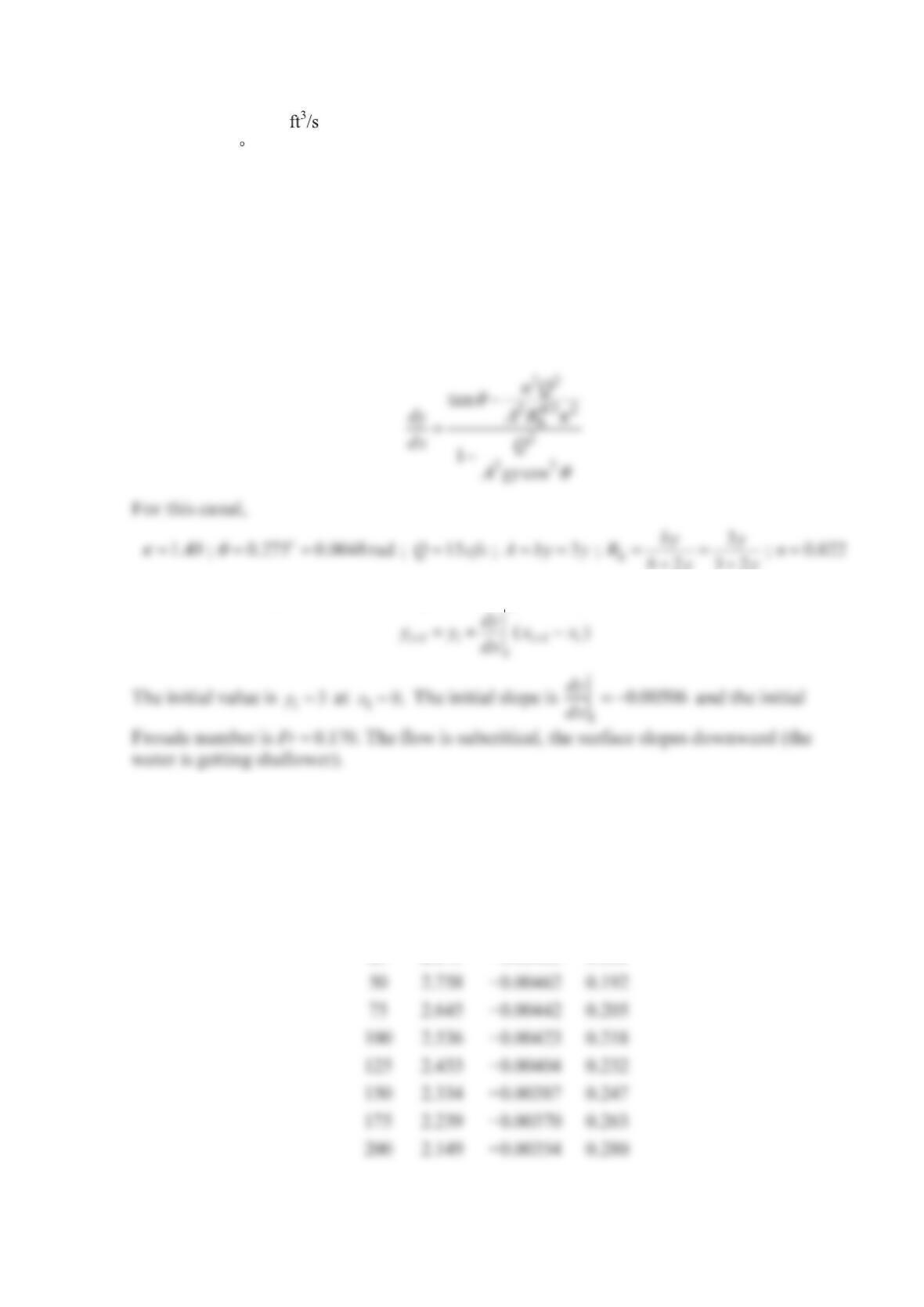
From Problem 10.72, the differential equation for the water depth is
232
by y
++
The differential equation can be integrated using the simple Euler method
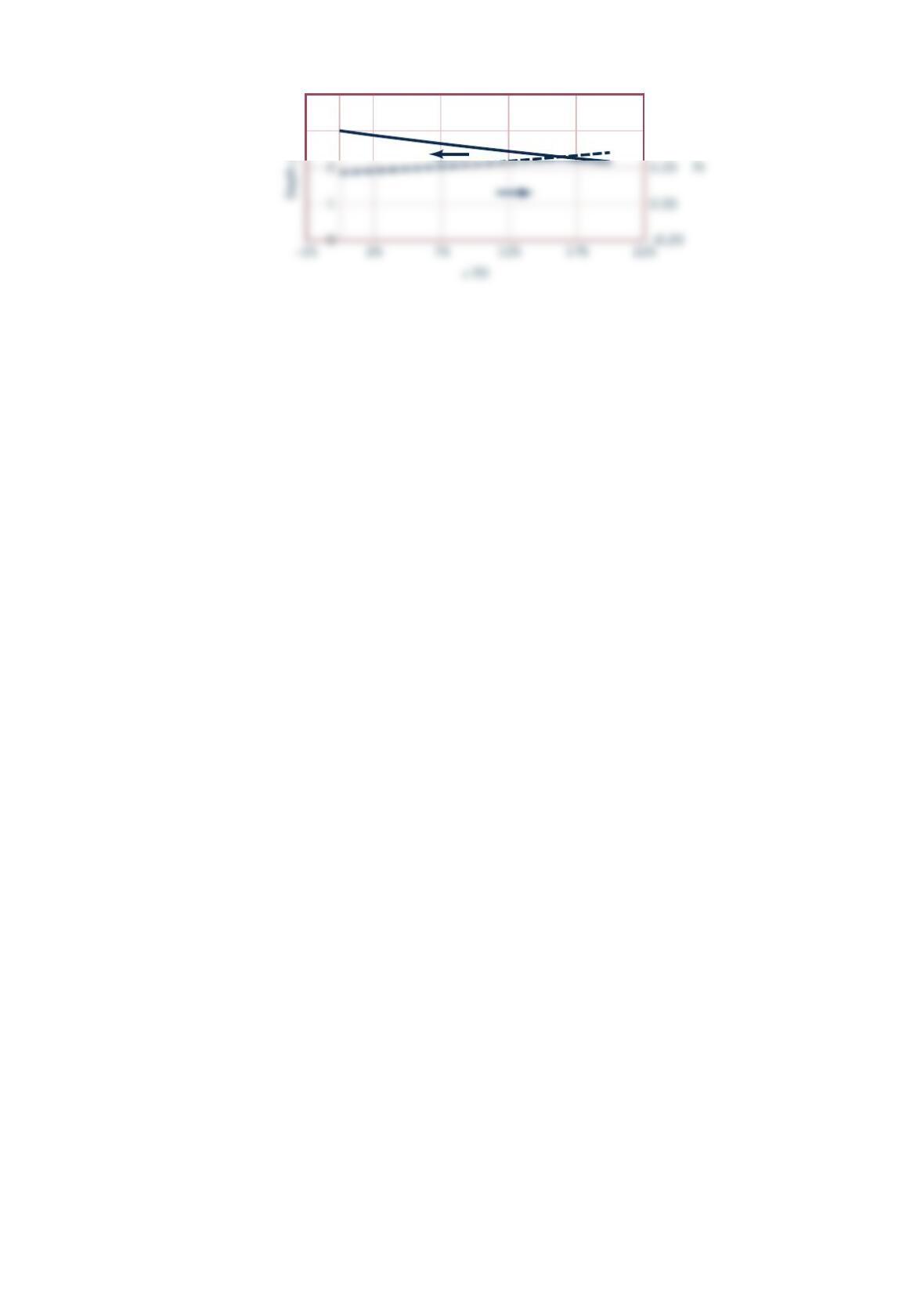
The surface profile and Froude Number were calculated using Microsoft® Excel®. The
200 ft reach was divided into 1ft sections and the depth adjusted after each section. Below
is a table showing the results at 25 ft intervals, followed by a graph of the results:
x(ft) y(ft) dy/dx Fr
0 3 −0.00506 0.170
25 2.873 −0.00483 0.181
0.40
0.60
(ft)
3
4
Problem 10.74
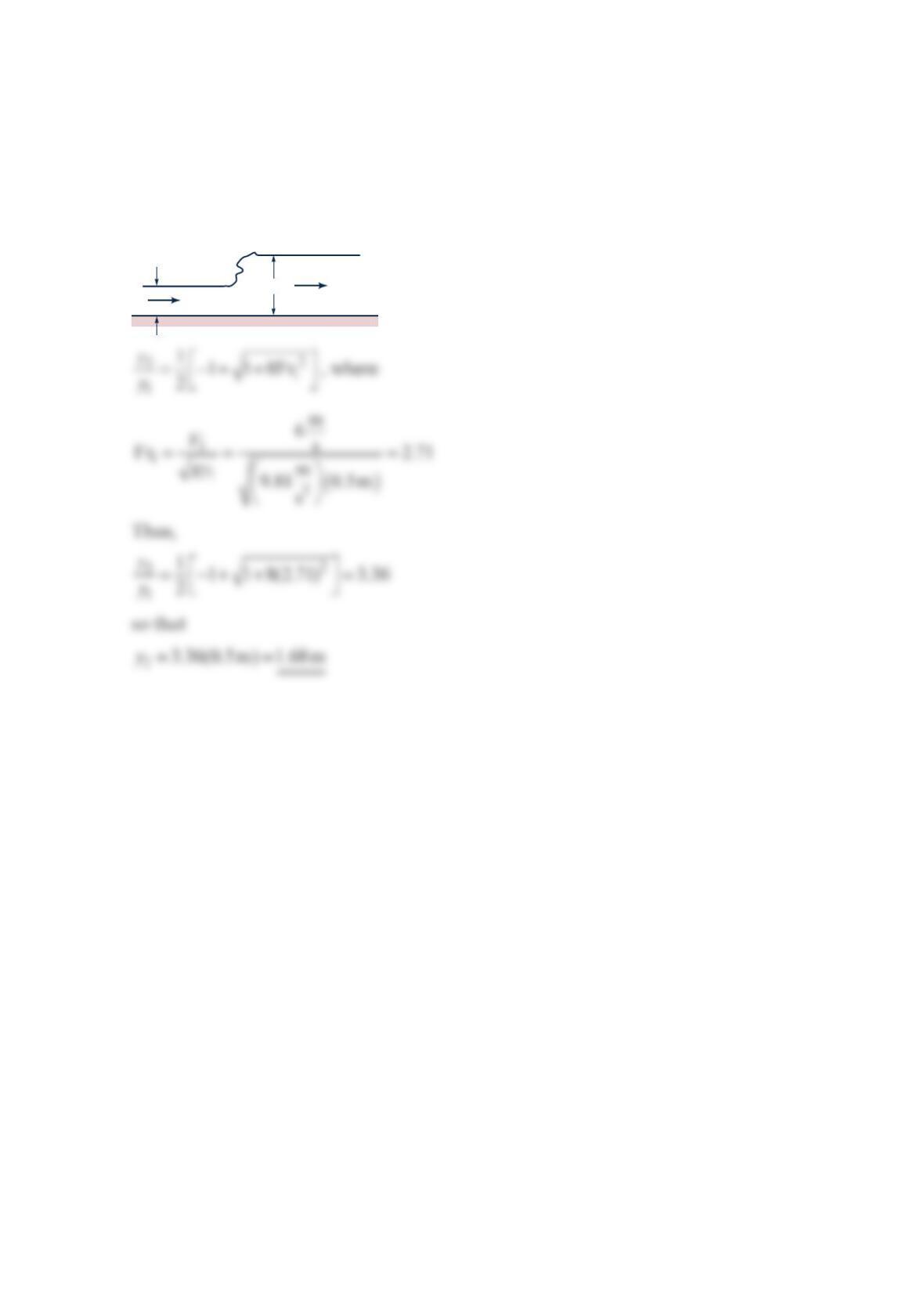
Water flows upstream of a hydraulic jump with a depth of 0.5 m and a velocity of 6 m/s.
Determine the depth of the water downstream of the jump.
Solution 10.74
y
1
y
2
V1
V2
Problem 10.75
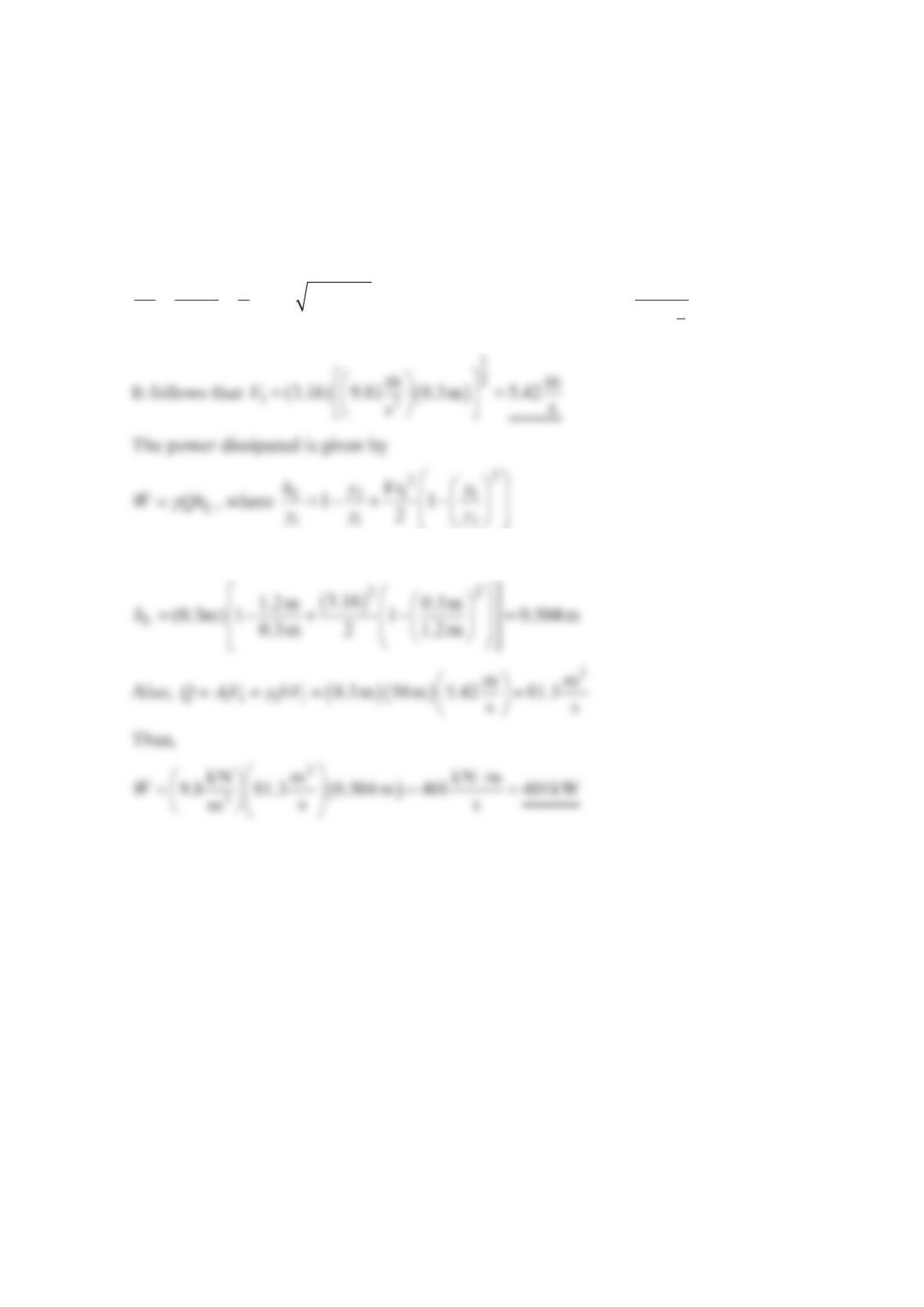
A 5.0-m -wide channel has a slope of 0.004 , a 3
8.0- m s water flowrate, and a water depth
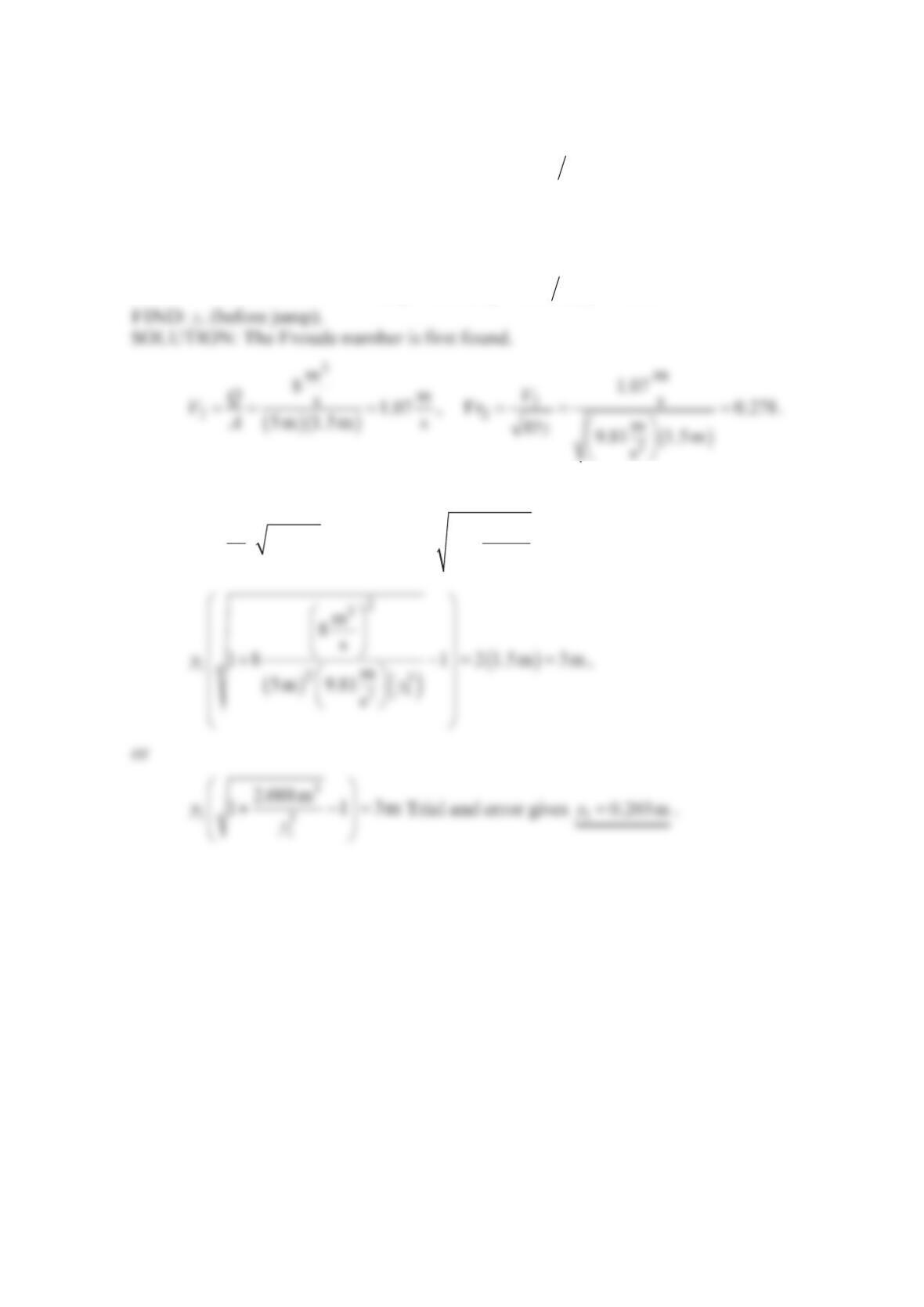
1.5 m after a hydraulic jump. Find the water depth before the jump.
Solution 10.75
GIVEN: Wide channel, =5mb,=
00.004S, =3
8m sQ,=
21.5 my.
The depth increase gives
()
=+−
2
1
21
1Fr 1
2
y
y,
+−=
2
12
23
1
18 1 2
Q
yy
bgy ,
Problem 10.76
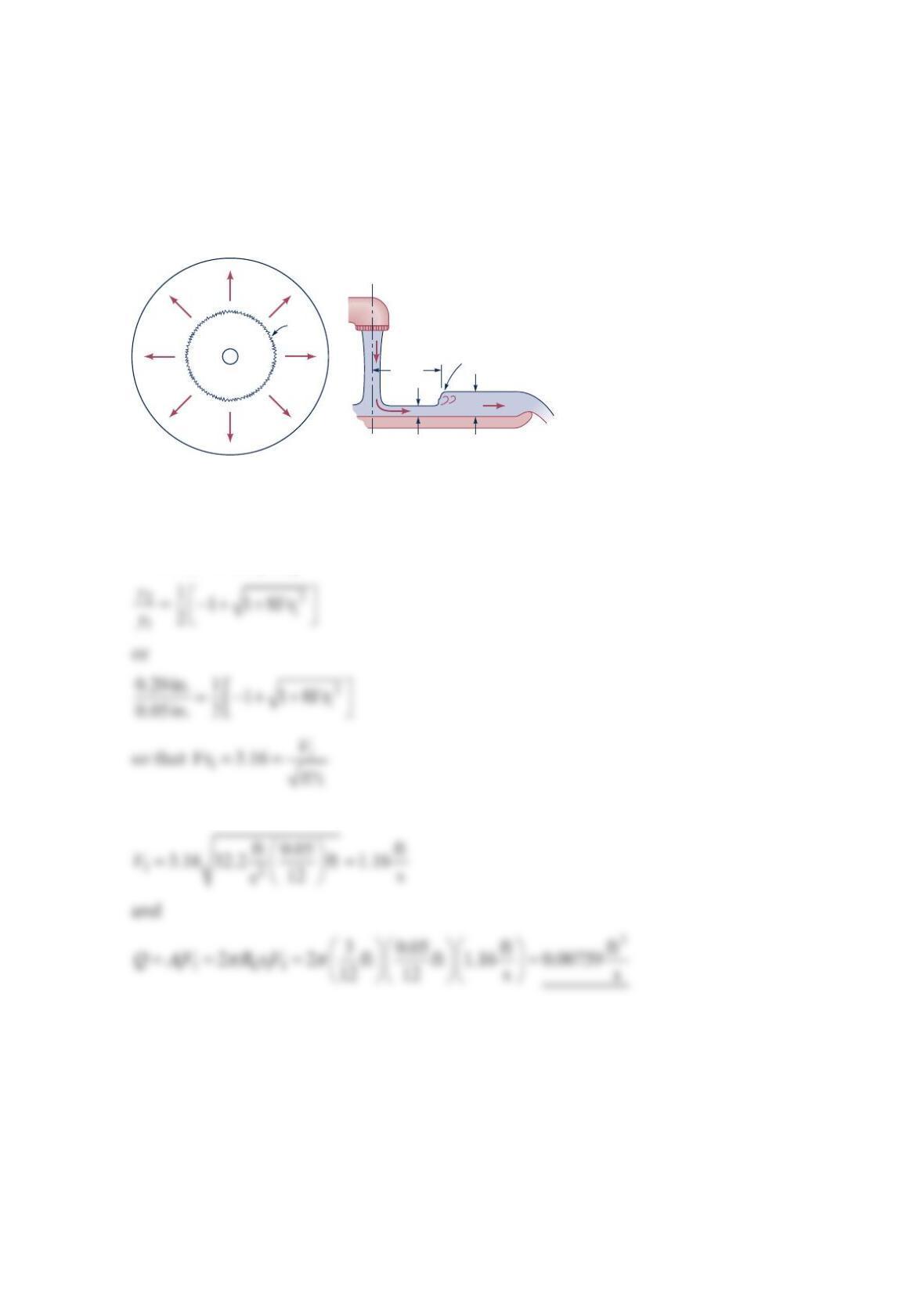
The water depths upstream and downstream of a hydraulic jump are 0.3 and 1.2 m ,
respectively. Determine the upstream velocity and the power dissipated if the channel is
50 m wide.
Solution 10.76
==−++
2
21
1
1.2 m 1 118Fr
0.3m 2
y
y or =
1
Fr 3.16 Thus, since
()
=1
11
2
1
Fr V
gy
or
Problem 10.77
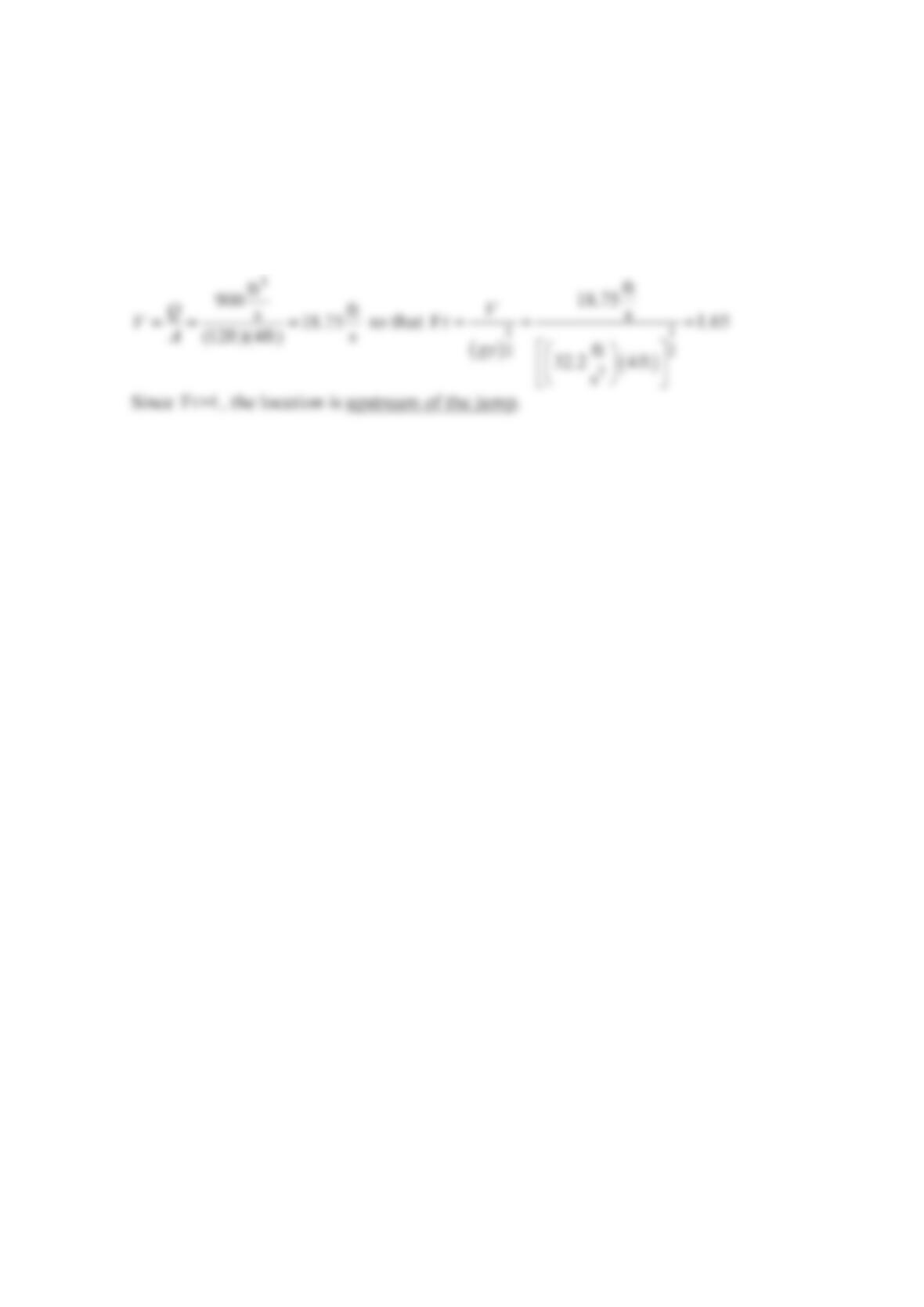
Under appropriate conditions, water flowing from a faucet, onto a flat plate, and over the
edge of the plate can produce a circular hydraulic jump as shown in the figure below.
Consider a situation where a jump forms 3.0 in. from the center of the plate with depths
upstream and downstream of the jump of 0.05 in. and 0.20 in. , respectively. Determine the
flowrate from the faucet.
Solution 10.77
For a hydraulic jump:
Thus,
Jump
3 in. Jump
0.05 in. 0.20 in.
Problem 10.78
At a given location in a
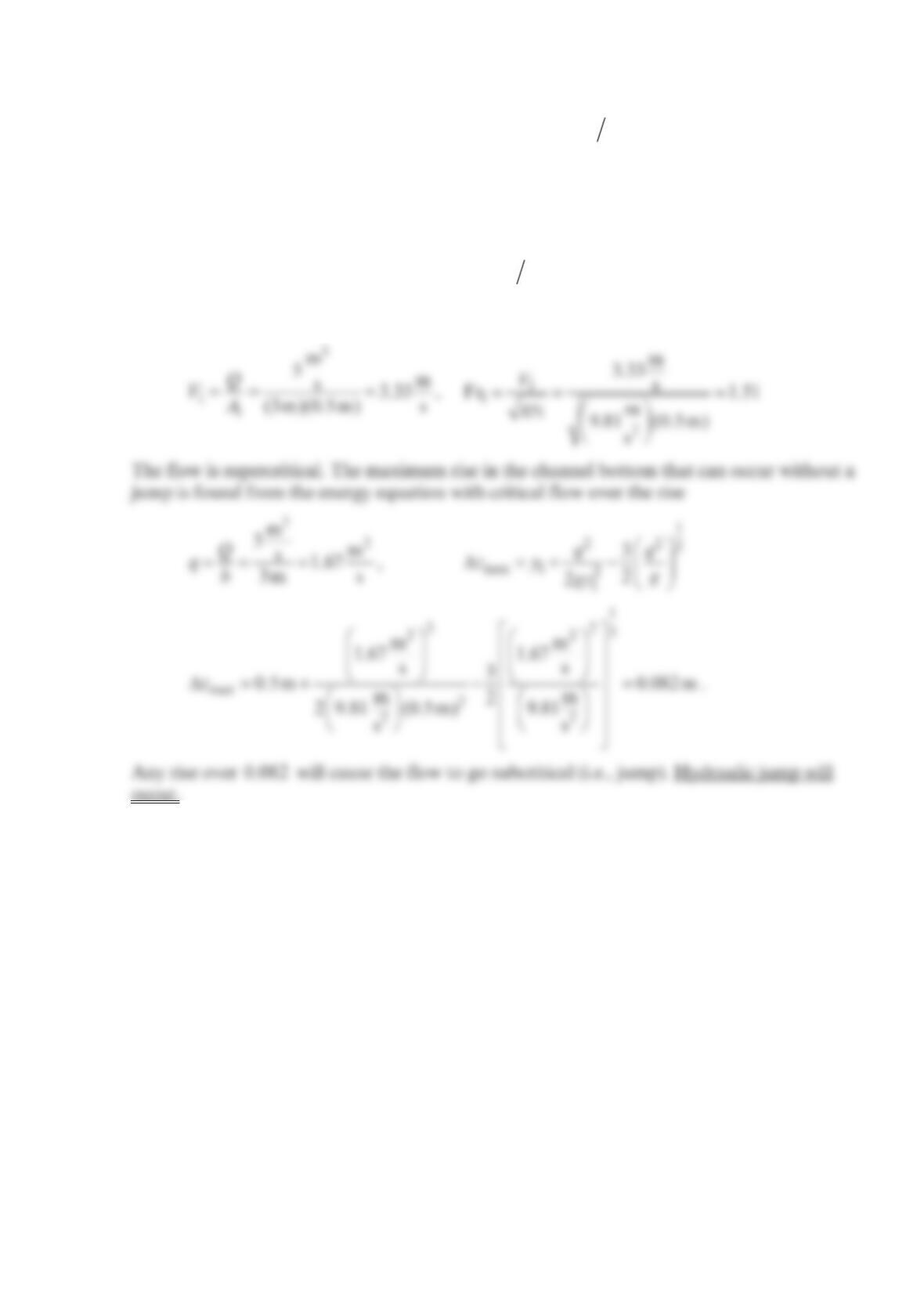
1
2-ft–wide rectangular channel the flowrate is 3
900 ft / s and the
depth is 4ft . Is this location upstream or downstream of the hydraulic jump that occurs in
this channel? Explain.
Solution 10.78
Problem 10.79
A rectangular channel 3.0 m wide has a flowrate of 3
5.0 m s with a normal depth of
0.50 m . The flow then encounters a dam that rises 0.25m above the channel bottom. Will
a hydraulic jump occur? Justify your answer.
Solution 10.79
GIVEN: Rectangular channel, =3mb, =3
5m sQ, =0.5 m, 0.25 m
n
y dam.
FIND: Will a hydraulic jump occur?
SOLUTION: The Froude number is
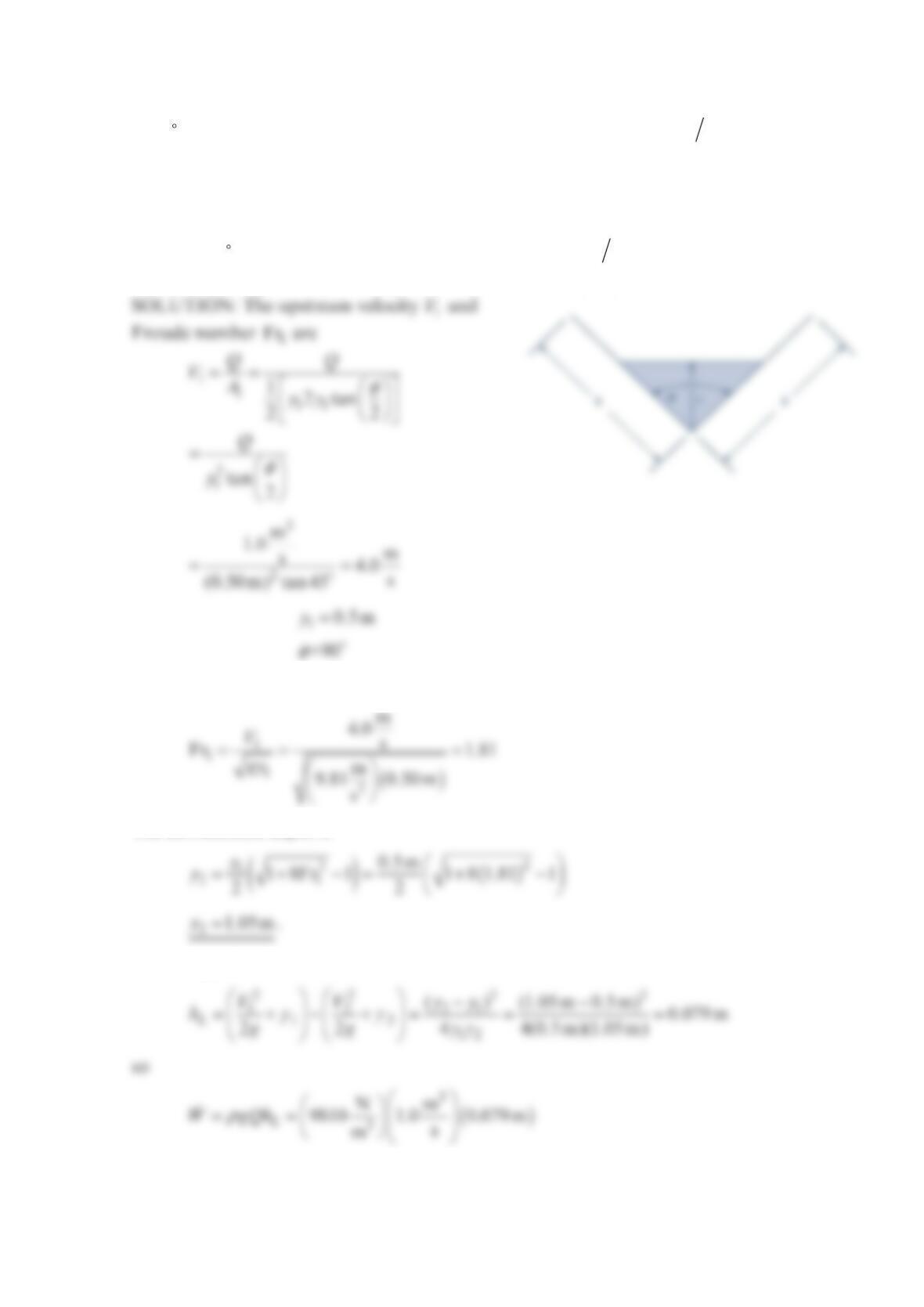
Problem 10.80
A 90 triangular flume has sides 2.0 m wide, a water flowrate of 3
1.0 m s , and a depth of
0.50 m . Find the depth after a hydraulic jump and the power loss in the jump.
Solution 10.80
GIVEN: 90 triangular flume, sides 2.0 m wide, =3
1.0 m sQ, depth =
10.50 my.
FIND: Depth 2
y
after hydraulic jump and power loss in jump.
and
The downstream depth is
The energy loss is
or

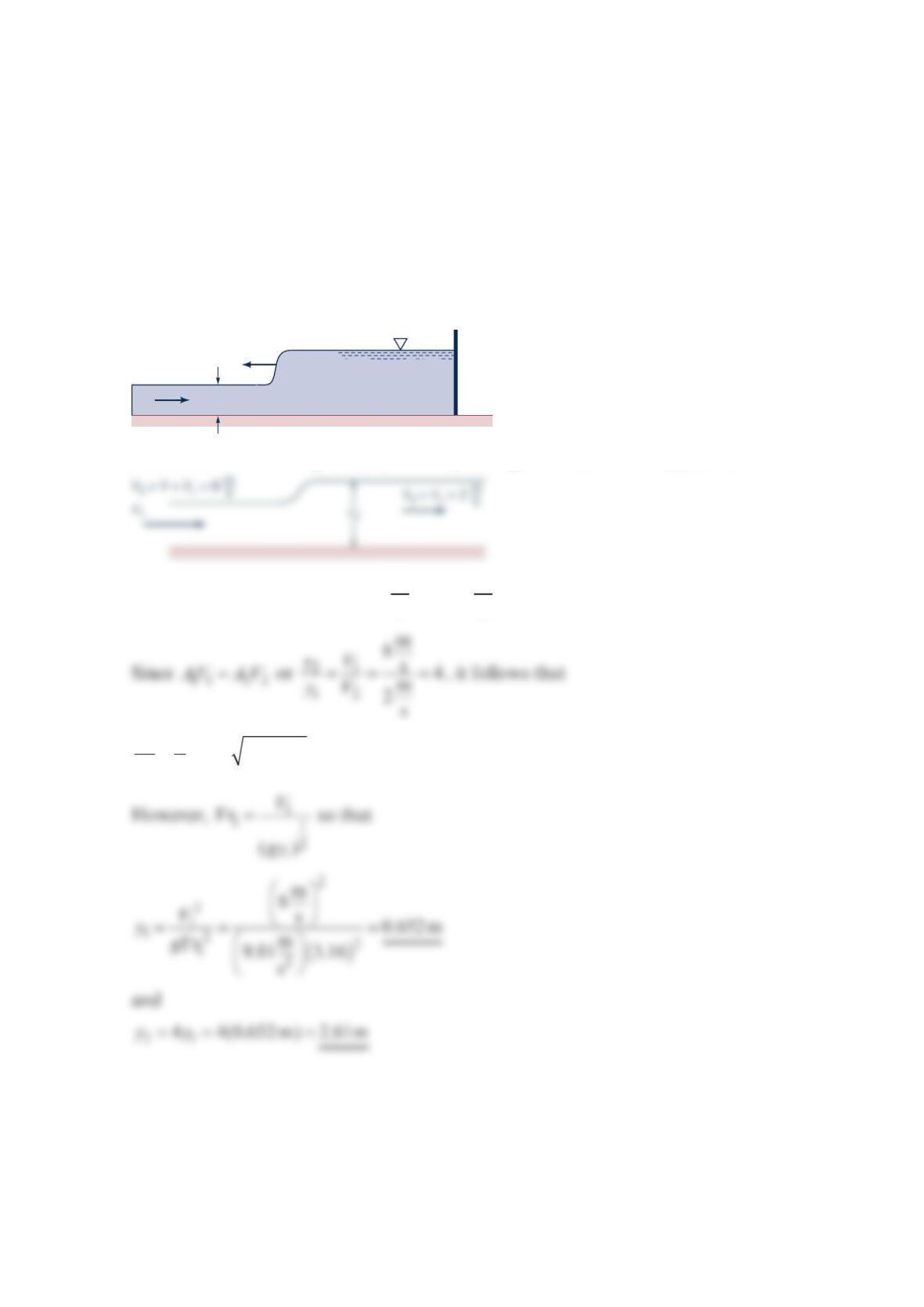
Problem 10.81
Water flows in a rectangular channel with velocity =6m/sV. A gate at the end of the
channel is suddenly closed so that a wave (a moving hydraulic jump) travels upstream with
velocity =
w2m/sV. Determine the depths ahead of and behind the wave. Note that this is
an unsteady problem for a stationary observer. However, for an observer moving to the left
with velocity w
V, the flow appears as a steady hydraulic jump.
Solution 10.81
For an observer moving to the left with speed =
w2m/sV, the flow appears as shown below.
Thus, treat as a jump with =
1
m
8s
V, =
2
m
2s
V
=−++ =
2
21
1
1118Fr 4
2
y
y. Hence, =
1
Fr 3.16
yV
V
V
= 0
Problem 10.82
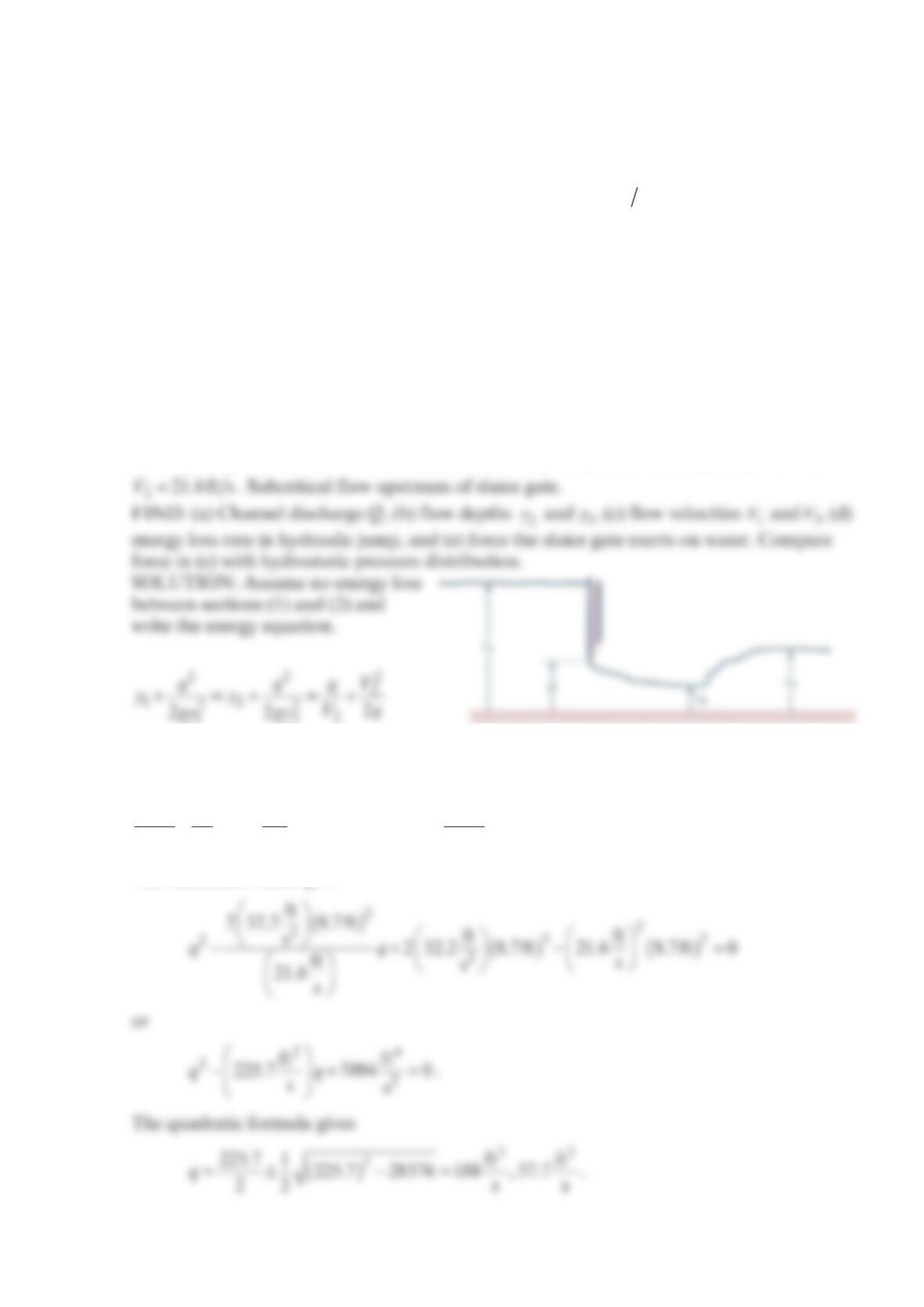
A hydraulic engineer wants to analyze steady flow in a rectangular channel featuring a
hydraulic jump immediately downstream from a sluice gate that is open to a vertical
clearance of 3ft . The flow depth upstream from the sluice gate 8.7 ft , and the flow velocity
beyond the sluice gate and prior to the hydraulic jump is 21.6 ft s . Assume that the flow
upstream from the sluice gate is subcritical. Find:
(a) The discharge in the channel;
(b) The flow depth before and after the hydraulic jump;
(c) The flow velocities upstream from the sluice gate and beyond the hydraulic jump;
(d) The energy loss rate in the hydraulic jump;
(e) The force the sluice gate exerts on the fluid.
How does this compare with the force computed assuming a hydrostatic pressure
distribution?
Solution 10.82
GIVEN: Rectangular channel, steady flow, hydraulic jump immediately downstream of
sluice gate open a vertical clearance of 3ft . Flow depth upstream sluice gate =
18.7 fty,
or
−+− =
2
2
2
1
22
1
0
2
2
V
qq
y
Vg
gy or −+−=
2
2322
1121
2
220
gy
qqgyVy
V.
The numerical values give