14-1
Dansk Minox
Teaching Commentary
OVERVIEW
This case is used in the required course on Managerial Accounting, and it teaches very well if used early in the term.
The case reinforces the breakdown between fixed and variable costs (contribution analysis and full cost analysis). A
significant benefit in using this case early in the course is that it illustrates nicely the importance of integrating cost
analysis with strategic and business considerations. The case can be covered in one class period (ninety minutes).
This short case is an excellent classroom vehicle to generate good discussion regarding a number of key issues
in managerial accounting:
1. Identifying fixed and variable costs. Practice in calculating contribution and full cost profits.
A/S Dansk Minox (DM), a company in Copenhagen, Denmark, manufactures and markets a variety of vacuum–
packed cooked meat products. The consumer puts together a meal by either combining the pre–prepared packages (sold
Note 1: The standard pork pack weighs .450 kg and sells for 3.38. The sales price per kg would be 7.51 (3.38 1000 ÷
450). The total sales of standard pork pack approximately is D.Cr. 1,419,600 (189,000 kg 7.51), which is 15% of total
sales. Therefore, turnover is D.Cr. 9.5 million.
1. The percentage of women in the workforce is on the rise. Working mothers have a strong preference for pre–
prepared complete meal products.
14-2
Management’s decision to introduce this
complete meal has led to disagreements between the
marketing department and finance department on how to
scheme. They believe that a strict application of D.Cr.
1.20 per kg to the CM product leads to unreasonable
consequences when a relatively cheap component fired
cabbage) is added to an expensive component (sliced pork
in gravy) and the cheap component more than doubles the
TEACHING STRATEGY
The class discussion should start by focusing on the
management decision about introducing the new product
(Question 7). The instructor might want to take a poll of
“how many students would price CM at the lower price of
analyses (Questions 1 to 6) are discussed next, before
returning to their implications for management action.
SUGGESTED ANSWERS TO QUESTIONS
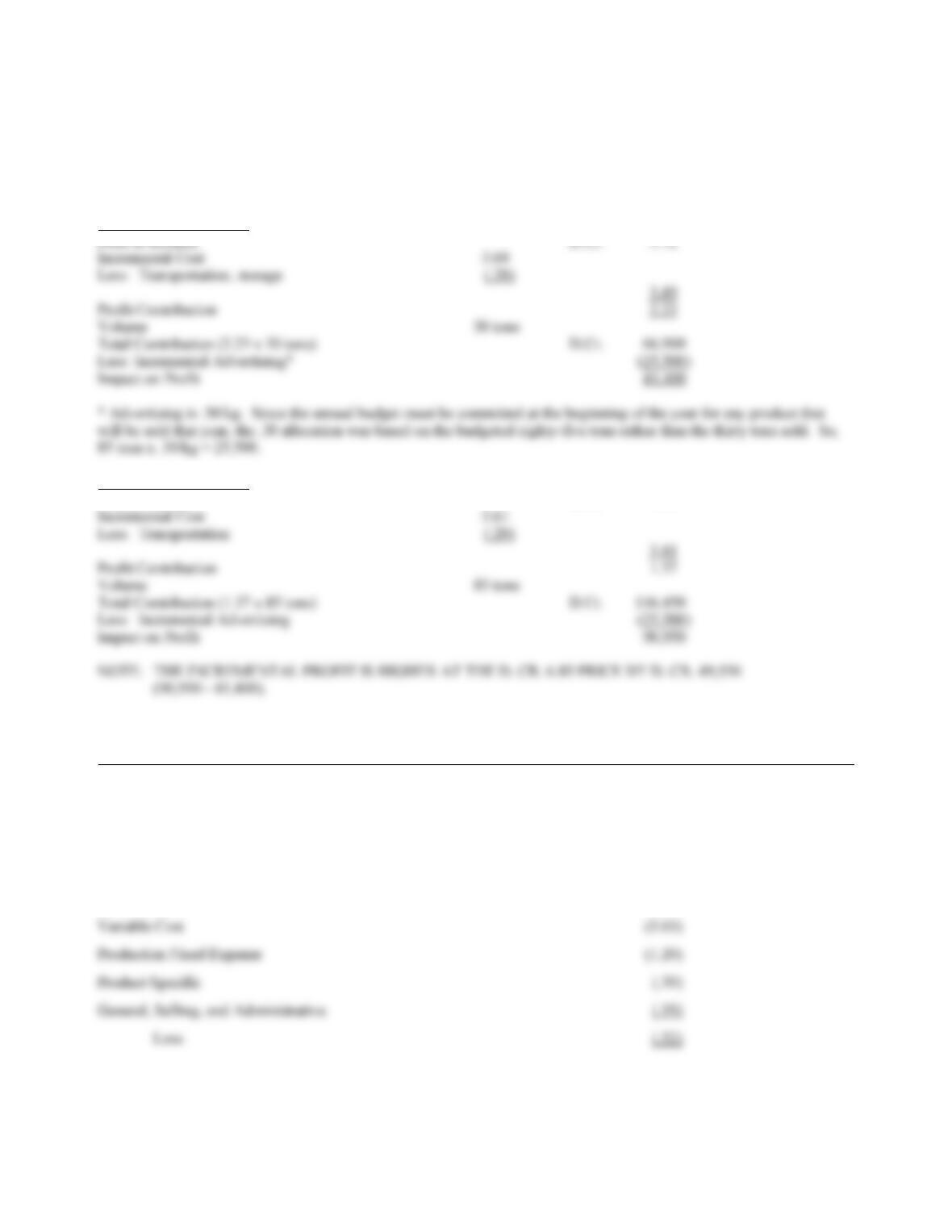
Exhibit A contains the contribution analysis for
the D.Cr. 8.20 price and the D.Cr. 6.85 price. It can be
noted from Exhibit 1 that the D.Cr. 6.85 price yields
2. Transportation and storage cost has been treated as a
fixed expense since this represents an allocated share
of the expense for operating a fleet of company–
3. Exhibit A assumes no cannibalization of the standard
pork pack due to the introduction of the CM product.
The key idea embodied in Exhibit A is that, in
the short run, the impact on profits between the two prices
at 8.20 Price
66,900
at the 6.85 Price
1.37
÷
49 Tons
Thus, the low price is better as long as DM can
FULL COST ANALYSIS
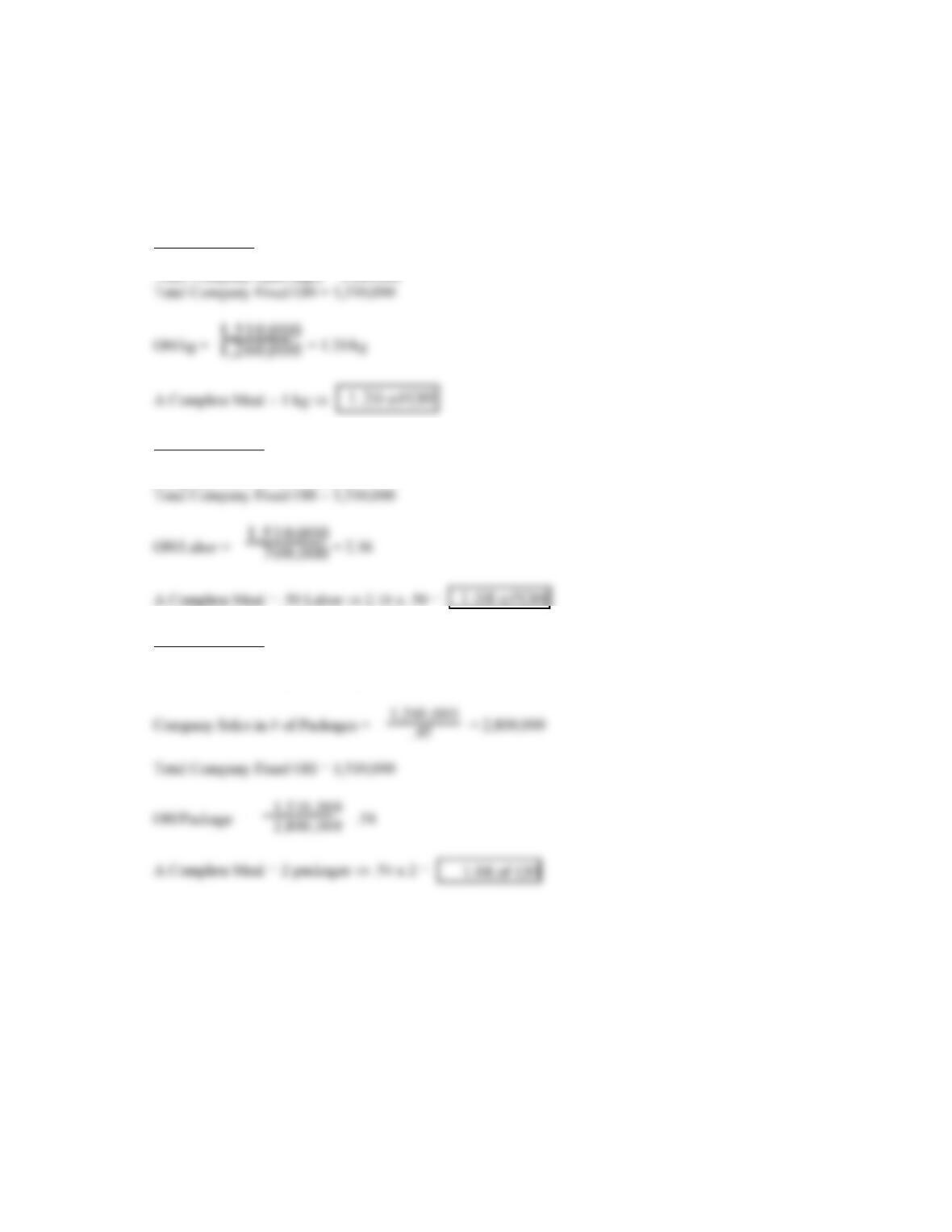
Exhibit B shows the full cost profit calculations
for the CM product at the D.Cr. 6.85 price. This exhibit
shows D.Cr. 0.52 loss for every unit sold at the low price.
This suggests that, at 6.85, CM is a “good contribution/no
profit” product.
Exhibit B assumes allocation of D.Cr. 1.20 for
14-3
D.Cr. 6.85.
Further, we might note that the products in DM’s
factory probably move through in batches of certain
IMPLICATIONS FOR MANAGEMENT ACTION
The contribution analysis suggests the D.Cr. 6.85
price but the full cost metric suggests the D.Cr. 8.20
price. What should management do? As is the theme
1. It produces good incremental contribution to
profits. Since there is excess capacity, we
should take advantage of it. The fixed costs are
already being covered.
2. The contribution is much better at D.Cr. 6.85
than at D.Cr. 8.20 because of the larger sales
demand at the lower price. The difference in
consumer price between the standard and the
CM packs as proposed by the finance department
but there is a small market at D.Cr. 3.35. This
makes sense because the ingredients for making
the red cabbage salad at home could be bought
for about D.Cr. 1.10. The consumer is unlikely
3. New products such as the complete meal are the
wave of the future for the following reasons:
b. Packaged cabbage is already here.
c. CM fits our strategic thrust toward whole
based on weight is incorrect.
5. The value price for the complete meal is D.Cr.
6.85 (based on the D.Cr. 2.00 value price for the
cabbage salad). That is the price at which the
To counter these arguments, students can raise
the following points:
1. Concerning the allocation of fixed overhead to
the complete meal, the following can be noted:
a. In the long run, the capacity really is not
“free” in this market.
c. Production fixed overhead at D.Cr. 1.51
million is large. It is 16% of sales
(9.5 million
1.51 million ). We are a high fixed cost
operation. A good product must be able to
based on weight is defensible.
14-4
3. DM’s current market positioning is based on high
value/high price products, such as the standard
pork package. The complete meal does not fit
that strategy. Our current products tend toward
higher value/lower bulk, but cabbage salad is
lower value/higher bulk:
a. Standard pack weighs .450 kg and sells for
D.Cr. 3.38; but cabbage salad weighs .550
kg and sells only for D.Cr. 1.40. The
b. Cabbage salad takes just as much labor time
(a rough proxy for “value added”) as pork —
both require D.Cr. 0.25 of labor per unit.
However, cabbage salad sells for much less
than pork. One inference is that DM is
4. Cannibalization of standard pack sales by
complete meal sales would be much more likely
at D.Cr. 6.85 price (D.Cr. 2.00 for cabbage) than
at D.Cr. 8.20 price (D.Cr. 3.35 for cabbage). At
the D.Cr. 6.85 price, customers might well prefer
a.) It seems like a bad use of our factory at the
D.Cr. 6.85 price (the value price); low
value-added product not appropriate for our
high fixed cost factory.
b.) It is low volume and low growth idea at the
D.Cr. 8.20 price (= full cost price).
c.) D.Cr. 8.20 is not even a high enough price
them.)
e. It appears that meat product firms cannot
make money at the value price of D.Cr. 6.85
(not enough value added).
SUMMARY
As is typical of the cases in this book, DM’s
product introduction problem cannot be easily resolved.
There are no “right” or “wrong” answers to this case. The
important point is to make sure that students comprehend
14-5
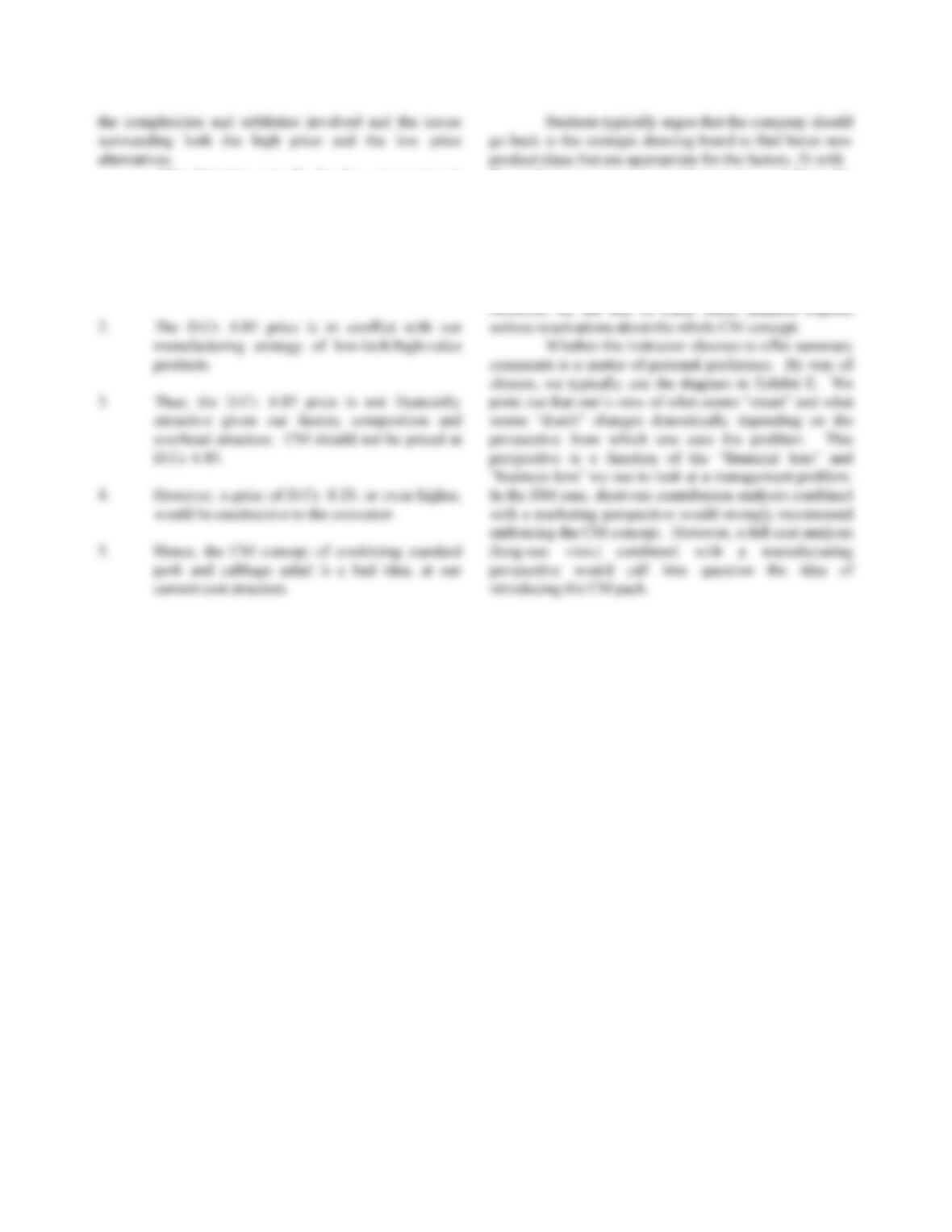
After bringing out all the key arguments in
support of both pricing approaches, we typically take
another poll of the students’ recommended approach.
Typically, a majority of students at this stage conclude:
1. The marketing arguments for CM make sense
only at the D.Cr. 6.85 price.
the marketing competence, and generate a profit in the
long run (i.e., products whose contribution is high enough
to cover a fair share of allocated fixed overhead and show
a good profit).
Our experience in teaching this case has been
that students come to class with a good deal of
enthusiasm for the CM pack at the D.Cr. 6.85 price.
14-6
Exhibit A
A/S DANSK MINOX
Contribution Analysis
At a Retail Price of 8.20
At a Retail Price of 6.85
Price to retailer D.Cr. 4.78
Exhibit B
A/S DANSK MINOX
Full Cost Analysis
Price to Retailer D.Cr. 4.78
14-7
Exhibit C
A/S DANSK MINOX
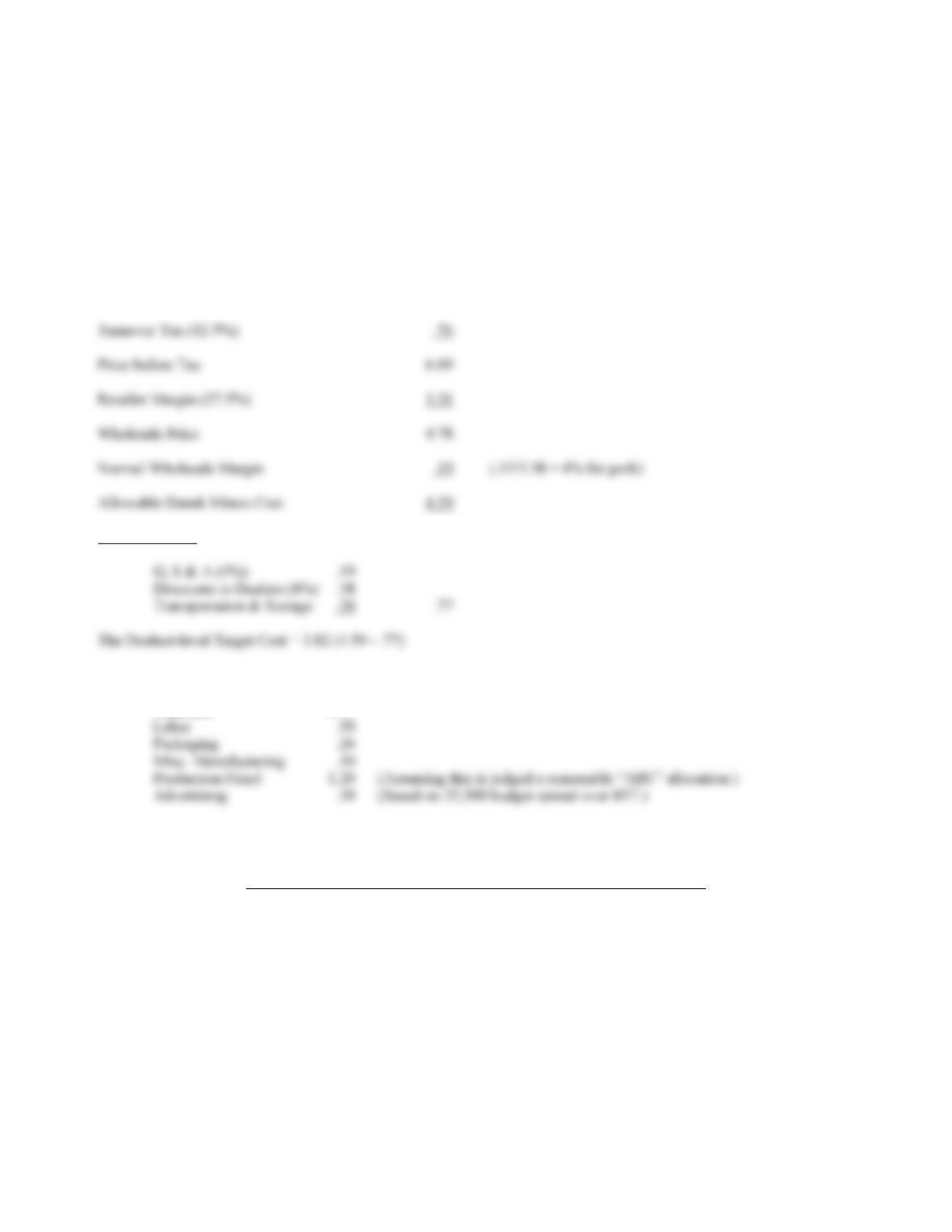
Alternate Methods of Allocating Fixed Overhead
1. Current Method (Allocate Fixed OH on Kilograms)
Total Company Sales (kgs) = 1,260,000
2. Alternate Method (Allocate Fixed OH on Labor Cost)
Company Labor Cost = 700,000
3. Alternate Method (Allocate Fixed OH on # of Packages)
Standard Pork Package = .450 kg. Assume this is average for the meat products.
14-8
Exhibit D
A/S DANSK MINOX
Target Cost for “Complete Meal,” at a Value Price
of 6.85 to the Consumer
Using the same format as in Case Exhibit 1:
Consumer Price 6.85
Allocated Costs (Probably not subject to product level management.)
“Normal” Cost (per case Exhibits) = 4.53
Materials 2.17
The Management Challenge is to reduce the “normal” costs by .71 (16%).

14-9
Exhibit E
A/S DANSK MINOX
Perspective on Decision Making
B usiness Perspective
Time Frame
Marketing
Shorter
Manufacturing
Longer