10.55: PROBLEM DEFINITION
Situation:
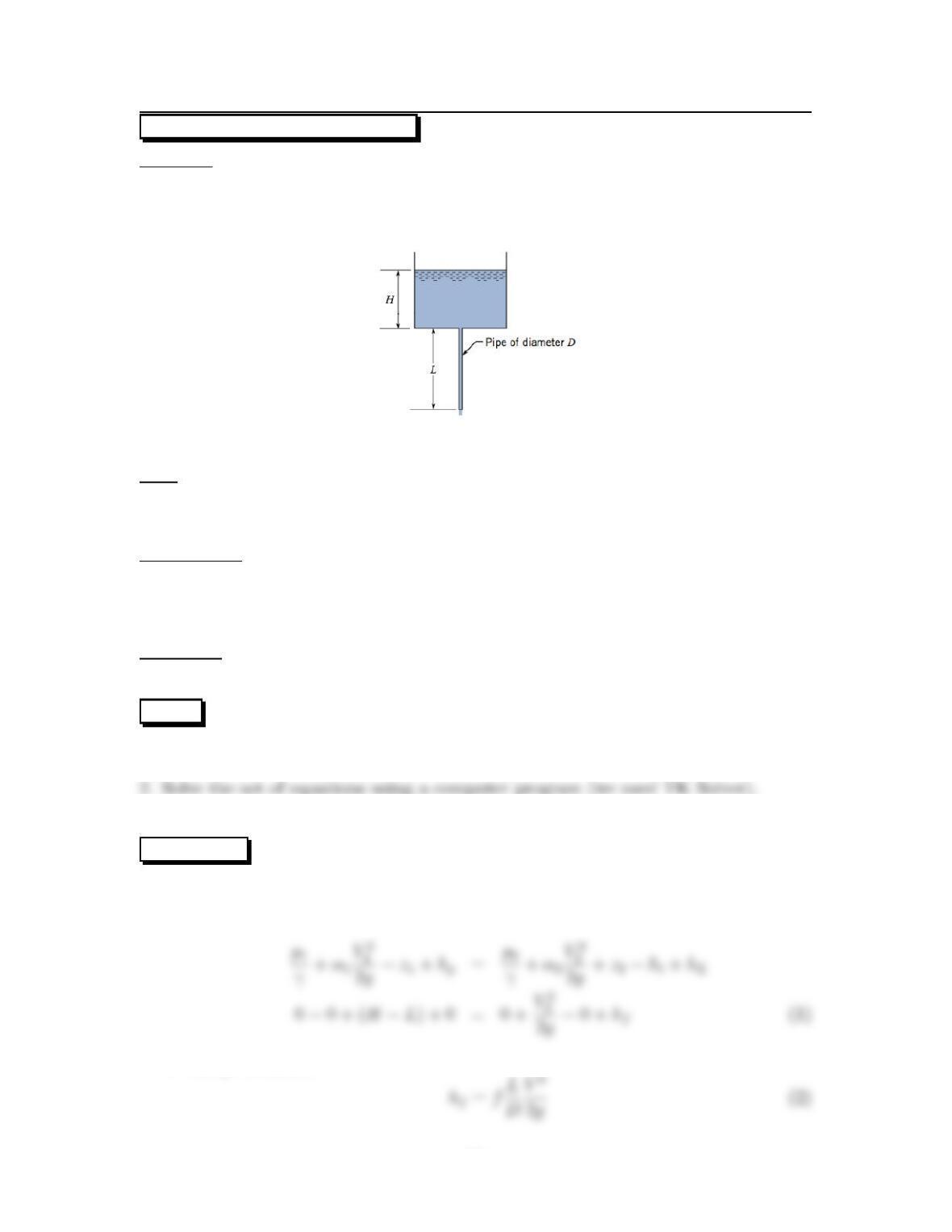
Water is draining out of a tank through a galvanized iron pipe.
ks=0.006 in = 5 ×10⁻⁴ft,L=10ft,H=4ft.
Thepipeis1–inschedule40NPS,D=1.049 in = 0.08742 ft.
Find:
Velocity in the pipe (ft/s).
Flow rate (cfs)
Assumptions:
Steady flow.
Component head loss is zero.
Turbulent flow. Also, α2=1.0.
Properties:
Water (70 ◦F), Table A.5, ρ=1.94 slug/ft3,γ=62.3lbf/ft3,ν=1.06 ×10−5ft2/s.
PLAN Classify this problem as case 2 (Vis unknown), then
1. Write the energy eqn., the Darcy-Weisbach eqn., etc. to produce a set of 4
equations with 4 unknowns.
3. Find the flow rate with Q=VA.
SOLUTION
1. Governing equations:
•Energy equation (section 1 on water surface, section 2 at exit plane)
•Darcy-Weisbach:
81
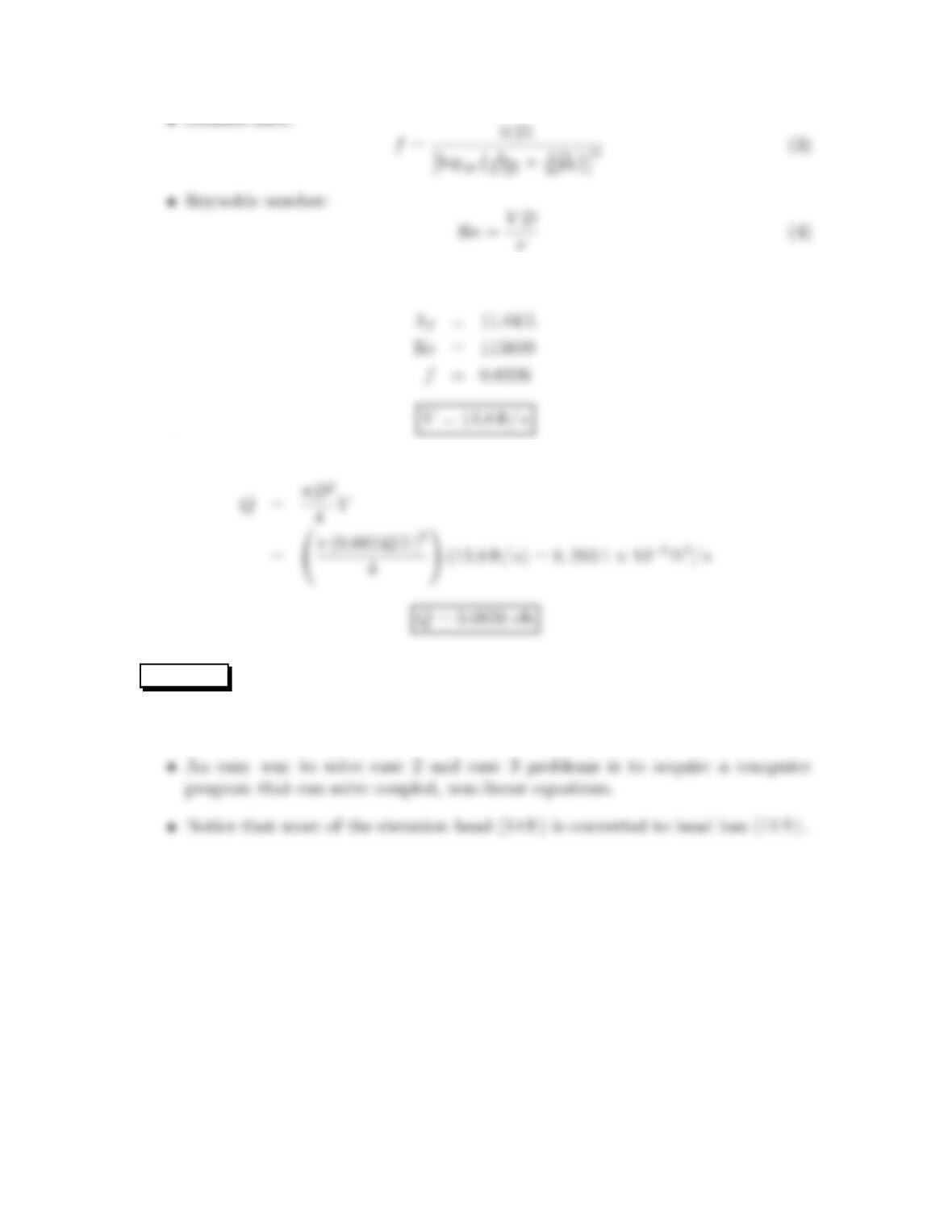
2. Solution of Eqs. (1) to (4):
3. Flow rate equation:
REVIEW
•Notice that the turbulent flow assumption is valid because Re >2300.
82
10.56: PROBLEM DEFINITION
Situation:
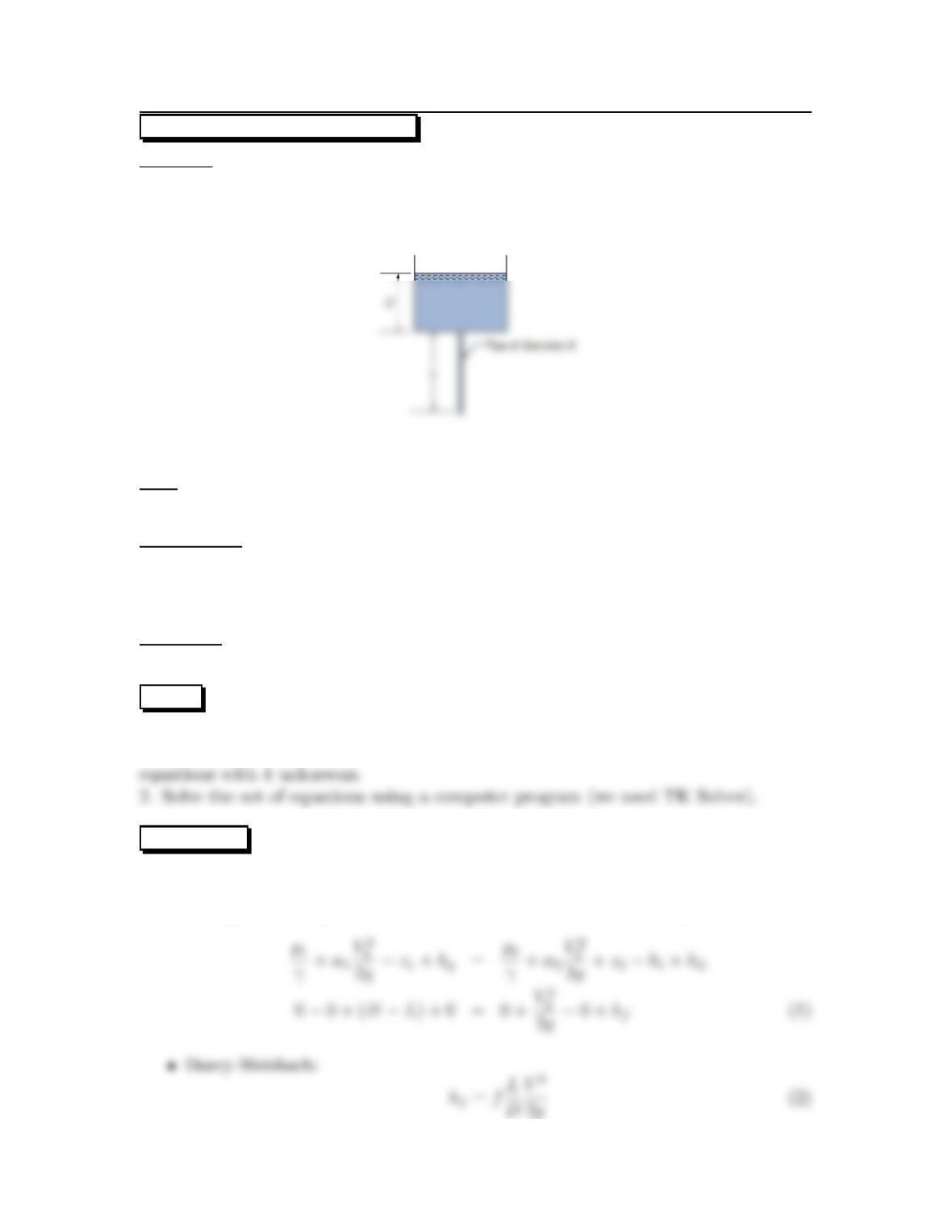
Water is draining out of a tank through a galvanized iron pipe.
L=2m,H=1m,ks=0.15 ×10⁻³m
Thepipeis0.5–inschedule40NPS,D=0.622 in = 0.0158 m.
Find:
Velocity in the pipe (ft/s).
Assumptions:
Steady flow.
Component head loss is zero.
Turbulent flow, so α2=1.0.
Properties:
Water (15 ◦C), Table A.5, ν=1.14 ×10⁻⁶m2/s.
PLAN
Classify this problem as case 2 (Vis unknown), then
1. Write the energy eqn., the Darcy-Weisbach eqn., etc. to produce a set of 4
SOLUTION
1. Governing equations:
•Energy equation (section 1 on water surface, section 2 at exit plane)
83
3. Solution of Eqs. (1) to (4):
REVIEW
1. Notice that the turbulent flow assumption is valid because Re >2300.
2. An easy way to solve case 2 and case 3 problems is to acquire a computer program
10.57: PROBLEM DEFINITION
Situation:
Air is flowing in a horizontal copper tube.
L=150m,Q=0.1m
3/s,ks=1.5×10−6m.
Pressure drop in the tube cannot exceed ∆p=6in-H20 = 1493 Pa.
Find:
Tube diameter (meters).
Assumptions:
Steady flow. Fully developed flow.
Component head loss is zero.
Turbulent flow.
Properties:
Air (40 ◦C,1atm),TableA.5,γ=11.1N/m3,ν=1.69 ×10−5m2/s.
PLAN
Classify this problem as case 3 (Dis unknown), then
1. Write the energy eqn., the Darcy-Weisbach eqn., etc. to produce a set of 5
equations with 5 unknowns.
2. Solve the set of equations using a computer program (we used TK Solver).
SOLUTION
1. Governing equations:
•Flow rate equation:
•Energy equation (section 1 is located 150 m upstream from section 2).
•Darcy-Weisbach:
85
3. Solution of Eqs. (1) to (5):
REVIEW . The turbulent flow assumption is valid because Re >2300.
86
10.58: PROBLEM DEFINITION
Situation:
Afluid flows through a galvanized iron pipe.
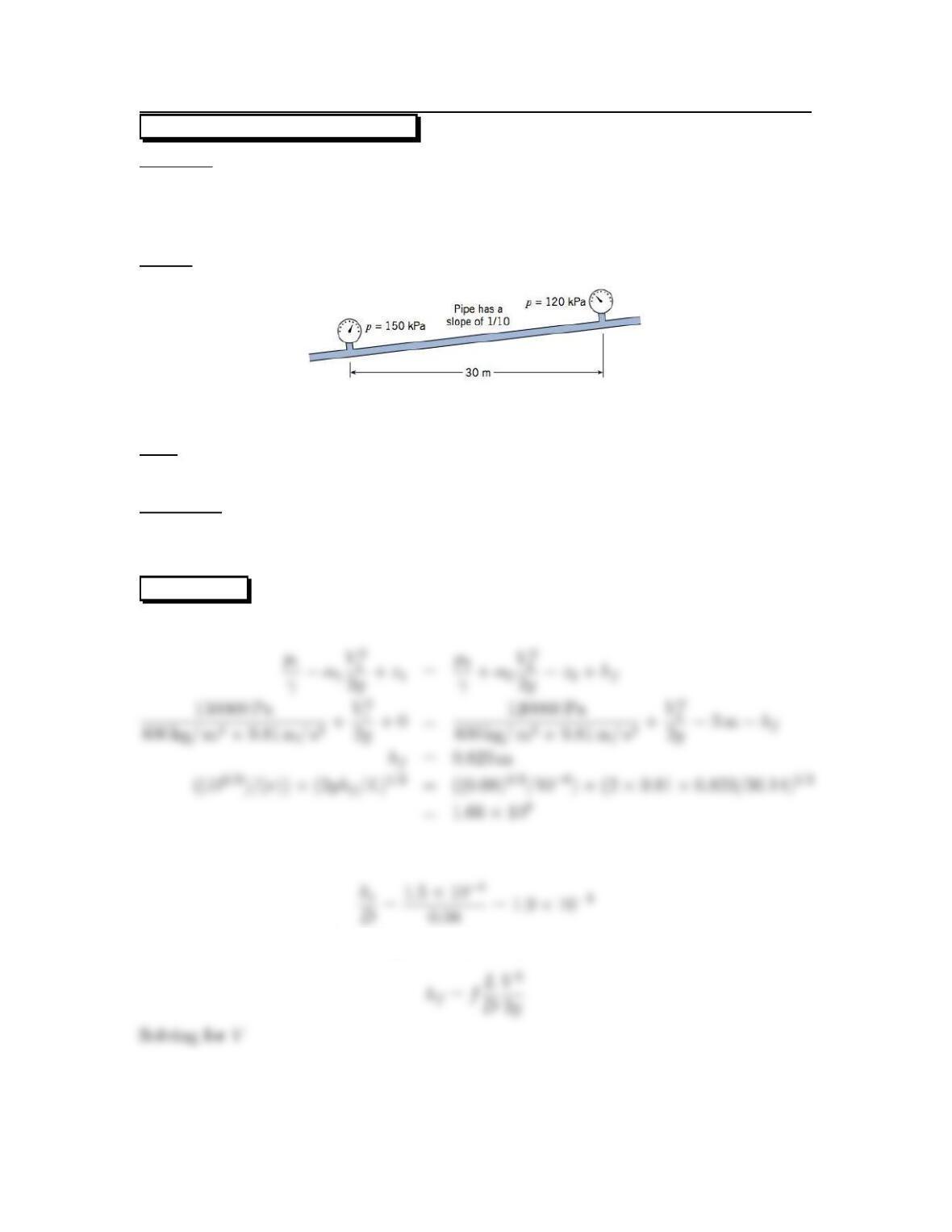
D=8cm.
Pipe slope is 1 Horizontal to 10 Vertical.
Sketch:
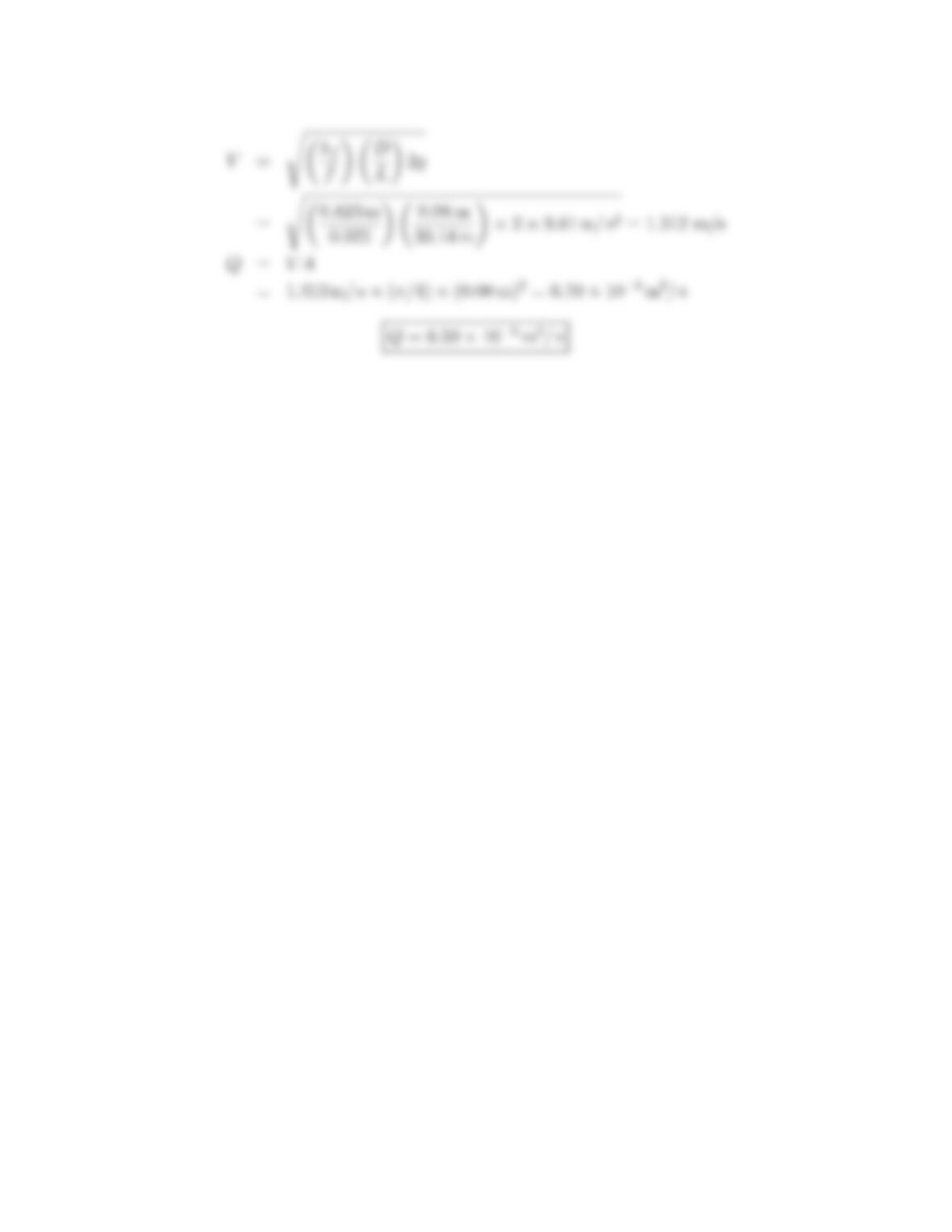
Find:
Flow rate.
Properties:
From Table 10.4 ks=0.15 mm.
ρ=800kg/m3,ν=10
−6m2/s.
SOLUTION
Energy equation
Relative roughness
Resistance coefficient. From Fig. 10.14 (in 10e) f=0.025.Then
87
88
10.59: PROBLEM DEFINITION
Situation:
Commercial steel pipe will convey water.
hL=1 ft per 1000 ft of pipe length.
Q=300ft
3/s.
Find:
Pipe diameter to produce specified head loss.
Assumptions:
The pipes are available in even inch sizes (e.g. 10 in., 12 in., 14 in., etc.)
Properties:
Water (60 ◦F), Table A.5: ν=1.22 ×10⁻⁵ft2/s.
From Table 10.4: ks=0.002 in = 1.7×10⁻⁴ft.
SOLUTION
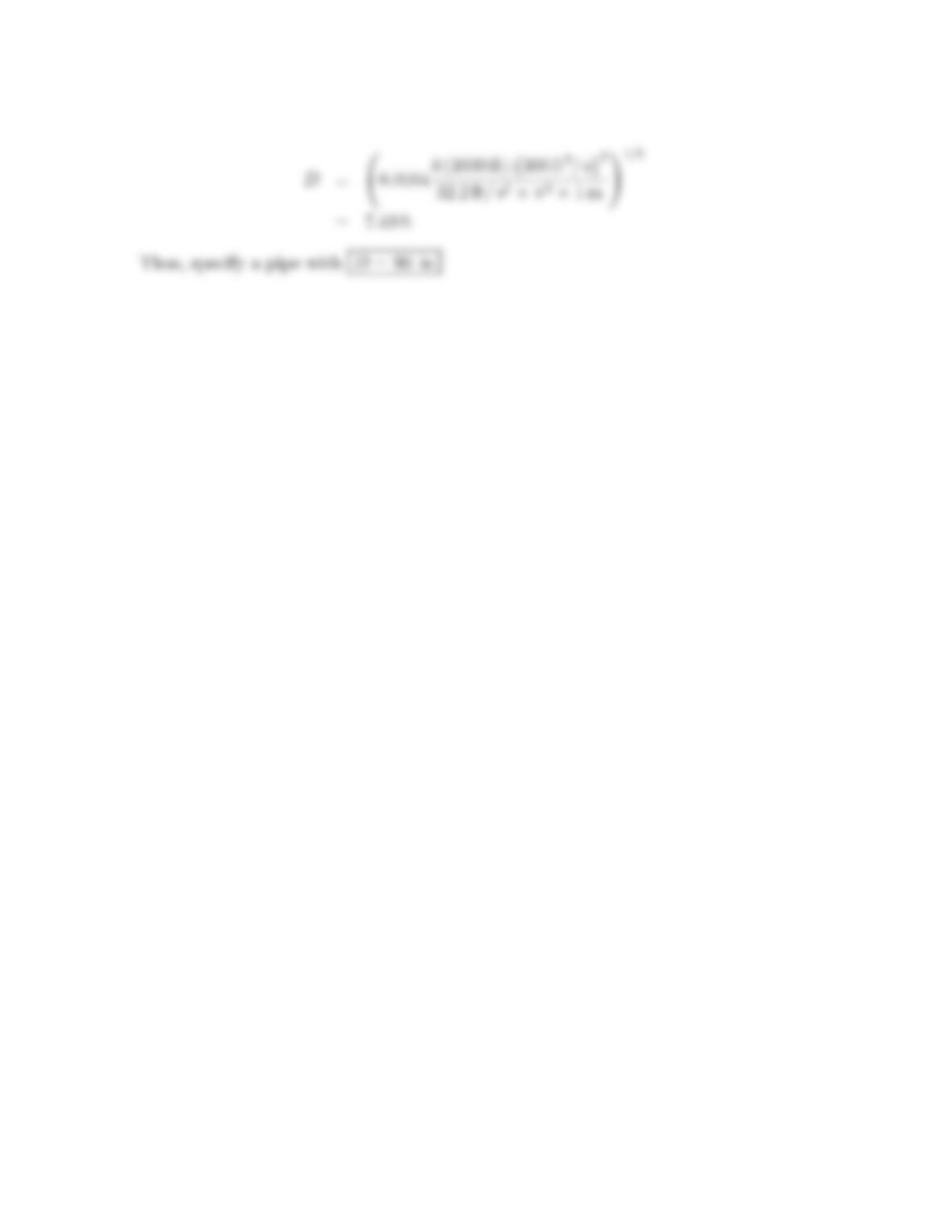
Darcy Weisbach equation
gπ2hf¶1/5
Assume f=0.015
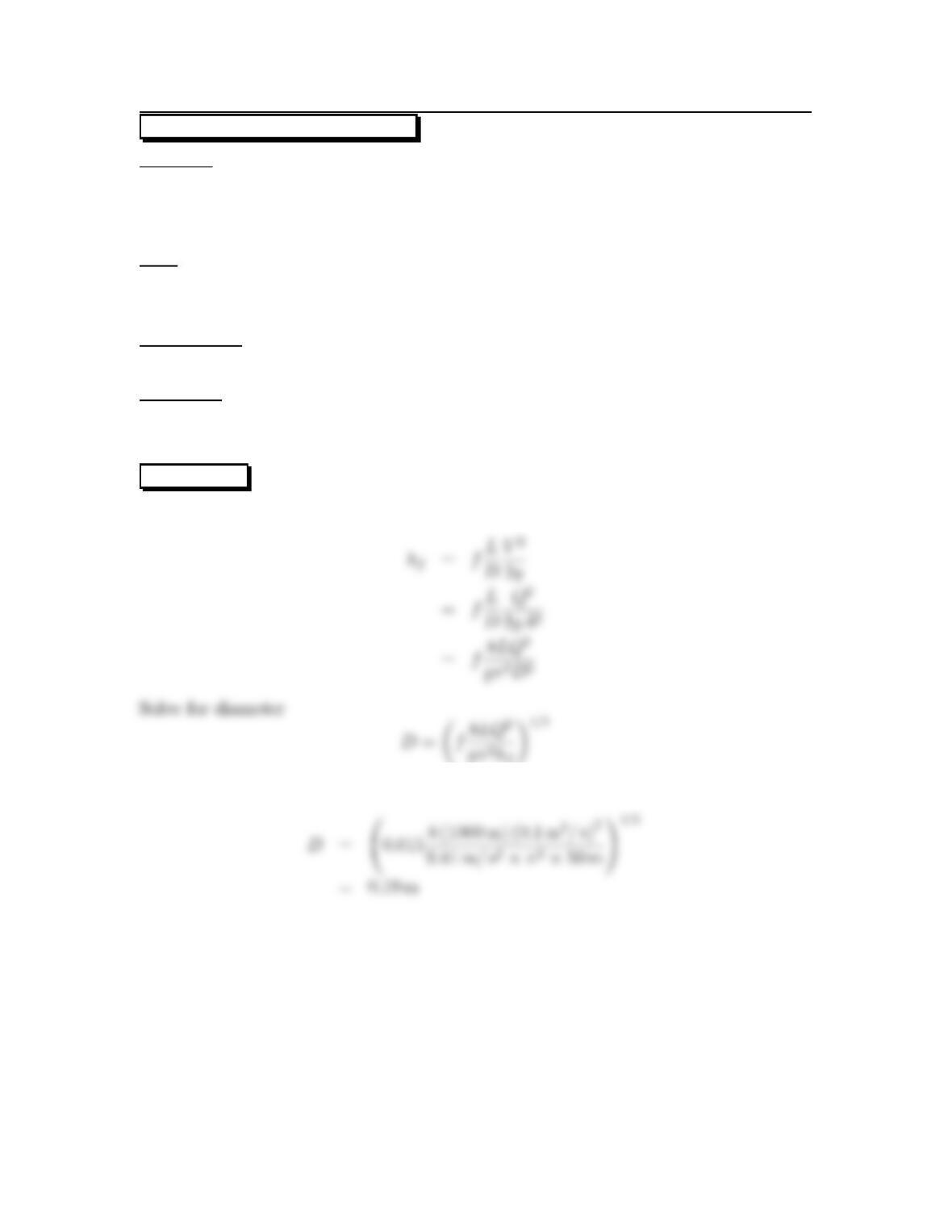
Now get a better estimate of f:
Compute Dagain:
90
10.60: PROBLEM DEFINITION
Situation:
A steel pipe will carry crude oil.
Q=0.1m
3/s.
hL=50mper km of pipe length.
Find:
(a) Diameter of pipe for a head loss of 50 m.
(b) Pump power.
Assumptions:
Available pipe diameters are D=20,22,and 24 cm.
Properties:
From Table 10.4: ks=0.046 mm.
S=0.93,ν=10
−5m2/s.
SOLUTION
Darcy Weisbach equation
Assume f=0.015
91
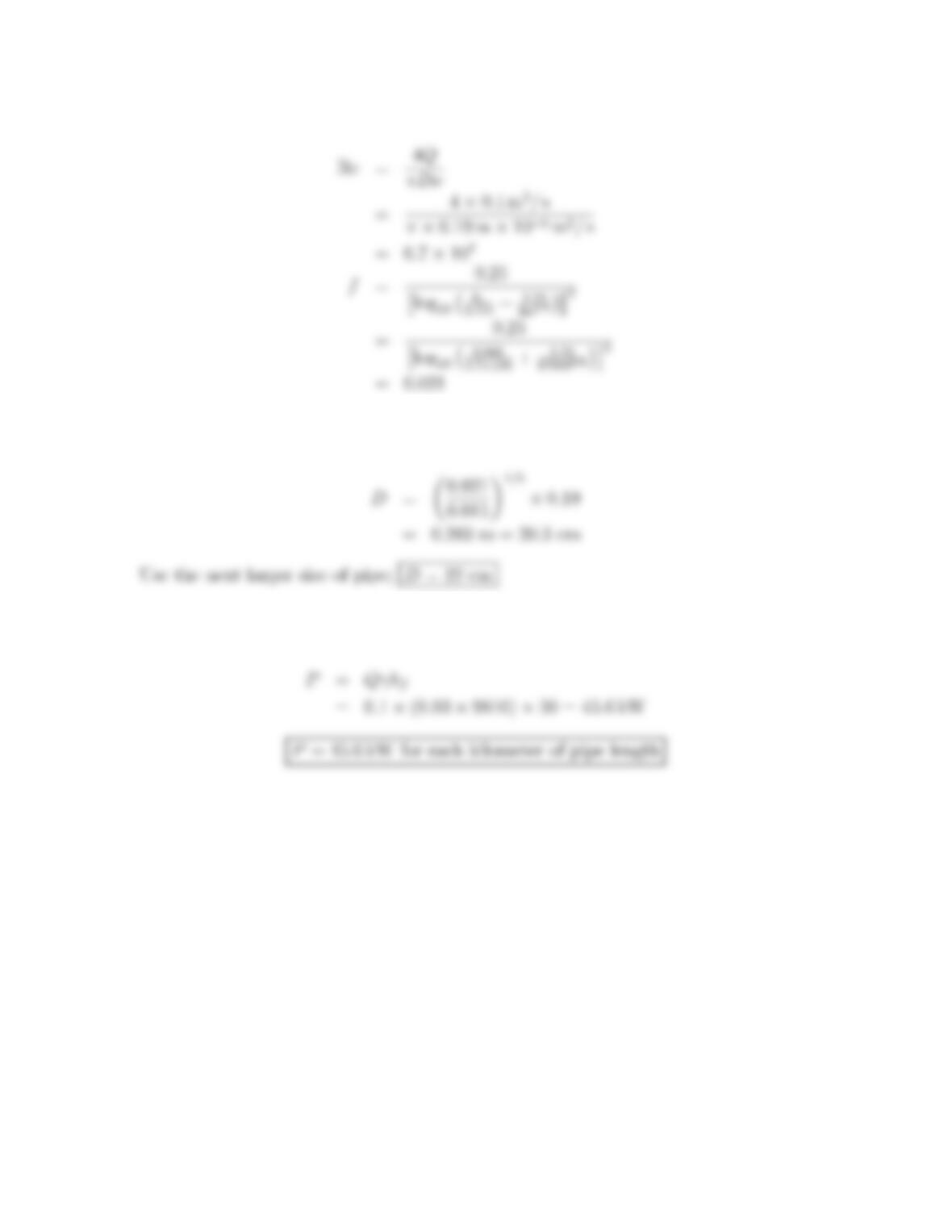
Calculateamoreaccuratevalueoff
Recalculate diameter using new value of f
Power equation (assume the head loss is remains at hL≈50 m/1,000 m)
92

10.61: PROBLEM DEFINITION
Find:
Use Table 10.5 (in §10.8) to select loss coefficients, K, for the following transitions
and fittings.
a. A threaded pipe 90◦elbow.
b. A 90◦smooth bend with r/d =2.
c. A pipe entrance with r/d of 0.3.
d. An abrupt contraction, with θ=180
◦,andD2/D1=0.60.
e. A gate valve, wide open.
SOLUTION
a. Answer: 0.9
93
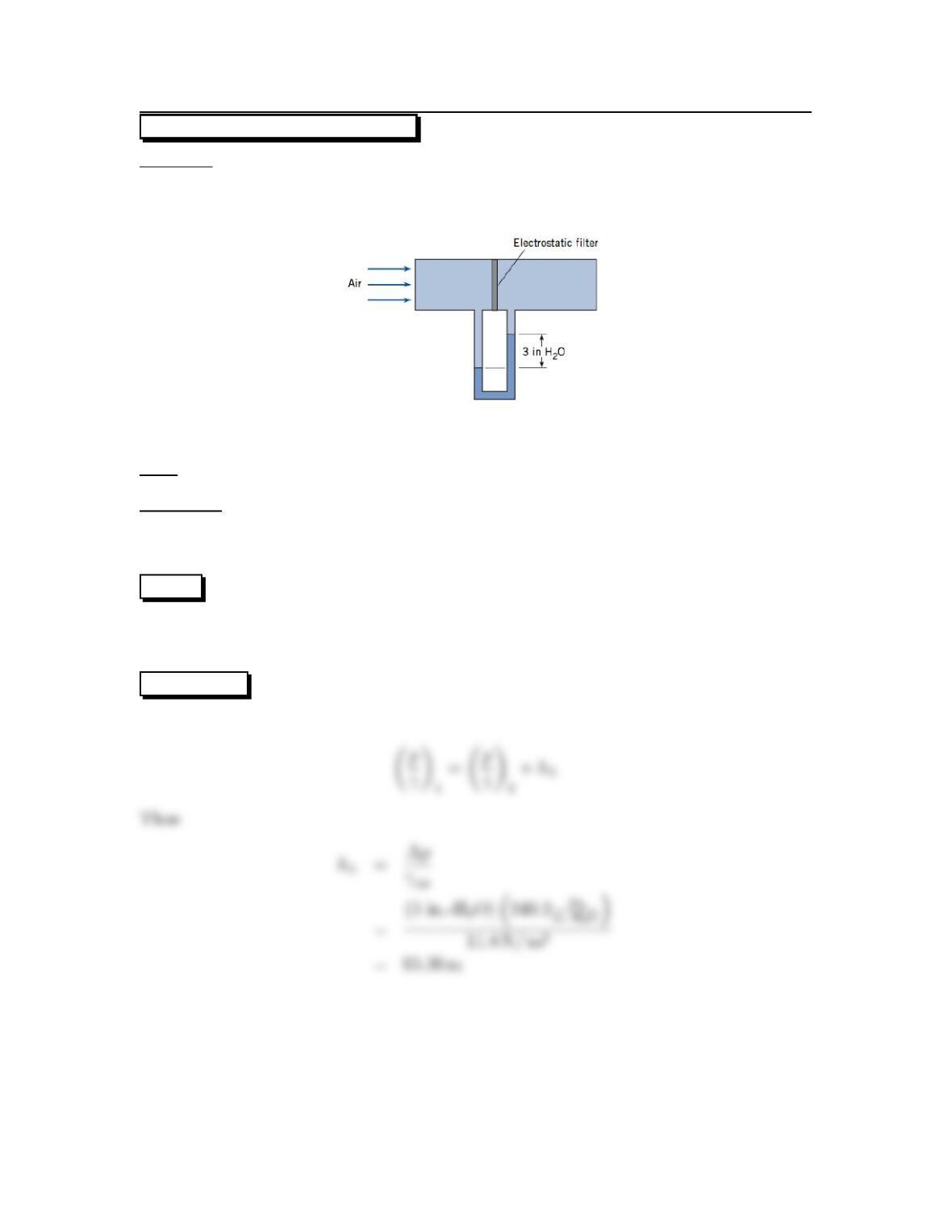
10.62: PROBLEM DEFINITION
Situation:
An electrostatic air filter is being tested.
Pressure drop is ∆p=3in.–H
20. Air speed is V=10m/s.
Find: The minor loss coefficient (K)for the filter.
Properties:
Air (20 ◦C) Table A.3: ν=15.1×10⁻⁶m2/s.
ρ=1.2kg/m3,γ=11.8N/m3.
PLAN
Apply the energy equation to relate the pressure drop to head loss. Then, find the
minor loss coefficient using hL=KV 2/2g.
SOLUTION
Energy equation (select a control volume surrounding the filter)
94
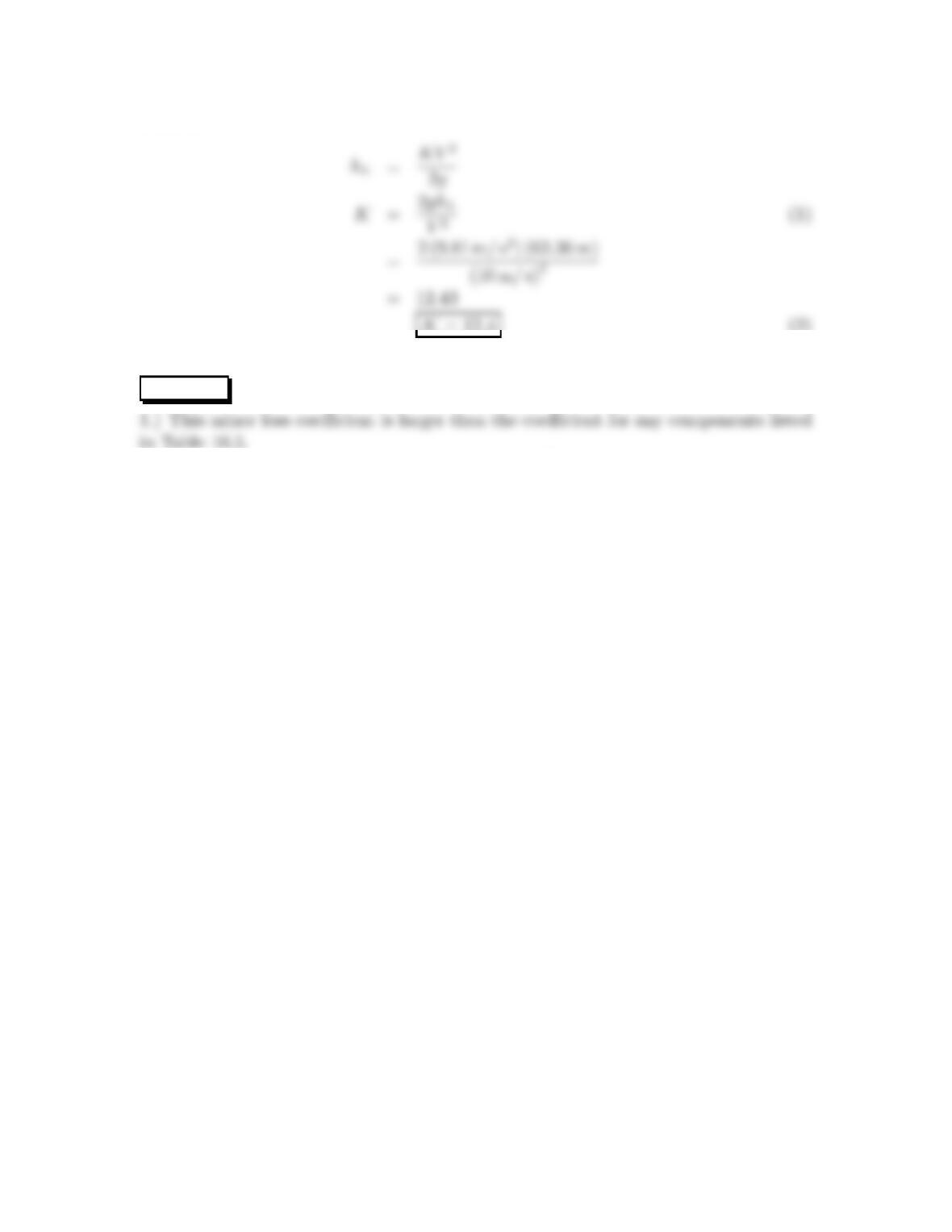
Head loss
K=12.4(2)
REVIEW
2.) Combining Eqs. (1) and (2) gives K=∆p/(ρV 2/2).Thus, the pressure drop for
the filter is about 12 times larger that the pressure change that results when the flow
is brought to rest.
95
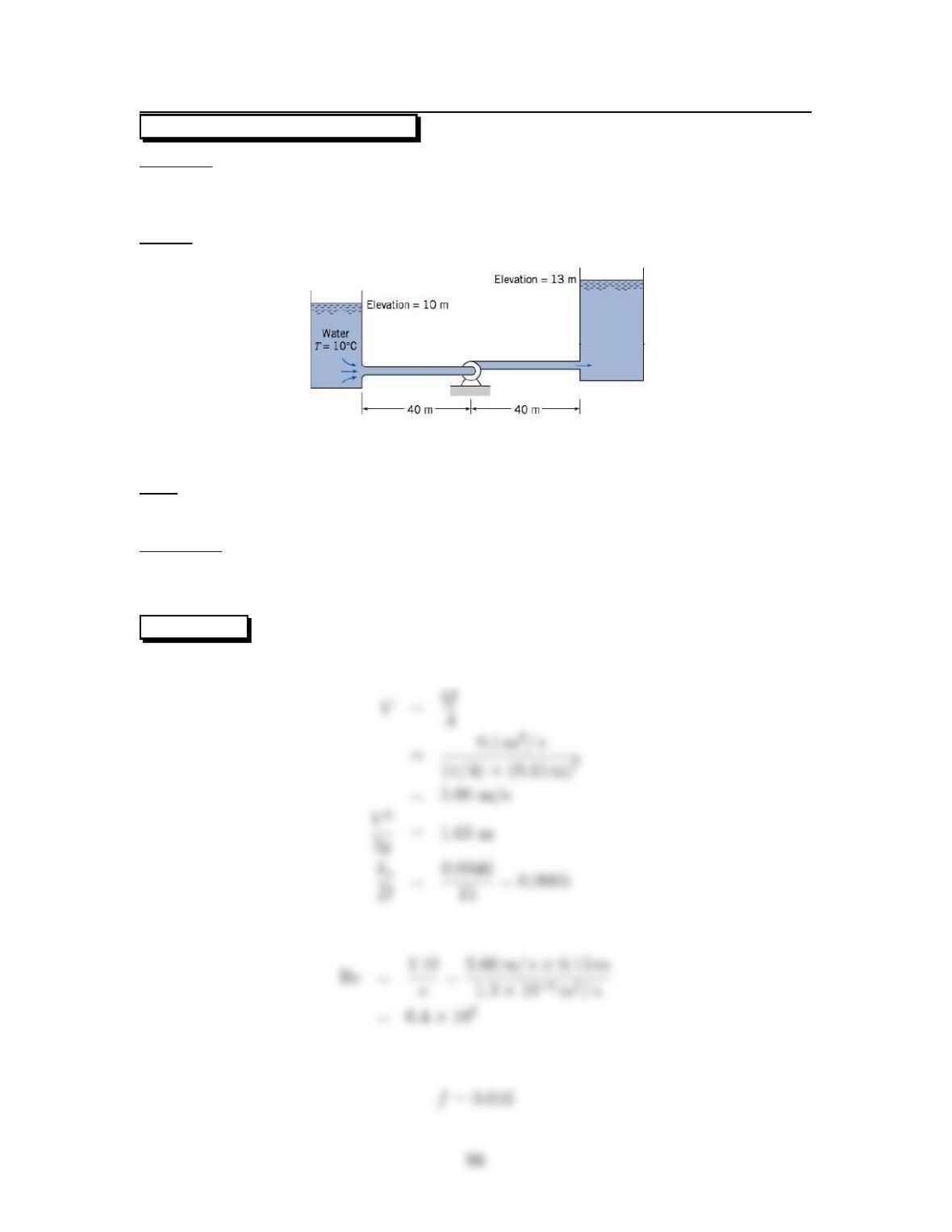
10.63: PROBLEM DEFINITION
Situation:
Water is pumped between reservoirs through a steel pipe.
Q=0.1m
3/s,D=15cm.
Sketch:
Find:
Power that is supplied to the system by the pump.
Properties:
From Table 10.4: ks=0.046 mm.
Water (10 ◦C),TableA.5: v=1.3×10⁻⁶m2/s,γ=9810N/m3.
SOLUTION
Flow rate equation
Reynolds number
Resistance coefficient (from the Moody diagram, Fig. 10.14 in EFM10e)
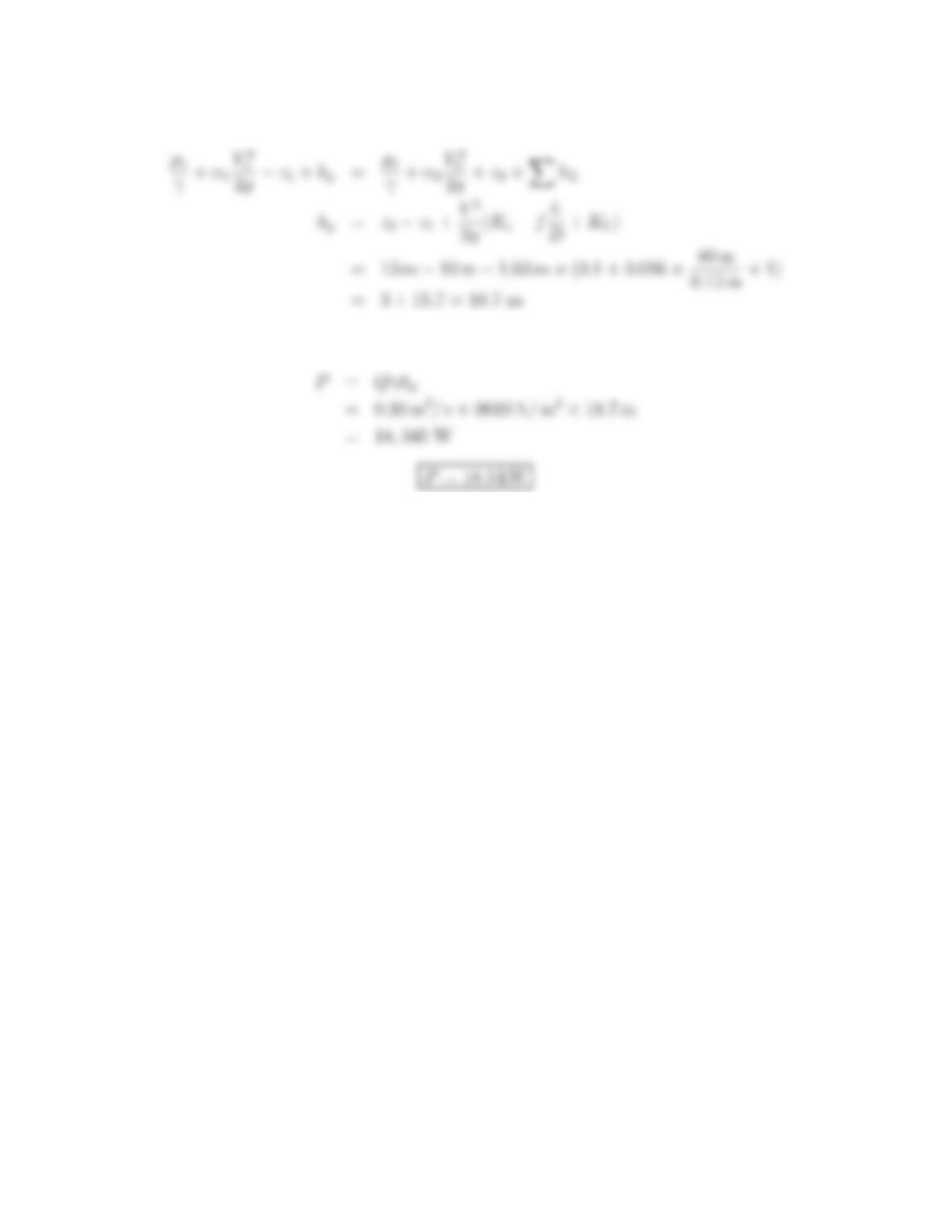
Energy equation (between the reservoir surfaces)
Power equation
97
10.64: PROBLEM DEFINITION
Situation:
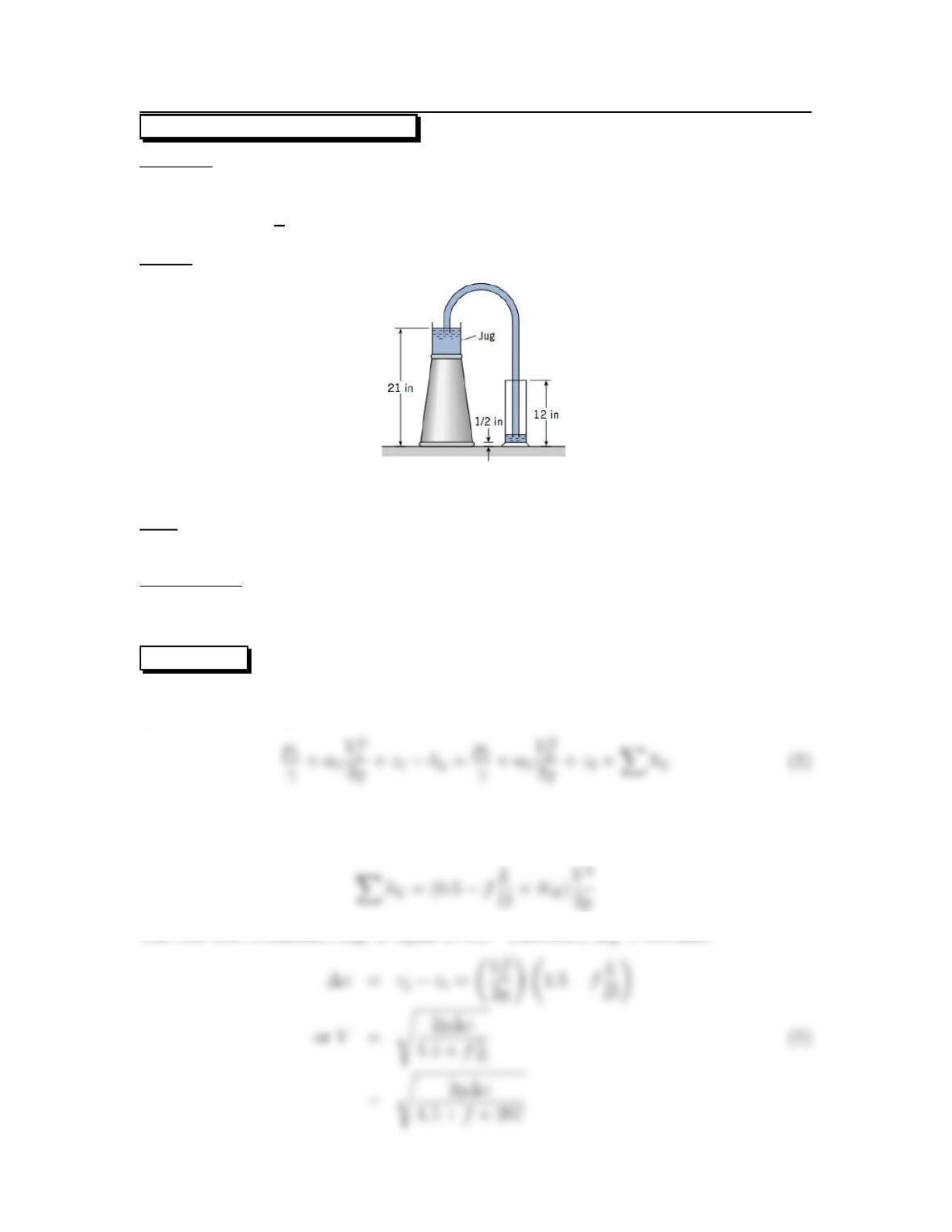
A siphon tube is used to drain water from a jug into a graduated cylinder.
Dtube =3/16 in. =0.01562 ft.
Ltube =50in,V=500ml.
Sketch:
Find:
Time to fill cylinder.
Assumptions:
T‘60oFwithν=1.2×10⁻⁵ft2/s.
Neglect head loss associated with any bend in the Tygon tube.
SOLUTION
Energy equation (from the surface of the water in the jug to the surface in the
graduated cylinder)
Assume that the entrance loss coefficient is equal to 0.5. It could be larger than 0.5,
but this should yield a reasonable approximation. Therefore
Theexitlosscoefficient, KE, is equal to 1.0. Therefore, Eq. 1 becomes
98
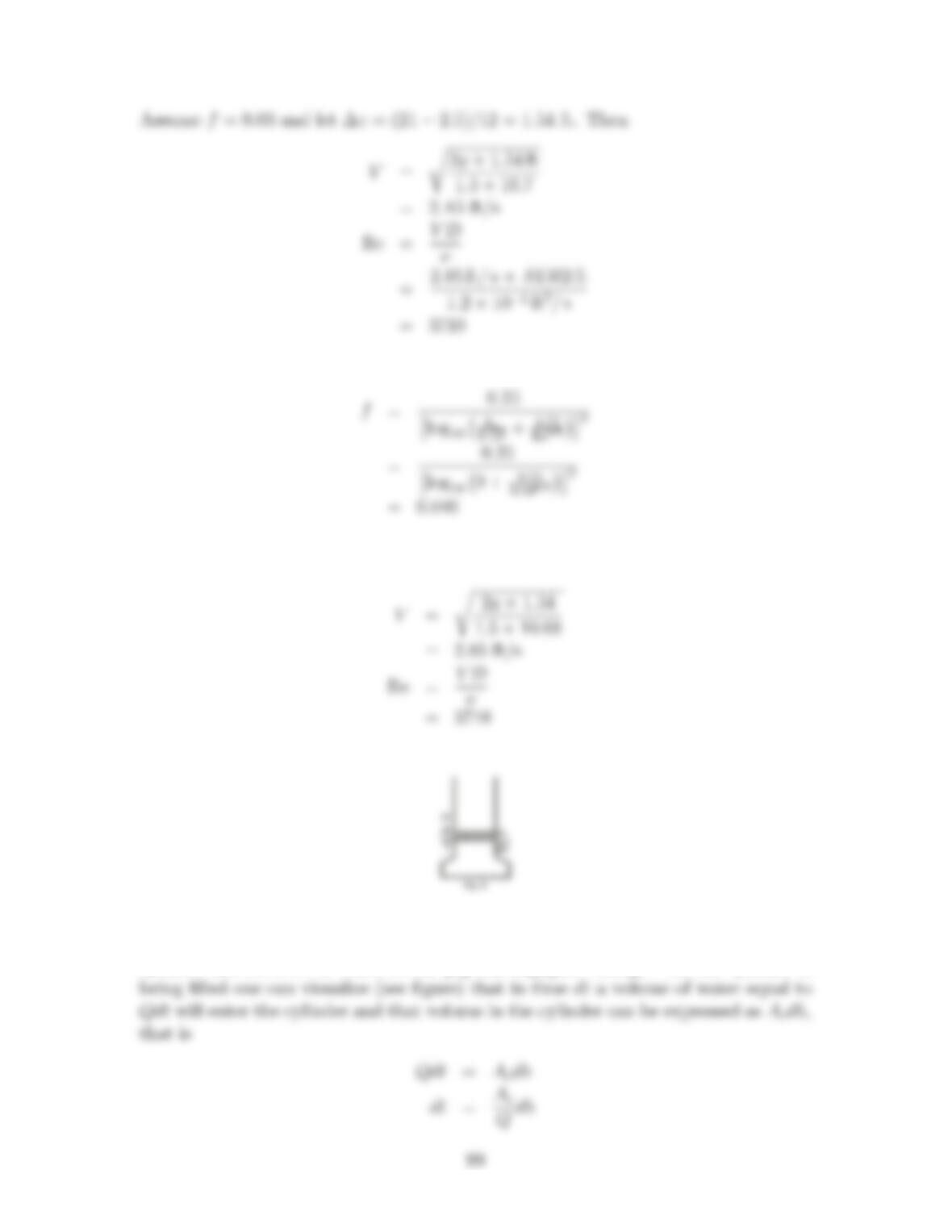
Resistance coefficient (recalculate)
Repeat calculations with a new value of friction factor.
Use f=0.040 for final solution. As a simplifying assumption assume that as the
cylinder fills the level of water in the jug has negligible change. As the cylinder is
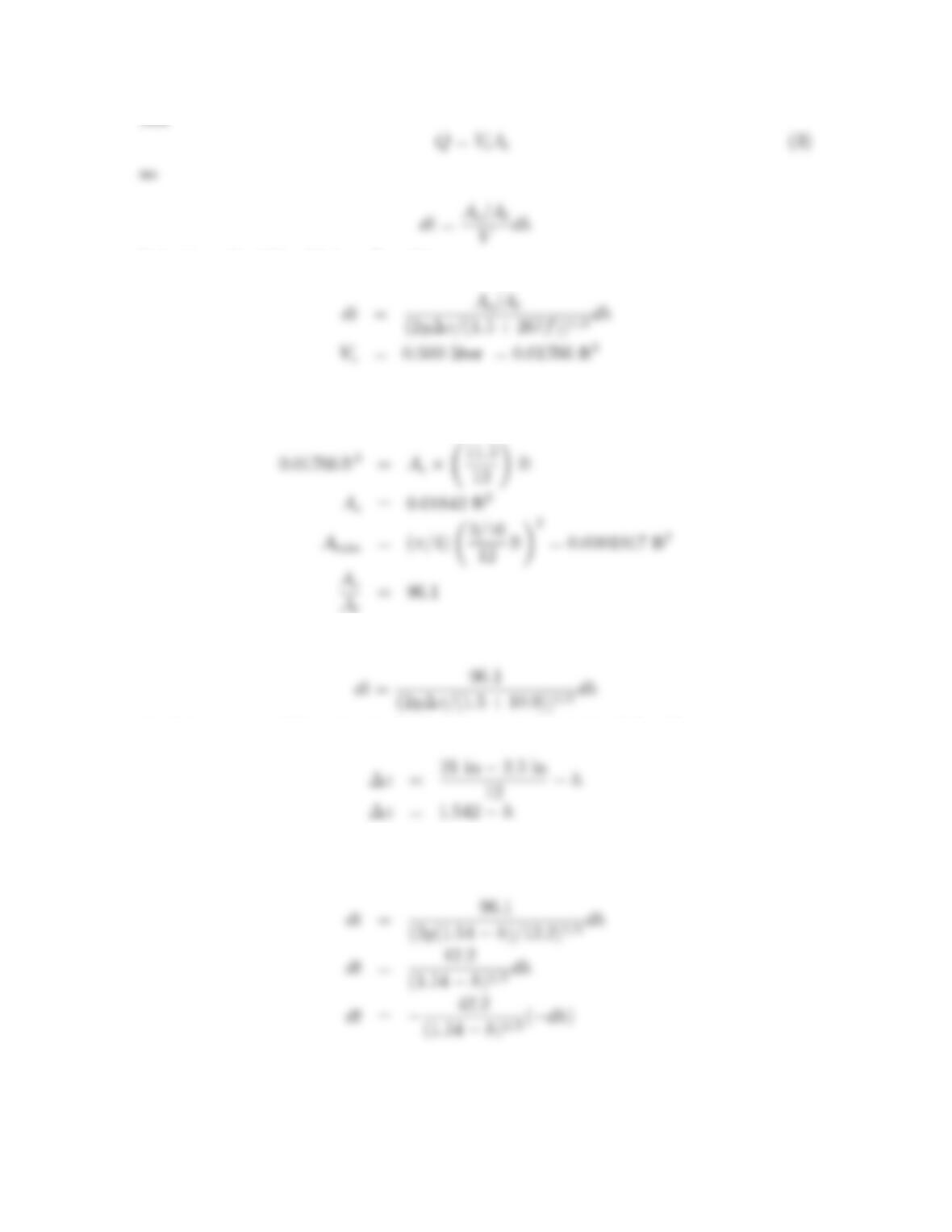
Substitute Vof Eq. (1) into Eq. (2):
or
The differential equation becomes
Let hbe measured from the level where the cylinder is 2 in full. Then
Now we have
100