10.1: PROBLEM DEFINITION
Situation:
Kerosene flows in a pipe.
Q=0.02 m3/s,D=17.7cm.
Find:
Is the flow laminar or turbulent?
Entrance length (meters).
Properties:
Kerosene (20 ◦C),Table A.4,ν=2.37 ×10⁻⁶m2/s.
SOLUTION
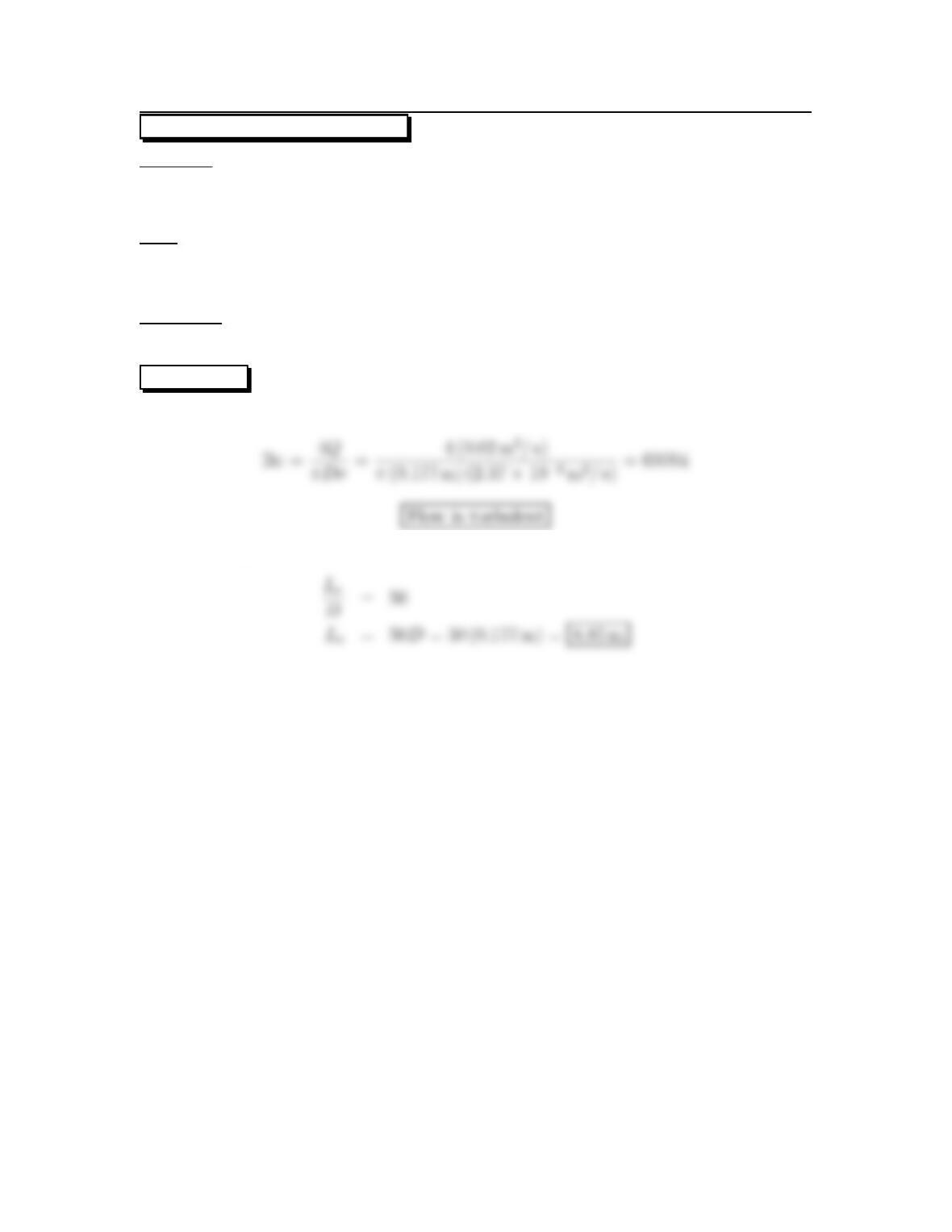
Reynolds number:
Entrance length:
1
10.2: PROBLEM DEFINITION
Situation:
A compressor is drawing ambient air through a duct.
Q=0.3m
3/s,D=0.15 m.
L=10m,T=20◦C.
Find:
Determine if the flow is laminar or turbulent.
Entrance length (meters).
Assumptions:
Smooth inlet, so Lecorrelations apply.
Pressure in duct is 1.0 atm.
Properties:
Air (20 ◦C,p=1atm), Table A.3, ν=15.1×10⁻⁶m2/s.
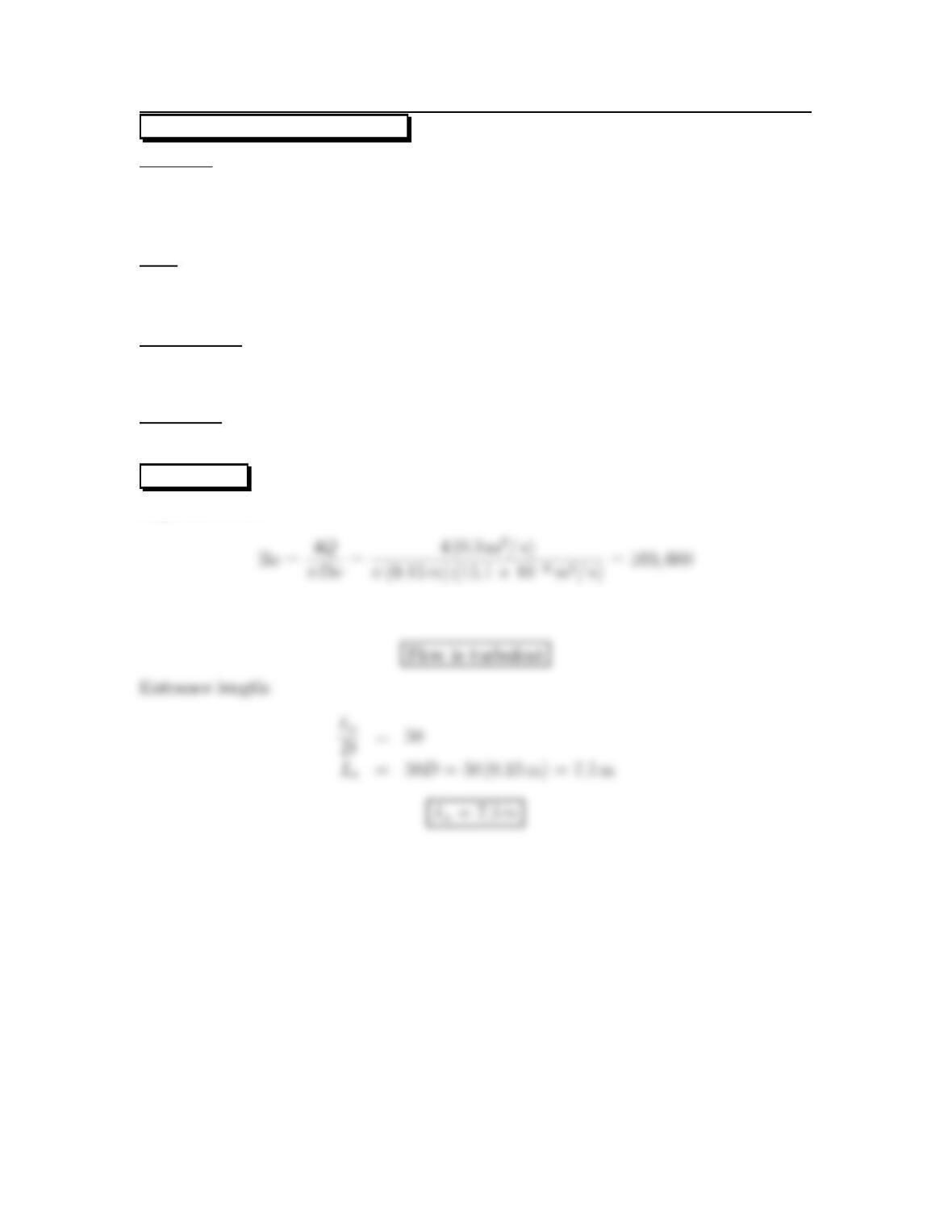
SOLUTION
Reynolds number:
Since Re >3000,theflow is turbulent.
2
10.3: PROBLEM DEFINITION
Situation:
A tube carries SAE 10W-30 oil.
Q=0.1L/s=0.0002 m3/s,T=38◦C.
Flow must be laminar and fully developed.
Find:
Specify a tube length (millimeters).
Specify a tube diameter (millimeters).
Assumptions:
Smooth inlet, so Lecorrelations apply.
Properties:
SAE 10W-30 oil (38 ◦C), Table A.4, ν=7.6×10⁻⁵m2/s.
PLAN
1. Find diameter Dby specifying a Reynolds number of 1500 (laminar).
2. Find length Lby specifying a length so L>0.05DRe .
SOLUTION
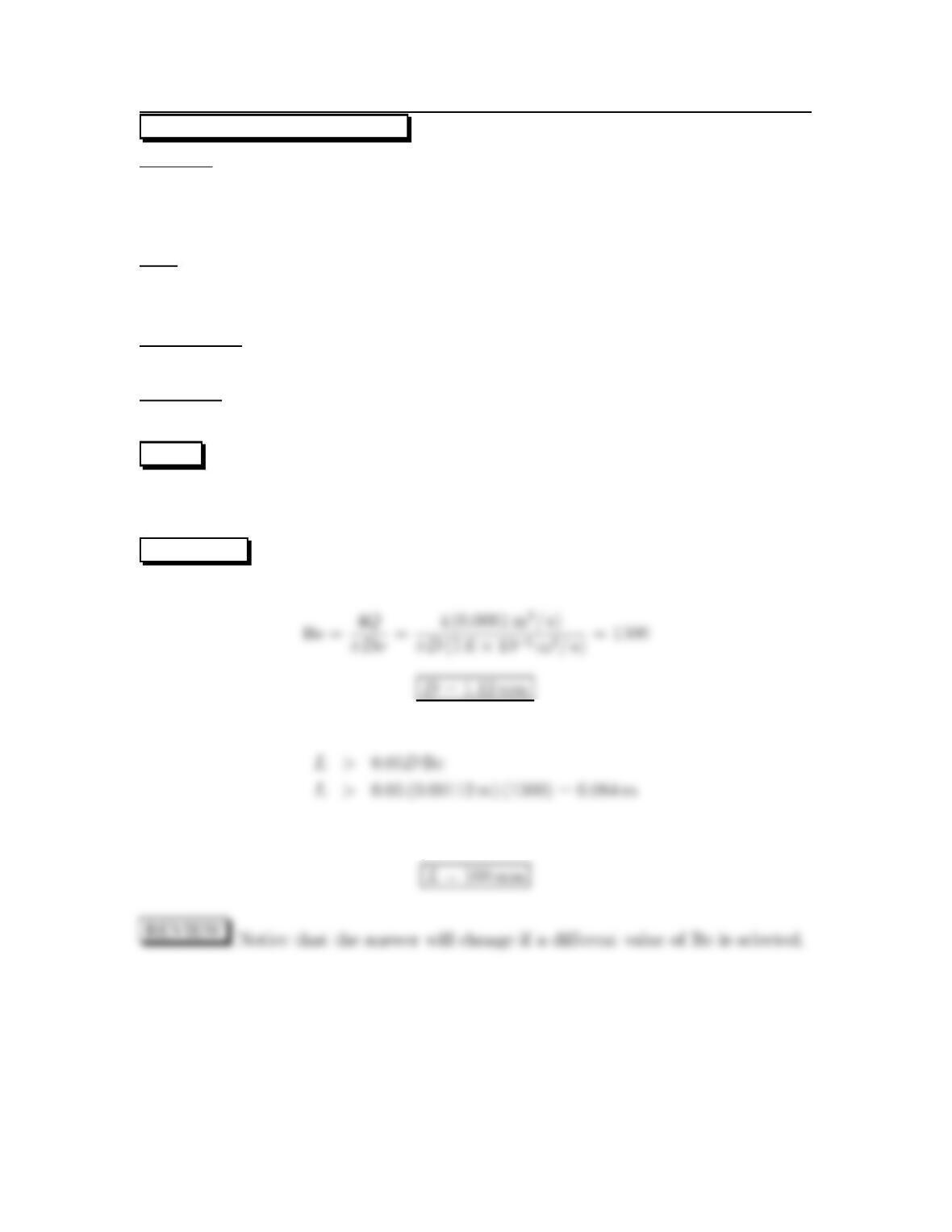
Reynolds number:.
Entrance length:
Select
3
Problem 10.4
Answer the questions below.
a.) What is pipe head loss? How is pipe head loss related to total head loss?
•Pipe head loss ==>head loss associated with fully developed flow in straight
b.) What is the friction factor f?Howisfrelated to wall shear stress?
•fis a π-group
c.) What assumptions need to be satisfied to apply the Darcy Weisbach equation?
•the conduit needs to be completely full of the flowing fluid
4
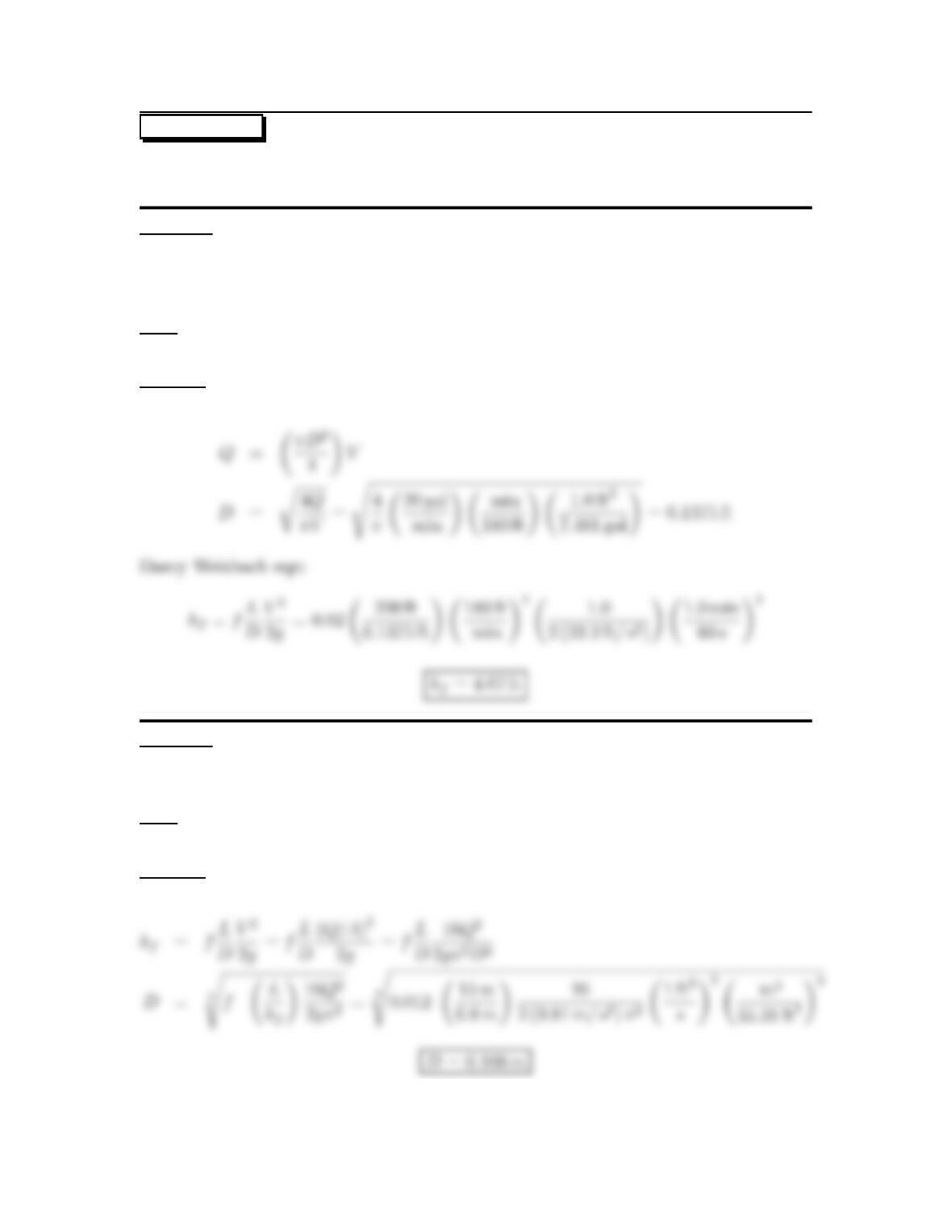
Problem 10.5
Apply the grid method to each situation described below. Apply the Darcy Weisbach
equation. Note: Unit cancellations are not shown in this solution.
Situation:(a)
Water is flowing in a pipe.
Q=20gpm, V=180ft/min.
L=200ft,f=0.02.
Find:
Head loss (ft).
Solution:
Flow rate eqn:
Situation:(b)
Flow in a PVC pipe.
hf=0.8m,f=0.012,L=15m Q=2ft
3/s..
Find:
Pipe diameter (meters).
Solution:
5
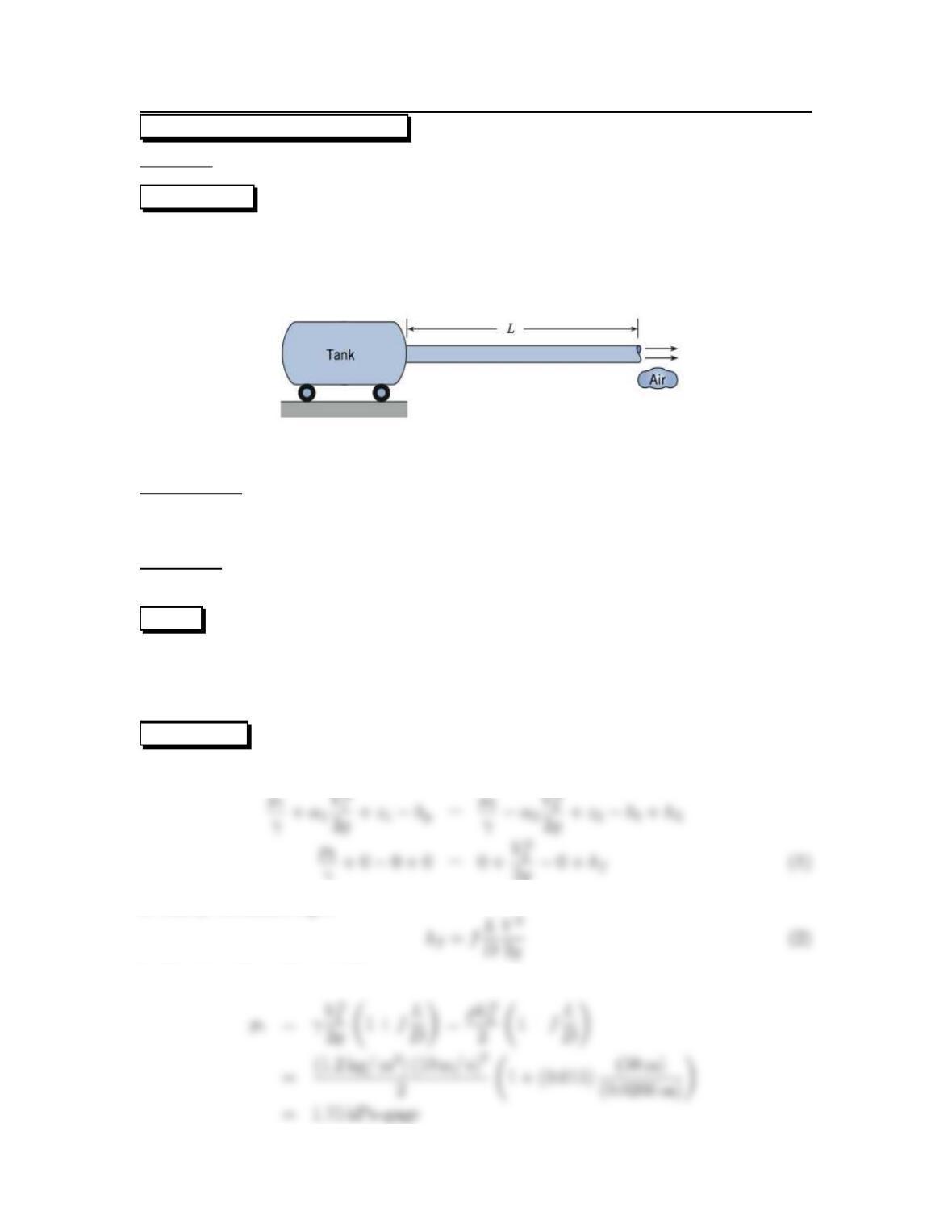
10.6: PROBLEM DEFINITION
Situation:
SITUATION
Air is flowing from a large tank to ambient through a horizontal pipe.
Pipe is 1″ Schedule 40. D=1.049 in = 0.0266 m.
V=10m/s.f=0.015,L=50m.
Assumptions:
Air has constant density (look up properties at 1 atm).
KE correction factor is a2=1.0.
Properties:
Air (20 ◦C,1atm,Table A.3): ρ=1.2kg/m3.
PLAN
1. Relate pressure in tank to head loss using the energy equation.
2. Describe head loss using the Darcy-Weisbach equation.
3. Combine steps 1 & 2.
SOLUTION
1. Energy eqn. (location 1 inside the tank, location 2 at the pipe exit)
2. Darcy-Weisbach eqn.:
3. Combine Eqs. (1) and (2).
6

REVIEW The constant density assumption is valid because the pressure in the tank
is less than 2% of atmospheric pressure.
7
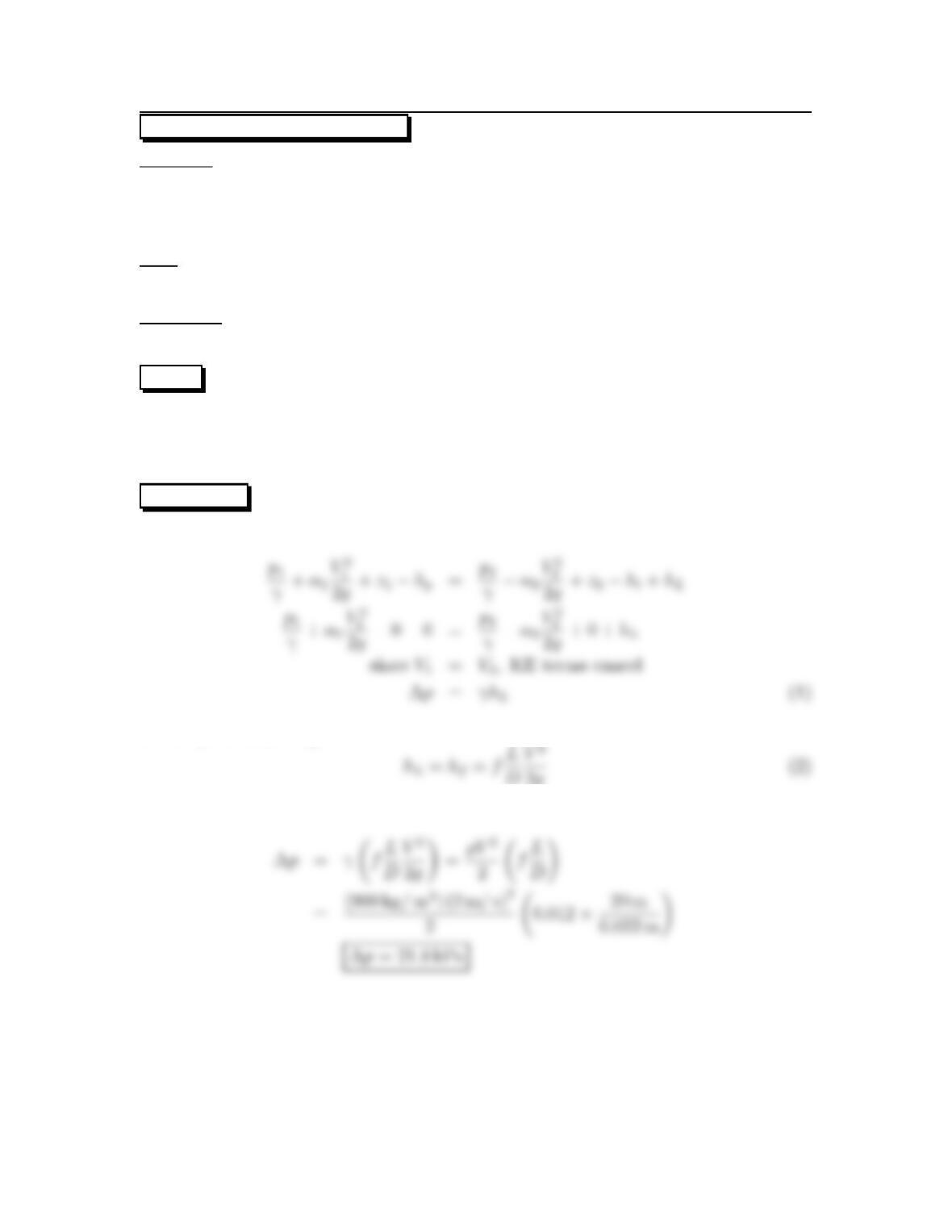
10.7: PROBLEM DEFINITION
Situation:
Water is flowing through a horizontal pipe (garden hose).
D=0.022 m,L=20m.
f=0.012,V=2.0m/s.
Find:
Pressure drop (Pa) for 20 m of hose.
Properties:
Water (15 ◦C), Table A.5, ρ= 999 kg/m3.
PLAN
1. Relate pressure drop to head loss using the energy equation.
2. Describe head loss using the Darcy-Weisbach equation.
3. Combine steps 1 & 2.
SOLUTION
1. Energy eqn. (location 1 upstream; location 2 is 20 m downstream)
2. Darcy-Weisbach eqn.:
3. Combine Eqs. (1) and (2):
8
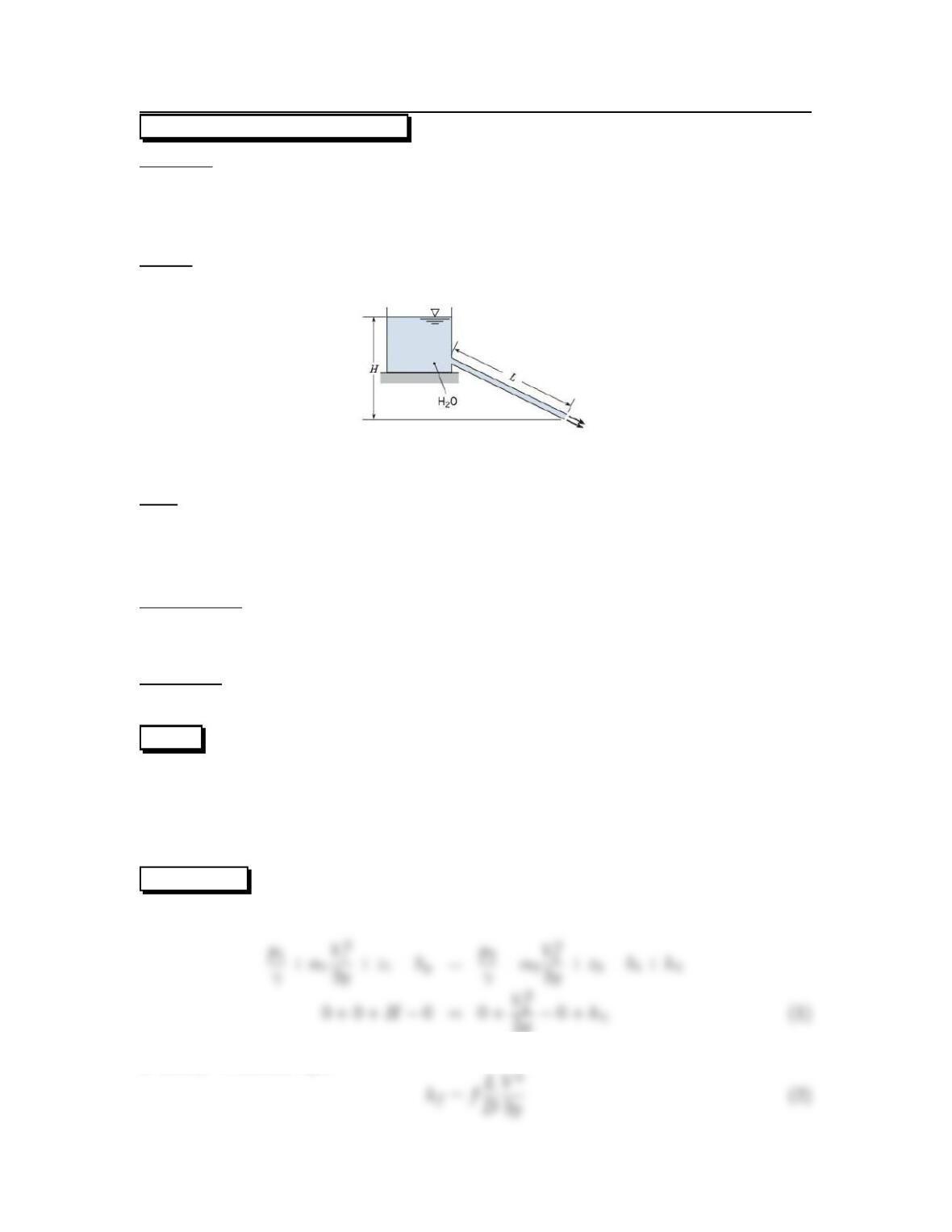
10.8: PROBLEM DEFINITION
Situation:
Water is flowing from a tank through a tube & then discharging to ambient.
D=0.008 m,L=6m.
H=3m,f=0.015.
Sketch:
Find:
Exit velocity (m/s).
Discharge (L/s).
Sketch the HGL & EGL.
Assumptions:
Theonlyheadlossisinthetube.
Turbulent flow so α2=1.0.
Properties:
Water (15 ◦C), Table A.5 (EFM10e), ρ=999kg/m3ν=1.14 ×10−6m2/s.
PLAN
1. Relate Hto head loss using the energy equation.
2. Describe head loss using the Darcy-Weisbach equation.
3. Find Vby combining steps 1 & 2.
4. Find Qby using the flow rate equation.
SOLUTION
1. Energy eqn. (location 1 at the free surface, location 2 at the pipe exit)
2. Darcy-Weisbach eqn.:
9
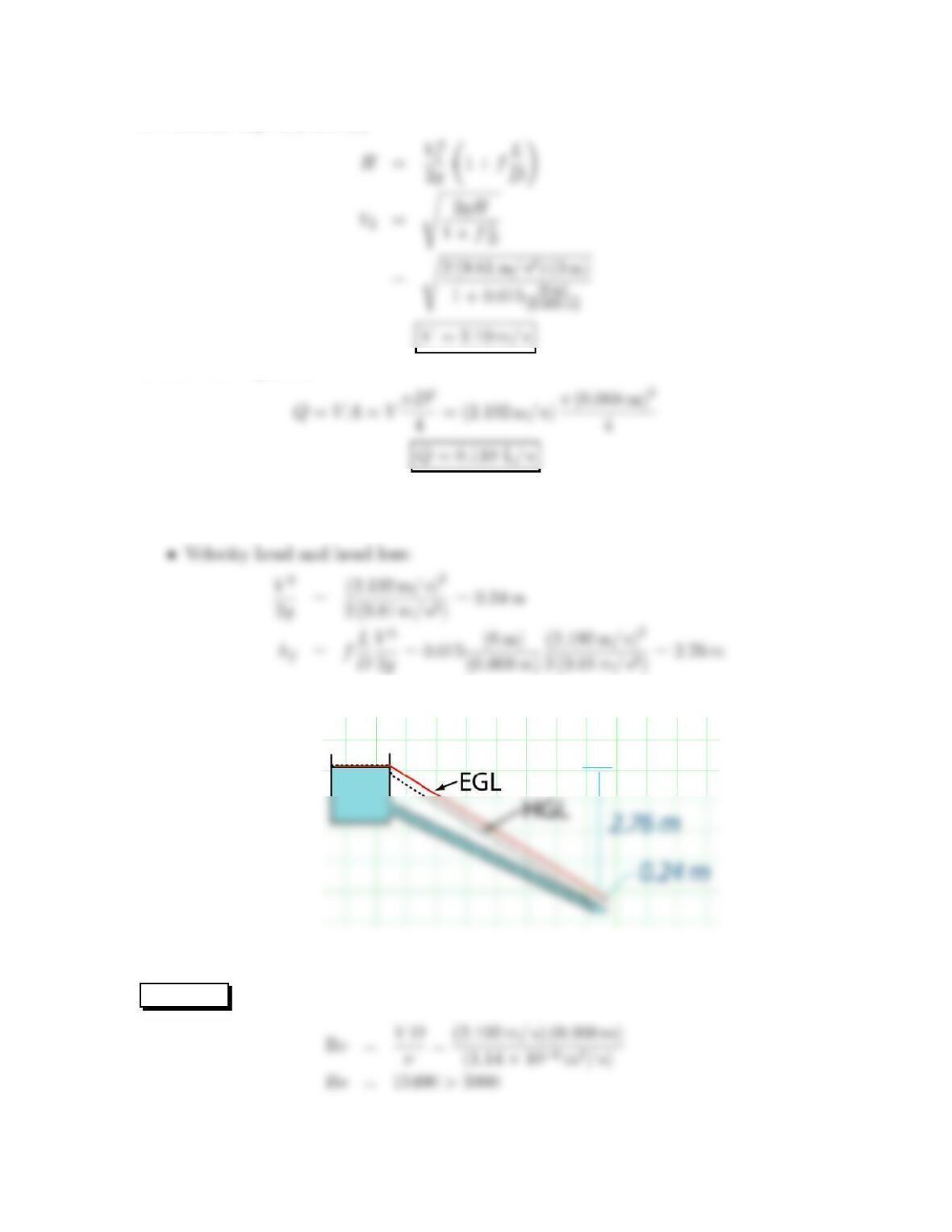
3. Combine Eqs. (1) and (2):
4. Flow rate equation:
5. Sketch HGL & EGL
•Locate the EGL & HGL on free surface of tank.
•Locate the EGL and HGL at the end of the pipe. Sketch lines.
REVIEW Check the turbulent flow assumption.
Thus, the assumption of turbulent flow is valid.
10
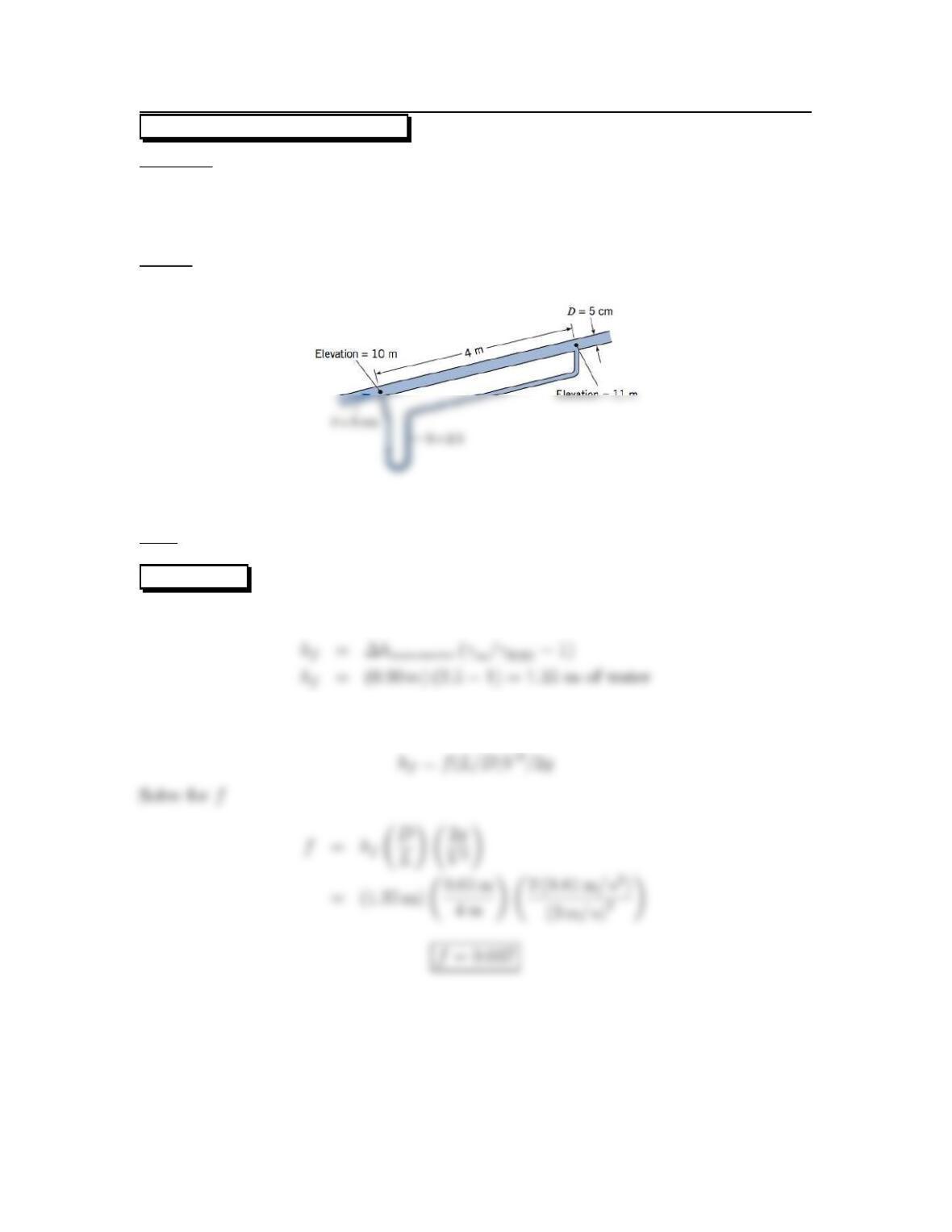
10.9: PROBLEM DEFINITION
Situation:
Water flows through a pipe.
V=3m/s,z1=10m.
z2=11m,D=5cm
Sketch:
Find:Resistancecoefficient, f.
SOLUTION
Manometer equation
Darcy Weisbach
11
10.10: PROBLEM DEFINITION
Answer the questions below.
a. What are the main characteristics of laminar flow?
•Flow in layers
b. What is the meaning of each variable that appears in Eq. (10.27)?
•Vis the area-averaged velocity in the pipe; also called the mean velocity
c. In Eq. (10.33), what is the meaning of hf?
12
10.11: PROBLEM DEFINITION
Situation:
Fluid flowing in a pipe.
V=0.04 m/s,D=0.1m.
Find:
(a) Reynolds number.
(b) Maximum velocity in the pipe.
(c) Friction factor f.
(d) Shear stress at the wall.
(e) Shear stress 25 mm from pipe center.
Properties:μ=10
−2Pa ·s,ρ=800kg/m3
SOLUTION Reynolds number:
Therefore, the flow is laminar:
Wall shear stress (from definition of f):
13

14
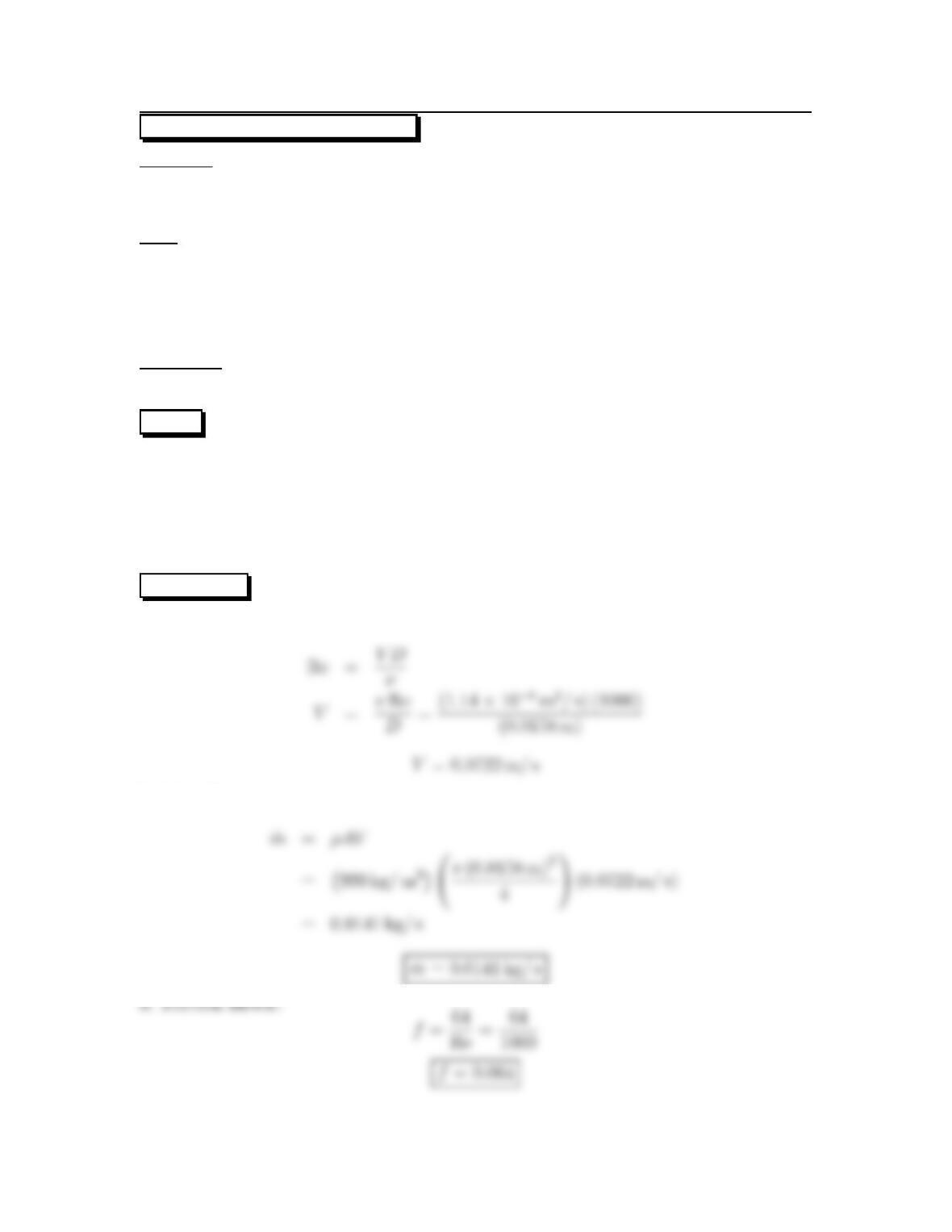
10.12: PROBLEM DEFINITION
Situation:
Water is flowing in a pipe. Re = 1000,T=15◦C.
Nominal diameter = 1/2″ Schedule 40. D=0.622 in = 0.0158 m.
Find:
(a) Mass flow rate (kg/s).
(b) Friction factor f.
(c) Head loss per meter of pipe length.
(d) Pressure drop per meter of head length.
Properties:Water(15 ◦C,1atm), Table A.5, ρ=999kg/m3,γ =9800N/m3,ν=
1.14 ×10⁻⁶m2/s,μ=1.14 ×10−3N·s/m2.
PLAN
1. Find Vby using known Re.
2Find˙mby using ˙m=ρAV.
3. Find fby using 64/Re.
4. Find hLby using Darcy–Weisbach eqn.
5. Find ∆pby using the energy eqn.
SOLUTION
1. Reynolds Number:
2. Mass flow rate:
15
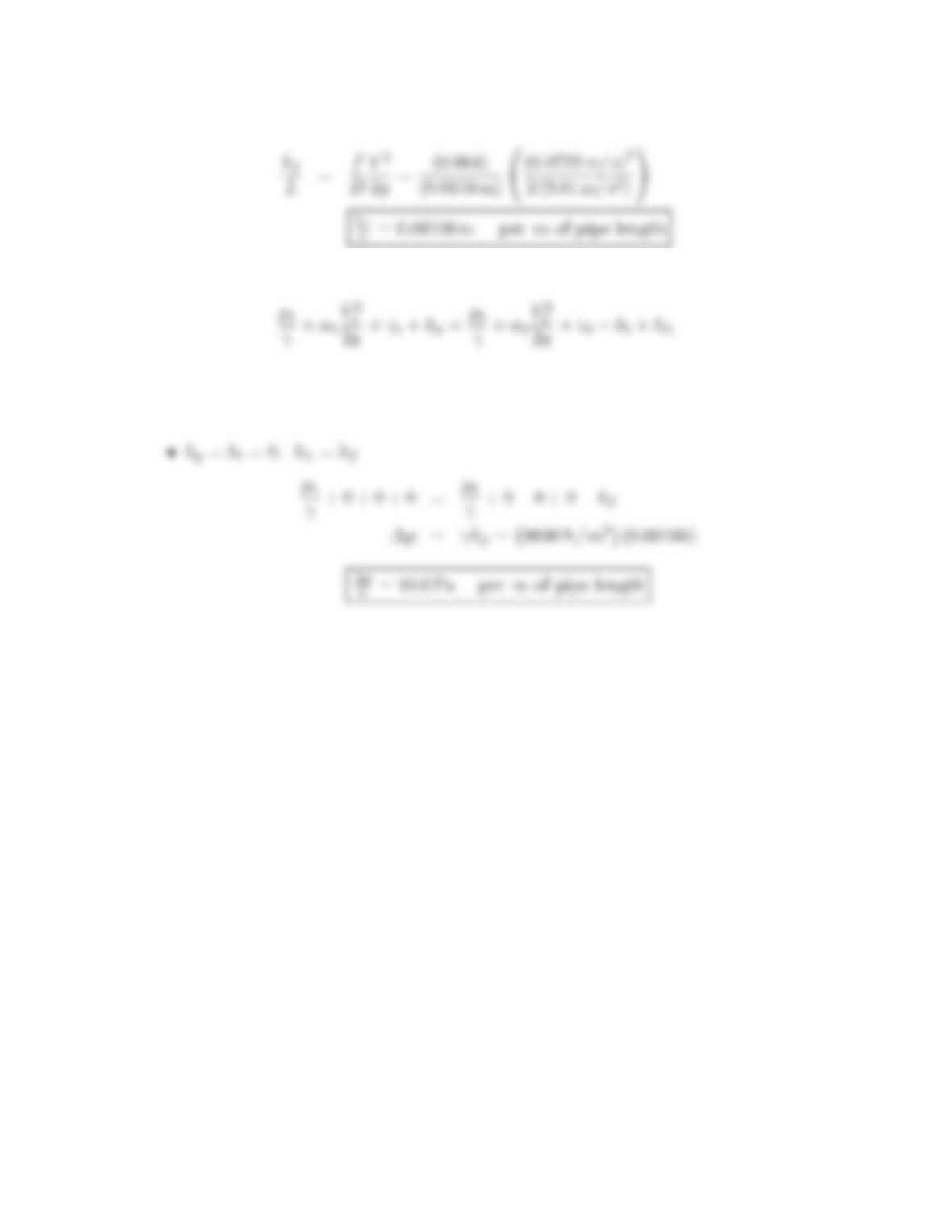
4. Darcy-Weisbach Eqn.:
5. Energy eqn.
•KE terms cancel.
•Assume horizontal pipe.
16
10.13: PROBLEM DEFINITION
Situation:
Liquid flows through a smooth pipe.
V=0.5m/s.h
f=2m per m,D=0.025 m.
Find:
Friction factor.
Reynolds number.
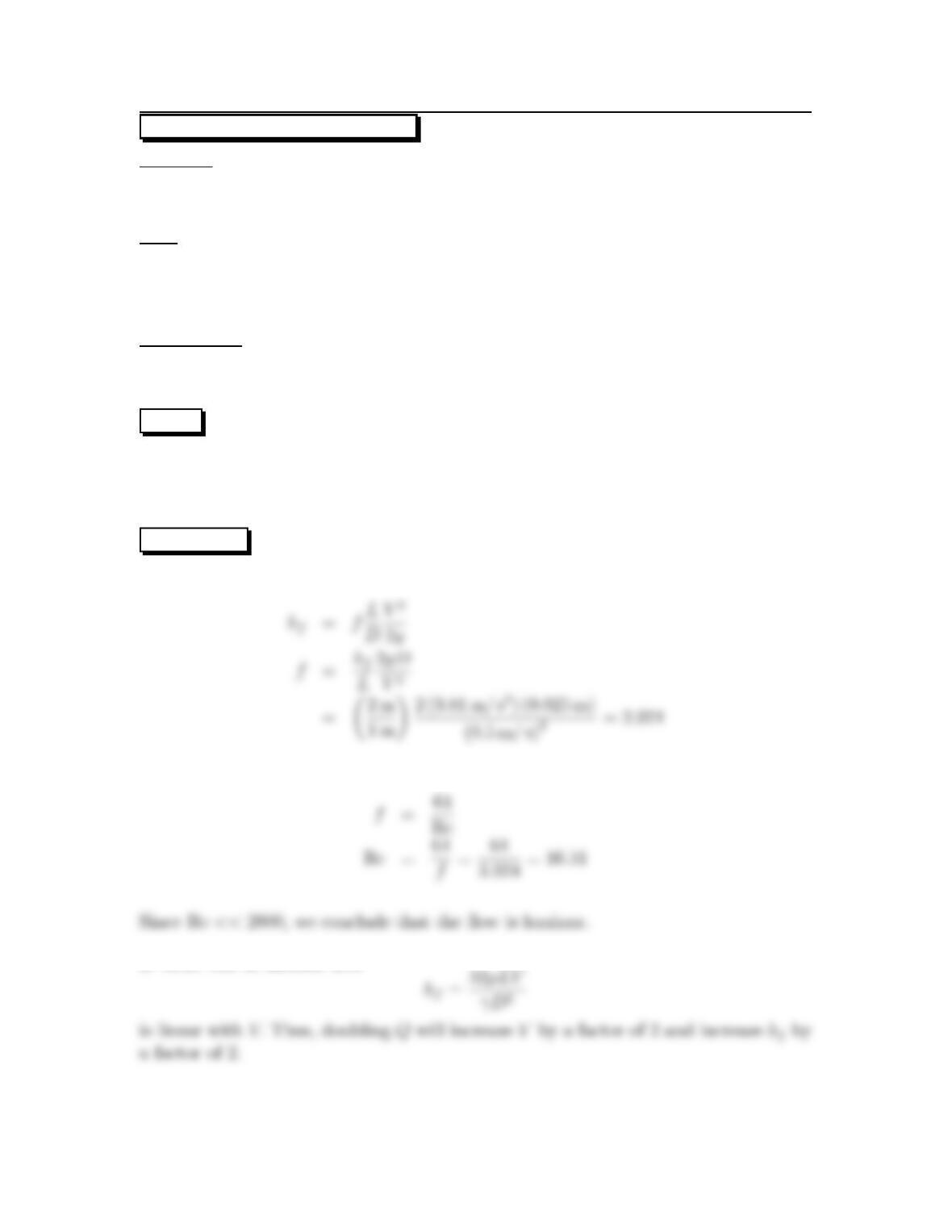
Prove that doubling the flow will double the head loss.
Assumptions:
Laminar flow.
Fully developed flow.
PLAN
1. Find fusing the Darcy-Weisbach eqn.
2. Find Re using f=64/Re .
3. Determine the effect of doubling Qby logical reasoning with the head loss eqn.
SOLUTION
1. Darcy-Weisbach:
2. Assume laminar flow:
3. Head loss in laminar flow
17
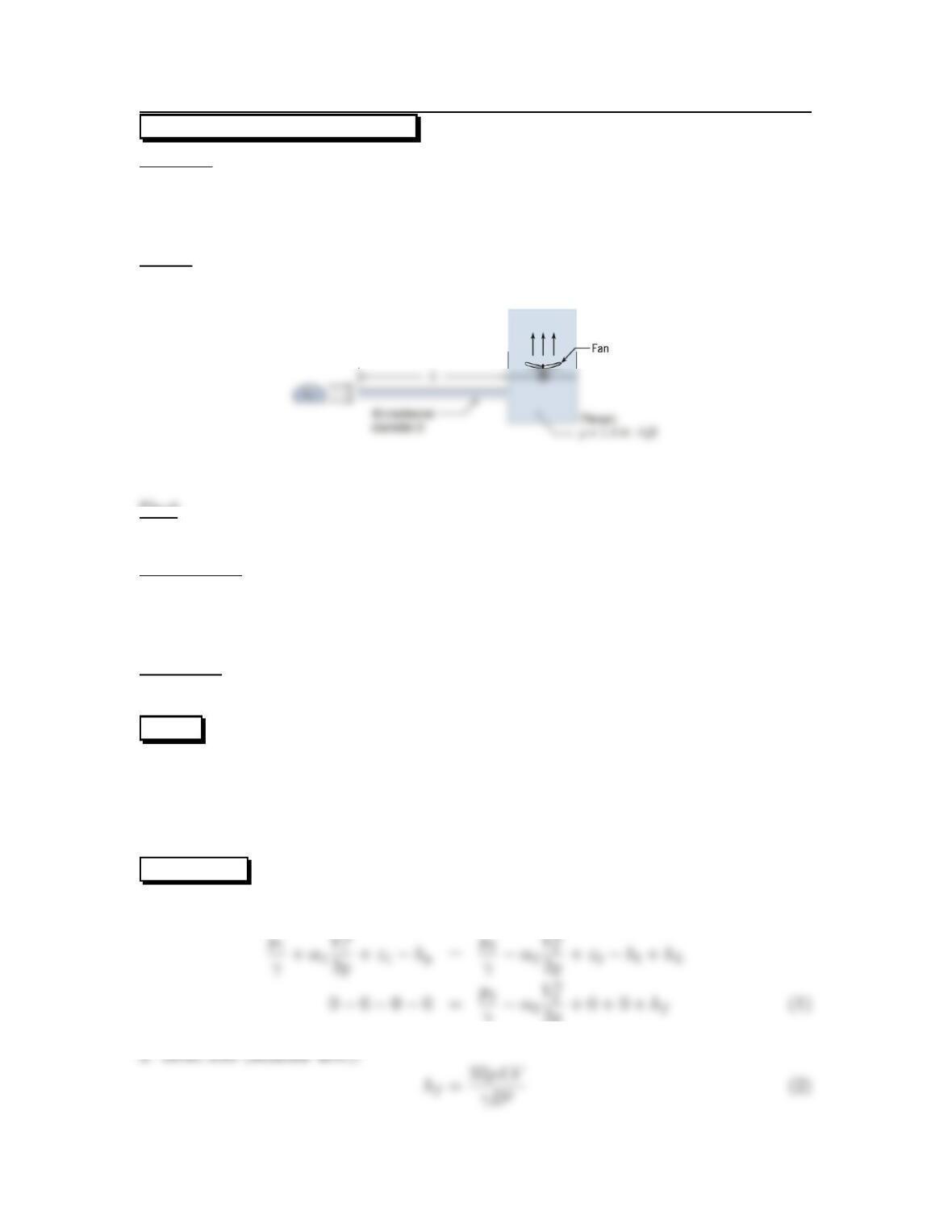
10.14: PROBLEM DEFINITION
Situation:
Air flows through a round tube.
D=0.0005 m,L=0.75 m.
p2=−1.5inch H20 = –373 Pa gage.
Sketch:
Find:
Velocity in the tube (m/s).
Assumptions:
Fully developed flow.
Laminar flow.
Only source of head loss is flow in tube.
Properties:
Air (20 ◦C,1atm), Table A.3, μ=1.81 ×10⁻⁵N·s/m2,ν=15.1×10−6m2/s.
PLAN
1. Relate velocity to pressure using the energy equation.
2. Find head loss.
3. Find velocity by combining steps 1 and 2.
4. Check laminar flow assumption by calculating Re.
SOLUTION
1. Energy eqn (point 1 back from tube inlet; point 2 at tube outlet):
18
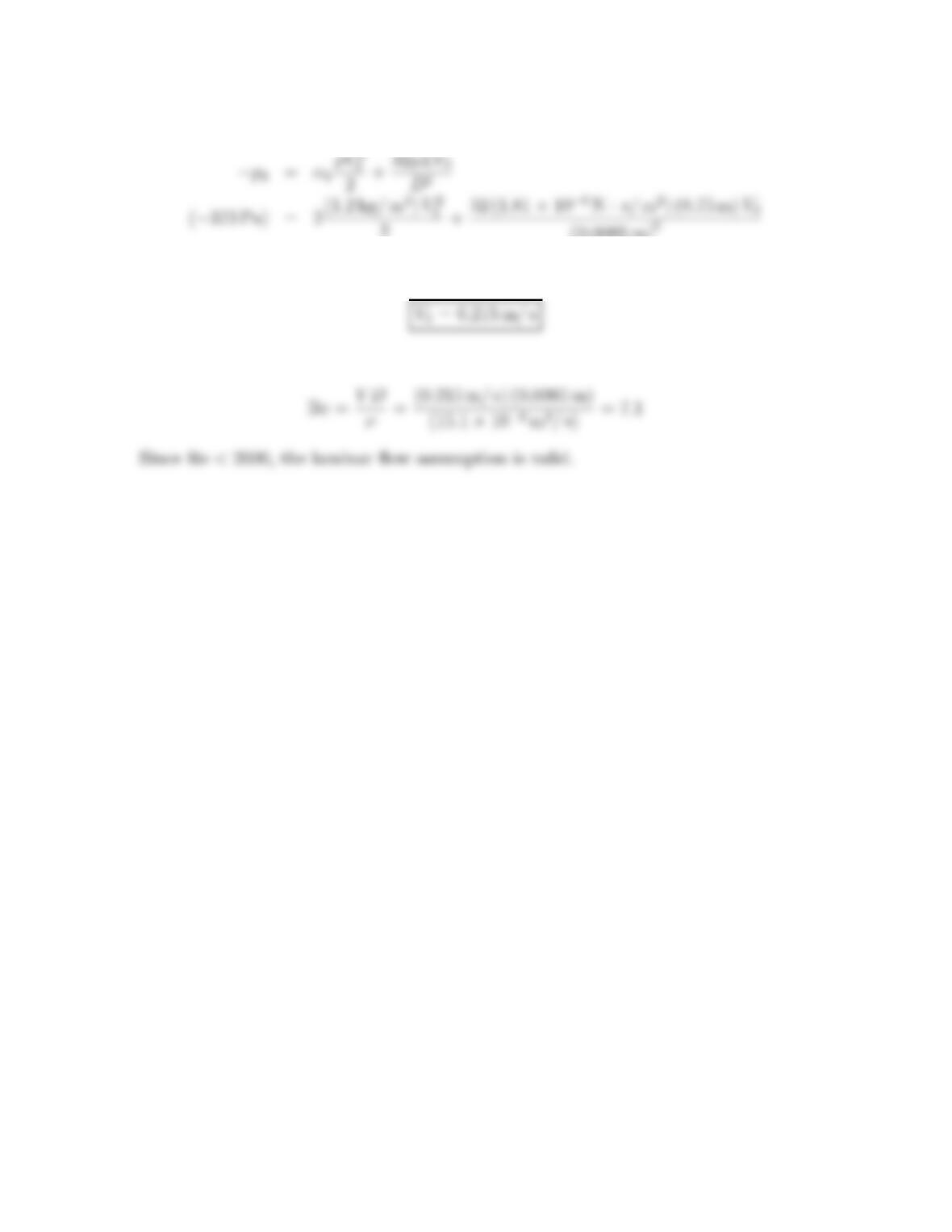
3. Combine Eq. (1) and (2):
(0.0005 m)2
Solve using quadratic equation:
4. Reynolds number:
19
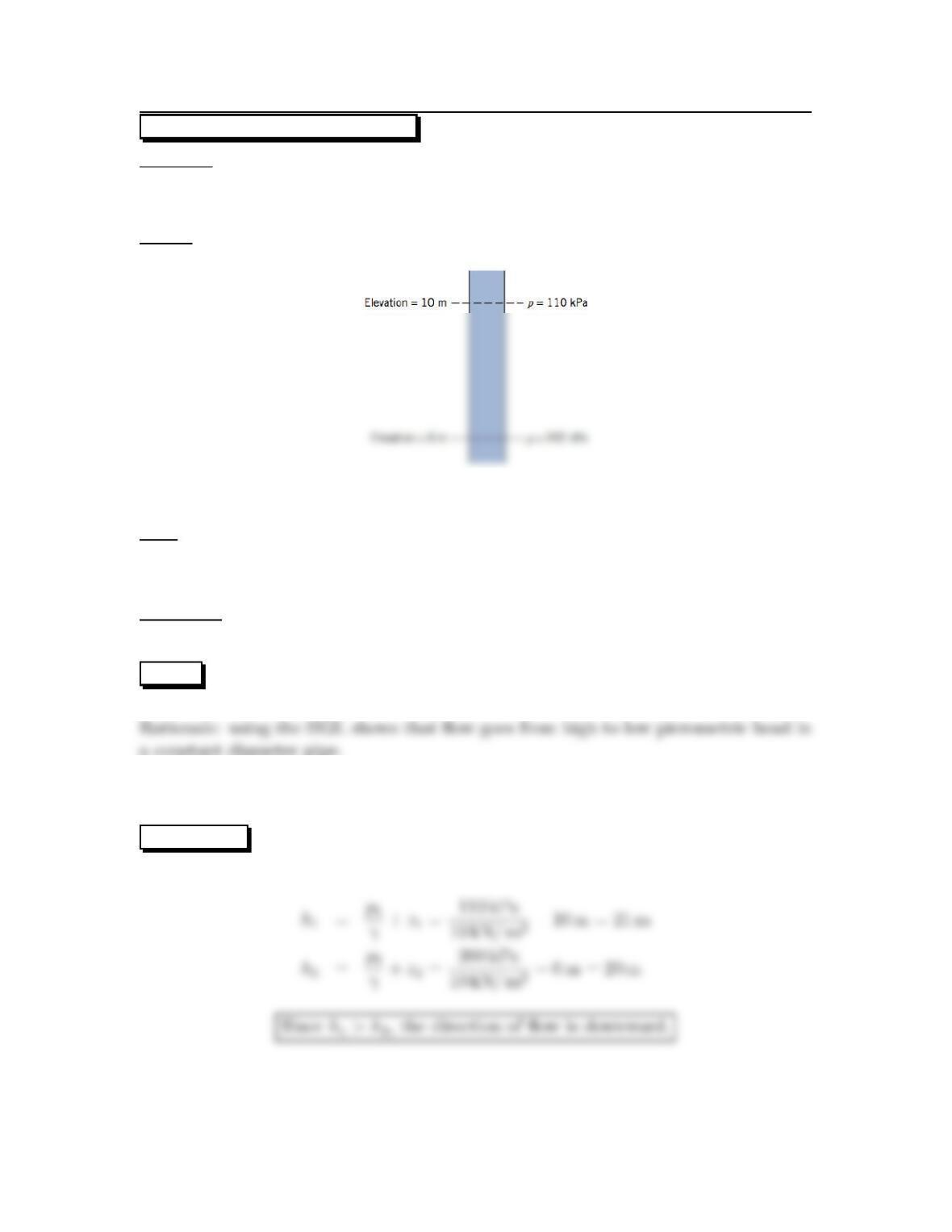
10.15: PROBLEM DEFINITION
Situation:
Liquid flows in a vertical pipe; flow direction is unknown.
D=0.008 m.
Sketch:
Find:
Direction of flow.
Velocity (m/s).
Properties:
γ=10kN/m3,μ=3.0×10−3N·s/m2.
PLAN
1. Find the flow direction by calculating the piezometric head at locations 1 and 2.
2. Find head loss using the energy eqn.
3. Find velocity by using the equation for head loss in laminar flow.
SOLUTION
1. Piezometric Head (location 1 at z=10m):
20