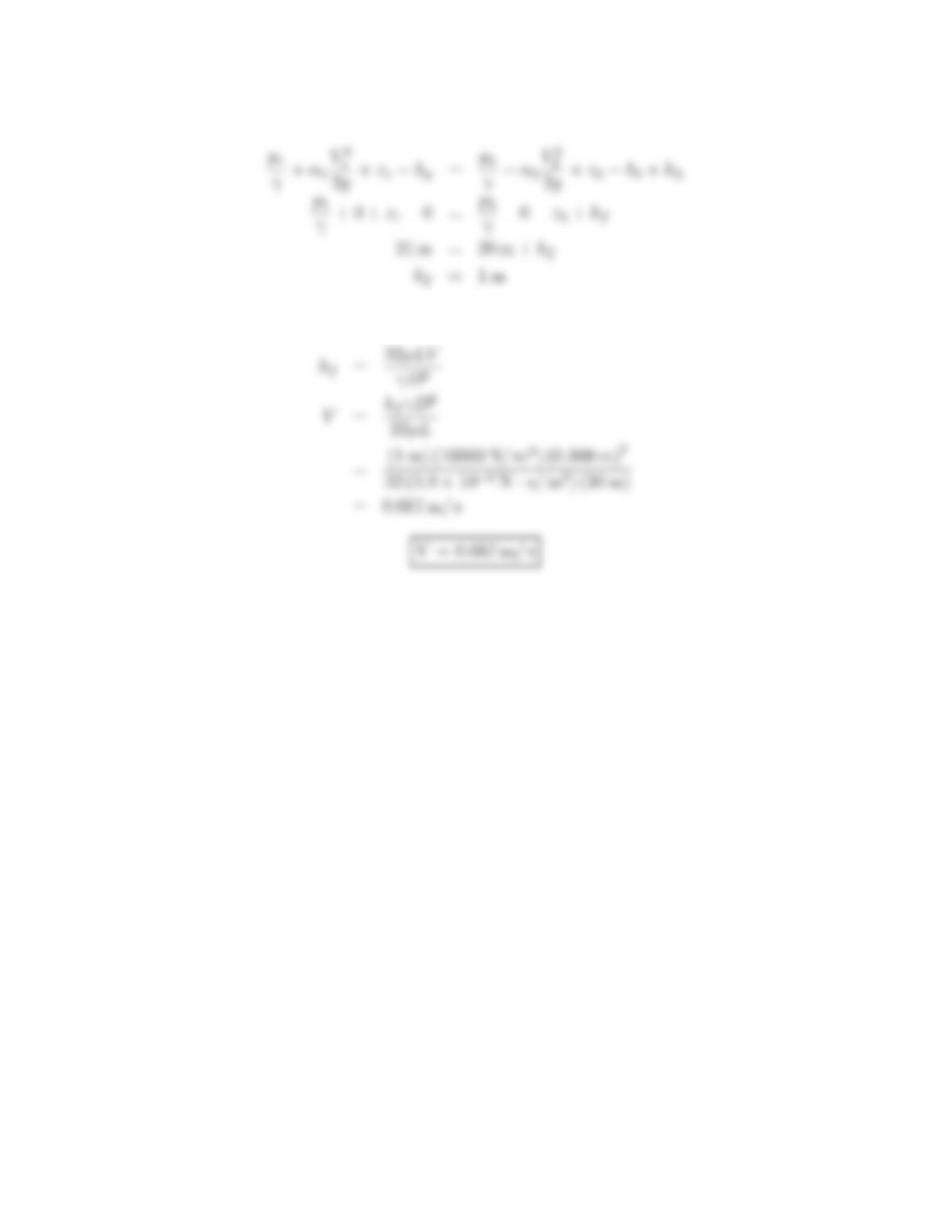
2. Energy equation:
3. Head loss (laminar flow):
21
10.16: PROBLEM DEFINITION
Situation:
Oil is pumped through a horizontal pipe. Q=0.004 ft3/s.
Nominal diameter = 1 in. Schedule 80. D=0.957 in = 0.0798 ft.
Find:
Head loss (ft) per 100 feet of pipe.
Properties:
Oil, S=0.97,μ=10
−2lbf ·s/ft2.
PLAN
1. Find Vusing the flow rate equation.
3. Find hf.
SOLUTION
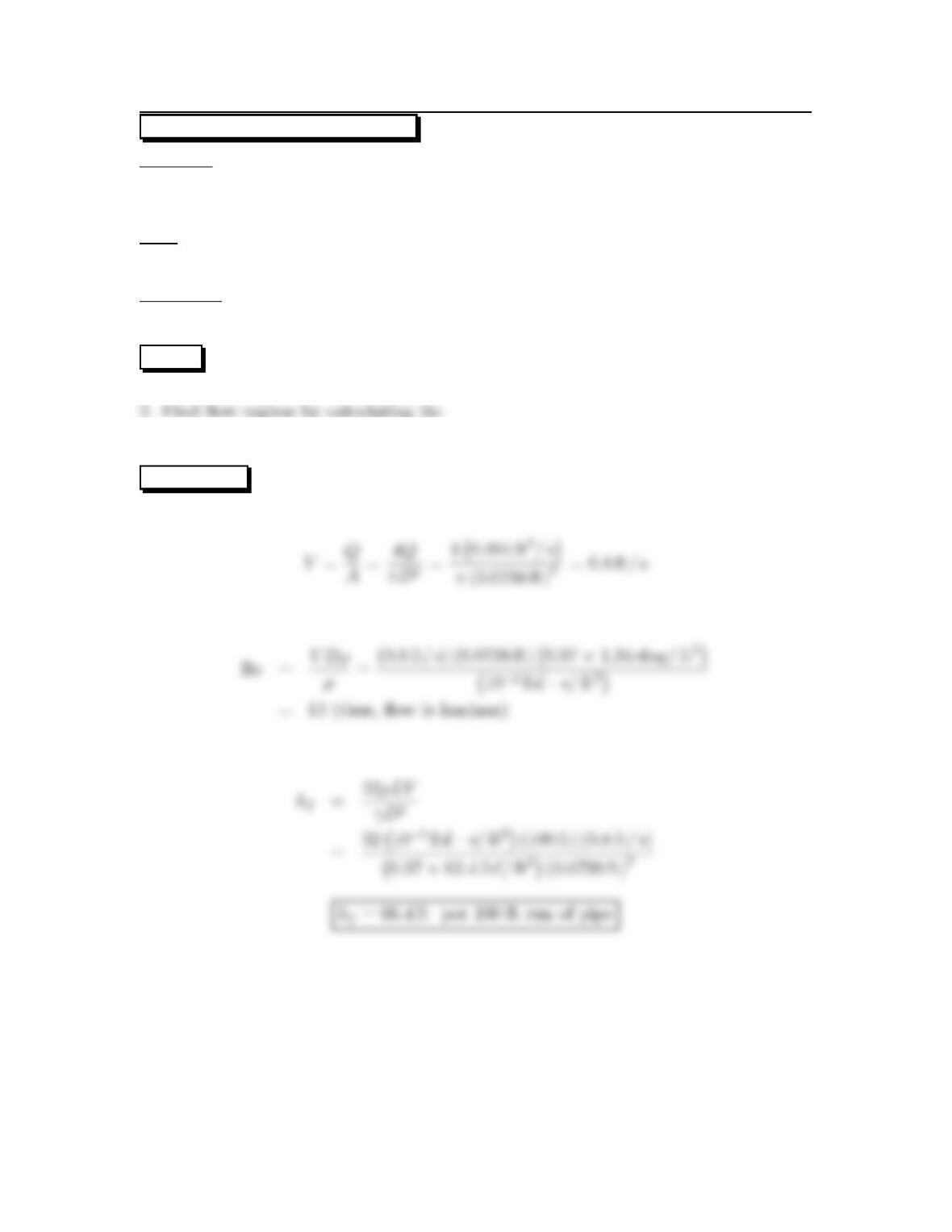
1. Flow rate equation:
2. Reynolds number:
3. Head loss (laminar flow):
22
10.17: PROBLEM DEFINITION
Situation:
A liquid flows in a pipe.
D=0.1m,V=1.5m/s.
Find:
Show that the flow is laminar.
Friction factor f.
Head loss per meter of pipe length. .
Properties:
ρ=1000kg/m3,μ=10
−1N·s/m2,ν=10
−4m2/s.
SOLUTION
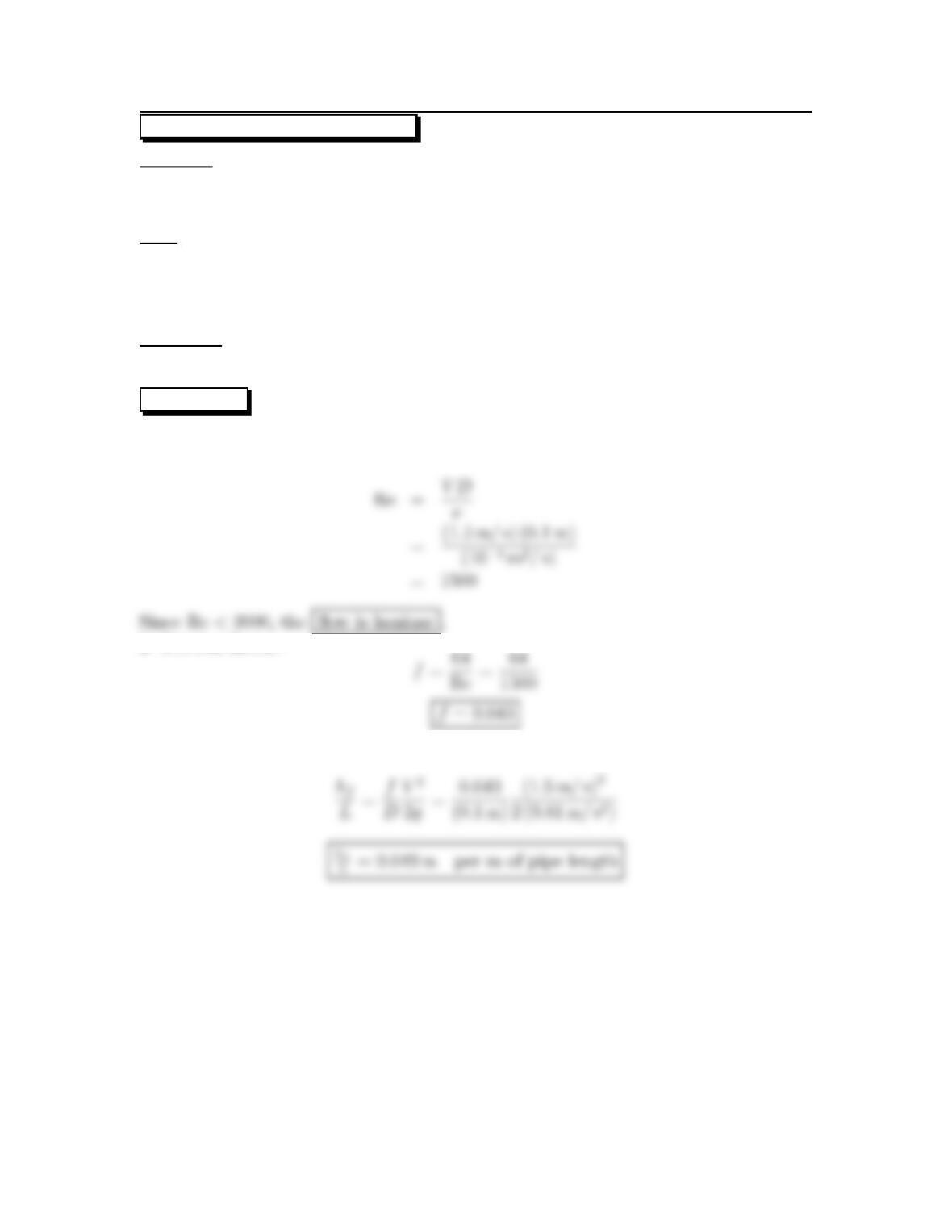
1. Reynolds number:
2. Friction factor:
3. Darcy Weisbach eqn.:
23
10.18: PROBLEM DEFINITION
Situation:
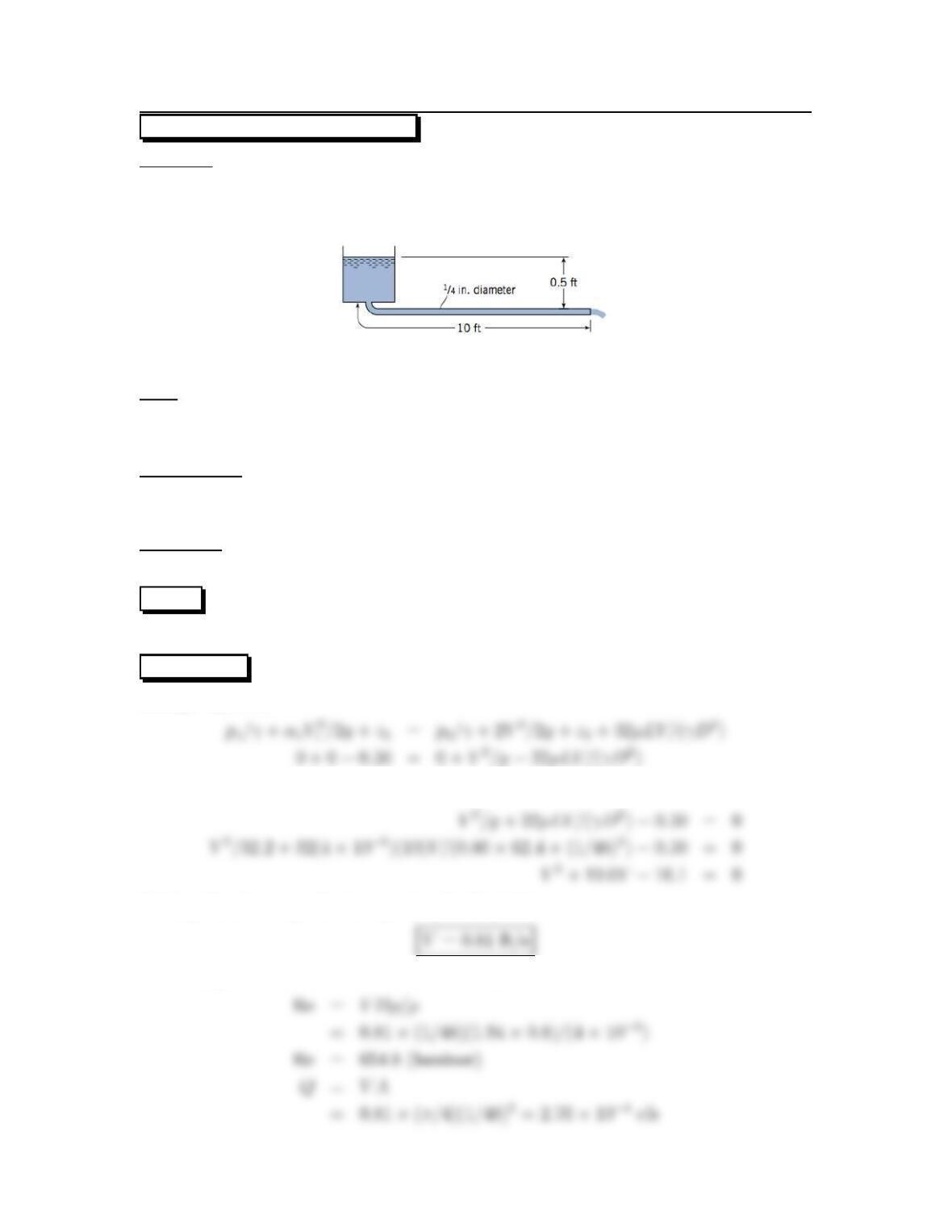
Kerosene flows out a tank and through a tube.
D=0.25 in,L=10ft.
z1=0.5ft.
Find:
Mean velocity in the tube.
Discharge.
Assumptions:
Laminar flow so α=2.
Only head loss is in the tube.
Properties:
Kerosene (68 ◦F): S=0.8.
PLAN
Apply the energy equation from the surface of the reservoir to the pipe outlet.
SOLUTION
Energy equation
Thus
Solving the above quadratic equation for Vyields:
Check Reynolds number to see if flow is laminar
24

25
10.19: PROBLEM DEFINITION
Situation:
Oil is pumped through a horizontal pipe.
D=0.05 m,V=0.5m/s.
Find:
Head loss per 10 m of pipe.
Properties:
S=0.94,μ=0.048 N ·s/m2.
PLAN
1. Determine flow regime (laminar or turbulent) by finding the Reynolds number.
3. Apply eqn. for head loss in laminar flow.
4. Combine steps 2 and 3.
SOLUTION
1. Reynolds number:
2. Energy equation:
3. Head loss (laminar flow):
4. Combine Eqs. (1) and (2):
26
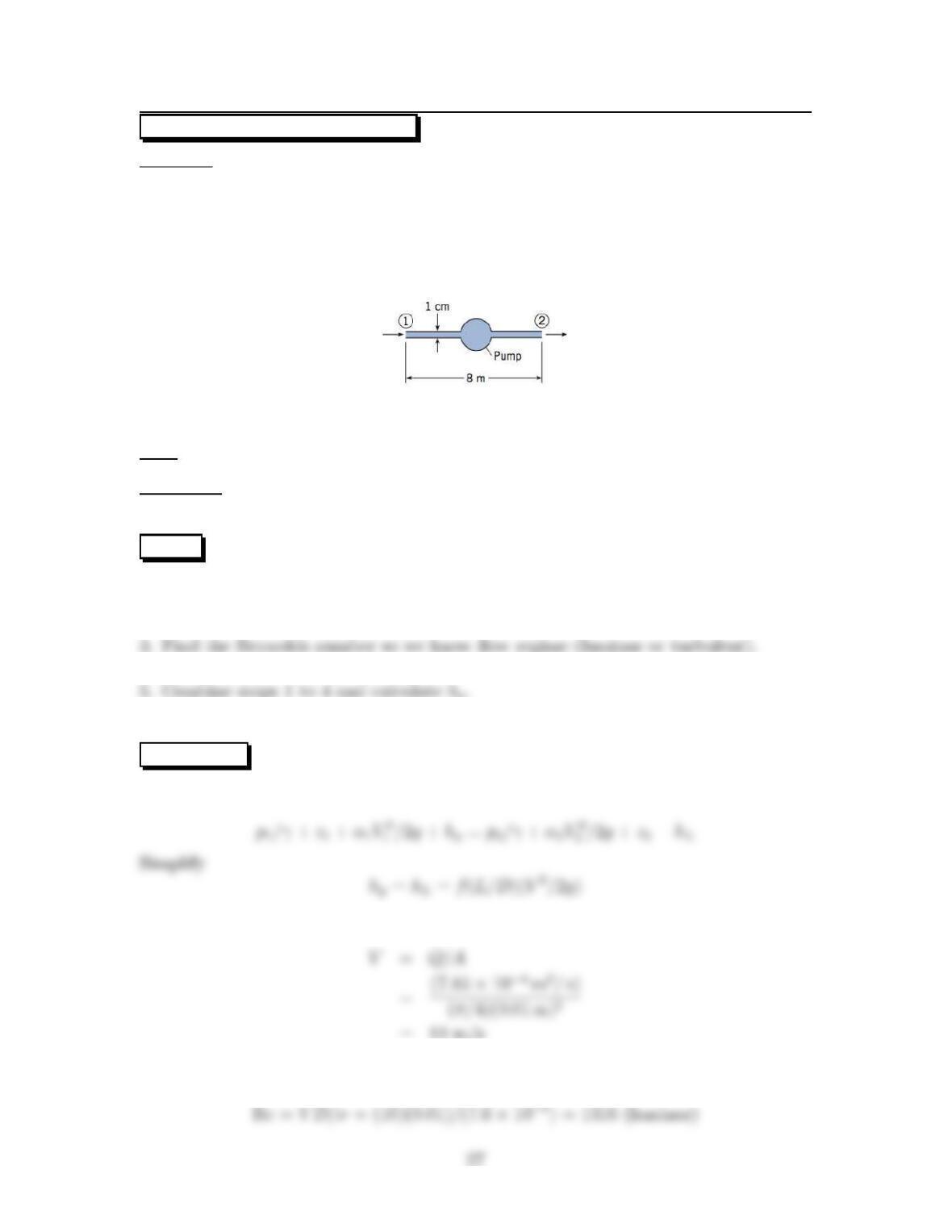
10.20: PROBLEM DEFINITION
Situation:
SAE 10W-30 oil is pumped through a tube.
L=8m,D=.01 m.
Q=7.85 ×10⁻⁴m3/s
Pump efficiency: η=1.0
Pressures at points 1 and 2 are equal.
Find: Power to operate the pump.
Properties: SAE 10W-30 Oil (given in problem statement) ν=7.6×10⁻⁵m2/s,
γ= 8630 N/m3.
PLAN Power can be found using P=γQhp.To find the terms on the right side, the
step are:
1. Develop an equation for hpby applying the energy equation.
2. Find velocity Vby apply the flow rate equation.
4. Calculate f.
6. Calculate power.
SOLUTION
1. Energy equation (from 1 to 2)
2. Flow rate equation
=10m/s
3. Reynolds number
4. Friction factor (f)
5. Head of the pump
6. Power equation
REVIEW
1. The head of the pump (198 m) is quite high because the velocity is high (10
m/s).
2. If the velocity was reduced, for example by specifying a larger tube, the required
28
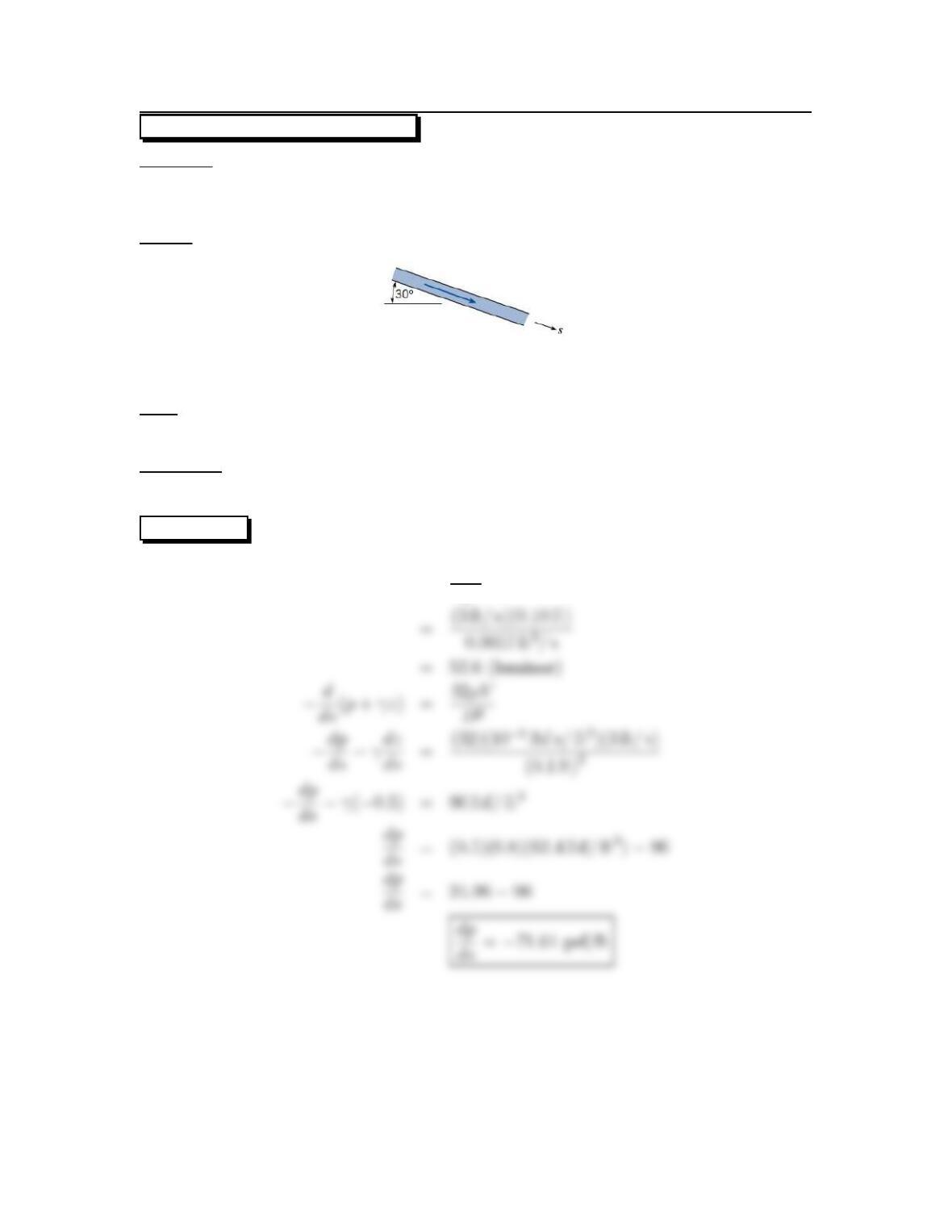
10.21: PROBLEM DEFINITION
Situation:
Oil flows downward in a pipe.
D=0.1ft,V=3ft/s,Slope of 30 ◦.
Sketch:
Find:
Pressure gradient along the pipe (psf/ft).
Properties:
Oil, S=0.8,μ=10
−2lbf s/ft2,v=0.0057 ft2/s.
SOLUTION
Re = VD
v
29
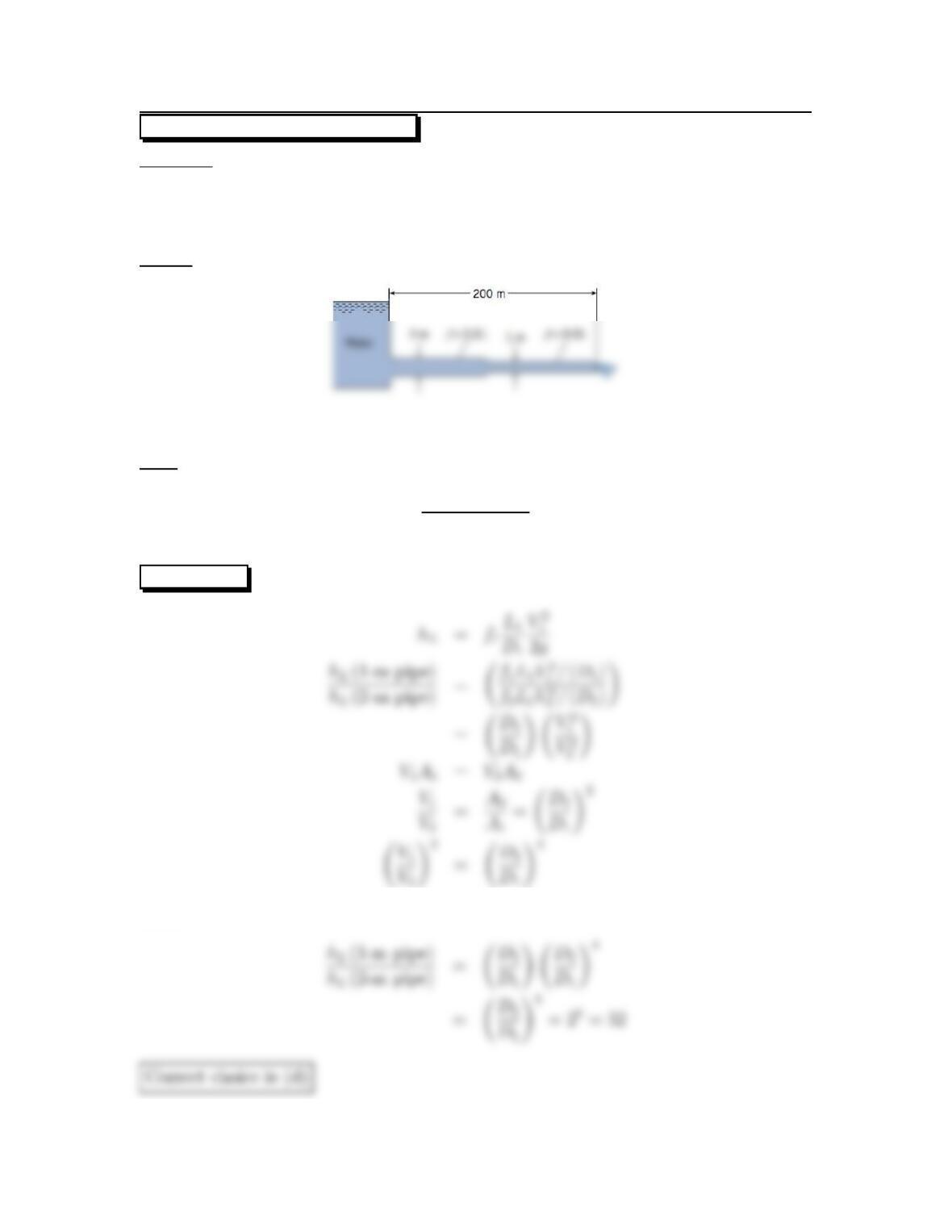
10.22: PROBLEM DEFINITION
Situation:
Fluid flows out of a tank through a pipe with an abrupt contraction.
L1=L2=100m,f=0.01.
D1=2m,D2=1m.
Sketch:
Find:
Ratio of head loss. hL(1-m pipe)
hL(2-m pipe)
SOLUTION
Thus
30
10.23: PROBLEM DEFINITION
Situation:
Glycerine flows in a pipe
D=0.5ft,¯
V=1.5ft/s.
Find:
Determine if the flow is laminar or turbulent.
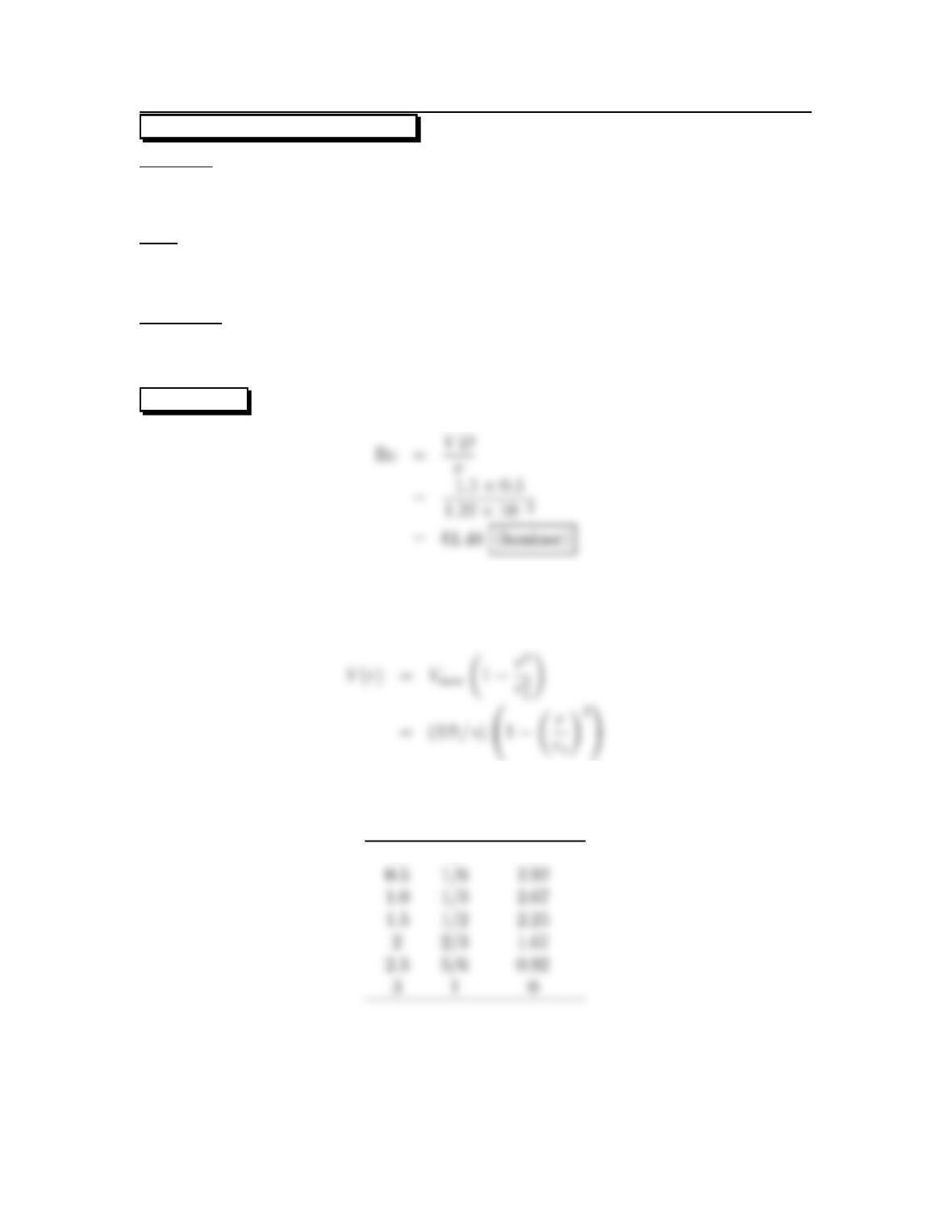
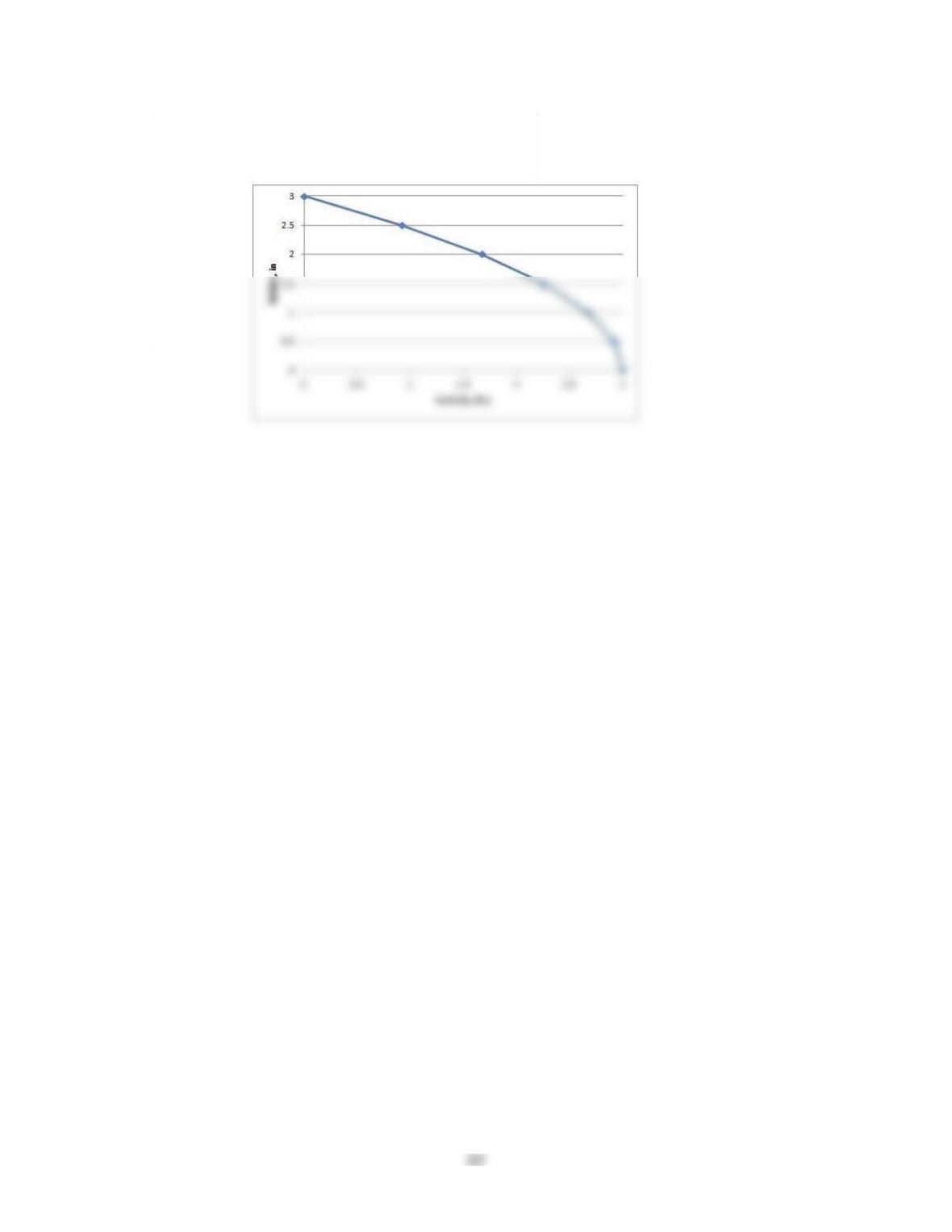
Plot the velocity distribution.
Properties:
Glycerine at 68 ◦Ffrom Table A.4:
μ=0.03 lbf ·s/ft2,ν=1.22 ×10−2ft2/s.
SOLUTION
To plot the velocity distribution, begin with Eq. (10.23) from EFM10e. Recall also
for laminar flow that Vmax =2Vavg .
Create a table of values and then plot
r(in) r/r0V(r)(ft/s)
00 3
31
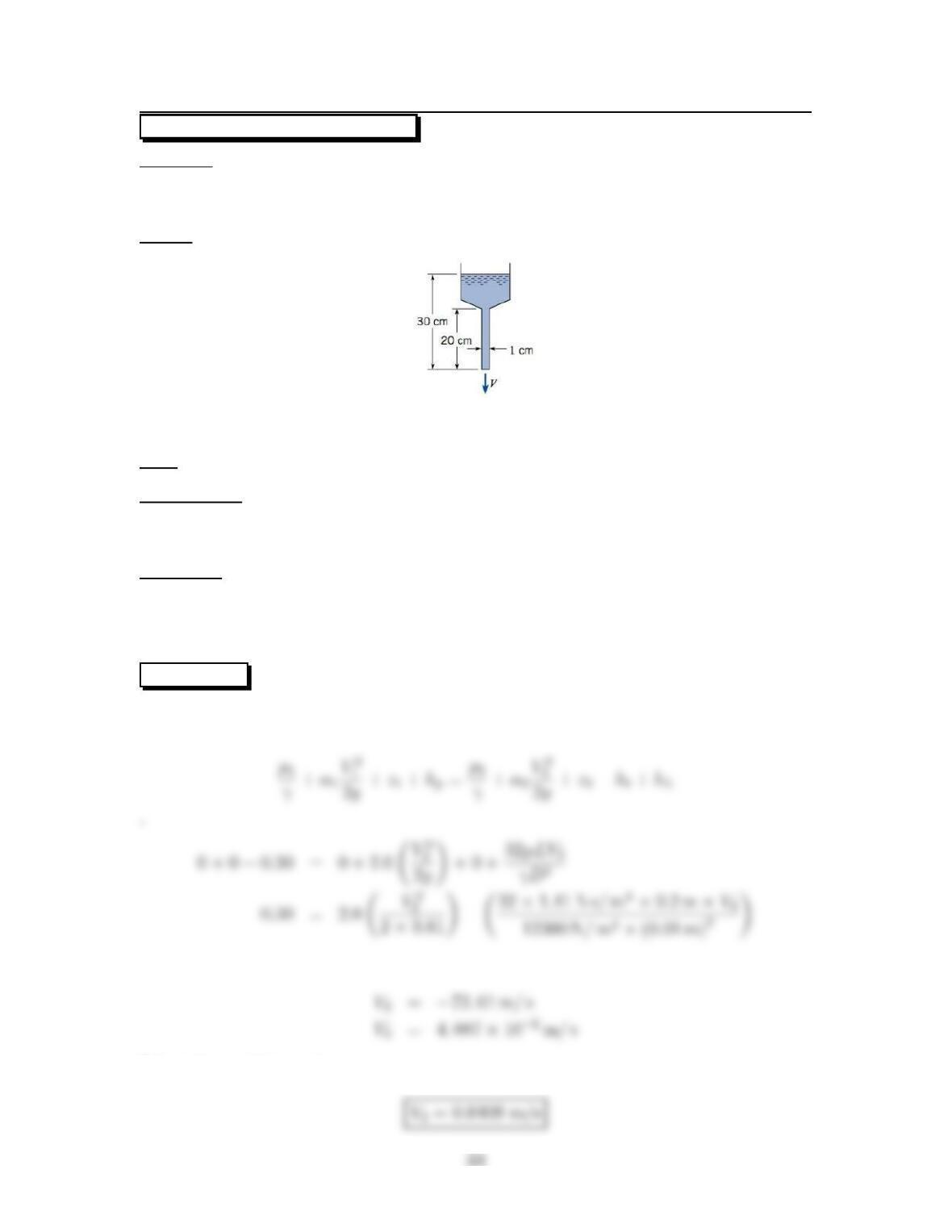
10.24: PROBLEM DEFINITION
Situation:
Glycerin flows through a funnel
D=1cm,L=20cm.
Sketch:
Find:Meanvelocity(in m/s)at the exit.
Assumptions:
Laminar flow (α2=2.0) .
Theonlyheadlossisduetofrictionintube.
Properties:
Glycerin (20 ◦C) ,Table A.4:
ρ=1260kg/m3,γ=12,300 N/m3.
μ=1.41 N ·s/m2,ν=1.12 ×10−3m2/s.
SOLUTION
Energy equation (Let section 1 be the surface of the liquid and section 2 be the exit
plane of the funnel).
Solve quadratic equation.
Select the positive root
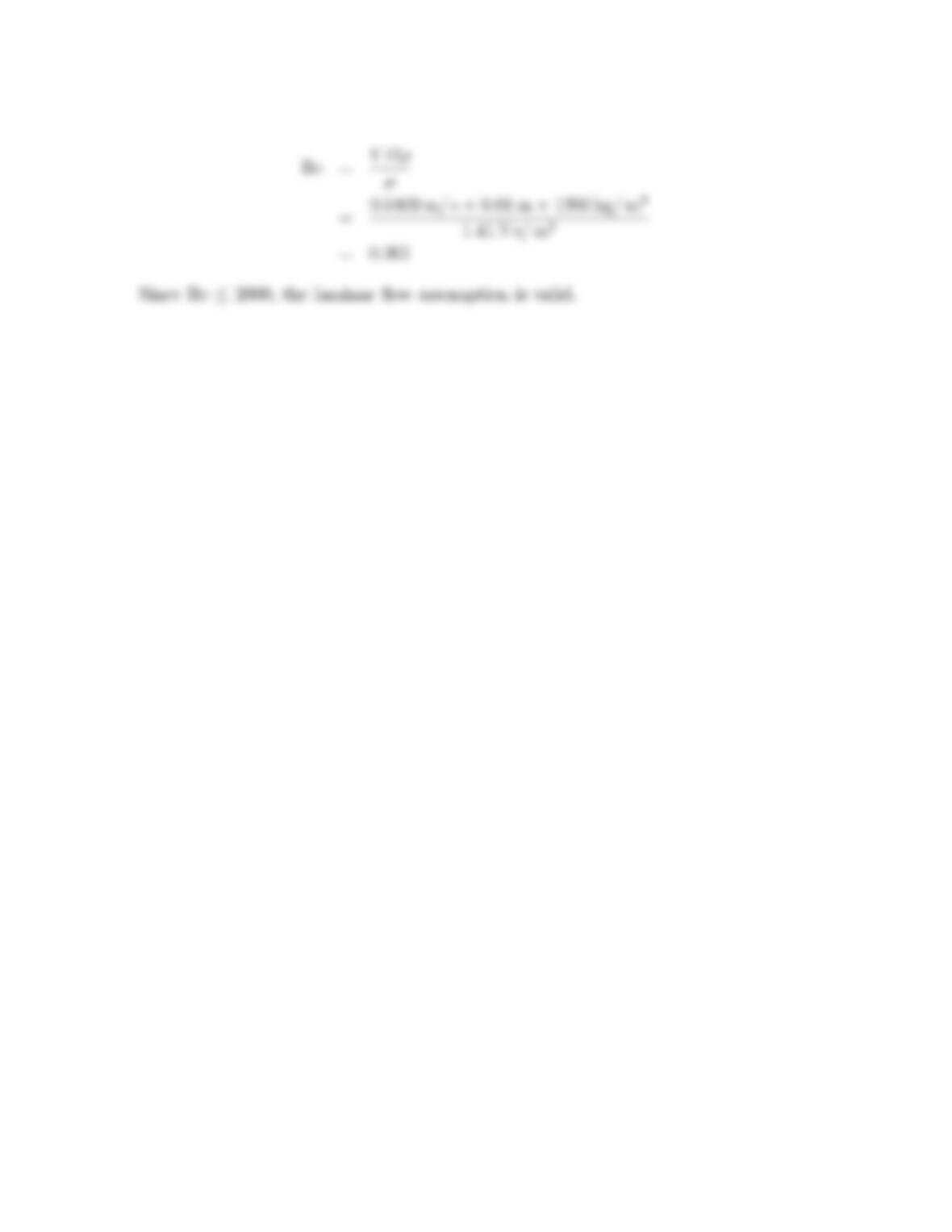
Check the laminar flow assumption
34
10.25: PROBLEM DEFINITION
Situation:
Castor oil flows through a steel pipe.
Q=0.2ft
3/s,L=0.5 mi = 2640 ft.
Allowable pressure drop is 10 psi.
Find:
Nominal diameter of pipe (ft).
Assumptions:
Laminar flow.
Horizontal pipe.
Properties:
Castor oil (90 ◦F): μ=0.085 lbf ·s/ft2,S=0.85.
SOLUTION
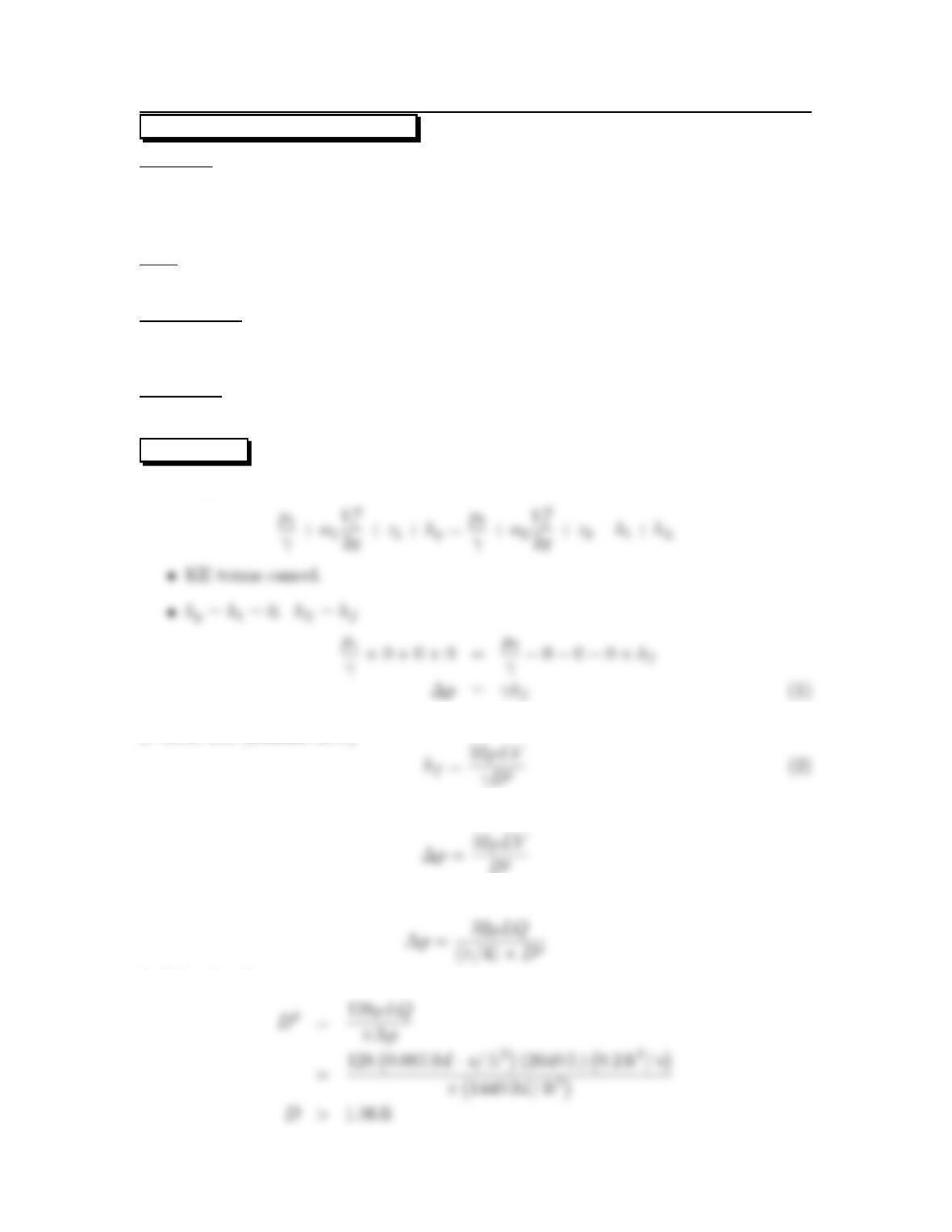
1. Energy eqn.
2. Head loss (laminar flow)
3. Combine Eq. (1) and (2)
D2
4.Let V=Q/A
5. Solve for diameter.
35
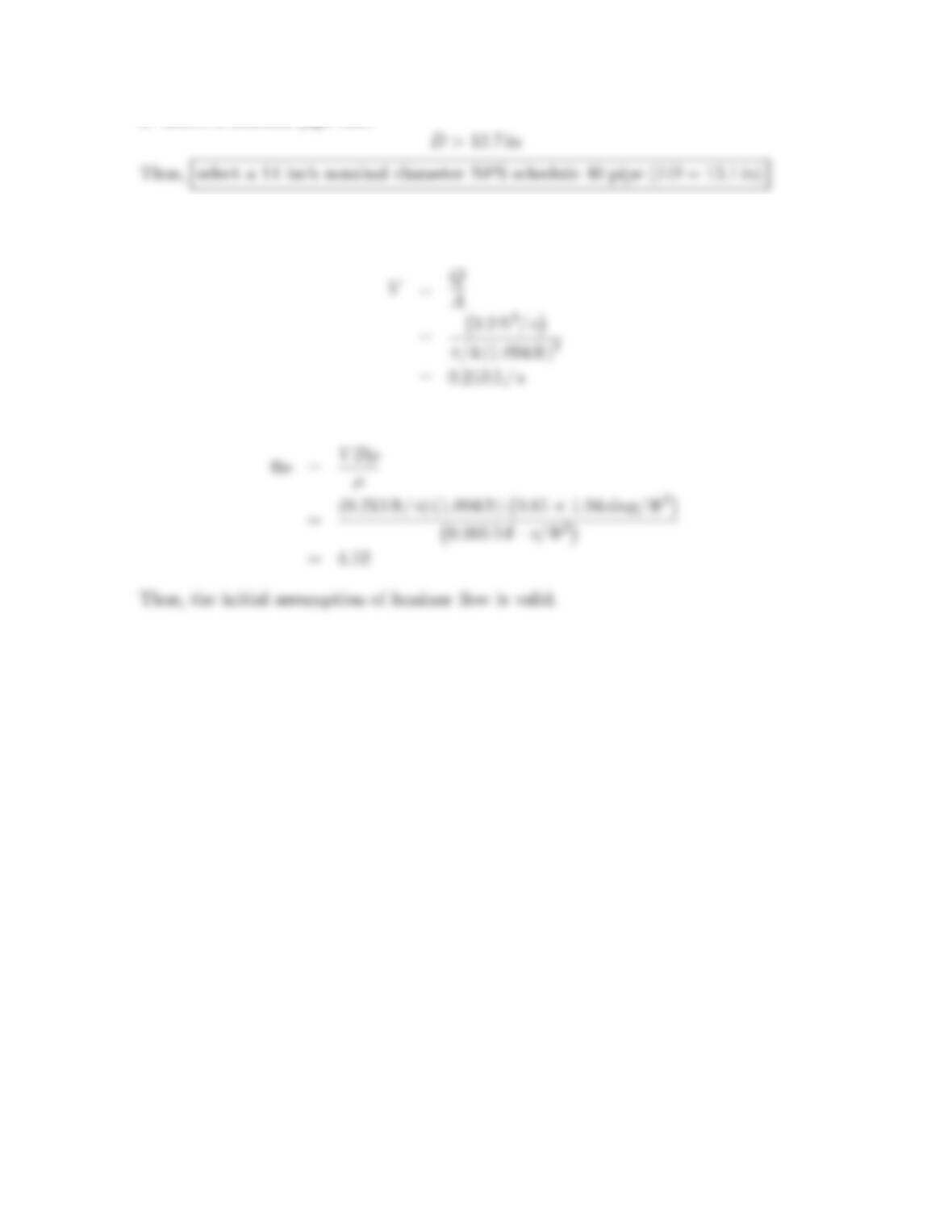
6. Select a nominal pipe size.
7. Check Laminar flow assumption:
Velo city:
Reynolds number
36
10.26: PROBLEM DEFINITION
Situation:
Velocity measurements are made in a pipe.
D=0.3m,V=1.5m/s.
∆p=1.9kPa per 100 m of pipe.
Find:
Kinematic viscosity of fluid (m
2/s).
Assumptions:
Laminar flow (since velocity profile is parabolic).
Horizontal pipe.
Properties:
S=0.8
SOLUTION
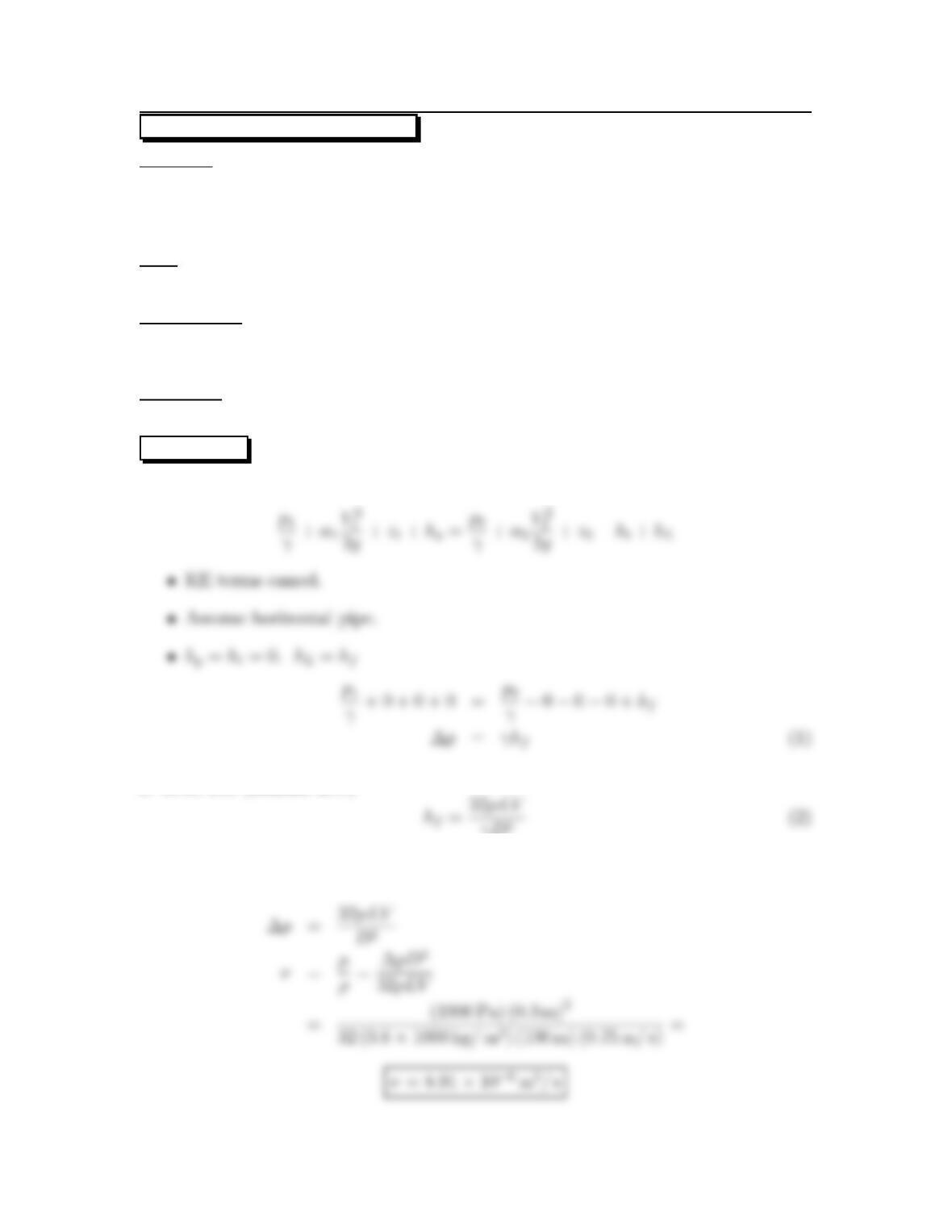
1. Energy eqn.
2. Head loss (laminar flow)
γD2(2)
3. Combine Eq. (1) and (2)
37
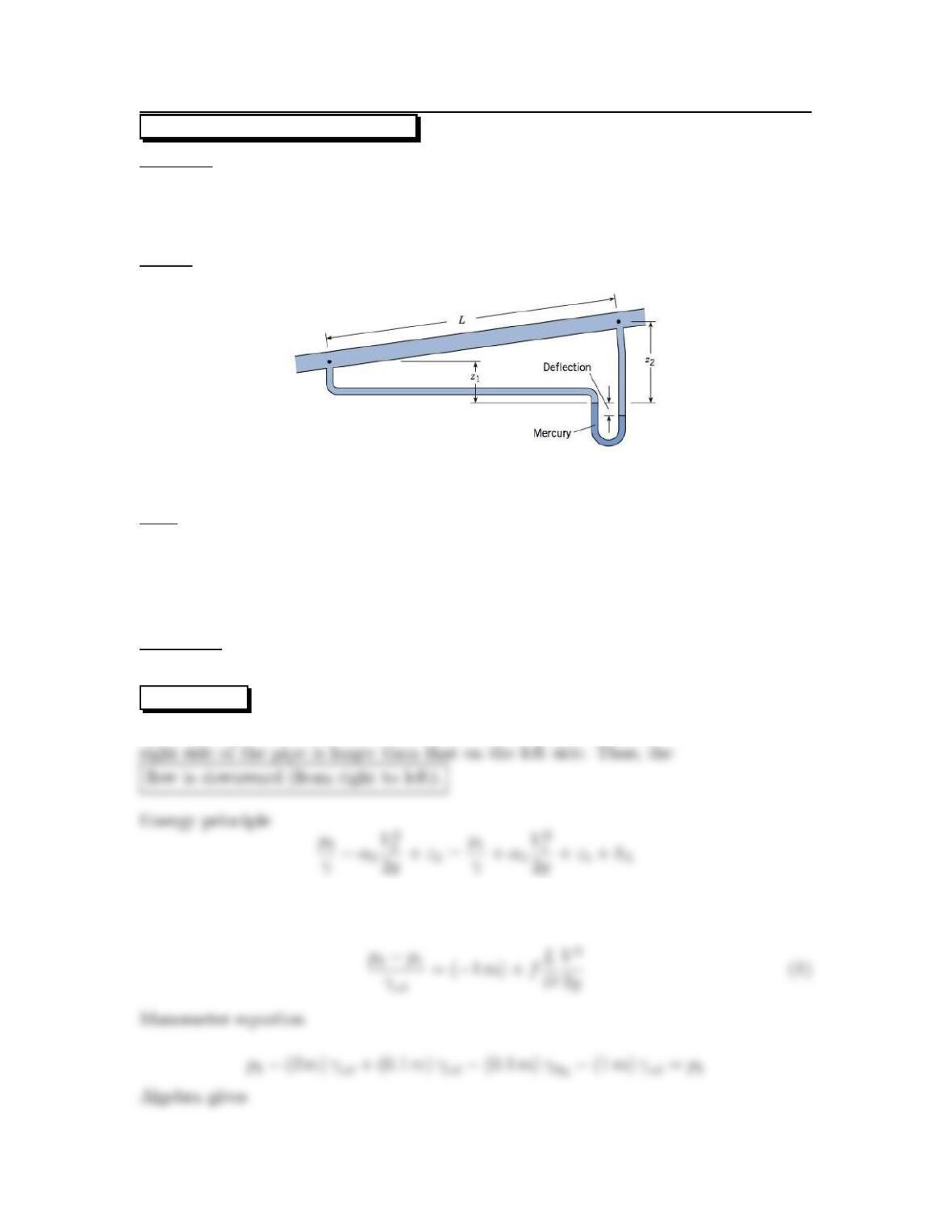
10.27: PROBLEM DEFINITION
Situation:
Oil flows through a smooth pipe.
L=12m,z1=1m,z2=2m.
V=1.2m/s,D=5cm.
Sketch:
Find:
Flow direction.
Resistance coefficient.
Nature of flow (laminar or turbulent).
Viscosity of oil (Ns/m2).
Properties:
S=0.8.
SOLUTION
Basedonthedeflection on the manometer, the piezometric head (and HGL) on the
Assume α1V1=α2V2.Let z2−z1=1m.Also the head loss is given by the Darcy
Weisbach equation: hf=f(L/D)V2/(2g).The energy principle becomes
38
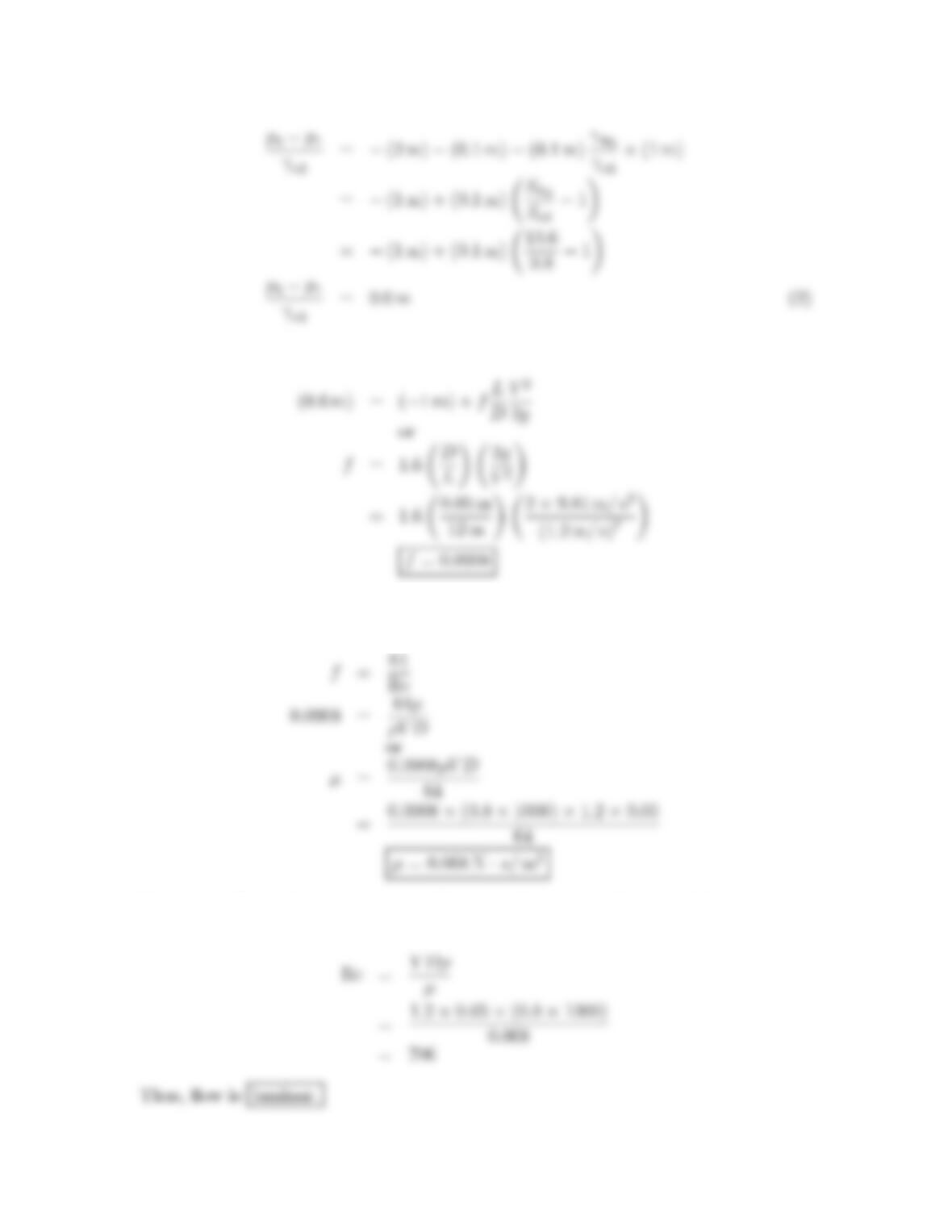
Substituting Eq. (2) into (1) gives
Since the resistance coefficient is now known, this value can be used to find viscosity.
To perform this calculation, assume the flow is laminar.
Now, check Reynolds number to see if laminar flow assumption is valid
39
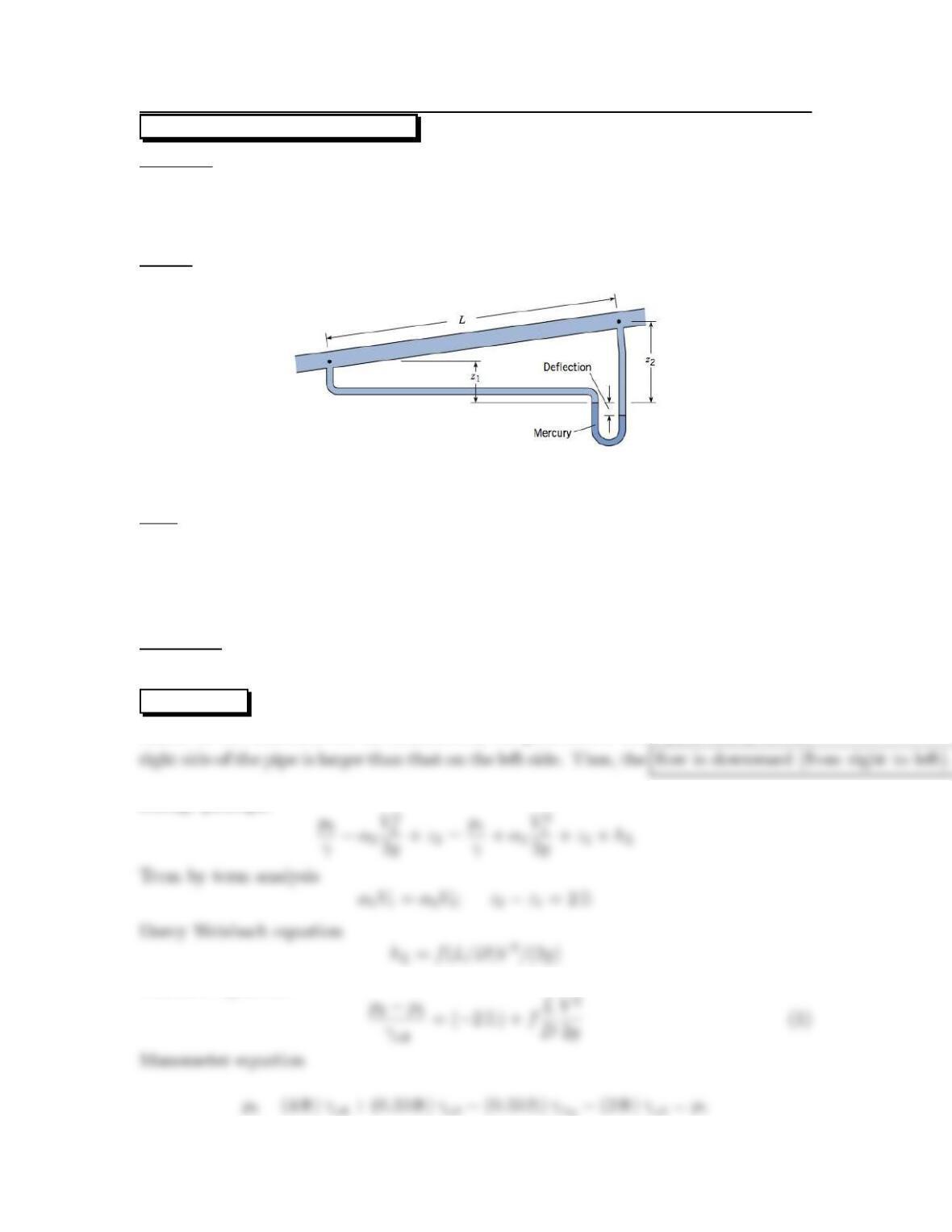
10.28: PROBLEM DEFINITION
Situation:
Oil flows through a smooth pipe.
D=2in,V=5ft/s.
L=30ft,z1=2ft,z2=4ft.
Sketch:
Find:
The direction of the flow.
Resistance coefficient.
Nature of the flow (laminar or turbulent).
Viscosity of oil ¡lbf s/ft2¢.
Properties:
Oil, S=0.8.
SOLUTION
Basedonthedeflection on the manometer, the piezometric head (and HGL) on the
Energy principle
Combine equations
40