P10-1 (continued)
8. Building 1,000
Land and Buildings 1,000
10. Loss Due to Worker’s Injury 3,000
Land and Buildings 3,000
To expense cost to compensate
construction worker.
13. Land and Buildings 700
Land 700
Credit to Land account for salvage
value of demolished building.
10-22
P10-2
Note: This question requires knowledge that corrections of errors in prior years
are recorded to Retained Earnings. This was briefly discussed in Chapter 5.
Machinery 24,000
Building 36,000
Property, Plant, and Equipment 60,000
Machinery 280
Building 420
Property, Plant, and Equipment 700
The legal fees are allocated in the same
proportion as the original purchase.
P10-2 (continued)
Retained Earnings 2,000
Property, Plant, and Equipment 2,000
To correct the 2010 repairs that were
incorrectly recorded in the asset account.
To remove the depreciation of $6,879 incorrectly
credited to Property, Plant, and Equipment in 2010;
to credit the correct depreciation to Accumulated
Depreciation: Building [$1,821 + ($10,000 ÷ 19)]
(this assumes the addition has the same life as the
building); to credit the correct depreciation to
Accumulated Depreciation: Machinery ($24,280 ÷ 8);
P10-2 (continued)
Loss on Disposal of Machinery 100
Property, Plant, and Equipment 500
Accumulated Depreciation: Machinery 200
Machinery 800
$800) ÷ 8]; and to correct the depreciation
expense before the books are closed.
P10-3
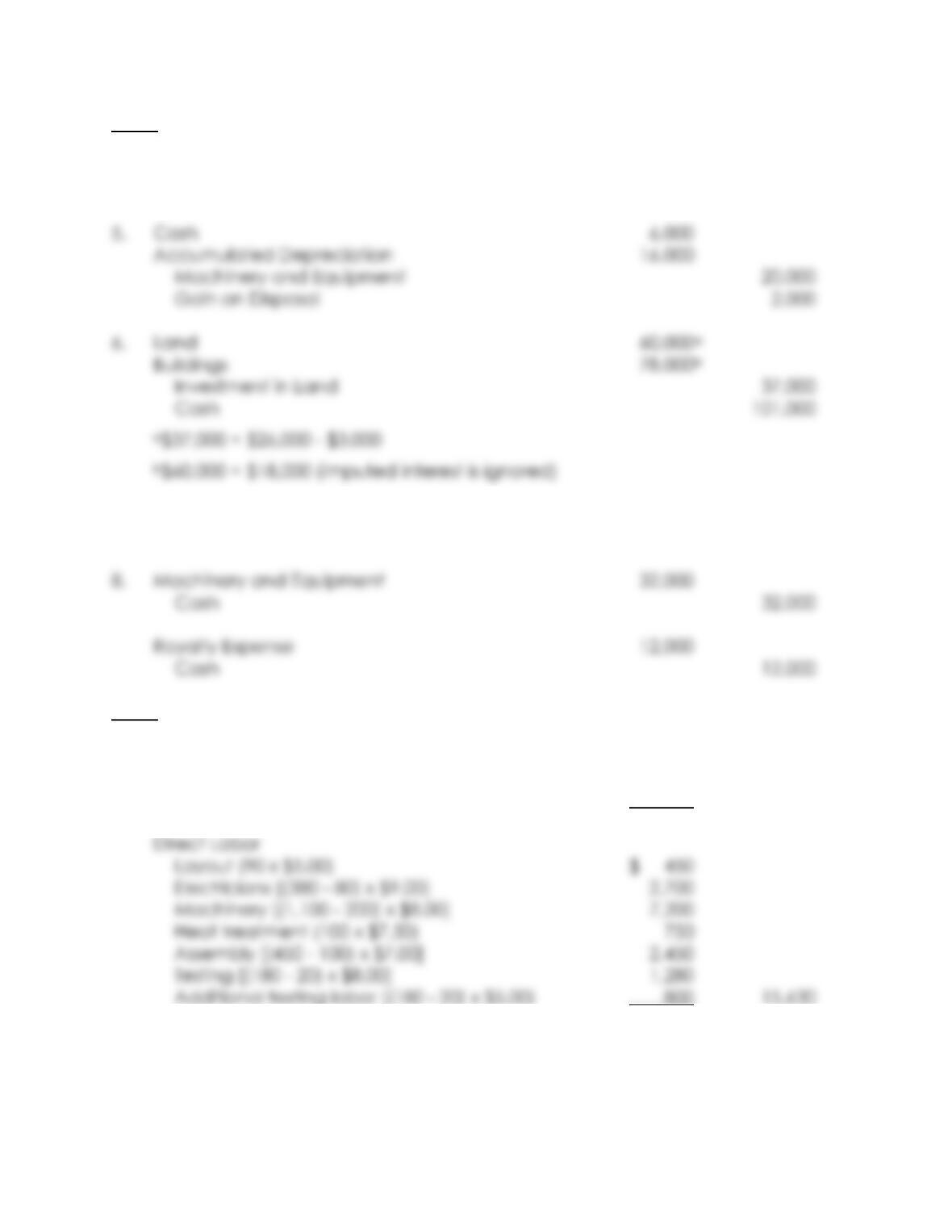
1. Investment in Land 74,000
Cash 74,000
10-25
P10-3 (continued)
4. Land Improvements 30,000
Cash 30,000
7. Leasehold Improvements 20,000
Cash 20,000
P10-4 (CMA adapted solution)
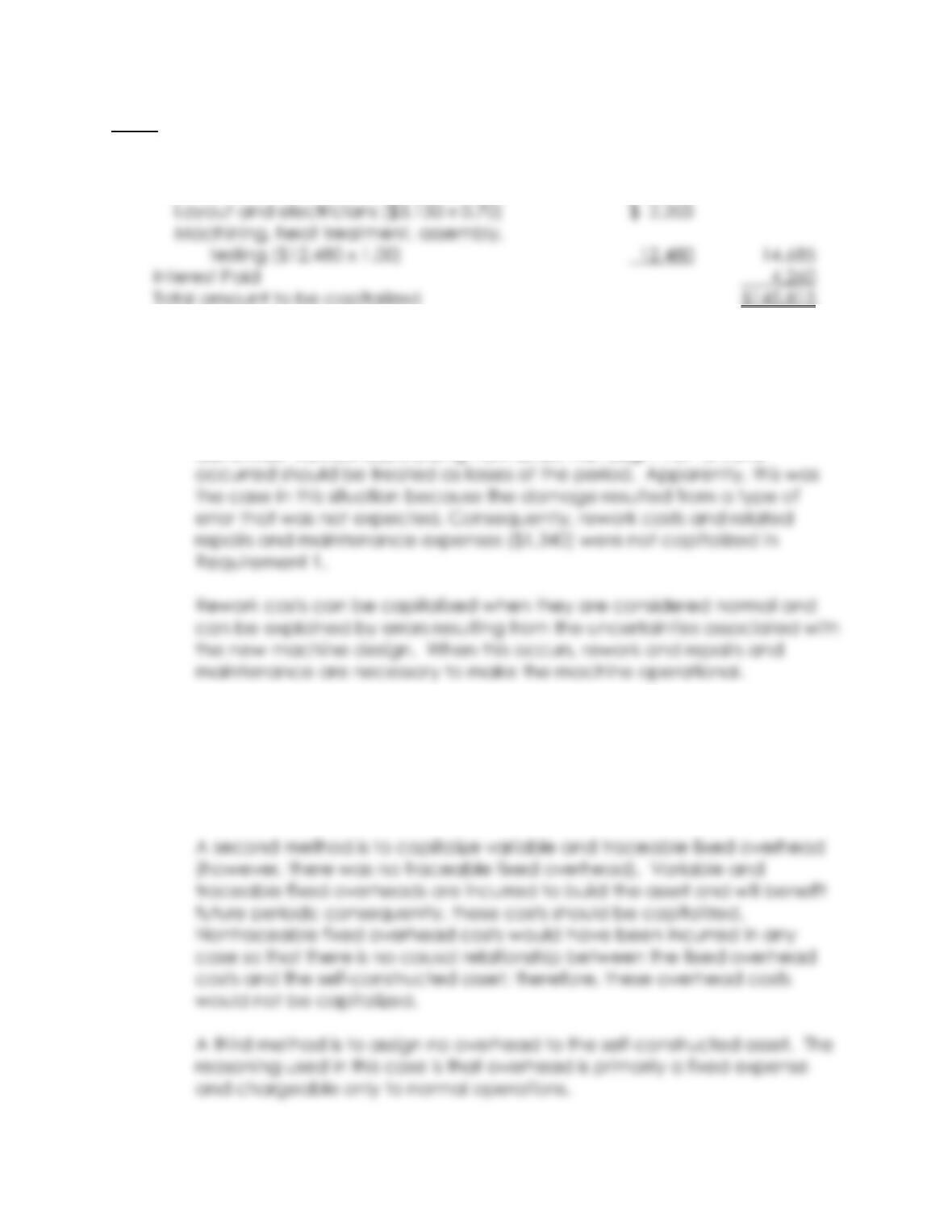
1. Raw Materials
Iron castings $61,040
Other raw materials 50,200 $111,240
10-26
P10-4 (continued)
1. (continued)
Factory Overhead
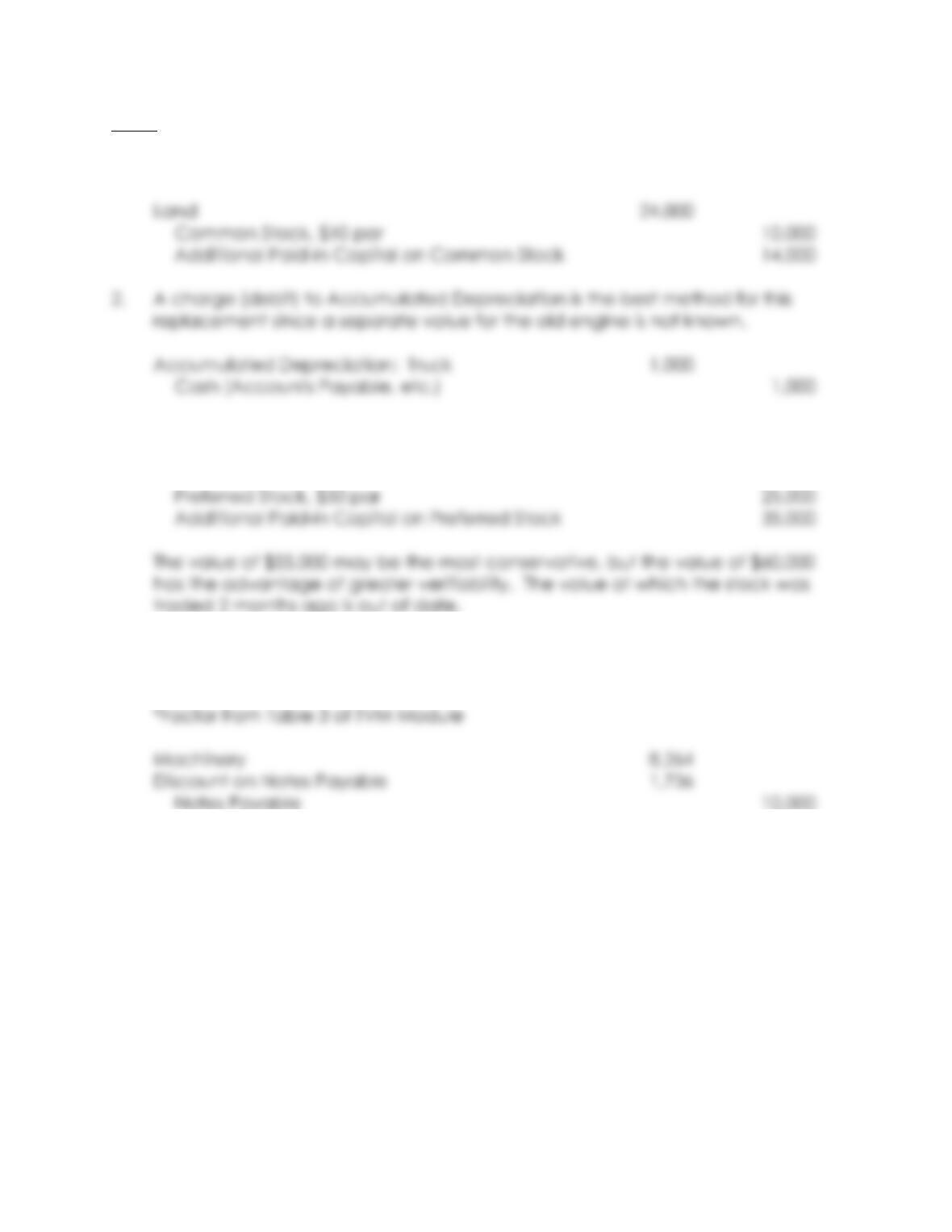
2. Alternate procedures are possible for two costs–rework costs (affects direct
labor, repairs and maintenance, and factory overhead) and factory
overhead.
a. Rework costs should be treated as a cost of the period when they are
abnormal. Rework costs arising from errors that ought not to have
b. There are three alternate ways to allocate overhead costs to self-
constructed assets. The method followed in Requirement 1 was to assign
a full share of all overhead costs to the self-constructed asset. The
reasoning justifying this treatment is that all productive output should
absorb its proportionate share of all factory overhead costs.
10-27
P10-5
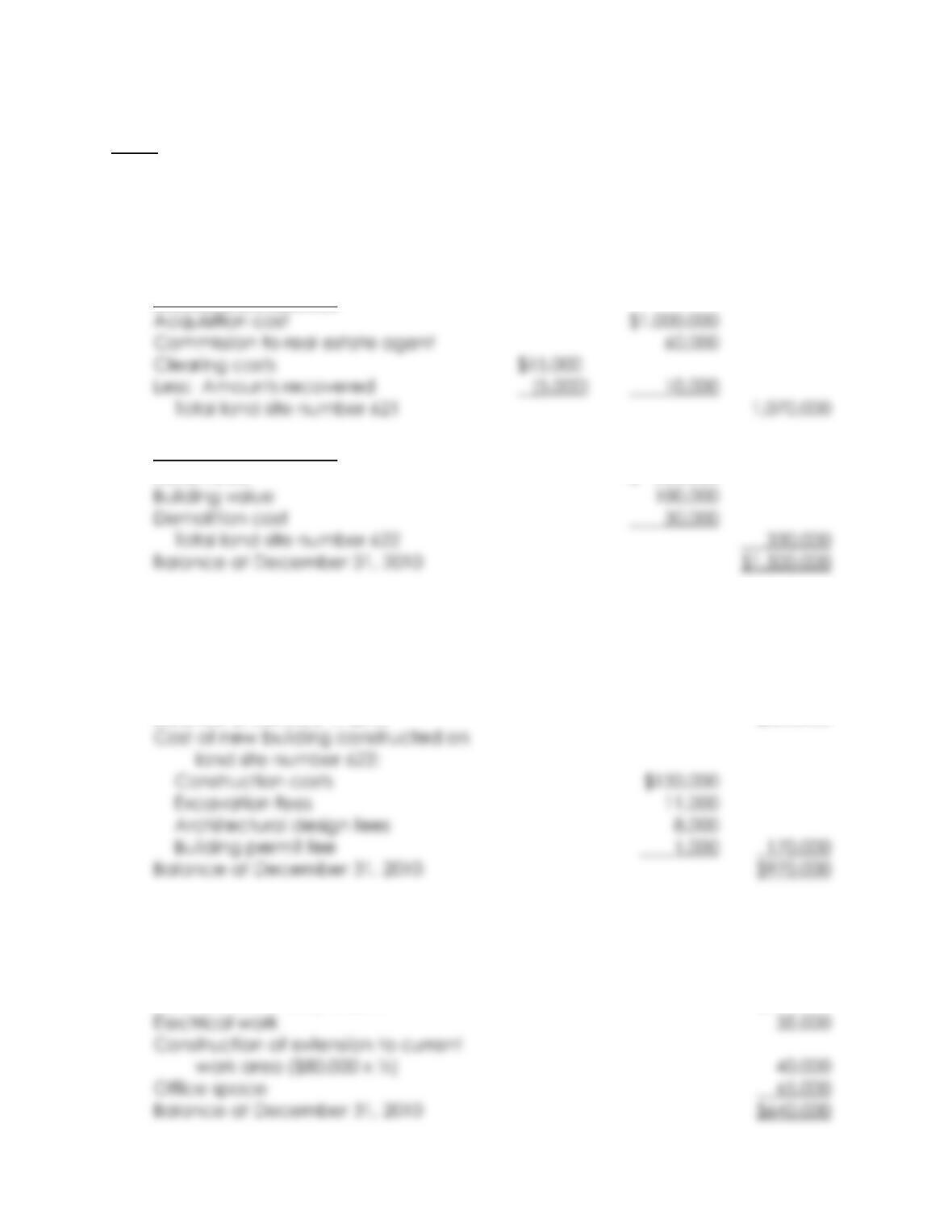
1. Stock exchanged: 1,000 shares at $24/share = $24,000
3. Land is acquired:
Land 60,000
4. The present value of the 2-year noninterest-bearing note, using the 10%
imputed interest rate, is: $10,000 x 0.826446* = $8,264
10-28
P10-6 (AICPA adapted solution)
1. TOWNSAND COMPANY
Analysis of Land Account
for 2010
Balance at January 1, 2010 $ 100,000
Land site number 621:
Land site number 622:
Land value $ 200,000
TOWNSAND COMPANY
Analysis of Buildings Account
for 2010
Balance at January 1, 2010 $800,000
TOWNSAND COMPANY
Analysis of Leasehold Improvements Account
for 2010
Balance at January 1, 2010 $500,000
P10-6 (continued)
1. (continued)
TOWNSAND COMPANY
Analysis of Machinery and Equipment Account
for 2010
Balance at January 1, 2010 $700,000
2. Items in the fact situation which were not used to determine the answer to
Requirement 1 above, and where, or if, these items should be included in
Townsand’s financial statements are as follows:
P10-7
1. Machine (new) 10,000b
Accumulated Depreciation: Machine 28,000
Loss 4,000a
10-30
P10-7 (continued)
2. Building 55,000b
Land 35,000
3. Machine (new) 20,000b
Accumulated Depreciation: Machine 2,000
Machine (old) 13,000
4. Equipment: Car 15,800b
Accumulated Depreciation: Truck 5,000
Cash 1,000
P10-8
1. Machine (new) 34,000b
Accumulated Depreciation: Machine 15,000
Machine (old) 40,000
10-31
P10-8 (continued)
2. Machine (new) 34,000b
Accumulated Depreciation: Machine 7,000
Loss 3,000a
3. Machine (new) 27,000b
Accumulated Depreciation: Machine 25,000
Cash 5,000
4. Machine (new) 27,000b
Accumulated Depreciation: Machine 9,000
Loss 4,000a
5. Machine (new) 90,000b
Accumulated Depreciation: Machine 70,000
10-32
P10-8 (continued)
6. Machine (new) 90,000b
Accumulated Depreciation: Machine 56,000
7. Building 200,000b
Gain 70,000a
8. Building 230,000b
Gain 70,000a
9. Building 180,000b
Cash 20,000
P10-9
Average costs = [(Beginning cumulative costs + Ending cumulative costs) ÷ 2]
1. Average costs, 2010 $1,000,000 [($0 + $2,000,000) ÷ 2]
bSince the project is completed on June 30, 2012, interest for half a
year is capitalized.
2. Total costs = Expenditures + Capitalized interest
P10-9 (continued)
3. The interest capitalization has the following effects on the financial statements:
Income Statement:
Balance Sheet:
December 31, 2010: Asset (construction in process) increased by $120,000.
Retained earnings increased by $120,000.
Statement of Cash Flows:
If the company is producing the asset for its own use, the cash paid for the
10-35
P10-10
Supporting computations: Construction costs, (excluding capitalized interest)
Capitalized interest, 2010 = $3,000,000 x 12% x 9/12a
= $270,000
P10-10 (continued)
aSince activities were suspended for 3 months, interest is only capitalized
for 9 months.
cSince the project is completed on March 31, 2012, interest for three months
is capitalized.
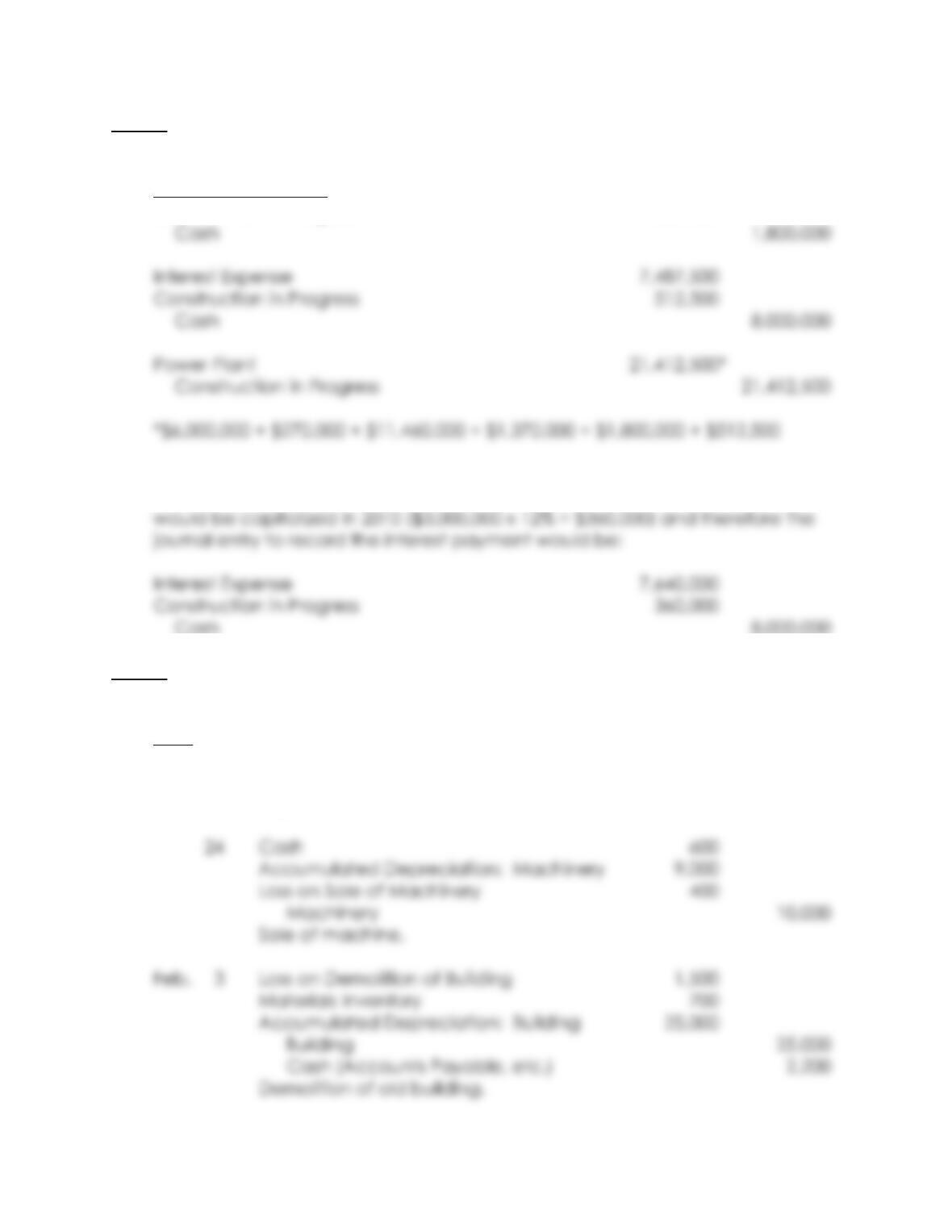
1. Journal entries, 2010:
Construction in Progress 6,000,000
Cash 6,000,000
10-37
P10-10 (continued)
1. (continued)
Journal entries, 2012:
Construction in Progress 1,800,000
2. If the 3 month suspension was due to an environmental dispute, activities
would still be in progress according to GAAP. Therefore interest for a full year
P10-11
1.
2010
Jan. 10 Accumulated Depreciation: Machinery 800
Cash (Accounts Payable, etc.) 800
Replacement of motor.