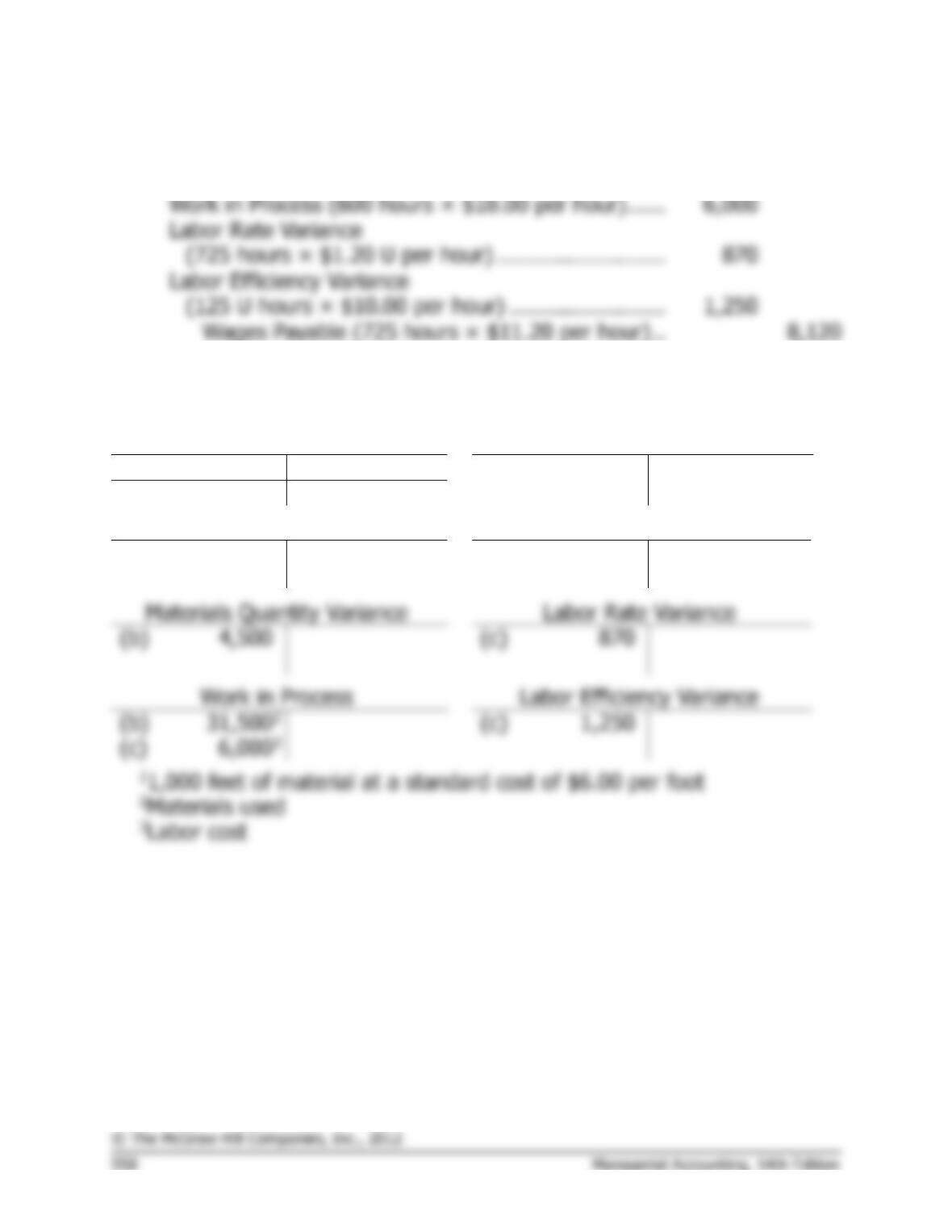
Exercise 10B-2 (continued)
b. The journal entry would be:
Wages Payable (725 hours × $11.20 per hour) ..
3. The entries are: (a) purchase of materials; (b) issue of materials to
production; and (c) incurrence of direct labor cost.
Raw Materials
Accounts Payable
(a)
42,000
(b)
36,000
(a)
40,250
Bal.
6,0001
Materials Price Variance
Wages Payable
(a)
1,750
(c)
8,120
Materials Quantity Variance
(b)
(c)
(c)
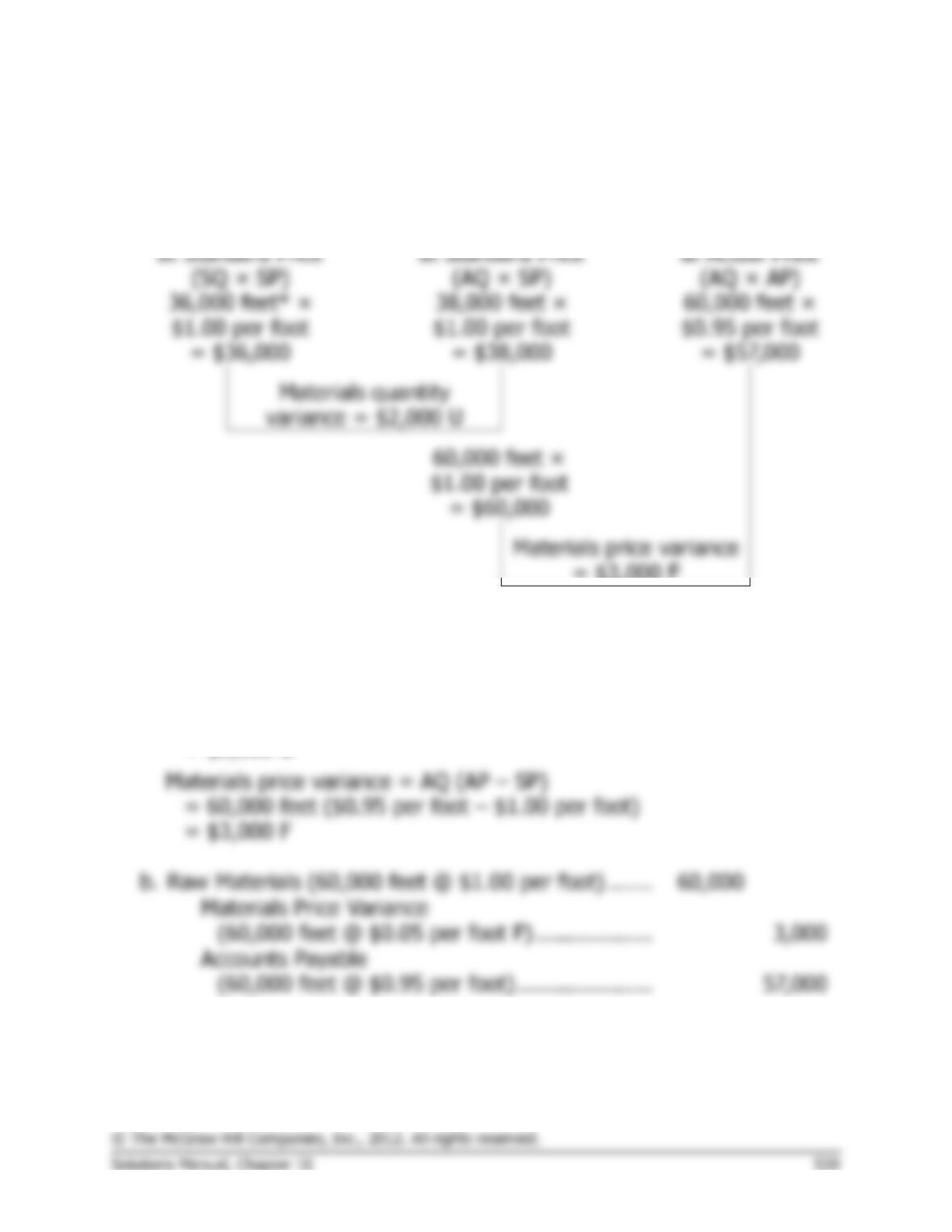
Problem 10B-3 (75 minutes)
1. a.
Standard Quantity Allowed
for Actual Output,
Actual Quantity
of Input,
Actual Quantity
of Input,
= $3,000 F
*6,000 units × 6.0 feet per unit = 36,000 feet
Alternatively, the variances can be computed using the formulas:
Materials quantity variance = SP (AQ – SQ)
= $1.00 per foot (38,000 feet – 36,000 feet)
= $2,000 U
Raw Materials (60,000 feet @ $1.00 per foot) …….
60,000
Work in Process (36,000 feet @ $1.00 per foot) ….
36,000
Materials Quantity Variance
(2,000 feet U @ $1.00 per foot) ……………………
2,000
Raw Materials (38,000 feet @ $1.00 per foot) ..
38,000
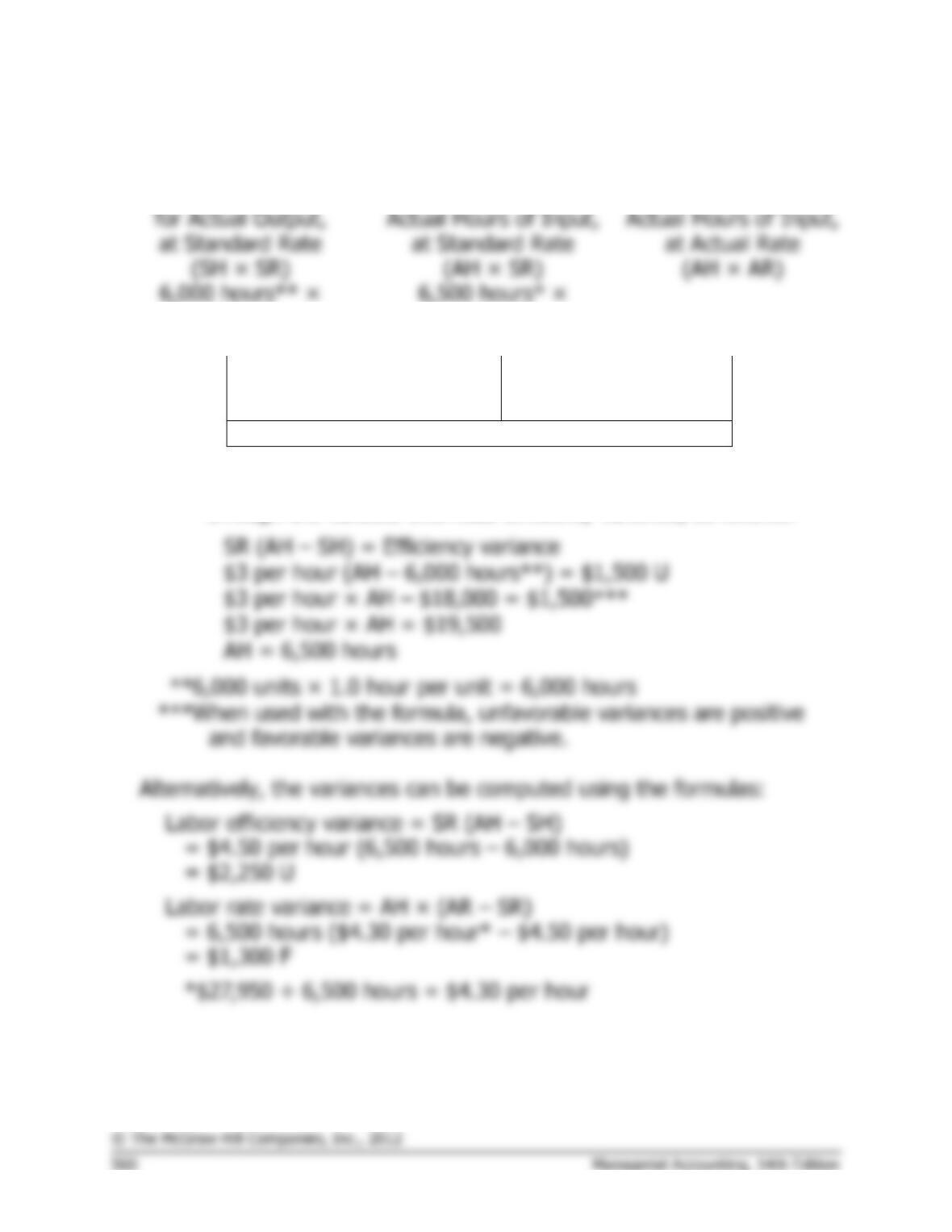
Problem 10B-3 (continued)
2. a.
Standard Hours Allowed
$4.50 per hour
= $27,000
$4.50 per hour
= $29,250
$27,950
Labor efficiency variance
= $2,250 U
Labor rate variance
= $1,300 F
Spending variance = $950 U
*
The actual hours worked during the period can be computed
through the variable overhead efficiency variance, as follows:
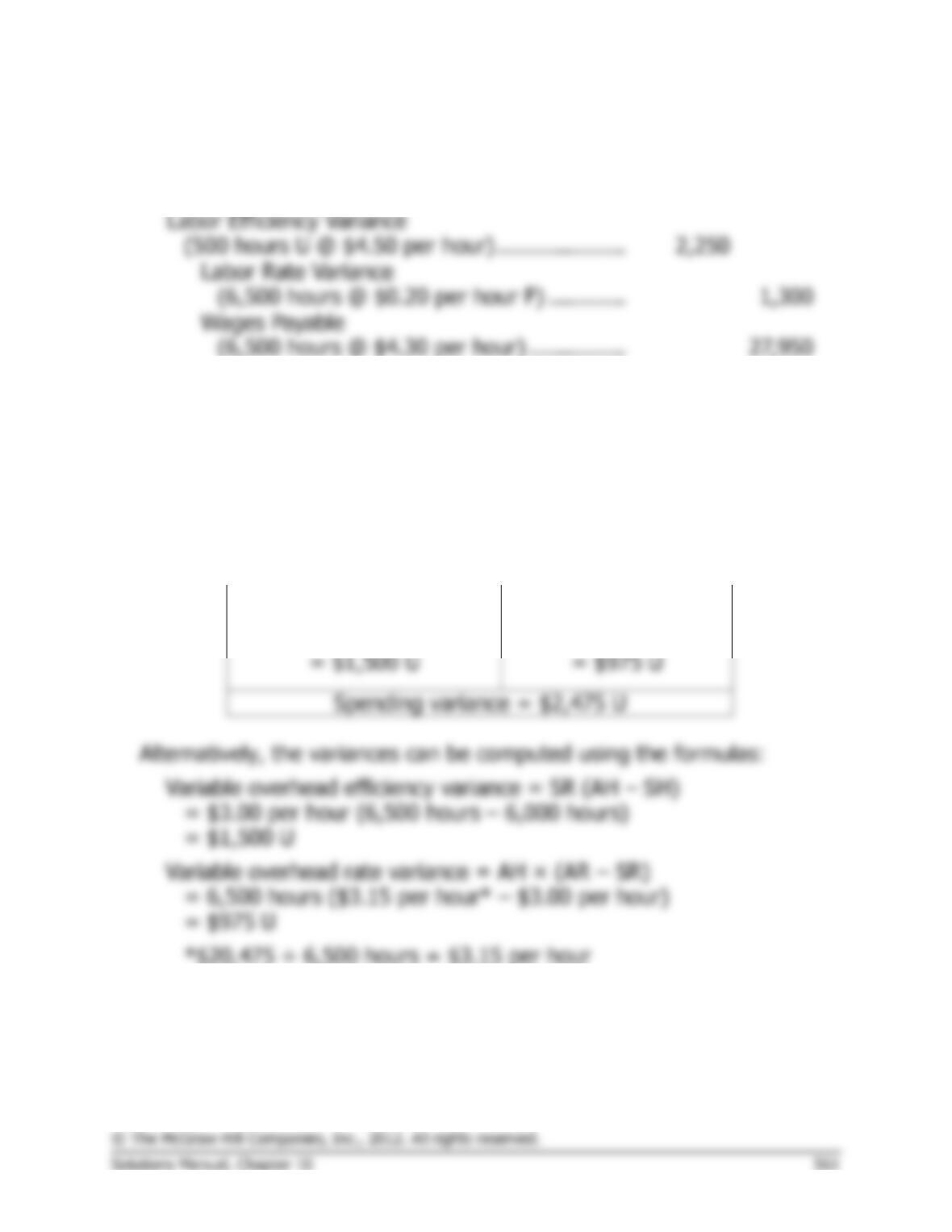
Problem 10B-3 (continued)
b.
Work in Process
(6,000 hours @ $4.50 per hour) ………………..
27,000
3. a.
Standard Hours Allowed
for Actual Output,
at Standard Rate
(SH × SR)
Actual Hours of Input,
at Standard Rate
(AH × SR)
Actual Hours of Input,
at Actual Rate
(AH × AR)
6,000 hours ×
$3.00 per hour
= $18,000
6,500 hours ×
$3.00 per hour
= $19,500
$20,475
Variable overhead
efficiency variance
Variable overhead
rate variance
Problem 10B-3 (continued)
b. No. When variable manufacturing overhead is applied on the basis of
direct labor-hours, it is impossible to have an unfavorable variable
4.
For materials:
Favorable price variance: Decrease in outside purchase prices, fortunate
buy, inferior quality materials, unusual discounts due to quantity
purchased, inaccurate standards.
Unfavorable quantity variance: Inferior quality materials, carelessness,
poorly adjusted machines, unskilled workers, inaccurate standards.
Problem 10B-4 (60 minutes)
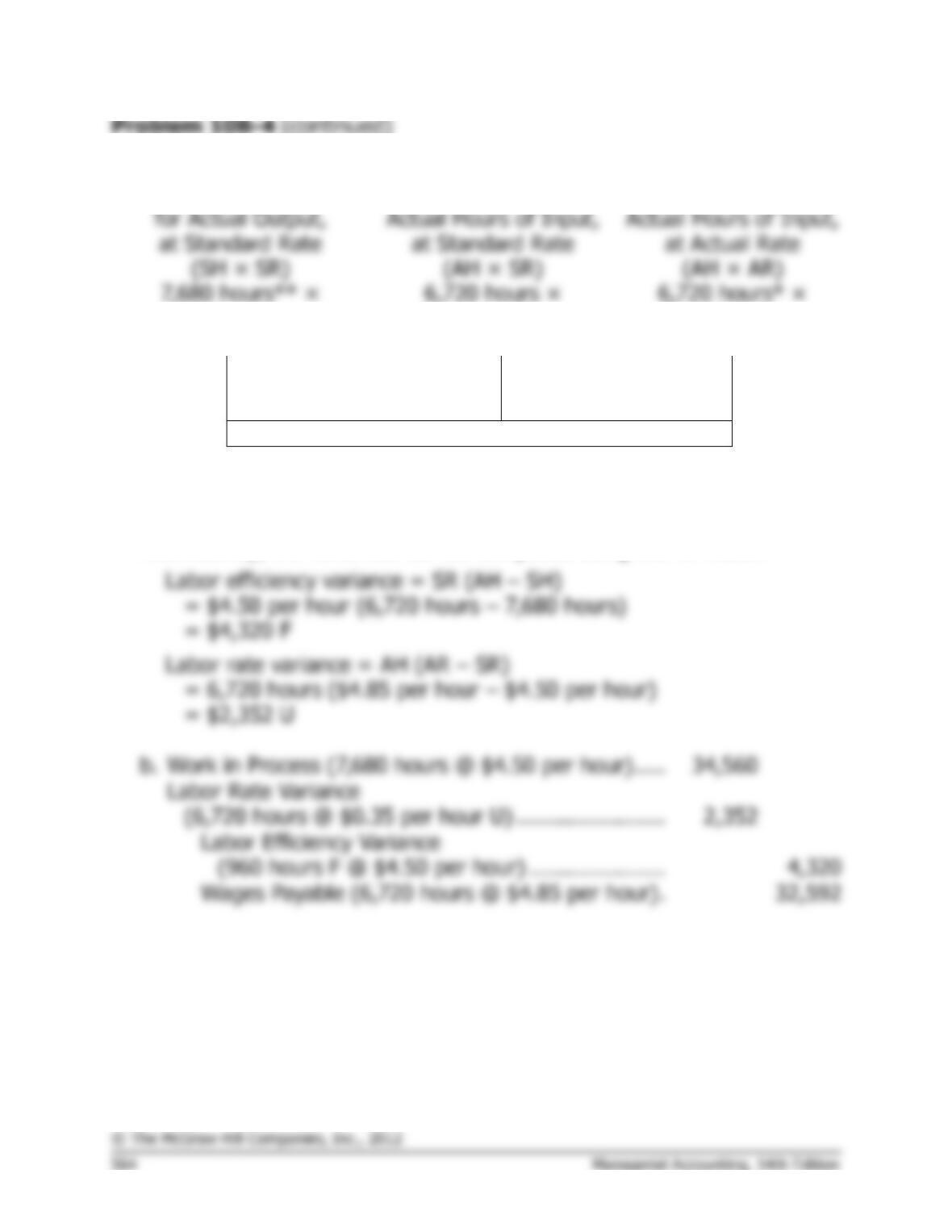
1. a.
Standard Quantity Allowed
Actual Quantity of
Actual Quantity of
$3.60 per yard
= $69,120
$3.60 per yard
= $76,032
$3.35 per yard
= $70,752
Materials quantity
variance = $6,912 U
Materials price
variance = $5,280 F
Spending variance = $1,632 U
*4,800 units × 4.0 yards per unit = 19,200 yards
Alternatively, the variances can be computed using the formulas:
Materials quantity variance = SP (AQ – SQ)
= $3.60 per yard (21,120 yards – 19,200 yards)
= $6,912 U
Materials price variance = AQ (AP – SP)
= 21,120 yards ($3.35 per yard – $3.60 per yard)
= $5,280 F
2. a.
Standard Hours Allowed
$4.50 per hour
= $34,560
$4.50 per hour
= $30,240
$4.85 per hour
= $32,592
Labor efficiency variance
= $4,320 F
Labor rate variance
= $2,352 U
Spending variance = $1,968 F
*
4,800 units × 1.4 hours per unit = 6,720 hours
**
4,800 units × 1.6 hours per unit = 7,680 hours
Alternatively, the variances can be computed using the formulas:
Work in Process (7,680 hours @ $4.50 per hour) …..
Problem 10B-4 (continued)
3.
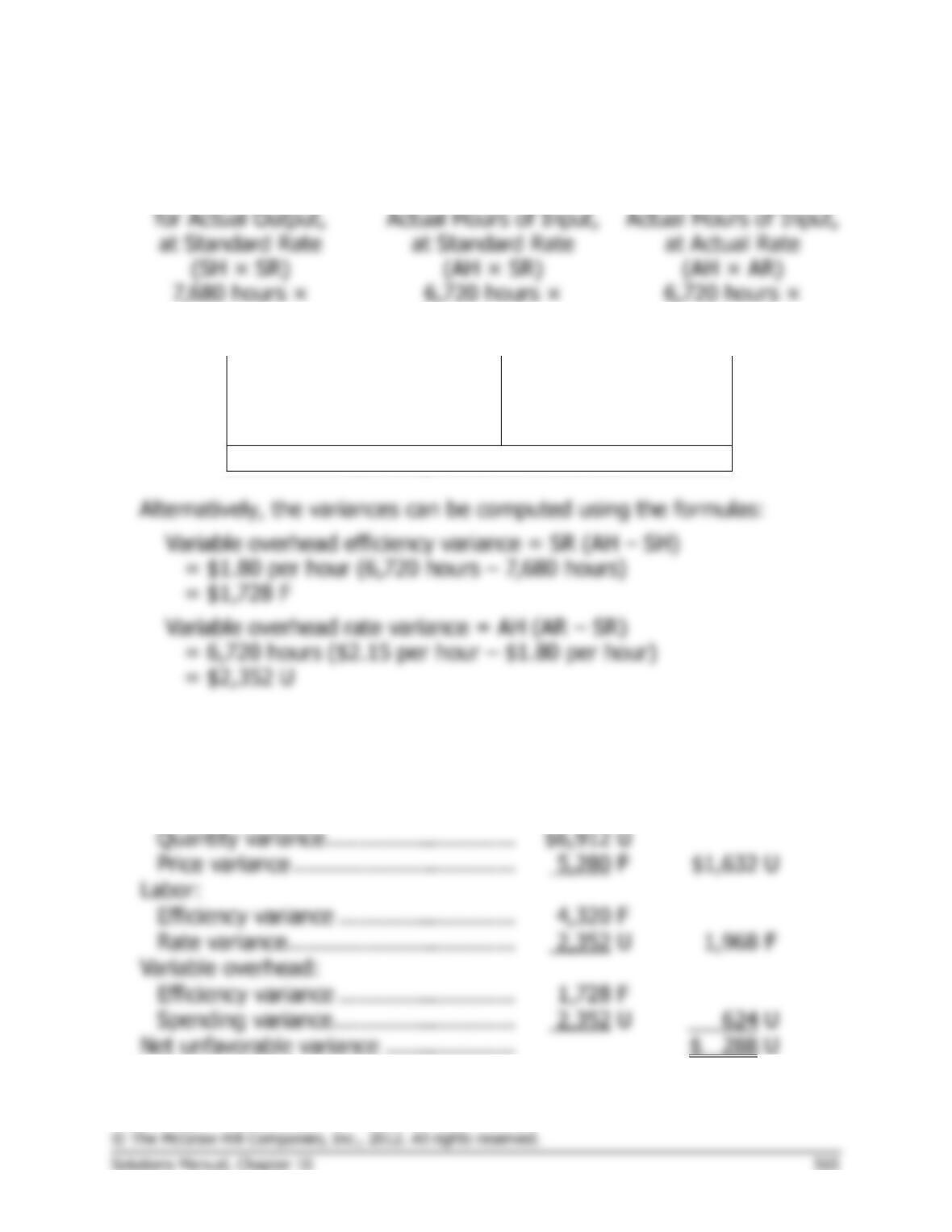
Standard Hours Allowed
$1.80 per hour
= $13,824
$1.80 per hour
= $12,096
$2.15 per hour
= $14,448
Variable overhead
efficiency variance
= $1,728 F
Variable overhead
rate variance
= $2,352 U
Spending variance = $624 U
4. No. This total variance is made up of several quite large individual
variances, some of which may warrant investigation. A summary of
variances is given below:
Materials:
U
F
Variable overhead:
Problem 10B-4 (continued)
5. The variances have many possible causes. Some of the more likely
causes include:
Materials variances:
Favorable price variance: Good price, inaccurate standards, inferior
Case 10B-5 (30 minutes)
This case may be difficult for some students to grasp because it requires
1. Lansing has evidently set very loose standards in which the standard
prices and standard quantities are far too high. This guarantees that
favorable variances will ordinarily result from operations. If the standard
2. Lansing should not be permitted to continue this practice for several
reasons. First, it distorts the quarterly earnings for both the division and
the company. The distortions of the division’s quarterly earnings are
troubling because the manipulations may mask real signs of trouble. The
Case 10B-5 (continued)
3. Stacy Cummins does not have any easy alternatives available. She has
already taken the problem to the President, who was not interested. If
she goes around the President to the Board of Directors, she will be
putting herself in a politically difficult position with little likelihood that it
will do much good if, in fact, the Board of Directors already knows what
is going on.