Problem 10-10 (continued)
Note that all of the price variance is due to the hospital’s 4% quantity
2. a. The standard hours allowed for tests performed during the month
would be:
Smears: 0.3 hour per test × 2,700 tests …..
810
Blood tests: 0.6 hour per test × 900 tests …
540
Total standard hours allowed ………………….
1,350
Problem 10-10 (continued)
2. b. The policy probably should not be continued. Although the hospital is
saving $1.75 per hour by employing more assistants relative to the
3. The variable overhead variances follow:
Standard Hours Allowed
for Actual Output,
at Standard Rate
(SH × SR)
Actual Hours of Input,
at Standard Rate
(AH × SR)
Actual Hours of Input,
at Actual Rate
(AH × AR)
1,350 hours ×
$6.00 per hour
= $8,100
1,800 hours ×
$6.00 per hour
= $10,800
$11,700
Variable overhead
efficiency variance
Variable overhead
rate variance
Problem 10-11 (45 minutes)
1. a. In the solution below, the materials price variance is computed on the
entire amount of materials purchased, whereas the materials quantity
variance is computed only on the amount of materials used in
production:
Standard Quantity Allowed
for Actual Output,
at Standard Price
(SQ × SP)
Actual Quantity
of Input,
at Standard Price
(AQ × SP)
Actual Quantity
of Input,
at Actual Price
(AQ × AP)
4,500 pounds* ×
$6.00 per pound
= $27,000
6,000 pounds ×
$6.00 per pound
= $36,000
$46,000
$6.00 per pound
= $48,000
Materials price variance
= $2,000 F
Problem 10-11 (continued)
2. a.
Standard Hours Allowed
for Actual Output,
at Standard Rate
(SH × SR)
Actual Hours of Input,
at Standard Rate
(AH × SR)
Actual Hours of Input,
at Actual Rate
(AH × AR)
1,800 hours* ×
$12.00 per hour
= $21,600
1,600 hours** ×
$12.00 per hour
= $19,200
1,600 hours** ×
$12.50 per hour
= $20,000
Labor efficiency variance
= $2,400 F
Labor rate variance
= $800 U
Spending variance = $1,600 F
*
3,000 units × 0.6 hours per unit
= 1,800 hours
**
10 workers × 160 hours per worker
= 1,600 hours
= $800 U
b. Yes, the new labor mix should probably be continued. Although it
increases the average hourly labor cost from $12.00 to $12.50,
resulting in an $800 unfavorable labor rate variance, this is more than
reduces overall labor costs.
Problem 10-11 (continued)
3.
Standard Hours Allowed
$2.50 per hour
= $4,500
$2.50 per hour
= $4,000
$3,600
Variable overhead
efficiency variance
= $500 F
Variable overhead
rate variance
= $400 F
Spending variance = $900 F
Alternatively, the variances can be computed using the formulas:
Variable overhead efficiency variance = SR (AH – SH)
= $2.50 per hour (1,600 hours – 1,800 hours)
= $500 F
Problem 10-12 (45 minutes)
1. a.
Standard Quantity Allowed
Actual Quantity of
Actual Quantity of
$3.00 per foot
= $64,800
$3.00 per foot
= $63,000
$3.20 per foot
= $67,200
Materials quantity
variance = $1,800 F
Materials price
variance = $4,200 U
Spending variance = $2,400 U
*
12,000 units × 1.80 feet per unit = 21,600 feet
**
12,000 units × 1.75 feet per unit = 21,000 feet
Problem 10-12 (continued)
1. b.
Standard Hours Allowed
$18.00 per hour
= $194,400
$18.00 per hour
= $205,200
$17.40 per hour
= $198,360
Labor efficiency variance
= $10,800 U
Labor rate variance
= $6,840 F
Spending variance = $3,960 U
*
12,000 units × 0.90 hours per unit = 10,800 hours
**
12,000 units × 0.95 hours per unit = 11,400 hours
Problem 10-12 (continued)
1. c.
Standard Hours Allowed
$5.00 per hour
= $54,000
$5.00 per hour
= $57,000
$4.60 per hour
= $52,440
Variable overhead
efficiency variance
= $3,000 U
Variable overhead
rate variance
= $4,560 F
Spending variance = $1,560 F
*
12,000 units × 0.90 hours per unit = 10,800 hours
**
12,000 units × 0.95 hours per unit = 11,400 hours
2.
Materials:
Quantity variance ($1,800 ÷ 12,000 units) ……
$0.15 F
Price variance ($4,200 ÷ 12,000 units) ………..
0.35 U
$0.20 U
Labor:
Efficiency variance ($10,800 ÷ 12,000 units) ..
Variable overhead:
Efficiency variance ($3,000 ÷ 12,000 units) ….
Problem 10-12 (continued)
3. Both the labor efficiency and variable overhead efficiency variances are
affected by inefficient use of labor time.
Excess of actual over standard cost per unit …….
$0.40 U
Variable overhead efficiency variance ……………..
by $0.75 rather than unfavorable by $0.40.
4. Although the excess of actual cost over standard cost is only $0.40 per
unit, the total amount of $4,800 (= $0.40 per unit × 12,000 units) is
substantial. Moreover, the details of the variances are significant. The
Problem 10-13 (45 minutes)
1. a. Materials price variance = AQ (AP – SP)
6,000 pounds ($2.75 per pound* – SP) = $1,500 F**
$16,500 – 6,000 pounds × SP = $1,500***
6,000 pounds × SP = $18,000
SP = $3.00 per pound
b. Materials quantity variance = SP (AQ – SQ)
$3.00 per pound (6,000 pounds – SQ) = $1,200 U
$18,000 – $3.00 per pound × SQ = $1,200*
$3.00 per pound × SQ = $16,800
SQ = 5,600 pounds
*
When used with the formula, unfavorable variances are
positive and favorable variances are negative.
Problem 10-13 (continued)
2. a. Labor efficiency variance = SR (AH – SH)
$9.00 per hour (AH – 3,500 hours*) = $4,500 F
$9.00 per hour × AH – $31,500 = –$4,500**
$9.00 per hour × AH = $27,000
AH = 3,000 hours
b. Labor rate variance = AH (AR – SR)
3,000 hours ($9.50 per hour* – $9.00 per hour) = $1,500 U
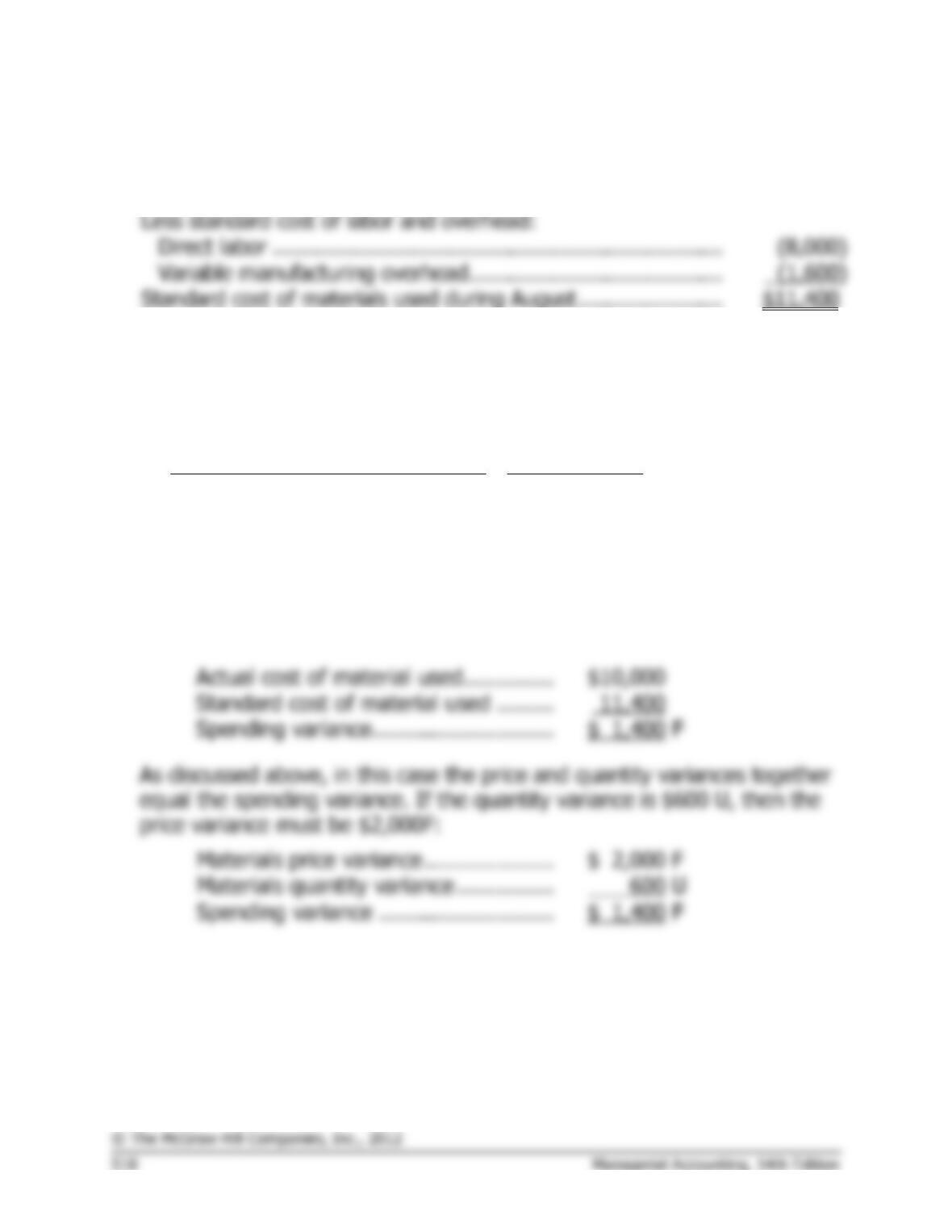
Alternative approach to parts (a) and (b):
Standard Hours Allowed
for Actual Output,
Actual Hours of Input,
Actual Hours of Input,
Problem 10-14 (60 minutes)
1.
Total standard cost for units produced during August:
500 kits × $42 per kit ………………………………………………..
$21,000
Less standard cost of labor and overhead:
Standard cost of materials used during August …………………..
$11,400
2.
Standard cost of materials used during August (a) ……………..
$11,400
Number of units produced (b) ………………………………………..
500
Standard materials cost per kit (a) ÷ (b) …………………………..
$22.80
Standard materials cost per kit $22.80 per kit
= =3.8 yards per kit
Standard materials cost per yard $6 per yard
3. Since there were no beginning or ending inventories of materials, all of
the materials that were purchased during the period were used in
production. Therefore, the sum of the price and quantity variances
equals the spending variance, which is the difference between the actual
cost and standard cost of materials used in production.
Actual cost of material used …………..
Standard cost of material used ………
Spending variance ……………………….
F
Materials price variance ………………..
F
Materials quantity variance ……………
U
Spending variance ………………………
F
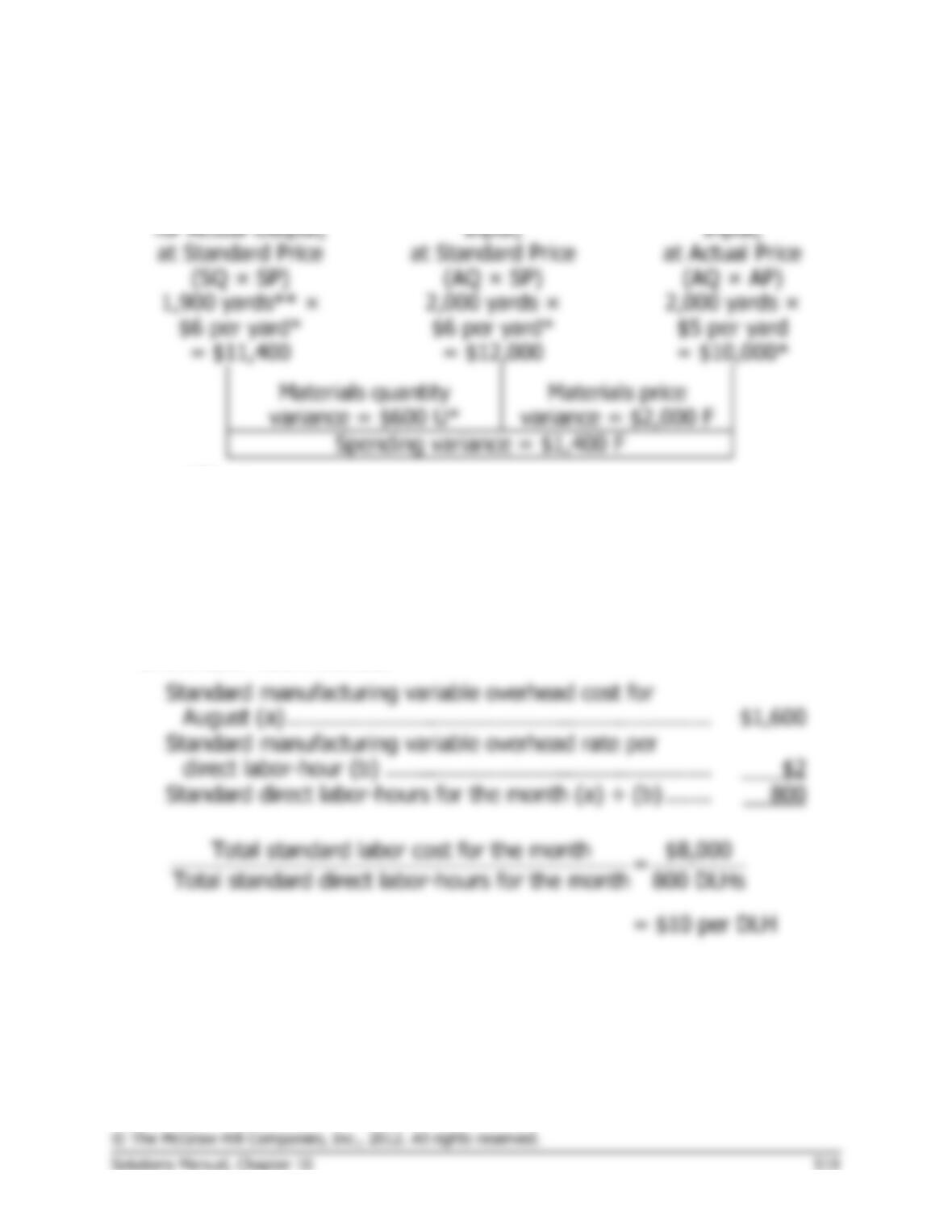
Problem 10-14 (continued)
Alternatively, the variances can be computed using the formulas:
Standard Quantity Allowed
Actual Quantity of
Actual Quantity of
*
Given.
**
500 kits × 3.8 yards per kit = 1,900 yards
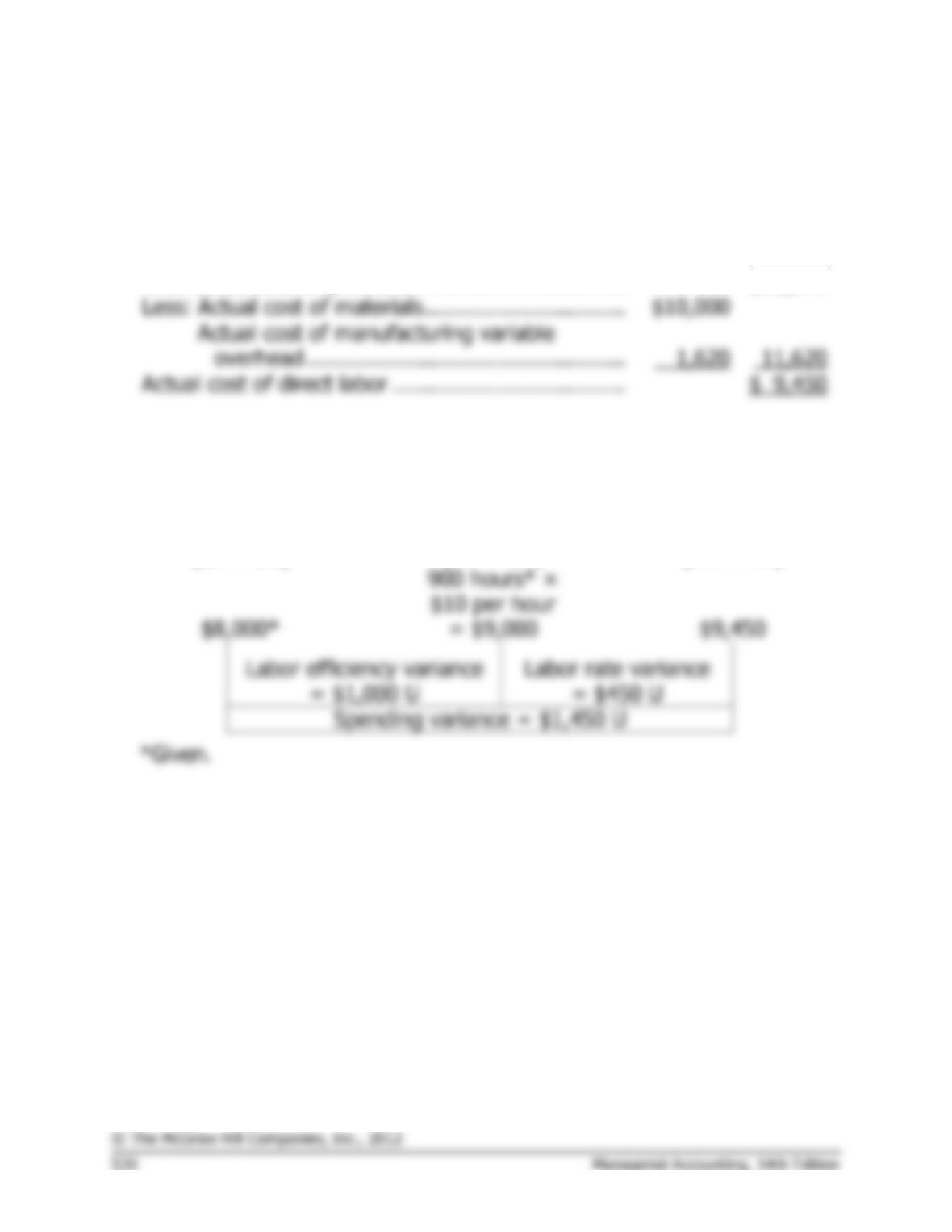
4. The first step in computing the standard direct labor rate is to determine
the standard direct labor-hours allowed for the month’s production. The
standard direct labor-hours can be computed by working with the
variable manufacturing overhead cost figures because they are based on
direct labor-hours worked:
Standard direct labor-hours for the month (a) ÷ (b) …….
Problem 10-14 (continued)
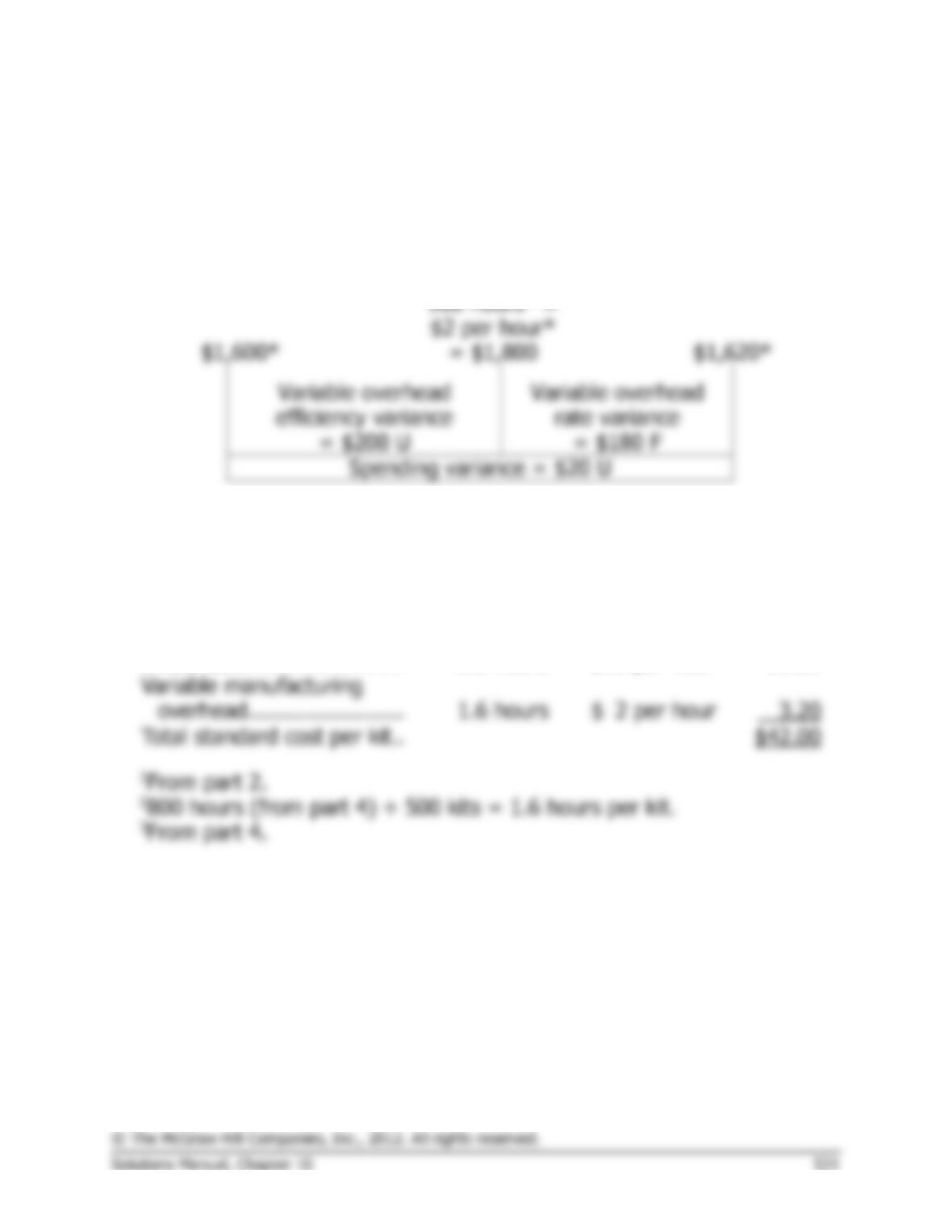
5. Before the labor variances can be computed, the actual direct labor cost
for the month must be computed:
Actual cost per kit produced ($42.00 + $0.14) ……
$ 42.14
Number of kits produced ……………………………….
× 500
Total actual cost of production ………………………..
$21,070
Less: Actual cost of materials ………………………….
Actual cost of direct labor …………………………..….
$ 9,450
With this information, the variances can be computed:
Standard Hours Allowed
for Actual Output,
at Standard Rate
(SH × SR)
Actual Hours of Input,
at Standard Rate
(AH × SR)
Actual Hours of Input,
at Actual Rate
(AH × AR)
$9,450
Problem 10-14 (continued)
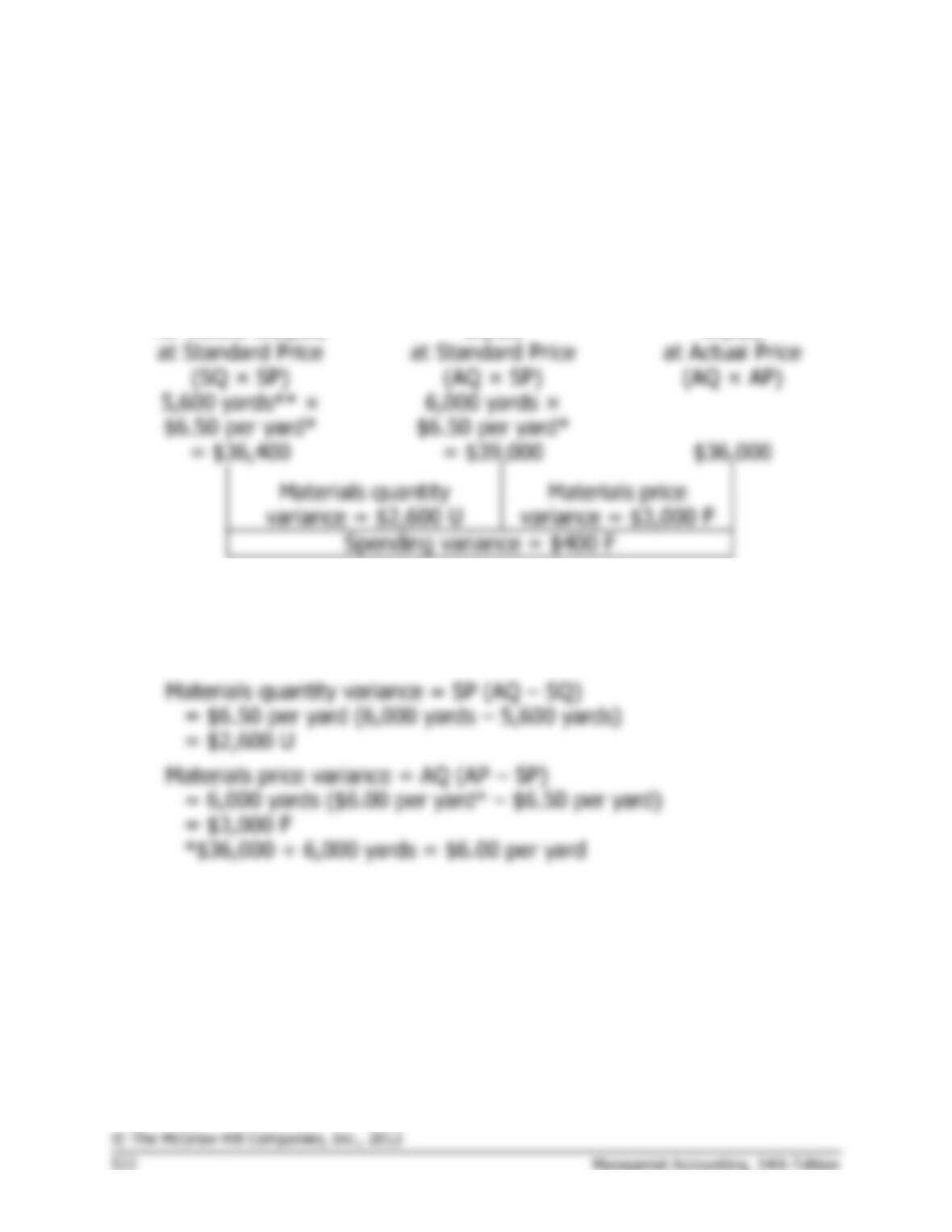
6.
Standard Hours Allowed
for Actual Output,
at Standard Rate
(SH × SR)
Actual Hours of Input,
at Standard Rate
(AH × SR)
Actual Hours of Input,
at Actual Rate
(AH × AR)
*Given.
7.
Standard
Quantity or
Hours per Kit
Standard Price
or Rate
Standard
Cost per
Kit
Direct materials ……………..
3.8 yards1
$ 6 per yard
$22.80
Direct labor …………………..
1.6 hours2
$10 per hour3
16.00
Total standard cost per kit..
$42.00
Problem 10-15 (45 minutes)
This is a very difficult problem that is harder than it looks. Be sure your
students have been thoroughly “checked out” in the variance formulas
before assigning it.
1.
Standard Quantity Allowed
for Actual Output,
Actual Quantity of
Input,
Actual Quantity of
Input,
*
$18.20 ÷ 2.8 yards = $6.50 per yard.
**
2,000 units × 2.8 yards per unit = 5,600 yards
Alternatively, the variances can be computed using the formulas:
Problem 10-15 (continued)
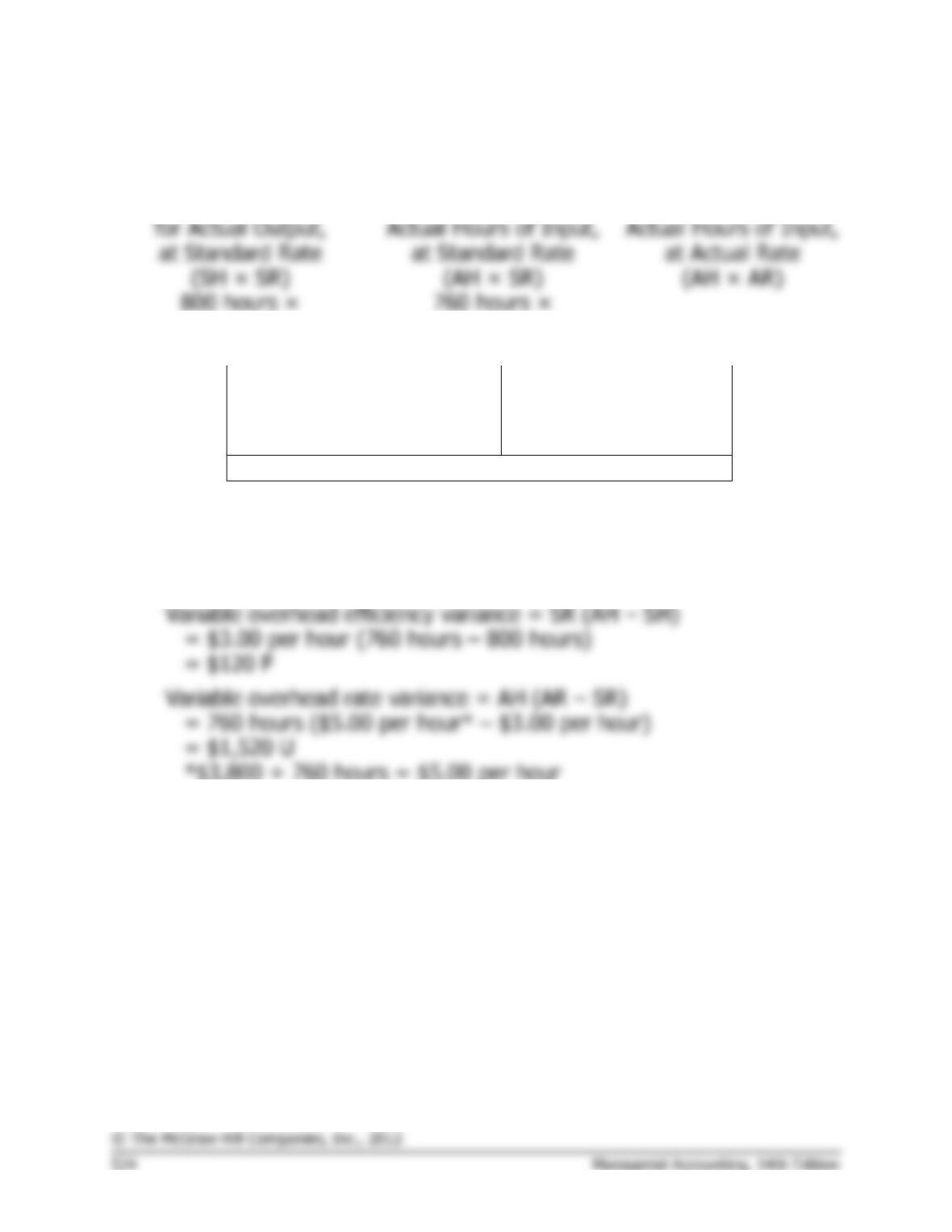
2. Many students will miss parts 2 and 3 because they will try to use
product
costs as if they were
hourly
costs. Pay particular attention to the
computation of the standard direct labor time per unit and the standard
direct labor rate per hour.
780 standard hours ÷ 1,950 robes = 0.4 standard hour per robe
$3.60 standard cost per robe ÷ 0.4 standard hours = $9 standard
rate per hour
**
2,000 robes × 0.4 standard hour per robe = 800 standard hours
Alternatively, the variances can be computed using the formulas:
Problem 10-15 (continued)
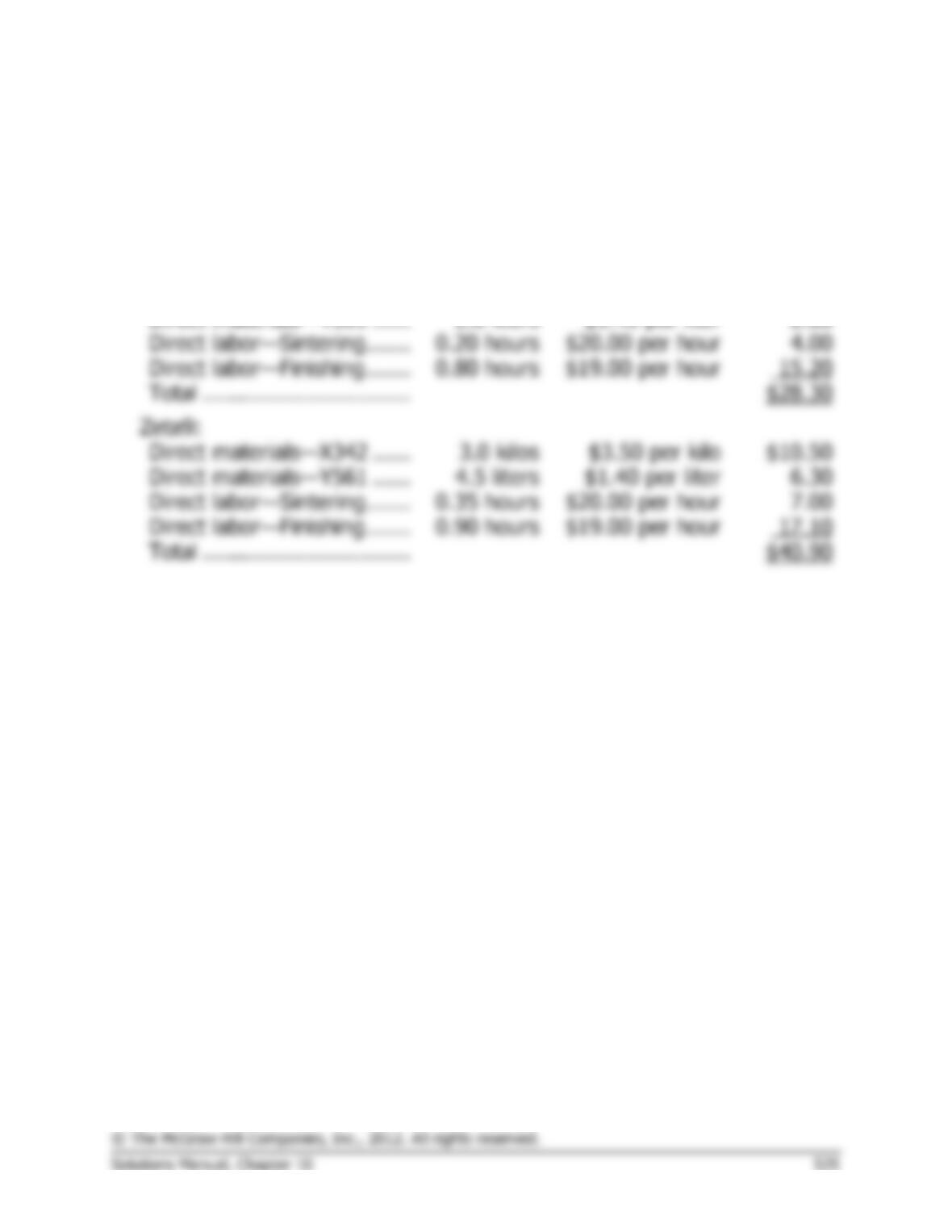
3.
Standard Hours Allowed
$3.00 per hour*
= $2,400
$3.00 per hour*
= $2,280
$3,800
Variable overhead
efficiency variance
= $120 F
Variable overhead
rate variance
= $1,520 U
Spending variance = $1,400 U
*
$1.20 standard cost per robe ÷ 0.4 standard hours = $3.00
standard rate per hour
Alternatively, the variances can be computed using the formulas:
Problem 10-16 (45 minutes)
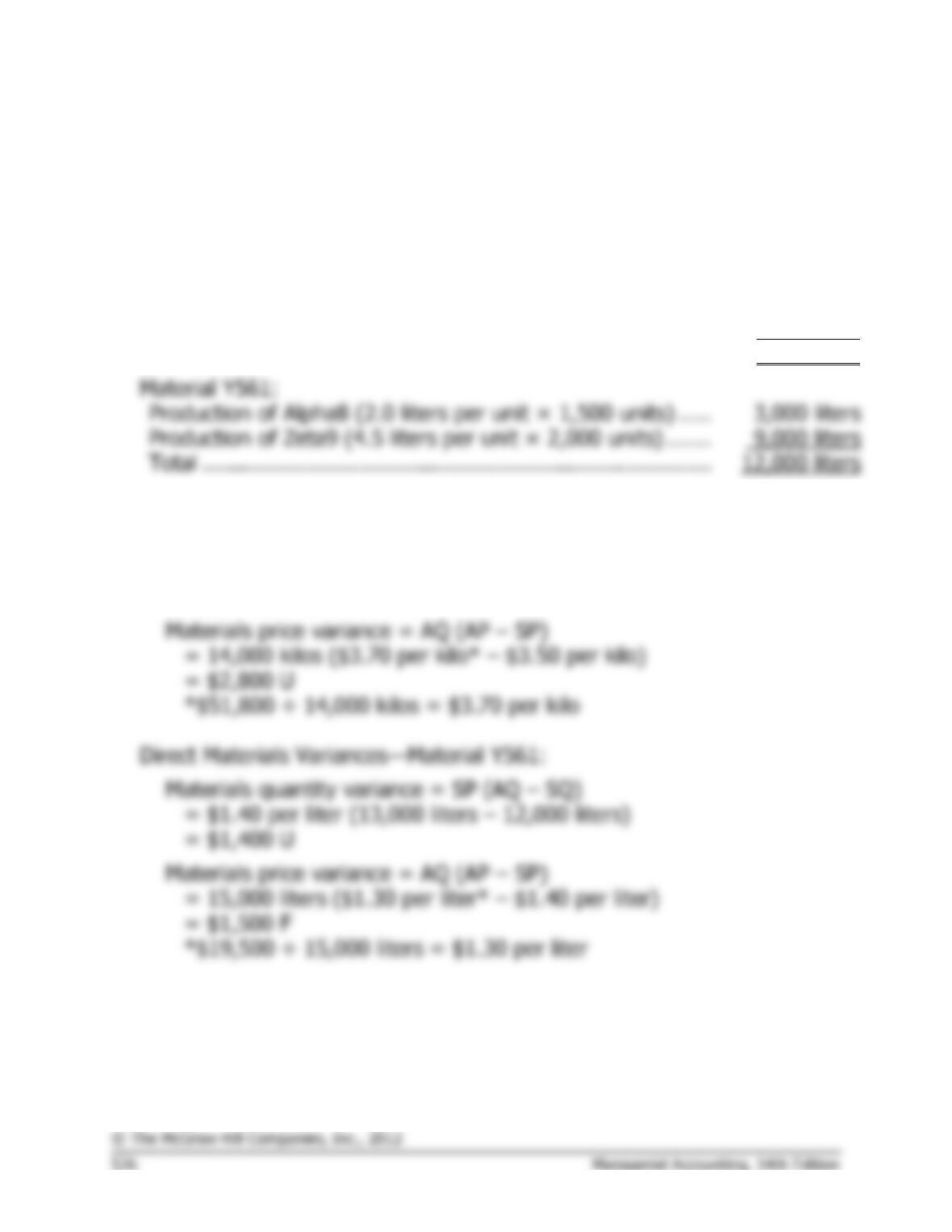
1.
Standard
Quantity or
Hours
Standard Price
or Rate
Standard
Cost
Alpha8:
Direct materials—X342 ……
1.8 kilos
$3.50 per kilo
$ 6.30
Direct labor—Finishing …….
15.20
Zeta9:
Direct materials—X342 ……
3.0 kilos
$3.50 per kilo
$10.50
Direct labor—Finishing …….
17.10
Problem 10-16 (continued)
2. The computations to follow will require the standard quantities allowed
for the actual output for each material.
Standard Quantity Allowed
Material X342:
Production of Alpha8 (1.8 kilos per unit × 1,500 units) ……
2,700 kilos
Production of Zeta9 (3.0 kilos per unit × 2,000 units) ……..
6,000 kilos
Total ……………………………………………………………………
8,700 kilos
Material Y561:
Production of Alpha8 (2.0 liters per unit × 1,500 units) …..
Production of Zeta9 (4.5 liters per unit × 2,000 units) …….
Total ……………………………………………………………………
Direct Materials Variances—Material X342:
Materials quantity variance = SP (AQ – SQ)
= $3.50 per kilo (8,500 kilos – 8,700 kilos)
= $700 F