Accounting Information Systems, 10e 1
SOLUTIONS FOR CHAPTER 10
Each end-of-chapter question in the Solutions Manual is tagged to correspond with AACSB, AICPA
and CISA standards, allowing professors to more easily manage the task of reporting outcomes to these
professional and accrediting bodies. Please see the corresponding spreadsheet file for the tagging
information.
Discussion Questions
DQ 10-1 Explain how and where the control goals for effectiveness of operations would be
shown in the control goal columns of a control matrix prepared for the OE/S
process. At a minimum, include the following topics from Chapter 7 in your
discussion:
a. Differentiate between control goals for the operations process and control
goals for the information process.
ANS. Goals for the order entry/sales operations process would be included under the
ANS. Operations process control goals include the following:
• Achieving effectiveness of operations by accomplishing goals for the
operations process. For example, we want the OE/S to provide certain
2 Solutions for Chapter 10
DQ 10-2 “A control plan that helps to attain operational effectiveness by ‘providing
assurance of creditworthiness of customers’ also helps to achieve the information
process control goal of sales order input validity.” Do you agree? Discuss fully.
ANS. One measure of the validity of sales order inputs is the likelihood that the
DQ 10-3 Examine the systems flowchart in Figure 10.11. Discuss how this process
implements the concept of segregation of duties, discussed in Chapter 8. Be
specific as to which entity (or entities) performs each of the four event processing
functions (authorizing, executing, recoding, and safeguarding resources)
mentioned in Chapter 8 (assuming that all four functions are illustrated by the
process).
ANS. The four functions are distributed as follows:
a. Authorizing events
Accounting Information Systems, 10e 3
DQ 10-4 What goals for the OE/S process (both operations process and information
process goals) would be more difficult to achieve with an enterprise system?
ANS. To answer this question, we might first summarize those goals that might be
easier to achieve with an enterprise system. For example:
• The integrated nature of the order fulfillment processes should reduce
processing delays and ensure timeliness of acknowledgements and shipments.
DQ 10-5 Describe how data mining and a CRM system might be used by any of the
managers depicted in Figure 10.1, a horizontal perspective of the OE/S process,
or in Figure 10.2, a vertical perspective of the OE/S process.
ANS. The following is a sample of the ways that data mining and a CRM system might
be used by the various decision makers depicted in the chapter:
• They may be used by the credit manager to make credit-granting decisions.
The systems can combine credit and sales histories with credit, sales, and bad
debt goals to recommend optimal credit limits.
4 Solutions for Chapter 10
DQ 10-6 Describe how Web 2.0 tools might be used by any of the managers depicted in
Figure 10.1, a horizontal perspective of the OE/S process, or in Figure 10.2, a
vertical perspective of the OE/S process.
ANS. The following is a sample of the ways that Web 2.0 tools might be used by various
decision makers depicted in the chapter:
• The VP Logistics might review blogs and discussion forums to become aware
of complaints about shipments (e.g., timeliness, condition of goods,
satisfaction with carrier)
DQ 10-7 An enterprise system supports a business process by:
a. Facilitating the functioning of the business process.
b. Providing records that business events have occurred.
c. Storing data for decision making.
Describe how the enterprise system depicted in Figure 10.11 provides support in
these three areas.
ANS. An enterprise system:
a. Facilitates the functioning of a business process by determining customer
Accounting Information Systems, 10e 5
Short Problems
SP 10-1 ANS. Some potential incongruences in goal orientation not already discussed in
the chapter include the following:
a. Marketing vs. Logistics:
b. Marketing vs. Finance:
6 Solutions for Chapter 10
c. Finance vs. Logistics:
SP 10-2 Note: The chapter suggests four questions, which might be asked by marketing
managers:
1. Where is sales volume (quantity and dollars) concentrated?
2. Who are the specific major customers (by sales and profitability), both present
and potential?
3. What opportunities exist to sell after-sales services, to cross-sell (offer related
products), and to up-sell (offer higher-priced products)?
4. What kinds of advertising and promotions have the greatest influence on
customers?
ANS.
Questions Being Asked
OE/S Process’s Capability to Answer
Manager, advertising
• Where are our existing customers located?
• The customer record should indicate the
geographic location of each customer.
• Which existing customers might respond
positively to an advertising campaign?
• An analysis of sales data might reveal this.
Manager, new product development
• What complaints are being lodged about our
• The OE/S process can collect such data.
Accounting Information Systems, 10e 7
Manager, customer sales and service
• When is the peak demand for sales order entry
clerks? In which sales locations do peak
demands occur?
• The OE/S can collect such data. Many fast-food
chains, for example, collect data about sales by
the hour and use this information to schedule
Manager, marketing intelligence
• What distribution channels are available? What
distribution channels are being used by our
competitors?
• Research must be conducted to determine this.
• What are the major advantages and
disadvantages of current products relative to our
competitors?
• Research must be conducted to determine this.
our expected margins?
and budgeting processes.
SP 10-3 ANS.
Function
Risks
Controls and Technology
Marketing
Poor decisions on markets,
products, and so on.
Marketing and sales information, CRM
system, data mining, and data analysis tools.
Finance (treasurer, credit
department, controller)
Failure to protect resources.
Controls over acceptance of orders and
shipment of goods.
Nonoptimal bad debt expense.
Establish credit policy, set and monitor credit
limits.
• What call activity is required both for the
protection of present volume and development of
new business?
• OE/S historical reports and market forecasts.
competitors?
8 Solutions for Chapter 10
SP 10-4 ANS.
a. This procedure checks the customer’s credit by totaling the outstanding balances in
accounts receivable, open sales orders that will be shipped and billed, and the
amount of the present order, and compares this amount to the customer’s credit limit.
Accounting Information Systems, 10e 9
SP 10-5 ANS.
1. E
SP 10-6 ANS.
The basic control is separation of duties.
• Authorization to approve credit and create customer master records should be assigned to
someone other than those completing the sales orders. For example, customer records
might be maintained by a separate function within the mar- keting department, and the
Problems
Problems 1 and 2
Note: In the pages that follow, we provide solutions for Problems 1 and 2 for all four of the Case
Studies (Cases A, B, C, and D). Although the solution for each case study comprises several
10 Solutions for Chapter 10
pages, it is not necessarily comprehensive, nor does it represent the only acceptable answers.
Your or your students’ answers easily may vary in two areas. First, the grouping on the annotated
table of entities and activities determines the configuration of the current logical DFD. Second,
we have included in the formal controls analysis only a sample of the possible present and
missing controls. At the end of the descriptions of the controls for each case, we include a list of
other controls that you or your students might want to include in a solution.
Auto Supplies, Inc. (Order Entry) Solutions (see Note above)
P 10-1 ANS. a. Table of Entities and Activities for Auto Supplies, Inc. (Order entry)
Entities
Para
Activities
Customer
2
1. Call in and give customer ID and name.
Order entry (clerks)
2
2. Enter customer number.
Order entry (clerks)
2
4. Compare name to display.
Customer
2
5. Give order.
Order entry (clerks)
2
6. Key in order.
Computer
2
7. Verify that the order does not exceed credit balance.
3
8. Create an entry in the sales order event data store and allocate inventory.
3
10. Print customer acknowledgement.
Mailroom (clerk)
3
Accounting Information Systems, 10e 11
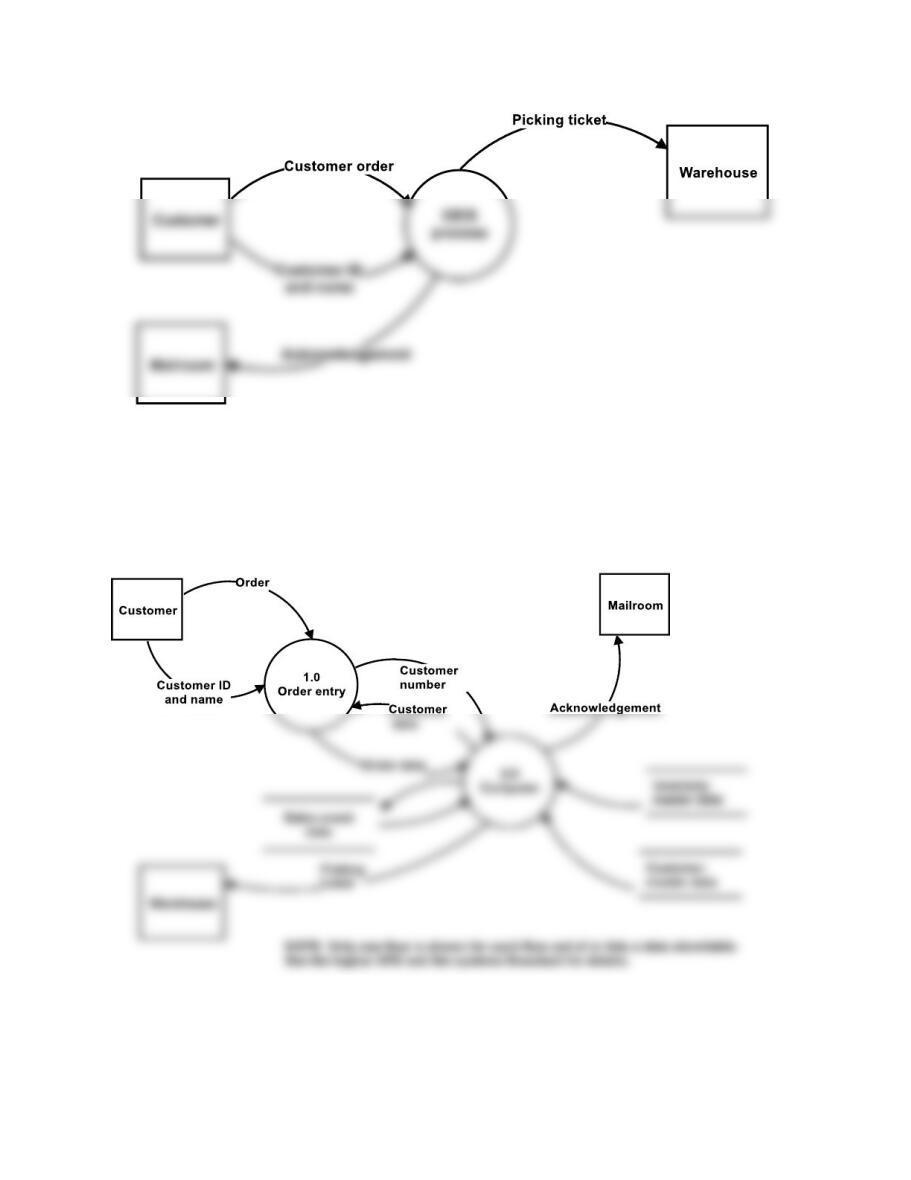
FIGURE SM-10.1 Problem 1, Part b Solution—Context Diagram for Auto Supplies, Inc.
(Order Entry)
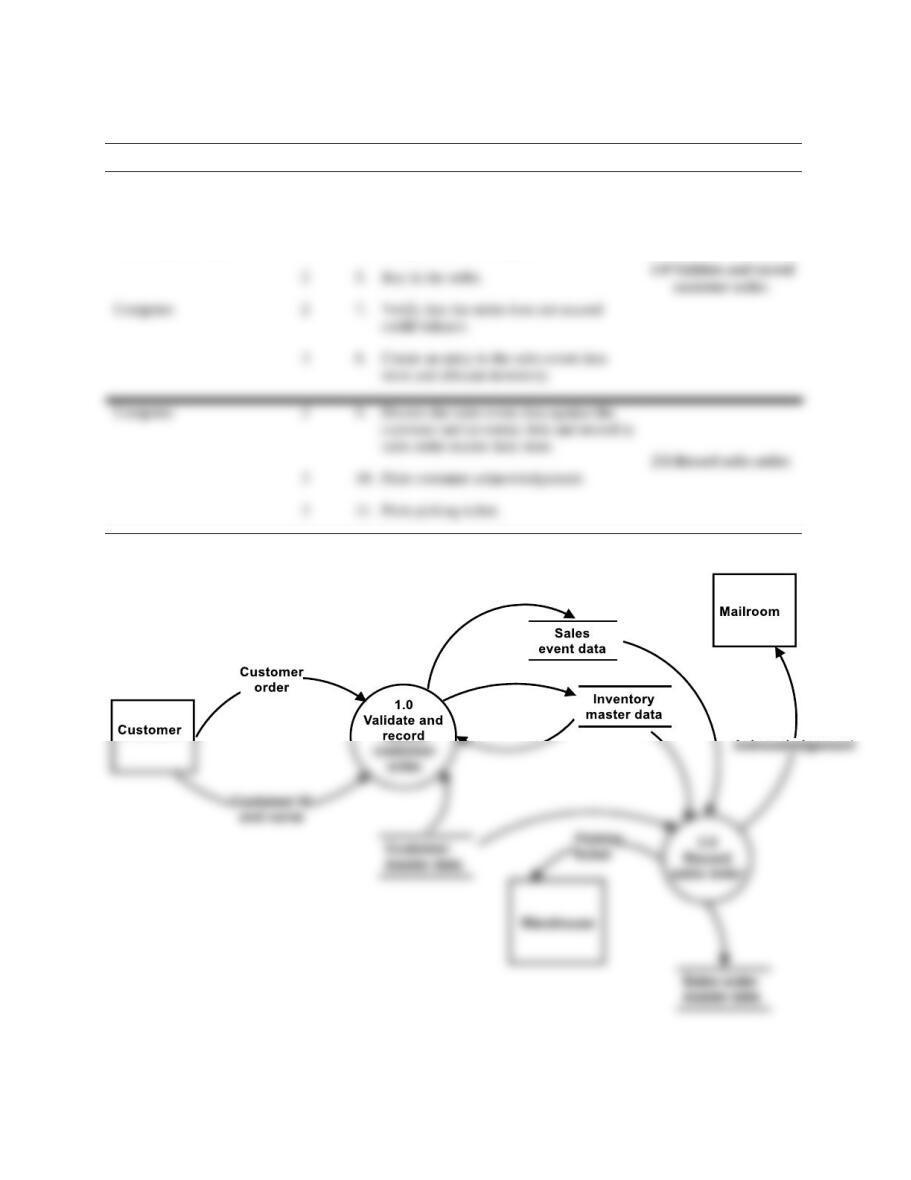
FIGURE SM-10.2 Problem 1, Part c Solution—Physical DFD for Auto Supplies, Inc. (Order
Entry)
12 Solutions for Chapter 10
d. Table of Entities and Activities (Annotated) for Auto Supplies, Inc. (Order entry)
Entities
Para
Activities
Process
Order entry (clerks)
2
2. Enter customer number.
Computer
2
3. Retrieve and display the customer data.
Order entry (clerks)
2
4. Compare name to display.
2
5. Key in the order.
3
10. Print customer acknowledgement.
3
11. Print picking ticket.
Accounting Information Systems, 10e 13
FIGURE SM-10.3 Problem 1, Part e Solution—Logical DFD for Auto Supplies, Inc. (Order
Entry)
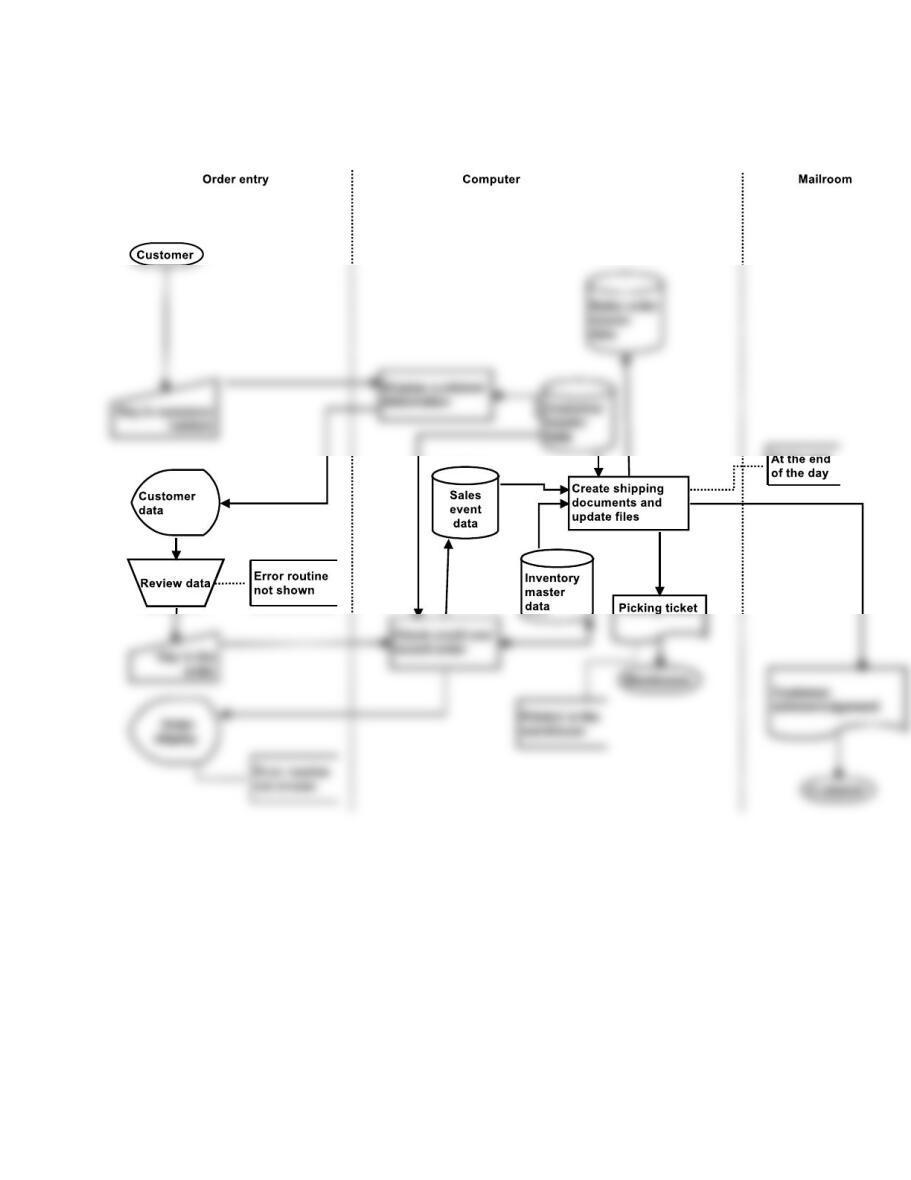
FIGURE SM-10.4 Problem 2, Part a Solution—Systems Flowchart for Auto Supplies, Inc.
(Order Entry)
14 Solutions for Chapter 10
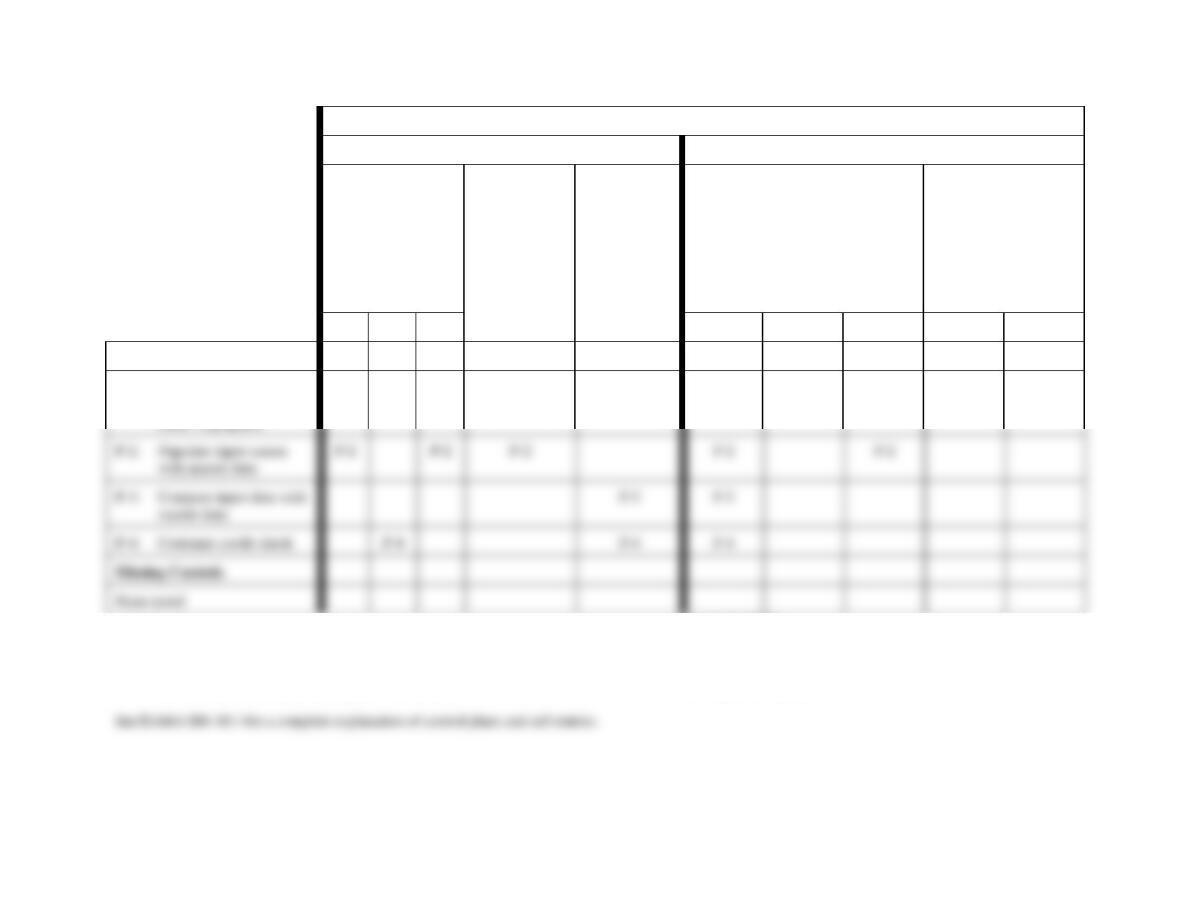
Control Goals of the Auto Supplies, Inc. (Order entry) Process
Control Goals of the Operations Process
Control Goals of the Information Process
Recommended control plans
Ensure
effectiveness of
operations
Ensure
efficient
employment
of resources
(e.g., people
and
computers)
Ensure
security of
resources
(e.g.,
inventory,
customer
master data)
For the customer order inputs,
ensure:
For the sales order
and inventory master
data, ensure:
A
B
C
IV
IC
IA
UC
UA
Present controls
P-1: Enter data close to the
location where customer
order is prepared
P-1
P-1
P-1
P-1
P-1
Effectiveness goals include:
A – Provide timely acknowledgement of customer orders
B – Provide assurance of customer’s creditworthiness
C – Provide timely shipment of goods to customers
IV = input validity
IC = input completeness
IA = input accuracy
UC = update completeness
UA = update accuracy
FIGURE SM-10.5 Problem 2, Part b Solution (Partial)—Control Matrix for Auto Supplies, Inc. (Order Entry)
Missing Controls
Accounting Information Systems, 10e 15
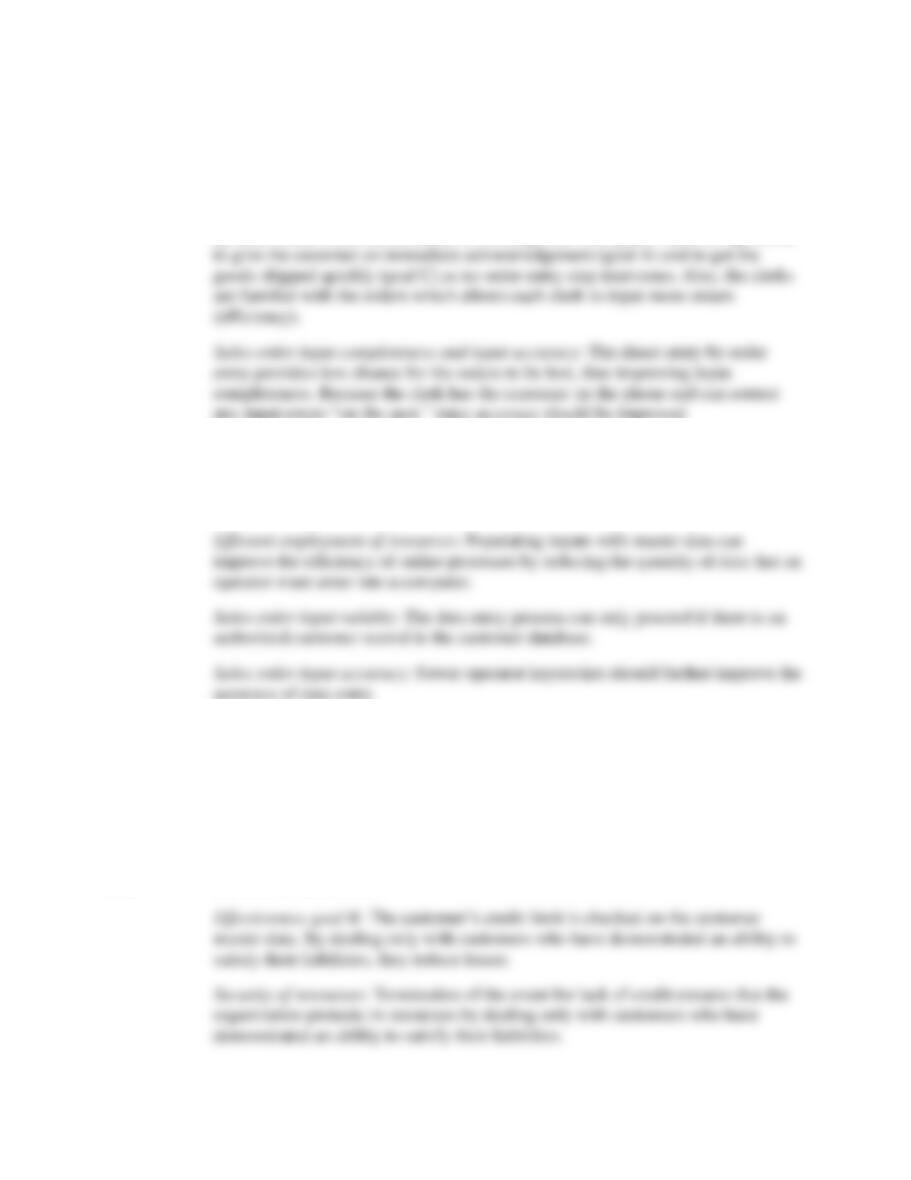
Exhibit SM-10.1 Problem 2 Part b Solution (Partial)⎯Explanation of Cell Entries for
Control Matrix in Figure SM-10.5
P-1: Enter data close to the location where customer order is prepared.
Effectiveness goals A and C, efficient employment of resources: Orders are entered
by sales clerks while the customer is on the phone. This places them in a position
P-2: Populate input screens with master data.
Effectiveness goals A and C: Fewer operator keystrokes should also improve the
speed with which events can be processed.
P-3: Compare input data with master data.
Security of resources and sales order input validity: The order entry clerk
compares the input customer number and name to the computer display to ensure
that orders are input only for customers who are known to exist and will likely
pay for merchandise received. The record that is retrieved from the customer
database determines that the customer has been approved.
P-4: Customer credit check.
16 Solutions for Chapter 10
Sales order input validity: Valid sales orders are those that fall within
preauthorized credit limits, so this plan also speaks to the goal input validity.
Solution Note: Several controls not described in the previous list could be
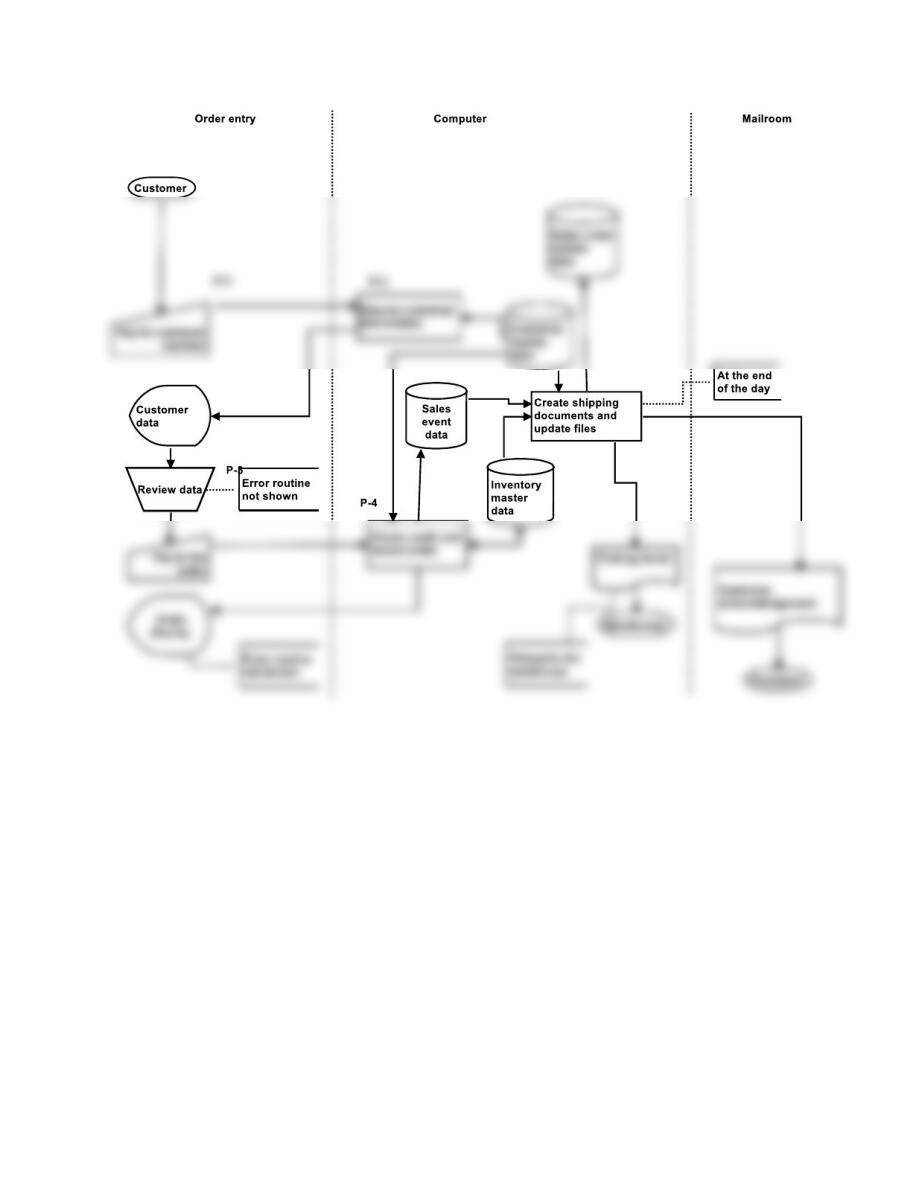
Accounting Information Systems, 10e 17
FIGURE SM-10.6 Problem 2, Part c Solution—Annotated Systems Flowchart for Auto
Supplies, Inc. (Order Entry)
18 Solutions for Chapter 10
Auto Supplies, Inc. (Shipping) Solutions (see Note on pg. 9)
P 10-1 ANS. a. Table of Entities and Activities for Auto Supplies, Inc. (Shipping)
Entities
Para
Activities
Warehouse (clerk)
3
1. Assemble the order.
4
2. Forward completed orders to shipping department.
Shipping department
(clerk)
4
3. Key sales order number into computer.
Computer
4
8. Update the sales order master data and inventory (for the shipment).
4
9. Create a record on the billing due data store.
4
10. Print a packing slip and bill of lading.
Carrier
4
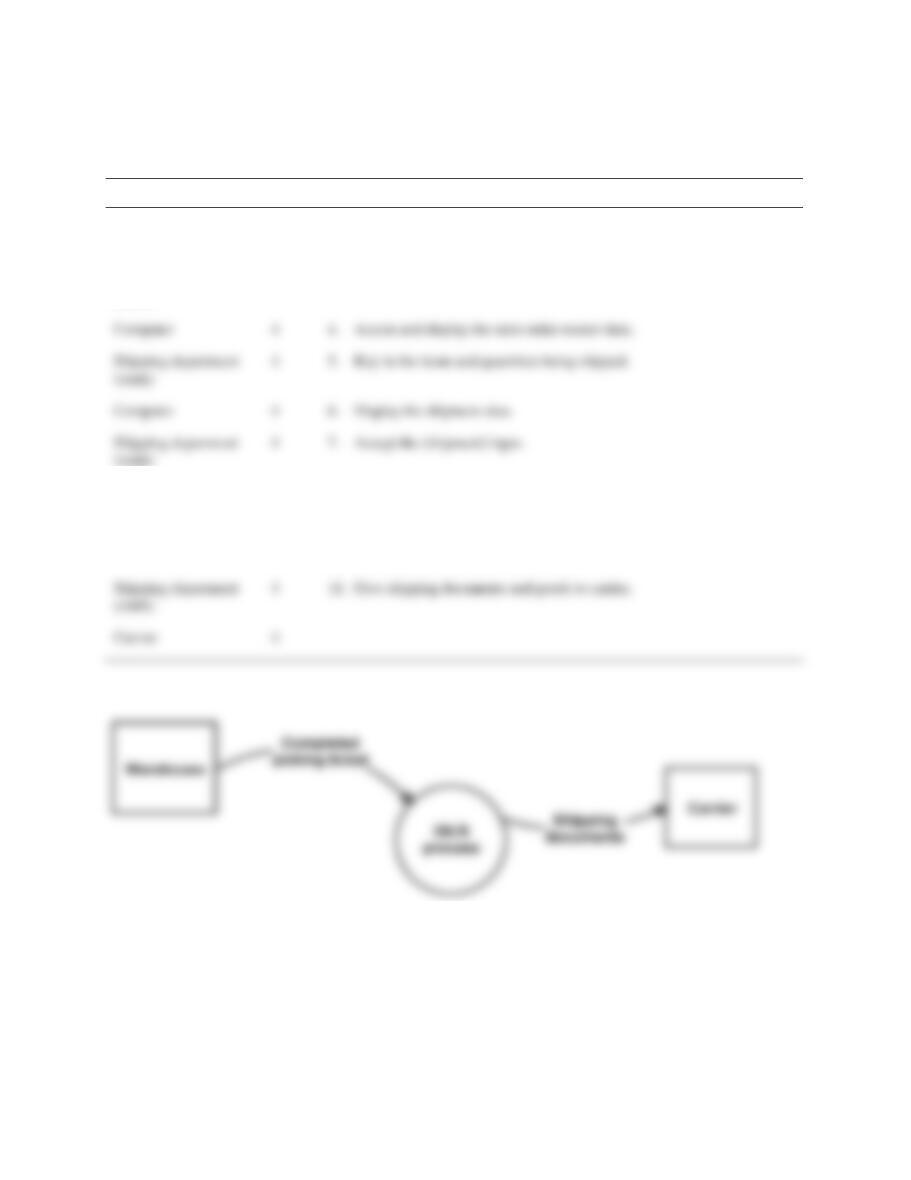
FIGURE SM-10.7 Problem 1, Part b Solution—Context Diagram for Auto Supplies, Inc.
(Shipping)
Computer
4
4. Access and display the sales order master data.
(clerk)
Computer
4
6. Display the shipment data.
Shipping department
4
7. Accept the (shipment) input.
Accounting Information Systems, 10e 19
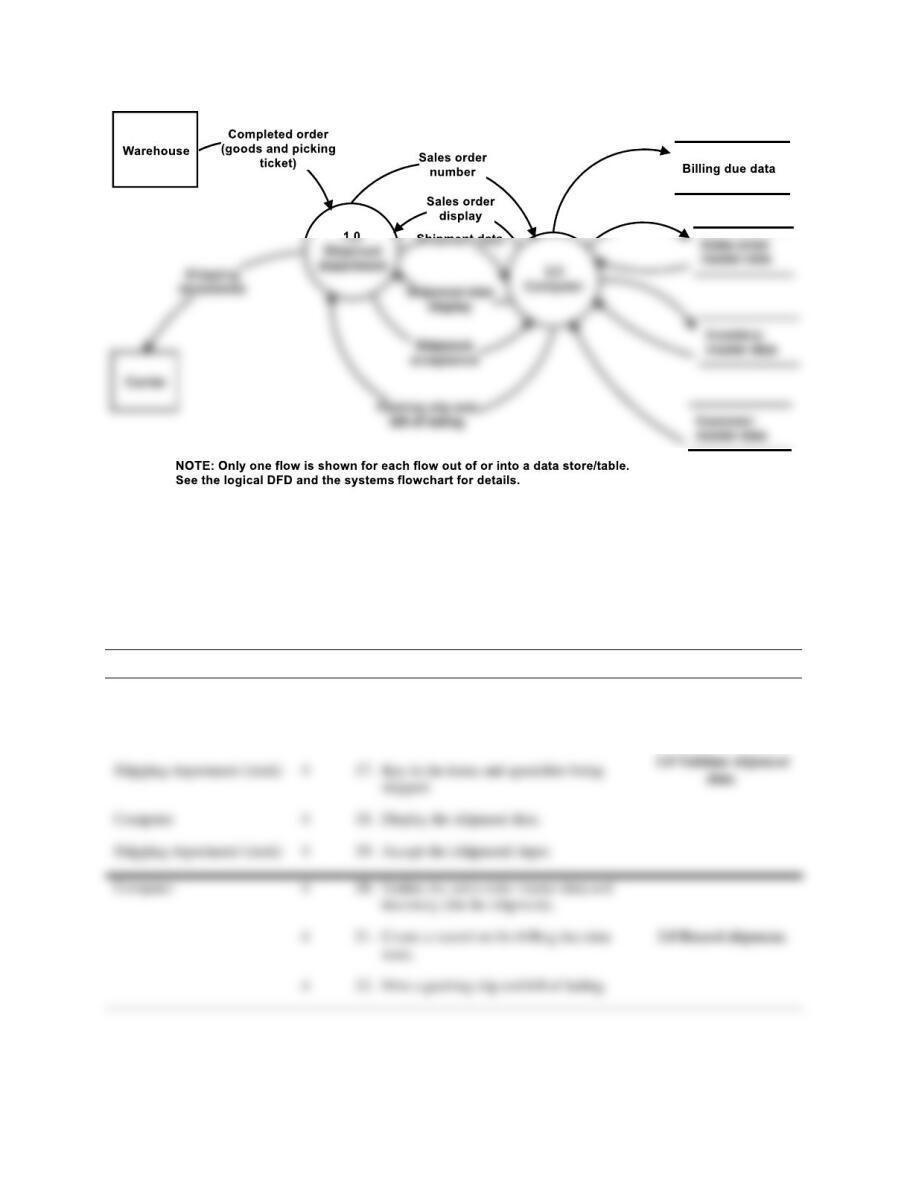
FIGURE SM-10.8 Problem 1, Part c Solution—Physical DFD for Auto Supplies, Inc.
(Shipping)
d. Table of Entities and Activities (Annotated) for Auto Supplies, Inc. (Shipping)
Entities
Para
Activities
Process
Shipping department (clerk)
4
15. Key sales order number into computer.
Computer
4
16. Access and display the sales order master
data.
Shipping department (clerk)
4
17. Key in the items and quantities being
shipped.
Computer
4
18. Display the shipment data.
Shipping department (clerk)
4
19. Accept the (shipment) input.
4
20. Update the sales order master data and
4
21. Create a record on the billing due data
4
22. Print a packing slip and bill of lading.
20 Solutions for Chapter 10
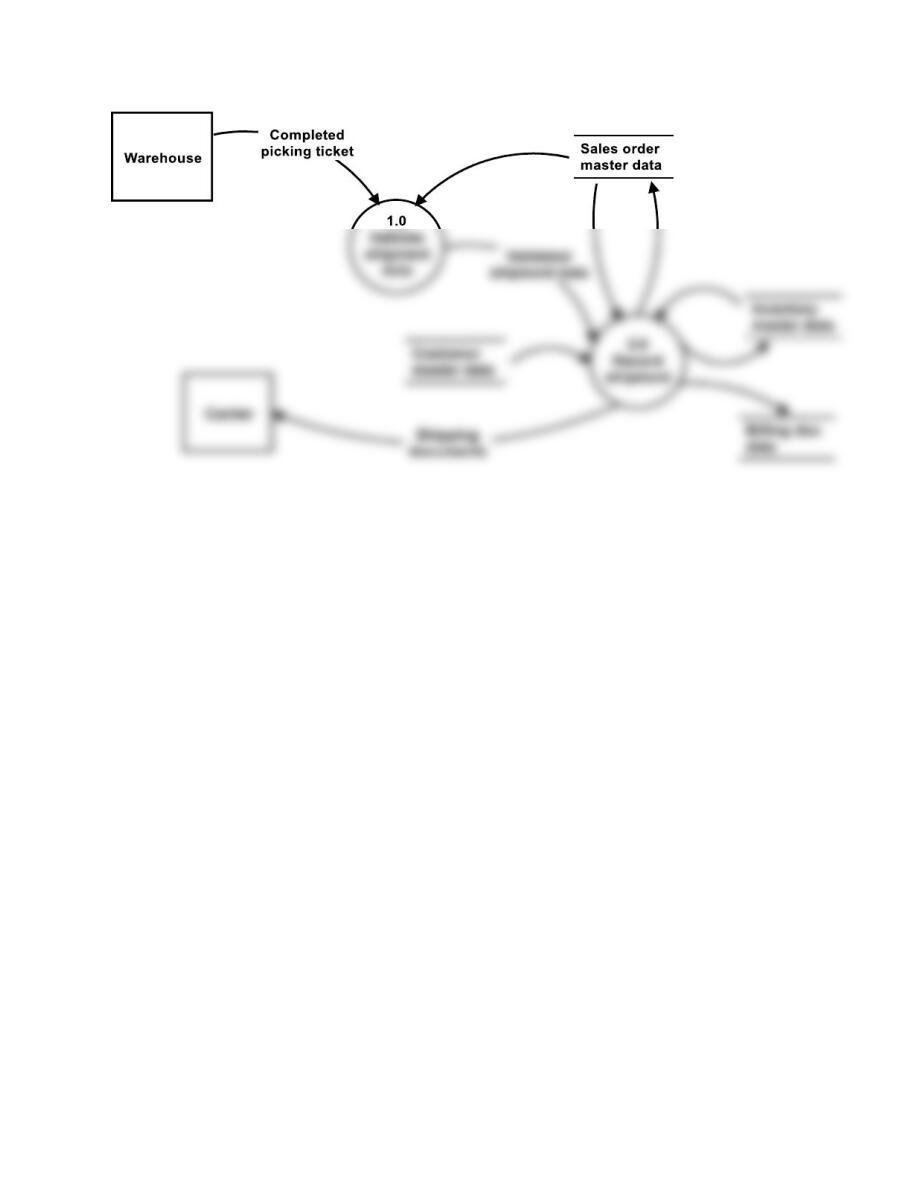
FIGURE SM-10.9 Problem 1, Part e Solution—Logical DFD for Auto Supplies, Inc.
(Shipping)