10–61
PROBLEM 10-10 (Continued)
(c) Has Commercial Substance
Marshall Construction
1.
Equipment ($98,000 + $102,000)………………….
200,000
Accumulated Depreciation—Equipment ……..
50,000
Equipment…………………………………………
140,000
Brigham Manufacturing
2.
Cash ………………………………………………………..
102,000
Inventory ………………………………………………….
98,000
Sales Revenue ………………………………….
200,000
Cost of Goods Sold …………………………………..
165,000
Inventory ………………………………………….
165,000
(d)
Marshall Construction
1.
Equipment ……………………………………………….
200,000
Accumulated Depreciation—Equipment …….
50,000
Cash ………………………………………………..
103,000
Equipment………………………………………..
140,000
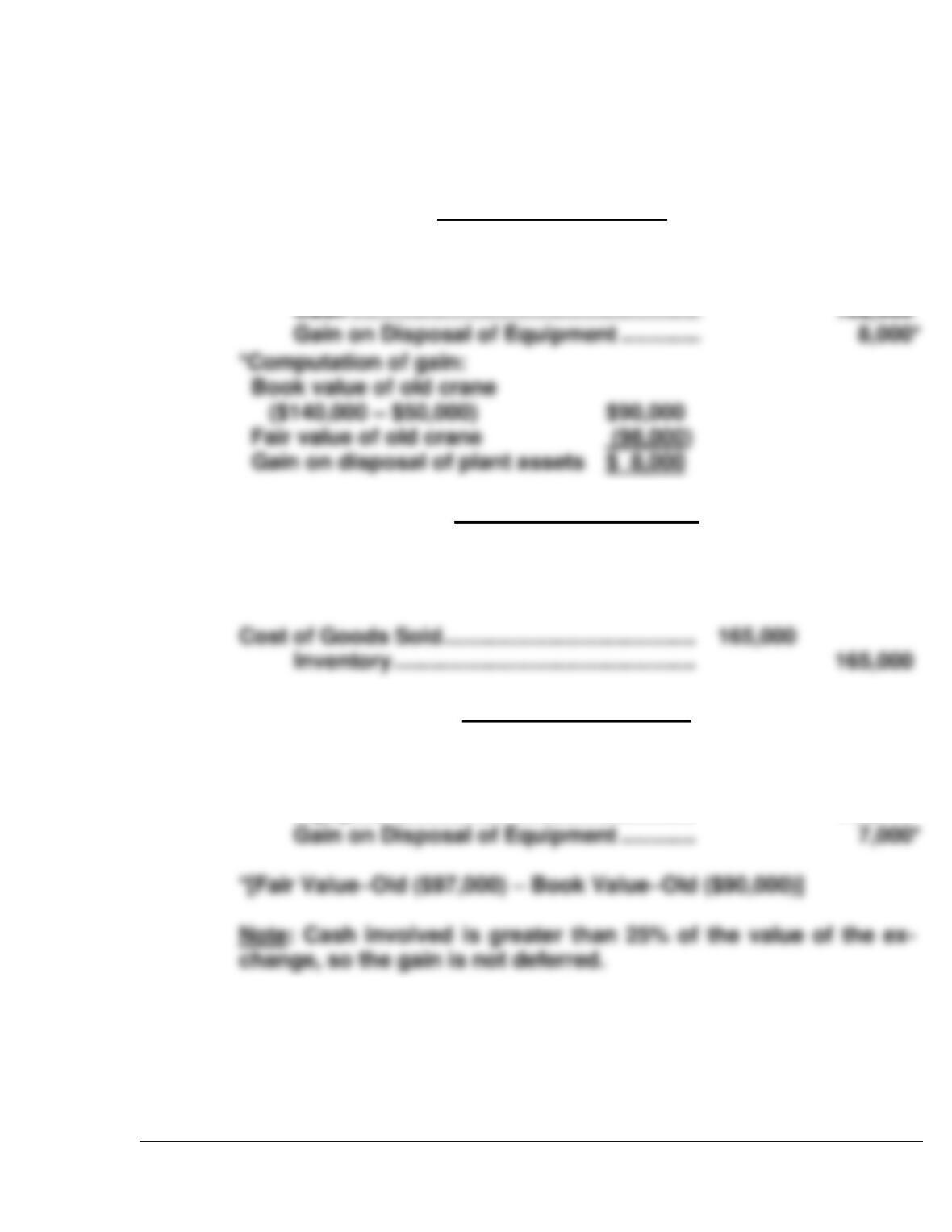
Gain on Disposal of Equipment …………
*[Fair Value–Old ($97,000) – Book Value–Old ($90,000)]
change, so the gain is not deferred.
Cash …………………………………………………
102,000
Gain on Disposal of Equipment ………….
10–62
PROBLEM 10-10 (Continued)
Brigham Manufacturing
2.
Cash ……………………………………………………….
103,000
Inventory ………………………………………………….
97,000
Sales Revenue ………………………………….
200,000
Cost of Goods Sold …………………………………..
Inventory ………………………………………….
165,000
10–63
PROBLEM 10-11
(a) The major characteristics of plant assets, such as land, buildings, and
equipment, that differentiate them from other types of assets are
presented below.
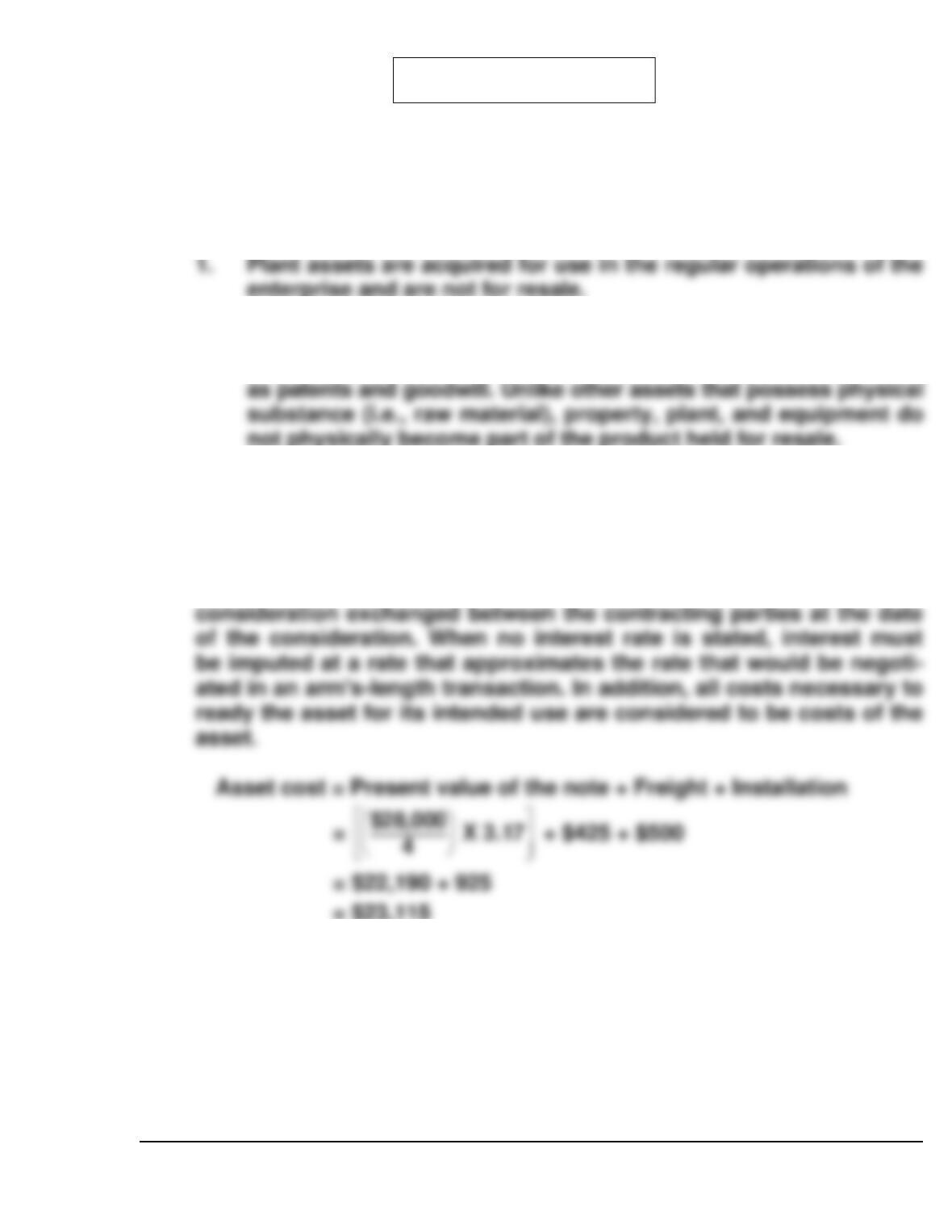
2. Property, plant, and equipment possess physical substance or
existence and are thus differentiated from intangible assets such
3. These assets are durable and long-term in nature and are usually
subject to depreciation.
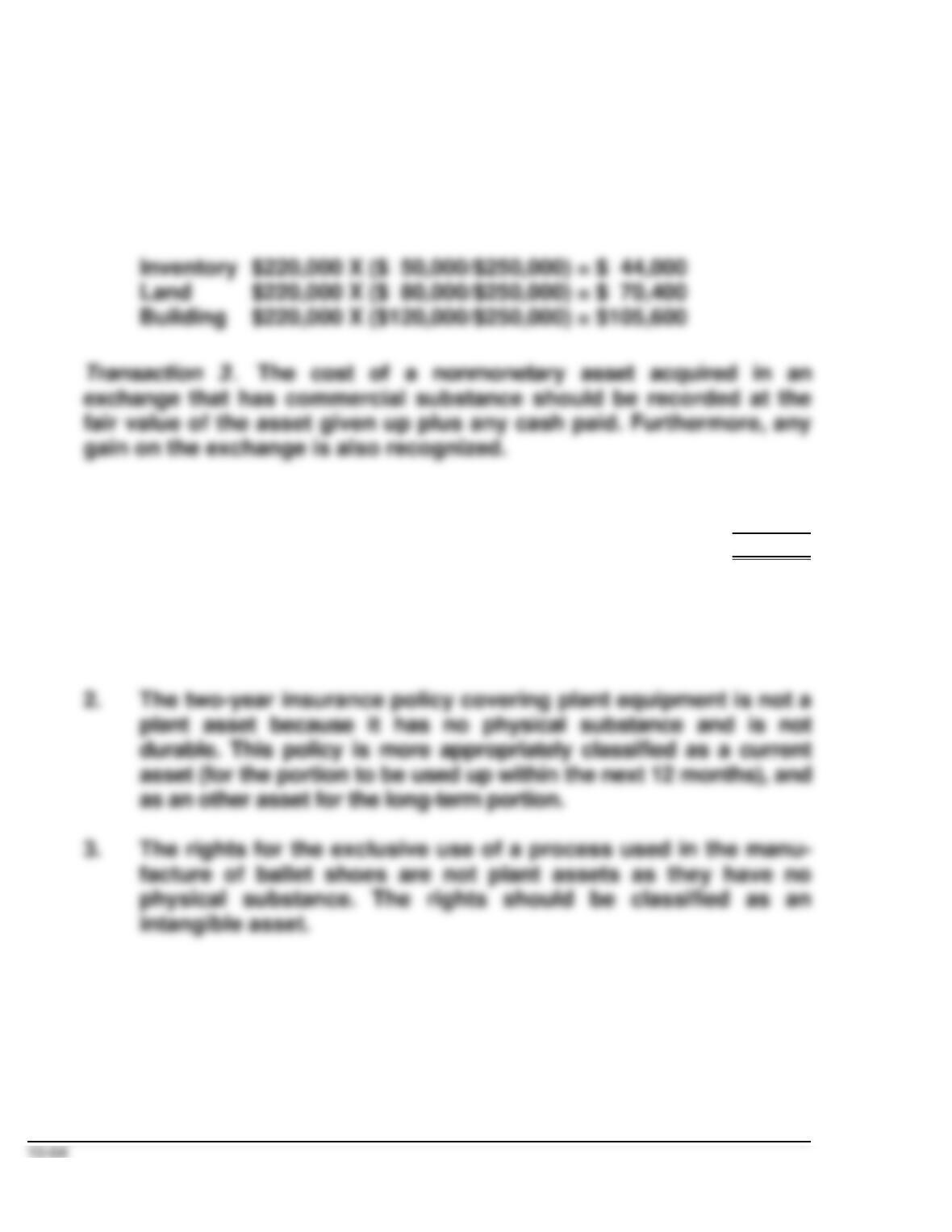
(b) Transaction 1. To properly reflect cost, assets purchased on deferred
payment contracts should be accounted for at the present value of the
PROBLEM 10-11 (Continued)
Transaction 2. The lump-sum purchase of a group of assets should be
accounted for by allocating the total cost among the various assets
on the basis of their relative fair values. The $8,000 of interest
expense incurred for financing the purchase is a period cost and is
not a factor in determining asset cost.
Fair value of trucks …………………………………………..
$46,000
Cash paid…………………………………………………………
19,000
Cost of land ……………………………………………………..
$65,000
(c) 1. A building purchased for speculative purposes is not a plant
asset as it is not being used in normal operations. The building
is more appropriately classified as an investment.

10–65
TIME AND PURPOSE OF CONCEPTS FOR ANALYSIS
CA 10-1 (Time 20–25 minutes)
Purpose—to provide the student with a problem to decide which expenditures related to purchasing
land, constructing a building, and adding to the building should be capitalized and how each should be
depreciated. When the land and building are sold, the student discusses how the book value is
determined and how a gain would be reported.
CA 10-2 (Time 20–25 minutes)
Purpose—to provide the student with a situation involving the proper allocation of costs to self–
constructed machinery. As part of this case, the student is required to discuss the propriety of including
overhead costs in the construction costs. Finally, the proper accounting treatment accorded the
development costs associated with the construction of a new machine must be evaluated.
CA 10-3 (Time 20–25 minutes)
Purpose—to provide the student with a problem involving the proper accounting treatment for interest
costs. The student is required to assess the advantages and disadvantages of capitalizing interest.
CA 10-4 (Time 30–40 minutes)
Purpose—to provide the student with a situation to determine capitalization of interest and to explain in
a memorandum the conceptual basis for interest capitalization.
CA 10-5 (Time 30–40 minutes)
Purpose—to provide the student with a situation in which to examine differences in accounting for
exchanges that have or lack commercial substance.
CA 10-6 (Time 20–25 minutes)
Purpose—to provide the student with an understanding of the proper accounting treatment involving
incidental costs associated with the purchase of a machine. The student must be able to defend why
certain costs might be capitalized even though this valuation has no relationship to net realizable value.
In addition, the costs may be charged off immediately for tax purposes and the student is required to
analyze why these costs may still be capitalized for book purposes.
CA 10-7 (Time 20–25 minutes)
Purpose—to provide the student with a case involving allocation of costs between land and buildings,
including ethical issues.
SOLUTIONS TO CONCEPTS FOR ANALYSIS
CA 10-1
(a) Expenditures should be capitalized when they benefit future periods. The cost to acquire the land
should be capitalized and classified as land, a nondepreciable asset. Since tearing down the small
factory is readying the land for its intended use, its cost is part of the cost of the land and should
be capitalized and classified as land. As a result, this cost will not be depreciated as it would if it
were classified with the capitalizable cost of the building.
(b) A gain should be recognized on the sale of the land and building because income is realized
whenever the earning process has been completed and a sale has taken place.
CA 10-2
(a) Materials and direct labor used in the construction of the equipment definitely should be charged to
the equipment account. It should be emphasized that no gain on self-construction should be
recorded because such an approach violates the historical cost principle. The controversy centers
on the assignment of indirect costs, called overhead or burden, consisting of power, heat, light,
insurance, property taxes on factory buildings, etc. The suggested approaches are discussed below.
10–67
CA 10-2 (Continued)
CA 10-3
Three approaches have been suggested to account for actual interest incurred in financing the
construction or acquisition of property, plant, and equipment. One approach is to capitalize no interest
during construction. Under this approach interest is considered a cost of financing and not a cost of
construction. It is contended that if the company had used stock financing rather than debt financing,
CA 10-4
To: Jane Esplanade, President
From: Good Student, Manager of Accounting
Date: January 15, 2012
Subject: Capitalization of avoidable interest on the warehouse
construction project
I am writing in response to your questions about the capitalized interest
costs for the warehouse construction project. This brief explanation of my
calculations should facilitate your understanding of these costs.
Because interest capitalization is allowed in special circumstances only,
the company must be especially careful to capitalize only that interest
which is associated with the construction itself. Thus, GAAP provides
guidance indicating how much interest may be associated with the
construction, i.e., the lower of actual or avoidable interest.
10–69
CA 10-4 (Continued)
Calculations for avoidable interest are more complex. First, interest can be
capitalized only on the weighted–average amount of accumulated expenditures.
Although total costs amounted to $5,200,000 for the project, an average of
only $3,500,000 was outstanding during the period of construction.
Third, we compute our avoidable interest as follows: calculate the interest
on the loan directly associated with the construction. Apply the weighted–
average interest rate to the remainder of the weighted-average accumulated
expenditures. Add these products. Avoidable interest for 2011 amounts to
$396,300 (see Schedule #3).
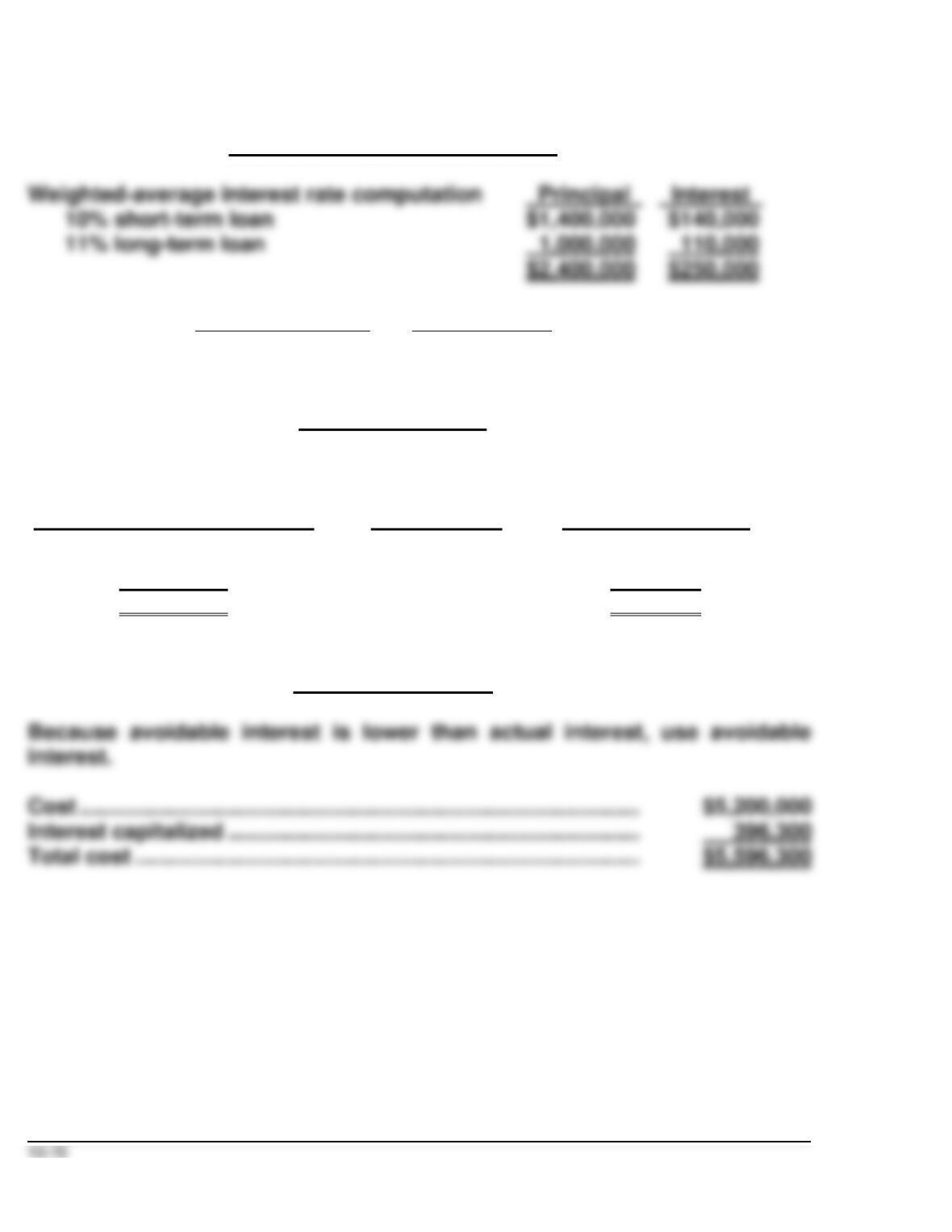
Schedule #1
Actual Interest
Construction loan
$2,000,000 X 12% =
Short-term loan
$1,400,000 X 10% =
Long-term loan
$1,000,000 X 11% =
CA 10-4 (Continued)
Schedule #2
Weighted-Average Interest Rate
Weighted-average interest rate computation
10% short-term loan
$1,400,000
11% long-term loan
$2,400,000
Total Interest
=
$250,000
= 10.42%
Total Principal
$2,400,000
Schedule #3
Avoidable Interest
Weighted-Average
Accumulated Expenditures
X
Interest Rate
=
Avoidable Interest
$2,000,000
12%
$240,000
1,500,000
10.42%
156,300
$3,500,000
$396,300
Schedule #4
Interest Capitalized
Cost ……………………………………………………………………………….
Interest capitalized ………………………………………………………….
Total cost ……………………………………………………………………….
10–71
CA 10-5
(a) Client A
Treatment if the exchange has commercial substance
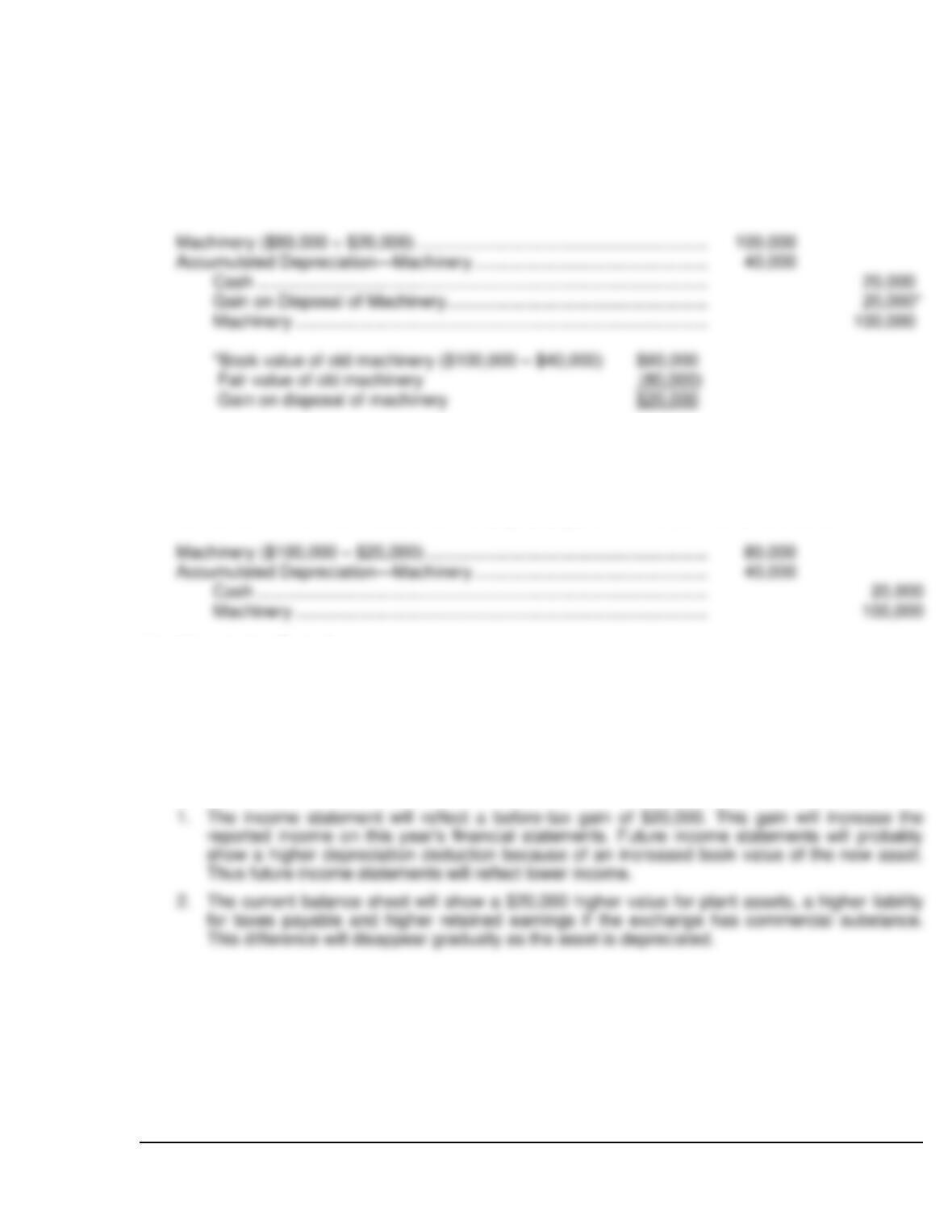
Client A would recognize a gain of $20,000 on the exchange. The basis of the asset acquired
would be $100,000. The entry would be as follows:
(b) Treatment if the exchange lacks commercial substance
Client A would be prohibited from recognizing a $20,000 gain on the exchange. This is because
the transaction lacks commercial substance. The new asset on their books would have a basis of
$80,000 ($100,000 less the $20,000 unrecognized gain). The entry would be as follows:
(c) Memo to the Controller:
TO: The Controller
RE: Exchanges of Assets—Commercial Substance Issues.
Financial statement effect of treating the exchange as having commercial substance versus not.