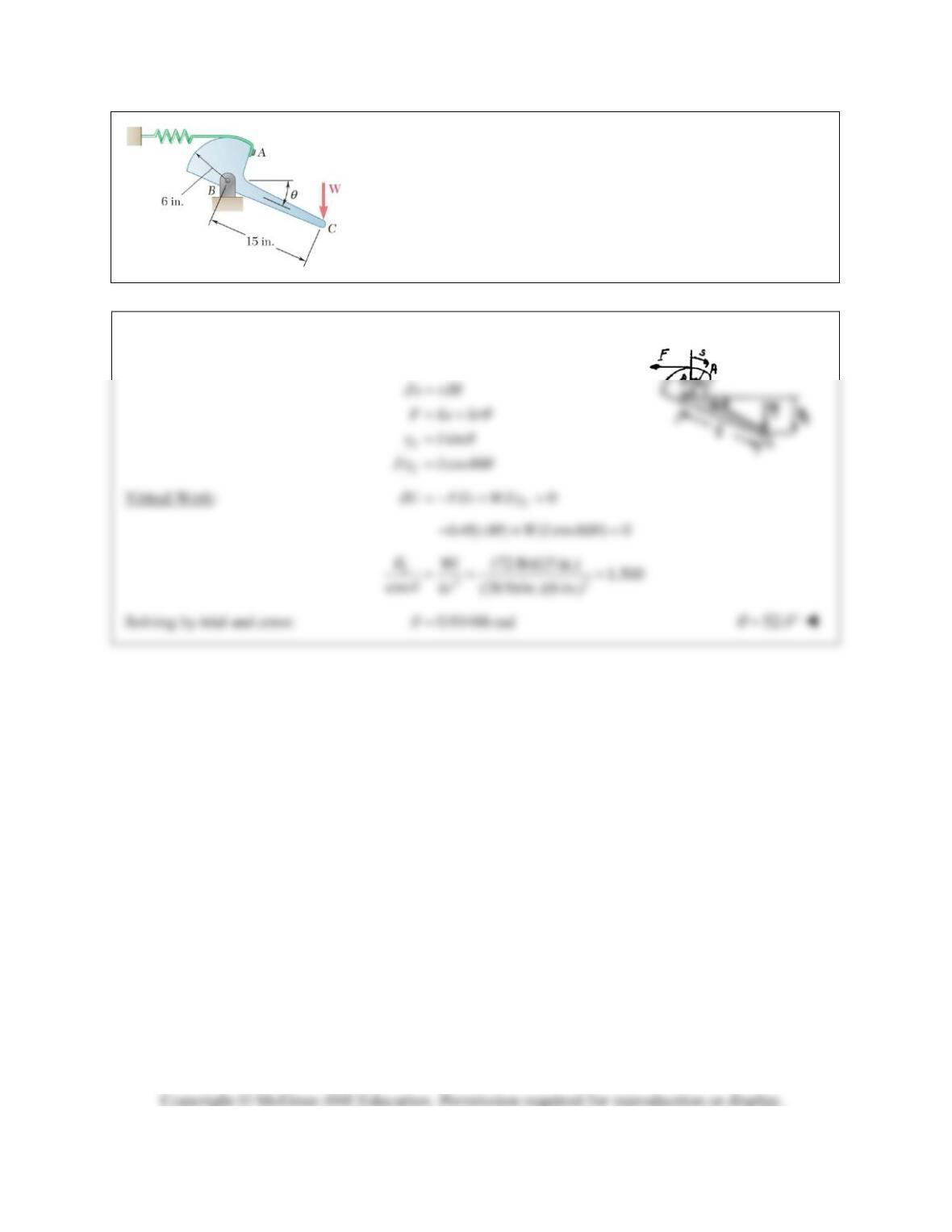
PROBLEM 10.36
A load
W
of magnitude 72 lb is applied to the mechanism at C.
Neglecting the weight of the mechanism, determine the value of
corresponding to equilibrium. The constant of the spring is
20 lb/in.,k
and the spring is unstretched when
0.
SOLUTION
sr
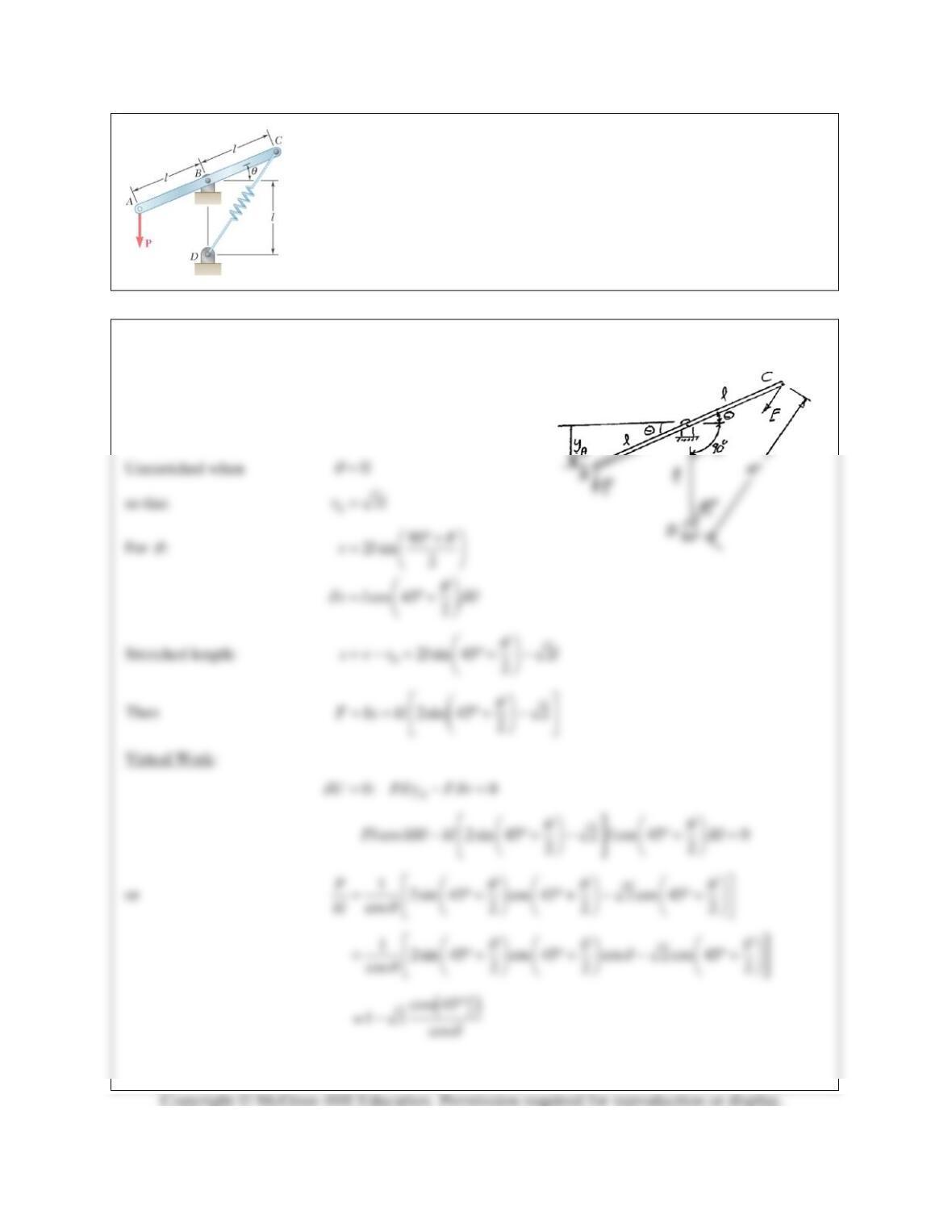
PROBLEM 10.37
Knowing that the constant of spring CD is k and that the spring is unstretched
when rod ABC is horizontal, determine the value of
corresponding to
equilibrium for the data indicated.
300 N, 400 mm, 5 kN/m.Pl k
SOLUTION
sin
A
yl
cos
A
yl
Spring:
vCD
PROBLEM 10.37 (Continued)
Now, with 300 N, 400 mm, and 5 kN/mPl k
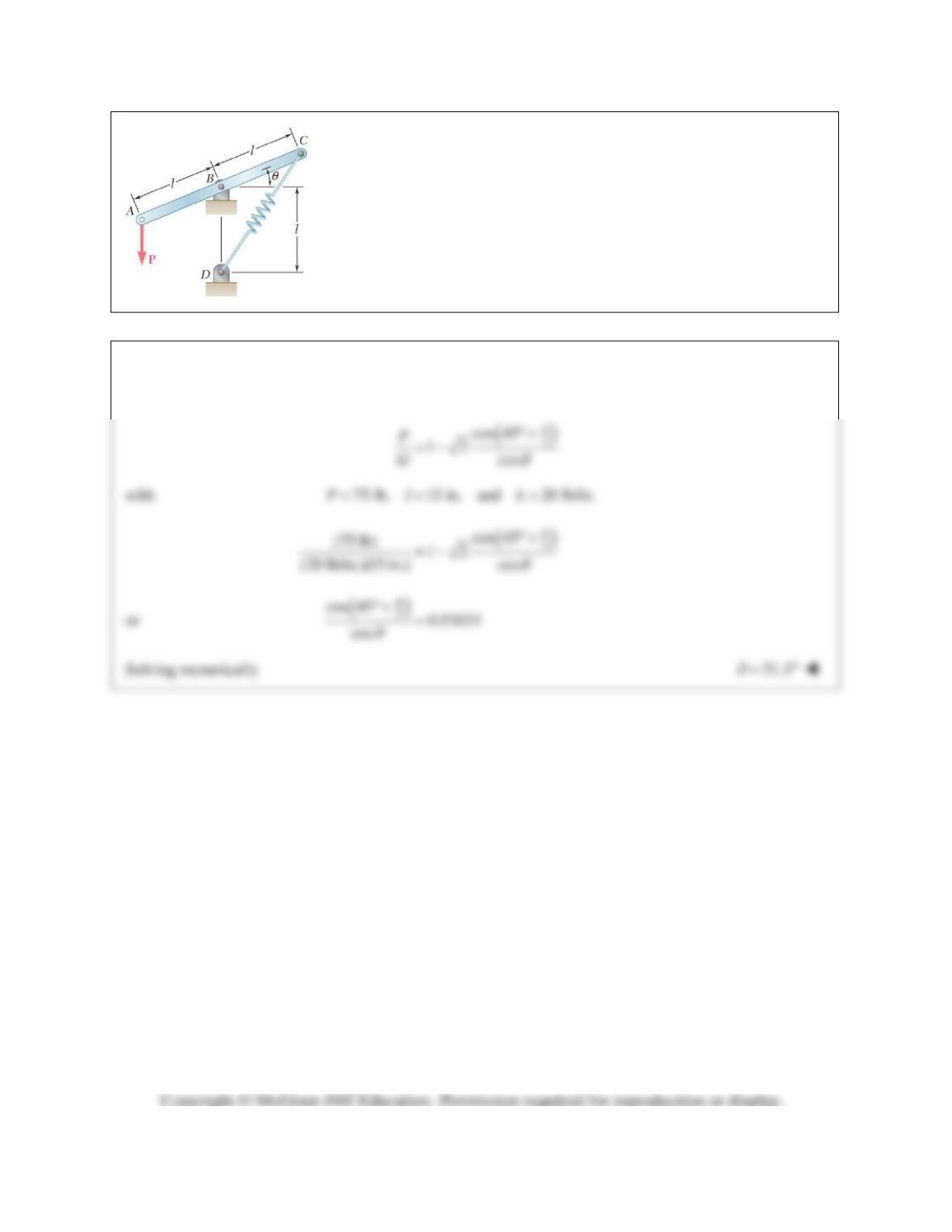
PROBLEM 10.38
Knowing that the constant of spring CD is k and that the spring is
unstretched when rod ABC is horizontal, determine the value of
corresponding to equilibrium for the data indicated.
75 lb, 15 in., 20 lb/in.Pl k
SOLUTION
From the analysis of Problem 10.37, we have
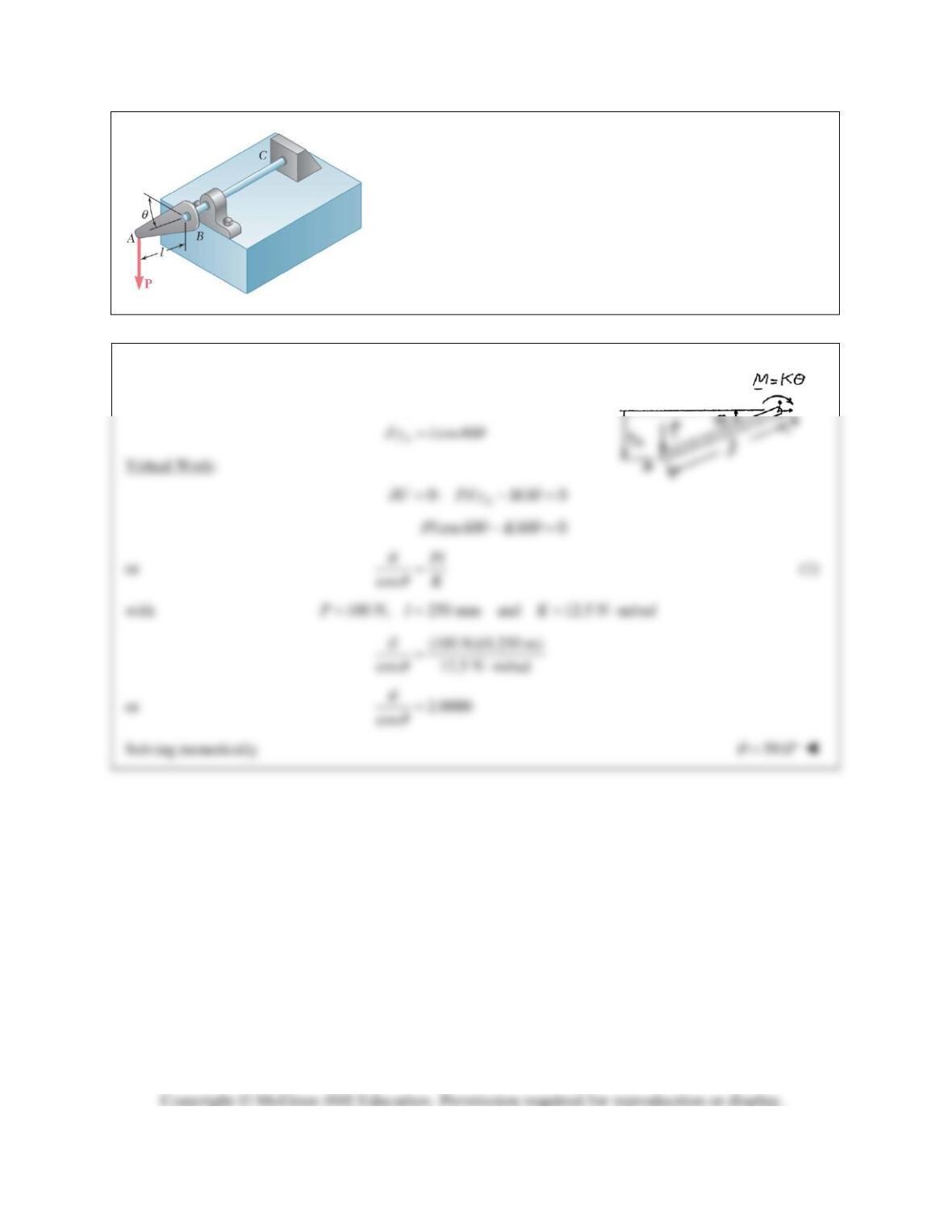
PROBLEM 10.39
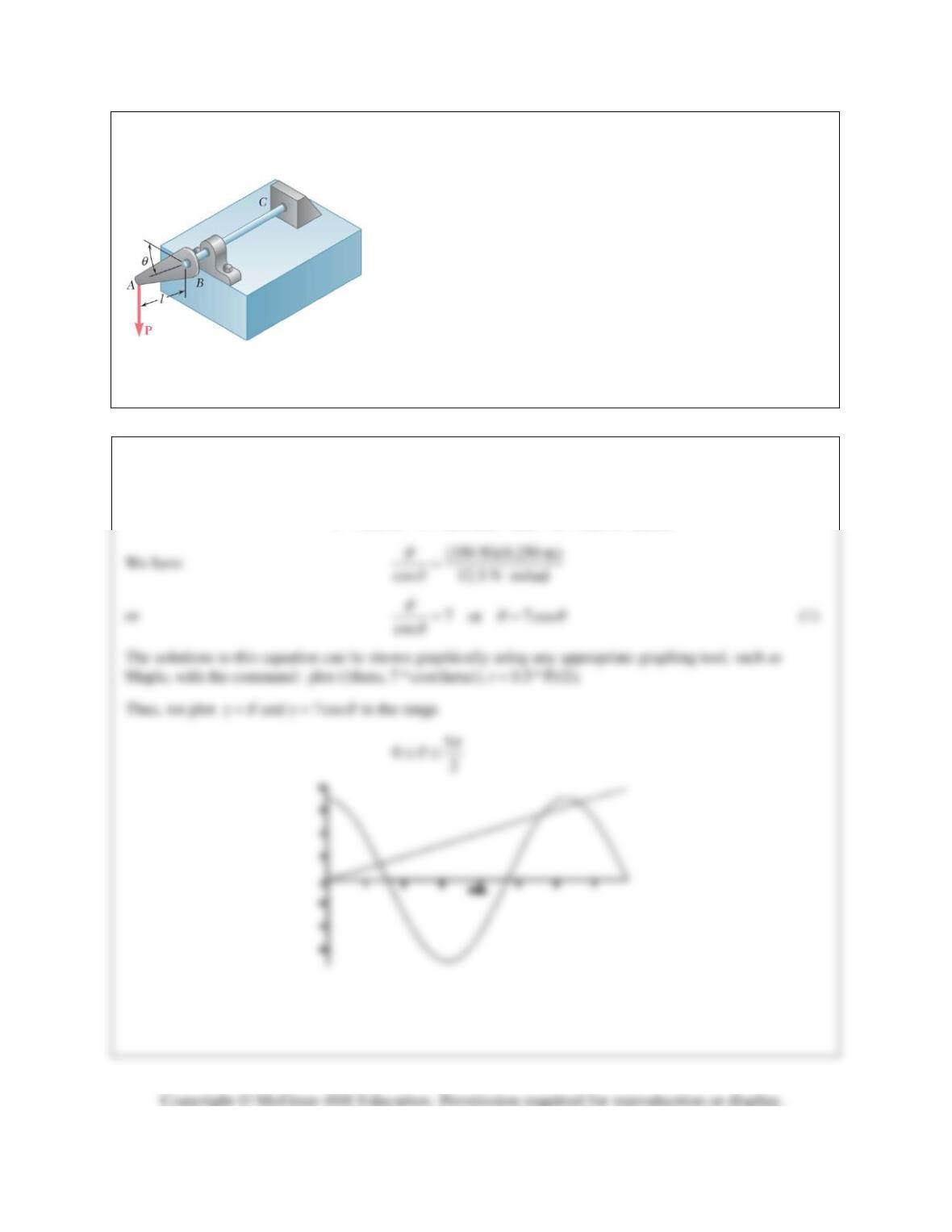
The lever AB is attached to the horizontal shaft BC that passes
through a bearing and is welded to a fixed support at C. The
torsional spring constant of the shaft BC is K; that is, a couple of
magnitude K is required to rotate end B through 1 rad. Knowing
that the shaft is untwisted when AB is horizontal, determine the
value of
corresponding to the position of equilibrium when
100 N, 250 mm,Pl
and
12.5 N · m/rad.K
SOLUTION
We have
sin
A
yl
PROBLEM 10.40
Solve Problem 10.39 assuming that
350 N,P
250 mm,l
and
12.5 N · m/rad.K
Obtain answers in each of the following
quadrants:
0 90 , 270 360°, 360 450 .
PROBLEM 10.39
The lever AB is attached to the horizontal shaft
BC that passes through a bearing and is welded to a fixed support
at C. The torsional spring constant of the shaft BC is K; that is, a
couple of magnitude K is required to rotate end B through 1 rad.
Knowing that the shaft is untwisted when AB is horizontal,
determine the value of
corresponding to the position of
equilibrium when
100P
N, l
250 mm,
and
12.5 N · m/rad.K
SOLUTION
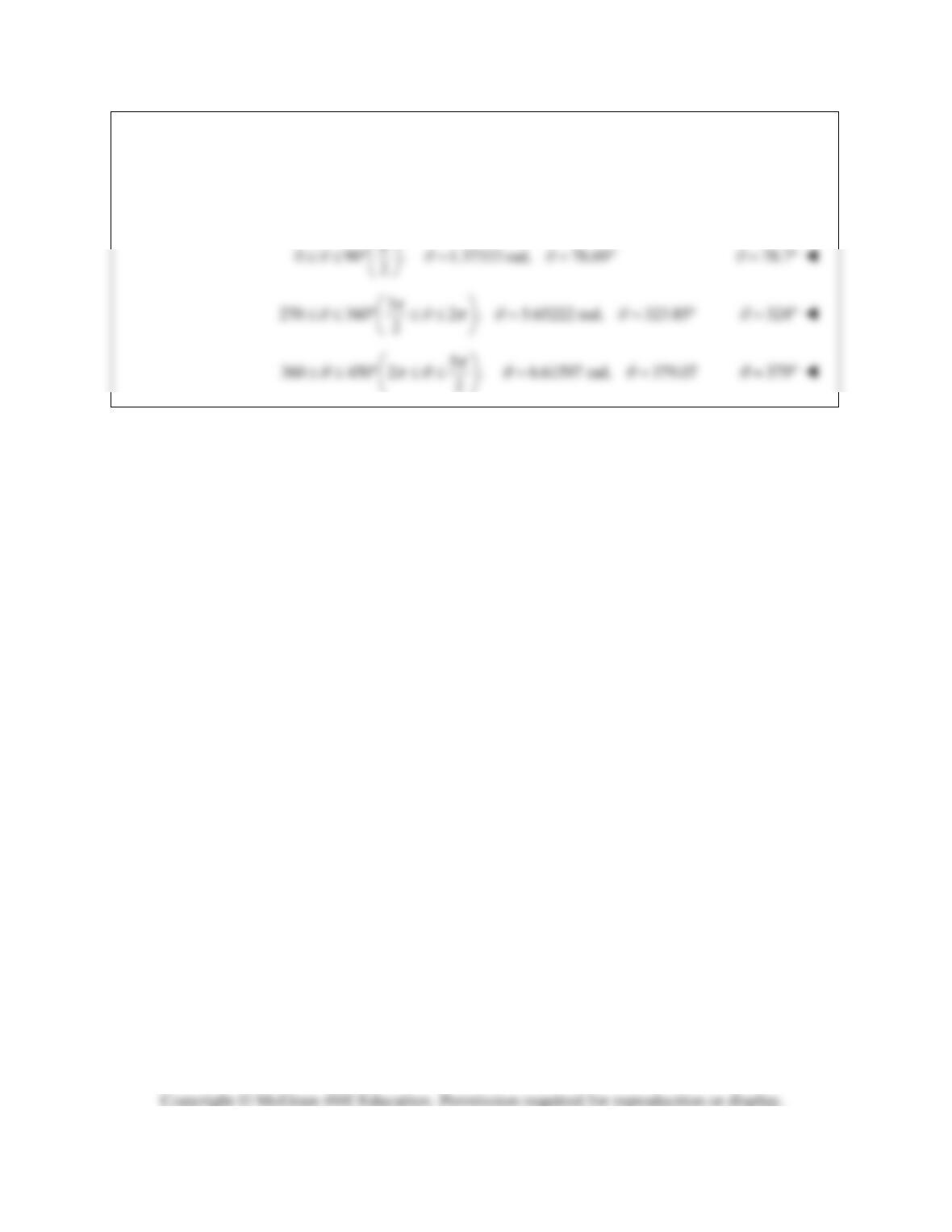
Using Equation (1) of Problem 10.39 and
350 N, 250 mm and 12.5 N m/radPl K
PROBLEM 10.40 (Continued)
We observe that there are three points of intersection, which implies that Equation (1) has three roots in
the specified range of .
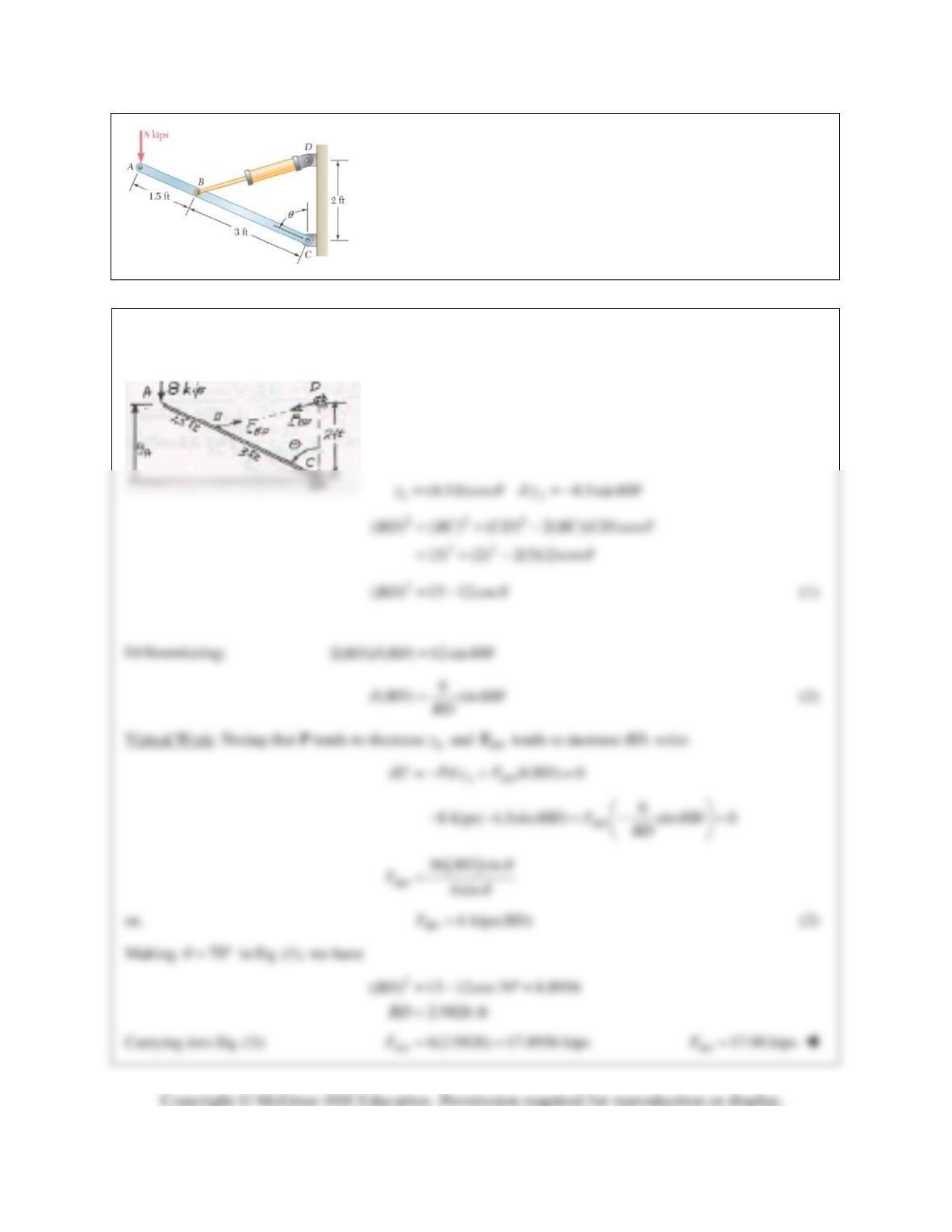
PROBLEM 10.41
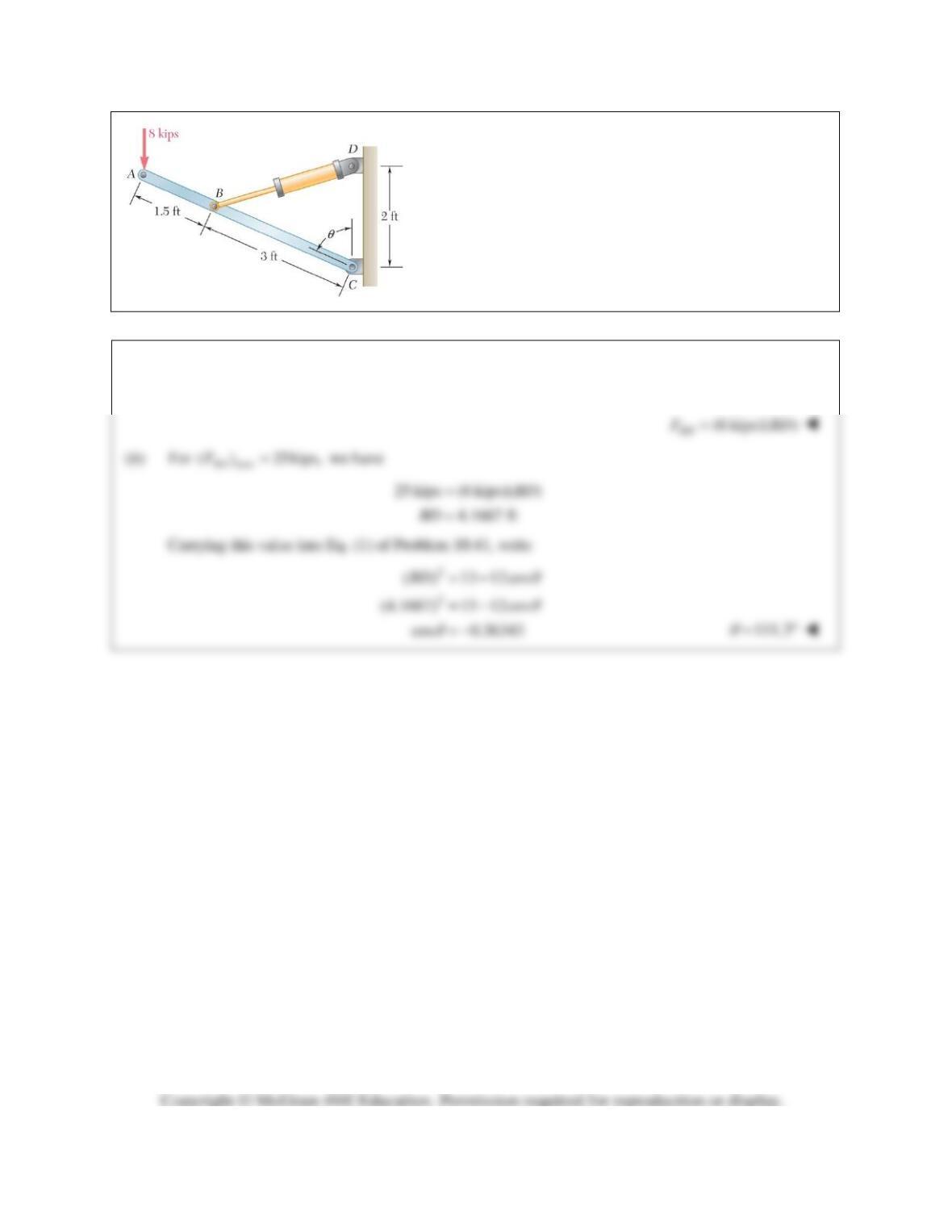
The position of boom ABC is controlled by the hydraulic cylinder
BD. For the loading shown, determine the force exerted by the
hydraulic cylinder on pin B when
= 70.
SOLUTION
We have
PROBLEM 10.42
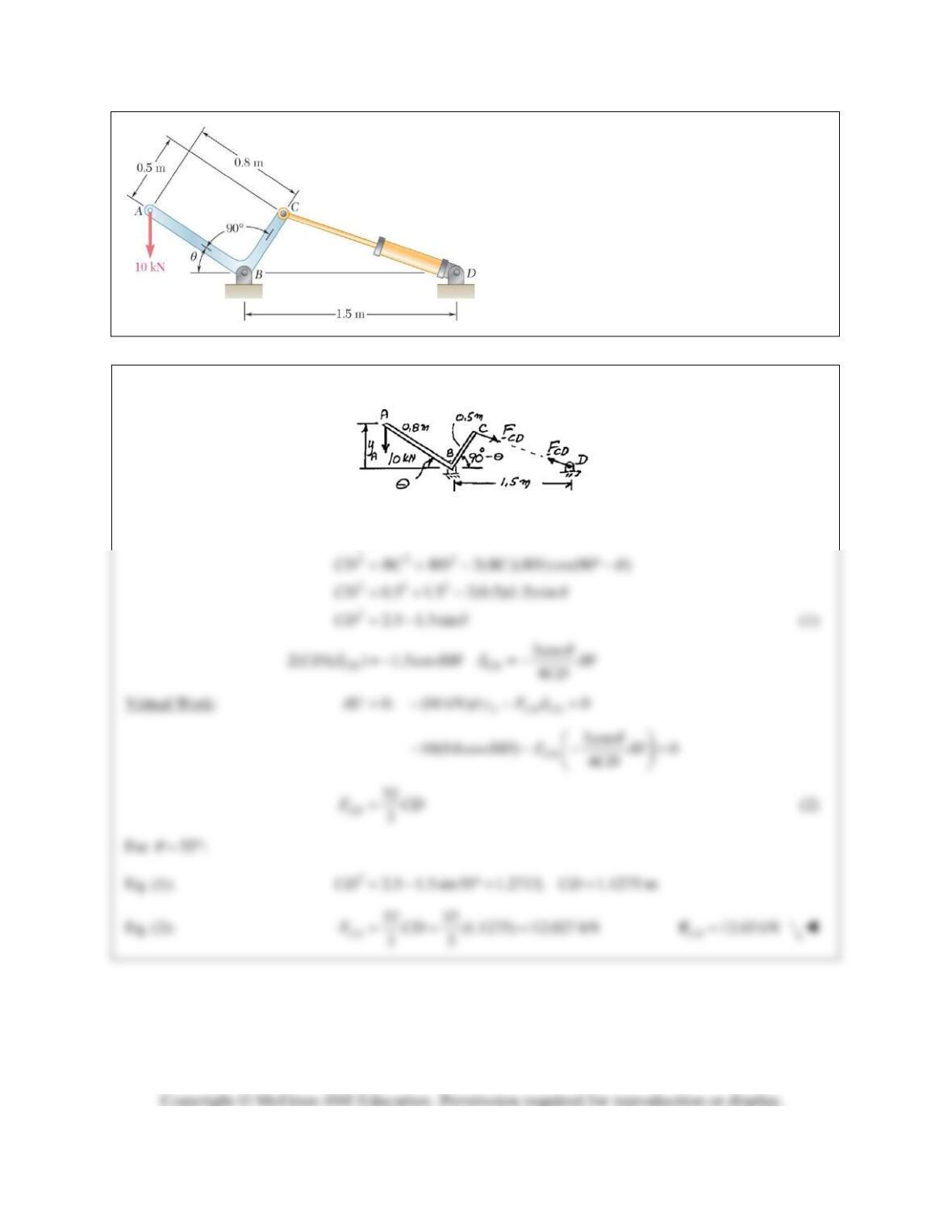
The position of boom ABC is controlled by the hydraulic
cylinder BD. For the loading shown, determine the largest
allowable value of the angle
if the maximum force that
the cylinder can exert on pin B is 25 kips.
SOLUTION
(a) See solution of Problem 10.41 for the derivation of Eq. (3):
PROBLEM 10.43
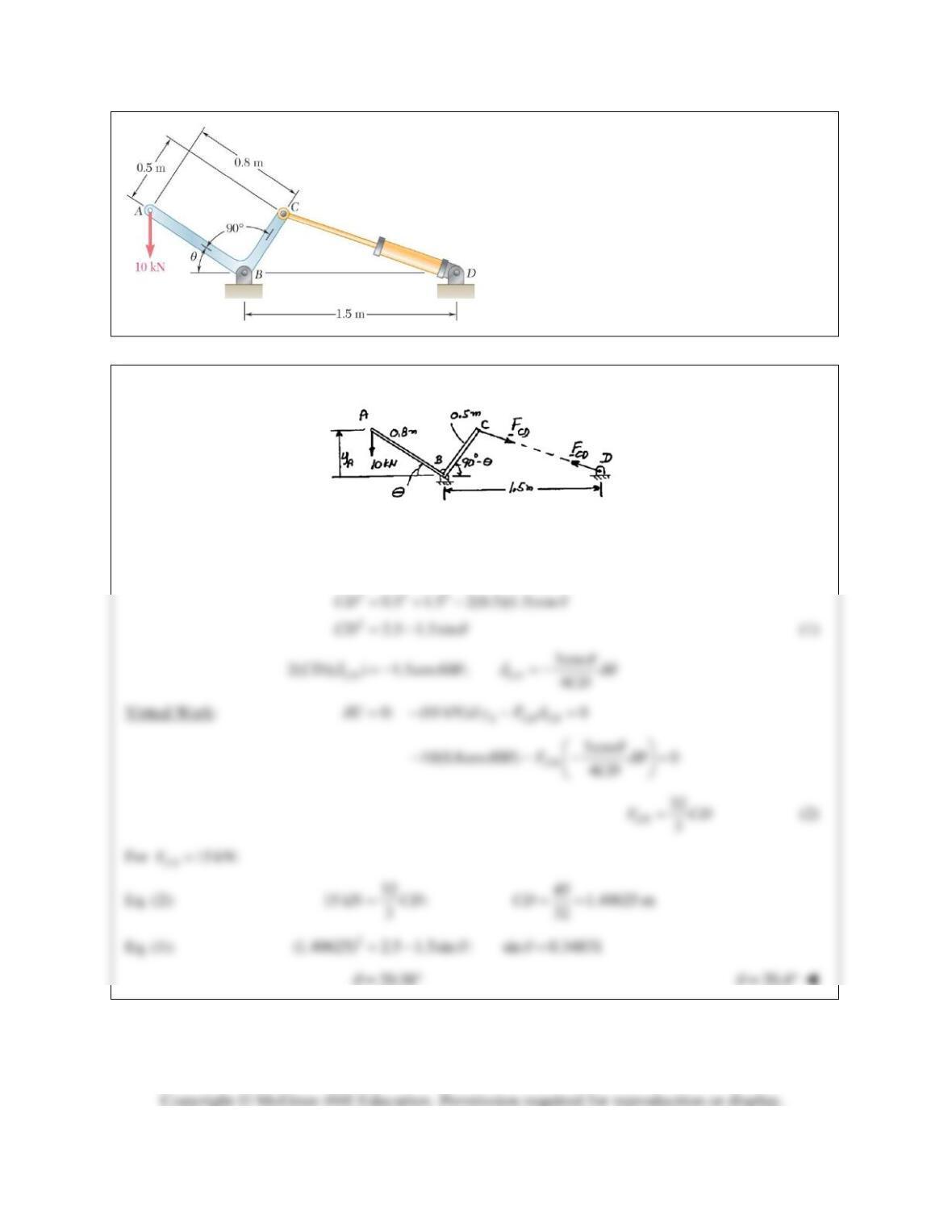
The position of member ABC is controlled by
the hydraulic cylinder CD. For the loading
shown, determine the force exerted by the
hydraulic cylinder on pin C when
55 .
SOLUTION
(0.8 m)sin
0.8cos
A
A
y
y
PROBLEM 10.44
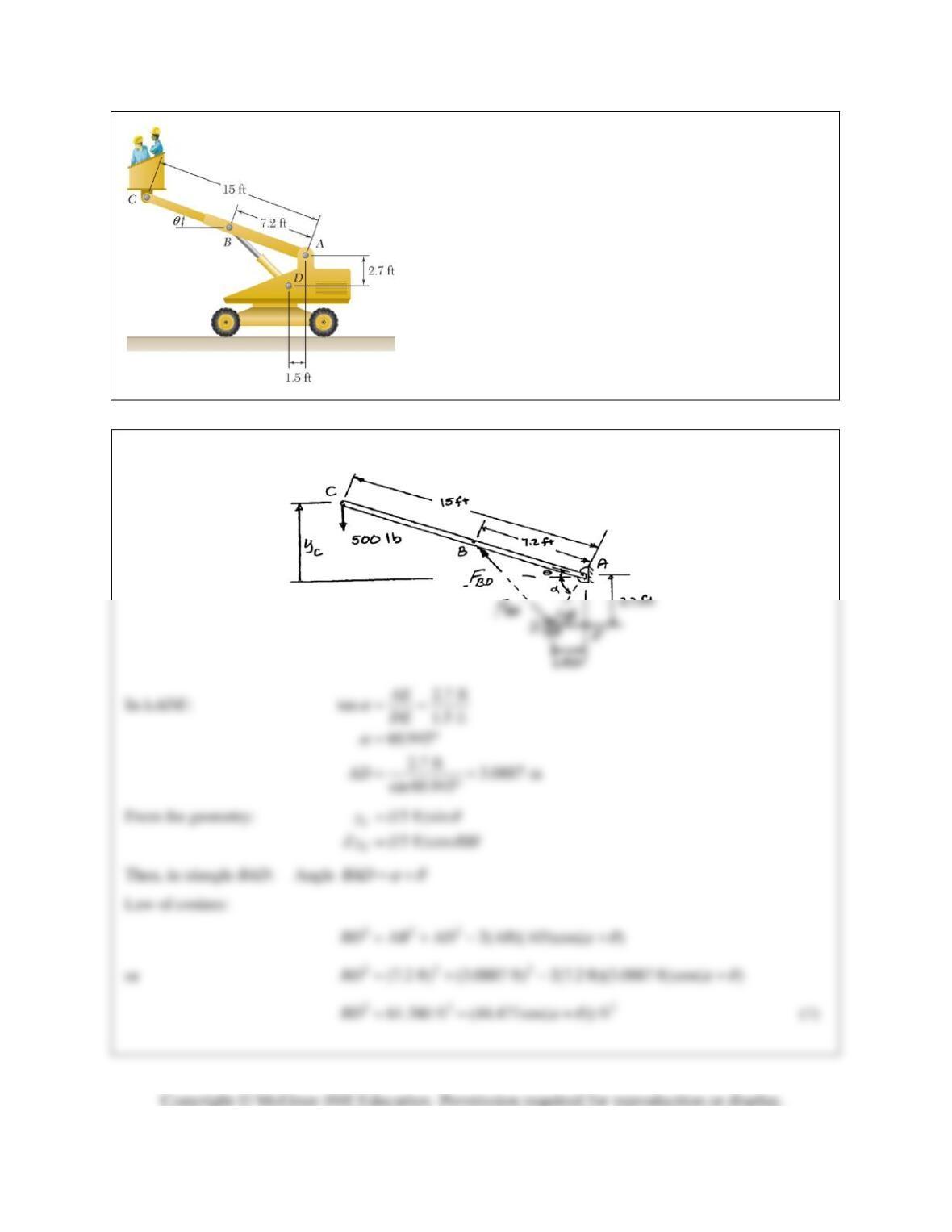
The position of member ABC is controlled by
the hydraulic cylinder CD. Determine the angle
knowing that the hydraulic cylinder exerts a 15-kN
force on pin C.
SOLUTION
222
(0.8 m)sin
0.8cos
2( )( ) cos(90 )
A
A
y
y
CD BC BD BC BD
PROBLEM 10.45
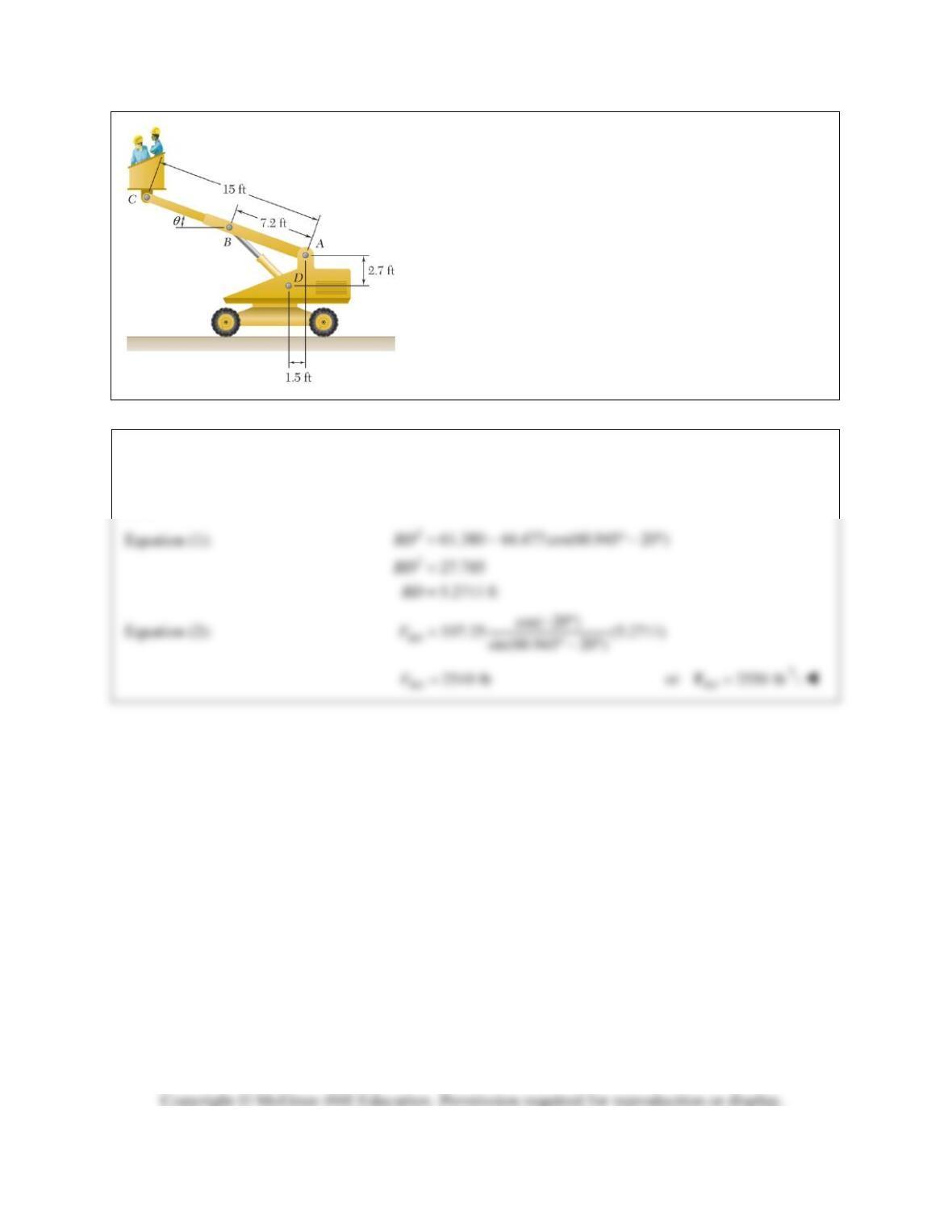
The telescoping arm ABC is used to provide an elevated
platform for construction workers. The workers and the
platform together weigh 500 lb and their combined center of
gravity is located directly above C. For the position when
20 ,
determine the force exerted on pin B by the single
hydraulic cylinder BD.
SOLUTION
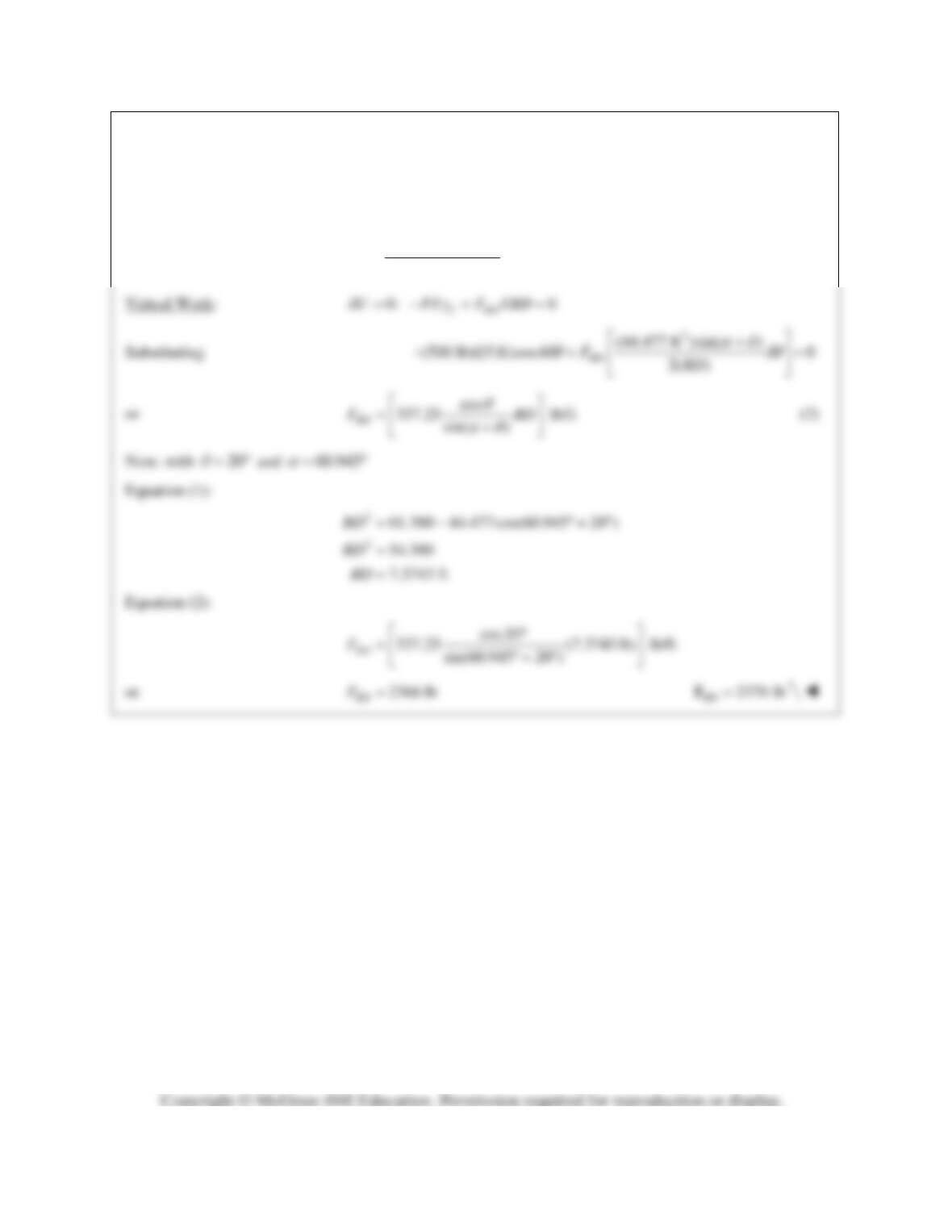
PROBLEM 10.45 (Continued)
And then
2( )( ) (44.477sin( ))
44.477sin( )
2( )
BD BD
BD BD
PROBLEM 10.46
Solve Problem 10.45 assuming that the workers are lowered
to a point near the ground so that
20 .
PROBLEM 10.45
The telescoping arm ABC is used to
provide an elevated platform for construction workers. The
workers and the platform together weigh 500 lb and their
combined center of gravity is located directly above C. For
the position when
20 ,
determine the force exerted on
pin B by the single hydraulic cylinder BD.
SOLUTION
Using the figure and analysis of Problem 10.45, including Equations (1) and (2), and with
20 ,
we
have
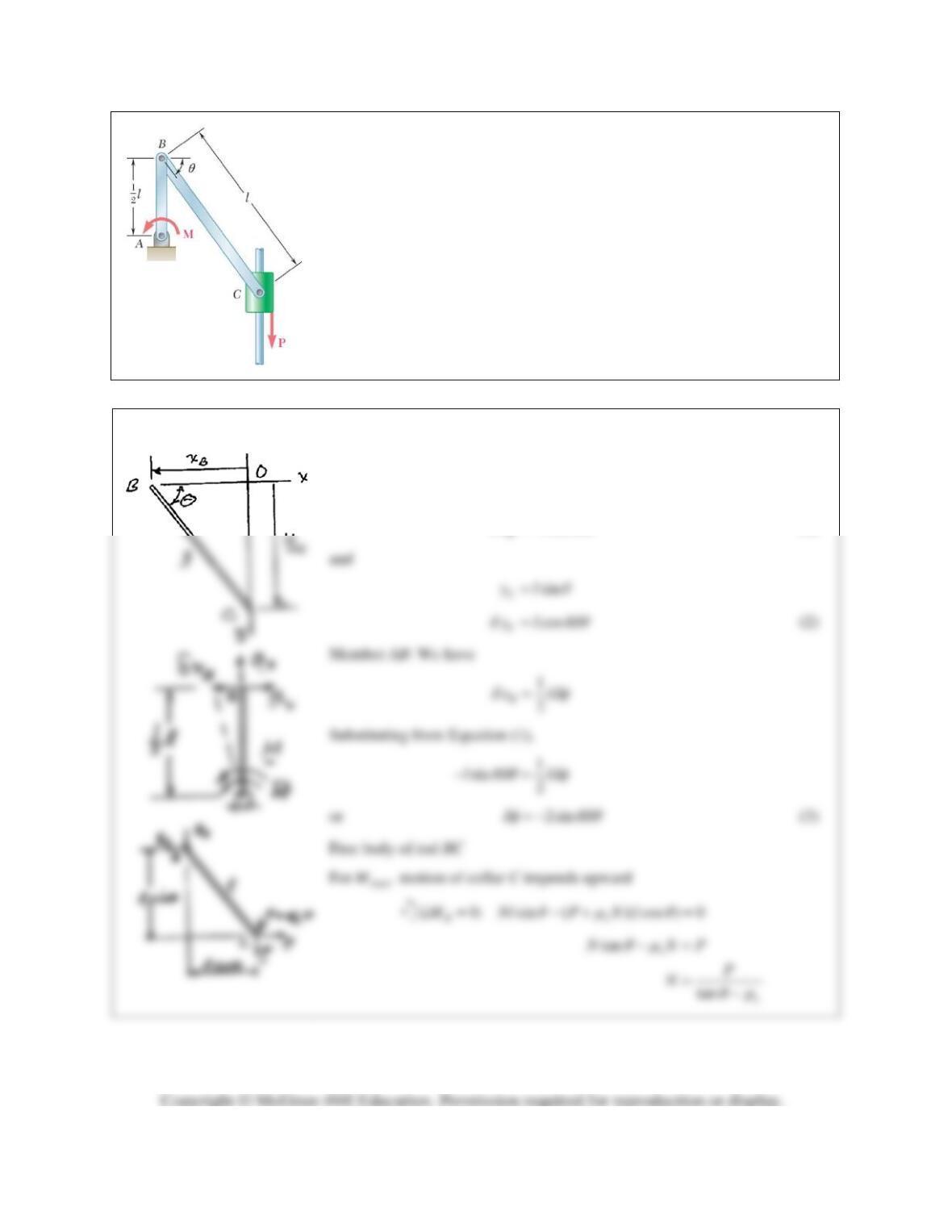
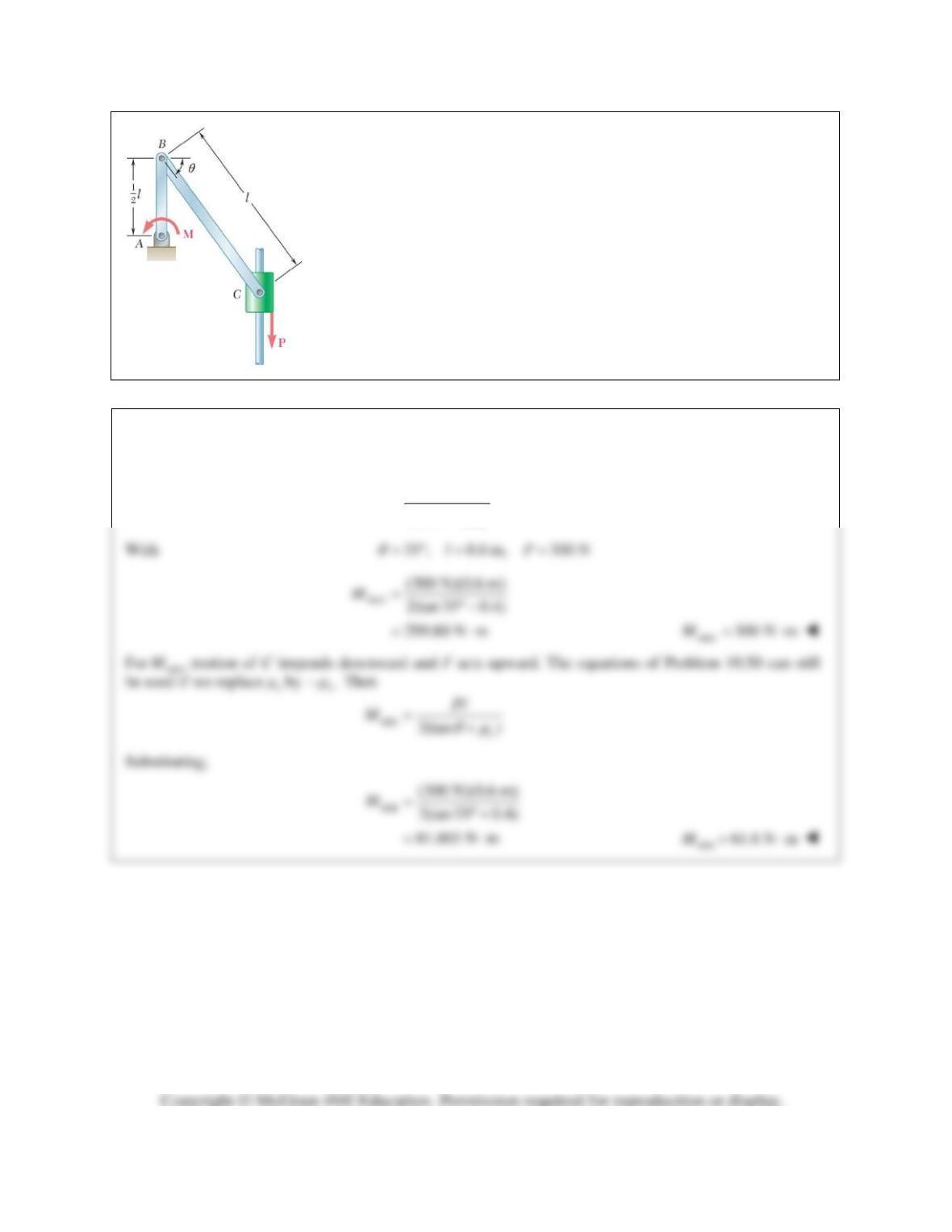
PROBLEM 10.47
Denoting by
s
the coefficient of static friction between collar C and the
vertical rod, derive an expression for the magnitude of the largest couple
M
for which equilibrium is maintained in the position shown. Explain what
happens if
tan .
s
SOLUTION
Member BC: We have
cos
B
xl
sin
xl
(1)
PROBLEM 10.47 (Continued)
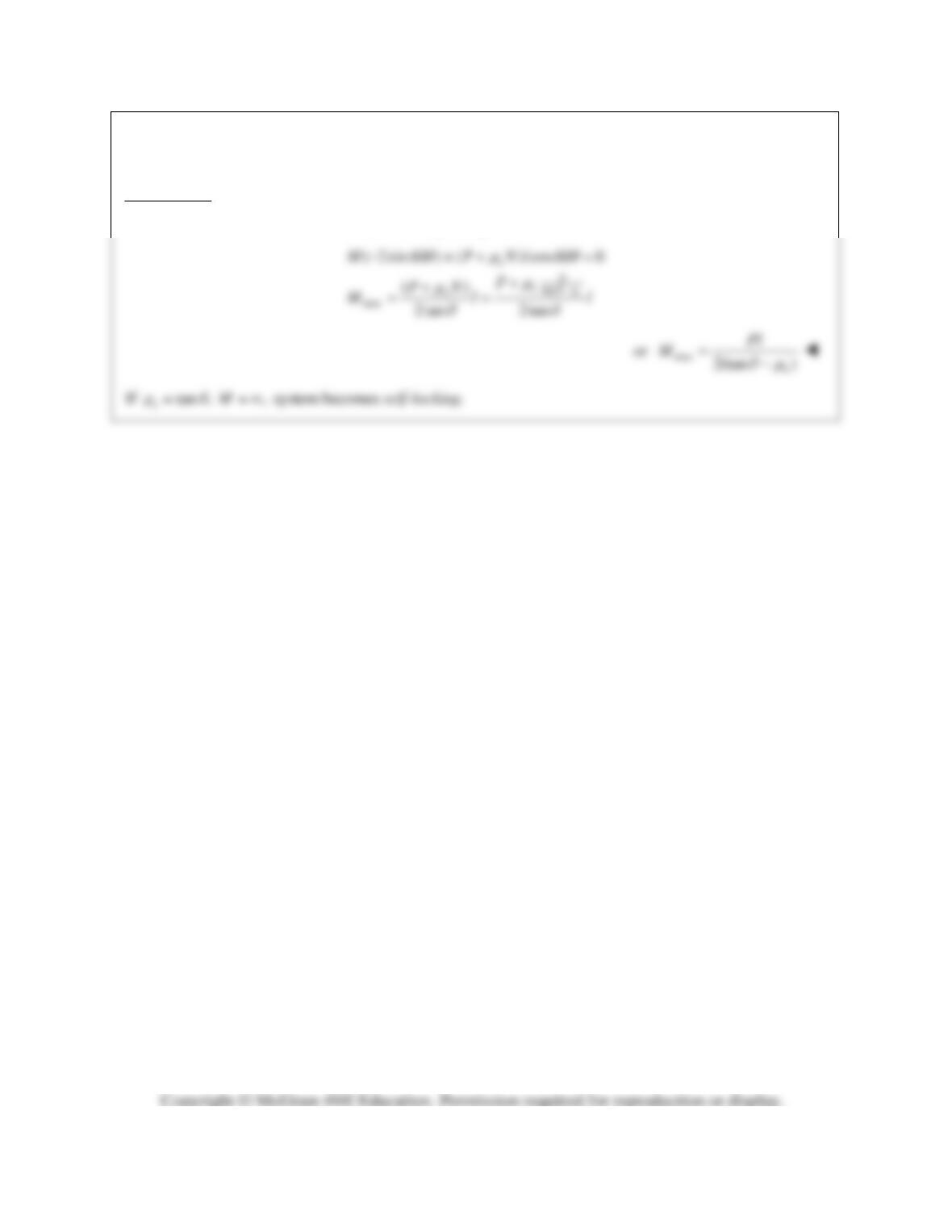
Virtual Work:
0: ( ) 0
sC
UMPNy
PROBLEM 10.48
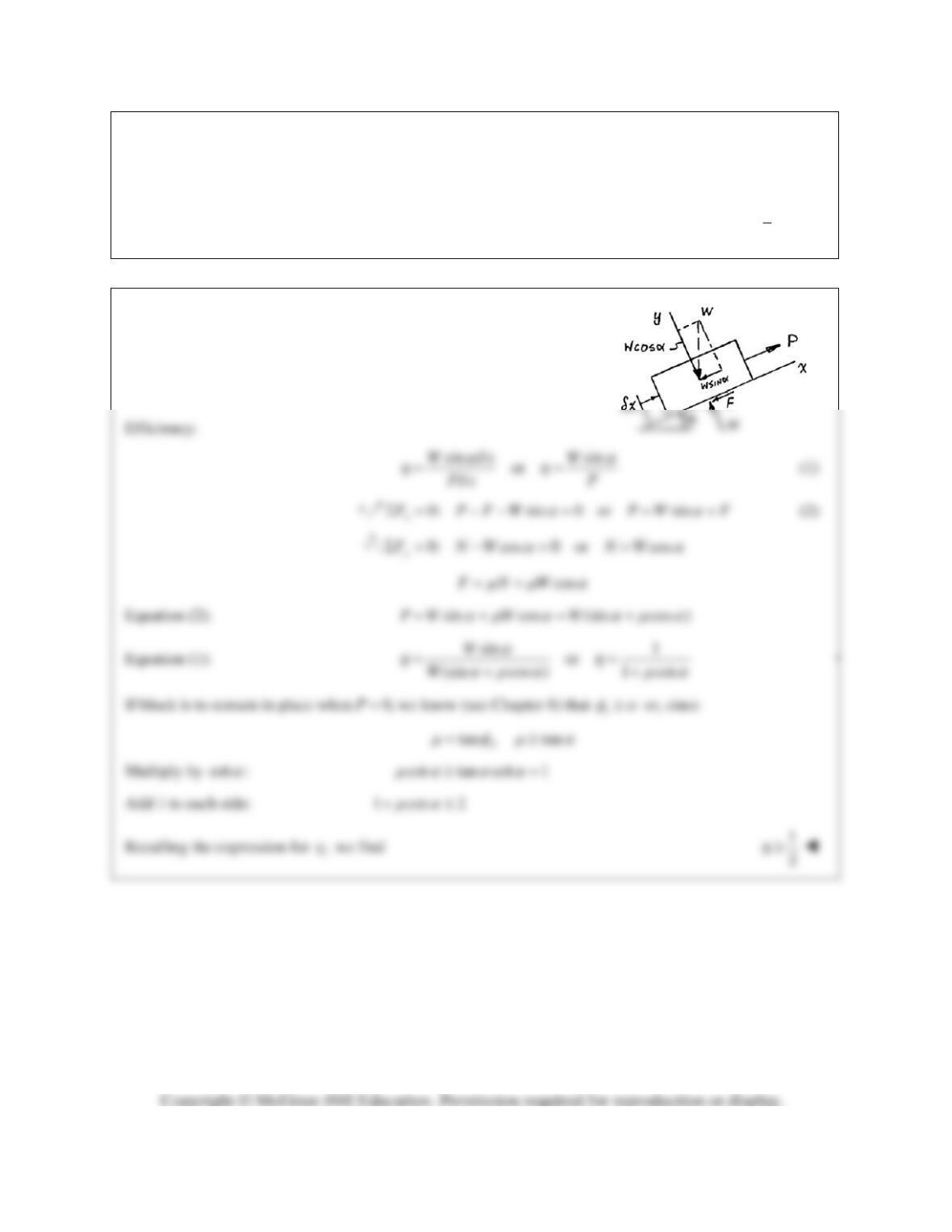
Knowing that the coefficient of static friction between collar C and the
vertical rod is 0.40, determine the magnitude of the largest and smallest
couple M for which equilibrium is maintained in the position shown, when
35, l 600 mm, and 300 N.P
SOLUTION
From the analysis of Problem 10.50, we have
max 2(tan )
s
Pl
M
s
PROBLEM 10.49
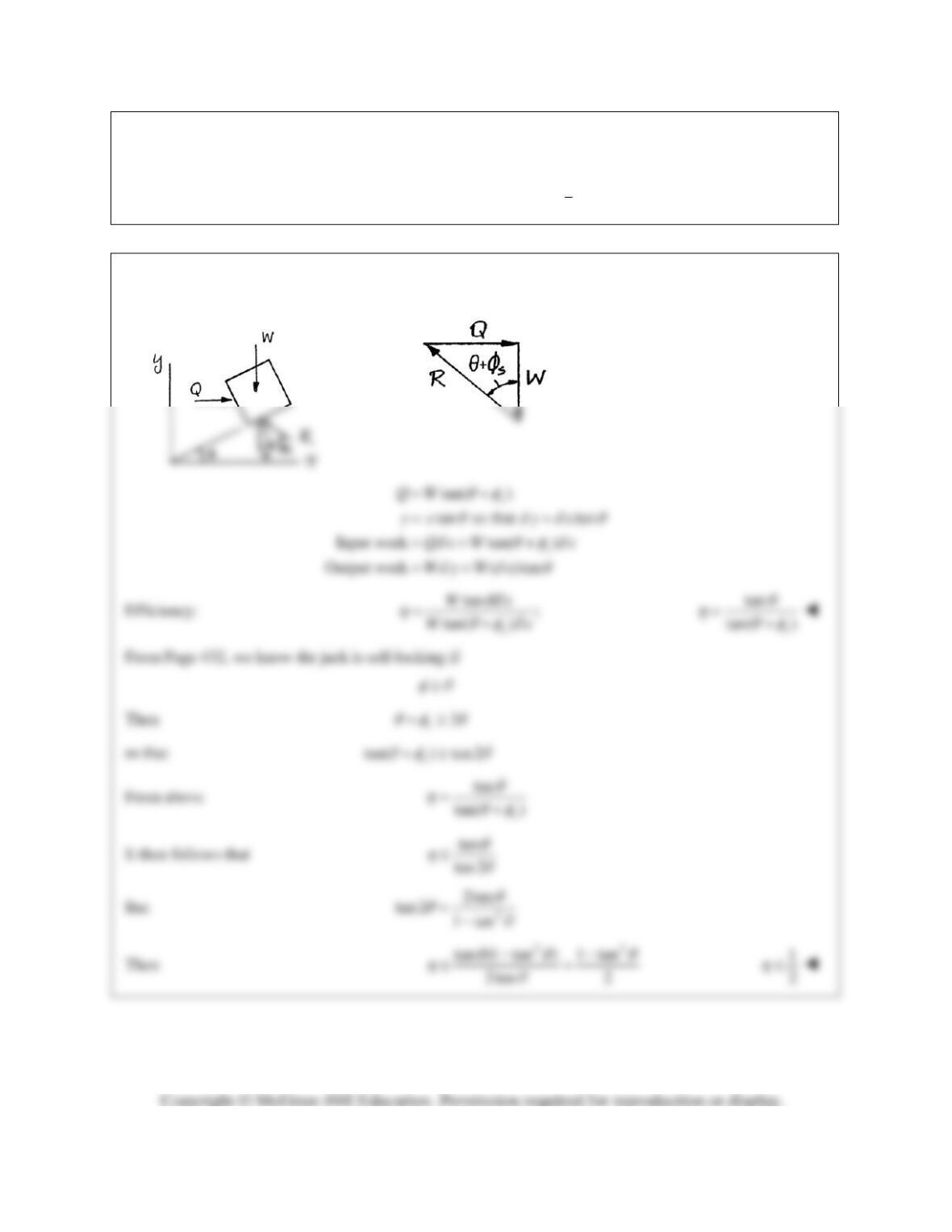
A block of weight W is pulled up a plane forming an angle
with the horizontal by a force
P
directed
along the plane. If
is the coefficient of friction between the block and the plane, derive an expression for
the mechanical efficiency of the system. Show that the mechanical efficiency cannot exceed
1
2 if the
block is to remain in place when the force
P
is removed.
SOLUTION
Input work
Output work ( sin )
Px
Wx
PROBLEM 10.50
Derive an expression for the mechanical efficiency of the jack discussed in Section 8.6. Show that if the
jack is to be self-locking, the mechanical efficiency cannot exceed
1
2.
SOLUTION
Recall Figure 8.9a. Draw force triangle
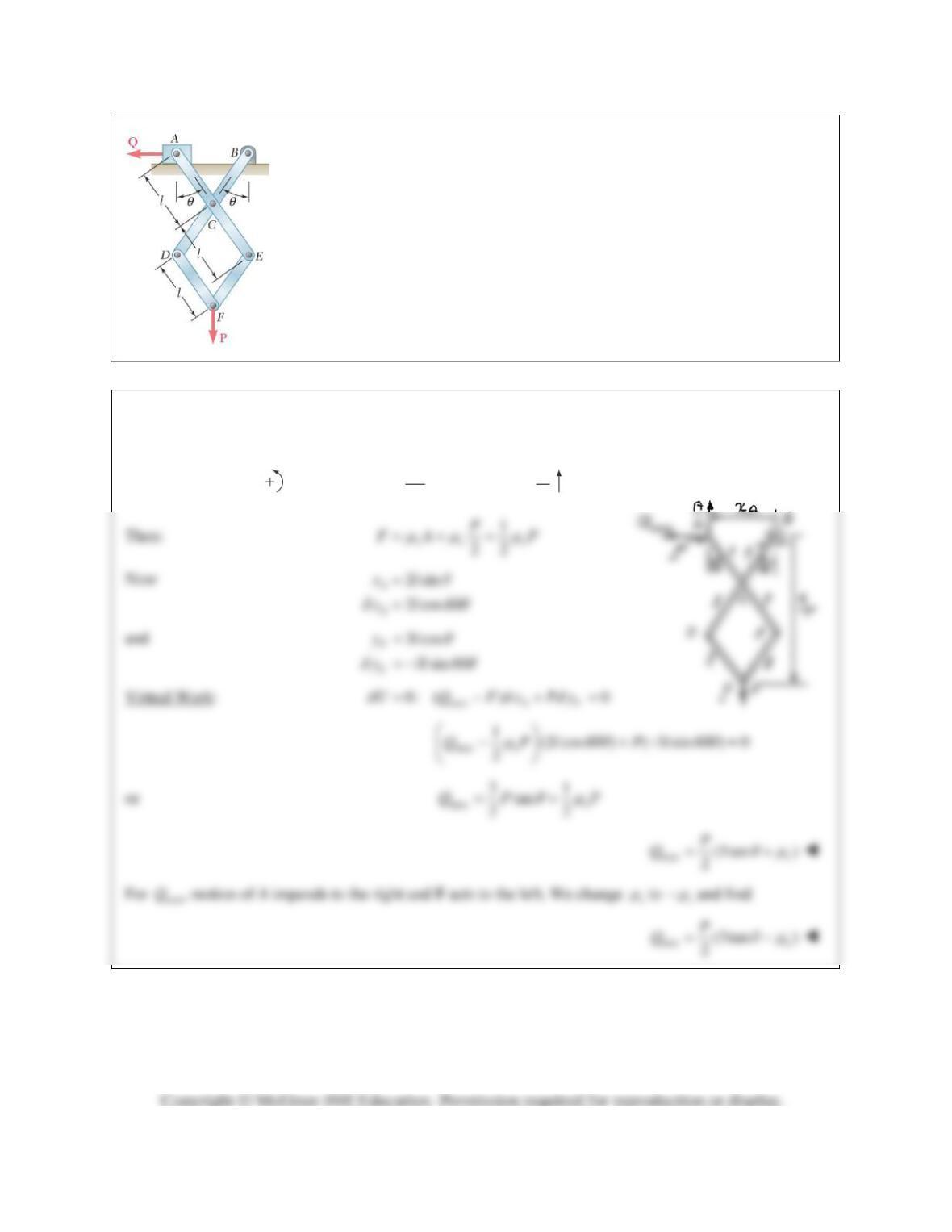
PROBLEM 10.51
Denoting by
s
the coefficient of static friction between the block attached to
rod ACE and the horizontal surface, derive expressions in terms of P,
,
s
and
for the largest and smallest magnitude of the force
Q
for which equilibrium is
maintained.
SOLUTION
For the linkage:
0: 0 or
22
A
BA
xP
MxP
A