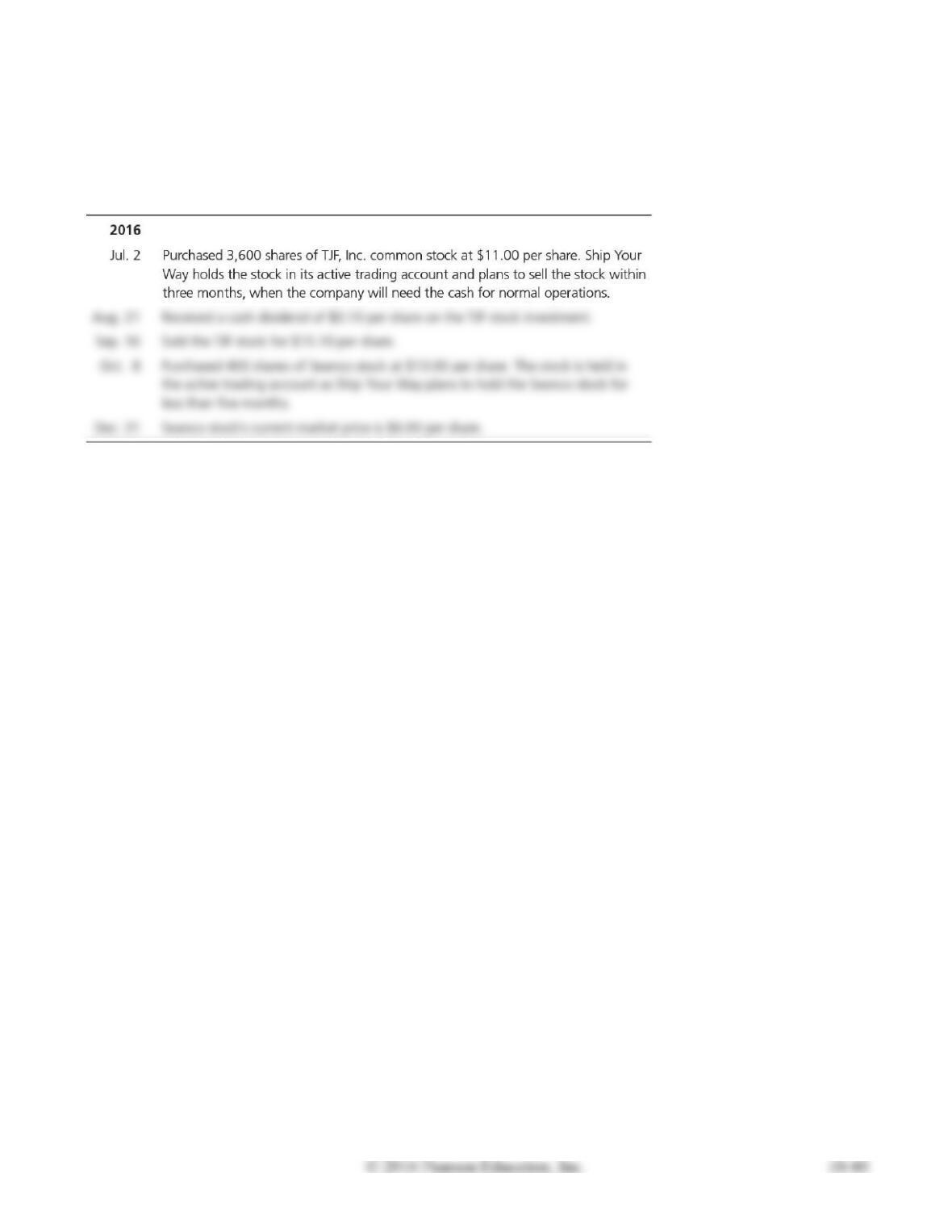
P10-21B Classifying and accounting for stock investments
Learning Objectives 1, 3, 4
2. Sep. 16 Gain on Disposal CR $14,760
Ship Your Way Corporation generated excess cash and invested in securities as follows:
Requirements
1. Classify each of the investments made during 2016. (Assume the investments represent less than
20% of ownership of outstanding voting stock.)
2. Journalize the 2016 transactions. Explanations are not required.
3. Prepare T-accounts for the investment assets, and show how to report the investments on Ship Your
Way’s balance sheet at December 31, 2016.
SOLUTION
Requirement 1
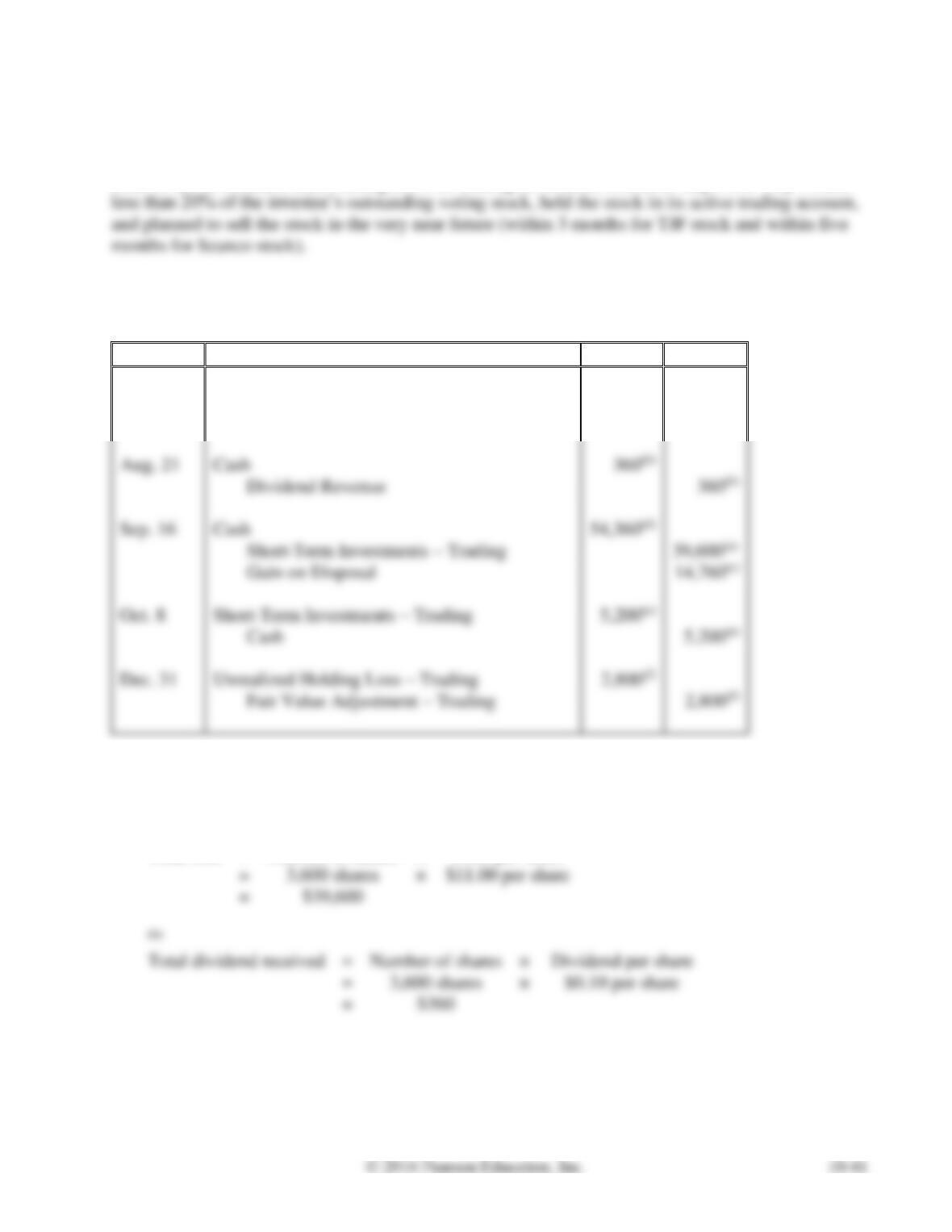
Both of the investments made during 2016 are trading investments because Ship Your Way owned
Requirement 2
Date
Accounts and Explanation
Debit
Credit
2016
Jul. 2
Short-Term Investments—Trading
39,600(a)
Cash
39,600(a)
Aug. 21
Cash
Dividend Revenue
Sep. 16
Cash
Short-Term Investments – Trading
Gain on Disposal
14,760(c)
Oct. 8
Short-Term Investments – Trading
Cash
Dec. 31
Unrealized Holding Loss – Trading
Fair Value Adjustment – Trading
Calculations:
(a)
Total cost
=
Number of shares
×
Price per share
=
×
=
(b)
Total dividend received
=
Number of shares
×
Dividend per share
=
×
=
P10-21B, cont.
Requirement 2, cont.
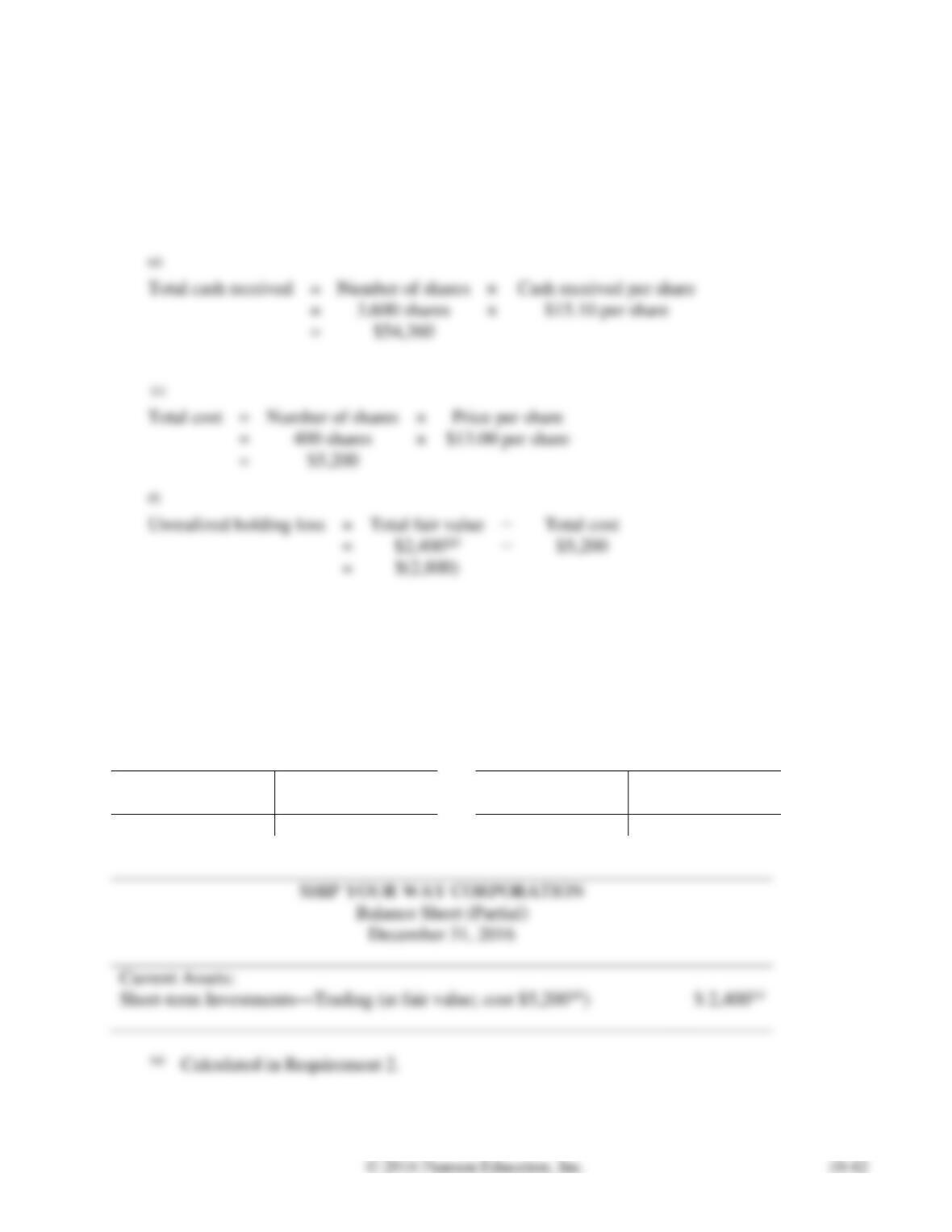
(c)
Gain on disposal
=
Total cash received
−
Total cost
=
$54,360(d)
−
$39,600
=
$14,760
(d)
Total cash received
=
Number of shares
×
=
3,600 shares
×
$15.10 per share
=
Total cost
=
Number of shares
×
=
400 shares
×
$13.00 per share
=
$5,200
Unrealized holding loss
=
Total fair value
−
=
−
$5,200
=
(g)
Total fair value
=
Number of shares
×
Market price (fair value) per share
=
400 shares
×
$6.00 per share
=
$2,400
Requirement 3
Short-Term Investments—Trading
Fair Value Adjustment—Trading
Jul. 2
39,600(a)
39,600(a)
Sep. 16
2,800(a)
Dec. 31
Oct. 8
5,200(a)
Bal.
5,200
2,800
Bal.
Current Assets:
(a)
Calculated in Requirement 2.
P10-22B Accounting for stock investments
Learning Objectives 3, 4
1. Dec. 31 Fair Value Adjustment— AFS DR $18,000
The beginning balance sheet of Water Source Co. included a $800,000 investment in Larsen stock (35%
ownership).
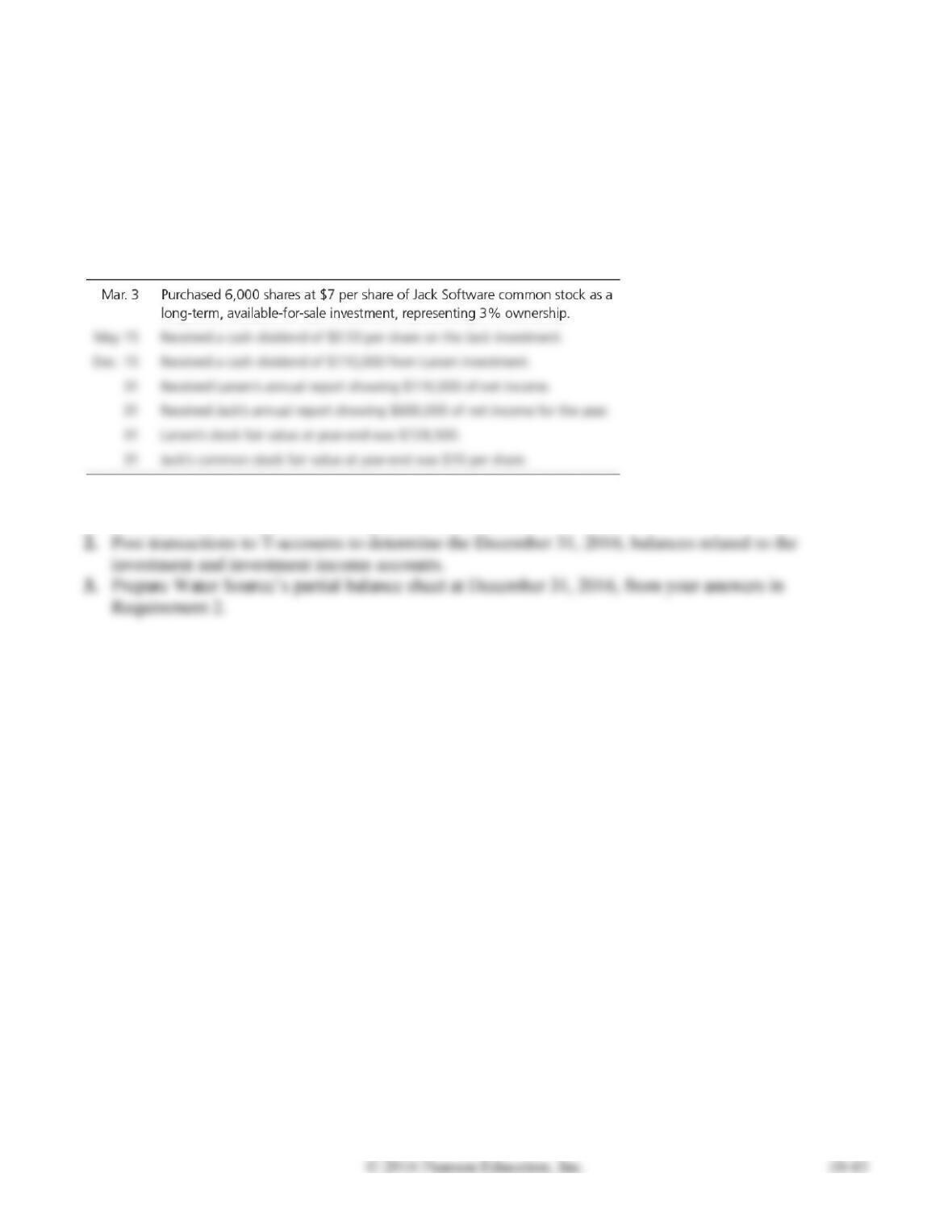
During the year, Water Source completed the following investment transactions:
Requirements
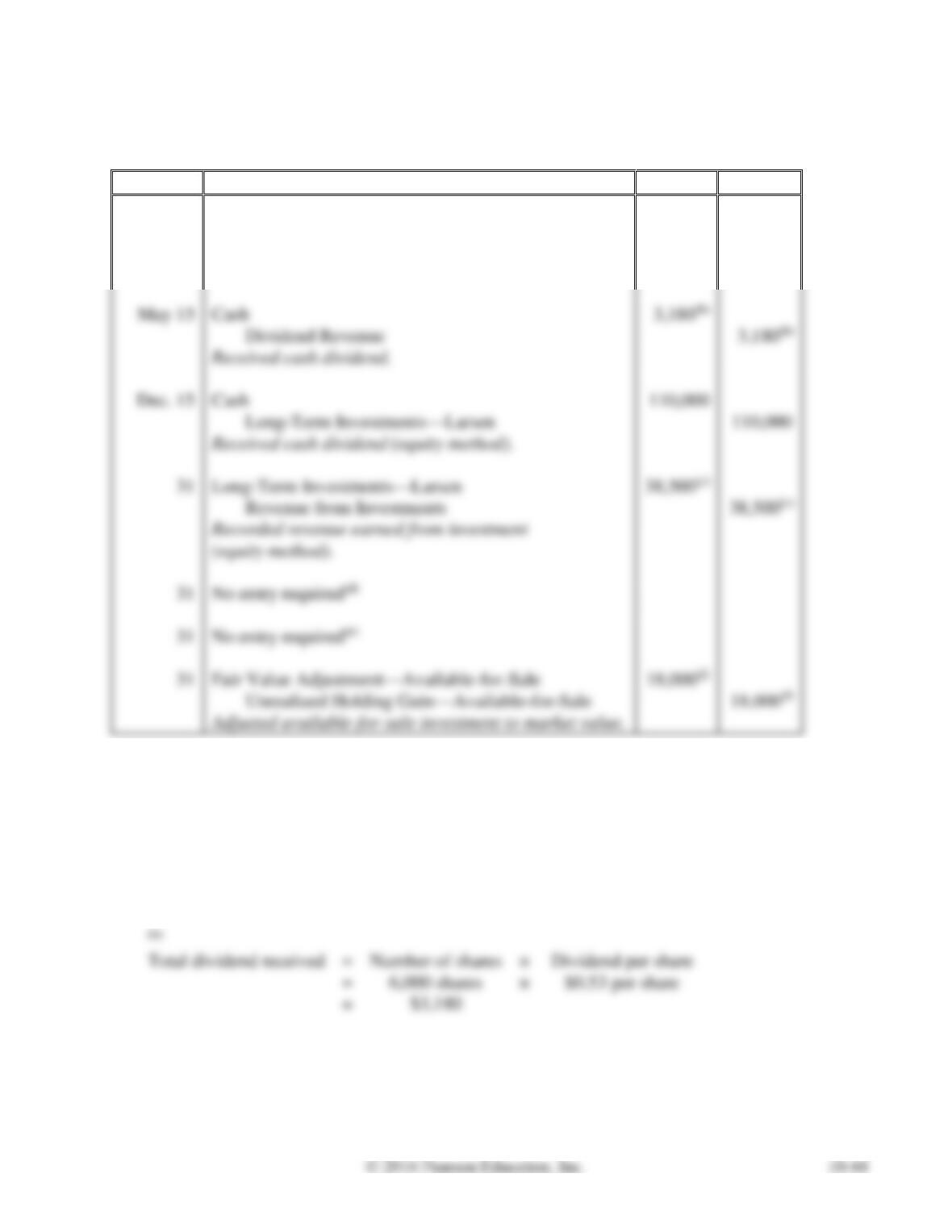
1. Journalize the transactions for the year of Water Source.
SOLUTION
Requirement 1
Date
Accounts and Explanation
Debit
Credit
2016
Mar. 3
Long-Term Investments—Available-for-Sale
42,000(a)
Cash
42,000(a)
Purchased investment in stock.
Cash
Dividend Revenue
Received cash dividend.
Cash
110,000
Long-Term Investments—Larsen
110,000
Received cash dividend (equity method).
Long-Term Investments—Larsen
Revenue from Investments
38,500(c)
(equity method).
Fair Value Adjustment—Available-for-Sale
18,000(f)
Unrealized Holding Gain—Available-for-Sale
Adjusted available-for-sale investment to market value.
Calculations:
(a)
Total cost
=
Number of shares
×
Price per share
=
6,000 shares
×
$7 per share
=
$42,000
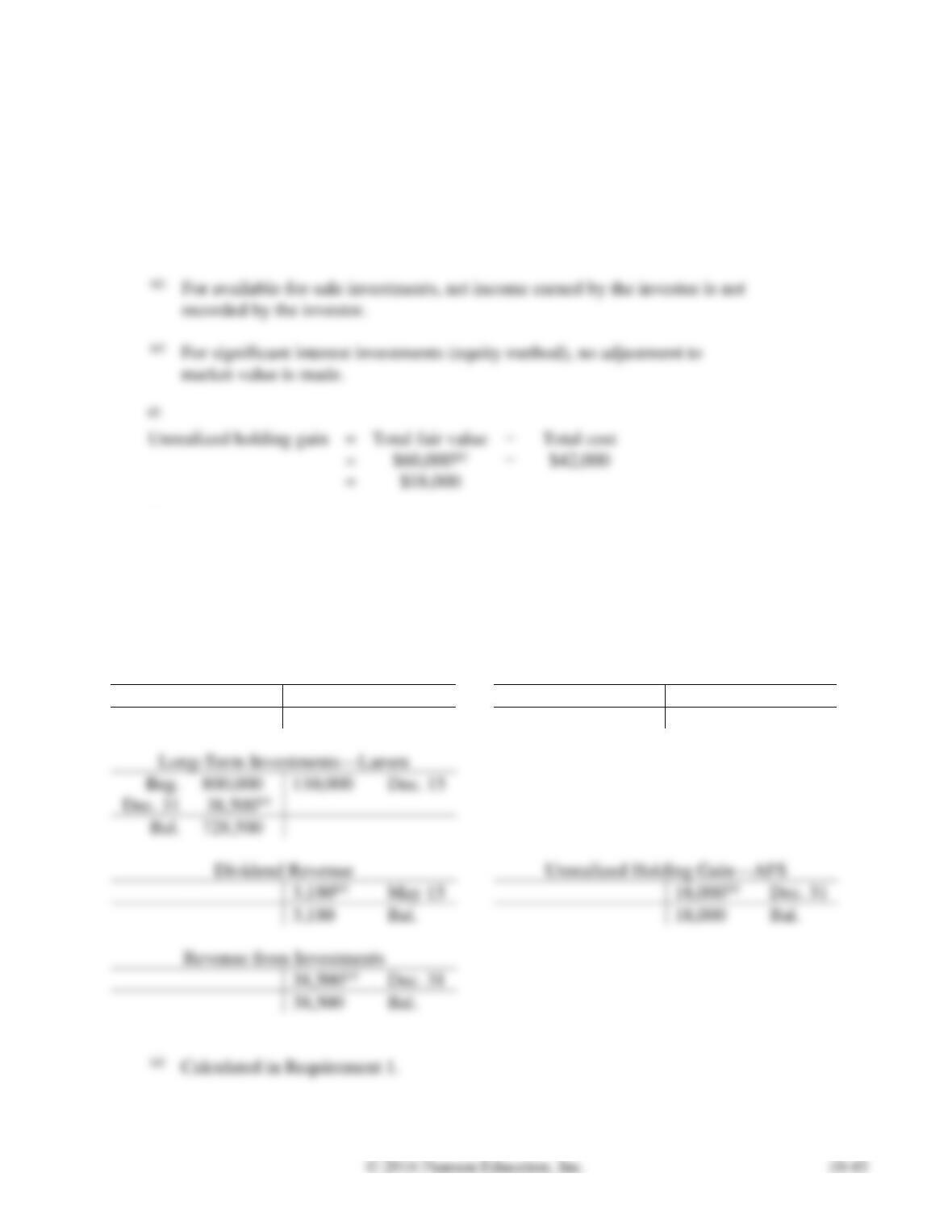
(b)
Total dividend received
=
Number of shares
×
Dividend per share
=
6,000 shares
×
$0.53 per share
=
P10-22B, cont.
Requirement 1, cont.
(c)
Revenue from
investments
=
Net income earned by investee
×
Percentage ownership
=
$110,000
×
35%
=
$38,500
recorded by the investor.
market value is made.
Unrealized holding gain
=
Total fair value
Total cost
=
=
$18,000
(g)
Total fair value
=
Number of shares
×
Fair value per share
=
6,000 shares
×
$10 per share
=
$60,000
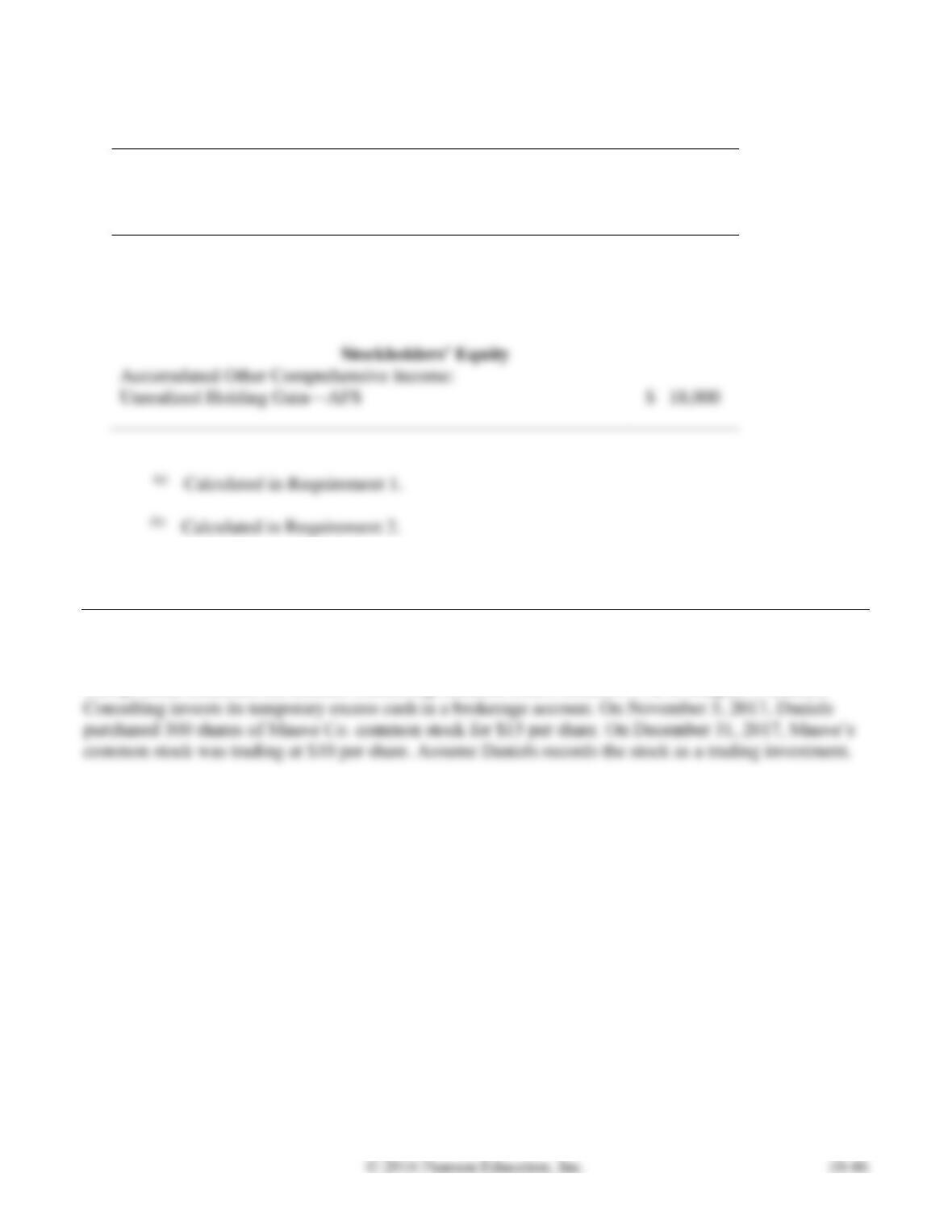
Requirement 2
Long-Term Investments—AFS
Fair Value Adjustment—AFS
Mar. 3
42,000(a)
Dec. 31
18,000(a)
Bal.
42,000
Bal.
18,000
800,000
110,000
Dec. 15
Bal.
728,500
May 15
Dec. 31
3,180
Bal.
18,000
Bal.
Dec. 31
38,500
Bal.
P10-22B, cont.
Requirement 3
WATER SOURCE CO.
Balance Sheet (Partial)
December 31, 2016
Assets
Long-term Assets:
Long-term Investments—AFS (at fair value; cost $42,000(a))
$ 60,000(a)
Long-term Investments—Larsen (equity method)
728,500(b)
Accumulated Other Comprehensive Income:
Unrealized Holding Gain—AFS
Calculated in Requirement 1.
Calculated in Requirement 2.
Continuing Problem
P10-23 Accounting for stock investments
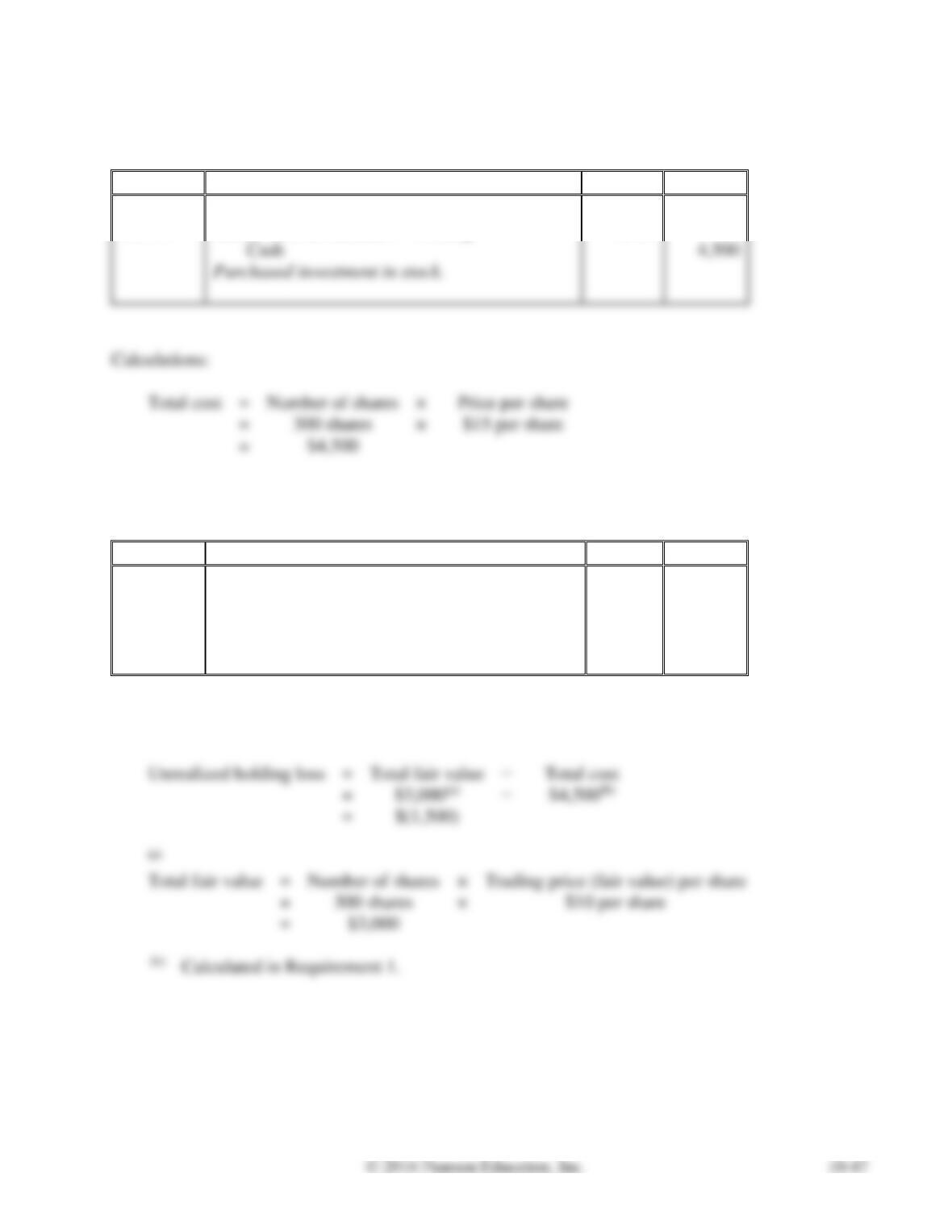
This problem continues the Daniels Consulting situation from Problem P9-42 of Chapter 9. Daniels
Requirements
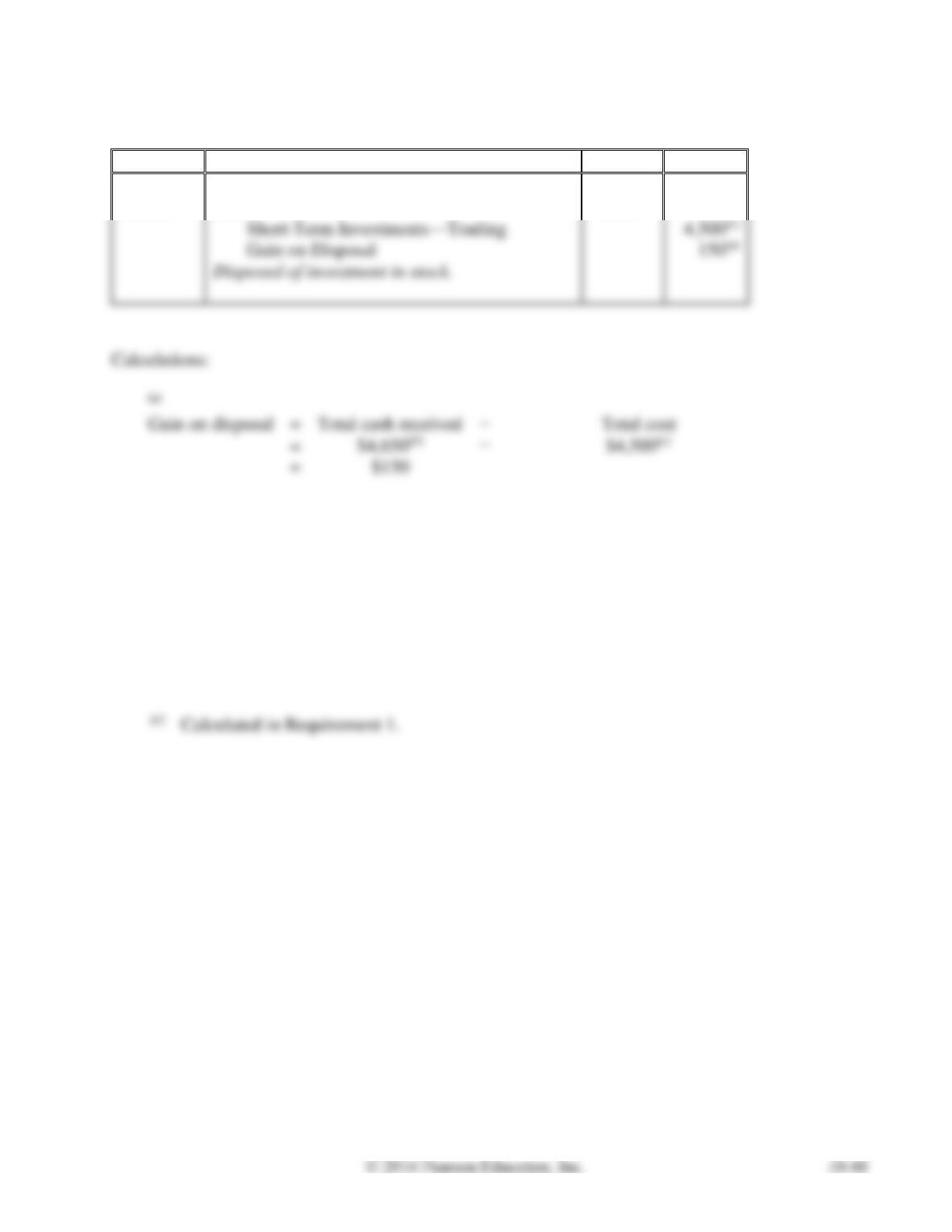
1. Journalize the acquisition of Mauve stock on November 3, 2017.
2. Journalize any entries, if required, at December 31, 2017.
3. On January 25, 2018, Daniels sold the Mauve stock for $15.50 per share. Journalize the sale.
SOLUTION
Requirement 1
Date
Accounts and Explanation
Debit
Credit
2017
Nov. 3
Short-Term Investments—Trading
4,500
Cash
4,500
Purchased investment in stock.
Requirement 2
Date
Accounts and Explanation
Debit
Credit
2017
Dec. 31
Unrealized Holding Loss—Trading
1,500
Fair Value Adjustment—Trading
1,500
Adjusted trading investment to market value.
Calculations:
P10-23, cont.
Requirement 3
Date
Accounts and Explanation
Debit
Credit
2018
Jan. 25
Cash
4,650(b)
(a)
Gain on disposal
=
Total cash received
=
=
P10-23, cont.
Requirement 3, cont.
(b)
Total cash received
=
Number of shares
×
Cash received per share
=
300 shares
×
$15.50 per share
=
$4,650
(c)
Calculated in Requirement 1.
Critical Thinking
Decision Case 10-1
Rock Designs, Inc. is a jewelry store located in Miramar Beach, Florida. After Valentine’s Day, the
store often has excess cash to get it through the three-month slow season. The primary stockholder,
Hardy Rock, wants to make this seasonal cash work for the business.
Requirements
1. Identify which investment class options are available to Rock Designs, Inc.
2. The company identifies that it wants to invest in the technology sector and has narrowed its choices
to three companies: Apple Inc., Google Inc., and Microsoft Corporation. Prepare a brief analysis
comparing the three companies, and recommend one of the three based on your analysis.
SOLUTION
Requirement 1
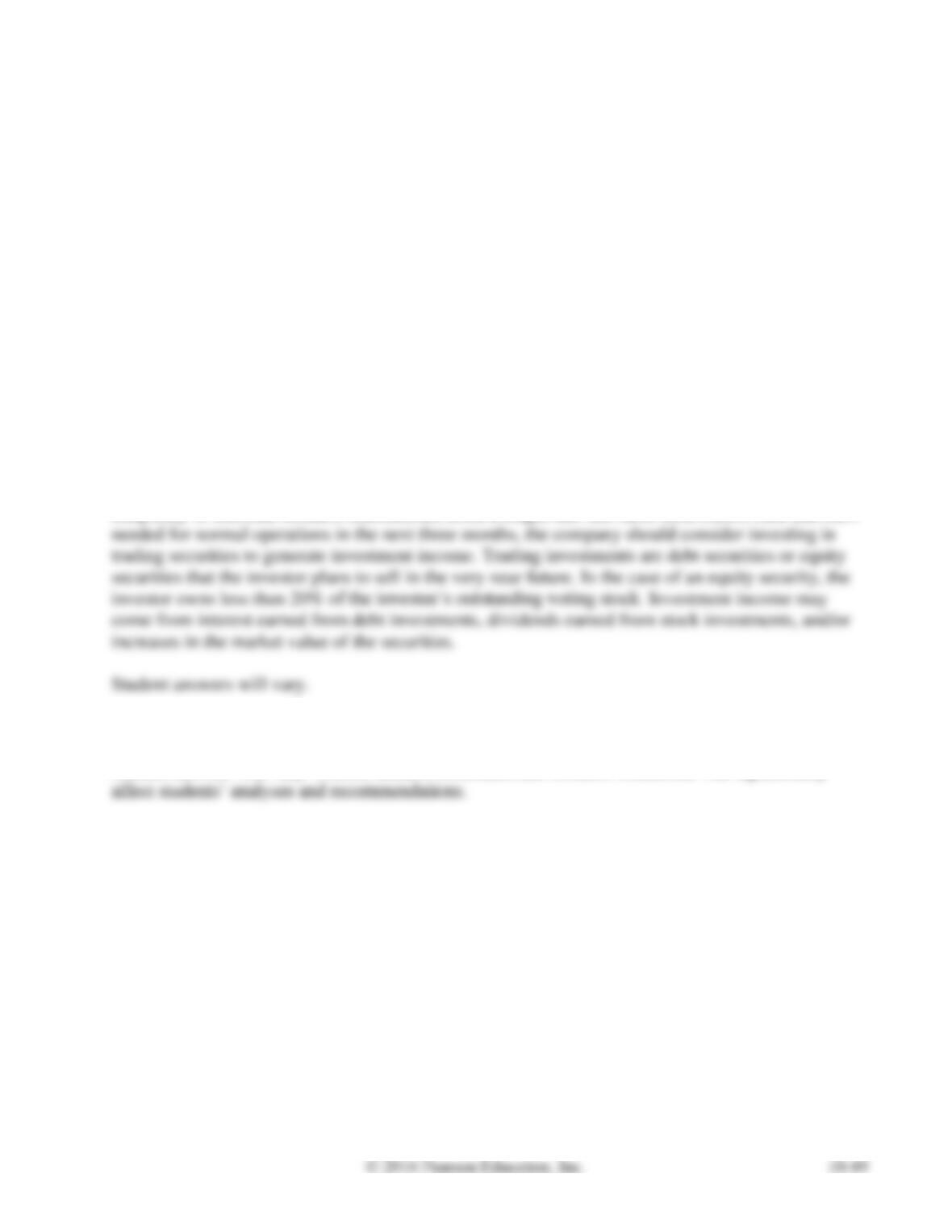
As Hardy Rock indicates, companies should make the best use of excess cash. Because, as a result of
temporary or seasonal business fluctuations, Rock Designs Inc. has short-term excess cash that isn’t
Requirement 2
Student answers will vary. Current market, economic, and business conditions will significantly
Ethical Issue 10-1
As a result of the recent mortgage crisis, many banks reported record losses to their mortgage
receivables and other assets based on the decline in these assets’ fair values.
Requirements
1. What would the effect be to stakeholders if such losses were not reported in a timely way?
2. If a business chooses not to report these losses, is there an ethical issue involved? Who is hurt?
SOLUTION
Requirement 1
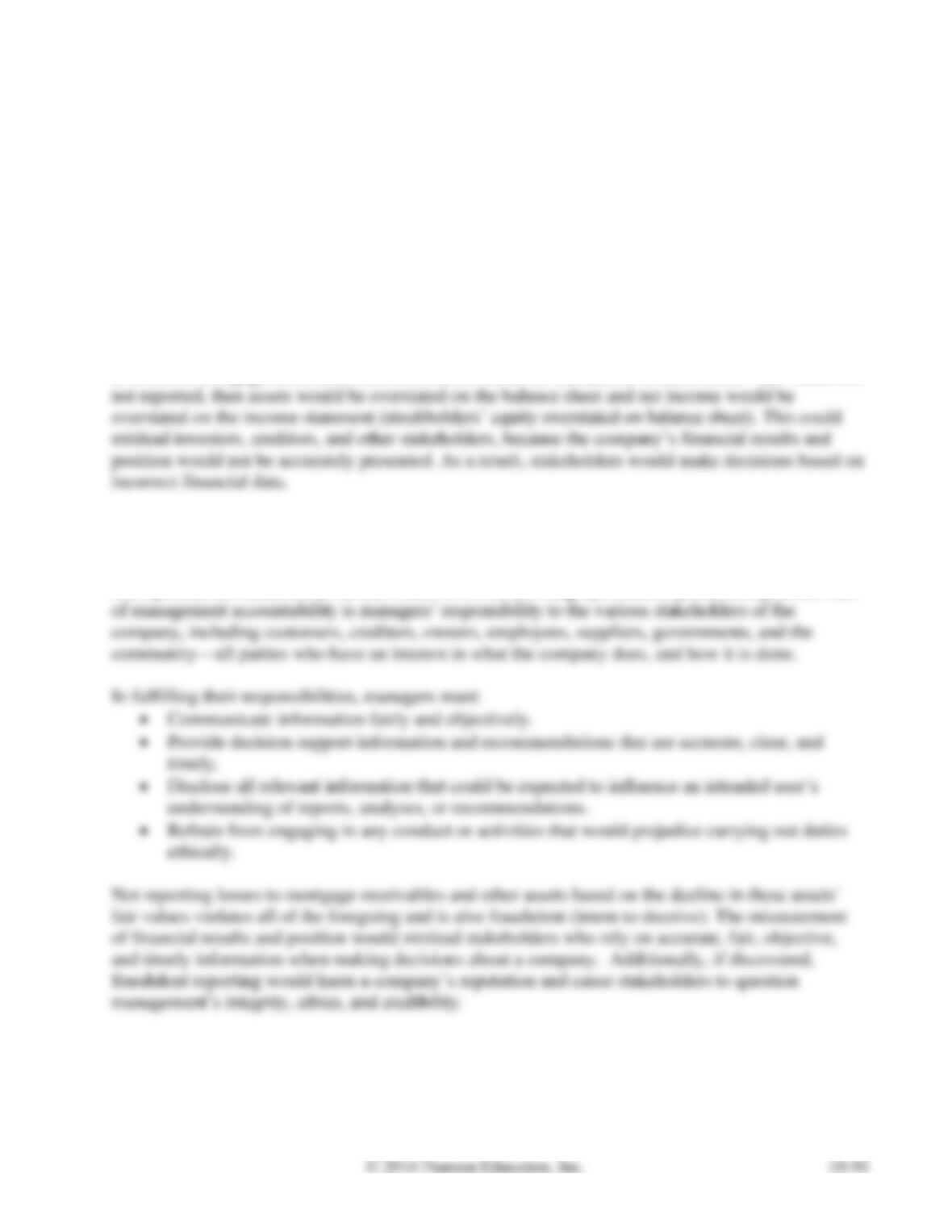
If losses to mortgage receivables and other assets based on the decline in these assets’ fair values are
Requirement 2
If losses to mortgage receivables and other assets based on the decline in these assets’ fair values are
not reported, the fundamental ethical issues involved are integrity, credibility, and competence. Part
Fraud Case 10-1
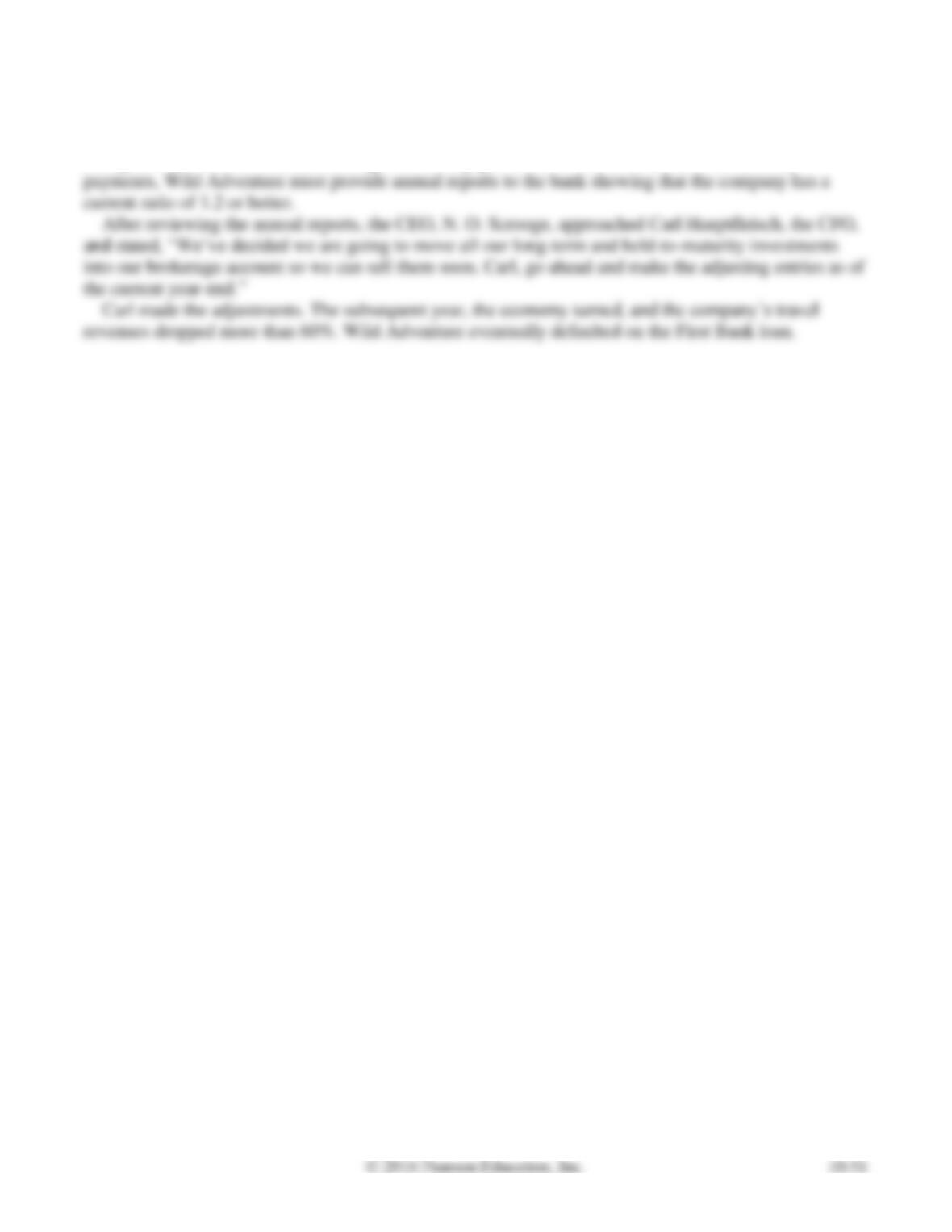
Wild Adventure conducts tours of wildlife reserves around the world. The company recently purchased
a lodge in Adelaide, Australia, securing a 4% mortgage from First Bank. In addition to monthly
Requirements
1. What effect did the adjustments have on the financial statements? What effect did the adjustments
have on the current ratio?
2. What type of information in the financial reports would have helped the bank detect this
reclassification?
3. Has a fraud occurred? If so, what is the fraud?
SOLUTION
Requirement 1
The adjustment, a reclassification of long-term investments from long-term assets to current assets
Requirement 2
Wild Adventure is required to disclose the reclassification in the notes to its financial statements. If
dropped to zero, the bank should have requested additional details from the company.
Requirement 3
A fraud has occurred. There was an intent to deceive. Included in ethical behavior are integrity,
credibility, and competence. Part of management accountability is managers’ responsibility to the
various stakeholders of the company—all parties who have an interest in what the company does,
and how it is done. These include creditors, such as First Bank.

Financial Statement Case 10-1
Requirements
1. What classifications of debt and/or equity security investments does Starbucks hold?
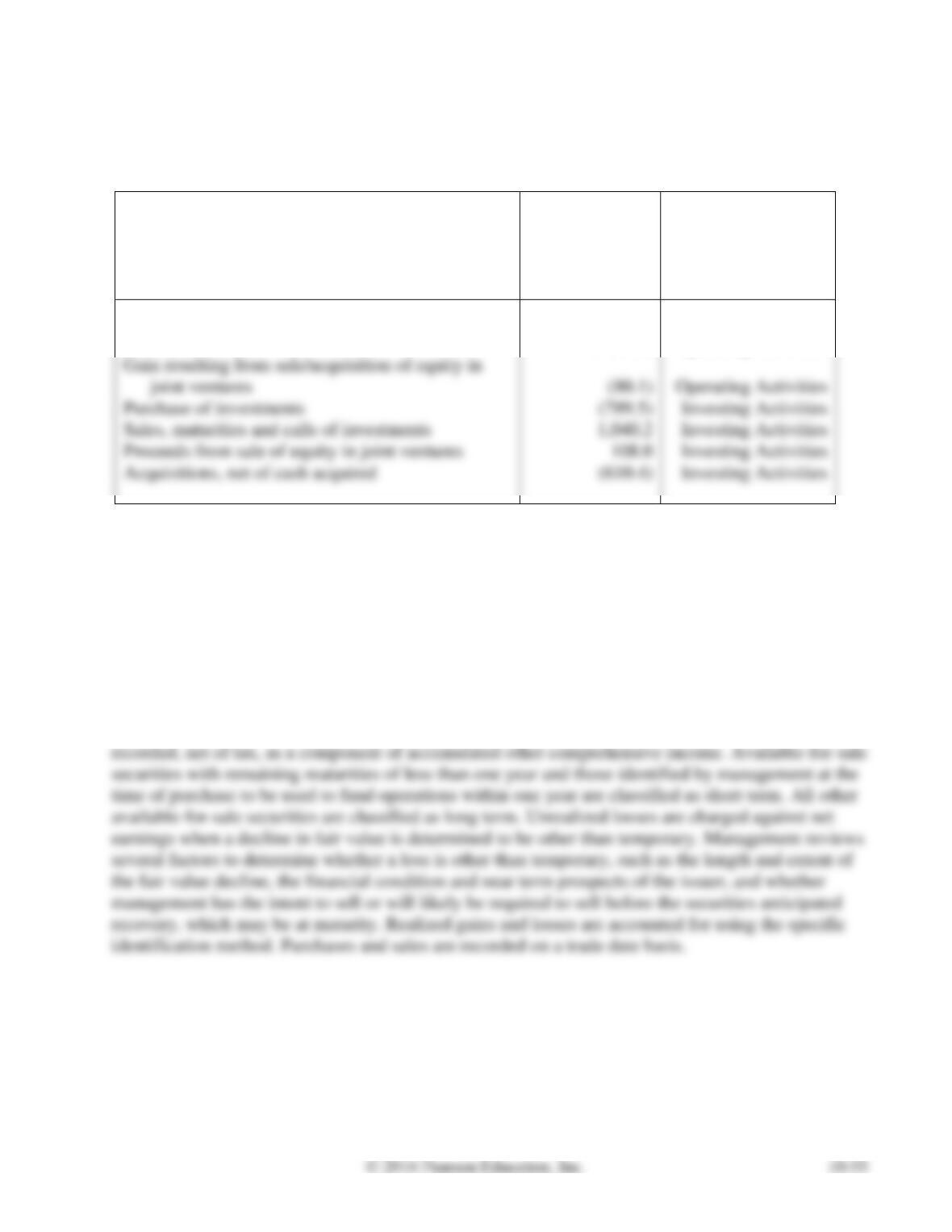
2. Review Notes 4 and 6. Give the breakdown of the short-term and long-term investments Starbucks
held at September 29, 2013.
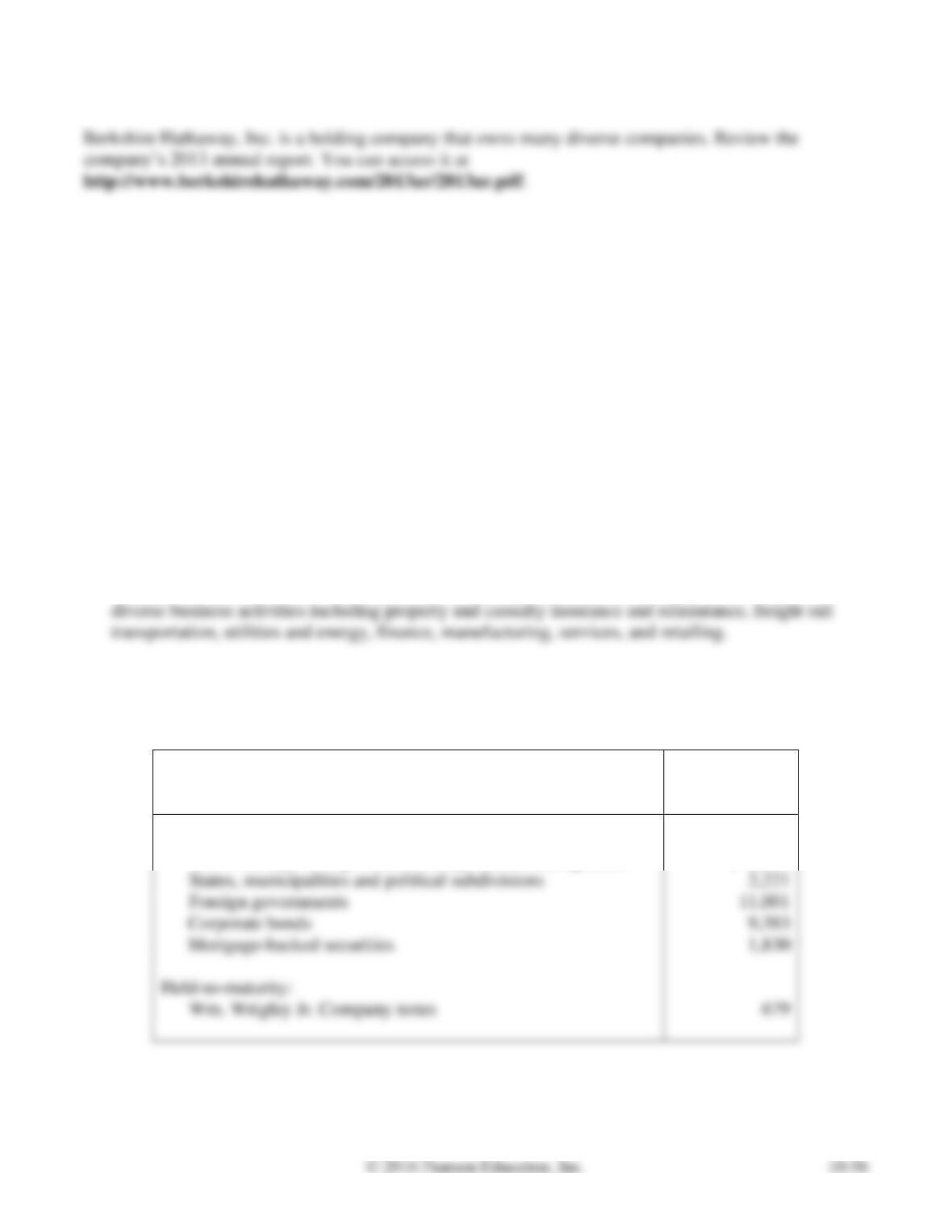
3. Review Starbucks’s consolidated statement of cash flows for the year ended September 29, 2013.
Identify each item related to the company’s debt and equity security investments, the amount of the
item, and the section of the cash flow statement in which the item appears.
4. Review Note 1, specifically Short-term and Long-term Investments. How are Starbucks’s available–
for-sale investments reported? How are Starbucks’s trading investments reported?
SOLUTION
Requirement 1
Source: Starbucks Corporation, Consolidated Balance Sheets.
Classifications of debt and/or equity securities held by Starbucks:
Requirement 2
Source: Starbucks Corporation, Consolidated Balance Sheets and Notes to the Consolidated Financial
Statements, Note 4.
Sept. 29, 2013
Amounts
in millions
Short-term investments:
Available-for-sale securities
Agency obligations
Commercial paper
Corporate debt securities
Government treasury securities
Certificates of deposit
Total Available-for-sale securities
591.5
Trading securities
Total Short-term investments
658.1
Long-term investments:
Available-for-sale securities
Agency obligations
Corporate debt securities
Auction rate securities
Total Long-term investments
Financial Statement Case 10-1, cont.
Requirement 3
Source: Starbucks Corporation, Consolidated Statements of Cash Flows.
Items Related to Debt and Equity Security
Investments:
Fiscal Year
Ended
Sept. 29, 2013
Amounts
in Millions
Section
Income earned from equity method investees, net
of distributions
$ (56.2)
Operating Activities
(80.1)
Operating Activities
Purchase of investments
Sales, maturities and calls of investments
Proceeds from sale of equity in joint ventures
Acquisitions, net of cash acquired
Requirement 4
Source: Notes to the Consolidated Financial Statements, Note 1.
Trading securities are recorded at fair value with unrealized holding gains and losses included in net
earnings.
Available-for-sale securities are recorded at fair value, and unrealized holding gains and losses are
Team Project 10-1
Requirements
With a partner or group, lead your class in a discussion of the following questions or write a report as
directed by your instructor.
1. What types of companies does Berkshire Hathaway own?
2. Review Note 3. At December 31, 2013, how much did the company hold in available-for-sale and
held-to-maturity investments?
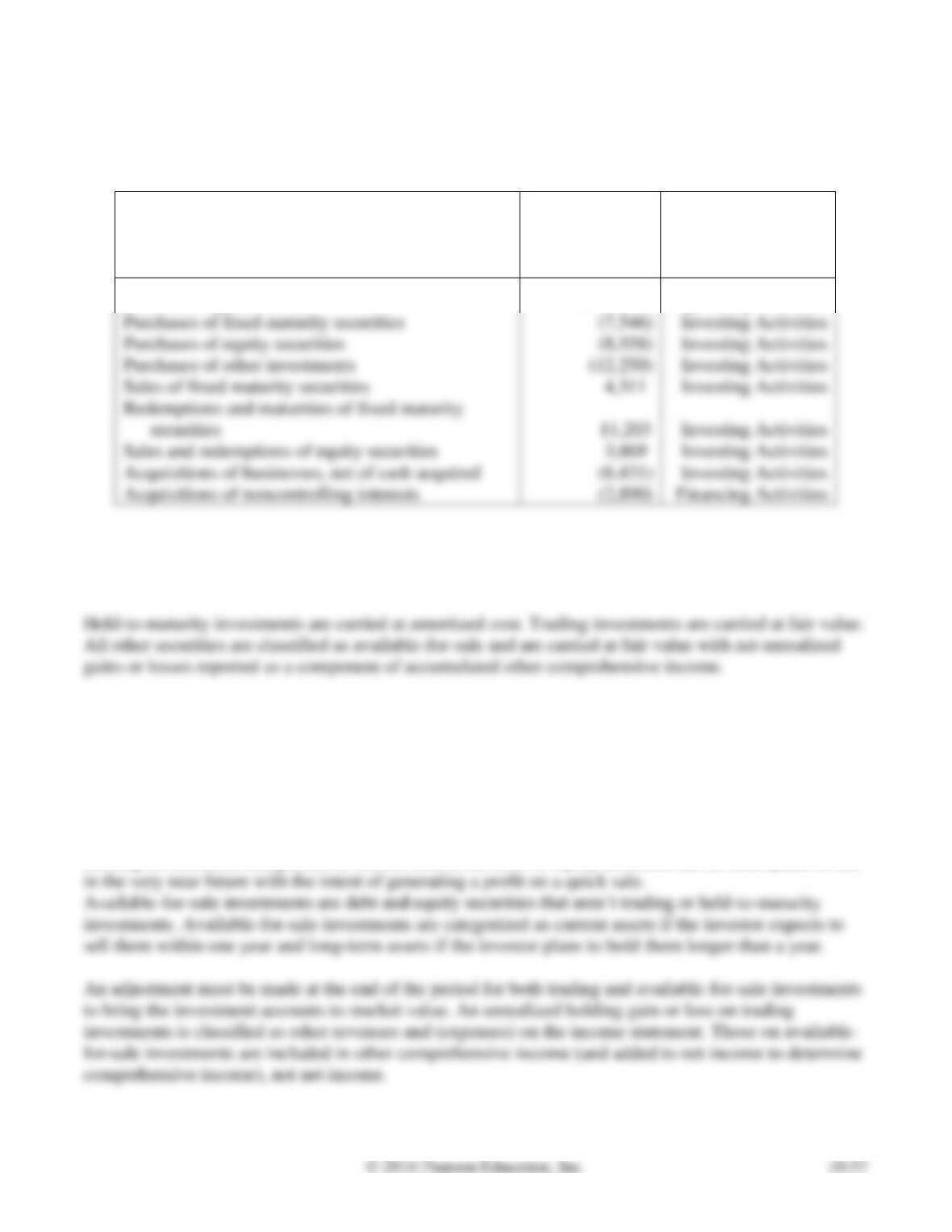
3. Review Berkshire’s consolidated statement of cash flows for the year ended December 31, 2013.
Identify each item related to the company’s debt and equity security investments, the amount of the
item, and the section of the cash flow statement in which the item appears.
4. Review Note 1(d). How, if at all, does the company use fair value measurements in regards to its
investments?
SOLUTION
Requirement 1
Source: Berkshire Hathaway Inc. 2013 Annual Report
Berkshire Hathaway Inc. is a holding company owning subsidiaries that engage in a number of
Requirement 2
Source: Berkshire Hathaway Inc. and Subsidiaries, Consolidated Balance Sheets, Note 3
Dec. 31, 2013
Amounts
in Millions
Available-for-sale:
U.S. Treasury, U.S. government corporations and agencies
$ 2,650
States, municipalities and political subdivisions
Wm. Wrigley Jr. Company notes
Team Project 10-1, cont.
Requirement 3
Source: Berkshire Hathaway Inc. and Subsidiaries, Consolidated Statements of Cash Flows.
Items Related to Debt and Equity Security
Investments:
Year Ended
Dec. 31, 2013
Amounts
in Millions
Section
Investment (gains) losses
$ (4,065)
Operating Activities
Purchases of fixed maturity securities
Purchases of equity securities
Purchases of other investments
Sales of fixed maturity securities
4,311
Redemptions and maturities of fixed maturity
Sales and redemptions of equity securities
3,869
Acquisitions of businesses, net of cash acquired
(6,431)
Acquisitions of noncontrolling interests
Financing Activities
Requirement 4
Source: Notes to the Consolidated Financial Statements, Note 1 (d).
Communication Activity 10-1
In 150 words or fewer, explain the difference between trading investments and available-for-sale
investments.
SOLUTION
Trading investments, categorized as current assets, are debt or equity securities the investor plans to sell