Chapter 10
Standard Costs and Variances
Solutions to Questions
10-1 A quantity standard indicates how much
10-2 Ideal standards assume perfection and
do not allow for any inefficiency. Ideal standards
are rarely, if ever, attained. Practical standards
can be attained by employees working at a
reasonable, though efficient pace and allow for
normal breaks and work interruptions.
10-5 The materials price variance is usually
the responsibility of the purchasing manager.
The materials quantity and labor efficiency
variances are usually the responsibility of
production managers and supervisors.
10-6 The materials price variance can be
computed either when materials are purchased
or when they are placed into production. It is
usually better to compute the variance when
10-7 This combination of variances may
10-8 If standards are used to find who to
blame for problems, they can breed resentment
and undermine morale. Standards should not be
used to find someone to blame for problems.
10-9 Several factors other than the
10–10 If poor quality materials create
production problems, a result could be excessive
labor time and therefore an unfavorable labor
efficiency variance. Poor quality materials would
not ordinarily affect the labor rate variance.
10–11 If overhead is applied on the basis of
direct labor-hours, then the variable overhead
efficiency variance and the direct labor efficiency
variance will always be favorable or unfavorable
together. Both variances are computed by
10–12 A statistical control chart is a graphical
aid that helps identify variances that should be
10–13 If labor is a fixed cost and standards are
tight, then the only way to generate favorable
labor efficiency variances is for every
workstation to produce at capacity. However, the
output of the entire system is limited by the
capacity of the bottleneck. If workstations
workstations with the least capacity.
Exercise 10-1 (20 minutes)
1.
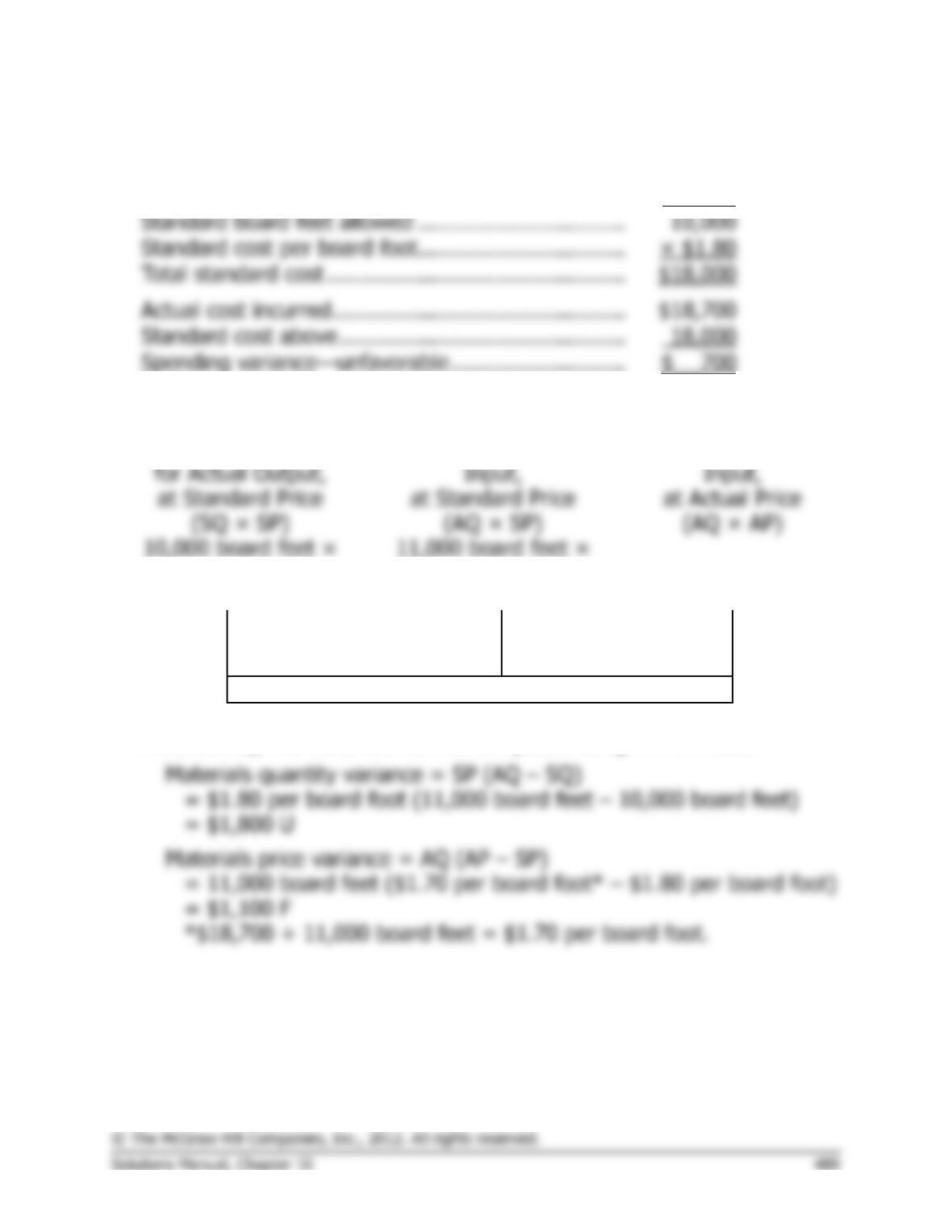
Number of chopping blocks …………………………….
4,000
Number of board feet per chopping block ………….
× 2.5
Standard board feet allowed …………………………..
Standard cost per board foot…………………………..
Spending variance—unfavorable ………………………
2.
Standard Quantity Allowed
Actual Quantity of
Actual Quantity of
$1.80 per board foot
= $18,000
$1.80 per board foot
= $19,800
$18,700
Materials quantity
variance = $1,800 U
Materials price
variance = $1,100 F
Spending variance = $700 U
Alternatively, the variances can be computed using the formulas:
Exercise 10-2 (20 minutes)
1.
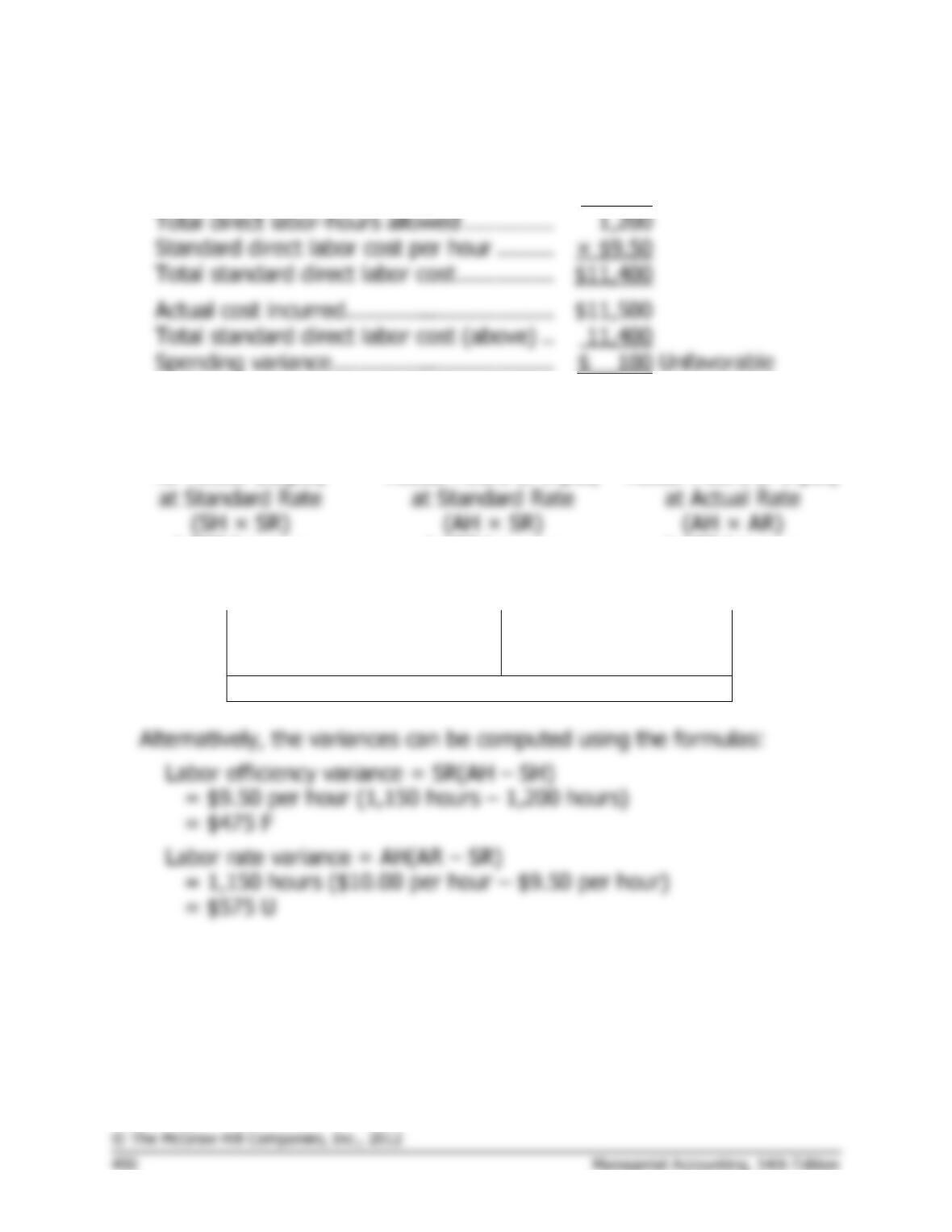
Number of meals prepared …………………
6,000
Standard direct labor-hours per meal ……
× 0.20
Total direct labor-hours allowed …………..
1,200
Standard direct labor cost per hour ………
Spending variance …………………………….
Unfavorable
2.
Standard Hours Allowed
for Actual Output,
Actual Hours of Input,
Actual Hours of Input,
1,200 hours ×
$9.50 per hour
= $11,400
1,150 hours ×
$9.50 per hour
= $10,925
1,150 hours ×
$10.00 per hour
= $11,500
Labor efficiency variance
= $475 F
Labor rate variance
= $575 U
Spending variance = $100 U
Exercise 10-3 (20 minutes)
1.
Number of items shipped …………………………...
140,000
Standard direct labor-hours per item …………….
× 0.04
Total direct labor-hours allowed …………………..
Standard variable overhead cost per hour ………
Spending variance …………………………………….
Unfavorable
2.
Standard Hours Allowed
$2.80 per hour
= $15,680
$2.80 per hour
= $16,240
$2.75 per hour*
= $15,950
Variable overhead
efficiency variance
Variable overhead
rate variance
Exercise 10-4 (30 minutes)
1.
Number of units manufactured ………………………..
20,000
Standard labor time per unit
(6 minutes ÷ 60 minutes per hour) ………………..
× 0.10
Total standard direct labor cost ……………………….
Actual direct labor cost ………………………………….
Standard direct labor cost ………………………………
Spending variance—unfavorable ………………………
2.
Standard Hours Allowed
$24.00 per hour
= $48,000
$24.00 per hour
= $51,000
$49,300
Labor efficiency variance
= $3,000 U
Labor rate variance
= $1,700 F
Spending variance = $1,300 U
*20,000 units × 0.10 hour per unit = 2,000 hours
Exercise 10-4 (continued)
3.
Standard Hours Allowed
$16.00 per hour
= $32,000
$16.00 per hour
= $34,000
$39,100
Variable overhead
efficiency variance
= $2,000 U
Variable overhead
rate variance
= $5,100 U
Spending variance = $7,100 U
Alternatively, the variances can be computed using the formulas:
Variable overhead efficiency variance = SR (AH – SH)
=$16.00 per hour (2,125 hours – 2,000 hours)
= $2,000 U
Exercise 10-5 (20 minutes)
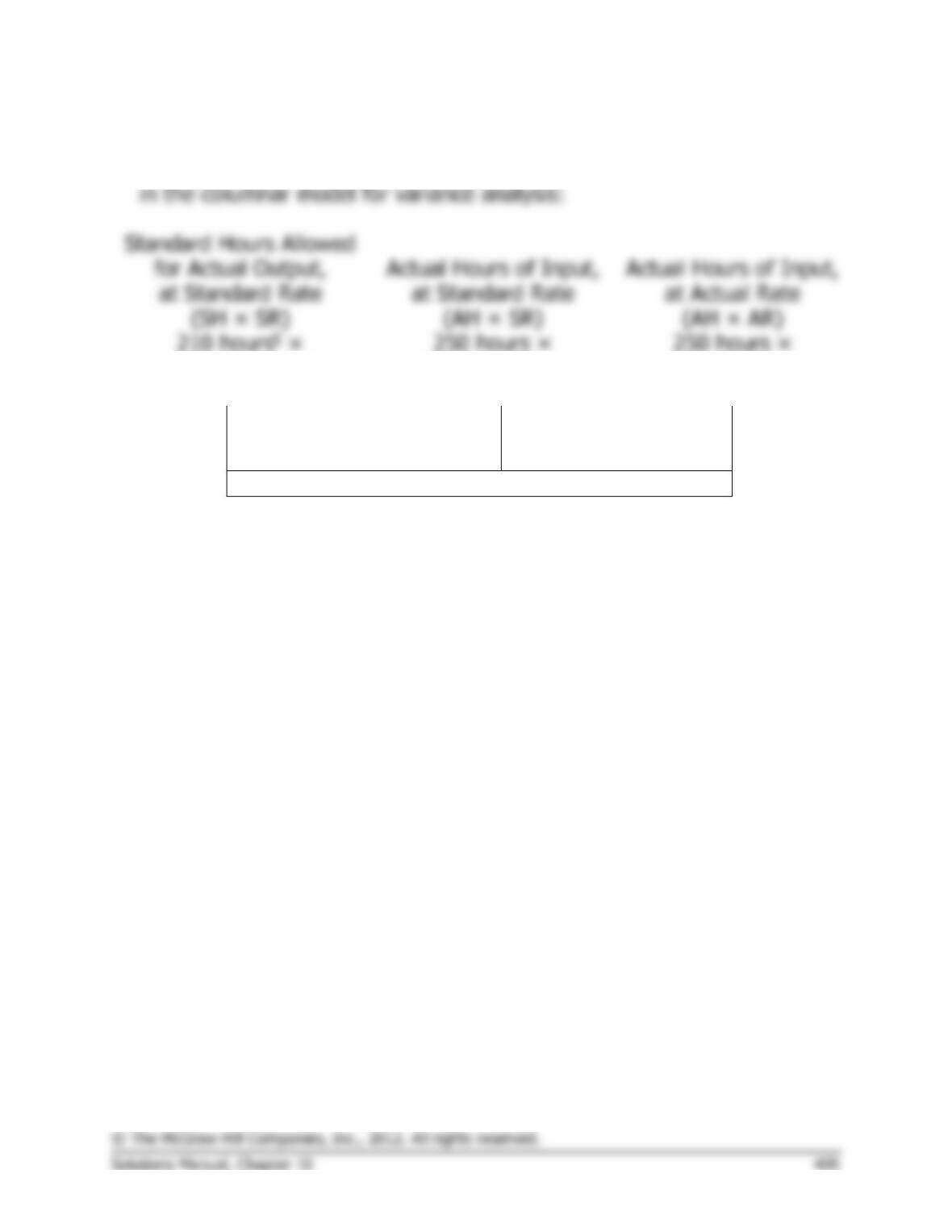
1. If the total labor spending variance is $330 unfavorable, and if the labor
rate variance is $150 favorable, then the labor efficiency variance must
be $480 unfavorable, because the labor rate and labor efficiency
variances taken together equal the total labor spending variance.
2. Knowing that 250 hours of labor time were used during the week, the
actual rate of pay per hour can be computed as follows:
Labor rate variance = AH (AR – SR)
Exercise 10-5 (continued)
An alternative approach would be to work from known to unknown data
$12.00 per hour*
= $2,520
$12.00 per hour*
= $3,000
$11.40 per hour
= $2,850
Labor efficiency variance
= $480 U
Labor rate variance
= $150 F*
Spending variance = $330 U*
§168 batches × 1.25 hours per batch = 210 hours
*Given
Exercise 10-6 (20 minutes)
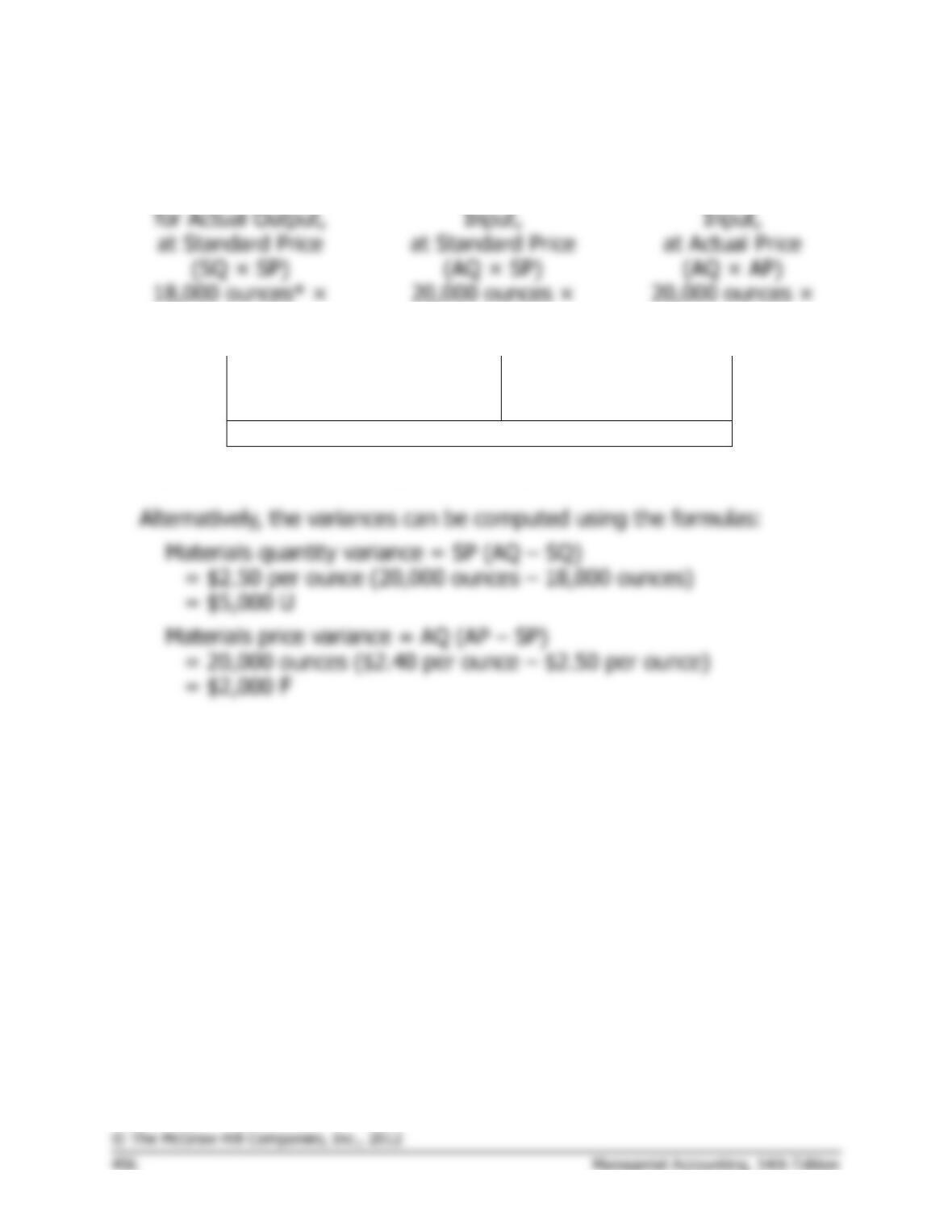
1.
Standard Quantity Allowed
Actual Quantity of
Actual Quantity of
$2.50 per ounce
= $45,000
$2.50 per ounce
= $50,000
$2.40 per ounce
= $48,000
Materials quantity
variance = $5,000 U
Materials price
variance = $2,000 F
Spending variance = $3,000 U
*2,500 units × 7.2 ounces per unit = 18,000 ounces
Exercise 10-6 (continued)
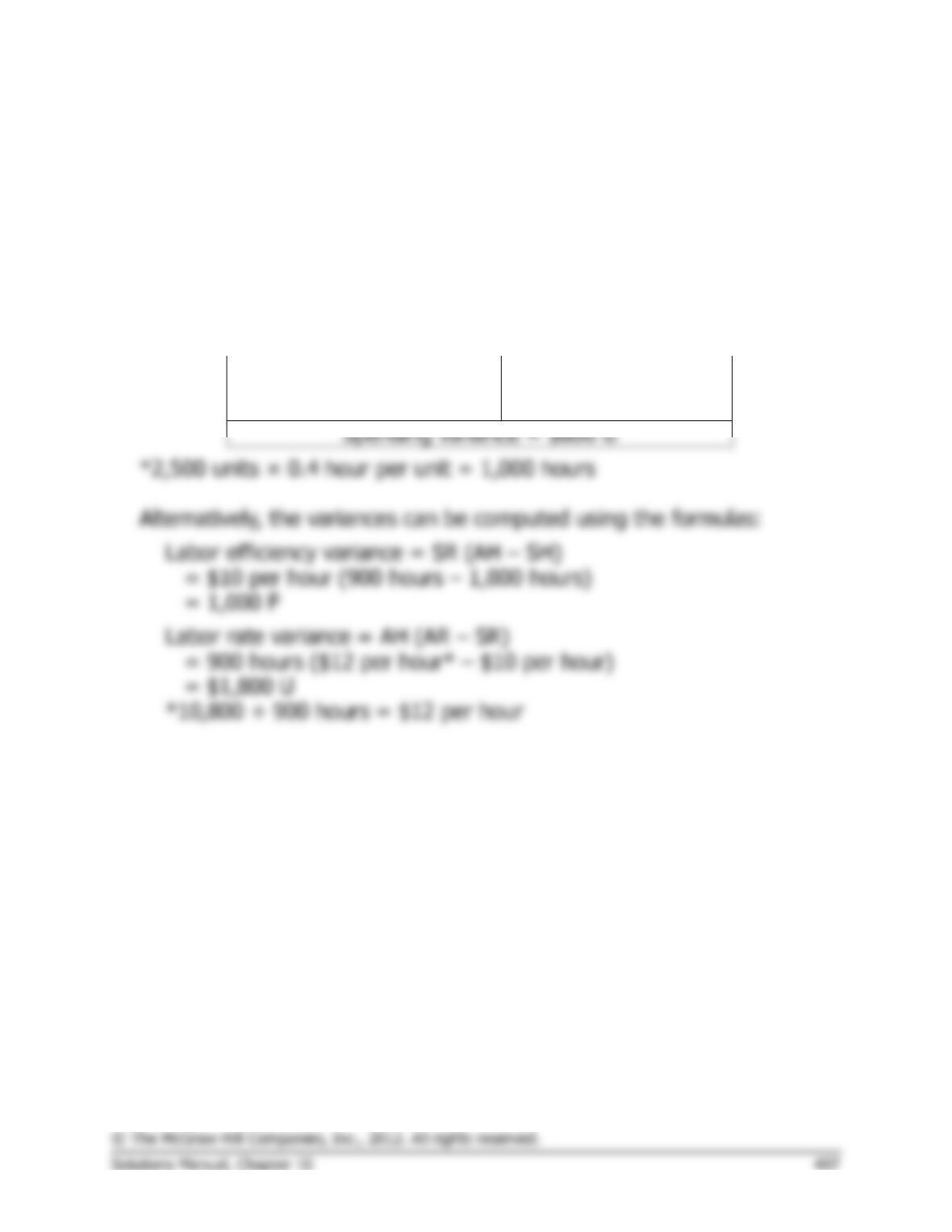
2.
Standard Hours Allowed
for Actual Output,
at Standard Rate
(SH × SR)
Actual Hours of Input,
at Standard Rate
(AH × SR)
Actual Hours of Input,
at Actual Rate
(AH × AR)
1,000 hours* ×
$10.00 per hour
= $10,000
900 hours ×
$10.00 per hour
= $9,000
$10,800
Labor efficiency variance
= $1,000 F
Labor rate variance
= $1,800 U
Exercise 10-7 (15 minutes)
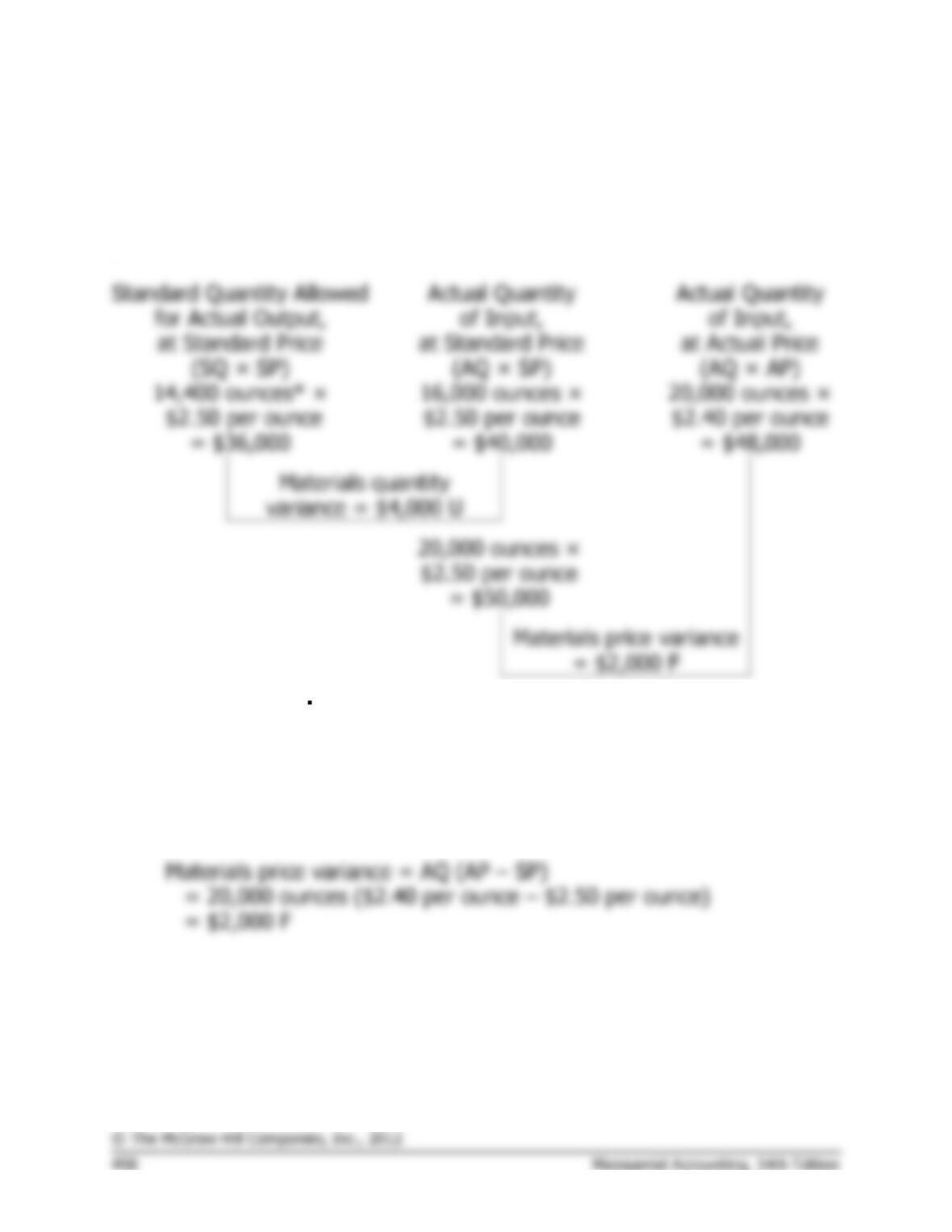
Notice in the solution below that the materials price variance is computed
on the entire amount of materials purchased, whereas the materials
quantity variance is computed only on the amount of materials used in
production.
*2,000 bottles × 7.2 ounces per bottle = 14,400 ounces
Alternatively, the variances can be computed using the formulas:
Materials quantity variance = SP (AQ – SQ)
= $2.50 per ounce (16,000 ounces – 14,400 ounces)
= $4,000 U
Exercise 10-8 (30 minutes)
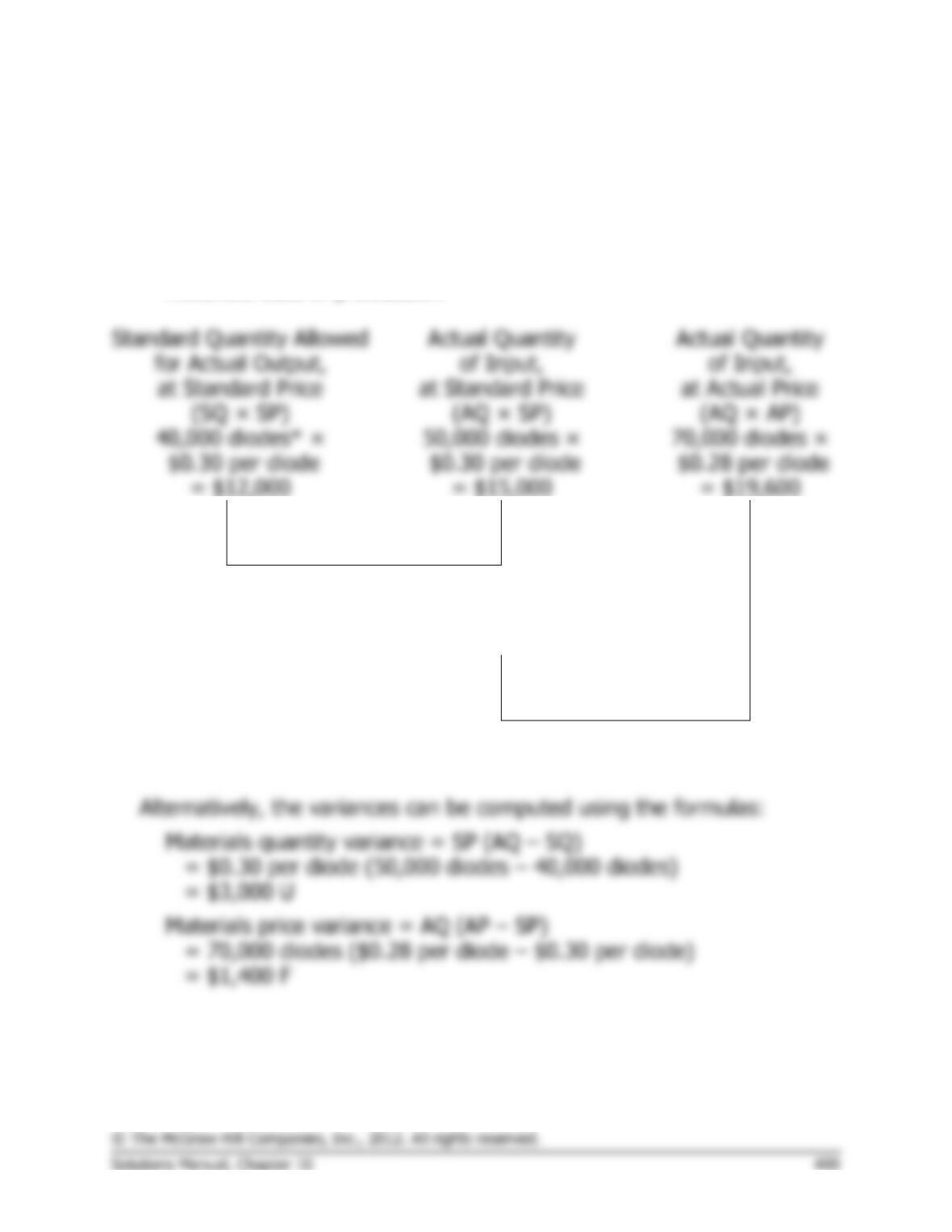
1. a. Notice in the solution below that the materials price variance is
computed on the entire amount of materials purchased, whereas the
materials quantity variance is computed only on the amount of
materials used in production.
Materials quantity
variance = $3,000 U
70,000 diodes ×
$0.30 per diode
= $21,000
Materials price variance
= $1,400 F
*5,000 toys × 8 diodes per toy = 40,000 diodes
Exercise 10-8 (continued)
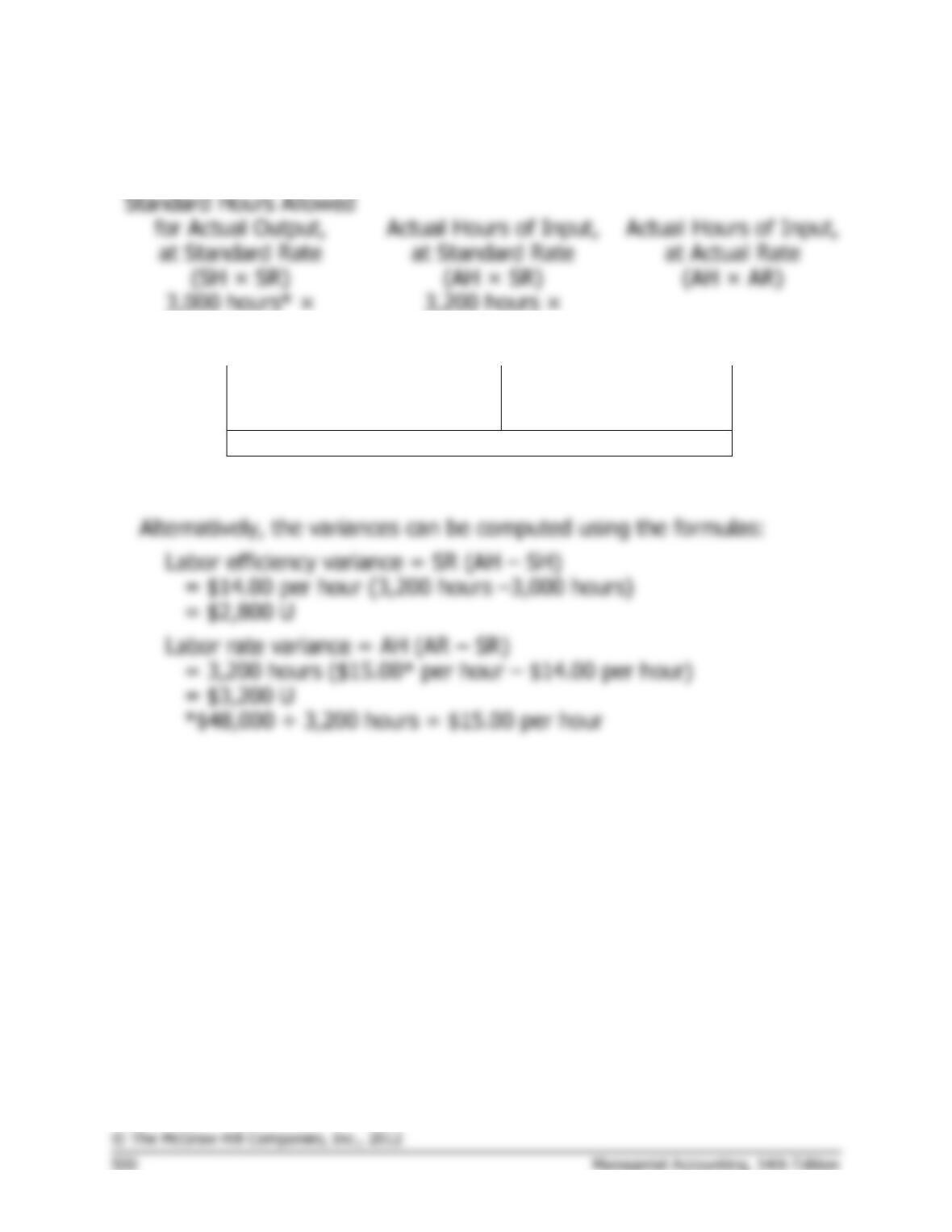
b. Direct labor variances:
$14.00 per hour
= $42,000
$14.00 per hour
= $44,800
$48,000
Labor efficiency variance
= $2,800 U
Labor rate variance
= $3,200 U
Spending variance = $6,000 U
*5,000 toys × 0.6 hours per toy = 3,000 hours
Exercise 10-8 (continued)
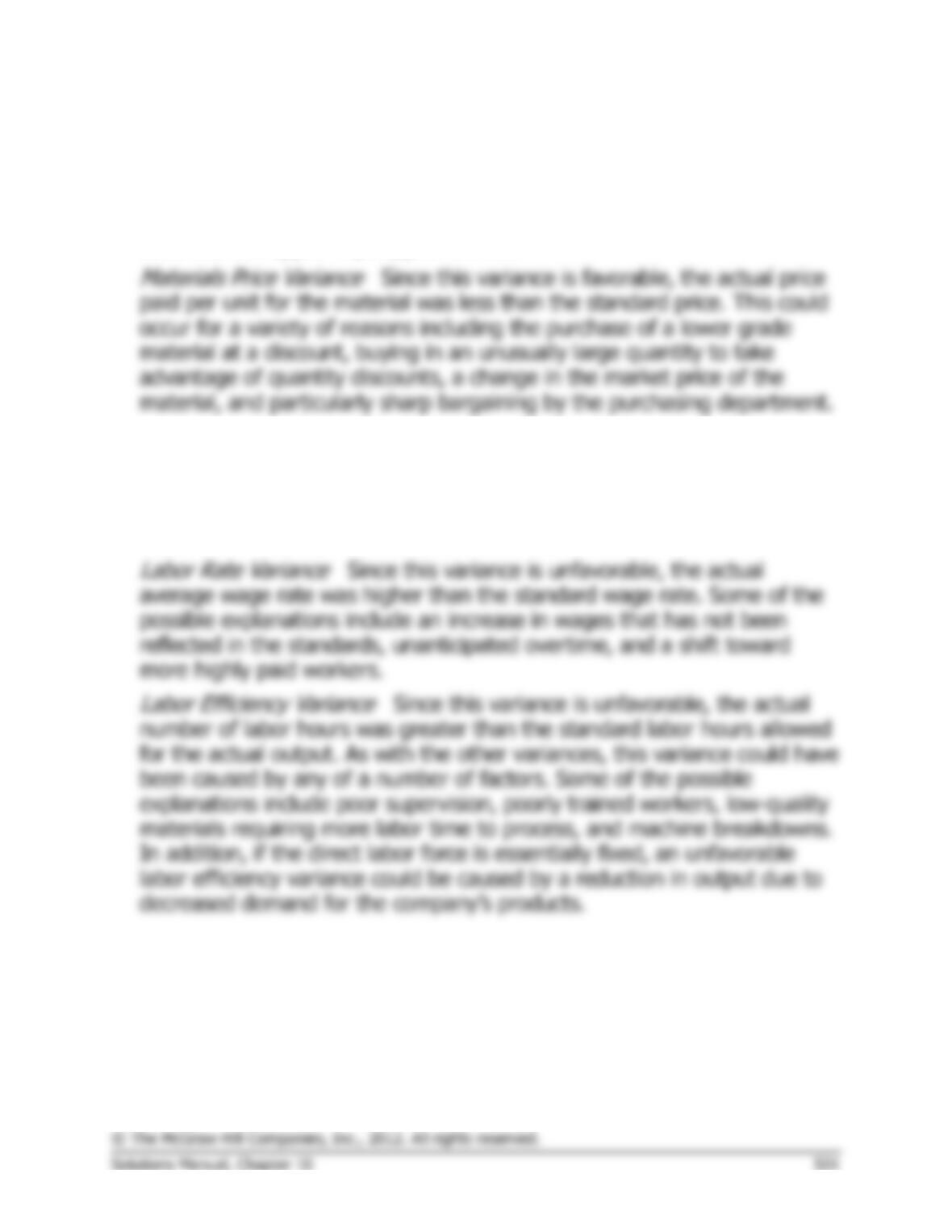
2. A variance usually has many possible explanations. In particular, we
should always keep in mind that the standards themselves may be
incorrect. Some of the other possible explanations for the variances
observed at Topper Toys appear below:
Materials Quantity Variance
Since this variance is unfavorable, more
materials were used to produce the actual output than were called for by
the standard. This could also occur for a variety of reasons. Some of the
possibilities include poorly trained or supervised workers, improperly
adjusted machines, and defective materials.
Problem 10-9 (45 minutes)
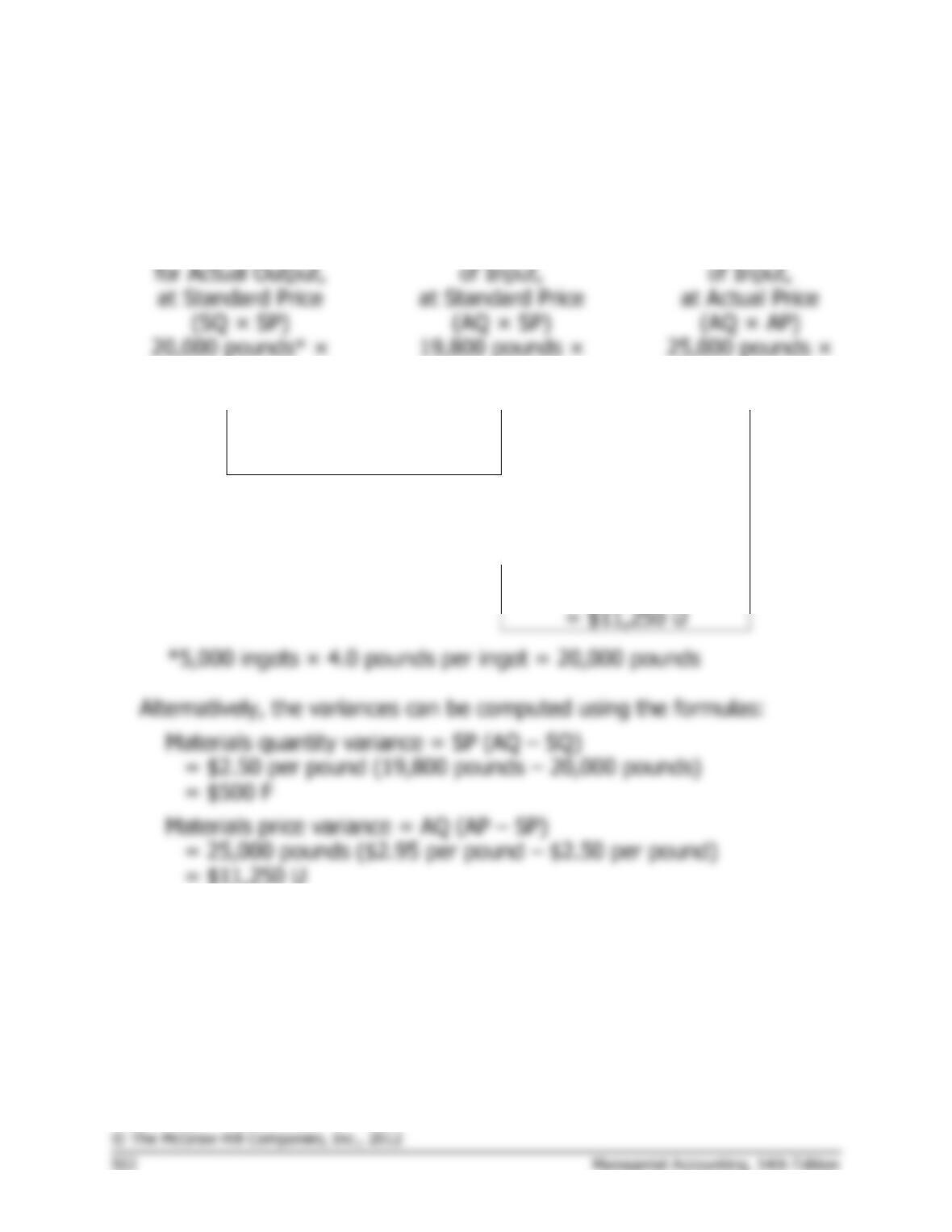
1. a.
Standard Quantity Allowed
Actual Quantity
Actual Quantity
$2.50 per pound
= $50,000
$2.50 per pound
= $49,500
$2.95 per pound
= $73,750
Materials quantity
variance = $500 F
25,000 pounds ×
$2.50 per pound
= $62,500
Materials price variance
Problem 10-9 (continued)
1. b.
Standard Hours Allowed
$9.00 per hour
= $27,000
$9.00 per hour
= $32,400
$8.70 per hour
= $31,320
Labor efficiency variance
= $5,400 U
Labor rate variance
= $1,080 F
Problem 10-9 (continued)
1. c.
1,500 hours* ×
Standard Hours Allowed
$2.00 per hour
= $3,000
$2.00 per hour
= $3,600
$4,320
Variable overhead
efficiency variance
Variable overhead
rate variance
Problem 10-9 (continued)
2. Summary of variances:
Material quantity variance ………………….
$ 500
F
Material price variance ……………………..
11,250
U
Labor efficiency variance …………………..
5,400
U
Labor rate variance ………………………….
1,080
F
Variable overhead efficiency variance …..
600
U
Variable overhead rate variance ………….
720
U
Net variance …………………………………..
$16,390
U
Budgeted cost of goods sold at $16 per ingot ……
$80,000
Add the net unfavorable variance (as above) …….
Actual cost of goods sold ………………………………
This $16,390 net unfavorable variance also accounts for the difference
between the budgeted net operating income and the actual net loss for
the month.
Budgeted net operating income ……………………..
$15,000
Deduct the net unfavorable variance added to
cost of goods sold for the month …………………
16,390
Net operating loss ………………………………………
$(1,390)
Problem 10-10 (45 minutes)
1. The standard quantity of plates allowed for tests performed during the
month would be:
Smears …………………………...
2,700
Blood tests ……………………….
900
Total ……………………………….
3,600
Plates per test …………………..
× 3
Standard quantity allowed ……
10,800
Alternatively, the variances can be computed using the formulas:
Materials quantity variance = SP (AQ – SQ)
= $2.50 per plate (14,000 plates – 10,800 plates)
= $8,000 U