Chapter 10 Summary and Review: Study Guide 281
104. 6x=−12
106. (4.1×10⁻²)(6.5×10⁶)=26.65 ×10⁴
50
5−4i=50
5−4i·5+4i
5+4i=250 + 200i
41 =250
41 +200
41 i
110. 12−1
−1·1
112. i5+i6+i7+i8
114. 5−√5i
√5i=5−√5i
√5i·−√5i
−√5i=−5√5i−5
5=
Chapter 10 Vocabulary Reinforcement
√a, if the
4. To find an equivalent expression without a radical in the
6. An imaginary number is a number that can be named bi,
where bis some real number and b=0.
Chapter 10 Concept Reinforcement
1. True; see page 695 in the text.
3. False; radicals cannot be added unless they have the same
index and the same radicand.
Chapter 10 Study Guide
1. 36y2=(6y)2=|6y|=6|y|
25y2√6=5y√6
8. √20a
√5=20a
5=√4a=2
√a
11. 3+√x−1=x
x−2=0 or x −5=0
12. √x+3−√x−2=1
√x+3=√x−2+1
2=(
√x−2+1)
2
13. (2 −5i)2=4−20i+25i2=4−20i+ 25(−1) =
Chapter 10 Review Exercises
f(1) = √3·1−16 = √3−16 = √−13
4. The domain of f(x)=√3x−16 is the set of all x-values
for which 3x−16 ≥0.
x≥16
3
The domain is x
x≥16
3,or16
3,∞.
10. 3
27 =−1
3Since −1
33
=−1
27
17. 5
√a2b3=(a2b3)1/5
18. 49−1/2=1
491/2=1
√49 =1
7
Chapter 10 Summary and Review: Review Exercises 283
−1/3−(−1/2) =7
−1/3+1/2=7
−2/6+3/6=7
1/6
27. 4
√x3
√x=x1/4·x1/3=x1/4+1/3=x3/12+4/12 =x7/12 =
√−108 = 3
√−27 ·4= 3
√−27 3
√4=−33
√4
31. 49
36 =√49
√36 =7
6
64x6
3
√64x6
12
√x5
40. 53
√x+23
√x=(5+2)3
√x=73
√x
44. (√5−3√8)(√5+2
√8)
45. (1 −√7)2=1
2−2·1·√7+(
√7)2
46. (3
√27 −3
√2)( 3
√27 + 3
√2)
47. 8
√9=√4·6
50. 4
√x+3=2
51. √x+8−√3x+1=1
√x+8=√3x+1+1
y
284 Chapter 10: Radical Expressions, Equations, and Functions
52. d(n)=0.75√2.8n
(108)2=(
√2.8n)2
54. Let s= the length of a side of the square, in cm. We use
the Pythagorean theorem.
55. Let w= the width of the bookcase, in ft. Then we can
refer to the drawing in the text, replacing “?” with w.We
use the Pythagorean theorem.
56. a=7,b=24
625 = c2
57. a=2,c=5
√2
Find b.
a2+b2=c2
58. √−25 + √−8=√−1·25 + √−1·4·2=
59. (−4+3i)+(2−12i)=(−4+2)+(3−12)i=
61. (2+5i)(2 −5i)=2
2−(5i)2
=12−12i−3i2=−1
=9−12i
25
=10
25 +15
25i
=3−7i−2
9+1
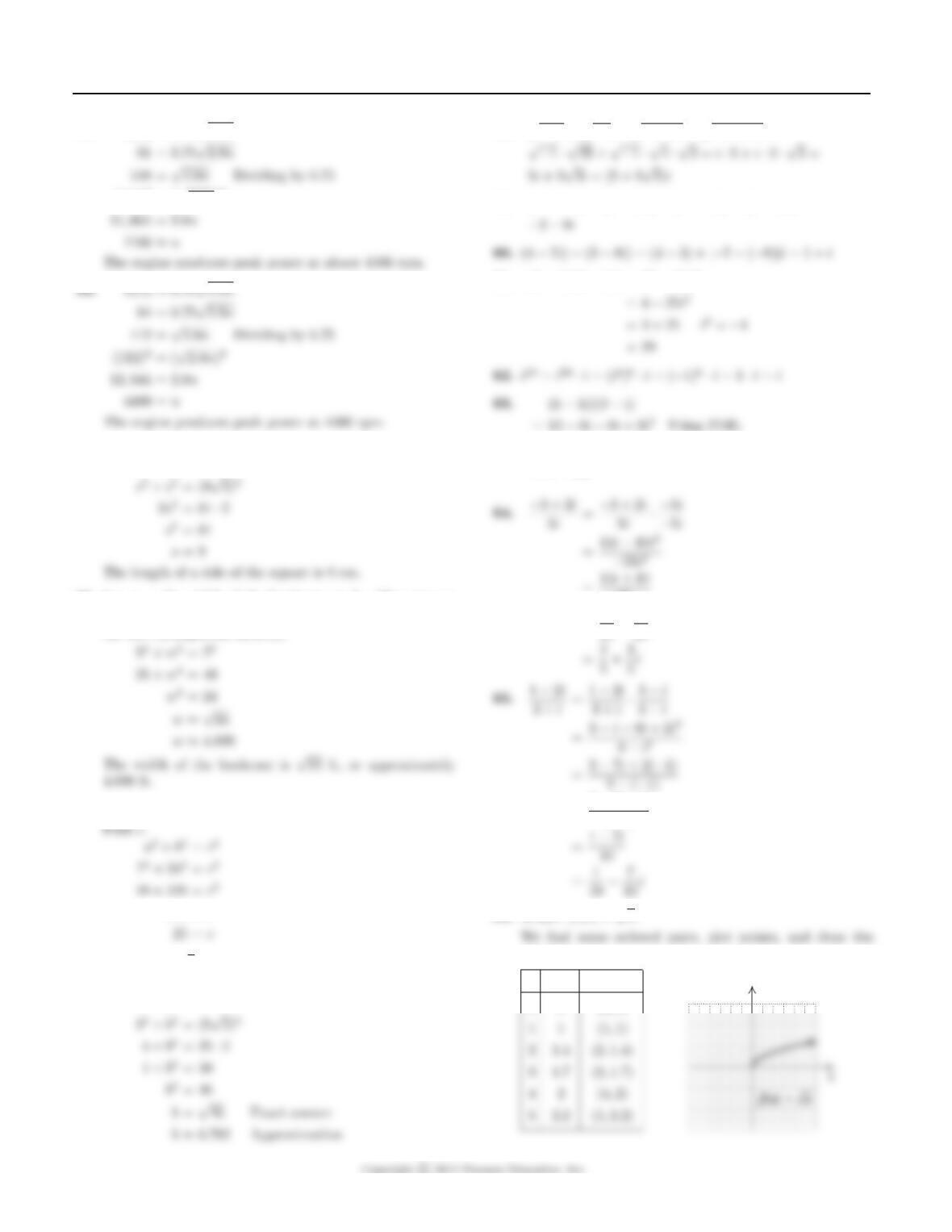
66. Graph: f(x)=√x.
curve.
x f(x) (x, f(x))
0 0 (0,0)
Chapter 10 Test 285
67. We substitute each complex number in the equation to
determine if it is a solution.
1−2i−1+4−4i+5
9−6iFALSE
For 1 + i:
x2+4x+5=0
For 2 + i:
x2+4x+5=0
Choice D is correct.
68. i·i2·i3…i
99 ·i100
Pairing iand i100,i2and i99,i3and i98, and so on, we
√6+x=36−11x
(√6+x)2= (36 −11x)2
121x−430=0 or x −3=0
121x= 430 or x =3
Chapter 10 Discussion and Writing Exercises
Consider (x+5)
1/2. Since the exponent is 1
2,x+5
2. Since √xexists only for {x|x≥0}, this is the domain of
y=√x·√x.
Chapter 10 Test
1. √148 ≈12.166
3. The domain of f(x)=√8−4xis the set of all x-values
for which 8 −4x≥0.
286 Chapter 10: Radical Expressions, Equations, and Functions
5. √x2+10x+25=(x+5)
2=|x+5|
9. a2/3=3
10. 323/5=5
√323=5
(25)3=5
√215 =2
3=8
17. 8
√x2=x2/8=x1/4=4
√x
√16x6= (16x6)1/4=(2
3
16x5
3
√16x5
3
√8x3·2x2
26. 3
√2x3
5y2=3
2x·5y2=3
10xy2
30. 3√128+2
√18+2
√32
=3
√64 ·2+2
√9·2+2
√16 ·2
31. (√20+2
√5)(√20 −3√5)
33. 1+√2
3−5√2=1+√2
3−5√2·3+5
√2
3+5
√2
35. √x−6=√x+9−3
(√x−6)2=(
√x+9−3)2
Chapter 10 Test 287
36. √x−1+3=x
37. We make a drawing, letting s= the length of a side of the
square, in feet.
7√2s
38. D=1.2√h
72=1.2√h
39. a=7,b= 7; find c.
a2+b2=c2Pythagorean equation
40. a=1,c=√5; find b.
43. (3 −4i)(3+7i)=9+21i−12i−28i2FOIL
=9+21i−12i+28 i2=−1
45. −7+14i
6−8i=−7+14i
6−8i·6+8i
6+8i
x2+2x+5=0
(1+2i)2+2(1+2i)+5 ? 0
47. x−4=√x−2
(x−4)2=(
√x−2)2
288 Chapter 10: Radical Expressions, Equations, and Functions
48. 1−4i
4i(1+4i)−1=(1 −4i)(1+4i)
4i
=−68i
16
49. √2x−2+√7x+4=√13x+10
(√2x−2+√7x+4)
2=(
√13x+ 10)2
10x2−22x−24 = 0
5x2−11x−12 = 0 Dividing by 2
(5x+ 4)(x−3) = 0
1. (2x2−3x+1)+(6x−3x3+7x2−4) =
−3x3+9x2+3x−3
4. x3+64
x2−49 ·x2−14x+49
x2−4x+16
5.
y2−7y−18
y2+3y+2
=(y2−5y−6)(y2+4y+4)
(y2−7y−18)(y2+3y+2)
6.
x
x+2+1
x−3−x2−2
x2−x−6
=x
x+2+1
x−3−x2−2
(x+ 2)(x−3),
7. y2+y−2
y+2 y3+3y2+0y−5
y3+2y2
Cumulative Review Chapters 1 – 10 289
10. 9√75+6
√12=9
√25 ·3+6
√4·3=
12. 3√5
√6−√3=3√5
√6−√3·√6+√3
√6+√3=3√30+3
√15
13. 6
m12n24
64 =m12n24
261/6
=m2n4
2
17. 1
5+3
10x=4
5
x=10
3·3
5
19. 3a−4<10+5a
−2a−4<10
20. −8<x+2<15
21. |3x−6|=2
3x−6=−2or 3x−6=2
3x=4 or 3x=8
22. 625 = 49y2
7y=−25 or 7y=25
23. 3x+5y=30,(1)
5x+3y= 34 (2)
5y=15
y=3
24. 3x+2y−z=−7,(1)
−x+y+2z=9,(2)
3x+2y−z=−7
5x+5y+z=−1
35x+35y=−35
x=−1
Next we use Equation (4) to find y.
5(−1) + 5y=−5 Substituting
290 Chapter 10: Radical Expressions, Equations, and Functions
5(−1)+5·0+z=−1
−5+z=−1
6x
x−5−300
x2+5x+25 =2250
(x−5)(x2+5x+25)
6x3+30x2+ 150x−300x+ 1500 = 2250
6x3+30x2−150x+ 1500 = 2250
x=−5or x =5 or x =−5
The number −5 checks but 5 does not, so the solution is
−5.
26. 3x2
(x+ 2)(x−2) ·−48
(x+ 2)(x−2)
27. I=nE
R+nr
28. √4x+1−2=3
√4x+1=5
29. 2√1−x=√5
(2√1−x)2=(
√5)2
30. 13 −x=5+√x+4
8−x=√x+4
(8 −x)2=(
√x+4)
2
64 −16x+x2=x+4
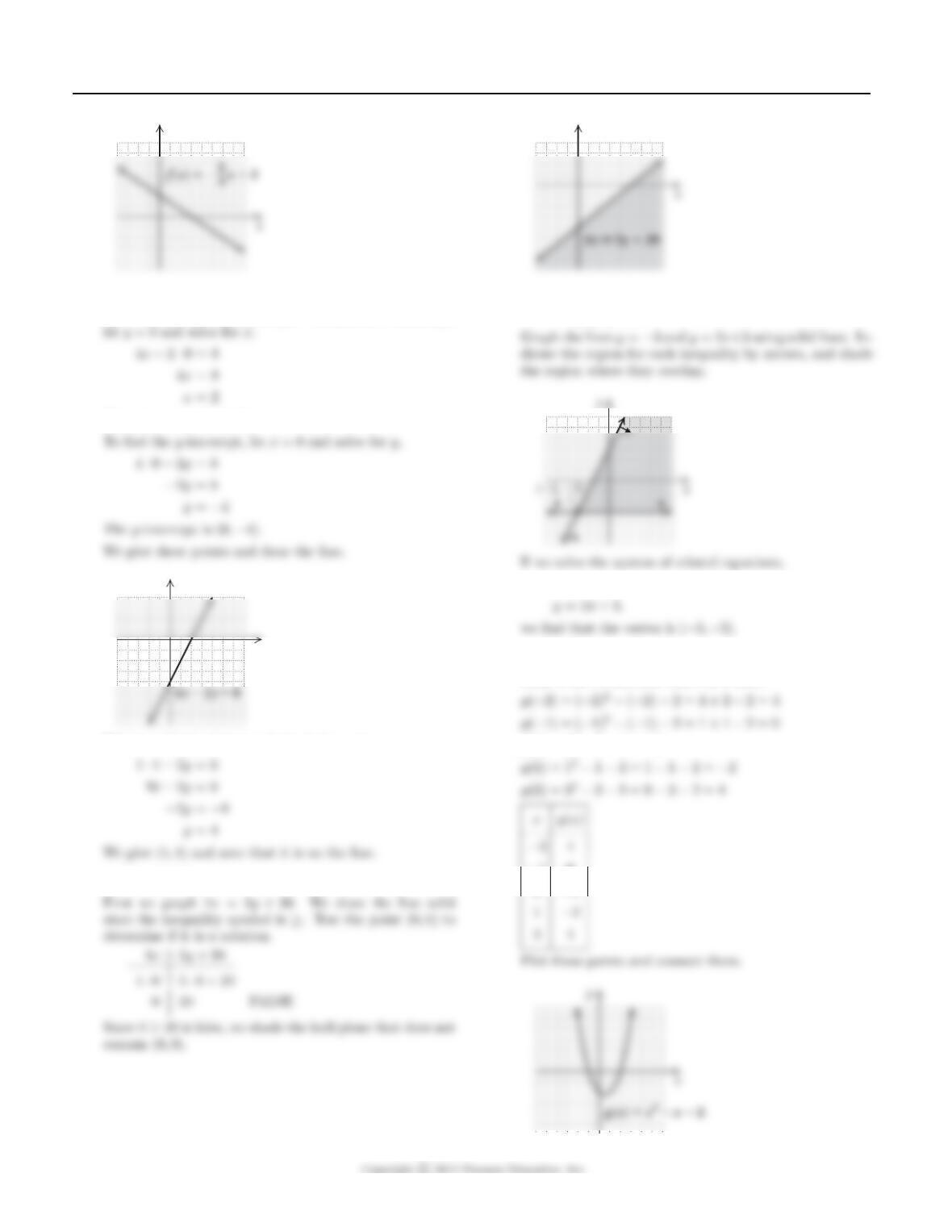
31. Graph: f(x)=−2
3x+2
y
y
x
y
Cumulative Review Chapters 1 – 10 291
32. Graph: 4x−2y=8
First we will find the intercepts. To find the x-intercept,
The x-intercept is (2,0).
We use a third point as a check. Let x=4.
33. Graph: 4x≥5y+20
34. Graph: y≥−3,
y≤2x+3
y=−3,
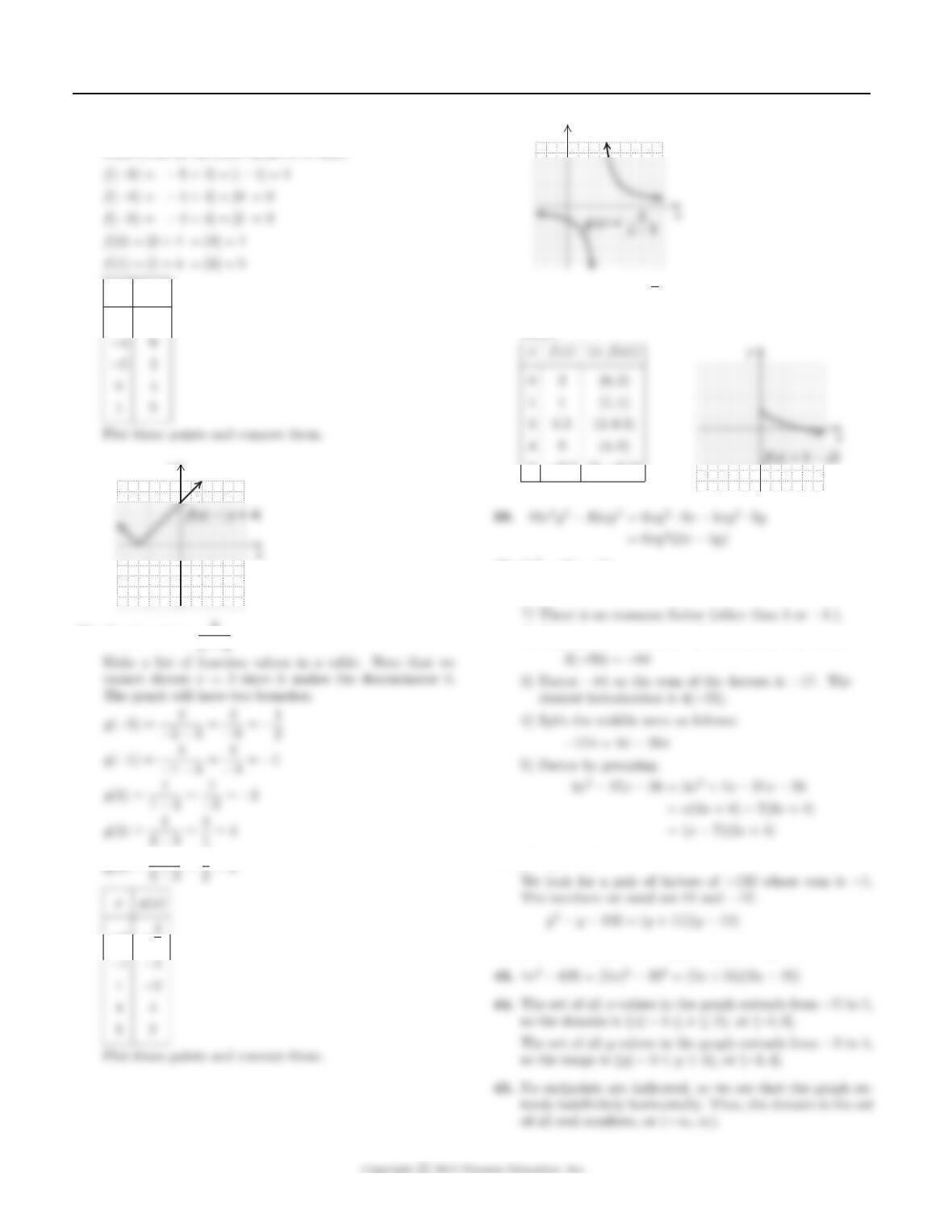
35. Graph: g(x)=x2−x−2
Make a list of function values in a table.
g(0) = 02−0−2=−2
−1 0
0−2
x
y
y
292 Chapter 10: Radical Expressions, Equations, and Functions
36. f(x)=|x+4|
Make a list of function values in a table.
x f(x)
−5 1
37. Graph: g(x)= 4
−5−1
2
38. Graph: f(x)=2−√x
We find some ordered pairs, plot points, and draw the
curve.
5−0.2 (5,−0.2)
40. 3x2−17x−28
We will use the ac-method.
2) Multiply the coefficients of the first and last terms.
41. y2−y−132
42. 27y3+8=(3y)3+2
3=(3y+ 2)(9y2−6y+4)
Cumulative Review Chapters 1 – 10 293
The smallest y-value is −5. No endpoints are indicated,
46. First we find the slope-intercept form of the equation by
47. First we find the slope of the given line.
48. h=k
b
100 = k
20
A=1
49. Familiarize. Let t= the number of hours it will take the
t
Check. We verify the work principle.
50. V=kd2
52. Using the work principle, we translate to the equation
t
3+t
15 =1,
53. 31−12 4
294 Chapter 10: Radical Expressions, Equations, and Functions
54. 2x+6=8+√5x+1
2x−2=√5x+1
55. x+√x+1
x−√x+1 =5
11
9x+8=0 or x −8=0