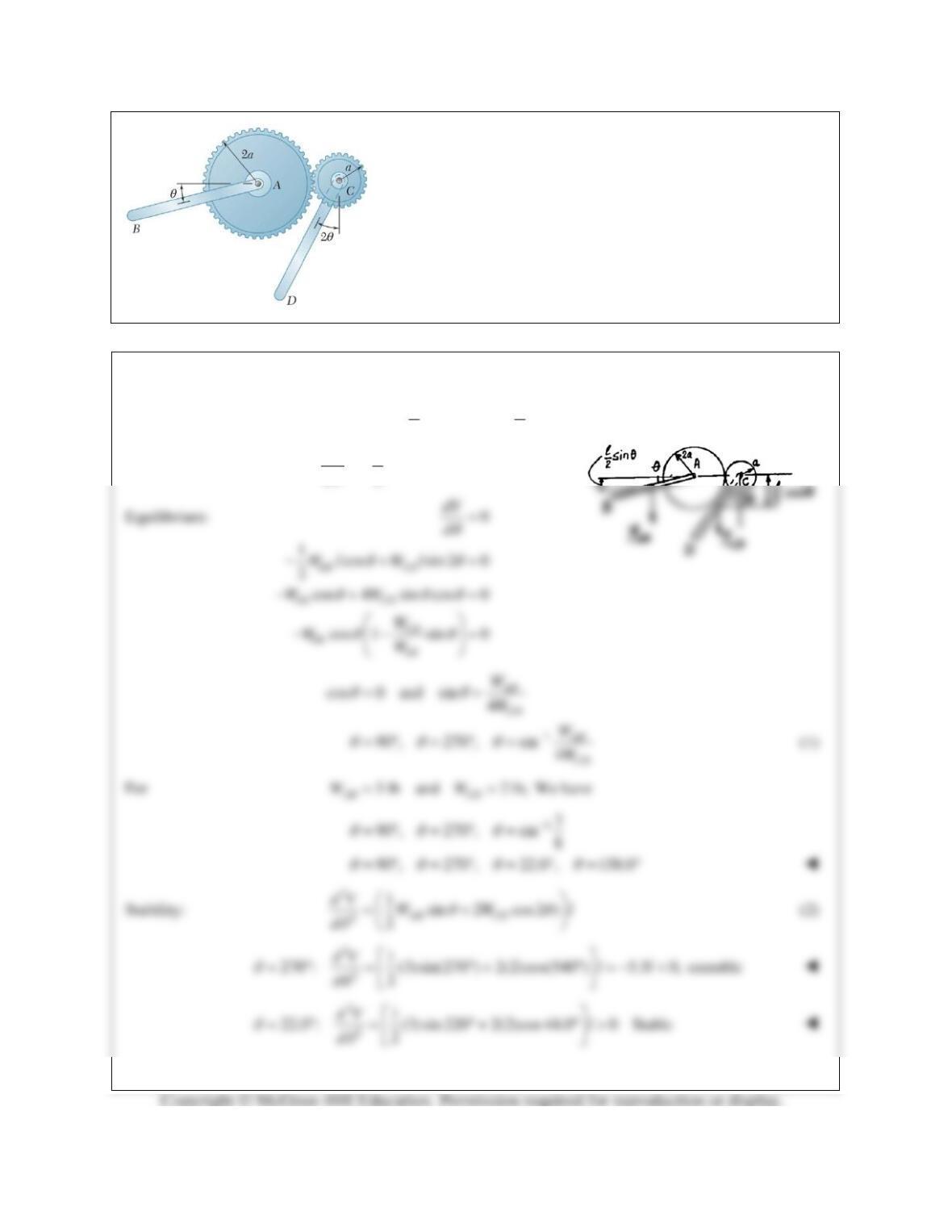
PROBLEM 10.71
Two uniform rods AB and CD, of the same length l, are attached
to gears as shown. Knowing that rod AB weighs 3 lb and that rod
CD weighs 2 lb, determine the positions of equilibrium of the
system and state in each case whether the equilibrium is stable,
unstable, or neutral.
SOLUTION
sin cos 2
22
1cos sin 2
2
AB CD
AB CD
ll
VW W
dV Wl Wl
d
PROBLEM 10.71 (Continued)
2
2
1
90 : (3)sin 90 2(2) cos180 2.5 0, Unstable
2
dV ll
d
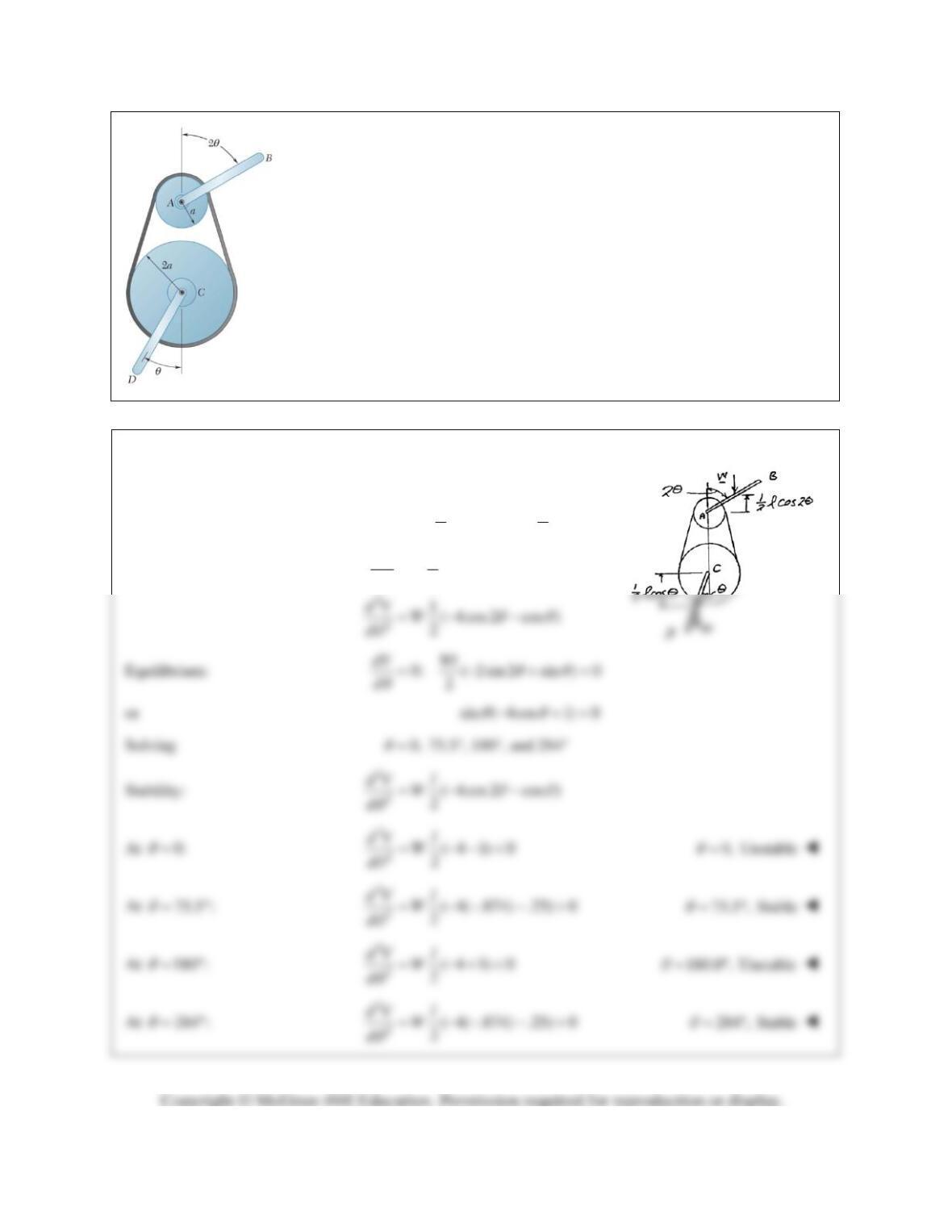
PROBLEM 10.72
Two uniform rods, each of mass m and length l, are attached to drums that are
connected by a belt as shown. Assuming that no slipping occurs between the
belt and the drums, determine the positions of equilibrium of the system and
state in each case whether the equilibrium is stable, unstable, or neutral.
SOLUTION
cos 2 cos
22
( 2sin 2 sin )
2
Wmg
ll
VW W
dV l
W
d
PROBLEM 10.73
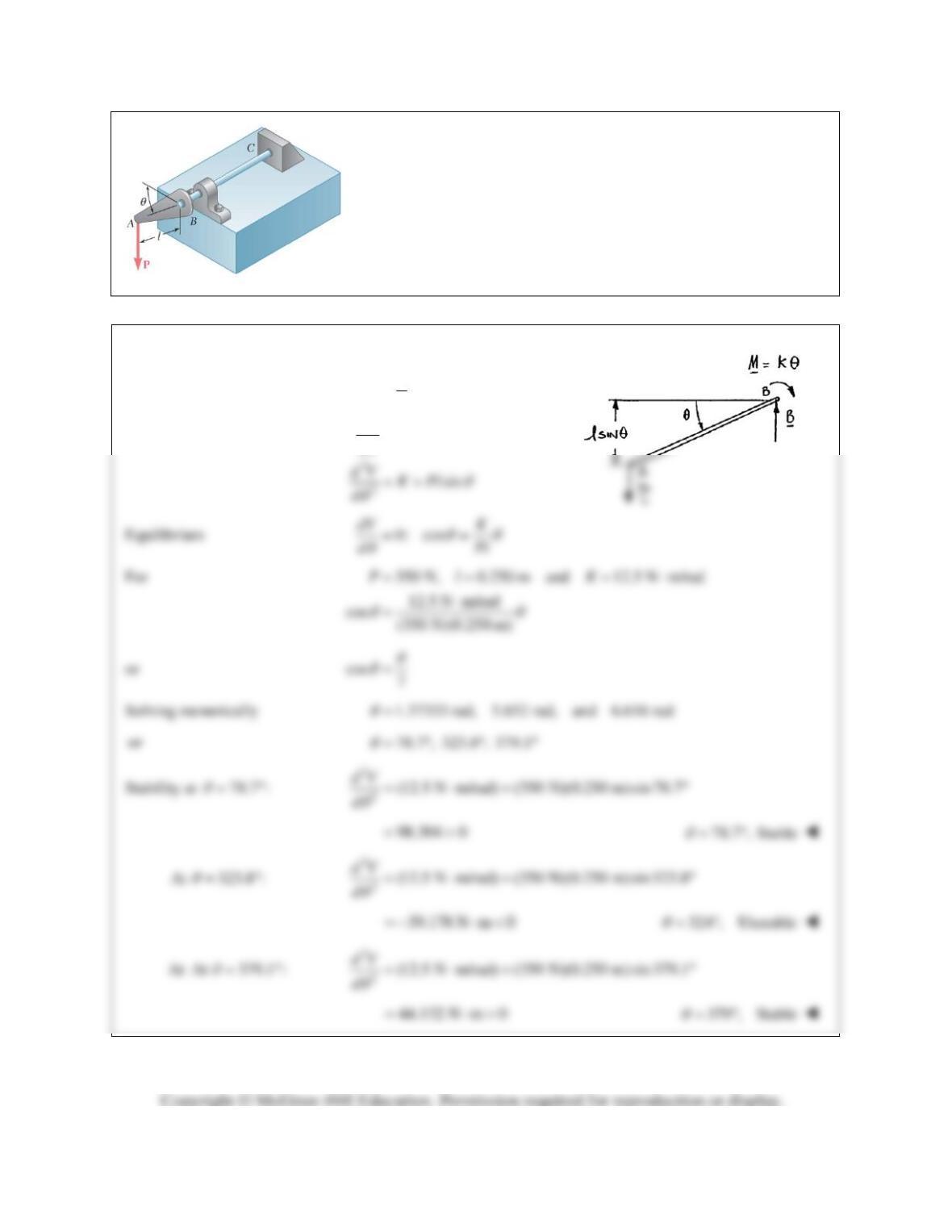
Using the method of Section 10.8, solve Problem 10.39.
Determine whether the equilibrium is stable, unstable, or neutral.
(Hint: The potential energy corresponding to the couple exerted
by a torsion spring is
2
1
2
,
K
where K is the torsional spring
constant and
is the angle of twist.)
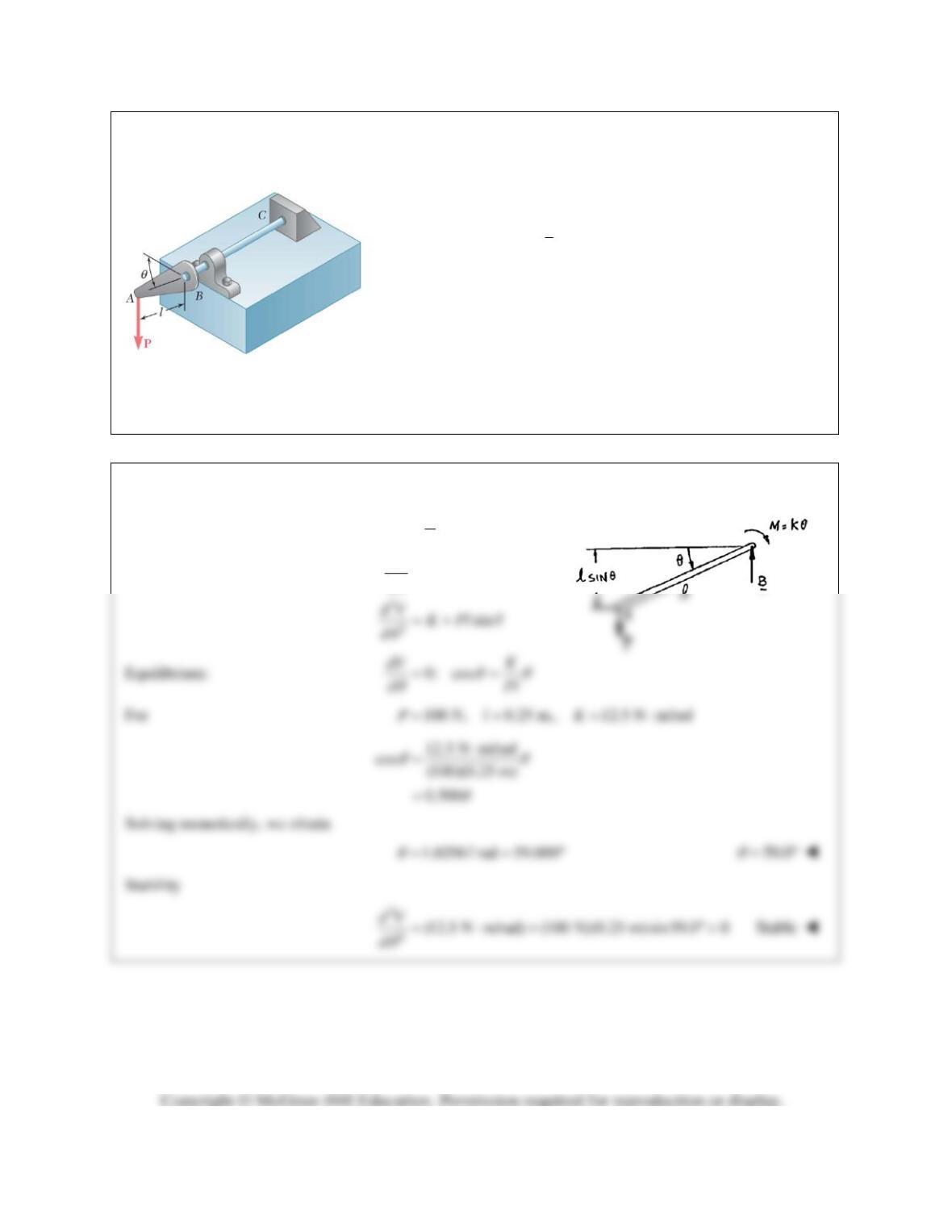
PROBLEM 10.39
The lever AB is attached to the horizontal shaft
BC that passes through a bearing and is welded to a fixed support
at C. The torsional spring constant of the shaft BC is K; that is, a
couple of magnitude K is required to rotate end B through 1 rad.
Knowing that the shaft is untwisted when AB is horizontal,
determine the value of
corresponding to the position of
equilibrium when P 100 N, l 250 mm, and
12.5 N m/rad.K
SOLUTION
Potential energy
2
1sin
2
cos
VK Pl
dV KPl
d
PROBLEM 10.74
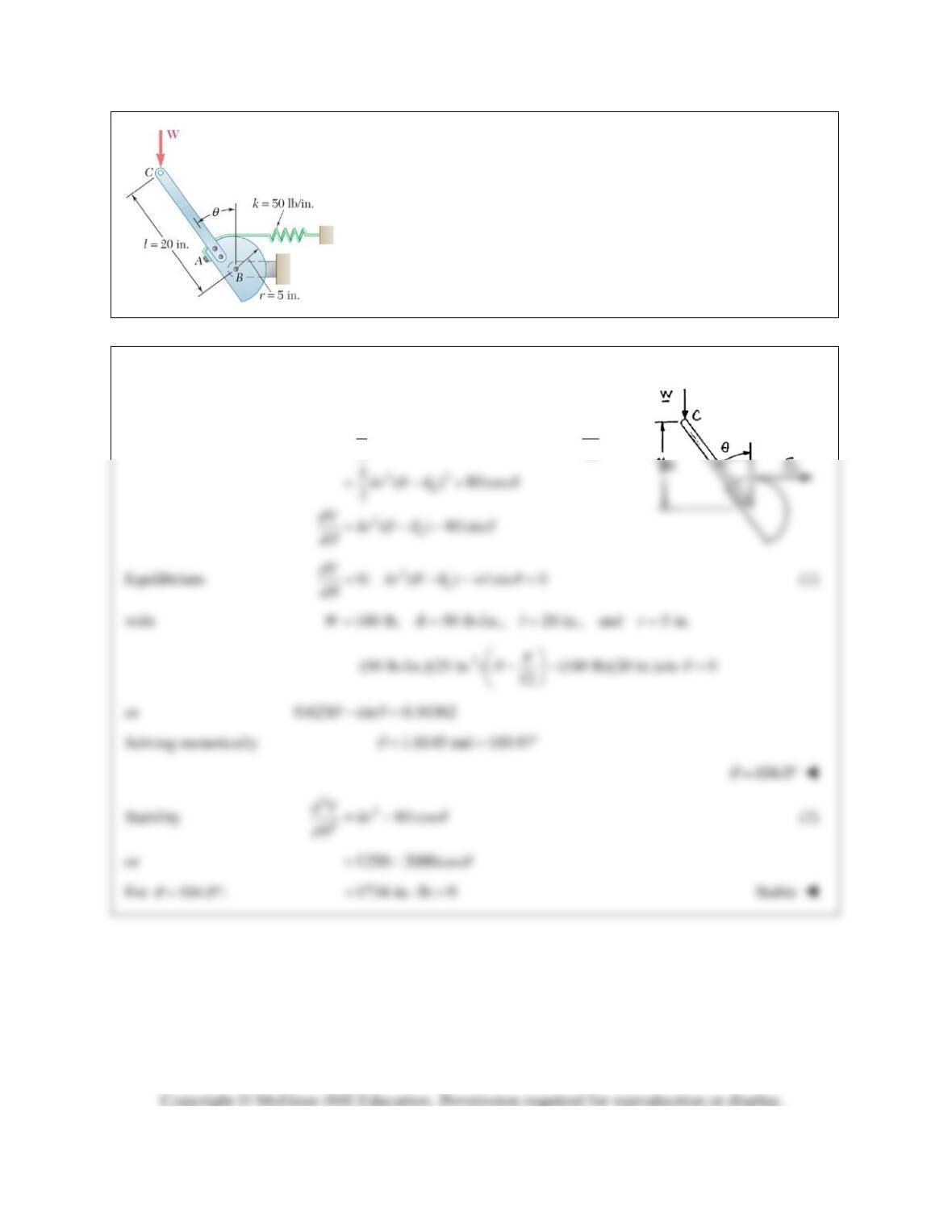
In Problem 10.40, determine whether each of the positions of
equilibrium is stable, unstable, or neutral. (See hint for Problem 10.73.)
PROBLEM 10.40
Solve Problem 10.39 assuming that
350 N,P
250 mm,l
and
12.5 N m/rad.K
Obtain answers in each of the
following quadrants:
0 90°, 270° 360°, 360° 450°.
SOLUTION
Potential energy
2
1sin
2
cos
VK Pl
dV KPl
d
PROBLEM 10.75
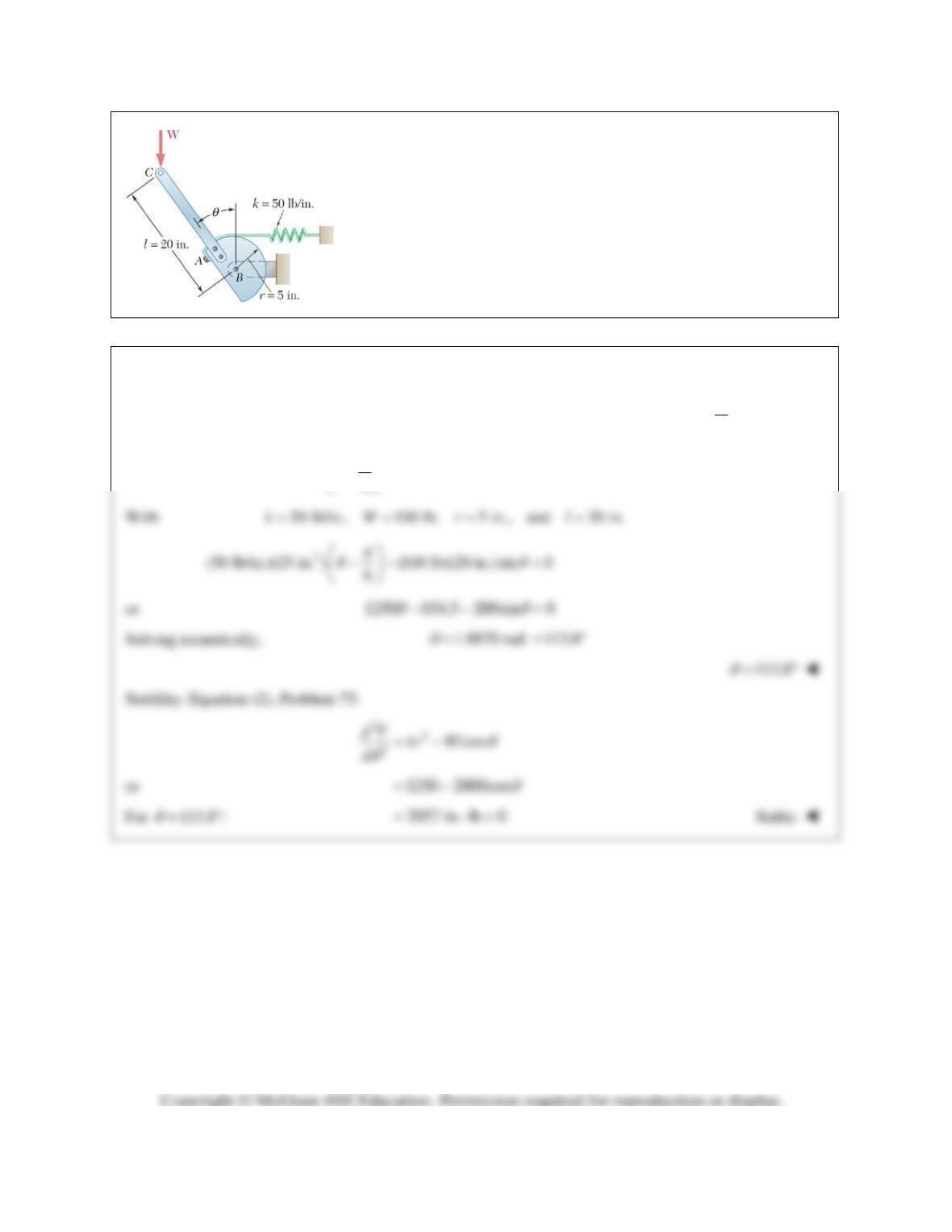
A load
W
of magnitude 100 lb is applied to the mechanism at
C
.
Knowing that the spring is unstretched when
15 ,
determine that
value of
corresponding to equilibrium and check that the
equilibrium is stable.
SOLUTION
We have
2
00
cos
1[( )] 15 rad
212
C
C
yl
Vkr Wy
PROBLEM 10.76
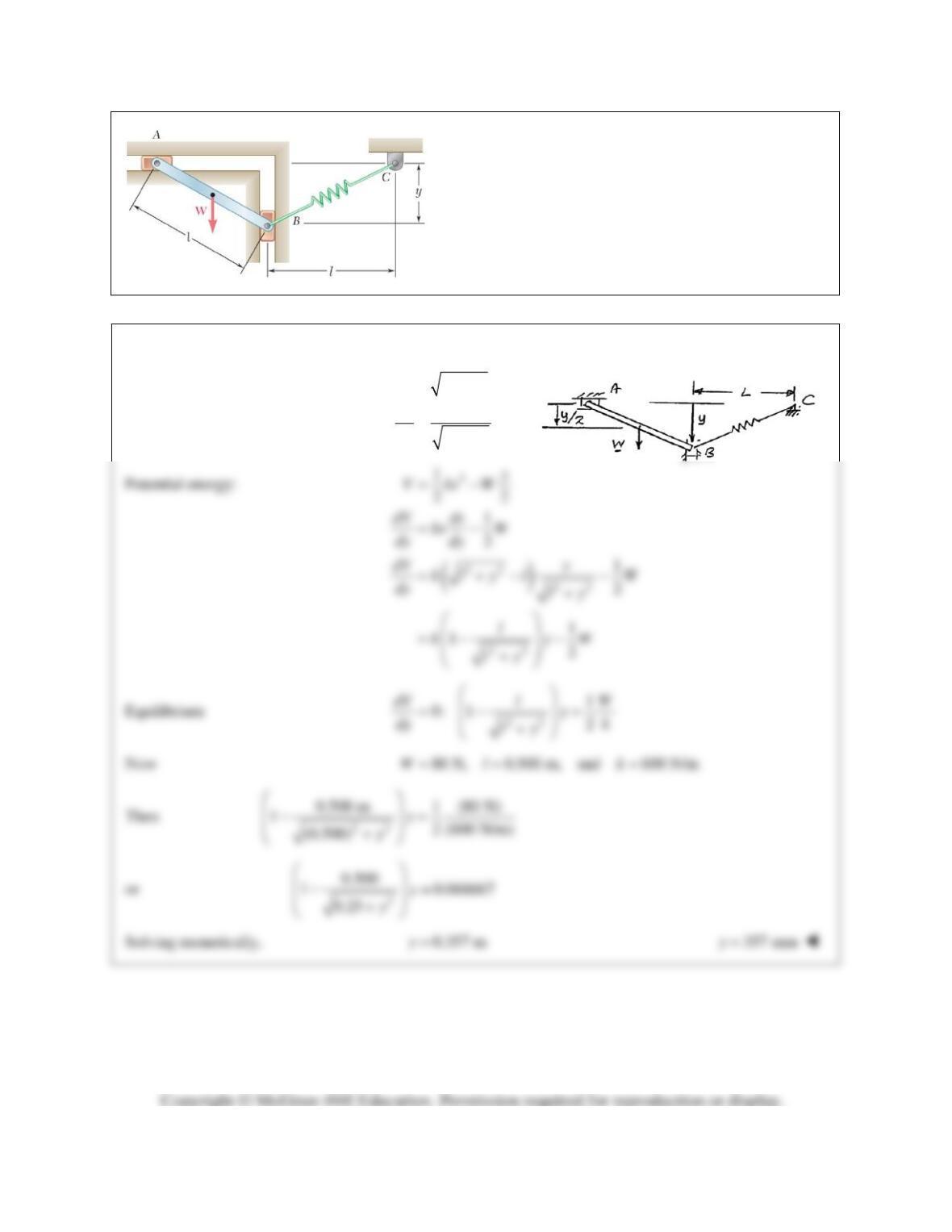
A load W of magnitude 100 lb is applied to the mechanism at C.
Knowing that the spring is unstretched when 30 ,
determine that
value of
corresponding to equilibrium and check that the
equilibrium is stable.
SOLUTION
Using the solution of Problem 10.75, particularly Equation (1), with 15° replaced by 30 rad :
6
For equilibrium 2sin 0
6
kr Wl
PROBLEM 10.77
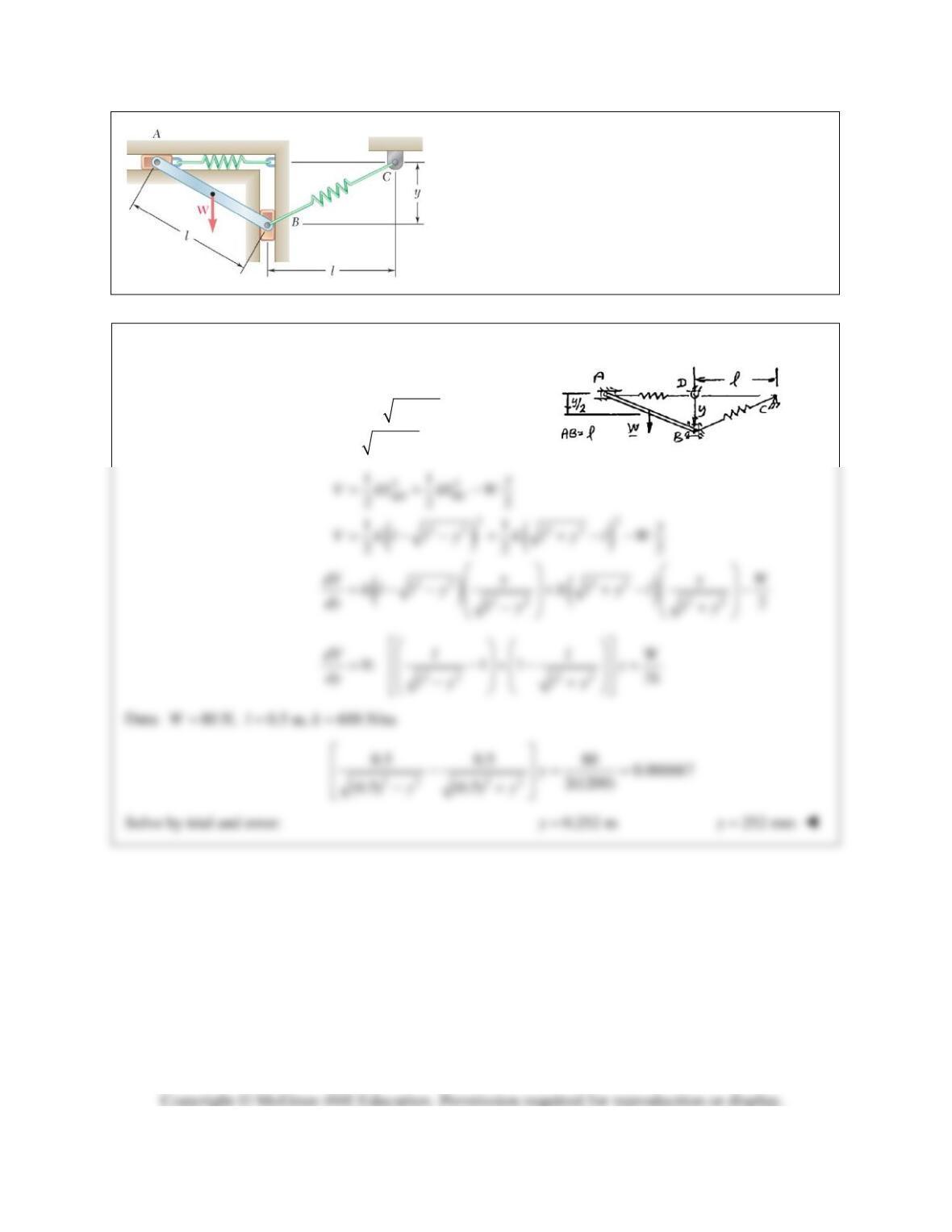
A slender rod
AB
, of weight
W
, is attached to two blocks
A
and
B
that can move freely in the guides shown.
Knowing that the spring is unstretched when
0,
y
determine the value of
y
corresponding to equilibrium
when
80 N,W500 mm,l
and
600 N/m.k
SOLUTION
Deflection of spring
s
, where
22
22
slyl
ds y
dy ly
PROBLEM 10.78
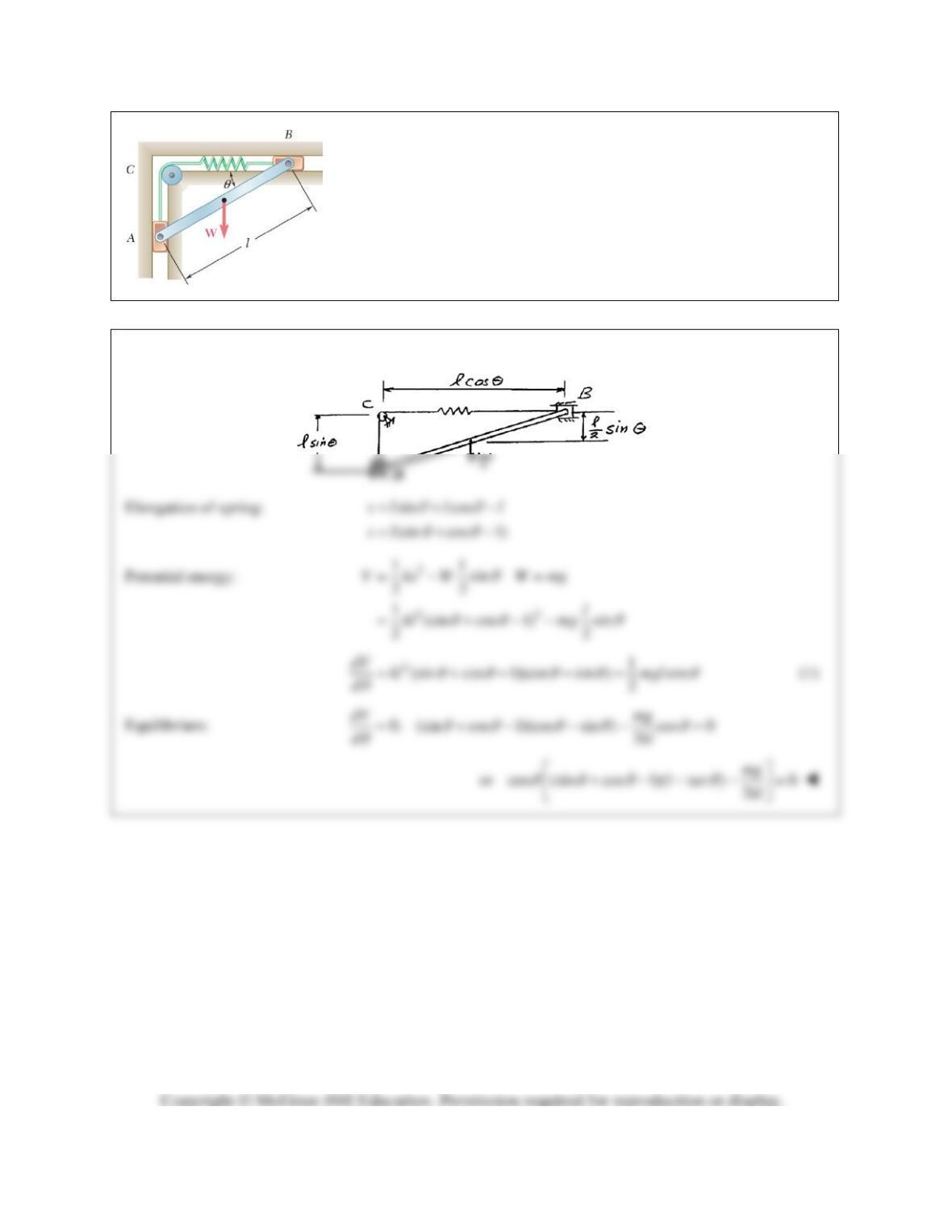
A slender rod AB, of weight W, is attached to two blocks
A and B that can move freely in the guides shown.
Knowing that both springs are unstretched when
0,
y
determine the value of y corresponding to equilibrium
when
80 N,W
l 550 mm, and
600 N/m.k
SOLUTION
Spring deflections
22
22
AD
BC
Slly
Slyl
PROBLEM 10.79
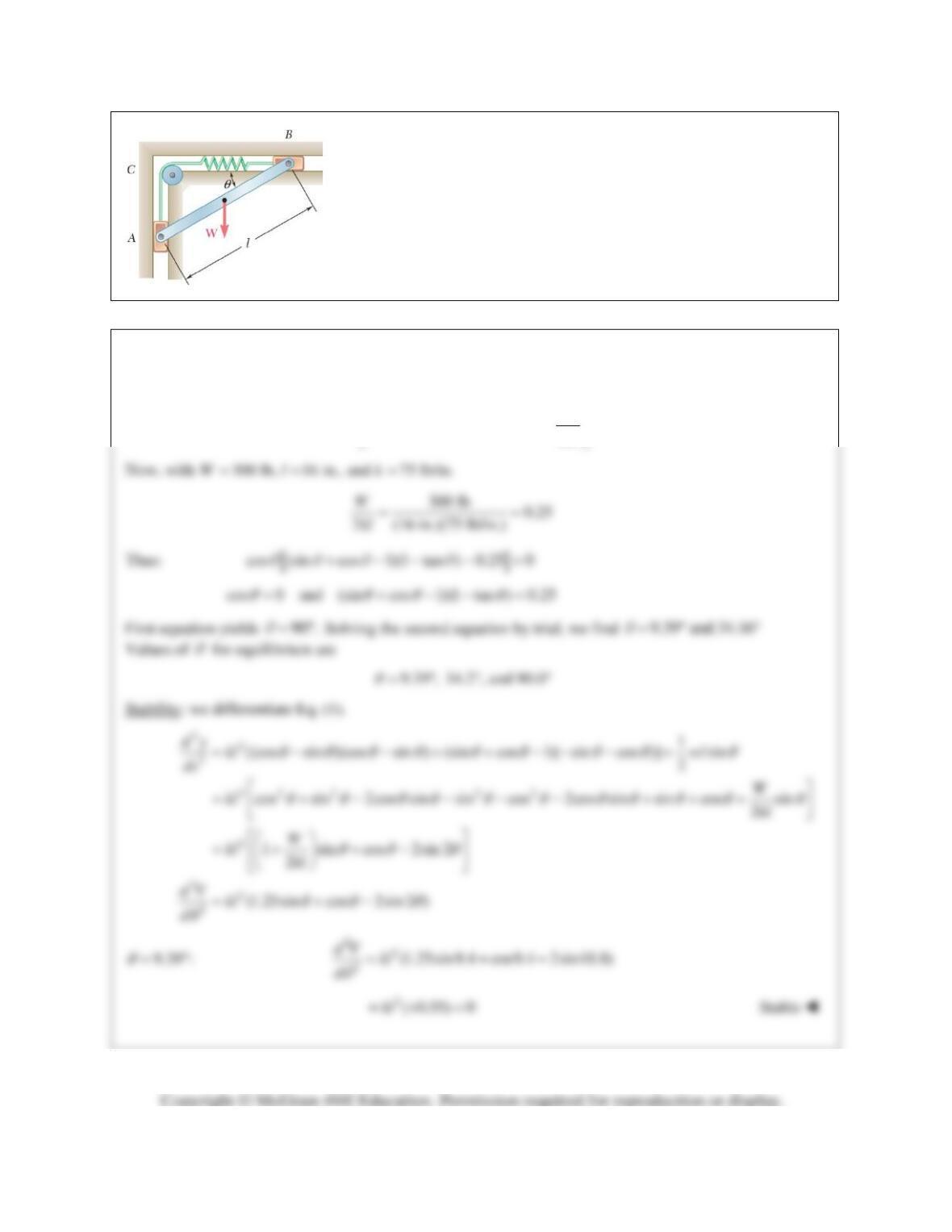
A slender rod
AB
, of weight
W
, is attached to two blocks
A
and
B
that
can move freely in the guides shown. The constant of the spring is
k
,
and the spring is unstretched when
AB
is horizontal. Neglecting the
weight of the blocks, derive an equation in
,
W
,
l
, and
k
that must be
satisfied when the rod is in equilibrium.
SOLUTION
PROBLEM 10.80
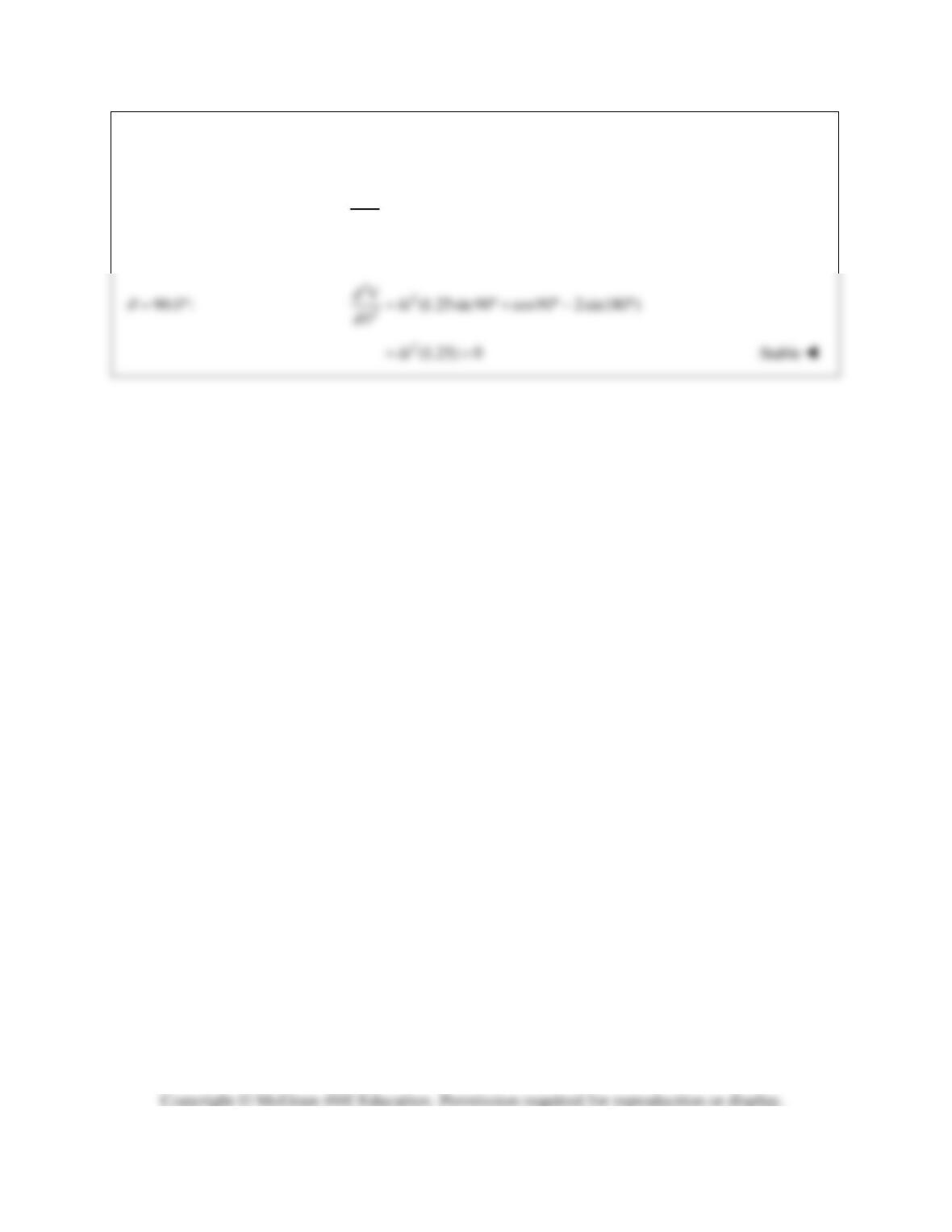
A slender rod AB, of weight W, is attached to two blocks A and B that
can move freely in the guides shown. Knowing that the spring is
unstretched when AB is horizontal, determine three values of
corresponding to equilibrium when 300 lb,
W16 in.,l and
75 lb/in.k State in each case whether the equilibrium is stable,
unstable, or neutral.
SOLUTION
Using the results of Problem 10.79, particularly the condition of equilibrium
cos (sin cos 1)(1 tan ) 0
2
mg
kl
PROBLEM 10.80 (Continued)
34.2 :
2
2
2(1.25sin 34.2 cos34.3 2sin 68.4 )
dv kl
d
2(0.33) 0kl
Unstable
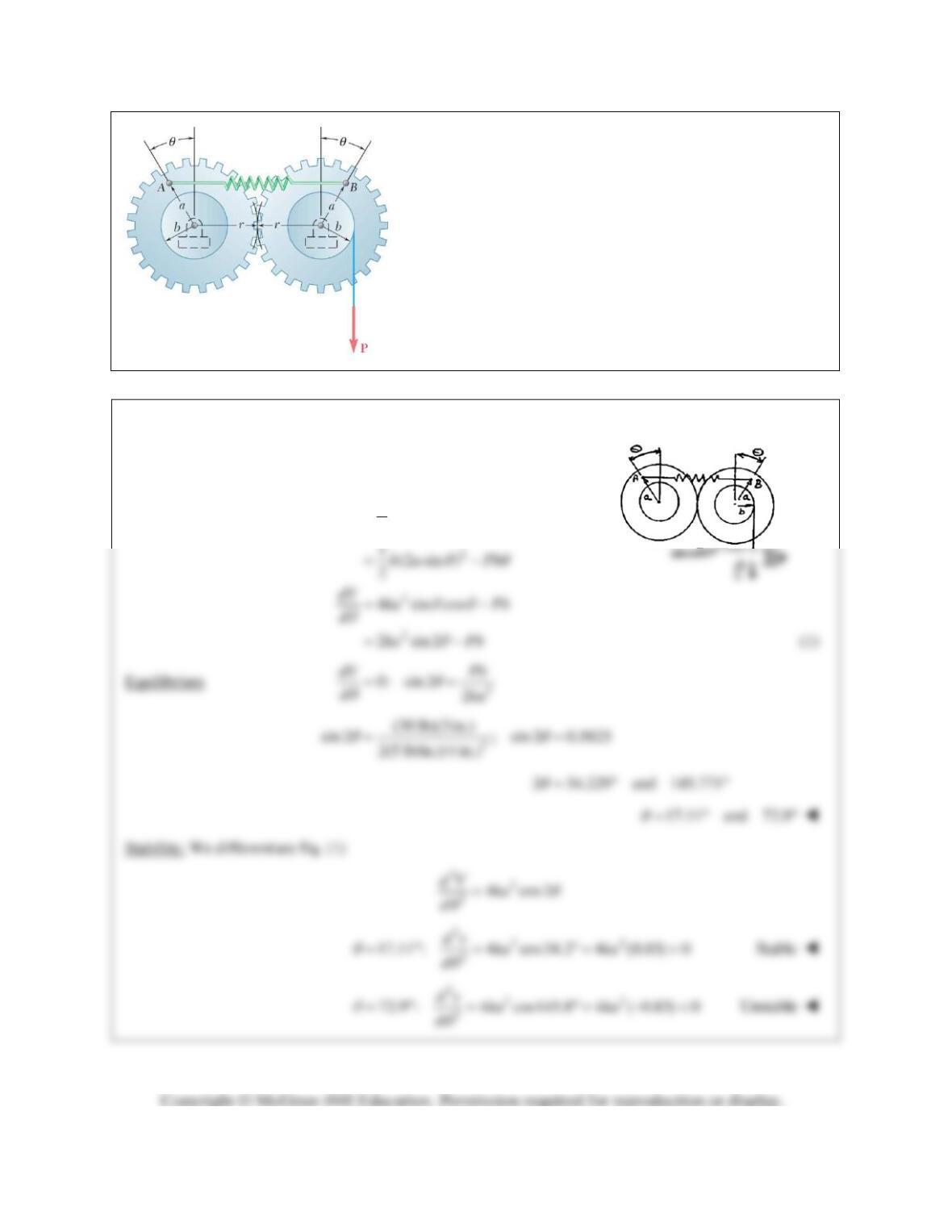
PROBLEM 10.81
A spring
AB
of constant
k
is attached to two identical gears as
shown. Knowing that the spring is undeformed when
0,
determine two values of the angle
corresponding to
equilibrium when
P
30 lb,
a
4 in.,
b
3 in.,
r
6 in., and
k
5 lb/in. State in each case whether the equilibrium is
stable, unstable, or neutral.
SOLUTION
Elongation of spring
2
2( sin ) 2 sin
1
2
sa a
VksPb
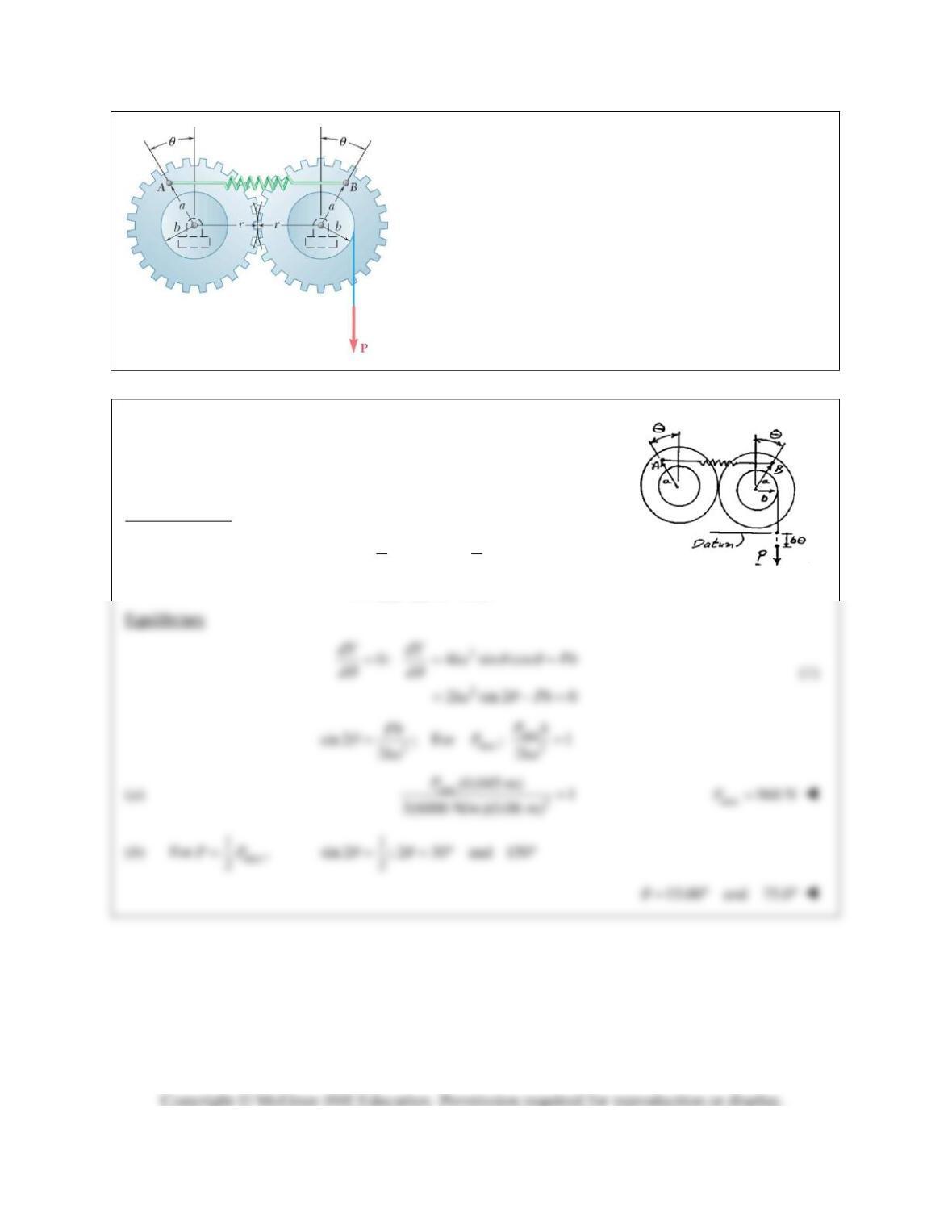
PROBLEM 10.82
A spring AB of constant k is attached to two identical gears as
shown. Knowing that the spring is undeformed when
0,
and given that
60 mm, 45 mm, 90 mm,abr
and
6 kN/m,k
determine (a) the range of values of P for which
a position of equilibrium exists, (b) two values of
corresponding to equilibrium if the value of P is equal to half
the upper limit of the range found in part a.
SOLUTION
Elongation of spring
2( sin ) 2 sinsa a
Potential energy
22
22
11
(2 sin )
22
2sin
VksPb ka Pb
Vka Pb
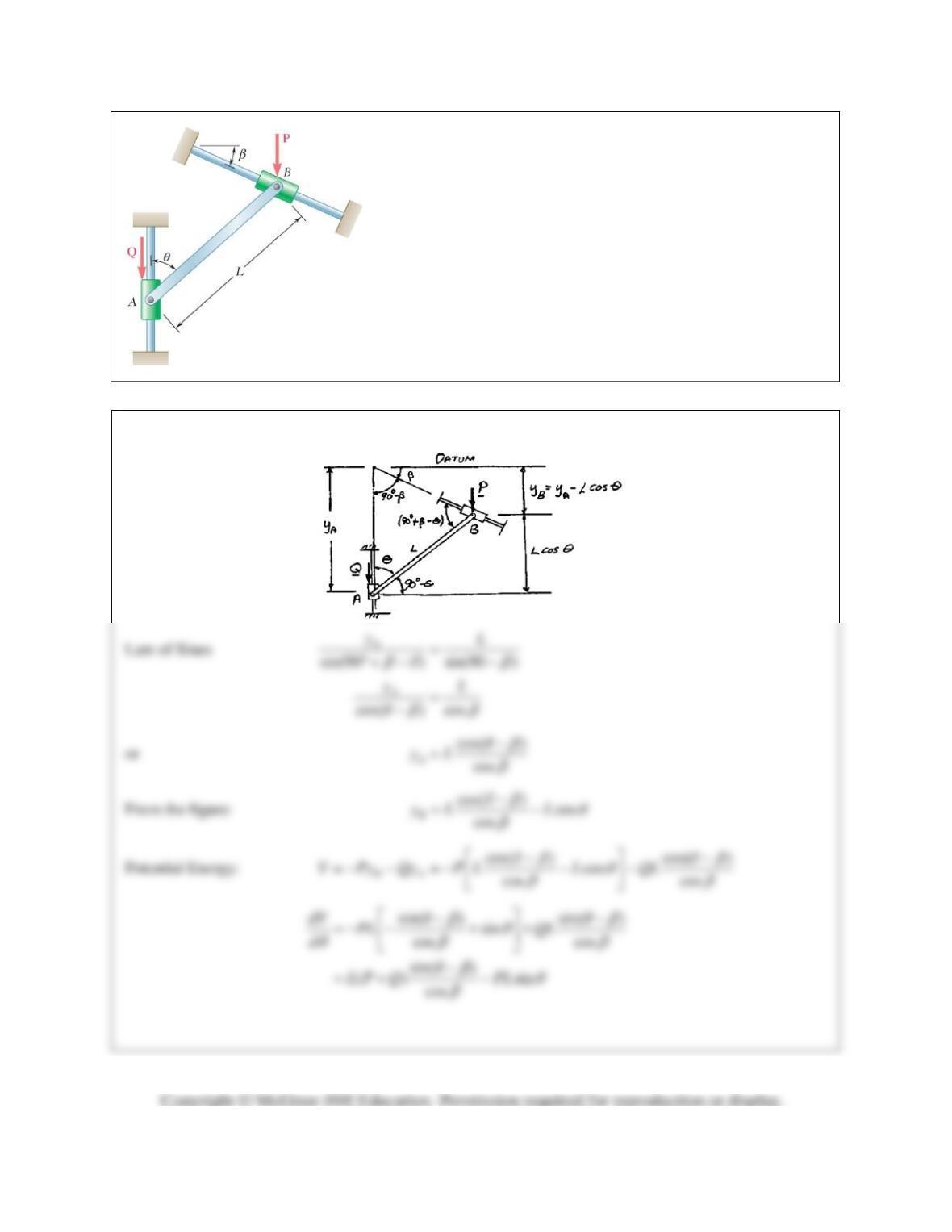
PROBLEM 10.83
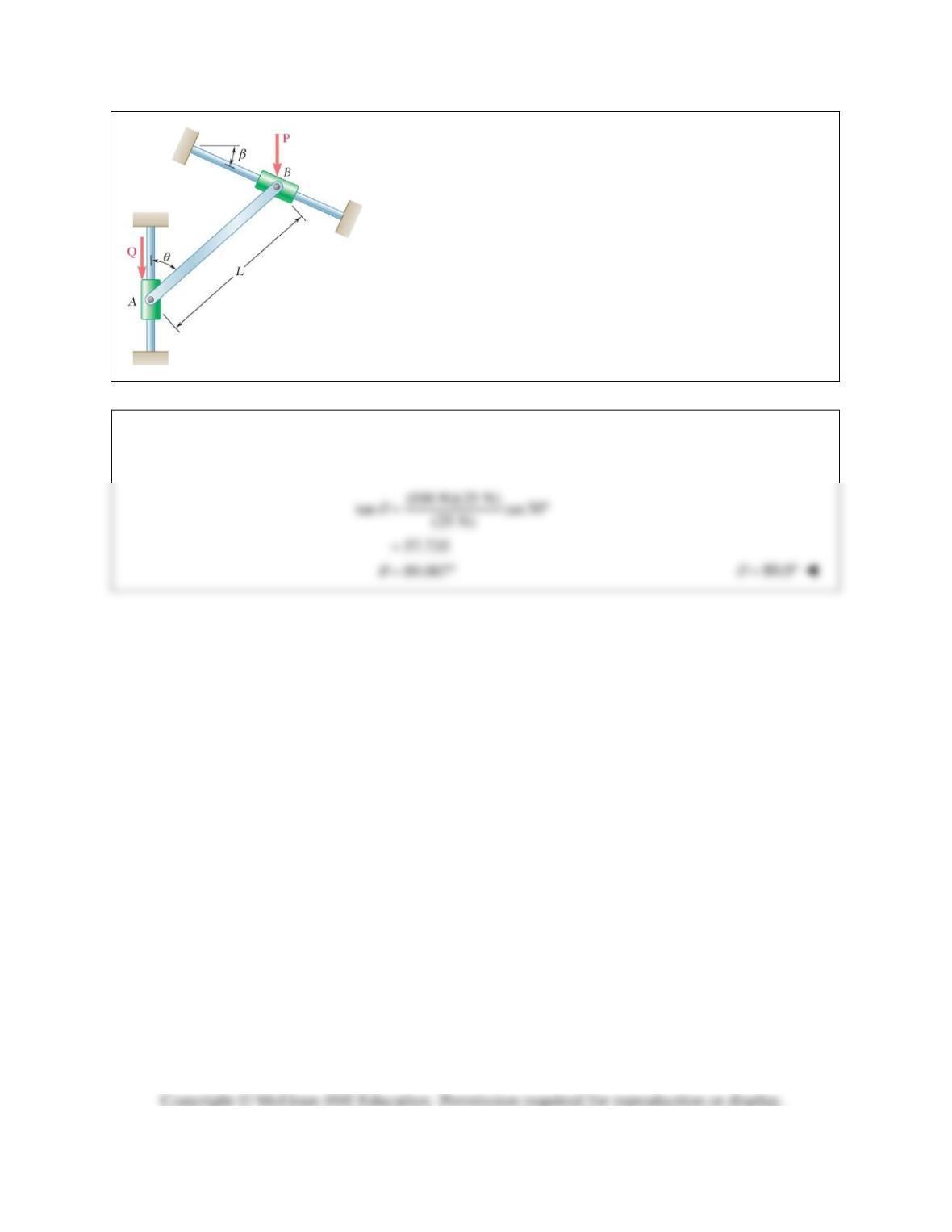
A slender rod AB is attached to two collars A and B that can move
freely along the guide rods shown. Knowing that
30
and
P Q 400 N, determine the value of the angle
corresponding
to equilibrium.
SOLUTION
PROBLEM 10.83 (Continued)
Equilibrium sin( )
0: ( ) sin 0
cos
dV LP Q PL
d
or ()sin()sincos
PQ P
PROBLEM 10.84
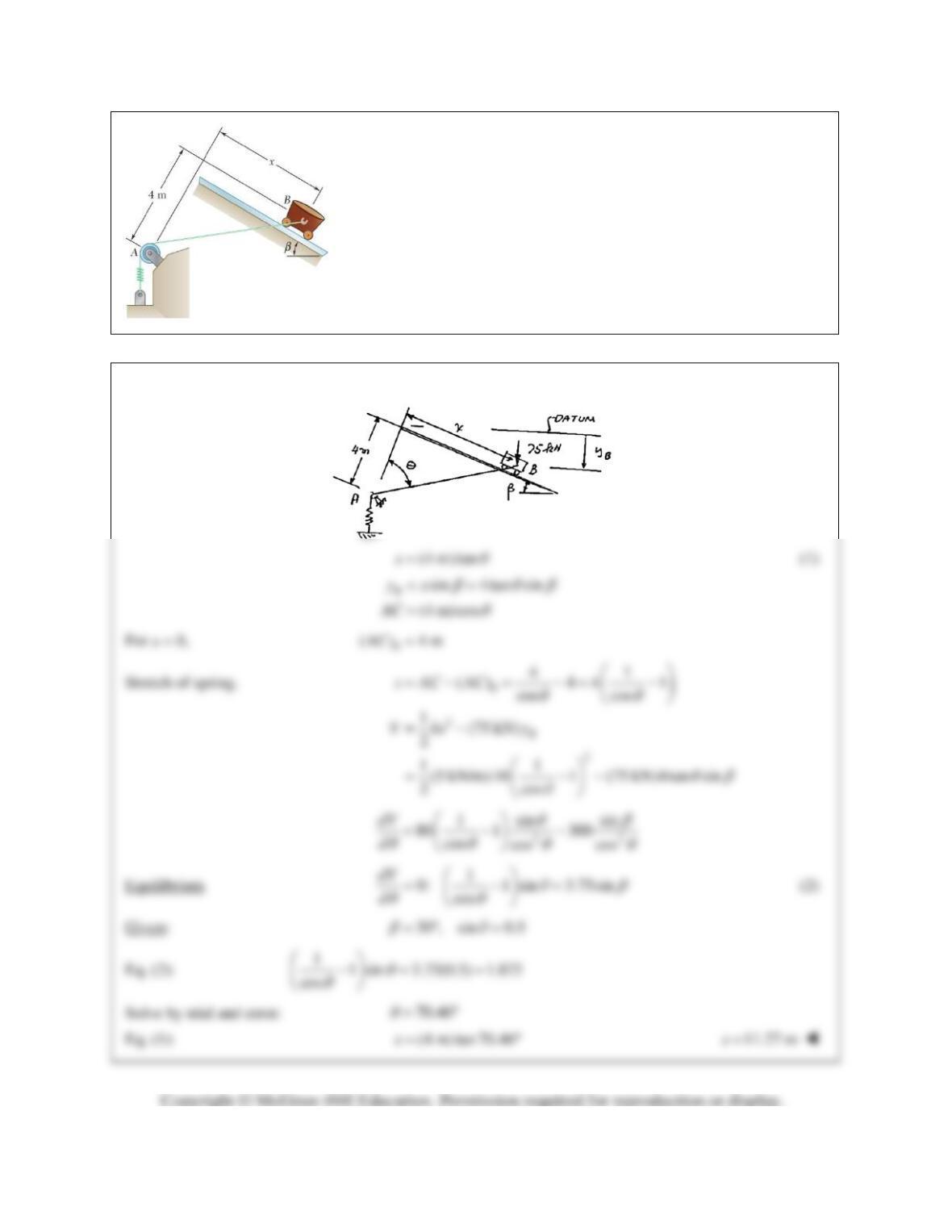
A slender rod AB is attached to two collars A and B that can move
freely along the guide rods shown. Knowing that
30 , 100 N,P
and 25 N,
Q determine the value of the
angle
corresponding to equilibrium.
SOLUTION
Using Equation (2) of Problem 10.83, with 100 N, 25 N, and 30 ,
PQ we have
PROBLEM 10.85
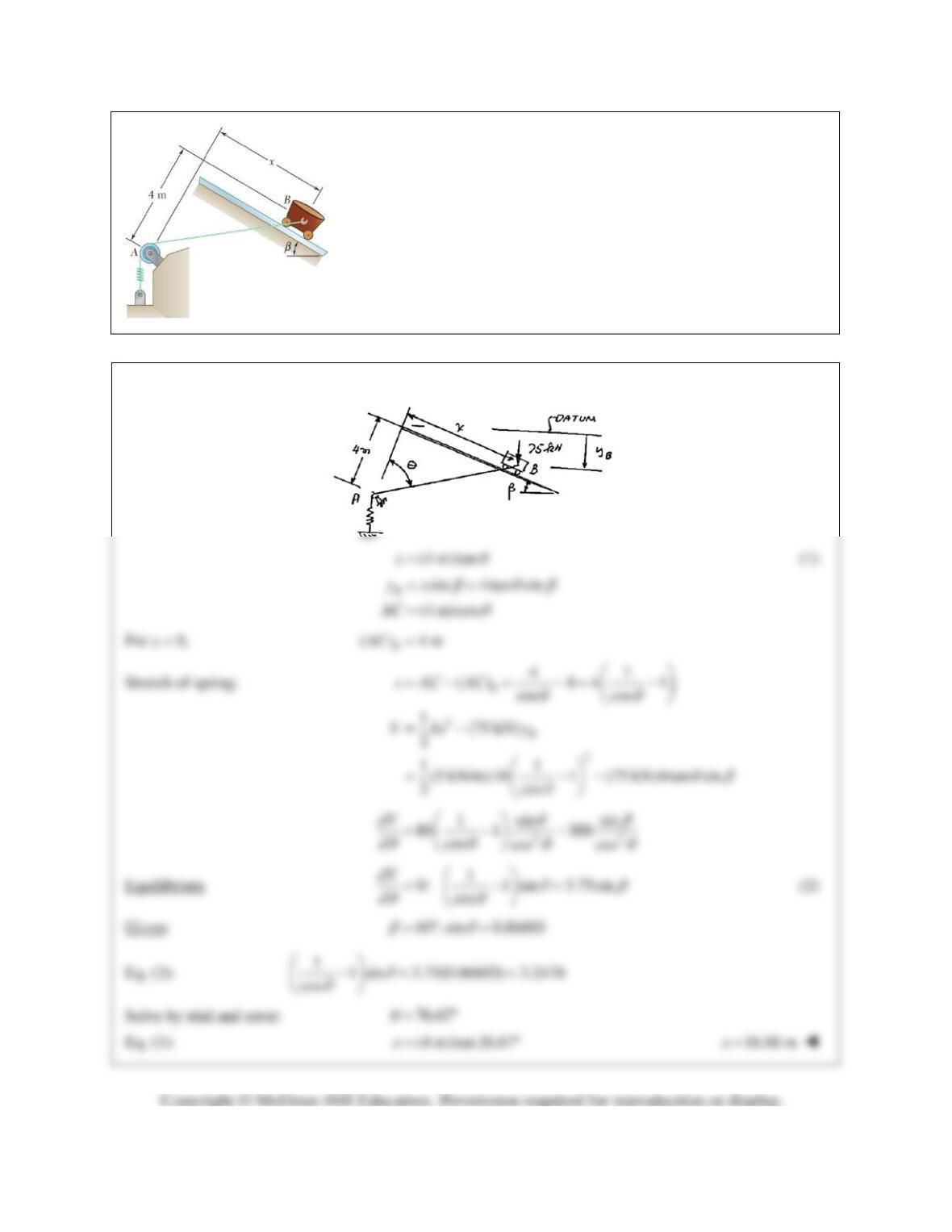
Cart B, which weighs 75 kN, rolls along a sloping track that forms an
angle
with the horizontal. The spring constant is 5 kN/m, and the
spring is unstretched when
0.
x
Determine the distance x
corresponding to equilibrium for the angle
indicated.
Angle
= 30 .
SOLUTION
PROBLEM 10.86
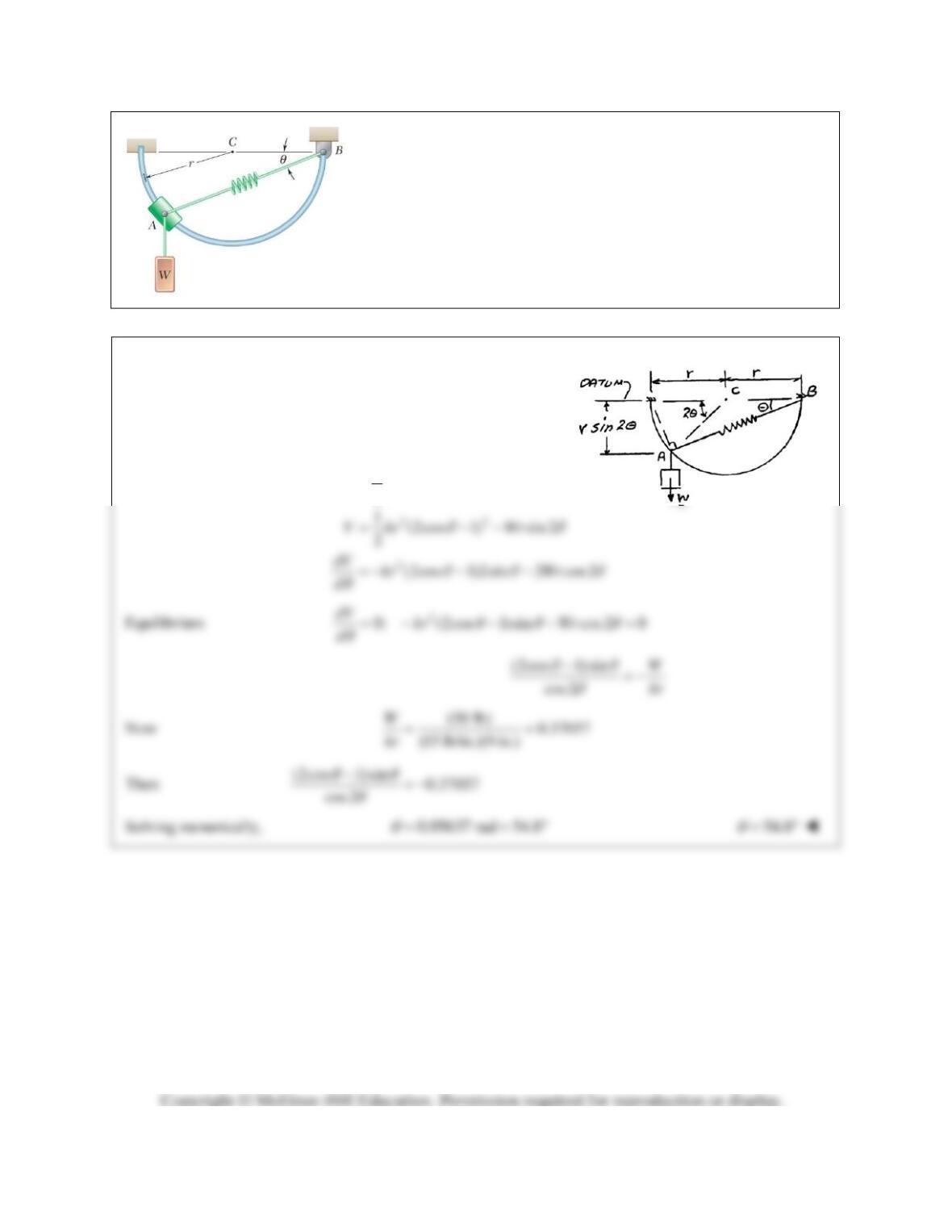
Cart B, which weighs 75 kN, rolls along a sloping track that forms an
angle
with the horizontal. The spring constant is 5 kN/m, and the
spring is unstretched when
0.
x
Determine the distance x
corresponding to equilibrium for the angle
indicated.
Angle
= 60°.
SOLUTION
PROBLEM 10.87
Collar A can slide freely on the semicircular rod shown. Knowing
that the constant of the spring is k and that the unstretched length of
the spring is equal to the radius r, determine the value of
corresponding to equilibrium when
50 lb, 9 in.,Wr
and
15 lb/in.k
SOLUTION
Stretch of spring
2( cos )
(2cos 1)
sABr
sr r
sr
Potential energy: 2
1sin 2
2
VksWr Wmg