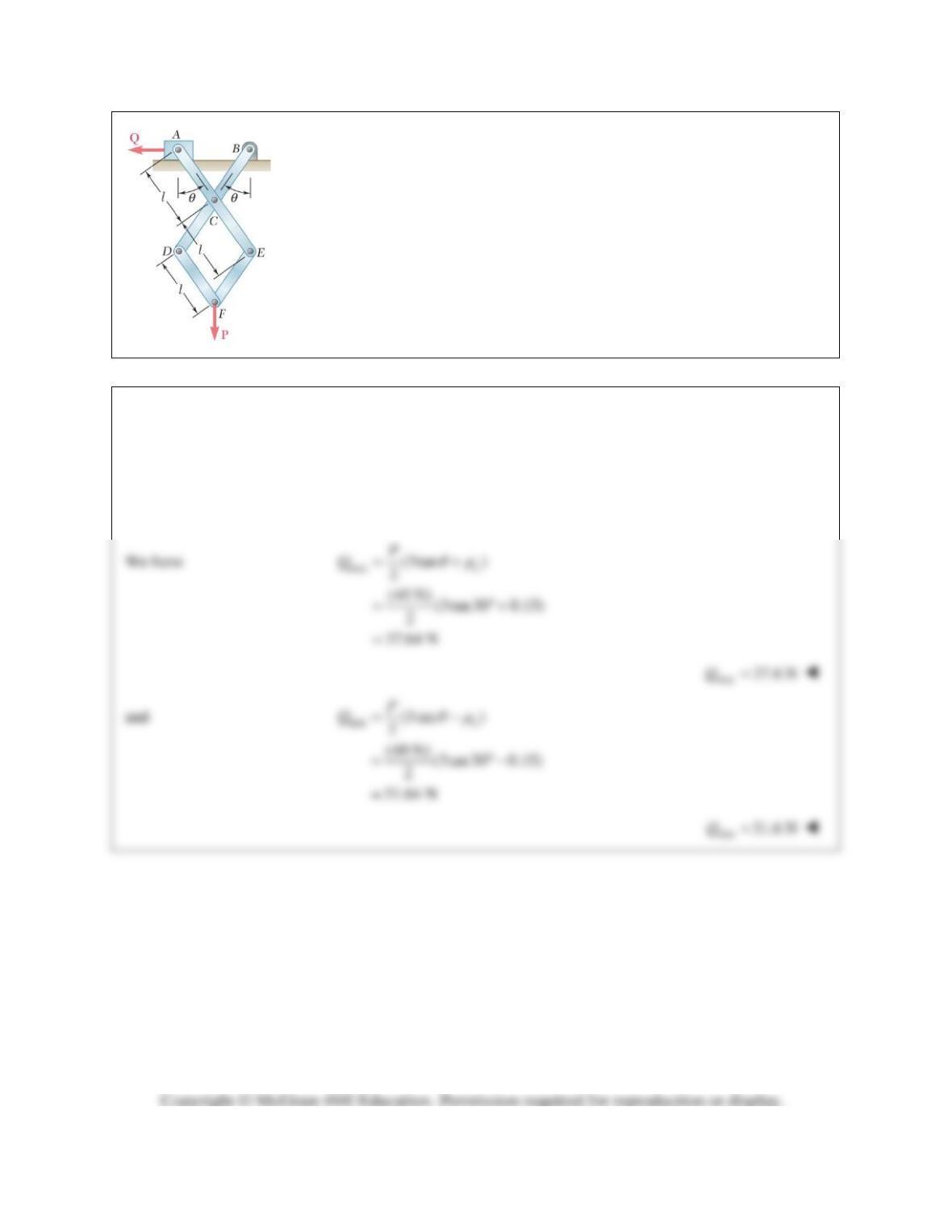
PROBLEM 10.52
Knowing that the coefficient of static friction between the block attached to
rod ACE and the horizontal surface is 0.15, determine the magnitude of the
largest and smallest force Q for which equilibrium is maintained when
30 , 0.2 m,l
and P 40 N.
SOLUTION
Using the results of Problem 10.48 with
30
0.2 m
40 N, and 0.15
s
l
P
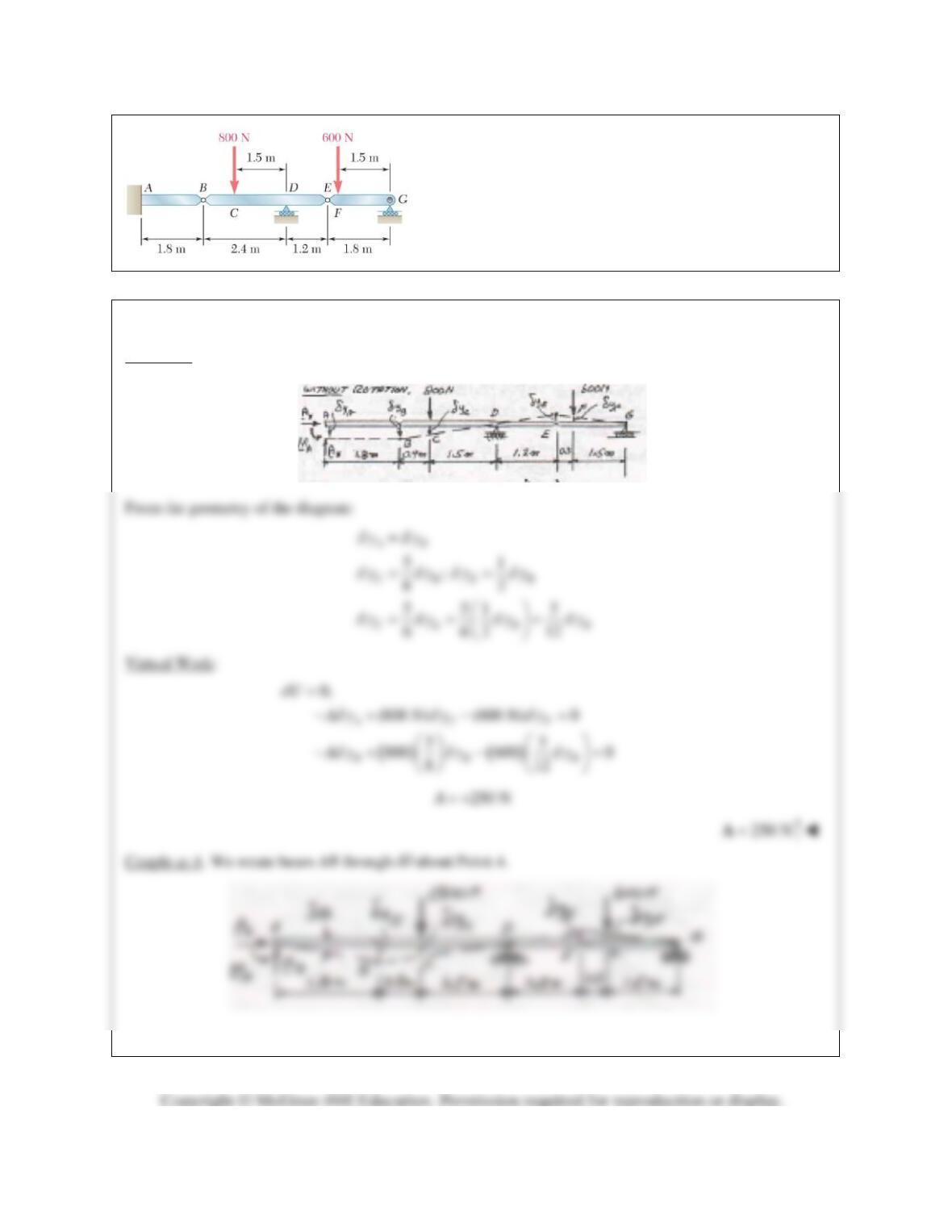
PROBLEM 10.53
Using the method of virtual work, determine separately the
force and couple representing the reaction at A.
SOLUTION
Force at A. We give a vertical virtual displacement
A
y
to Point A, keeping member AB horizontal.
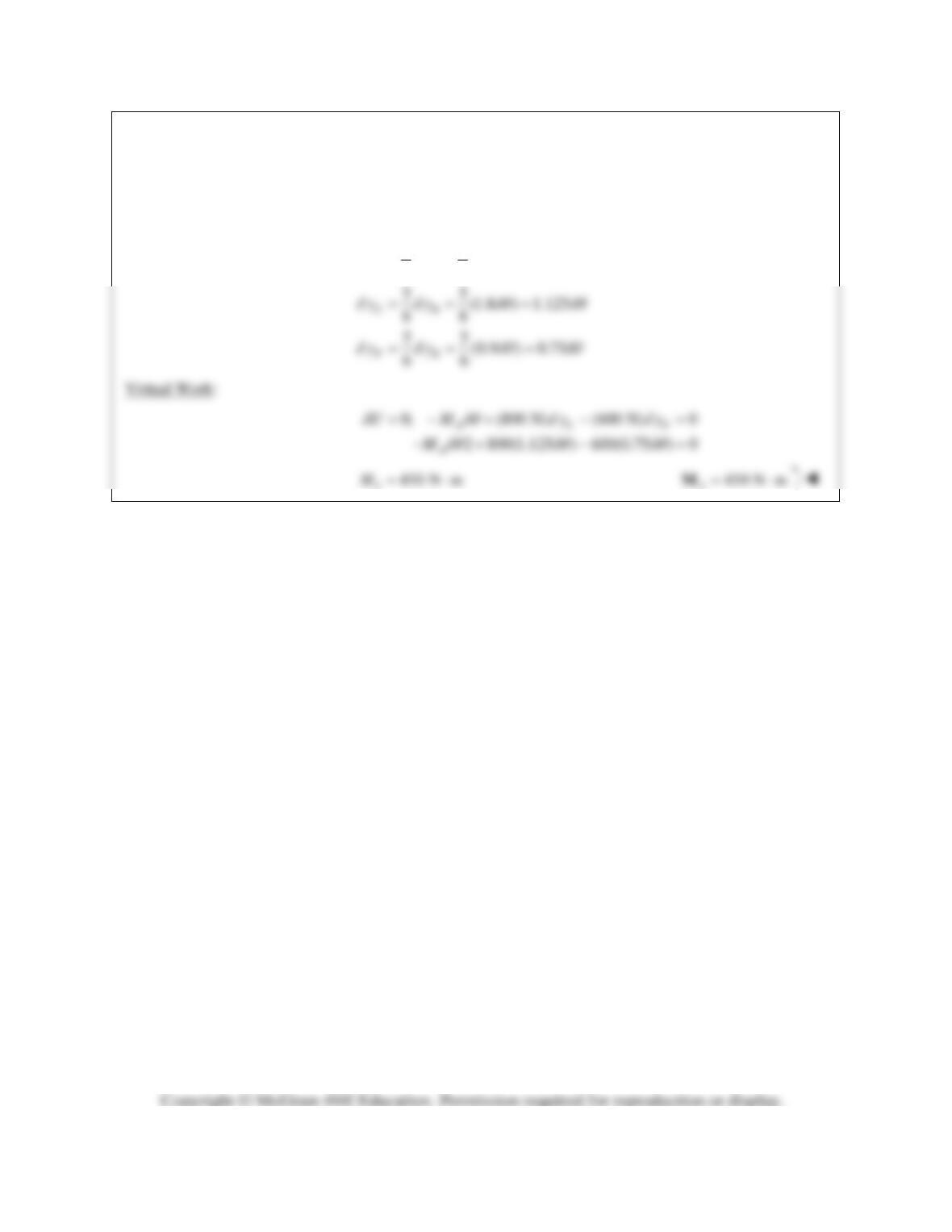
PROBLEM 10.53 (Continued)
From the geometry of the diagram:
1.8
11
(1.8 ) 0.9
55
B
EB
y
yy
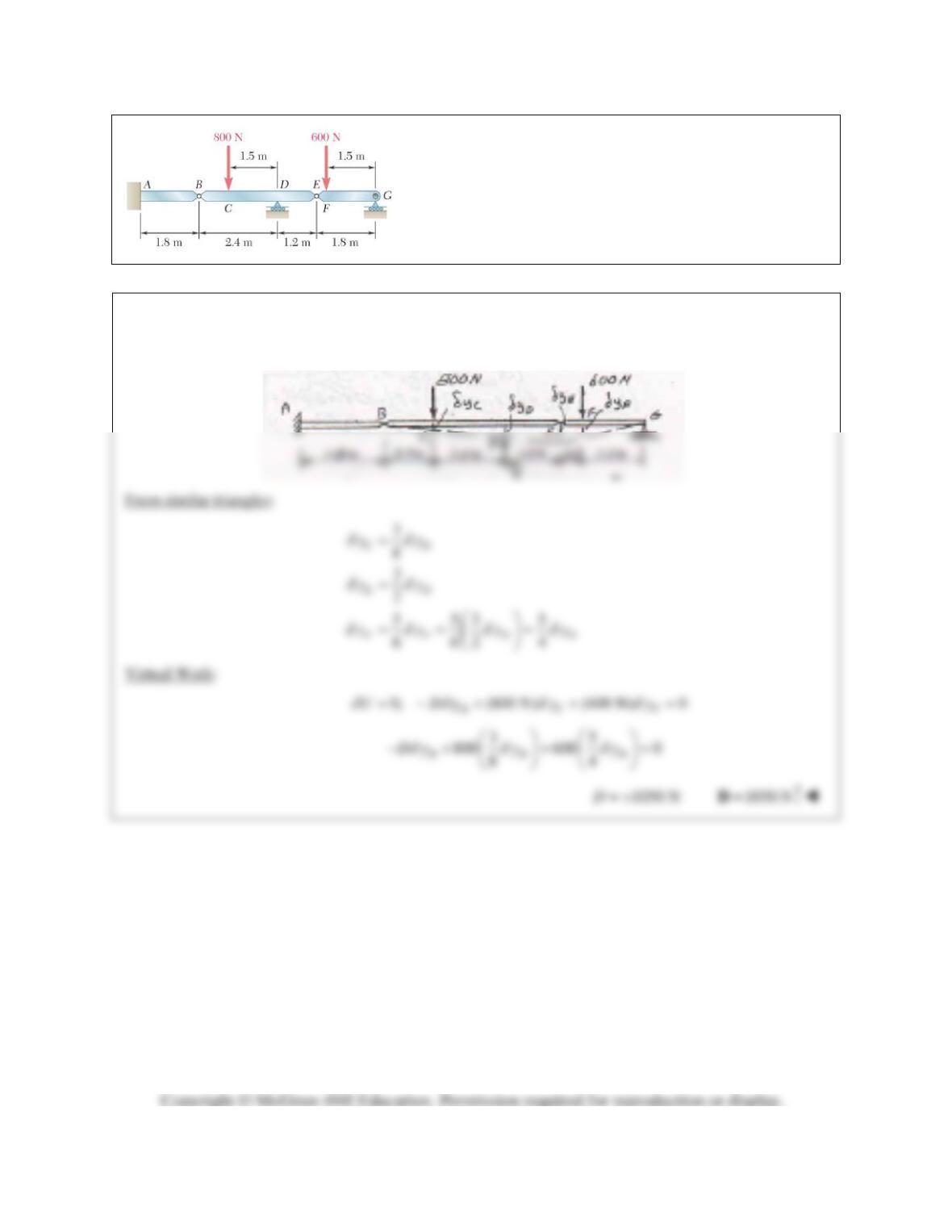
PROBLEM 10.54
Using the method of virtual work, determine the reaction at D.
SOLUTION
We release the support at D and assume a virtual displacement
D
y
for Point D.
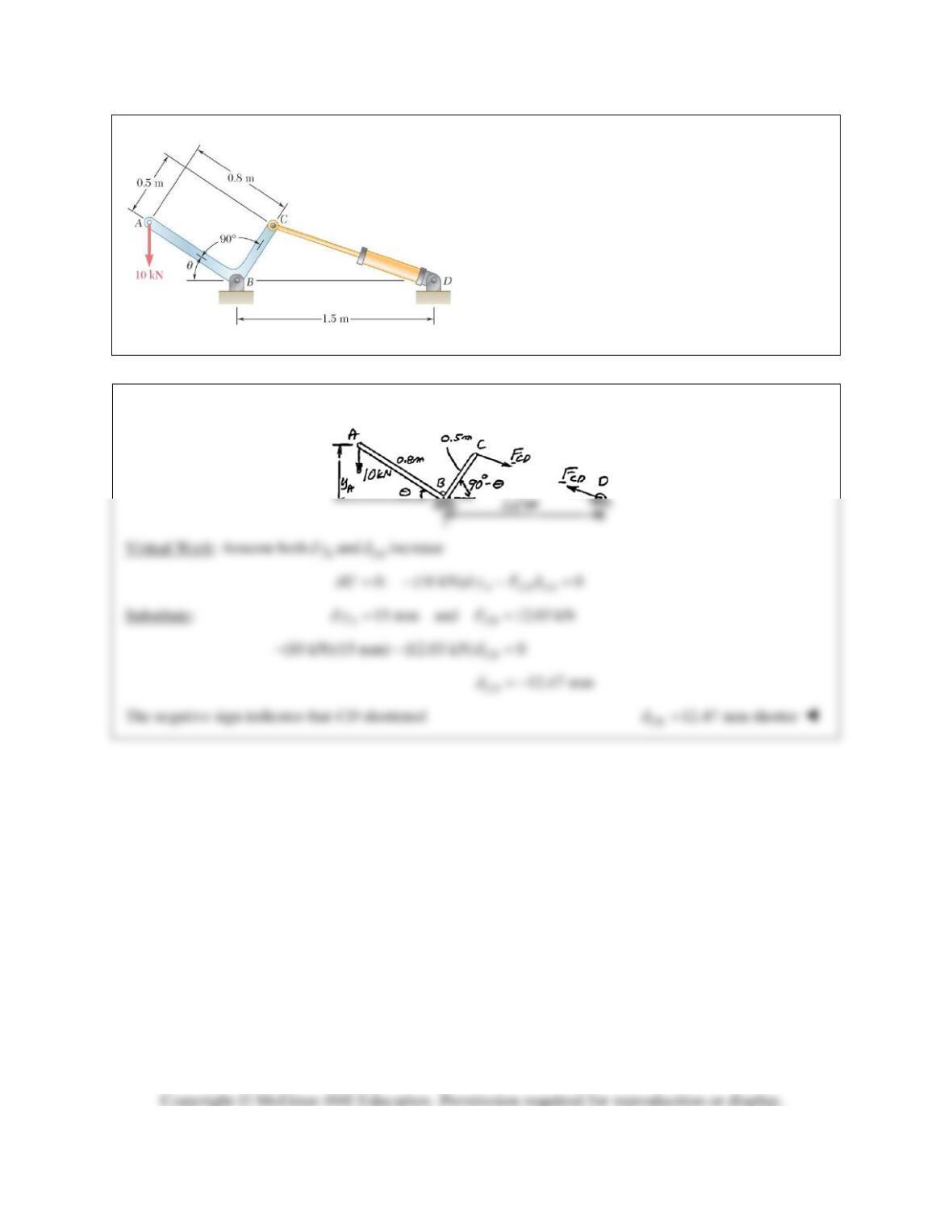
PROBLEM 10.55
Referring to Problem 10.43 and using the value
found for the force exerted by the hydraulic cylinder
CD, determine the change in the length of CD
required to raise the 10-kN load by 15 mm.
PROBLEM 10.43
The position of member ABC is
controlled by the hydraulic cylinder CD. For the
loading shown, determine the force exerted by the
hydraulic cylinder on pin C when
55 .
SOLUTION
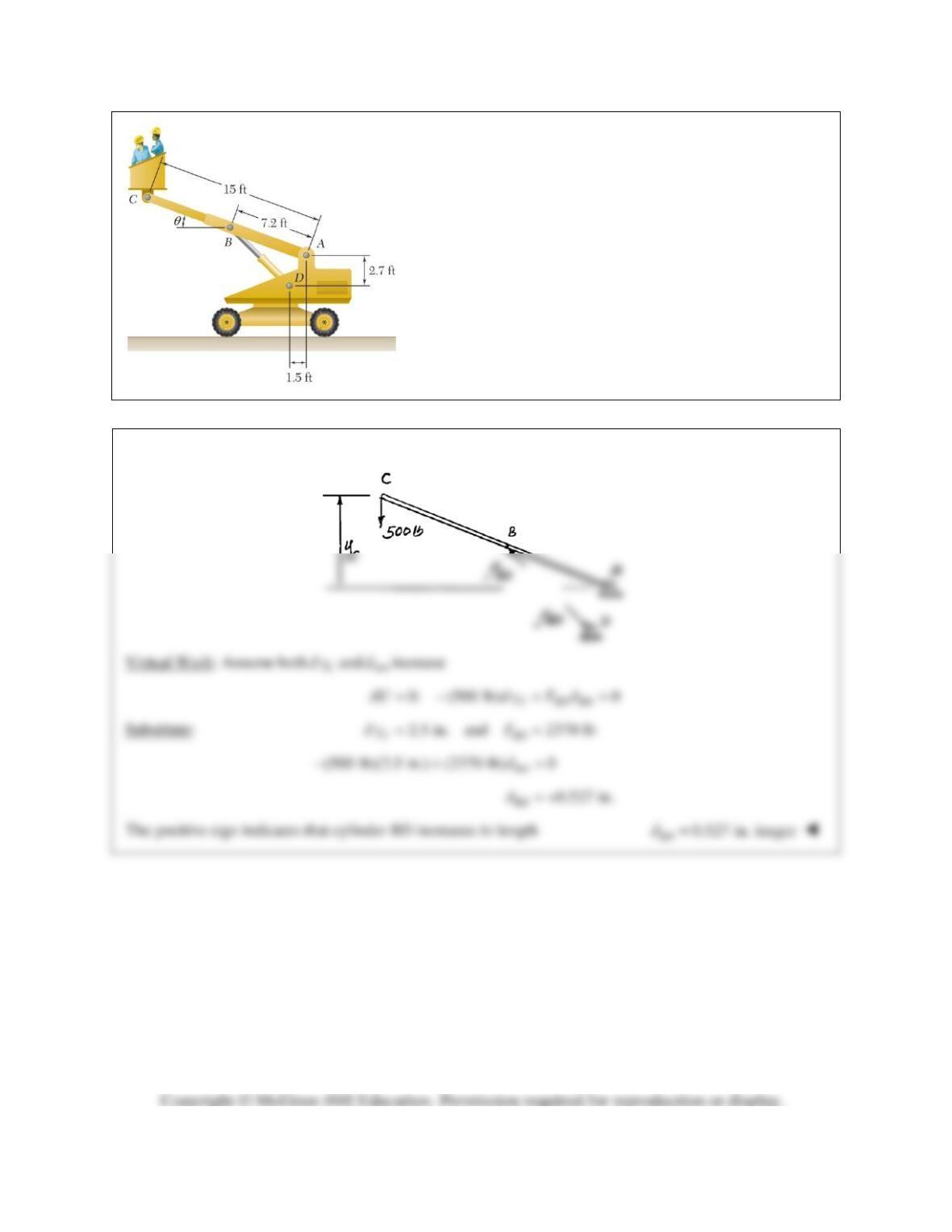
PROBLEM 10.56
Referring to Problem 10.45 and using the value found for the
force exerted by the hydraulic cylinder BD, determine the
change in the length of BD required to raise the platform
attached at C by 2.5 in.
PROBLEM 10.45
The telescoping arm ABC is used to
provide an elevated platform for construction workers. The
workers and the platform together weigh 500 lb and their
combined center of gravity is located directly above C. For
the position when
20 ,
determine the force exerted on
pin B by the single hydraulic cylinder BD.
SOLUTION
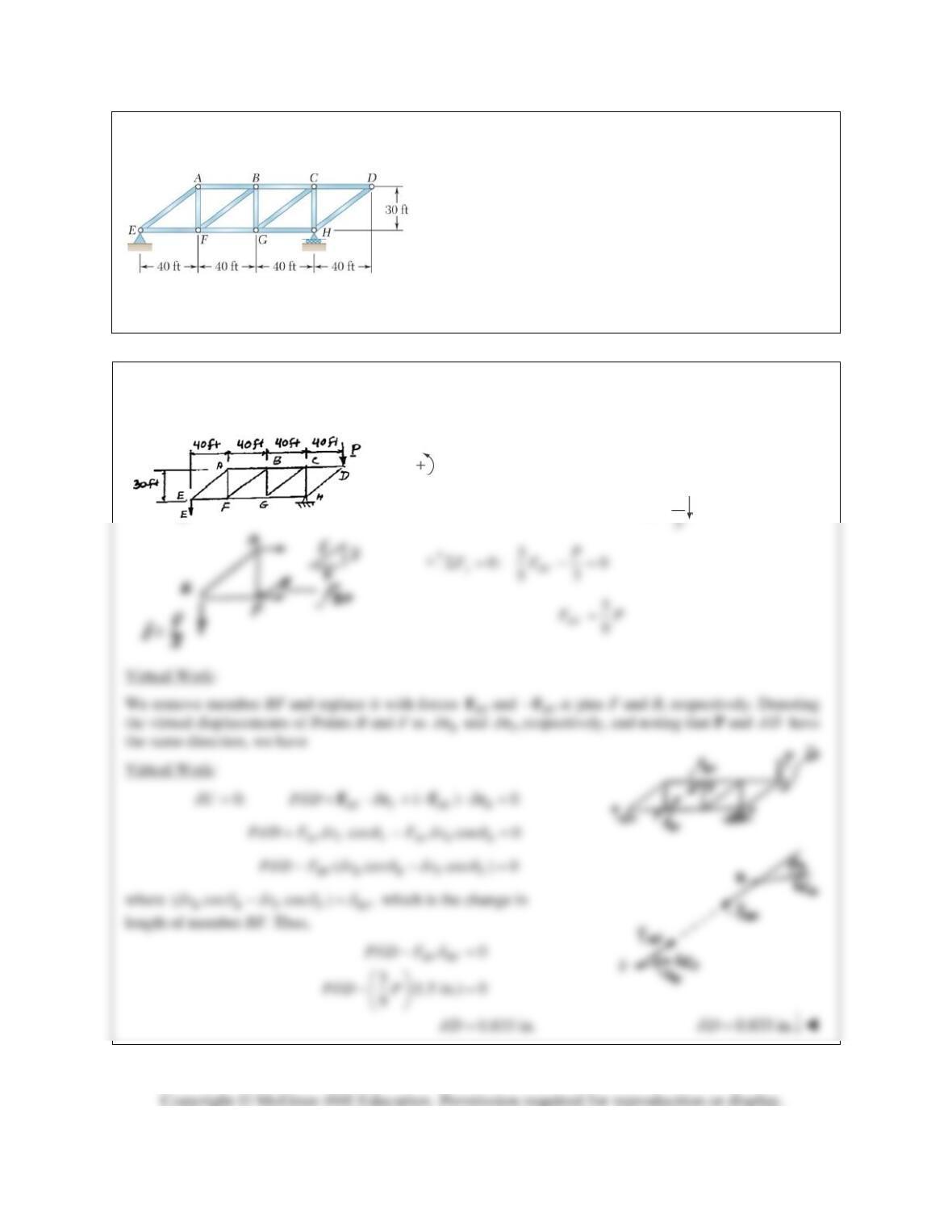
PROBLEM 10.57
Determine the vertical movement of joint D if the length of
member BF is increased by 1.5 in. (Hint: Apply a vertical
load at joint D, and, using the methods of Chapter 6,
compute the force exerted by member BF on joints B and
F. Then apply the method of virtual work for a virtual
displacement resulting in the specified increase in length of
member BF. This method should be used only for small
changes in the lengths of members.)
SOLUTION
Apply vertical load P at D.
0: (40 ft) (120 ft) 0
H
MPE
P
E
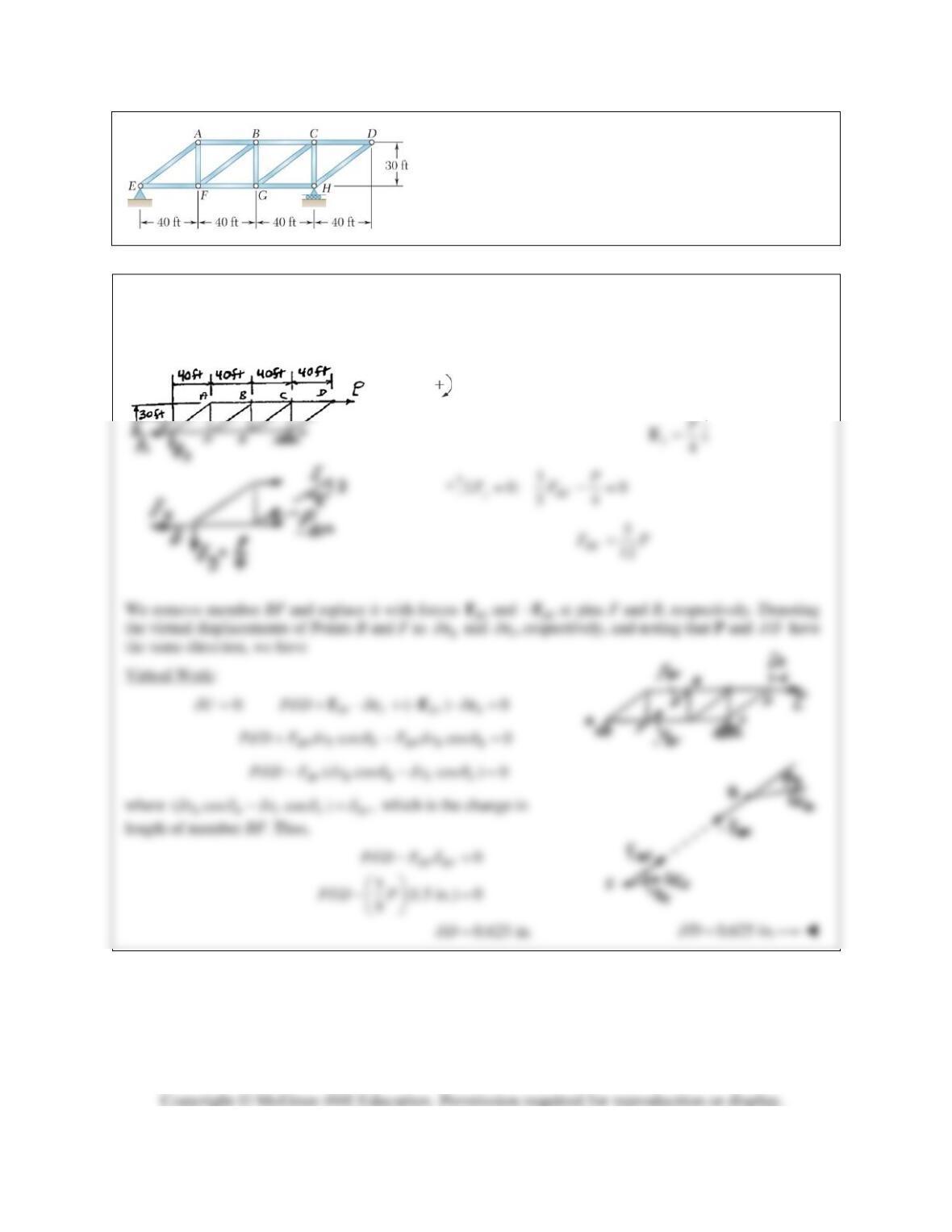
PROBLEM 10.58
Determine the horizontal movement of joint D if the length
of member BF is increased by 1.5 in. (See the hint for
Problem 10.57.)
SOLUTION
Apply horizontal load P at D.
0: (30 ft) (120 ft) 0
Hy
MPE
PROBLEM 10.59
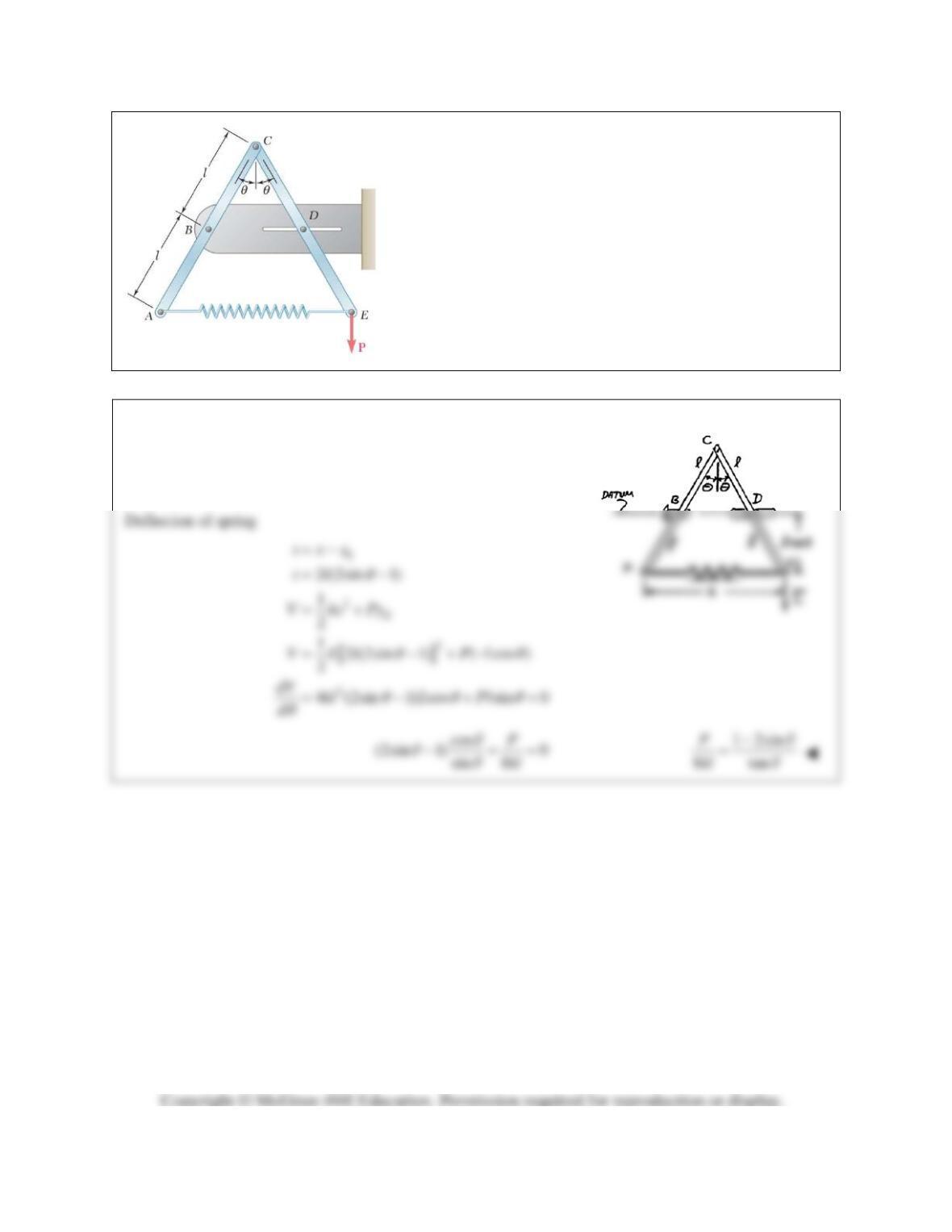
Using the method of Section 10.8, solve Problem 10.29.
PROBLEM 10.29
Two rods AC and CE are connected by a pin
at C and by a spring AE. The constant of the spring is k, and the
spring is unstretched when
30 .
For the loading shown,
derive an equation in P,
, l, and k that must be satisfied when
the system is in equilibrium.
SOLUTION
Spring:
2(2 sin ) 4 sinAE x l l
Unstretched length:
0
4 sin 30 2
xl l
PROBLEM 10.60
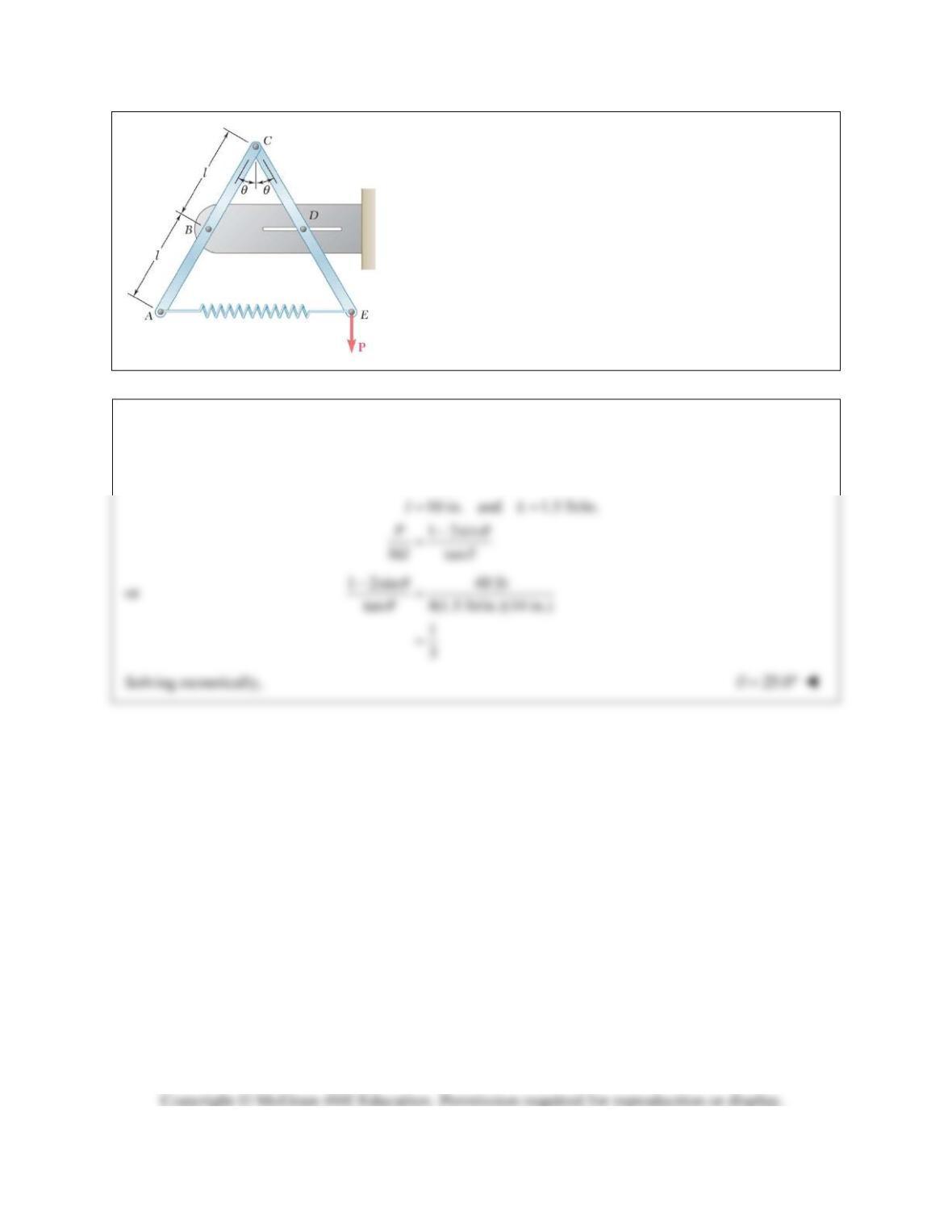
Using the method of Section 10.8, solve Problem 10.30.
PROBLEM 10.30 Two rods AC and CE are connected by a pin
at C and by a spring AE. The constant of the spring is 1.5 lb/in.,
and the spring is unstretched when 30 .
Knowing that
10 in.l
and neglecting the weight of the rods, determine the
value of
corresponding to equilibrium when 40 lb.P
SOLUTION
Using the result of Problem 10.59, with
40 lb
P
PROBLEM 10.61
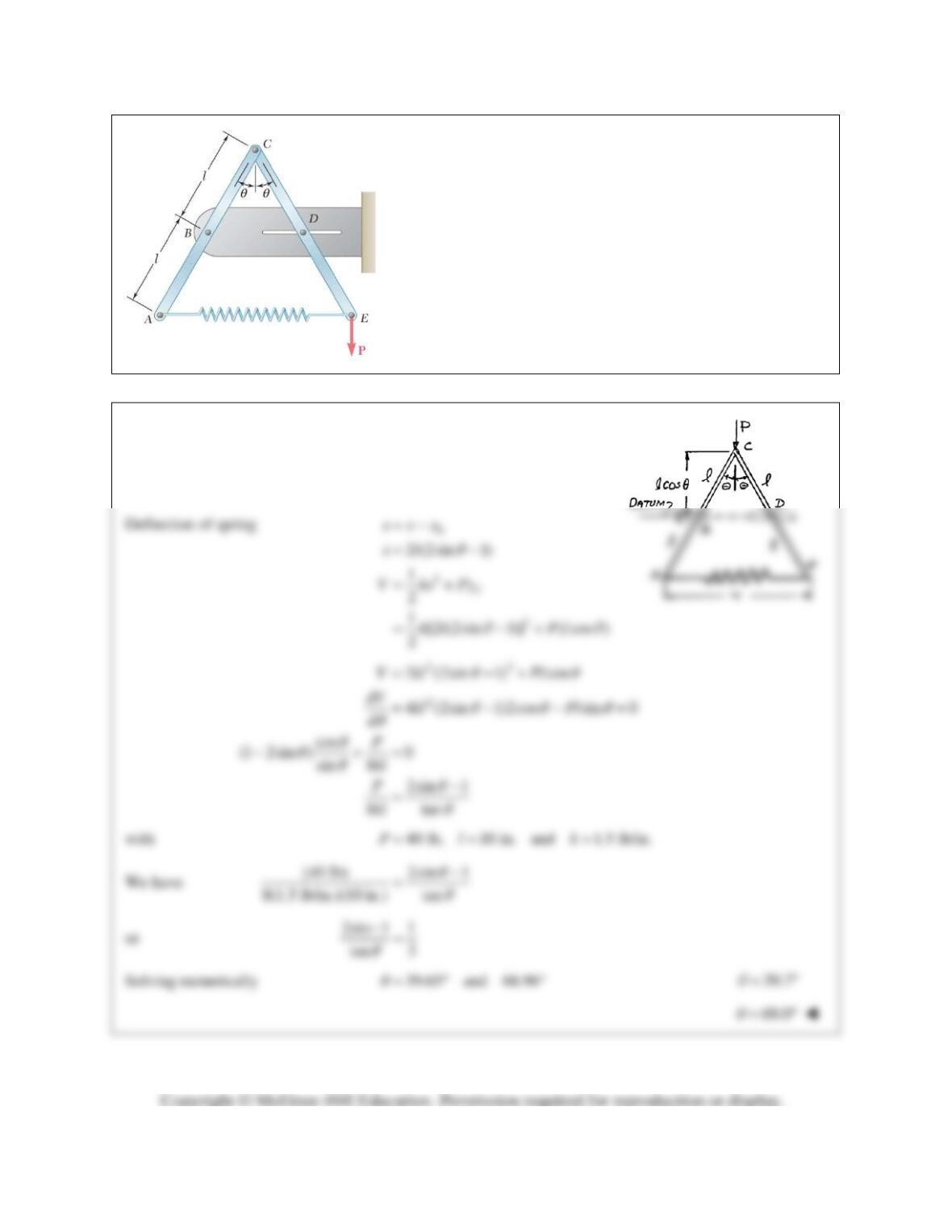
Using the method of Section 10.8, solve Problem 10.31.
PROBLEM 10.31
Solve Problem 10.30 assuming that force
P
is
moved to C and acts vertically downward.
SOLUTION
Spring:
2(2 sin ) 4 sinAE x l l
Unstretched length:
0
4 sin 30 2
xl l
PROBLEM 10.62
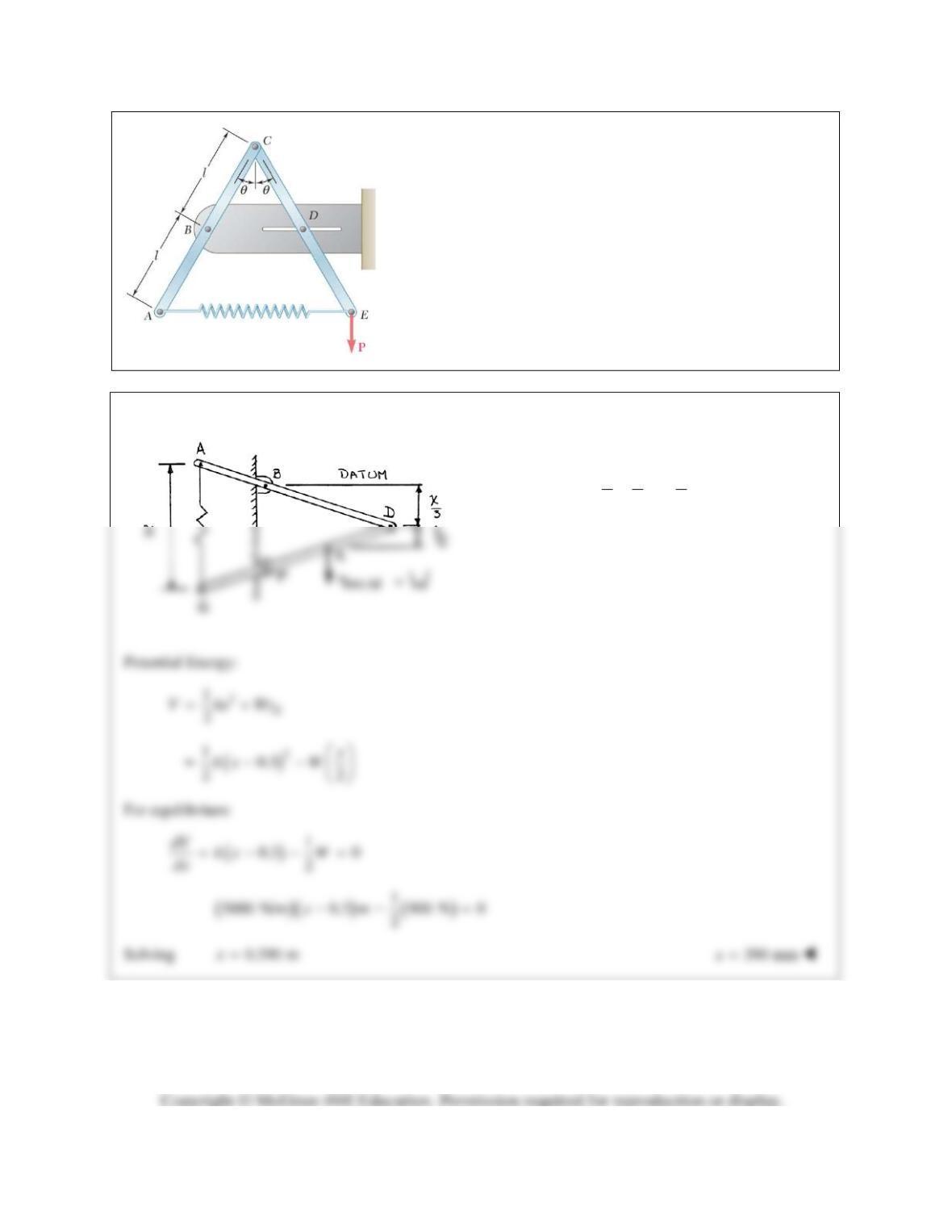
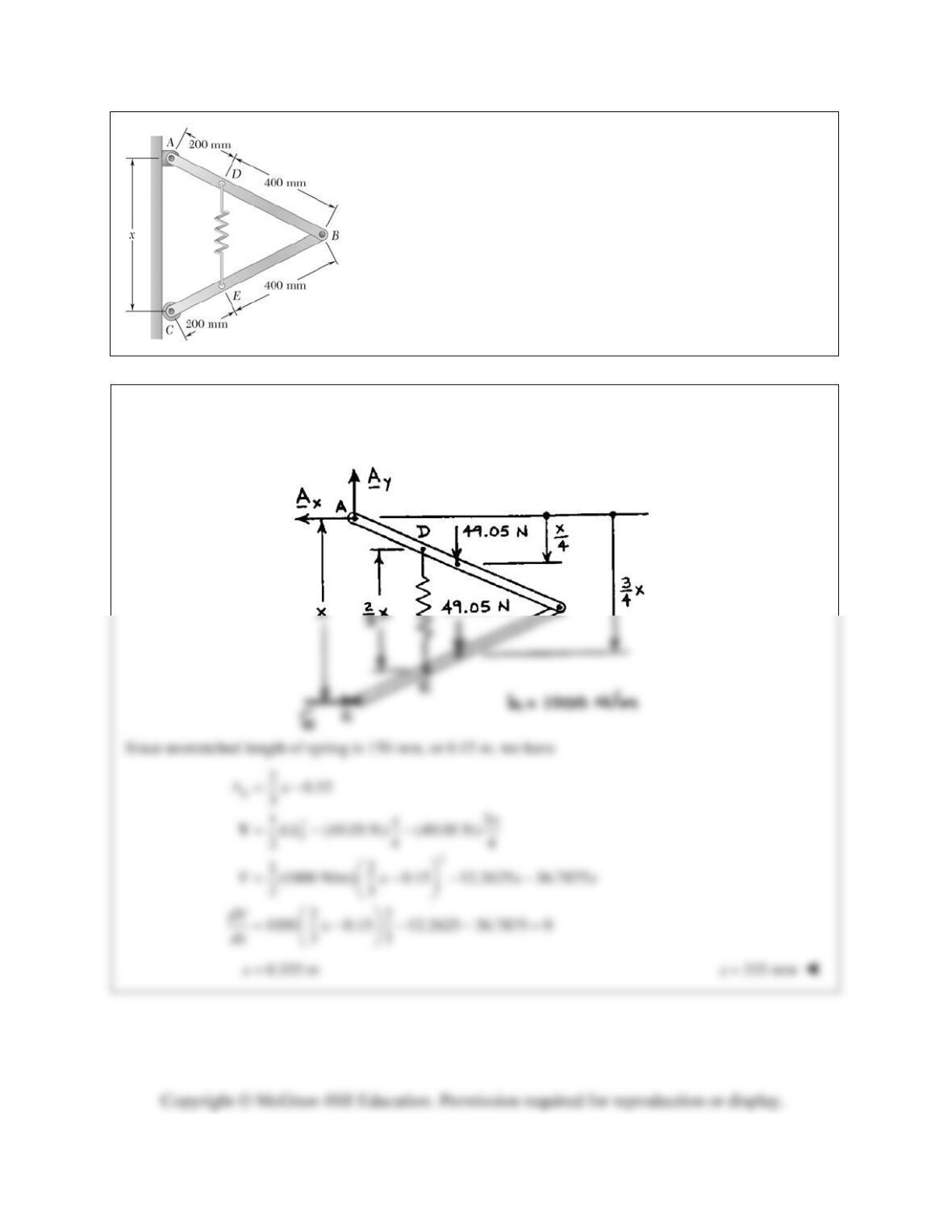
Using the method of Sec. 10.8, solve Prob. 10.30.
Problem 10.30:
Two bars AD and DG are connected by a pin at
D and by a spring AG. Knowing that the spring is 300 mm long
when unstretched and that the constant of the spring is 5 kN/m,
determine the value of x corresponding to equilibrium when a
900-N load is applied at E as shown.
SOLUTION
Spring:
0.3 msx
36 2
E
xx x
y
PROBLEM 10.63
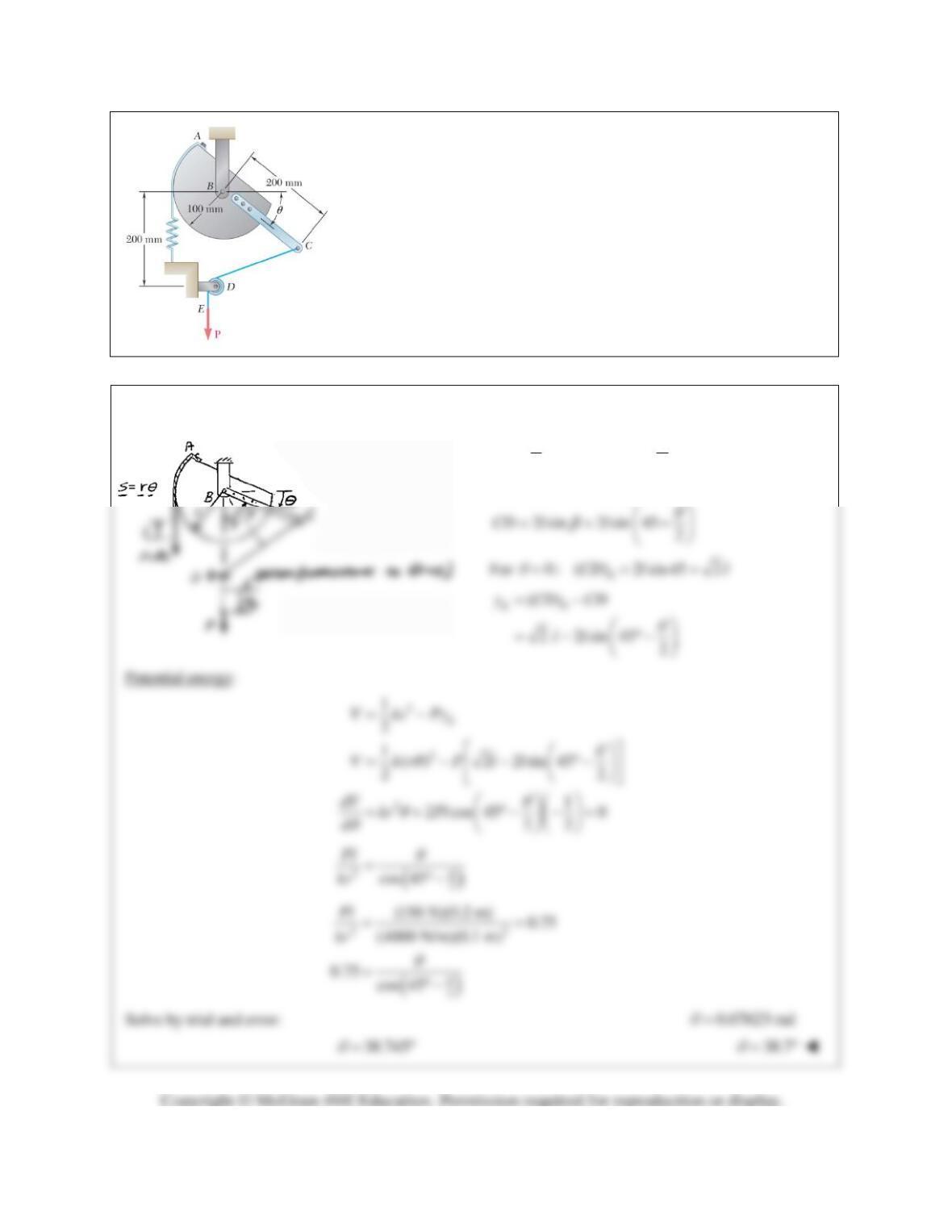
Using the method of Section 10.8, solve Problem 10.33.
PROBLEM 10.33
Two 5-kg bars AB and BC are connected by a pin
at B and by a spring DE. Knowing that the spring is 150 mm long
when unstretched and that the constant of the spring is 1 kN/m,
determine the value of x corresponding to equilibrium.
SOLUTION
First note:
2
bar (5 kg)(9.81 m/s ) 49.05 NW
PROBLEM 10.64
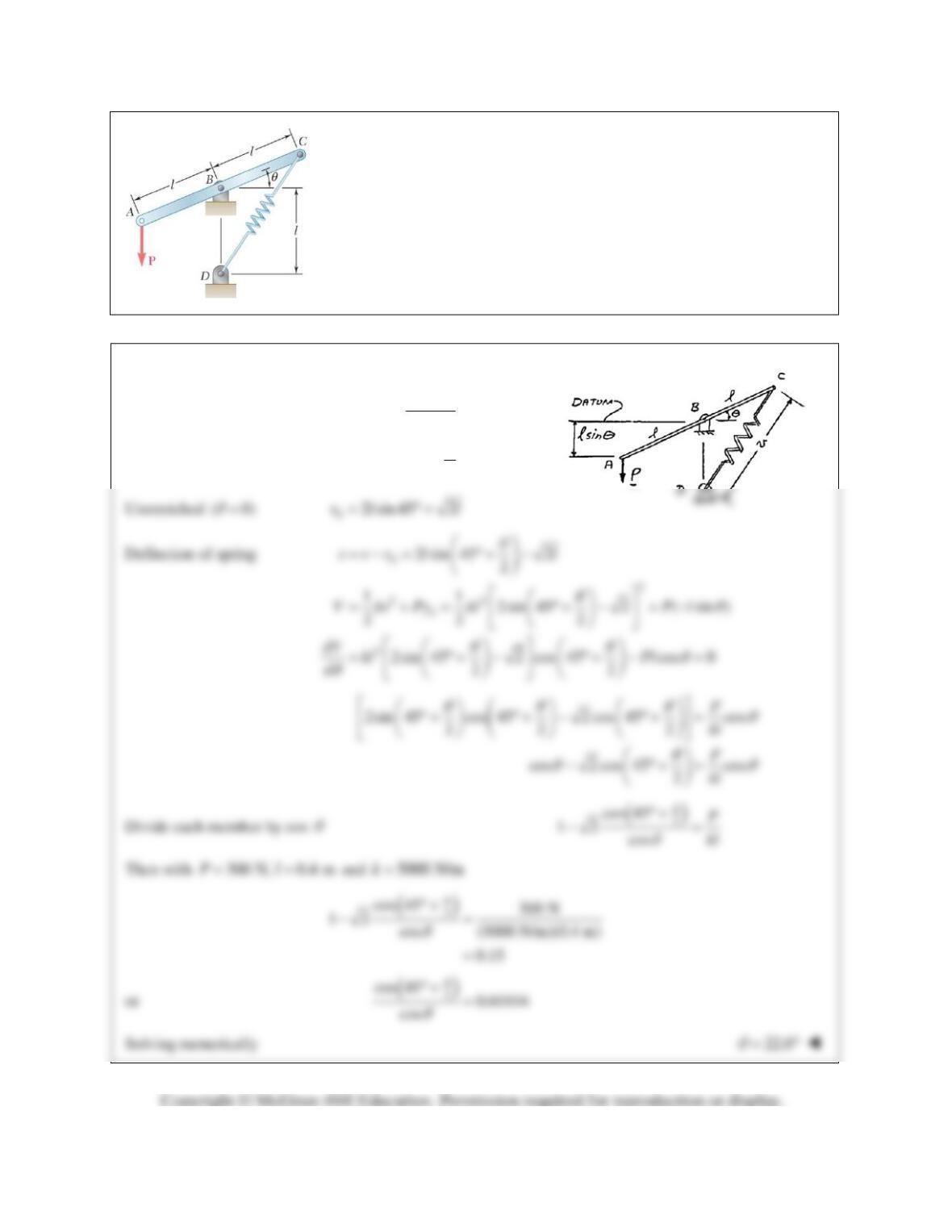
Using the method of Section 10.8, solve Problem 10.35.
PROBLEM 10.35 A vertical force P of magnitude 150 N is applied to
end E of cable CDE, which passes over a small pulley D and is
attached to the mechanism at C. The constant of the spring is k 4
kN/m, and the spring is unstretched when
0. Neglecting the weight
of the mechanism and the radius of the pulley, determine the value of
corresponding to equilibrium.
SOLUTION
1(90 ) 45
22
BC BD l
PROBLEM 10.65
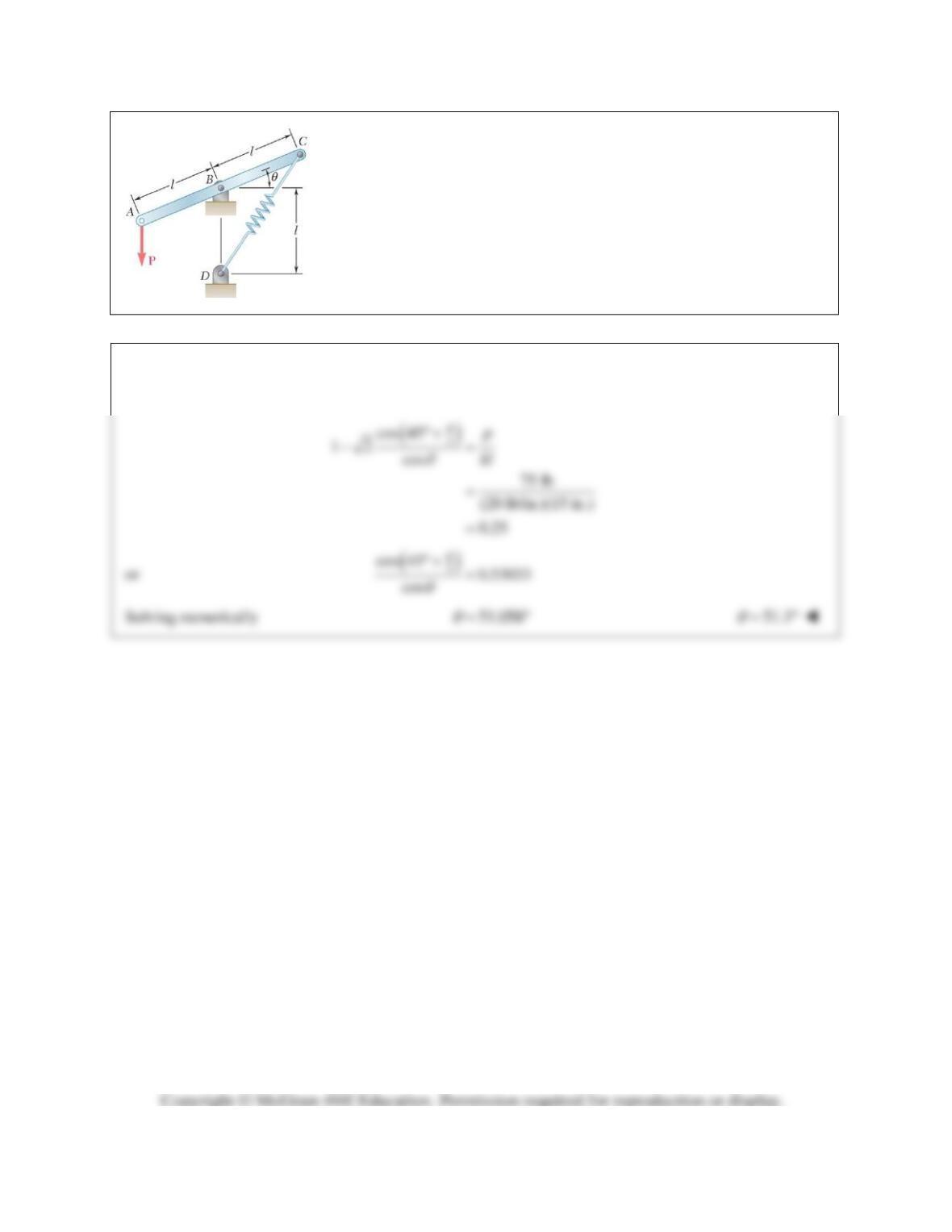
Using the method of Section 10.8, solve Problem 10.37.
PROBLEM 10.37 and 10.38
Knowing that the constant of spring CD is
k and that the spring is unstretched when rod ABC is horizontal, determine
the value of
corresponding to equilibrium for the data indicated.
PROBLEM 10.37
300 N, 400 mm, 5 kN/m.Pl k
SOLUTION
Spring 90
2sin 2
2sin 45 2
vl
vl
PROBLEM 10.66
Using the method of Section 10.8, solve Problem 10.38.
PROBLEM 10.37 and 10.38 Knowing that the constant of spring CD is k
and that the spring is unstretched when rod ABC is horizontal, determine
the value of
corresponding to equilibrium for the data indicated.
PROBLEM 10.38 75 lb, 15 in., 20 lb/in.Pl k
SOLUTION
Using the results of Problem 10.65 with 75 lb, 15 in. and 20 lb/in., we have
Pl k
PROBLEM 10.67
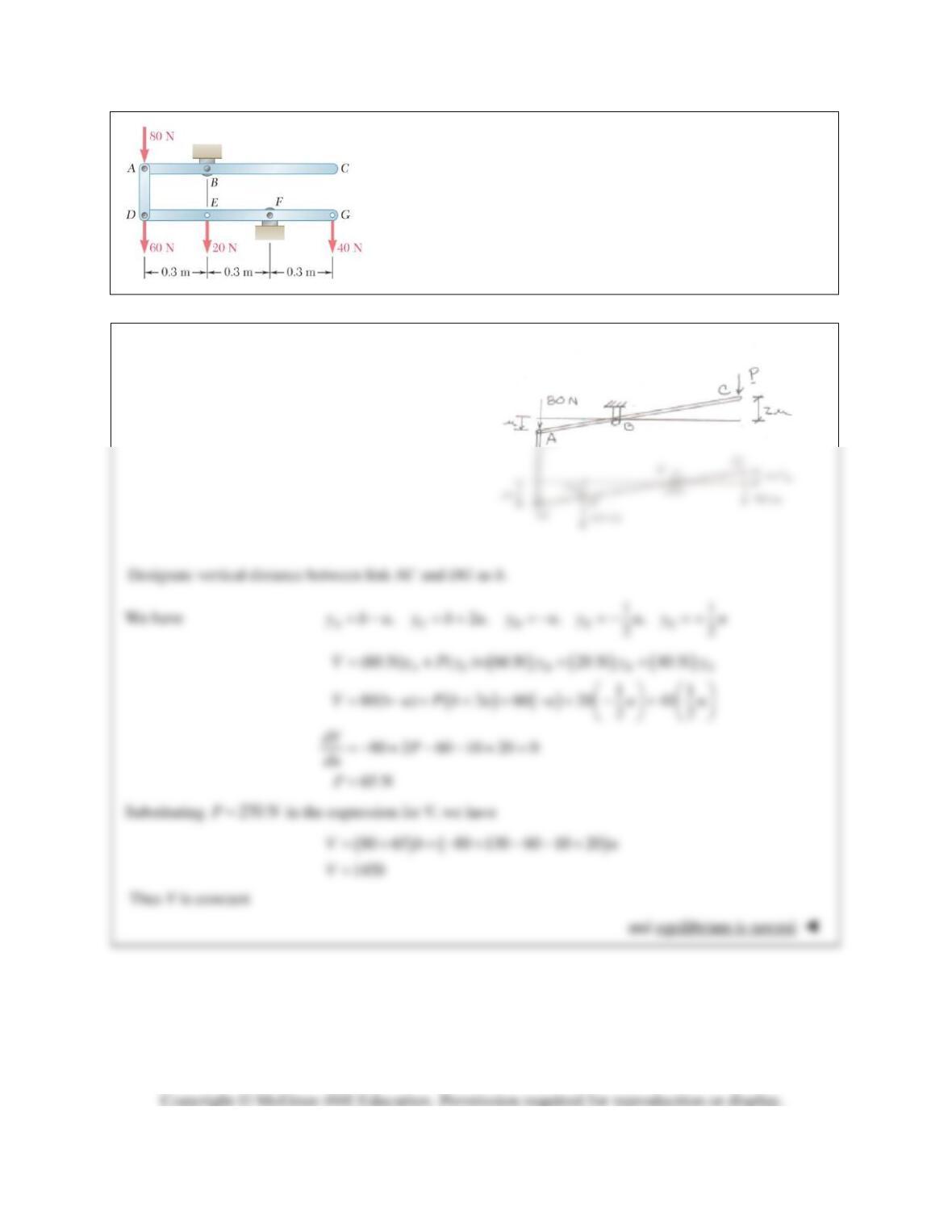
Show that equilibrium is neutral in Problem 10.1.
PROBLEM 10.1
Determine the vertical force
P
that must be
applied at C to maintain the equilibrium of the linkage.
SOLUTION
PROBLEM 10.68
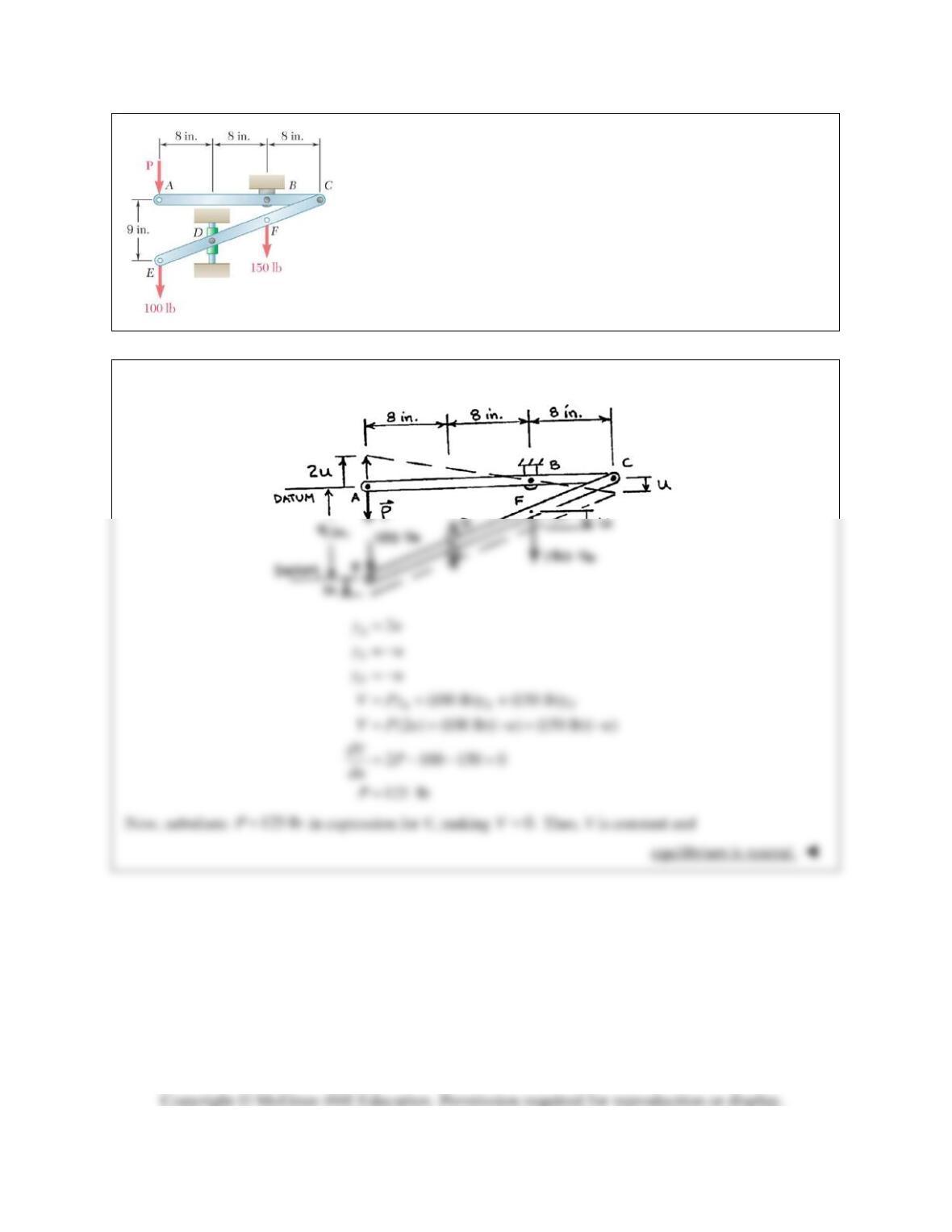
Show that equilibrium is neutral in Problem 10.7.
PROBLEM 10.7
The two-bar linkage shown is supported by a pin
and bracket at B and a collar at D that slides freely on a vertical rod.
Determine the force
P
required to maintain the equilibrium of the
linkage.
SOLUTION
PROBLEM 10.69
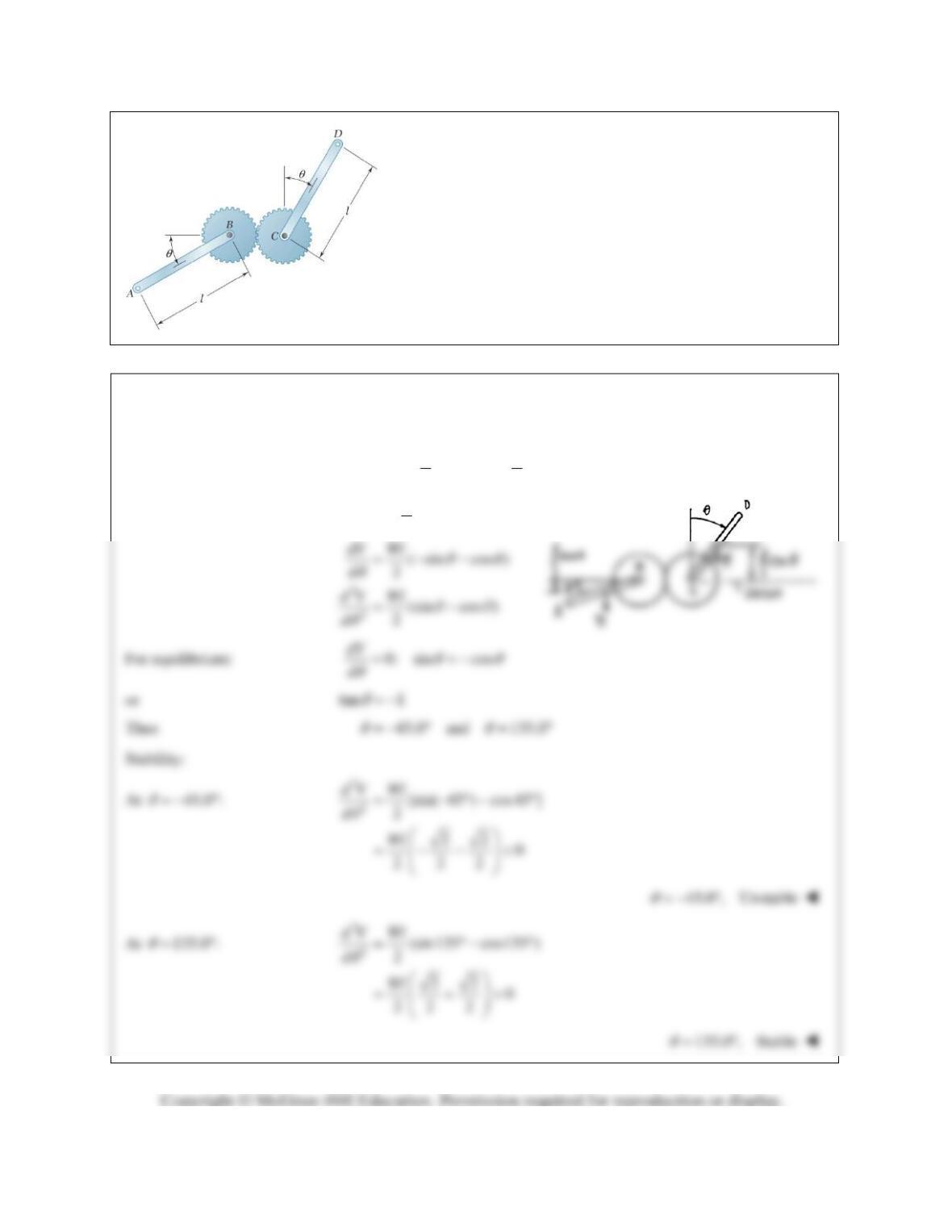
Two uniform rods, each of mass m, are attached to gears of
equal radii as shown. Determine the positions of equilibrium of
the system and state in each case whether the equilibrium is
stable, unstable, or neutral.
SOLUTION
Potential energy
sin cos
22
(cos sin )
2
ll
VW W Wmg
l
W
PROBLEM 10.70
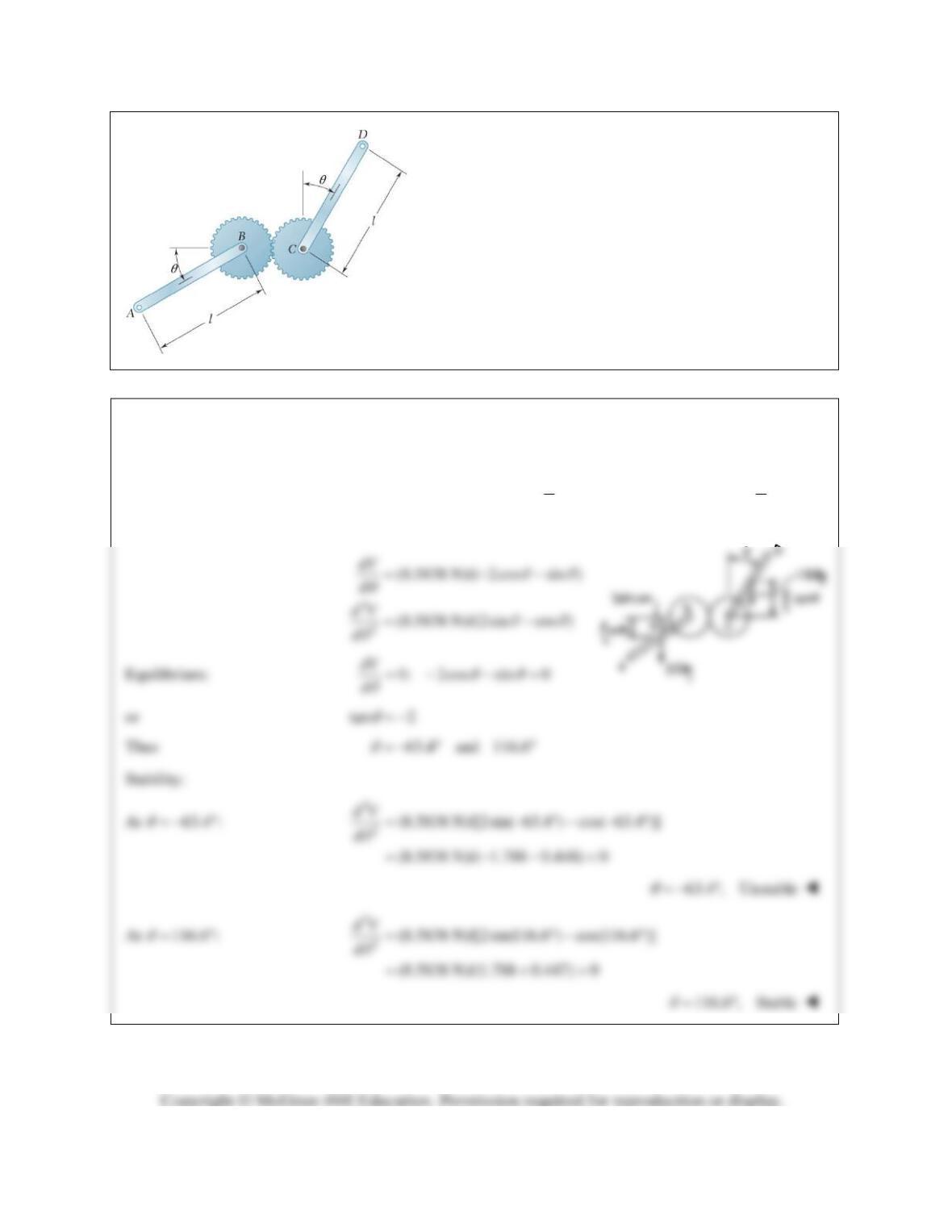
Two uniform rods, AB and CD, are attached to gears of
equal radii as shown. Knowing that
8 lb
AB
W
and
4 lb,
CD
W
determine the positions of equilibrium of the
system and state in each case whether the equilibrium is
stable, unstable, or neutral.
SOLUTION
Potential energy
22
(3.5 kg 9.81 m/s ) sin (1.75 kg 9.81 m/s ) cos
22
(8.5838 N) ( 2 sin cos )
ll
V
l