
CHAPTER 9 – 1
CHAPTER 10
SOME LESSONS FROM CAPITAL
MARKET HISTORY
Answers to Concepts Review and Critical Thinking Questions
1. They all wish they had! Since they didn’t, it must have been the case that the stellar performance was
not foreseeable, at least not by most.
4. On average, the only return that is earned is the required return—investors buy assets with returns in
excess of the required return (positive NPV), bidding up the price and thus causing the return to fall
to the required return (zero NPV); investors sell assets with returns less than the required return
(negative NPV), driving the price lower and thus the causing the return to rise to the required return
(zero NPV).
9. The EMH only says, that within the bounds of increasingly strong assumptions about the information
processing of investors, that assets are fairly priced. An implication of this is that, on average, the
typical market participant cannot earn excessive profits from a particular trading strategy. However,
that does not mean that a few particular investors cannot outperform the market over a particular
investment horizon. Certain investors who do well for a period of time get a lot of attention from the
financial press, but the scores of investors who do not do well over the same period of time generally
get considerably less attention.
CHAPTER 9 – 2
b. Under (2), if the market is not semi-strong form efficient, then this information could be used to
buy the stock “cheap” before the rest of the market discovers the financial statement anomaly.
Since (2) is stronger than (1), both imply that a profit opportunity exists; under (3) and (4), this
information is fully impounded in the current price and no profit opportunity exists.
price.
Solutions to Questions and Problems
NOTE: All end-of-chapter problems were solved using a spreadsheet. Many problems require multiple
steps. Due to space and readability constraints, when these intermediate steps are included in this solutions
manual, rounding may appear to have occurred. However, the final answer for each problem is found
without rounding during any step in the problem.
Basic
1. The return of any asset is the increase in price, plus any dividends or cash flows, all divided by the
initial price. The return of this stock is:
Capital gains yield = .1806, or 18.06%
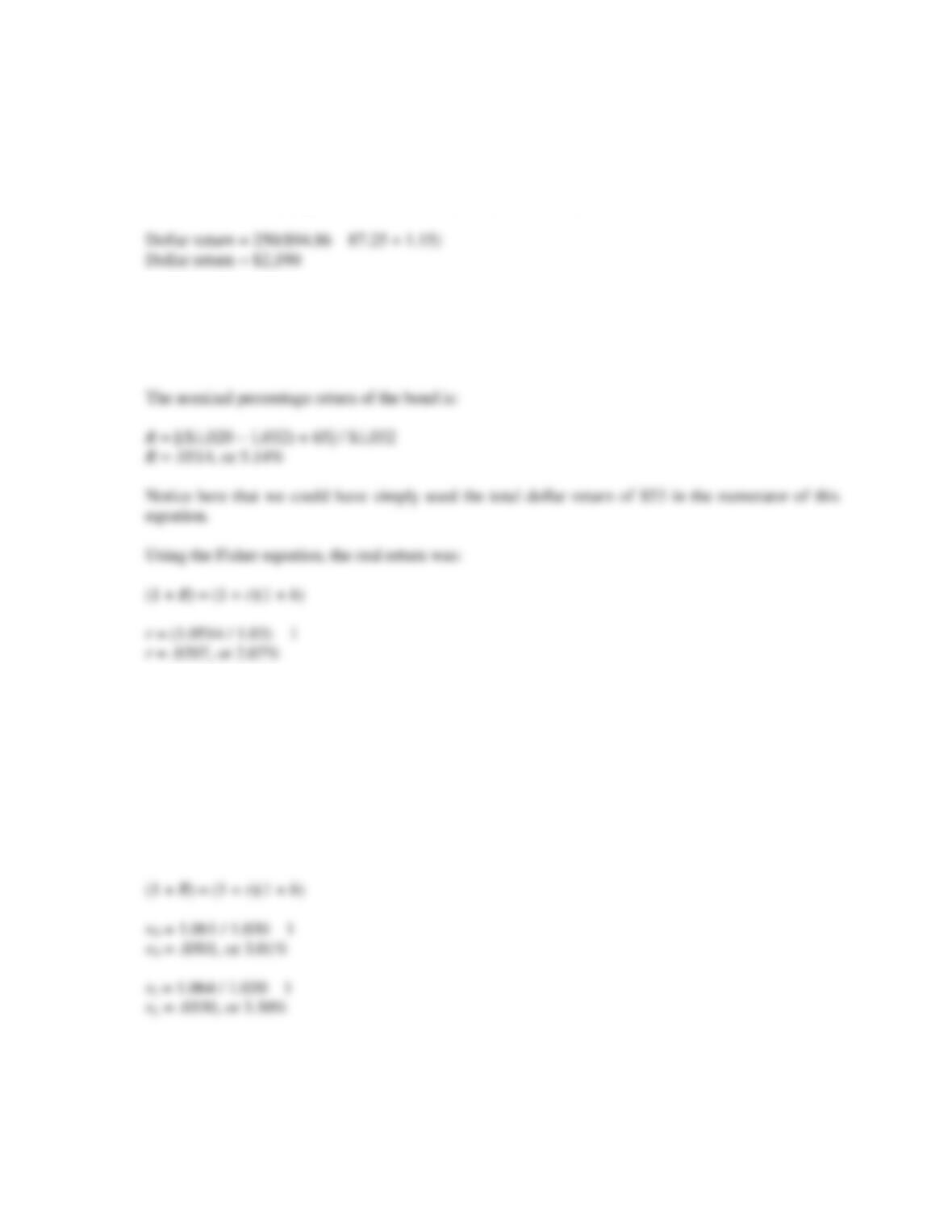
2. Using the equation for total return, we find:
R = [($62 – 72) + 1.65] / $72
R = –.1160, or –11.60%
And the dividend yield and capital gains yield are:
CHAPTER 9 – 3
Here’s a question for you: Can the dividend yield ever be negative? No, that would mean you were
paying the company for the privilege of owning the stock, however, it has happened on bonds.
3. To calculate the dollar return, we multiply the number of shares owned by the change in price per
share and the dividend per share received. The total dollar return is:
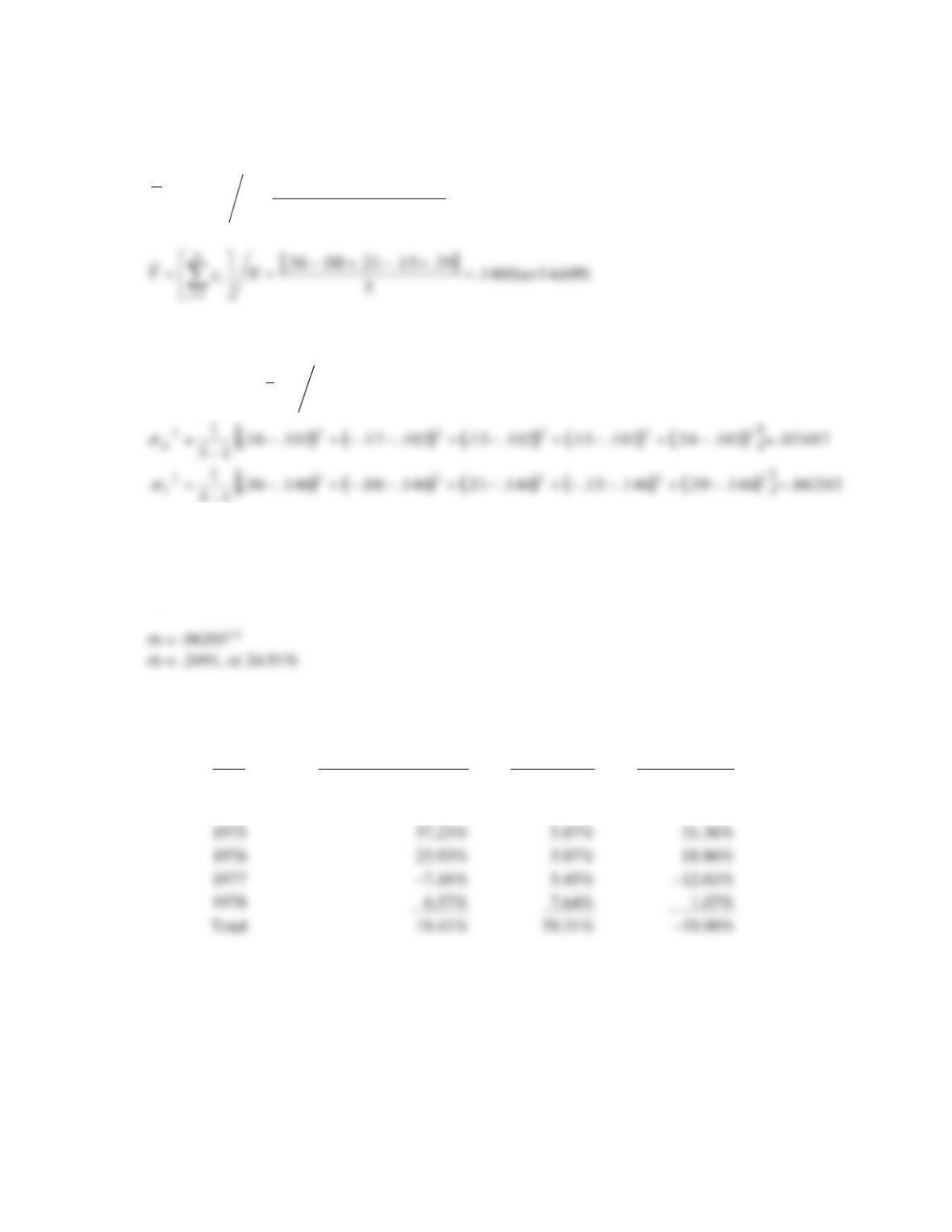
4. The total dollar return is the change in price plus the coupon payment, so:
Total dollar return = $1,020 – 1,032 + 65
Total dollar return = $53
5. The nominal return is the stated return, which is 12.10 percent. Using the Fisher equation, the real
return was:
(1 + R) = (1 + r)(1 + h)
r = (1.1210) / (1.030) – 1
r = .0883, or 8.83%
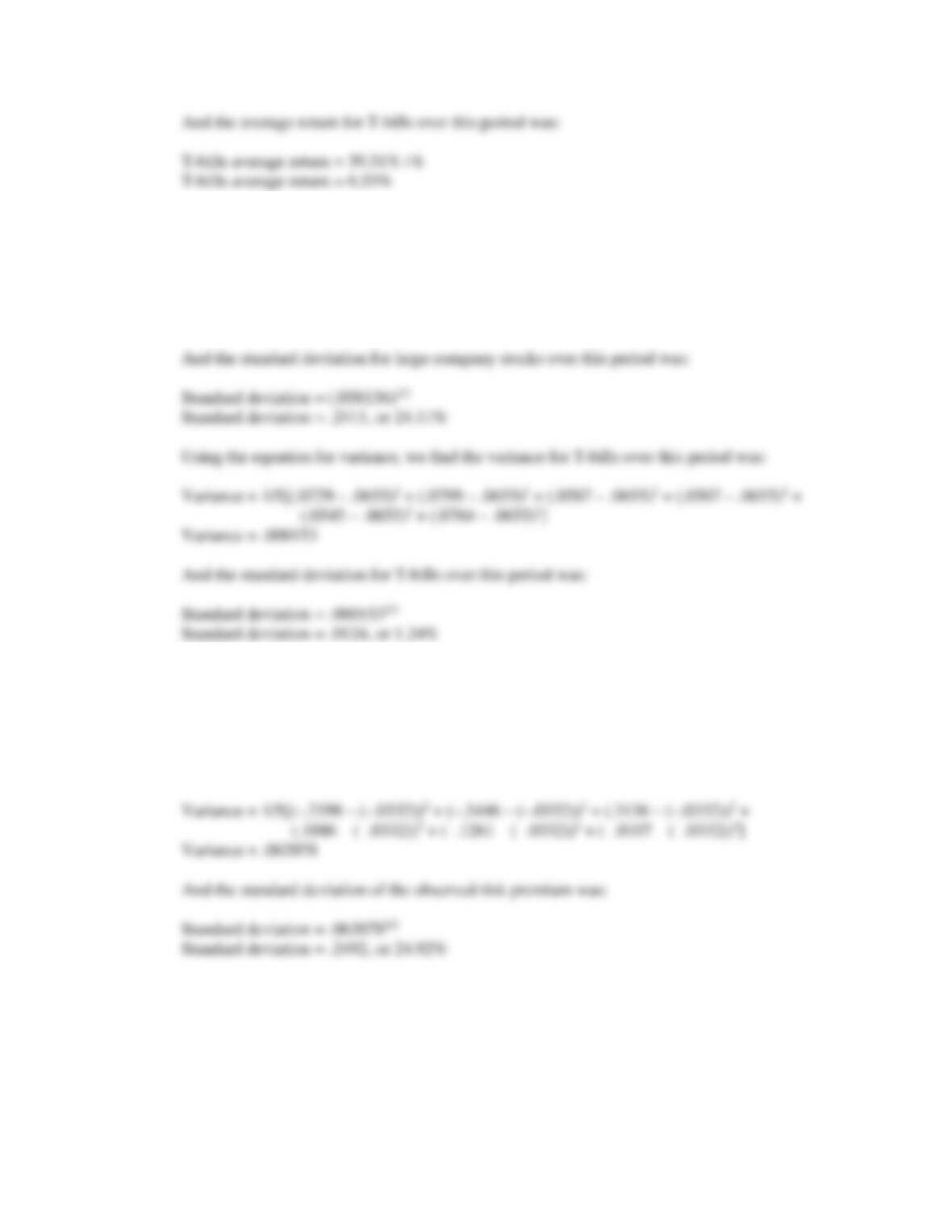
6. Using the Fisher equation, the real returns for government and corporate bonds were:
CHAPTER 9 – 4
7. The average return is the sum of the returns, divided by the number of returns. The average return for each
stock was:
%10.20or .1020,
5
24.15.13.17.16.
1
=
+++−
=
=
=
NxX N
ii
Remembering back to “sadistics,” we calculate the variance of each stock as:
( ) ( )
1
1
22
−
−=
=
N
iiX Nxx
The standard deviation is the square root of the variance, so the standard deviation of each stock is:
X = .024871/2
X = .1577, or 15.77%
8. We will calculate the sum of the returns for each asset and the observed risk premium first. Doing so,
we get:
Year
Large co. stock return
T-bill return
Risk premium
1973
–14.69%
7.29%
–21.98%
1974
–26.47%
7.99%
–34.46%
1975
5.87%
1976
5.07%
1977
5.45%
–12.61%
–19.90%
a. The average return for large-company stocks over this period was:
Large-company stock average return = 19.41% / 6
Large-company stock average return = 3.24%
CHAPTER 9 – 5
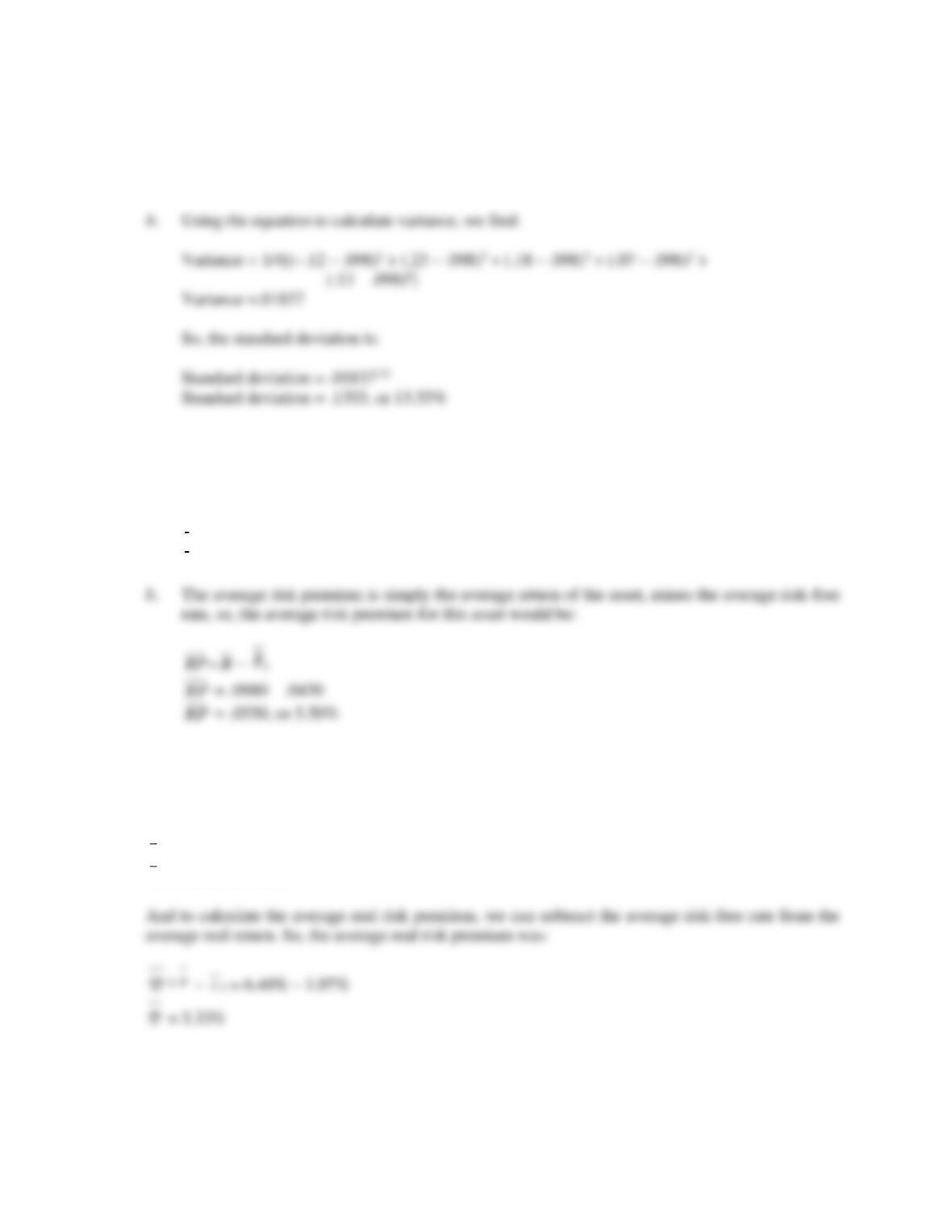
b. Using the equation for variance, we find the variance for large-company stocks over this period
was:
Variance = 1/5[(–.1469 – .0324)2 + (–.2647 – .0324)2 + (.3723 – .0324)2 + (.2393 – .0324)2 +
(–.0716 – .0324)2 + (.0657 – .0324)2]
Variance = .058136
c. The average observed risk premium over this period was:
Average observed risk premium = –19.90% / 6
Average observed risk premium = –3.32%
The variance of the observed risk premium was:
d. Before the fact, for most assets the risk premium will be positive; investors demand compensation
over and above the risk-free return to invest their money in the risky asset. After the fact, the
observed risk premium can be negative if the asset’s nominal return is unexpectedly low, the risk–
free return is unexpectedly high, or if some combination of these two events occurs.
CHAPTER 9 – 6
9. a. To find the average return, we sum all the returns and divide by the number of returns, so:
Arithmetic average return = (–.12 + .23 + .18 + .07 + .13) / 5
Arithmetic average return = .0980, or 9.80%
b. Using the equation to calculate variance, we find:
10. a. To calculate the average real return, we can use the average return of the asset, and the average
inflation rate in the Fisher equation. Doing so, we find:
(1 + R) = (1 + r)(1 + h)
r
= (1.0980 / 1.032) – 1
r
= .0640, or 6.40%
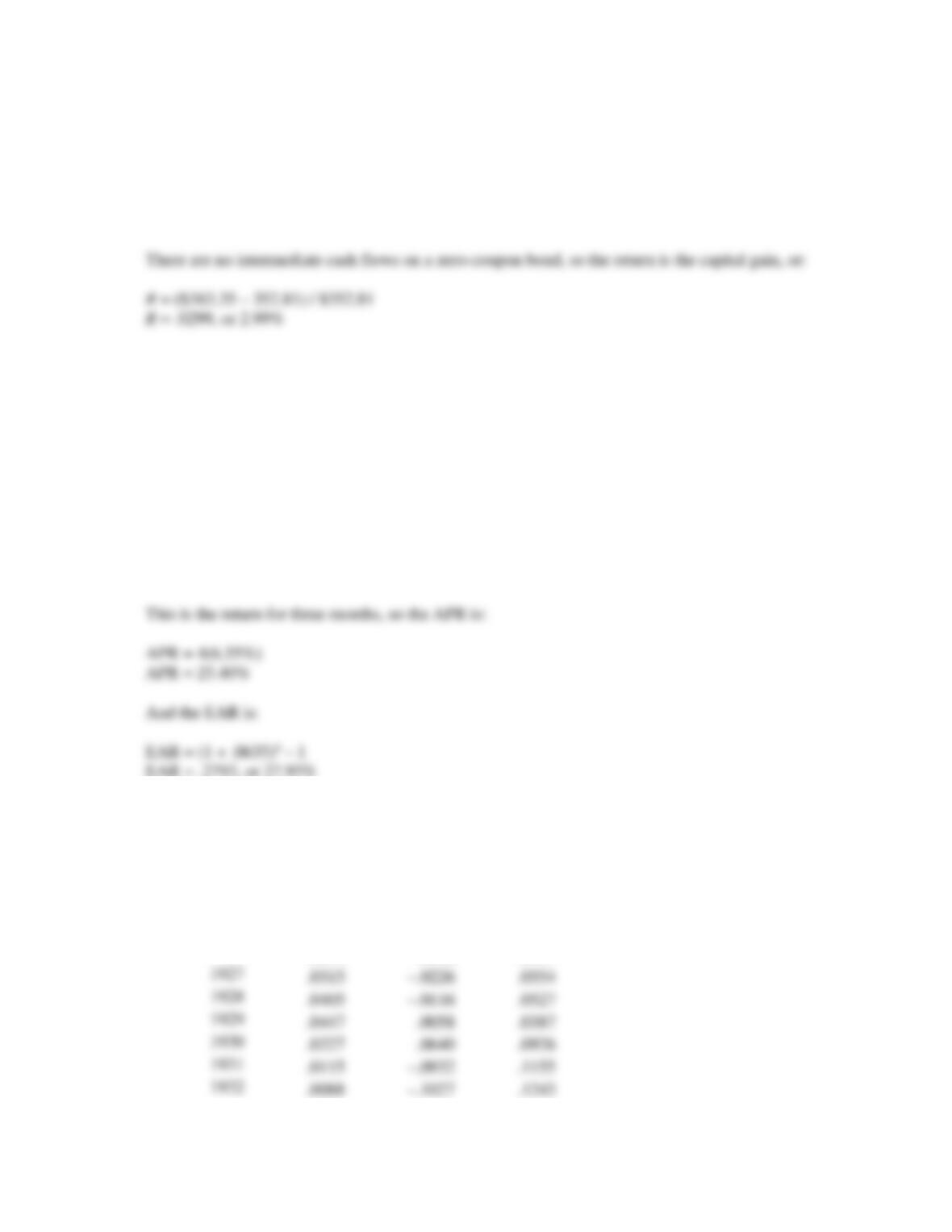
11. We can find the average real risk-free rate using the Fisher equation. The average real risk-free rate
was:
(1 + R) = (1 + r)(1 + h)
f
r
= (1.043 / 1.032) – 1
f
r
f
r
= .0107, or 1.07%
12. T-bill rates were highest in the early eighties. This was during a period of high inflation and is
consistent with the Fisher effect.
CHAPTER 9 – 7
13. To find the return on the zero-coupon bond, we first need to find the price of the bond today. We need
to remember that the price for zero-coupon bonds is calculated with semiannual periods. Since one
year has elapsed, the bond now has 19 years to maturity, so the price today is:
P1 = $1,000 / 1.02738
P1 = $363.35
14. The return of any asset is the increase in price, plus any dividends or cash flows, all divided by the
initial price. Since preferred stock is assumed to have a par value of $100, the dividend was $5.50, so
the return for the year was:
R = ($102.67 – 104.18 + 5.50) / $104.18
R = .0383, or 3.83%
15. The return of any asset is the increase in price, plus any dividends or cash flows, all divided by the
initial price. This stock paid no dividend, so the return was:
R = ($45.38 – 42.67) / $42.67
R = .0635, or 6.35%
EAR = .2793, or 27.93%
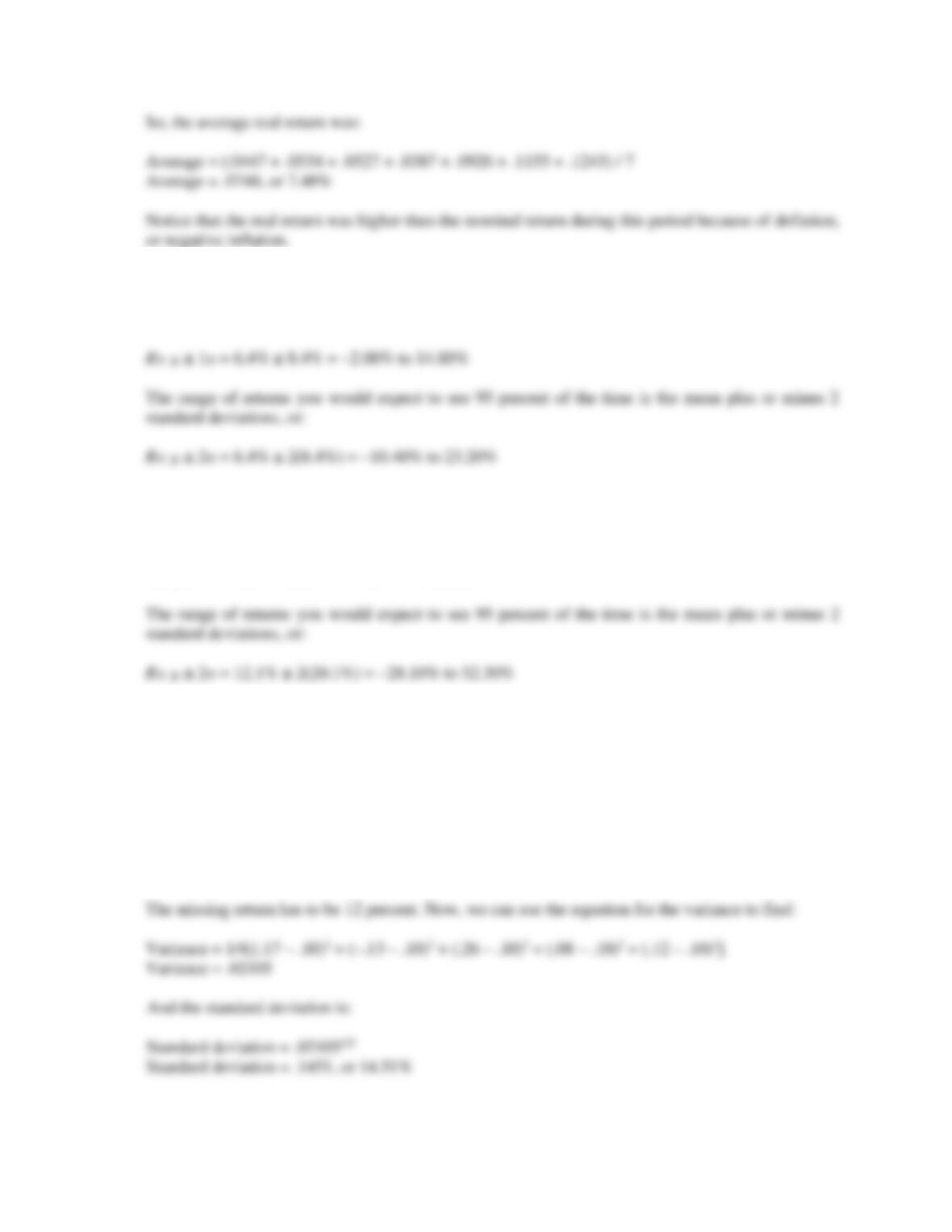
16. To find the real return each year, we will use the Fisher equation, which is:
1 + R = (1 + r)(1 + h)
Using this relationship for each year, we find:
T-bills
Inflation
Real Return
1926
.0330
–.0112
.0447
.0315
–.0226
.0554
.0405
–.0116
.0527
1932
.0088
–.1027
.1243
CHAPTER 9 – 8
17. Looking at the long-term corporate bond return history in Figure 10.10, we see that the mean return
was 6.4 percent, with a standard deviation of 8.4 percent. The range of returns you would expect to
see 68 percent of the time is the mean plus or minus 1 standard deviation, or:
18. Looking at the large-company stock return history in Figure 10.10, we see that the mean return was
12.1 percent, with a standard deviation of 20.1 percent. The range of returns you would expect to see
68 percent of the time is the mean plus or minus 1 standard deviation, or:
R ± 1 = 12.1% ± 20.1% = –8.00% to 32.20%
Intermediate
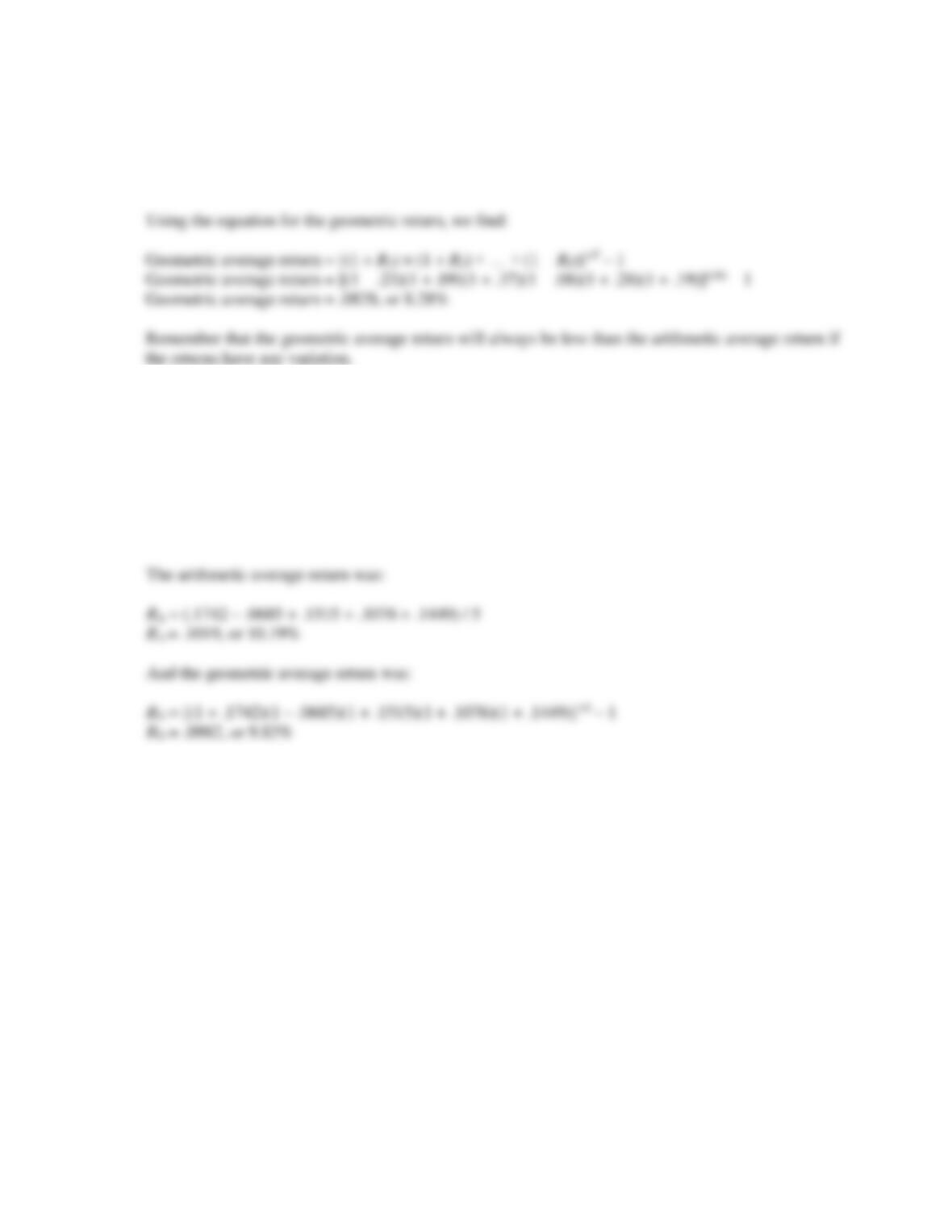
19. Here, we know the average stock return, and four of the five returns used to compute the average
return. We can work the average return equation backward to find the missing return. The average
return is calculated as:
.10 = (.17 – .13 + .26 + .08 + R) / 5
.50 = .17 – .13 + .26 + .08 + R
R = .12, or 12%
CHAPTER 9 – 9
20. The arithmetic average return is the sum of the known returns divided by the number of returns, so:
Arithmetic average return = (–.23 + .09 + .37 –.08 + .28 +.19) / 6
Arithmetic average return = .1033, or 10.33%
21. To calculate the arithmetic and geometric average returns, we must first calculate the return for each
year. The return for each year is:
R1 = ($67.32 – 58.27 + 1.10) / $58.27 = .1742, or 17.42%
R2 = ($61.46 – 67.32 + 1.25) / $67.32 = –.0685, or –6.85%
R3 = ($69.32 – 61.46 + 1.45) / $61.46 = .1515, or 15.15%
R4 = ($75.15 – 69.32 + 1.60) / $69.32 = .1076, or 10.76%
R5 = ($84.32 – 75.18 + 1.75) / $75.18 = .1449, or 14.49%
22. To find the real return, we need to use the Fisher equation. Re-writing the Fisher equation to solve for
the real return, we get:
r = [(1 + R) / (1 + h)] – 1
CHAPTER 9 – 10
So, the real return each year was:
Year
T-bill return
Inflation
Real return
1973
.0729
.0871
–.0131
1974
.0799
.1234
–.0387
1975
a. The average return for T-bills over this period was:
Average return = .6197 / 8
Average return = .0775, or 7.75%
b. Using the equation for variance, we find the variance for T-bills over this period was:
Variance = 1/7[(.0729 – .0775)2 + (.0799 – .0775)2 + (.0587 – .0775)2 + (.0507 – .0775)2
+ (.0545 – .0775)2 + (.0764 – .0775)2 + (.1056 – .0775)2 + (.1210 − .0775)2]
Variance = .000616
And the standard deviation for T-bills was:
And the standard deviation of inflation was:
Standard deviation = .0009711/2
Standard deviation = .0312, or 3.12%
.0587
.0694
–.0100
1976
.0507
.0486
.0020
1977
1978
1979
.1056
.1329
–.0241
1980
.1210
.1252
–.0037
.6197
.7438
–.1120
CHAPTER 9 – 11
23. To find the return on the coupon bond, we first need to find the price of the bond today, so:
P1 = $65(PVIFA5.2%,9) + $1,000 / 1.0529
P1 = $1,091.58
You received the coupon payments on the bond, so the nominal return was:
24. Looking at the long-term government bond return history in Figure 10.10, we see that the mean return
was 6.1 percent, with a standard deviation of 10.0 percent. In the normal probability distribution,
approximately 2/3 of the observations are within one standard deviation of the mean. This means that
1/3 of the observations are outside one standard deviation away from the mean. Or:
Pr(R< –3.9 or R > 16.1) 1/3
z = (X – µ) /
z = (–3.9% – 6.1) / 10.0% = –1.00
Looking at the z-table, this gives a probability of 15.87%, or:
CHAPTER 9 – 12
The range of returns you would expect to see 99 percent of the time is the mean plus or minus 3
standard deviations, or:
99% level: R ± 3 = 6.1% ± 3(10.0%) = –23.90% to 36.10%
25. The mean return for small company stocks was 16.7 percent, with a standard deviation of 32.1 percent.
Doubling your money is a 100% return, so if the return distribution is normal, we can use the z-statistic.
So:
z = (X – µ) /
z = (100% – 16.7) / 32.1% = 2.595 standard deviations above the mean
26. It is impossible to lose more than 100 percent of your investment. Therefore, return distributions are
truncated on the lower tail at –100 percent, and cannot truly follow a normal distribution.
Challenge
27. Using the z-statistic, we find:
28. For each of the questions asked here, we need to use the z-statistic, which is:
z = (X – µ) /
a. z1 = (10% – 6.4) / 8.4% = .4286
CHAPTER 9 – 13
For a return less than 0 percent:
Pr(R≤0%) 22.31%
b. The probability that T-bill returns will be greater than 10 percent is:
z3 = (10% – 3.50) / 3.1% = 2.0968
Pr(R≤0) 12.94%
c. The probability that the return on long-term corporate bonds will be less than –4.18 percent is:
z5 = (–4.18% – 6.4) / 8.4% = –1.2595