CHAPTER 10
Liabilities
ASSIGNMENT CLASSIFICATION TABLE
Learning Objectives
Questions
Brief
Exercises
Do It!
Exercises
A
Problems
* 1. Explain how to account for
current liabilities.
1, 2, 3, 4, 5
1, 2, 3, 4, 5,
6
1a, 1b
1, 2, 3, 4, 5,
6
1A, 2A,
* 2. Describe the major
characteristics of bonds.
6, 7, 8, 9,
2
7
*6. Apply the straight-line
method of amortizing bond
discount and bond premium.
19, 20
16, 17
17, 18
6A, 7A, 8A
13, 14
11, 12
15, 16
13
4
13
5A
reported and analyzed.
17, 18
14, 15
5
14, 15, 16
1A, 2A, 3A,
4A, 5A, 6A,
7A, 10A
ASSIGNMENT CHARACTERISTICS TABLE
Problem
Number
Description
Difficulty
Level
Time
Allotted (min.)
1A
Prepare current liability entries, adjusting entries, and
current liabilities section.
Moderate
30–40
4A
Prepare entries to record issuance of bonds, interest
accrual, and bond redemption.
Moderate
15–20
5A
Prepare installment payments schedule and journal
entries for a mortgage note payable.
Moderate
20–30
*6A
Prepare entries to record issuance of bonds, interest
accrual, and straight-line amortization for 2 years.
Moderate
30–40
*7A
Prepare entries to record issuance of bonds, interest,
and straight-line amortization of bond premium and
discount.
Moderate
30–40
*8A
Prepare entries to record interest payments, straight-line
premium amortization, and redemption of bonds.
Moderate
30–40
of interest, and amortization of bond premium using
effective-interest method.
Prepare entries to record issuance of bonds, payment
of interest, and amortization of discount using
effective-interest method. In addition, answer questions.
Moderate
30–40
2A
Journalize and post note transactions; show balance
sheet presentation.
Moderate
30–40
3A
Prepare entries to record issuance of bonds, interest
accrual, and bond redemption.
Moderate
20–30

WEYGANDT FINANCIAL AND MANAGERIAL ACCOUNTING 2E
CHAPTER 10
LIABILITIES
Number
LO
BT
Difficulty
Time (min.)
BE1
1
C
Simple
3–5
BE2
1
AP
Simple
2–4
BE3
1
AP
Simple
2–4
BE4
1
AP
Simple
2–4
BE11
3
AP
Simple
3–5
BE12
3
AP
Simple
6–8
BE13
4
AP
Simple
3–5
BE14
5
AP
Simple
3–5
BE15
5
AP
Simple
4–6
6
AP
Simple
4–6
*BE17
6
AP
Simple
4–6
*BE18
7
AP
Simple
DI1b
1
Simple
DI2
2
AP
Simple
5–7
DI3b
3
Simple
DI4
4
AP
Simple
4–6
DI5
5
AP
Simple
3–5
EX1
1
AN
Moderate
8–10
EX2
1
AN
Simple
6–8
EX3
1
AP
Simple
4–6
EX4
1
AN
Simple
6–8
EX5
1
AP
Simple
8–10
EX6
1
AP
Simple
3–5
EX7
2
AP
Simple
6–8
EX8
3
Simple
4–6
EX9
3
Simple
4–6
EX10
3
AP
Simple
4–6
EX11
3
AP
Simple
4–6
EX12
3
AP
Simple
6–8
Number
LO
BT
Difficulty
Time (min.)
BE5
1
AP
Simple
3–5
BE6
1
AP
Simple
3–5
BE7
3
AP
Simple
6–8
BE8
3
AP
Simple
4–6
BE9
3
AP
Simple
3–5
BE10
3
AP
Simple
4–6
EX13
4
AP
Simple
6–8
EX14
5
AP
Moderate
8–10
EX15
5
AP
Simple
6–8
EX16
5
AP
Simple
3–5
*EX17
6
AP
Simple
4–6
*EX18
6
AP
Simple
4-6
*P9A
7
AP
Moderate
30–40
*P10A
5, 7
AP
Moderate
30–40
BYP1
5
AN
Simple
5–10
BYP2
5
AP
Simple
10–15
BYP3
5
AP
Simple
10–15
BYP4
2
C
Simple
10–15
BYP5
AN
Moderate
15–20
Simple
BYP7
E
Simple
5–10
BYP8
—
AP
Moderate
15–20
BYP9
Simple
10–15
*EX19
7
AP
8–10
*EX20
7
AP
Moderate
8-10
P1A
1, 5
AN
Moderate
30–40
P2A
AN
30–40
P3A
AP
Moderate
20–30
P4A
AP
Moderate
15–20
P5A
AP
20–30
*P6A
5, 6
AP
Moderate
30–40
*P7A
5, 6
AP
Moderate
30–40
*P8A
6
AP
30–40
BLOOM’ S TAXONOMY TABLE
Correlation Chart between Bloom’s Taxonomy, Learning Objectives and End–of-Chapter Exercises and Problems
Learning Objective
Knowledge
Comprehension
Application
Analysis
Synthesis
Evaluation
1. Explain how to account for current
liabilities.
Q10-5
Q10-1 BE10-1
Q10-2 DI10-1
Q10-3
Q10-4
BE10-2 BE10-6 E10-5
BE10-3 DI10-1b E10-6
BE10-4 E10-3
BE10-5
E10-1 P10-1A
E10-2 P10-2A
E10-4
Q10-8
DI10-2b
4. Explain how to account for long-term
notes payable.
Q10-15
BE10-13
DI10-4
E10-13
P10-5A
5. Describe how liabilities are reported
and analyzed
Q10-16
Q10-17
Q10-18
BE10-14
BE10-15
DI10-5
E10-14
E10-15
E10-16
P10-3A
P10-4A
P10-5A
P10-6A
P10-7A
P10-1A
P10-2A
bond premium.
Q10-22
E10-19
E10-20
P10-10A
Across the
ANSWERS TO QUESTIONS
1. Lori is not correct. A current liability is a debt that a company expects to pay within one year or
the operating cycle, whichever is longer.
2. In the balance sheet, Notes Payable of $40,000 and Interest Payable of $700 ($40,000 X .07 X 3/12)
should be reported as current liabilities. In the income statement, Interest Expense of $700 should
be reported under other expenses and losses.
4. (a) The entry when the tickets are sold is:
Cash…………………………………………………………………………….. 1,200,000
Unearned Ticket Revenue ………………………………………… 1,200,000
5. Three taxes commonly withheld by employers from employees’ gross pay are: (1) federal income
taxes (2) state income taxes, and (3) social security (FICA) taxes.
Questions Chapter 10 (Continued)
7. (a) Secured bonds have specific assets of the issuer pledged as collateral. In contrast, unse-
cured bonds are issued against the general credit of the borrower. These bonds are called
8. (a) Face value is the amount of principal due at the maturity date.
(b) The contractual interest rate is the rate used to determine the amount of cash interest the borrower
9. The two major obligations incurred by a company when bonds are issued are the interest
payments due on a periodic basis and the principal which must be paid at maturity.
10. Less than. Investors are required to pay more than the face value; therefore, the market interest
rate is less than the contractual rate.
11. $56,000. $800,000 X 7% = $56, 000.
13. Debits: Bonds Payable (for the face value) and Premium on Bonds Payable (for the
unamortized balance).
Credits: Cash (for 97% of the face value) and Gain on Bond Redemption (for the difference
between the cash paid and the bonds’ carrying value).
14. A convertible bond permits bondholders to convert it into common stock at the option of the
bondholders.
(a) For bondholders, the conversion option gives an opportunity to benefit if the market price of
the common stock increases substantially.
(b) For the issuer, convertible bonds usually have a higher selling price and a lower rate of
(3) Earnings per share may be higher—although bond interest expense will reduce net income,
earnings per share on common stock will often be higher under bond financing because no
additional shares of common stock are issued.
(b) The major disadvantages in using bonds are that interest must be paid on a periodic basis
and the principal (face value) of the bonds must be paid at maturity.
18. Liquidity refers to the ability of a company to pay its maturing obligations and meet unexpected
needs for cash. Two measures of liquidity are working capital (current assets – current liabilities)
and the current ratio (current assets ÷ current liabilities).
*21. Kelli is probably indicating that since the borrower has the use of the bond proceeds over the
term of the bonds, the borrowing rate in each period should be the same. The effective-interest
method results in a varying amount of interest expense but a constant rate of interest on the
balance outstanding. Accordingly, it results in a better matching of expenses with revenues than
the straight-line method. When the difference between the straight-line method of amortization
and the effective interest method is material, GAAP requires the use of the effective interest
method.
SOLUTIONS TO BRIEF EXERCISES
BRIEF EXERCISE 10-1
BRIEF EXERCISE 10-2
BRIEF EXERCISE 10-3
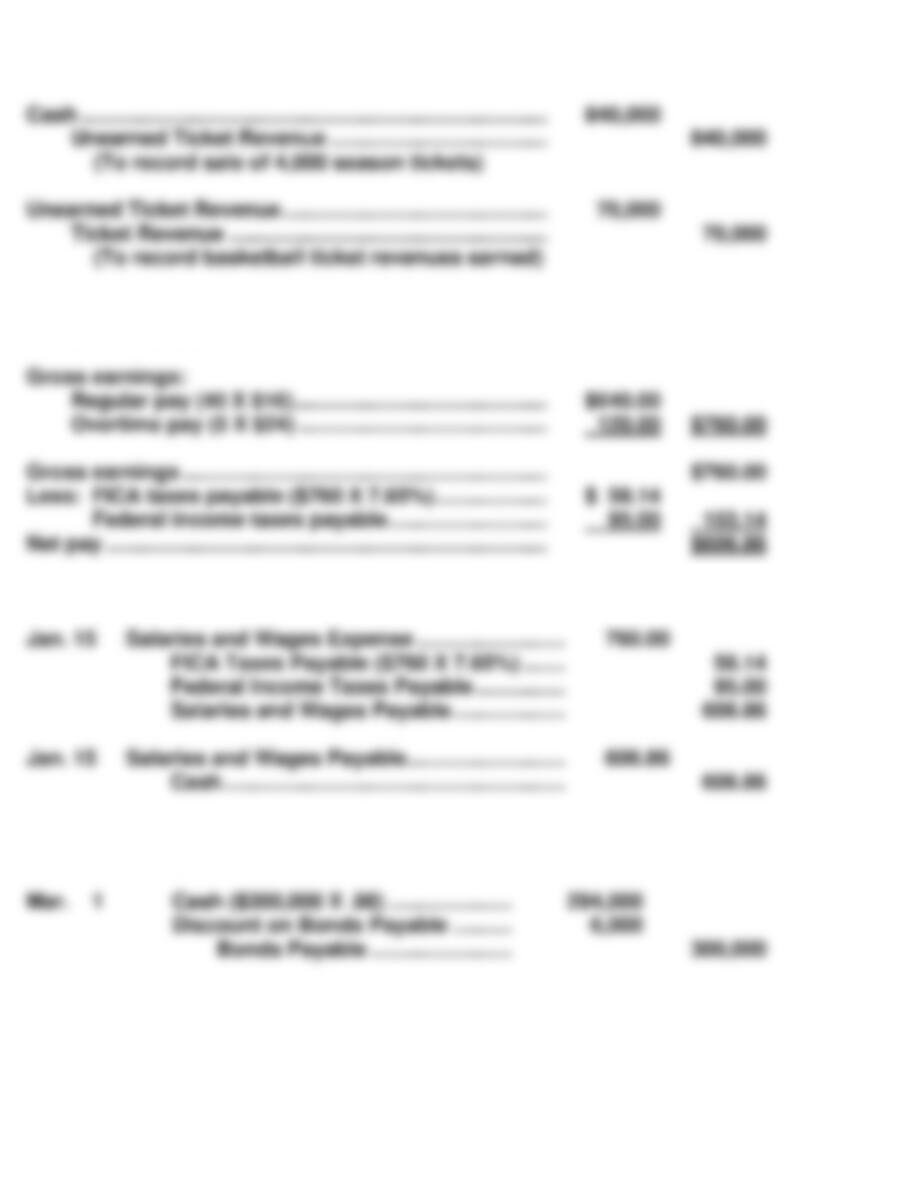
BRIEF EXERCISE 10-4
BRIEF EXERCISE 10-5
BRIEF EXERCISE 10-6
BRIEF EXERCISE 10-7
BRIEF EXERCISE 10-8
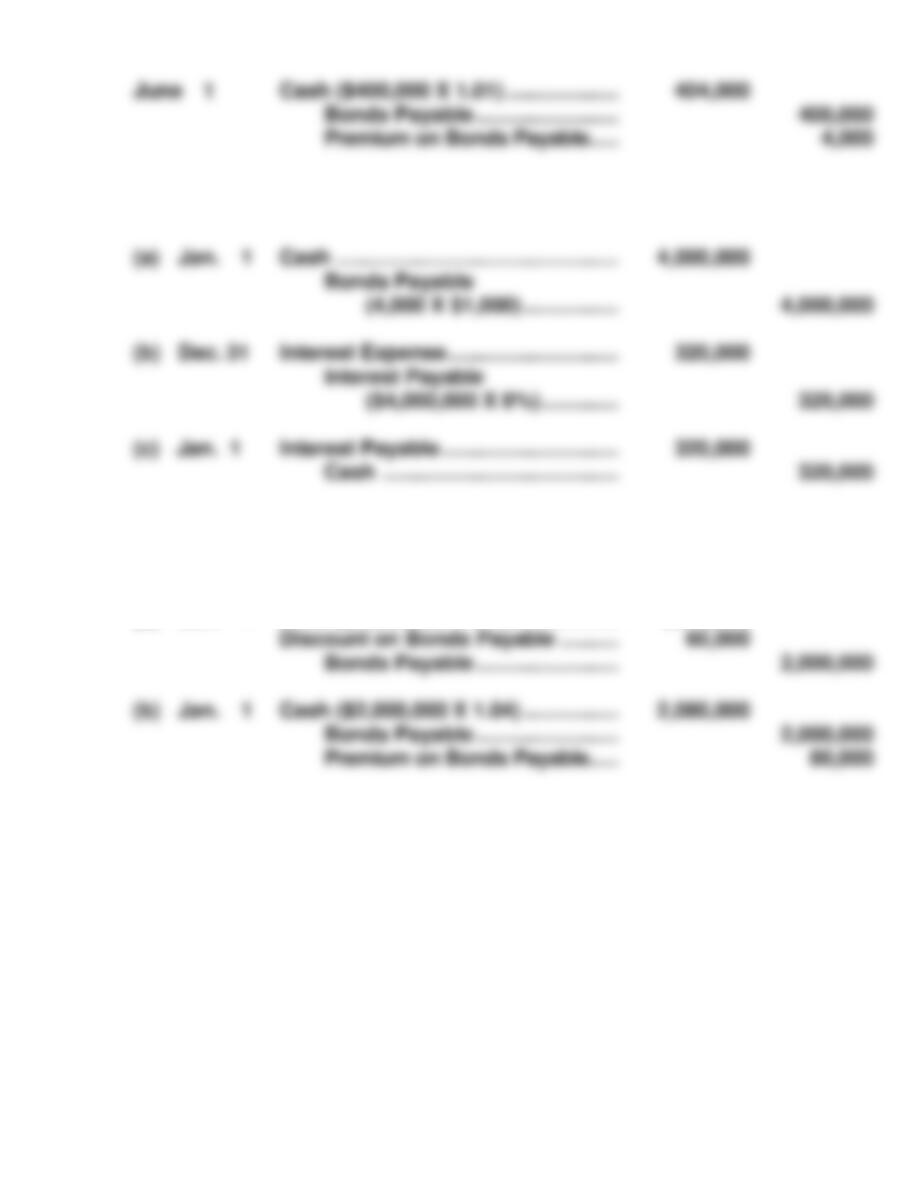
BRIEF EXERCISE 10-9
BRIEF EXERCISE 10-10
(a) Jan. 1 Cash ($2,000,000 X .97) ……………… 1,940,000
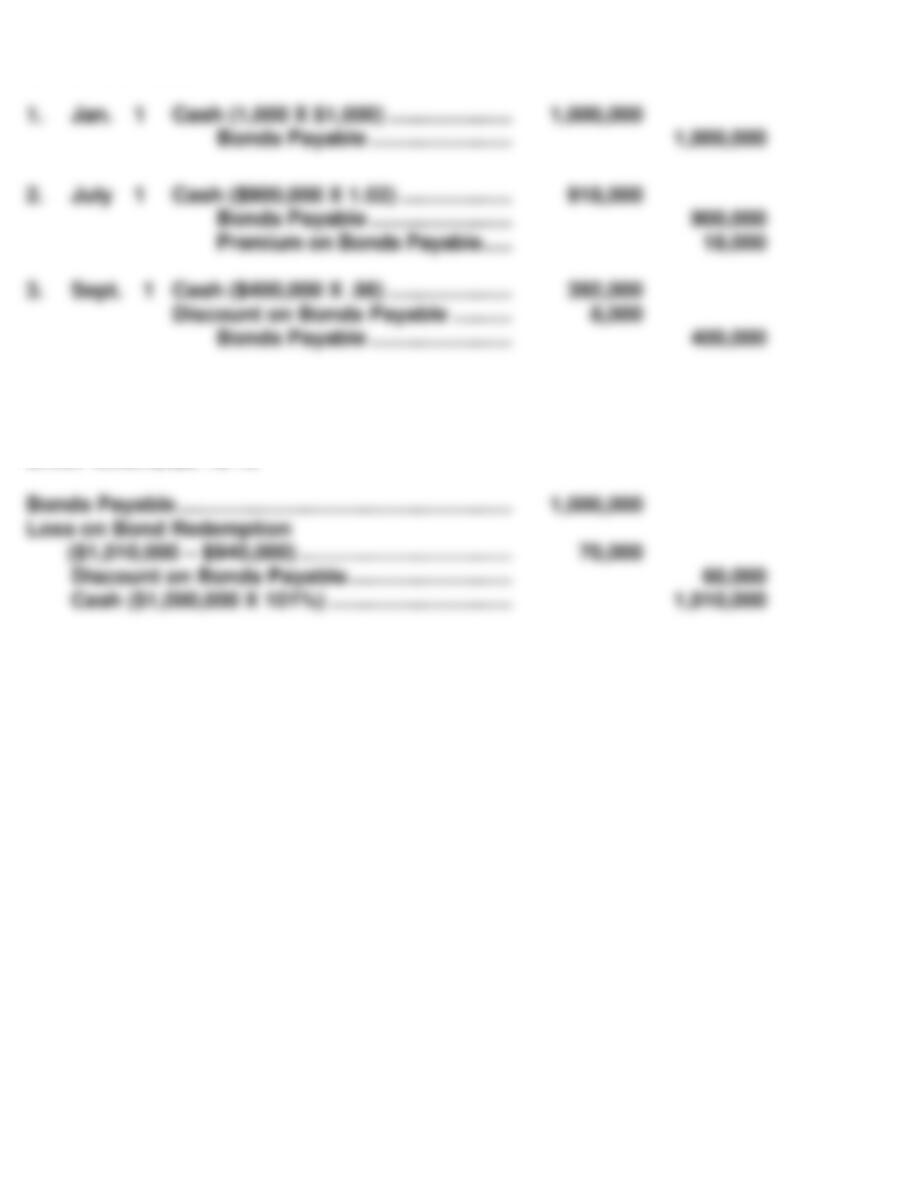
BRIEF EXERCISE 10-11
BRIEF EXERCISE 10-12
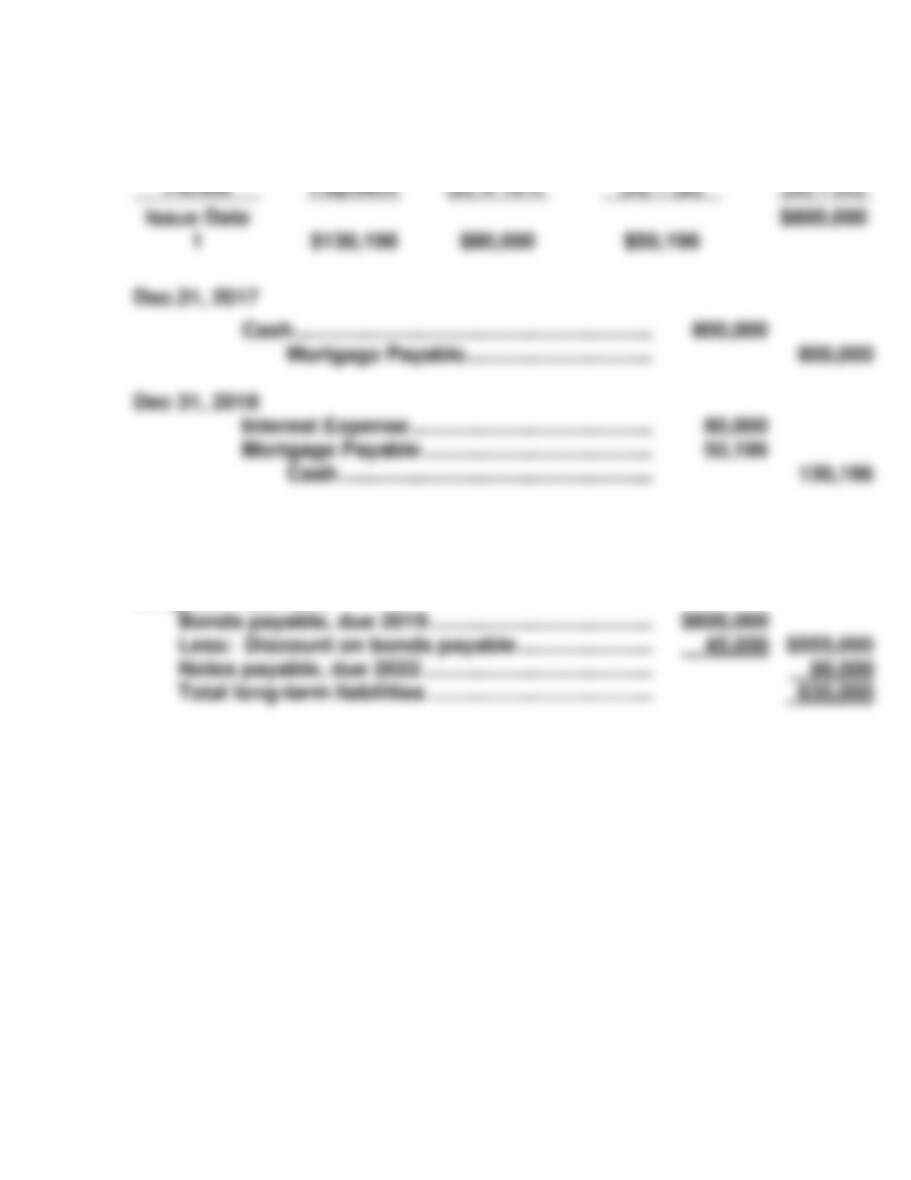
BRIEF EXERCISE 10-13
Annual
Interest
(A)
Cash
(B)
Interest
Expense
(C)
Reduction
of Principal
(D)
Principal
Balance
BRIEF EXERCISE 10-14
Long-term liabilities
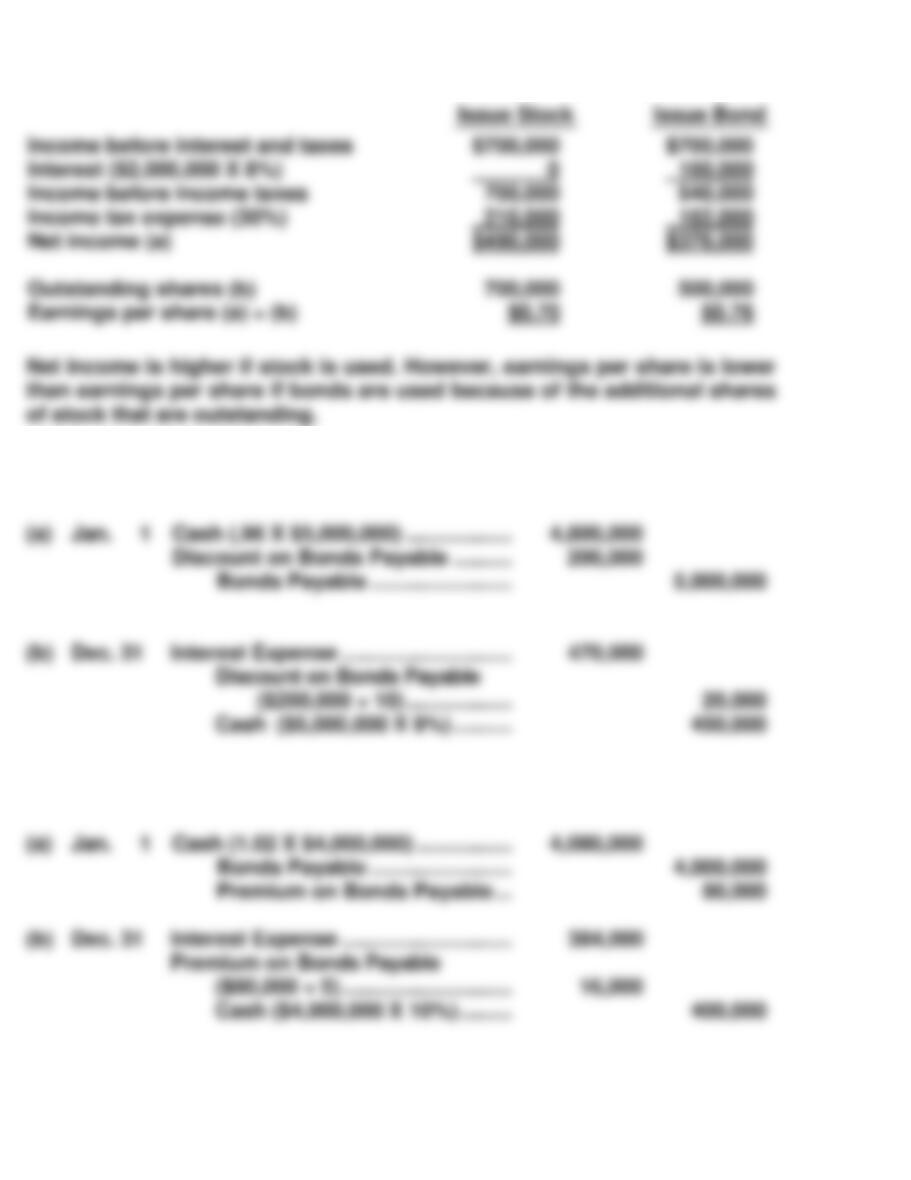
BRIEF EXERCISE 10-15
*BRIEF EXERCISE 10-16
*BRIEF EXERCISE 10-17
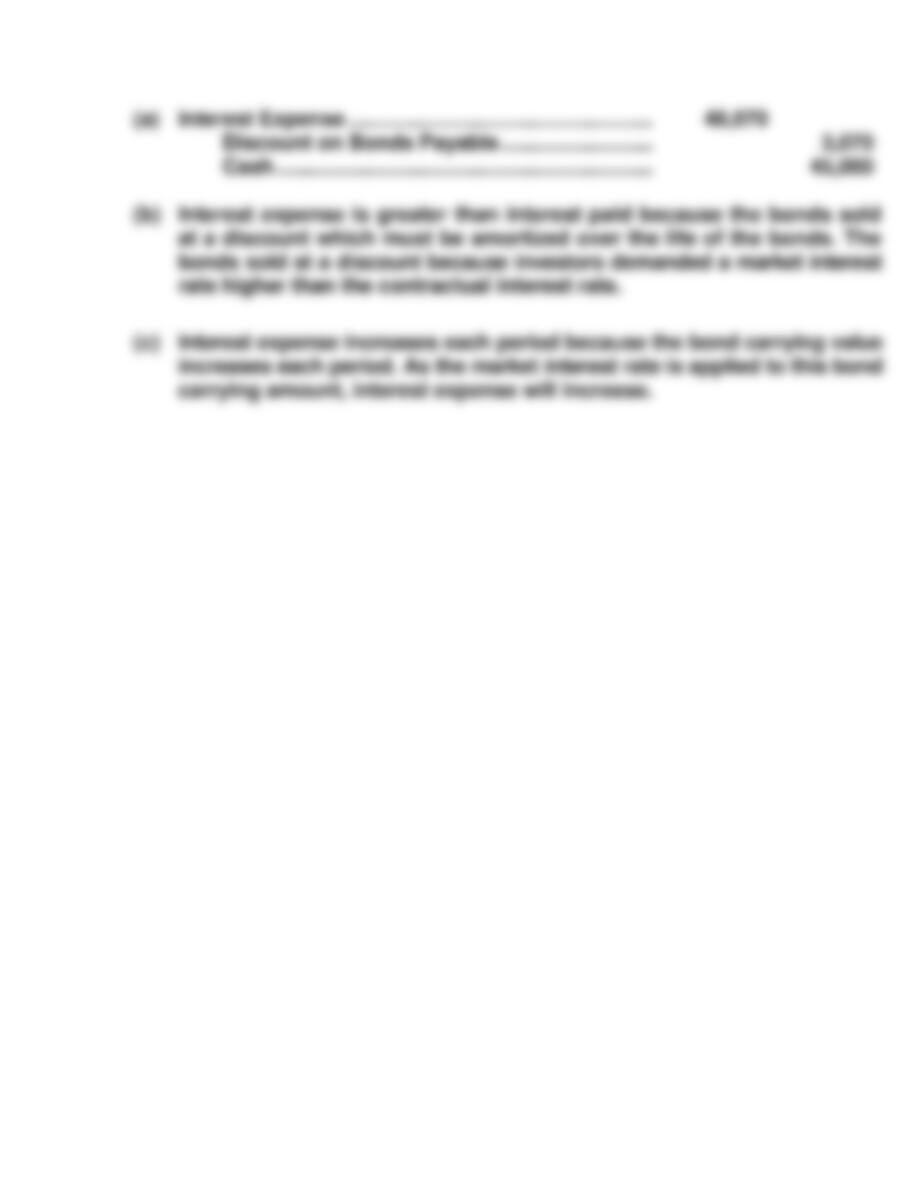
*BRIEF EXERCISE 10-18
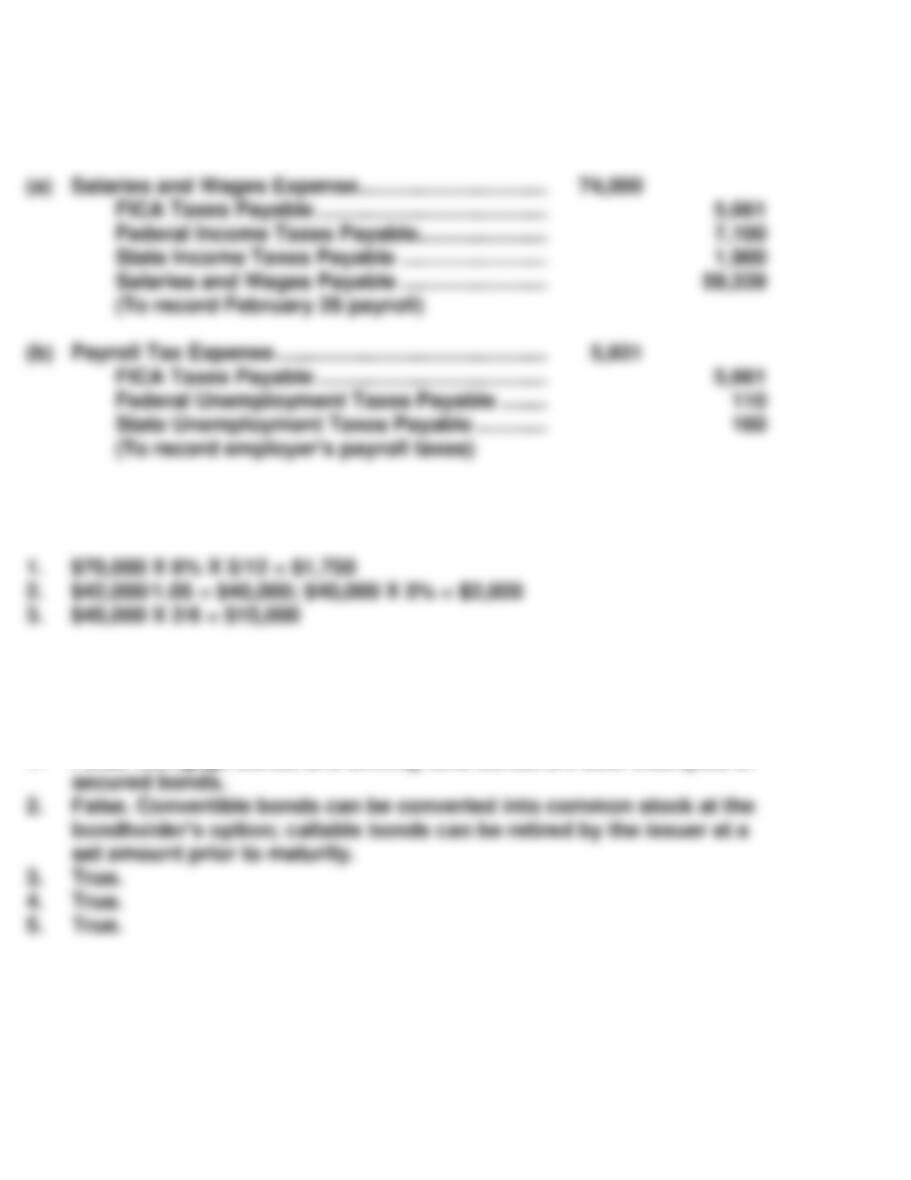
SOLUTIONS FOR DO IT! REVIEW EXERCISES
DO IT! 10-1a
DO IT! 10-1b
DO IT! 10-2
1. False. Mortgage bonds and sinking fund bonds are both examples of
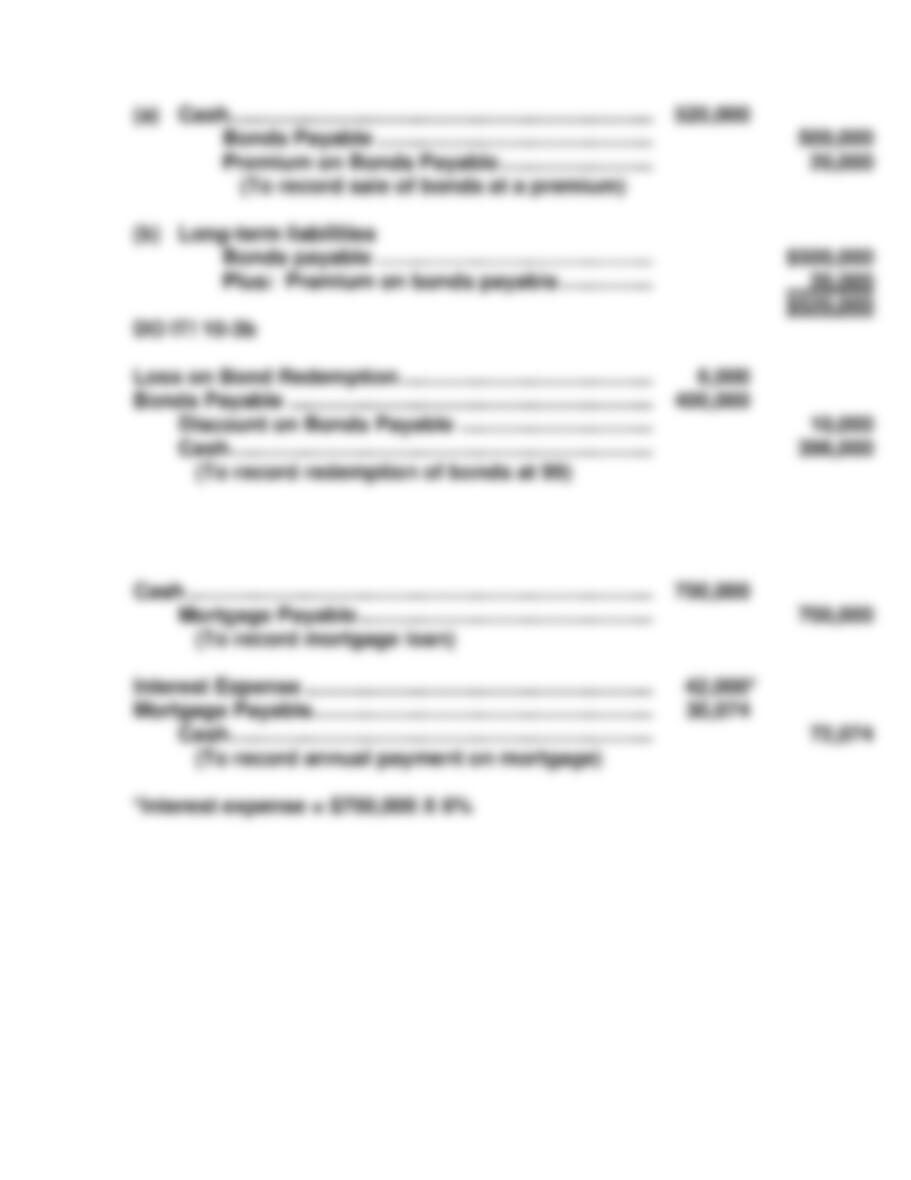
DO IT! 10-3a
DO IT! 10-4

DO IT! 10-5
(a) Current ratio $11,500 ÷ $12,000 = .96:1
SOLUTIONS TO EXERCISES
EXERCISE 10-1
July 1, 2017
EXERCISE 10-2
(a) June 1 Cash …………………………………………………. 90,000
Notes Payable …………………………..… 90,000
(d) $3,600
EXERCISE 10-3
POOLE COMPANY
EXERCISE 10-4
EXERCISE 10-5
EXERCISE 10-6
EXERCISE 10-7
EXERCISE 10-8
EXERCISE 10-9
EXERCISE 10-10
(b) (1) Cash ………………………………………………………. 525,000
EXERCISE 10-11
EXERCISE 10-12
EXERCISE 10-13
2017
EXERCISE 10-14
EXERCISE 10-15
Plan One
Issue Stock
Plan Two
Issue Bonds
EXERCISE 10-16
(a) Current ratio
*EXERCISE 10-17
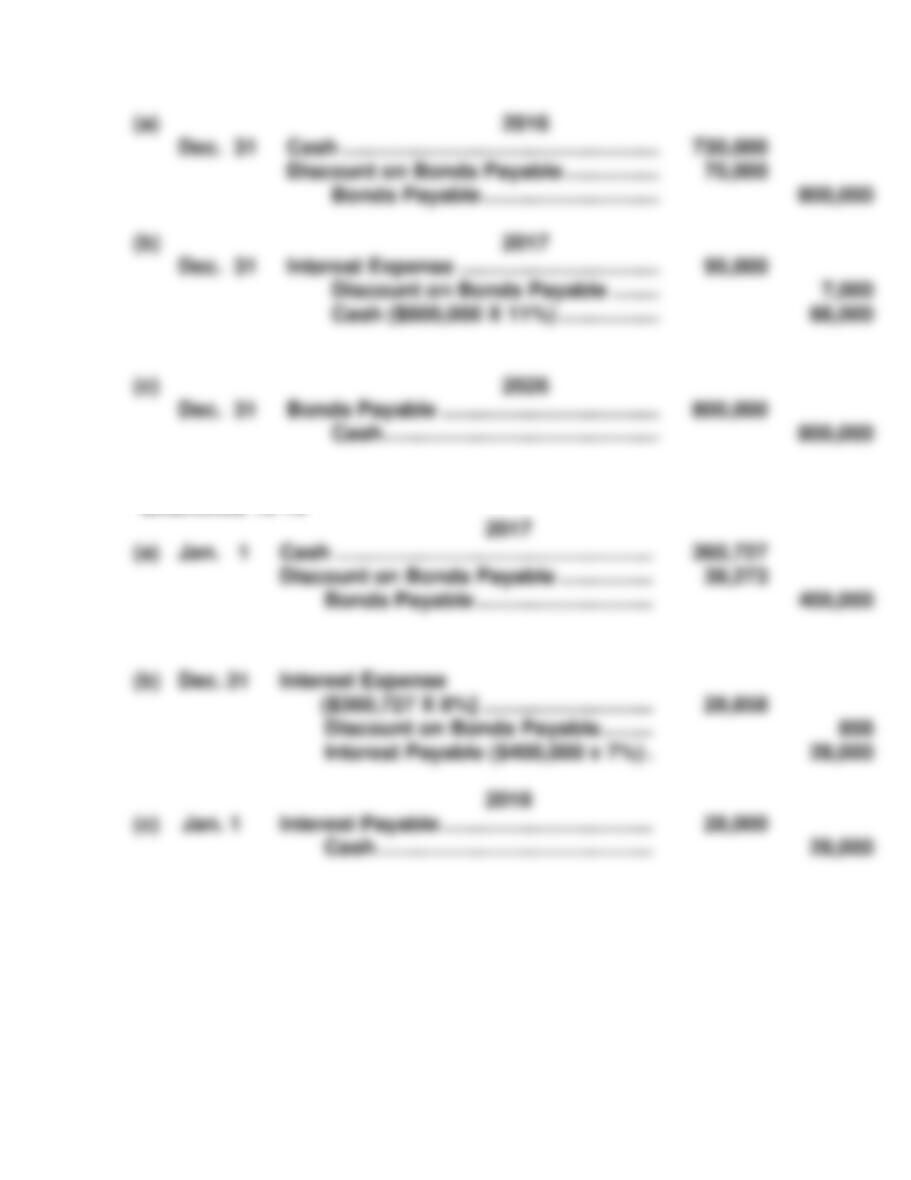
*EXERCISE 10-18
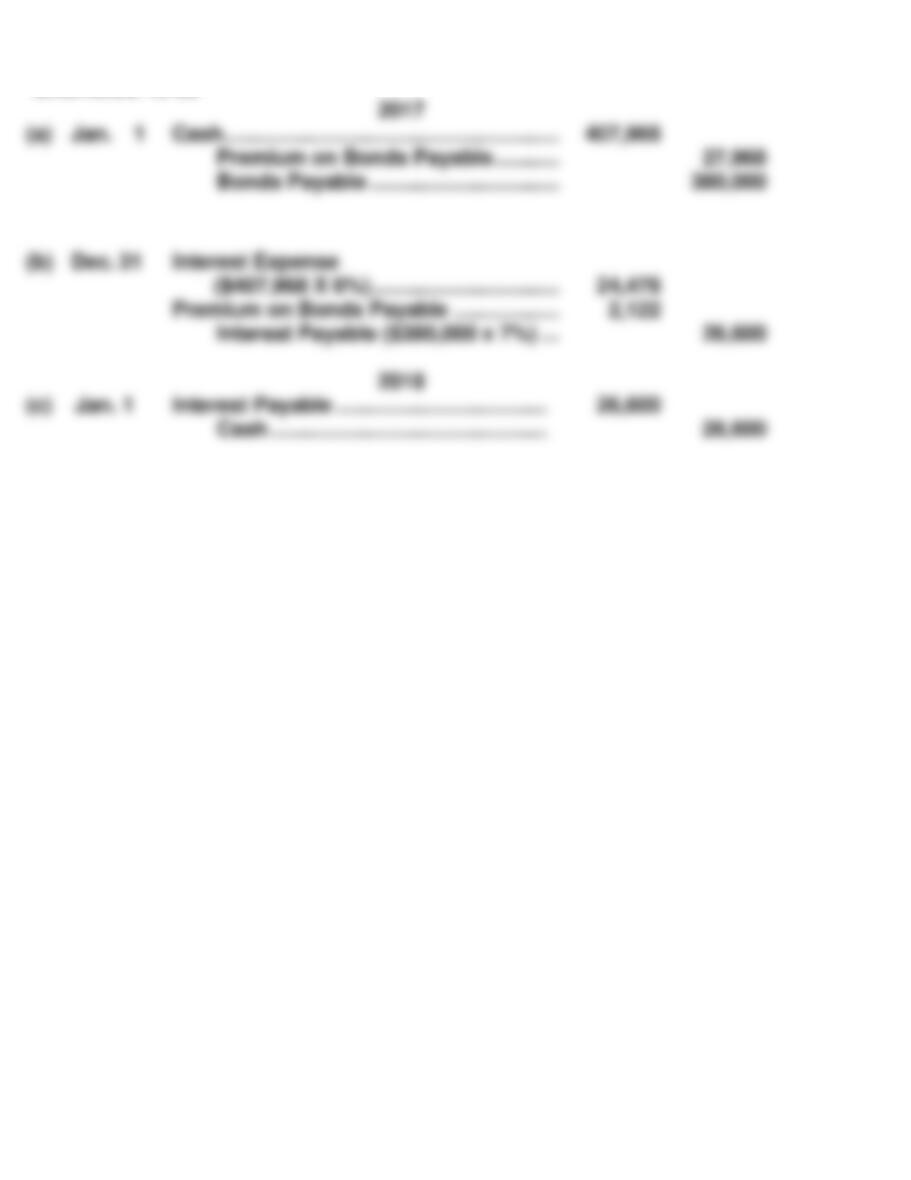
*EXERCISE 10-19 2017
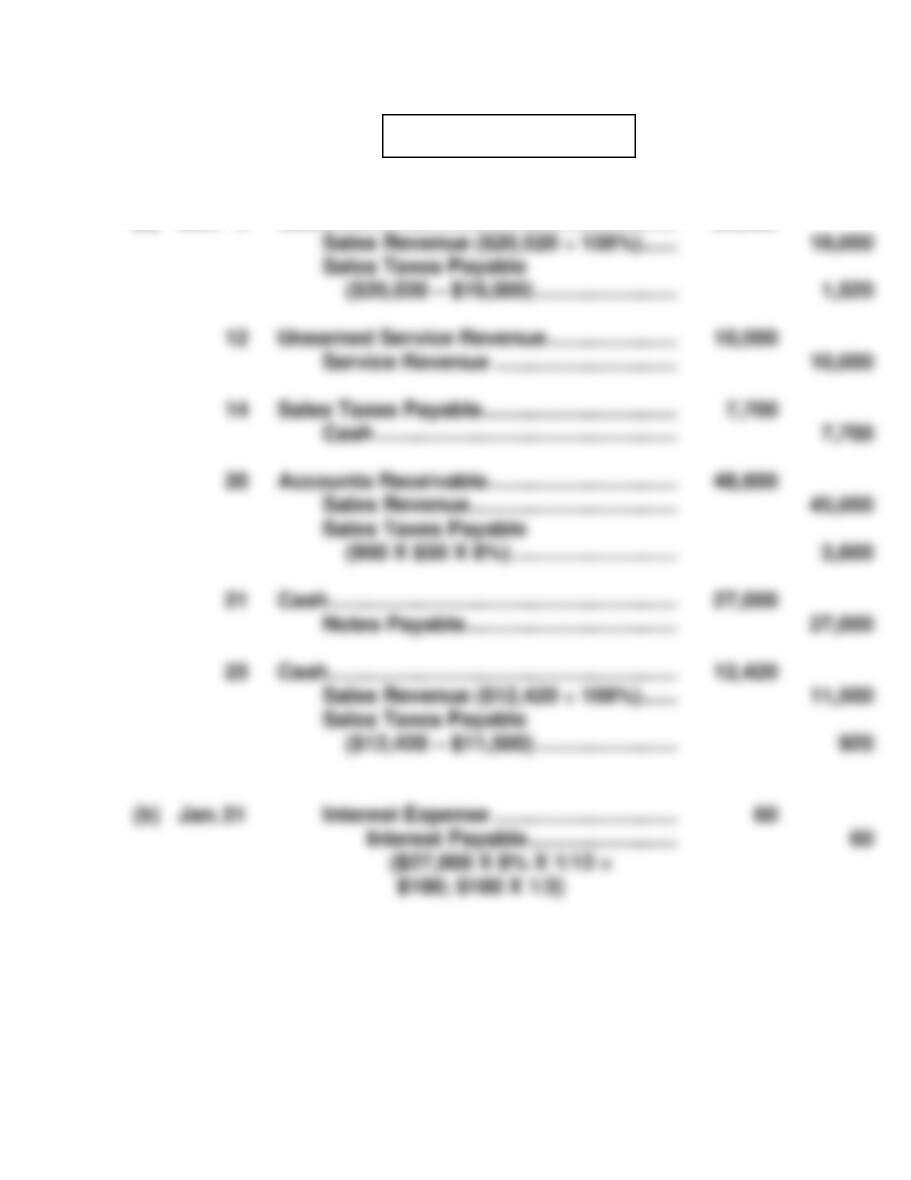
*EXERCISE 10-20 2017
SOLUTIONS TO PROBLEMS
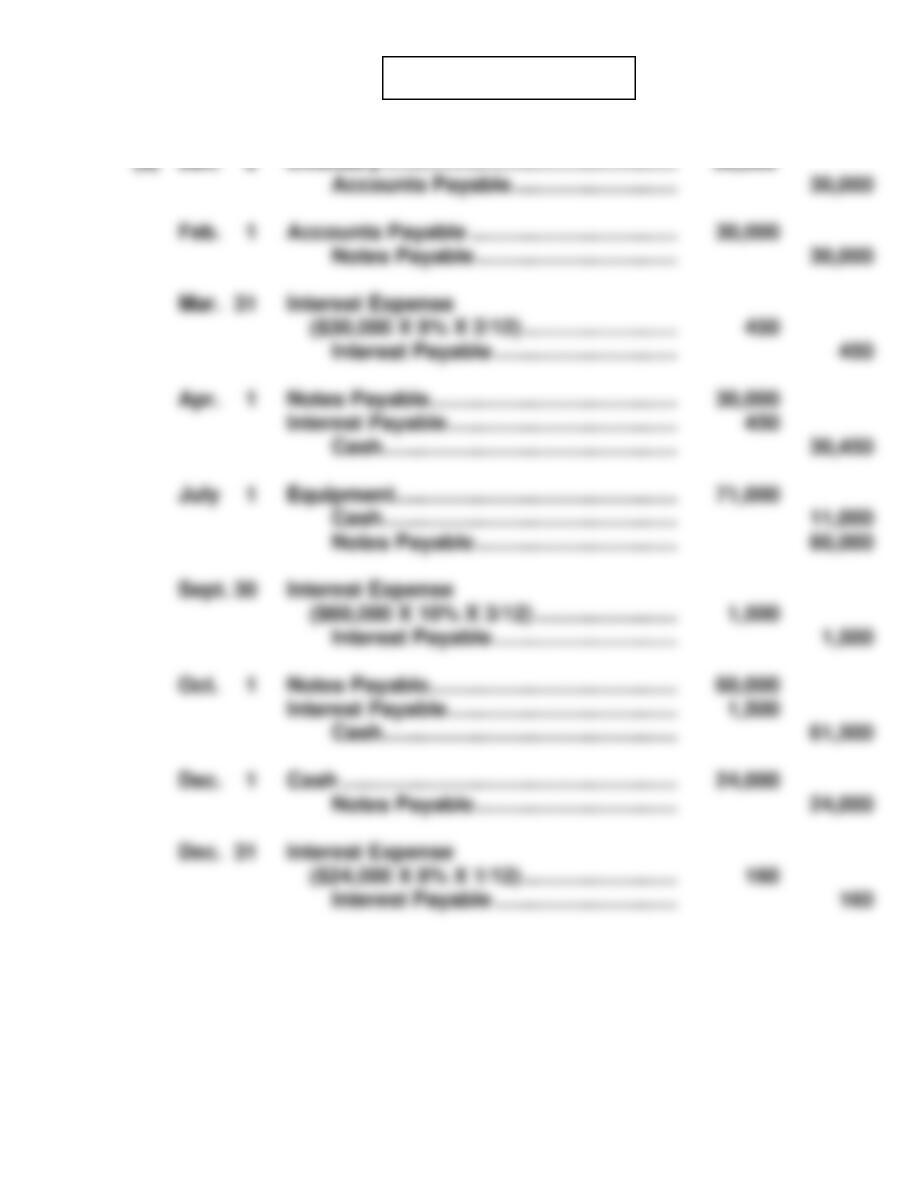
PROBLEM 10–1A
(a) Jan. 5 Cash ………………………………………………….. 20,520

PROBLEM 10-1A (Continued)
(c) Current liabilities
PROBLEM 10–2A
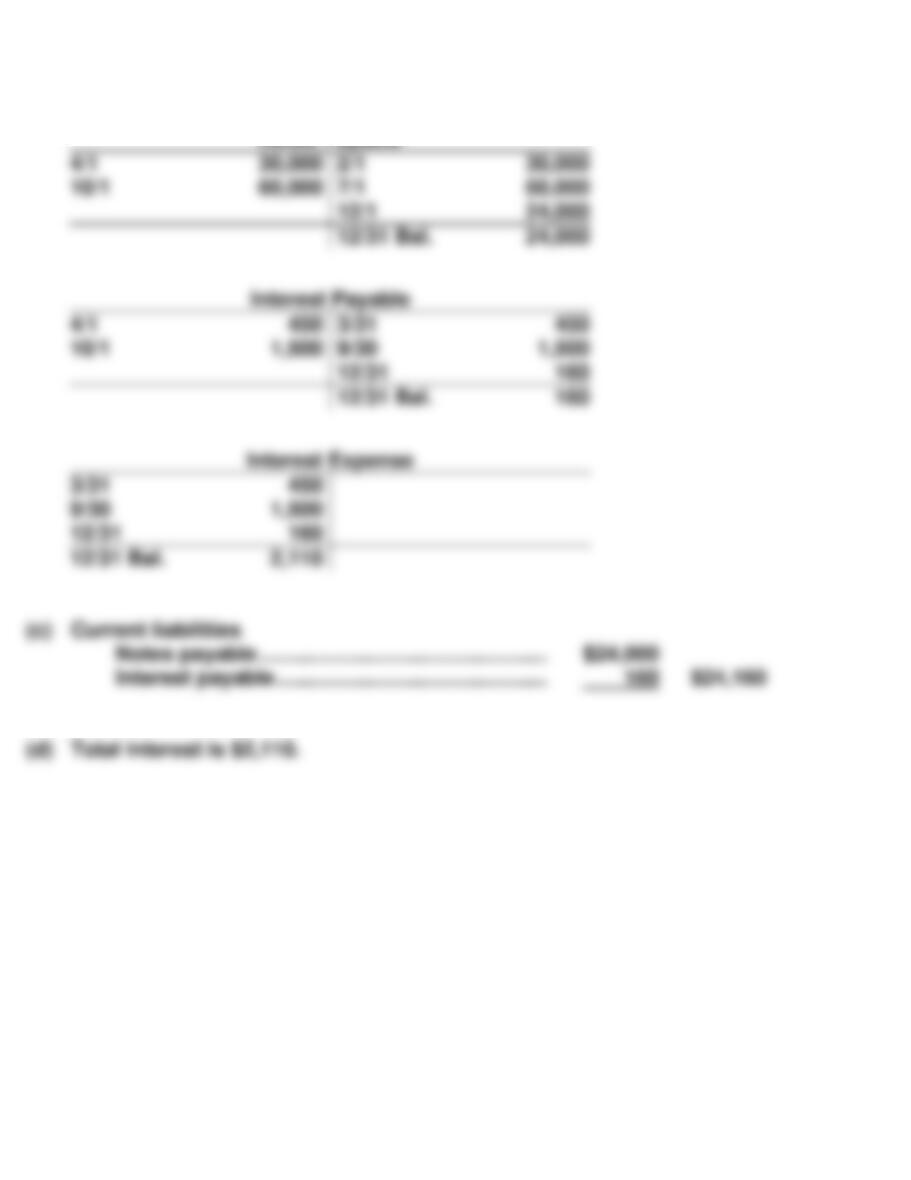
PROBLEM 10-2A (Continued)
(b)
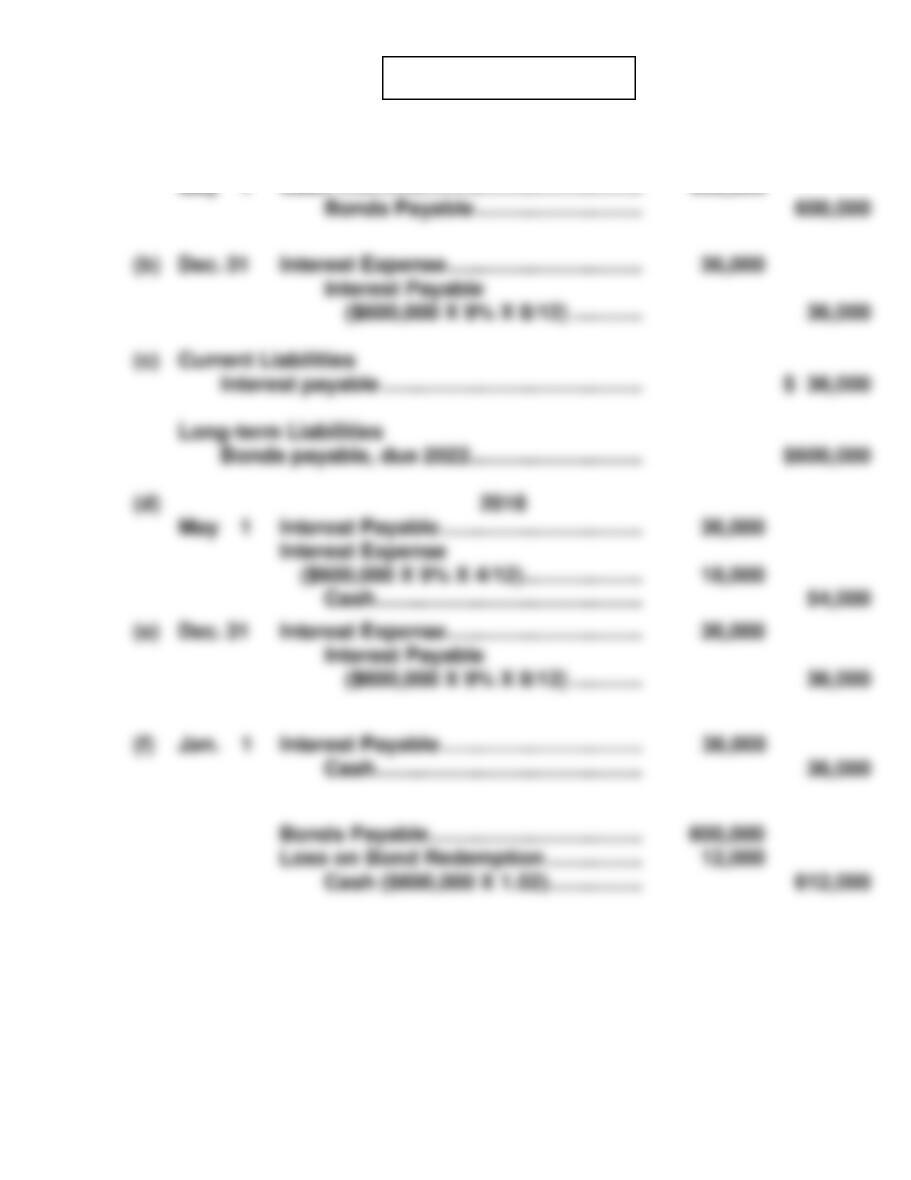
PROBLEM 10-3A
(a) 2017
May 1 Cash ……………………………………………. 600,000
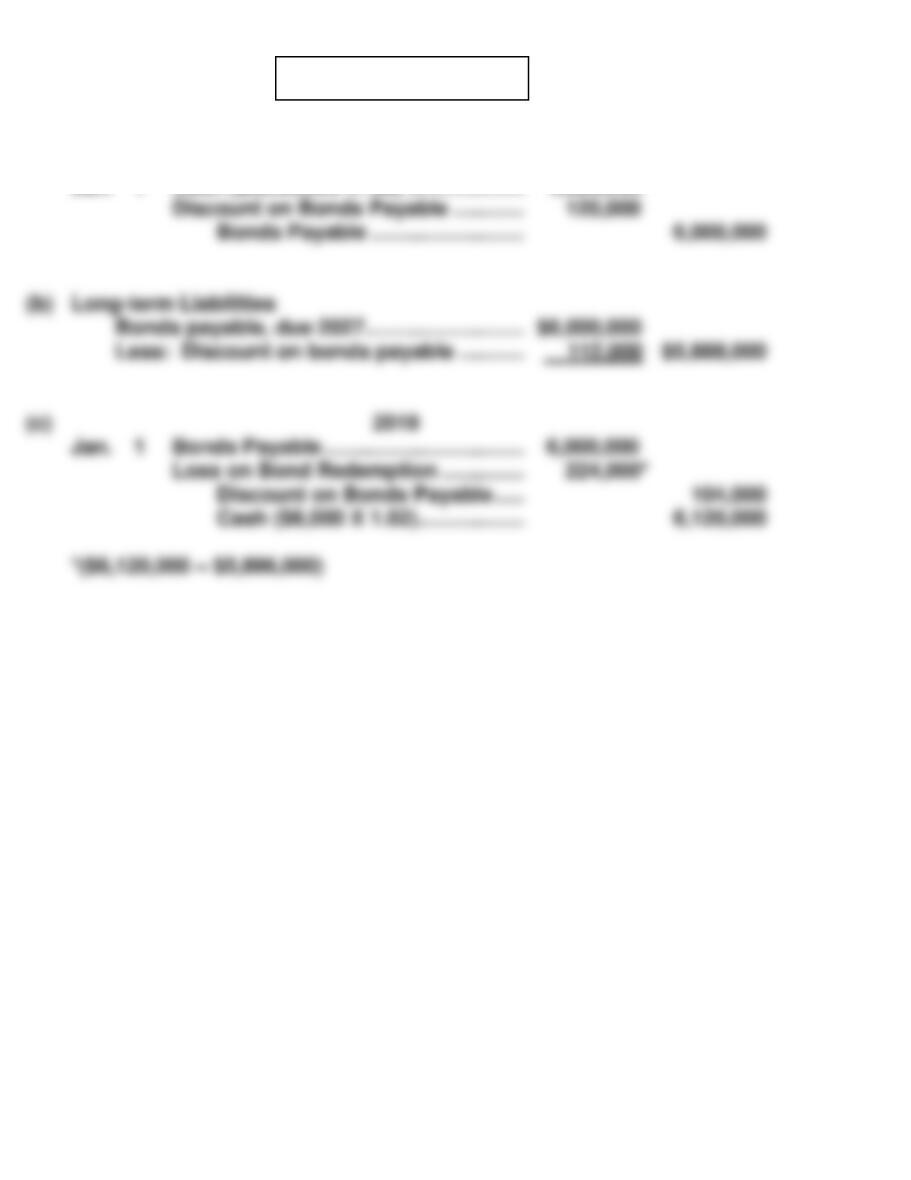
PROBLEM 10-4A
(a) 2017
Jan. 1 Cash ($6,000,000 X .98) ……………….. 5,880,000
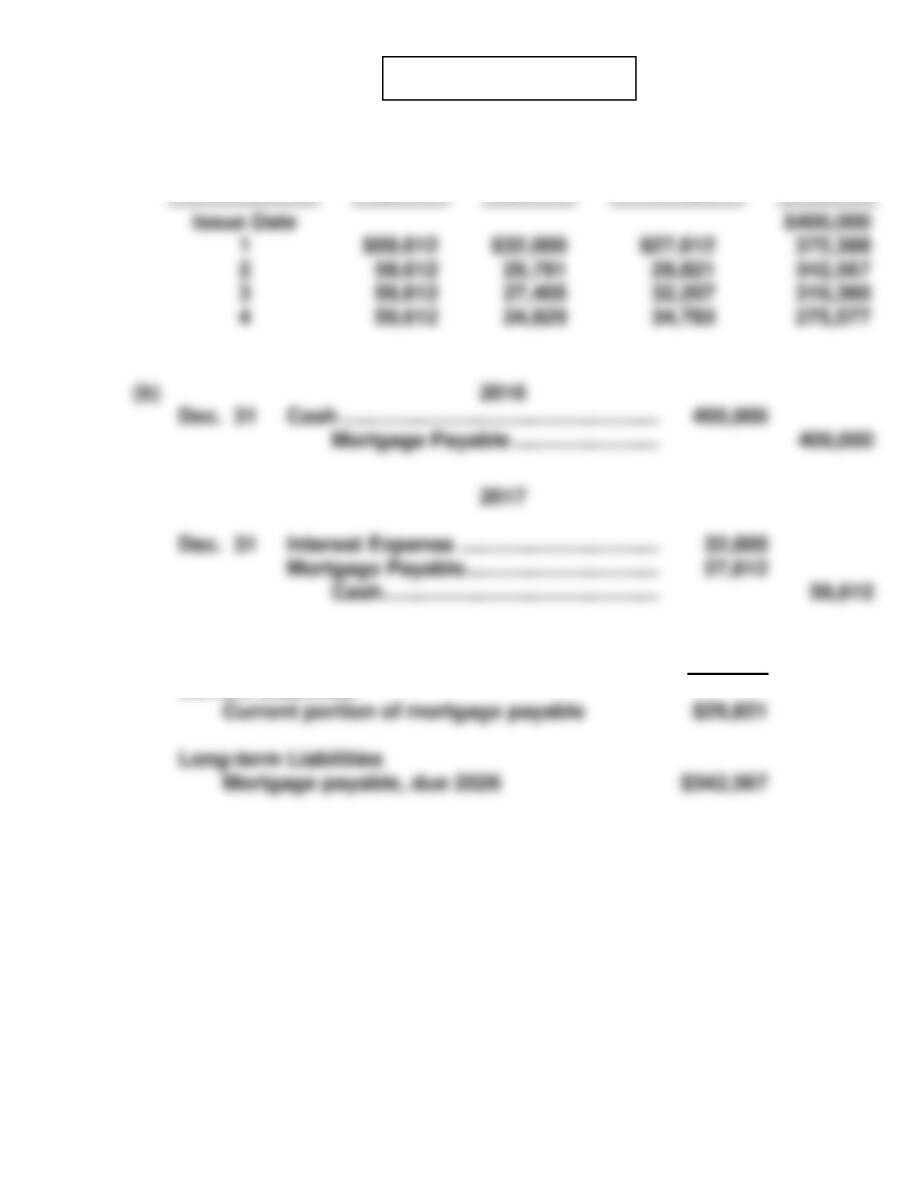
PROBLEM 10-5A
(a)
Annual
Interest Period
Cash
Payment
Interest
Expense
Reduction of
Principal
Principal
Balance
(c) 12/31/17
Current Liabilities
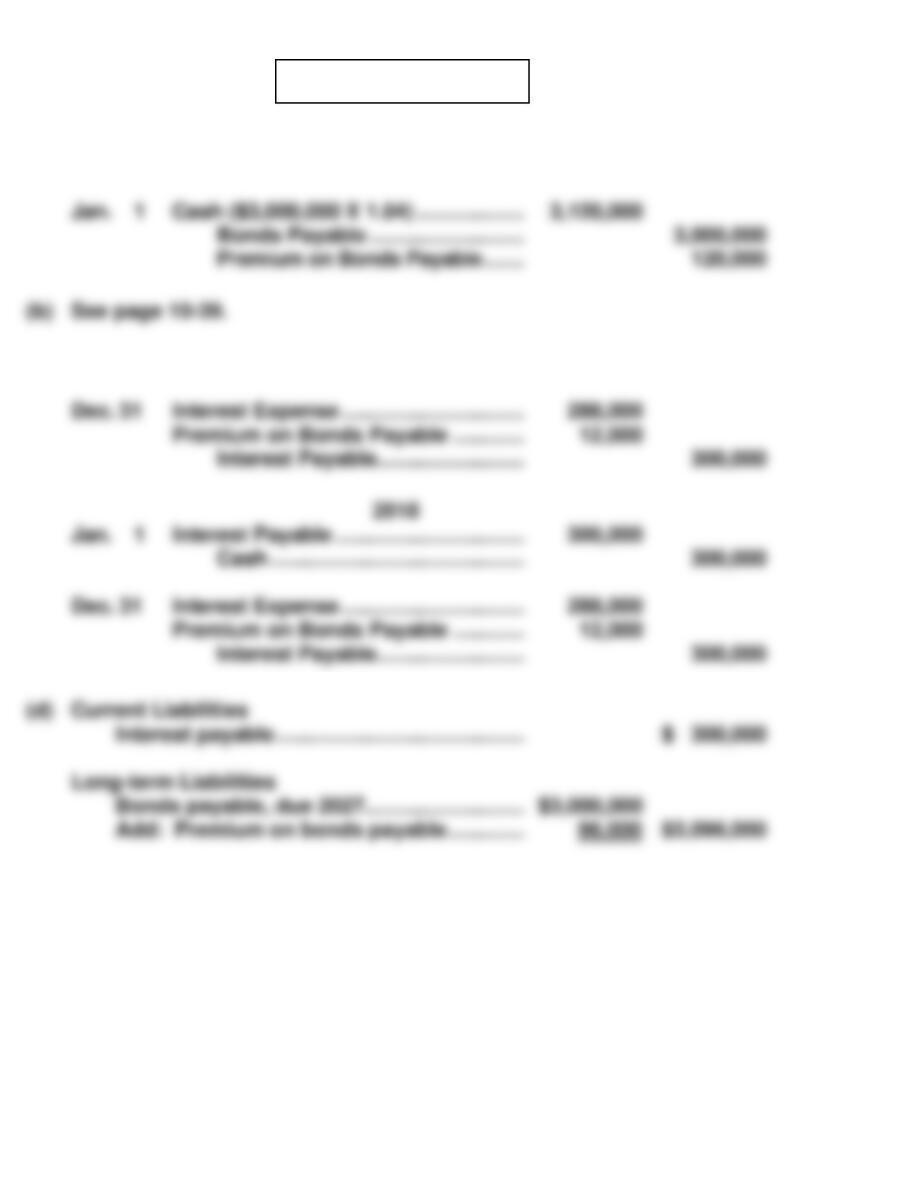
*PROBLEM 10-6A
(a) 2017
(c) 2017
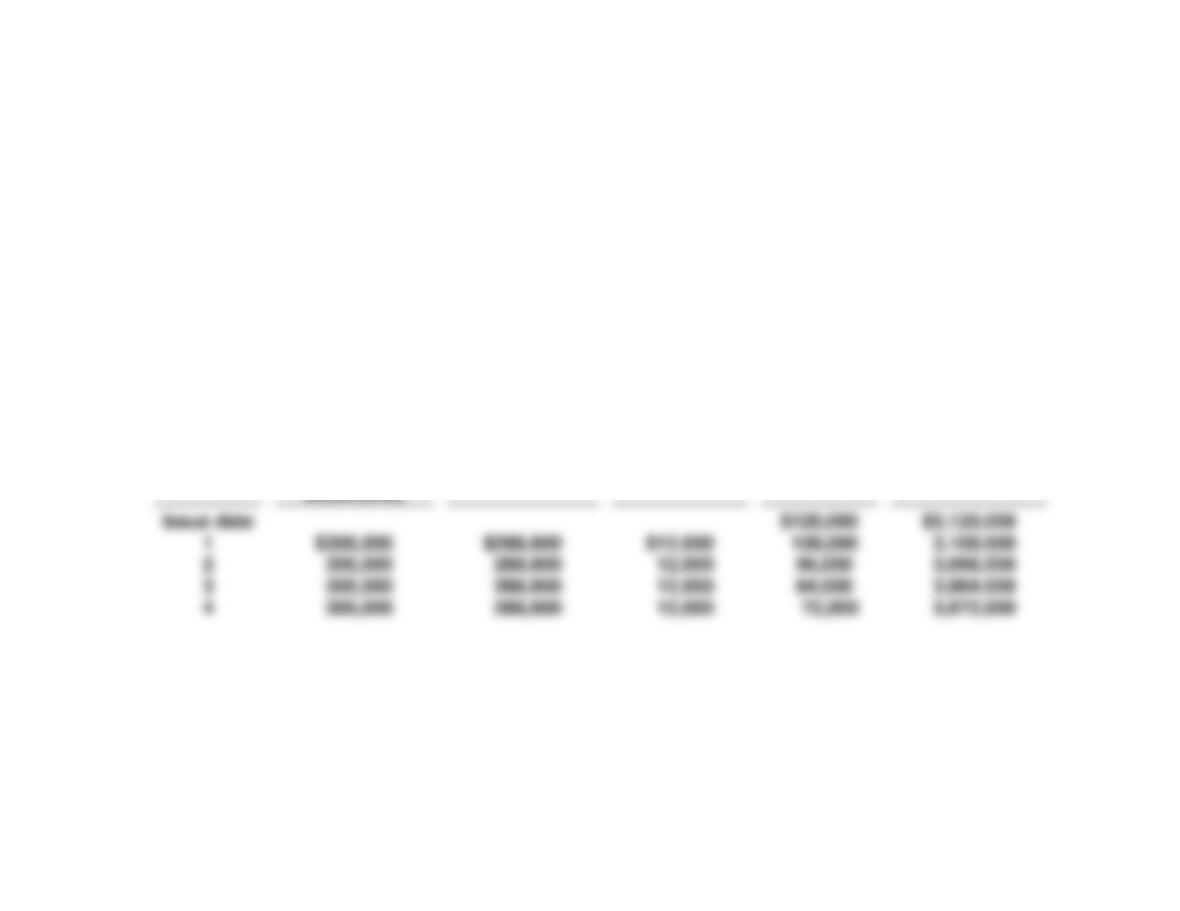
*PROBLEM 10-6A (Continued)
(b)
Annual
Interest
Periods
(A)
Interest to
Be Paid
(10% X
$3,000,000)
(B)
Interest Expense
to Be Recorded
(A) – (C)
(C)
Premium
Amortization
($120,000 ÷ 10)
(D)
Unamortized
Premium
(D) – (C)
(E)
Bond
Carrying Value
[$3,000,000 + (D)]
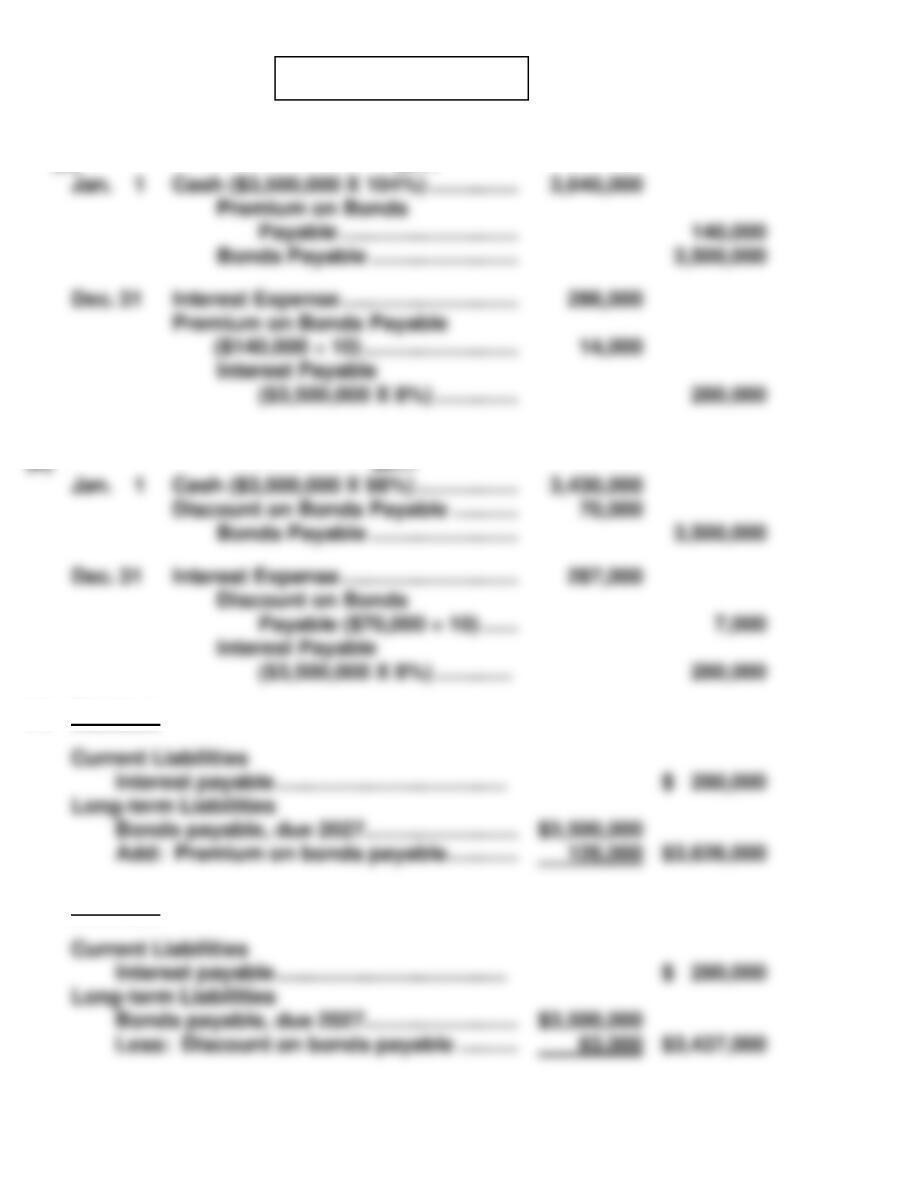
*PROBLEM 10-7A
(a) 2017
(c) Premium
Discount
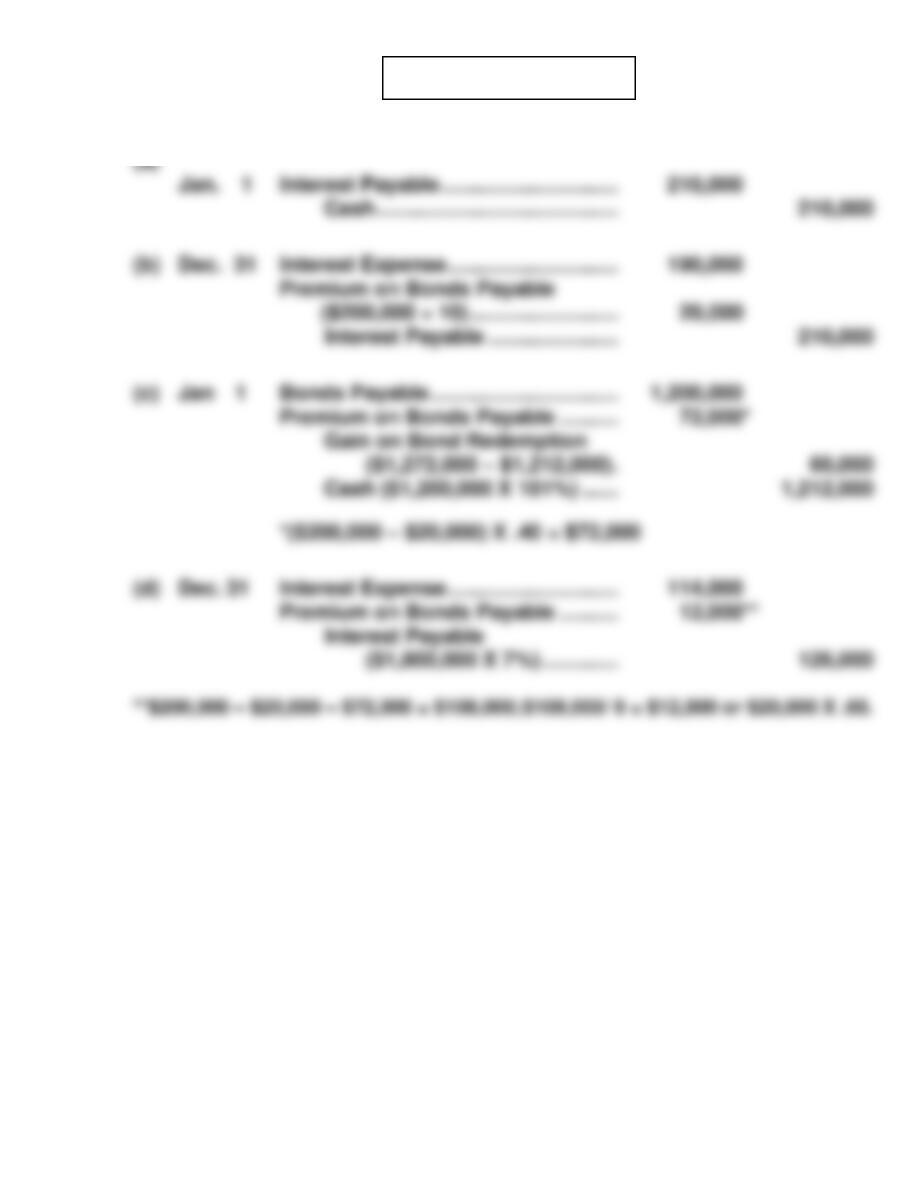
*PROBLEM 10-8A
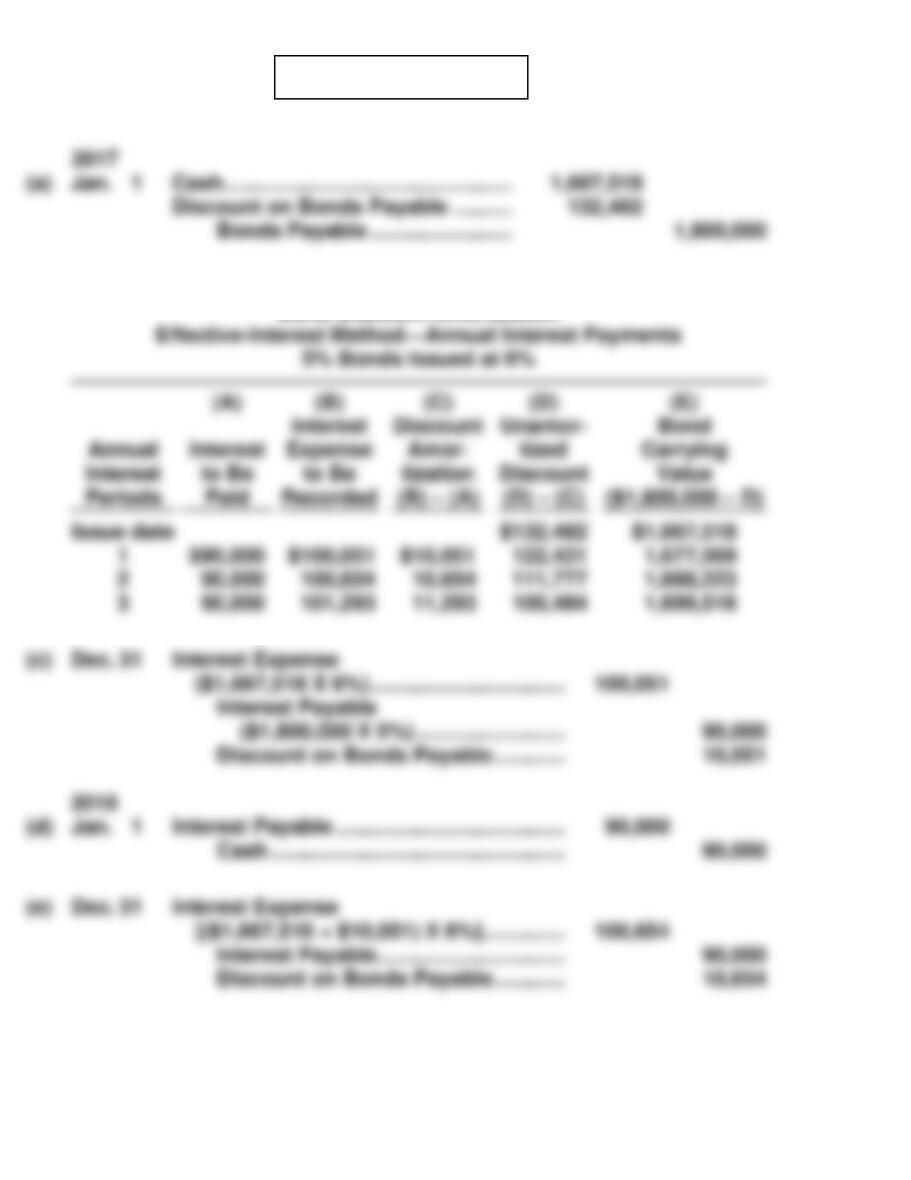
*PROBLEM 10-9A
(b) LOCK CORP.
Bond Discount Amortization
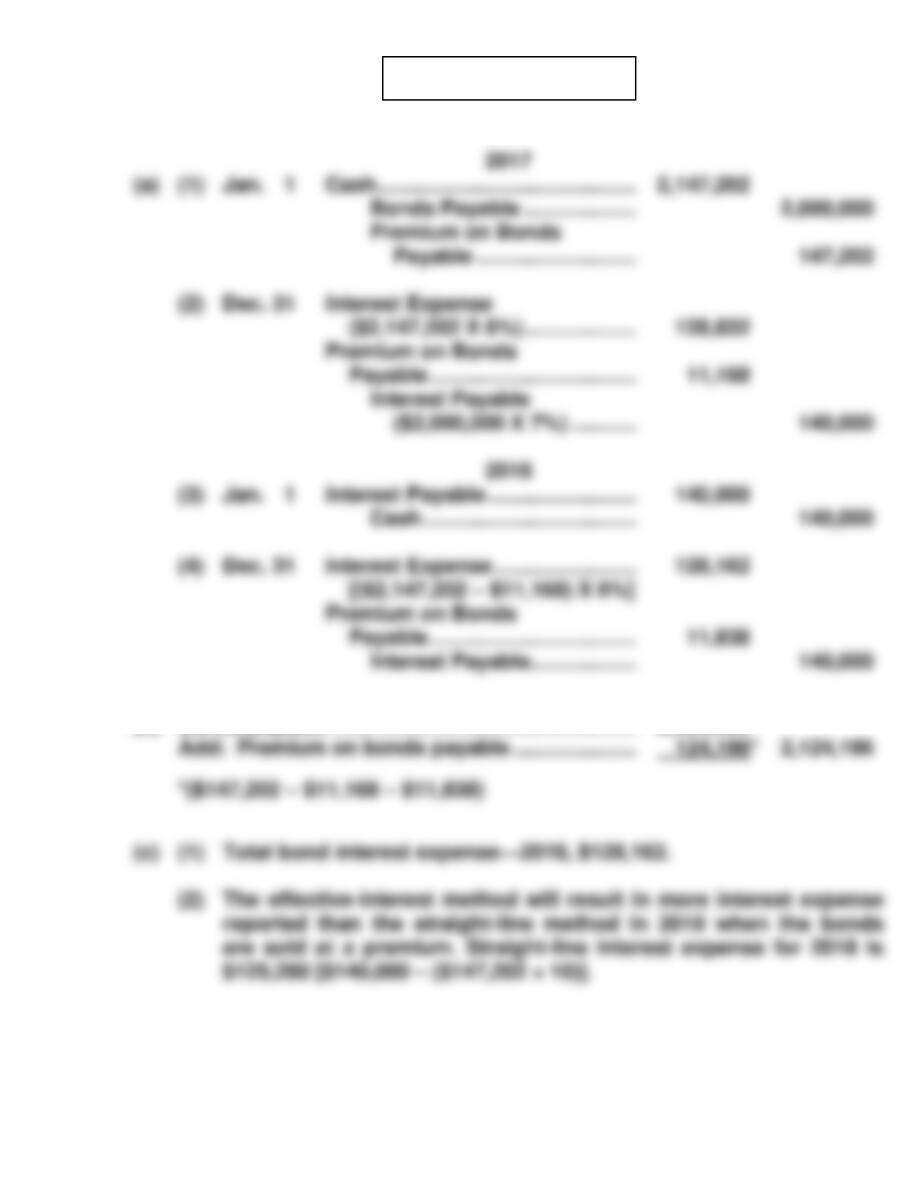
*PROBLEM 10-10A
2017
(b) Bonds payable ……………………………………………. 2,000,000
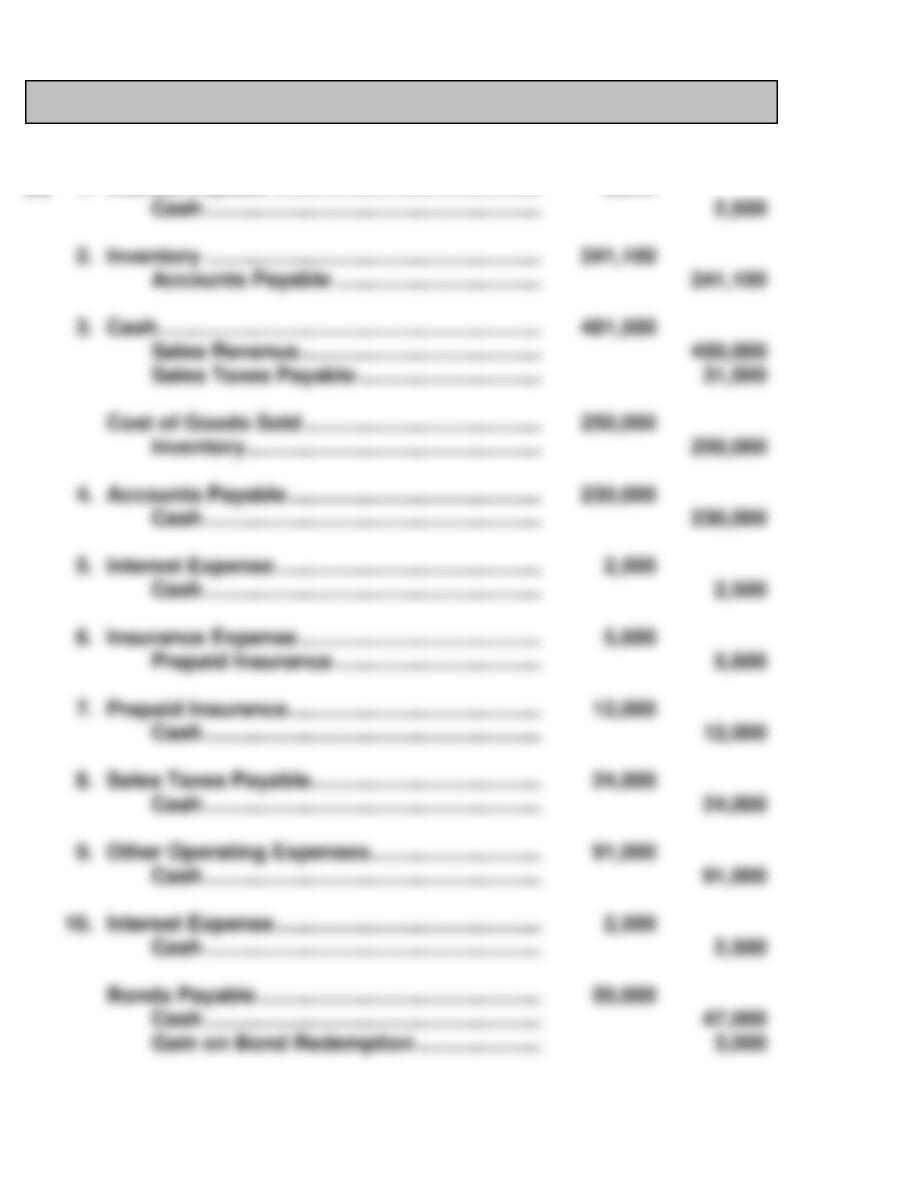
COMPREHENSIVE PROBLEM SOLUTION 10–1
(a)
1.
Interest Payable ……………………………………….
2,500
2.
Inventory …………………………………………………
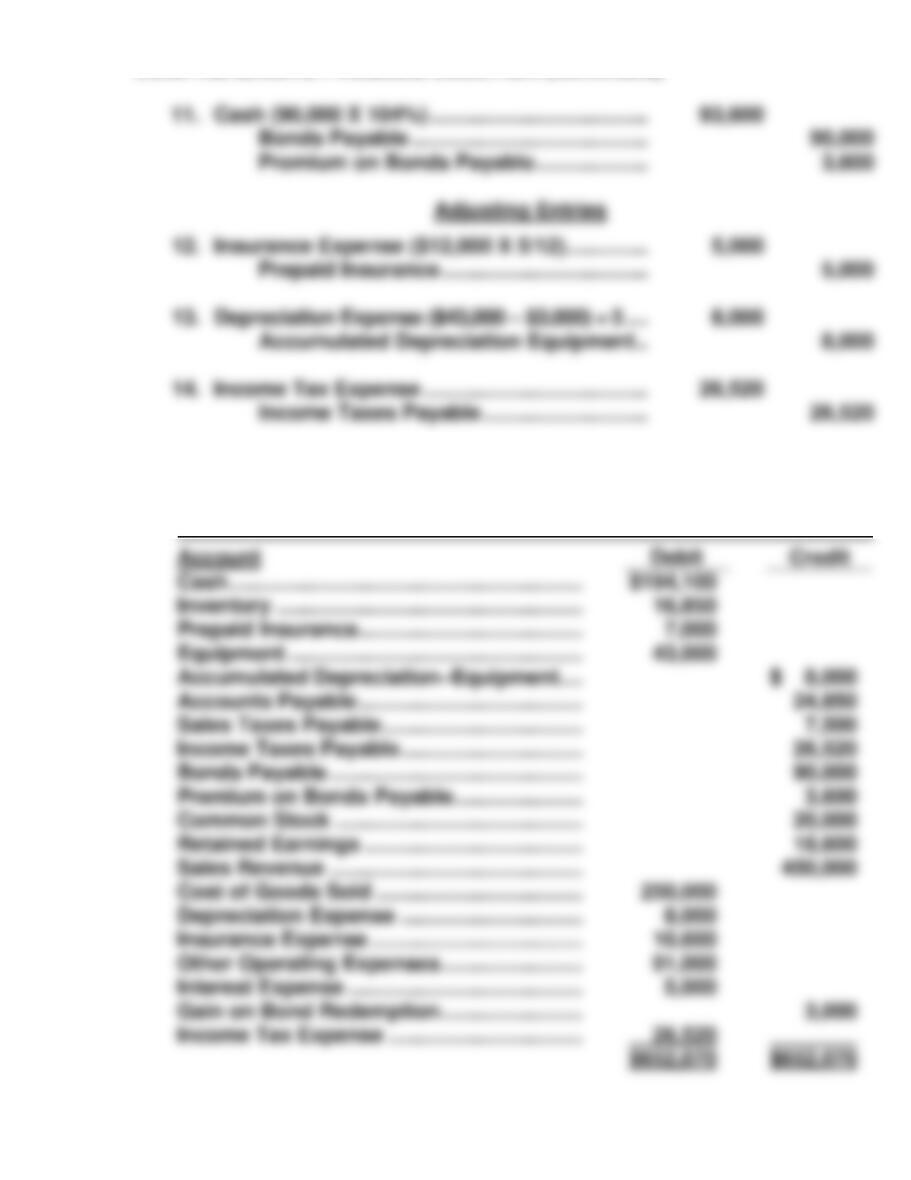
COMPREHENSIVE PROBLEM SOLUTION (Continued)
(b) JAMES CORPORATION
Trial Balance
12/31/2017
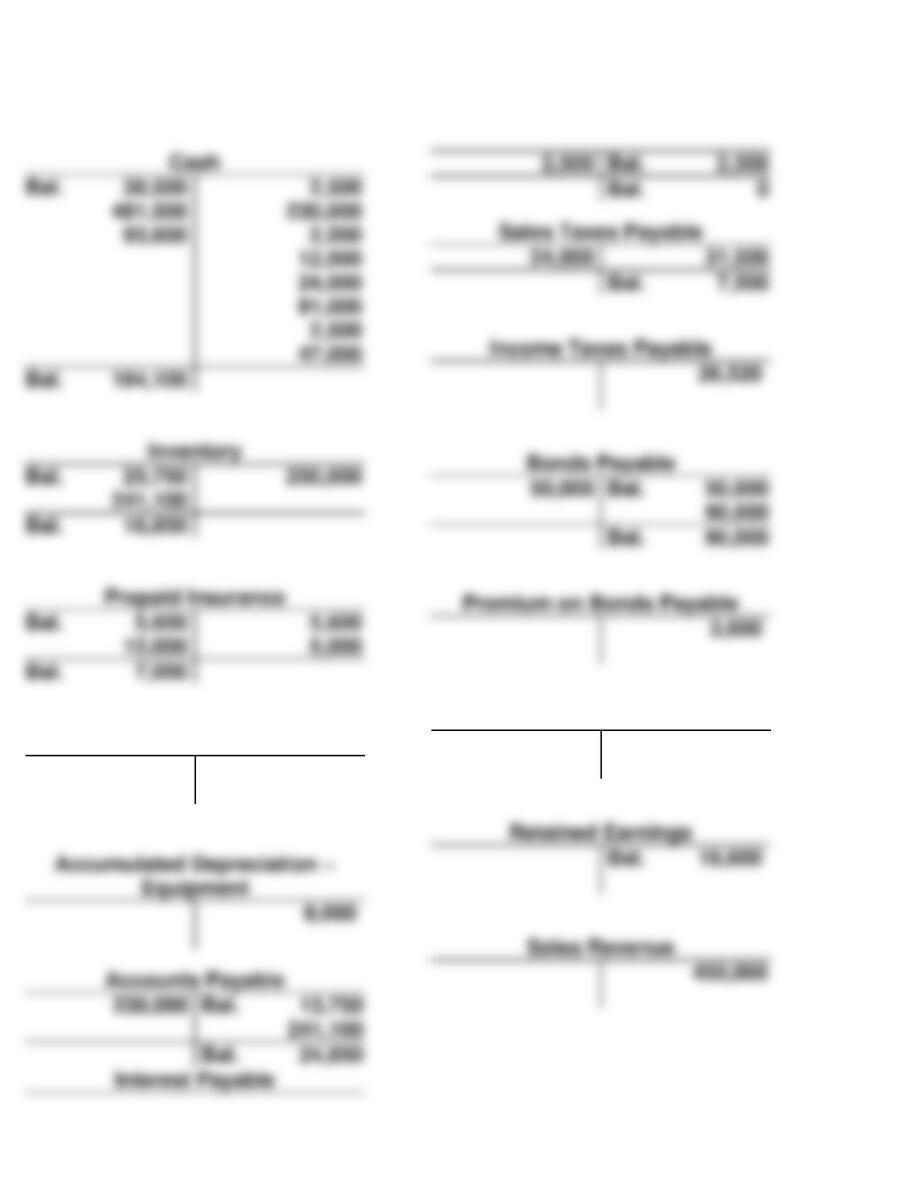
Equipment
8,000
241,100
Bal. 24,850
Bal. 18,600
450,000
COMPREHENSIVE PROBLEM SOLUTION (Continued)
(a) and (b) Optional T accounts
Equipment
Bal. 43,000
Common Stock
Bal. 20,000
47,000
Bal. 194,100
241,100
Bal. 16,850
12,000
5,000
Bal. 7,000
2,500
Bal. 2,500
Bal. 0
24,000
31,500
Bal. 7,500
26,520
90,000
Bal. 90,000
3,600
COMPREHENSIVE PROBLEM SOLUTION (Continued)
(a) and (b) (Continued)
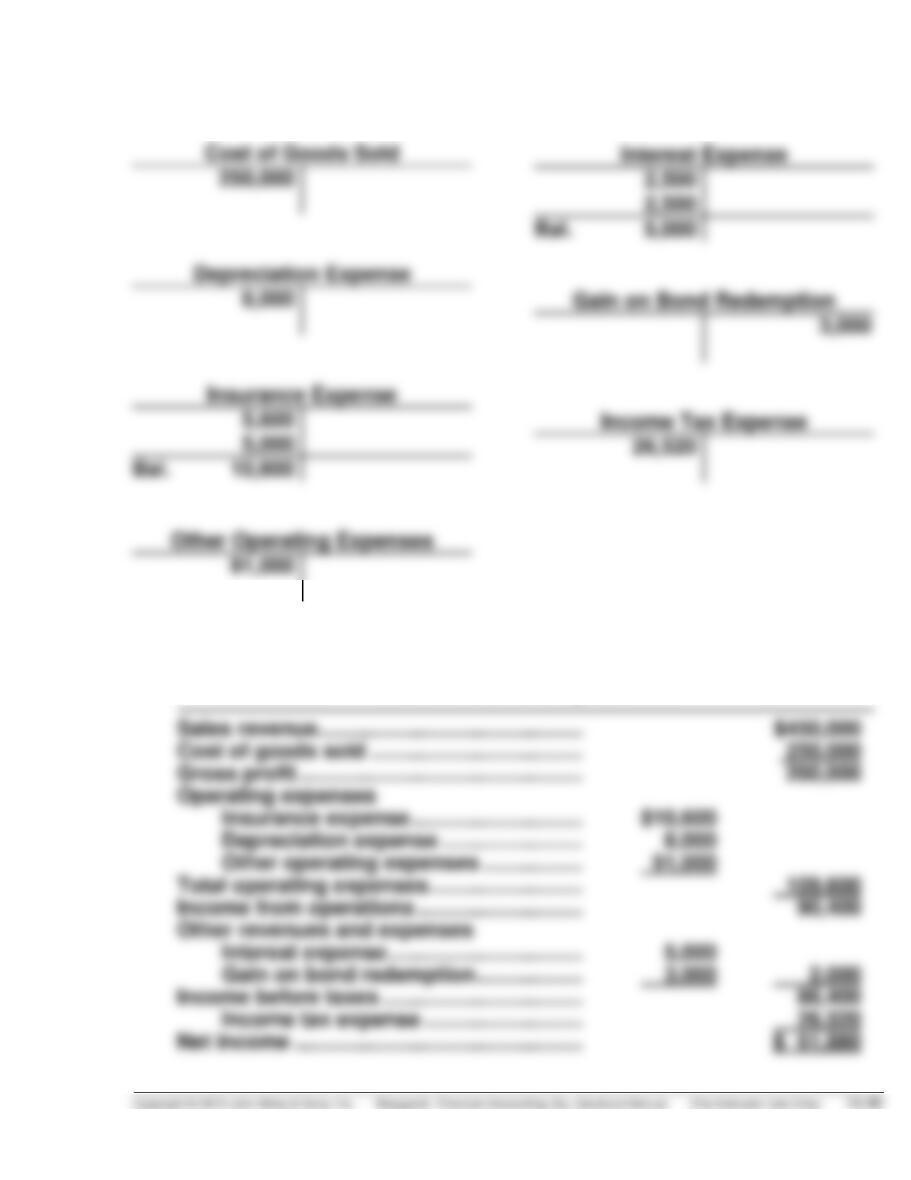
250,000
8,000
Bal. 10,600
3,000
26,520
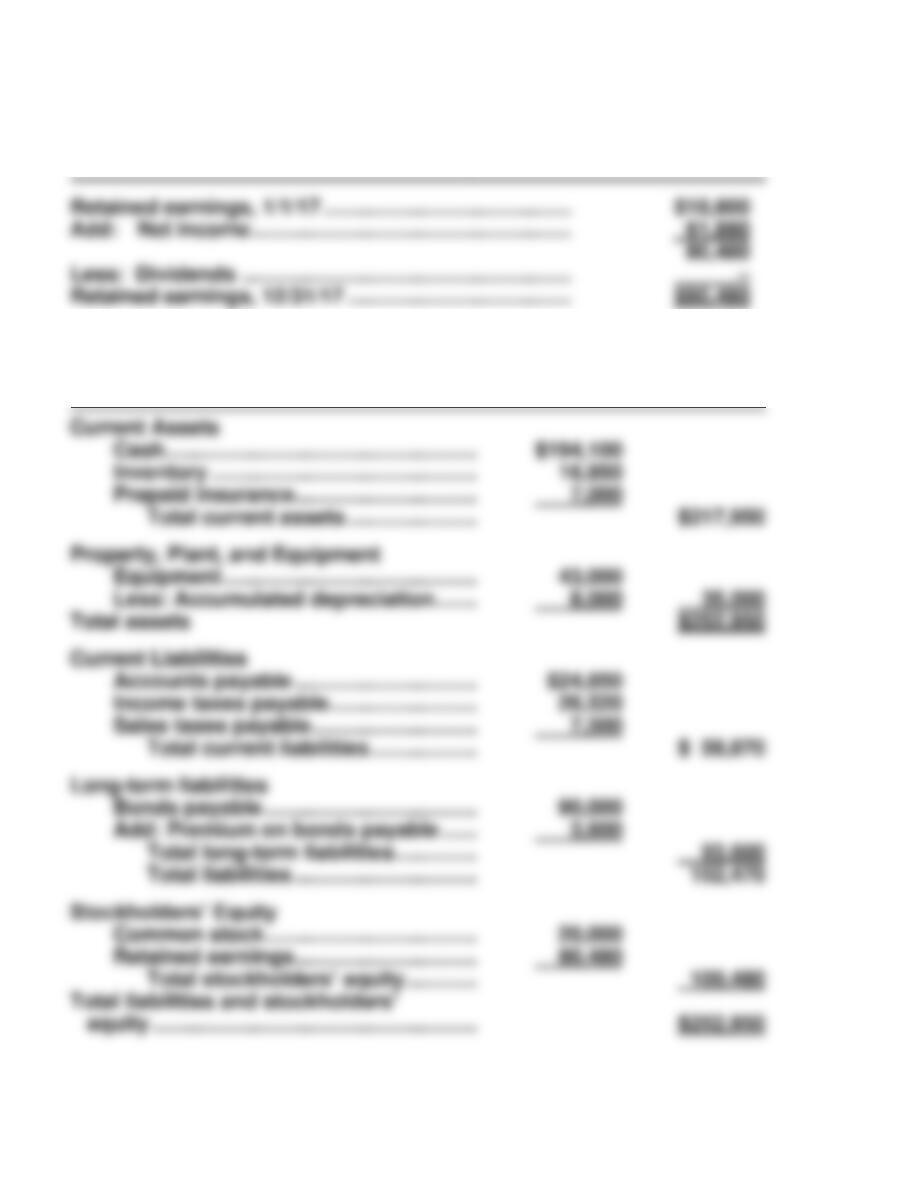
(c) JAMES CORPORATION
Income Statement
For the Year Ending 12/31/17
COMPREHENSIVE PROBLEM SOLUTION (Continued)
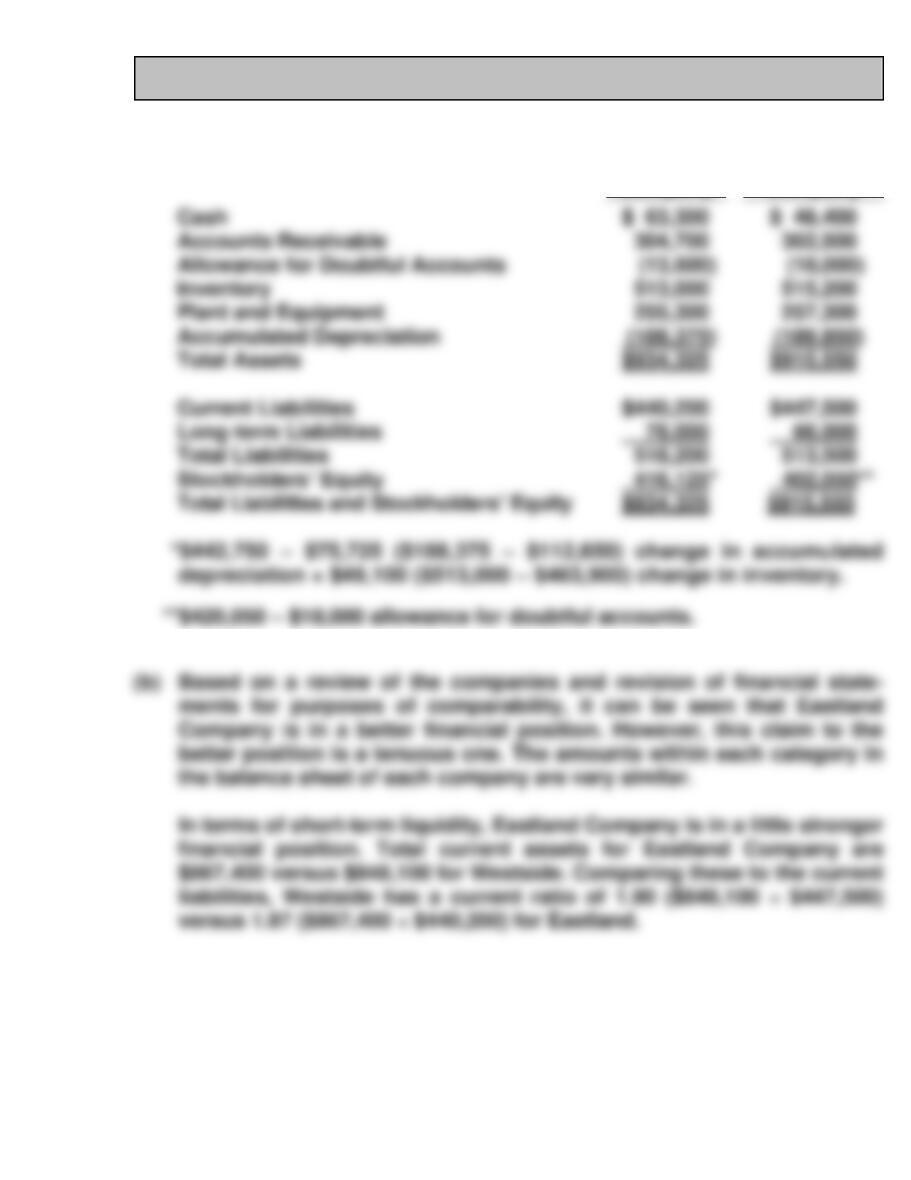
JAMES CORPORATION
Retained Earnings Statement
For the Year Ending 12/31/17
JAMES CORPORATION
Balance Sheet
12/31/2017
COMPREHENSIVE PROBLEM SOLUTION 10–2
(a)
Eastland
Company
Westside
Company
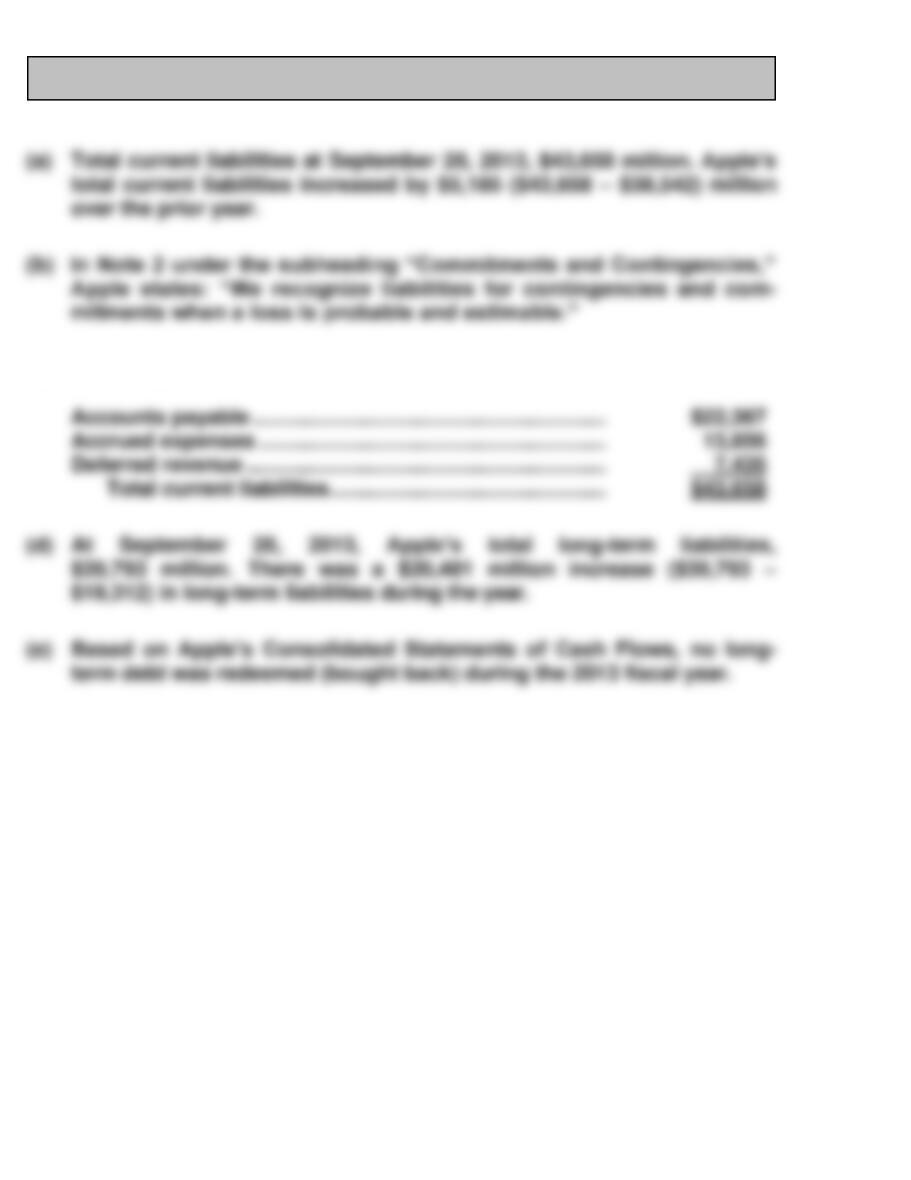
BYP 10-1 FINANCIAL REPORTING PROBLEM
(c) The components of current liabilities are:
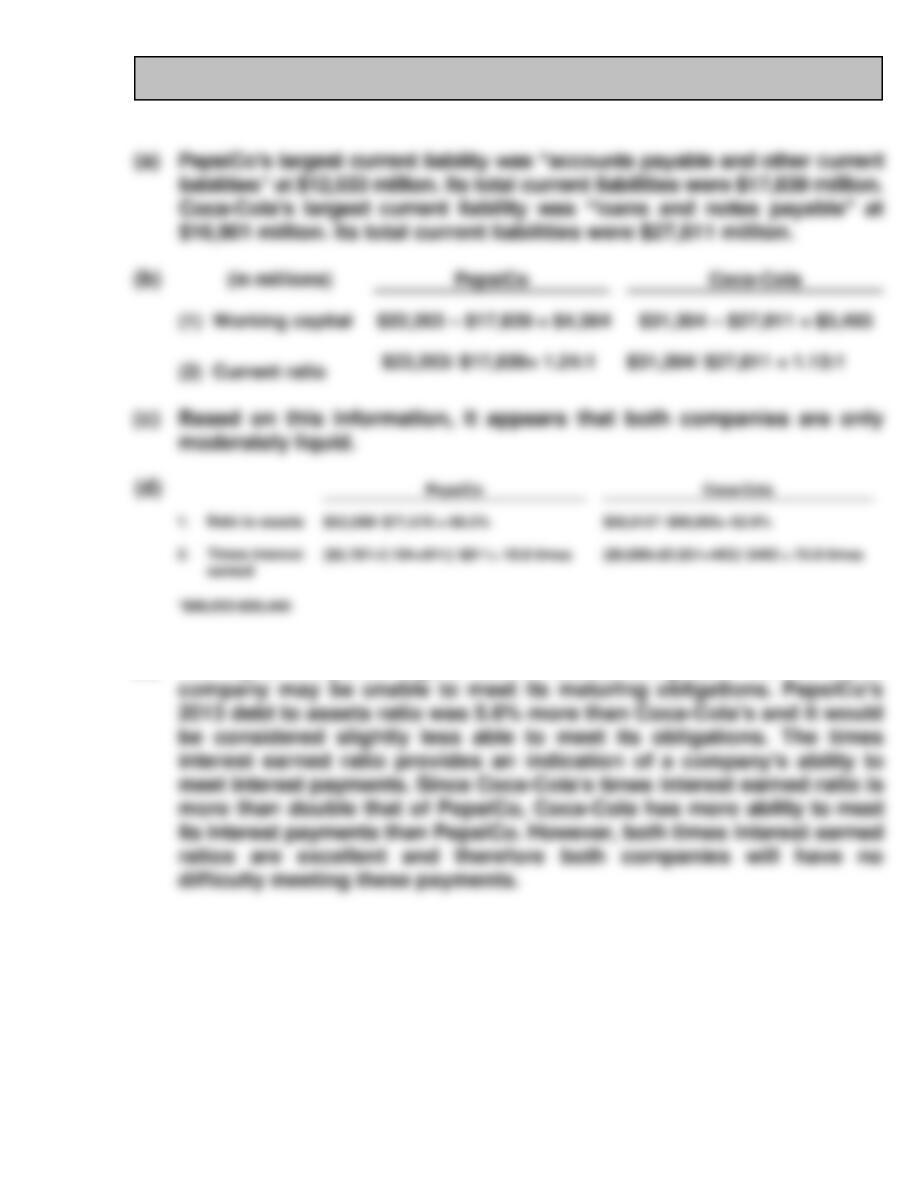
BYP 10-2 COMPARATIVE ANALYSIS PROBLEM
(e) The higher the percentage of debt to assets, the greater the risk that a
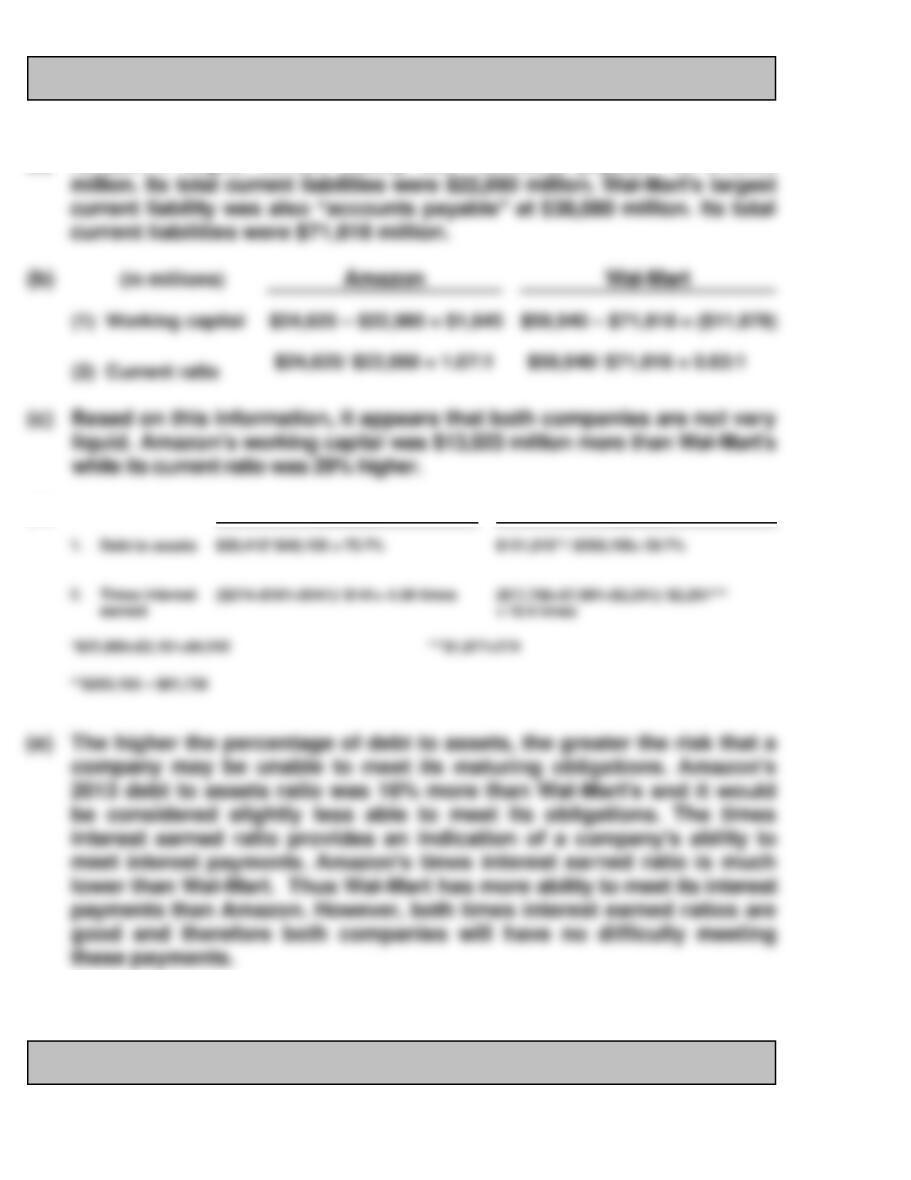
BYP 10-3 COMPARATIVE ANALYSIS PROBLEM
(a) Amazon’s largest current liability was “accounts payable” at $15,133
(d)
Amazon
Wal-Mart
BYP 10-4 REAL-WORLD FOCUS
(a) An ‘A’ rating means that the company has a strong capacity to meet
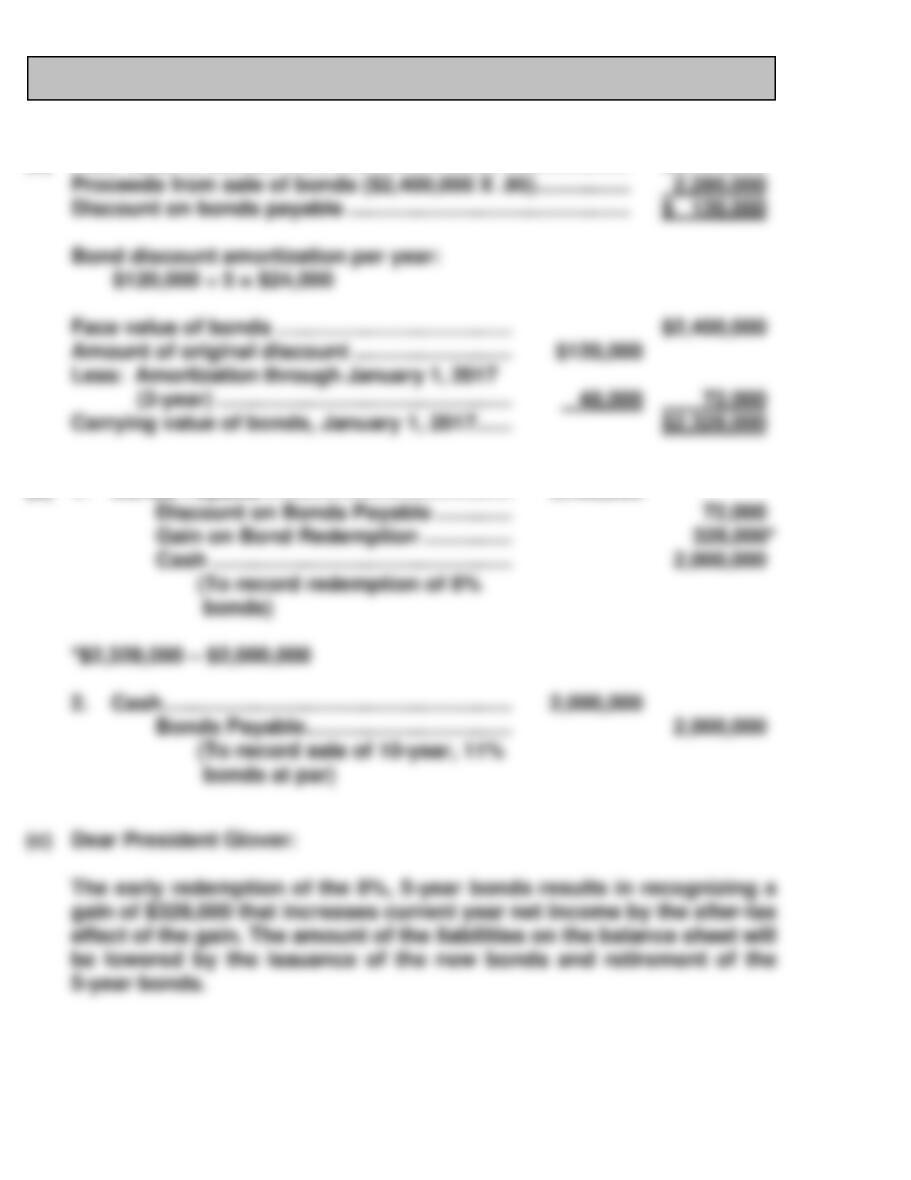
BYP 10-5 DECISION MAKING ACROSS THE ORGANIZATION
(a) Face value of bonds …………………………………………………… $2,400,000
(b) 1. Bonds Payable …………………………………… 2,400,000
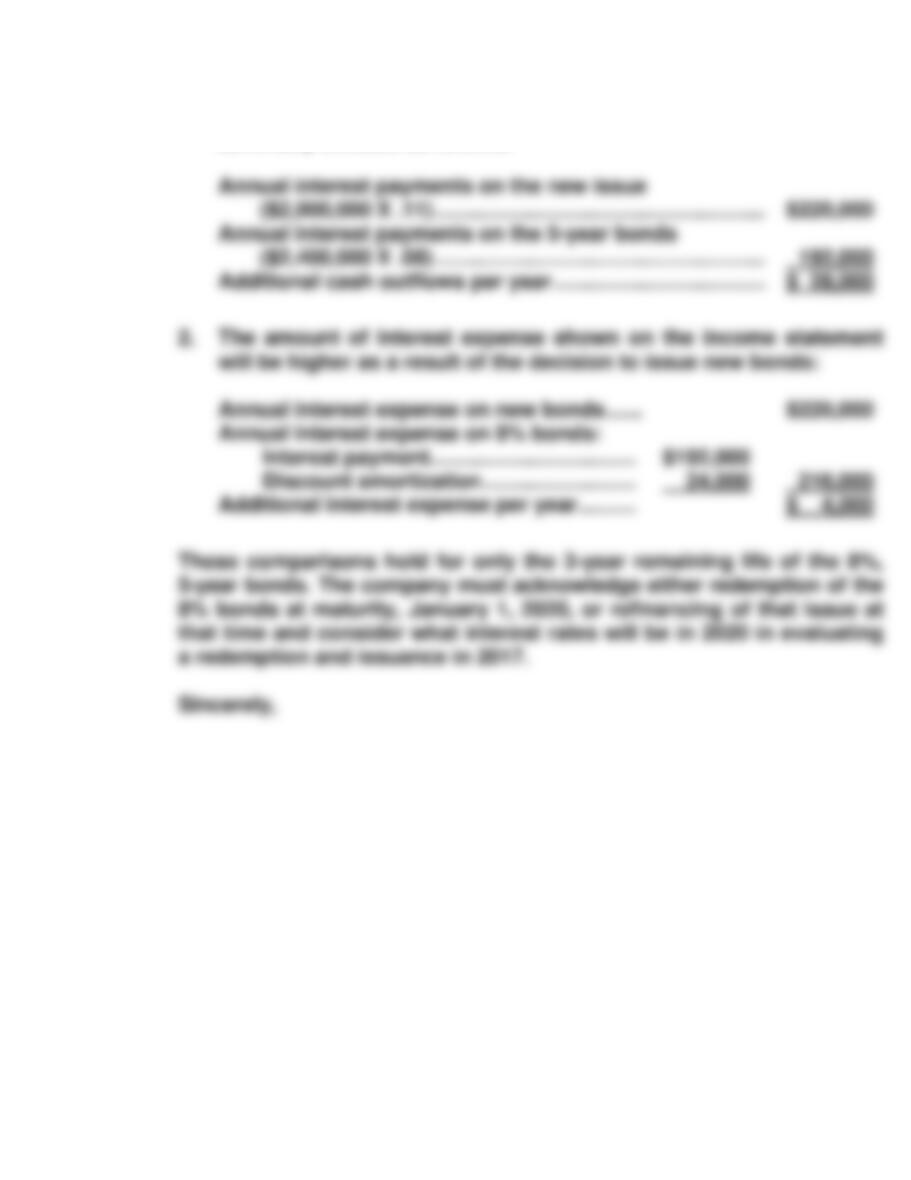
BYP 10-5 (Continued)
1. The cash flow of the company as it relates to bonds payable will be
adversely affected as follows:
BYP 10-6 COMMUNICATION ACTIVITY
To: Sam Masasi
From: I. M. Student
Subject: Bond Financing
(1) The advantages of bond financing over common stock financing include:
BYP 10-7 ETHICS CASE
(a) The stakeholders in the Olathe case are:
Questions:
Is what Ken wants to do legal? Is it unethical? Is Ken’s action brash
and irresponsible? Who may benefit/suffer if Ken arranges a high-risk
bond issue? Who may benefit/suffer if Barb Lowery gains control of
Olathe?
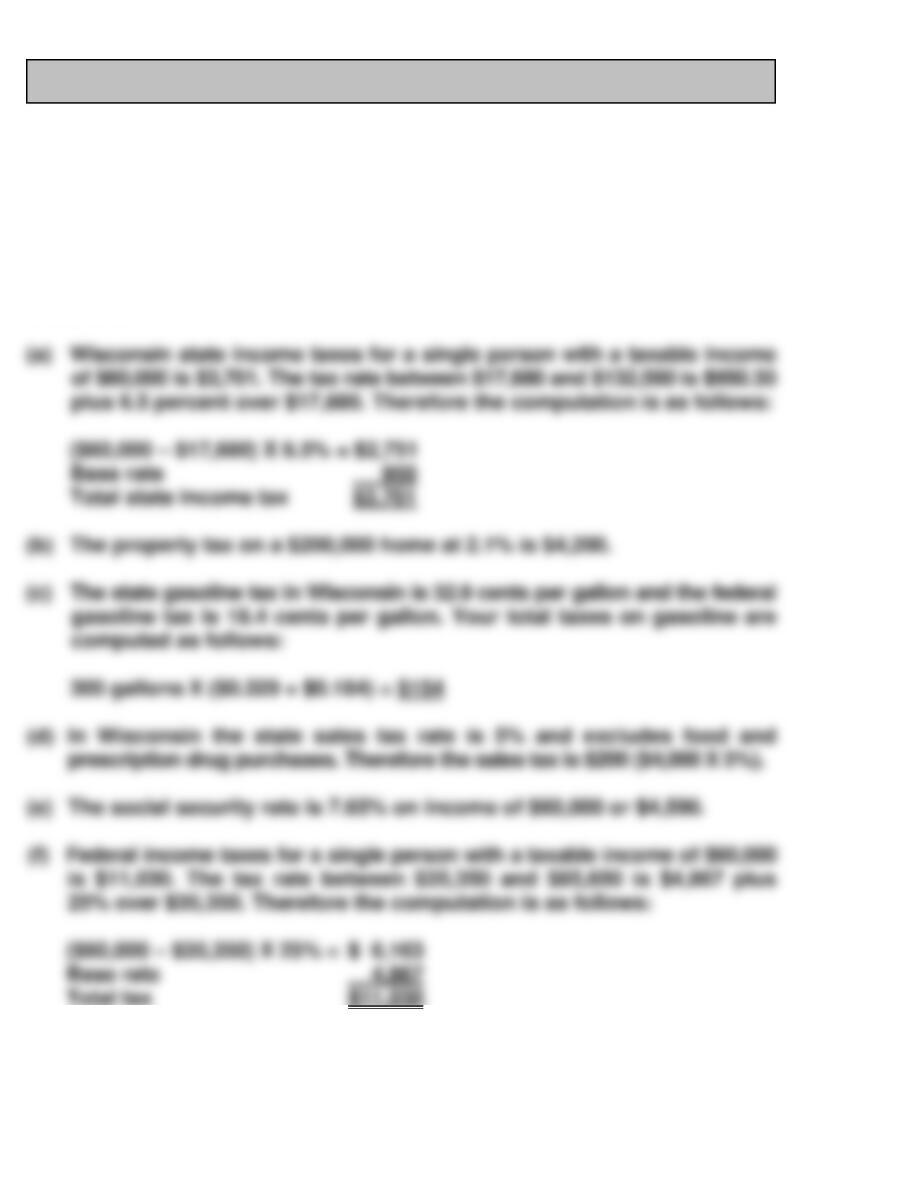
BYP 10-8 ALL ABOUT YOU
The answer to these questions depends on the state in which the student
resides. It also will be depend on the year chosen, although we expect that
the results will be much the same whether they pick any rates between
2014 and 2016. We provide a solution for this problem using the state of
Wisconsin as an example. It should be pointed out that certain taxes can
be deducted for computing federal income tax but are ignored in our
computation.
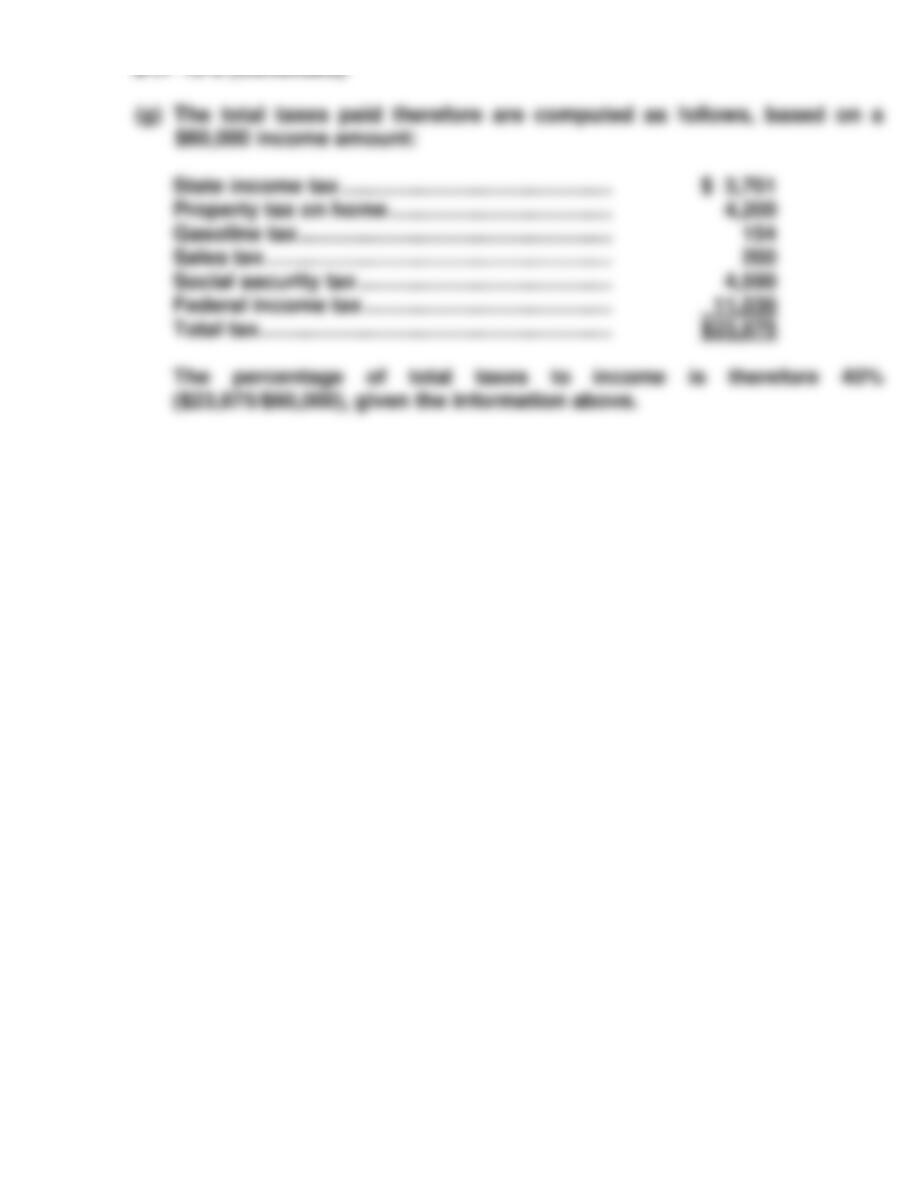
BYP 10-8 (Continued)

BYP 10-9 ALL ABOUT YOU
BYP 10-10 FASB CODIFICATION ACTIVITY
(a) Current liabilities is used principally to designate obligations whose
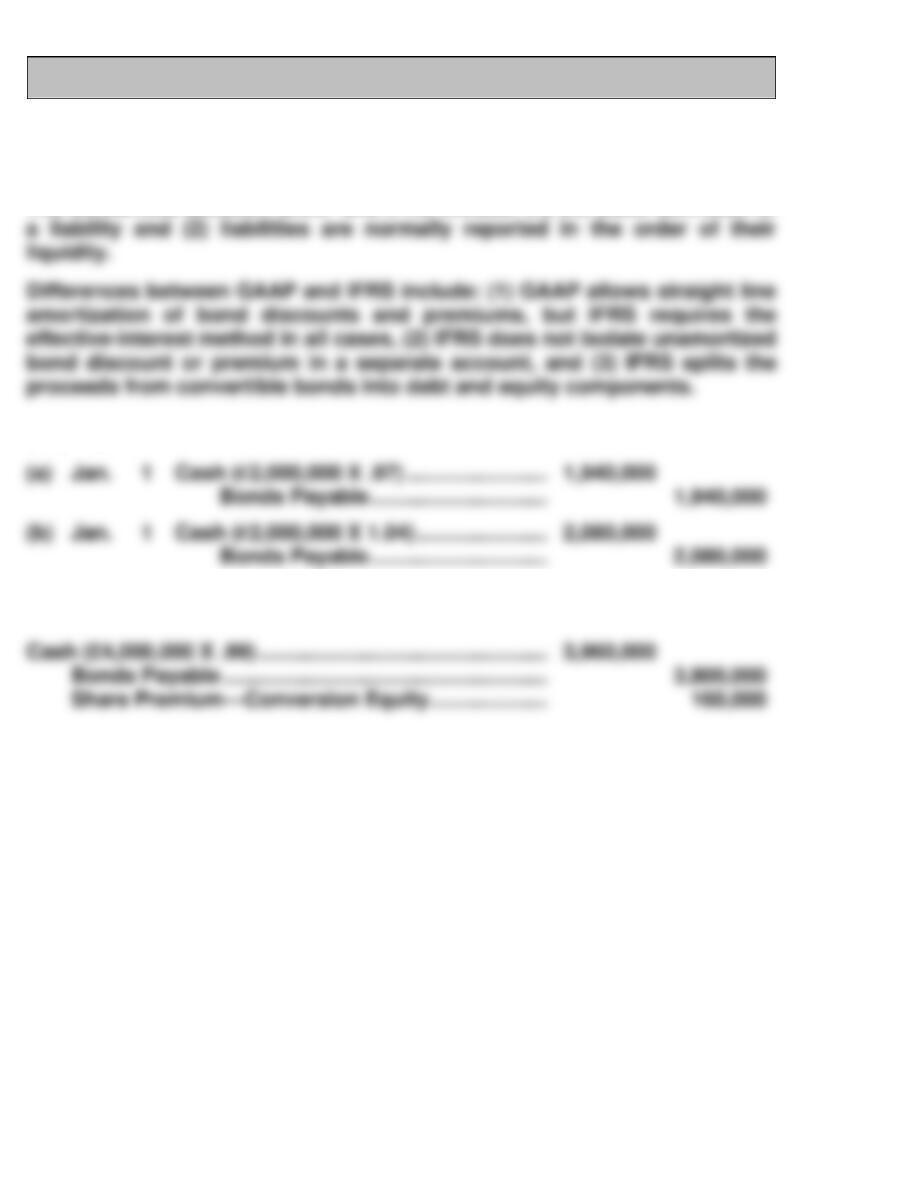
IFRS EXERCISES
IFRS 10-1
The similarities between GAAP and IFRS include: (1) the basic definition of
IFRS 10-2
IFRS 10-3
IFRS10-4 INTERNATIONAL FINANCIAL REPORTING PROBLEM