Chapter 10
Investments
Review Questions
1. What is a debt security?
2. What is an equity security?
An equity security represents stock ownership in another company that sometimes pays dividends.
3. Why would a company invest in debt or equity securities?
Two common reasons why a company would invest in debt or equity securities are as follows:
4. Briefly describe the five specific types of debt and equity securities.
The five specific types of debt and equity securities are as follows:
• Trading investments are debt securities or equity securities that the investor plans to sell in the
5. How is the purchase of a held-to-maturity debt security at face value recorded?
6. When disposing of an available-for-sale investment, where is the gain or loss on disposal reported in
the financial statements?
A gain or loss on disposal of an available-for-sale investment is classified as other revenues and
(expenses) on the income statement.
7. What method is used for investments in equity securities with 20% to 50% ownership? Briefly
describe how dividends declared and received and share of net income are reported.
The equity method is used by the investing company to account for equity securities that represent
8. What method is used for investments in equity securities with more than 50% ownership? Briefly
describe this method.
Consolidation accounting is used by the investing company to account for equity securities that
9. What adjustment must be made at the end of the period for trading investments and available-for-
sale investments?
An adjustment must be made at the end of the accounting period for trading investments and
available-for-sale investments to bring the investment accounts to market (fair) value.
10. Where on the financial statements is an unrealized holding gain or loss on trading investments
reported?
11. Where on the financial statements is an unrealized holding gain or loss on available-for-sale
investments reported?
Unrealized holding gains or losses on available-for-sale investments are not included in net income.
12. What is comprehensive income, and what does it include?
Comprehensive income is a company’s change in total stockholders’ equity from all sources other
13. How are held-to-maturity investments reported on the financial statements?
Depending on the maturity date, held-to-maturity investments are categorized as current assets or
long-term assets on the balance sheet and reported at amortized cost.
14. What does the rate of return on total assets measure, and how is it calculated?
The rate of return on total assets measures the success a company has in using its assets to earn
income.
Short Exercises
S10-1 Identifying why companies invest and classifying investments
Learning Objective 1
Garden Haven has excess cash of $15,000 at the end of the harvesting season. Garden Haven will need
this cash in four months for normal operations.
Requirements
1. What are some reasons why Garden Haven may choose to invest in debt or equity securities?
2. What type of classification would Garden Haven’s investment fall within— short-term or long-term?
Why?
SOLUTION
Requirement 1
Companies should make the best use of excess cash. Because, as a result of temporary or seasonal
Requirement 2
Garden Haven’s investment would be classified as a trading investment and reported as a current (short-
S10-2 Accounting for held-to-maturity investments
Learning Objective 2
On January 1, 2016, the Warden’s Restaurant decides to invest in Lake Turner bonds. The bonds mature
on December 31, 2030, and pay interest on June 30 and December 31 at 5% annually. The market rate of
interest was 5% on January 1, 2016, so the $150,000 maturity value bonds sold for face value. Warden’s
intends to hold the bonds until December 31, 2030.
Requirements
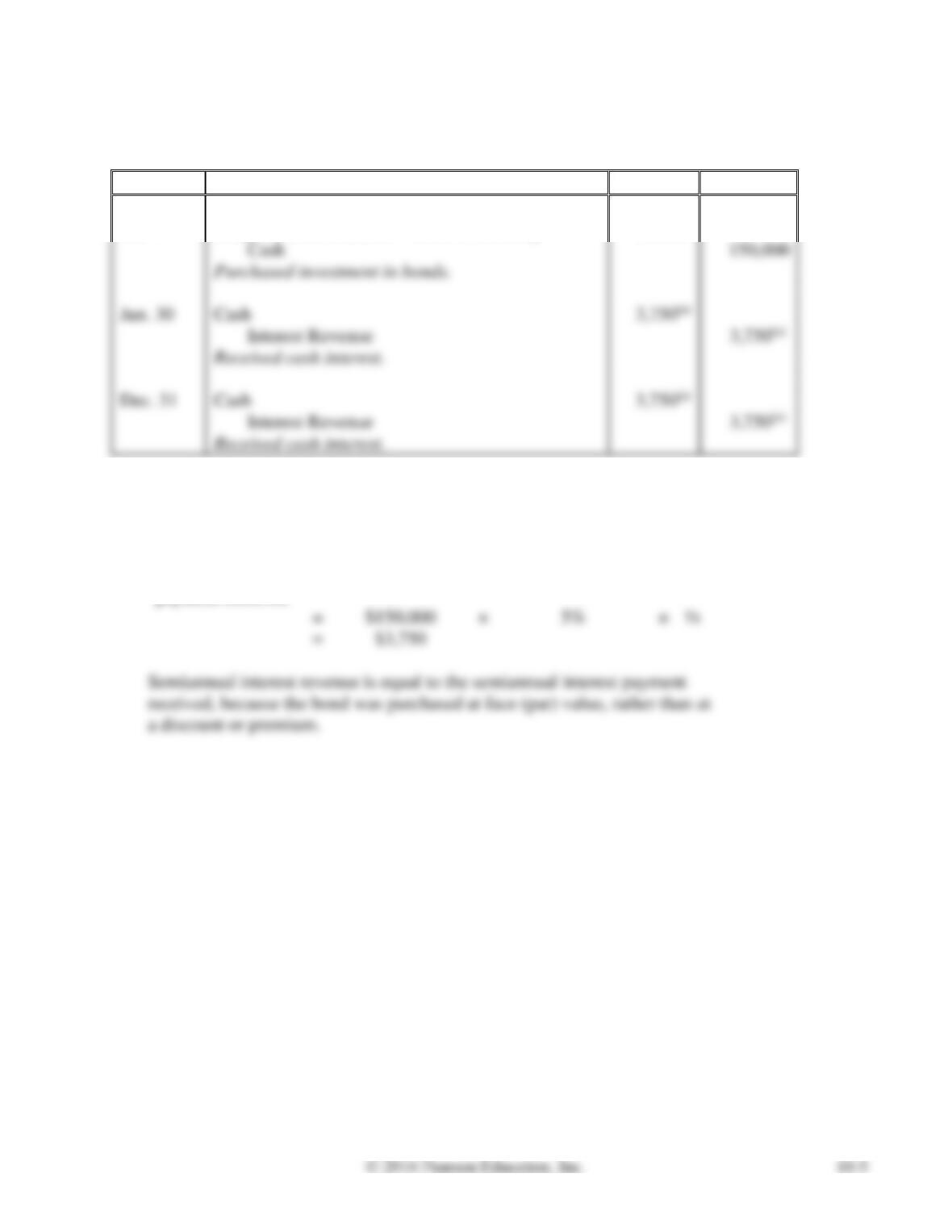
1. Journalize the transactions related to Warden’s investment in Lake Turner bonds during 2016.
2. In what category would Warden’s report the investment on the December 31, 2016, balance sheet?
SOLUTION
Requirement 1
Date
Accounts and Explanation
Debit
Credit
2016
Jan. 1
Long-Term Investments – Held-to-Maturity
150,000
Jun. 30
Cash
Dec. 31
Cash
Calculations:
(a)
Semiannual interest
payment received
=
Face (par) value
×
Annual stated rate
×
½
received, because the bond was purchased at face (par) value, rather than at
Requirement 2
Warden’s would report the investment as a held–to-maturity investment classified as a long-term
asset on the December 31, 2016 balance sheet.
S10-3 Accounting for trading investments
Learning Objective 3
On January 1, 2016, Maple Company invests $16,000 in Sprouts, Inc. stock. Sprouts pays Maple a $300
dividend on August 1, 2016. Maple sells the Sprouts’s stock on August 31, 2016, for $16,500. Assume
the investment is categorized as a trading investment.
Requirements
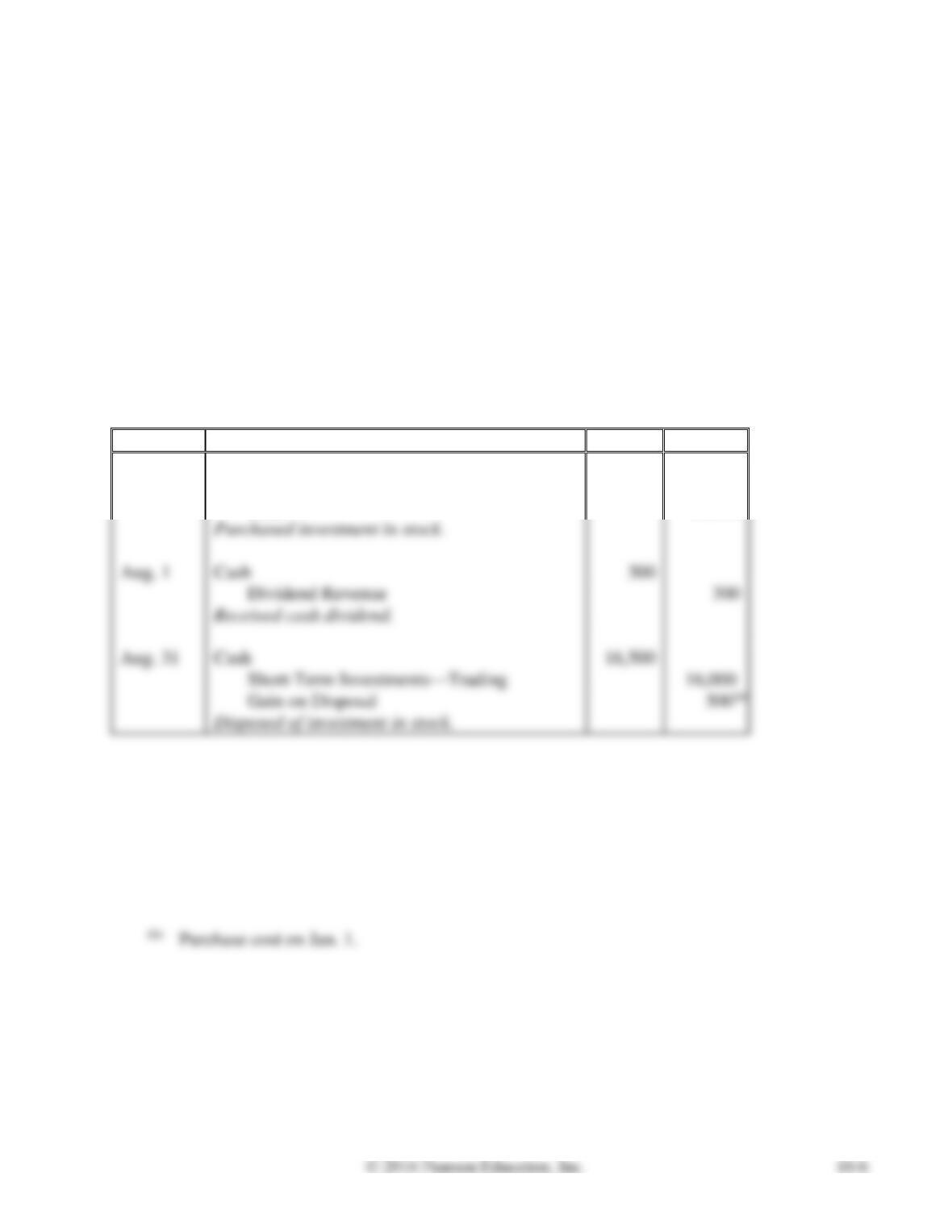
1. Journalize the transactions for Maple’s investment in Sprouts’s stock.
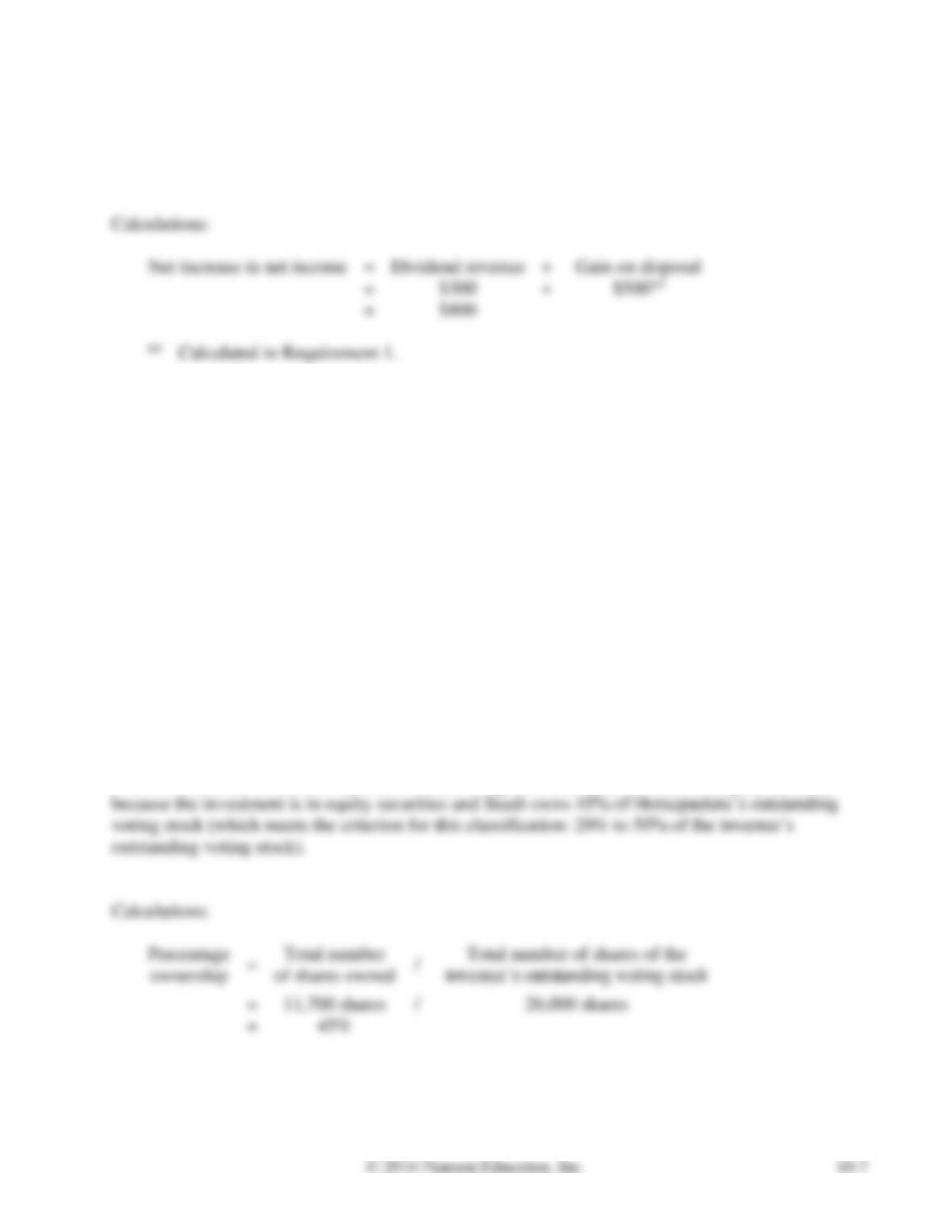
2. What was the net effect of the investment on Maple’s net income for the year ended December 31,
2016?
SOLUTION
Requirement 1
Date
Accounts and Explanation
Debit
Credit
2016
Jan. 1
Short-Term Investments—Trading
16,000
Cash
16,000
Aug. 1
Cash
Dividend Revenue
Aug. 31
Cash
16,500
Short-Term Investments—Trading
Gain on Disposal
Calculations:
(a)
Gain on disposal
=
Total cash received
−
Total cost
=
$16,500
−
$16,000(b)
=
$500
(b)
Purchase cost on Jan. 1.
Requirement 2
The net effect of the investment on Maple’s net income for the year ended December 31, 2016, was
a $800 net increase.
S10-4 Accounting for equity method
Learning Objective 3
On January 1, 2016, Staub, Inc. decides to invest in 11,700 shares of Horsepasture stock when the stock
is selling for $12 per share. On August 1, 2016, Horsepasture paid a $0.30 per share cash dividend to
stockholders. On December 31, 2016, Horsepasture reports net income of $60,000 for 2016. Assume
Horsepasture has 26,000 shares of voting stock outstanding during 2016.
Requirements
1. Identify what type of investment the Horsepasture stock is for Staub.
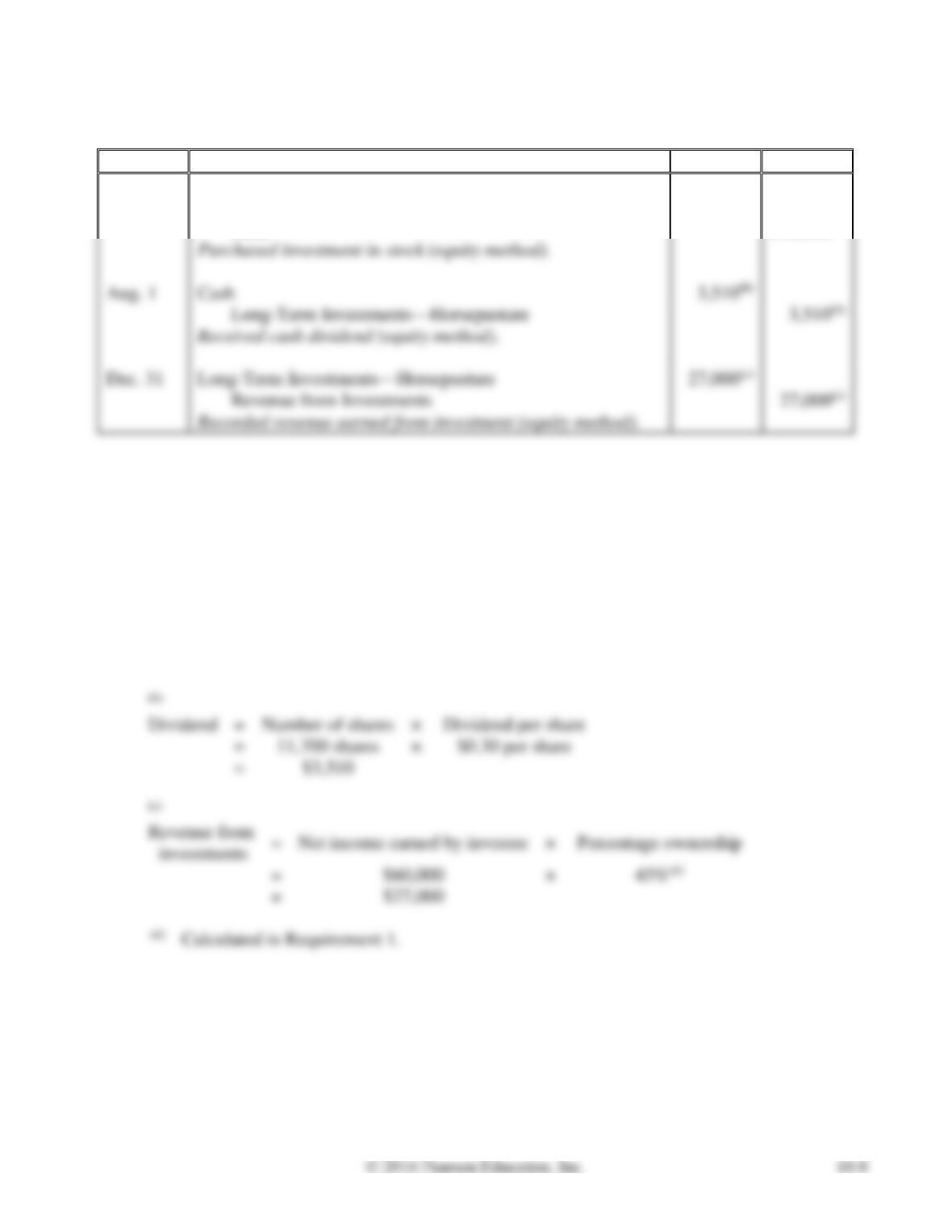
2. Journalize the transactions related to Staub’s investment in the Horsepasture stock during 2016.
3. In what category and at what value would Staub’s report the investment on the December 31, 2016,
balance sheet?
SOLUTION
Requirement 1
Staub’s investment in the Horsepasture stock is a significant interest investment (equity method)
S10-4, cont.
Requirement 2
Date
Accounts and Explanation
Debit
Credit
2016
Jan. 1
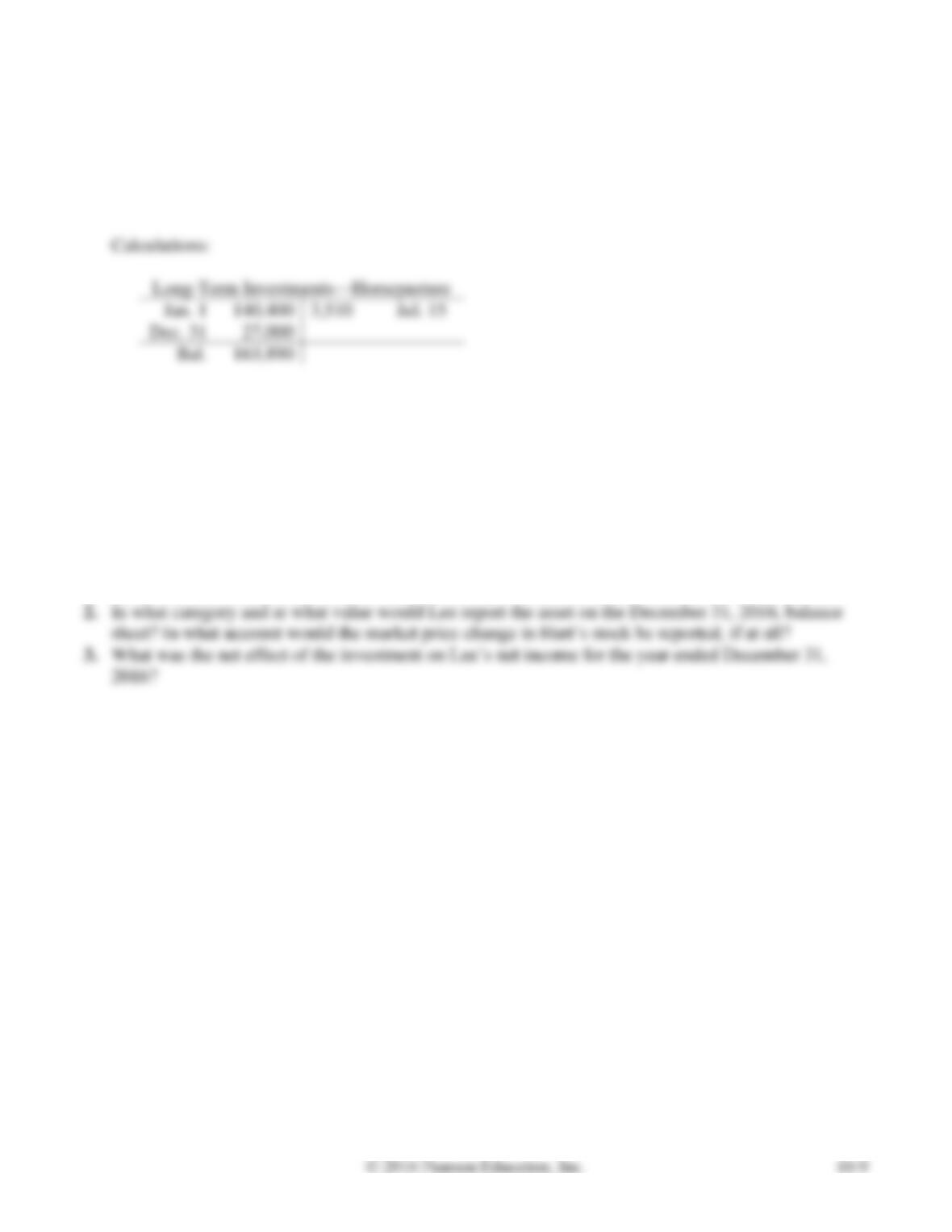
Long-Term Investments—Horsepasture
140,400(a)
Cash
140,400(a)
Aug. 1
Cash
Long-Term Investments—Horsepasture
Dec. 31
Long-Term Investments—Horsepasture
Revenue from Investments
S10-4
Requirement 2, cont.
Calculations:
(a)
Total cost
=
Number of shares
×
Price per share
=
11,700 shares
×
$12 per share
=
$140,400
(b)
Dividend
=
Number of shares
×
Dividend per share
=
11,700 shares
×
=
(c)
=
×
=
(d)
Calculated in Requirement 1.
S10-4, cont.
Requirement 3
Staub would report the investment (equity method) at $163,890, classified as a long-term asset on
the balance sheet as of December 31, 2016.
S10-5 Accounting for trading investments
Learning Objectives 3, 4
On February 1, 2016, Lee Co. decides to invest excess cash of $21,000 by purchasing 1,400 shares of
Hart, Inc. stock at $15 per share. At year-end, December 31, 2016, Hart’s market price was $19 per
share. The investment is categorized as a trading investment.
Requirements
1. Journalize the transactions for Lee’s investment in Hart, Inc. for 2016.
SOLUTION
Requirement 1
Date
Accounts and Explanation
Debit
Credit
2016
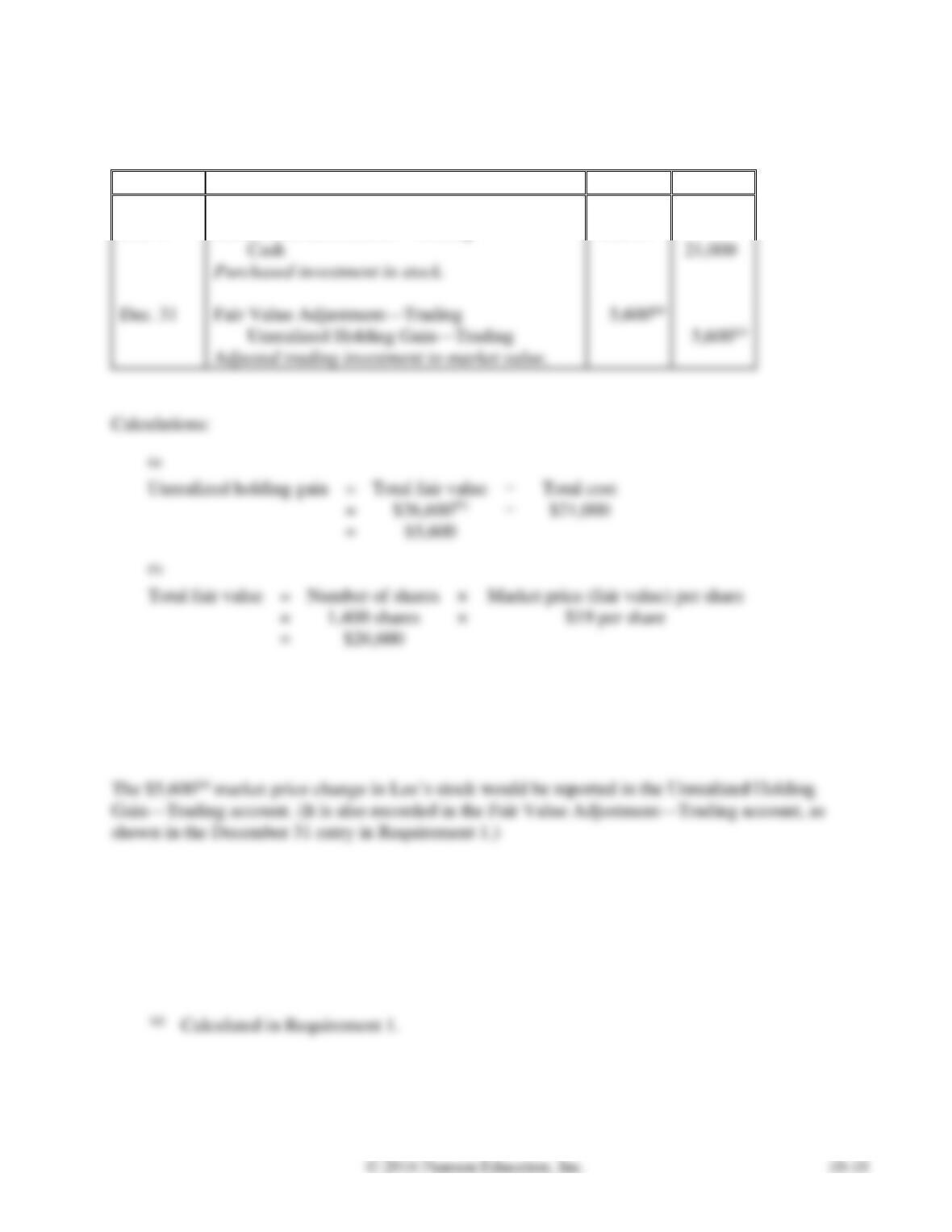
Feb. 1
Short-Term Investments—Trading
21,000
21,000
Dec. 31
Fair Value Adjustment—Trading
(a)
Unrealized holding gain
=
Total fair value
=
=
(b)
Total fair value
=
Number of shares
×
=
×
=
Requirement 2
Lee would report the asset (trading investment) at its $26,600(a) fair value, classified as a current
asset on the balance sheet as of December 31, 2016.
(a)
Calculated in Requirement 1.
Requirement 3
The net effect of the investment on Lee’s net income for the year ended December 31, 2016, was a
$5,600 net increase (the amount of the unrealized holding gain).(a)
(a)
Calculated in Requirement 1.
S10-6 Accounting for available-for-sale investments
Learning Objectives 3, 4
On June 1, 2016, Rick’s Restaurant decides to invest excess cash of $41,800 from the tourist season by
Requirements
1. Journalize the transactions for Rick’s investment in Bison, Inc. for 2016.
2. In what category and at what value would Rick report the asset on the December 31, 2016, balance
sheet? In what account would the market price change in Bison’s stock be reported, if at all?
3. What was the net effect of the investment on Rick’s net income for the year ended December 31,
2016?
SOLUTION
Requirement 1
Date
Accounts and Explanation
Debit
Credit
2016
Jun. 1
Short-Term Investments—Available-for-Sale
41,800
Cash
41,800
Dec. 31
Unrealized Holding Loss—Available-for-Sale
Fair Value Adjustment—Available-for-Sale
S10-6, cont.
Requirement 2
Rick would report the asset (available-for-sale investment) at its $33,000(a) fair value, classified as a
short-term asset on the balance sheet as of December 31, 2016.
The $8,800(a) market price change in Bison’s stock would be reported in the Unrealized Holding
(a)
Calculated in Requirement 1.
Requirement 3
There was no net effect of the investment on Rick’s net income for the year ended December 31,
2016, because the $8,800(a) unrealized holding loss is not included in net income. (It is included in
other comprehensive income, which is subtracted from net income to determine comprehensive
income.)
(a)
Calculated in Requirement 1.
S10-7 Computing rate of return on total assets
Learning Objective 5
Kabra’s 2016 financial statements reported the following items—with 2015 figures given for
comparison:
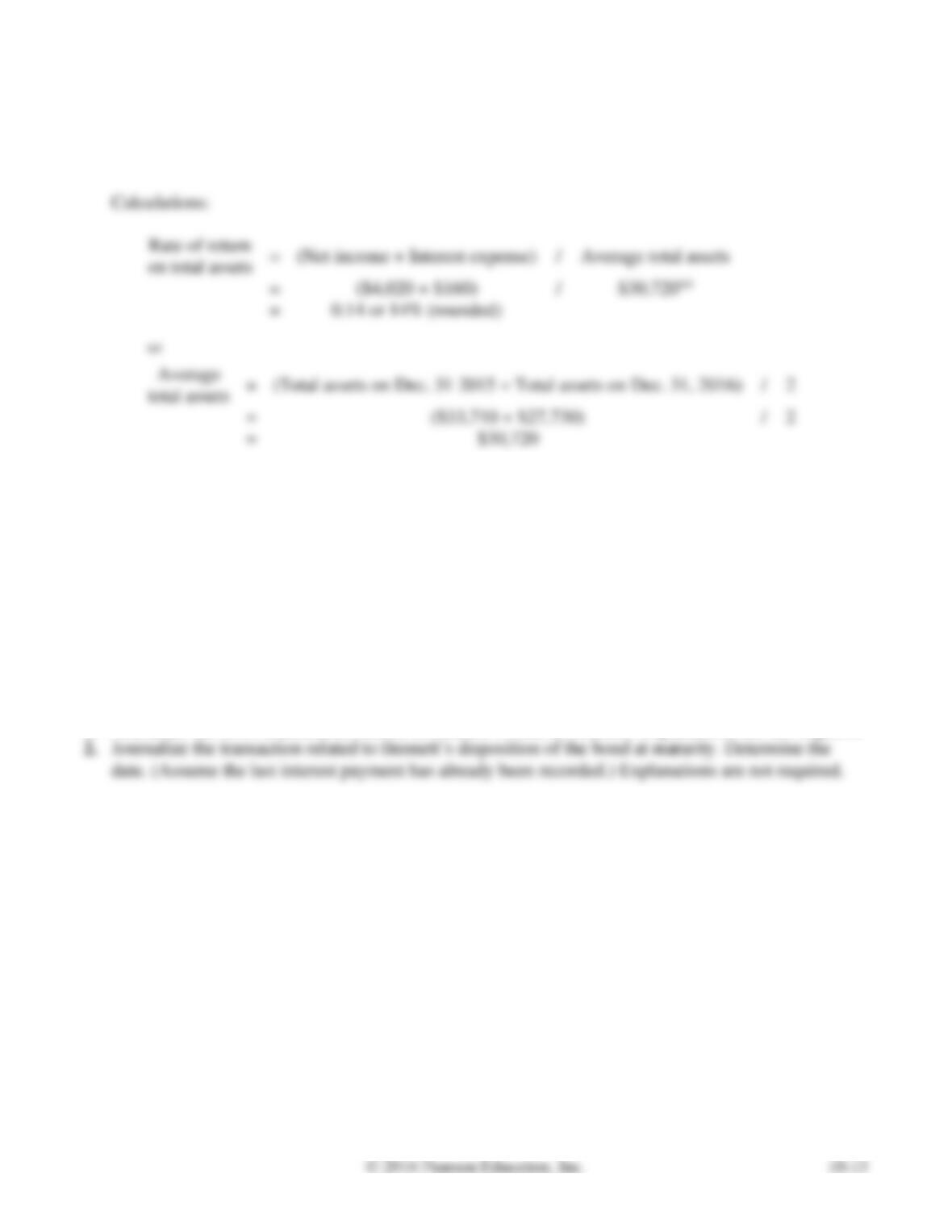
SOLUTION
Kabra’s rate of return on total assets for 2016 is 14% (rounded).
Exercises
E10-8 Accounting for bond investments
Learning Objective 2
1. Jun. 30 Int. Rev. CR $2,250
Bennett purchased a bond on January 1, 2016, for $150,000. The bond has a face value of $150,000 and
matures in 15 years. The bond pays interest on June 30 and December 31 at a 3% annual rate. Bennett
plans on holding the investment until maturity.
Requirements
1. Journalize the 2016 transactions related to Bennett’s bond investment. Explanations are not required.
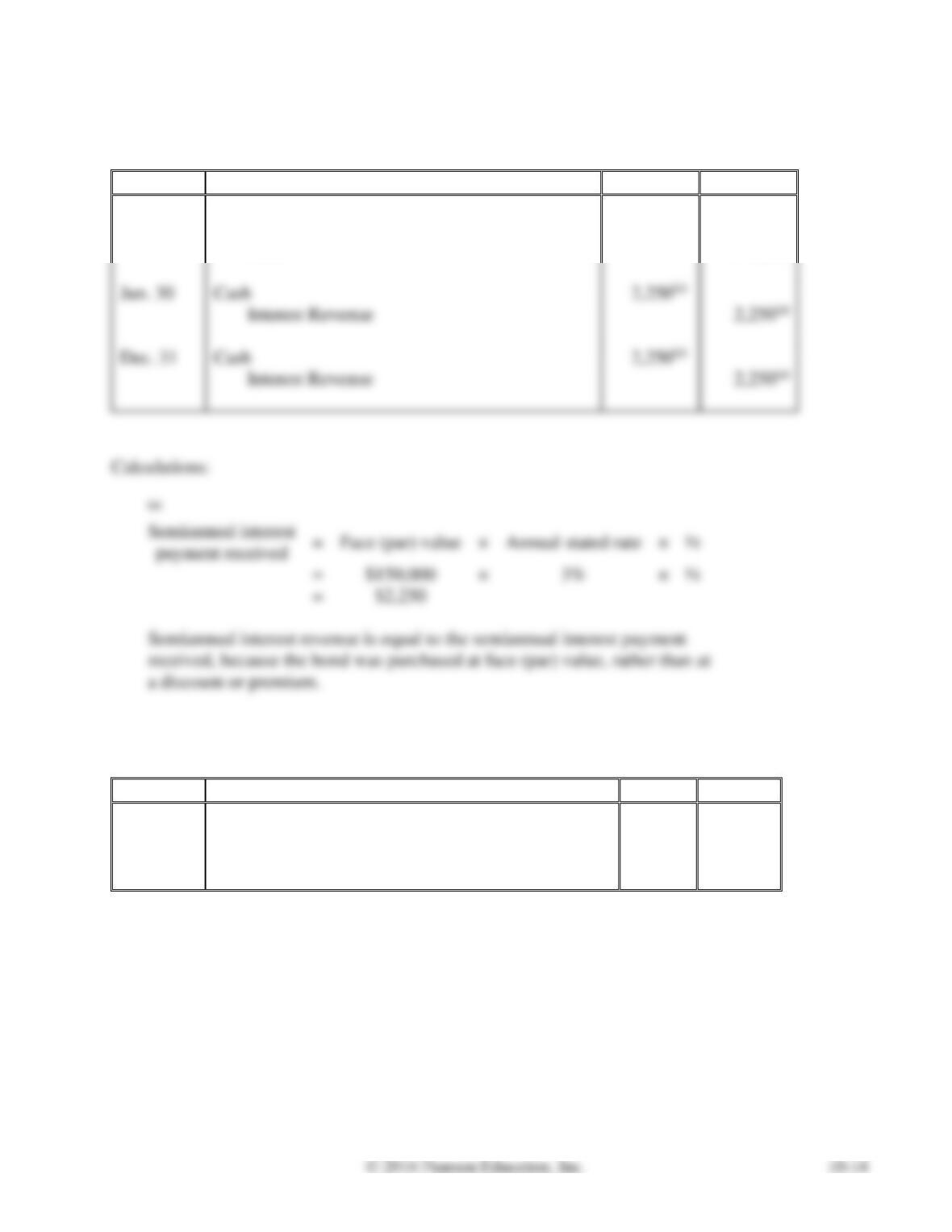
SOLUTION
Requirement 1
Date
Accounts and Explanation
Debit
Credit
2016
Jan. 1
Long-Term Investments—Held-to-Maturity
150,000
Cash
150,000
Jun. 30
Cash
Interest Revenue
Dec. 31
Cash
Interest Revenue
Requirement 2
Date
Accounts and Explanation
Debit
Credit
2030
Dec. 31
Cash
150,000
Long-Term Investments—Held-to-Maturity
150,000
E10-9 Accounting for bond investments
Learning Objective 2
2. $32,000
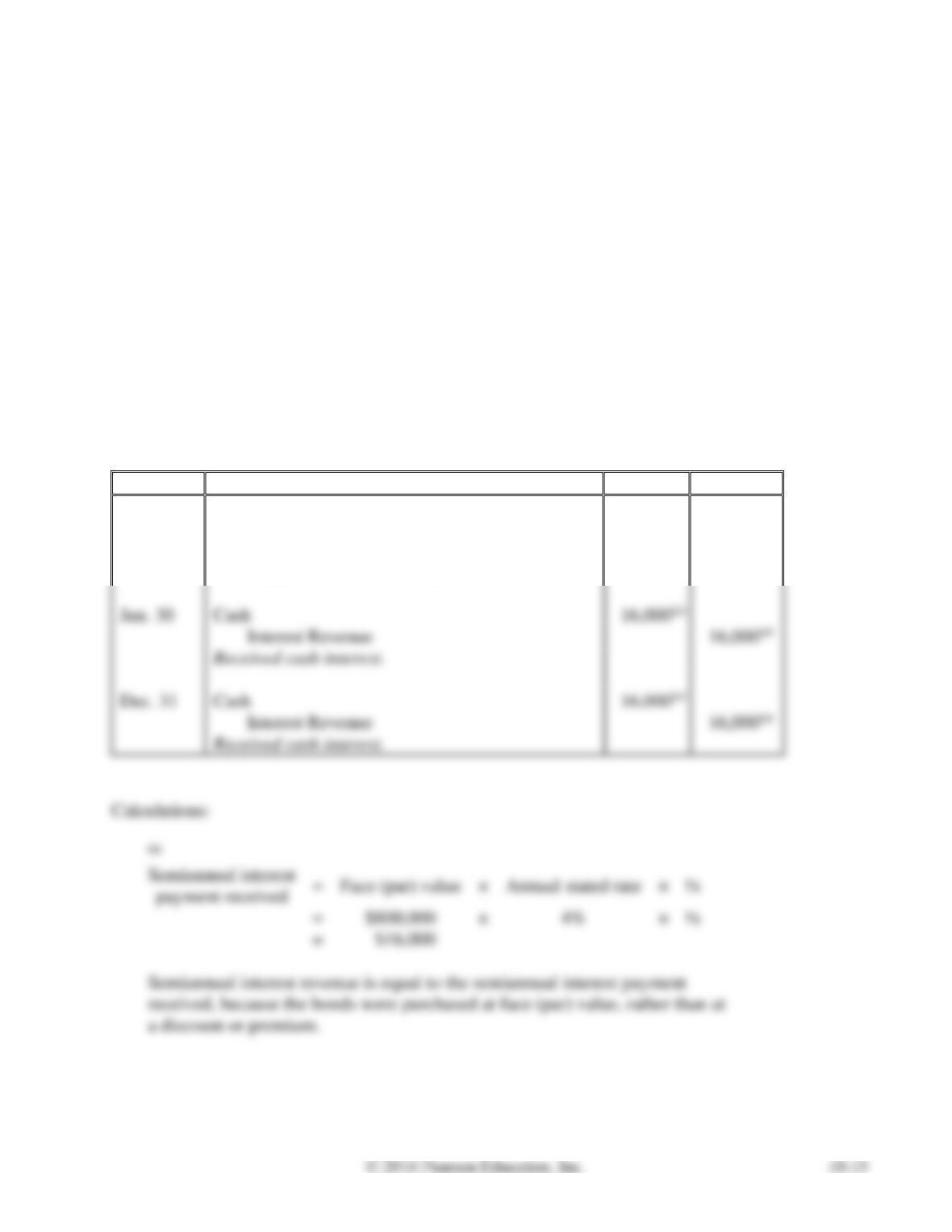
League Up & Co. owns vast amounts of corporate bonds. Suppose League Up buys $800,000 of
CocoCorp bonds at face value on January 2, 2016. The CocoCorp bonds pay interest at the annual rate
of 4% on June 30 and December 31 and mature on December 31, 2033. League Up intends to hold the
investment until maturity.
Requirements
1. Journalize any required 2016 entries for the bond investment.
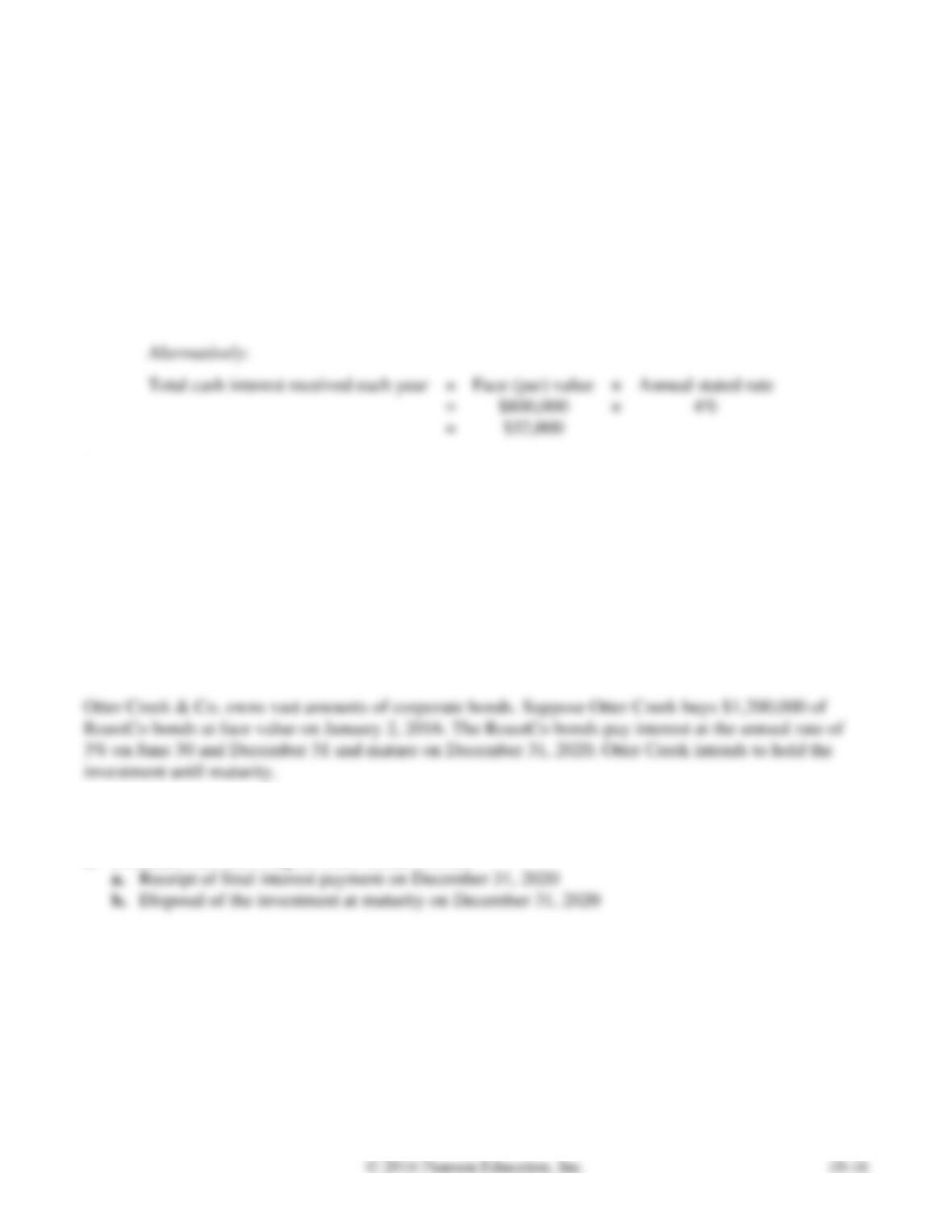
2. How much cash interest will League Up receive each year from CocoCorp?
3. How much interest revenue will League Up report during 2016 on this bond investment?
SOLUTION
Requirement 1
Date
Accounts and Explanation
Debit
Credit
2016
Jan. 2
Long-Term Investments—Held-to-Maturity
800,000
Cash
800,000
Purchased investment in bonds.
Jun. 30
Cash
Interest Revenue
Received cash interest.
Dec. 31
Cash
Interest Revenue
Received cash interest.
S10-9, cont.
Requirement 2
League Up will receive cash interest of $32,000 each year from CocoCorp.
Calculations:
Total cash interest received each year
=
Semiannual cash interest received
×
2
=
$16,000(a)
×
2
=
$32,000
Total cash interest received each year
=
Face (par) value
×
Annual stated rate
=
×
=
Requirement 3
League Up will report interest revenue of $32,000 during 2016 on this bond investment. (Annual
interest revenue is equal to the annual cash interest received, calculated in Requirement 2, because
the bonds were purchased at face (par) value, rather than at a discount or premium.)
E10-10 Accounting for bond investments
Learning Objective 2
2a. Int. Rev. CR $18,000
Requirements
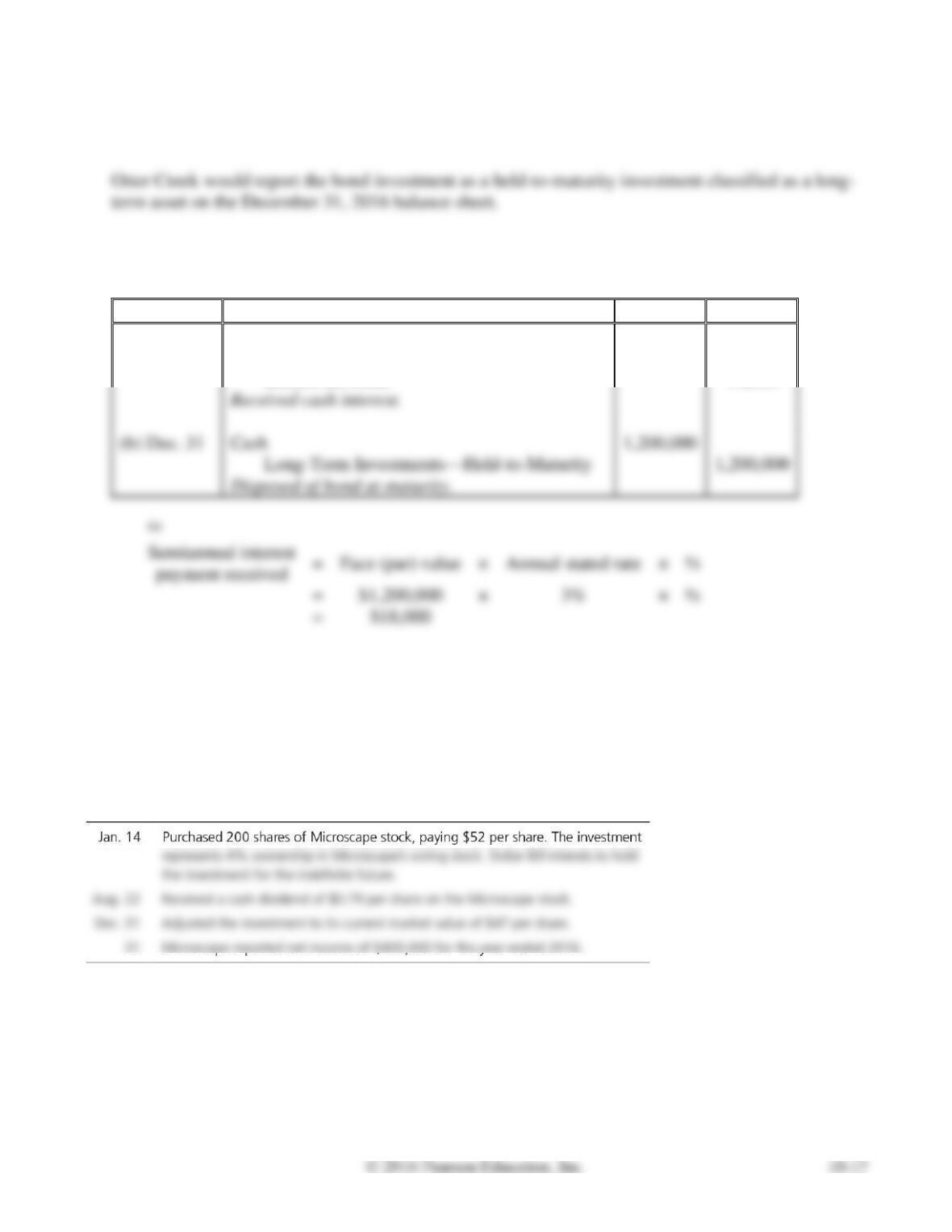
1. How would the bond investment be classified on Otter Creek’s December 31, 2016, balance sheet?
2. Journalize the following on Otter Creek’s books:
SOLUTION
Requirement 1
Requirement 2
Date
Accounts and Explanation
Debit
Credit
2020
(a) Dec. 31
Cash
18,000(a)
Interest Revenue
18,000(a)
(b) Dec. 31
Cash
1,200,000
Long-Term Investments—Held-to-Maturity
1,200,000
E10-11 Accounting for stock investments
Learning Objectives 3, 4
1. Dec. 31 Unrealized Holding Loss—AFS DR $1,000
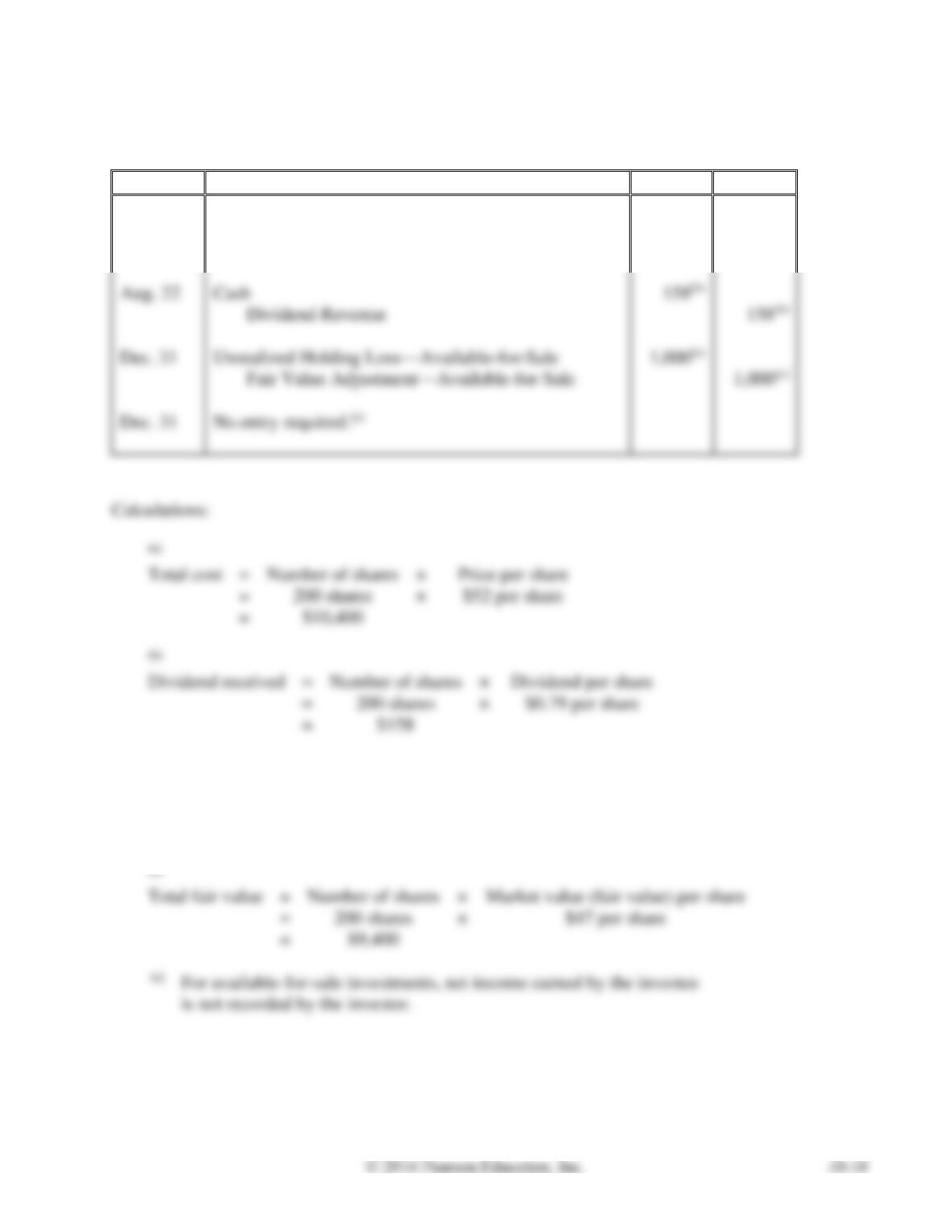
Dollar Bill Investments completed these long-term, available-for-sale investment transactions during
2016:
Requirements
1. Journalize Dollar Bill’s investment transactions. Explanations are not required.
2. Classify and prepare partial financial statements for Dollar Bill’s Microscape investment as of
December 31, 2016. Assume Dollar Bill Investments’ net income for the year is $40,000.
SOLUTION
Requirement 1
Date
Accounts and Explanation
Debit
Credit
2016
Jan. 14
Long-Term Investments—Available-for-Sale
10,400(a)
Cash
10,400(a)
Aug. 22
Cash
Dividend Revenue
Dec. 31
Unrealized Holding Loss—Available-for-Sale
Fair Value Adjustment—Available-for-Sale
Dec. 31
(a)
Total cost
=
Number of shares
×
=
×
=
(b)
Dividend received
=
Number of shares
×
Dividend per share
=
×
=
(c)
Unrealized holding loss
=
Total fair value
−
Total cost
=
$9,400(d)
−
$10,400
=
$(1,000)
(d)
Total fair value
=
Number of shares
×
=
×
=
is not recorded by the investor.
E10-11, cont.
Requirement 2
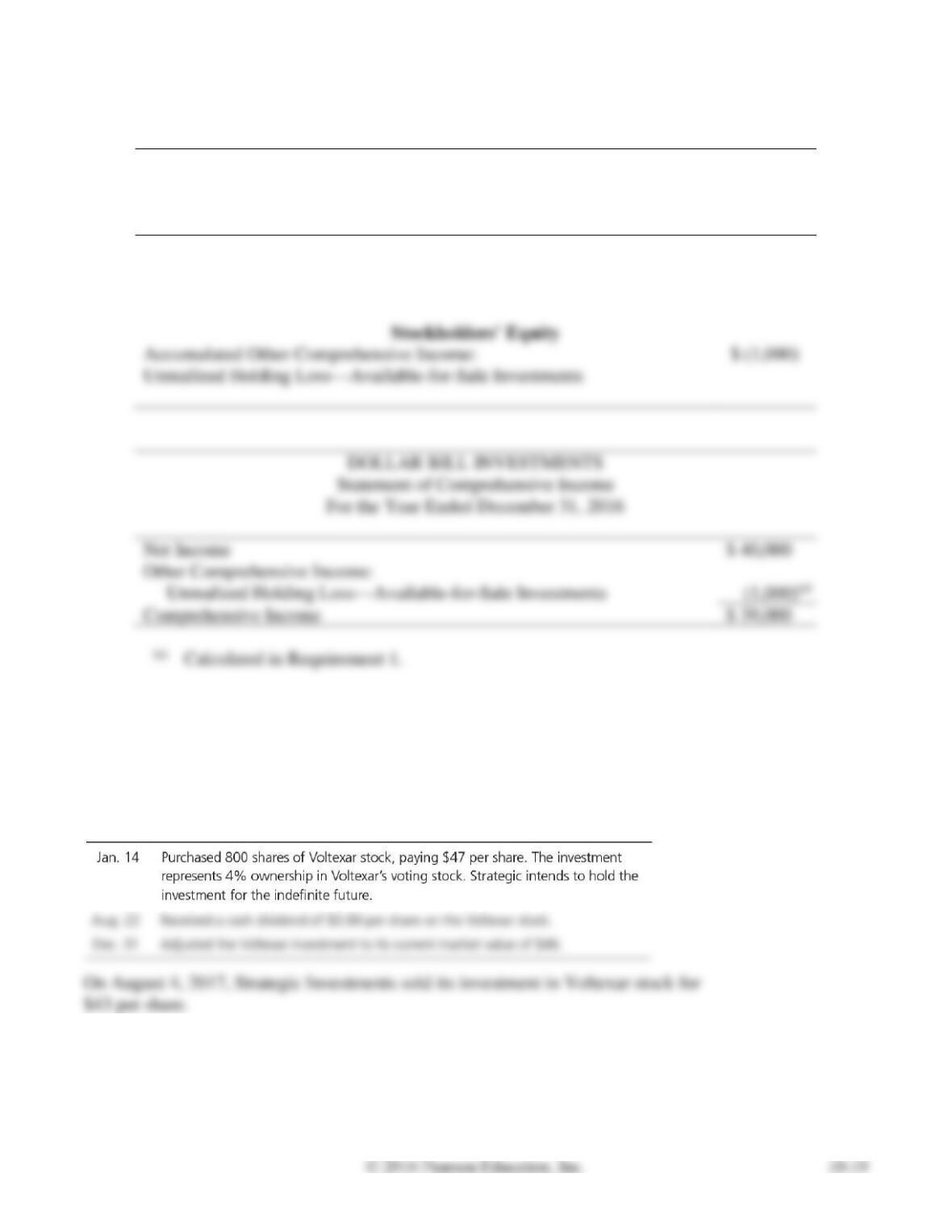
DOLLAR BILL INVESTMENTS
Balance Sheet (Partial)
December 31, 2016
Assets
Long-term Assets:
Long-term Investments—Available-for-Sale (at fair value; cost $10,400(a))
$ 9,400(a)
Unrealized Holding Loss—Available-for-Sale Investments
DOLLAR BILL INVESTMENTS
Net Income
$ 40,000
Other Comprehensive Income:
Unrealized Holding Loss—Available-for-Sale Investments
Comprehensive Income
$ 39,000
Calculated in Requirement 1.
E10-12 Accounting for stock investments
Learning Objectives 3, 4
2. Long-term Investments—AFS CR $37,600
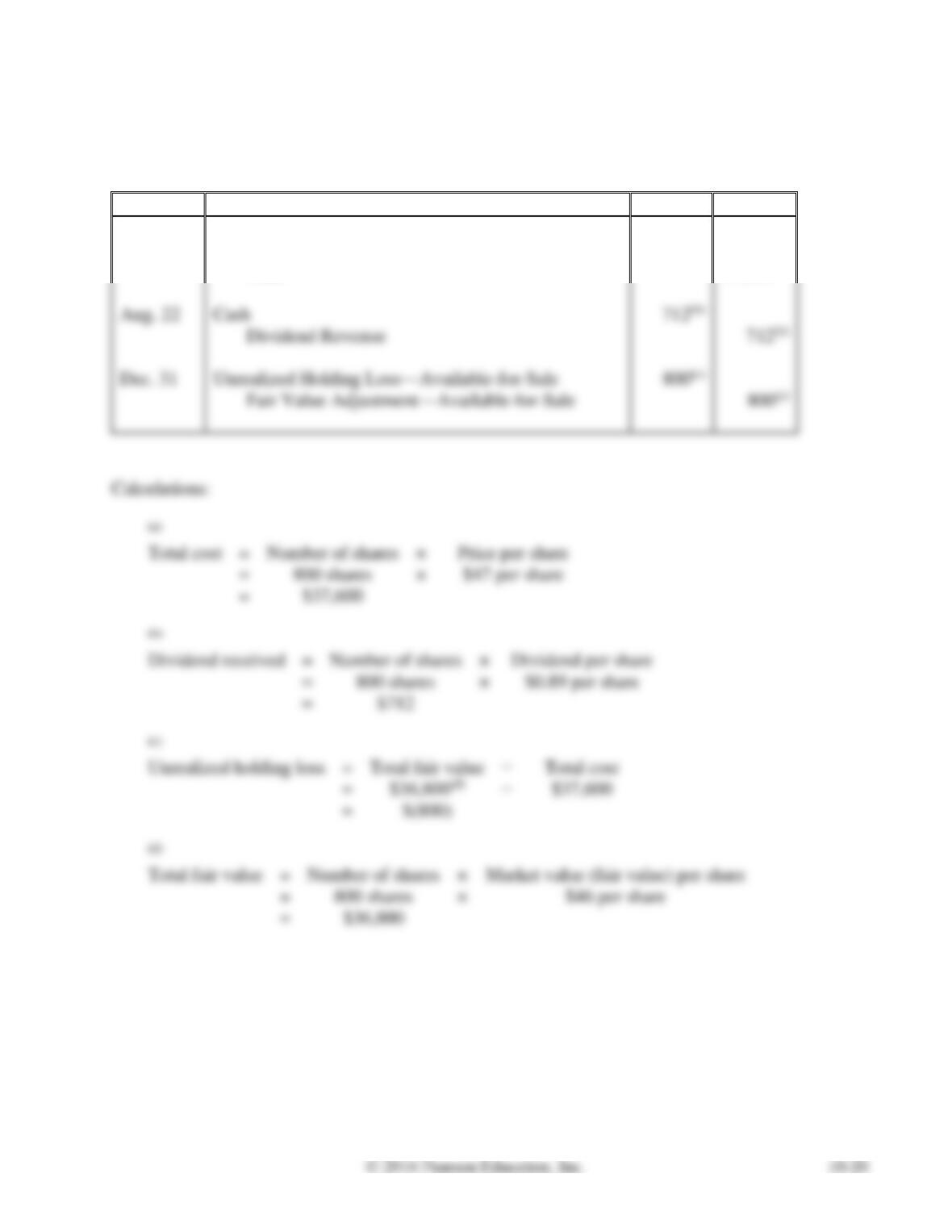
Strategic Investments completed the following long-term, available-for-sale investment transactions
during 2016:
Requirements
1. Journalize the entries for 2016. Explanations are not required.
2. Journalize the sale that occurred in 2017. Explanations are not required.
3. What account(s) and amount(s), if any, would be reported on Strategic’s financial statements for the
year ended December 31, 2017?
SOLUTION
Requirement 1
Date
Accounts and Explanation
Debit
Credit
2016
Jan. 14
Long-Term Investments—Available-for-Sale
37,600(a)
Cash
37,600(a)
Aug. 22
Cash
Dividend Revenue
Dec. 31
Unrealized Holding Loss—Available-for-Sale
Fair Value Adjustment—Available-for-Sale
$(800)