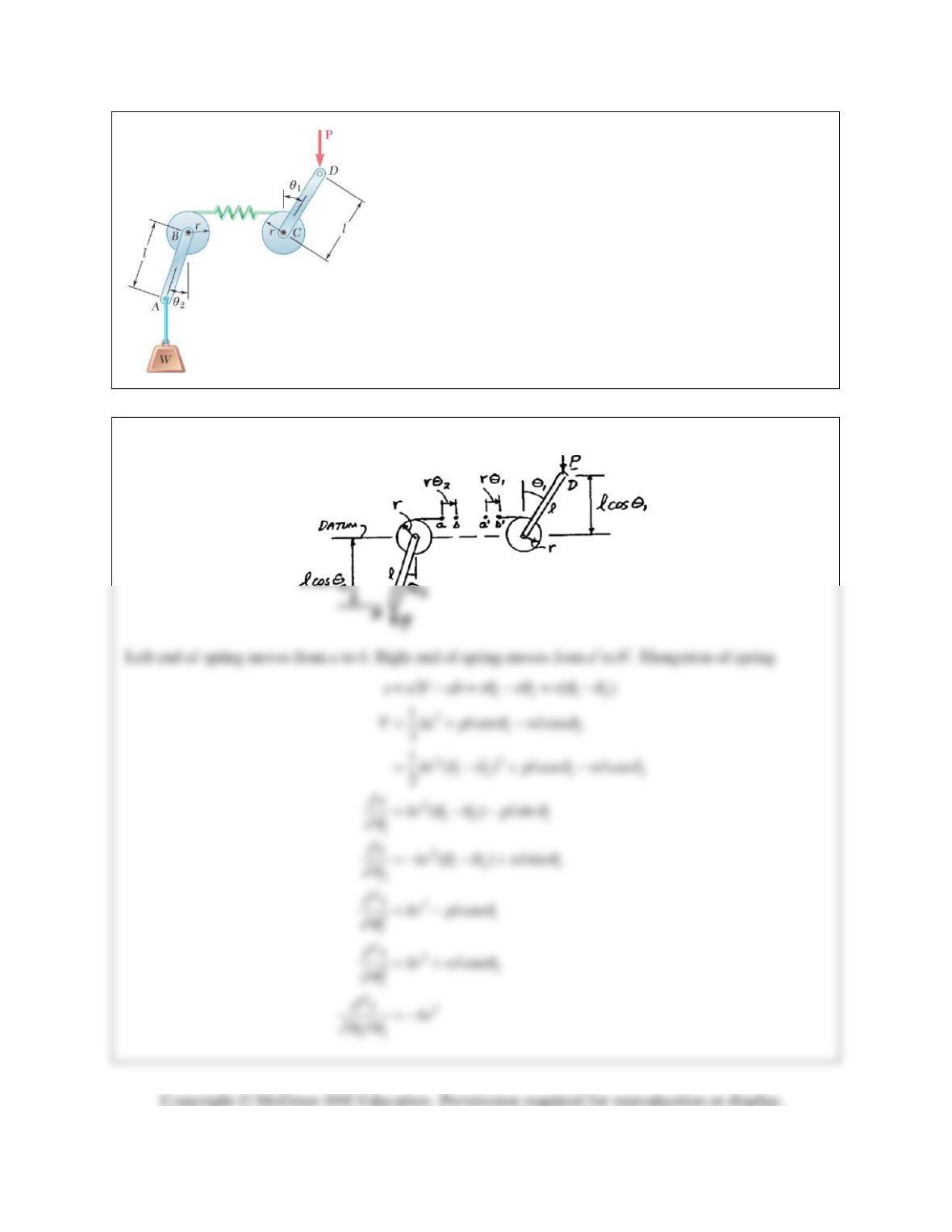
PROBLEM 10.99*
Two rods of negligible weight are attached to drums of radius r
that are connected by a belt and spring of constant k. Knowing
that the spring is undeformed when the rods are vertical,
determine the range of values of P for which the equilibrium
position
1
2
0 is stable.
SOLUTION
PROBLEM 10.99* (Continued)
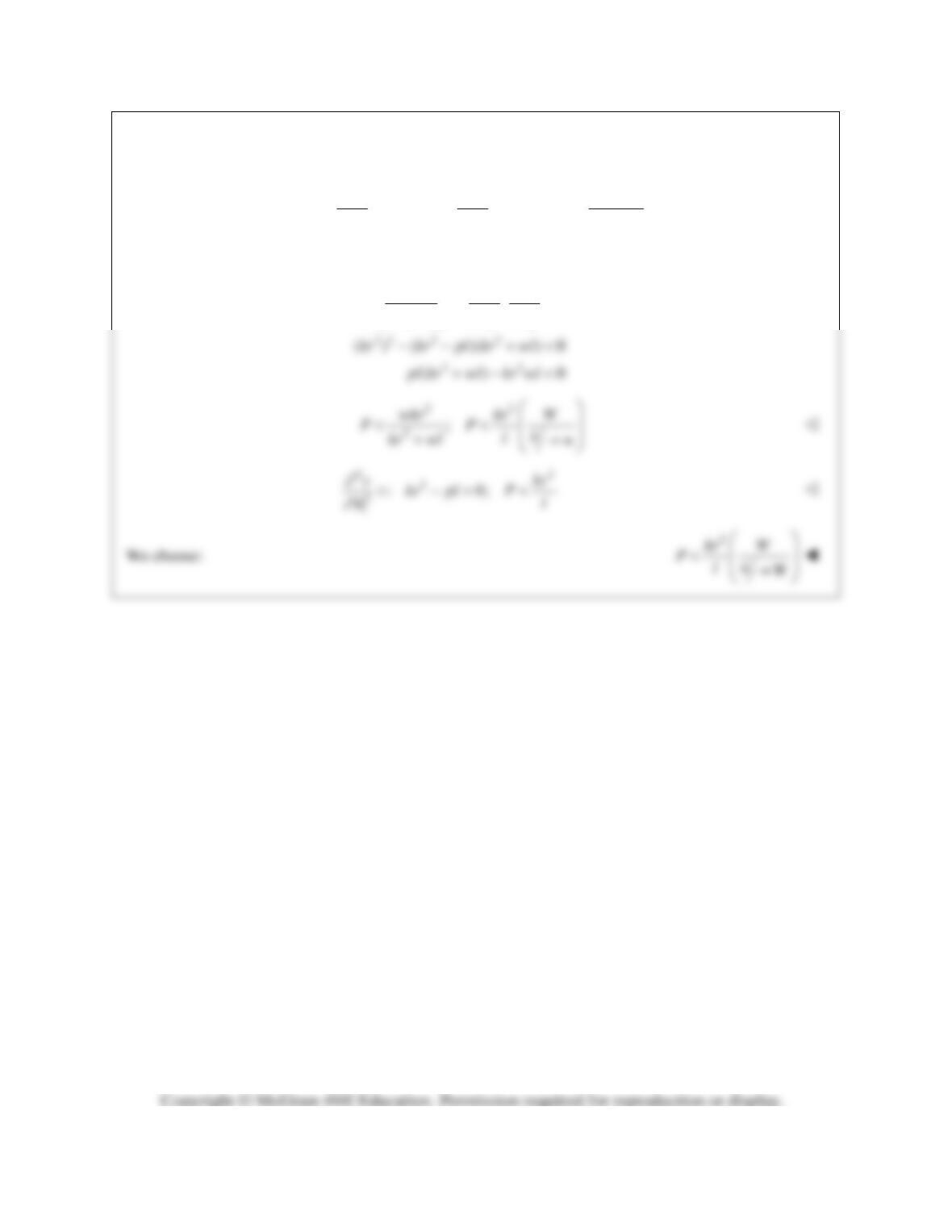
For
22 2
22 2
12 22
2
12
0: , , ,
vv rv
kr pl kr wl kr
Conditions for stability (see Page 583)
2
222
22
12 12
0
vvv
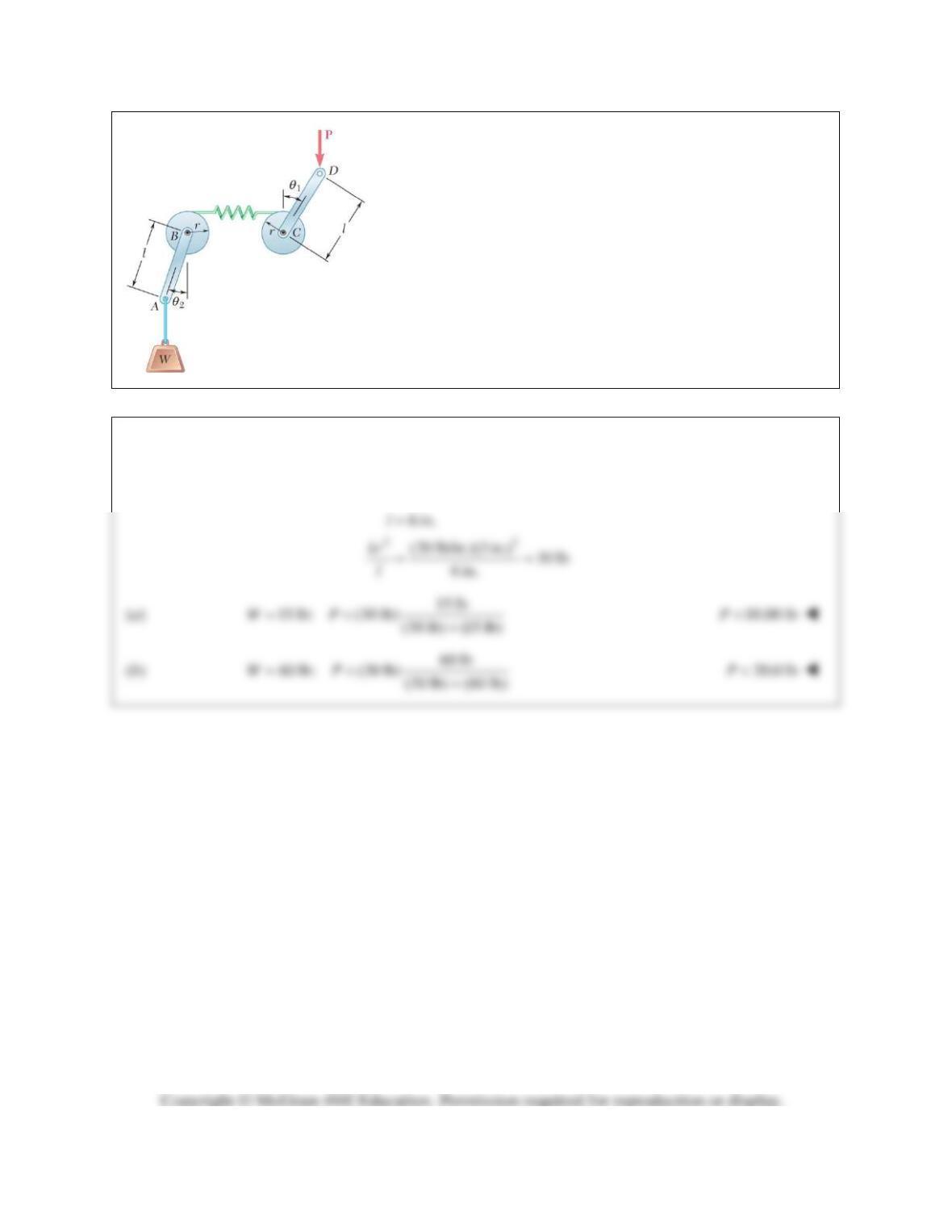
PROBLEM 10.100*
Solve Problem 10.99 knowing that k 20 lb/in., r 3 in., l 6
in., and (a) W 15 lb, (b) W 60 lb.
PROBLEM 10.99* Two rods of negligible weight are attached
to drums of radius r that are connected by a belt and spring of
constant k. Knowing that the spring is undeformed when the rods
are vertical, determine the range of values of P for which the
equilibrium position
1
2 0 is stable.
SOLUTION
20 lb/in.
3in.
k
r
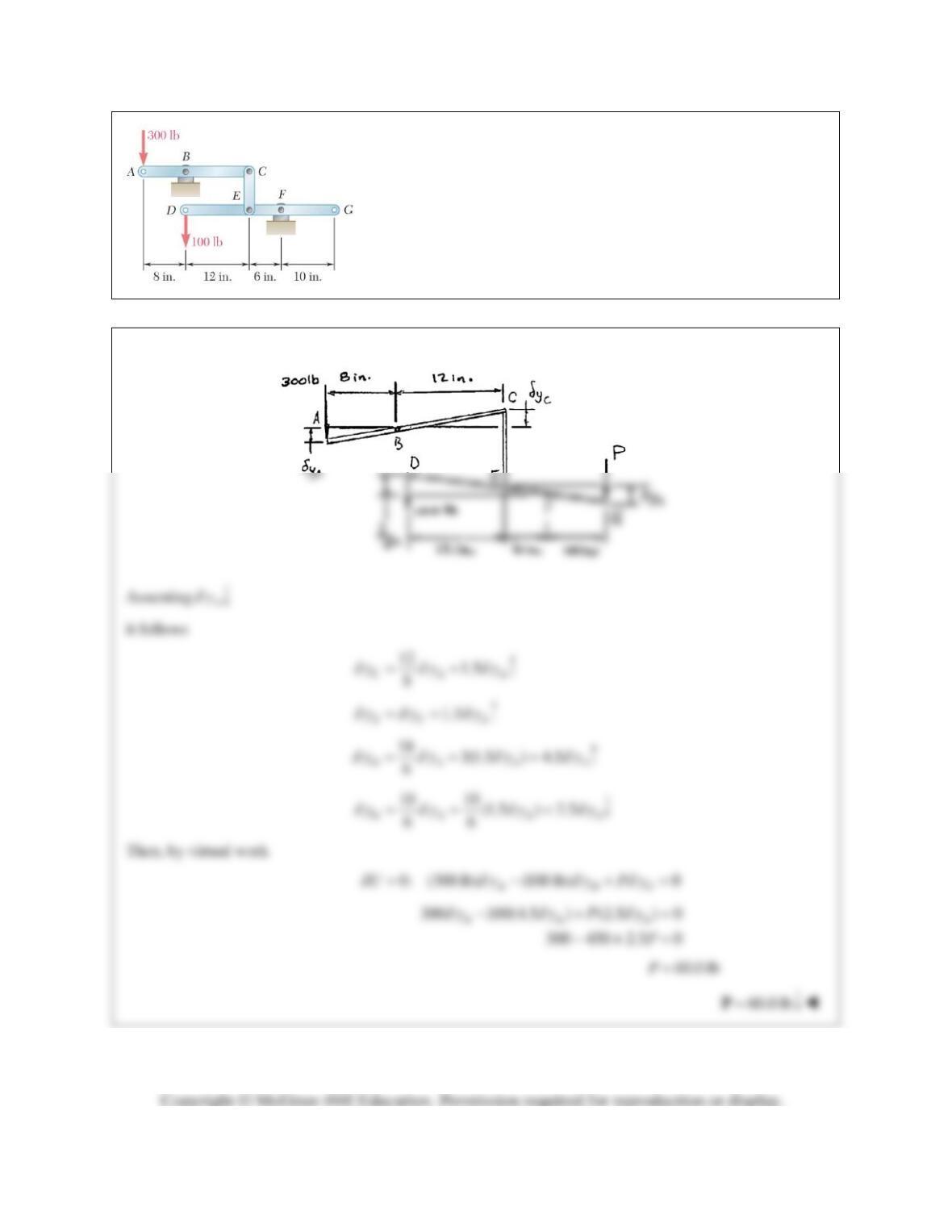
PROBLEM 10.101
Determine the vertical force
P
that must be applied at G to
maintain the equilibrium of the linkage.
SOLUTION
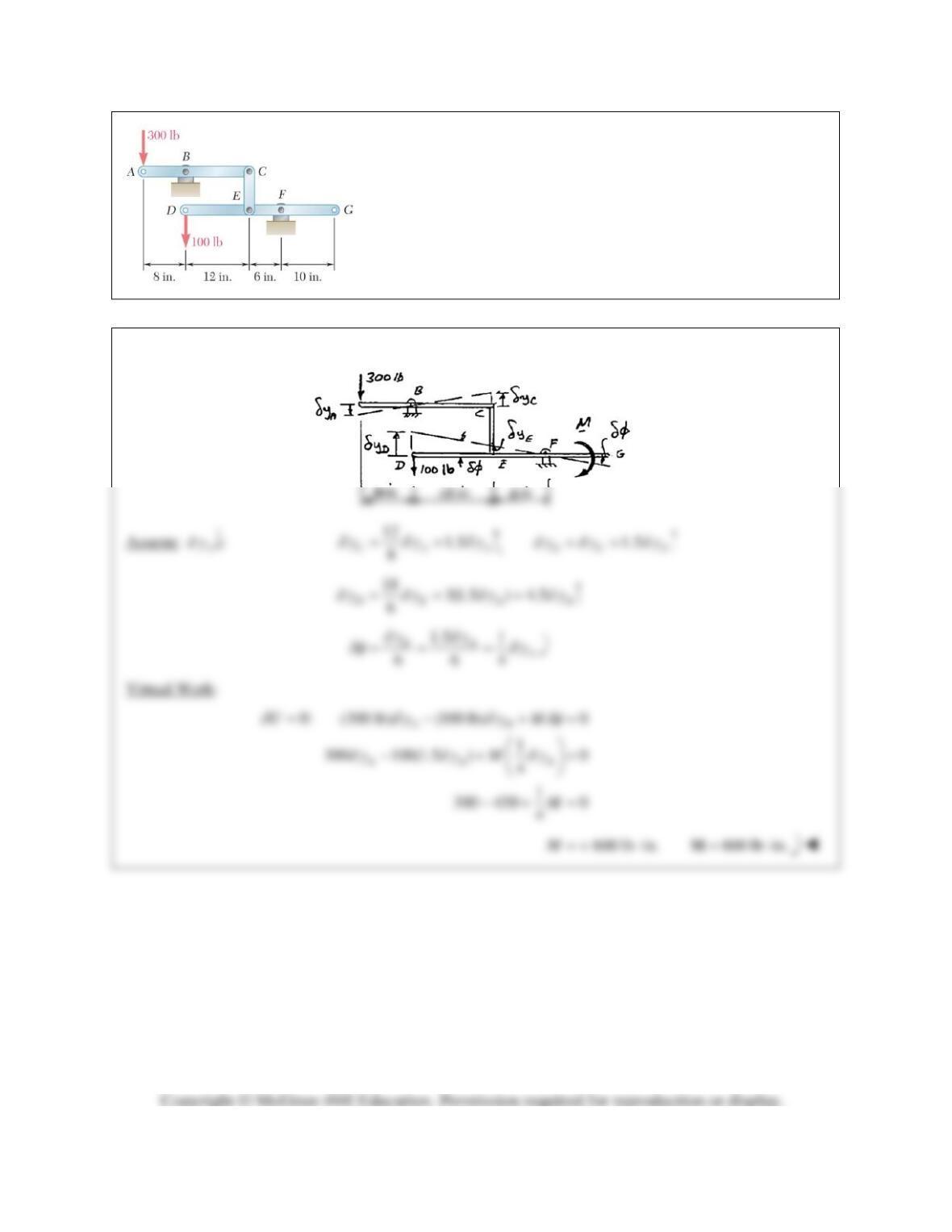
PROBLEM 10.102
Determine the couple
M
that must be applied to member DEFG to
maintain the equilibrium of the linkage.
SOLUTION
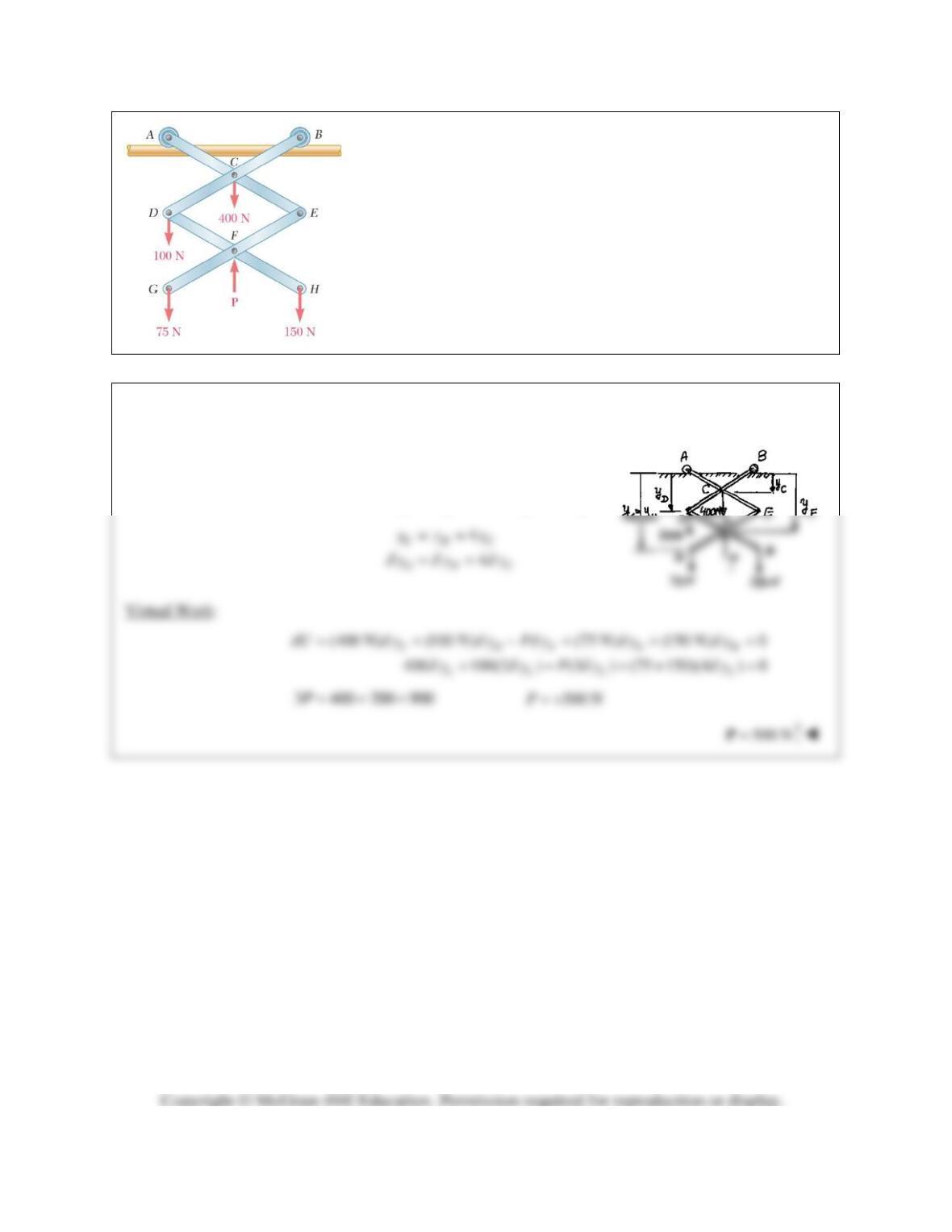
PROBLEM 10.103
Determine the force P required to maintain the equilibrium of the
linkage shown. All members are of the same length and the wheels at
A and B roll freely on the horizontal rod.
SOLUTION
Using yC as independent variable:
2
D
C
yy 2
D
C
yy
3
FC
yy 3
FC
yy
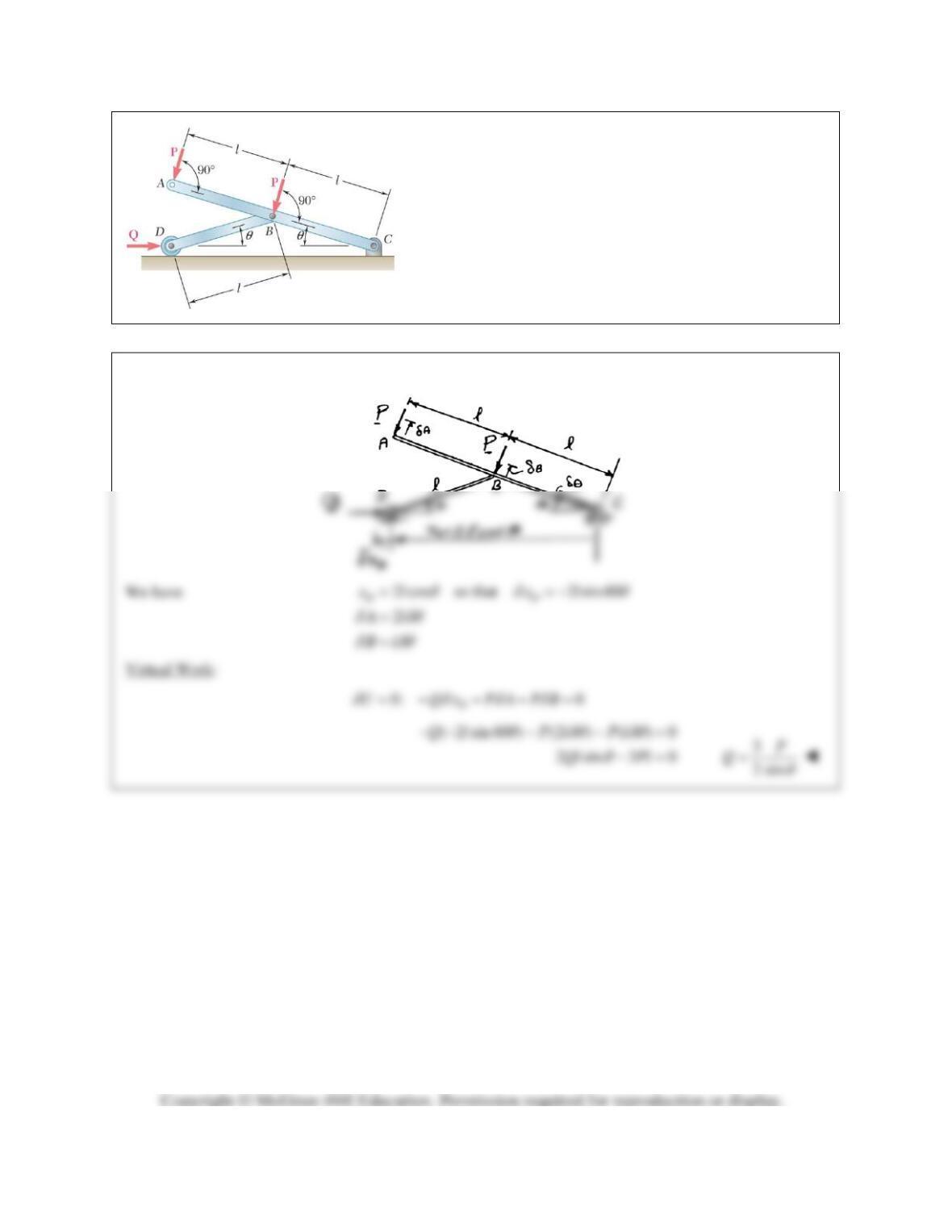
PROBLEM 10.104
Derive an expression for the magnitude of the force
Q
required to maintain the equilibrium of the mechanism
shown.
SOLUTION
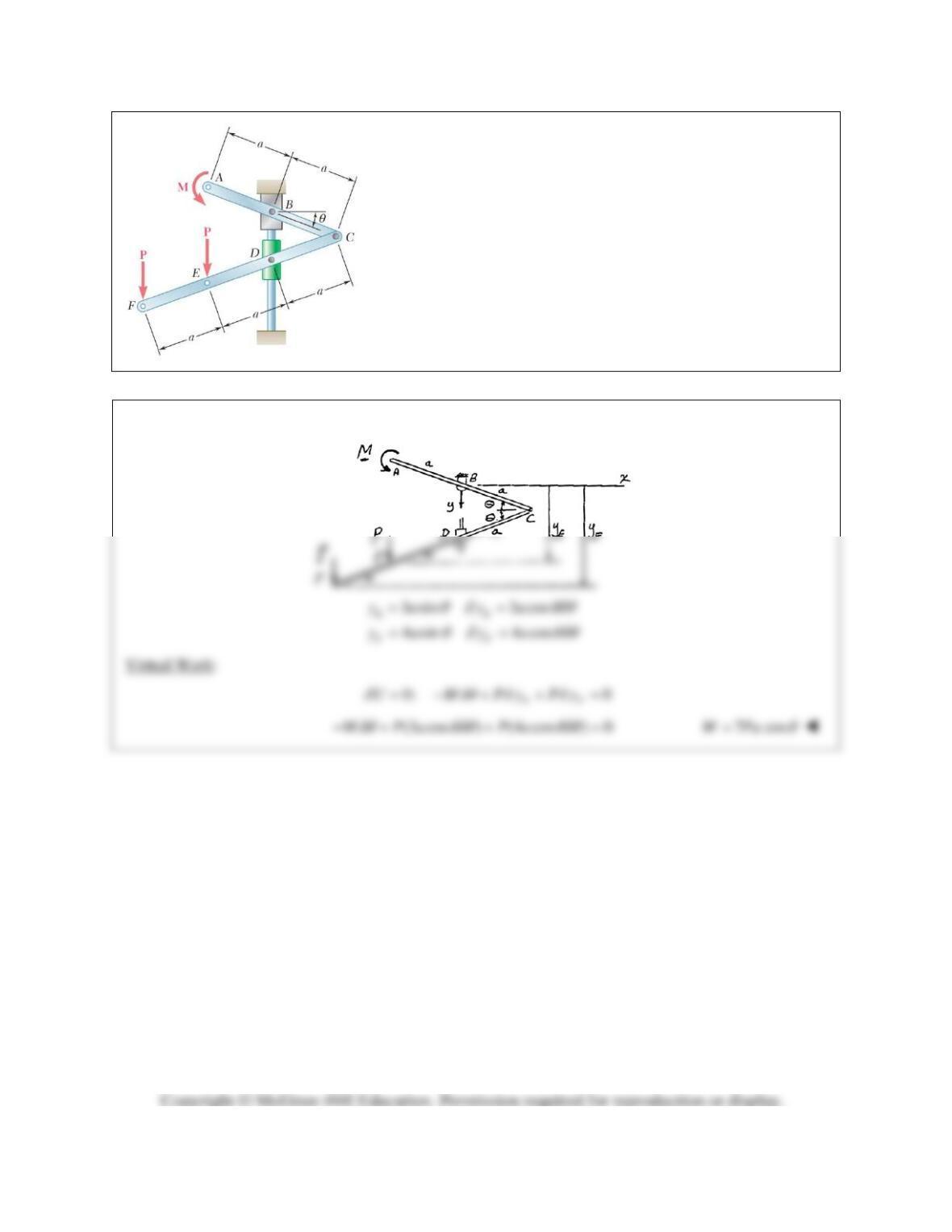
PROBLEM 10.105
Derive an expression for the magnitude of the couple
M
required
to maintain the equilibrium of the linkage shown.
SOLUTION
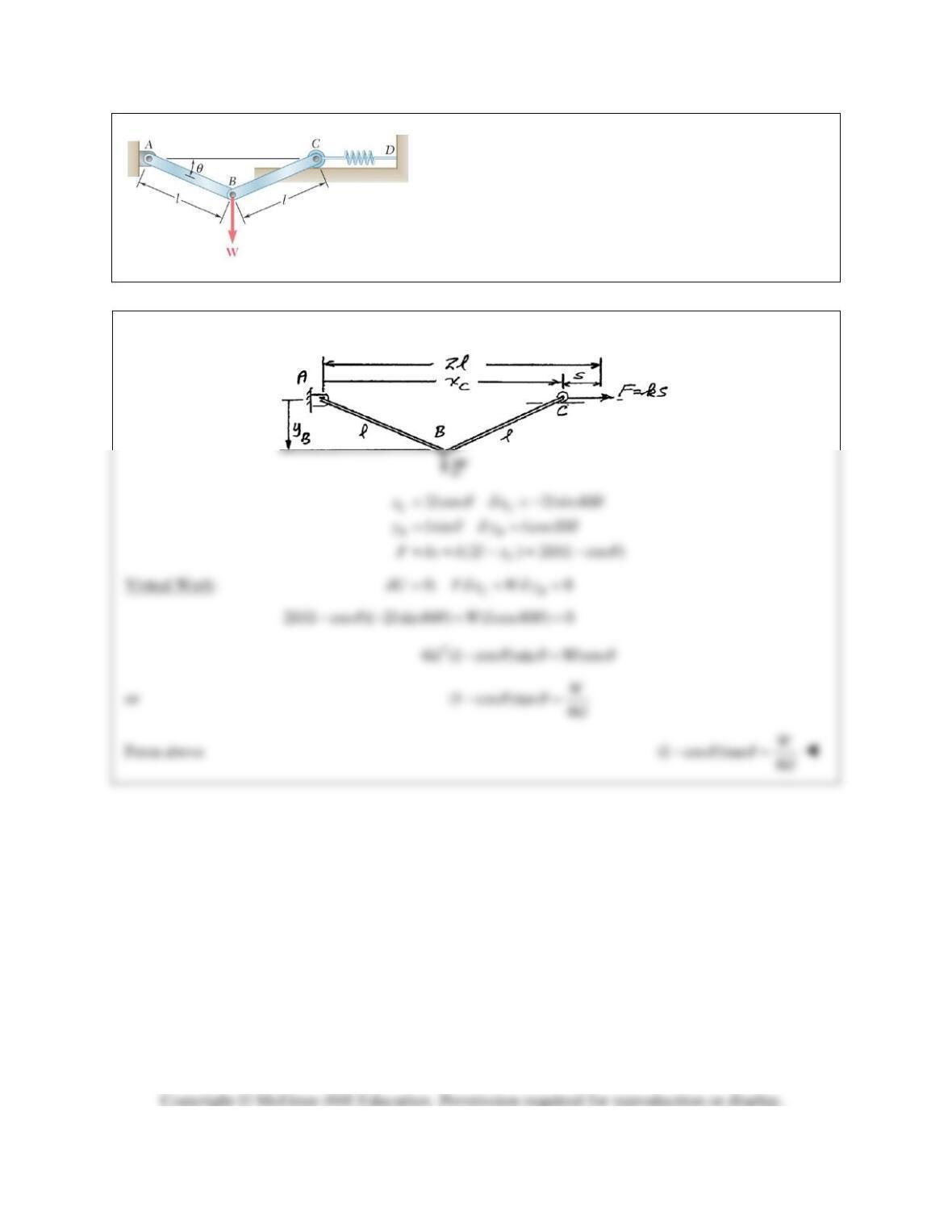
PROBLEM 10.106
A vertical load
W
is applied to the linkage at B. The
constant of the spring is k, and the spring is unstretched
when AB and BC are horizontal. Neglecting the weight of
the linkage, derive an equation in
, W, l, and k that must
be satisfied when the linkage is in equilibrium.
SOLUTION
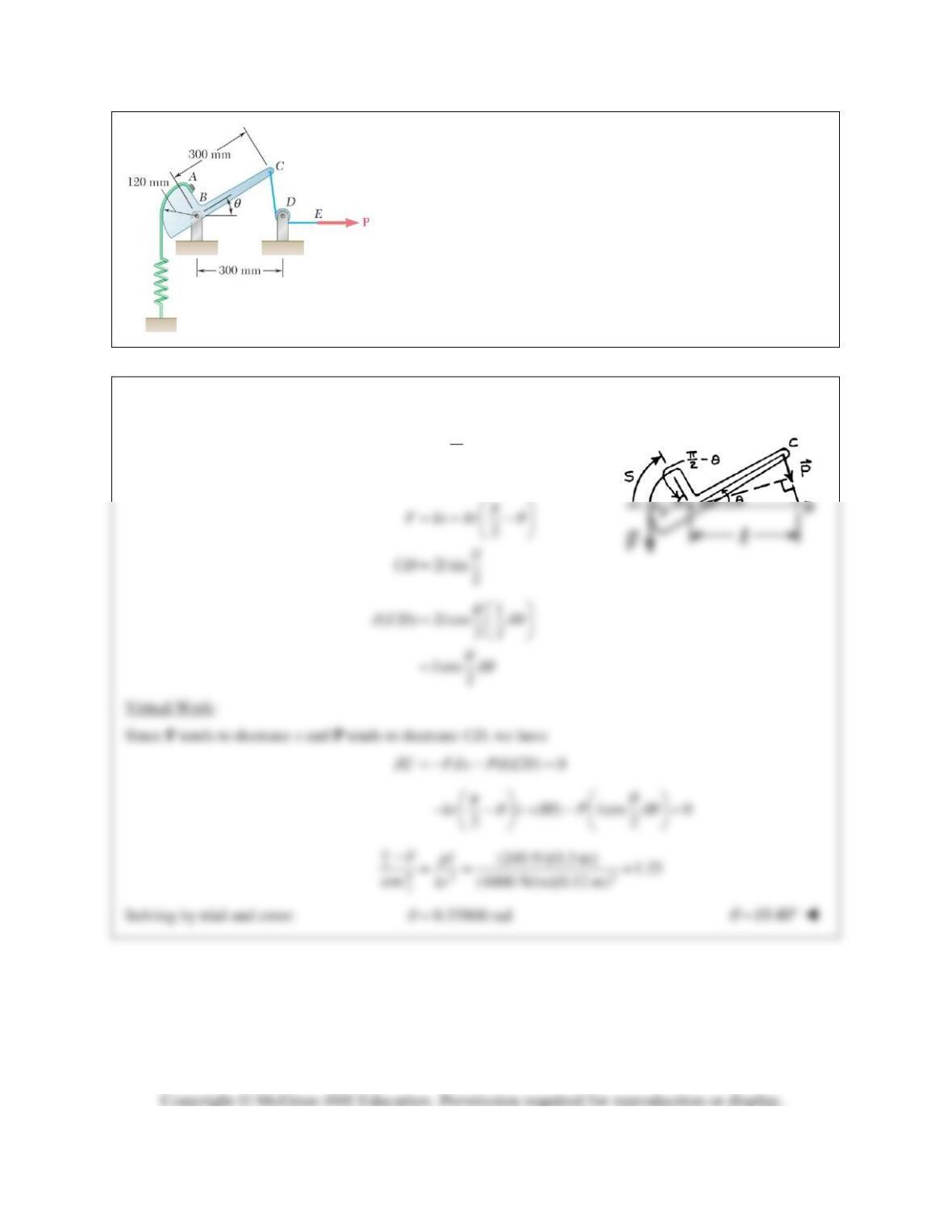
PROBLEM 10.107
A force
P
of magnitude 240 N is applied to end E of cable CDE,
which passes under pulley D and is attached to the mechanism at
C. Neglecting the weight of the mechanism and the radius of the
pulley, determine the value of
corresponding to equilibrium.
The constant of the spring is
4 kN/m,k
and the spring is
unstretched when
90 .
SOLUTION
2
sr
sr
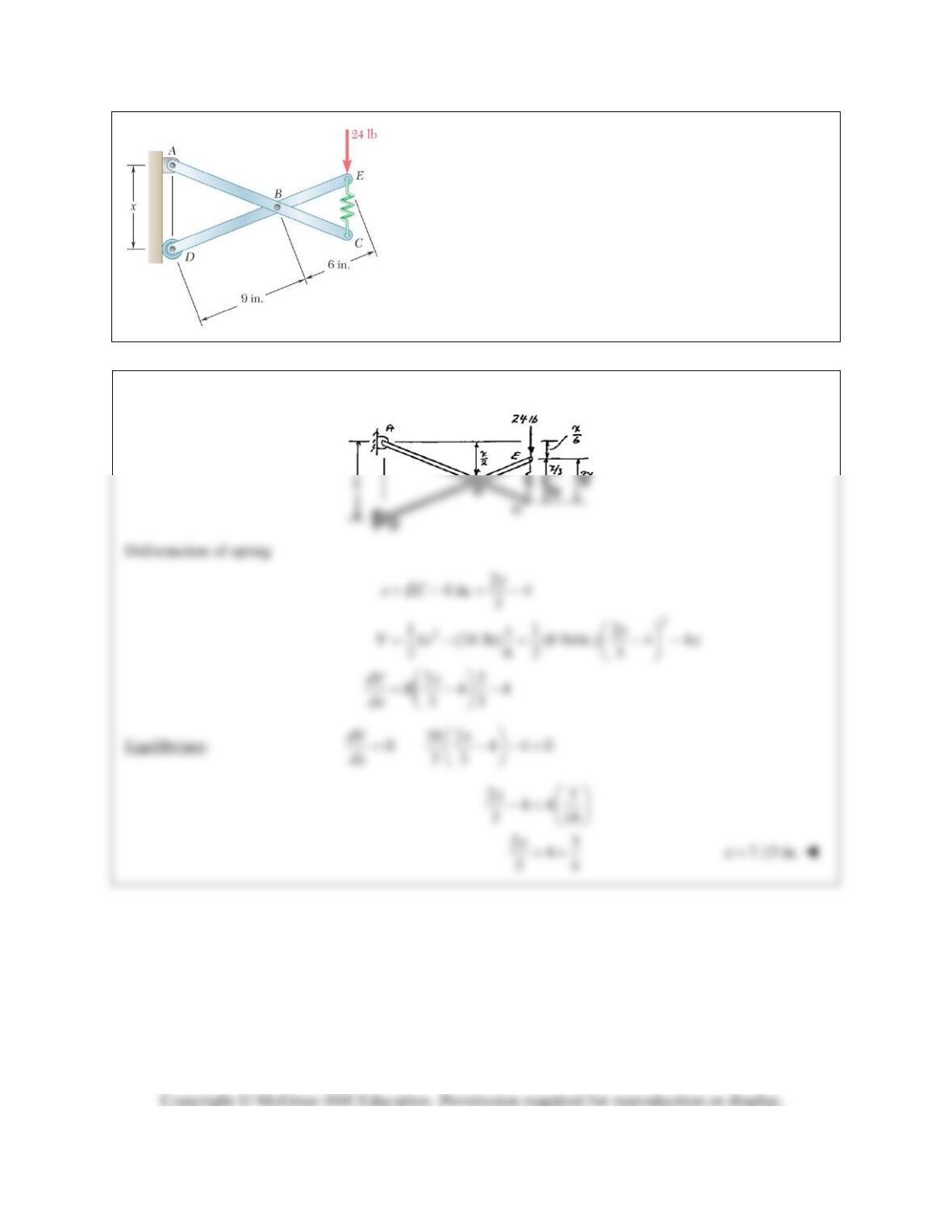
PROBLEM 10.108
Two identical rods ABC and DBE are connected by a pin at B
and by a spring CE. Knowing that the spring is 4 in. long when
unstretched and that the constant of the spring is 8 lb/in.,
determine the distance x corresponding to equilibrium when a
24-lb load is applied at E as shown.
SOLUTION
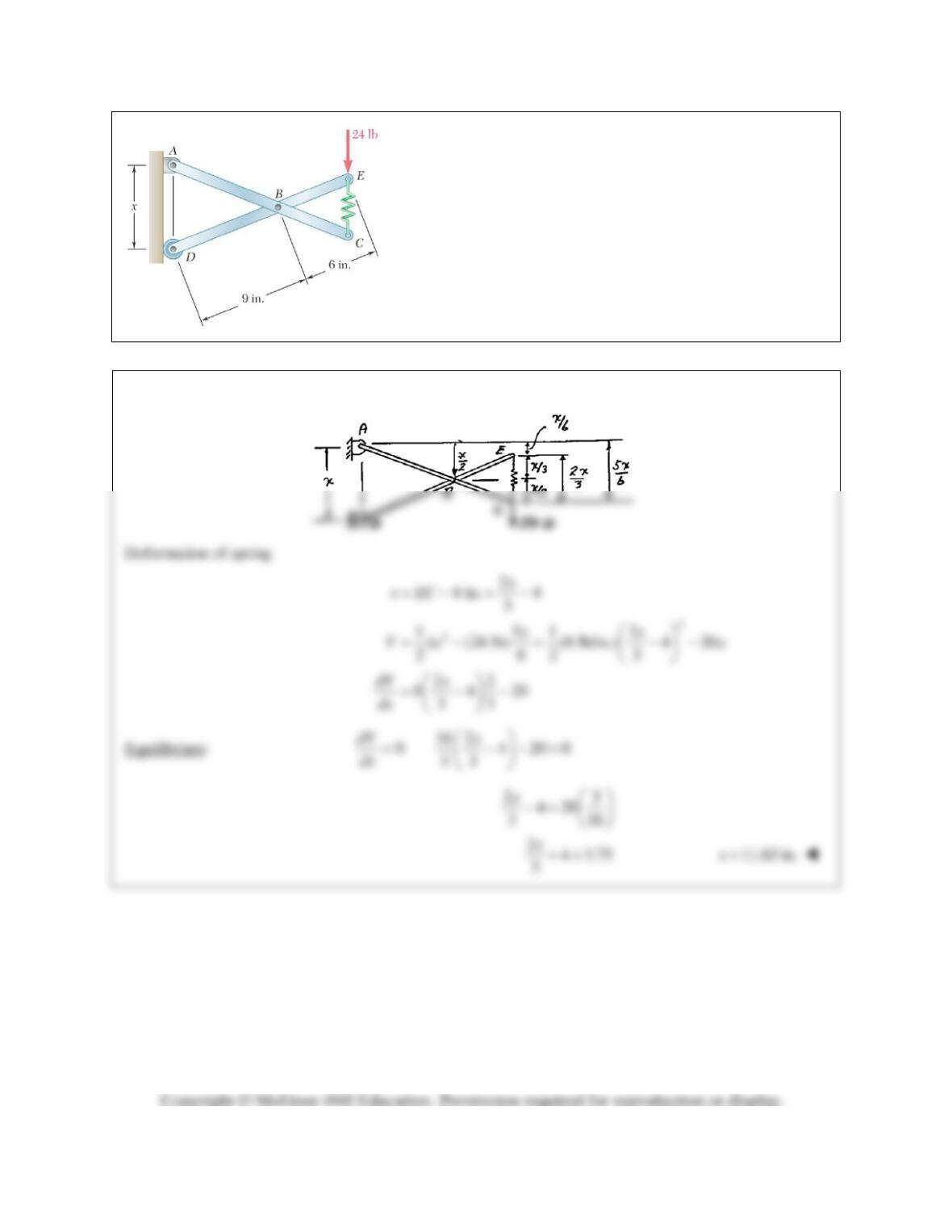
PROBLEM 10.109
Solve Problem 10.108 assuming that the 24-lb load is applied at
C instead of E.
PROBLEM 10.108
Two identical rods ABC and DBE are
connected by a pin at B and by a spring CE. Knowing that the
spring is 4 in. long when unstretched and that the constant of the
spring is 8 lb/in., determine the distance x corresponding to
equilibrium when a 24-lb load is applied at E as shown.
SOLUTION
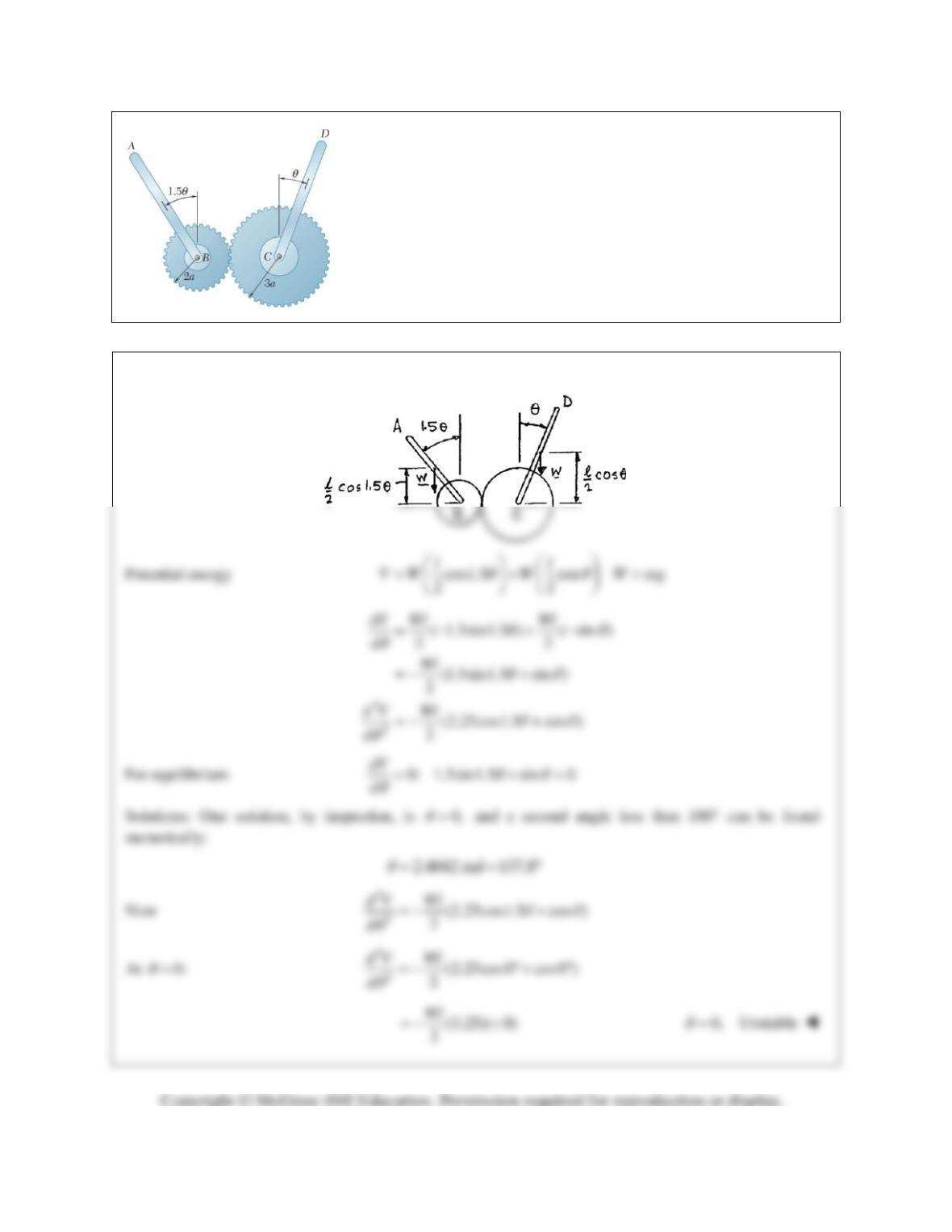
PROBLEM 10.110
Two uniform rods, each of mass m and length l, are attached to gears
as shown. For the range
0 180 ,
determine the positions of
equilibrium of the system and state in each case whether the
equilibrium is stable, unstable, or neutral.
SOLUTION
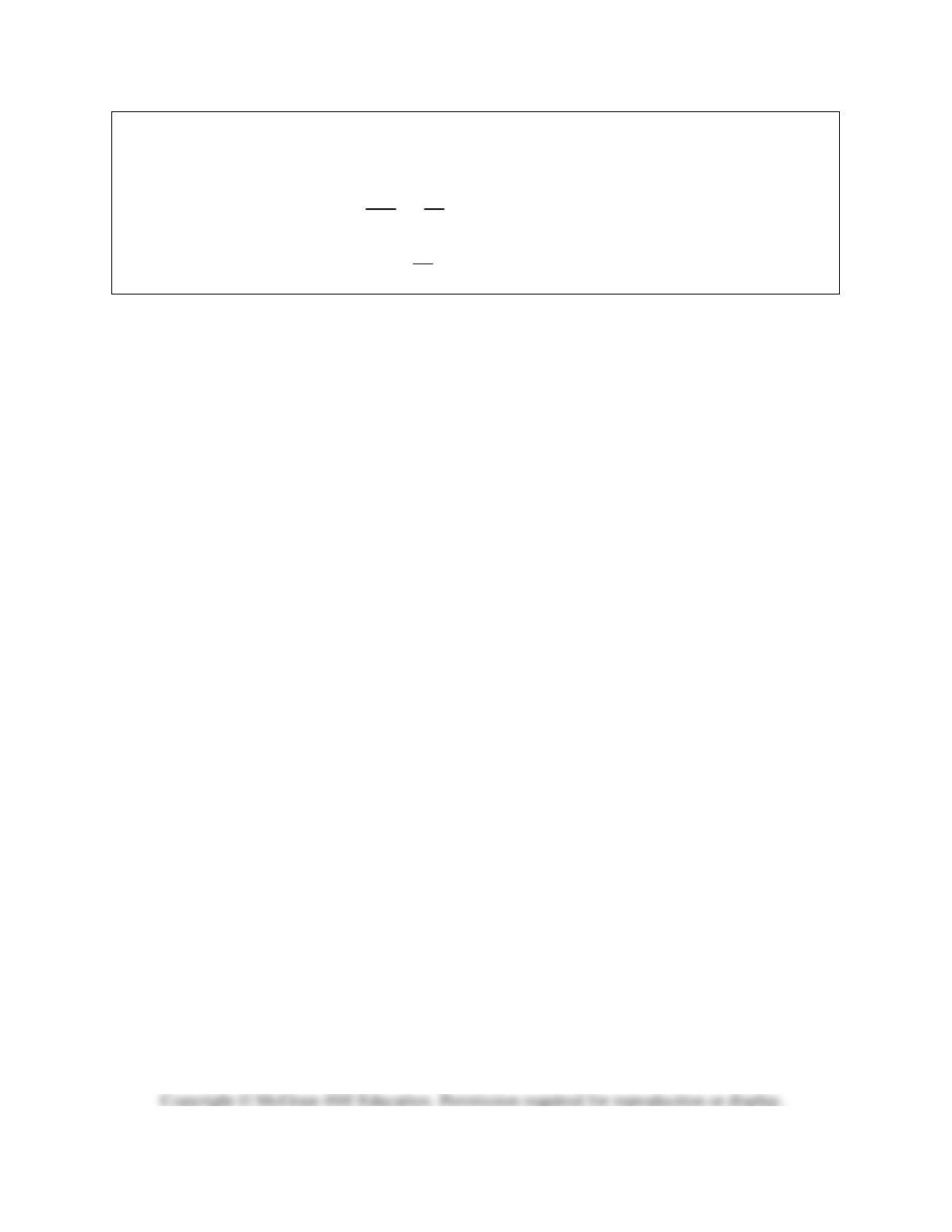
PROBLEM 10.110 (Continued)
At 137.8 :
2
2[2.25cos(1.5 137.8 ) cos137.8 ]
2
dV Wl
d
(2.75)( 0)
2
Wl
137.8 , Stable
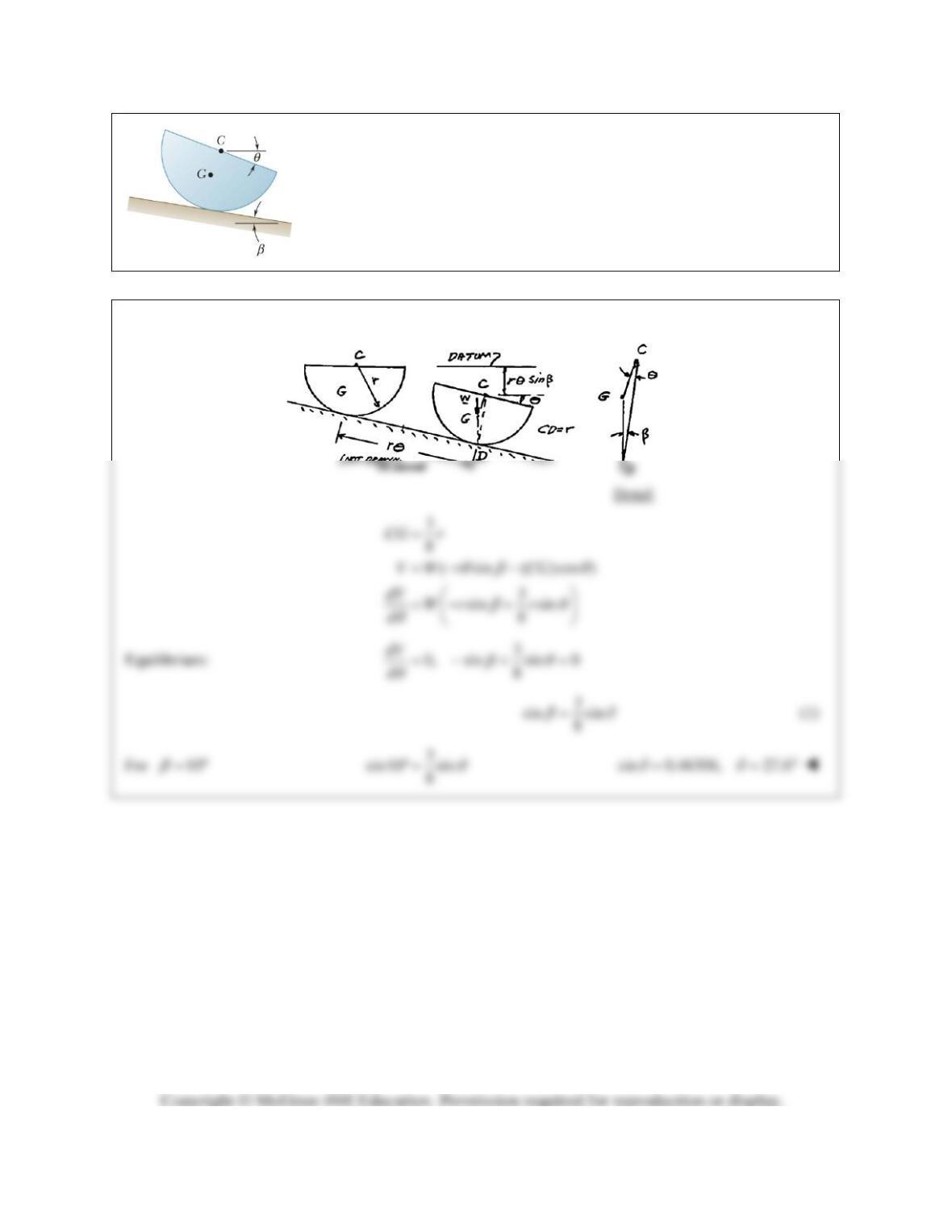
PROBLEM 10.111
A homogeneous hemisphere of radius r is placed on an incline as shown.
Assuming that friction is sufficient to prevent slipping between the
hemisphere and the incline, determine the angle
corresponding to
equilibrium when
10 .
SOLUTION
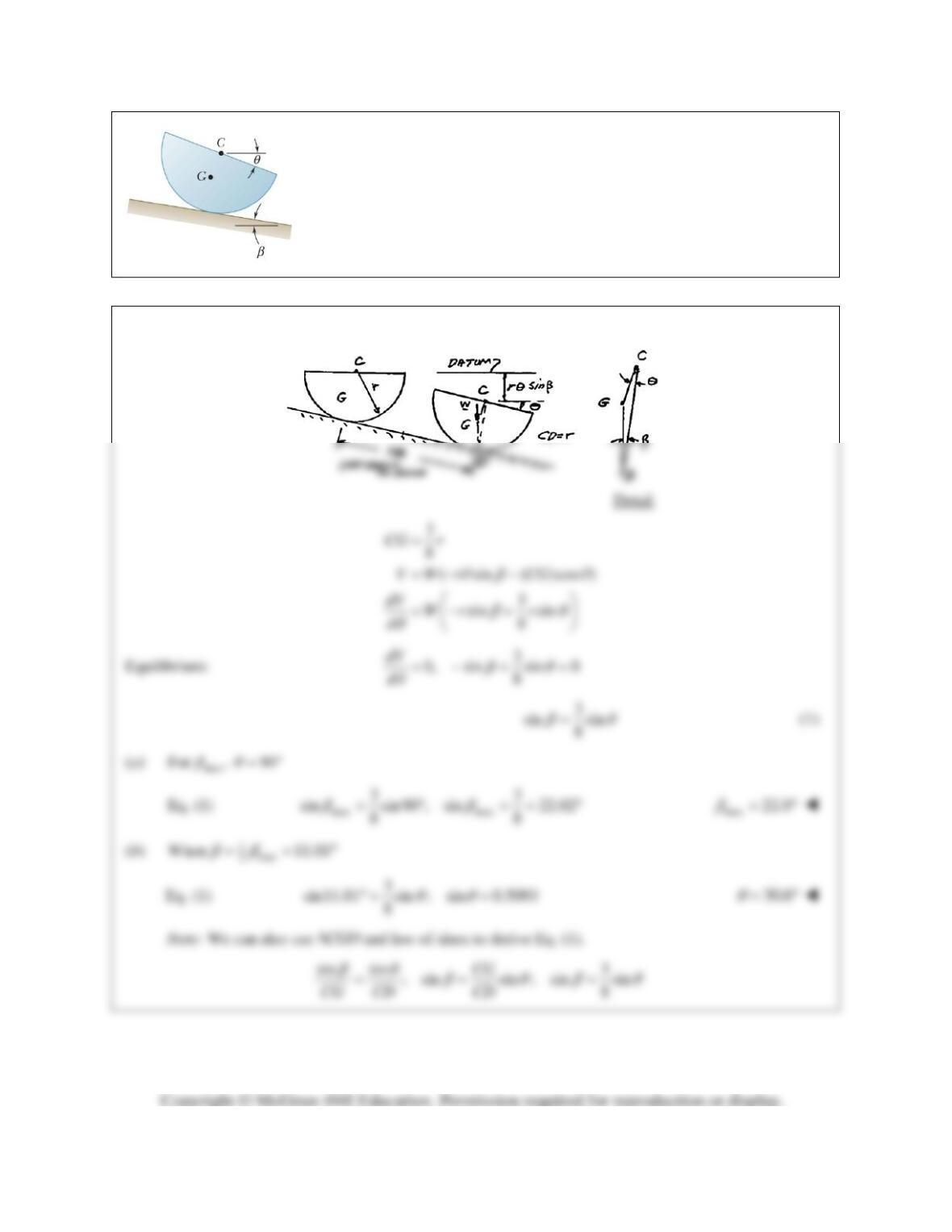
PROBLEM 10.112
A homogeneous hemisphere of radius r is placed on an incline as shown.
Assuming that friction is sufficient to prevent slipping between the
hemisphere and the incline, determine (a) the largest angle
for which a
position of equilibrium exists, (b) the angle
corresponding to equilibrium
when the angle
is equal to half the value found in part a.
SOLUTION