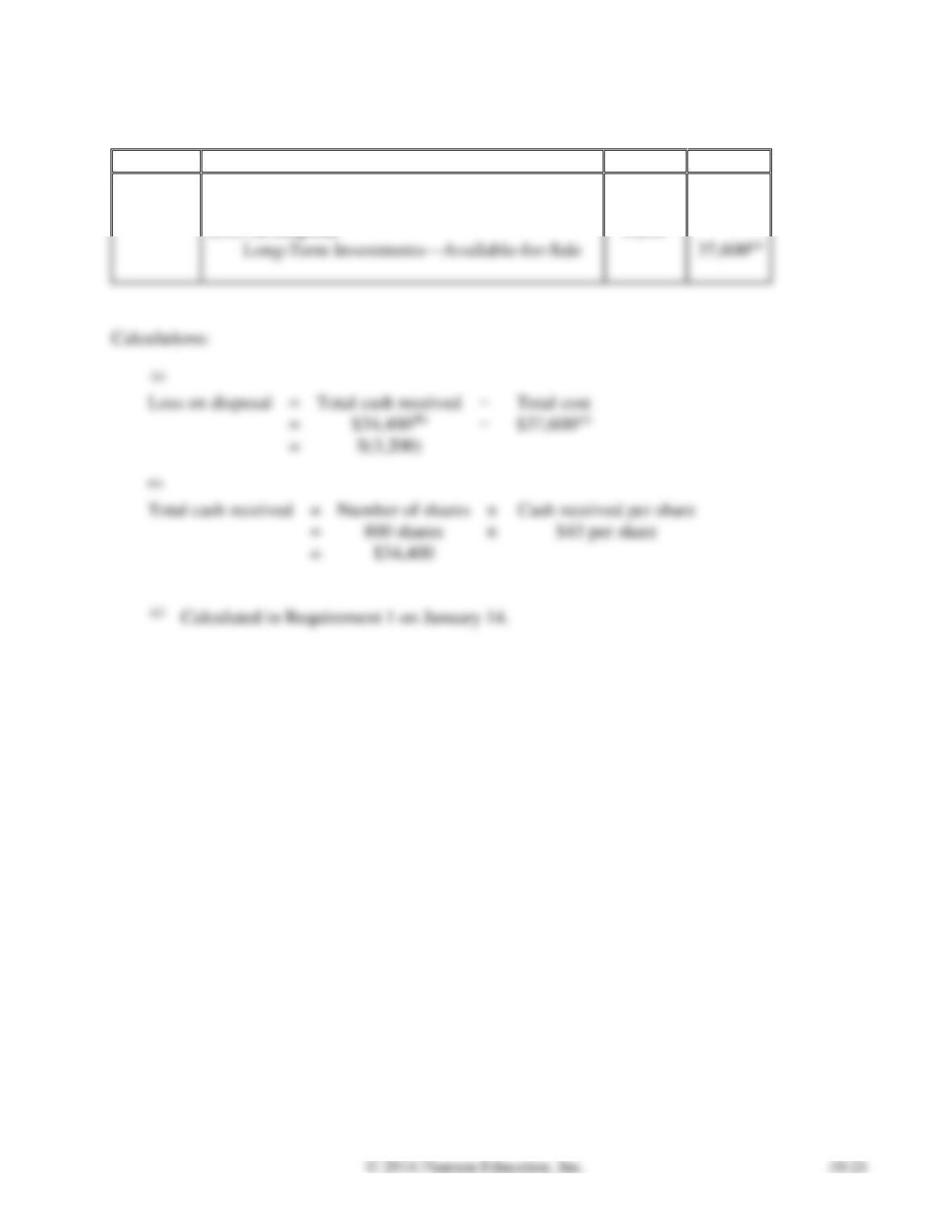
E10-12, cont.
Requirement 2
Date
Accounts and Explanation
Debit
Credit
2017
Aug. 4
Cash
34,400(b)
Loss on Disposal
3,200(a)
Loss on disposal
=
Total cash received
=
=
(b)
Total cash received
=
Number of shares
×
=
×
=
(c)
Calculated in Requirement 1 on January 14.
Requirement 3
Strategic would report the $3,200(a) loss on disposal on its income statement for the year ended
December 31, 2017, classified as other revenues and (expenses).
(a)
Calculated in Requirement 1.
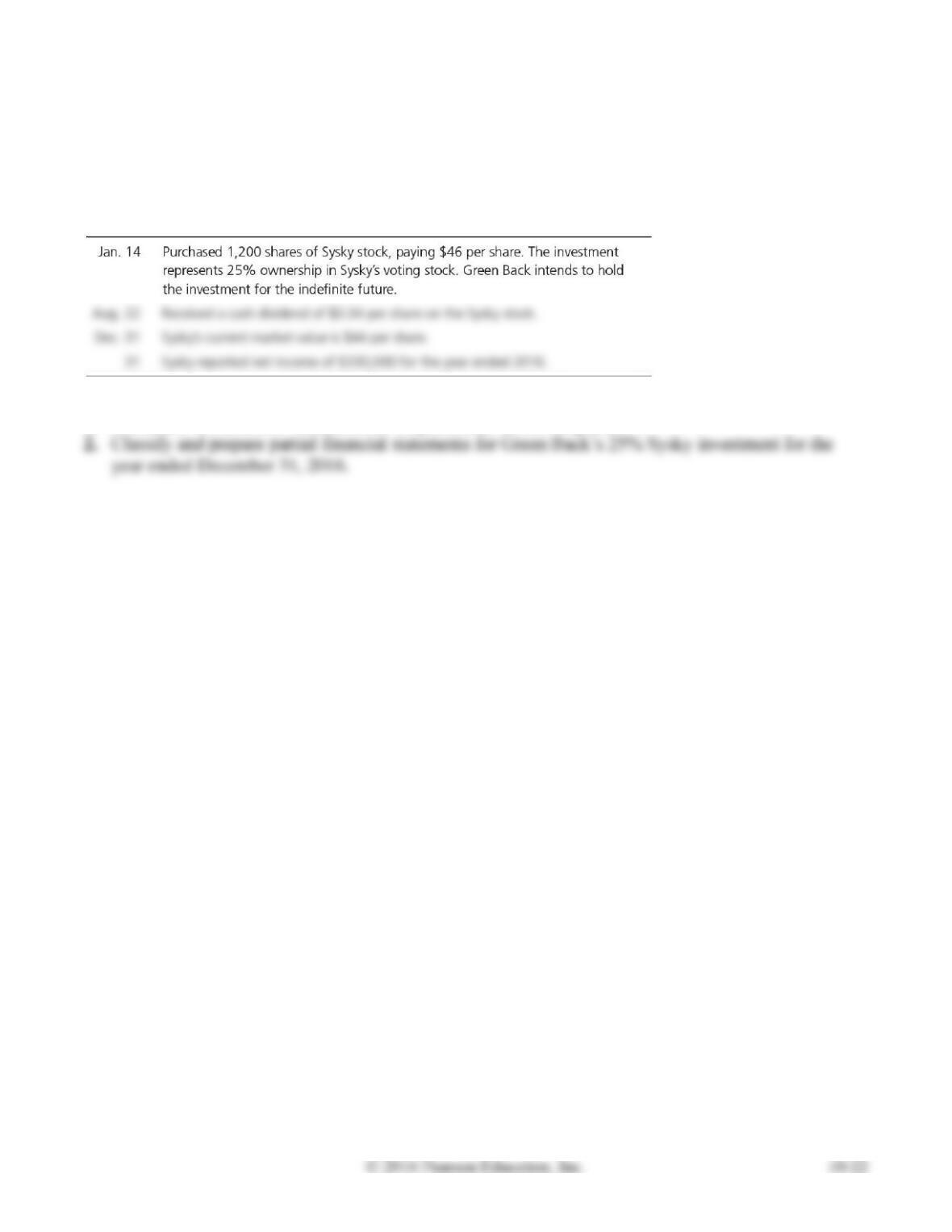
E10-13 Accounting for stock investments
Learning Objective 3
1. Revenue from Investments CR $82,500
Green Back Investments completed the following transactions during 2016:
Requirements
1. Journalize Green Back’s transactions. Explanations are not required.
SOLUTION
Requirement 1
Date
Accounts and Explanation
Debit
Credit
2016
Jan. 14
Long-Term Investments—Sysky
55,200(a)
Cash
55,200(a)
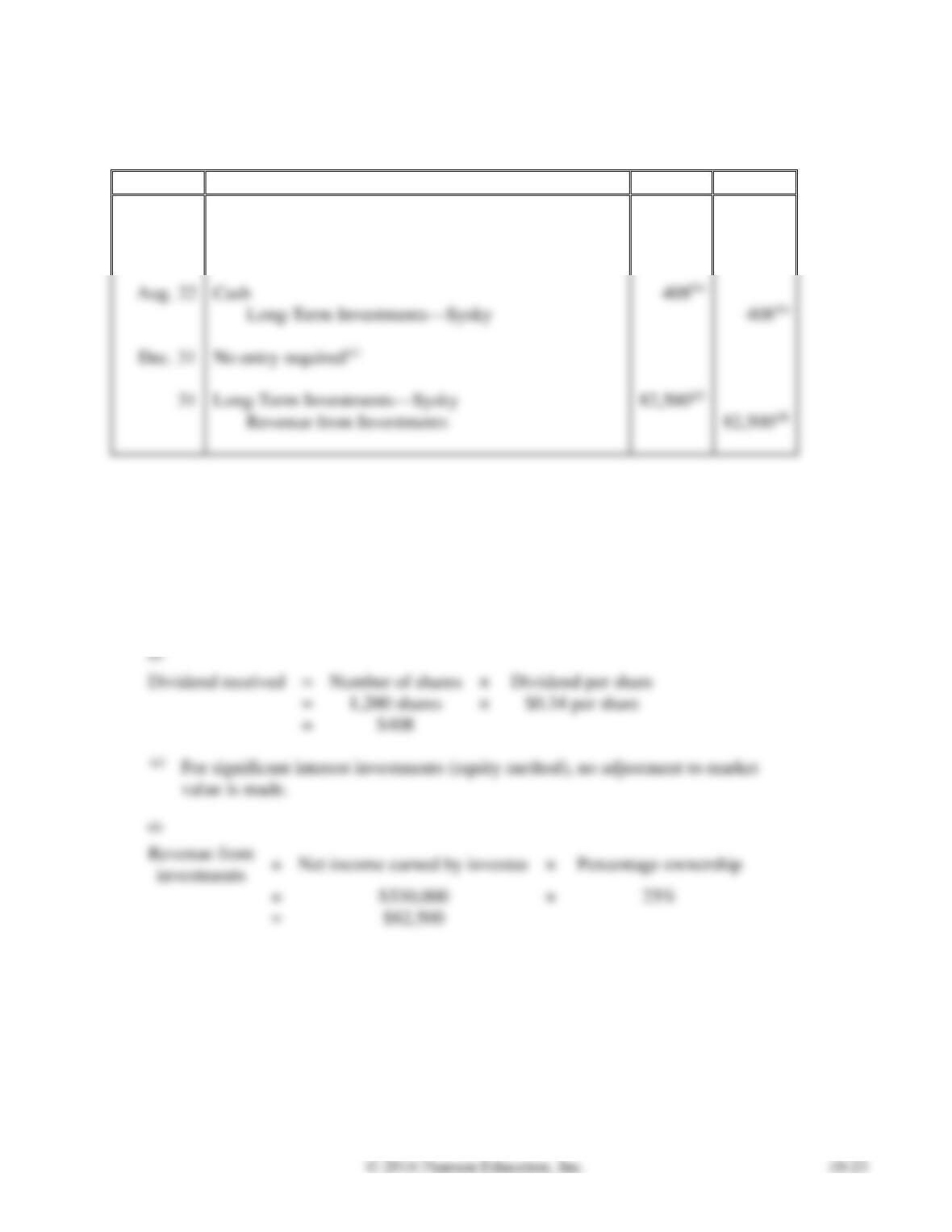
Aug. 22
Cash
Long-Term Investments—Sysky
Long-Term Investments—Sysky
Revenue from Investments
Calculations:
(a)
Total cost
=
Number of shares
×
Price per share
=
1,200 shares
×
$46 per share
=
$55,200
(b)
Dividend received
=
Number of shares
×
Dividend per share
=
1,200 shares
×
=
value is made.
(d)
=
×
25%
=
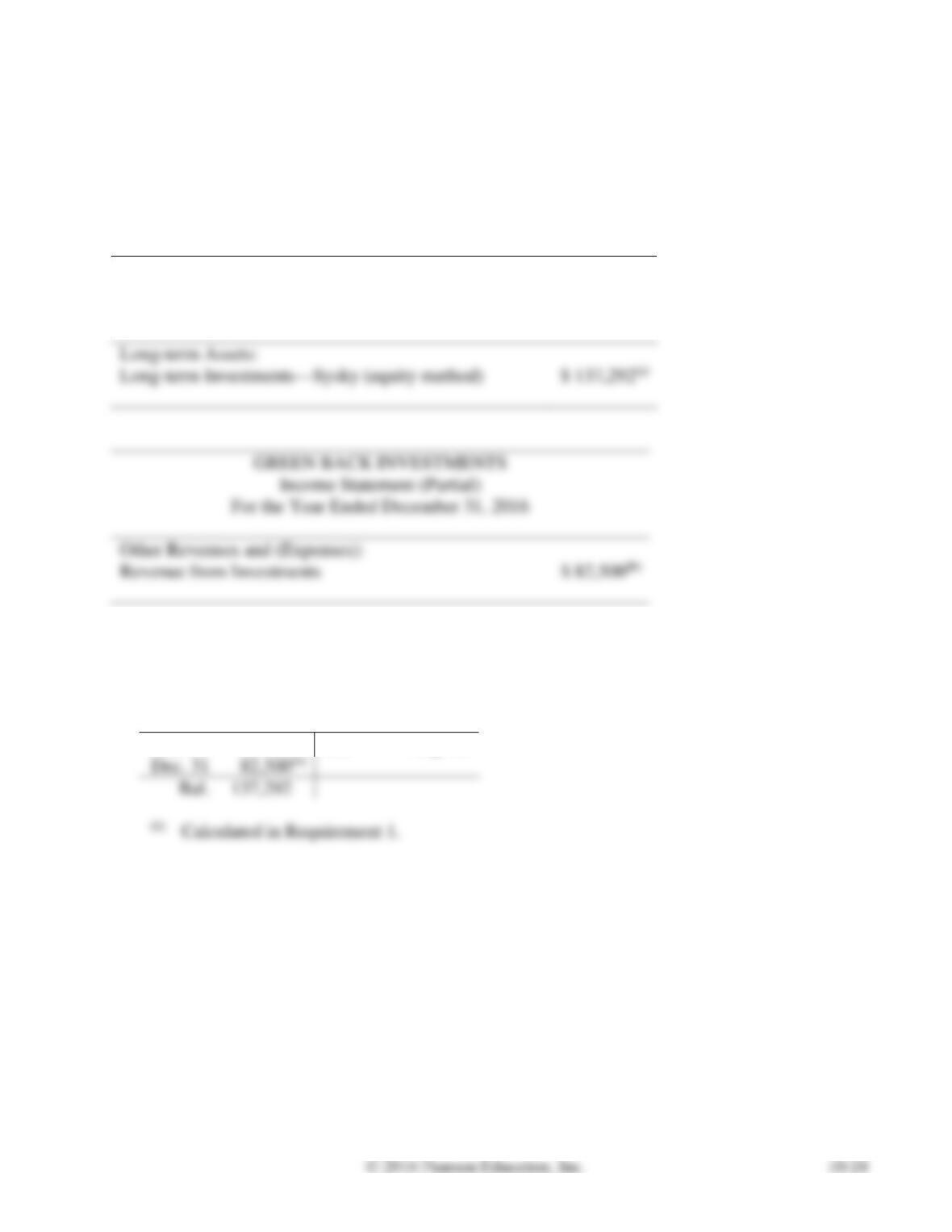
E10-13, cont.
Requirement 2
The investment (equity-method) is classified as a long-term asset on the balance sheet at December
31, 2016, and the revenue from investments is classified as other revenues and (expenses) on the
income statement for the year ended December 31, 2016.
GREEN BACK INVESTMENTS
Balance Sheet (Partial)
December 31, 2016
Long-term Assets:
Long-term Investments—Sysky (equity method)
Other Revenues and (Expenses):
Revenue from Investments
Calculations:
(a)
Long-Term Investments—Sysky
Jan. 14
55,200(b)
408(b)
Aug. 22
137,292
(b)
Calculated in Requirement 1.
E10-14 Accounting for stock investments
Learning Objective 3
3. $358,000,000 Bal.
Suppose that on January 6, 2016, Westfall Motors paid $360,000,000 for its 40% investment in Phase
Motors. Assume Phase earned net income of $20,000,000 and paid cash dividends of $25,000,000 to all
outstanding stockholders during 2016. (Assume all outstanding stock is voting stock.)
Requirements
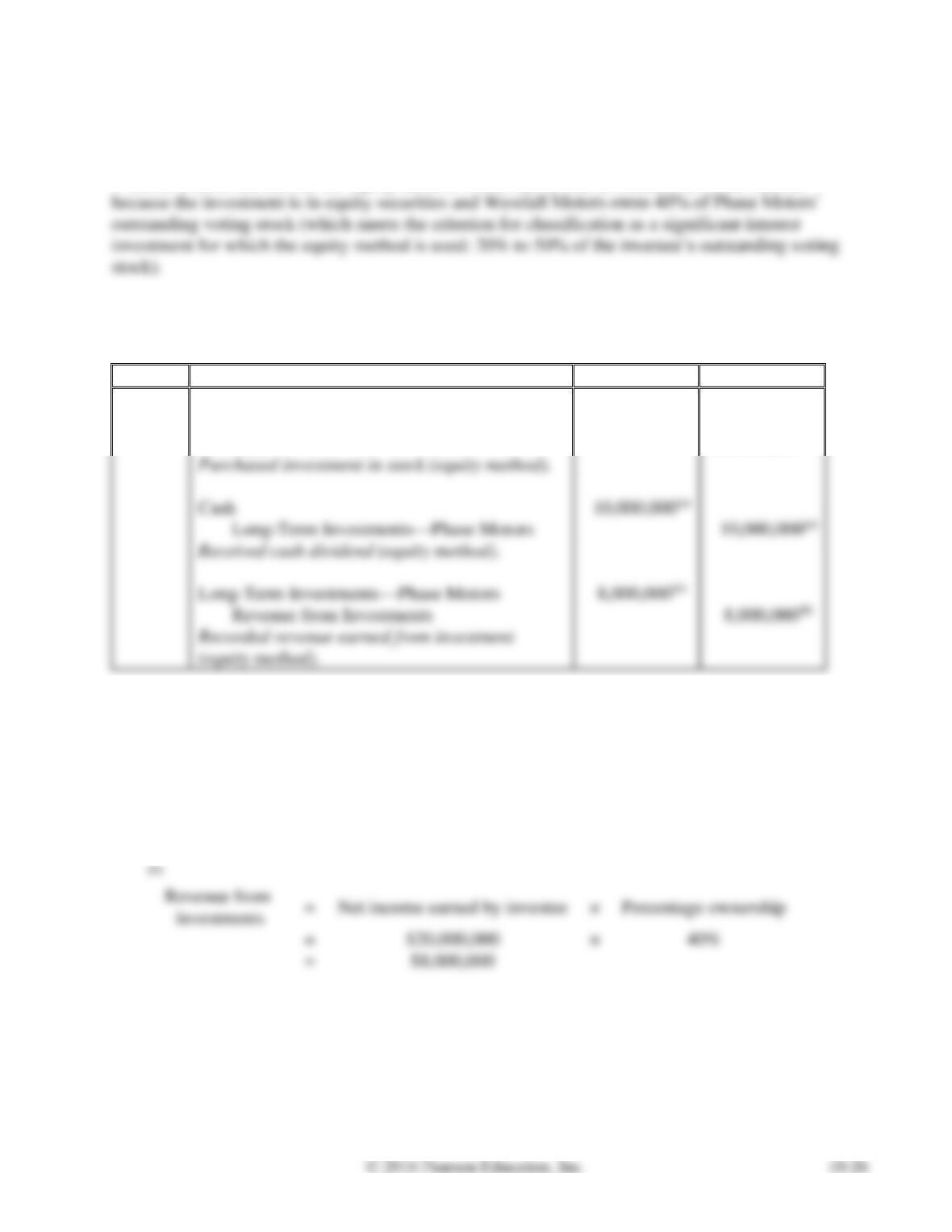
1. What method should Westfall Motors use to account for the investment in Phase Motors? Give your
reasoning.
SOLUTION
Requirement 1
Westfall Motors should use the equity method to account for the investment in Phase Motors
Requirement 2
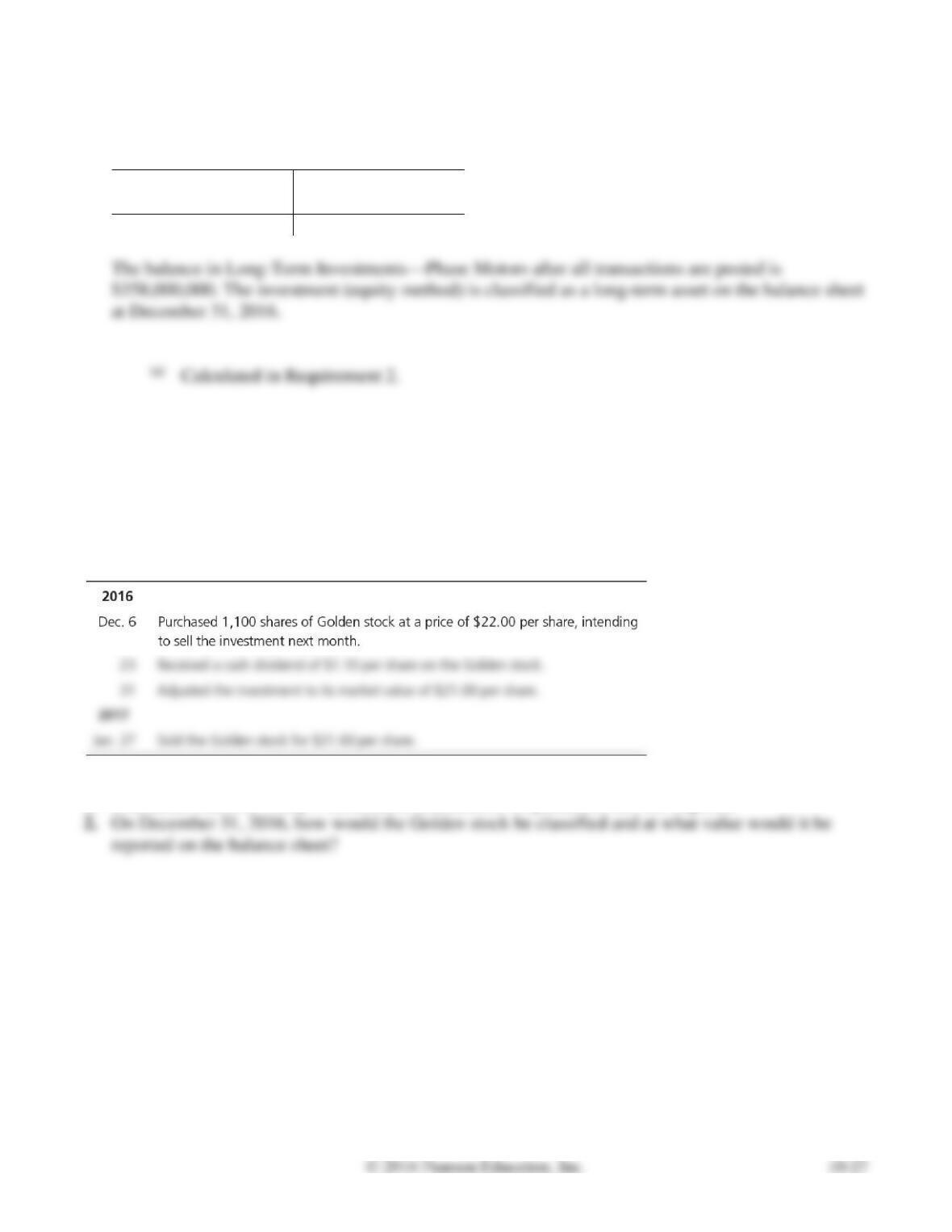
Date
Accounts and Explanation
Debit
Credit
2016
Jan. 6
Long-Term Investments—Phase Motors
360,000,000
Cash
360,000,000
Cash
Long-Term Investments—Phase Motors
Long-Term Investments—Phase Motors
Revenue from Investments
Calculations:
(a)
Dividend received
=
Total dividend paid by investee
×
Percentage ownership
=
$25,000,000
×
40%
=
$10,000,000
(b)
=
×
40%
=
E10-14, cont.
Requirement 3
Long-Term Investments – Phase Motors
Jan. 6
360,000,000
10,000,000(a)
8,000,000(a)
Bal.
358,000,000
Calculated in Requirement 2.
E10-15 Classifying and accounting for stock investments
Learning Objectives 1, 3, 4
1. Dec. 31 Fair Value Adjustment—Trading CR $1,100
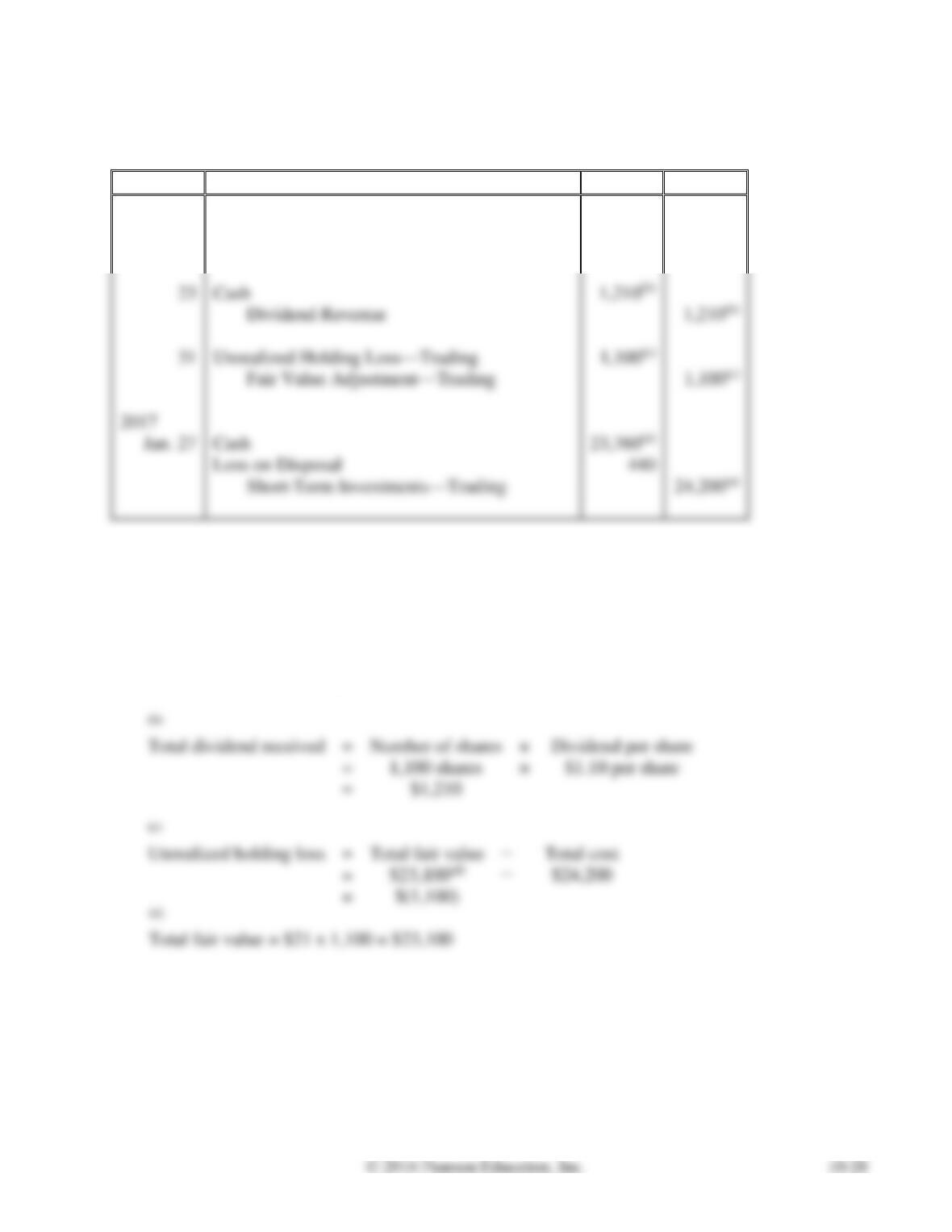
Hartford Today Publishers completed the following trading investment transactions during 2016 and
2017:
Requirements
1. Journalize Hartford Today’s investment transactions. Explanations are not required.
SOLUTION
Requirement 1
Date
Accounts and Explanation
Debit
Credit
2016
Dec. 6
Short-Term Investments—Trading
24,200(a)
Cash
24,200(a)
Cash
Dividend Revenue
Unrealized Holding Loss—Trading
Fair Value Adjustment—Trading
2017
Cash
23,760(d)
Loss on Disposal
440
Short-Term Investments—Trading
Calculations:
(a)
Total cost
=
Number of shares
×
Price per share
=
1,100 shares
×
$22.00 per share
=
$24,200
(b)
Total dividend received
=
Number of shares
×
Dividend per share
=
1,100 shares
×
=
(c)
Unrealized holding loss
=
Total fair value
=
=
E10-15
Requirement 1, cont.
(d)
Total cash received
=
Number of shares
×
Cash received per share
=
1,100 shares
×
$21.60 per share
=
$23,760
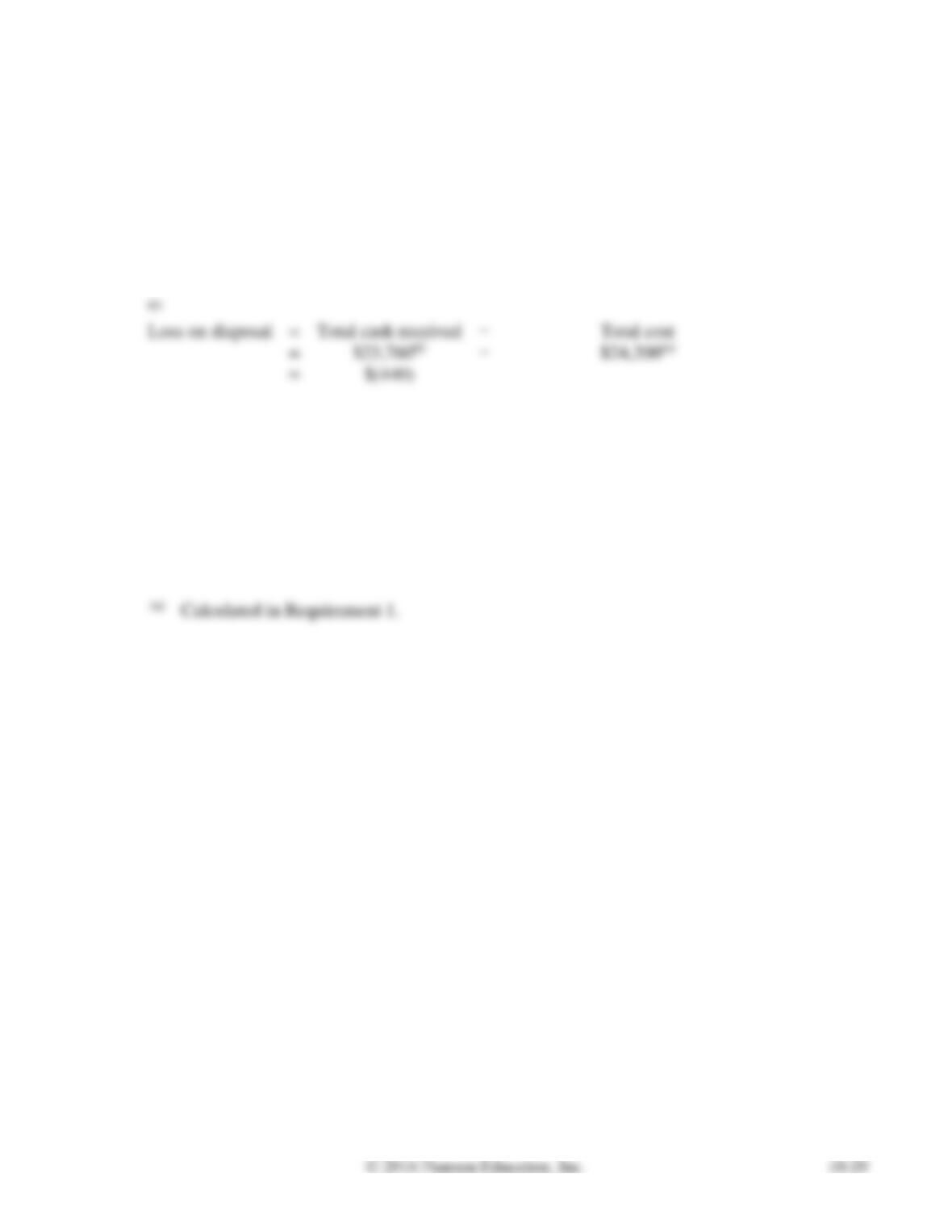
Loss on disposal
=
Total cash received
=
=
Requirement 2
Hartford Today would report the trading investment at its $23,100(a) fair value, classified as a current
asset on the balance sheet at December 31, 2016.
Calculated in Requirement 1.
E10-16 Computing rate of return on total assets
Learning Objective 5
Avg. total assets $315,000,000
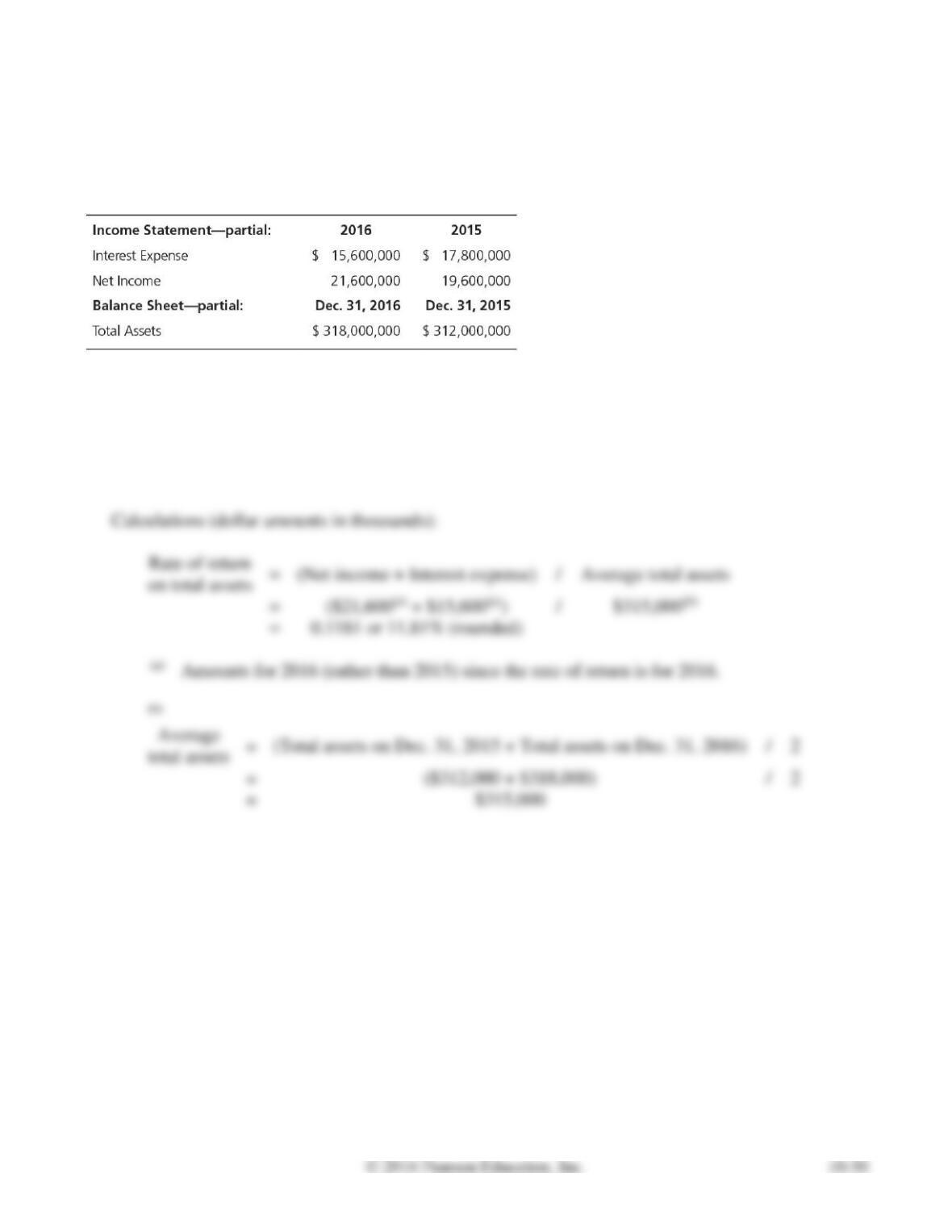
Winter Exploration Company reported these figures for 2016 and 2015:
Compute the rate of return on total assets for 2016. (Round to two decimals.)
SOLUTION
The rate of return on total assets for 2016 is 11.81% (rounded).
Problems (Group A)
P10-17A Accounting for bond investments
Learning Objective 2
1. Dec. 31 Int. Rev. CR $15,750
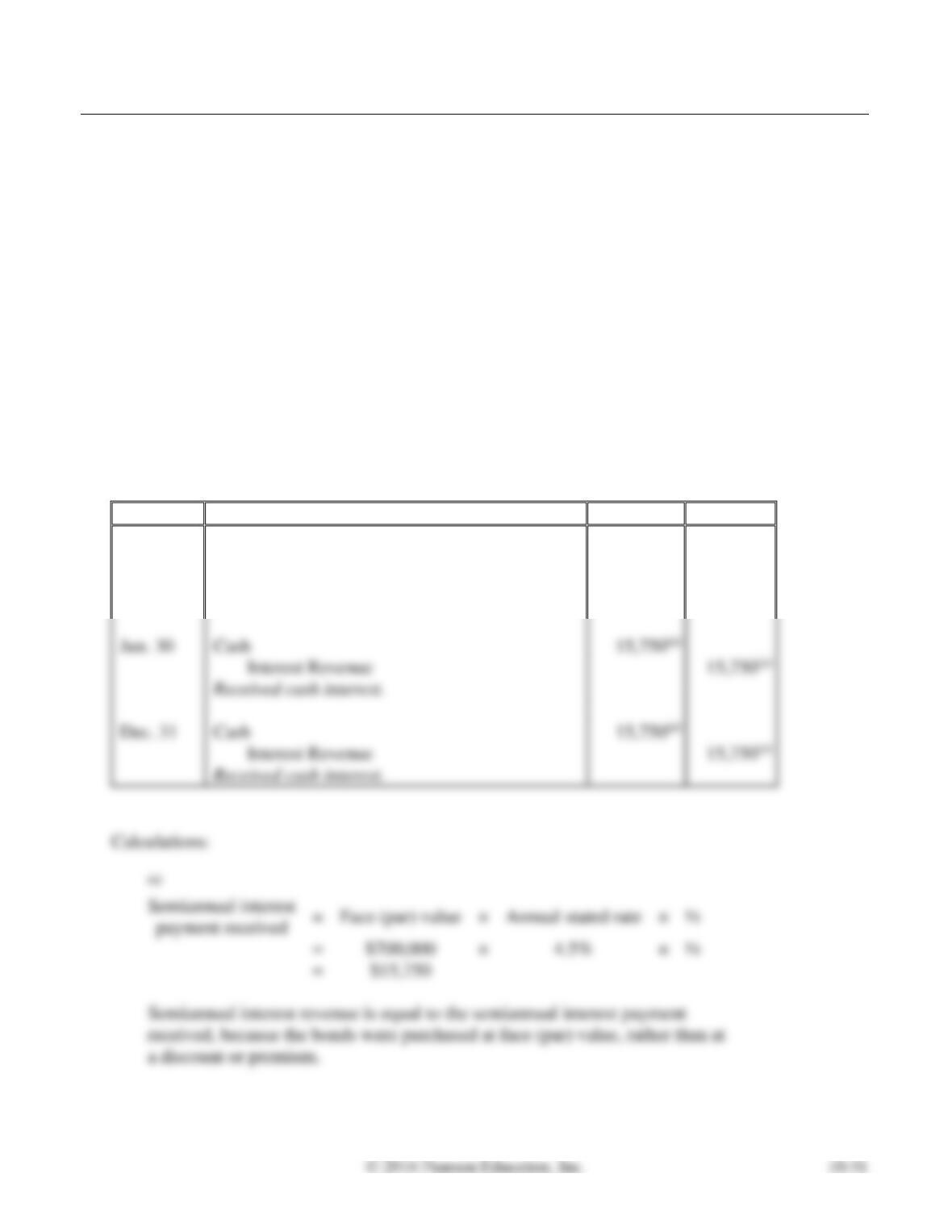
Suppose Jenner and Sons purchases $700,000 of 4.5% annual bonds of McPhee Corporation at face
value on January 1, 2016. These bonds pay interest on June 30 and December 31 each year. They mature
on December 31, 2020. Jenner intends to hold the McPhee bond investment until maturity.
Requirements
1. Journalize Jenner and Sons’s transactions related to the bonds for 2016.
2. Journalize the entry required on the McPhee bonds maturity date. (Assume the last interest payment
has already been recorded.)
SOLUTION
Requirement 1
Date
Accounts and Explanation
Debit
Credit
2016
Jan. 1
Long-Term Investments—Held-to-Maturity
700,000
Cash
700,000
Purchased investment in bonds.
Jun. 30
Cash
Interest Revenue
Received cash interest.
Dec. 31
Cash
Interest Revenue
Received cash interest.
P10-17A, cont.
Requirement 2
Date
Accounts and Explanation
Debit
Credit
2020
Dec. 31
Cash
700,000
Disposed of bond at maturity.
P10-18A Classifying and accounting for stock investments
Learning Objectives 1, 3, 4
2. Sep. 16 Gain on Disposal CR $12,920
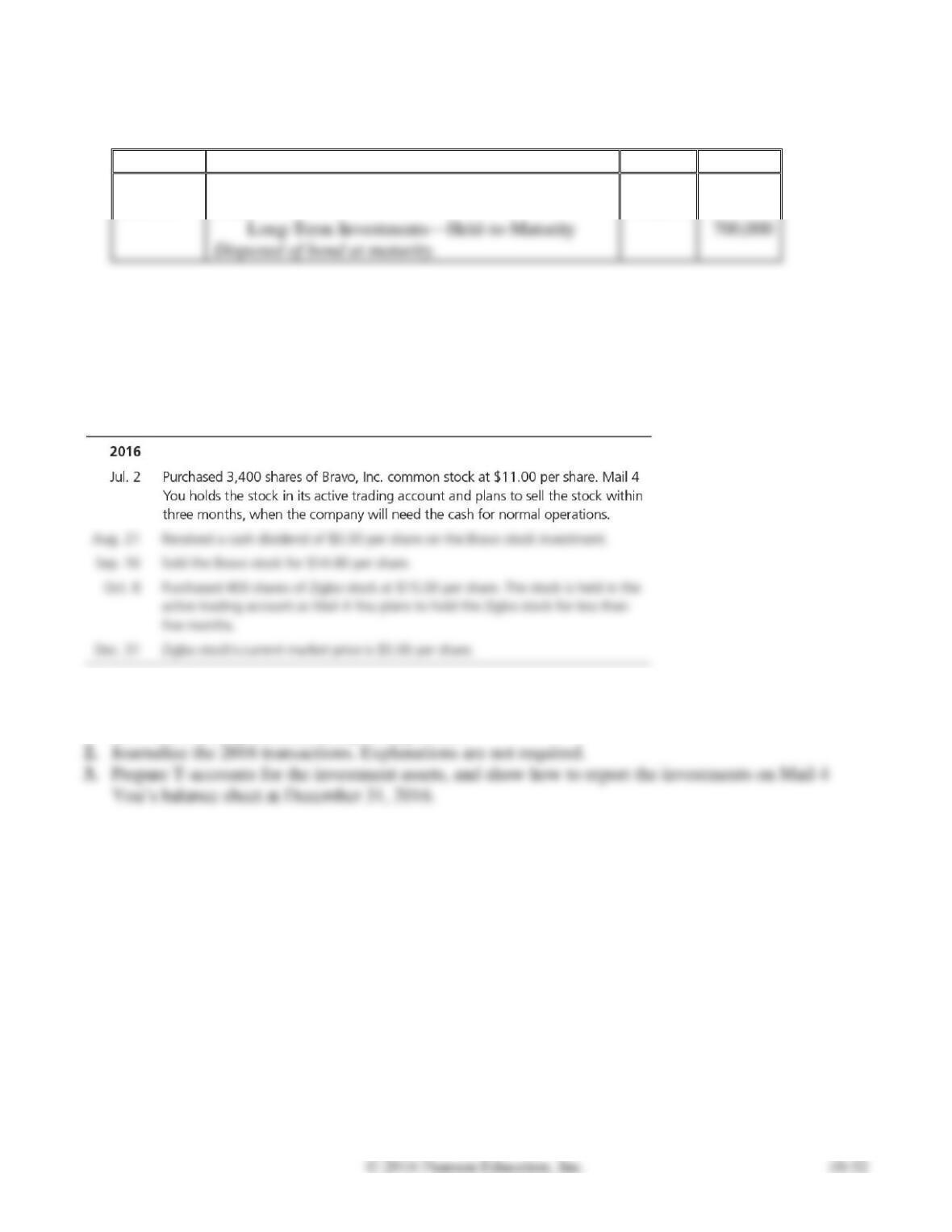
Mail 4 You Corporation generated excess cash and invested in securities as follows:
Requirements
1. Classify each of the investments made during 2016. (Assume the investments represent less than
20% of ownership of outstanding voting stock.)
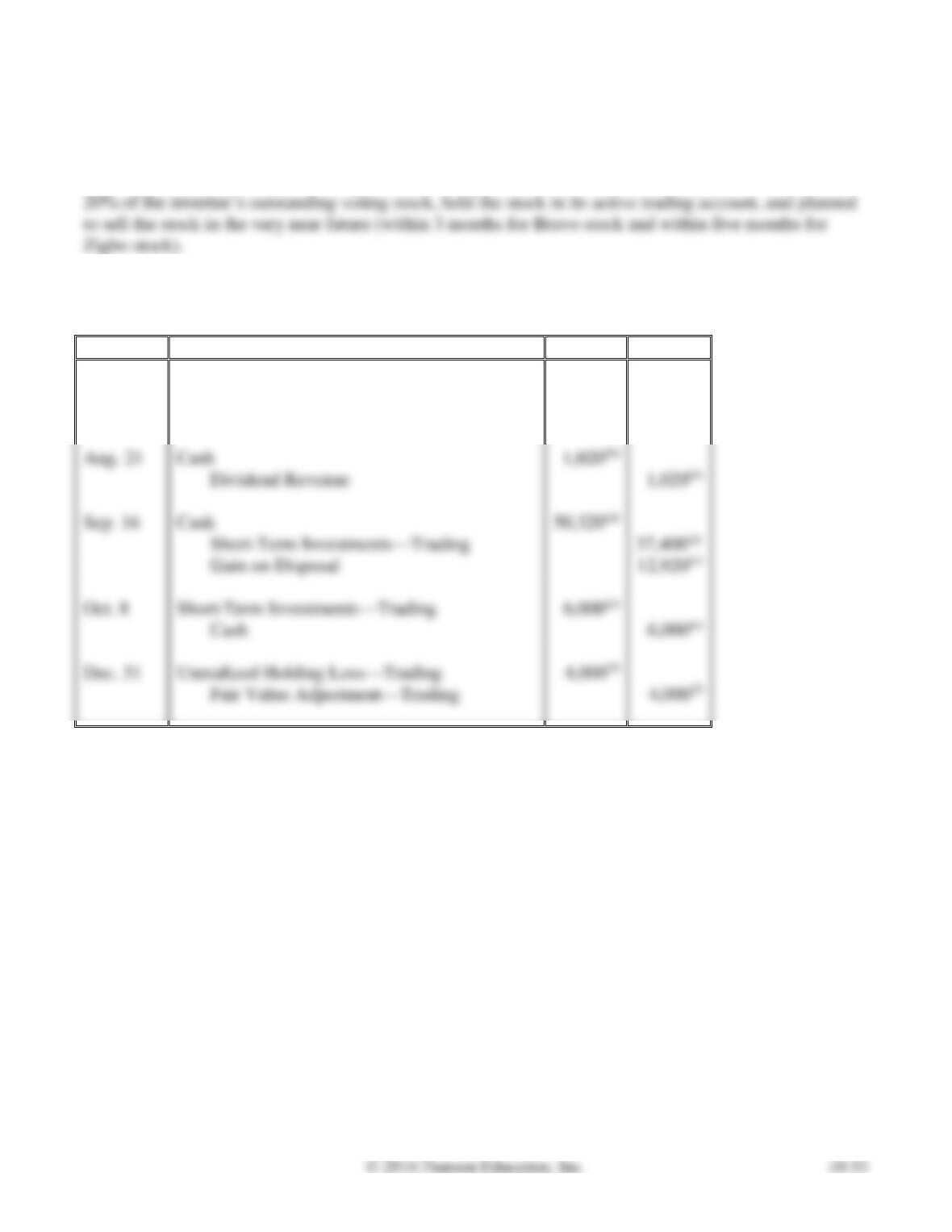
SOLUTION
Requirement 1
Both of the investments made during 2016 are trading investments because Mail 4 You owned less than
Requirement 2
Aug. 21
Cash
Dividend Revenue
Sep. 16
Cash
50,320(d)
Short-Term Investments—Trading
37,400(a)
Gain on Disposal
Oct. 8
Short-Term Investments—Trading
Cash
Dec. 31
Unrealized Holding Loss—Trading
Fair Value Adjustment—Trading
Date
Accounts and Explanation
Debit
Credit
2016
Jul. 2
Short-Term Investments—Trading
37,400(a)
Cash
37,400(a)
P10-18A, cont.
Requirement 2, cont.
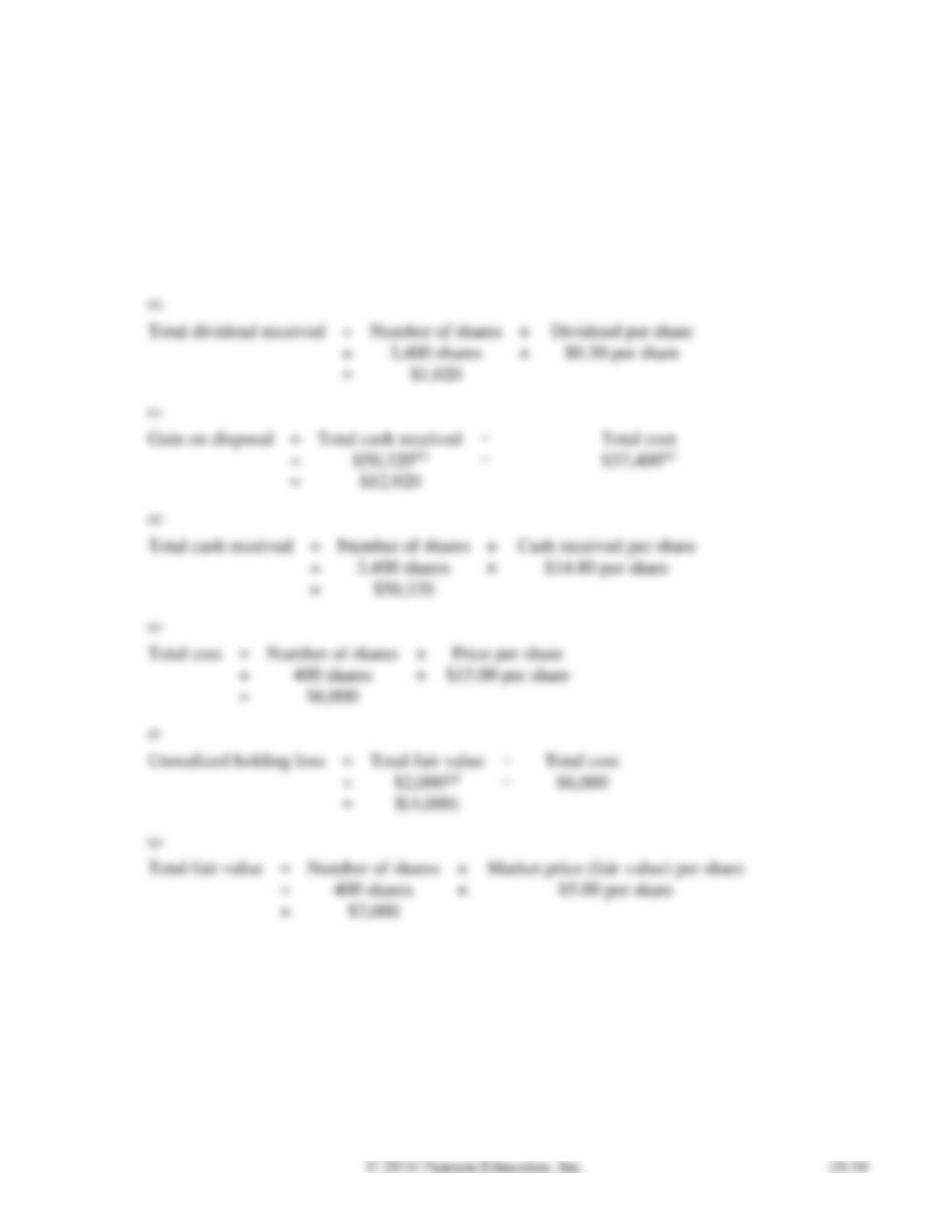
Calculations:
(a)
Total cost
=
Number of shares
×
Price per share
=
3,400 shares
×
$11.00 per share
=
$37,400
(b)
Total dividend received
=
Number of shares
×
Dividend per share
=
3,400 shares
×
=
(c)
Gain on disposal
=
Total cash received
=
=
(d)
Total cash received
=
Number of shares
×
=
3,400 shares
×
=
$50,320
Total cost
=
Number of shares
×
Price per share
=
×
$15.00 per share
=
(f)
Unrealized holding loss
=
Total fair value
=
=
Total fair value
=
Number of shares
×
Market price (fair value) per share
=
×
=
P10-18A, cont.
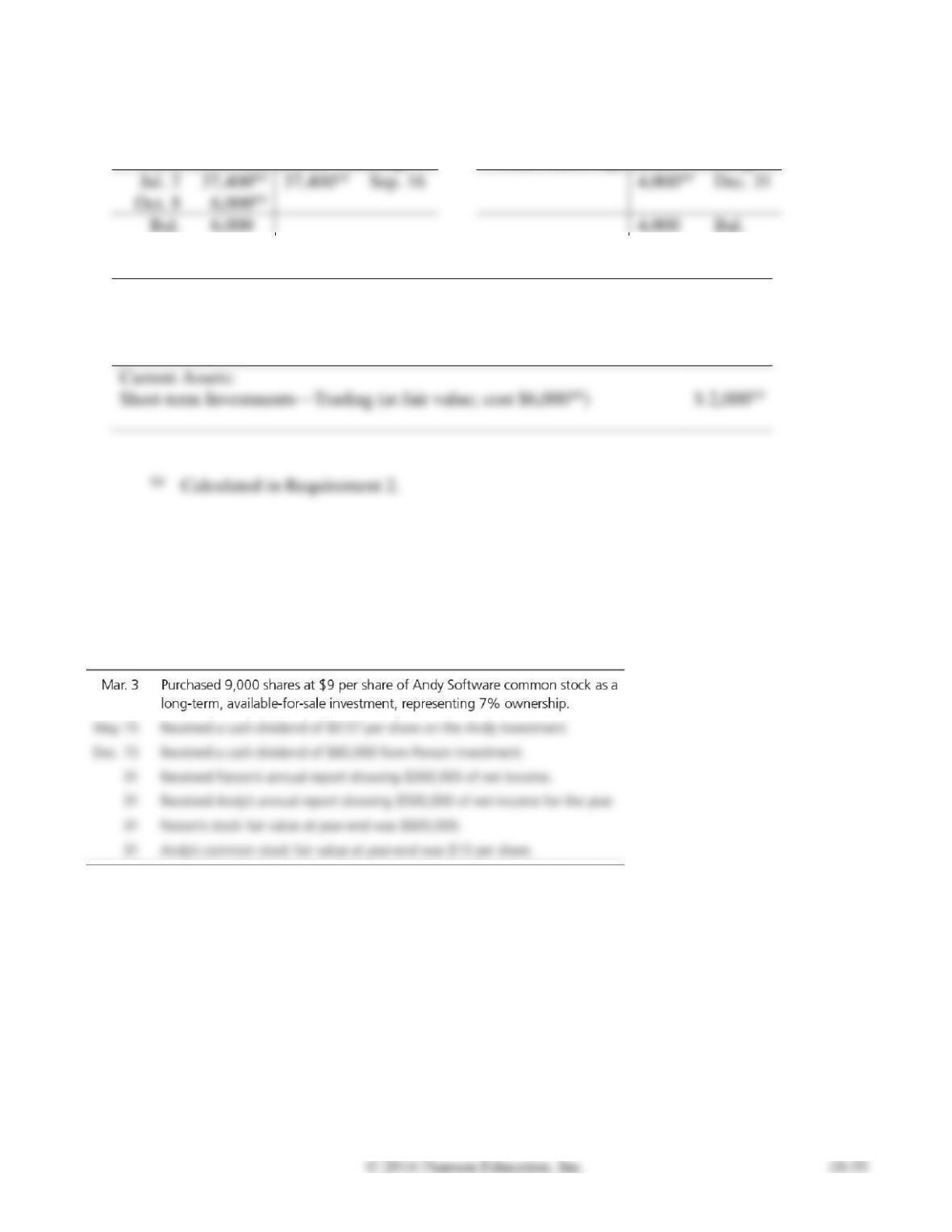
Requirement 3
Short-Term Investments—Trading
Fair Value Adjustment—Trading
Jul. 2
Sep. 16
Dec. 31
Oct. 8
Bal.
MAIL 4 YOU CORPORATION
Balance Sheet (Partial)
December 31, 2016
Current Assets:
Calculated in Requirement 2.
P10-19A Accounting for stock investments
Learning Objectives 3, 4
1. Dec. 31 Fair Value Adjustment—AFS DR $36,000
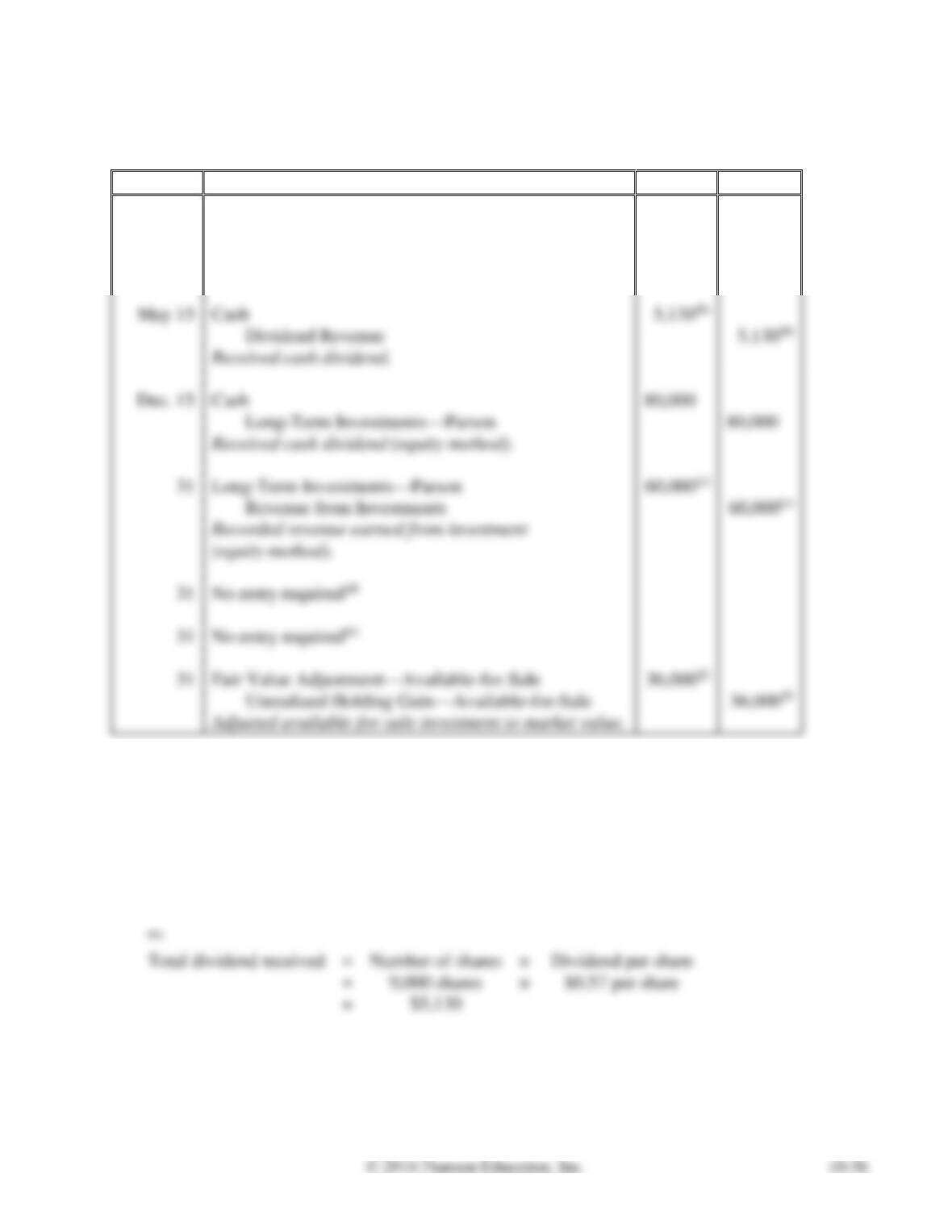
The beginning balance sheet of Desk Source Co. included an $850,000 investment in Parson stock (20%
ownership). During the year, Desk Source completed the following investment transactions:
Requirements
1. Journalize the transactions for the year of Desk Source.
2. Post transactions to T-accounts to determine the December 31, 2016, balances related to the
investment and investment income accounts.
3. Prepare Desk Source’s partial balance sheet at December 31, 2016, from your answers in
Requirement 2.
SOLUTION
Requirement 1
Date
Accounts and Explanation
Debit
Credit
Mar. 3
Long-Term Investments—Available-for-Sale
81,000(a)
Cash
81,000(a)
Purchased investment in stock.
Cash
Dividend Revenue
Received cash dividend.
Cash
Long-Term Investments—Parson
80,000
Received cash dividend (equity method).
Long-Term Investments—Parson
Revenue from Investments
60,000(c)
(equity method).
Fair Value Adjustment—Available-for-Sale
36,000(f)
Unrealized Holding Gain—Available-for-Sale
Adjusted available-for-sale investment to market value.
Calculations:
(a)
Total cost
=
Number of shares
×
Price per share
=
9,000 shares
×
$9 per share
=
$81,000
(b)
Total dividend received
=
Number of shares
×
Dividend per share
=
9,000 shares
×
$0.57 per share
=
P10-19A, cont.
Requirement 1, cont.
(c)
Revenue from
investments
=
Net income earned by investee
×
Percentage ownership
=
$300,000
×
20%
=
$60,000
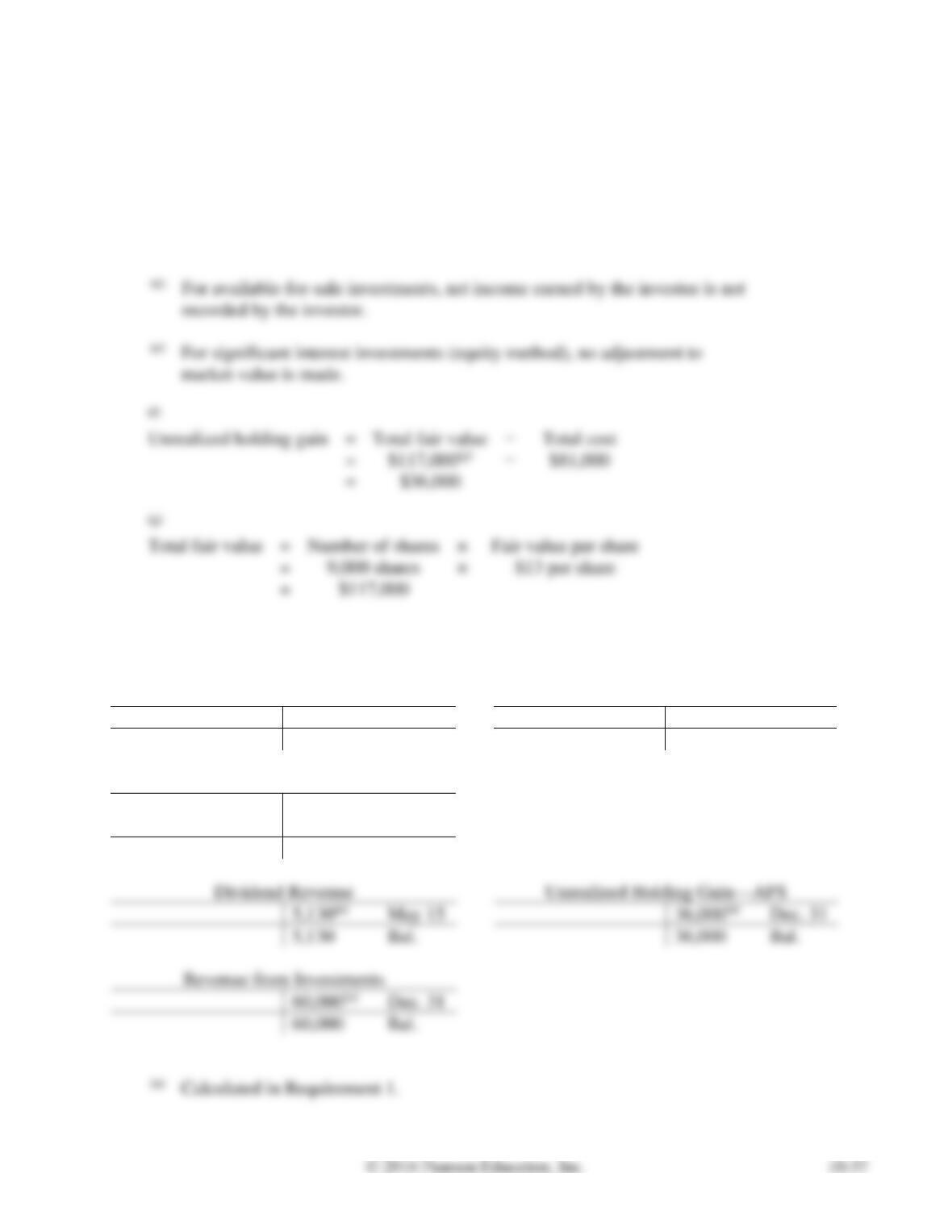
recorded by the investor.
market value is made.
Unrealized holding gain
=
Total fair value
Total cost
=
=
(g)
Total fair value
=
Number of shares
×
=
×
=
Requirement 2
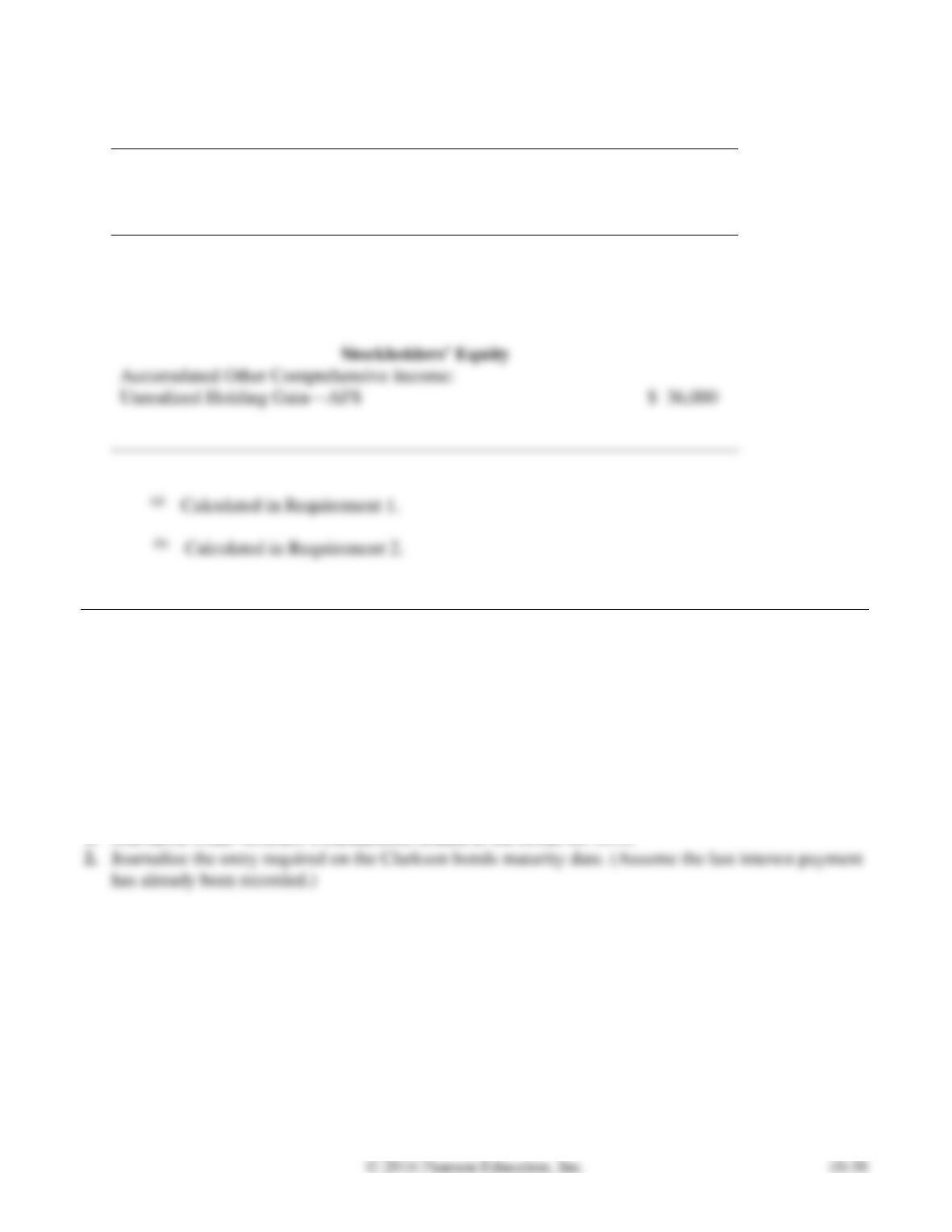
Long-Term Investments—AFS
Fair Value Adjustment—AFS
Mar. 3
81,000(a)
Dec. 31
36,000(a)
Bal.
81,000
Bal.
36,000
Long-Term Investments—Parson
Beg.
850,000
80,000
Dec. 15
Dec. 31
60,000(a)
Bal.
830,000
May 15
Dec. 31
5,130
Bal.
36,000
Bal.
Dec. 31
60,000
Bal.
(a)
P10-19A, cont.
Requirement 3
DESK SOURCE CO.
Balance Sheet (Partial)
December 31, 2016
Assets
Long-term Assets:
Long-term Investments—AFS (at fair value; cost $81,000(a))
$117,000(a)
Long-term Investments—Parson (equity method)
830,000(b)
Accumulated Other Comprehensive Income:
Unrealized Holding Gain—AFS
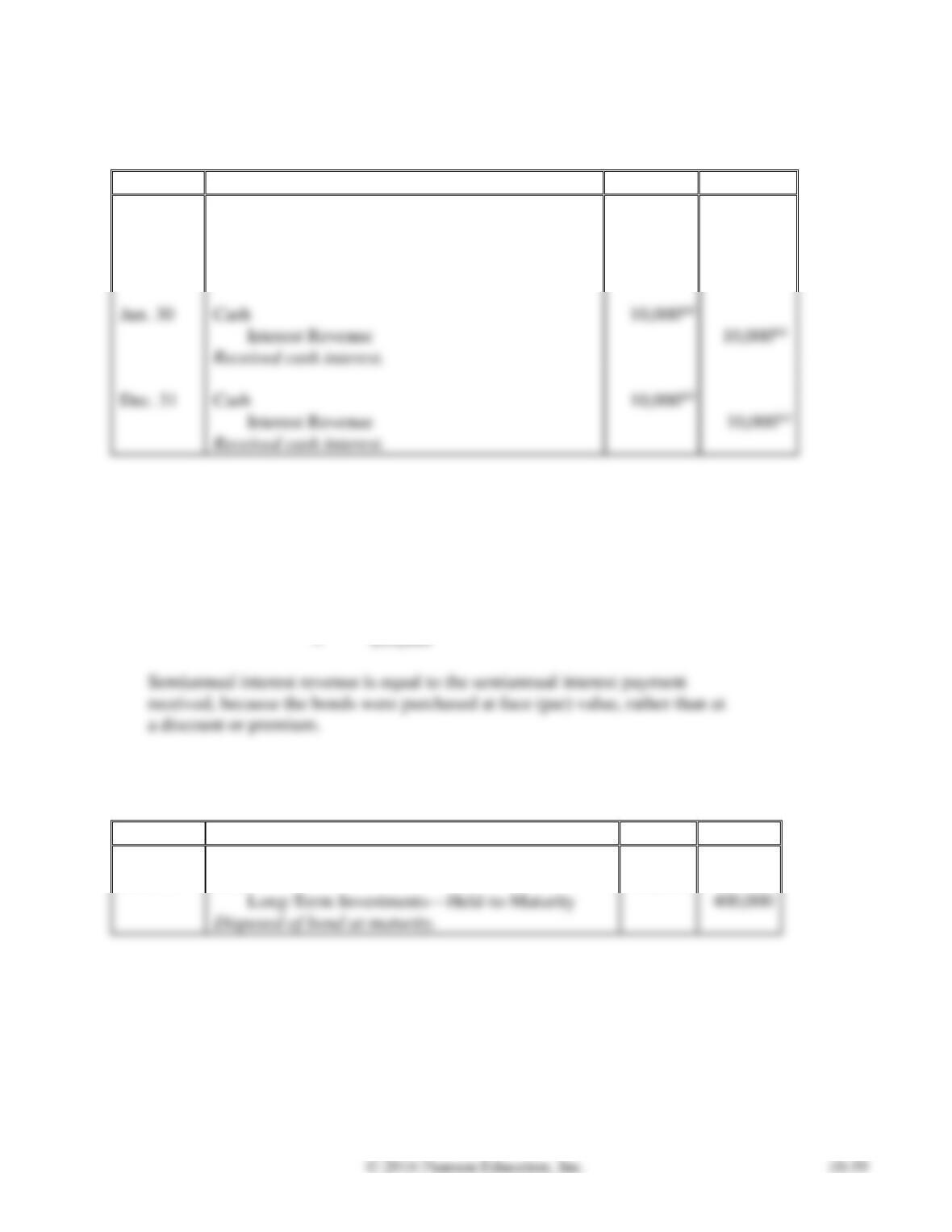
Calculated in Requirement 1.
Calculated in Requirement 2.
Problems (Group B)
P10-20B Accounting for bond investments
Learning Objective 2
1. Dec. 31 Int. Rev. CR $10,000
Suppose Ritter Brothers purchases $400,000 of 5% annual bonds of Clarkson Corporation at face value
on January 1, 2016. These bonds pay interest on June 30 and December 31 each year. They mature on
December 31, 2020. Ritter intends to hold the Clarkson bond investment until maturity.
Requirements
1. Journalize Ritter Brothers’s transactions related to the bonds for 2016.
SOLUTION
Requirement 1
Date
Accounts and Explanation
Debit
Credit
2016
Jan. 1
Long-Term Investments—Held-to-Maturity
400,000
Cash
400,000
Purchased investment in bonds.
Jun. 30
Cash
Interest Revenue
Received cash interest.
Dec. 31
Cash
Interest Revenue
Received cash interest.
Calculations:
(a)
Semiannual interest
payment received
=
Face (par) value
×
Annual stated rate
×
½
=
$400,000
×
5%
×
½
=
received, because the bonds were purchased at face (par) value, rather than at
a discount or premium.
Requirement 2
Date
Accounts and Explanation
Debit
Credit
2020
Dec. 31
Cash
400,000
Long-Term Investments—Held-to-Maturity
400,000
Disposed of bond at maturity.