CHAPTER 10
Strategies with Respect to Government
CHAPTER SUMMARY AND TEACHING OBJECTIVES
The government may be the most important external element in business. This chapter deals with how
the government intervenes in business and the ways that a business can use the government to create a
competitive advantage or a barrier to entry.
Managers must be aware of the government’s influence on business. It is necessary to know what the
IMPORTANT TERMS
Herfindahl-Hirschman Index (HHI) measure of concentration or market dominance. It is the sum of
squares of firm size.
antitrust attempts by government to enhance ‘fair’ competition.
dumping dumping occurs when a country sells a product in a foreign country for less that it does in its
own country
TOPICS AND TEACHING SUGGESTION
1. Government Intervention in Markets
It is more often the case that firms operate in markets that are not unfettered competition. There is
some governmental intervention. Still, the firm needs to remain efficient. However, government
can be used by others (or by you) to restrict what you can do – they can rent seek. There is the
traditional anti-trust regulation and the measurement of ‘fairness’. Do other firms use government
to limit entry or limit what you can do when you compete with them?
2. International Regulation
3. Economic Regulation
Economic regulation focuses on a single firm and how they operate. Often these regulations
4. Social Regulation
ANSWERS TO EXERCISES
1. Company X has developed an important brand name through its advertising, innovation, and
product quality and service. Suppose Company X sets up a network of exclusive dealerships,
and one of the dealers decides to carry rival products as well as Company X’s products. If
Company X terminates the dealership, is it acting in a pro– or anticompetitive manner?
2. Would auctioning broadcast licenses be more efficient than having the Federal
Communications Commission (FCC) assign licenses on some basis designed by the FCC?
3. Which of the three types of government policies—antitrust, social regulation, economic
regulation—is the basis for each of the following? Who benefits from the policy?
a. beautician education standards
b. certified public accounting requirements
c. liquor licensing
d. Justice Department guidelines
e. the Clean Air Act
f. the Nutrition and Labeling Act
a. Beautician education standards: Economic regulation: existing beauticians benefit—new or
4. Some airline executives have called for “re–reregulation”. Why might an executive of an
airline prefer to operate in a regulated environment?
5. Discuss the claim that social regulation is unnecessary. Does the claim depend on whether the
structure of an industry is primarily one of perfect competition or of oligopoly?
6. Suppose a firm is selling a product for less a foreign country than it does in the home country
and an antidumping suit forces an end to the practice. Is it possible that the result is a loss in
efficiency? Explain.
7. In the 1990s, the Justice Department sued several universities for collectively setting the size
of scholarships offered. Explain why the alleged price fixing on the part of universities might
8. Suppose a consumer hires Bekins moving company to move his possessions from California
to Utah and Bekins damages $3,000 worth of furniture and refuses to compensate him. The
consumer in frustration says, “There ought to be a law!” Evaluate the situation.
9. “The Japanese or Chinese or Koreans or others, are beating us at every step. We must act as
they do. We must allow and encourage cooperation among firms and we must develop
partnerships between business and government. ” Evaluate this argument.
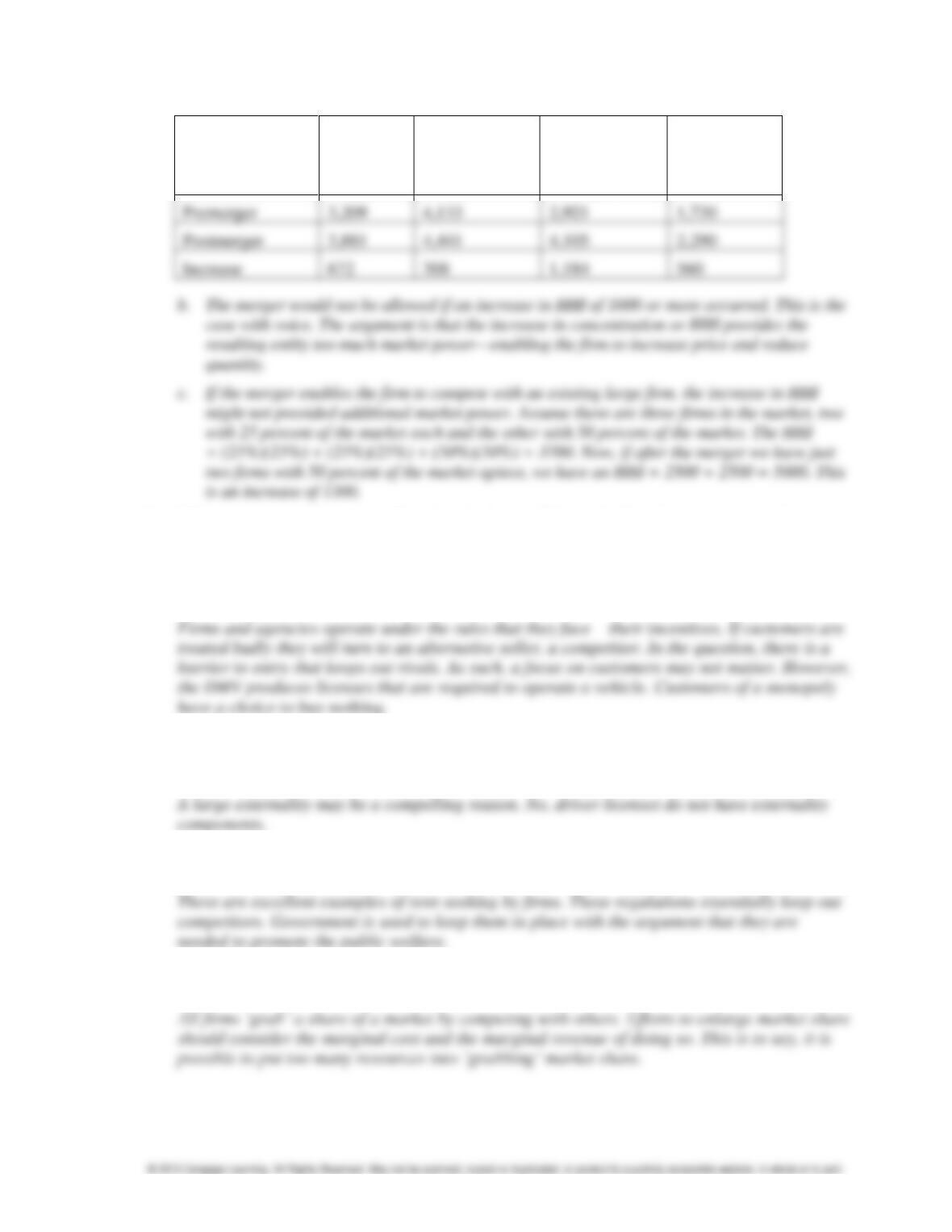
10. Using the following HHIs, do the following:
a. Indicate in which market a merger would be allowed under Department of Justice
guidelines.
b. Provide an economic explanation for why this result would occur.
c. Provide a numerical example illustrating why the result might not make economic sense.
Impact of WorldCom’s Acquisition of Sprint
(HHIs for Long-Distance Voice, Data, and Internet Backbone Markets)
Chapter 10: Strategies with Respect to Government 47
Total
Long
Distance
Voice
Consumer
Long Distance
Voice
Business Long
Distance Voice
Total Long
Distance
Data
Postmerger
3,881
4,441
4,105
2,290
Increase
1,184
11. “Government operations are often described as inefficient. In fact, they operate exactly as we
would expect given their incentives.” What does this mean? The example used is the DMV
– a monopoly that does not care about the customer. Is this an appropriate analogy? Would a
monopoly care about its customers? Can you to draw an analogy between the firm and the
DMV with respect to a firm’s relationships with employees and the assets it owns?
12. “The government should not be the sole provider of a good or service unless there is a
compelling reason …” What compelling reason? Would you agree that issuing driver’s
licenses must be left to government?
13. Explain why regulations such as licensing requirements and immigration restrictions come
into being and then remain in practice.
14. The “grabbing hand” may be described as merely an essential business strategy. Explain what
the strategy is and demonstrate how many resources a business should allocate to it.
15. What is a natural monopoly? Can you think of an example of a natural monopoly? If you
16. What are network externalities? What is the externality part of the “network externalities”?
Why don’t firms with network externalities become monopolists?
17. The 2010 FCC report on the wireless market also noted that: There are over 900,000 rural
residents who have no mobile service at all. Another 2.5 million get coverage from only one
provider. Why would the report note the rural residents? Do the rural residents have
something to do with the high HHI?
18. Explain why rent seeking competition tends to dissipate rents – to drive them down so that
there are no abnormal rents?
19. Would you expect rent seeking more by large firms or small firms? Explain
20. Suppose internal rent seeking increases as firm size increases. What would this say for the
‘optimal’ size of firms?