
30
X. CHAPTER TEN: RELATIONAL PREDICATE LOGIC
A. Symbolizing
1. If something is heavy, then Art won’t lift it. (Hx = “x is heavy”; a = “Art”; Lxy =
“x will lift y”.)
2. If something is heavy, then anyone who is weak will not lift it. (Px =“x is a
person”; Wx =“x is weak”.)
3. Everyone who loves himself hates someone (or other). (Px =“x is a person”; Lxy
=“x loves y”; Hxy =“x hates y”.)
4. All who have sinned have come short of the glory of God. (Px =“x is a person”;
Sx =“x has sinned”; Cxy =“x has come short of y”; g= “the glory of God.”)
5. If anything is heavy, then there is something heavier than this piece of chalk,
which happens not to be heavy. (Hx = “x is heavy”; Hxy = “x is heavier than y”;
c = “this piece of chalk”.)
6. All freshmen date only seniors. (Fx =“x is a freshman”; Dxy =“x dates y”; Sx =
“x is a senior”.)
7. Some freshmen date only seniors.
8. Some freshmen date every senior.
9. Some freshmen date no seniors.
10. No freshmen date all seniors.
11. No freshmen date any seniors.
12. Not all freshmen date seniors.
13. Not all freshmen date every senior.
14. Jones will listen to Smith, even though Smith is boring. (j = “Jones”; s = “Smith”;
Lxy = “x will listen to y”; Bx =“x is boring”.)
15. All sinners who sin against someone who is a sinner are sinned against by
someone who is a sinner. (Sx =“x is a sinner”; Sxy =“x sins against y”.)
16. If every sinner is sinned against by everyone who is a sinner, then everyone who
sins against someone (or other) sins against himself.

31
17. Someone who is a sinner and sins against someone (or other) who is a sinner sins
against himself.
18. All heads of horses are heads of animals, provided that all horses are animals. (Hx
= “x is a horse”; Ax = “x is an animal”; Hxy = “x is the head of y”.)
A. Answers
1. (x) (Hx ~Lax)
B. Translations. Letting Hxy = “x is heavier than y”, translate the following into English
(coming as close as possible to colloquial usage):
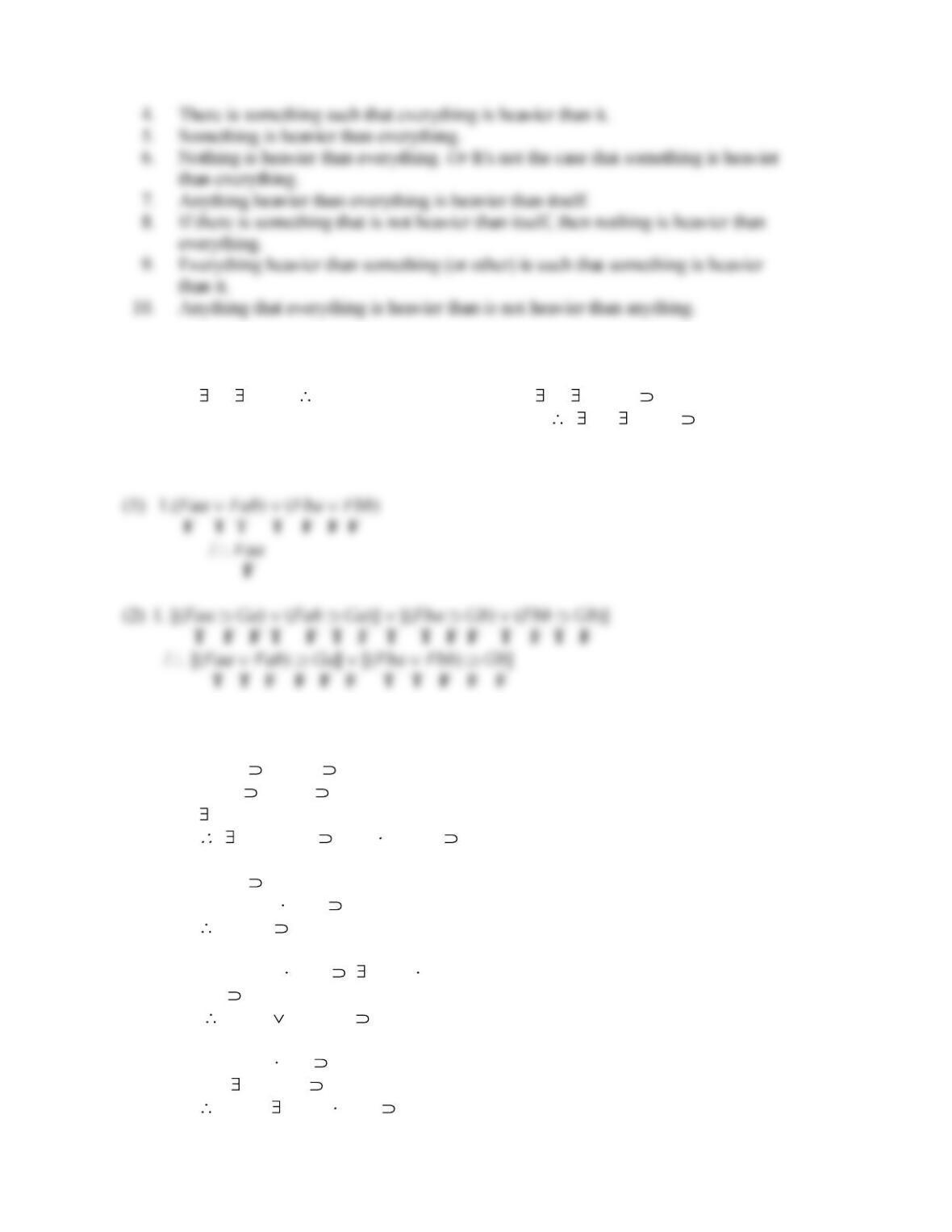
1. (x) (y)Hxy
2. ( x) ( y)Hxy
3. (x) ( y)Hxy
4. ( x) (y)Hyx
5. ( x) (y)Hxy
6. ~ ( x)(y)Hxy
7. (x) [(y)Hxy Hxx]
8. ( x) ~ Hxx ~ ( x) (y)Hxy
9. (x) [( y)Hxy (z)Hzx]
10. (x) [(y)Hyx ~ ( z)Hxz]
B. Answers
1. Everything is heavier than everything.
32
C. Proving invalidity. Show that the following arguments are invalid:
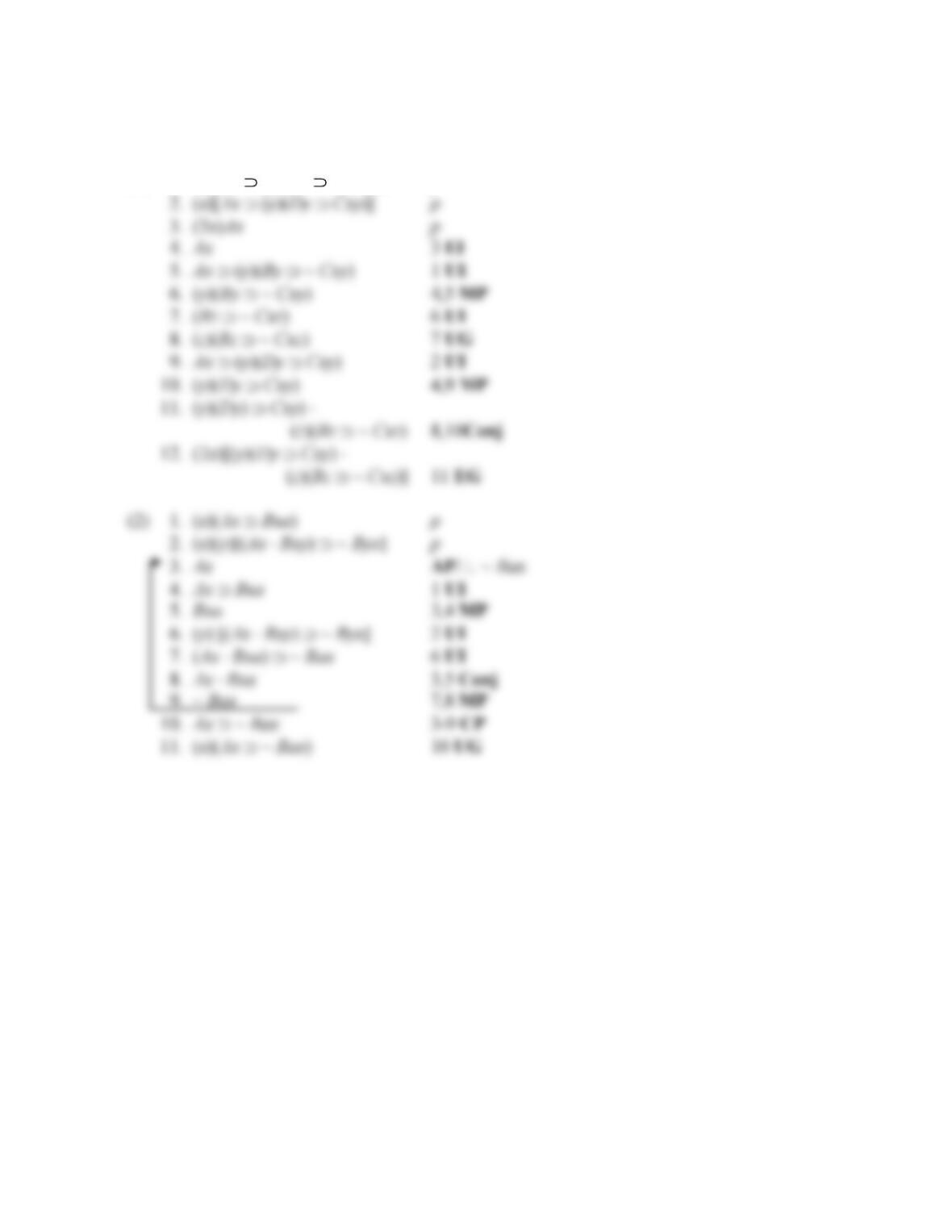
(1) 1. ( x) ( y)Fxy/Faa (2) 1. ( x) ( y) (Fxy Gx)
/ ( x) (( y) Fxy Gx)
C. Answers
D. Prove valid
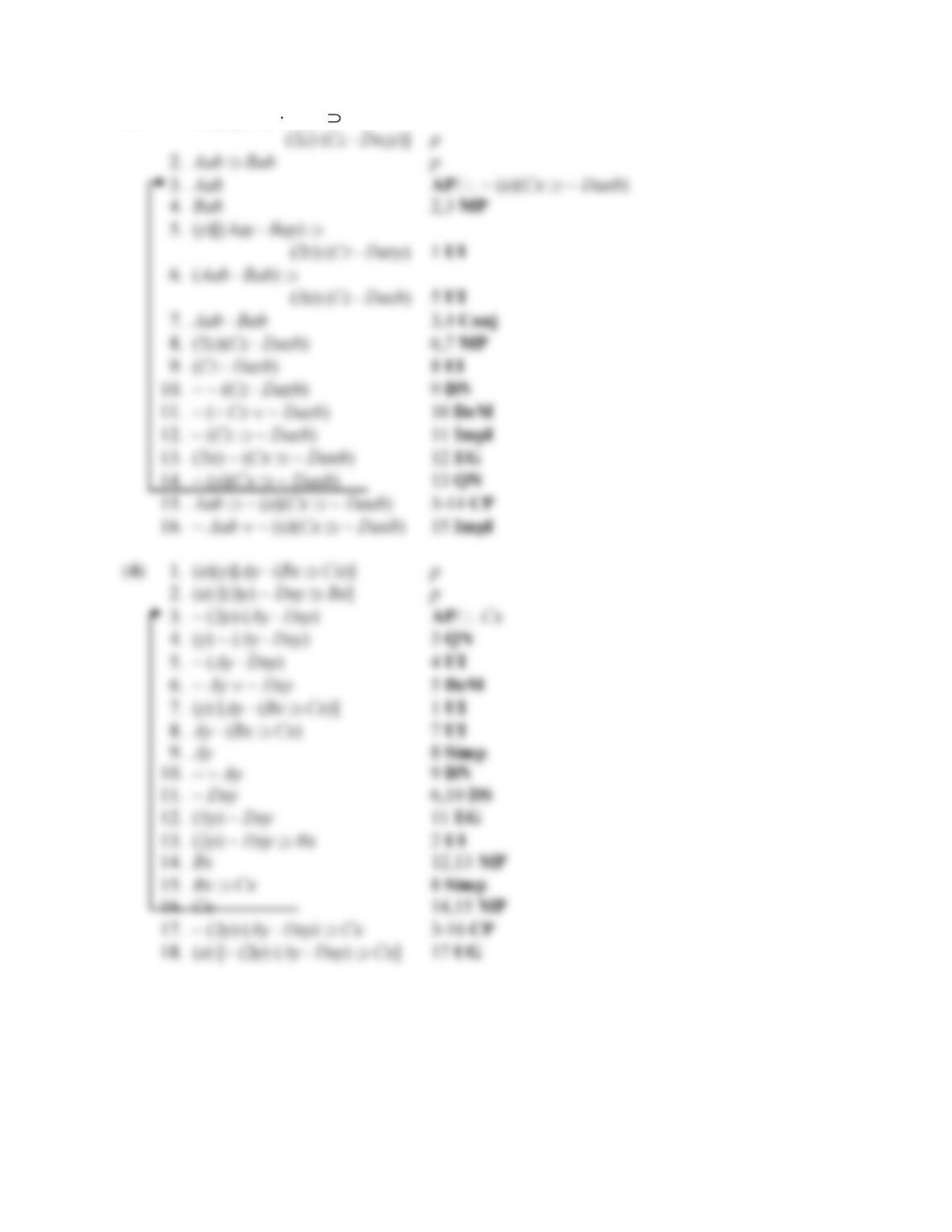
(1) 1. (x) [Ax (y) (By ~Cxy)]
2. (x)[Ax (y)(Dy Cxy )]
3. ( x)Ax
/(x) [(y) (Dy Cxy) (z) (Bz ~Cxz)]
(2) 1. (x) (Ax Bxa)
2. (x) (y) [(Ax Bxy) ~ Byx]
/ (x) (Ax ~Bax)
(3) 1. (x)(y) [(Axy Bxy) ( z) (Cz Dxzy)]
2. Aab Bab
/ ~ Aab ~ (x)(Cx ~Daxb)
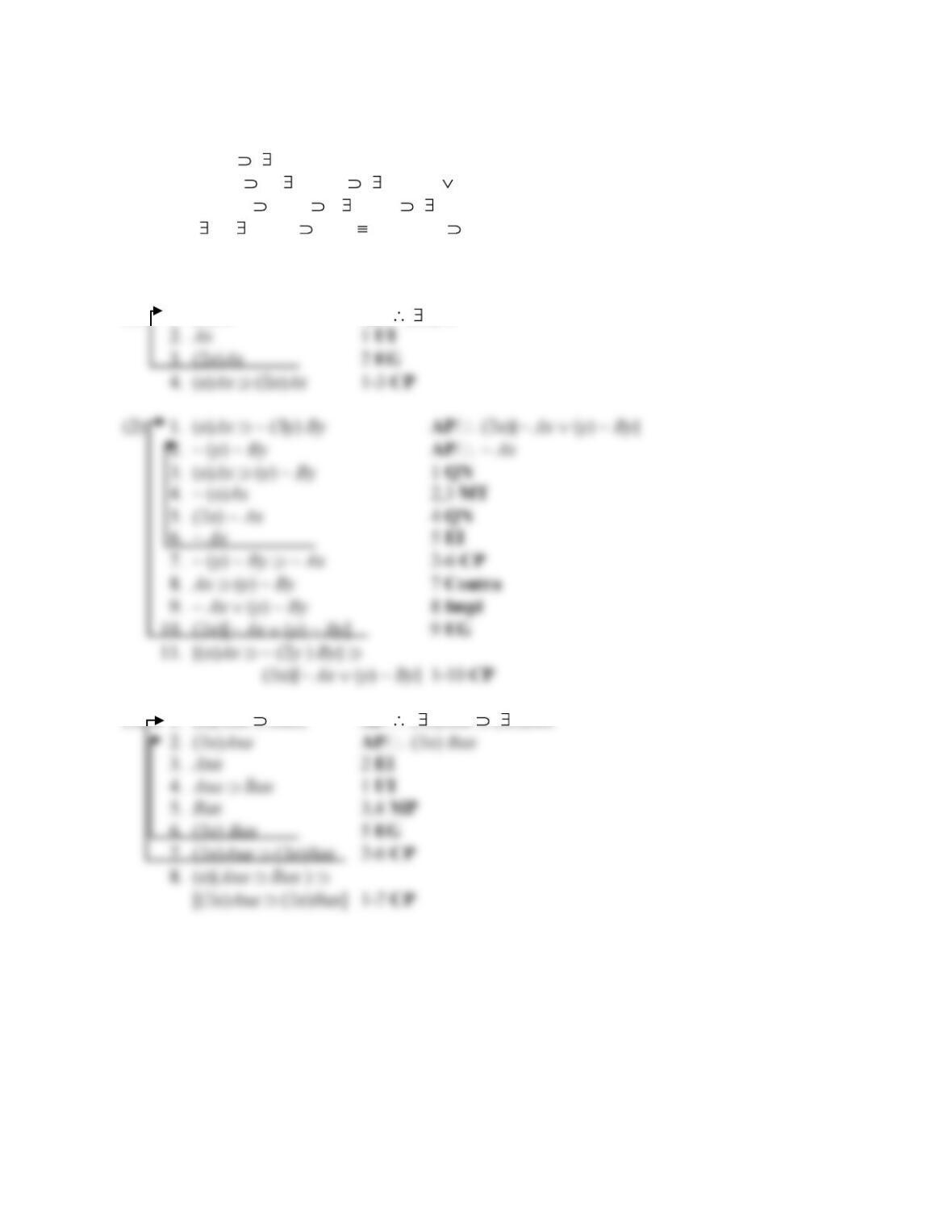
(4) 1. (x) (y) [Ay (Bx Cx)]
2. (x) [( y) ~ Dxy Bx]
/ (x) [~ ( y) (Ay Dxy)Cx]
33
D. Suggested Answers
(1) 1. (x)[Ax (y)(By ~Cxy)] p
34
(3) 1. (x)(y)[(Axy Bxy)
35
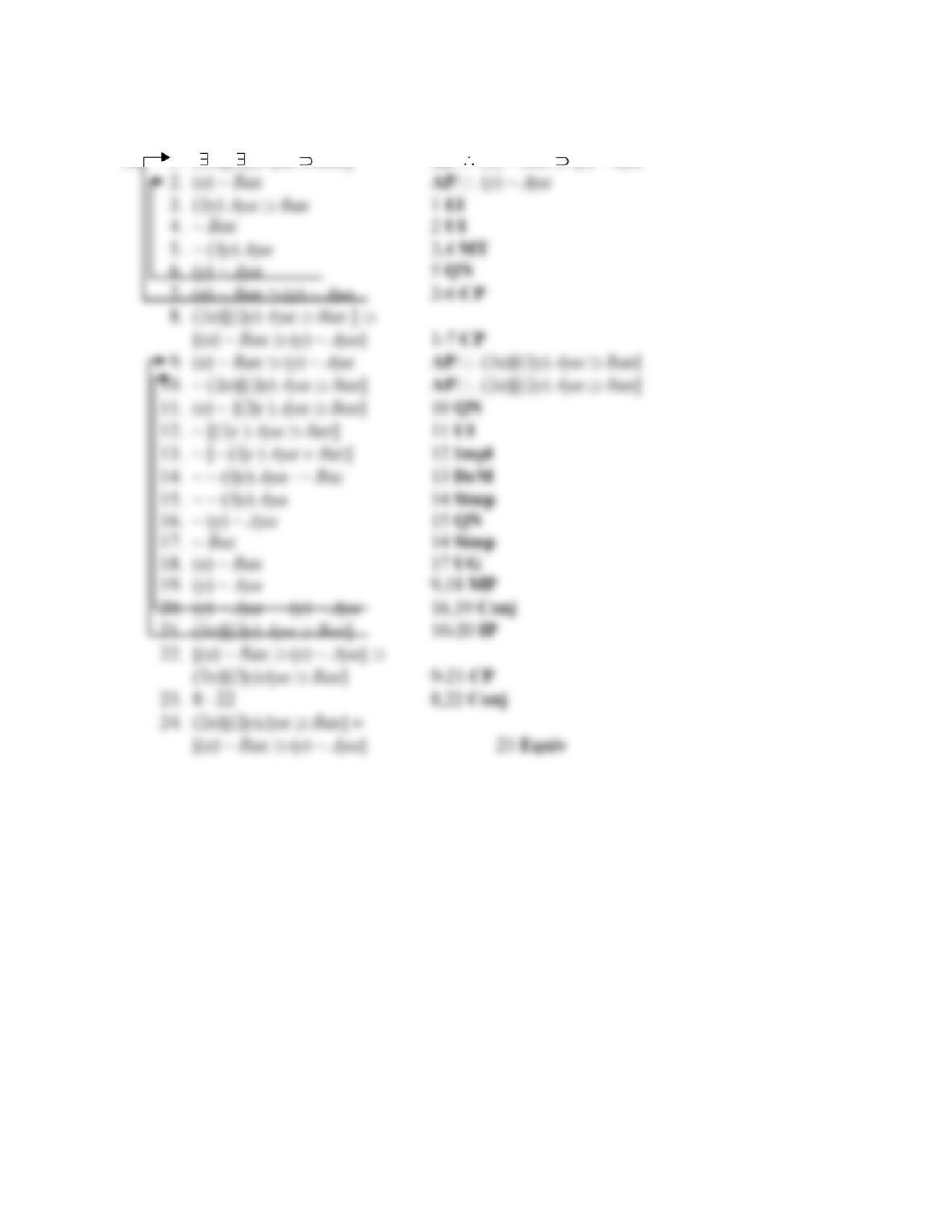
E. Theorems of logic. Prove that the following are theorems of logic:
1. (x)Ax (x)Ax
2. [(x)Ax ~ ( y)By ] ( x)[~ Ax (y) ~ By]
3. (x)(Axa Bax) [( x)Axa (x)Bax]
4. ( x)[( y)Aya Bax] [(x)~ Bax (y)~ Aya]
E. Suggested Answers
(1) 1. (x)Ax AP/ ( x)Ax
(3) 1. (x)(Axa Bax)AP/ ( x)Axa (x)Bax
36
(4) 1. ( x)[( y)Aya Bax]AP/ (x) ~ Bax (y) ~ Aya