
y10.33:= T 100 degC⋅:= Guess: x10.33:= P 100 kPa⋅:=
Given x1Psat1T()⋅1x
1
−
()
Psat2T()⋅+ P=
(c) Given: x10.33:= P 120 kPa⋅:= Guess: y10.5:= T 100 degC⋅:=
Chapter 10 – Section A – Mathcad Solutions
10.1 Benzene: A113.7819:= B12726.81:= C1217.572:=
Toluene: A213.9320:= B23056.96:= C2217.625:=
Psat1T() e
A1B1
T
degC C1
+
−
kPa⋅:= Psat2T() e
A2B2
T
degC C2
+
−
kPa⋅:=
(a) Given: x10.33:= T 100 degC⋅:= Guess: y10.5:= P 100 kPa⋅:=
(b) Given:
312
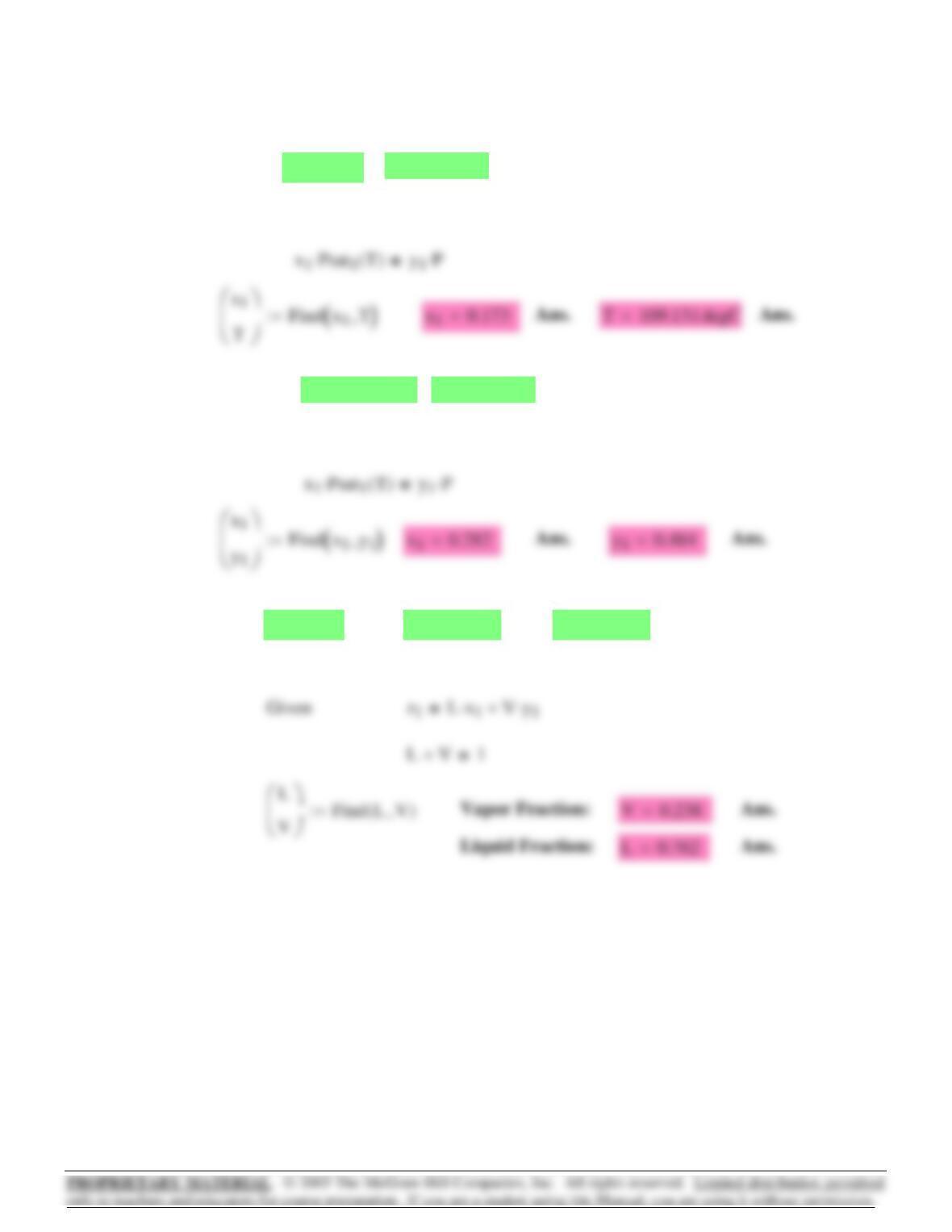
(f) z10.33:= x10.282=y10.484=
Guess: L 0.5:= V 0.5:=
(g) Benzene and toluene are both non-polar and similar in shape and
size. Therefore one would expect little chemical interaction
between the components. The temperature is high enough and
pressure low enough to expect ideal behavior.
(d) Given: y10.33:= P 120 kPa⋅:= Guess: x10.33:= T 100 degC⋅:=
Given x1Psat1T()⋅1x
1
−
()
Psat2T()⋅+ P=
(e) Given: T 105 degC⋅:= P 120 kPa⋅:= Guess: x10.33:= y10.5:=
Given x1Psat1T()⋅1x
1
−
()
Psat2T()⋅+ P=
313
140
150
x10 0.05,1.0..:=
y’1x1
()
x1Psat1Tx
1
()()
⋅
x1Psat1Tx
1
()()
⋅1x
1
−
()
Psat2Tx
1
()()
⋅+
:=
Tx
1
()
root x1Psat1t()⋅1x
1
−
()
Psat2t()⋅+ P’−t,
⎡
⎣
⎤
⎦
:=
t90:=
Guess t for root function:
Psat2T( ) exp A2B2
TC
2
+
−
⎛
⎜
⎝
⎞
⎠
:=
Psat1T( ) exp A1B1
TC
1
+
−
⎛
⎜
⎝
⎞
⎠
:=
C2212.300:=B23259.93:=A213.9726:=
C1217.572:=B12726.81:=A113.7819:=
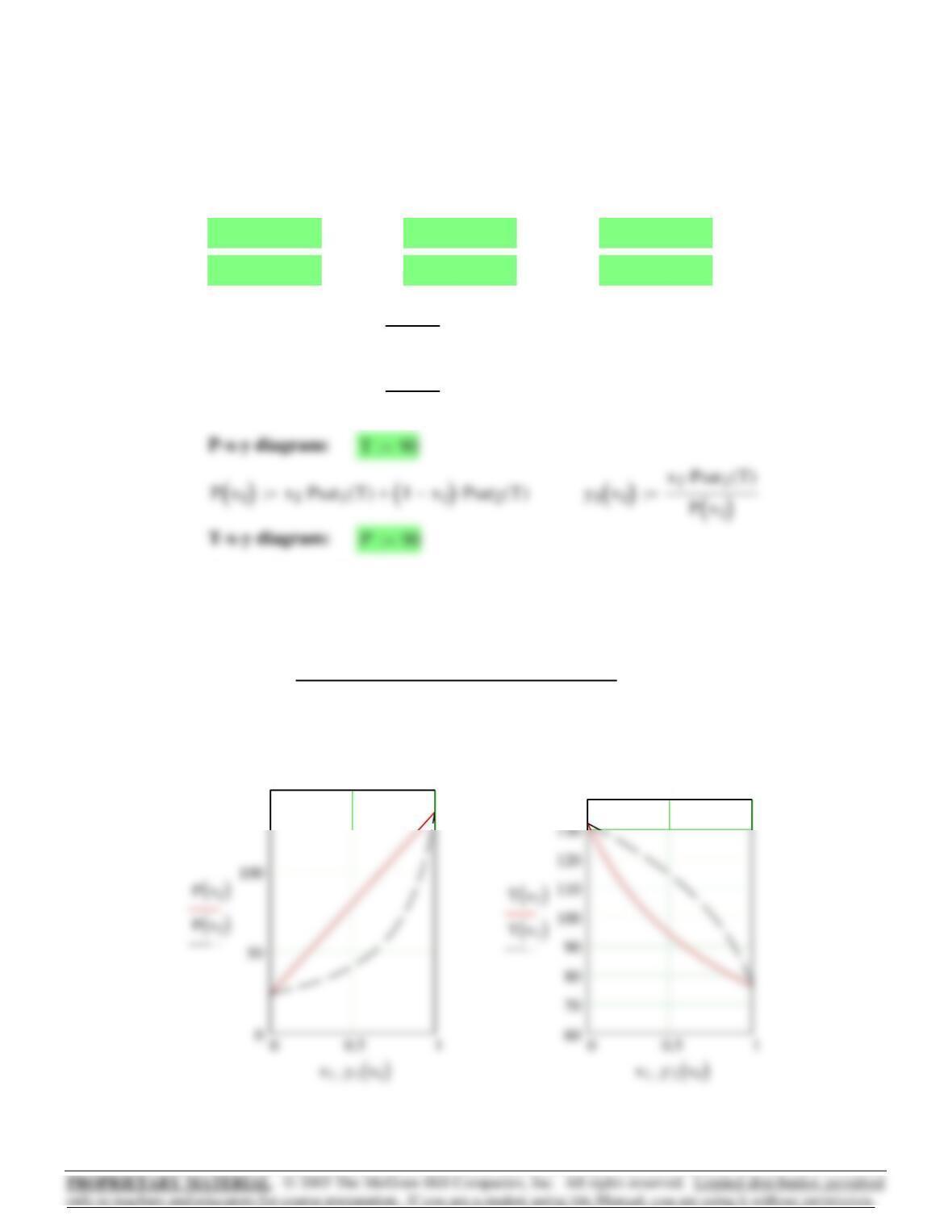
Antoine coefficients: Benzene=1; Ethylbenzene=2(a)
Pressures in kPa; temperatures in degC10.2
314
130
160
x10 0.05,1.0..:=
Tx
1
()
root x1Psat1t()⋅1x
1
−
()
Psat2t()⋅+ P’−t,
⎡
⎣
⎤
⎦
:=
t90:=
Guess t for root function:
T90:=
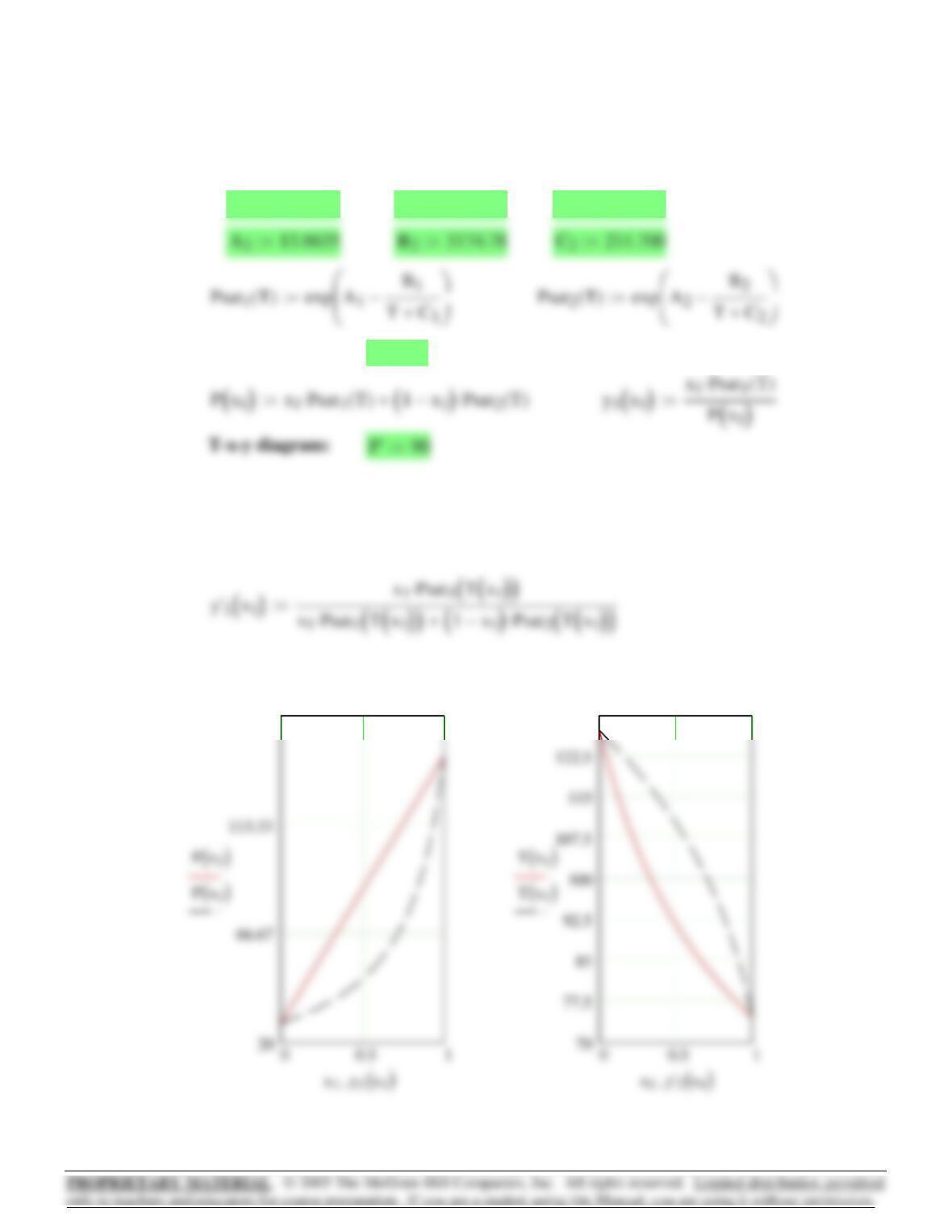
P-x-y diagram:
C1218.265:=B12723.73:=A113.7965:=
Antoine coefficients: 1-Chlorobutane=1; Chlorobenzene=2 (b)
315
1
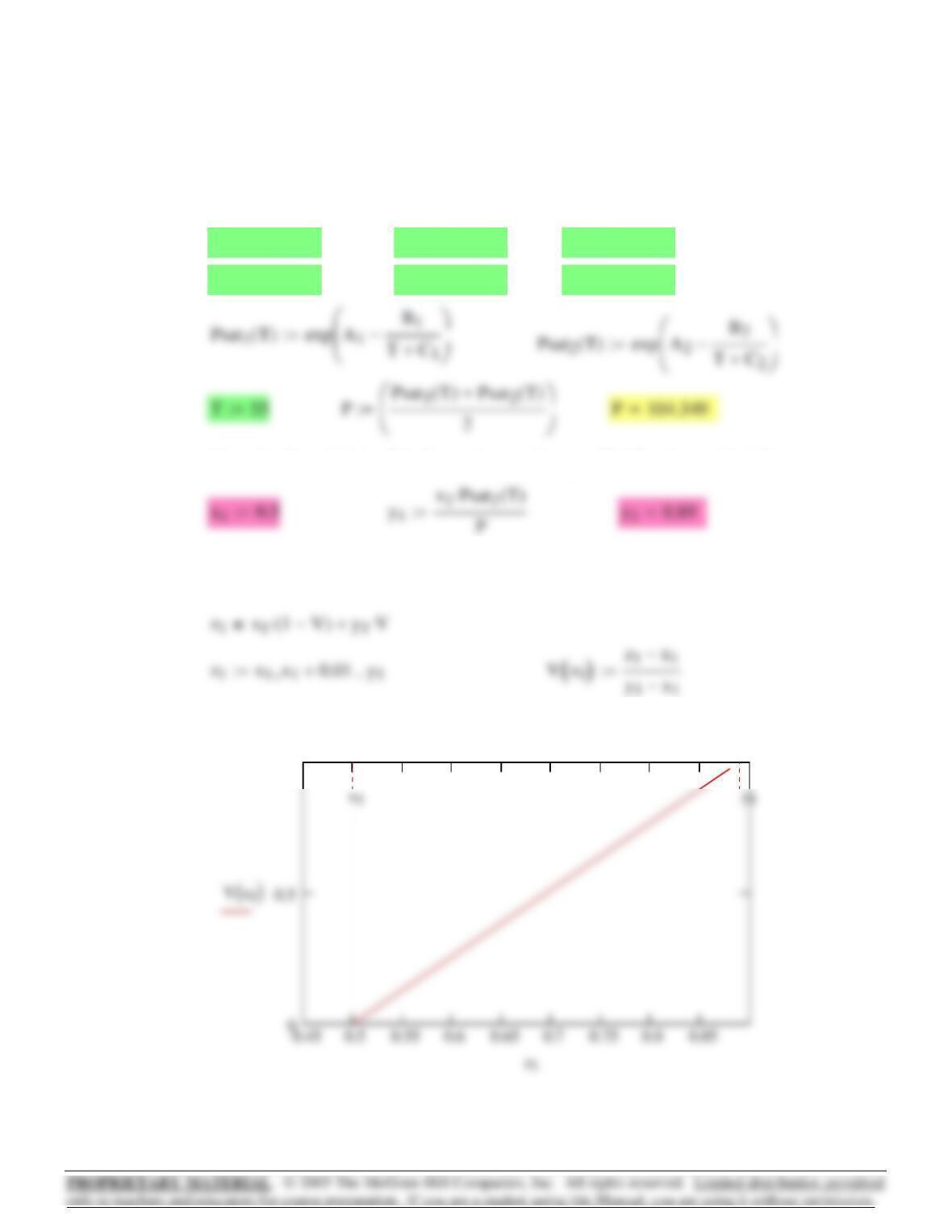
V is obviously linear in z1:
For a given pressure, z1 ranges from the liquid composition at the bubble
point to the vapor composition at the dew point. Material balance:
Since for Raoult’s law P is linear in x, at the specified P, x1 must be 0.5:
C2216.432:=B22911.26:=A213.8622:=
C1232.014:=B12451.88:=A113.7667:=
Antoine coefficinets: n-Pentane=1; n-Heptane=2(a)
Pressures in kPa; temperatures in degC10.3
316
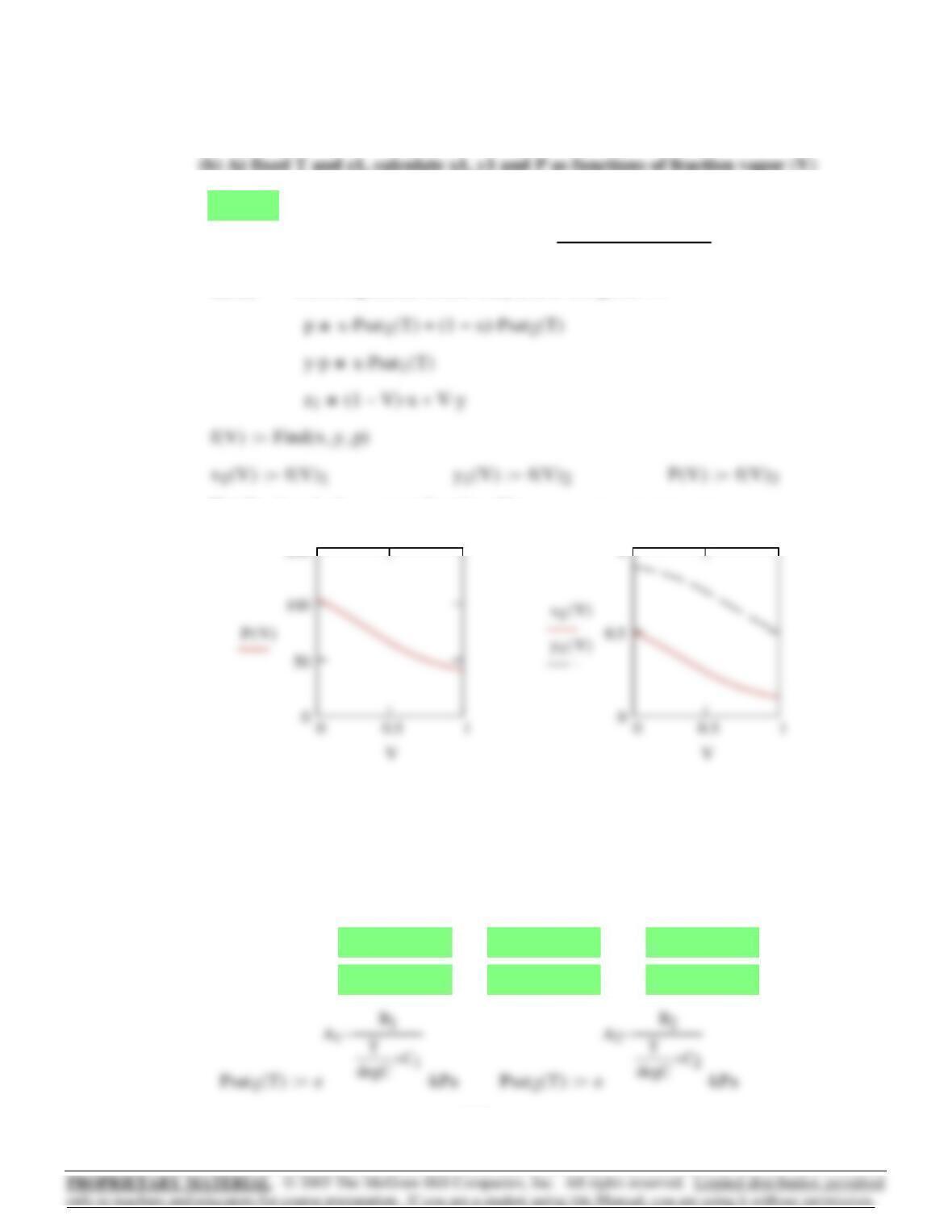
V 0 0.1,1.0..:=
150
1
10.4 Each part of this problem is exactly like Problem 10.3, and is worked in
exactly the same way. All that is involved is a change of numbers. In
fact, the Mathcad solution for Problem 10.3 can be converted into the
solution for any part of this problem simply by changing one number, the
temperature.
10.7 Benzene: A113.7819:= B12726.81:= C1217.572:=
Ethylbenzene A213.9726:= B23259.93:= C2212.300:=
z10.5:=
Guess: x 0.5:= y 0.5:= pPsat1T( ) Psat2T()+
2
⎛
⎜
⎝
⎞
⎠
:=
Given Three equations relate x1, y1, & P for given V:
Plot P, x1 and y1 vs. vapor fraction (V)
317
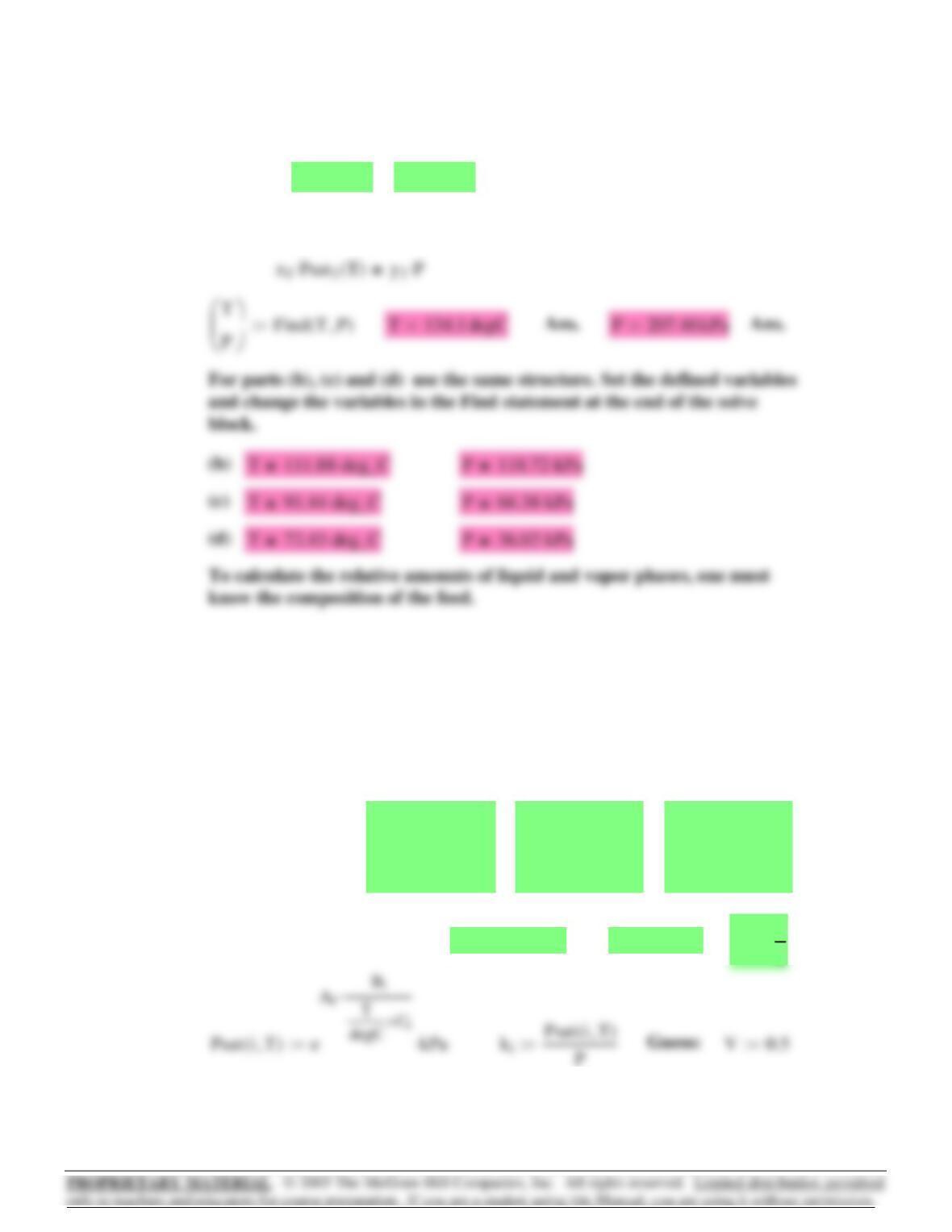
10.8 To increase the relative amount of benzene in the vapor phase, the
temperature and pressure of the process must be lowered. For parts (c)
and (d), the process must be operated under vacuum conditions. The
temperatures are well within the bounds of typical steam and cooling water
temperatures.
10.9 (1) = benzene
(2) = toluene
(3) = ethylbenzene A
13.7819
13.9320
13.9726
⎛
⎜
⎜
⎜
⎝
⎞
⎟
⎠
:= B
2726.81
3056.96
3259.93
⎛
⎜
⎜
⎜
⎝
⎞
⎟
⎠
:= C
217.572
217.625
212.300
⎛
⎜
⎜
⎜
⎝
⎞
⎟
⎠
:=
(a) n rows A():= i1n..:= T 110 degC⋅:= P 90 kPa⋅:= zi1
n
:=
(a) Given: x10.35:= y10.70:= Guess: T 116 degC⋅:= P 132 kPa⋅:=
Given x1Psat1T()⋅1x
1
−
()
Psat2T()⋅+ P=
318
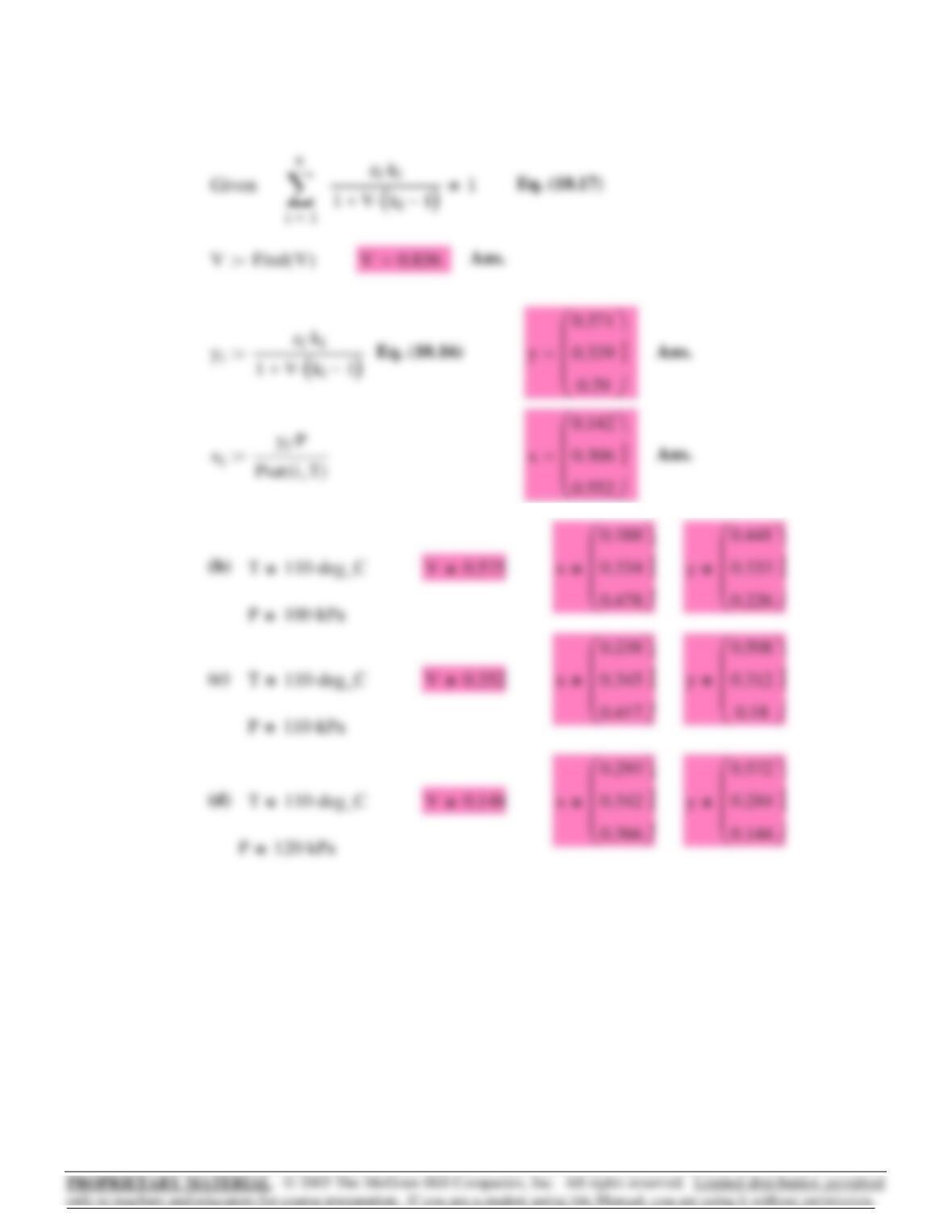
10.10 As the pressure increases, the fraction of vapor phase formed (V)
decreases, the mole fraction of benzene in both phases increases and the
the mole fraction of ethylbenzene in both phases decreases.
319
10.11 (a) (1) = acetone
(2) = acetonitrile A14.3145
14.8950
⎛
⎜
⎝
⎞
⎠
:= B2756.22
3413.10
⎛
⎜
⎝
⎞
⎠
:= C228.060
250.523
⎛
⎜
⎝
⎞
⎠
:=
n rows A():= i1n..:=
z10.75:= T 340 273.15−( ) degC⋅:= P 115 kPa⋅:=
z21z
1
−:=
Psat i T,()e
AiBi
T
degC Ci
+
−
kPa⋅:= kiPsat i T,()
P
:=
320
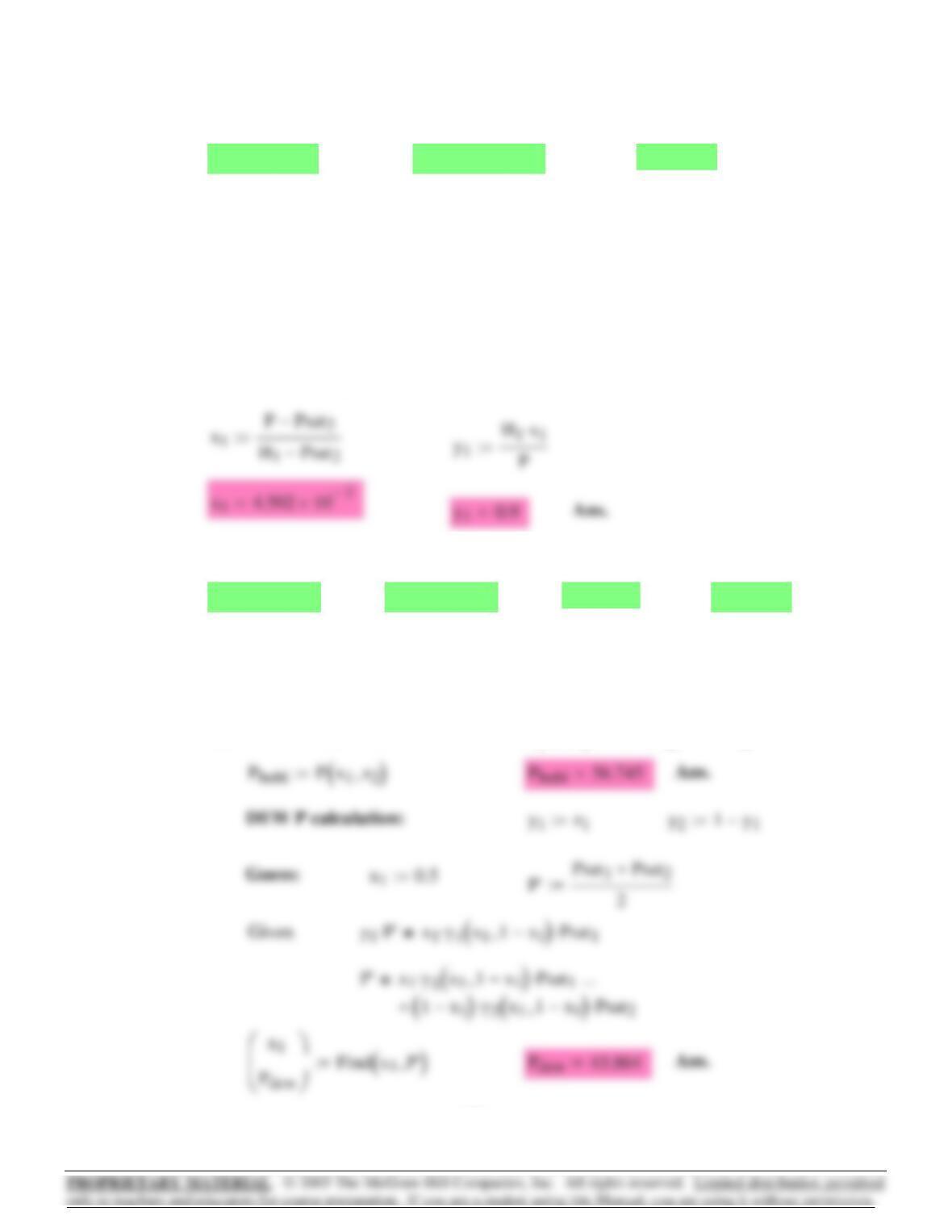
γ1x1x2
,
()
exp A x22
⋅
()
:= γ2x1x2
,
()
exp A x12
⋅
()
:=
Px
1x2
,
()
x1γ1x1x2
,
()
⋅Psat1
⋅x2γ2x1x2
,
()
⋅Psat2
⋅+:=
(a) BUBL P calculation: x1z1
:= x21x
1
−:=
10.13 H1200 bar⋅:= Psat20.10 bar⋅:= P 1 bar⋅:=
Assume at 1 bar that the vapor is an ideal gas. The vapor-phase fugacities
are then equal to the partial presures. Assume the Lewis/Randall rule
applies to concentrated species 2 and that Henry’s law applies to dilute
species 1. Then:
y1P⋅H1x1
⋅=y2P⋅x2Psat2
⋅=Py
1P⋅y2P⋅+=
x1x2
+1=PH
1x1
⋅1x
1
−
()
Psat2
⋅+=
Solve for x1 and y1:
10.16 Pressures in kPa
Psat132.27:= Psat273.14:= A 0.67:= z10.65:=
321
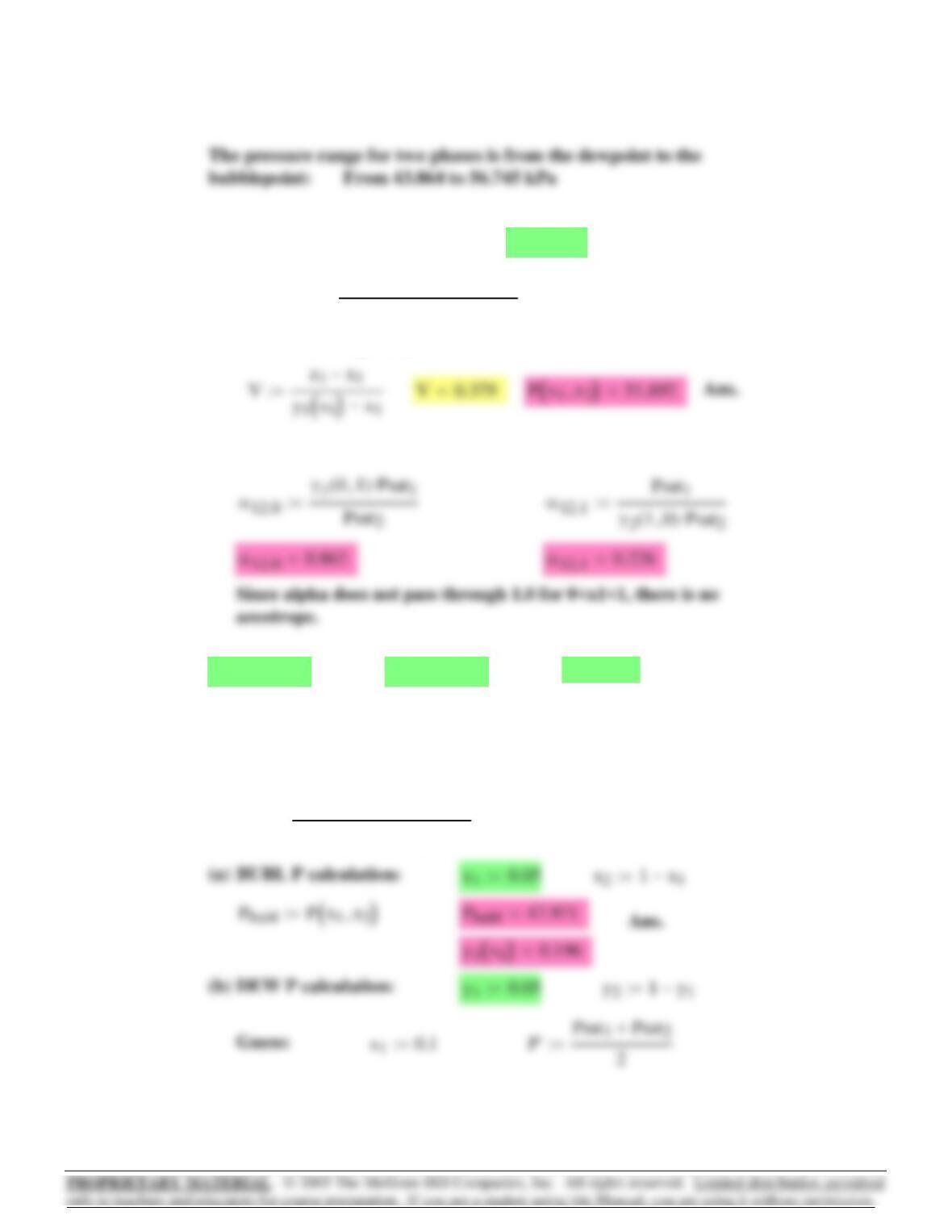
A 0.95:=
γ1x1x2
,
()
exp A x22
⋅
()
:= γ2x1x2
,
()
exp A x12
⋅
()
:=
Px
1x2
,
()
x1γ1x1x2
,
()
⋅Psat1
⋅x2γ2x1x2
,
()
⋅Psat2
⋅+:=
y1x1
()
x1γ1x11x
1
−,
()
⋅Psat1
⋅
Px
11x
1
−,
()
:=
(b) BUBL P calculation: x10.75:= x21x
1
−:=
y1x1
()
x1γ1x11x
1
−,
()
⋅Psat1
⋅
Px
11x
1
−,
()
:=
The fraction vapor, by material balance is:
(c) See Example 10.3(e).
10.17 Psat179.8:= Psat240.5:=
322
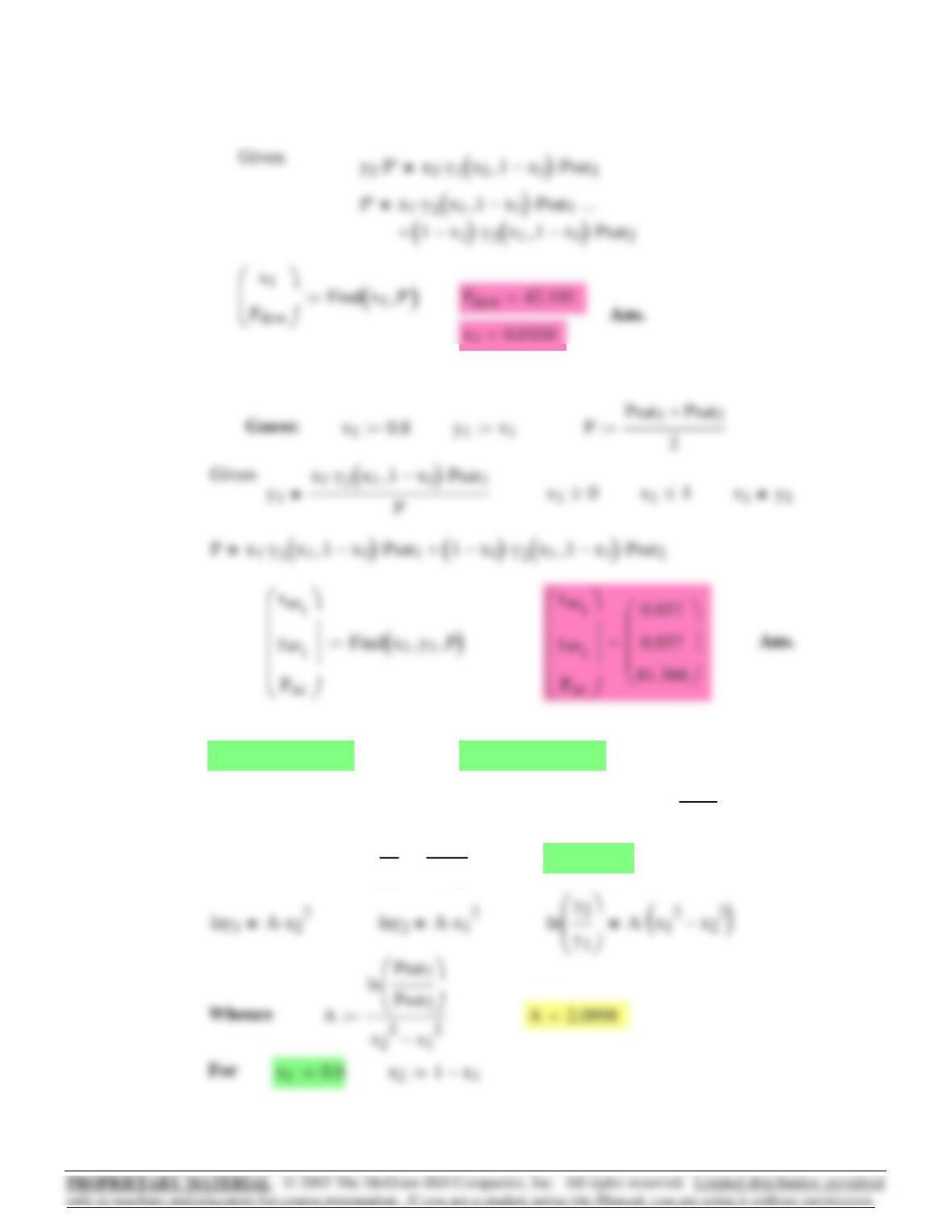
10.18 Psat175.20 kPa⋅:= Psat231.66 kPa⋅:=
At the azeotrope: y1x1
=and γiP
Psati
=
Therefore γ2
γ1
Psat1
Psat2
=x10.294:= x21x
1
−:=
(c) Azeotrope Calculation:
323
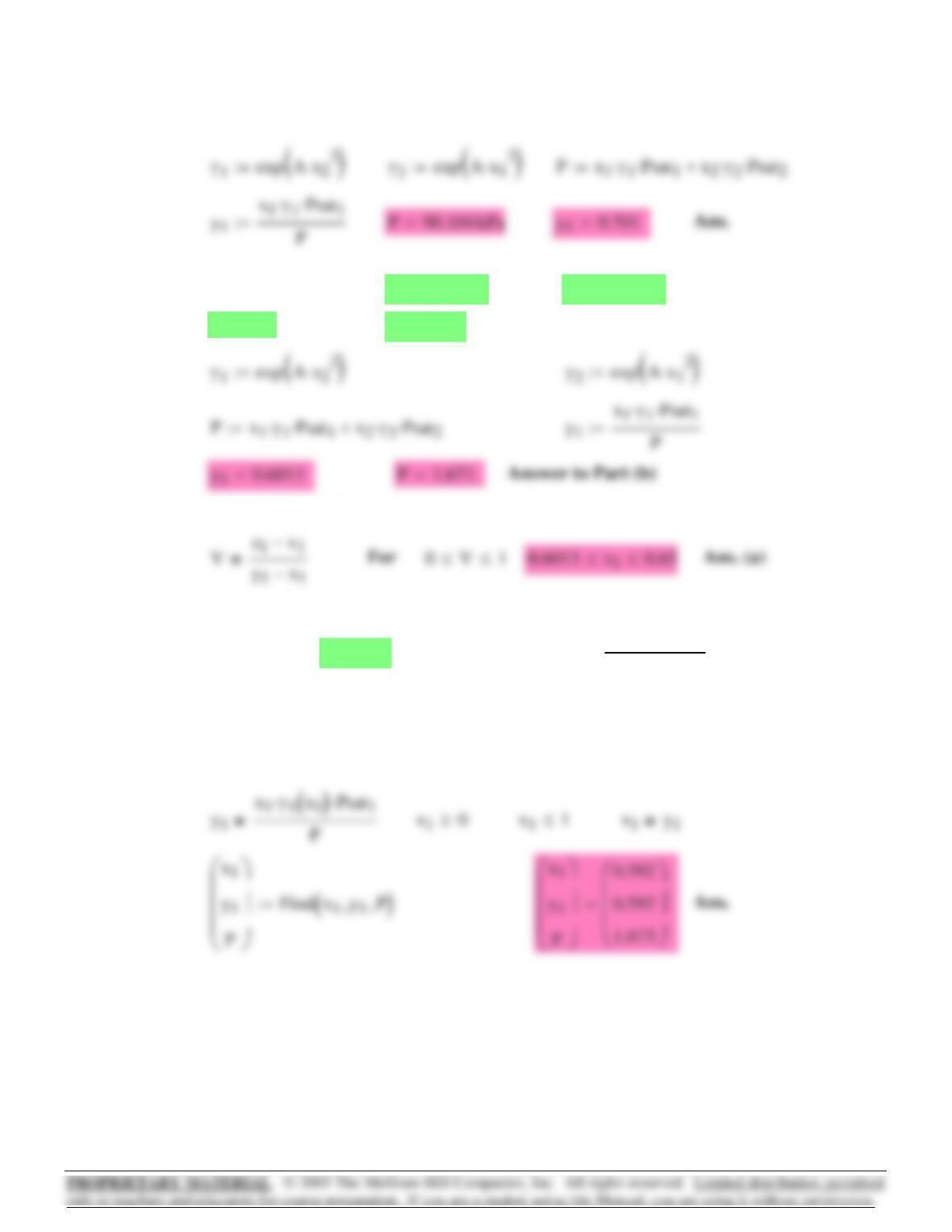
(c) Azeotrope calculation:
Guess: x10.6:= y1x1
:= PPsat1Psat2
+
2
:=
γ1x1
()
exp A 1 x1
−
()
2
⋅
⎡
⎣
⎤
⎦
:= γ2x1
()
exp A x12
⋅
()
:=
Given Px
1γ1x1
()
⋅Psat1
⋅1x
1
−
()
γ2x1
()
⋅Psat2
⋅+=
⎜
⎜
10.19 Pressures in bars: Psat11.24:= Psat20.89:=
A 1.8:= x10.65:= x21x
1
−:=
By a material balance,
324
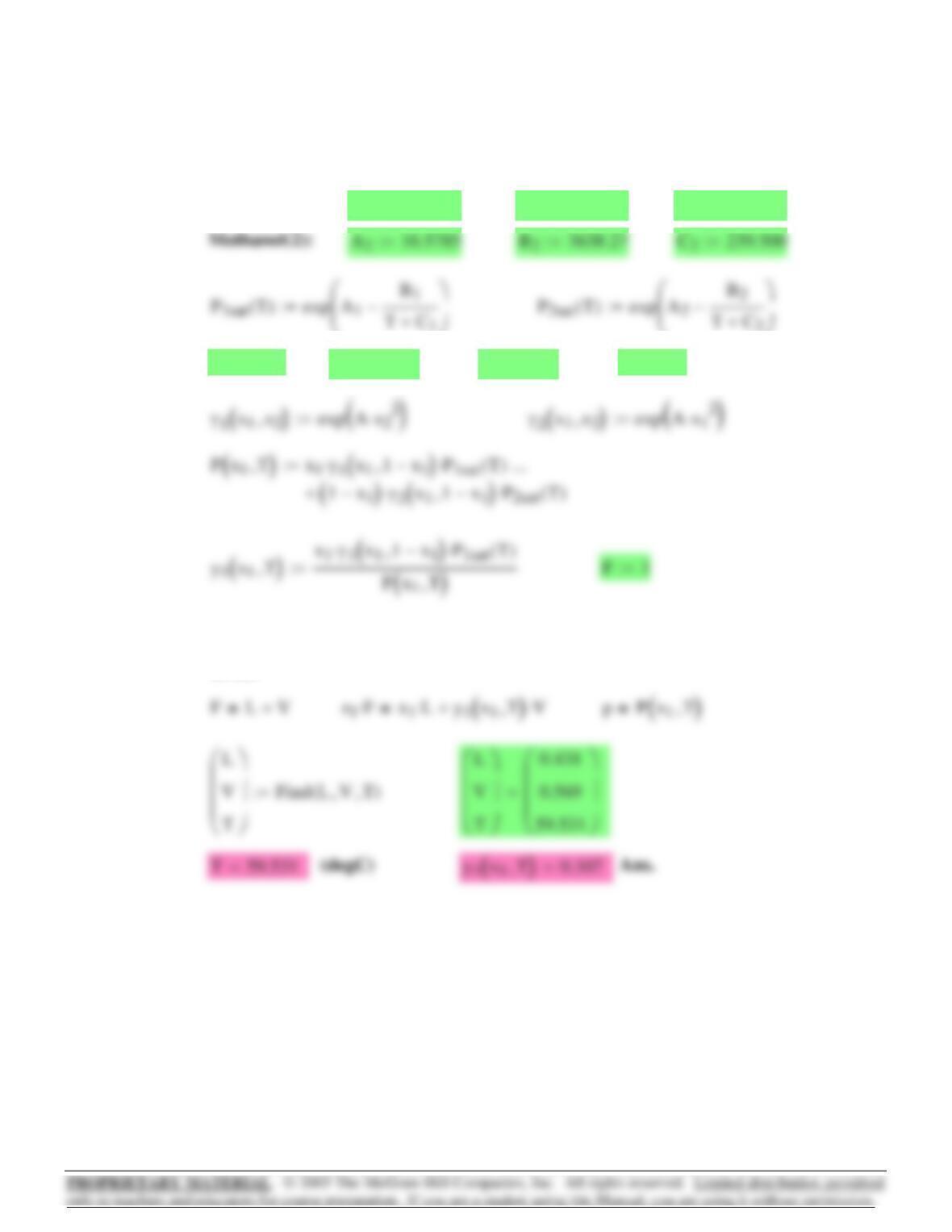
Guesses: V 0.5:= L 0.5:= T 100:=
Given
10.20 Antoine coefficients: P in kPa; T in degC
Acetone(1): A114.3145:= B12756.22:= C1228.060:=
⎝
⎠
⎝
⎠
A 0.64:= x10.175:= z10.25:= p 100:= (kPa)
325
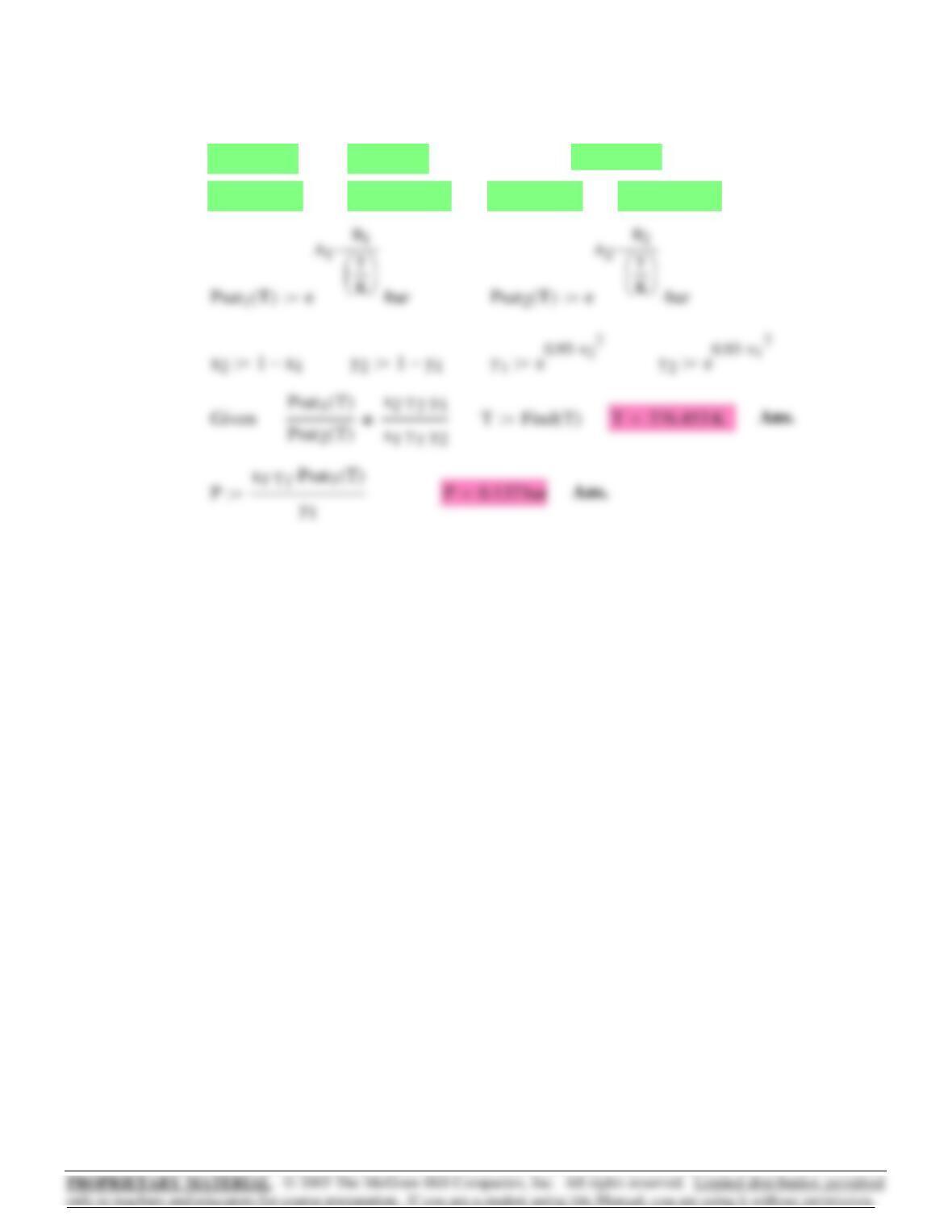
B26254.0:=A211.63:=B12572.0:=A110.08:=
T 300 K⋅:=
Guess:
y10.95:=x10.002:=
10.22
326