Accounting Information Systems, 10e 21
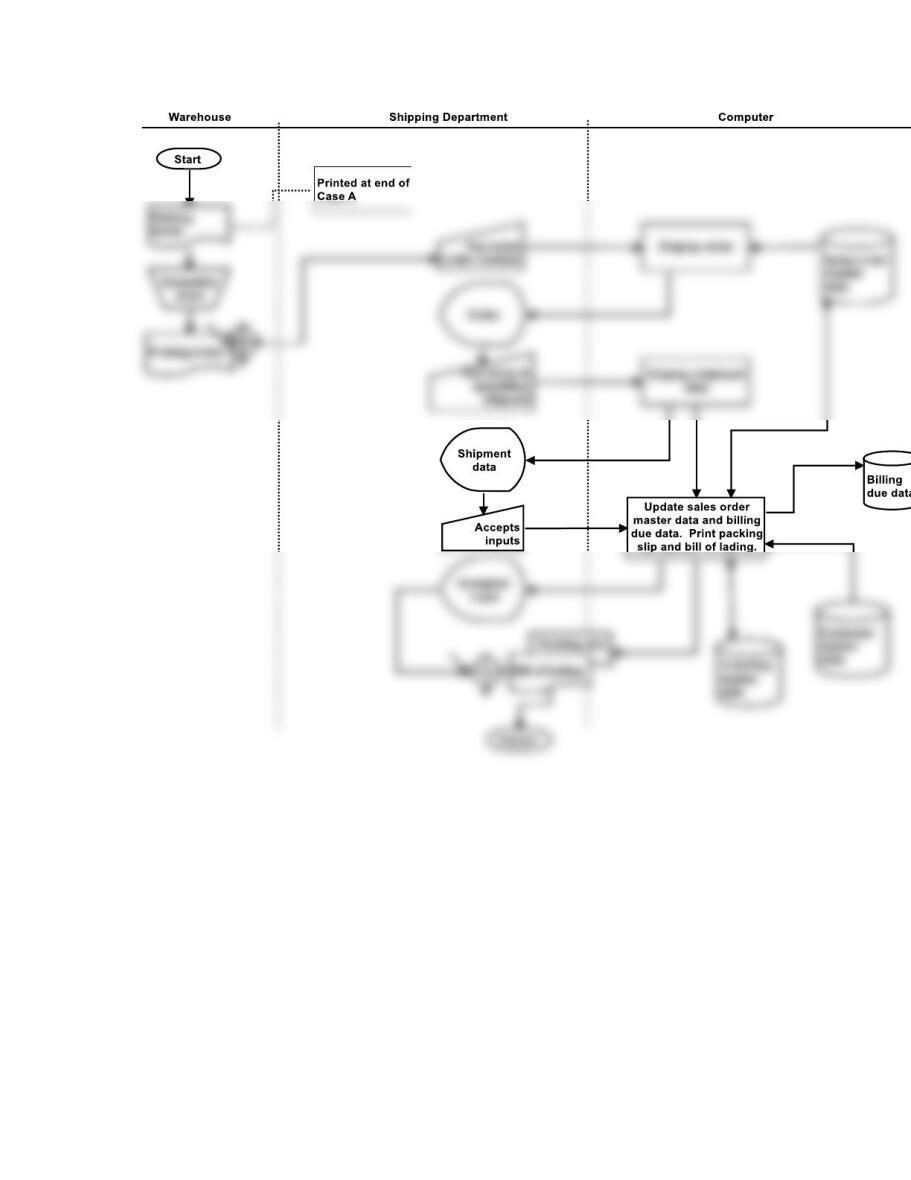
FIGURE SM-10.10 Auto Supplies, Inc. (Shipping) Systems Flowchart
22 Solutions for Chapter 10
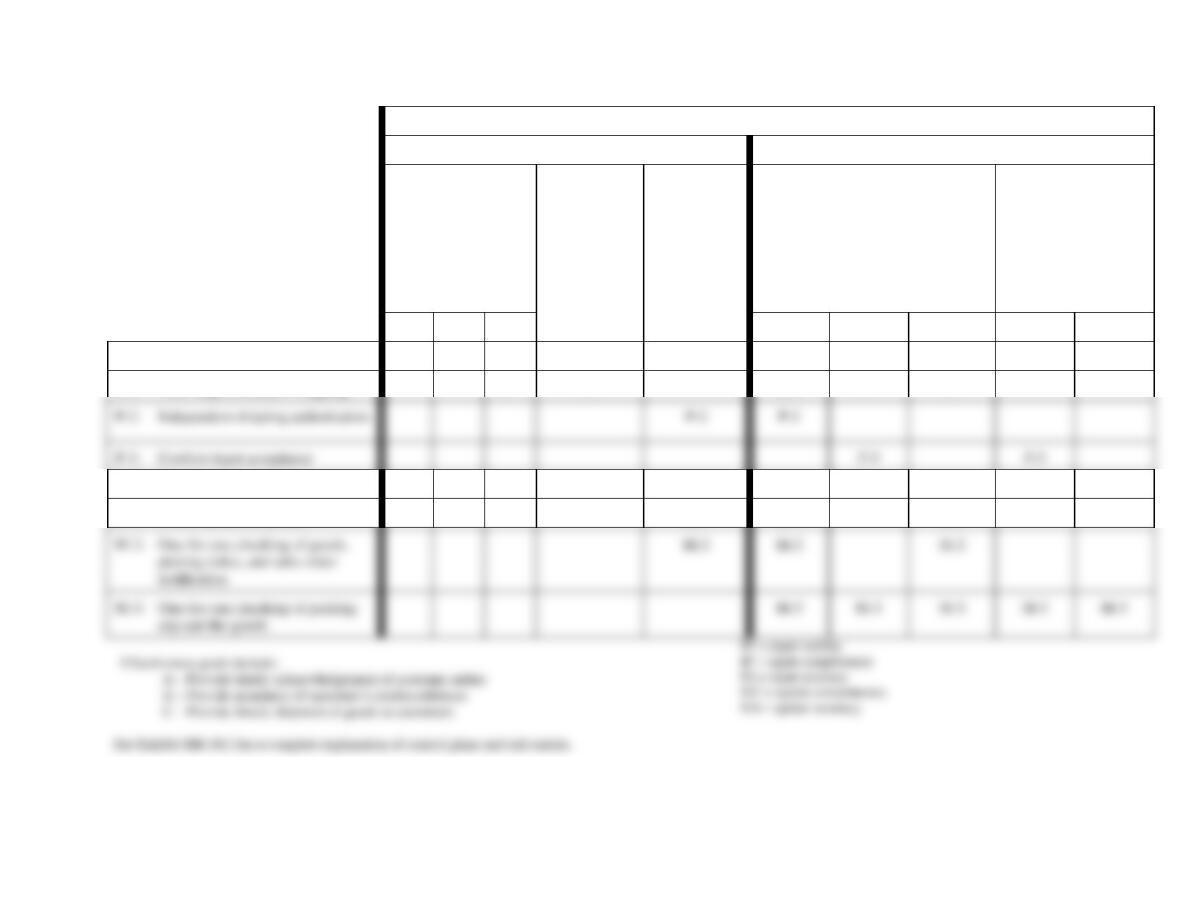
Control Goals of the Auto Supplies, Inc. (Shipping) Process
Control Goals of the Operations Process
Control Goals of the Information Process
Recommended control plans
Ensure effectiveness
of operations
Ensure
efficient
employ-ment
of resources
(e.g., people
and
computers)
Ensure
security of
resources
(e.g.,
inventory,
customer
master data)
For the shipment data inputs,
ensure:
For the sales order
and inventory master
data, ensure:
A
B
C
IV
IC
IA
UC
UA
Present controls
P-1: Enter shipment data in shipping
P-1
P-1
P-1
P-1
P-1
Missing Controls
M-1: Record quantities picked
M-1
M-1
M-1
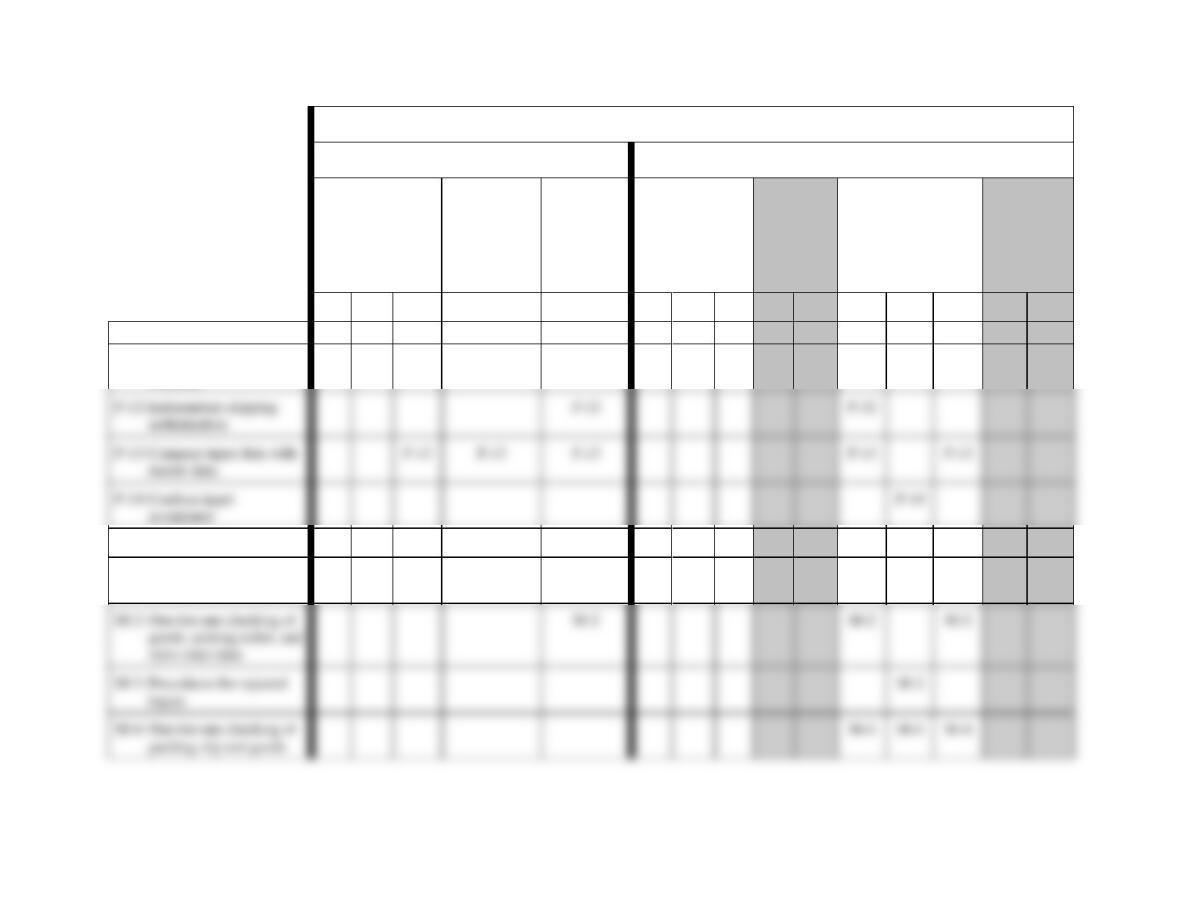
FIGURE SM-10.11 Problem 2, Part b Solution (Partial)—Control Matrix for Auto Supplies, Inc. (Shipping)
P-3: Confirm input acceptance
P-3
P-3
Accounting Information Systems, 10e 23
Exhibit SM-10.2 Problem 2, Part b solution (Partial)⎯Explanation of Cell Entries for
Control Matrix in Figure SM-10.11
P-1: Enter shipment data in shipping.
Effectiveness goal C, efficient employment of resources: Use of this strategy
places shipping clerks in a position to process shipments immediately, and being
P-2: Independent shipping authorization.
Security of resources: To provide security over merchandise inventory, the
shipping department has an independent authorization⎯the record on the sales
order master data⎯to ship inventory to a customer.
Sales order notification input validity: To ensure the validity of shipping notices,
the shipping department has an independent authorization⎯the record on the
sales order master data⎯to record a shipment.
P-3: Confirm input acceptance.
Sales order notification input completeness: The computer informs the user that
the input has been accepted and recorded.
M-1: Record quantities picked.
Security of resources: If the warehouse were to record on the picking ticket the
actual quantities picked, we would have a record of inventory movements and less
chance for inventory pilferage.
24 Solutions for Chapter 10
M-2: One-for-one checking of goods, picking ticket, and sales order notification.
Security of resources: By requiring that data on the sales order notification be
compared with that on the picking ticket and then that these data sets be compared
M-3: One-for-one checking of the packing slip and the goods.
Sales order notification input validity, input completeness, input accuracy: By
comparing an output document (the packing slip) to the goods, this checking
ensures that the input was valid and accurately entered. Any goods with no
packing slip would indicate that the sales order notification may not have been
entered.
Sales order master data update completeness, update accuracy: Because the
comparison is made after the sales order master data is updated, this checking will
ensure that the sales order master data was completely and accurately updated.
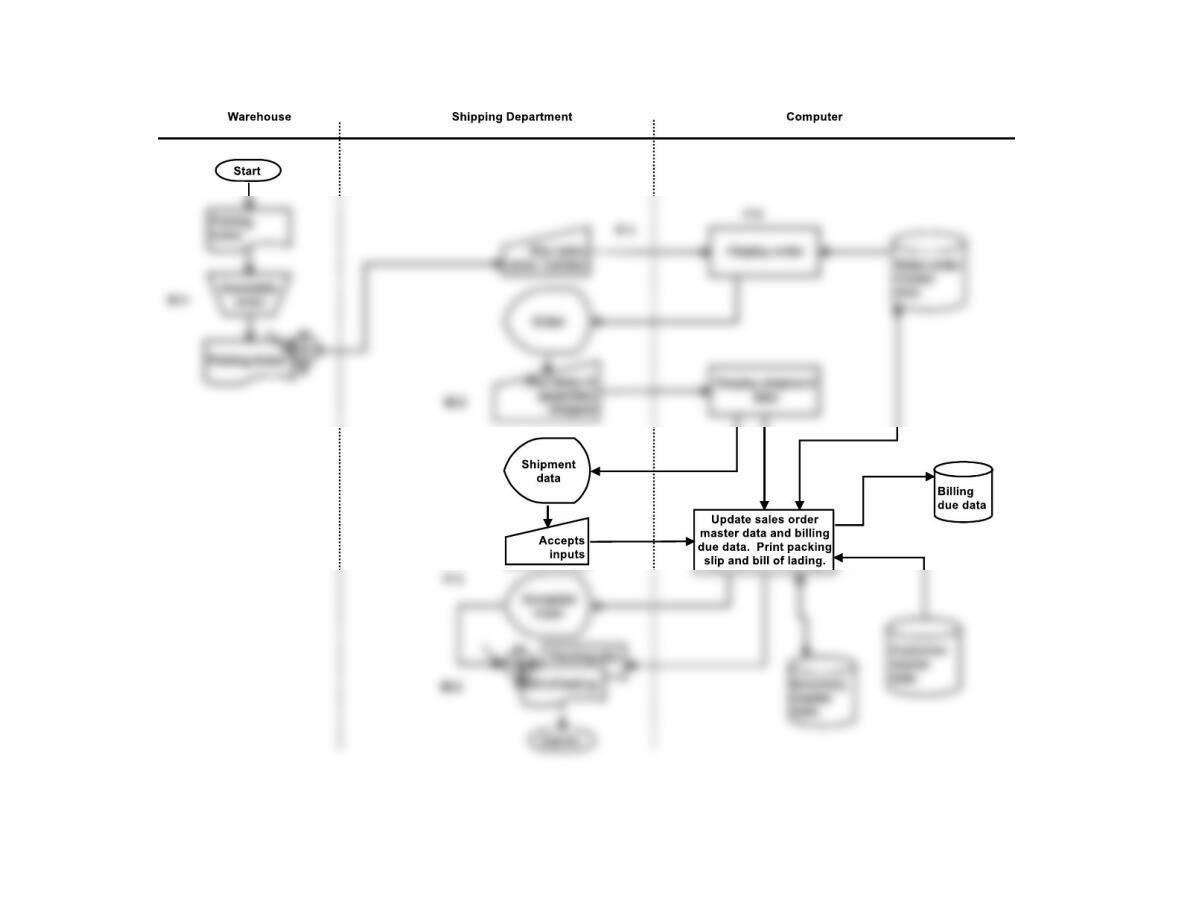
Accounting Information Systems, 10e 25
FIGURE SM-10.12 Auto Supplies, Inc. (Shipping) Annotated Systems Flowchart (continued)
26 Solutions for Chapter 10
Bondstreet Company Solutions (see Note on pg. 9)
P 10-1 a. Table of entities and activities for Bondstreet Company
Entities
Para
Activities
Customer
2
1. Call Bondstreet fulfillment center and give name to CSR.
CSR
2
2. -Key customer name.
CSR
9. Save order.
Computer
2
10. Create sales order record.
2
11. Print picking ticket in the warehouse.
2
12. Display sales order number.
CSR
2
13. Read sales order number to customer.
Warehouse (clerk)
3
14. Pick goods from shelf.
3
15. Record quantity and lot number.
3
16. Bring goods and picking ticket to shipping department.
Computer
3
18. Display the sales order master data.
Shipping department
(clerk)
3
19. Scan the items and quantities being shipped.
3
20. Save the shipment data.
Computer
3
21. Update the sales order master data and inventory (for the shipment).
3
22. Create a record on the billing due list data store.
3
23. Print a packing slip.
Shipping department
(clerk)
3
24. Attach packing slip to goods.
3
25. Give goods to carrier.
ERP system (computer)
2
3. Retrieve customer data and display onscreen.
CSR
2
4. Examine display.
Customer
2
5. Give items and quantities.
CSR
2
6. Key order.
Computer
2
7. Compare amount of the order to available credit.
2
8. Allocate inventory.
Accounting Information Systems, 9e 27
Customer order
Customer name
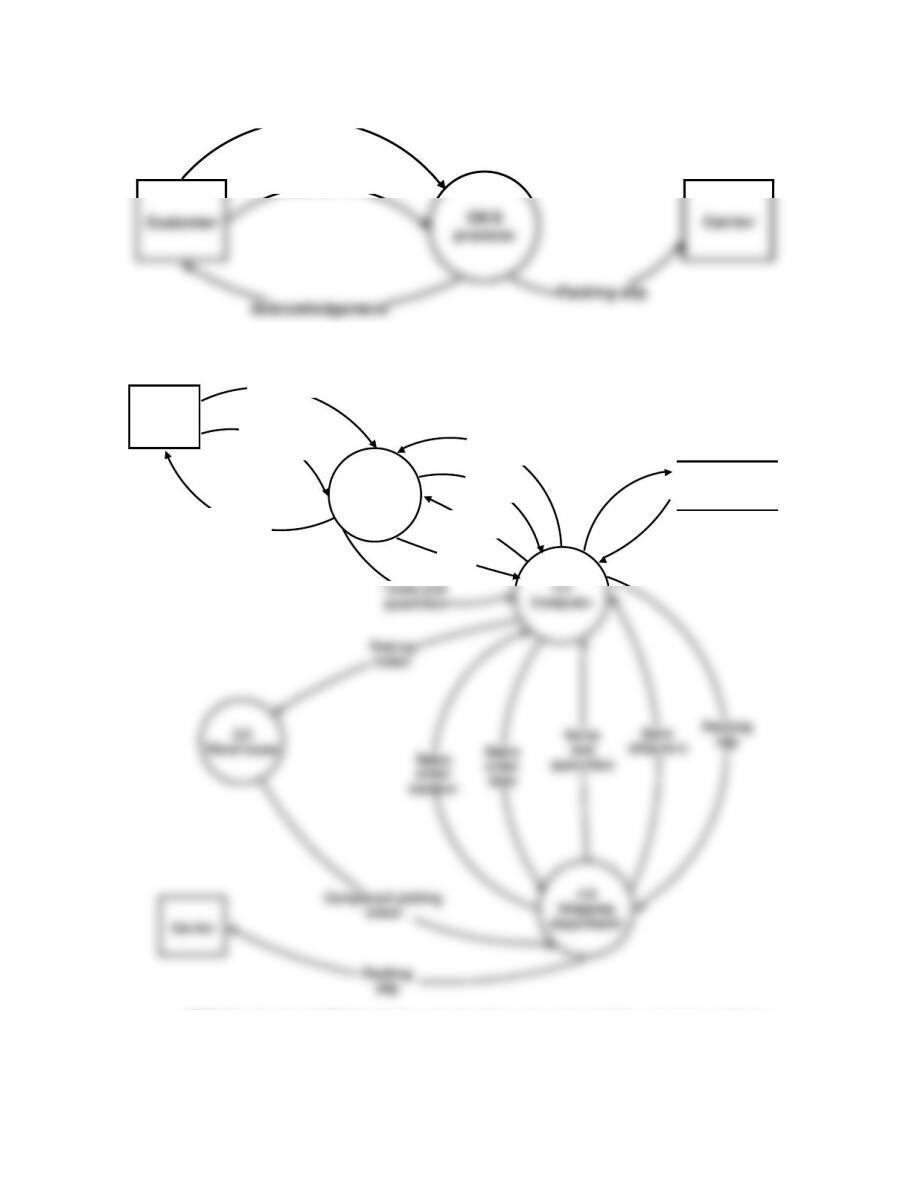
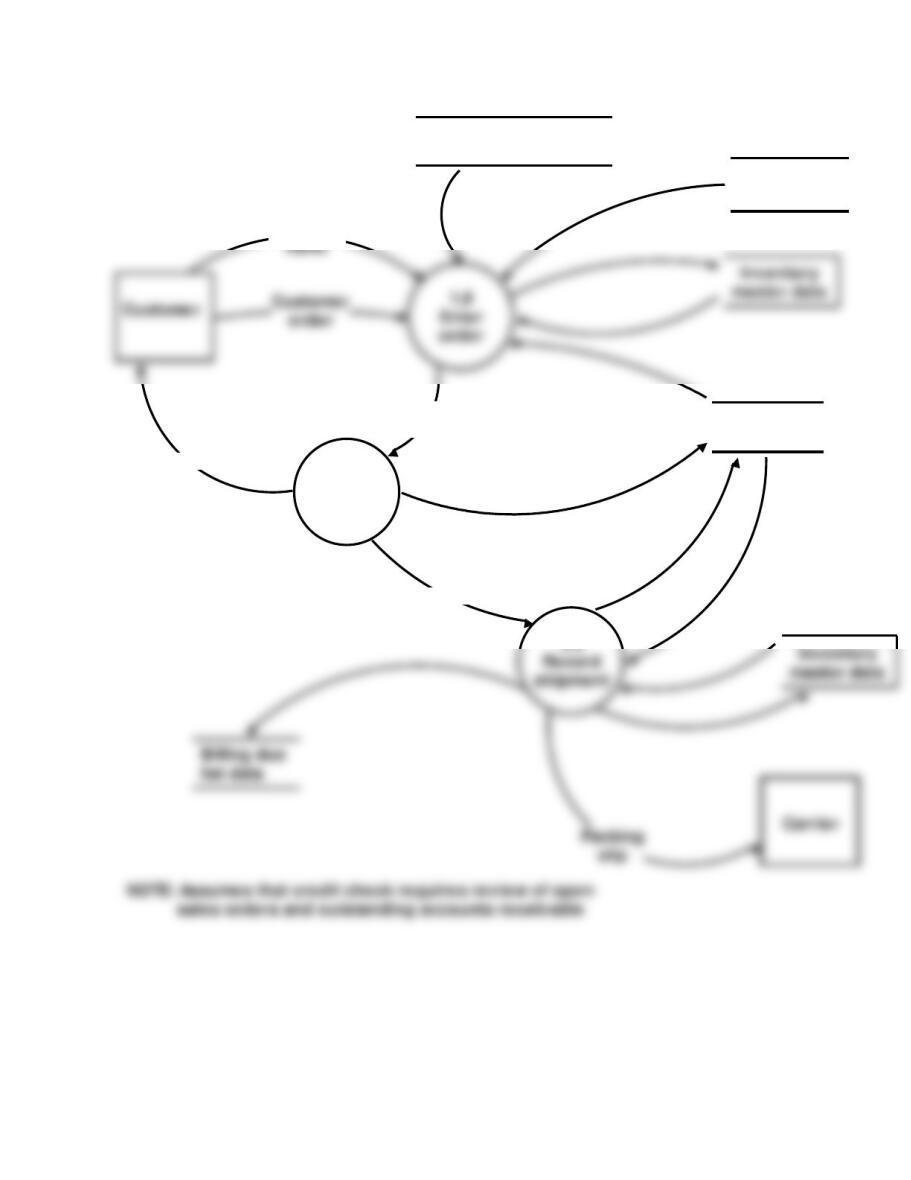
FIGURE SM-10.13 Problem 1, Part b Solution—Context Diagram for Bondstreet Company
Customer
1.0
CSR
Enterprise
database
Customer name
Customer
name
Customer
data
NOTE: See the logical DFD for details re garding flows into and out of the ente rprise database.
Items and
quantities
requeste d
Sales order
number
Sales order
number
Save
order
FIGURE SM-10.14 Problem 1, Part c Solution—Physical DFD for Bondstreet Company
28 Solutions for Chapter 10
d. Table of Entities and Activities (Annotated) for Bondstreet Company
Entities
Para
Activities
Process
CSR
2
2. Key customer name.
ERP System
(computer)
2
3. Retrieve customer data and display onscreen.
Computer
2
10. Create sales order record.
2.0 Record order.
2
11. Print picking ticket in warehouse.
2
12. Display sales order number.
Warehouse clerk
3
15. Record quantity and lot number.
Shipping clerk
3
19. Scan the items and quantities being shipped.
3
20. Save the shipment data.
21. Update the sales order master data and
3
22. Create a record on the billing due list data
3
23. Print packing slip.
3
24. Attach packing slip to goods.
Shipping clerk
3
17. Scan sales order number into computer.
CSR
2
4. Examine display.
2
6. Key order.
Computer
2
7. Compare amount of order and available
2
8. Allocate inventory.
CSR
9. Save order.
Accounting Information Systems, 9e 29
2.0
Record
order
Customer
master data
Customer
Accounts receivable
master data
Acknowledgement
Save
order Sales order
master data
Picking ticket
FIGURE SM-10.15 Problem 1, Part e Solution—Logical DFD for Bondstreet Company
30 Solutions for Chapter 10
CSR Computer
Customer
Key in
customer
Examine
display
Error routine
not shown
Key orde r
Display customer
information
Check credit and
allocate
inventory
Picking ticke t
Orde r
display
Warehouse
P. 2,
A
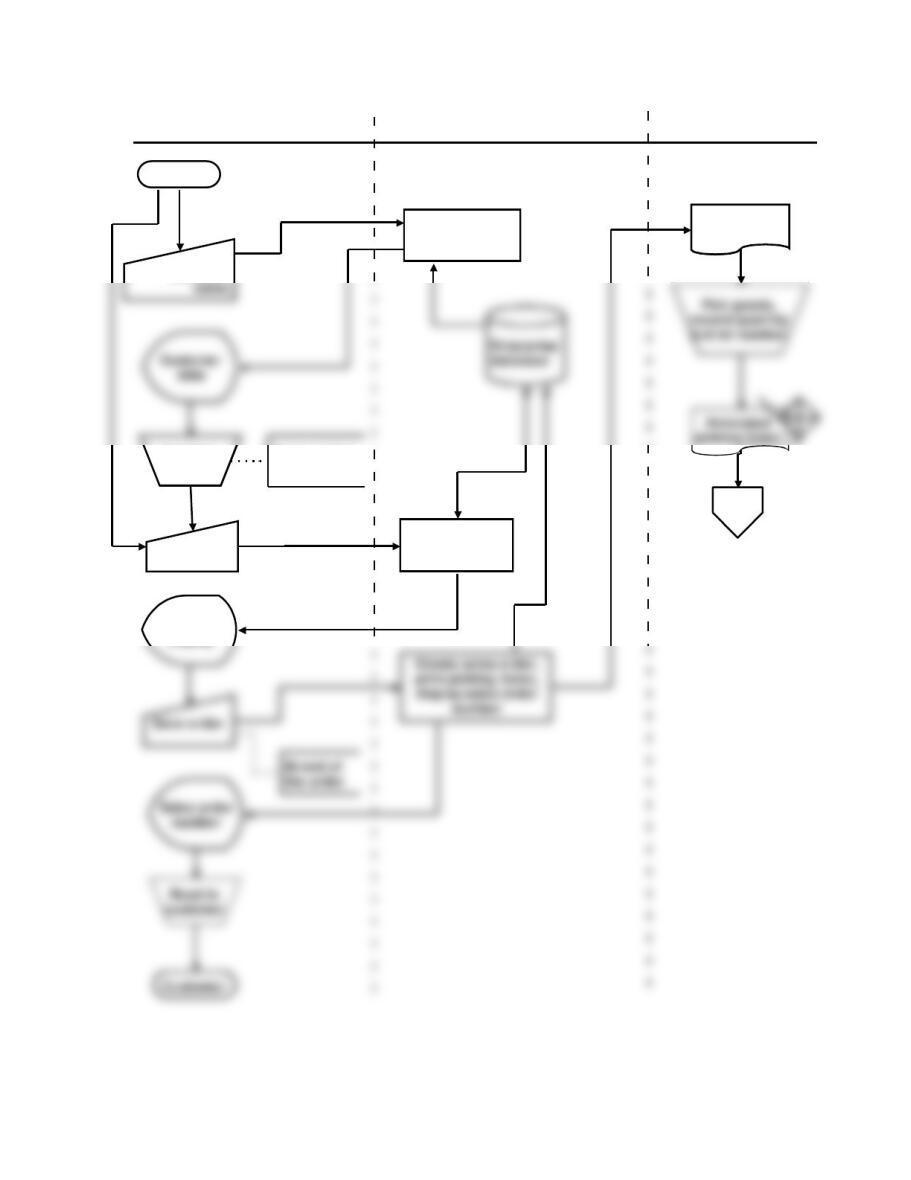
FIGURE SM-10.16 Problem 2, Part a Solution—Systems Flowchart for Bondstreet
Accounting Information Systems, 9e 31
Shipping De partment Computer
P. 1,
A
Annotated
picking ticke t
Shipment
data
Display shipment
data
Update sale s order and
inventory data and
record billing due list
data. Print packing slip.
Scan
items and
quantities
Save
shipment data
Afte r all items
scanned
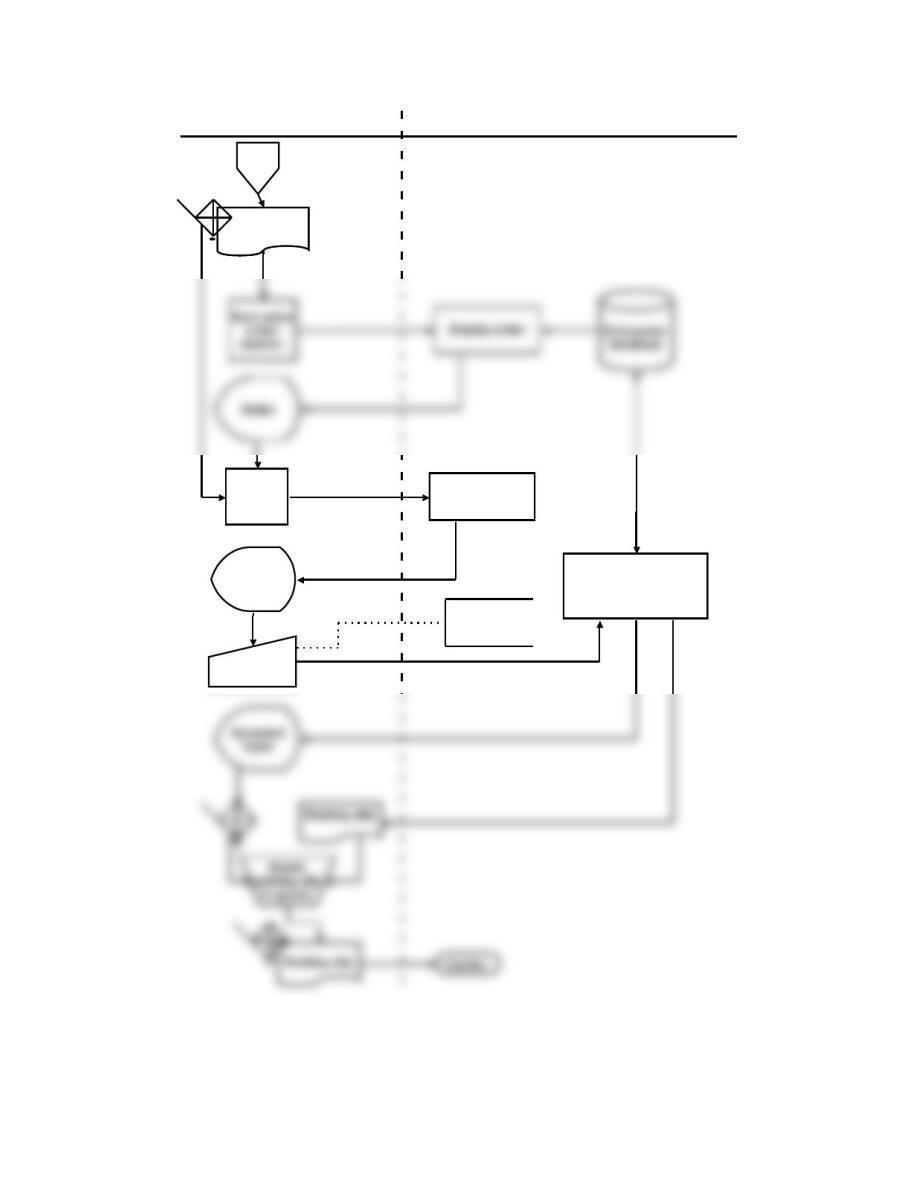
FIGURE SM-10.16 Bondstreet Systems Flowchart (continued)
32 Solutions for Chapter 10
Control Goals of the Bondstreet OE/S Business Process
Control Goals of the Operations Process
Control Goals of the Information Process
Ensure
effectiveness of
operations:
Ensure
efficient
employment
of resources
(computers,
people)
Ensure
security of
resources
(inventory,
customer
data)
For sales order
inputs (i.e.,
customer
orders), ensure:
For sales
order
master
data,
ensure:
For sales order
notification inputs
(i.e., shipment
data), ensure:
For sales
order
master
data,
ensure:
Recommended control plans
A
B
C
IV
IC
IA
UC
UA
IV
IC
IA
UC
UA
Present controls
P-1: Enter customer order
close to the location
where it is prepared
P-1
P-1
P-1
P-1
P-1
P-5: Procedures for rejected
inputs
P-5
P-6: Online prompting
P-6
P-6
P-6
P-6
P-8: Customer credit check
P-8
P-2: Populate input screens
with master data
P-3: Independent customer
master data maintenance
Accounting Information Systems, 9e 33
Control Goals of the Bondstreet OE/S Business Process
Control Goals of the Operations Process
Control Goals of the Information Process
Ensure
effectiveness of
operations:
Ensure
efficient
employment
of resources
(computers,
people)
Ensure
security of
resources
(inventory,
customer
data)
For sales order
inputs (i.e.,
customer
orders), ensure:
For sales
order
master
data,
ensure:
For sales order
notification inputs
(i.e., shipment
data), ensure:
For sales
order
master
data,
ensure:
Recommended control plans
A
B
C
IV
IC
IA
UC
UA
IV
IC
IA
UC
UA
(picking ticket)
P-11: Enter shipment data in
shipping
P-11
P-11
P-11
P-11
P-11
Missing Controls
M-1: One-for-one checking of
picking ticket with goods
M-1
M-1
M-1
M-1
M-1
M-4: One-for-one checking of
M-4
M-4
M-4
P-12: Independent shipping
authorization
P-12
P-13: Compare input data with
master data
P-13
P-13
P-13
P-13
P-14: Confirm input
acceptance
P-14
34 Solutions for Chapter 10
Control Goals of the Bondstreet OE/S Business Process
Control Goals of the Operations Process
Control Goals of the Information Process
Ensure
effectiveness of
operations:
Ensure
efficient
employment
of resources
(computers,
people)
Ensure
security of
resources
(inventory,
customer
data)
For sales order
inputs (i.e.,
customer
orders), ensure:
For sales
order
master
data,
ensure:
For sales order
notification inputs
(i.e., shipment
data), ensure:
For sales
order
master
data,
ensure:
Recommended control plans
A
B
C
IV
IC
IA
UC
UA
IV
IC
IA
UC
UA
M-5: Procedures for rejected
inputs
M-5
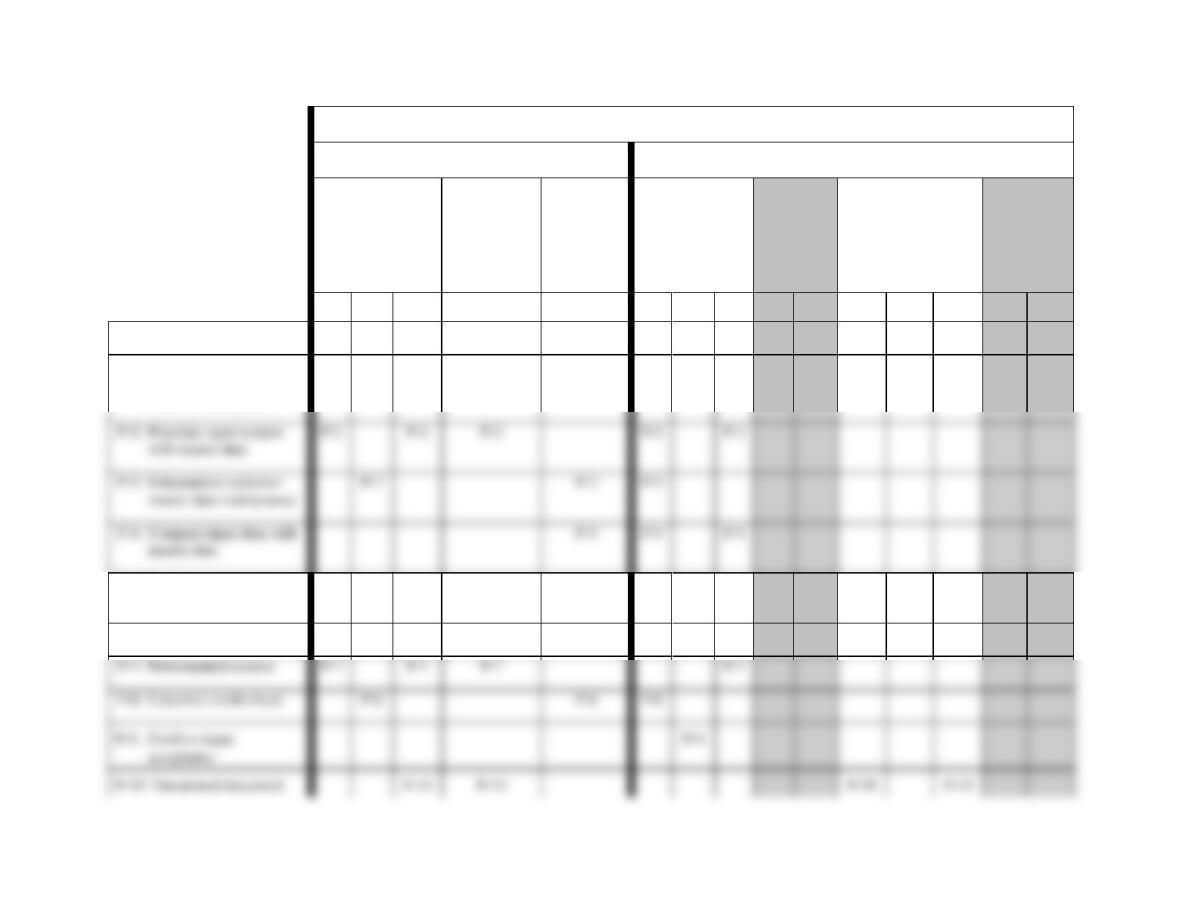
FIGURE SM-10.17 Problem 2, Part b Solution (Partial)—Control Matrix for Bondstreet Company
M-6: Review open sales order
M-6
M-6

Accounting Information Systems, 9e 35
Exhibit SM-10.3 Problem 2, Part b Solution (Partial)—Explanation of Cell Entries for
Control Matrix in Figure SM-10.17
Note: All inputs result in immediate updates to master data. Therefore, we do not show entries
for UC or UA.
P-1: Enter customer order close to the location to where it is prepared.
Effectiveness goals A and C, ensure efficient employment of resources: Orders are
entered by CSRs while the customer is on the phone. This places the CSRs in a
P-2: Populate input screens with master data.
Effectiveness goals A and C: Fewer operator keystrokes should improve the speed
with which orders can be entered.
P-3: Independent customer master data maintenance.
Effectiveness goal B: We assume that only personnel in the credit department, a
function that is separate from customer service, approve the credit limit and add
new customers to the customer master data.
36 Solutions for Chapter 10
P-4: Compare input data with master data.
Security of resources, sales order input validity, and sales order input accuracy:
P-5: Procedures for rejected inputs.
Sales order input completeness: We assume that the CSR follows some error-
correcting procedure when the displayed customer data and the input customer
name do not. These procedures should ensure the correction and re-input of all
(i.e., completeness) rejected orders.
P-7: Preformatted screens.
Effectiveness goals A and C, efficient employment of resources: This simplifies
the data entry process, allowing the CSR to enter orders more quickly (Goals A
and C) and allowing more orders to be input over a period of time (efficiency).
P-8: Customer credit check.
Effectiveness goal B: The customer’s credit limit is checked by comparing the
Accounting Information Systems, 9e 37
P-9: Confirm input acceptance.
Sales order input completeness: Ensures input completeness in that the computer
displays the sales order number, thus informing the CSR that the order has been
accepted and recorded.
P-10: Turnaround document (picking ticket).
Effectiveness goal C, efficient employment of resources: By reducing the amount
of data that must be input to record the shipment, we improve the speed and
P-11: Enter shipment data in shipping.
Effectiveness goal C: By entering the shipment data in shipping, shipments are
timelier.
Ensure efficient employment of resources: By entering the shipment data in
shipping, resources are more efficiently used than they would be if Bondstreet
sent the shipping notices to a separate data entry function.
P-12: Independent shipping authorization.
Ensure security of resources: To provide security over merchandise inventory, the
shipping department has an independent authorization⎯the record on the sales
order master data⎯to ship inventory to a customer.
38 Solutions for Chapter 10
P-13: Compare input data with master data.
Effectiveness goal C, efficient employment of resources: Shipments may be
processed more quickly and at a lower cost if errors, differences between the
P-14: Confirm input acceptance.
Sales order notification input completeness: Ensures input completeness in that
the computer informs the shipping clerk that the input shipment data has been
accepted and recorded.
M-1: One-for-one checking of picking tickets with the goods.
Effectiveness goal C, efficient employment of resources: By comparing the goods
to the picking ticket (and correcting any picking errors) in the warehouse, rather
M-2: One-for-one checking of goods, picking ticket, and sales order data.
Ensure security of resources: By requiring that the sales order data be compared
with that on the picking ticket and then that these data sets be compared to the
actual goods being shipped, this plan ensures that inventory shipments have been
authorized. It also ensures that shipping inputs are represented by an actual
shipment of goods.
M-3: Procedures for rejected inputs.
Sales order notification input completeness: We are not told what procedures the
M-4: One-for-one checking of the packing slip and the goods.
Sales order notification input validity, input completeness, and input accuracy:
M-5: Procedures for rejected inputs.
Sales order notification input completeness: We are not told what procedures the
shipping clerk follows when the goods and the packing do not match. These
procedures should ensure the correction and re-input of all (i.e., completeness)
rejected sales order notifications.
M-6: Review open sales orders (tickler file).
Effectiveness goal C: A tickler file of open sales orders maintained in the
enterprise database allows the shipping department to investigate any orders that
are open for an unreasonable period of time. Therefore, the plan would provide
assurance that goods are shipped to customers in a timely manner.
40 Solutions for Chapter 10
CSR Compute r
Customer
Key order
Display customer
Check credit and
allocate
inventory
Picking ticket
Orde r
display
Warehouse
P. 2,
A
P-1
P-2
P-6
P-7
P-8
FIGURE SM-10.18 Problem 2, Part c Solution—Annotated Systems Flowchart for Bondstreet