117
Chapter 10
Financial Projections
Key Words
Source and use of funds statement—a document that lays out specifically how much
money a firm needs (if the intention of the business plan is to raise money), where the
money will come from, and what the money will be used for
Net sales—total sales minus allowances for returned goods and discounts
COGS (cost of goods sold)—all the direct costs associated with producing or delivering
a product or service, including the material costs and direct labor
Operating expenses—include marketing, utilities, and administrative costs not directly
related to producing a product or service
Constant ratio method—a type of forecasting that increases general expense items at
the same rate as sales
Pro forma balance sheet—a projection of a firm’s assets, liabilities, and owner’s equity
at a specific point in time
Debt ratio—computed by dividing total debt by total assets
Cash flow statements—provides an indication of whether a firm will be able to maintain
a sufficient cash balance to get up and running successfully
Operating activities—includes net income (or loss), depreciation, and changes in current
assets and current liabilities other than cash
118
Ratio analysis—a practical way to interpret or make sense of a firm’s historical or pro
forma financial statements; ratios are computed by taking numbers out of financial
statements and forming ratios with them
Chapter Overview
This chapter covers the final section of a business plan; the pro forma (or projected)
Chapter Summary
1.
and express them in financial terms.
The final section of a business plan presents a firm’s pro forma financial
2.
The source and use of funds statement is a document that lays out specifically
how much money a firm needs (if the intention of the business plan is to raise
money) and what the money will be used for.
3.
An assumptions sheet is an explanation of the most critical assumptions that
your financial statements are based on.
4.
for a firm for a given period of time. It records all the projected sales and
expenses for the given period and shows whether the firms will be making a
profit or experiencing a loss.
The pro forma income statement reflects the projected results of the operations
5.
Pro forma income statements are useful in envisioning a firm’s overall earnings
6.
Unlike the pro forma income statement, which covers a specific period of time, a
pro forma balance sheet is a projection of a firm’s assets, liabilities, and owner’s
equity at a specific point in time.
7.
flows to be the most valuable of your financial statements. The statements
provide an indication of whether a firm will be able to maintain a sufficient cash
balance to get up and running successfully.
Many of the readers of your business plan will consider your pro forma cash
9.
To capture items in an organized manner, the cash flow statement is divided into
three activities: operating activities, investing activities, and finance activities.
119
10.
The most practical way to interpret or make sense of a firm’s historical or pro
forma financial statements is through ratio analysis. In general, ratios are
computed by taking numbers out of financial statements and forming ratios with
them. Each ratio has a particular meaning in regard to the potential of a business.
Chapter Outline
I. Introduction
II. Source and Use of Funds Statement
Chapter Notes
I. Introduction
• The final section of a business plan presents a firm’s pro forma (or
projected) financial projections
• There are three things to be particularly mindful of as you approach this
chapter:
o Potential investors reading your plan will be primarily interested in
the size of the returns and how quickly a company can grow,
II. Source and Use of Funds Statement
• The source and use of funds statement is a document that lays out
specifically how much money a firm needs (if the intention of the business
plan is to raise money), where the money will come from, and what the
money will be used for
120
III. Assumptions Sheet
• An assumptions sheet is an explanation of the most critical assumptions
that your financial statements are based on
IV. Pro Forma Financial Statements
• The pro forma financial statements are the heart of the financial section of
a business plan
• If the company you’re writing your plan for already exists, include three
years of historic financial statements
a. Pro Forma Income Statement
o The pro forma income statement reflects the projected
results of the operations for a firm for a given period of
time
o In demonstrating anticipated year-to-year increases in
expenses, you can use the constant ratio method, where
general expense items are expected to increase at the same
rate as sales if the actual numbers are not known
121
numbers and still run out of cash despite glowing income
statements
b. Balance Sheet
o A pro forma balance sheet is a projection of a firm’s assets,
liabilities, and owner’s equity at a specific point in time
o Balance sheets are somewhat deceiving in that firms spend
money on many things that never show up on their balance
sheets, intangible assets are not recognized on the balance
sheet, and property must be valued at the purchase price
instead of the current value
o When evaluating a pro forma balance sheet, the two
primary questions are whether a firm will have sufficient
short-term assets to cover its short-term debts and whether
it is financially sound overall
c. Cash Flow
o Many readers of your business plan will consider your pro
forma cash flows to be the most valuable of your financial
statements
V. Ratio Analysis
• The most practical way to interpret a firm’s historical or pro forma
financial statements is through ratio analysis
122
Review Questions
1.
financial projections. Having completed the previous sections of the plan, it’s
Why is the financial plan typically one of the last chapters in a business plan?
Answer: The final section of a business plan presents a firm’s pro forma
2.
What is the purpose of a source and use of funds statement?
Answer: The source and use of funds statement is a document that lays out
3.
What is the purpose of an assumptions sheet?
Answer: An assumptions sheet is an explanation of the most critical
4.
reflecting the projected results of the operations of a firm for a given period of
at a specific point in time, and (3) cash flow statement, which indicates whether
Briefly describe the three pro forma financial statements that should be included
in a business plan.
Answer: Pro forma financial statements include: (1) the income statement,
5.
earnings potential and prospective changes from year to year. They don’t,
however, provide an indication of a firm’s cash position. A firm can show
excellent sales numbers, but if the sales accumulate as accounts receivable (or
How is it possible for a firm to show a sizable net income on its income
statements and still be running out of cash?
Answer: Pro forma income statements are useful in envisioning a firm’s overall
6.
Describe the term cost of goods sold.
Answer: COGS (cost of goods sold) is all the direct costs associated with
123
7.
current assets for every $1.00 in current debt. This is a very tight number that
Why would a current ratio of 1.1 raise concerns?
Answer: Current ratio equals projected current assets divided by projected
may cause you to wonder if the firm will be able to meet its current liabilities.
8.
balance to get up and running successfully.
Describe why many people feel that the cash flow statement is the most valuable
statement of the three financial statements normally included in a business plan.
Answer: Many of the readers of your business plan will consider your pro forma
9.
computed by taking numbers out of financial statements and forming ratios with
them. Each ratio has a particular meaning in regard to the potential of a business.
Describe the purpose of ratio analysis.
Answer: The most practical way to interpret or make sense of a firm’s historical
10.
financial stability ratios measure the overall financial stability of a firm (e.g.,
debt ratio).
Briefly describe at least one profitability ratio, one liquidity ratio, and one
overall financial stability ratio.
Answer: Student responses will vary. Profitability ratios compare the amount of
Application Questions
1.
firm can show excellent sales numbers, but if the sales accumulate as accounts
receivable (or are used to build inventory), it can run out of cash.
Suppose a friend of yours showed you the pro forma income statements for his
start-up and exclaimed excitedly that during its first three years of operation his
firm will make a net income of $200,000 per year, which is just the amount of
money, $600,000, that the firm will need to pay off a three-year loan. Explain to
your friend why he might not actually have $600,000 in cash, even though his
pro forma income statements say that he will earn that amount of money.
Answer: Pro forma income statements don’t provide an indication of a firm’s
2.
Suppose a colleague of yours is gearing up to write a business plan for a business
she plans to start. She told you she plans to prepare the financial statements first
projections.
to get that job out of the way before she tackles the rest of the plan. Explain to
your colleague the flaw in her approach.
Answer: The final section of a business plan presents a firm’s pro forma
3.
to for help.
Kate Dodd, a friend of yours, has developed a new wireless application that she
feels will revolutionize the communications industry. She has been turned down
by several potential investors who seemed to like the idea but insisted on seeing
pro forma financial statements as part of a business plan. Kate doesn’t think it’s
a good use of her time to develop pro forma financial statements. She believes,
“If the product is good enough, the financials will take care of themselves.” Why
is Kate’s position unwise? In your opinion, how common is the position Kate is
taking about financial statements?
Answer: Kate is mistaken because although she is passionate about her idea,
investors will be primarily interested in her business’s potential financial results.
4.
At a conference you attended recently, you were chatting with a group of people,
and the subject came up that you recently completed a business plan, including a
full set of pro forma financial projections. One of the people in the conversation
asked you, “How in the world do you project income and expenses for a business
that doesn’t exist?” Write a brief answer to this question.
Answer: In regard to increases in net sales from one year to the next in the pro
increase at the same rate as sales if the actual numbers are not known.
5.
Refer to the vignette at the end of the chapter (from Business Plans That Work
by Rich and Gumpert). Imagine you are the entrepreneur in the vignette. How
would you have responded to the investor’s objection?
125
Additional Activities
1. You Know More Than You Think
Purpose: to establish that most students have already gained a significant amount of
knowledge and experience about financial management.
Then ask all students to stand up and share their lists with other students. Encourage them
to share their lists with as many other students as possible. Again, set a specific time
limit, such as 10 minutes.
When time is up, ask everyone to sit down, then ask the following questions to debrief
the activity:
o Does anyone lay out specifically how much money you need to live on and where
the money will come from? (Hint: this is a source and use of funds statement.)
2. Strange Words vs. Key Words
Purpose: to stimulate learning and retention of important key terms. This chapter
contains more key words than the other chapters, some of which may not be familiar to
students.
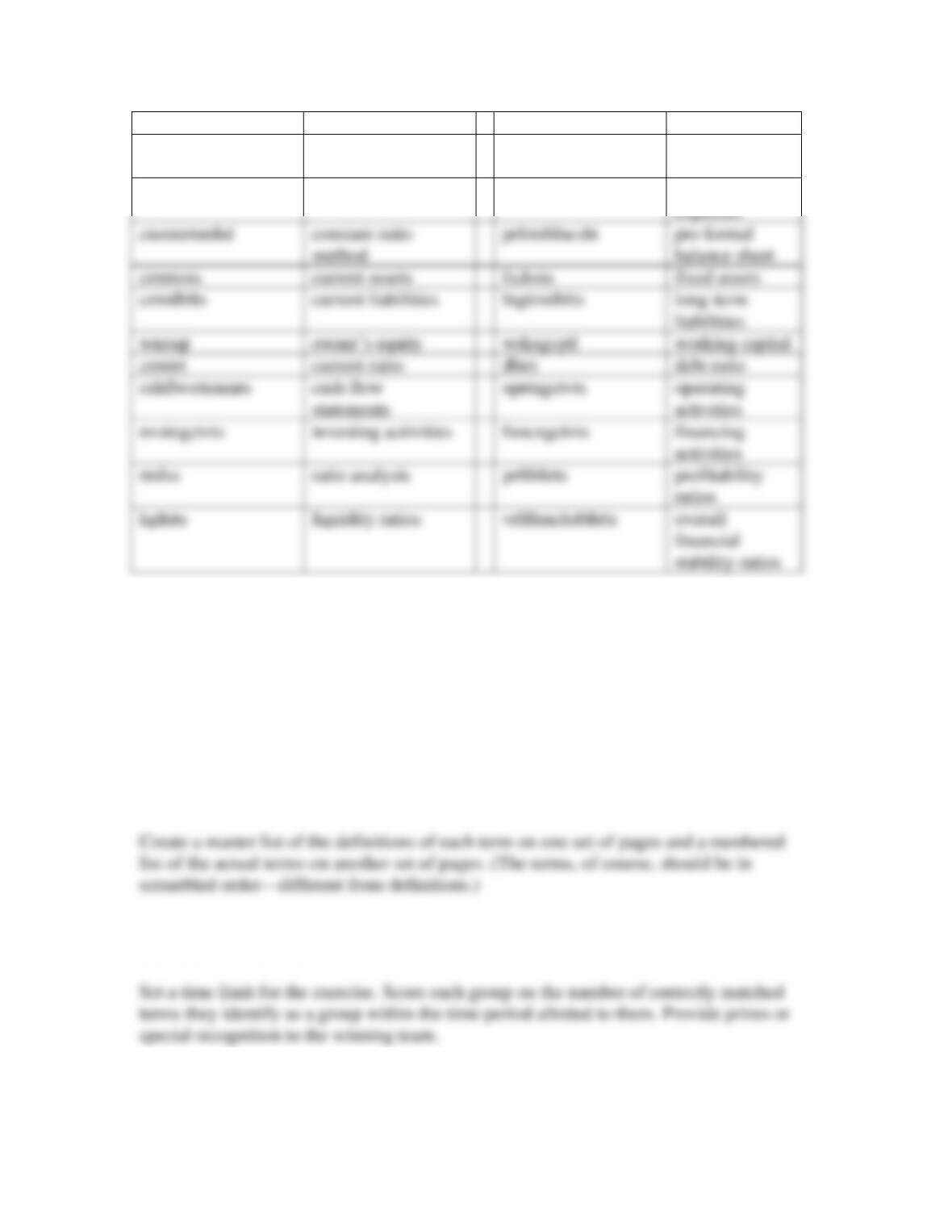
Strange Words
Key Words
Strange Words
Key Words
srcdsffndssttmnt
source and use of
ssmptssht
assumptions
126
funds statement
sheet
prfrmfnnclsttmnts
pro forma financial
statements
ntsls
net sales
cstfgdssld
cost of goods sold
oprtngxpnss
operating
Debrief this activity by asking students:
o What was your reaction to this method of learning?
o Did receiving the strange words in advance help or hinder your learning them?
3. Matching Review
Purpose: to assess the degree of retention of key words.
To reinforce major terms at the end of a training session (or module).
Divide the class into discussion teams of two to five persons, and give each team a set of
materials to work with.
Debrief the exercise by asking students these questions:
o Which key words gave your group the greatest difficulty? Why?
expenses
cnstntrtmthd
constant ratio
method
prfrmblncsht
pro formal
balance sheet
crrntssts
current assets
fxdssts
fixed assets
crrntlblts
current liabilities
lngtrmlblts
long-term
liabilities
wnrsqt
wrkngcptl
working capital
crrntrt
current ratio
dbtrt
debt ratio
cshflwsttemnts
cash flow
statements
oprtngctvts
operating
activities
nvstngctvts
investing activities
fnncngctvts
financing
activities
rtnlss
ratio analysis
prftbltrts
profitability
ratios
financial
stability ratios

o Which terms would you now like to have clarified?