ROBLEM 10.54
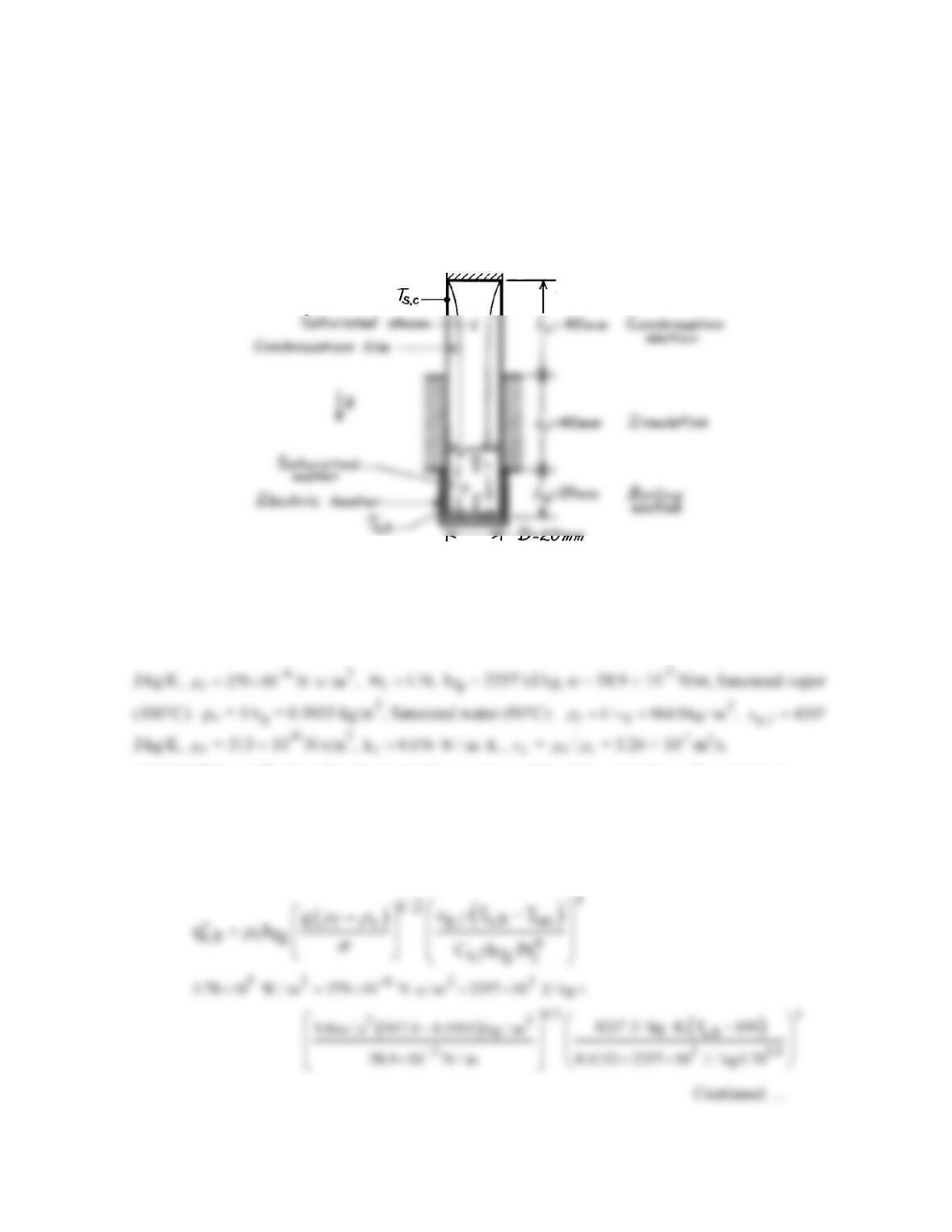
KNOWN: Thin-walled thermosyphon. Absorbs heat by boiling saturated water at atmospheric
pressure on boiling section Lb. Rejects heat by condensing vapor into a thick film which falls length
of condensation section Lc back into boiling section.
FIND: (a) Mean surface temperature, Ts,b, of the boiling surface if nucleate boiling flux is 30%
critical flux, (b) Mean surface temperature, Ts,c of condensation section, and total condensation flow
rate,
m,
in thermosyphon.
SCHEMATIC:
ASSUMPTIONS: (1) Film condensation occurs in condensation section which approximates a
vertical plate, (2) Boiling and condensing section are separated by insulated length Li, (3) Top surface
of condensation section is insulated, (4) For condensation, liquid properties evaluated at Tf = 90C.
PROPERTIES: Table A-6, Saturated water (100C):
3
f
1/ v 957.9 kg / m ,
ρ
= =
p,
c
= 4217
ANALYSIS: (a) The heat flux for the boiling section is 30% of the critical heat flux which at
atmospheric pressure is
62 52
s,b max
q 0.30q 0.30 1.26 10 W / m 3.78 10 W / m .
′′ ′′
= = ×× = ×
Using the Rohsenow correlation for nucleate boiling with Tsat = 100C and values for the surface of
Cs,f = 0.0132 and n = 1.0 from Table 10.1, find
PROBLEM 10.54 (Cont.)
s,b
T 114.2 C.=
<
(b) The heat transferred into the boiling section must be rejected by film condensation,
( )
δ
L2 1/3 1.22
δ
2
1/3 1.22
2
-7 2 2
k Re
h(ν /g) 1.08Re 5.2
0.676 W/m K 53.5 12,290 W/m K
1.08 53.5 5.2
3.24×10 m /s 9.8 m /s
= =
−
⋅
= = ⋅
×−
(1)
From Eq. 10.33 we can solve for Tsat – Ts,c, as
This solution can now be iterated by recalculating
fg
h′
and
Reδ
and re–solving Eqs. (1) and (2). The
iterations converge to Tsat – Ts,c = 19.1°C. Thus
PROBLEM 10.55
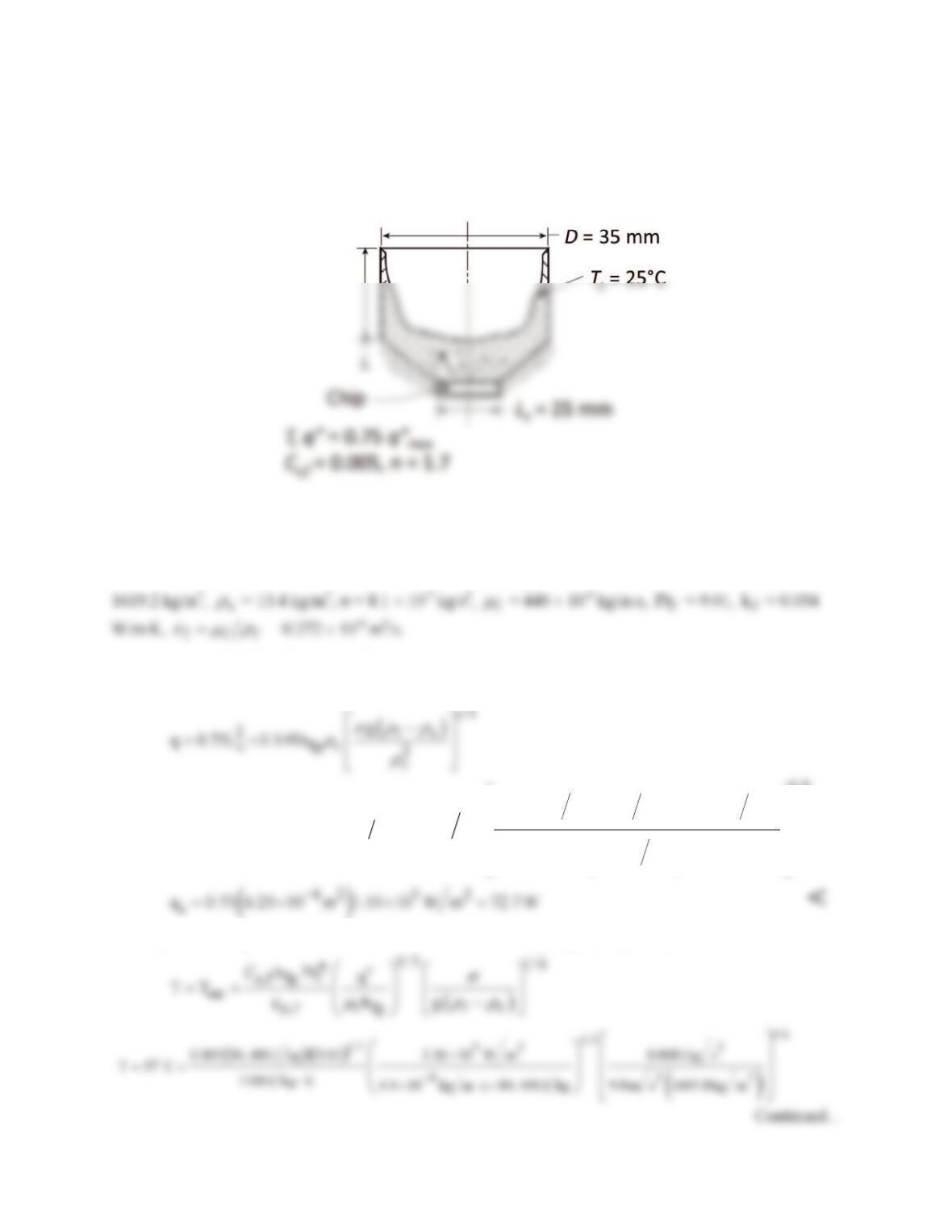
KNOWN: Thermosyphon configuration for cooling a computer chip of prescribed size.
FIND: (a) Chip temperature and total power dissipation when chip operates at 75% of critical heat flux,
(b) Required condenser length.
SCHEMATIC:
ASSUMPTIONS: (1) Steady-state, (2) Saturated liquid/vapor conditions, (3) Negligible heat transfer
from bottom of chip.
PROPERTIES: Fluorocarbon (prescribed): Tsat = 57C,
cp,
= 1100 J/kg⋅K, hfg = 84,400 J/kg,
ρ
=
ANALYSIS: (a) With
q′′
= 0.75
max
q′′
and the critical heat flux given by Eq. 10.6 with C=0.149, the
chip power dissipation is
( ) ( )
()()
()
1/4
22 3
23
2
3
0.0081kg s 9.8m s 1605.8kg m
q 0.75 0.025 m 0.149 84, 400 J kg 13.4 kg m
13.4 kg m
= ×
With operation at
q′′
= 1.16 × 10⁵ W/m2 in the nucleate boiling region, Eq. 10.5 yields
PROBLEM 10.55 (Cont.)
T 57 C 20.9 C 77.9 C=+=
<
(b) The power dissipated by the chip must be balanced by the rate of heat transfer from the condensing
section. We combine Eqs. 10.34 and 10.36 to obtain
Re
δ
m= ′
4q bh
fg
, where b = πD = 0.110 m and
δ
L2 1/3 1.22
δ
Re
k
h(ν /g) 1.08Re 5.2
= =
−
and from Eq. 10.33,
COMMENTS: The chip operating temperature (T = 77.9C) is not excessive, and the proposed scheme
provides a compact means of cooling high performance chips.
PROBLEM 10.56
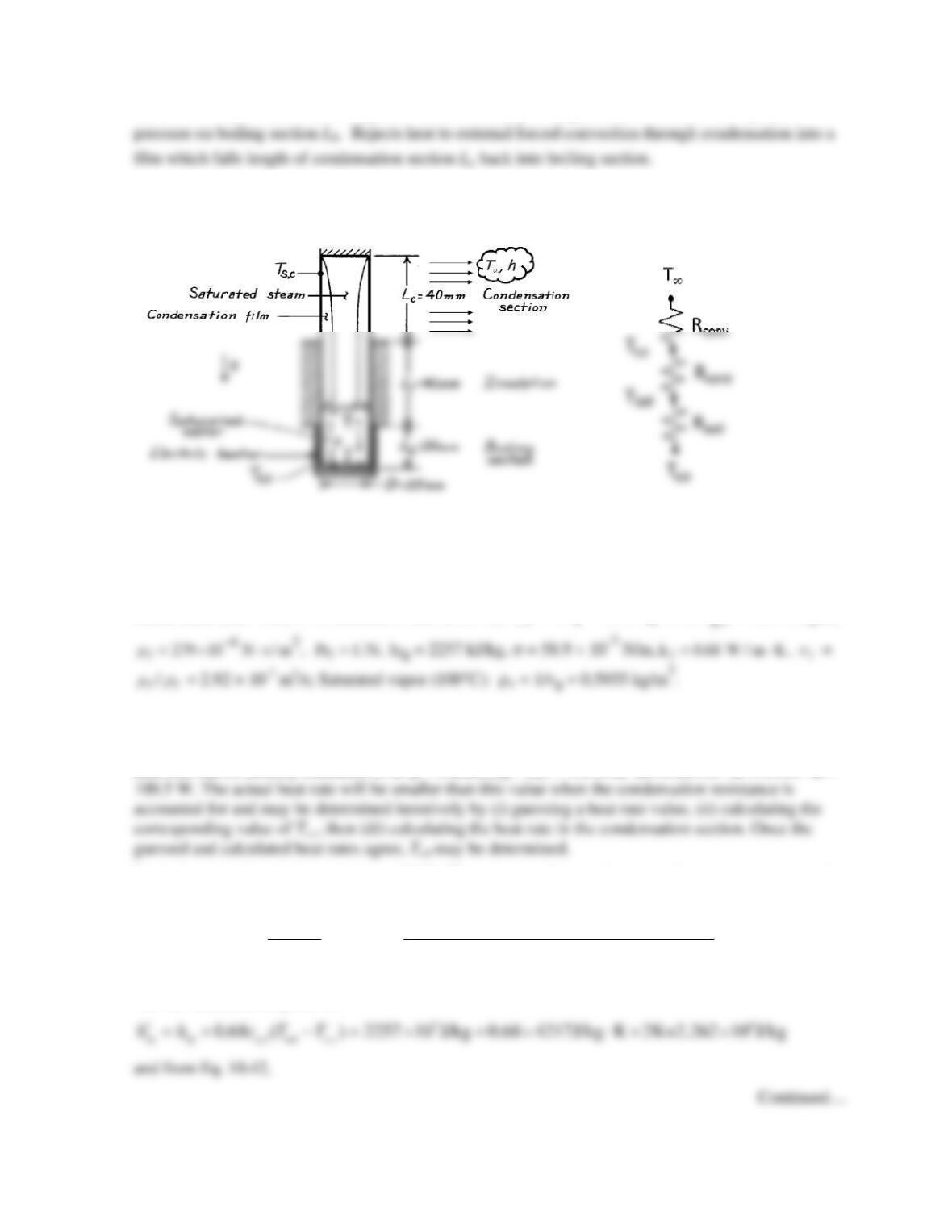
KNOWN: Thin-walled thermosyphon. Absorbs heat by boiling saturated water at atmospheric
FIND: Mean surface temperature, Ts,b, of the boiling surface, mean surface temperature, Ts,c of
condensation section, and heat rate.
SCHEMATIC:
ASSUMPTIONS: (1) Film condensation in condensation section approximates that of a vertical plate,
(2) Boiling and condensing section are separated by insulated length Li, (3) Top surface of
condensation section is insulated, (4) For condensation, liquid properties evaluated at Tf ≈ 100C.
PROPERTIES: Table A-6, Saturated water (100C): 3
f
1/ v 957.9 kg / m ,
ρ
==
p
,
c = 4217 J/kg⋅K,
ANALYSIS: The boiling, condensation and forced convection processes can be represented by a series
thermal resistance network as shown in the schematic. We begin by assuming Rconv >> Rcond so that the
heat rate can be initially estimated to be q = h
π
DLc(Tsat – T) = 500W/m2·K×π×20×10-3m ×40×10-3m =
Begin by assuming the heat rate is q = 98 W. The corresponding condenser surface temperature may be
determined with knowledge of the convection resistance. Hence,
,233
98 W
393 K 371 K
500W/m K 20 10 m 40 10 m
sc
c
q
TT
hDL
ππ
−−
=+ = + =
⋅×× × × ×
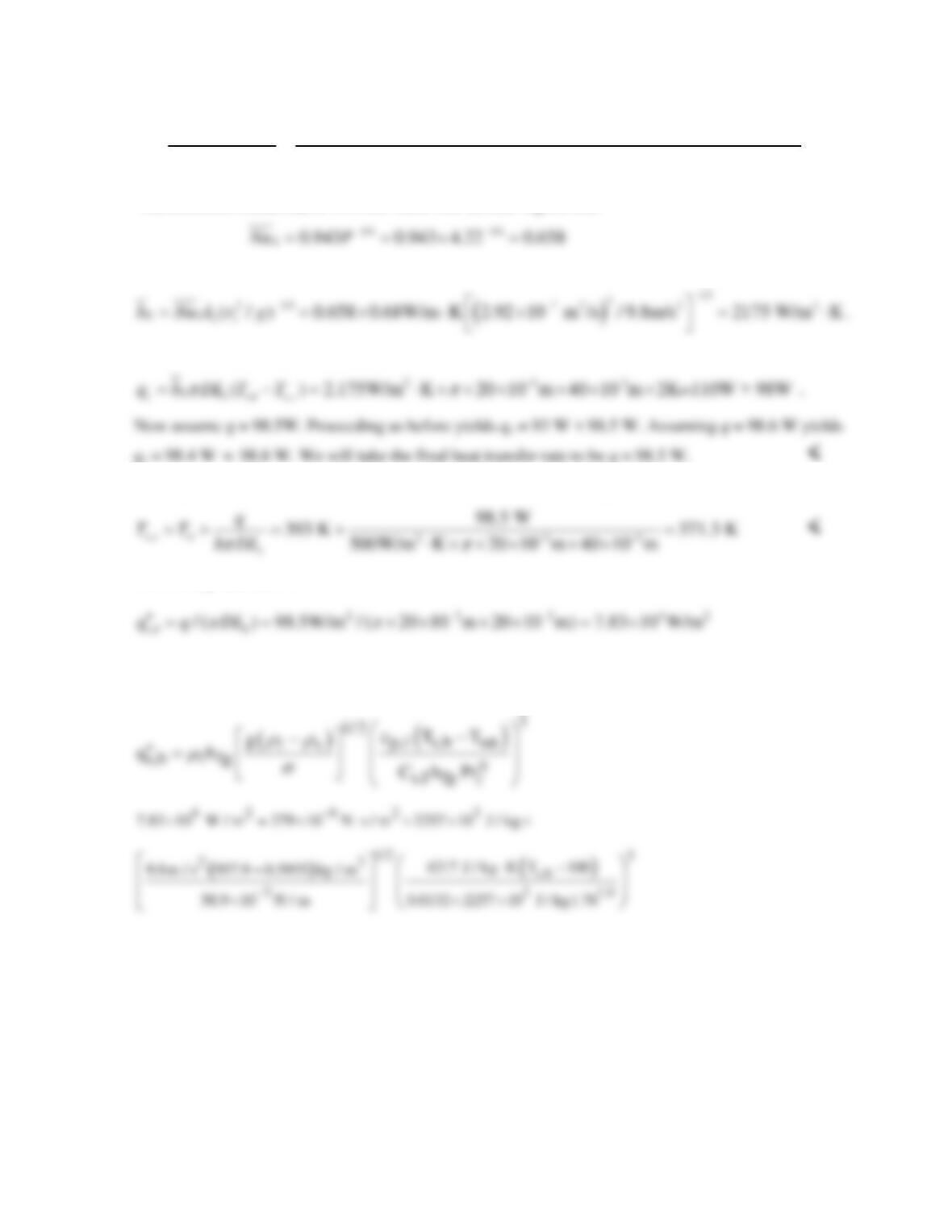
For the condensation process,
PROBLEM 10.56 (Cont.)
()
3
sat ,
1/3
21/3 2
62 6 72 2
() 0.68W/m K 40 10 m 2K 4.22
(/) 279 10 N s/m 2.262 10 J/kg 2.92 10 m /s / 9.8m/s )
lc sc
lfg l
kL T T
Phg
mν
−
−−
−⋅× × ×
== =
′
×⋅×× ×
Therefore, the condensation is in the wave-free laminar regime and
and
The condensation heat transfer rate is
We may now calculate the actual value of the condenser surface temperature,
The boiling heat flux is
Using the Rohsenow correlation for nucleate boiling with Tsat = 100C and values for the surface of
Cs,f = 0.0132 and n = 1.0 from Table 10.1,
From which Ts,b = 108.4°C. <
COMMENTS: (1) The film temperature for the condensation process is 372.1 K, so the assumed value
of the film temperature is appropriate. (2) Thermal resistances external to the thermosyphon often
dominate the thermal networks for such devices. The heat rate could be increased by adding fins to the
external walls of the condensation section.
PROBLEM 10.57
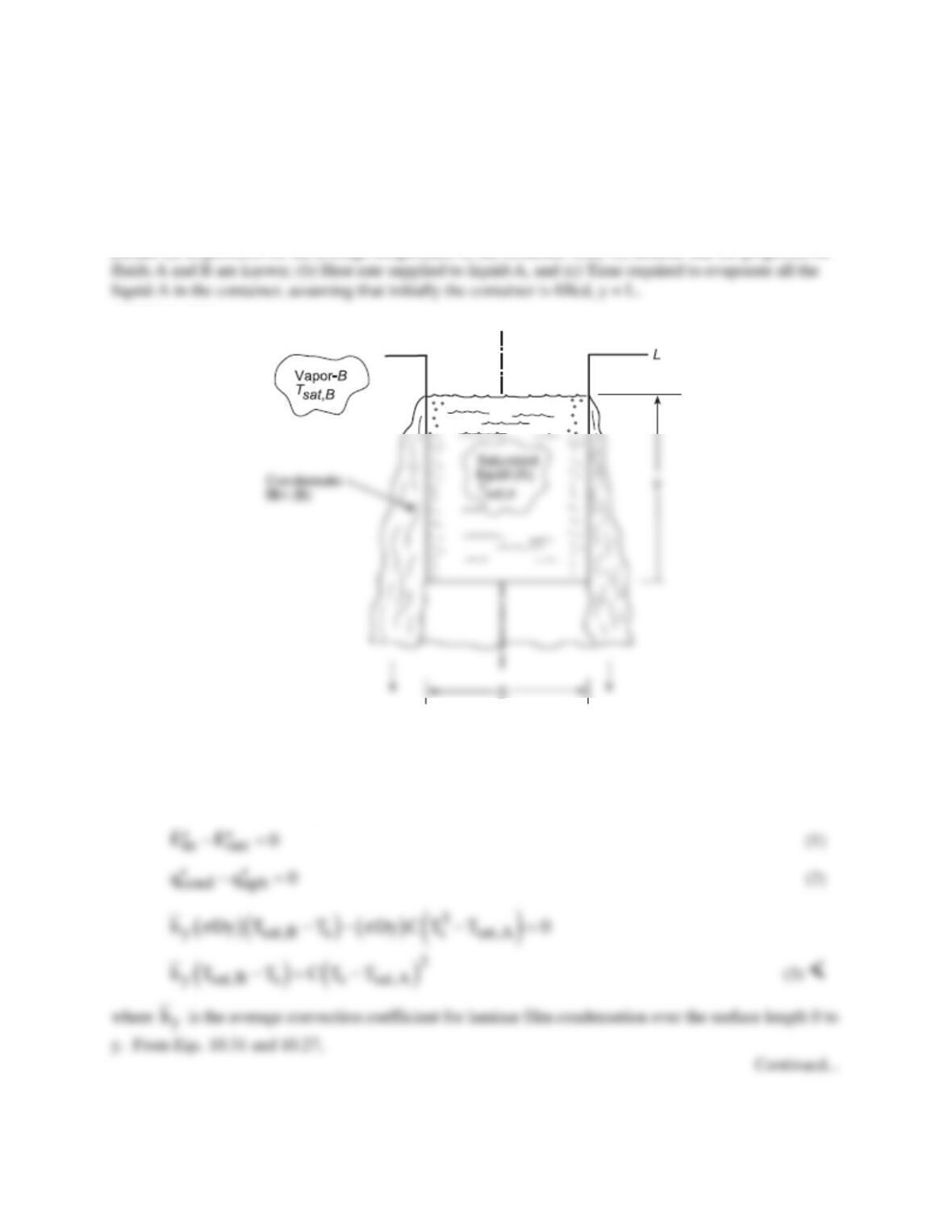
KNOWN: Thin–walled container filled with a low boiling point liquid (A) at Tsat,A. Outer surface of
container experiences laminar–film condensation with the vapor of a high–boiling point fluid (B).
Laminar film extends from the location of the liquid–A free surface. The heat flux for nucleate pool
boiling in liquid–A along the container wall is given as
npb
q′′
= C(Ts − Tsat)3, where C is a known
empirical constant.
FIND: (a) Expression for the average temperature of the container wall, Ts; assume that the properties of
SCHEMATIC:
ASSUMPTIONS: (1) Nucleate pool boiling occurs on the inner surface of the container with liquid–A,
(2) Laminar film condensation occurs on the outer surface of the container with fluid–B over the liquid–A
free surface, y, and (3) Negligible wall thermal resistance.
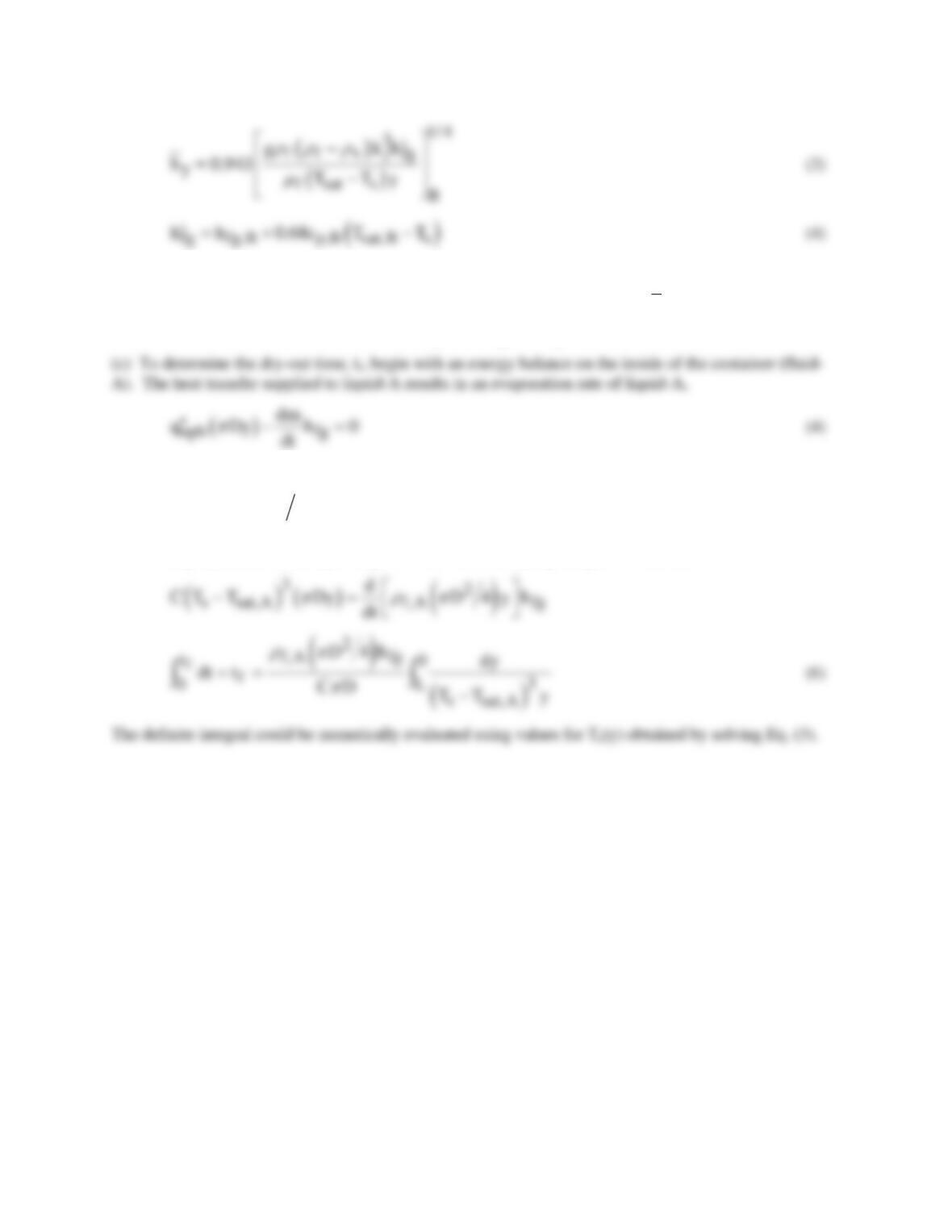
ANALYSIS: (a) Perform an energy balance on the control surface about the container wall along
locations experiencing boiling (A) and condensation (B) as shown in the schematic above.
PROBLEM 10.57 (Cont.)
where the properties are for fluid–B.
(b) The heat flux supplied to liquid–A is, from Eq. (2),
cond npb
qq
′′ ′′
=
. Since
y
h
is a function of y, Ts
and, hence, the heat fluxes will be functions of y, the height of liquid A in the container.
where M is the mass of liquid–A in the container,
()
2
,A
m D 4y
ρπ
=
(5)
Substituting Eq. (5) into (4), separating variables and identifying integration limits, find
PROBLEM 10.58
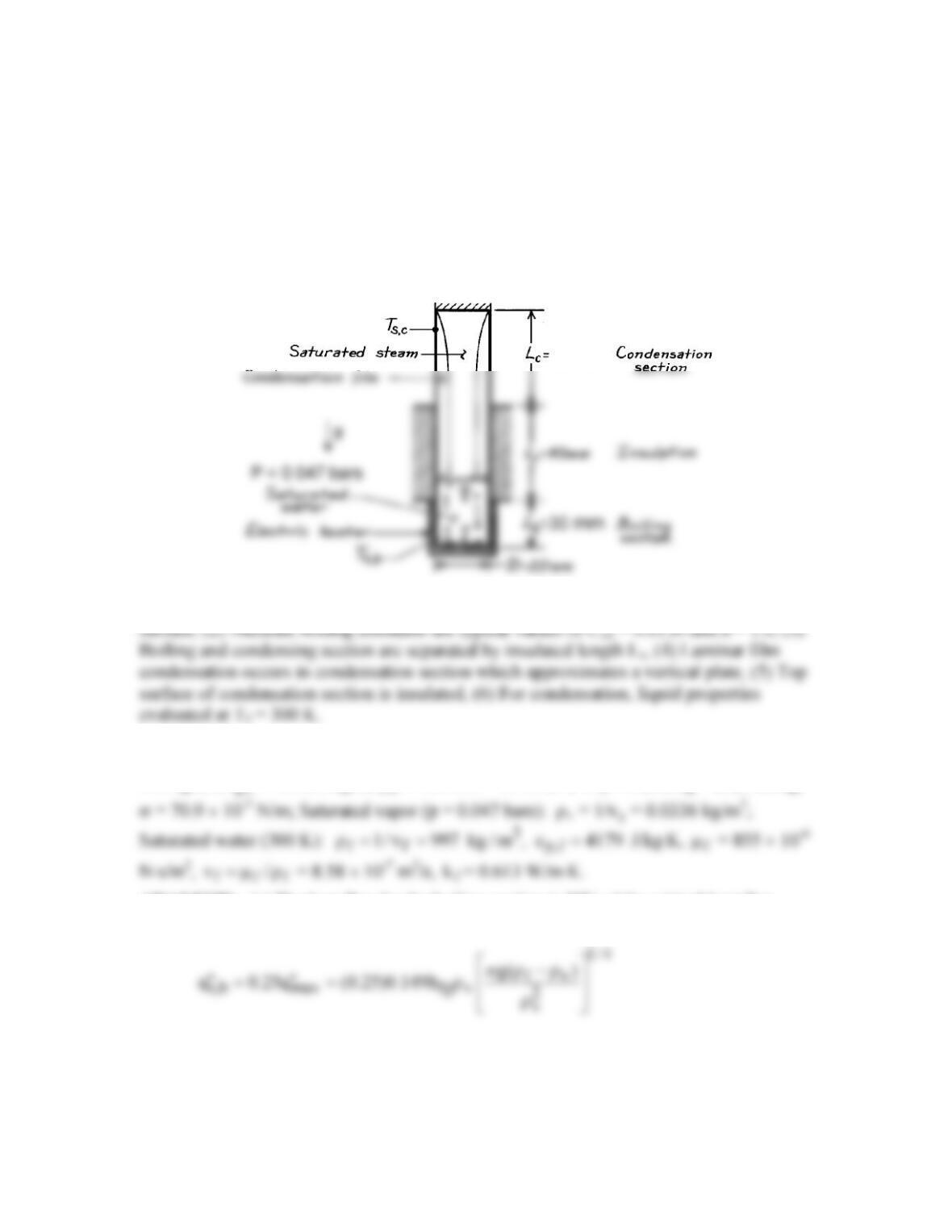
KNOWN: Dimensions of ten thin-walled thermosyphons with boiling, insulated, and
condensing sections of known lengths. Working fluid is saturated water at 0.047 bars.
FIND: (a) Heating rate delivered by thermosyphons if nucleate boiling heat flux is 25%
of CHF and mean temperatures of boiling and condensing sections, (b) Heat loss from
hot water tank to cool attic.
SCHEMATIC:
ASSUMPTIONS: (1) Bottom of thermosyphon can be treated as a large horizontal
PROPERTIES: Table A-6, Saturated water (p = 0.047 bars): Tsat = 305 K,
ρ
= 1/vf =
995 kg/m3,
c
= 4178 J/kg⋅K,
62
769 10 N s / m ,
−
m= × ⋅
Pr 5.20=
, hfg = 2426 kJ/kg,
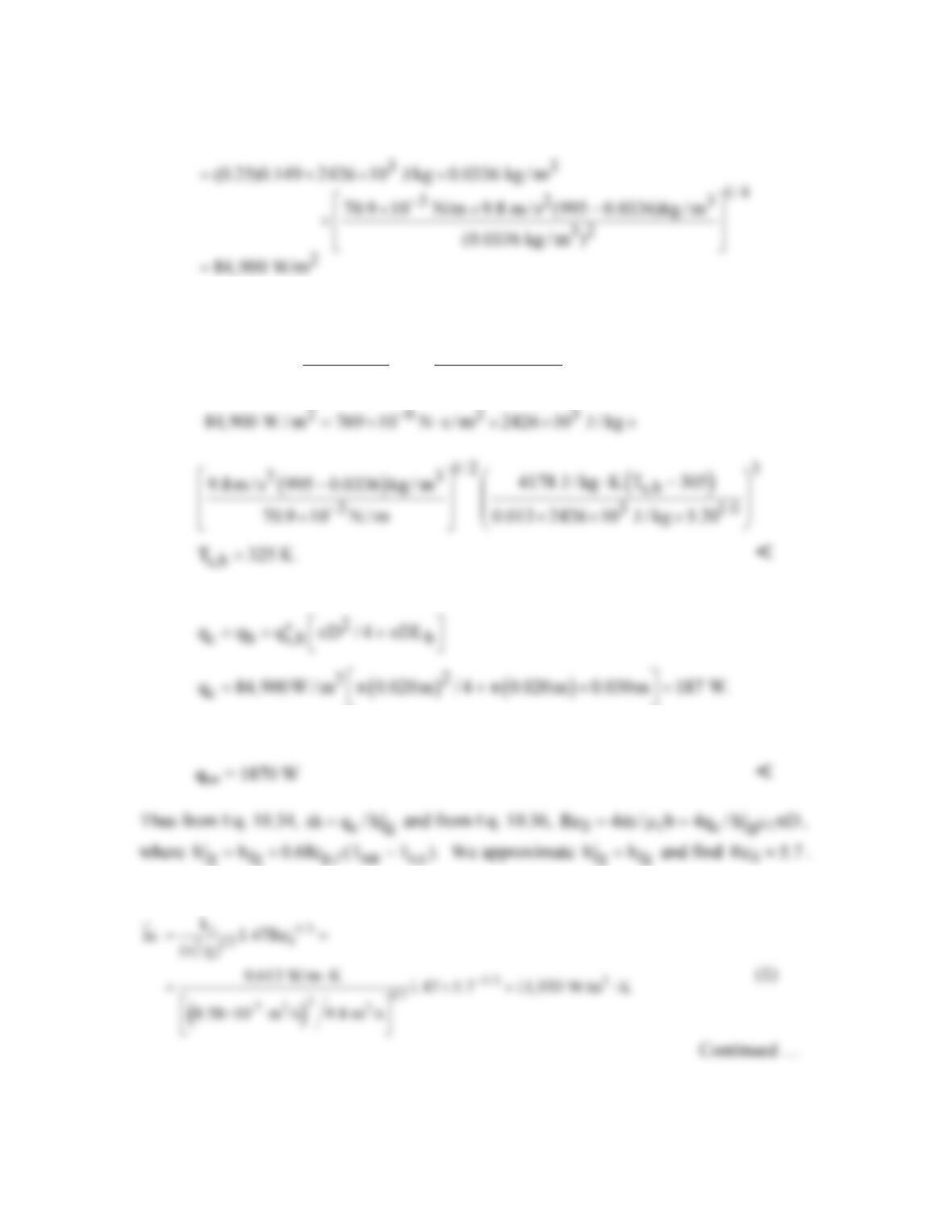
ANALYSIS: (a) The heat flux for the boiling section is 25% of the critical heat flux,
which is given by Eq. 10.6 with C = 0.149 for a large horizontal surface,
Continued …
50 mm
PROBLEM 10.58 (Cont.)
Using the Rohsenow correlation for nucleate boiling, find
( )
( )
3
1/2 p, s,b sat
v
s,b fg n
s,f fg
cT T
g
qh
C h Pr
−
ρ −ρ
′′ = m
s
The heat transferred into the boiling section must be rejected by film condensation,
For all ten thermosyphons, the heating rate is therefore
Thus the flow is laminar as assumed. From Eq. 10.38 we have
PROBLEM 10.58 (Cont.)
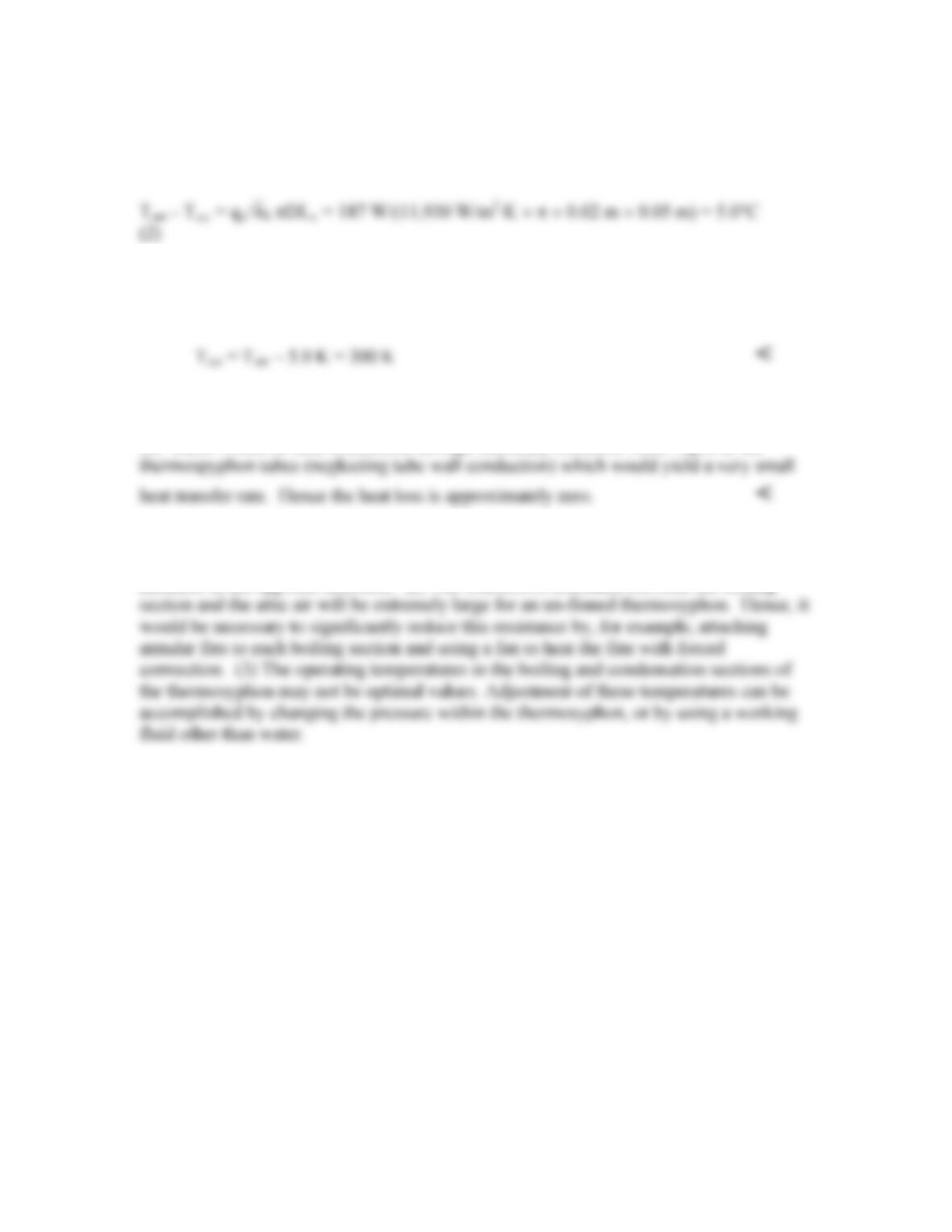
From Eq. 10.33 we can solve for Tsat – Ts,c, as
This solution can now be iterated by recalculating
fg
h′
and
Reδ
and re-solving Eqs. (1)
and (2). Subsequent iterations do not change the value of Tsat – Ts,c. Thus
Note that Tf = 302.5 K, which is not far from the assumed value of 300 K.
(b) There would be heat conduction through thermally-stratified water vapor in the
COMMENTS: (1) The thermosyphon is a unique device in that it acts like a thermal
diode, promoting high heat transfer rates in one direction, while serving as an effective
insulator in the opposite direction. (2) The convective resistance between the boiling