Problem 10.31
The following data are taken from measurements on Indian Fork Creek: =2
26 mA,
=16 mP, and =
0
0.02 m
62 m
S. Determine the average shear stress on the wetted perimeter of
this channel.
Solution 10.31
Problem 10.32
Consider laminar flow down a wide rectangular channel making an angle
θ
with the
horizontal. The fluid has kinematic viscosity vand the volume flowrate per unit width is
given by
θ
=
3sin
3
gy
qv,
where
y
is the fluid depth perpendicular to the channel bottom. Find Manning’s
n
for the
flow.
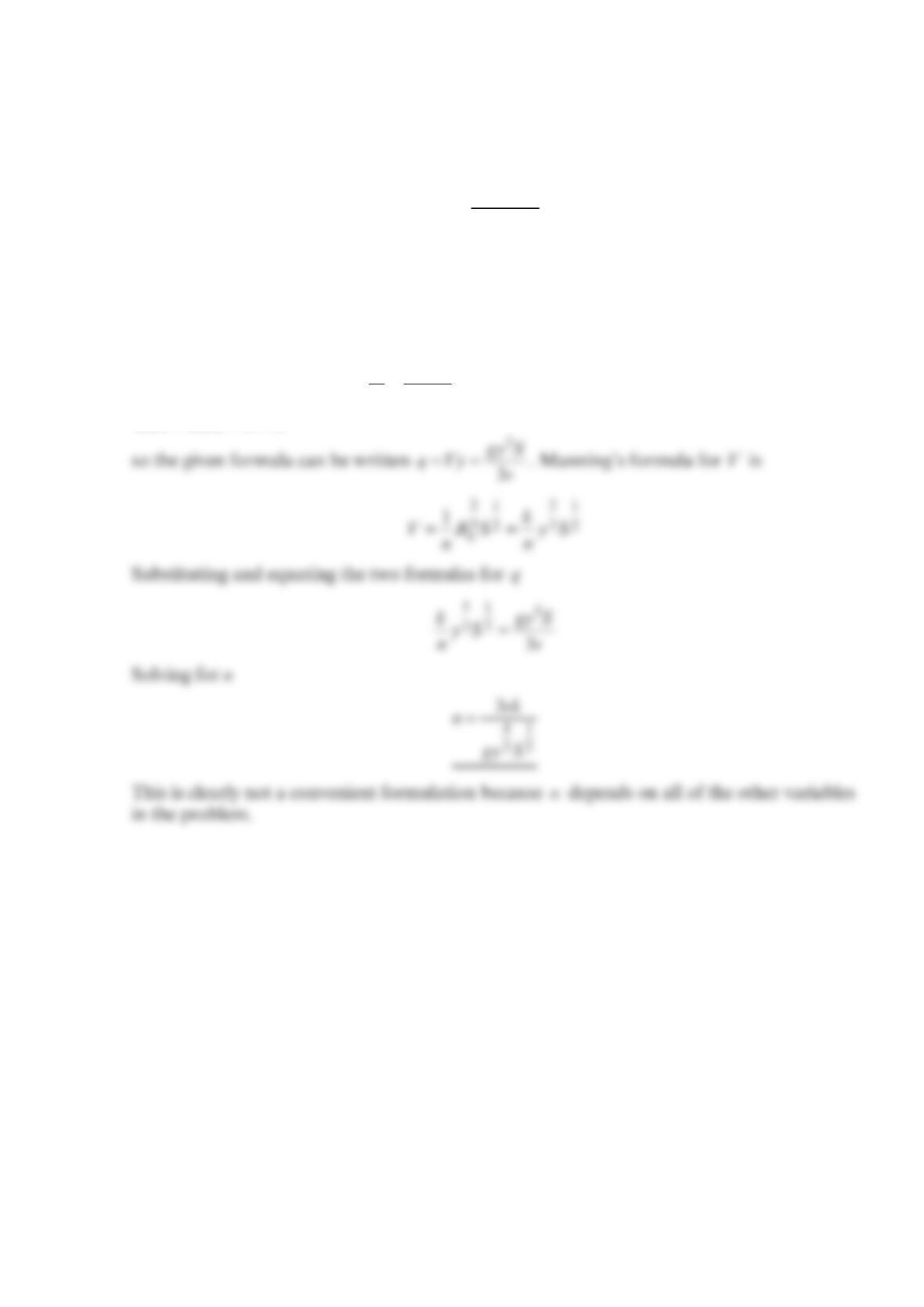
Solution 10.32
For a very wide channel == = →∞
+(for )
2
h
Aby
Ryb
Pb y . For a small slope,
θθθ
≈≈=sin tan S
n
Problem 10.33
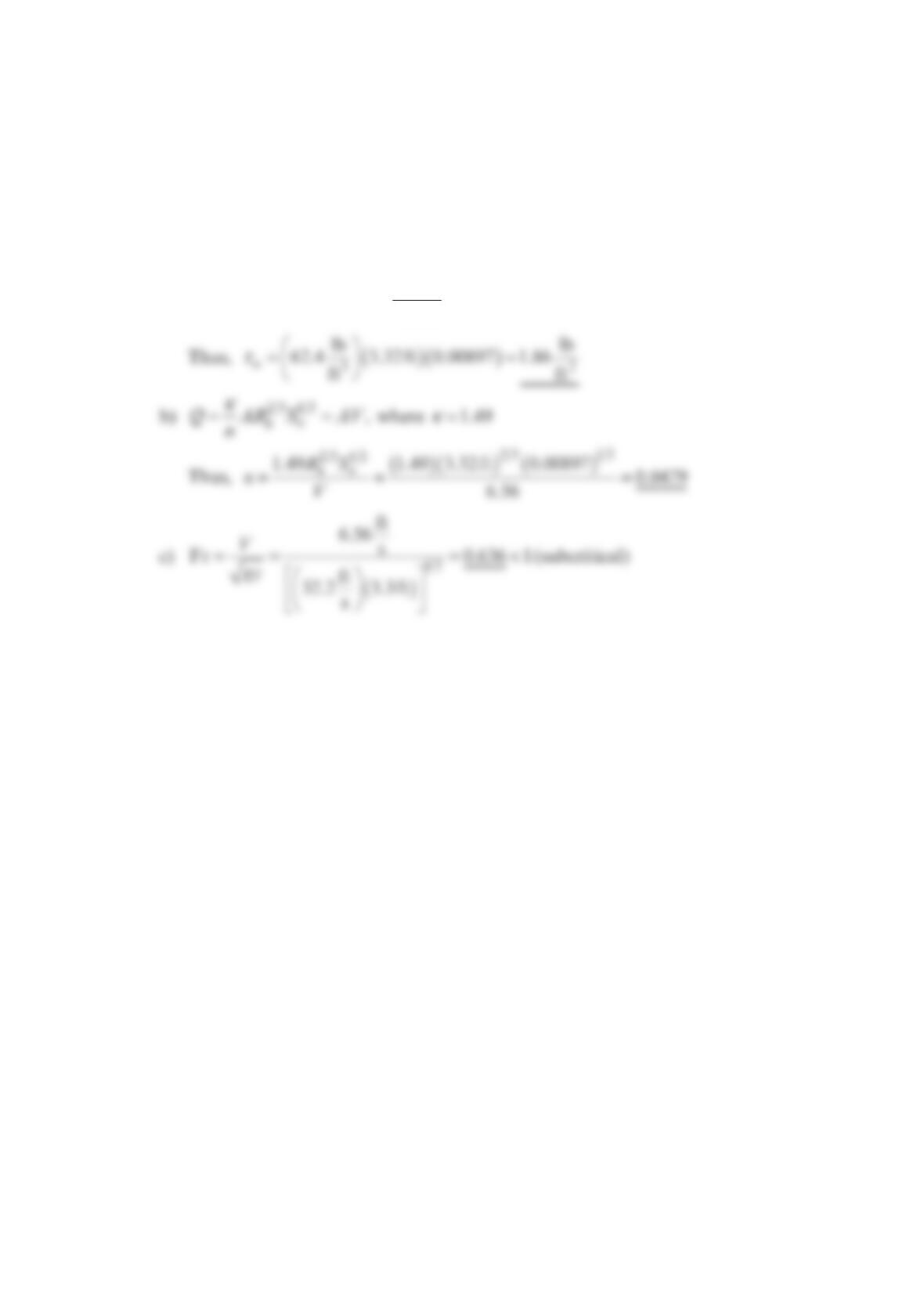
The following data are obtained for a particular reach of the Provo River in Utah:
=2
183ft ,A=free-surface width 55ft, =average depth 3.3ft, =3.32 ft,
h
R=6.56 ft/s,V
=length of reach 116 ft, and =elevation drop of reach 1.04 ft. Determine (a) the average
shear stress on the wetted perimeter, (b) the Manning coefficient, n, and (c) the Froude
number of the flow.
Solution 10.33
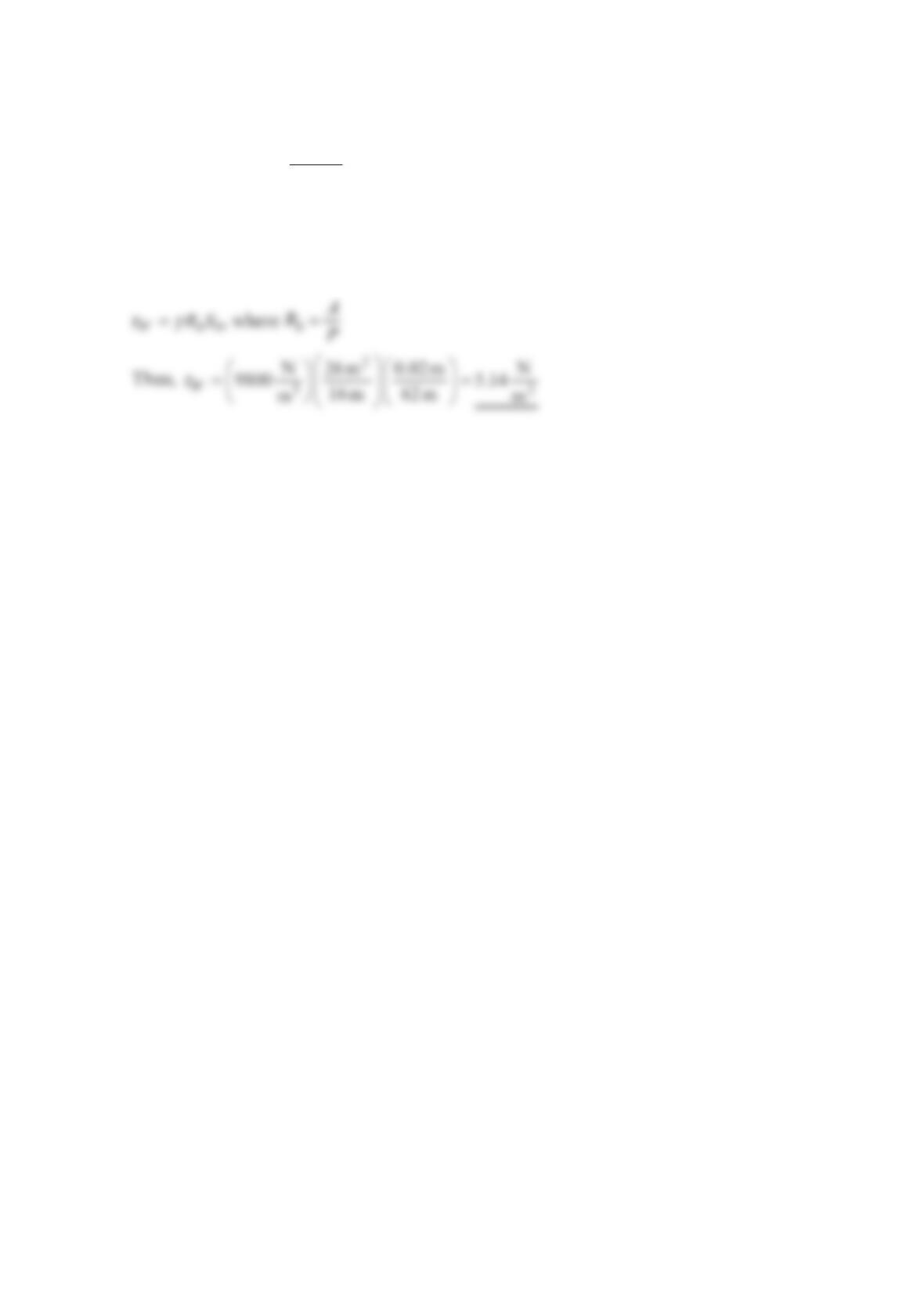
a)
τ
γ
=,
who
RS where ==
1.04 ft 0.00897
116 ft
o
S
Problem 10.34
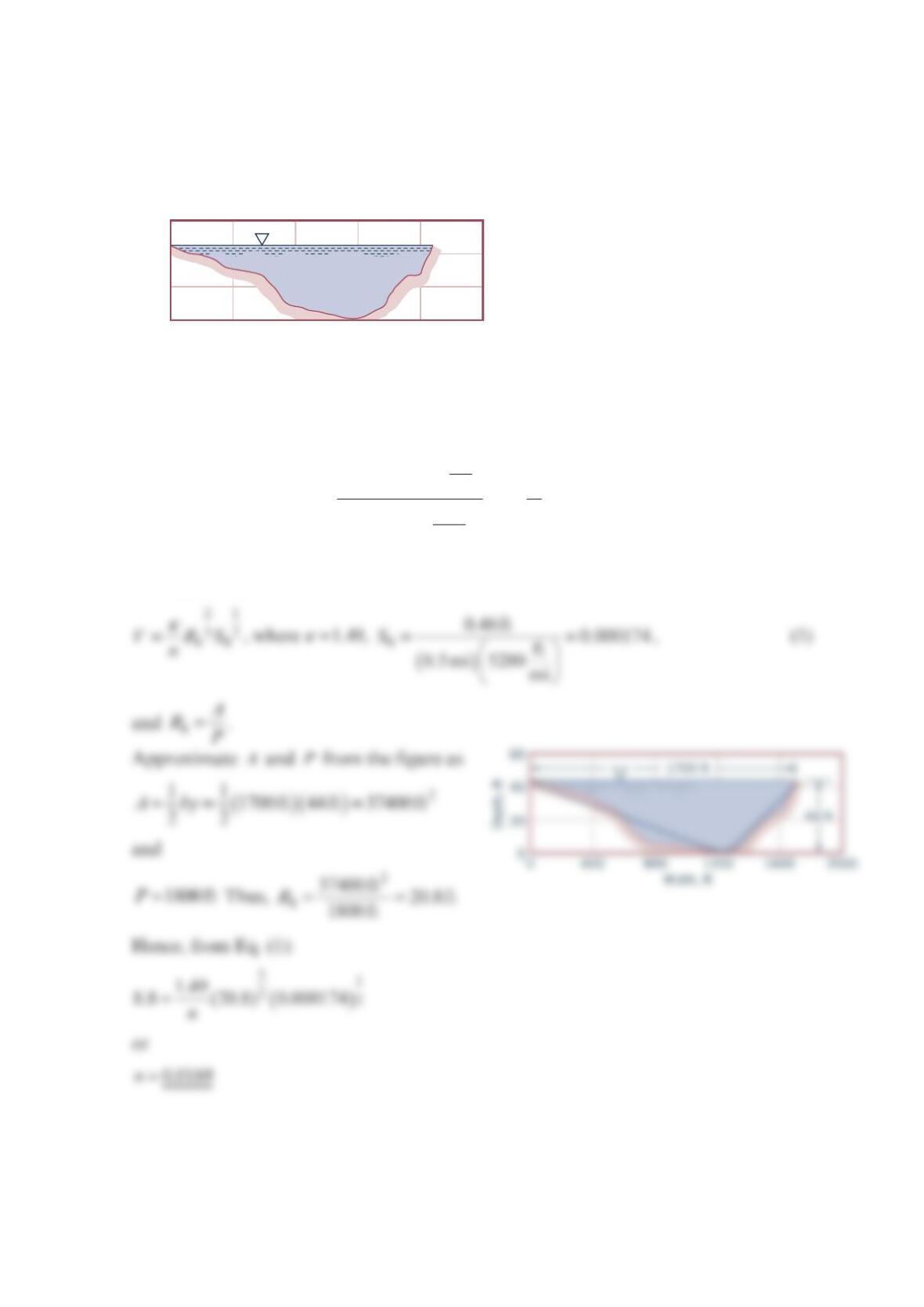
At a particular location, the cross section of the Columbia River is as indicated in the figure
below. If on a day without wind it takes 5min to float 0.5 mile along the river, which drops
0.46 ft in that distance, determine the value of the Manning coefficient,
n
.
Solution 10.34
From the given data,
()
()
==
ft
0.5 mi 5280 ft
mi 8.8
ss
5min 60min
V.
From the Manning equation, assuming that the velocity at the surface is the average
velocity of the river:
60
40
20
00 400 800 1200 1600 2000
Width (ft)
Depth (ft)
Problem 10.35
A uniform flow of 3
110,000 ft s is measured in a natural channel that is approximately
rectangular in shape with a 2650-ft width and 17.5-ft depth. The water-surface elevation
drops 0.37 ft per mile. Based on the computed Manning
n
, characterize the type of natural
channel observed. Also compute the Froude number and determine whether the flow is
subcritical or supercritical.
Solution 10.35
GIVEN: Uniform flow of =3
110,000 ft sQ, natural channel, rectangular =2650ftb,
=17.5fty, water-surface elevation drops 0.37 ft per mile.
so
()
()
=
5
23
2
3
3
46375ft
1.49 0.000070
ft 2650 ft
110000 s
n
n
n

Problem 10.36
A
2
-m–diameter pipe made of finished concrete lies on a slope of 1-m elevation change per
1000-m horizontal distance. Determine the flowrate when the pipe is half full.
Solution 10.36
(1)
κ
==
2
30h
QAV AR S
n, where
κ
=1 and ==
0
1m 0.001
1000 m
S
Problem 10.37
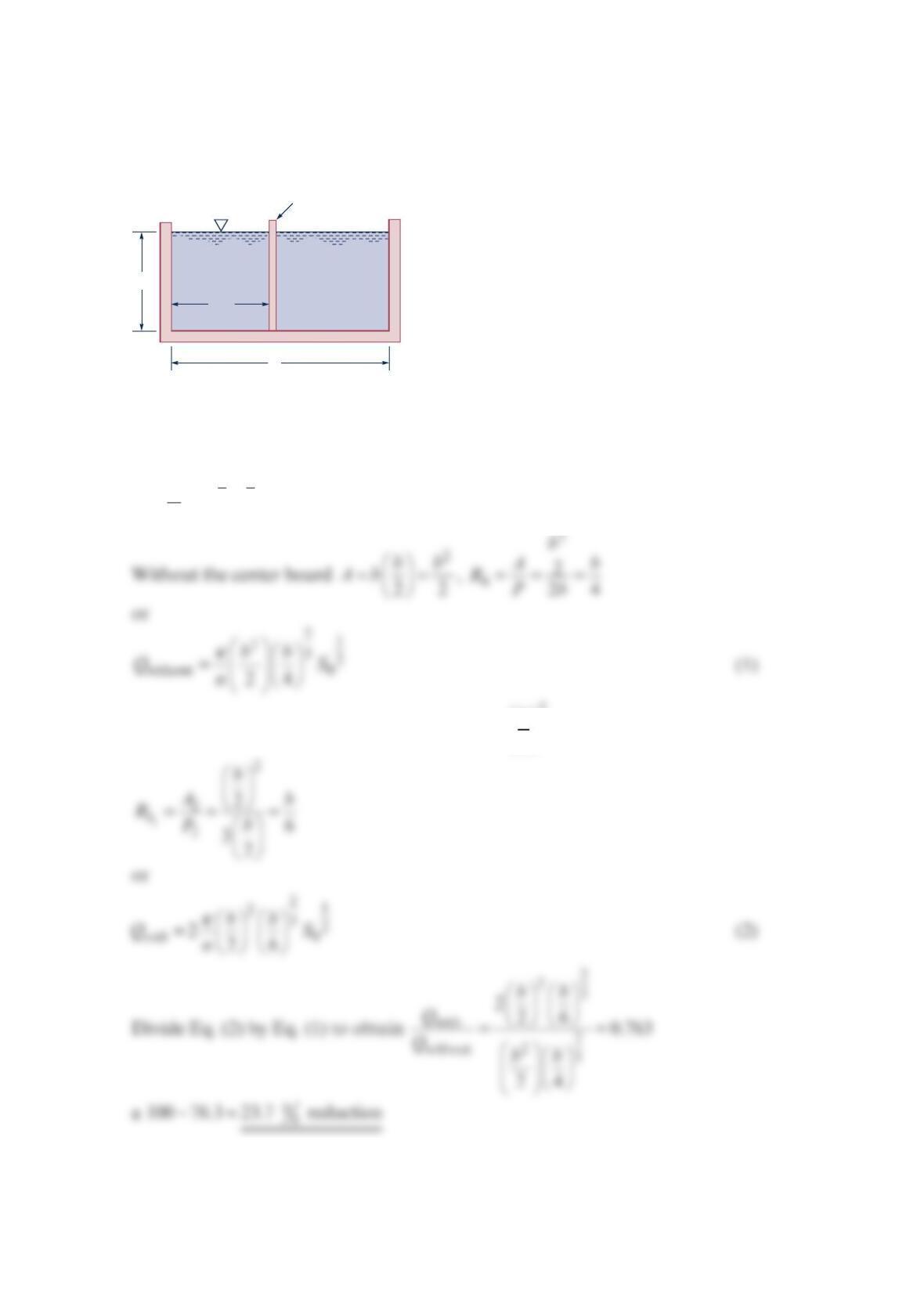
By what percent is the flowrate reduced in the rectangular channel shown in the figure
below because of the addition of the thin center board? All surfaces are of the same
material.
Solution 10.37
κ
=
21
32
0h
QARS
n
With the center board =
with 2
2QQ, where
=
2
22
b
A,
b
/2
b
/2
b
Center board
Problem 10.38
A large trapezoidal channel cut through stone has side slopes of 1:1 and a bed width of
291ft . Find the uniform flow in the channel when the flow depth is 30.4 ft and the bed
slopes 1ft per mile.
Solution 10.38
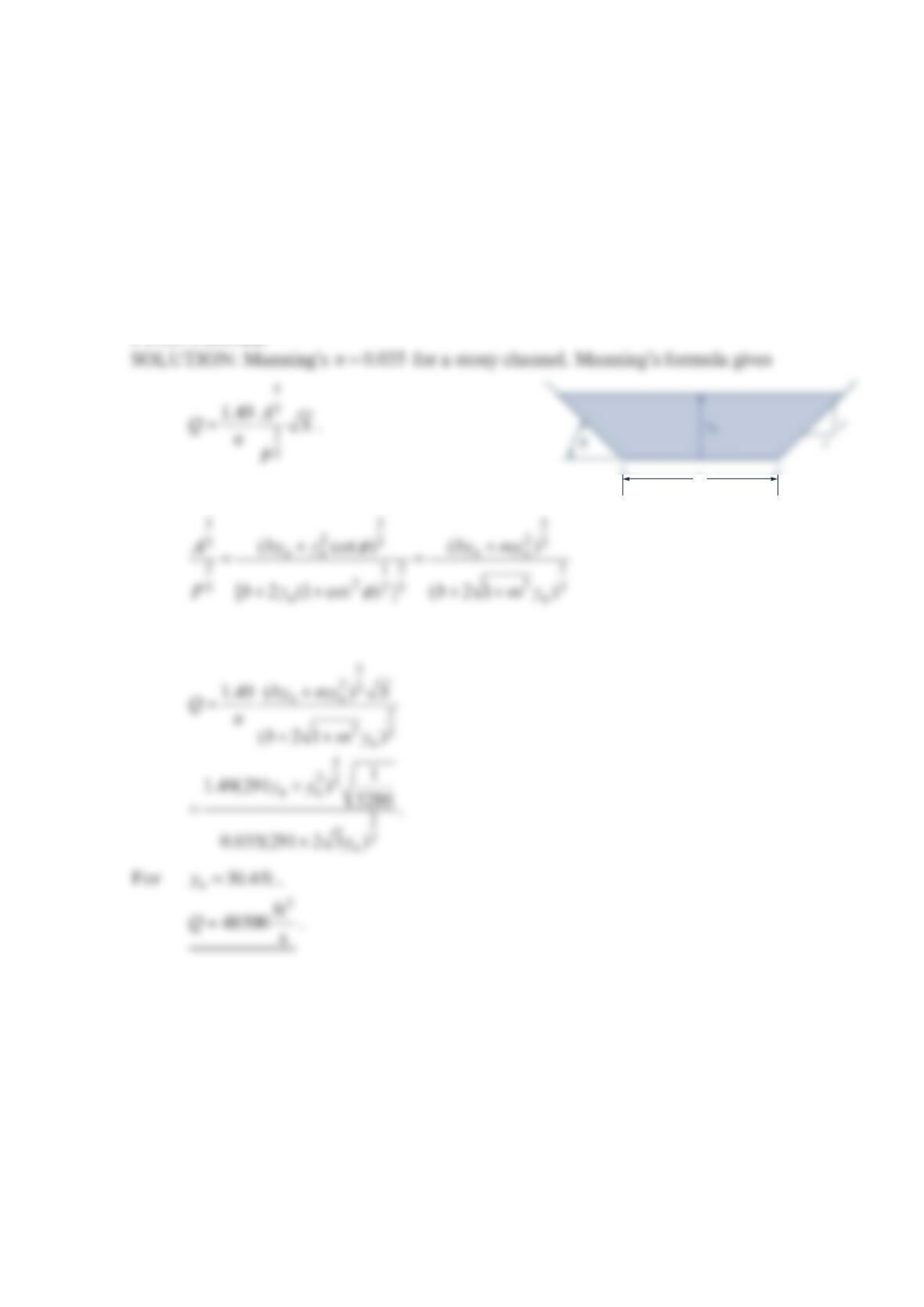
GIVEN: Stone trapezoidal channel with side slope 1:1 and a bed width of =291ftb. Flow
depth =30.4 ft
n
y. Bed slope 1.0ft per mile.
FIND: Flowrate.
For a trapezoidal channel of side slope
φ
=cotm
so
b
Problem 10.39
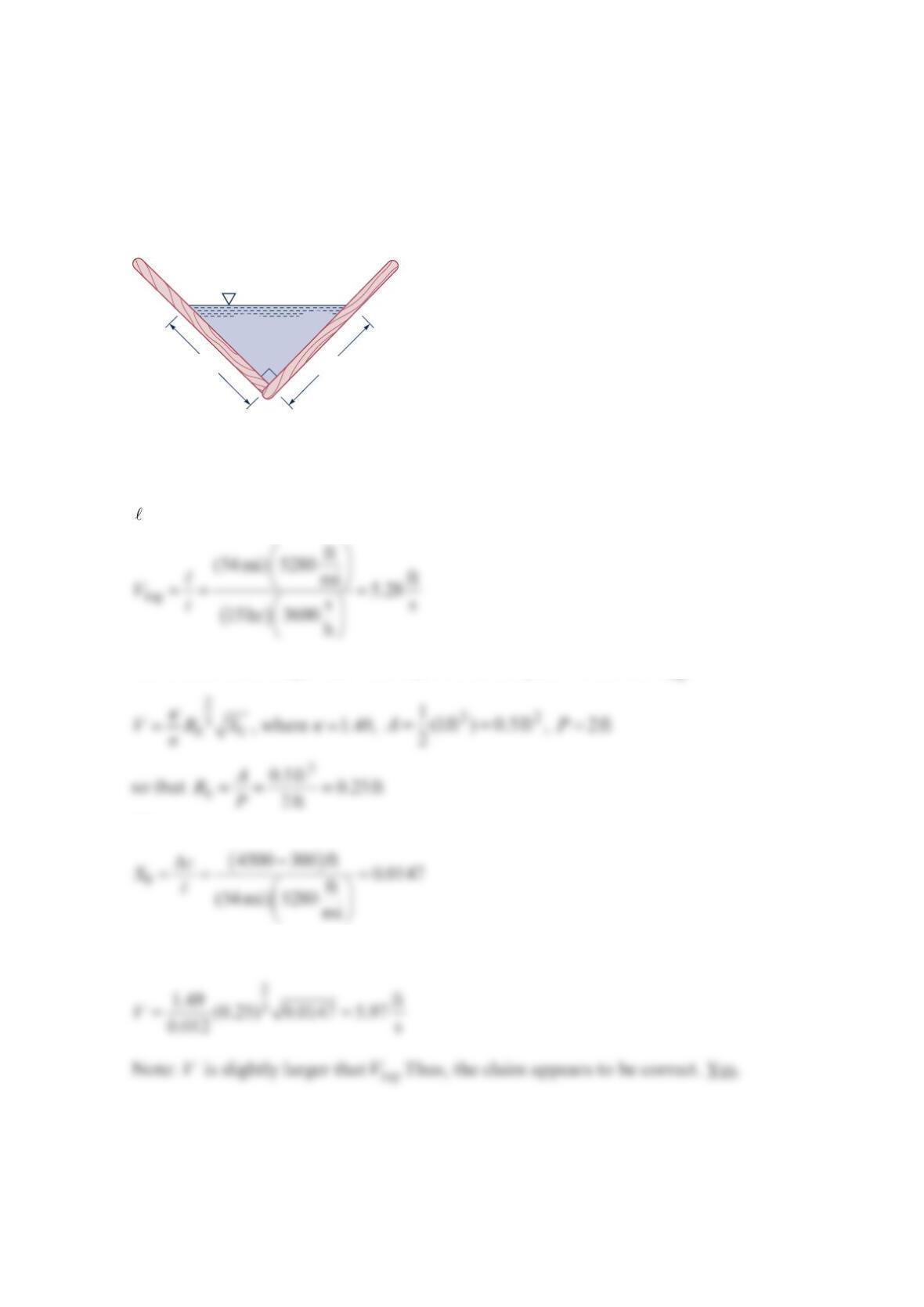
The great Kings River flume in Fresno County, California, was used from 1890 to 1923 to
carry logs from an elevation of 4500 ft where trees were cut to an elevation of 300 ft at the
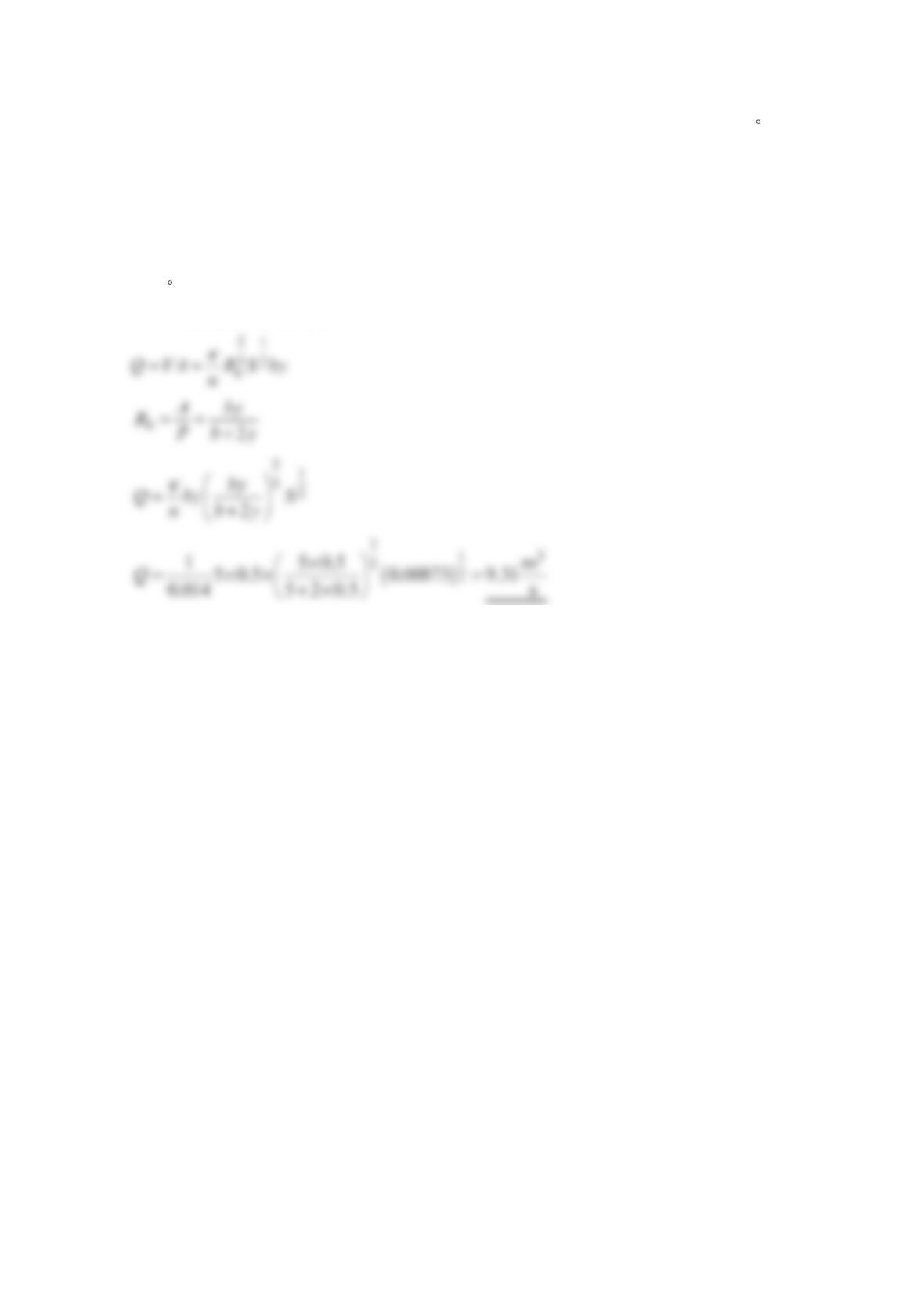
railhead. The flume was 54 miles long, constructed of wood, and had a V-cross section as
indicated in the figure below. It is claimed that logs would travel the length of the flume in
15 h. Do you agree with this claim? Provide appropriate calculations to support your
answer.
Solution 10.39
=distance traveled
=
log
Vt
. Thus,
Determine the average water velocity,
V
, and compare it with this log
V.
Also,
Thus, with =0.012n (for planed wood, from a table of Manning coefficients),
1 ft
1 ft
Problem 10.40
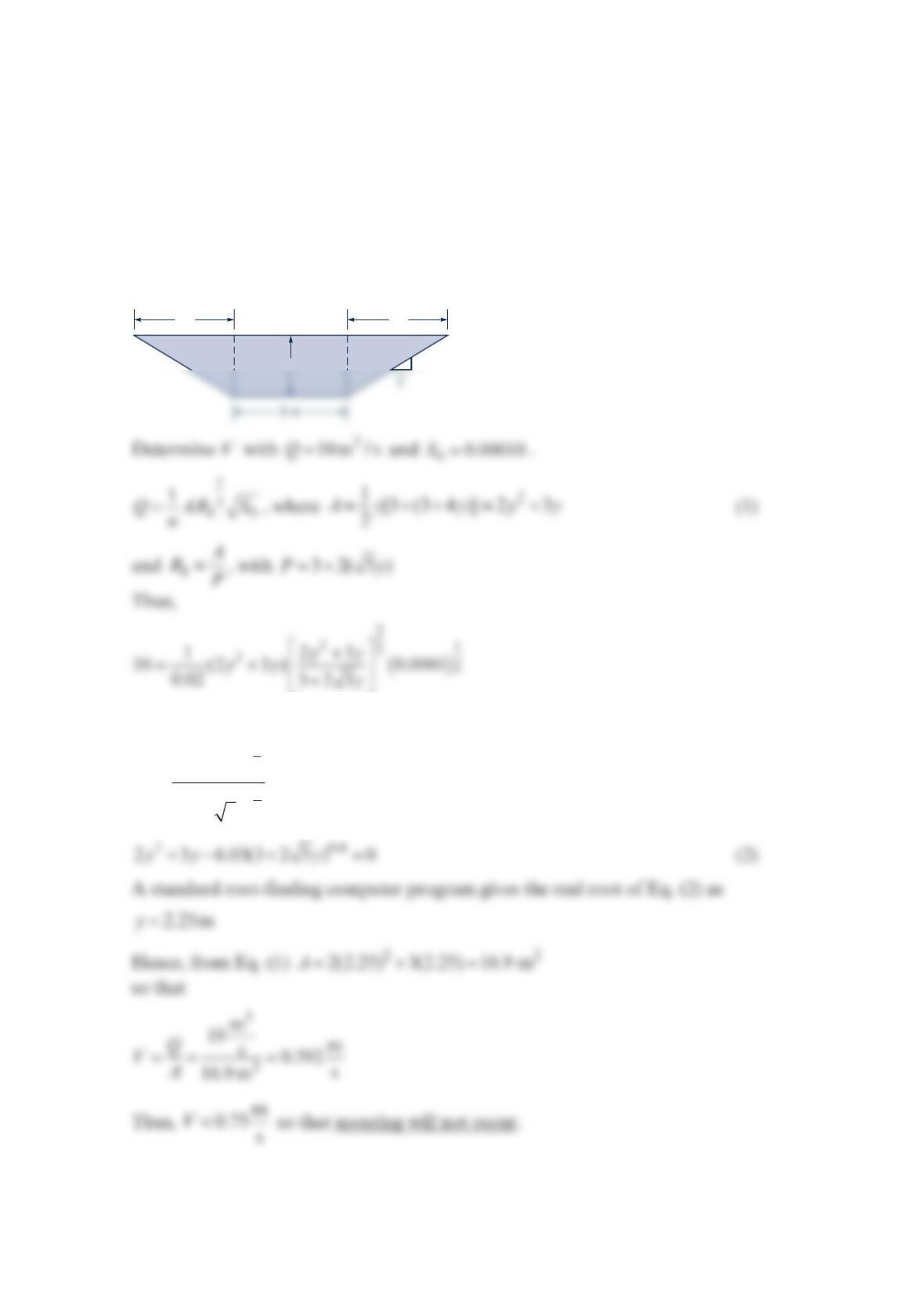
An unfinished concrete rectangular channel is 5m wide and has a slope of 0.50 . The water
is 0.5 m deep. Find the discharge rate for uniform flow.
Solution 10.40
=
0.50 0.00873rad
For Unfinished Concrete =0.014n,
Problem 10.41
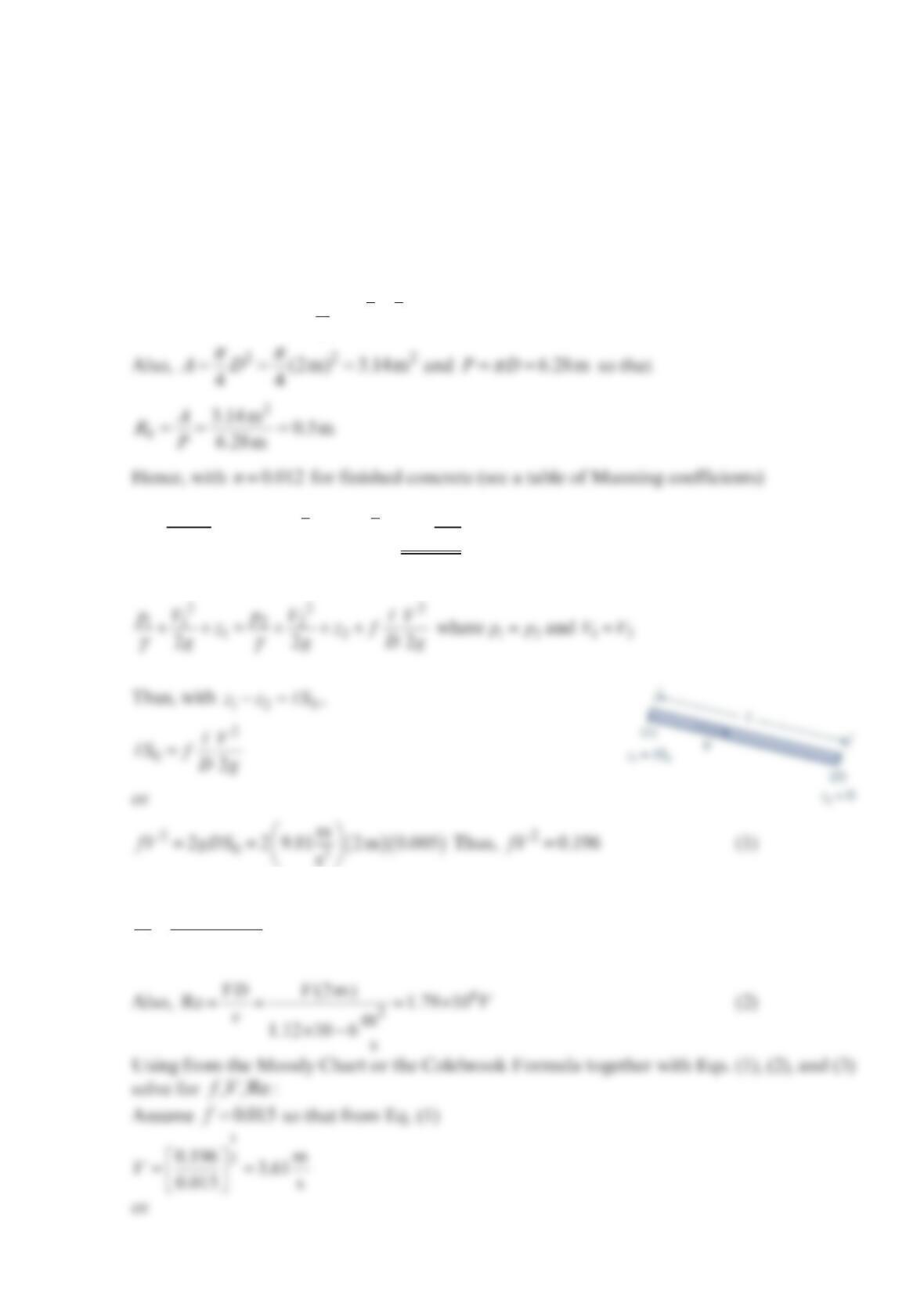
A trapezoidal channel with a bottom width of 3.0 m and sides with a slope of 2:1
(horizontal:vertical) is lined with fine gravel =( 0.020)n and is to carry 3
10 m / s . Can
this channel be built with a slope of =
00.00010S if it is necessary to keep the velocity
below 0.75 m/s to prevent scouring of the bottom? Explain.
Solution 10.41
or
+
=
+
5
23
2
3
(2 3 )
20
(3 2 5 )
y
y
y
which can be written as
2
y
2
y
y
1
Problem 10.42
Water flows in a
2
-m–diameter finished concrete pipe so that it is completely full and the
pressure is constant all along the pipe. If the slope is =
00.005S, determine the flowrate by
using open-channel flow methods. Compare this result with that obtained using pipe flow
methods of Chapter 8(Viscous Flow in Pipes).
Solution 10.42
For open channel,
κ
=
21
32
ho
QARS
n, where
κ
=1
()()()
==
3
21
32
1m
3.14 0.5 0.005 11.7
0.012 s
Q (open channel)
For pipe flow with constant pressure:
Using Moody’s table of equivalent roughness, for smooth concrete
ε
−−
==×
34
0.3×10 m 1.5 10
2mD
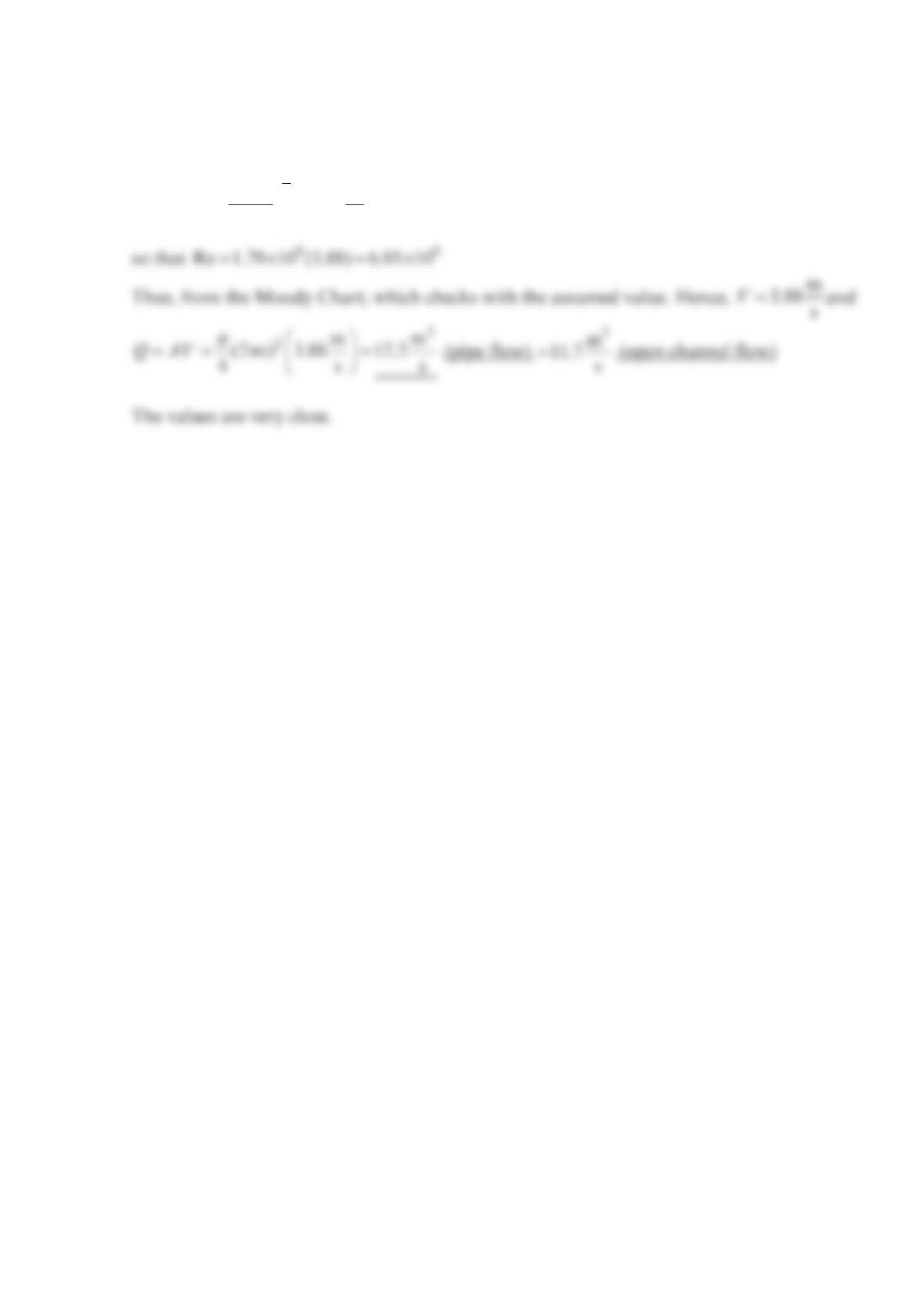
=× =×
66
Re 1.79 10 (3.61) 6.46 10
Thus, from the Moody Chart =≠0.13 0.15.fAssume =0.13f,
giving
==
1
2
0.196 m
3.88
0.013 s
V
Problem 10.43
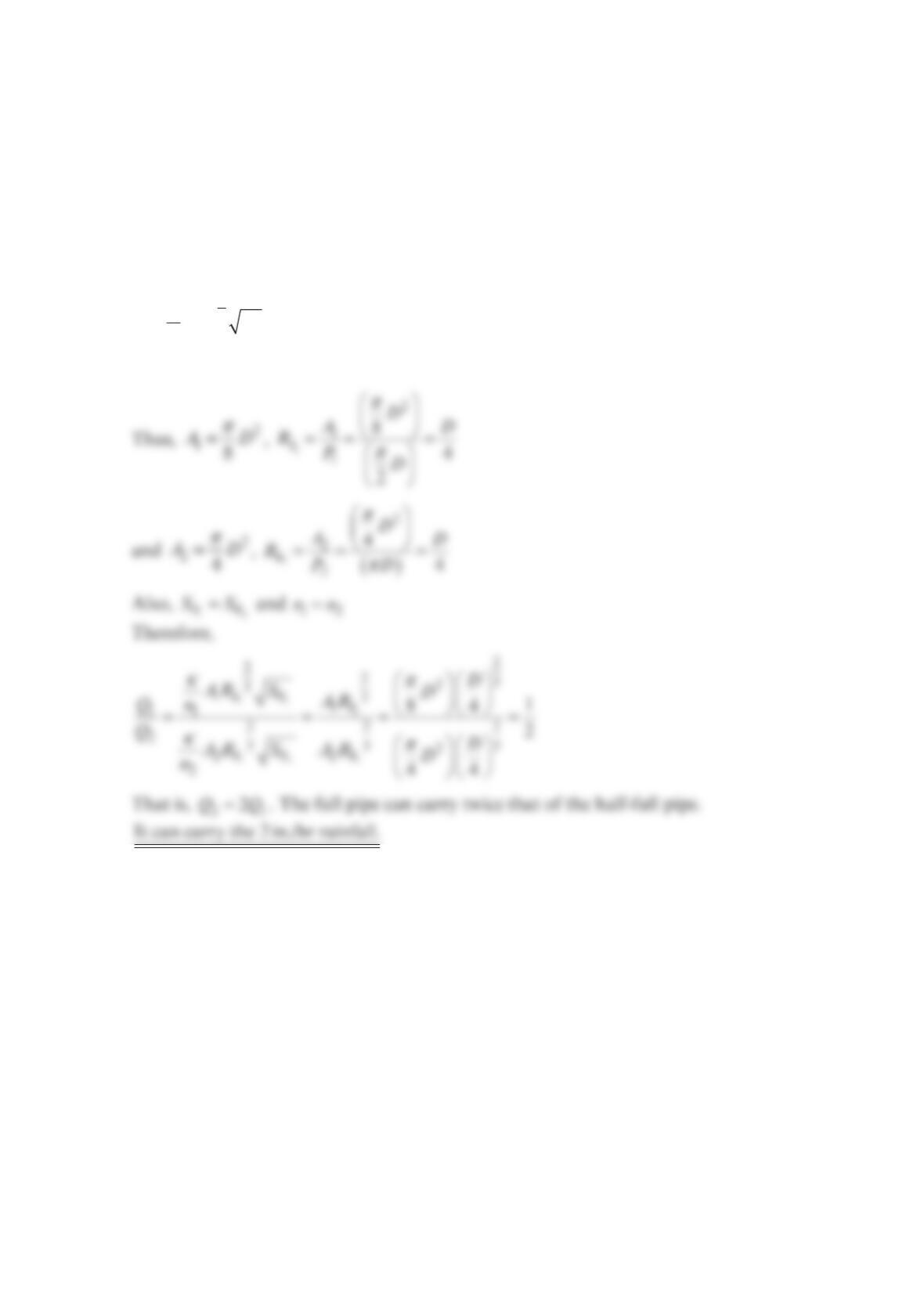
A round concrete storm sewer pipe used to carry rainfall runoff from a parking lot is
designed to be half full when the rainfall rate is a steady 1in./hr . Will this pipe be able to
handle the flow from a 2in./hr rainfall without water backing up into the parking lot?
Support your answer with appropriate calculations.
Solution 10.43
κ
=
2
30h
QARS
n
Let
()
1 denote conditions when the pipe is half full and
()
2 when the pipe is full.
Problem 10.44
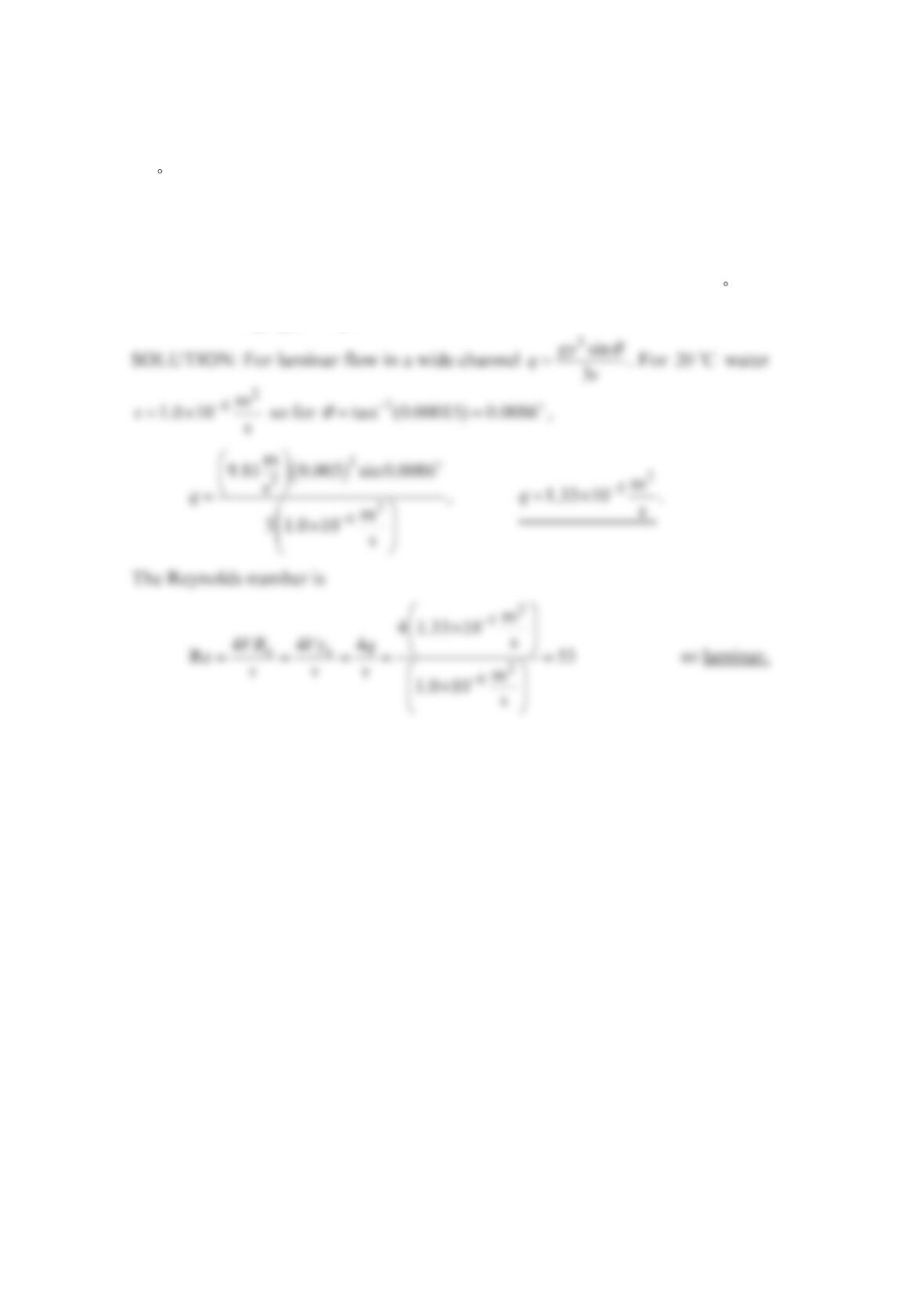
Find the discharge per unit width for a wide channel having a bottom slope of 0.00015. The
normal depth is 0.003m. Assume laminar flow and justify the assumption. The fluid is
20 C water.
Solution 10.44
GIVEN: Very wide channel, =
00.00015S, =0.003m,
n
y laminar flow, 20 C water.
FIND: Discharge Q, verify laminar flow.
Problem 10.45
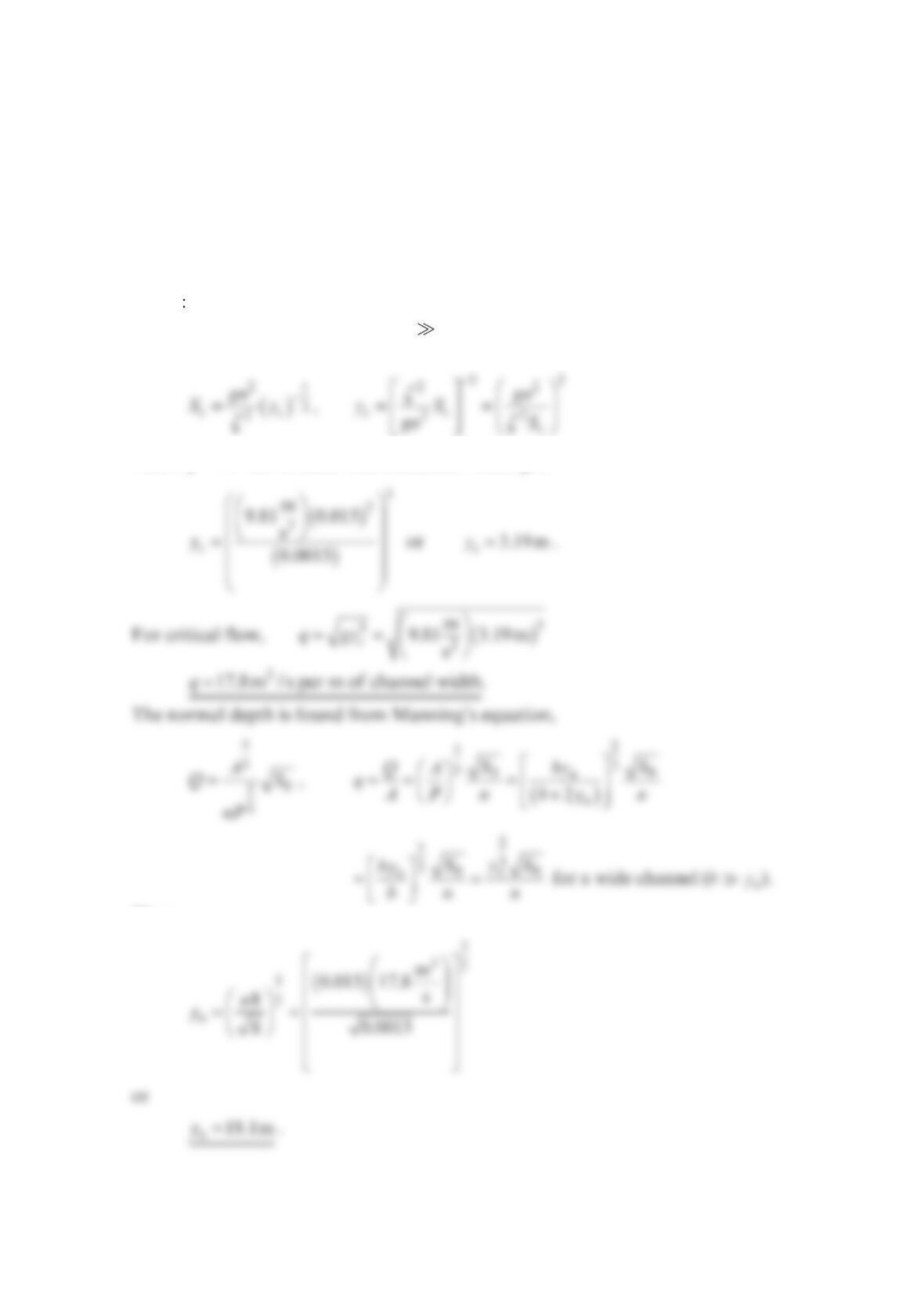
Water flows down a wide rectangular channel having Manning’s =0.015n and bottom
slope = 0.0015. Find the rate of discharge and normal depth for critical flow conditions.
Solution 10.45
GIVEN: Water flows down a wide rectangular channel having Manning’s =0.015n and
=
00.0015S.
FIND Q and n
y
for critical flow conditions.
SOLUTION: For a wide channel (
by
), Manning’s formula can be rearranged to the
critical slope and critical depth,
where
ζ
=1.0 for SI units. The numerical values give
Then
Problem 10.46
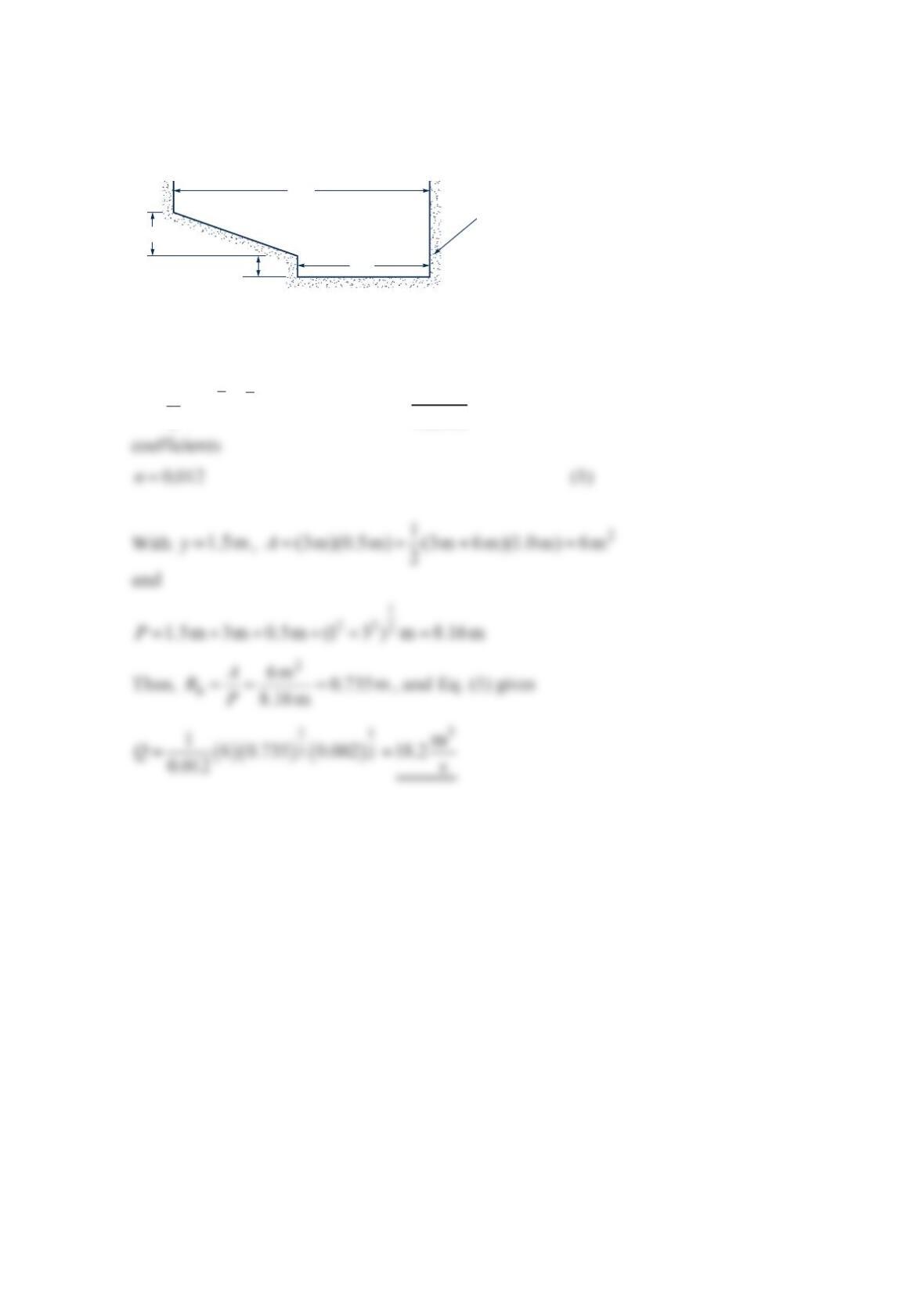
The smooth, concrete-lined channel shown in the figure below is built on a slope of 2 m/km.
Determine the flowrate if the depth is =1.5 my.
Solution 10.46
κ
=
21
32
0h
QARS
n, where
κ
=1, ==
0
2m 0.002,
1000 m
S and from a table of Manning
0.5 m
1.0 m
6 m
3 m
Concrete
Problem 10.47
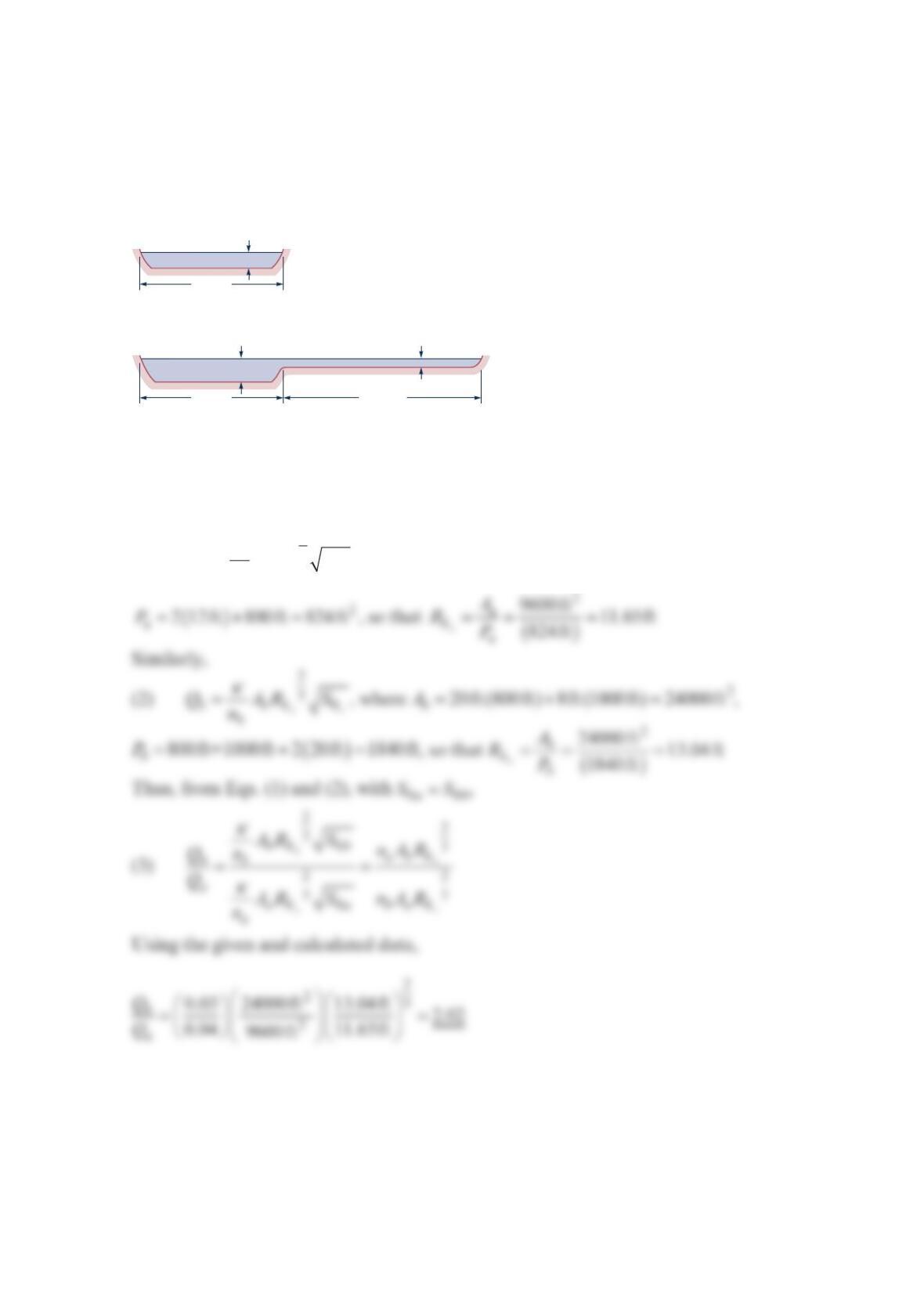
At a given location, under normal conditions, a river flows with a Manning coefficient of
0.030, and a cross section as indicated in the figure below (a). During flood conditions at
this location, the river has a Manning coefficient of 0.040 (because of trees and brush in
the floodplain) and a cross section as shown in the figure below (b). Determine the ratio of
the flowrate during flood conditions to that during normal conditions.
Solution 10.47
(1)
κ
=a
2
3
aa 0a
a
h
QARS
n, where ==
2
12 ft (800 ft) 9600 ft
a
A,
800 ft
12 ft
(a)
800 ft
20 ft
(b)
1000 ft
8 ft
Problem 10.48
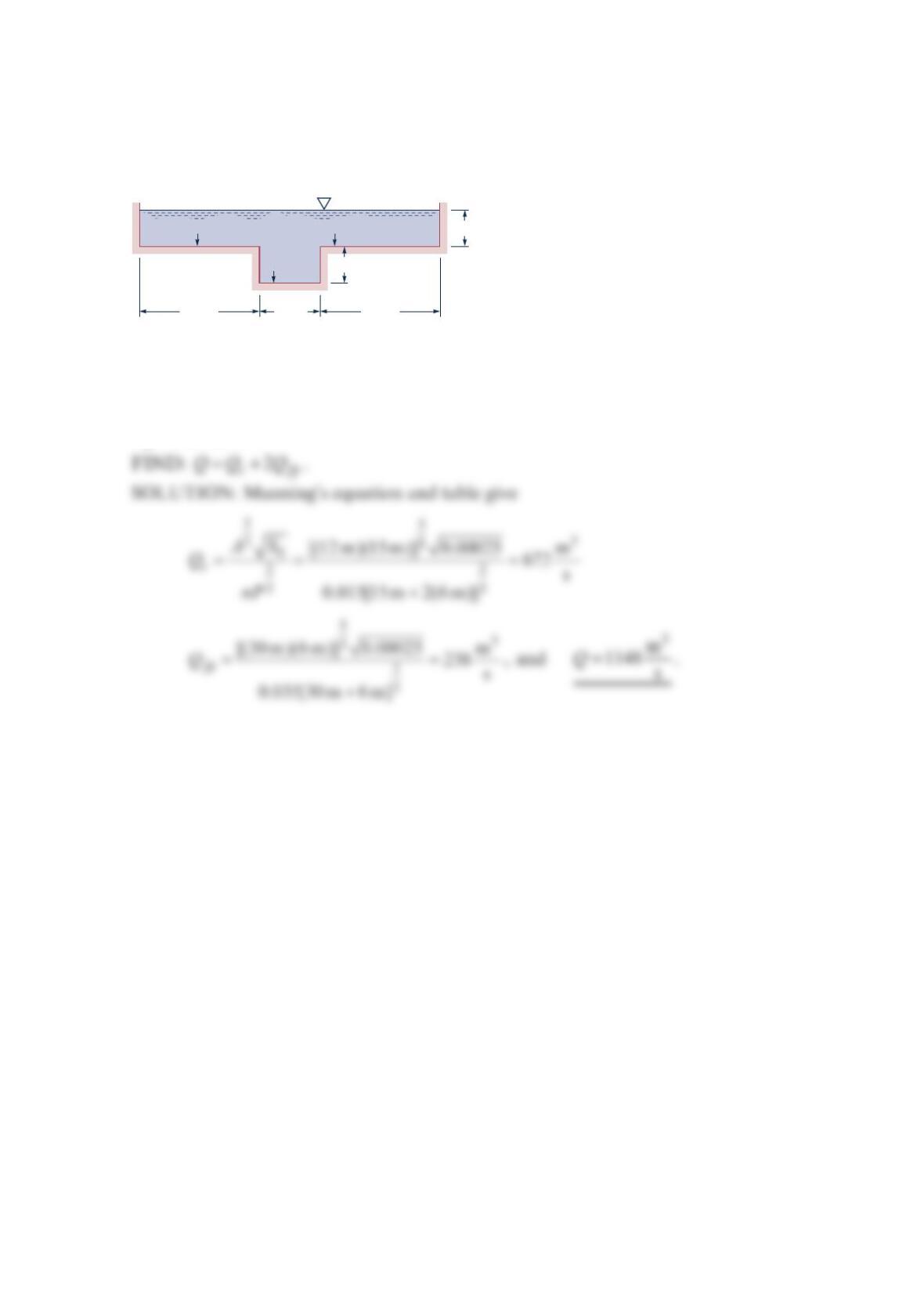
The channel in the figure below has two floodplains as shown. Find the discharge if the
center channel is lined with brick and the two floodplains are lined with cobblestones. The
slope 0
S is 0.00025 .
Solution 10.48
GIVEN: The figure in the problem, brick center channel, cobblestone flood plains.
=
00.00025S.
30 m 30 m
6 m
15 m
6 m
n
2
n
2
n
1
Problem 10.49
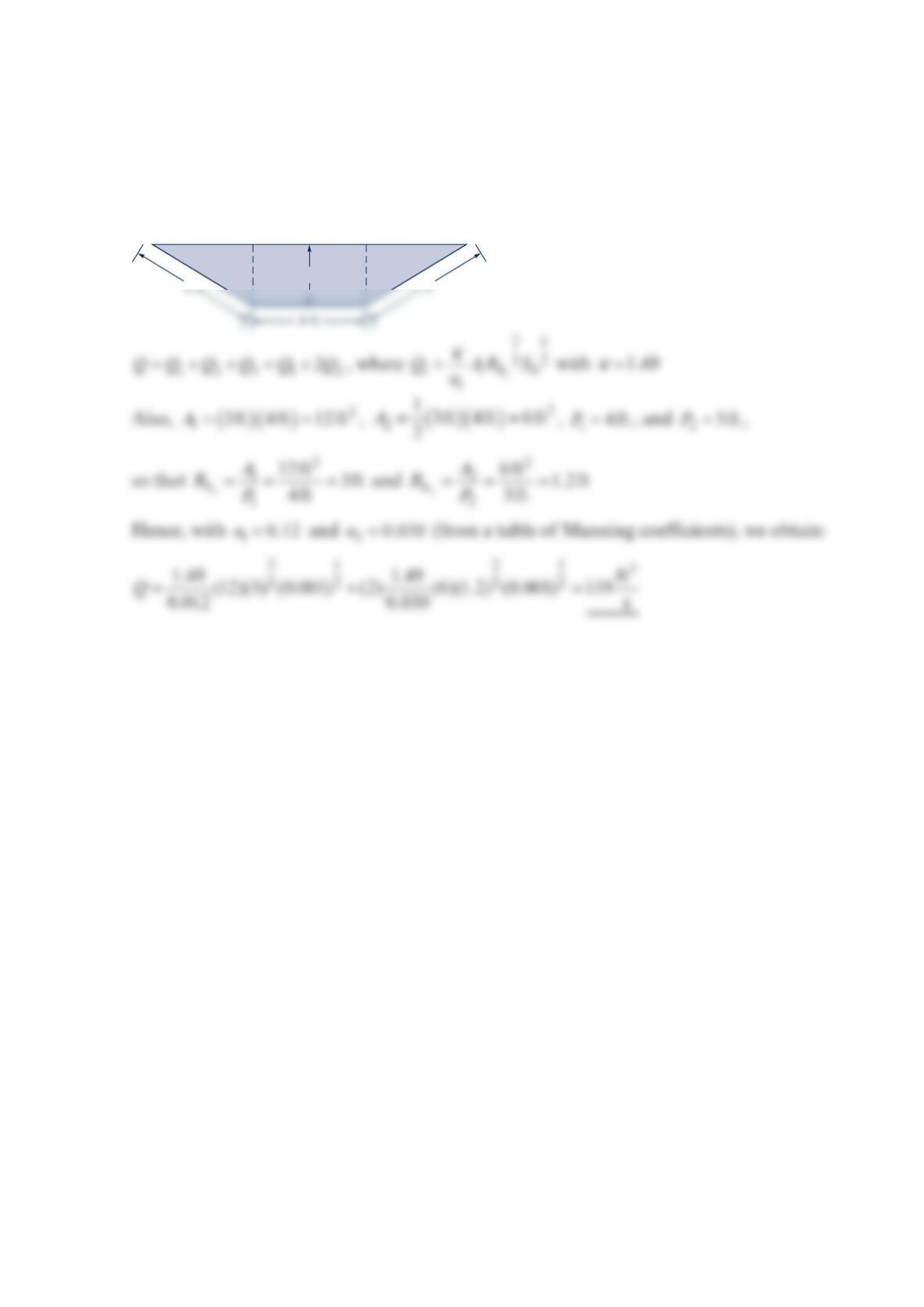
Determine the flowrate for the symmetrical channel shown in the figure below if the bottom
is smooth concrete and the sides are weedy. The bottom slope is =
00.001S.
Solution 10.49
3
ft
(2) (1) (3)