10-1
CHAPTER 10
PROPERTY, PLANT, AND EQUIPMENT: ACQUISITION AND DISPOSAL
CONTENT ANALYSIS OF EXERCISES AND PROBLEMS
Number
Content
Time Range
(minutes)
E10-1
Determination of Cost. (Moderate) Analysis of numerous items
to determine whether or not to include in property, plant, and
equipment.
5-10
E10-5
(AICPA adapted). Acquisition Cost. (Easy) Determination of
cost and journal entry to record acquisition.
5-15
E10-10
Exchange of Assets. (Moderate) Cash, gain, and loss. Journal
entries.
10-15
10-2
Number
Content
Time Range
(minutes)
E10-14
Self-Construction. (Moderate) Determination of amount to be
capitalized. Evaluation under differing outside contractor’s
bids.
10-15
E10-18
Expenditures. (Moderate) Capital vs. operating. Classification
of various items. IFRS differences.
5-15
P10-3
Cost Classification. (Moderate) Journal entries to record
various transactions. Acquisition, parking lot, sale, lease,
freight, installation, taxes.
25-35
P10-4
(CMA adapted). Self-Construction. (Challenging)
Computation according to GAAP of amount to be capitalized.
Identification of any alternative procedures.
30-45
10-3
Number
Content
Time Range
(minutes)
P10-9
Interest During Construction. (Moderate) Computation of
amount to be capitalized and amount to be depreciated.
Straight-line. Effects on financial statements.
20-30
P10-10
Comprehensive: Interest Capitalization. (Moderate)
Computation of amounts of capitalized interest, interest
expense, and interest revenue. Journal entries to record
construction costs, including interest.
40-60
ANSWERS TO QUESTIONS
– that is, the asset must have physical substance.
Q10-2 Generally, a company capitalizes the expenditures that are necessary to obtain the
benefits to be derived from the asset and includes them as a cost of property, plant,
Q10-3 A company classifies land held for investment on the balance sheet as an
Q10-5 At the date of acquisition, the acquisition cost is equal to the market value. At the
end of the life of the asset, the book value should equal the residual value (a market
Q10-6 In a lump-sum purchase, the company allocates the total purchase price to the
Q10-7 When a company exchanges securities for an asset, the acquisition cost of that asset
is either the fair value of the securities given up or the fair value of the asset acquired.
Q10-8 When nonmonetary assets are exchanged, a company records the cost of the
Q10-9 When nonmonetary assets are exchanged, the company recognizes a gain or loss
Q10-10 According to GAAP, a company capitalizes interest on the acquisition of an asset if
1. Inventories that are routinely manufactured or otherwise produced on a
repetitive basis.
Q10-11 A company bases the amount of interest capitalized for a self-constructed asset on
the actual amounts borrowed and the cost of those borrowings. The amount is
Q10-12 Since activities that are necessary to get the asset ready for its intended use are in
10-5
Q10-13 Three alternative treatments of fixed overhead costs are (1) to allocate a portion of
the total fixed overhead to the cost of the asset being constructed, (2) to include
only the incremental fixed overhead that is attributable to construction in the cost of
the self-constructed asset, or (3) to include no fixed overhead in the cost of the self-
Q10-14 Under GAAP, a company may not recognize profit on the self-construction of an
asset. The revenue recognition principle allows recognition of profit on asset use and
Q10-15 The primary difference between U.S. GAAP and IFRS is that IFRS allow a company to
Q10-16 The distinction between a capital expenditure and an operating expenditure is
whether the costs have increased the future economic benefits of the asset above
those that were originally expected. The future economic benefits can be increased
Q10-17 An addition is a new asset that is being “added” or utilized in conjunction with an old
asset. In contrast, an improvement/ replacement involves the substitution of a new
part or asset for an old one. In accounting for an addition, a company capitalizes
Q10-18 The costs of ordinary repairs and maintenance are expenses incurred routinely to
keep the asset in operating condition. Since these costs do not increase the future
benefits of the asset, a company expenses them as they are incurred. For interim
Q10-19 Leasehold improvements are improvements made to leased property that, upon
Q10-20 An Allowance for Repairs account appears only on balance sheets of interim
Q10-21 A company accounts for the disposal of an asset by removing both the asset and
accumulated depreciation to date from the respective accounts, recording the
Q10-22 Under the successful-efforts method of accounting for oil and gas properties, a
ANSWERS TO MULTIPLE CHOICE
10-7
SOLUTIONS TO REVIEW EXERCISES
RE10-1
RE10-2
RE10-3
Appraisal
Relative
Total
Allocated
RE10-4
Amount to be paid off each year: $350,000 ÷ 7 = $50,000
Use the Time Value of Money Module, Table 4 (Present Value of an Ordinary
RE10-5
Land received from the City of Lynchburg:
RE10-6
Cost of asset acquired = Fair value of asset surrendered – Cash received
RE10-7
Weighted average interest rate = [12% x ($3,000,000 ÷ $4,800,000)]
RE10-8
Average cumulative costs = [(Beginning cumulative costs)
RE10-9
Capitalized interest = Average cumulative cost x Interest rate
RE10-10
Note: Rick has two alternatives. The substitution method is not applicable to this
situation because the engines were improved and not replaced.
10-9
RE10-11
To record depreciation:
Depreciation Expense 5,000
10-10
SOLUTIONS TO EXERCISES
E10-1
The following are included in the cost:
1. Contract price
3. Freight costs
6. Installation costs
The following are not included in the cost:
2. List price
E10-2
The following are included in property, plant, and equipment:
The following are not included in property, plant, and equipment:
10-11
E10-2 (continued)
E10-3
Machine 213,000*
E10-4
1. The fair value of the asset is considered to be the cash price of $215,000 and
thus the machine is recorded at this fair value. Since a $55,000 down payment
is made, the remaining $160,000 has to be allocated between the note and
the preferred stock. In most situations, it would be considered that the 10% fair
value of the note should take precedence over the agreed value of the
10-12
E10-4 (continued)
2. If the $215,000 cash price were not known, the fair value of the note and the
agreed value of the preferred stock would be used.
E10-5 (AICPA adapted solution)
Cash equivalent price $9,500
Installation costs 300
E10-6 (AICPA adapted solution)
Land:
Purchase price $50,000
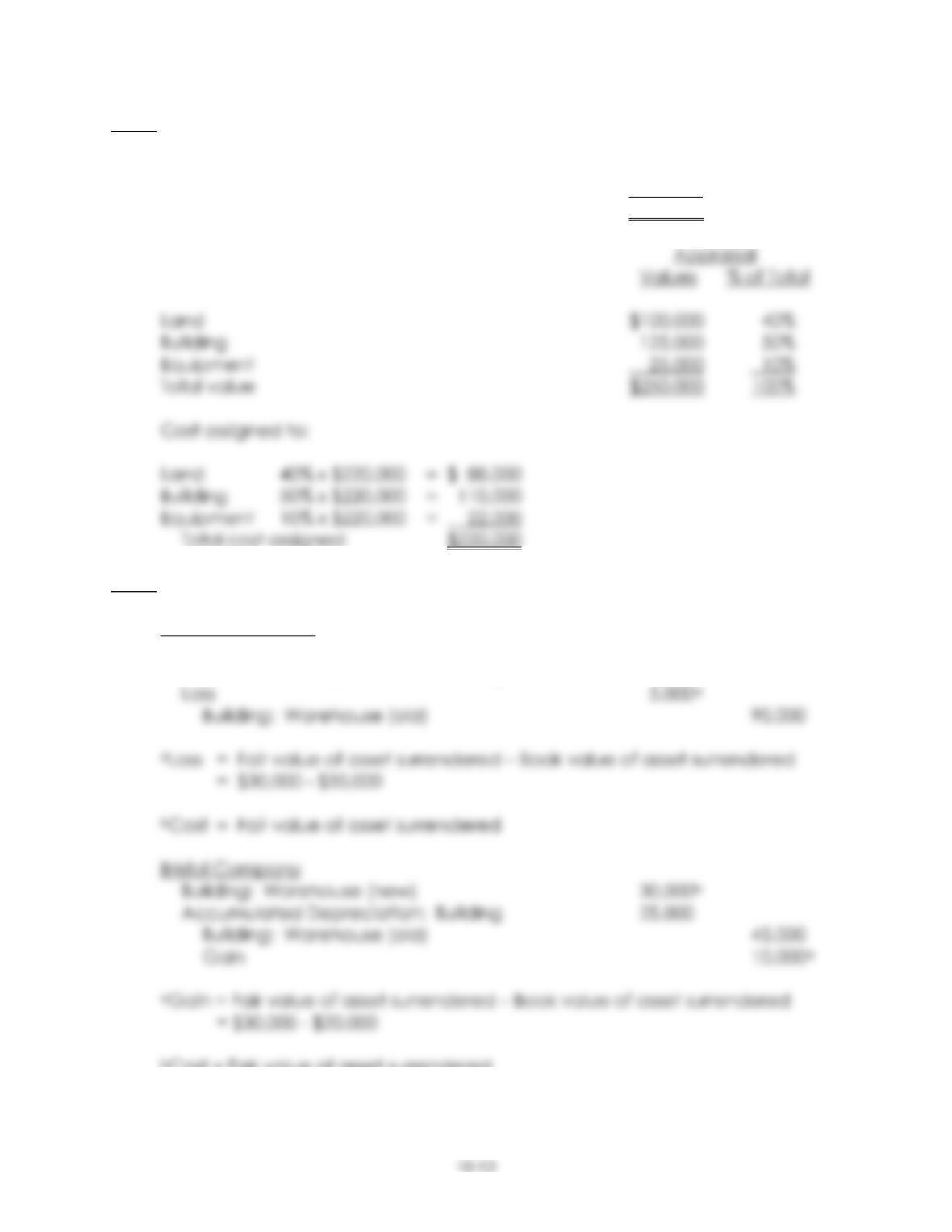
E10-7
Acquisition cost $200,000
Appraisal 20,000
Total cost $220,000
E10-8
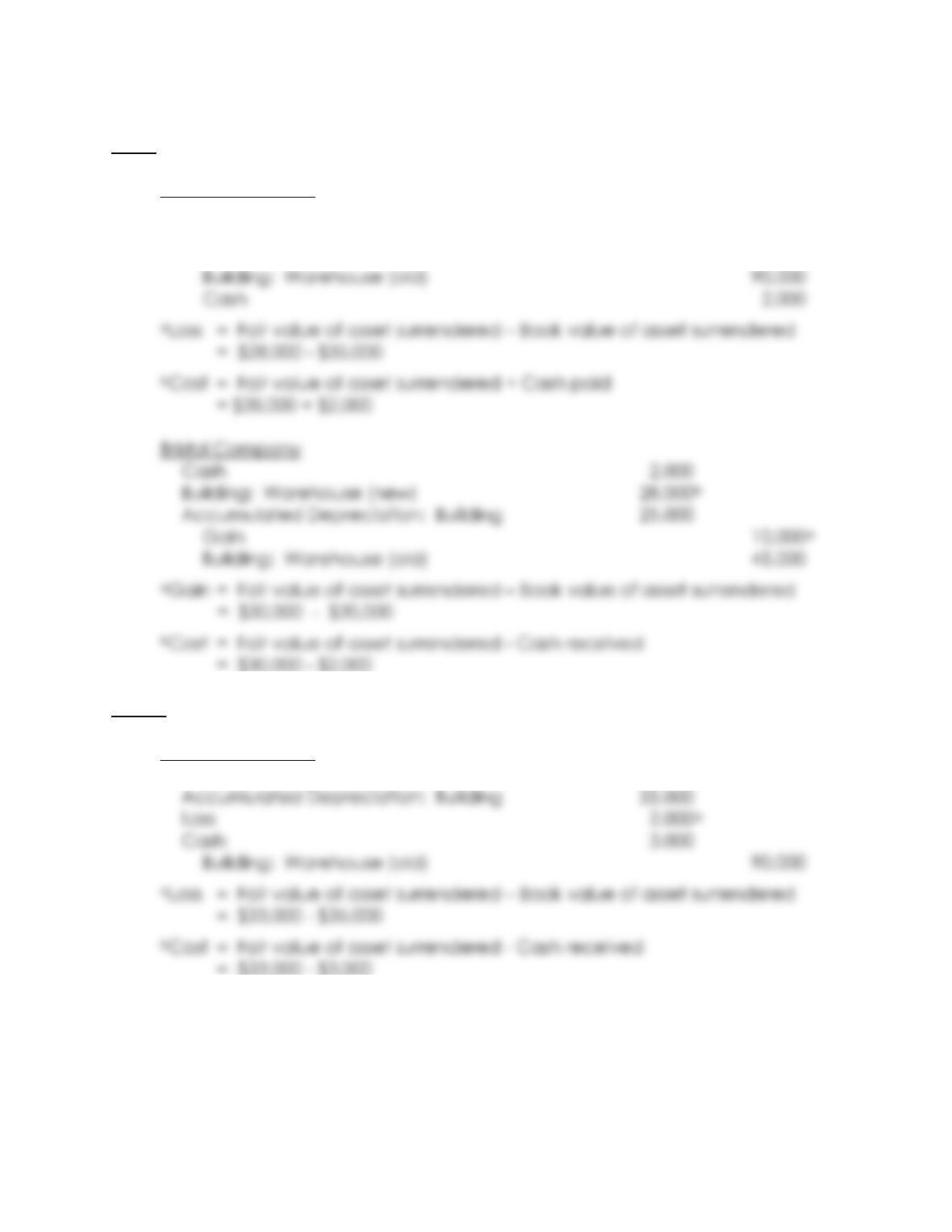
Denver Company
Building: Warehouse (new) 30,000b
Accumulated Depreciation: Building 55,000
10-14
E10-9
Denver Company
Building: Warehouse (new) 30,000b
Accumulated Depreciation: Building 55,000
Loss 7,000a
E10-10
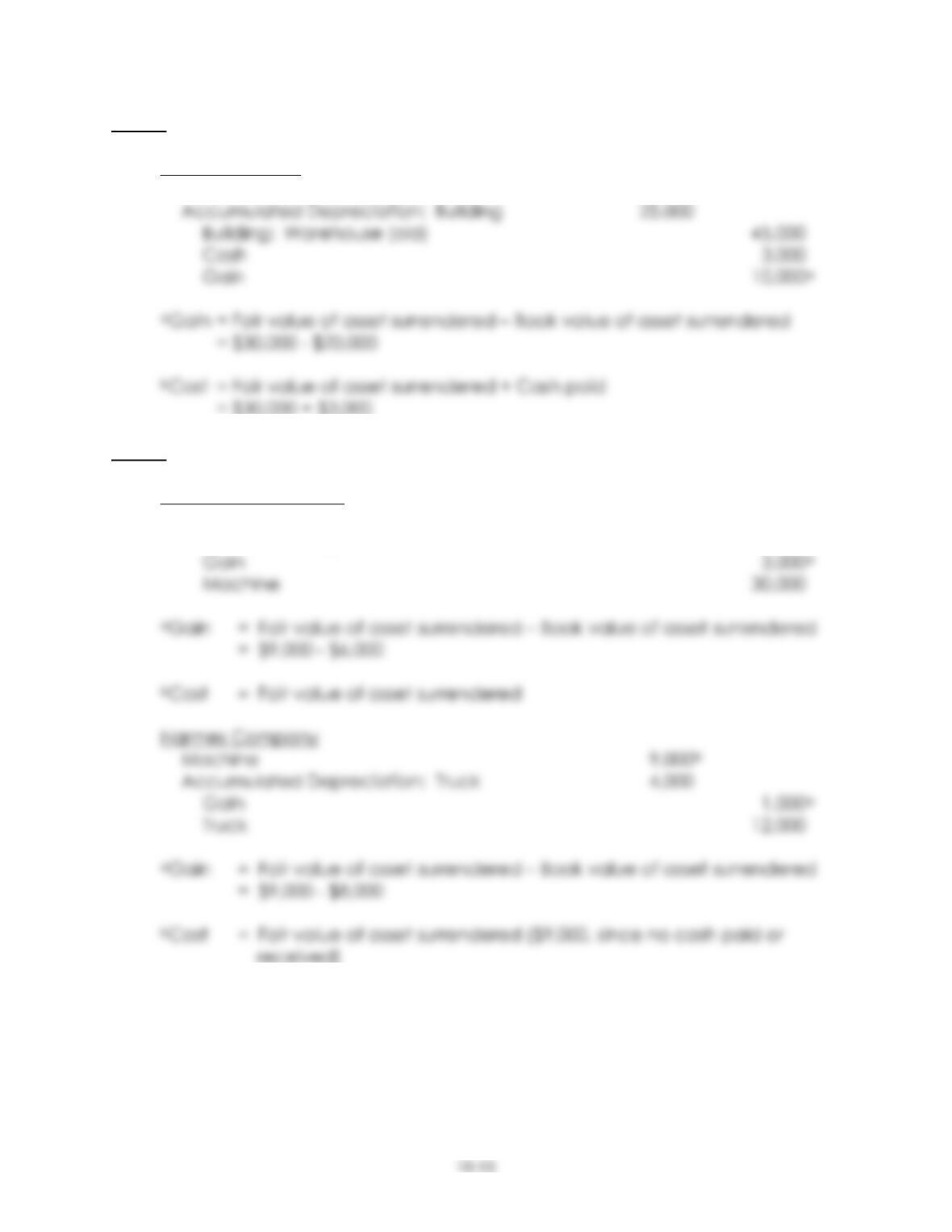
Denver Company
Building: Warehouse (new) 30,000b
E10-10 (continued)
Bristol Company
Building: Warehouse (new) 33,000b
E10-11
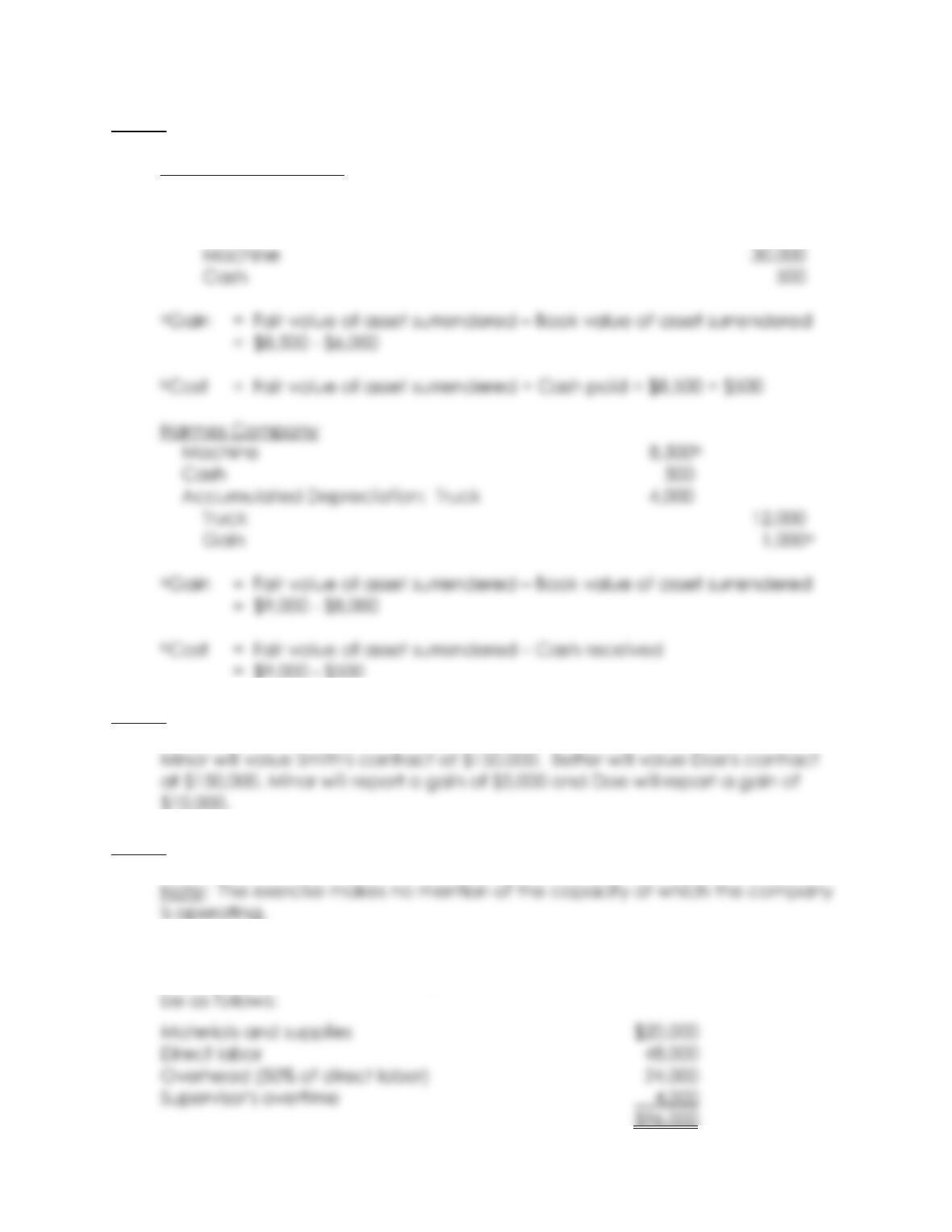
Goodman Company
Truck 9,000b
Accumulated Depreciation: Machine 24,000
10-16
E10-12
Goodman Company
Truck 9,000b
Accumulated Depreciation: Machine 24,000
Gain 2,500a
E10-13 (AICPA adapted solution)
E10-14
1. If the company is operating at full capacity so that the construction causes
less regular production to take place, the cost of the constructed asset should
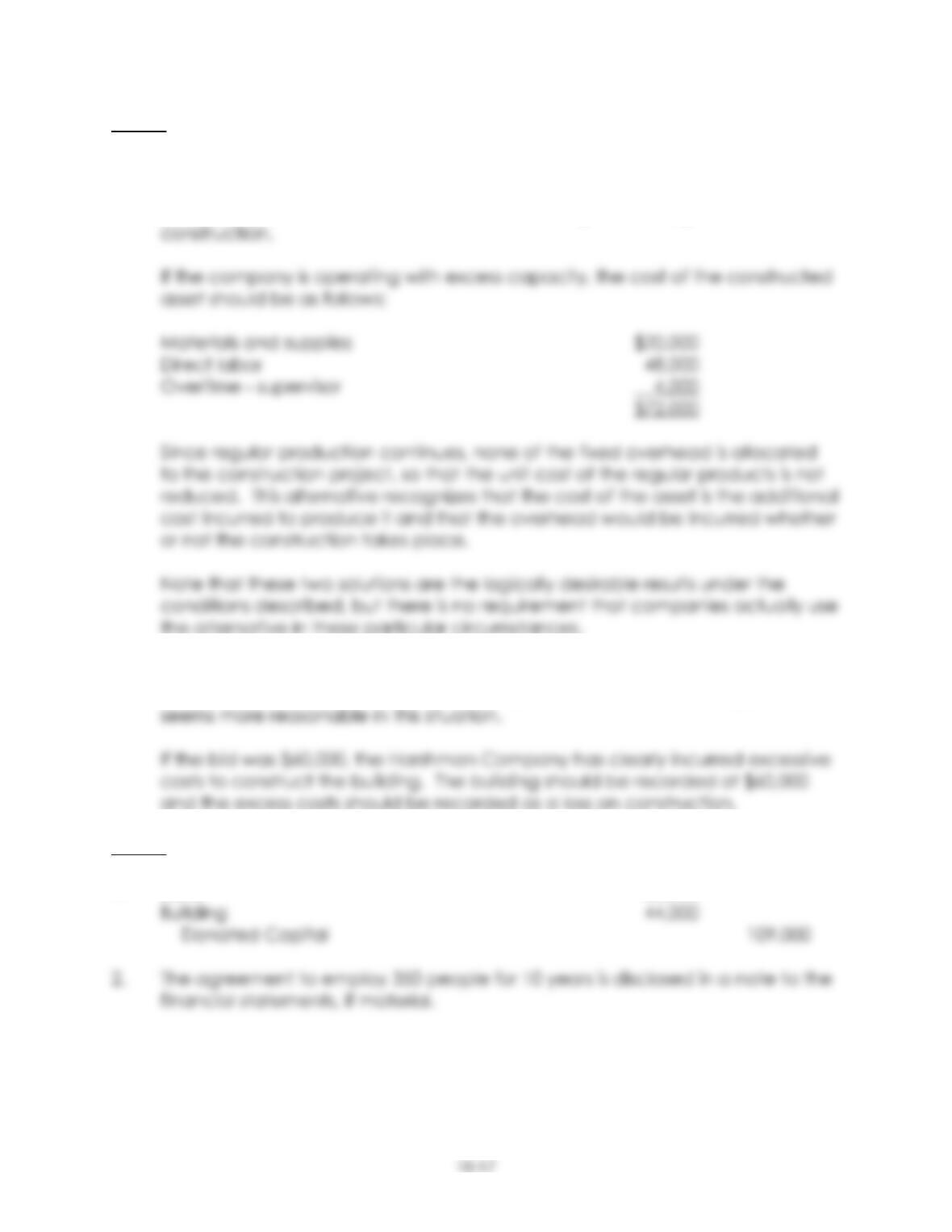
E10-14 (continued)
Under this alternative, the construction is accounted for in the same way as
regular products. The overtime might be excluded if it has been included in
the overhead rate. An unfavorable variance might be charged to the
2. If the bid from the outside contractors was $80,000, it is questionable whether
the use of the full overhead rate is appropriate. The incremental approach
E10-15
1. Land 65,000
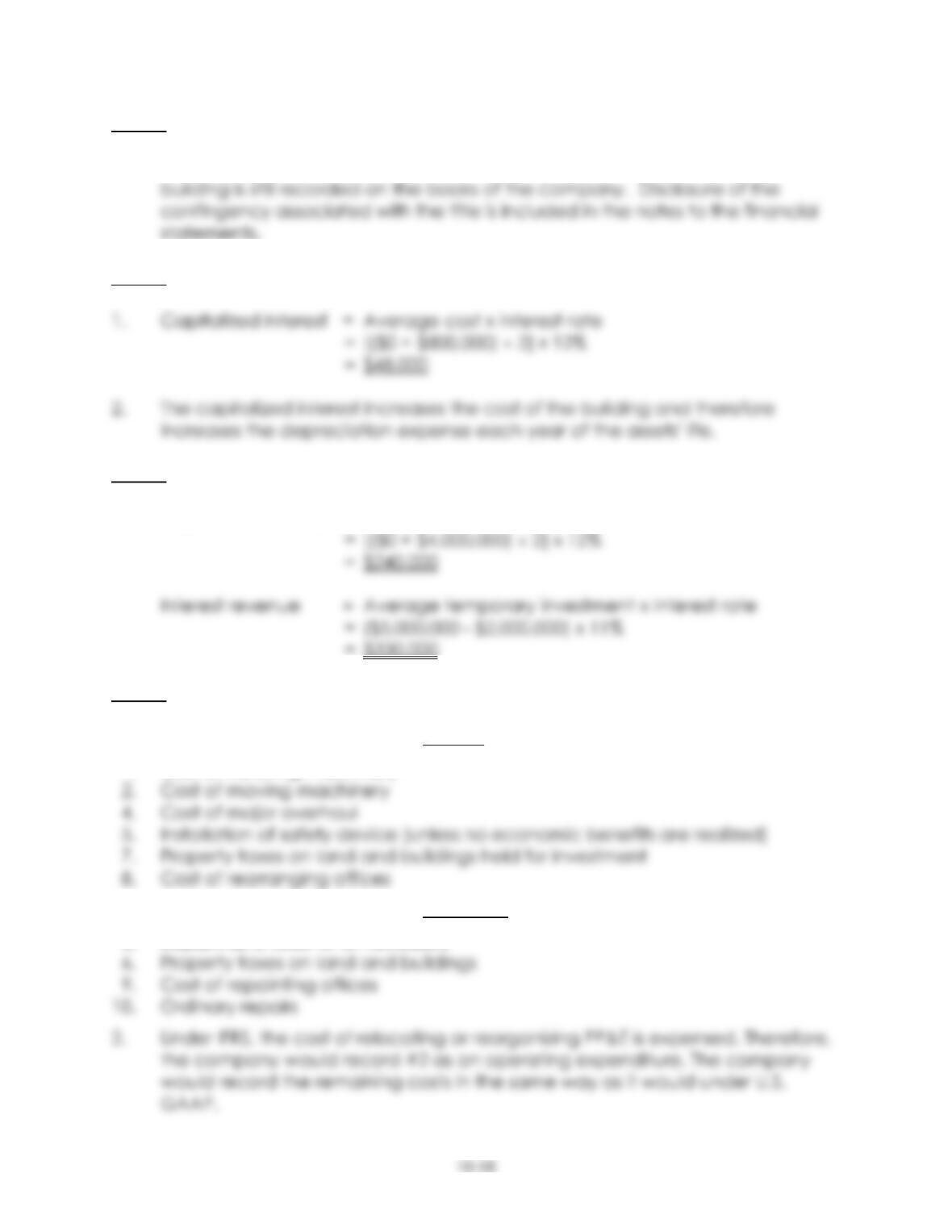
E10-15 (continued)
3. Even though title would not pass to the company for 10 years, the land and
E10-16
E10-17
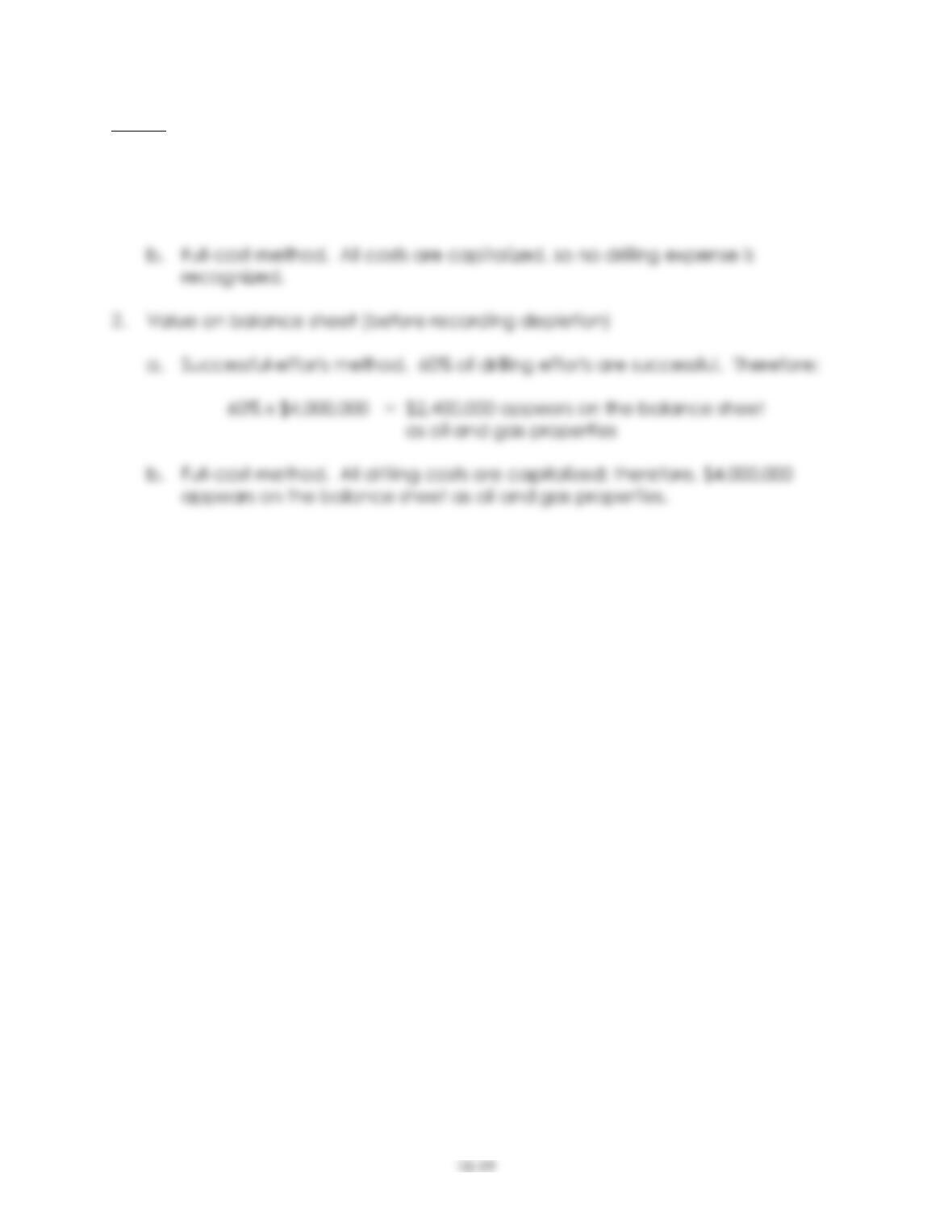
Capitalized interest = Average cost x Interest rate
E10-18
1.
The following are recorded as capital expenditures:
1. Cost of installing machinery
The following are recorded as operating expenditures:
3. Repairs as a result of an accident
E10-19
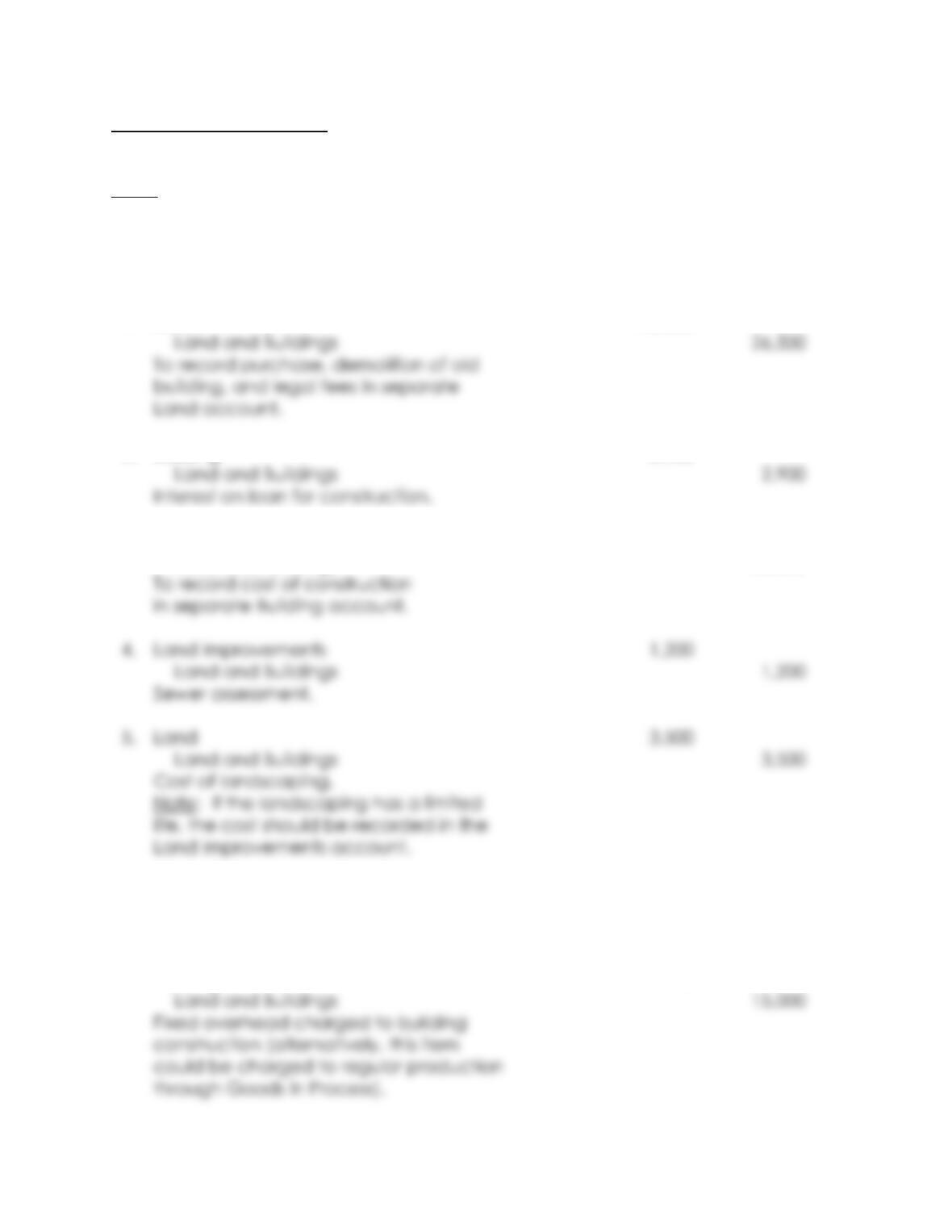
1. a. Successful-efforts method. 40% of drilling is unsuccessful. Therefore:
40% x $4,000,000 = $1,600,000 is expensed
10-20
SOLUTIONS TO PROBLEMS
P10-1
Adjusting entries at December 31, 2010 to correct the books. All original entries
must be reversed out of the Land and Buildings account and recorded in
correct accounts.
1. Land 26,500
2. Building 2,900
3. Building 53,000
Land and Buildings 53,000
6. Equipment 18,800
Land and Buildings 18,800
Excavation equipment purchase.
7. Building 15,000