Problem 10.19
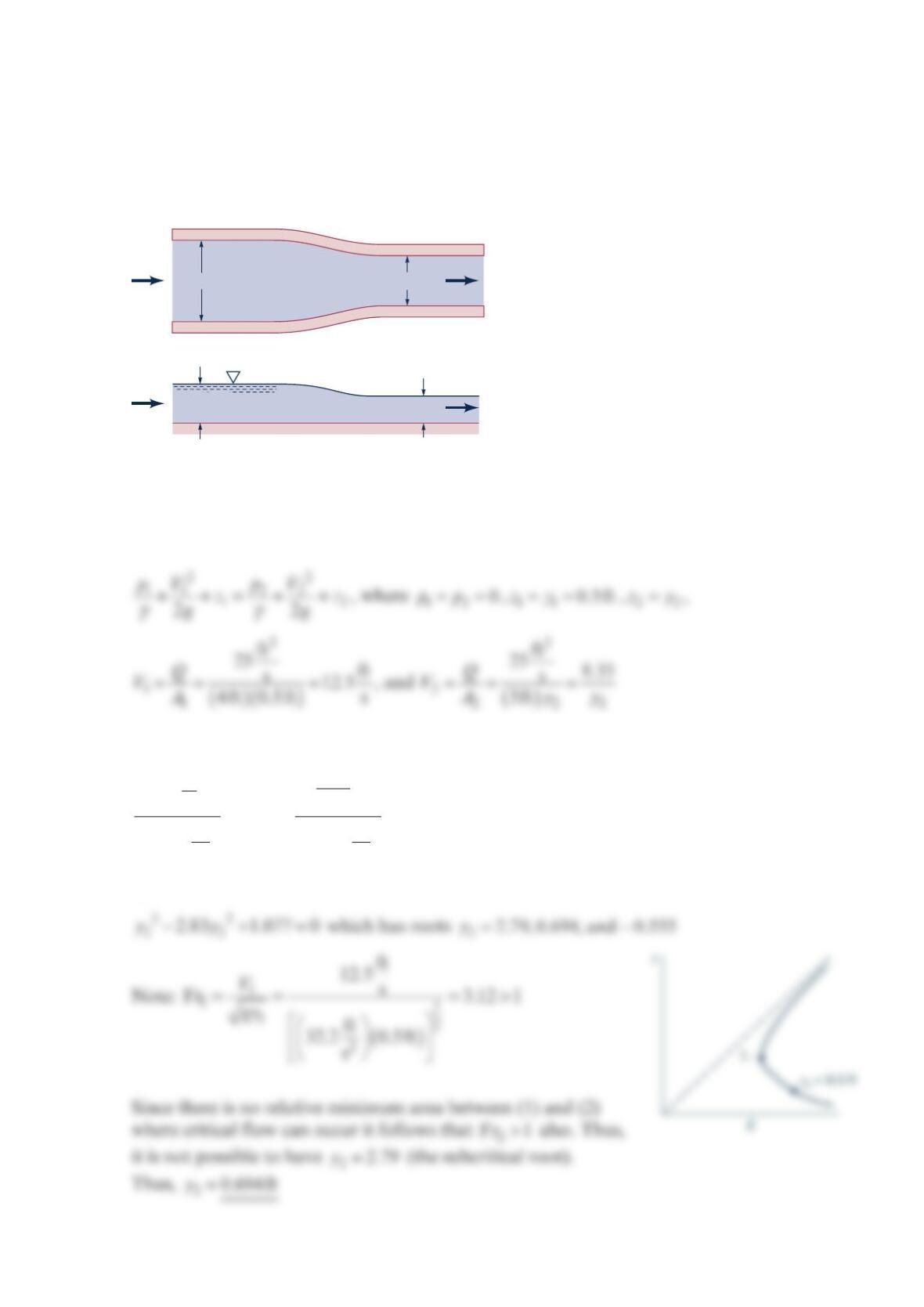
Water in a rectangular channel flows into a gradual contraction section as is indicated in
the figure below. If the flowrate is =3
25ft / sQ and the upstream depth is =
10.5fty,
determine the downstream depth, 2
y
. Assume that there are no losses between sections (1)
and (2).
Solution 10.19
Thus,
+= +
2
2
2
2
22
8.33
ft
12.5 s0.5ft
ft ft
2 32.2 2 32.2
ss
y
y
or
V1
V2
V1
V2
(2)(1)
y1y2
Side view
Top view
b2
= 3 ft
b1
= 4 ft
Problem 10.20
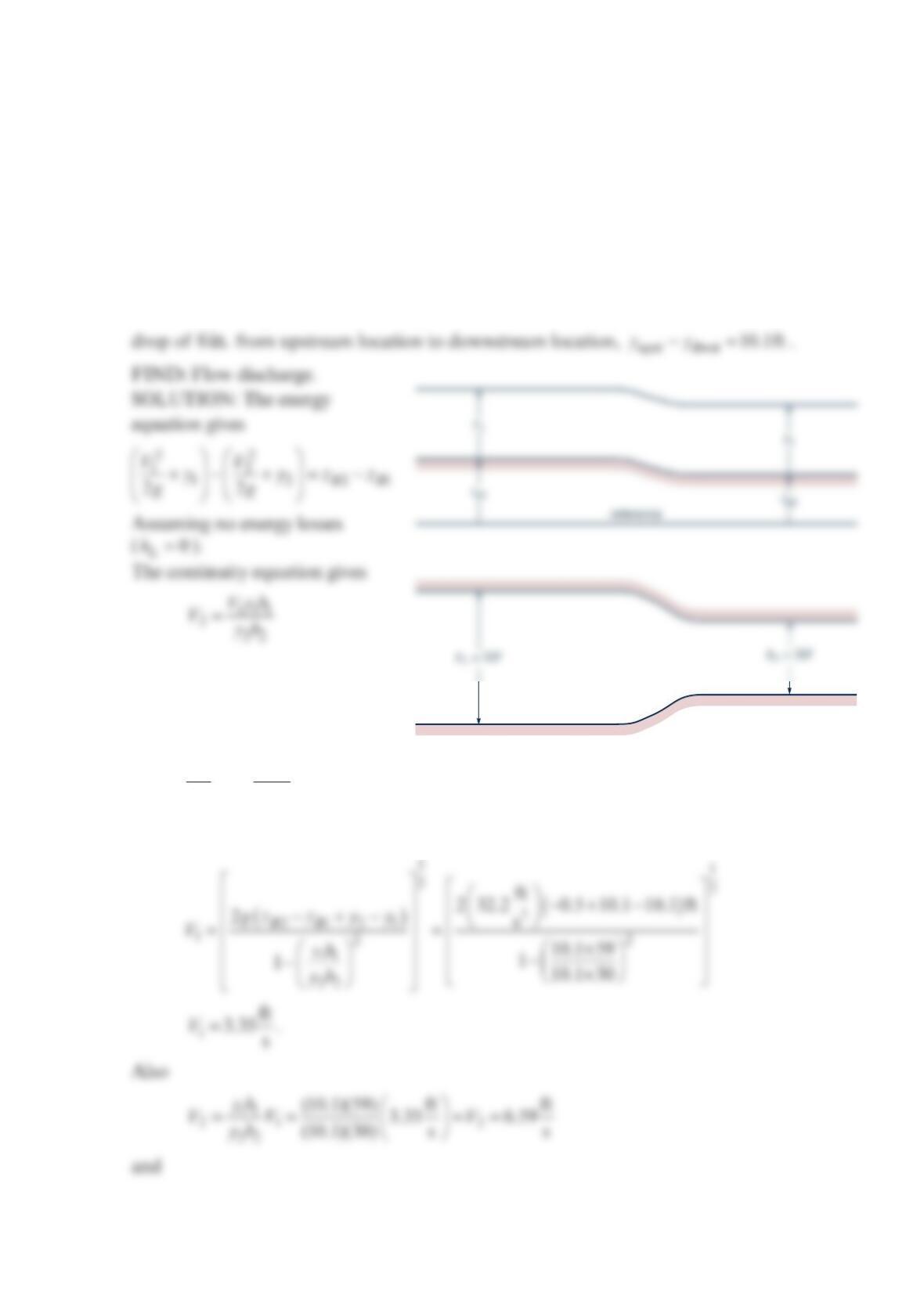
A rectangular channel has a gradual contraction in width from 59ft to 30 ft and a bed level
drop of 6in.below the upstream channel bed, which the increased velocity caused by the
contraction scoured. If the upstream and downstream flow depths are both 10.1ft , compute
the discharge in the channel.
Solution 10.20
GIVEN: Rectangular channel has a gradual contraction from 59ft to 30ft , a bed level
to give
2
2
111 212
1
22
1
2BB
Vyb
zzyy
gyb
−=−+−
.
or
Problem 10.21
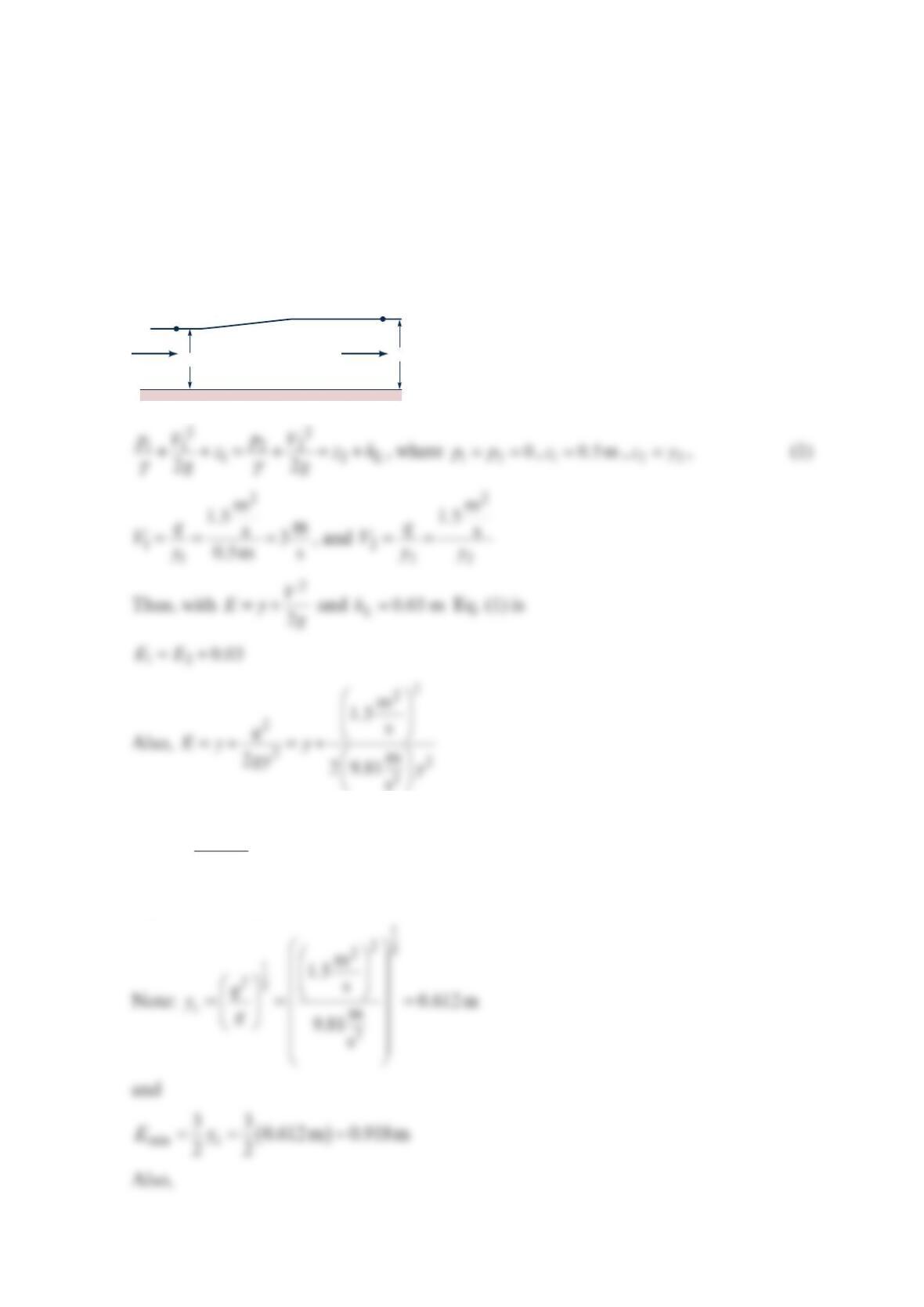
Water flows in a rectangular channel with a flowrate per unit width of =2
1.5 m / sq and a
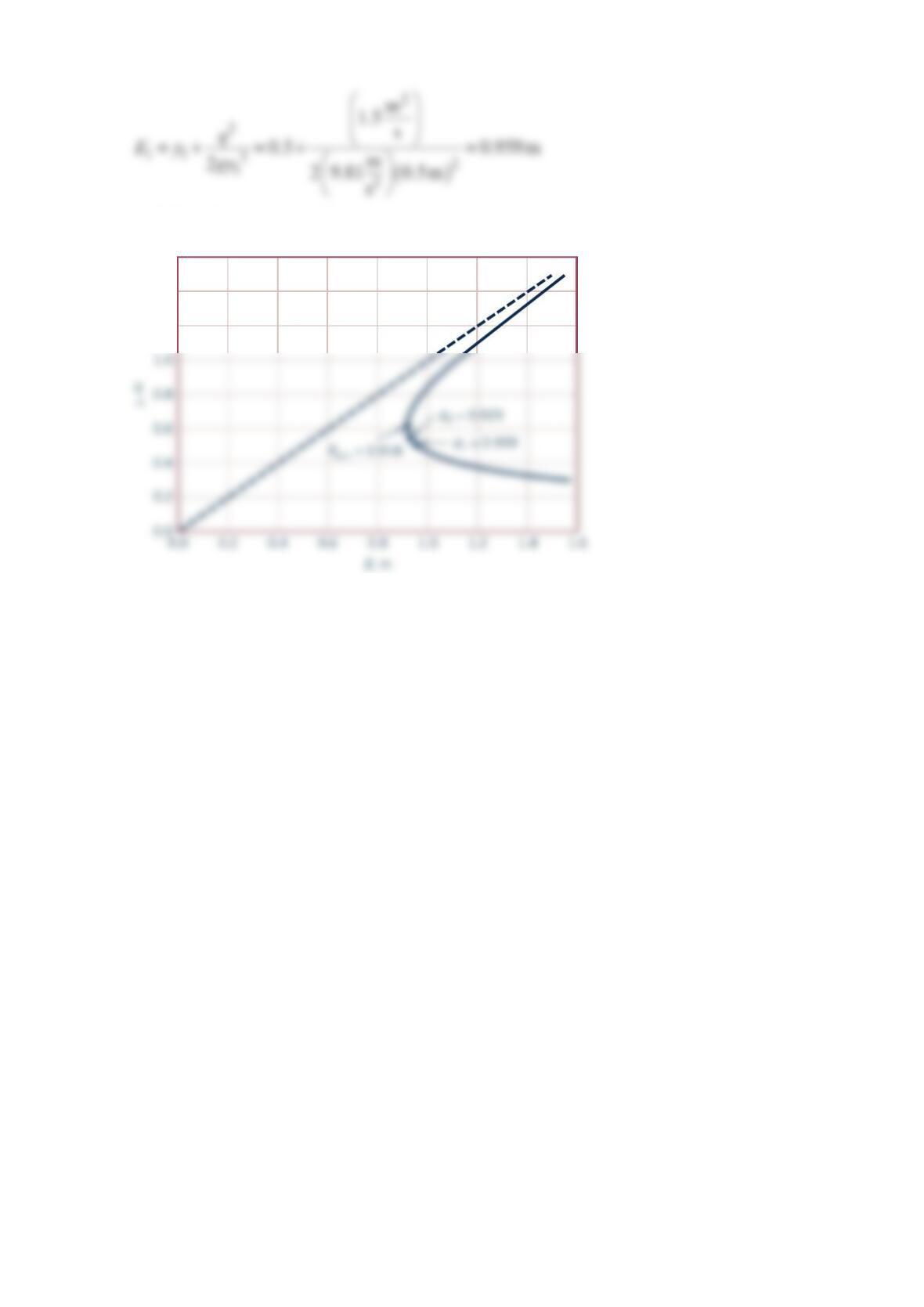
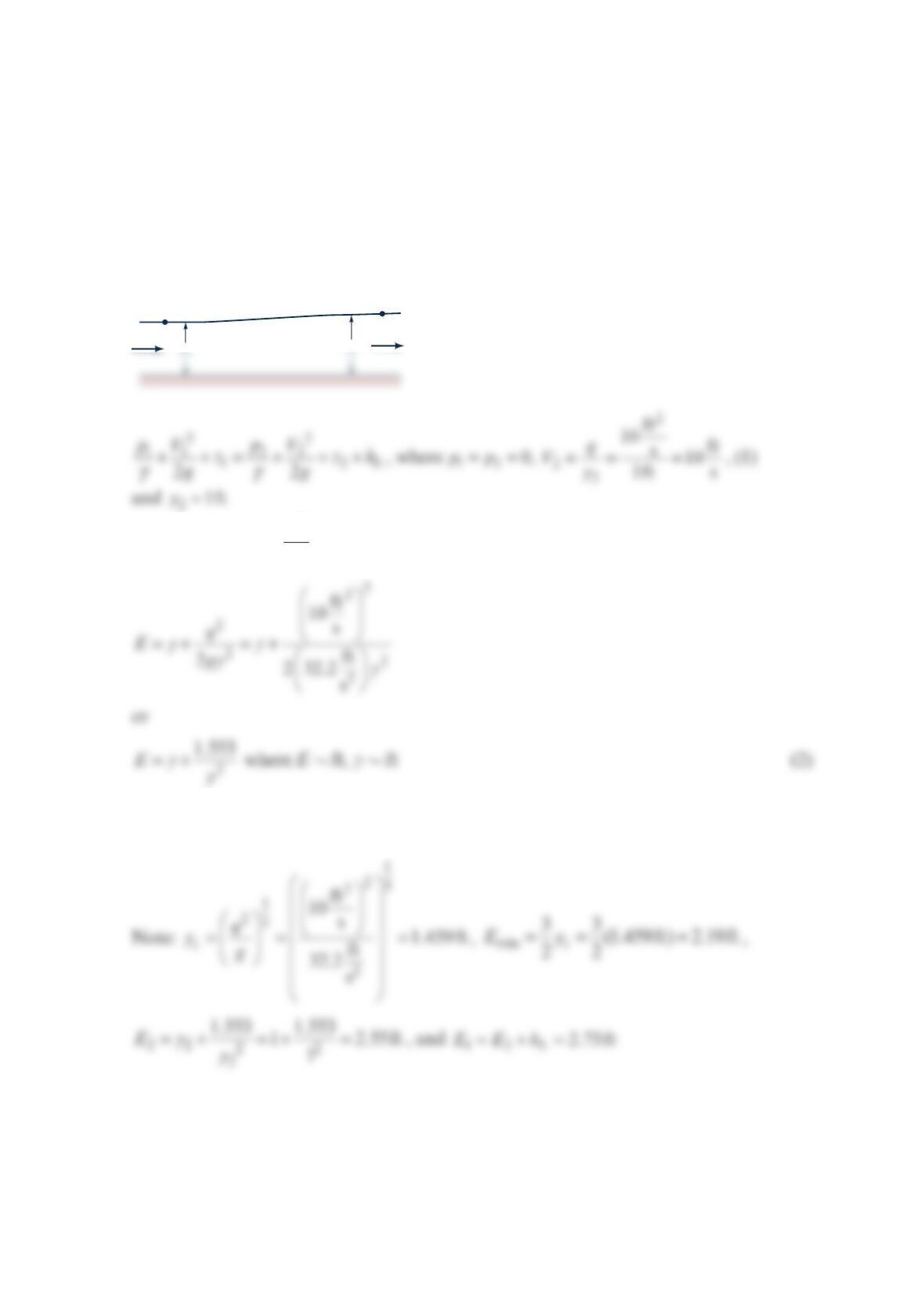
depth of 0.5 m at section (1). The head loss between sections (1) and (2) is 0.03 m . Plot the
specific energy diagram for this flow and locate states (1) and (2) on this diagram. Is it
possible to have a head loss of 0.06 m ? Explain.
Solution 10.21
or
=+ 2
0.1146
Ey y (2)
Equation (2) is plotted below.
y
2
y
1
V
2
V
1
(1) (2)
and =− =
21
0.03 0.929 mEE
Note: If =0.06 m
L
h with =
10.959 mE so that =−
21
0.06EE , then =
2min
0.899m < EE
Thus, it is not possible to have =0.06
L
h with the given q and 1.
y
1.6
1.4
1.2
Problem 10.22
Water flows in a horizontal rectangular channel with a flowrate per unit width of
=2
10 ft / sq and a depth of 1.0 ft at the downstream section (2). The head loss between
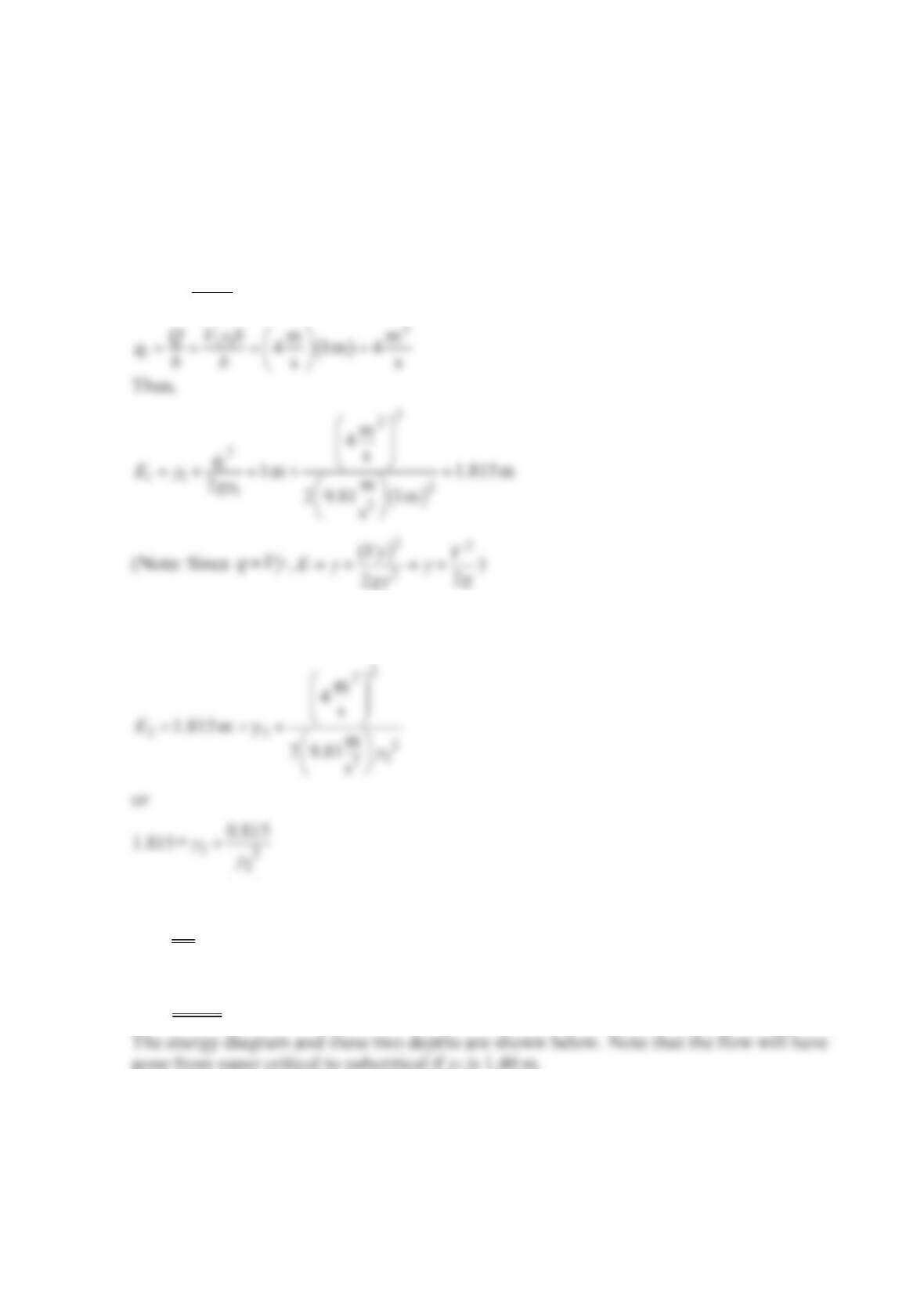
section (1) upstream and section (2) is 0.2 ft . Plot the specific energy diagram for this flow
and locate states (1) and (2) on this diagram.
Solution 10.22
Thus, with =+
2
2
V
Ey g
and Eq. (1) gives =+=+
12 2
0.2 ft
L
EEh E
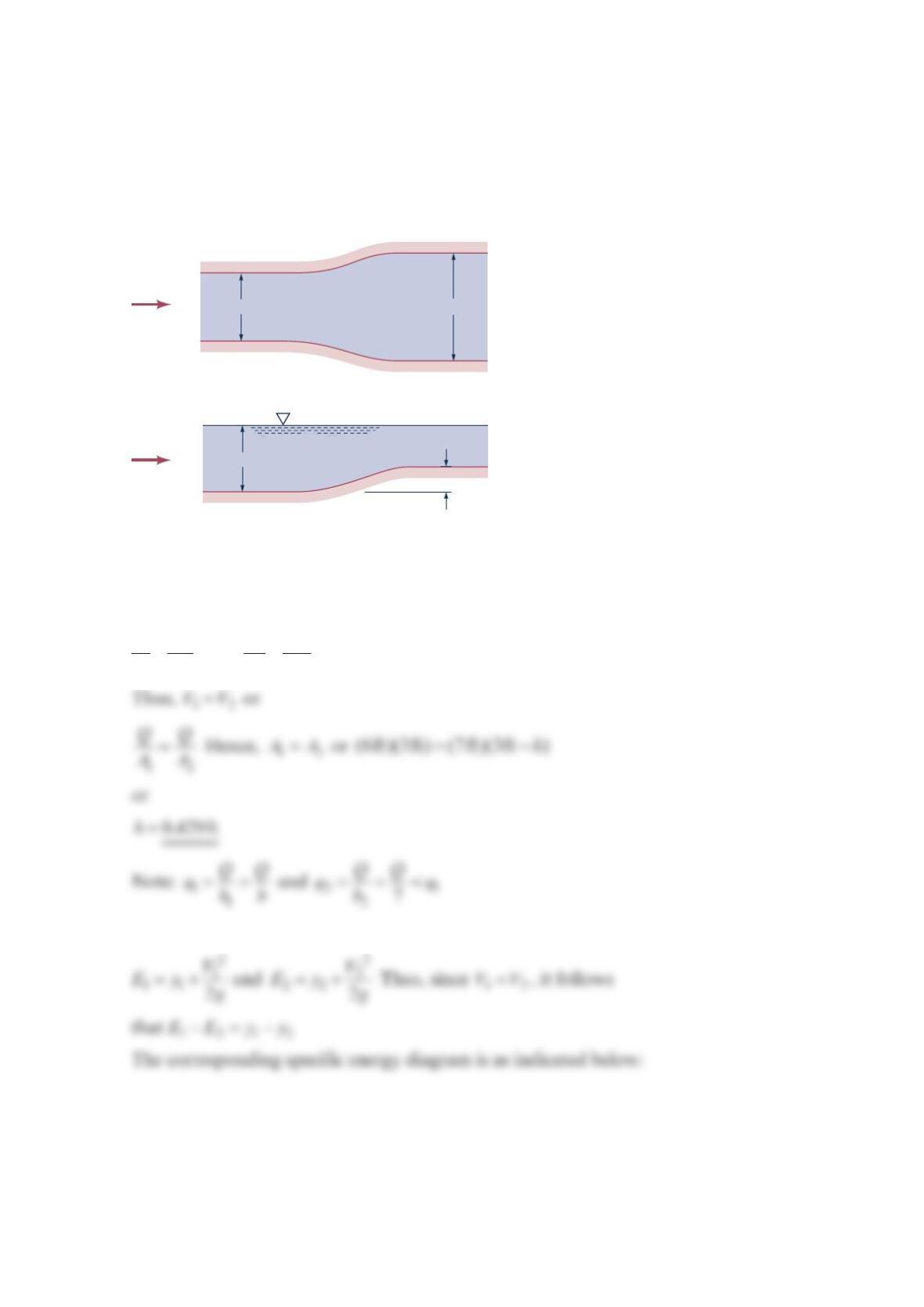
Equation (2) is plotted below.
y
2
y
V
1
V
2
(1) (2)

3.0
2.5
2.0
y
vs
E
Problem 10.23
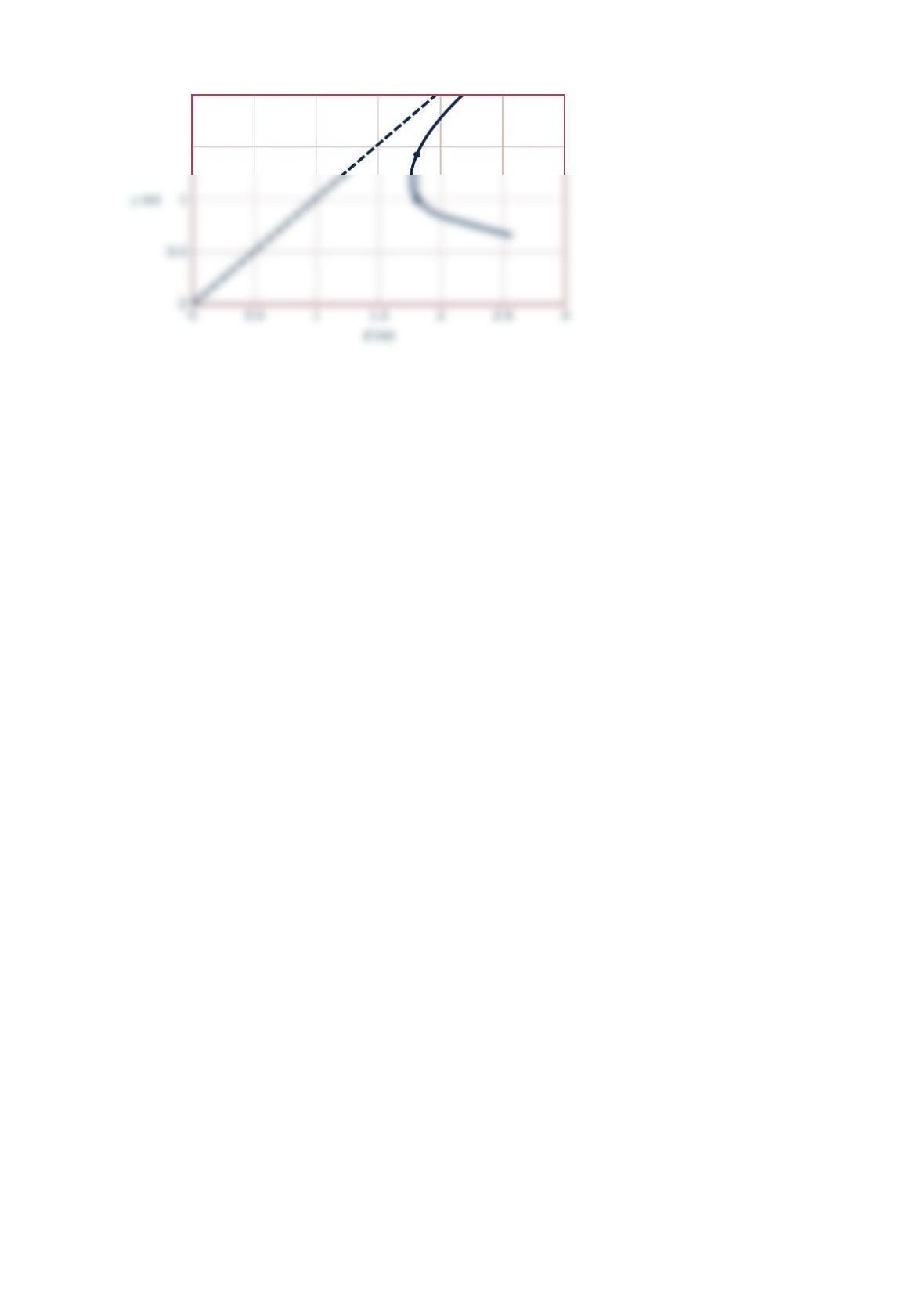
Water flows in a horizontal, rectangular channel with an initial depth of 1m and an initial
velocity of 4m/s. Determine the depth downstream if losses are negligible. Note that there
may be more than one solution.
Solution 10.23
=+
2
2
2
q
E
ygy , where from the initial conditions, =
11my and
With no losses, =
21
EE
, so that =
12
qq
(i.e., ===
111 2 22
QqbQ qb
,with =
12
b
b)
Hence,
which has solutions
=
21my (same as the initial depth)
or
=
21.40 my
2
1.5
Problem 10.24
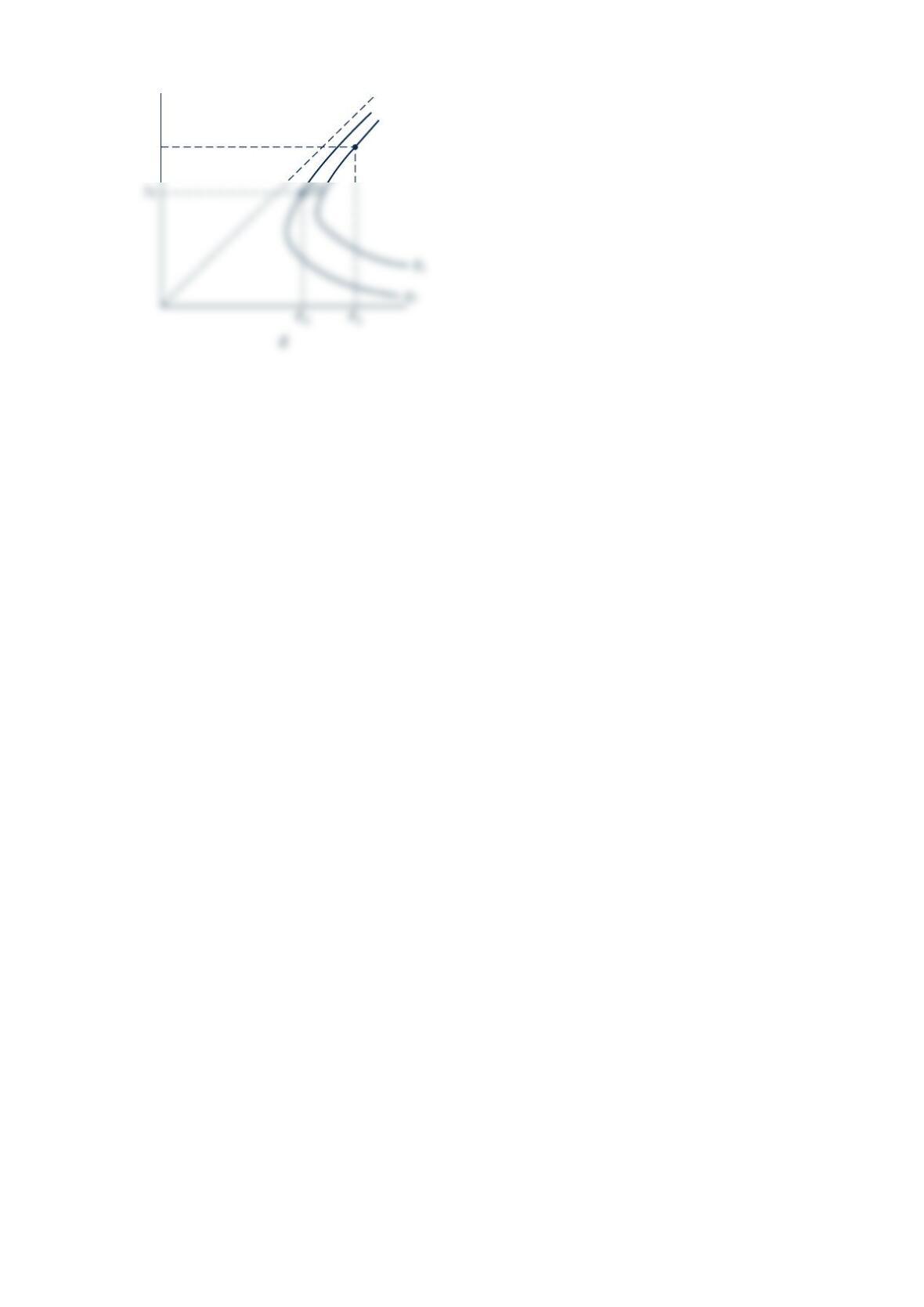
A smooth transition section connects two rectangular channels as shown in the figure
below. The channel width increases from 6.0 to 7.0 ft , and the water surface elevation is the
same in each channel. If the upstream depth of flow is 3.0 ft , determine
h
, the amount that
the channel bed needs to be raised across the transition section to maintain the same surface
elevation.
Solution 10.24
++=+ +
22
11 2 2
12
,
22
pV p V
zz
gg
γγ
where ==
12
0
p
p and =
12
zz
and
6 ft 7 ft
Q
Q
Top view
Side view
3 ft
h
(1)
y1
y
Problem 10.25
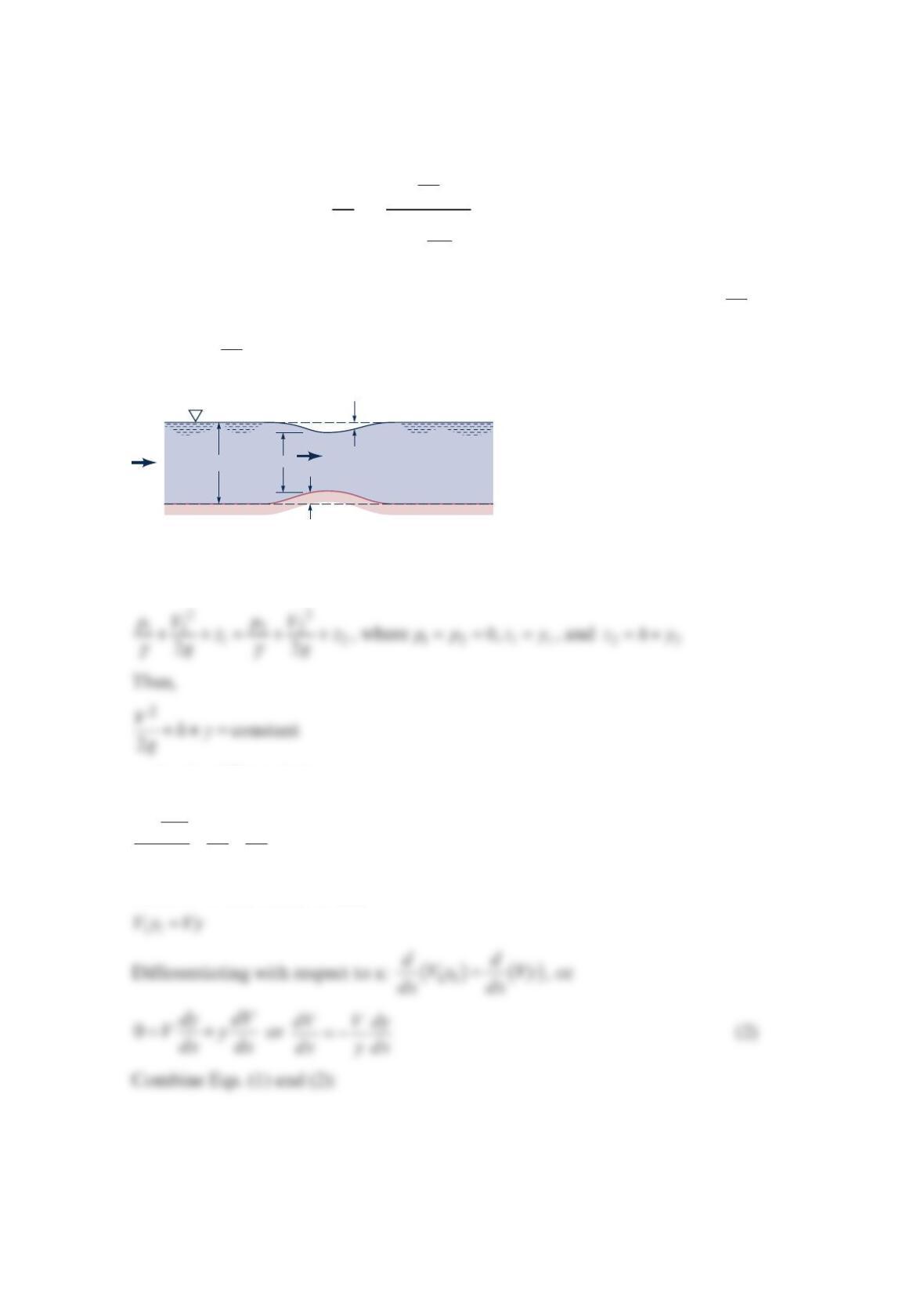
Water flows over a bump of height =()hhx
on the bottom of a wide rectangular channel as
is indicated in the figure below. If energy losses are negligible, show that the slope of the
water surface is given by
=−
−
2
1
dh
dy dx
dx V
gy
, where =()VVx
and =()yyx
are the local
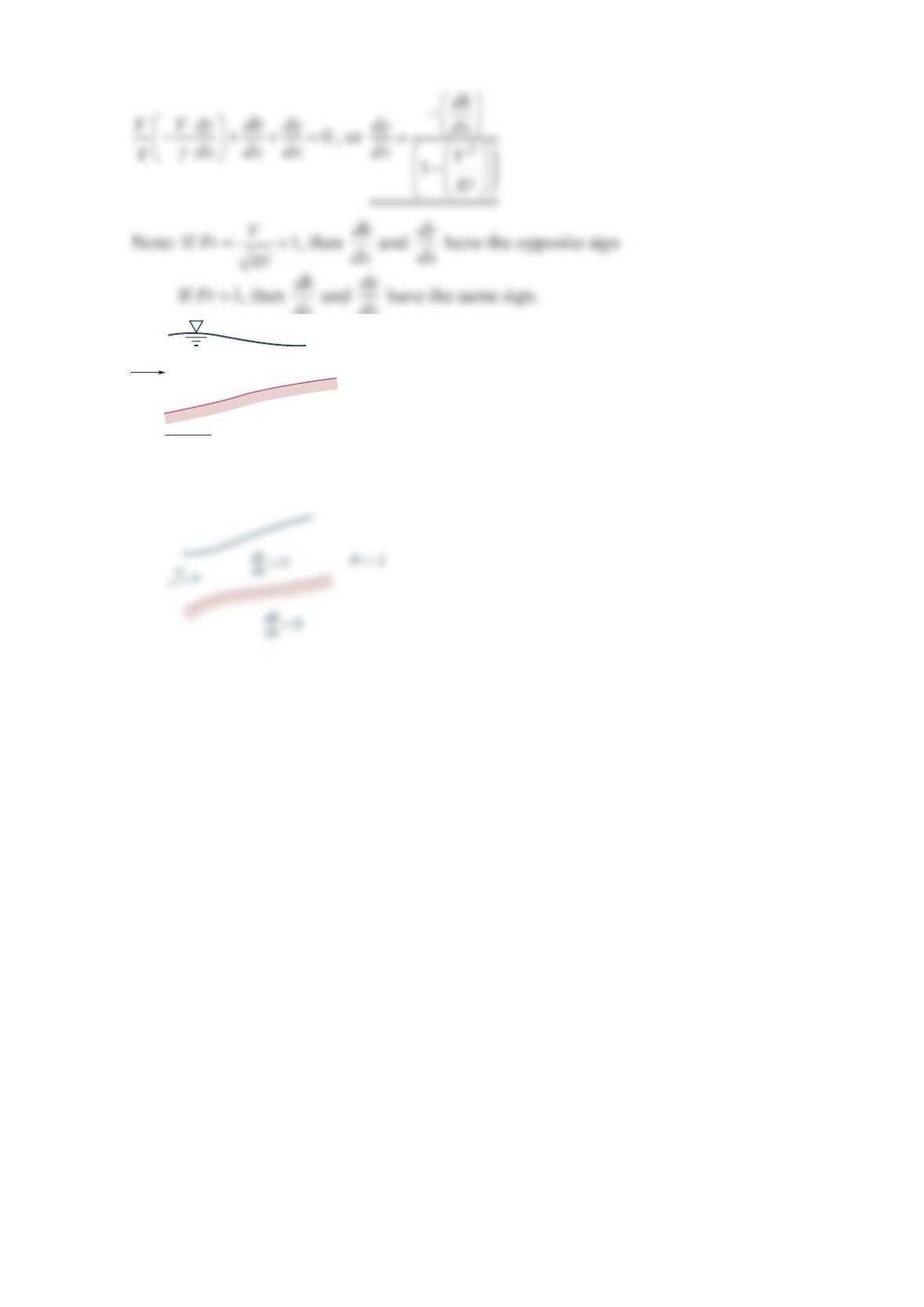
velocity and depth of flow. Comment on the sign (i.e., <=0, 0 , or >0) of dy
dx relative to
the sign of dh
dx .
Solution 10.25
For any two points on the free surface:
so that by differentiating
++=
2
0
2
dV
Vdh dy
dx
gdxdx
(1)
Also, for conservation of mass
V
1
V
(
x
)
y
1
y
h
(
x
)
𝓵
(
x
)
x
dx and dy
dx have the same sign.
V
x
dy
–––
dx < 0
dh
–––
dx > 0
Fr
< 1
Problem 10.26
Consider 3
100 ft s of water flowing down a rectangular channel measuring 10 ft wide. The
normal depth is 3.00 ft . A 4.0-ft-diameter pier is located in the channel. Find the water
depth as it flows past the pier. Assume frictionless flow.
Solution 10.26
GIVEN: Rectangular channel with =3
100 ft sQ, =10ftb, =
n3fty, and a 4-ft -diameter
pier located in the channel. Frictionless flow.
FIND: Water depth at pier.
SOLUTION:
=+
2
2
2
2
2
ft
10 ft 10 s
1
ft 6ft( )
2 32.2 s
yy
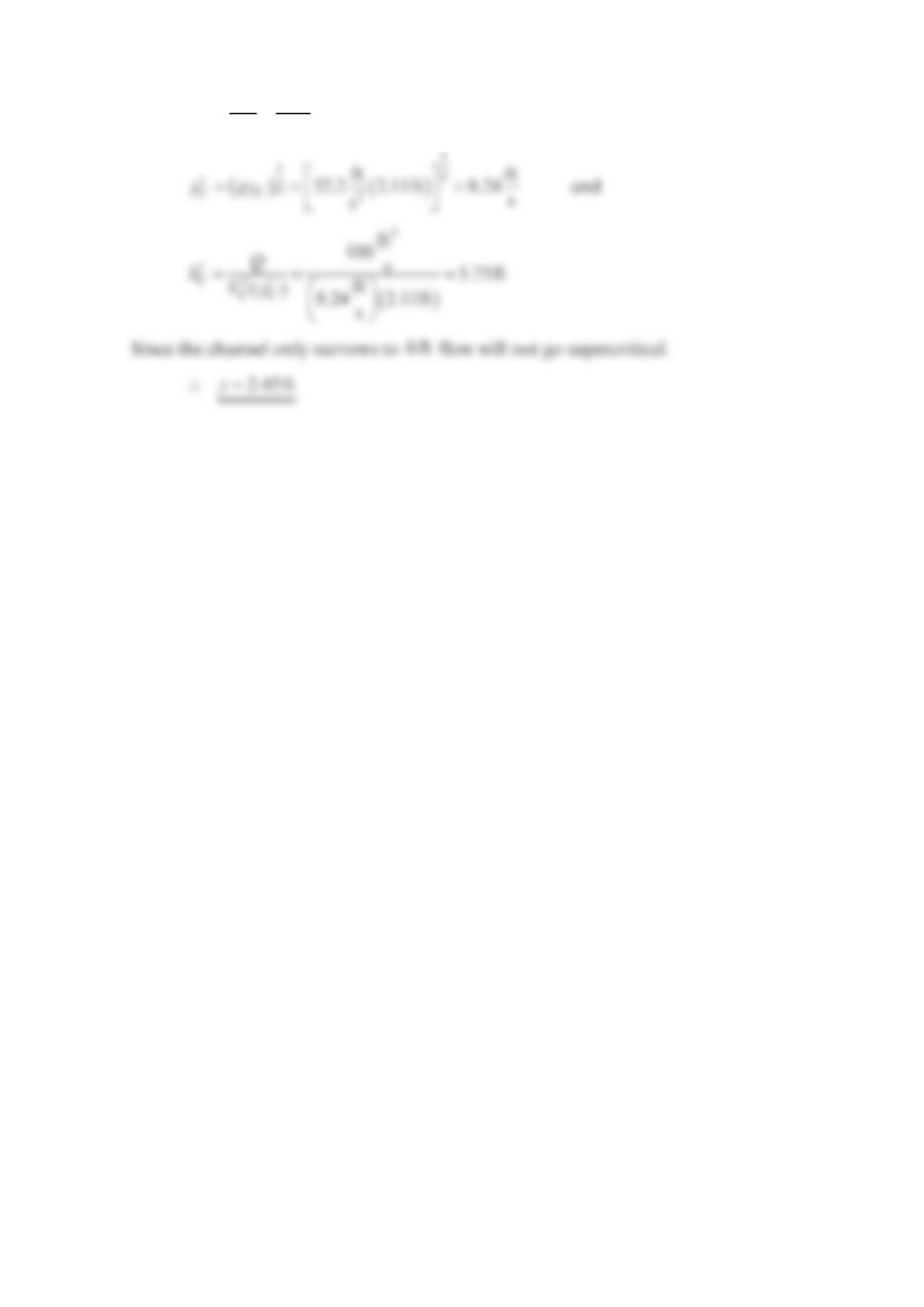
A trial and error solution yields =
21.67 fty and 2.45ft as the positive roots. To find which
root is valid for this flow:
′
′== =
3.17 2.11ft
1.5 1.5
C
C
E
y
Problem 10.27
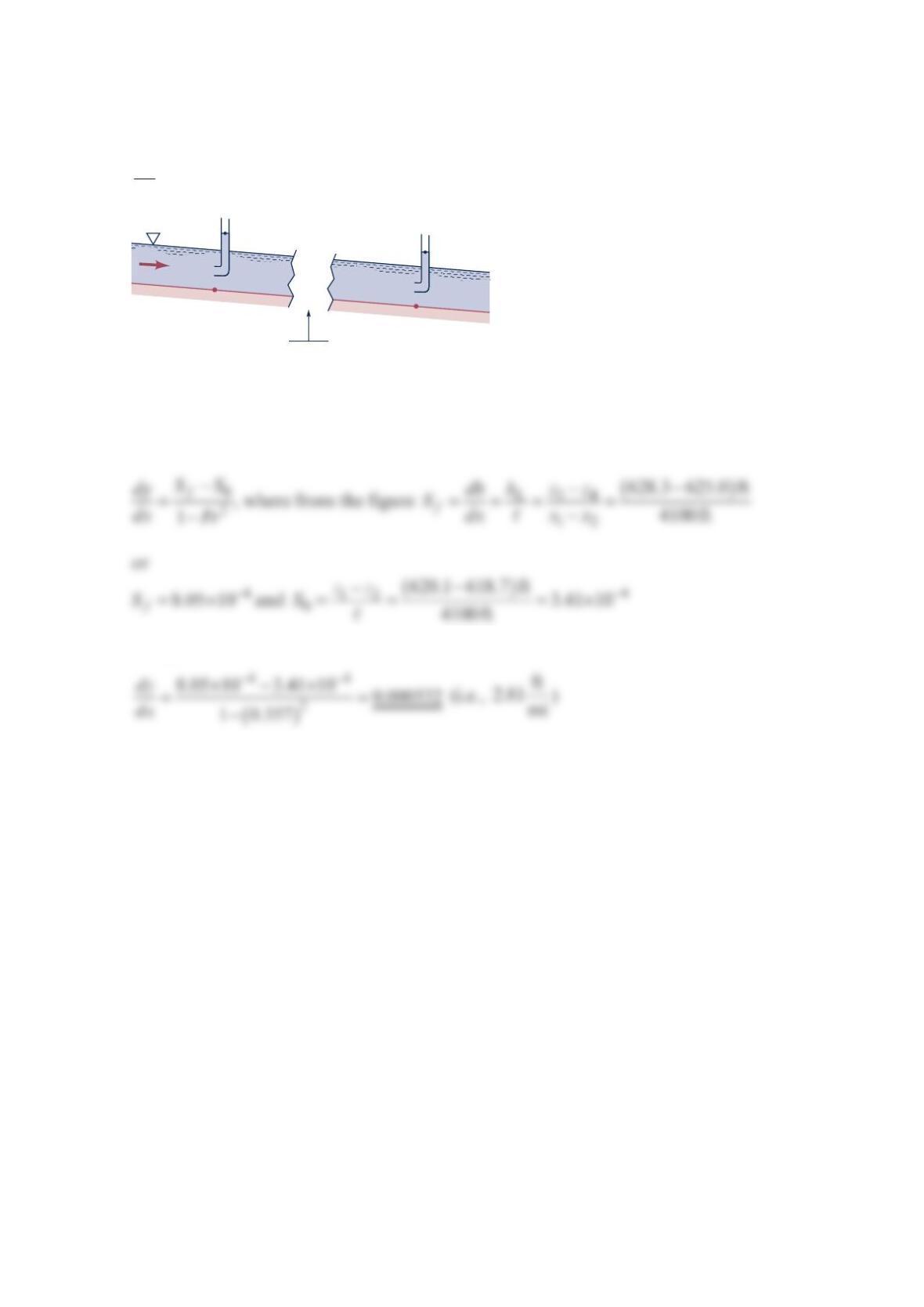
Water flows in the river as shown in the figure below with a uniform bottom slope. The
total head at each section is measured using Pitot tubes as indicated. Determine the value of
dy
dx at the location where the Froude number is 0.357 .
Solution 10.27
Thus,
(2)
(1)
(4)
(3)
Q
z
z
1
= 620.1 ft
z
3
= 628.3 ft
x
2
– x
1
= 4100 ft
z
2
= 618.7 ft
z
4
= 625.0 ft
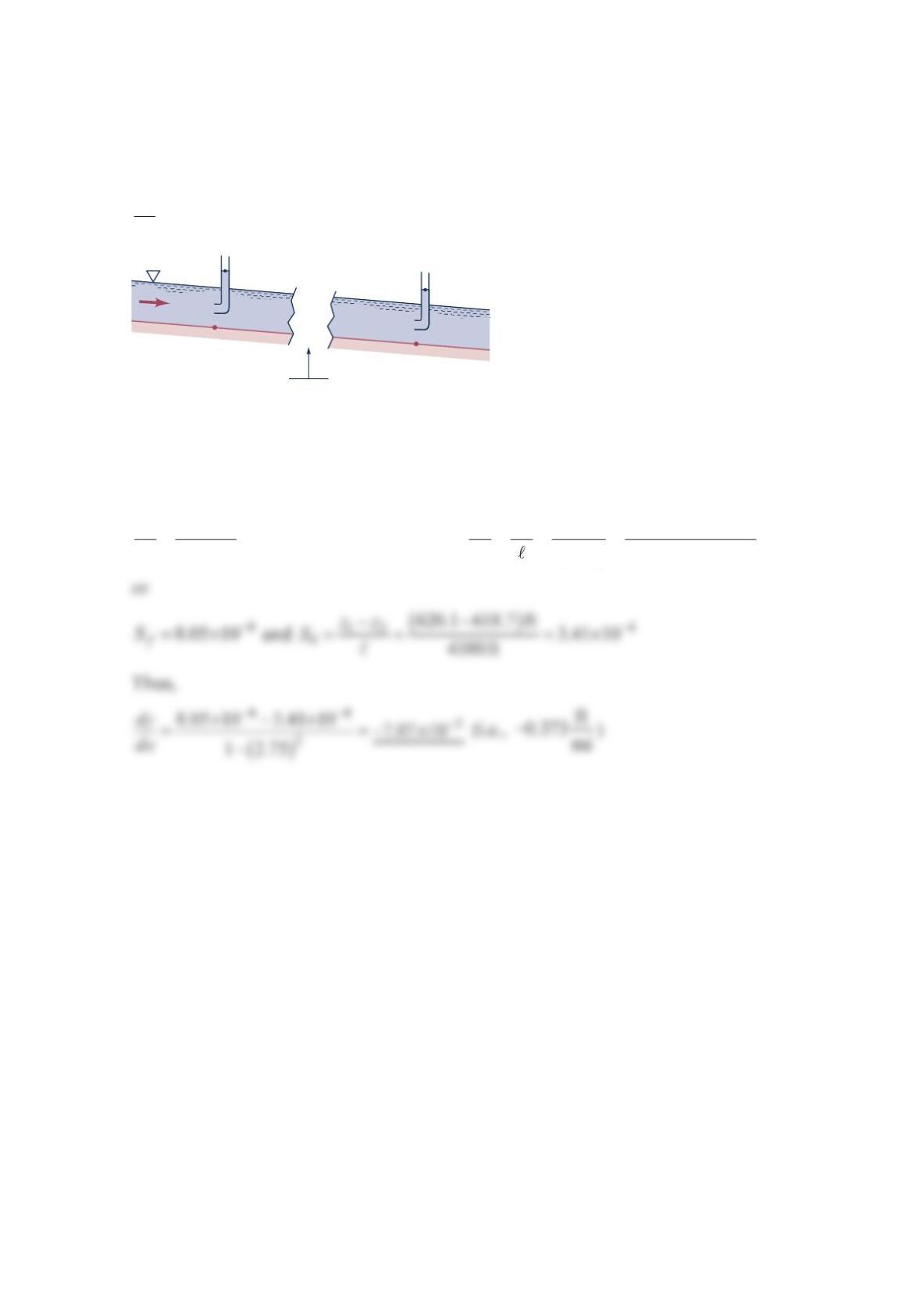
Problem 10.28
Water flows in the river as shown in the figure below with a uniform bottom slope. The
total head at each section is measured using Pitot tubes as indicated. Determine the value of
dy
dx at the location where the Froude number is 2.75.
Solution 10.28
−
=−
0
2
1Fr
f
SS
dy
dx , where from the figure
()
−
−
=== =
−
34
12
628.3 625.0 ft
4100 ft
L
f
zz
h
dh
Sdx x x
(2)
(1)
(4)
(3)
Q
z
z
1
= 620.1 ft
z
3
= 628.3 ft
x
2
– x
1
= 4100 ft
z
2
= 618.7 ft
z
4
= 625.0 ft
Problem 10.29
Supercritical, uniform flow of water occurs in a 5.0-m-wide, rectangular, horizontal
channel. The flow has a depth of 1.5 m and a flowrate of 3
45.0 m s. The water flow
encounters a 0.25-m rise in the channel bottom. Find the normal depth after the rise in the
channel bottom. Is the flow after the rise subcritical, critical, or supercritical? Assume
frictionless flow.
Solution 10.29
GIVEN: Supercritical, uniform flow, rectangular, horizontal channel, =5mb, =
11.5 my,
so
normal depth 2
y
after the rise, we use

()
+−=
2
2
22
2
2
m
9s3.085 m 0
m
29.81
s
y
y
Problem 10.30
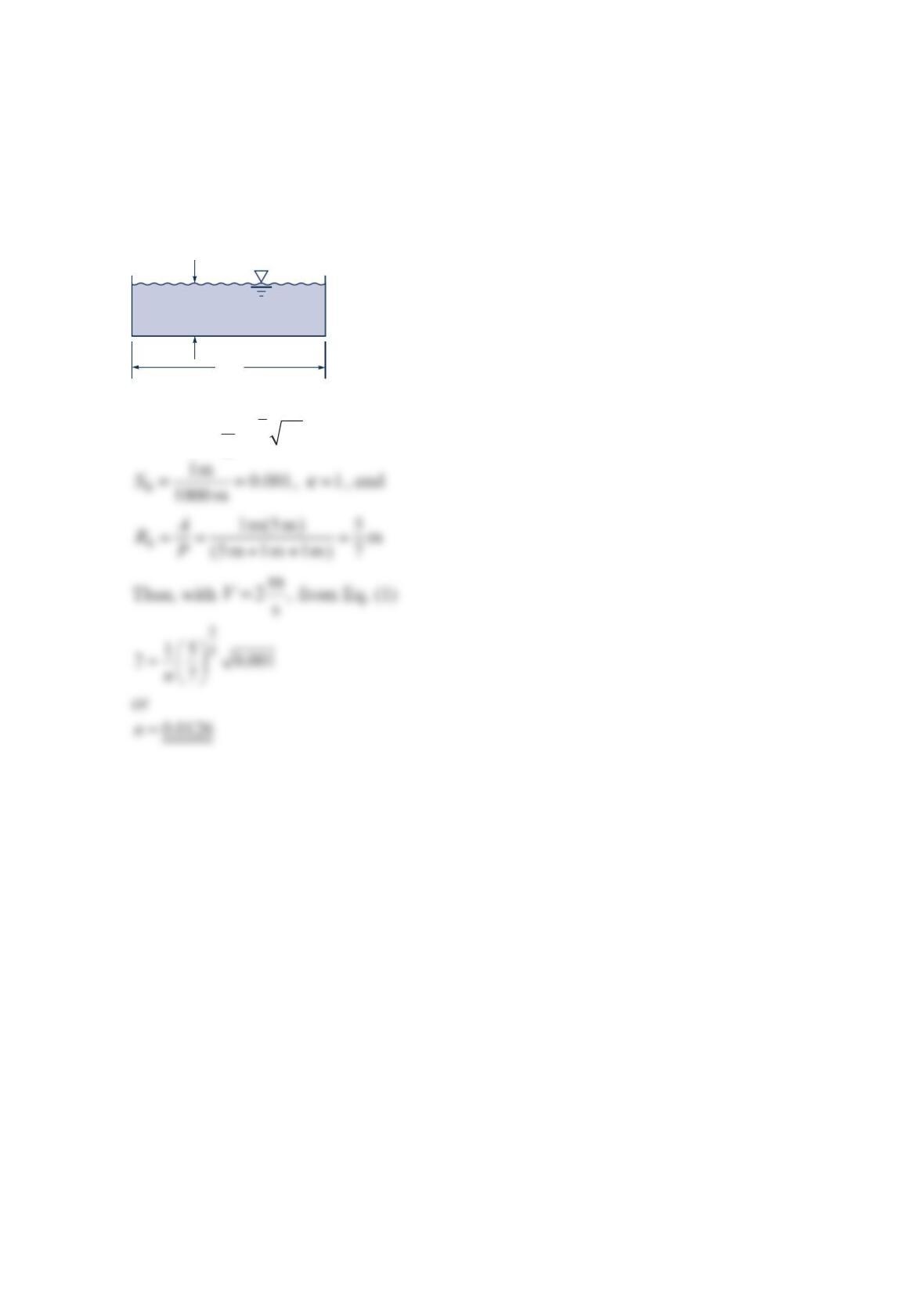
Water flows in a
5
-m–wide channel with a speed of 2 m/s and a depth of 1 m. The channel
bottom slopes at a rate of 1 m per
1
000 m. Determine the Manning coefficient for this
channel.
Solution 10.30
(1)
κ
=
2
30h
VRS
n, where
1 m
5 m