Problem 1.104
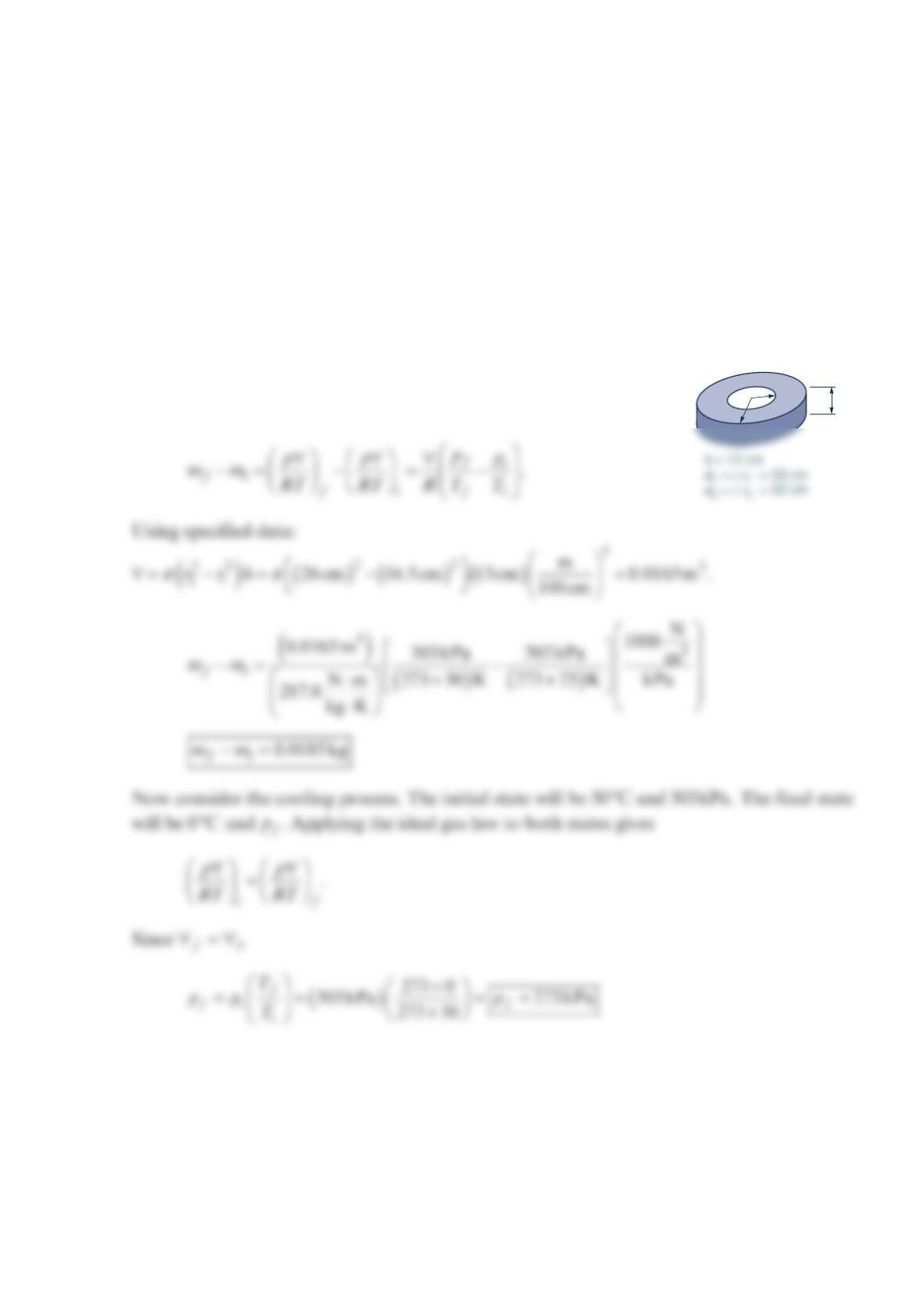
Assume that the air volume in a small automobile tire is constant and equal to the volume
between two concentric cylinders
1
3 cm high with diameters of
3
3 cm and
5
2 cm. The air in
the tire is initially at
2
5 °C and
2
02 kPa. Immediately after air is pumped into the tire, the
temperature is
3
0 °C and the pressure is
3
03 kPa. What mass of air was added to the tire?
What would be the air pressure after the air has cooled to a temperature of
0
°C?
Solution 1.104
The mass of air added to the tire is the difference of the final mass of
air
f
m and the initial mass i
m. Assuming air is an ideal gas,
h
r
2
r
1
Problem 1.105
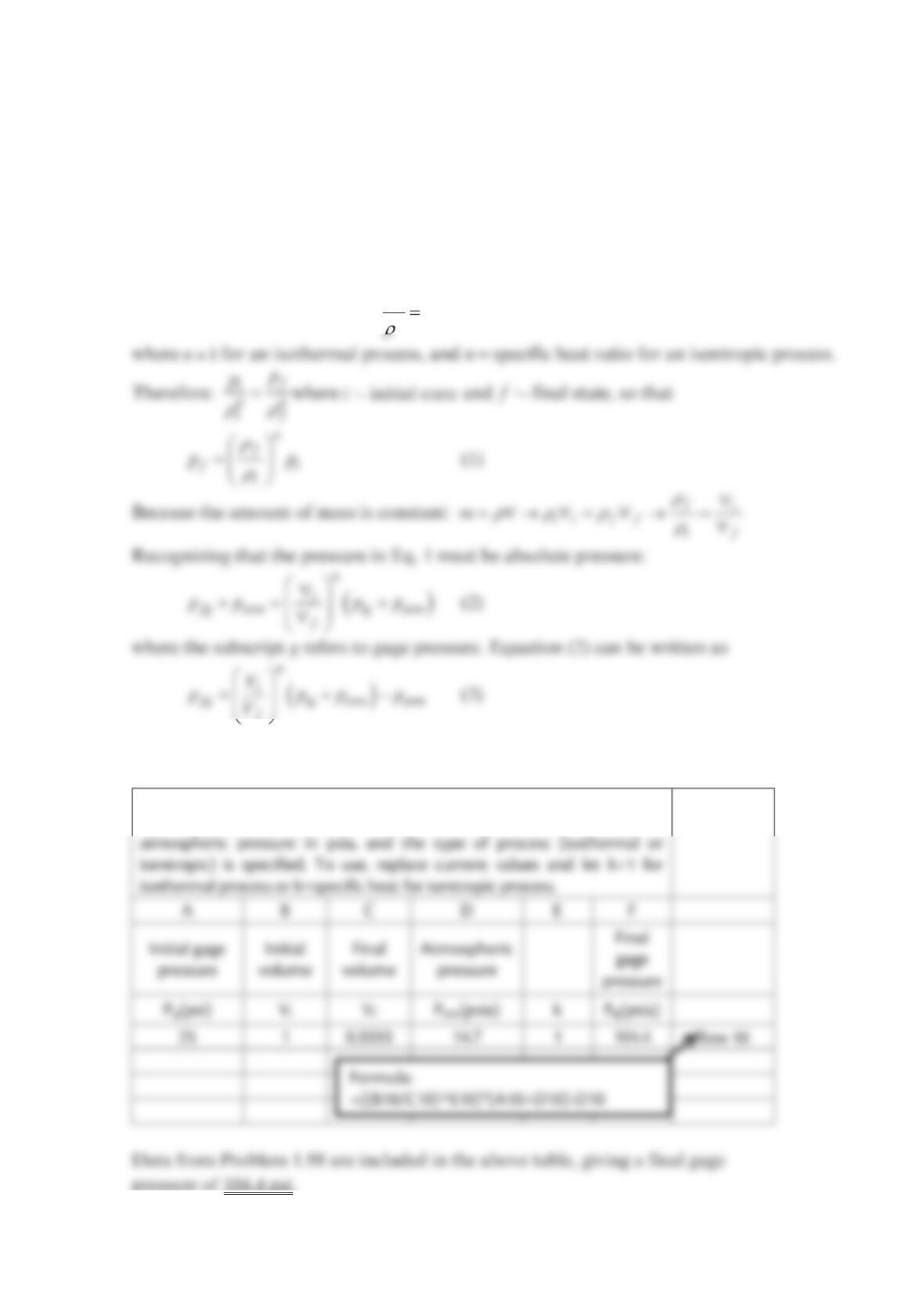
Develop a computer program for calculating the final gage pressure of gas when the initial
gage pressure, initial and final volumes, atmospheric pressure, and the type of process (iso-
thermal or isentropic) are specified. Use BG units. Check your program against the results
obtained for Problem 1.98.
Solution 1.105
For compression or expansion, constant
n
p
,
A spreadsheet (EXCEL) program for calculating the final gage pressure follows.
This program calculates the final gage pressure of an ideal gas when the
initial gage pressure in psi, the initial volume, the final volume, the
p
Problem 1.106
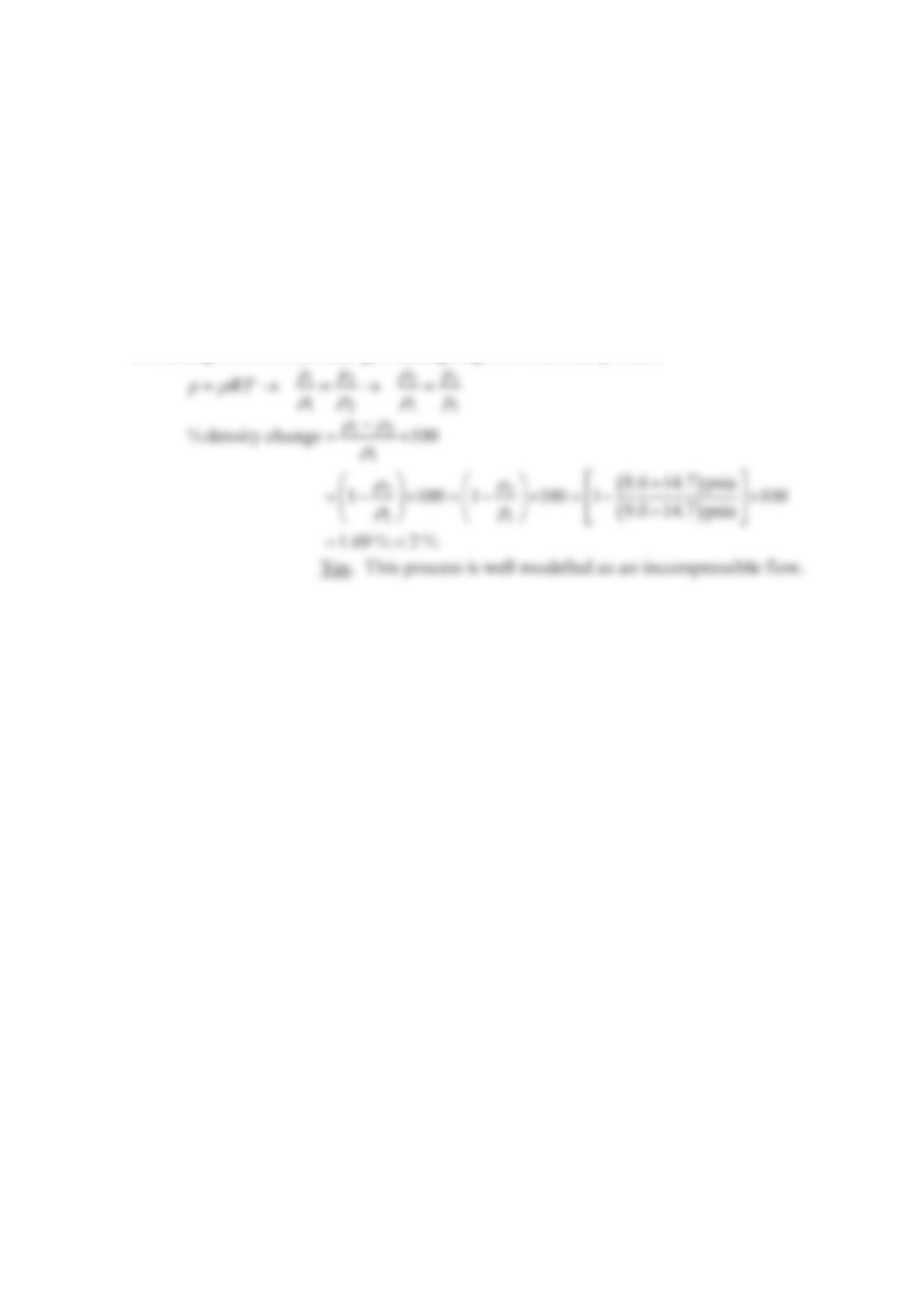
Often the assumption is made that the flow of a certain fluid can be considered as incom-
pressible flow if the density of the fluid changes by less than 2 %. If air is flowing through a
tube such that the air pressure at one section is 9.0 psi and at a downstream section it is 8.6
p
s
i
at the same temperature, do you think that this flow could be considered an incompress-
ible flow? Support your answer with the necessary calculations. Assume standard atmos-
pheric pressure.
Solution 1.106
Modelling the air as an ideal gas undergoing an isothermal process:
Problem 1.107
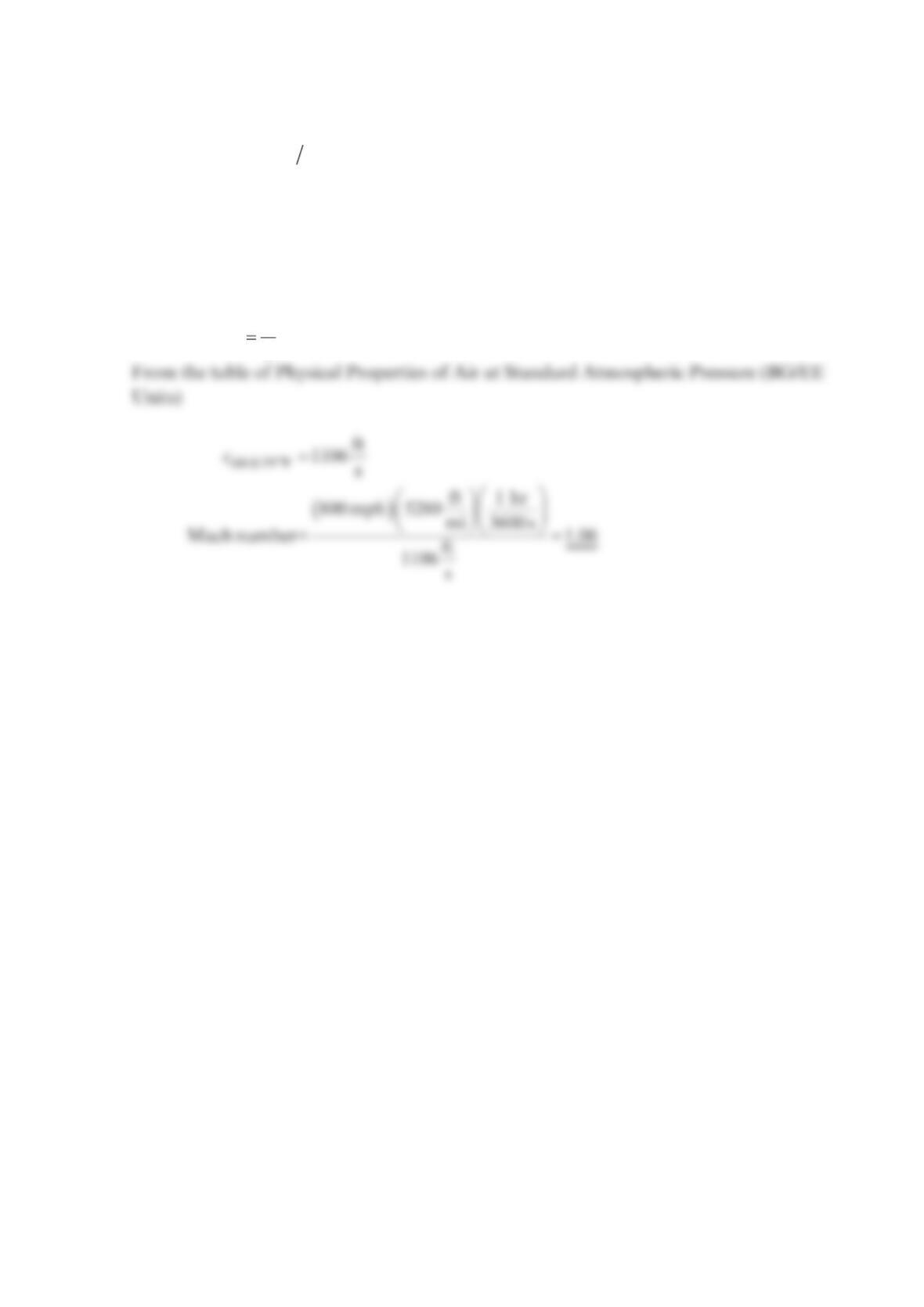
An important dimensionless parameter concerned with very high-speed flow is the Mach
number, defined as
V
c, where
V
is the speed of the object such as an airplane or projectile,
and
c
is the speed of sound in the fluid surrounding the object. For a projectile traveling at
800
m
ph through air at 50
°
F and standard atmospheric pressure, what is the value of the
Mach number?
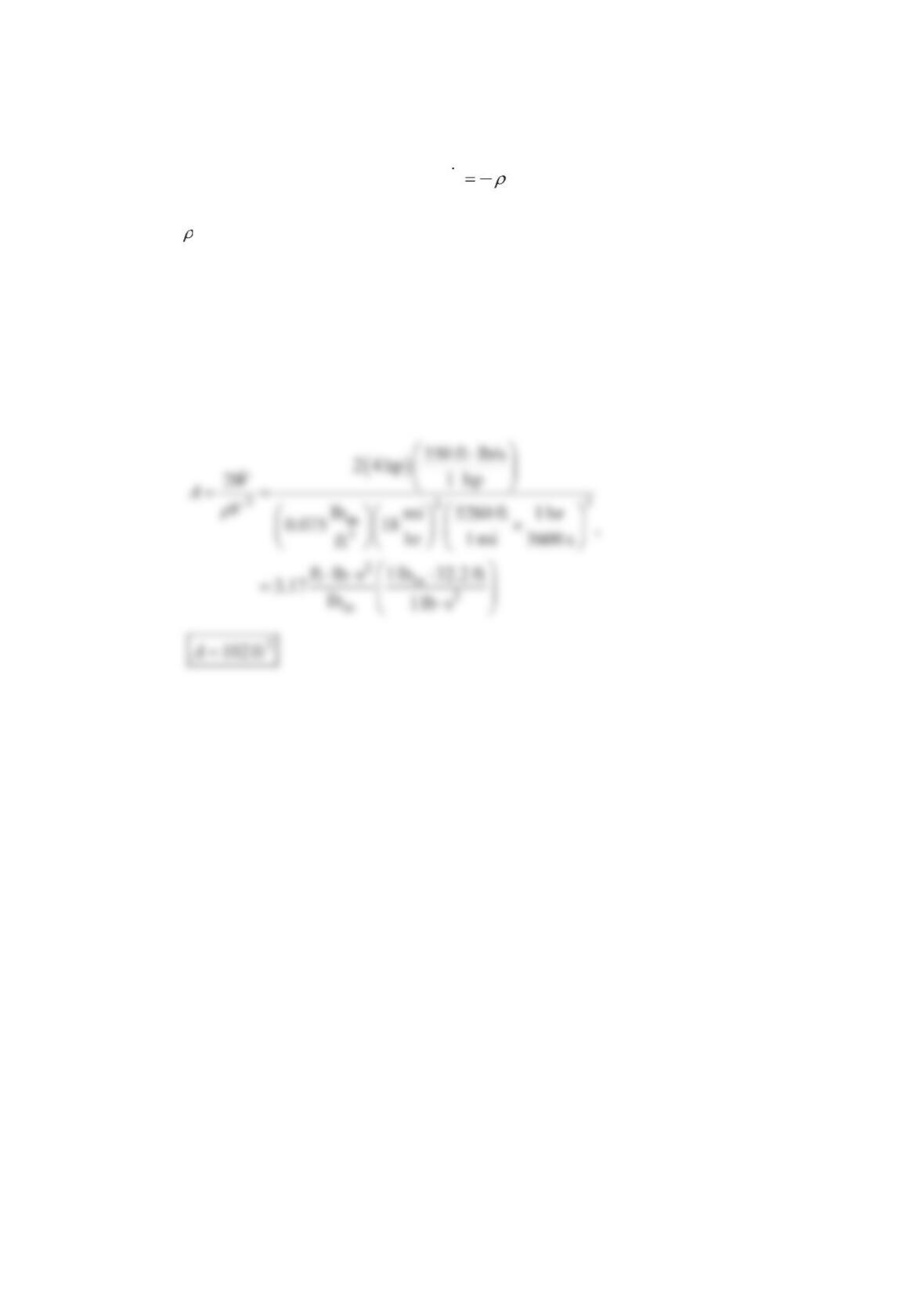
Solution 1.107
M
ach number V
c
Problem 1.108
The “power available in the wind” of velocity
V
through an area
A
is
3
1
2
W
AV ,
where is the air density ( 3
0.075 lbm/ft ). For an
1
8-mp
h
wind, find the wind area
A
that will
supply a power of 4hp.
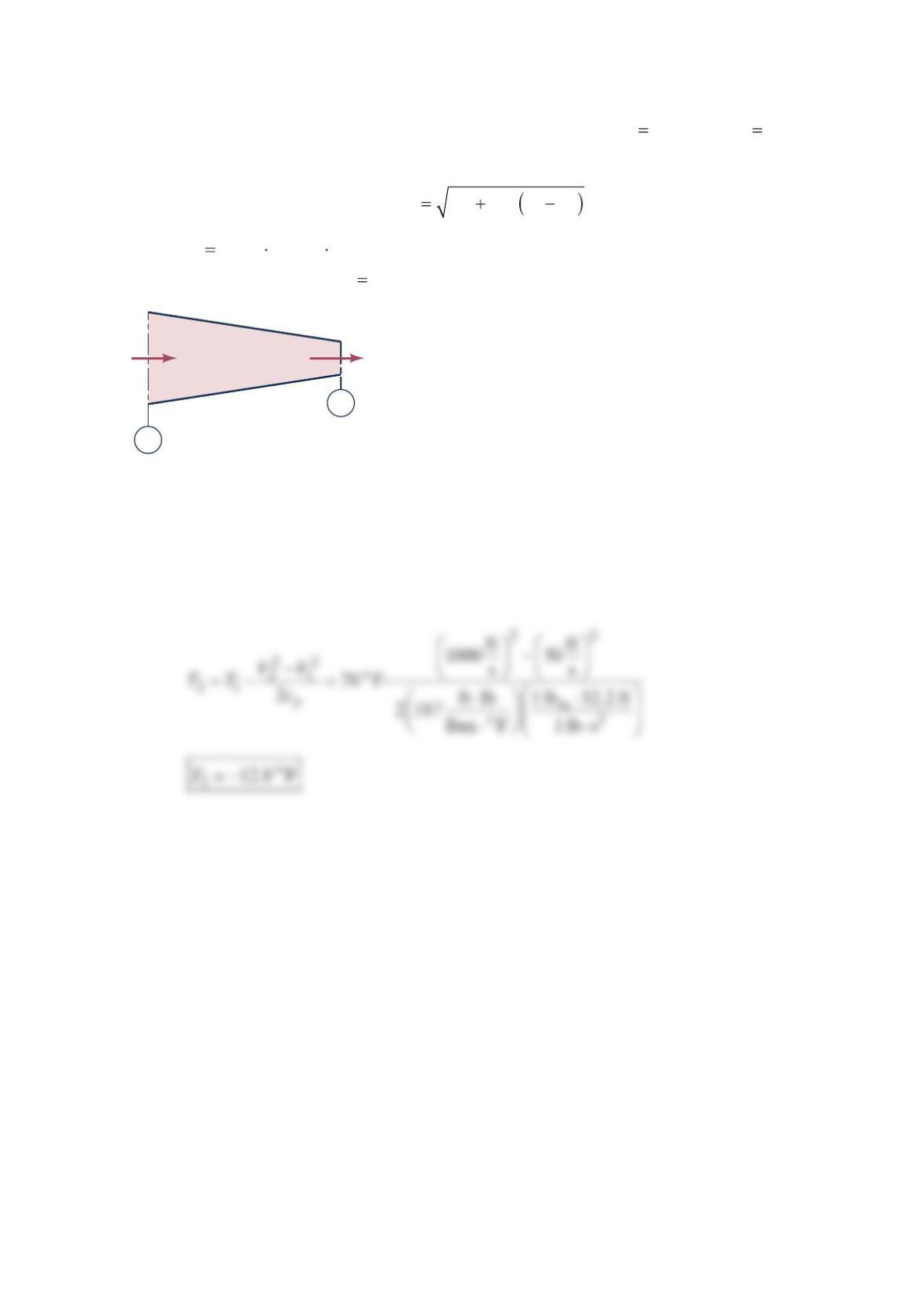
Solution 1.108
Solving for the area
A
and using appropriate unit conversion factors:
Problem 1.109
Air enters the converging nozzle shown in the figure below at 170 °F
T and 150 ft/s
V
.
At the exit of the nozzle, 2
V
is given by
2
21 12
2p
V
VcTT
,
where 187 ft lb/lbm °F
p
c and 2
T is the air temperature at the exit of the nozzle. Find the
temperature 2
T for which 21000 ft/s
V
.
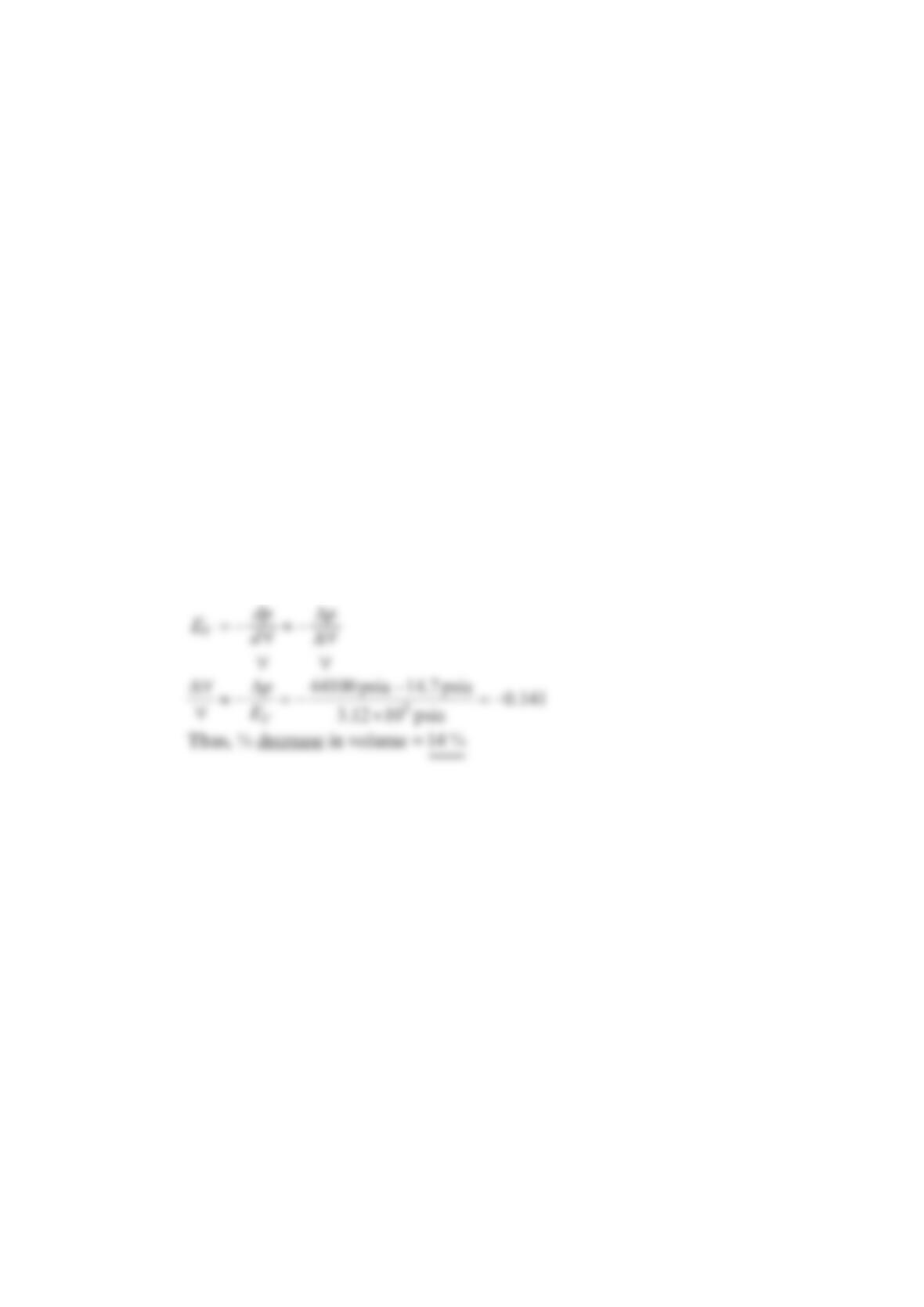
Solution 1.109
Solving for 2
T and inserting the values specified: c
q gives
1
2
V
1
V
2
Problem 1.110
This water jet is a blast Usually, liquids can be treated as incompressible fluids. However, in
some applications the compressibility of a liquid can play a key role in the operation of a
device. For example, a water pulse generator using compressed water has been developed
for use in mining operations. It can fracture rock by producing an effect comparable to a
conventional explosive such as gunpowder. The device uses the energy stored in a water-
filled accumulator to generate an ultrahigh-pressure water pulse ejected through a 10-to
25-mm-diameter discharge value. At the ultrahigh pressures used (300 to 400 MPa, or
3000 to 4000 atmospheres), the water is compressed (i.e., the volume reduced) by about
10% to 15%. When a fast-opening valve within the pressure vessel is opened, the water ex-
pands and produces a jet of water that upon impact with the target material produces an
effect similar to the explosive force from conventional explosives. Mining with the water jet
can eliminate various hazards that arise with the use of conventional chemical explosives,
such as those associated with the storage and use of explosives and the generation of toxic
gas by-products that require extensive ventilation. (See Problem 1.110.)
By what percent is the volume of water decreased if its pressure is increased to an equivalent
to 3000 atmospheres (44,100
p
s
i
)?
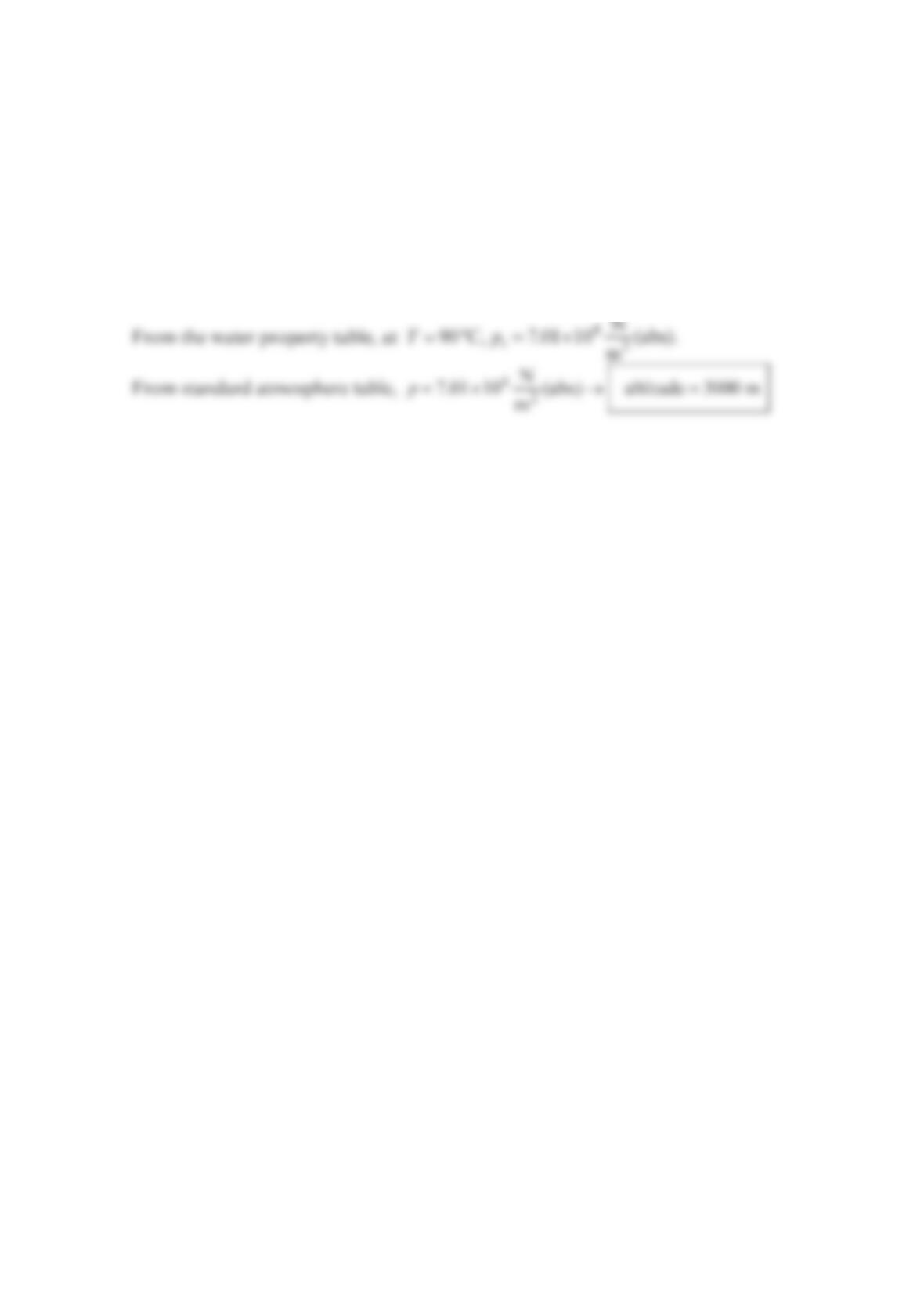
Solution 1.110
Problem 1.111
During a mountain climbing trip it is observed that the water used to cook a meal boils at
90
°
C rather than the standard 100
°
C at sea level. At what altitude are the climbers prepar-
ing their meal? See Table of Physical Properties of Water (SI Units) and Table of Properties
of the U.S. Standard Atmosphere (SI Units) for data needed to solve this problem.
Solution 1.111
Water boils when the vapor pressure of the liquid is the same as atmospheric pressure.

Problem 1.112
When a fluid flows through a sharp bend, low pressures may develop in localized regions of
the bend. Estimate the minimum absolute pressure (in psi) that can develop without causing
cavitation if the fluid is water at 160
°
F.
Solution 1.112
Cavitation may occur when the local pressure equals the vapor pressure. For water at 160
°
F

Problem 1.113
A partially filled closed tank contains ethyl alcohol at 68
°
F. If the air above the alcohol is
evacuated, what is the minimum absolute pressure that develops in the evacuated space?
Solution 1.113

Problem 1.114
Estimate the minimum absolute pressure (in Pascals) that can be developed at the inlet of a
pump to avoid cavitation if the fluid is carbon tetrachloride at 20
°
C.
Solution 1.114
Cavitation may occur when the section pressure at the pump inlet equals the vapor pressure
°
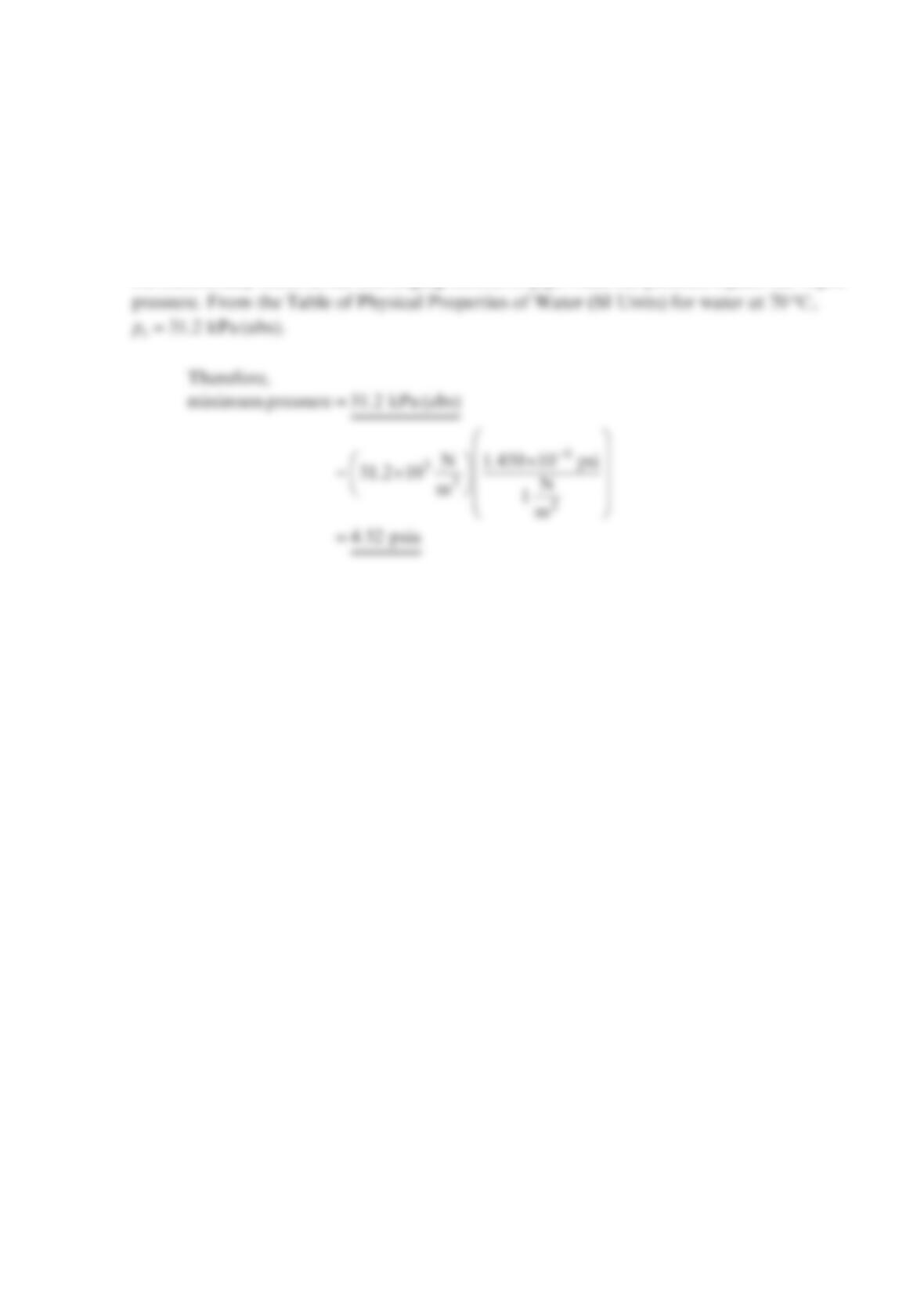
Problem 1.115
When water at 70
°
C flows through a converging section of pipe, the pressure decreases in
the direction of flow. Estimate the minimum absolute pressure that can develop without
causing cavitation. Express your answer in both BG and SI units.
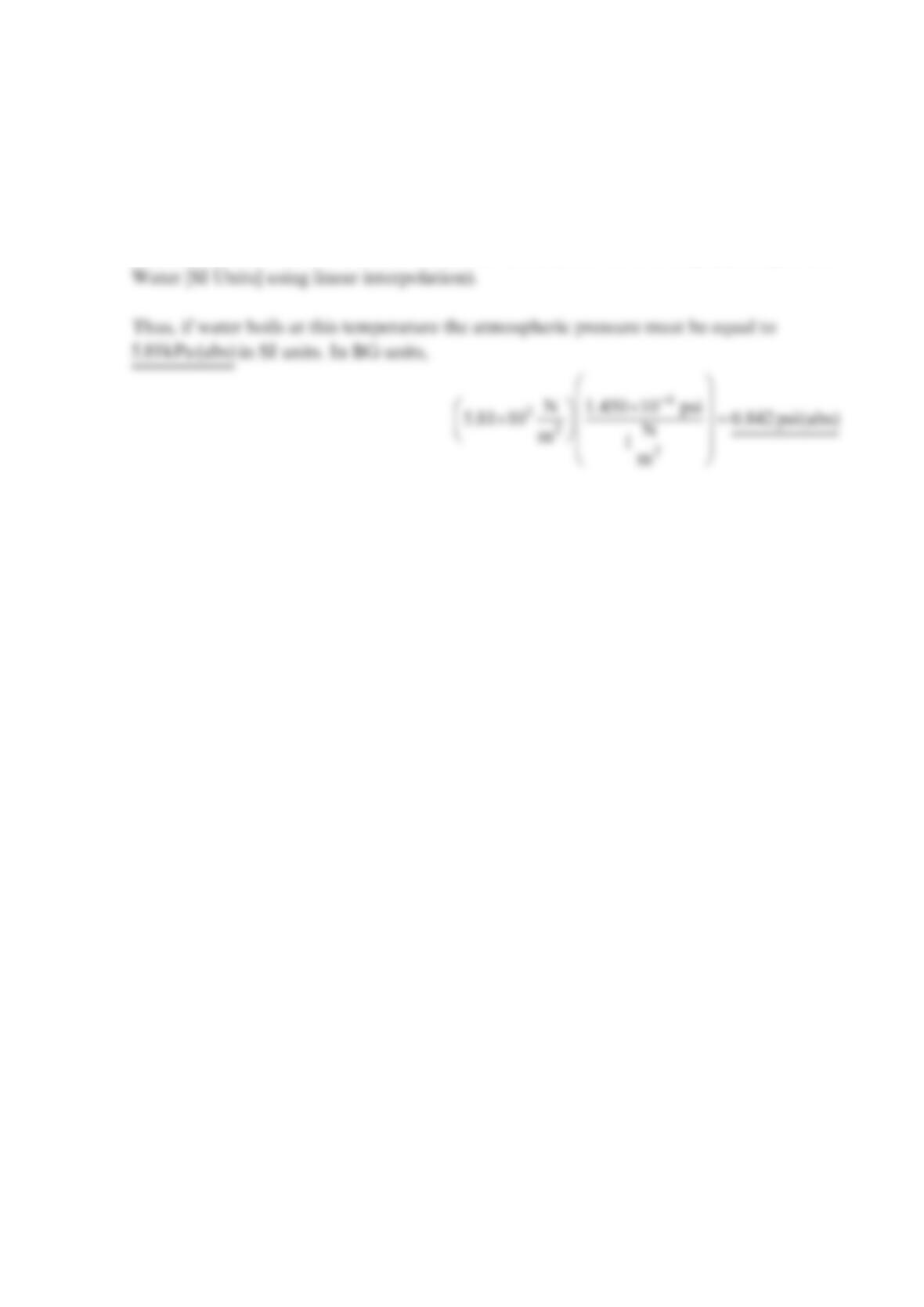
Solution 1.115
Cavitation may occur in the converging section of pipe when the pressure equals the vapor
°
Problem 1.116
At what atmospheric pressure will water boil at 35
°
C? Express your answer in both SI and
BG units.
Solution 1.116
The vapor pressure of water at
3
5°C is 5.81 kPa (abs
)
(from Table of Physical Properties of
Problem 1.118
When a 2-mm-diameter tube is inserted into a liquid in an open tank, the liquid is observed
to rise 10
m
m above the free surface of the liquid. The contact angle between the liquid and
the tube is zero, and the specific weight of the liquid is 43
1
.2 10 N m . Determine the value
of the surface tension for this liquid.
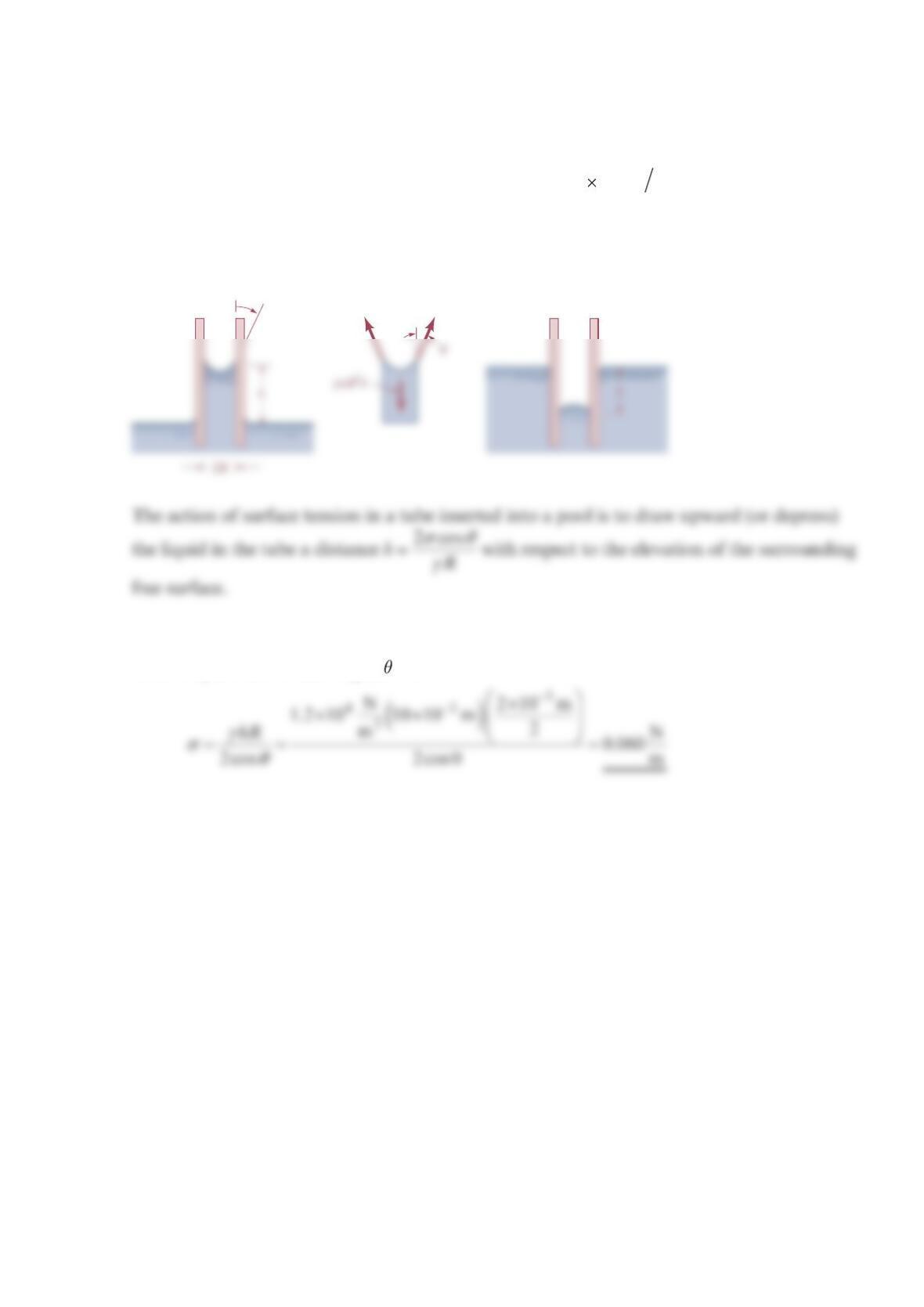
Solution 1.118
For the specified contact angle, = 0:
2
R
θ
πσ