Chapter 1
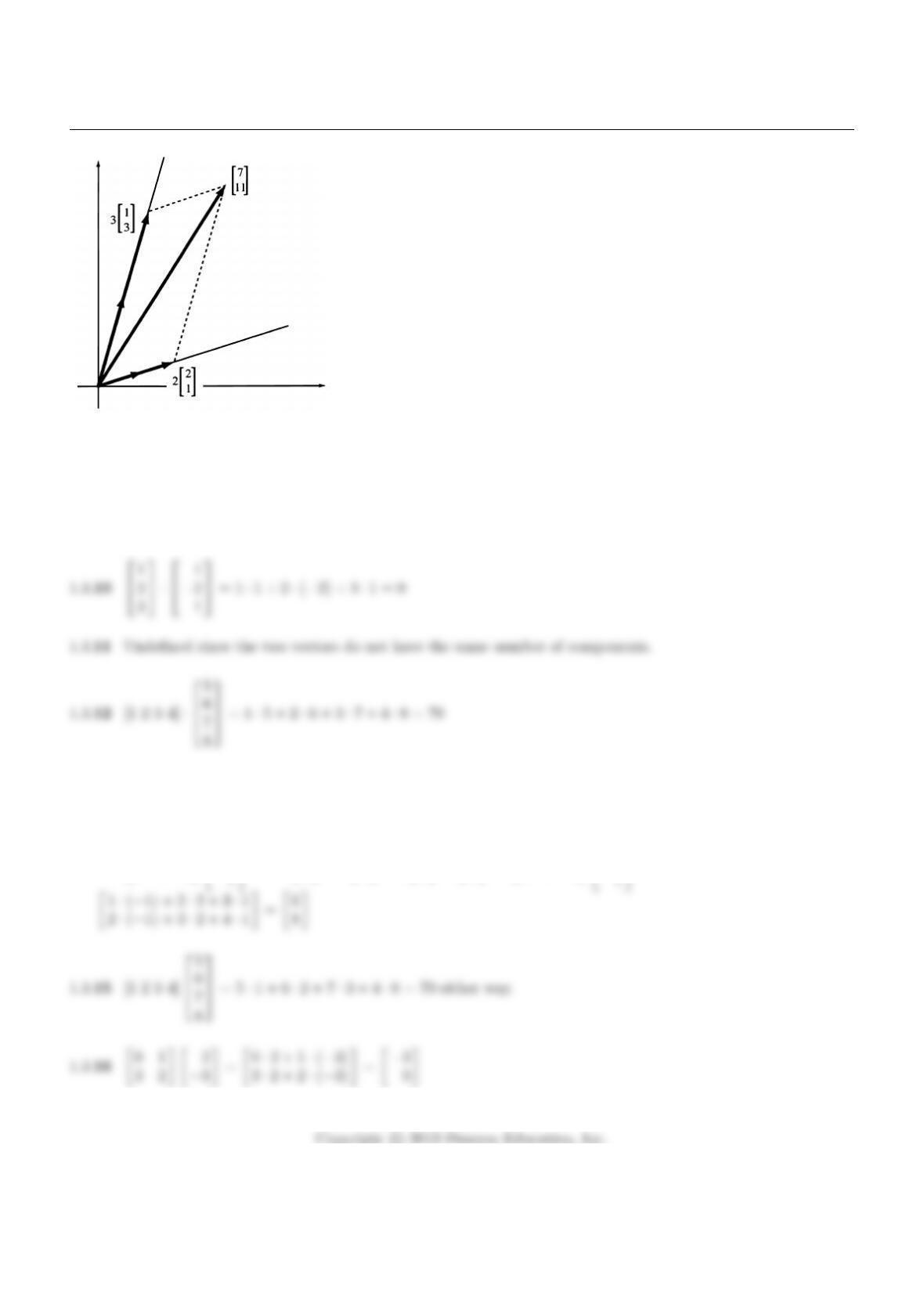
Figure 1.13: for Problem 1.3.5.
1.3.9
1 2 3
4 5 6
7 8 9
x
y
z
=
1
4
9
1.3.13 1 2
3 4 7
11 = 7 1
3+ 11 2
4=29
65 or 1 2
3 4 7
11 =1·7 + 2 ·11
3·7 + 4 ·11 =29
65
1.3.14 1 2 3
2 3 4
−1
2
=−11
2+ 2 2
3+ 1 3
4=6
8or 1 2 3
2 3 4
−1
2
=
36
Section 1.3
1.3.17 Undefined, since the matrix has three columns, but the vector has only two components.
1.3.18
1 2
3 4
5 6
1
2= 1
1
3
5
+ 2
2
4
6
=
5
11
17
b9−9 18
27 36 45
1.3.21
158
70
81
123
1.3.25 In this case, rref(A) has a row of zeros, so that rank(A)<4; there will be a free variable. The system A~x =~c
could have infinitely many solutions (for example, when ~c =~
0) or no solutions (for example, when ~c =~
b), but it
cannot have a unique solution, by Theorem 1.3.4.
37
Chapter 1
1.3.27 By Theorem 1.3.4, rref (A) =
1 0 0 0
0 1 0 0
0 0 1 0
0 0 0 1
.
1.3.29 Ais of the form
a0 0
0b0
0 0 c
and
a0 0
0b0
0 0 c
5
3
−9
=
5a
3b
−9c
=
2
0
1
.
1.3.31 Ais of the form
a b c
0d e
0 0 f
1.3.32 For this problem, we set up the same three equations as in Exercise 30. However, here, we must enforce that
our matrix, A, contains no zero entries. One possible solution to this problem is the matrix
−2−2−2
3 1 2
−1−1−1
.
38
Section 1.3
1.3.34 aA~e1=
a
d
g
, A~e2=
b
e
h
, and A~e3=
c
f
k
.
bB~e1= [~v1~v2~v3]
1
0
0
= 1~v1+ 0~v2+ 0~v3=~v1.
Likewise, B~e2=~v2and B~e3=~v3.
1.3.37 We have to solve the system x1+ 2x2= 2
x3= 1 or x1= 2 −2x2
x3= 1 .
Let x2=t. Then the solutions are of the form
x1
x2
x3
=
2−2t
t
1
, where tis an arbitrary real number.
1.3.38 We will illustrate our reasoning with an example. We generate the “random” 3 ×3 matrix
Chapter 1
Again, it is unlikely that any entries in the second column of the new matrix will be zero. Therefore, we can turn
the second column into
0
1
0
.
Likewise, we will be able to clear up the third column, so that rref(A) =
1 0 0
0 1 0
0 0 1
.
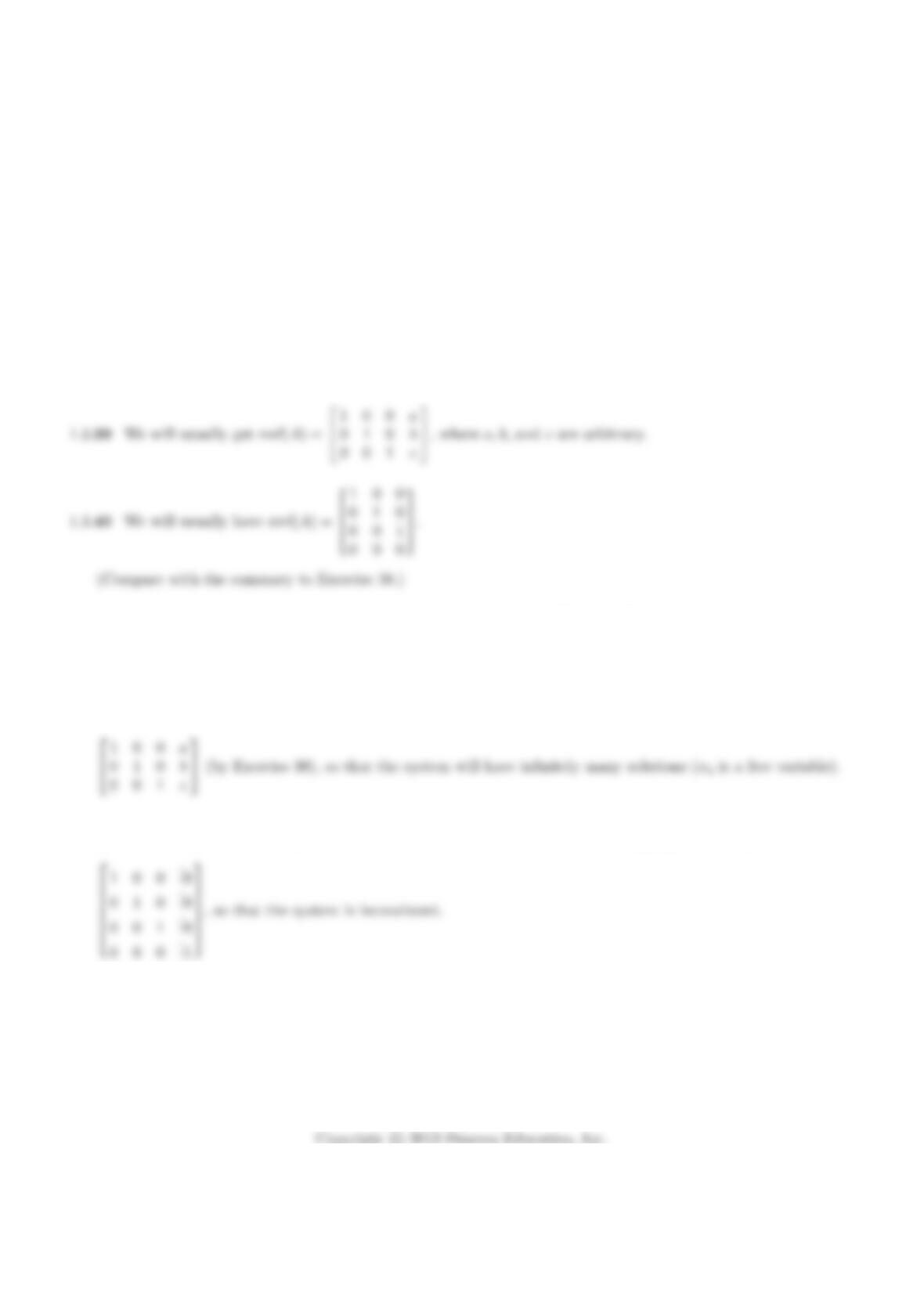
We summarize:
As we apply Gauss-Jordan elimination to a random matrix A(of any size), it is unlikely that we will ever
encounter a zero on the diagonal. Therefore, rref(A) is likely to have all ones along the diagonal.
1.3.41 If A~x =~
bis a “random” system, then rref(A) will usually be
1 0 0
0 1 0
0 0 1
, so that we will have a unique
solution.
1.3.42 If A~x =~
bis a “random” system of three equations with four unknowns, then rref(A) will usually be
1.3.43 If A~x =~
bis a “random” system of equations with three unknowns, then rref[A.
.
.~
b] will usually be
1.3.44 Let E= rref(A),and note that all the entries in the last row of Emust be zero, by the definition of rref.
If ~c is any vector in Rnwhose last component isn’t zero, then the system E~x =~c will be inconsistent. Now
consider the elementary row operations that transform Ainto E, and apply the opposite operations, in reversed
order, to the augmented matrix hE.
.
.~c i.You end up with an augmented matrix hA.
.
.~
bithat represents
an inconsistent system A~x =~
b, as required.
40
Section 1.3
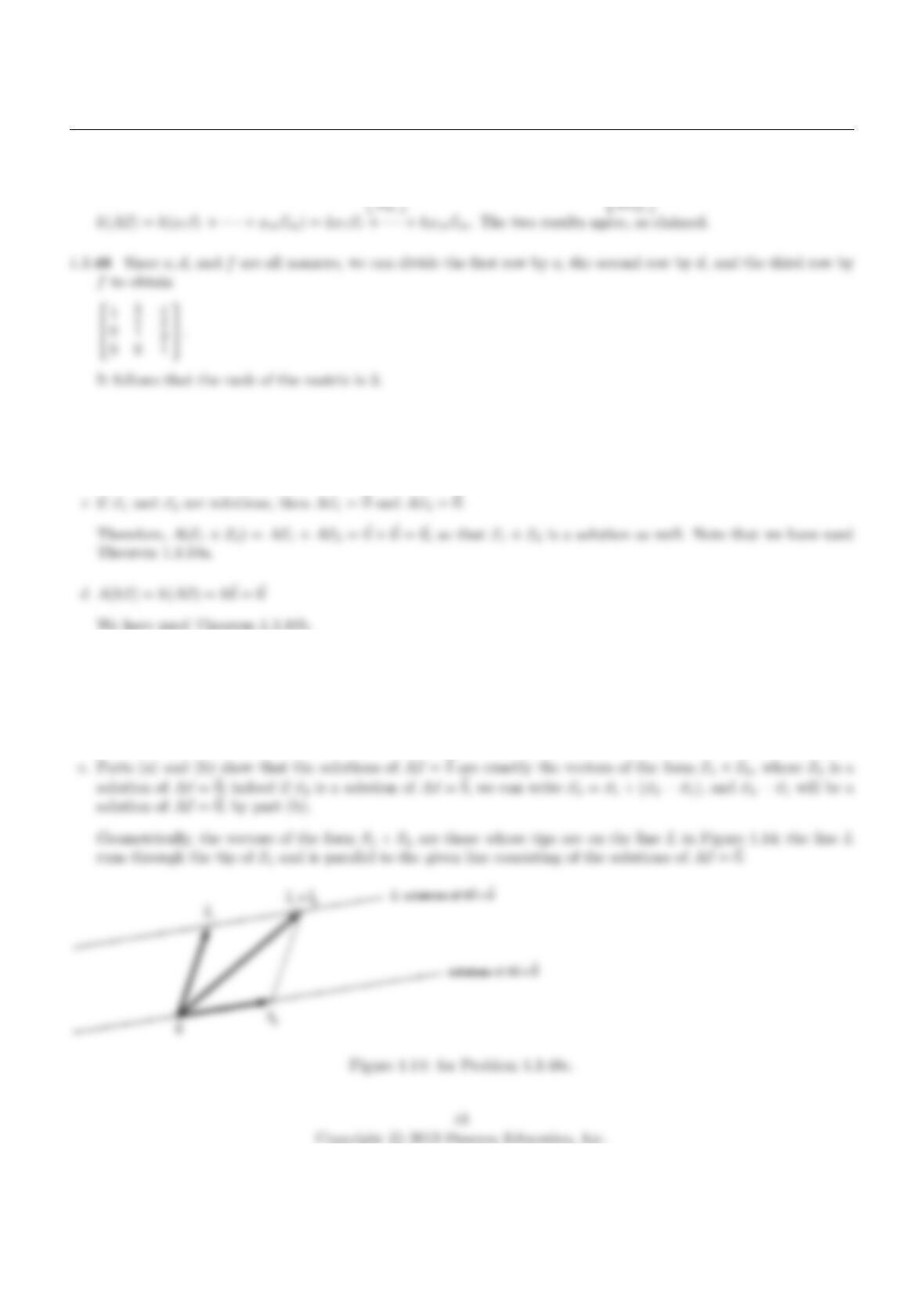
1.3.45 Write A= [~v1~v2. . . ~vm] and ~x =
x1
…
. Then A(k~x) = [~v1. . . ~vm]
kx1
…
=kx1~v1+···+kxm~vmand
1.3.47 a~x =~
0 is a solution.
b This holds by part (a) and Theorem 1.3.3.
1.3.48 The fact that ~x1is a solution of A~x =~
bmeans that A~x1=~
b.
a. A(~x1+~xh) = A~x1+A~xh=~
b+~
0 = ~
b
b. A(~x2−~x1) = A~x2−A~x1=~
b−~
b=~
0
Chapter 1
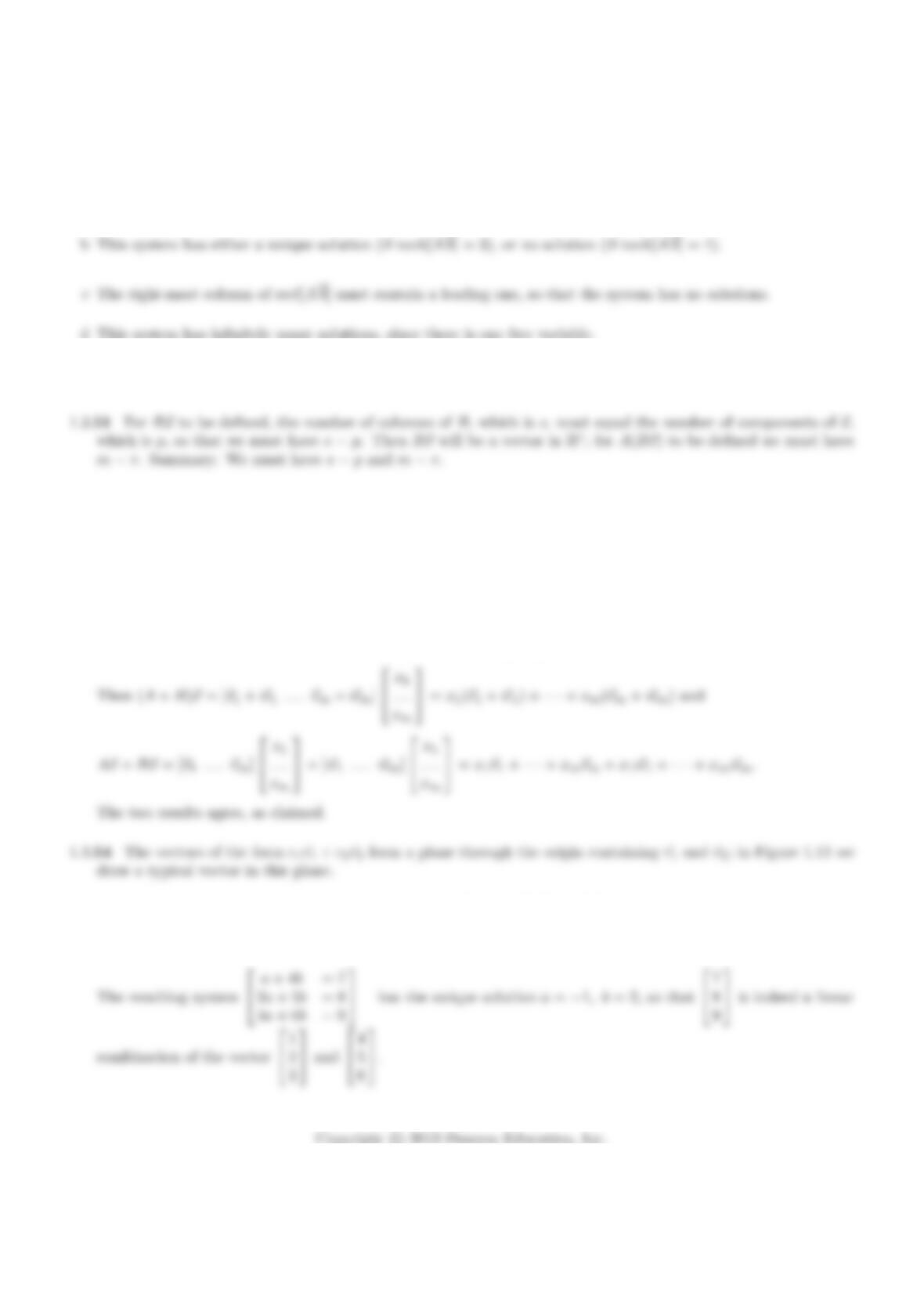
1.3.49 a This system has either infinitely many solutions (if the right-most column of rref[A.
.
.b] does not contain a
leading one), or no solutions (if the right-most column does contain a leading one).
1.3.50 The right-most column of rref[A.
.
.~
b] must contain a leading one, so that the system has no solutions.
1.3.52 A(B~x) = A0−1
1 0 x1
x2=1 0
1 2 −x2
x1=−x2
2x1−x2=0−1
2−1x1
x2,
so that C=0−1
2−1.
1.3.53 Yes; write A= [~v1. . . ~vm], B = [ ~w1. . . ~wm], and ~x =
x1
…
xm
.
1.3.55 We are looking for constants aand bsuch that a
1
2
3
+b
4
5
6
=
7
8
9
.
42
Section 1.3
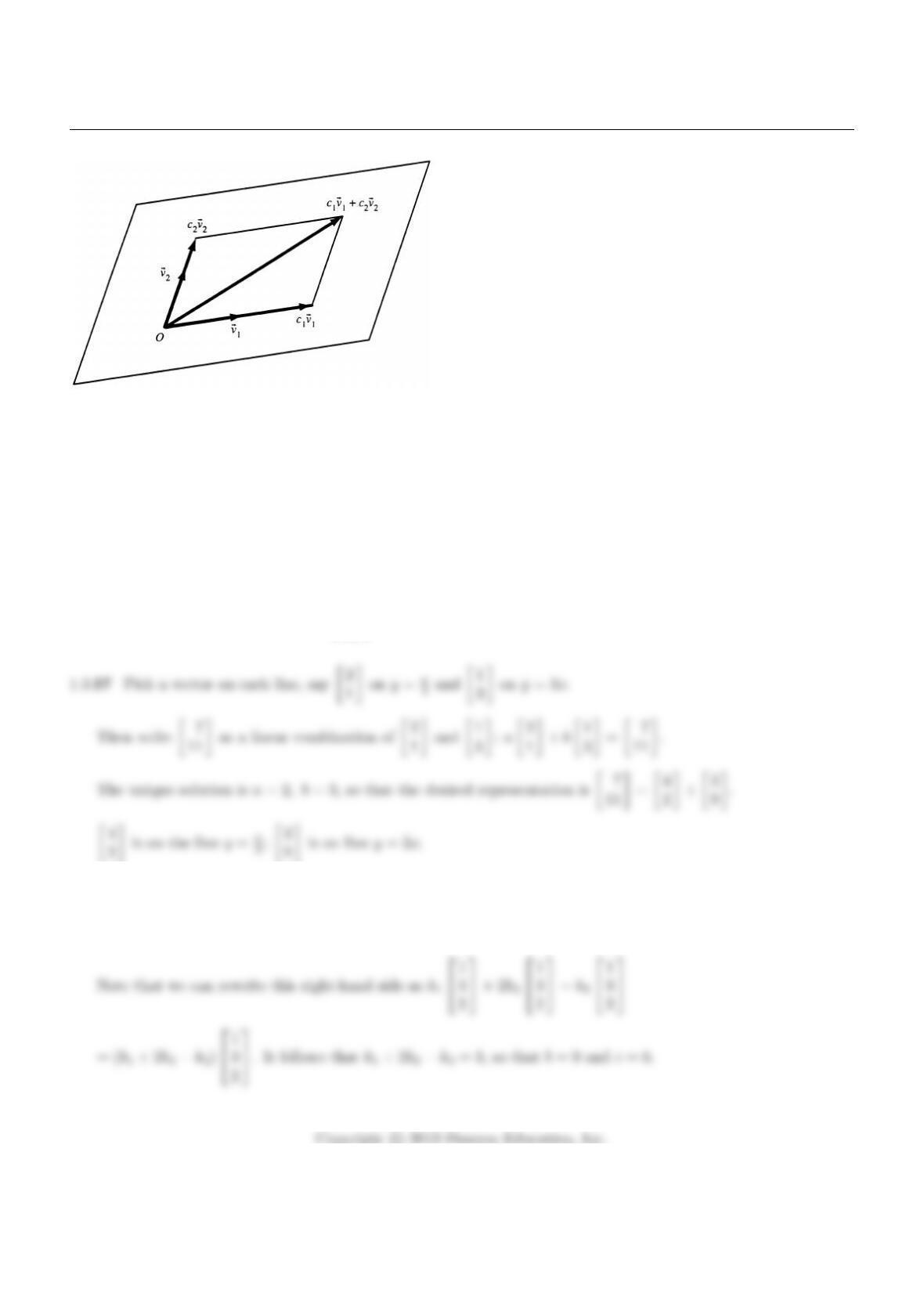
Figure 1.15: for Problem 1.3.54.
1.3.56 We can use technology to determine that the system
30
−1
38
56
62
=x1
1
7
1
9
4
+x2
5
6
3
2
8
+x3
9
2
3
5
2
+x4
−2
−5
4
7
9
is
inconsistent; therefore, the vector
30
−1
38
56
62
fails to be a linear combination of the other four vectors.
1.3.58 We want
3
b
c
=k1
1
3
2
+k2
2
6
4
+k3
−1
−3
−2
,for some k1, k2and k3.
43
Chapter 1
1.3.60 We need
a
b
c
d
=k1
0
0
3
0
+k2
1
0
4
0
+k3
2
0
5
6
=
k2+ 2k3
0
3k1+ 4k2+ 5k3
6k3
. From this we see that a, c and dcan
be any value, while bmust equal zero.
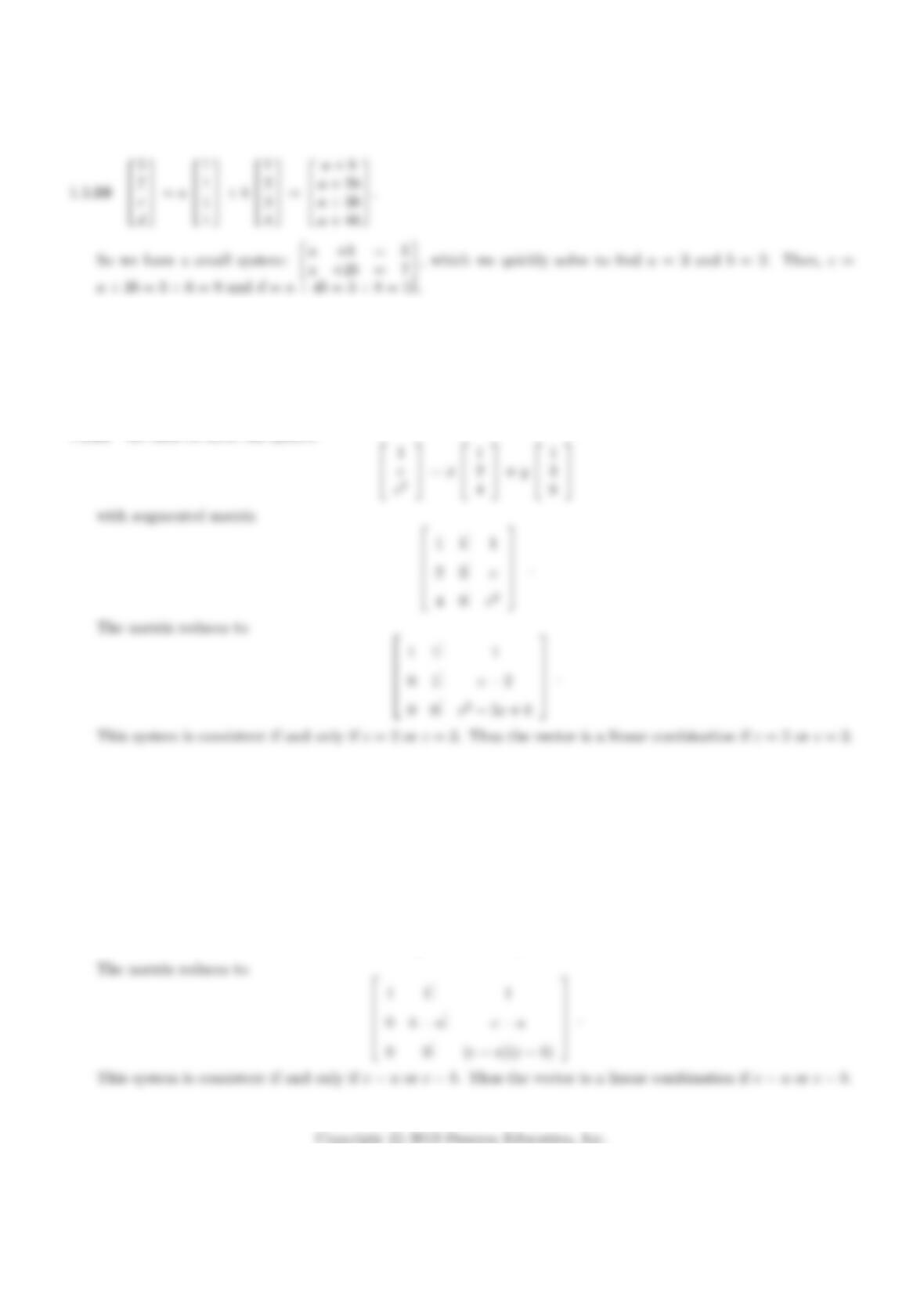
1.3.61 We need to solve the system
1.3.62 We need to solve the system
1
c
c2
=x
1
a
a2
+y
1
b
b2
with augmented matrix
1 1.
.
. 1
a b.
.
.c
a2b2.
.
.c2
.
44
True or False
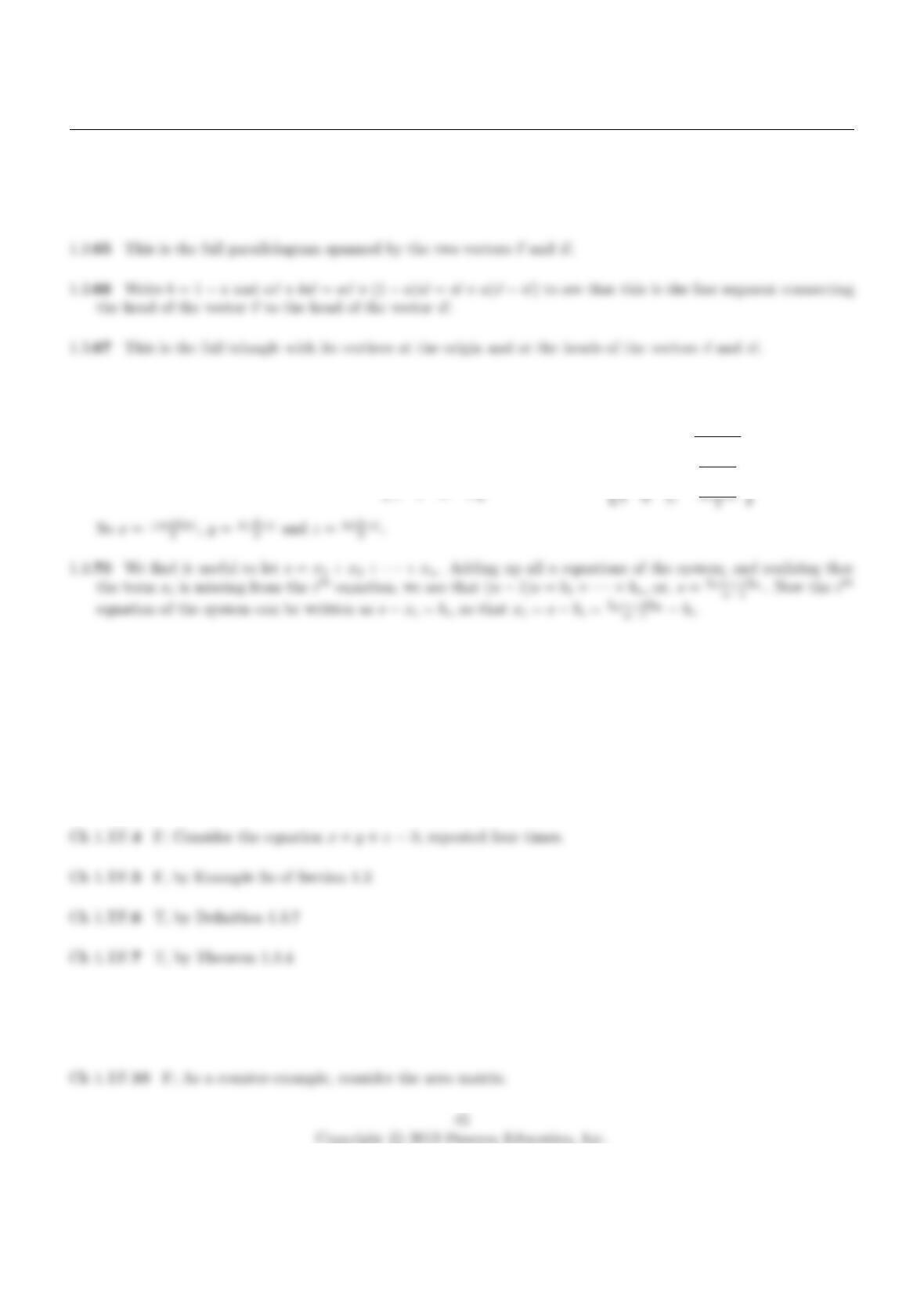
1.3.63 This is the line parallel to ~w which goes through the end point of the vector ~v.
1.3.64 This is the line segment connecting the head of the vector ~v to the head of the vector ~v +~w.
1.3.68 Writing ~u ·~v =~u ·~w as ~u ·(~v −~w) = 0, we see that this is the line perpendicular to the vector ~v −~w.
1.3.69 We write out the augmented matrix:
0 1 1.
.
.a
1 0 1.
.
.b
1 1 0.
.
.c
and reduce it to
1 0 0.
.
.−a+b+c
2
0 1 0.
.
.a−b+c
2
.
.
True or False
Ch 1.TF.1T, by Theorem 1.3.8
Ch 1.TF.2T, by Definition 1.3.9
Ch 1.TF.3T, by Definition.
Ch 1.TF.8F, by Theorem 1.3.1
Ch 1.TF.9F, by Theorem 1.3.4
Chapter 1
Ch 1.TF.11 T; The last component of the left-hand side is zero for all vectors ~x.
Ch 1.TF.15 F; Consider the 4 ×3 matrix Athat contains all zeroes, except for a 1 in the lower left corner.
Ch 1.TF.16 F; Note that A2
2= 2A1
1for all 2 ×2 matrices A.
Ch 1.TF.17 F; The rank is 1.
Ch 1.TF.18 F; The product on the left-hand side has two components.
Ch 1.TF.22 T, by Exercise 1.3.44.
Ch 1.TF.23 F; Find rref to see that the rank is always 2.
Ch 1.TF.24 T; Note that ~v = 1~v + 0 ~w.
Ch 1.TF.25 F; Let ~u =1
0, ~v =2
0, ~w =0
1, for example.
46
True or False
Ch 1.TF.29 F; The system x= 2, y = 3, x +y= 5 has a unique solution.
Ch 1.TF.32 F; If ~
b=~
0,then having a row of zeroes in rref(A) does not force the system to be inconsistent.
Ch 1.TF.33 T; By Example 4d of Section 1.3, the equation A~x =~
0 has the unique solution ~x =~
0. Now note that
A(~v −~w) = ~
0, so that ~v −~w =~
0 and ~v =~w.
Ch 1.TF.34 T; Note that rank(A) = 4, by Theorem 1.3.4
Ch 1.TF.37 F; Let A=B=1 0
0 1 , for example.
47
Chapter 1
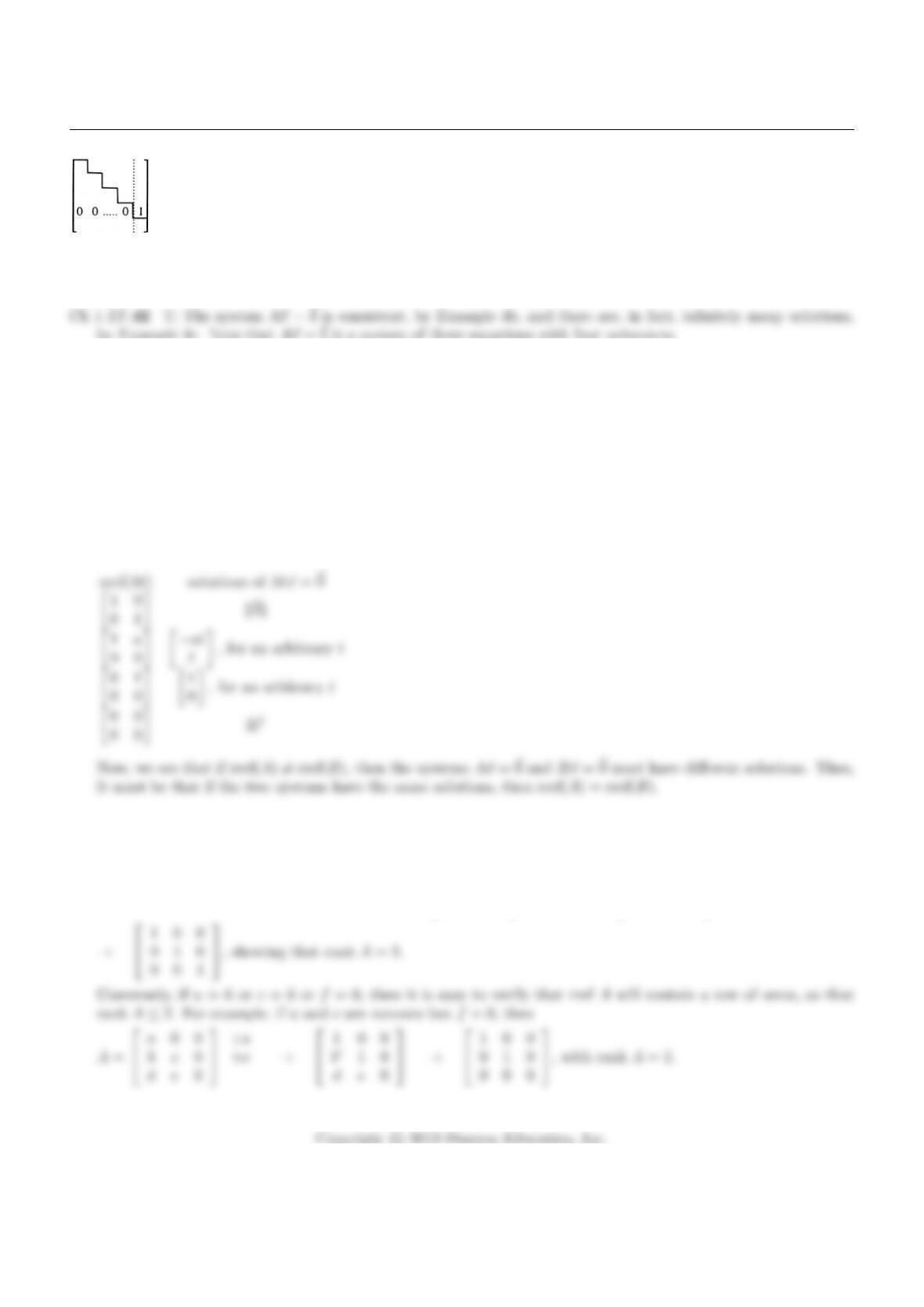
Figure 1.16: for Problem T/F 41.
Ch 1.TF.43 T; Recall that we use rrefA.
.
.~
0to solve the system A~x =~
0. Now, rrefA.
.
.~
0=rref(A).
.
.~
0=
rref(B).
.
.~
0= rref B.
.
.~
0. Then, since rref(A).
.
.~
0=rref(B).
.
.~
0, they must have the same solutions.
Ch 1.TF.44 F; Consider 1 2
0 0 .If we remove the first column, then the remaining matrix fails to be in rref.
Ch 1.TF.45 T; First we list all possible matrices rref(M), where Mis a 2 ×2 matrix, and show the corresponding
solutions for M~x =~
0:
Ch 1.TF.46 T . First note that the product of the diagonal entries is nonzero if (and only if) all three diagonal
entries are nonzero.
If all the diagonal entries are nonzero, then A=
a0 0
b c 0
d e f
÷a
÷c
÷f
→
1 0 0
b′1 0
d′e′1
48
True or False
Ch 1.TF.47 T. If a6= 0, then a b
c d ÷a→1b/a
c d −c(I)→1b/a
0 (ad −bc)/a a/(ad −bc)
→1b/a
0 1 →1 0
0 1 , showing that rank a b
c d = 2.
If a= 0, then band care both nonzero, so that 0b
c d reduces to 1 0
0 1 as claimed.
Ch 1.TF.50 F. Think about constructing a 0-1 matrix Aof size 3 ×3 with rank A= 3 row by row. The rows must
be chosen so that rref Awill not contain a row of zeros, which implies that no two rows of Acan be equal. For
the first row we have 7 = 23−1 choices: anything except [ 0 0 0 ]. For the second row we have six choices
49