Chapter 1
Biochemistry and the Organization of Cells
SUMMARY
Section 1.1
Biochemistry describes the molecular nature of life processes. In living cells,
Section 1.2
Life is based on compounds of carbon. This is the subject matter of organic
chemistry.
The reactions of organic compounds are those of their functional groups, which
are specifically linked atoms that react in similar ways under many different
conditions.
Section 1.3
Our solar system, including the Earth, is postulated to have been formed from
chemical elements produced by first-generation stars. The early Earth had an
Section 1.4
All cells contain DNA and are separated from their environment by a cell
Section 1.5
Prokaryotes have a nuclear region, which contains DNA, and ribosomes, the site
of protein synthesis, as their main features. They have a cell membrane, but do not
have an internal membrane system.
Section 1.6
Three of the most important organelles in eukaryotic cells are the nucleus, the
mitochondrion, and the chloroplast. Each is separated from the rest of the cell by
green algae, are the sites of photosynthesis. Both mitochondria and chloroplasts
contain DNA that differs from that found in the nucleus, and both carry out
transcription and protein synthesis distinct from that directed by the nucleus.
Other organelles play specific roles. They include the Golgi apparatus,
lysosomes, and peroxisomes.
Section 1.7
In the five-kingdom classification scheme, prokaryotes have a kingdom to
themselves (Monera). The remaining four kingdoms – protists, fungi, plants, and
Section 1.8
The sun is the source of energy for all life on Earth. It provides the energy for
photosynthesis, which produces carbohydrates as well as oxygen.
Section 1.9
A spontaneous reaction is one that will take place without outside intervention.
This point does not specify reaction rate. Some spontaneous processes can take
a long time to occur.
Section 1.10
The change in free energy (∆G) that accompanies a reaction determines whether
Section 1.11
Living things are ordered assemblies of molecules. They represent a local
decrease in entropy. Because the entropy of the universe increases in
LECTURE NOTES
As an introduction, this should not take more than one lecture. Students should
be made aware of some unifying themes and background information. Biochemistry is
LECTURE OUTLINE
I. Basic Themes
A. Interconnections among physical sciences
II. Origins of life
A. Big Bang — Elements, comparison of abundances in living organisms vs.
universe at large
B. Origin of biomolecules, abiotic synthesis
2. RNA world and other theories
III. Prokaryotes vs. eukaryotes – structural comparisons
A. Prokaryotes
1. No membrane-bound nuclei, but a nuclear region
2. Ribosomes – protein synthesis
IV. Biological classification systems
A. Five kingdoms
1. Fungi, plants, animals – mostly multicellular, all eukaryotes
2. Protists – mostly unicellular, all eukaryotes
3. Monera – prokaryotes
B. Three domains
1. Archaebacteria
V. Energy Use
A. Sun as ultimate source
B. Thermodynamics, favorability of processes, release of energy
ANSWERS TO PROBLEMS
1.1 Basic Themes
1. A polymer is a very large molecule formed by linking smaller units (monomers)
together. A protein is a polymer formed by linking amino acids together. A nucleic
acid is a polymer formed by linking nucleotides together. Catalysis is the process
1.2 Chemical Foundations of Biochemistry
2. The correct match of functional groups and the compounds containing those
functional groups is given in the following list:
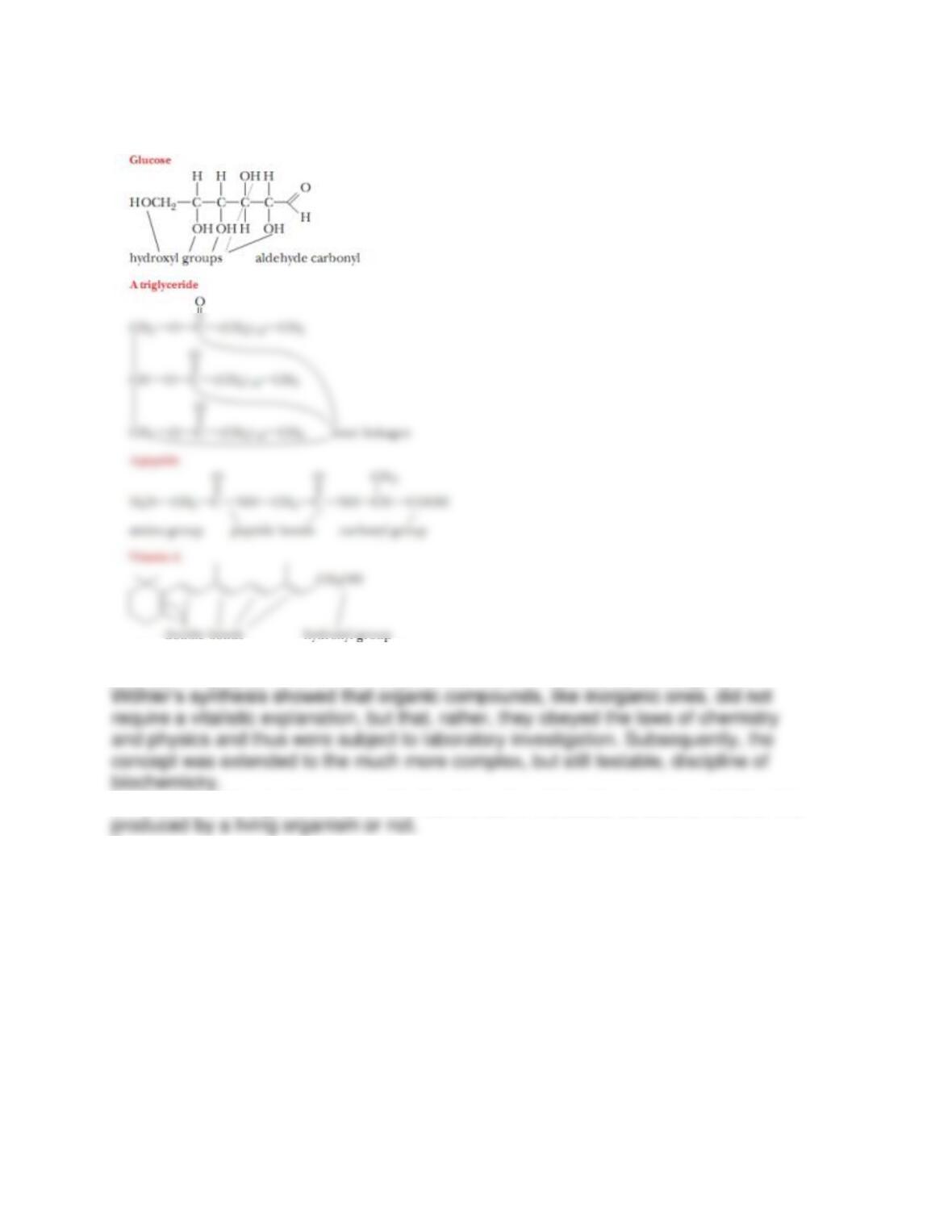
3. The functional groups in the compounds follow:
4. Before 1828, the concept of vitalism held that organic compounds could be made
only by living systems and were beyond the realm of laboratory investigations.
5. Urea, like all organic compounds, has the same molecular structure, whether it is
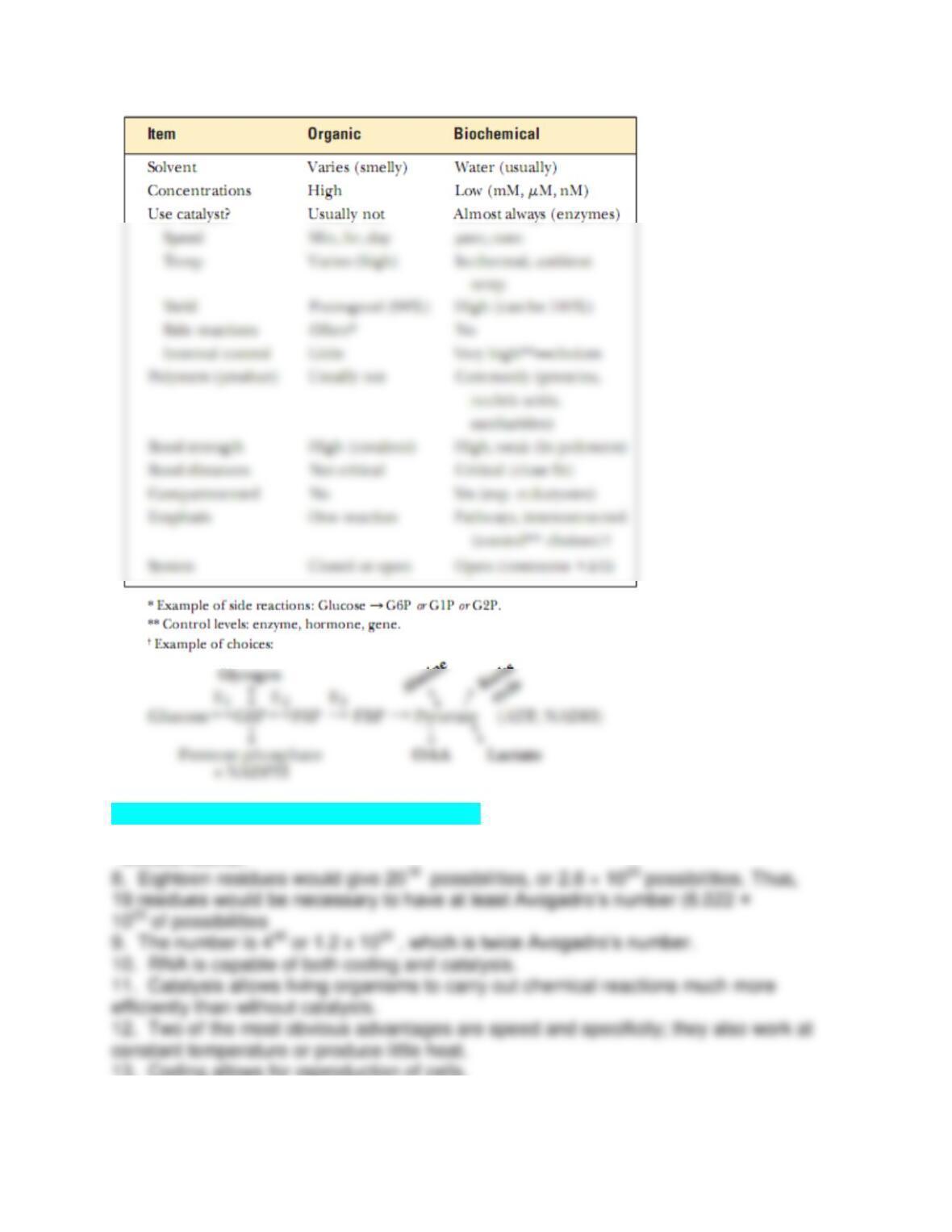
6.
1.3 The Beginnings of Biology: Origin of Life
7. It is generally believed that carbon is the likely basis for all life forms, terrestrial or
extraterrestrial.
13. Coding allows for reproduction of cells.
14. With respect to coding, RNA-type polynucleotides have been produced from
monomers in the absence of either a preexisting RNA to be copied or an enzyme
15. It is unlikely that cells could have arisen as bare cytoplasm without a plasma
1.4 The Biggest Biological Distinction—Prokaryotes and Eukaryotes
16. Five differences between prokaryotes and eukaryotes are as follows: (1)
Prokaryotes do not have a well-defined nucleus, but eukaryotes have a nucleus
17. Protein synthesis takes place on ribosomes both in prokaryotes and in
eukaryotes. In eukaryotes, ribosomes may be bound to the endoplasmic
1.5 Prokaryotic Cells
18. It is unlikely that mitochondria would be found in bacteria. These eukaryotic
1.6 Eukaryotic Cells
19. See Section 1.6 for the functions of the parts of an animal cell, which are shown
in Figure 1.10a.
21. In green plants photosynthesis takes place in the membrane system of
22. Nuclei, mitochondria, and chloroplasts are all enclosed by a double membrane.
23. Nuclei, mitochondria, and chloroplasts all contain DNA. The DNA found in
mitochondria and in chloroplasts differs from that found in the nucleus.
1.7 How We Classify Eukaryotes and Prokaryotes
26. Monera includes bacteria (e.g., E. coli) and cyanobacteria. Protista includes such
organisms as Euglena, Volvox, Amoeba, and Paramecium.
27. The kingdom Monera consists of prokaryotes. Each of the other four kingdoms
28. The five-kingdom classification takes into account the fact that bacteria, fungi, and
protists do not fit the plant/animal divide.
29. The major advantage of being eukaryotic is that of having compartments
30. See the discussion of the endosymbiotic theory in Section 1.7.
31. See Question 30. The division of labor in cells gives rise to greater efficiency and
1.8 Biochemical Energetics
32. Processes that release energy are favored.
1.9 Energy and Change
1.10 Spontaneity in Biochemical Reactions
34. The system consists of the nonpolar solute and water, which become more
disordered when a solution is formed; ∆Ssys is positive but comparatively small.
∆Ssurr is negative and comparatively large because it is a reflection of the
unfavorable enthalpy change for forming the solution (∆Hsys).
35. Processes (a) and (b) are spontaneous, whereas processes (c) and (d) are not.
39. Assuming the value of ∆S is positive, an increase in temperature increases the –
∆G contribution of the entropy component to the overall energy change.
40. The heat exchange, getting colder, reflects only the enthalpy or ∆H component of
1.11 Life and Thermodynamics
42. The lowering of entropy needed to give rise to organelles leads to higher entropy
in the surroundings, thus increasing the entropy of the Universe as a whole.
43. Compartmentalization in organelles brings components of reactions into
46. It would be unlikely that cells of the kind we know would have evolved on a gas
giant. The lack of solids and liquids on which aggregates could form would make
a large difference.
47. The available materials differ from those that would have been found on Earth,
and conditions of temperature and pressure are very different.