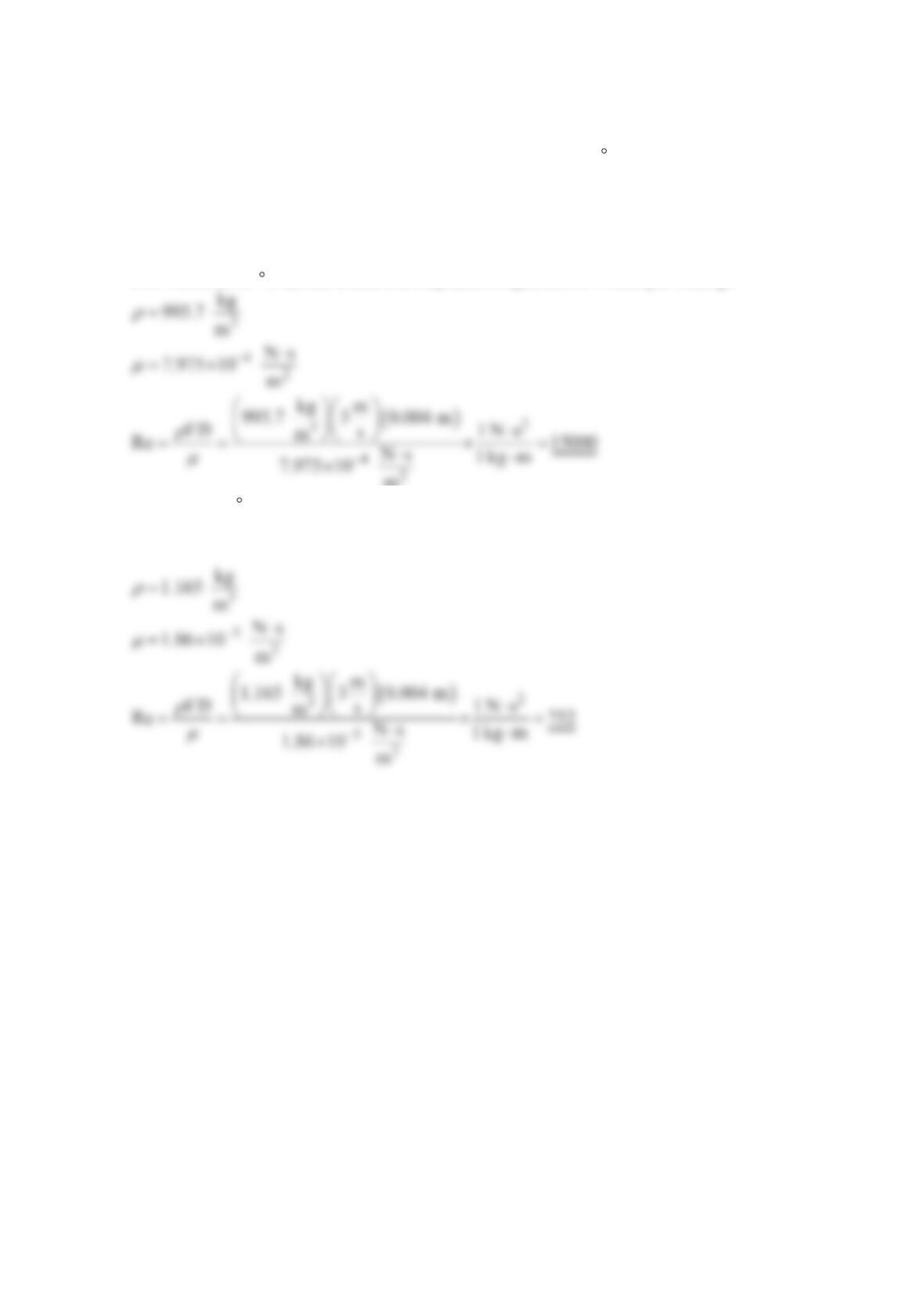
Problem 1.65
Calculate the Reynolds numbers for the flow of water and for air through a 4-mm-diameter
tube, if the mean velocity is 3m/s and the temperature is 30 C in both cases. Assume the
air is at standard atmospheric pressure.
Solution 1.65
For water at
3
0 C (from Table B.2 Physical Properties of Water [SI Units]):
For air at
3
0 C (from the Physical Properties of Air at Standard Atmospheric Pressure
[SI Units]):
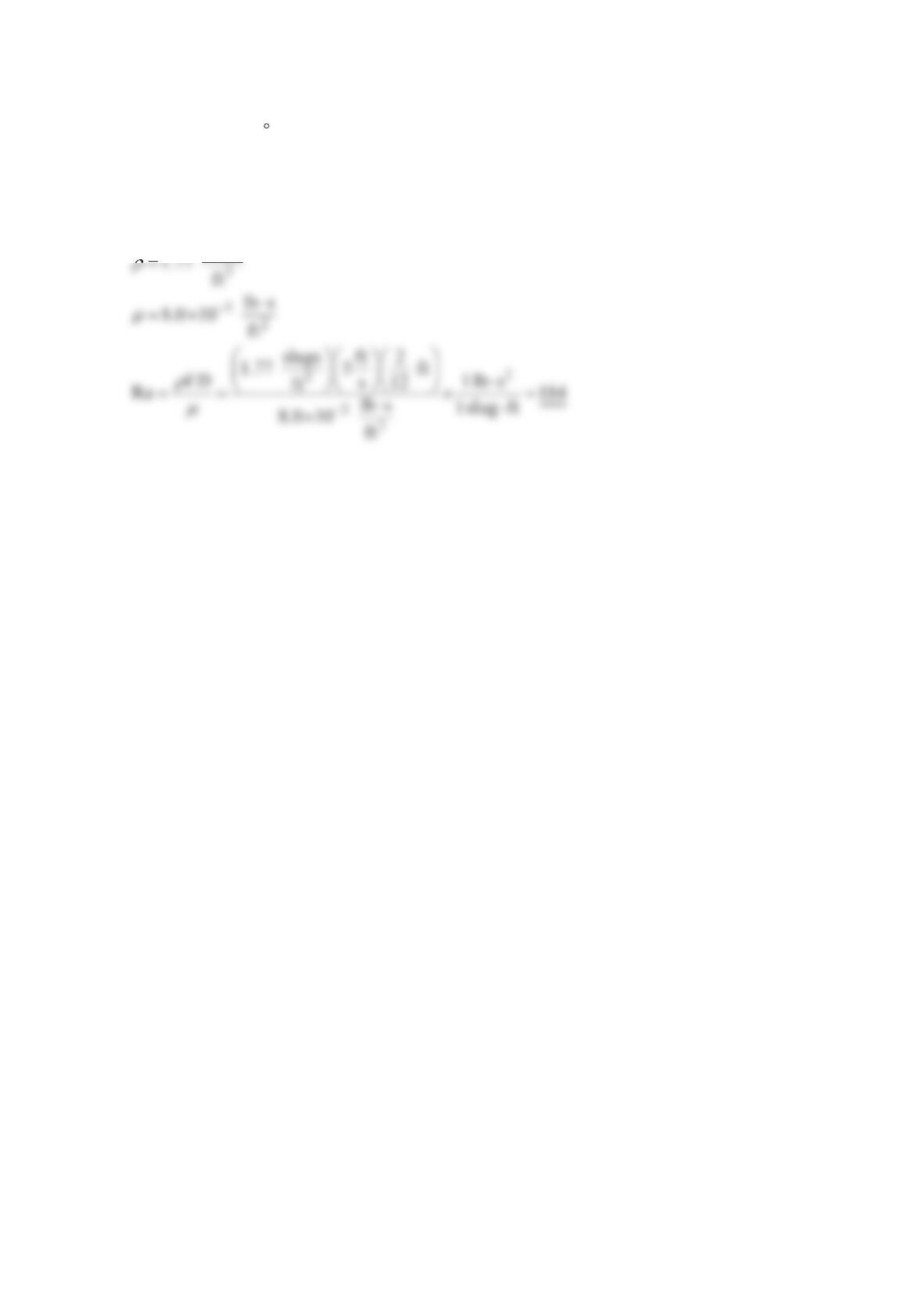
Problem 1.66
SAE 30 oil at 30 F flows through a 2-in.-diameter pipe with a mean velocity of
5
ft/s.
Determine the value of the Reynolds number.
Solution 1.66
slugs
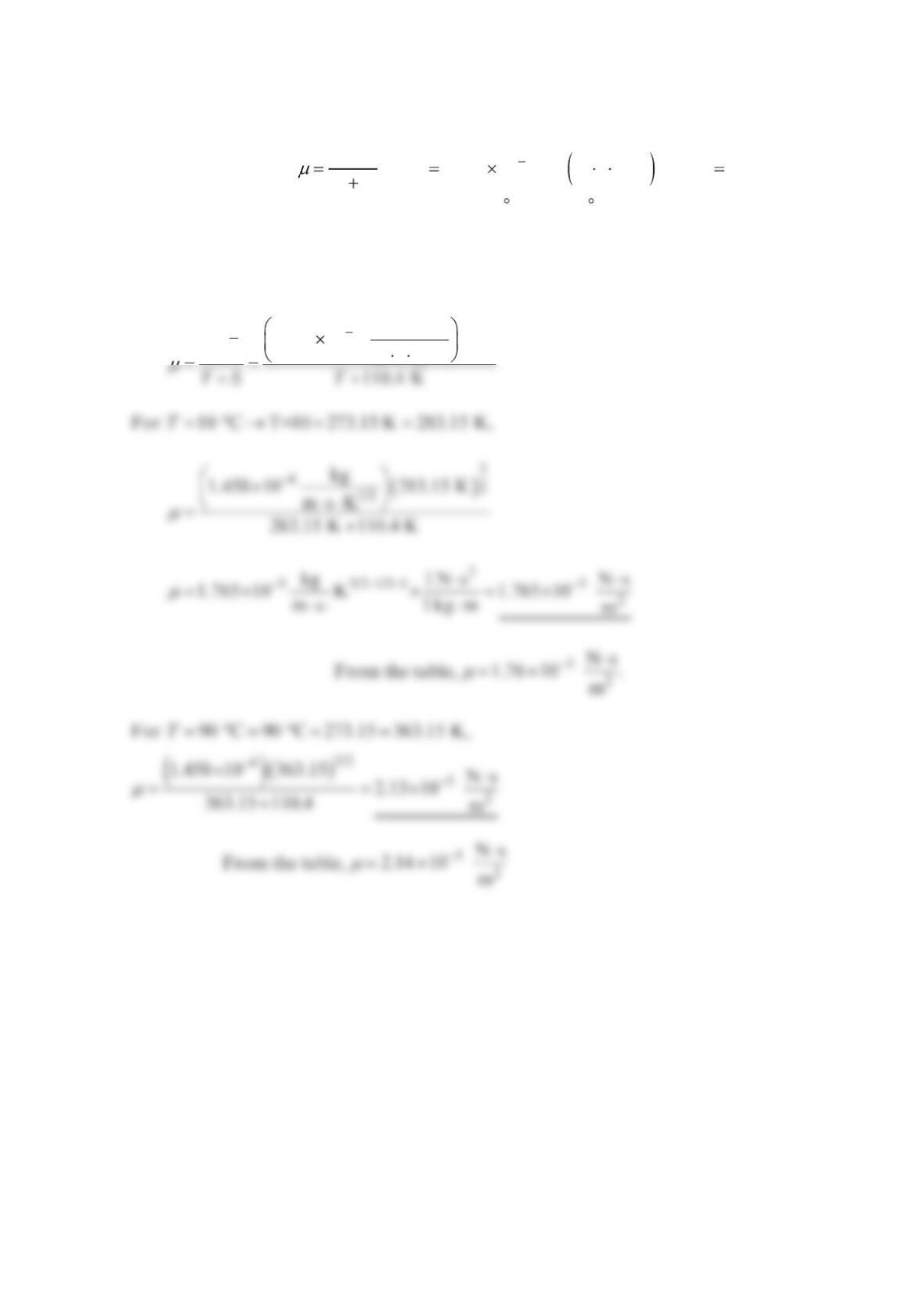
Problem 1.67
For air at standard atmospheric pressure, the values of the constants that appear in the
Sutherland equation
3/2
CT
TS
are 61/2
1.458 10 kg/ m s K and 110.4 K
C
S. Use
these values to predict the viscosity of air at
1
0 C and
9
0 C and compare with values given
in the table Physical Properties of Air at Standard Atmospheric Pressure (SI Units).
Solution 1.67
363/2
1/2
2
kg
1.458 10 msK
T
CT
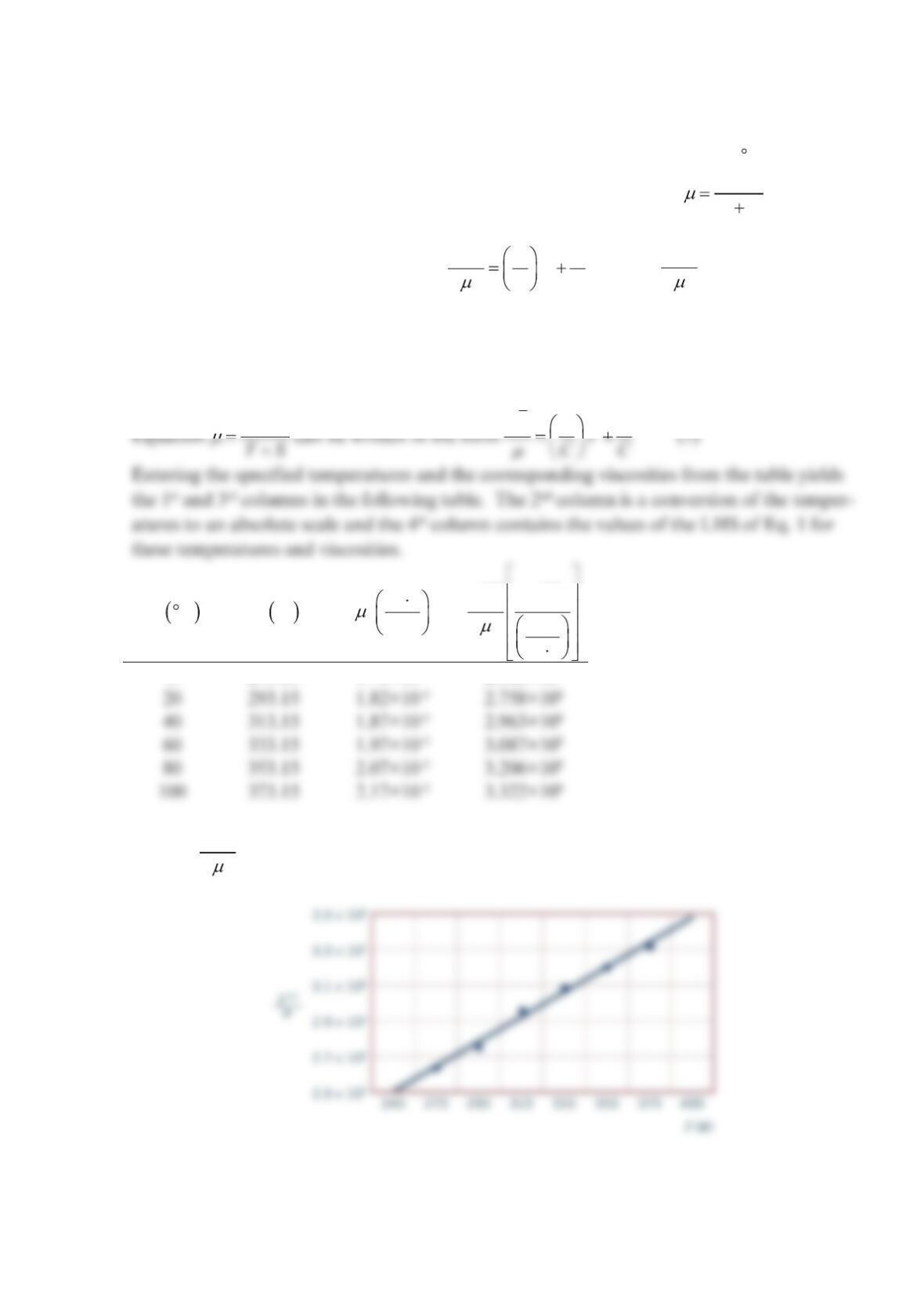
Problem 1.68
Use the values of viscosity of air given in the table of Physical Properties of Air at Standard
Atmospheric Pressure (SI Units) at temperatures of 0, 20, 40, 60, 80, and 100 C to deter–
mine the constants C and S, which appear in the Sutherland equation
3/2
CT
TS
.
Compare your results with the values given in Problem 1.67.
(Hint: Rewrite the equation in the form
3/2 1TS
T
CC
and plot
3/2
T versus
T
. From the
slope and intercept of this curve,
C
and
S
can be obtained.)
Solution 1.68
3/2
CT
3
21 (1)
TS
CT KT2
Ns
m
3/2 3/2
kg
ms
TK
0 273.15 1.71×10⁻⁵ 2.640×10⁸
Plotting
3/2
T versus.
T
yields:
A polynomial of order one, which is a straight line, would be a reasonable fit for the data.
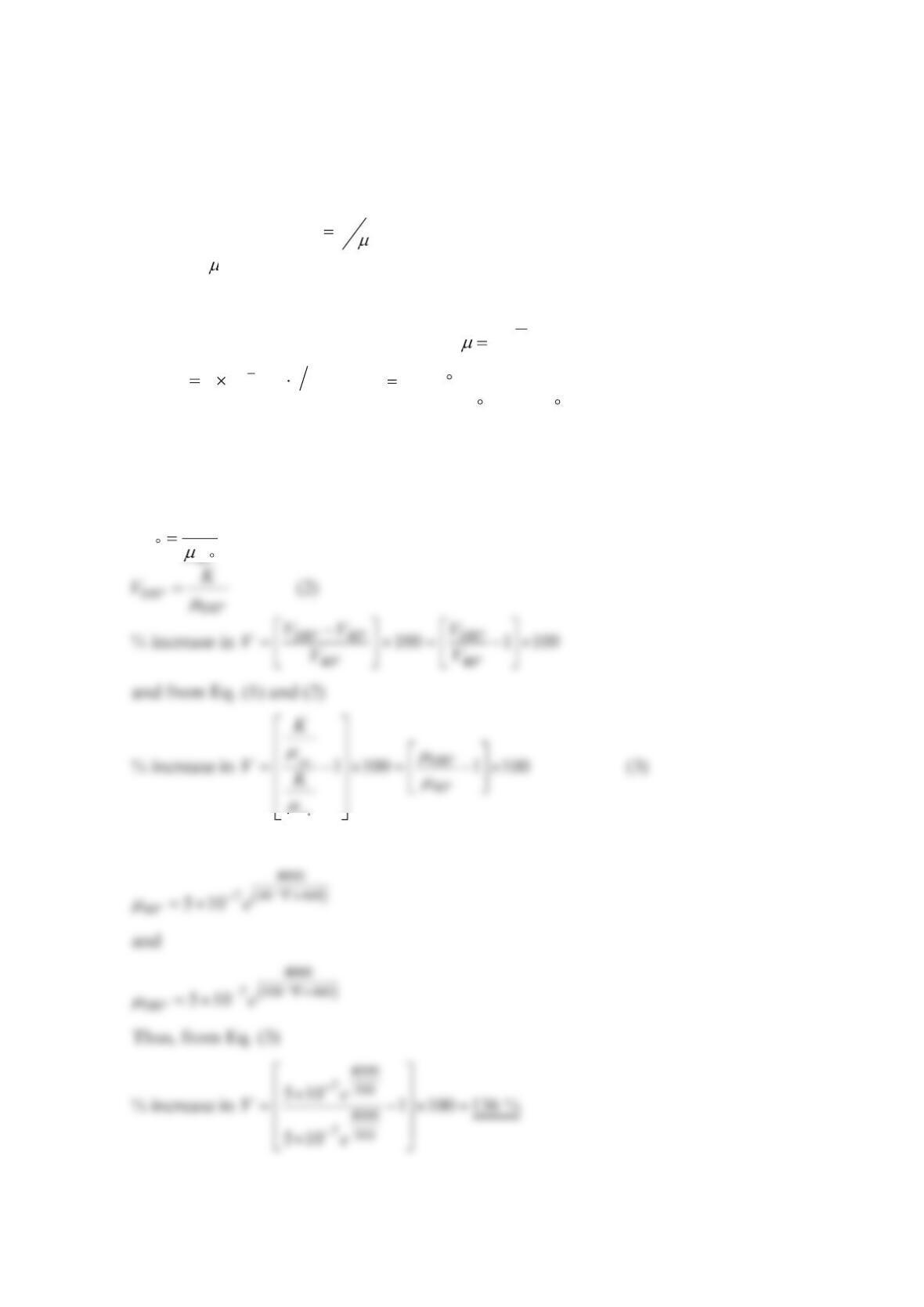
Using Excel to determine the constants for a fit of the data to a straight line given by
y
bx a
where
3/2 1
,,, and .
TS
xT y b a
CC
Problem 1.69
The viscosity of a fluid plays a very important role in determining how a fluid flows. The
value of the viscosity depends not only on the specific fluid but also on the fluid tempera-
ture. Some experiments show that when a liquid, under the action of a constant driving
pressure, is forced with a low velocity,
V
, through a small horizontal tube, the velocity is
given by the equation K
V
. In this equation
K
is a constant for a given tube and pres-
sure, and is the dynamic viscosity. For a particular liquid of interest, the viscosity is given
by Andrade’s equation
B
T
De
with 72
510 lbsft
D
and 4000 R
B. By what percentage will the velocity increase as
the liquid temperature is increased from
4
0 F to
1
00 F? Assume all other factors remain
constant.
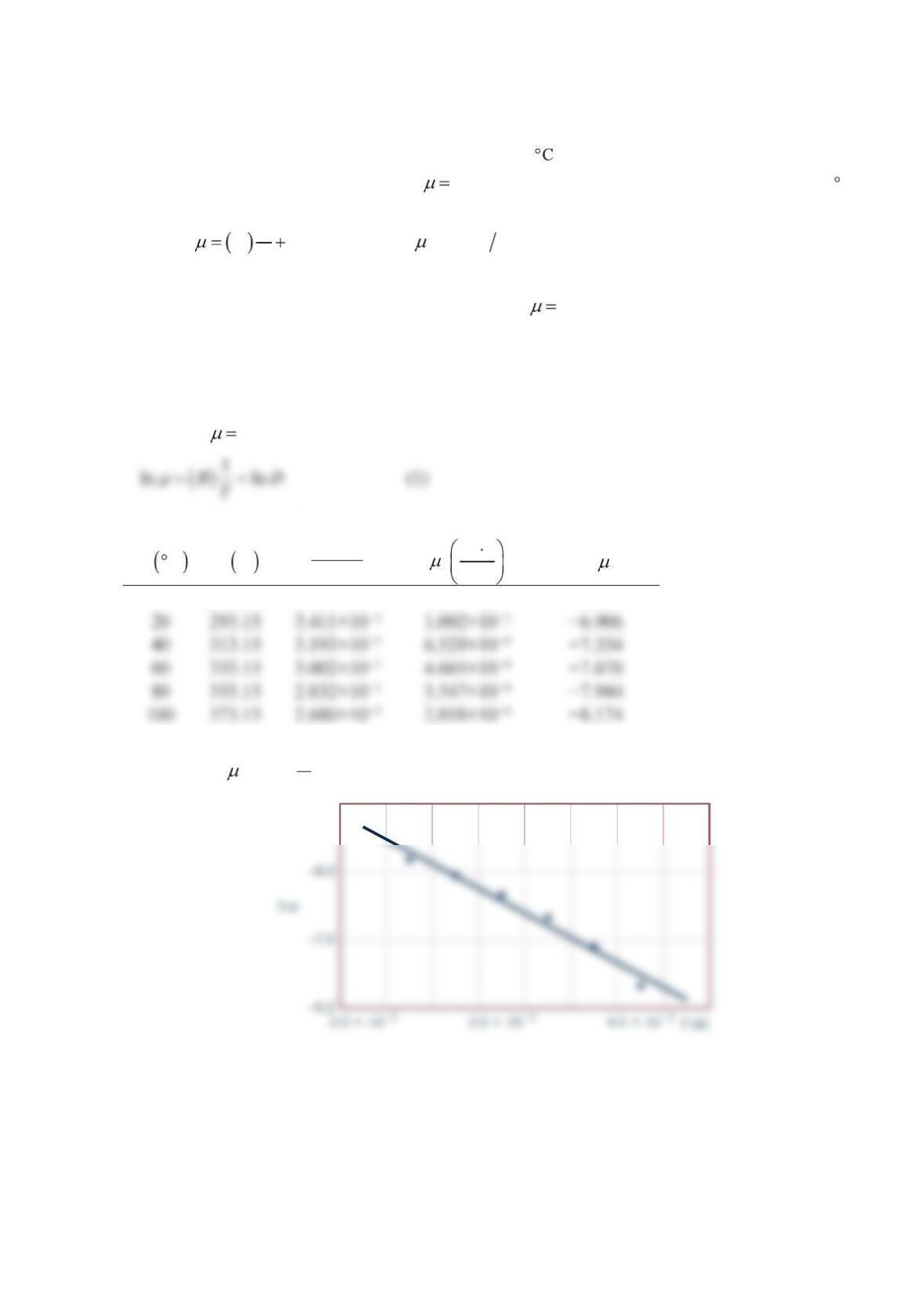
Solution 1.69
40
K
V
(1)
40
From Andrade’s equation
V
Problem 1.70
Use the value of the viscosity of water given in Table B.2 Physical Properties of Water (SI
Units) at temperatures of 0, 20, 40, 60, 80, and 100 to determine the constants
D
and B
which appear in Andrade’s equation
/
BT
De . Calculate the value of the viscosity at
5
0 C
and compare with the value given in the table above. (Hint: Rewrite the equation in the
form BD
T
1
ln ln and plot ln versus
1
T. From the slope and intercept of this curve,
B and
D
can be obtained. If a nonlinear curve-fitting program is available, the constants
can be obtained directly from Andrade’s equation
/
BT
De without rewriting the
equation.)
Solution 1.70
Equation
/
BT
De can be written in the form
and with data from the table in the problem:
CT KT1
(K)T2
Ns
mln
0273.15 3.661×10⁻³ 1.787×10⁻³ −6.327
A plot of ln versus 1
T is shown below:
–9.0
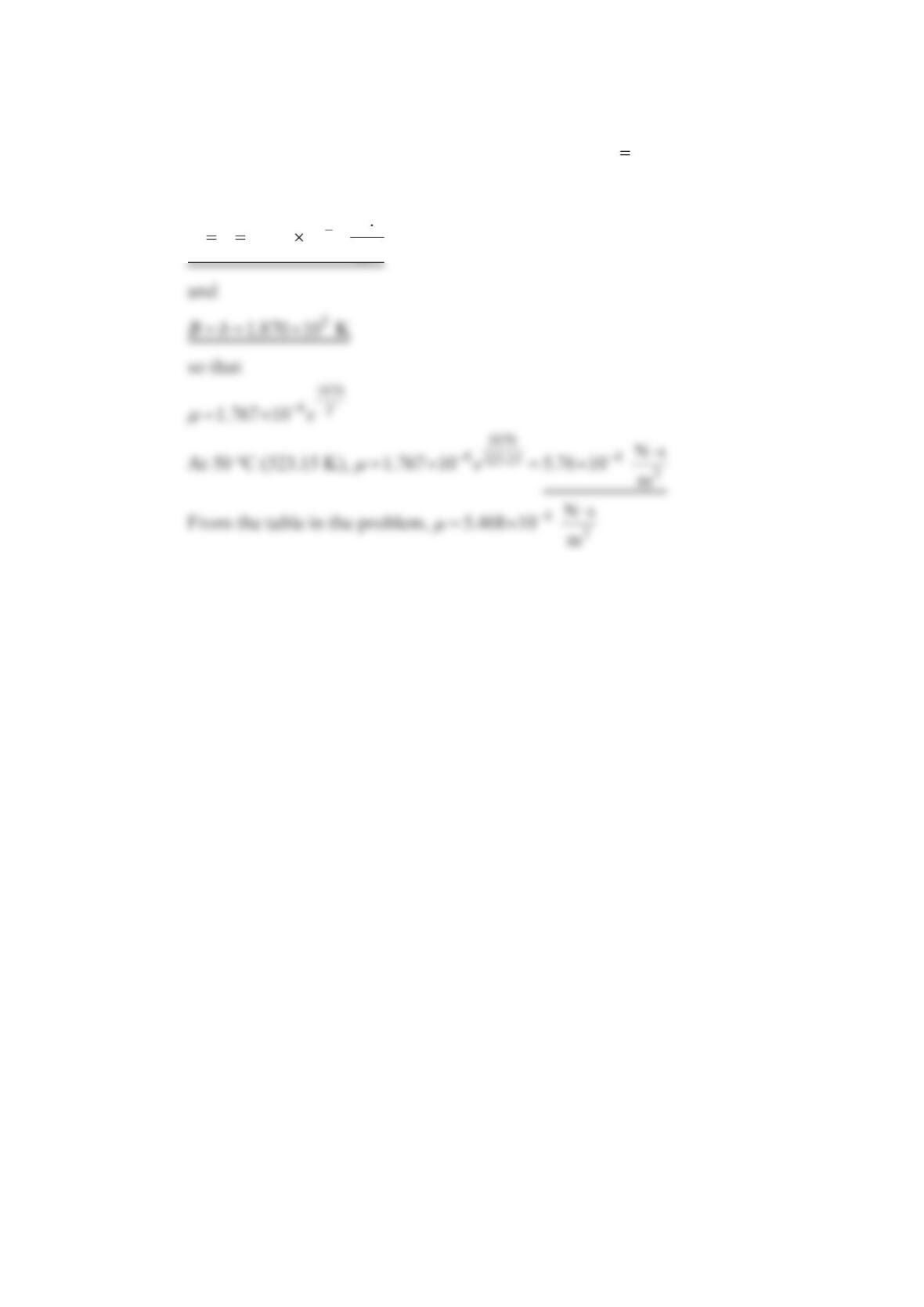
Although there appears to be a slight curvature to the data in the semi-log plot, it also ap-
pears to be reasonably well approximated by a straight line as would be expected for data
that follows a n exponential law. Using an exponential law ( bx
y
ae ) fit in Excel, (which is
the same as fitting a straight-line on a semi-log plot), yields:
6
2
Ns
1.767 10 m
D
a
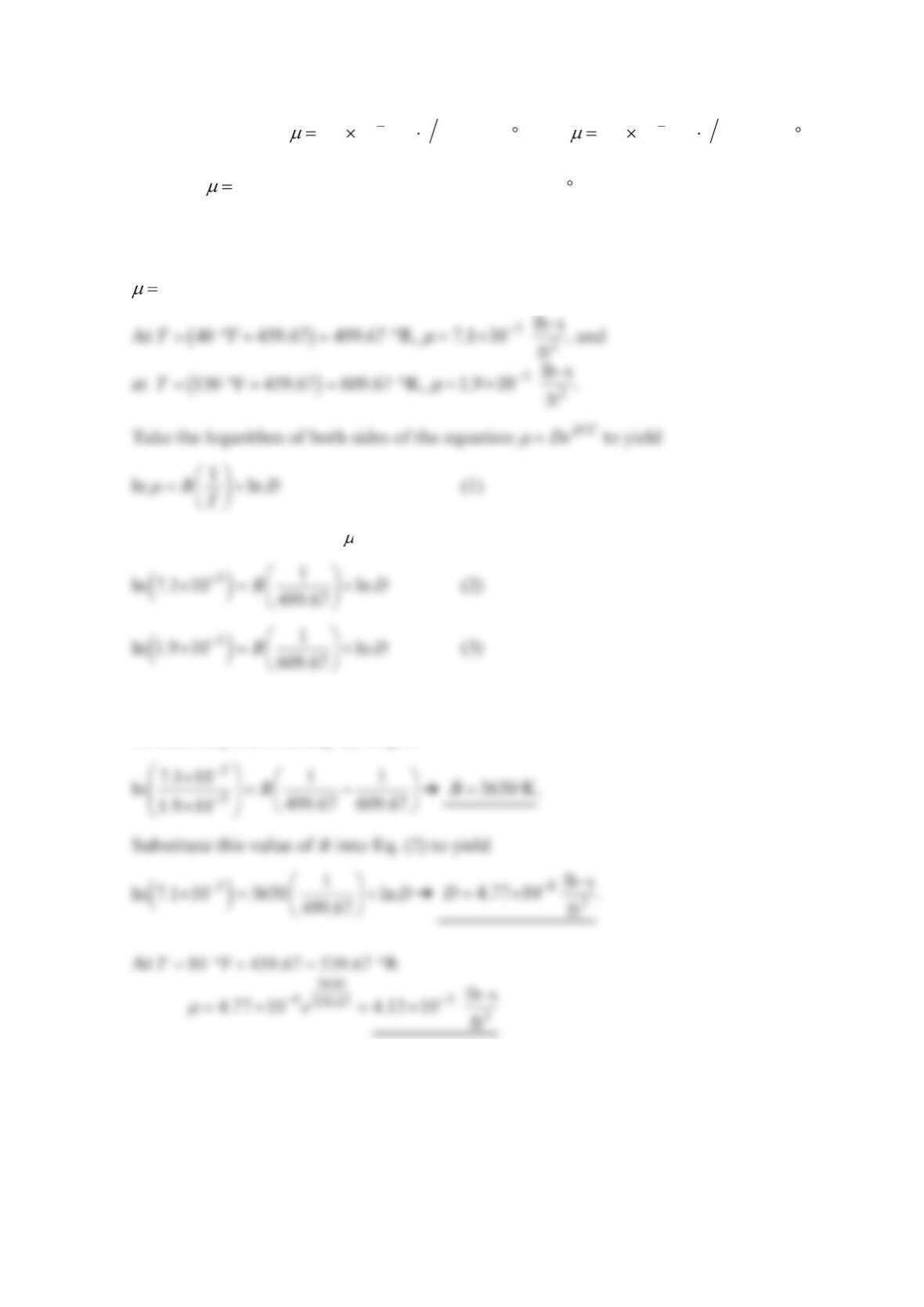
Problem 1.71
For a certain liquid 52
7.1 10 lb s ft at
4
0 F and 52
1.9 10 lb s ft at
1
50 F.
Make use of these data to determine the constants
D
and B, which appear in Andrade’s
equation /
BT
De . What would be the viscosity at
8
0 F?
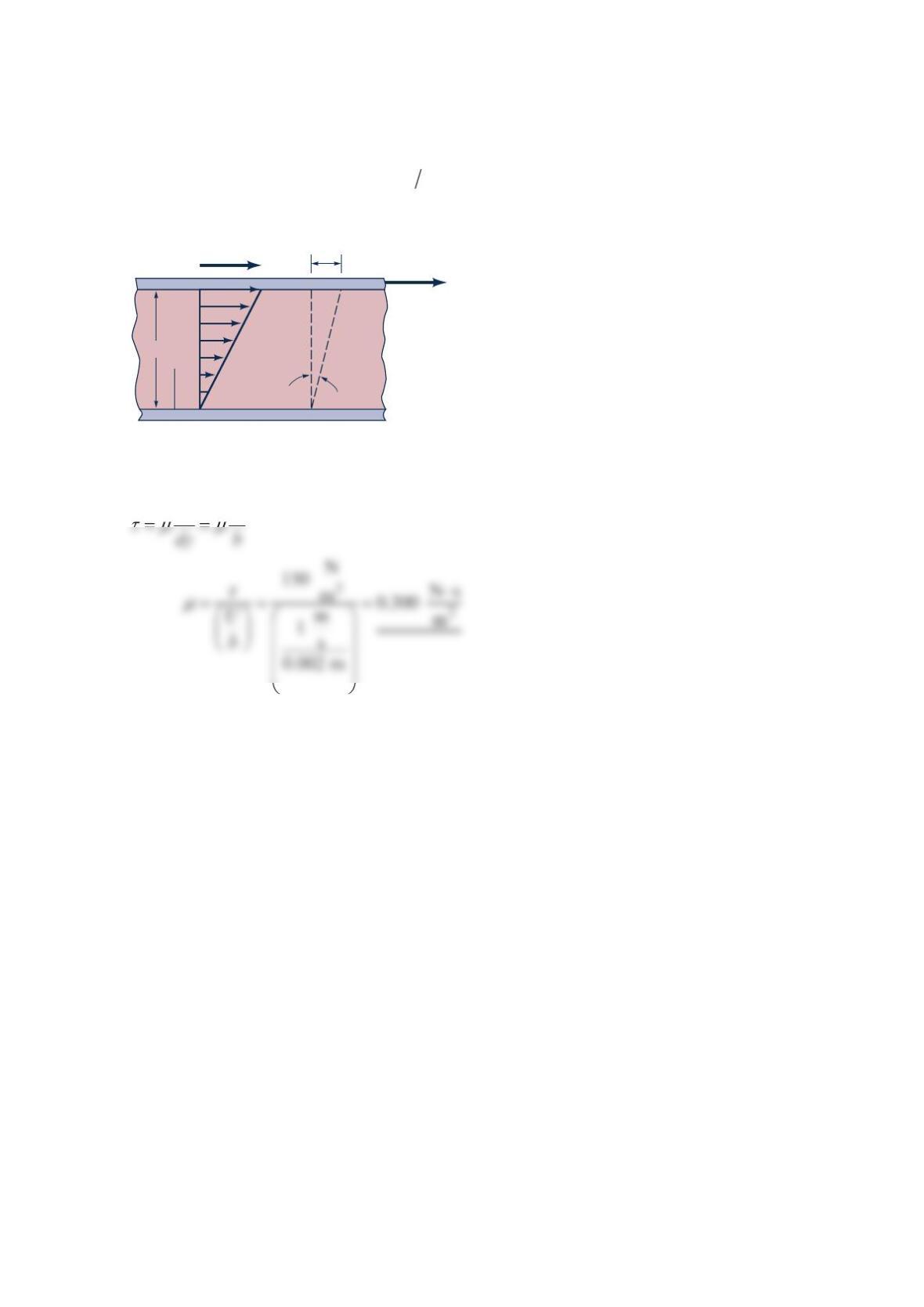
Solution 1.71
/
BT
De
Substitute above values of and
T
into Eq. (1) to give
and solve Eqs. (2) and (3) simultaneously for B and
D
.
Subtract Eq. (3) from Eq. (2) to give
Problem 1.72
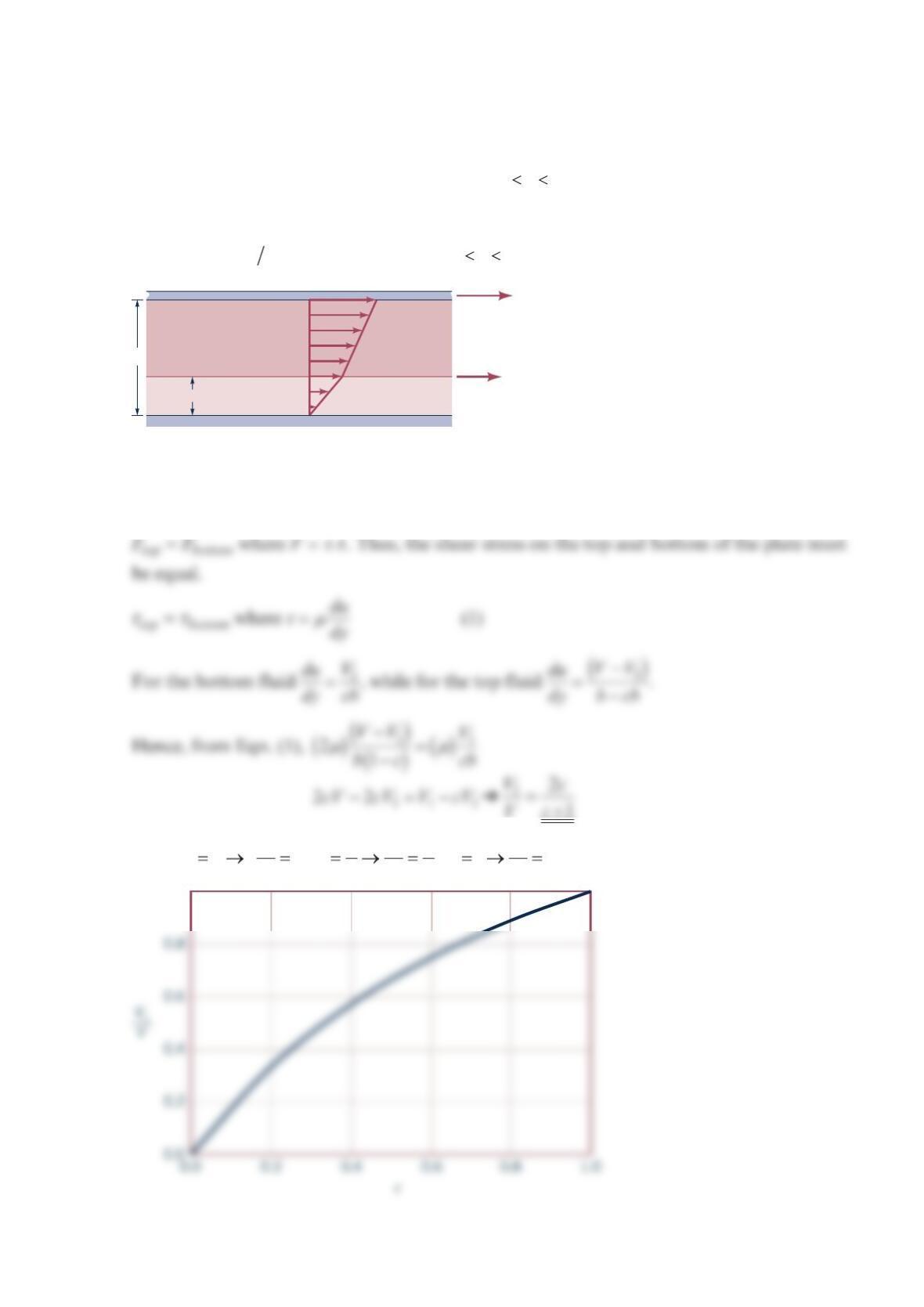
For a parallel plate arrangement of the type shown in the figure below it is found that when
the distance between plates is 2
m
m, a shearing stress of 150
P
a develops at the upper plate
when it is pulled at a velocity of 1
m
s. Determine the viscosity of the fluid between the
plates. Express your answer in SI units.
Solution 1.72
du U
b
U
δβ
B’B
P
u
Fixed plate
y
δ
A
a
Problem 1.73
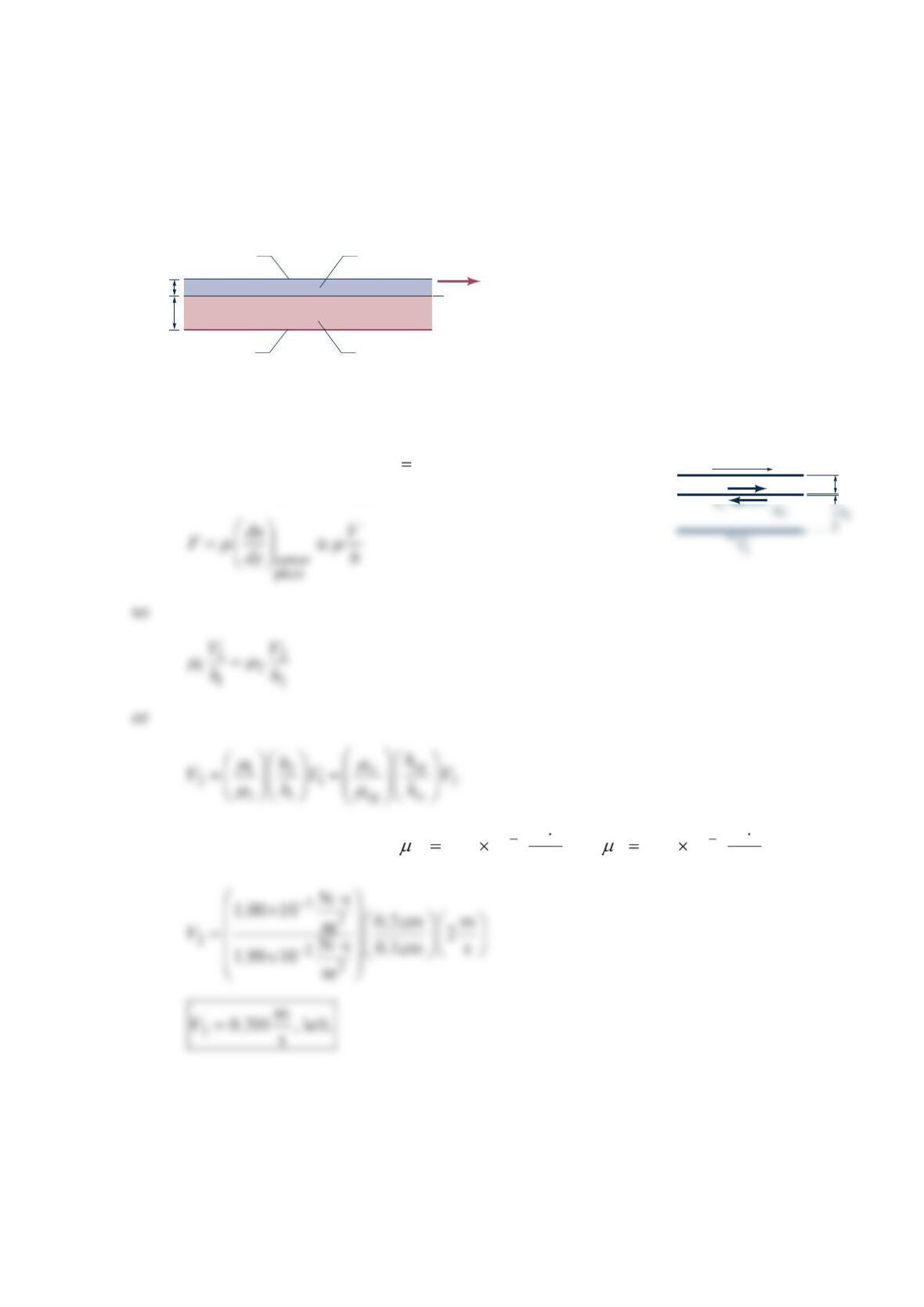
Two flat plates are oriented parallel above a fixed lower plate as shown in the figure below.
The top plate, located a distance
b
above the fixed plate, is pulled along with speed
V
. The
other thin plate is located a distance
c
b, where
0
1c, above the fixed plate. This plate
moves with speed 1
V
, which is determined by the viscous shear forces imposed on it by the
fluids on its top and bottom. The fluid on the top is twice as viscous as that on the bottom.
Plot the ratio 1
V
V as a function of
c
for
0
1c.
Solution 1.73
For constant speed, 1
V
, of the middle plate, the net force on the plate is 0, Hence,
Note: 1
0 0
V
cV, 1
12
23
V
cV, 1
1
1
V
cV
b
cb
2
μ
μ
V
V
1
1.0
h1
F1
V1
1
μ
Problem 1.74
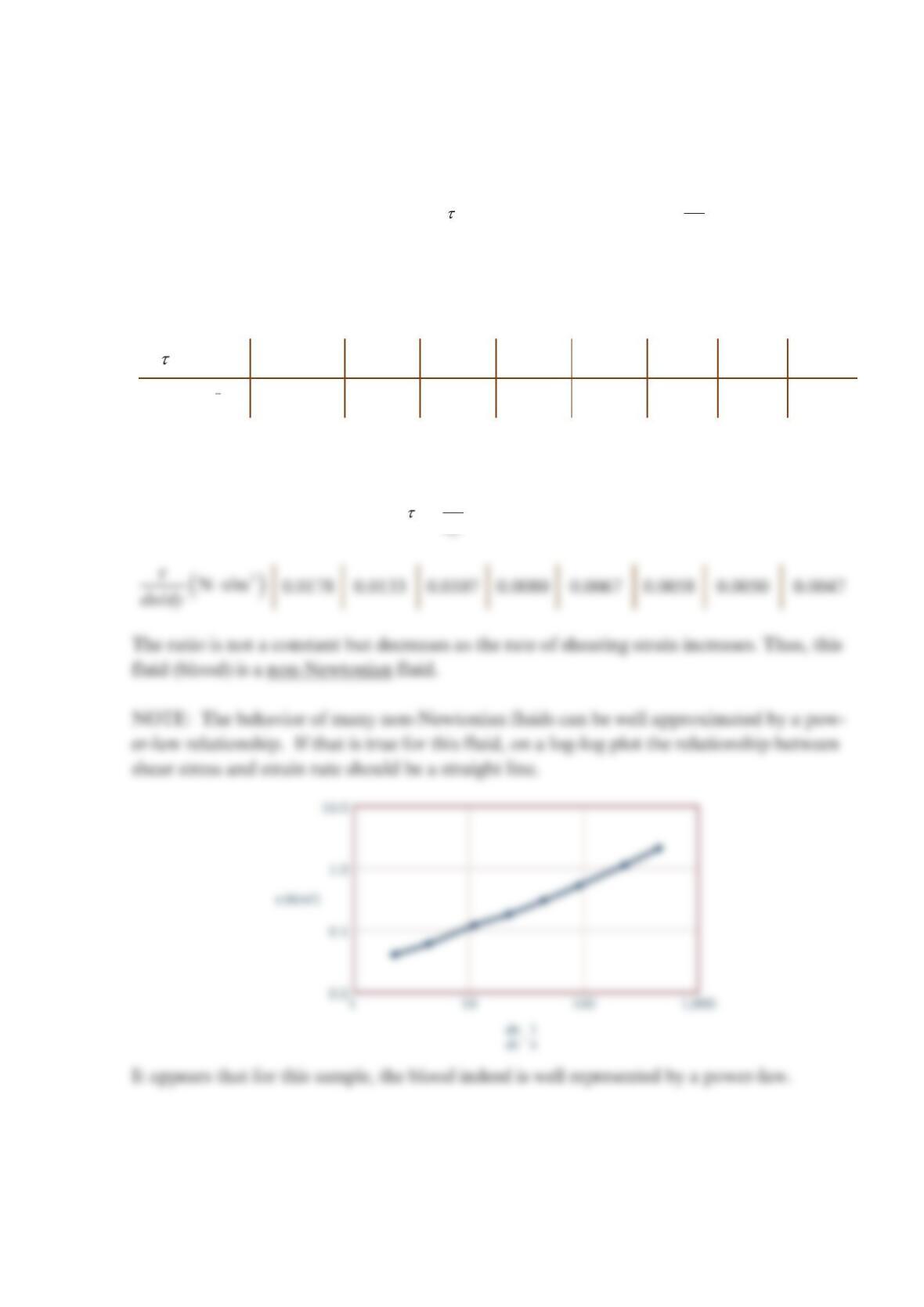
Three large plates are separated by thin layers of ethylene glycol and water, as shown in the
figure below. The top plate moves to the right at
2
m/s. At what speed and in what direction
must the bottom plate be moved to hold the center plate stationary?
Solution 1.74
The center plate is stationary if 12
F
F (see image). Assuming
Newtonian fluids and thin layers,
From the liquid properties table: 2
2
Ns
1.99 10 m
eg and 3
2
Ns
1.00 10 m
w.
Copper plate
Steel plate Ethylene glycol (20°C)
Water (20°C)
Plastic
plate
2 m/s
0.1 cm
0.2 cm
Problem 1.75
There are many fluids that exhibit non-Newtonian behavior. For a given fluid, the distinc-
tion between Newtonian and non-Newtonian behavior is usually based on measurements of
shear stress and rate of shearing strain. Assume that the viscosity of blood is to be deter-
mined by measurements of shear stress, , and rate of shearing strain, du
dy , obtained from a
small blood sample tested in a suitable viscometer. Based on the data given below, deter-
mine if the blood is a Newtonian or non-Newtonian fluid. Explain how you arrived at your
answer.
2
(N/m ) 0.04 0.06 0.12 0.18 0.30 0.52 1.12 2.10
1
/(s)
d
udy 2.25 4.50 11.25 22.5 45.0 90.0 225 450
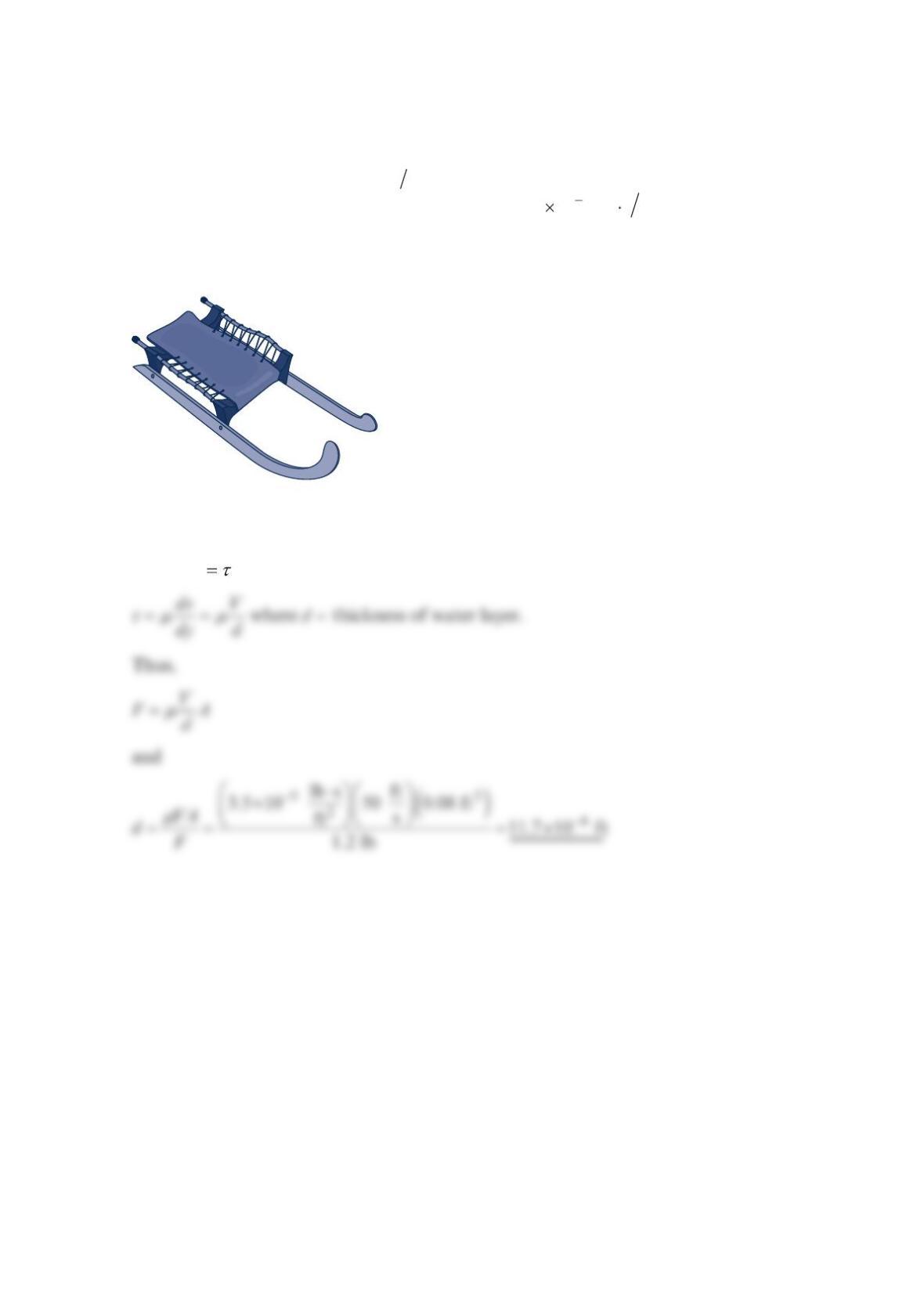
Solution 1.75
For a Newtonian fluid the ratio of to du
dy is a constant. For the data given:
Problem 1.76
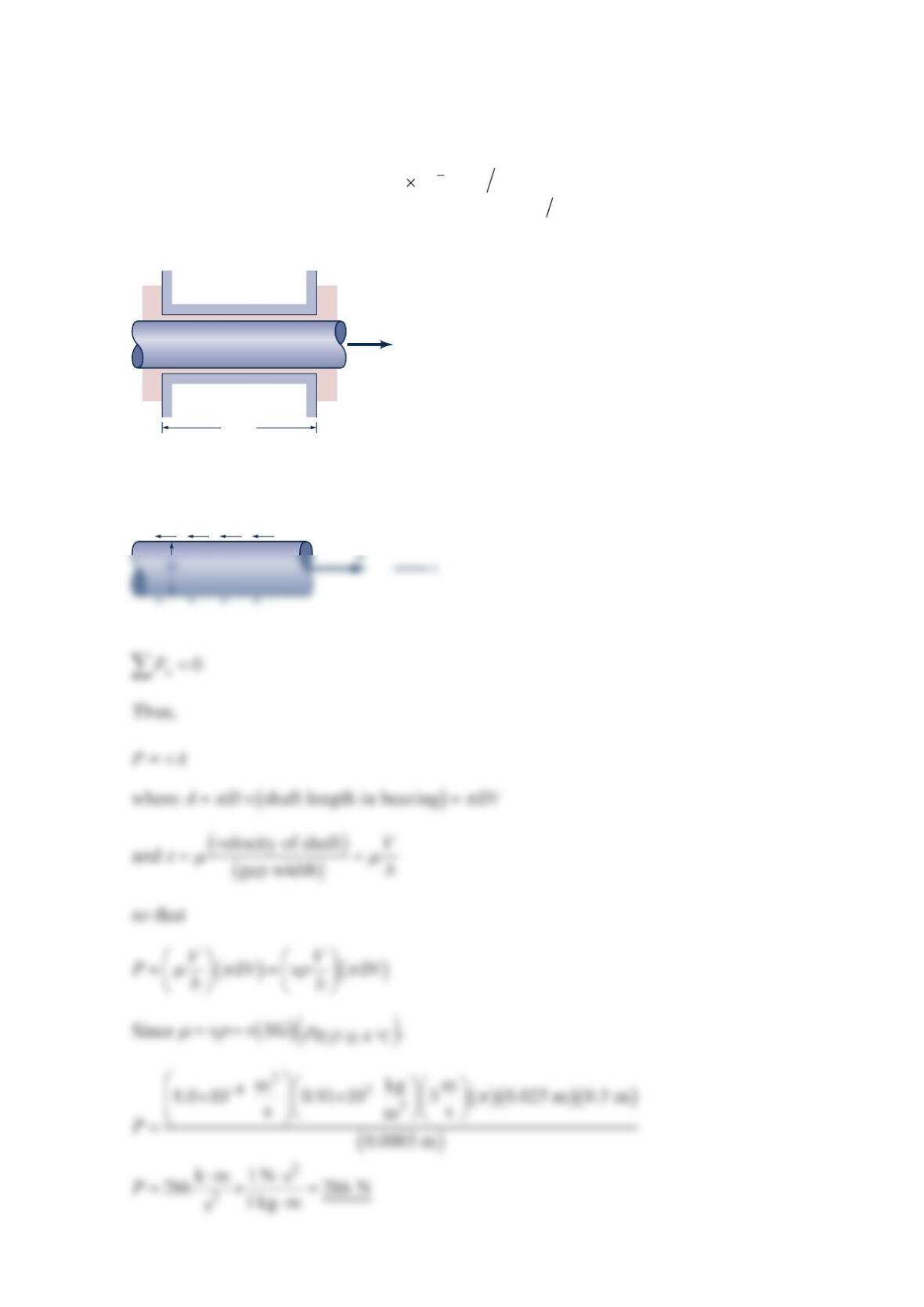
The sled shown in the figure below slides along on a thin horizontal layer of water between
the ice and the runners. The horizontal force that the water puts on the runners is equal to
1
.2 l
b
when the sled’s speed is
5
0ft s
. The total area of both runners in contact with the
water is 2
0.08 ft , and the viscosity of the water is 52
3
.5 10 lb s ft . Determine the thick-
ness of the water layer under the runners. Assume a linear velocity distribution in the water
layer.
Solution 1.76
(force)
F
A
Problem 1.77
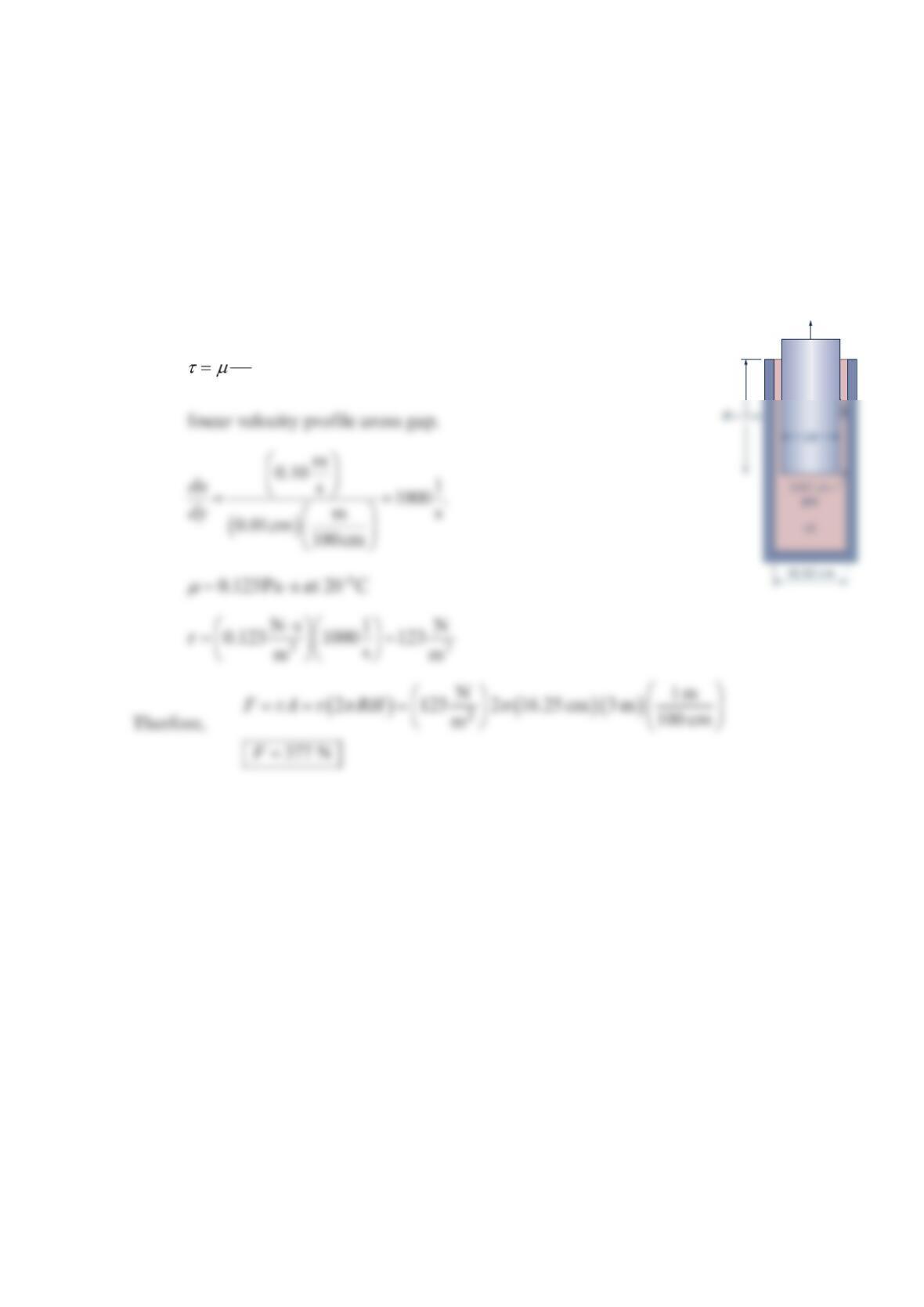
A 25-mm-diameter shaft is pulled through a cylindrical bearing as shown in the figure
below. The lubricant that fills the 0.3-mm gap between the shaft and bearing is oil
having a kinematic viscosity of 42
8
.0 10 m s and a specific gravity of 0.91. Determine the
force P required to pull the shaft at a velocity of
3
ms
. Assume the velocity distribution in
the gap is linear.
Solution 1.77
0.5 m
Lubricant
Bearing
Shaft
P
A
τ
Problem 1.78
A hydraulic lift in a service station has a
3
2.50-cm–diameter ram that slides in a
3
2.52-cm–
diameter cylinder. The annular space is filled with SAE
1
0 oil at
2
0°C. The ram is traveling
upward at the rate of
0
.10 m/s. Find the frictional force when
3
.0 m of the ram is engaged in
the cylinder.
Solution 1.78
Modeling the oil as a Newtonian fluid:
du
dy
0.10 m/s
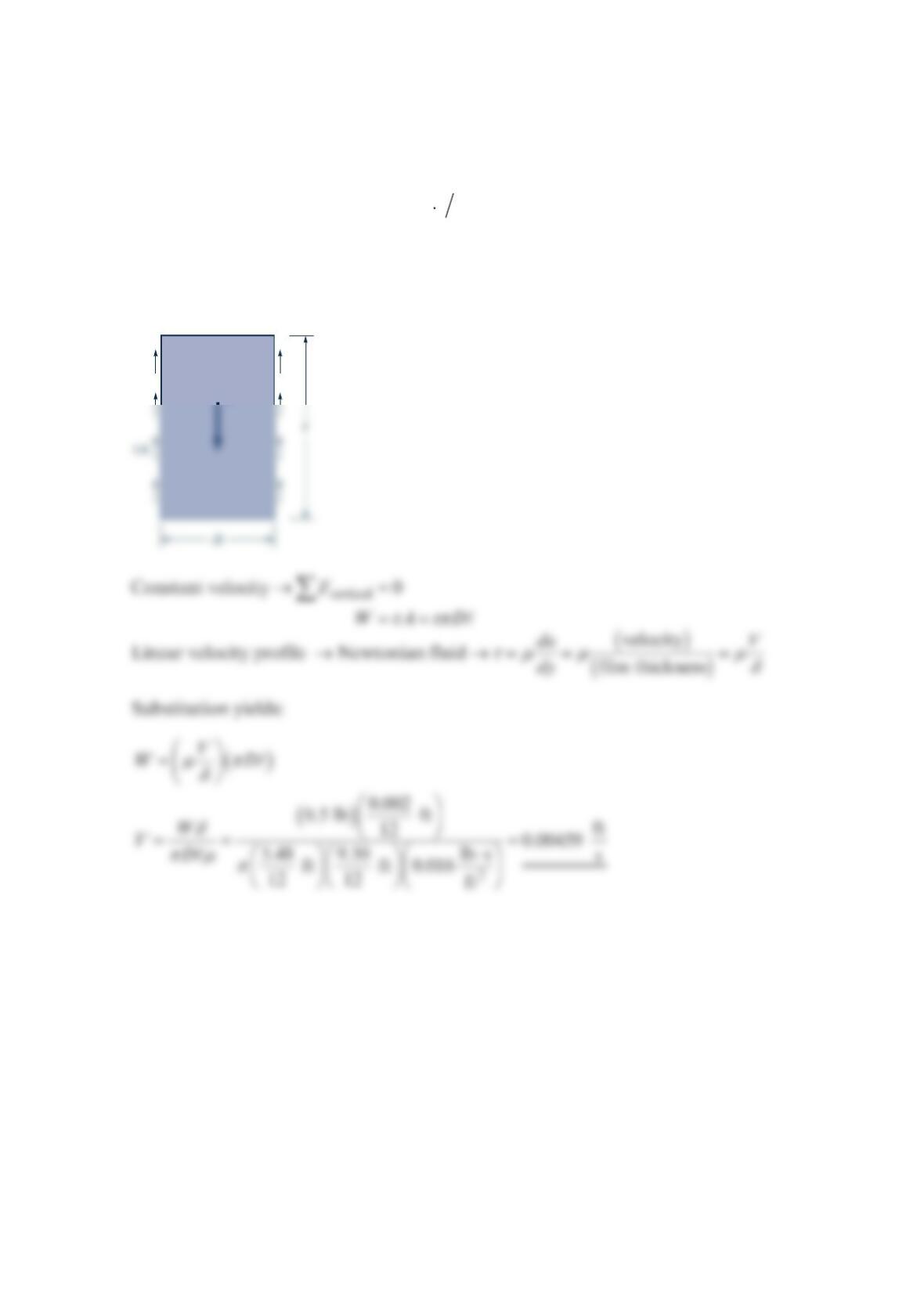
Problem 1.79
A piston having a diameter of
5
.48 in. and a length of
9
.50 in. slides downward with a veloc-
ity
V
through a vertical pipe. The downward motion is resisted by an oil film between the
piston and the pipe wall. The film thickness is 0.002 in., and the cylinder weighs 0.5 l
b
. Es-
timate
V
if the oil viscosity is 2
0.016 lb s ft . Assume the velocity distribution in the gap is
linear.
Solution 1.79
𝒲
τ
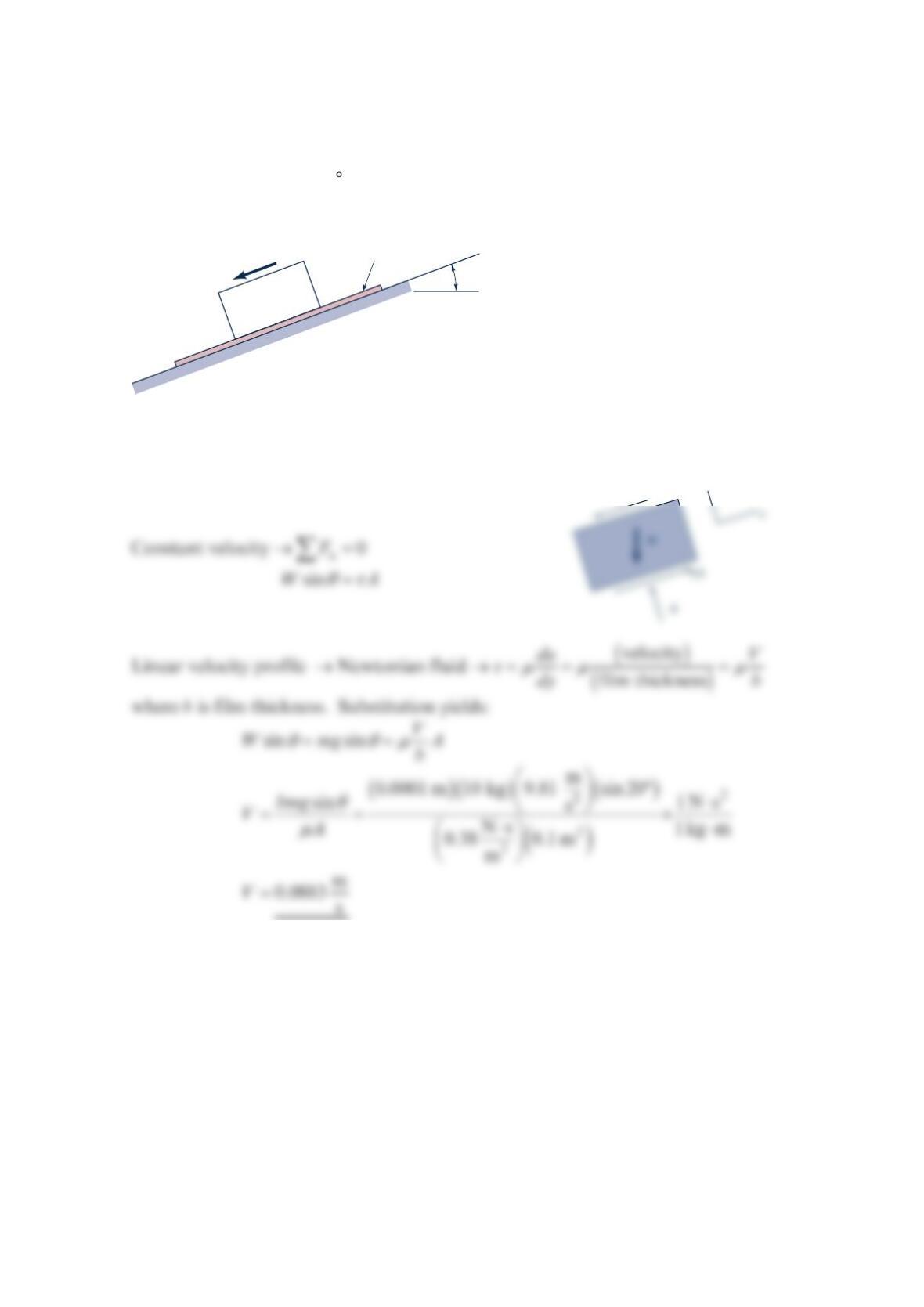
V
y
Problem 1.80
A 10-kg block slides down a smooth inclined surface as shown in the figure below. Deter-
mine the terminal velocity of the block if the 0.1-mm gap between the block and the surface
contains SAE 30 oil at 60 F. Assume the velocity distribution in the gap is linear, and the
area of the block in contact with the oil is 2
0.1 m .
Solution 1.80
Draw free body diagram to help resolve forces:
V
0.1 mm gap
20°
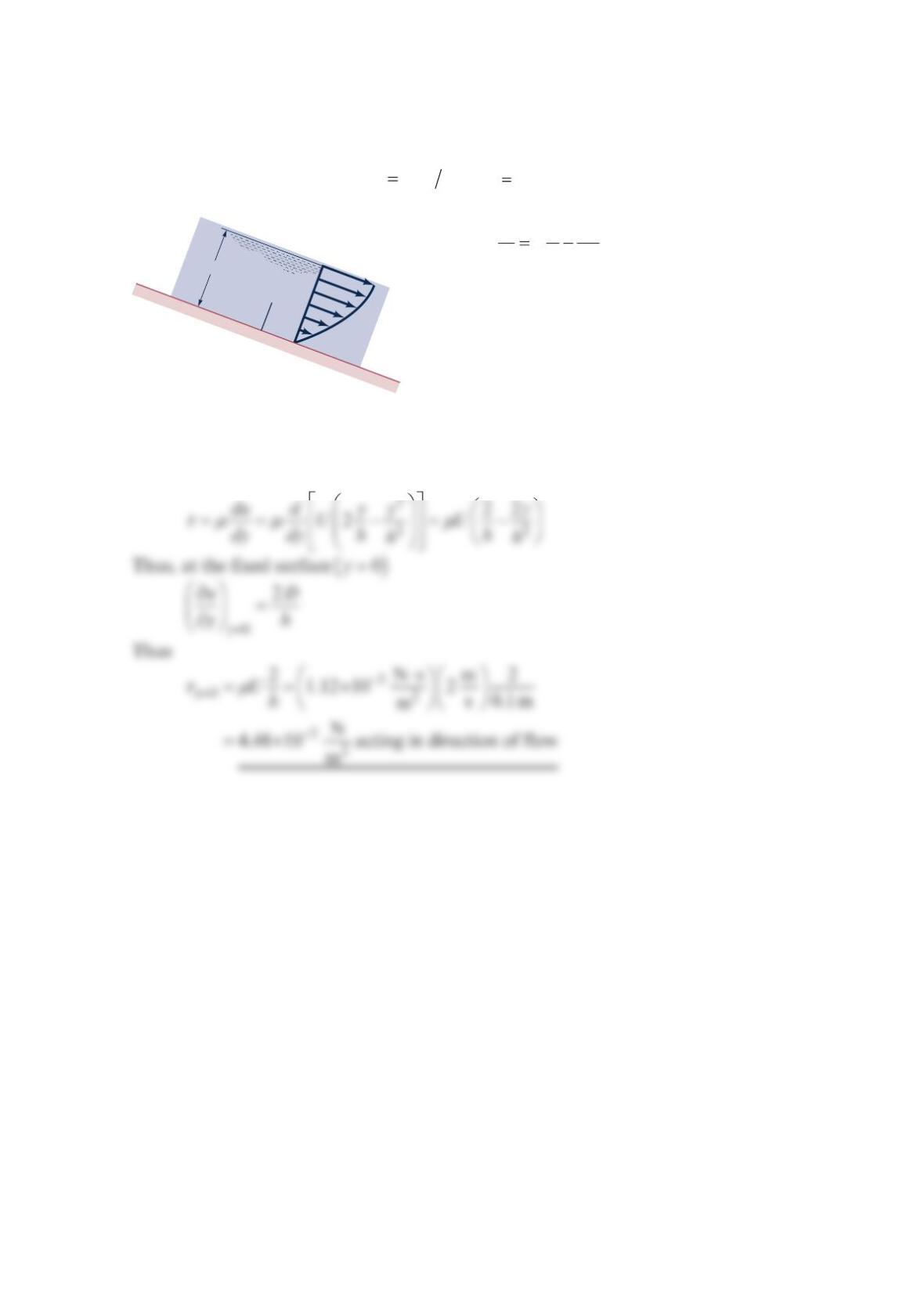
U
h
yu
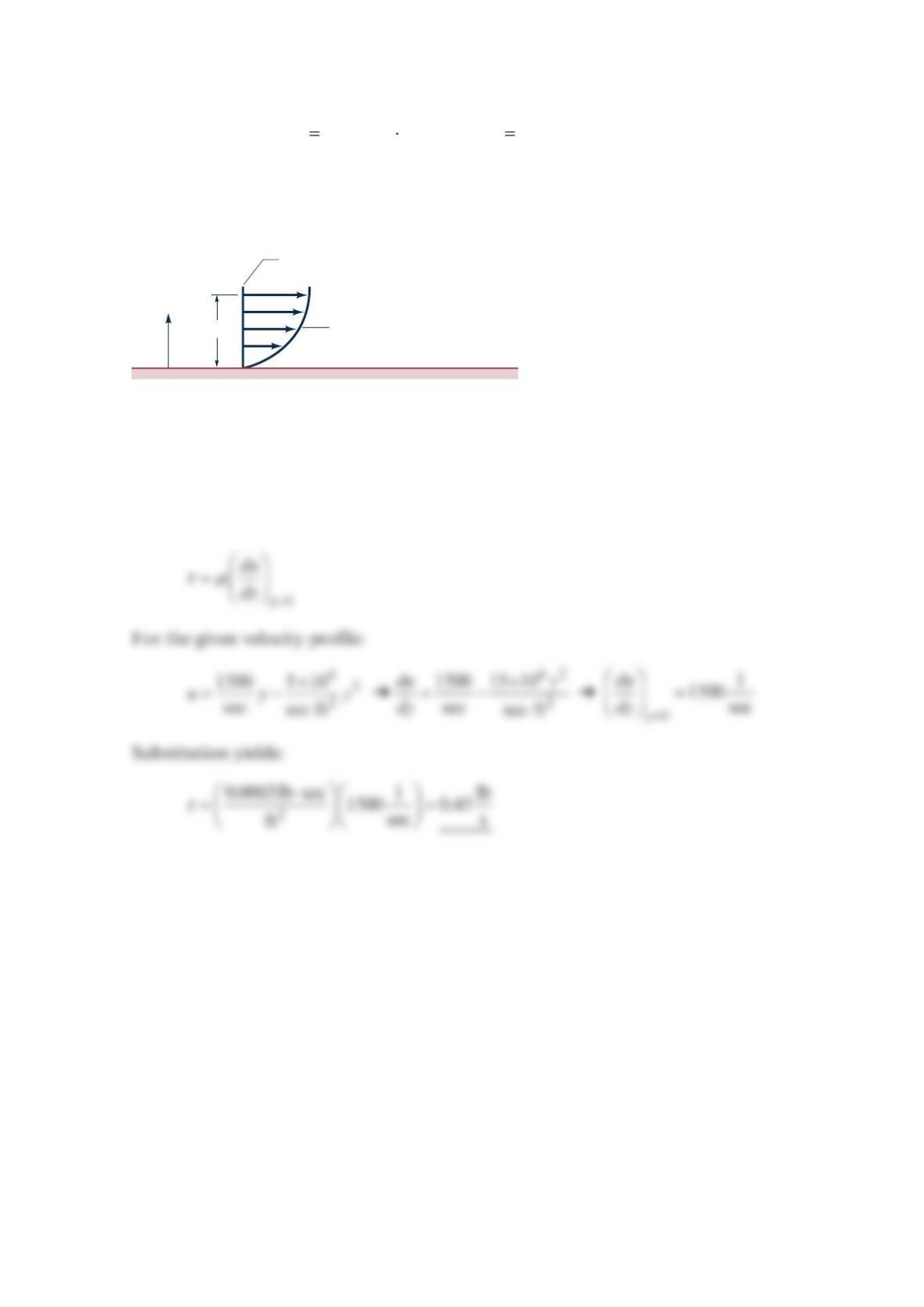
Problem 1.81
A layer of water flows down an inclined fixed surface with the velocity profile shown in the
figure below. Determine the magnitude and direction of the shearing stress that the water
exerts on the fixed surface for 2 m sU and 0.1 m
h
.
2
2
2
uyy
Uh
h
Solution 1.81
Enforcing the no-slip boundary condition at the solid surface:
Problem 1.82
Oil ( 2
a
bsolute viscosity 0.0003 lb s/ft , 3
density 50 lbm/ft ) flows in the boundary layer, as
shown in the figure below. The plate is 1 ft wide perpendicular to the paper. Calculate the
shear stress at the plate surface.
Solution 1.82
Assuming a newtonian fluid, the shear stress on the plate by the oil is
y
u = 1500 y – 5 × 10
6
× y
3
ft/sec
Plate
Edge of boundary layer
0.01 ft
u