16-1
The Dulux Lamp
Teaching Commentary
OVERVIEW
This case deals with a topic, economic value to the customer (EVC), that is potentially very important in managerial
accounting but that receives very little attention in textbooks or casebooks. We see this topic, EVC, as a major
component of the rapidly evolving focus on customers in cost analysis.
The basic idea is to study the customer’s cost for buying and using a product over its useful life (Life Cycle
Cost) as a basis for establishing selling price, product positioning, and marketing strategy. This is a very different way of
viewing “cost–based pricing.” The focus is the customer’s costs, not the manufacturer’s costs.
The Dulux Lamp case is disguised. The real company is OSRAM, NA (ONA), a U.S.-based subsidiary of
Siemens, the German company.
The case describes the introduction in North America by OSRAM of a very innovative light bulb that lasts ten
times longer than an incandescent bulb and uses about one-fifth the energy. The cost analysis focuses on two different
potential customers for the new bulb, called the “compact fluorescent lamp” (CFL). The CFL product has a very
different value to different users, depending on how the bulb is used.
ANSWERS TO ASSIGNMENT QUESTIONS
Question 1-a
Annual Power Cost for the Hotel
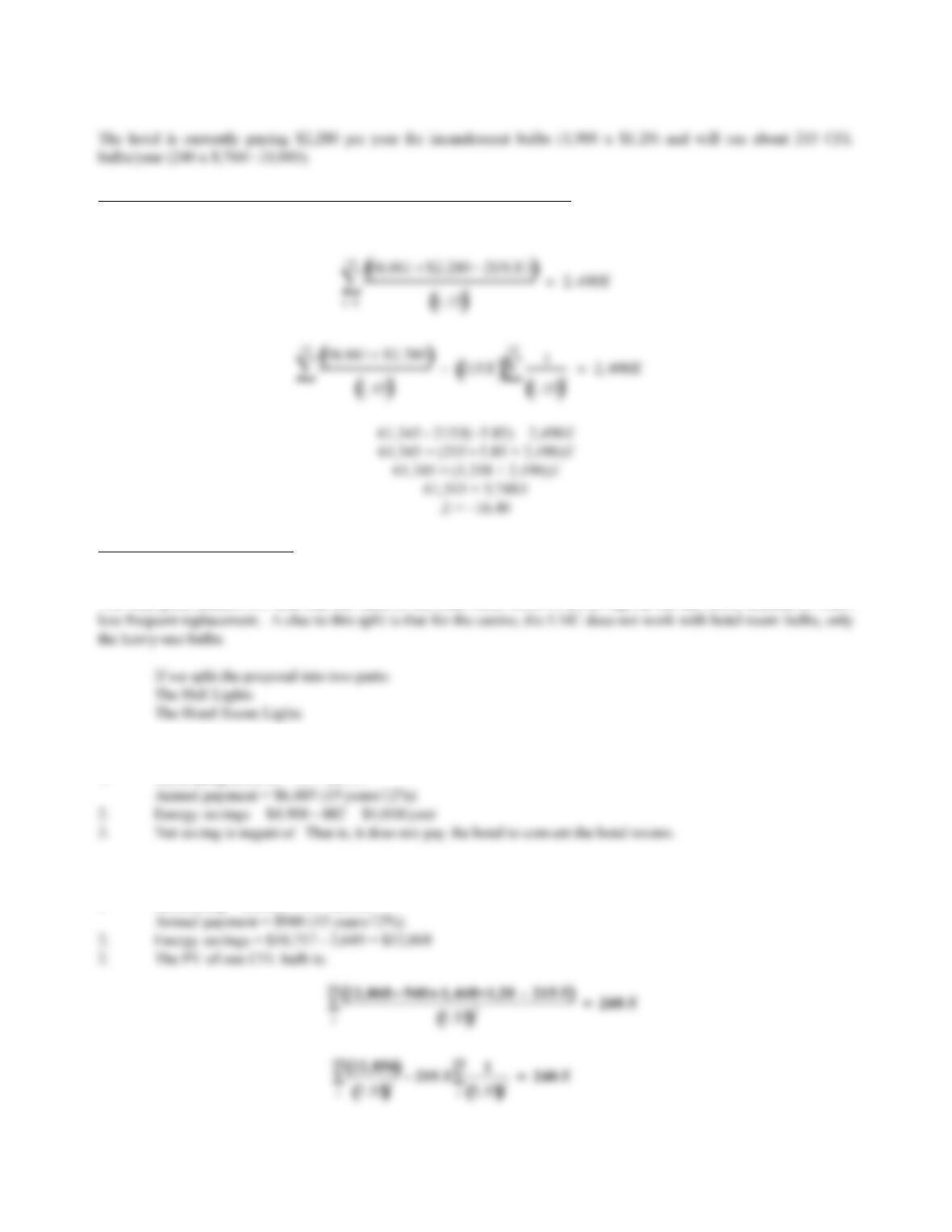
Incandescent: 100 -watt bulbs—250 rooms 7 hrs/day x 200 days/yr
Fixtures Retrofit
Cost:
Rooms: 4 table/vanity x $7.00 = $28
2 wall x $15 = $30 $106/room
Net Annual Advantage: $16,086 – $7,425 = $8,661, before considering cost of replacement bulbs.
16-2
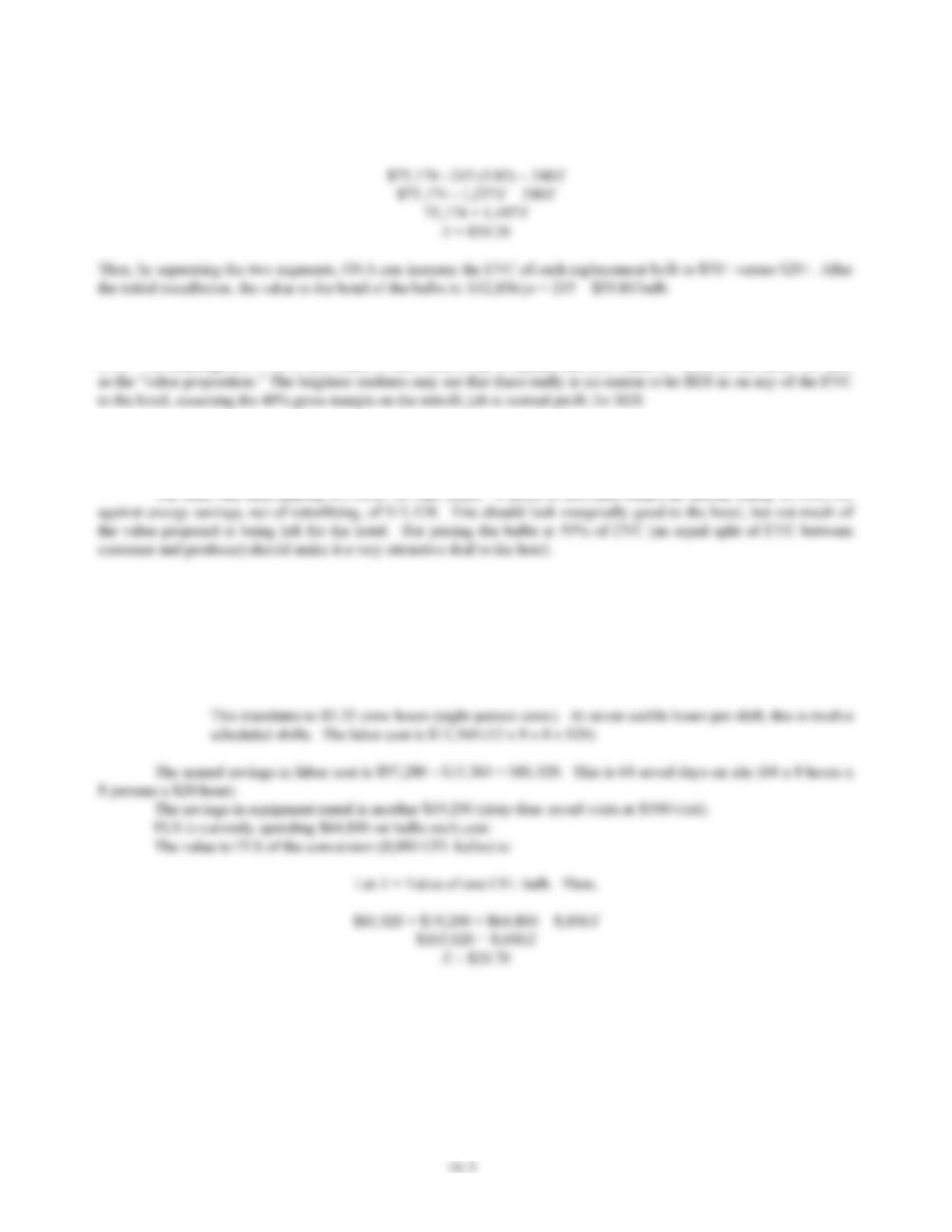
Present value to hotel of one CFL bulb equals (assume 15% cost of capital):
Let X = value to the hotel of one CFL bulb. Then:
Value of the initial installation = $16.40 • 2,490 = ~$40,800 for bulbs. Maximum price of job to the hotel = $91,400
(50,600 + 40,800), assuming the ESCO is satisfied with the 40% gross margin on the retrofit job.
The very good student will note that the value of the hotel room bulbs is not as high as the hall bulbs because of much
Then, the value of the hotel room bulbs is
1. Retrofitting $26,500 ÷ .6 = $4,167
But, the value of the hall bulbs, alone, is:
1. Retrofitting = $3,840 ÷ .6 = $6,400
Question 1-b
The value to BES of the first round of CFL bulbs for the halls = $50.20 each, for a total of $12,048 ($50.20 x
240). The challenge for ONA is how much of this value to try to capture and how much to “leave on the table” for BES
Question 1-c
The challenge for ONA is how much of the customer value of about $60 per CFL bulb to try to capture and how
much to “leave on the table” as the “value proposition” to the hotel.
The hotel has been paying $1,728/yr for hall bulbs. A price of $60/bulb means an annual outlay of $10,750,
Question 2-a
Current changeover time = 4,864 scheduled hours (4,234 working hours)
With CFL bulbs, and still using “group relamping,” but with 90% of rated life:
8,000 hallway and casino bulbs at 8,760 hrs usage a year and 9,000 hrs life. Change each bulb once a
year, at 12/hr = 667 hours.
But, as in Question 1, why should FLS get any of this value, which really accrues to the hotel’s benefit? Does
ONA really need FLS at all with the new bulbs? Since FLS loses 5/6 of its business, it may well go out of business!
The casino should find someone to change the bulbs without giving any of the EVC to the maintenance contractor.
16-4
Question 2-b
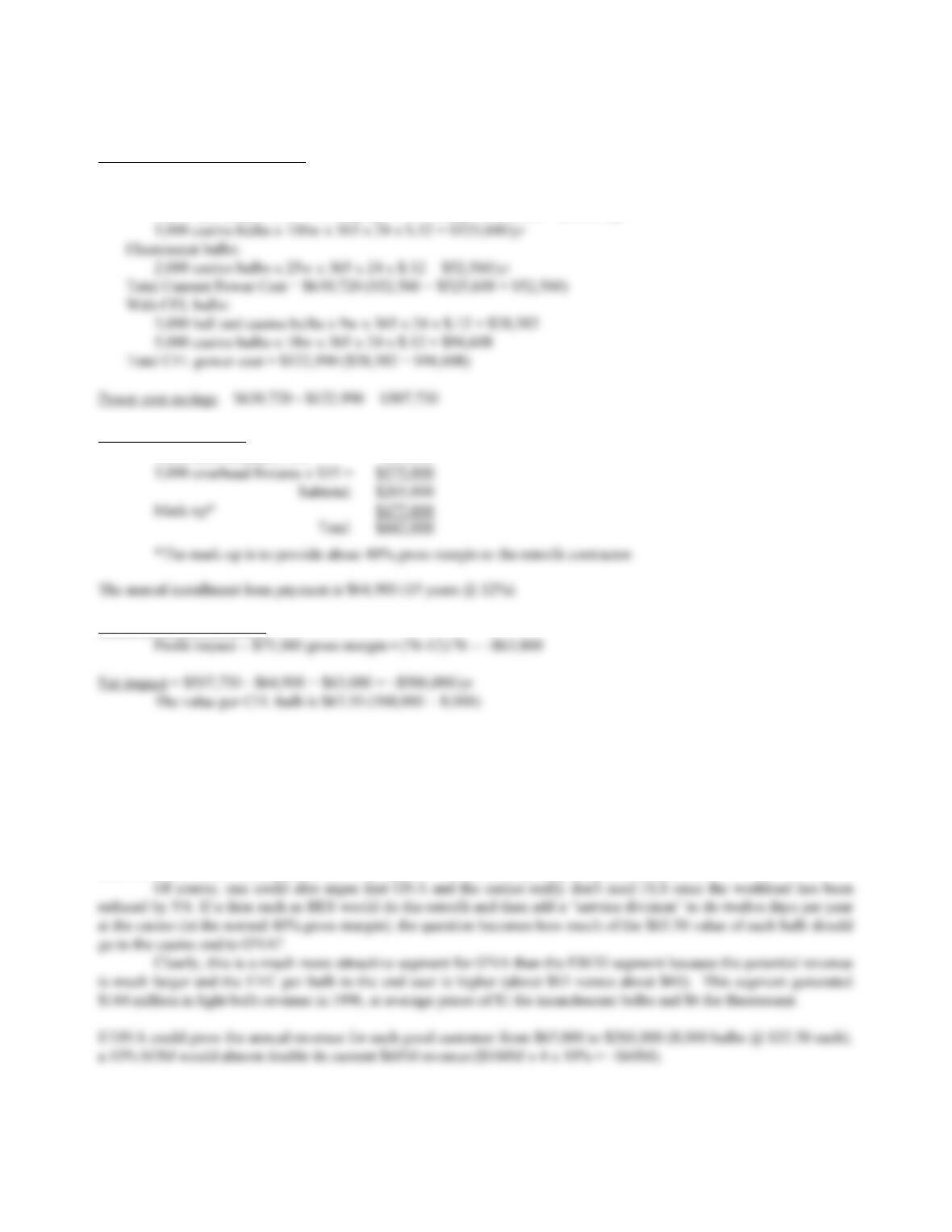
Annual Power Cost to the Casino
Incandescent bulbs:
1,000 hall lamps x 50w x 365 days/yr x 24 hrs/day x $.12/kwh = $52,560/yr
One-time Retrofit Cost:
3,000 wall fixtures x $30 = $90,000
Reduced casino downtime:
Question 2-c
Obviously, CFL technology dramatically changes the nature of the relationship among the casino, FLS, and the
light bulb supplier. With CFL technology, the casino is about $508,000 better off and FLS is about $166,000 better off,
just because of ONA’s bulbs. But FLS loses 5/6 of its work. The net result is $674,000 ($508,000 + $166,000) per year
to be split, somehow, among the casino, FLS, and ONA.
Splitting it 1/3, 1/3, 1/3 would mean ~$225,000 annual revenue for ONA on 8,000 replacement bulbs (after the
initial installation). This is an average of about $28 per bulb. Of course, there is nothing to say that ONA should limit
itself to 1/3 of the net value generation. A 2/3 split for ONA drives up the price per CFL bulb to $56.
Question 3
Both segments are very attractive for ONA, although the LMC segment is better. If it is possible to price
TEACHING STRATEGY
I use this very challenging case after spending one prior class period on the basic concepts of EVC and LCC. For that
prior class, I use the Note on EVC and LCC, along with two one-page cases (Acme Fasteners and Micromini
In the MBA program at Tuck and at Babson, I just assign all the questions with only the hints that are shown in
bold letters in the assignment. In class, I go through the questions in order, trying to get students to see the very different
EVCs involved:
Per CFL Bulb
For the hotel, combining rooms and halls ~$16
For the hotel, for halls only ~$50 or $60, after the first round.