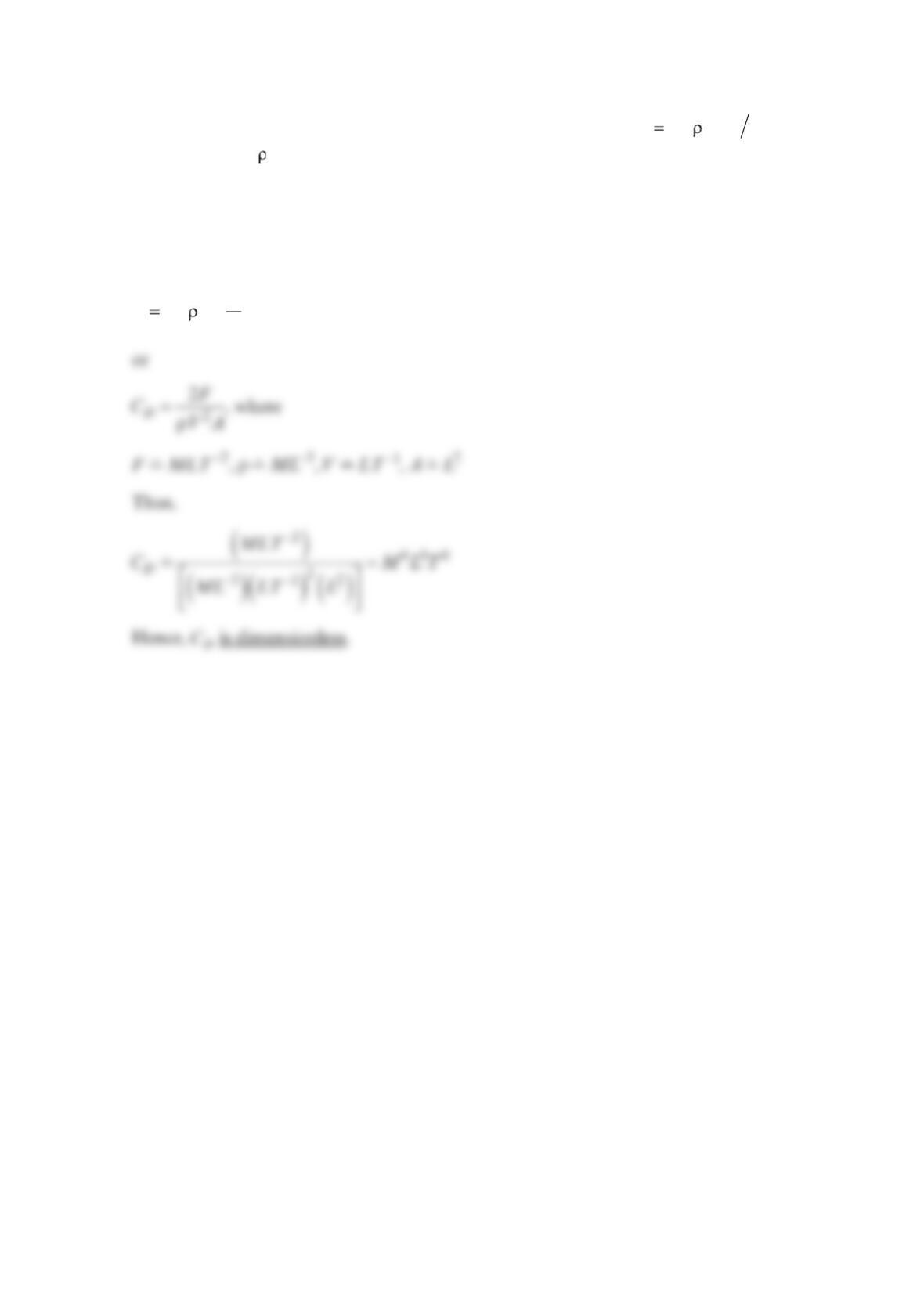
Problem 1.1
The force,
F
, of the wind blowing against a building is given by 22
D
F
CVA
, where
V
is
the wind speed, the density of the air,
A
the cross-sectional area of the building, and D
C
is
a constant termed the drag coefficient. Determine the dimensions of the drag coefficient.
Solution 1.1
2
2
D
A
F
CV
C
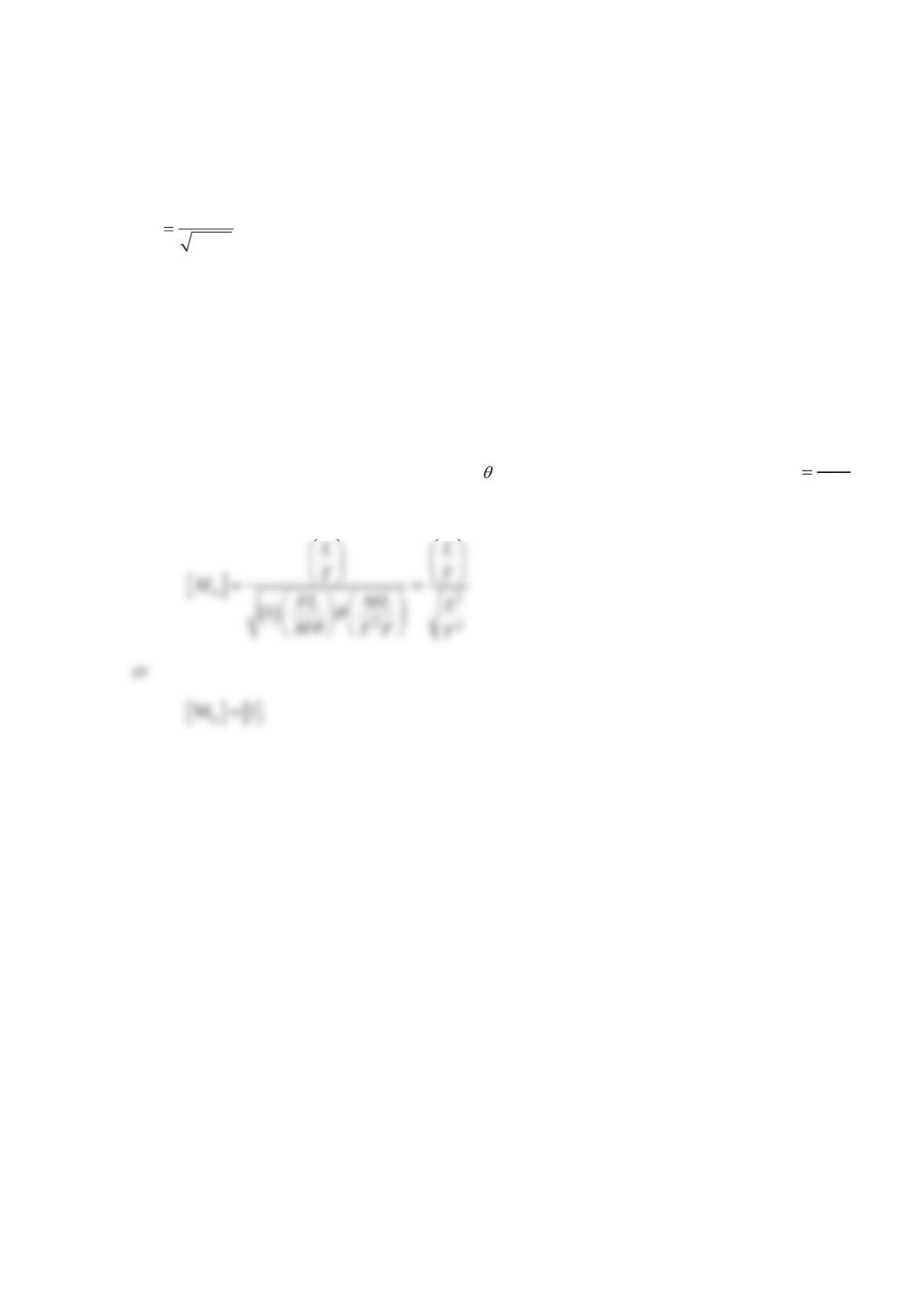
Problem 1.2
The Mach number is a dimensionless ratio of the velocity of an object in a fluid to the speed
of sound in the fluid. For an airplane flying at velocity
V
in air at absolute temperature
T
,
the Mach number
M
a is,
M
aV
kRT ,
where
k
is a dimensionless constant and
R
is the specific gas constant for air. Show that
M
a
is dimensionless.
Solution 1.2
We denote the dimension of temperature by and use Newton’s second law to get 2
ML
F
T.
Then
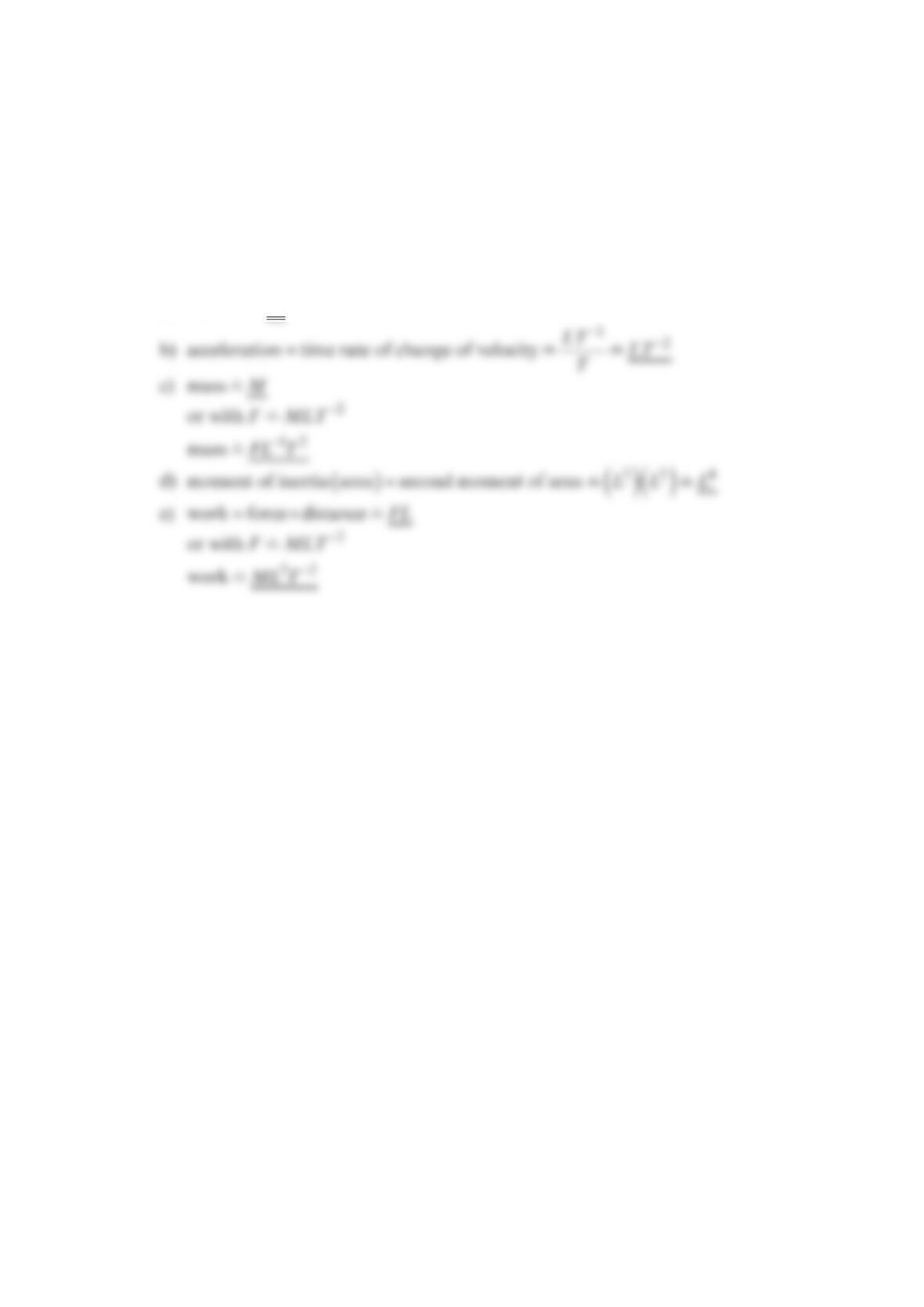
Problem 1.3
Verify the dimensions, in both the
F
LT and the
M
LT systems, of the following quantities,
which appear in Table B.1 Physical Properties of Water (BG/EE Units).
(a) Volume, (b) acceleration, (c) mass, (d) moment of inertia (area), and (e) work.
Solution 1.3
a)
3
v
olume L
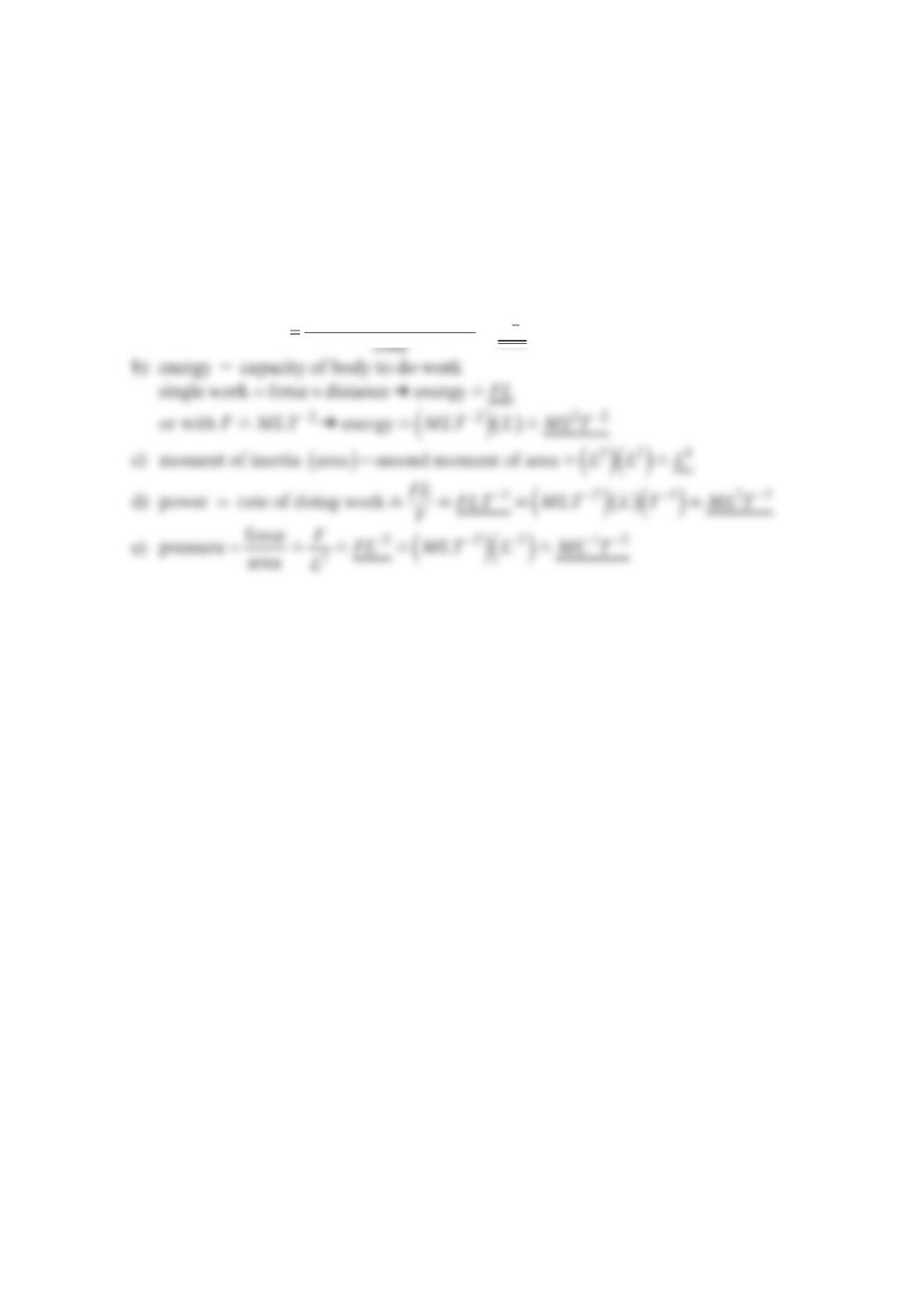
Problem 1.4
Verify the dimensions, in both the
F
LT and the
M
LT systems, of the following quantities,
which appear in Table B.1 Physical Properties of Water (BG/EE Units).
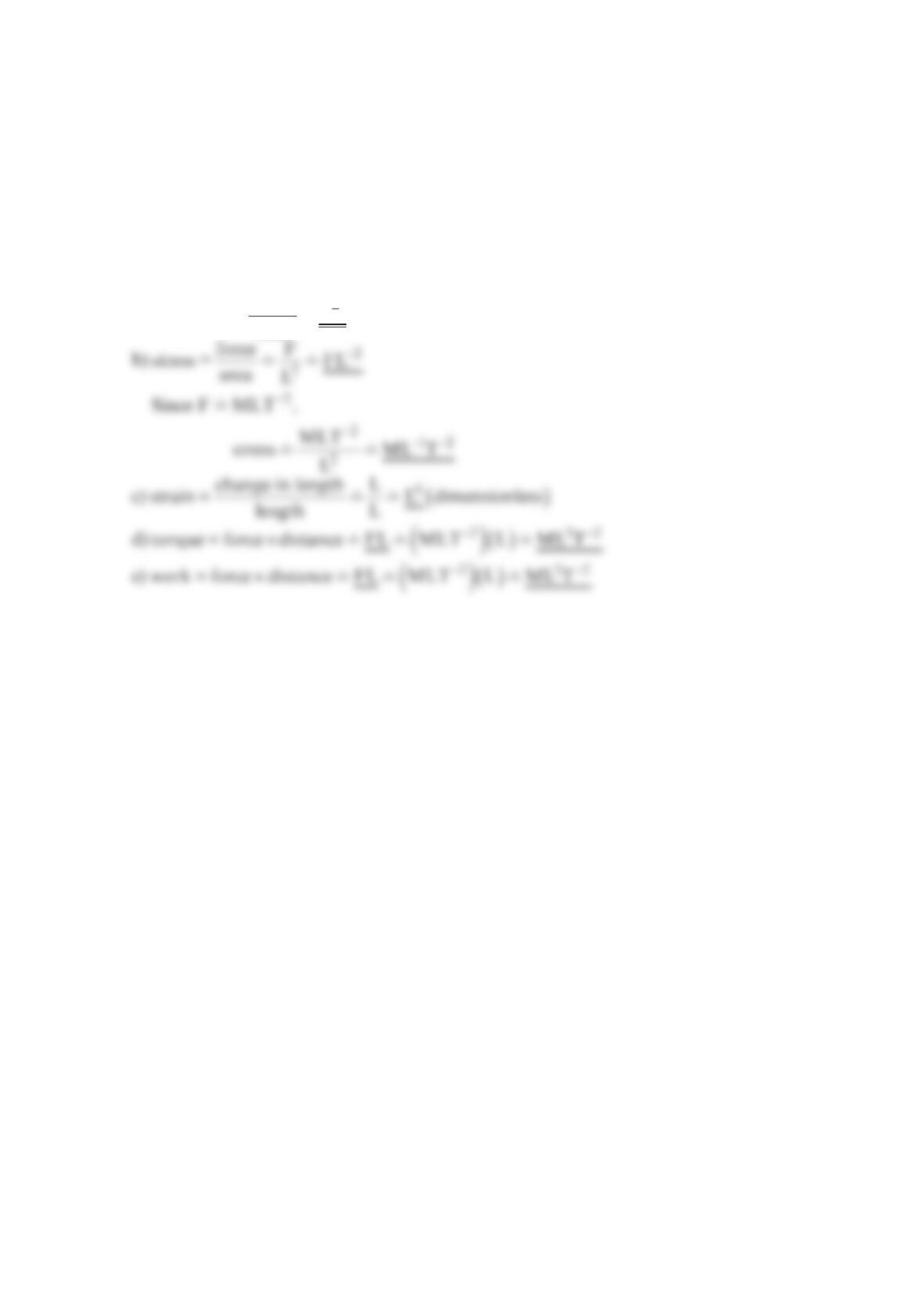
(a) Angular velocity, (b) energy, (c) moment of inertia (area), (d) power, and (e) pressure.
Solution 1.4
a) 1
angular displacement
a
ngular velocity time T
p
Problem 1.5
Verify the dimensions, in both the
F
LT system and the
M
LT system, of the following
quantities, which appear in Table B.1 Physical Properties of Water (BG/EE Units).
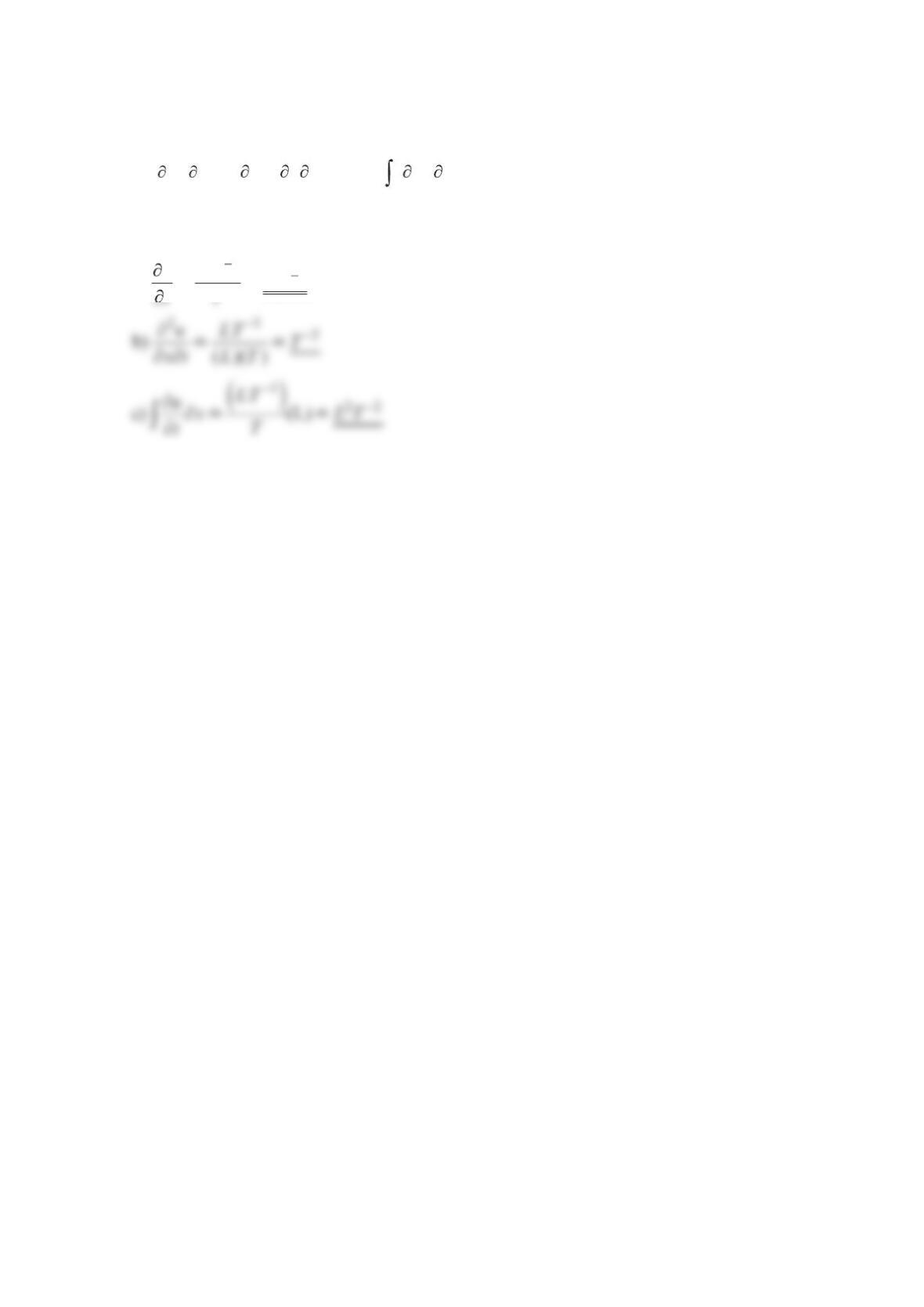
(a) Frequency, (b) stress, (c) strain, (d) torque, and (e) work.
Solution 1.5
a) 1
cycles
f
requency = T
time
Problem 1.6
If
u
is velocity, x is length, and t is time, what are the dimensions (in the
M
LT system) of
(a) /
ut
, (b) 2
/
uxt
, and (c) ()/utdx
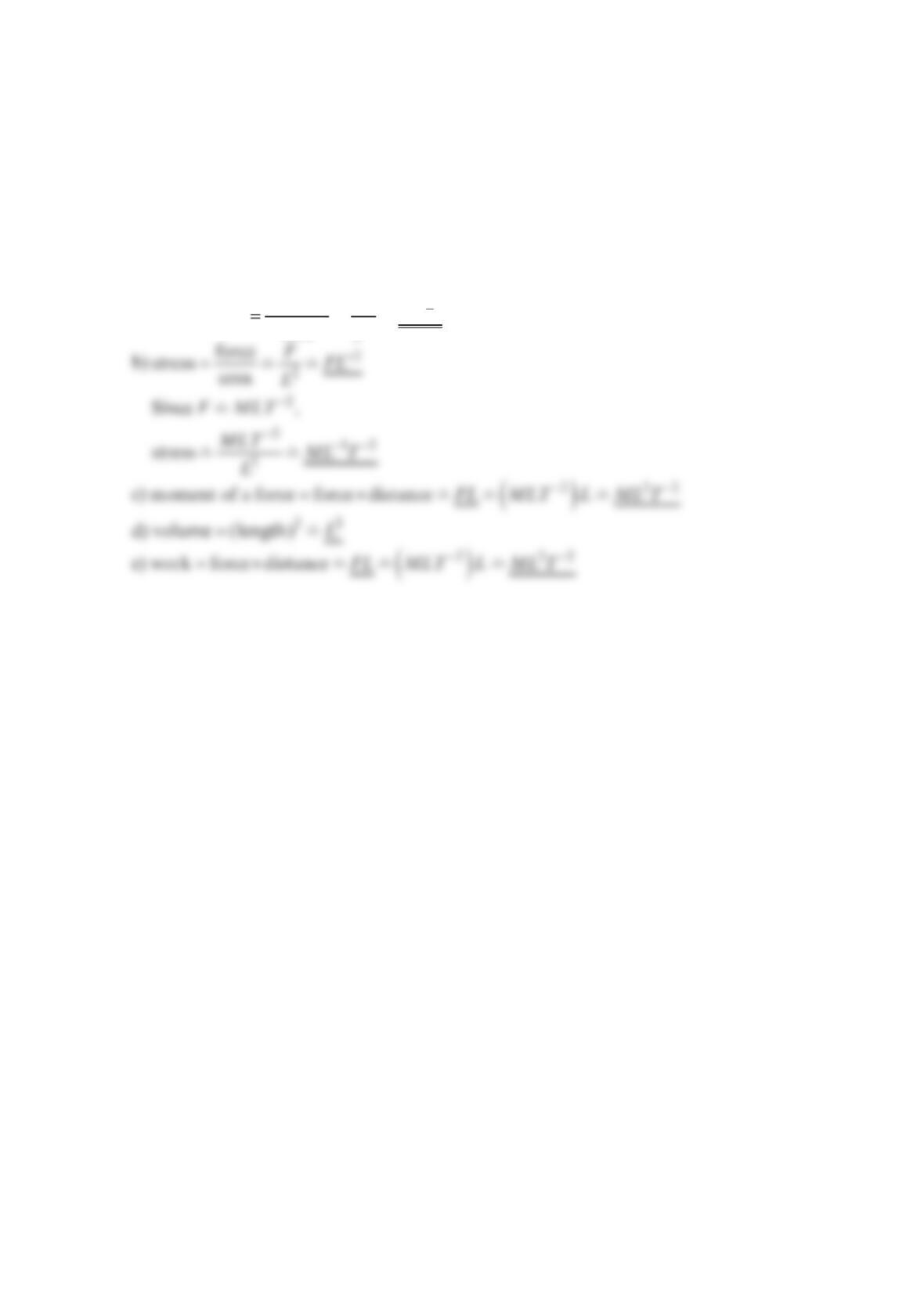
?
Solution 1.6
a)
12
uLT LT
Problem 1.7
Verify the dimensions, in both the
F
LT system and the
M
LT system, of the following
quantities, which appear in Table B.1 Physical Properties of Water (BG/EE Units).
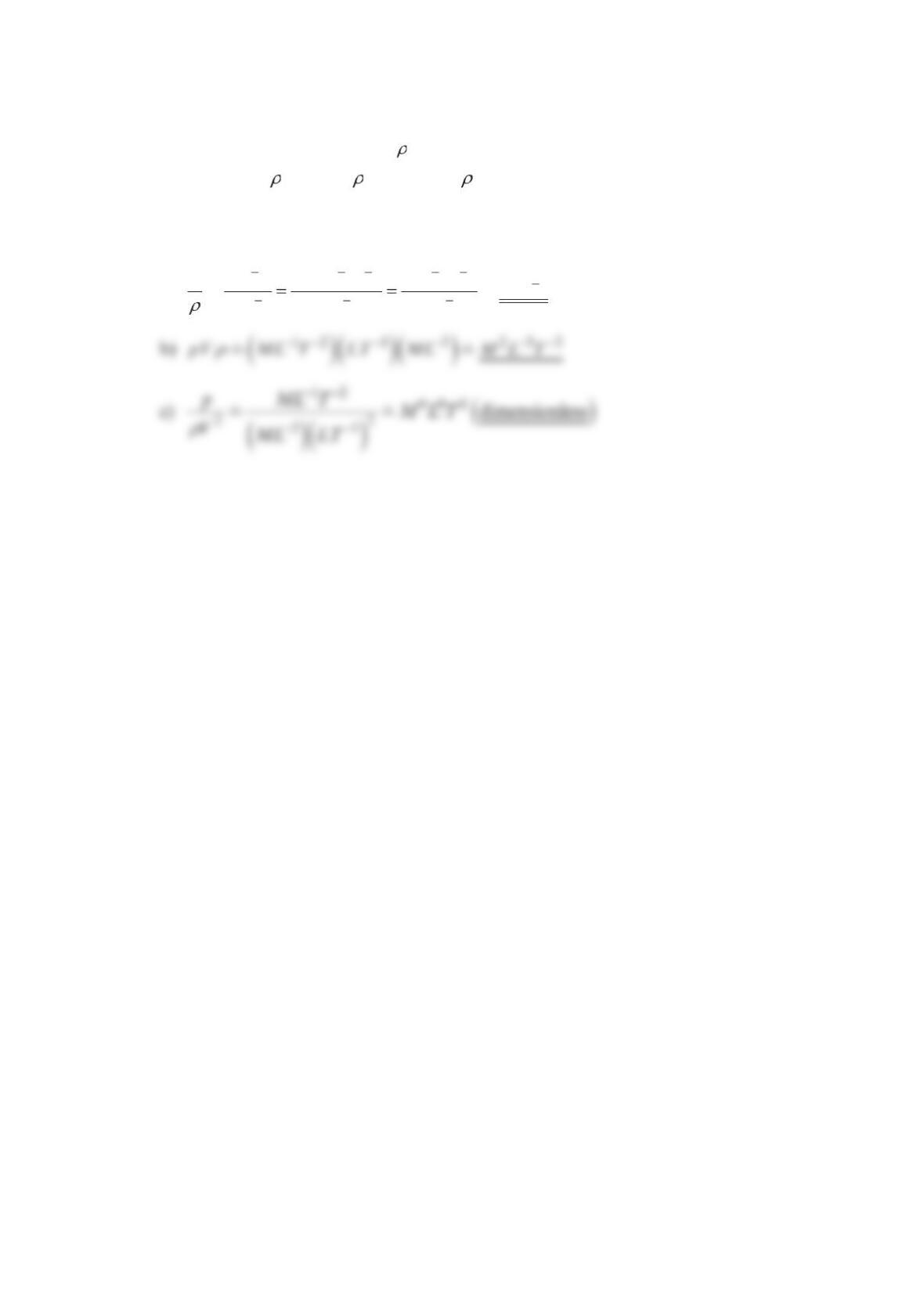
(a) Acceleration, (b) stress, (c) moment of a force, (d) volume, and (e) work.
Solution 1.7
a) 2
2
velocity
a
cceleration time
LLT
T
Problem 1.8
If
p
is pressure,
V
is velocity, and is fluid density, what are the dimensions (in the
M
LT
system) of (a) /
p
, (b)
p
V , and (c) 2
/
p
V?
Solution 1.8
a)
22212
22
33 3
pFL MLTL MLT LT
ML ML ML
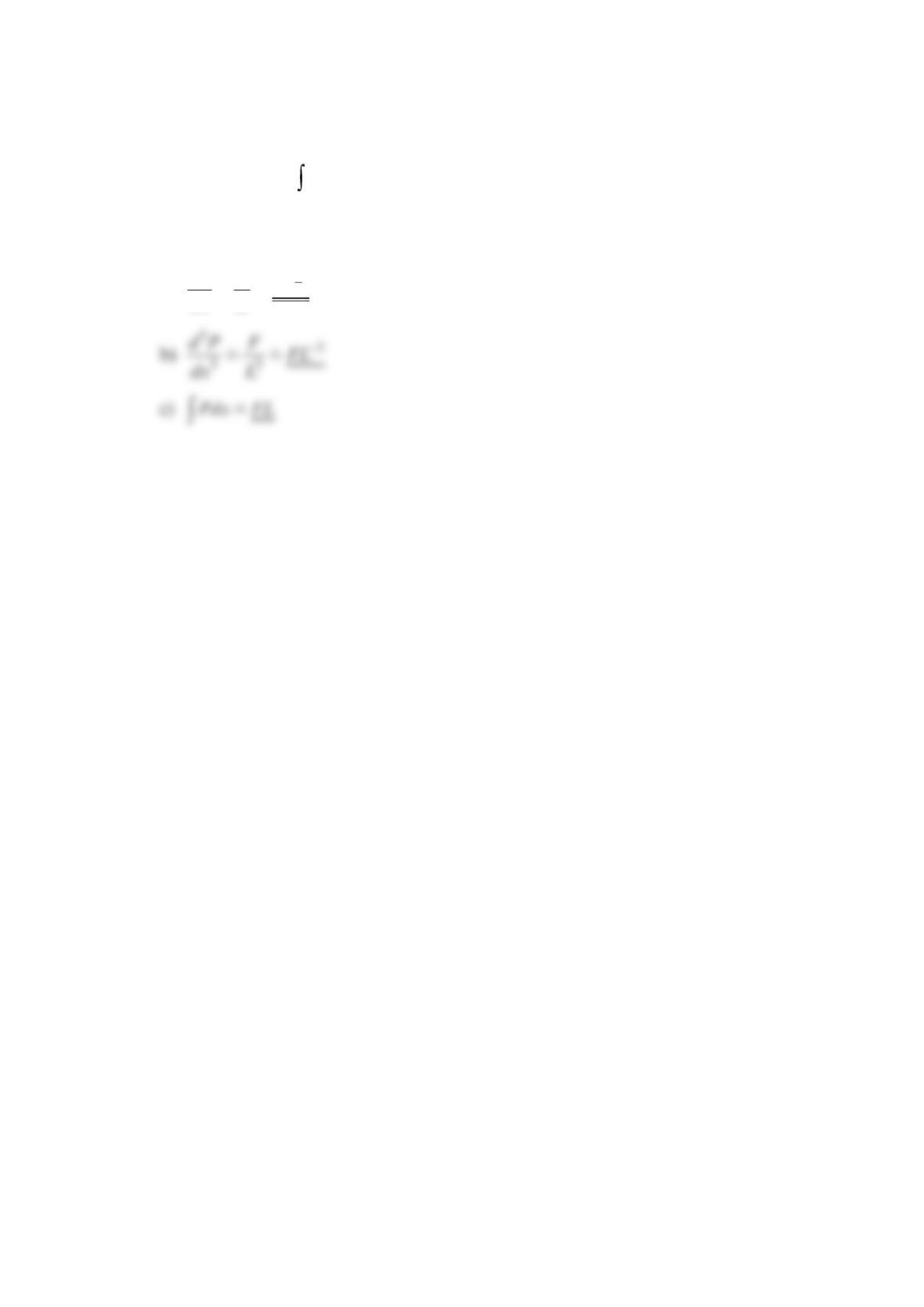
Problem 1.9
If P is force and x is length, what are the dimensions (in the
F
LT system) of (a)
/
d
Pdx
,
(b) 33
/
d
Pdx
, and (c) Pdx
?
Solution 1.9
a) 1
dP F FL
dx L
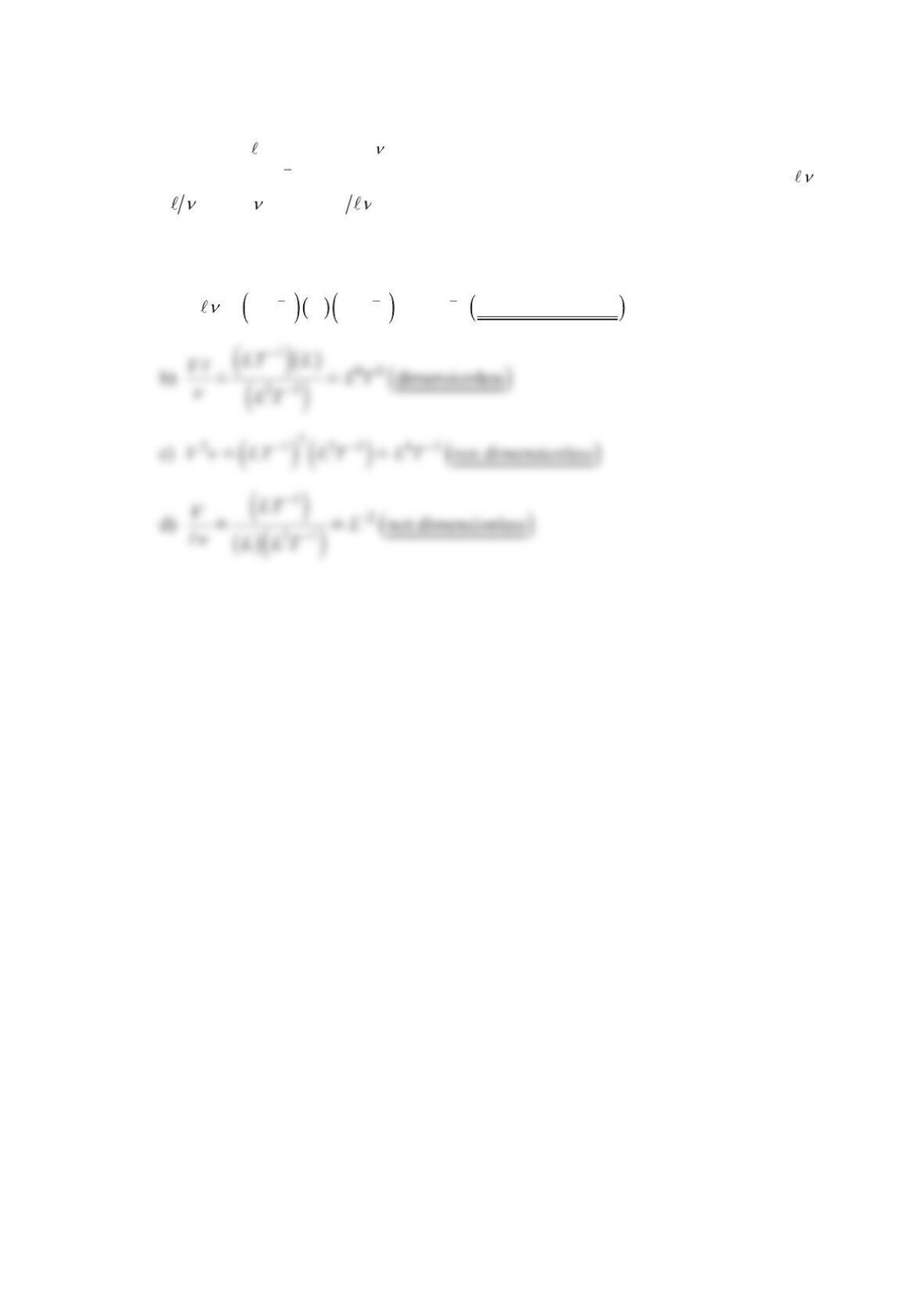
Problem 1.10
If
V
is velocity, is length, and is a fluid property (the kinematic viscosity) having
dimensions of 21
LT , which of the following combinations are dimensionless: (a)
V
,
(b) V, (c) 2
V
, and (d) V?
Solution 1.10
a) 12142
not dimensionless
V
LT L L T L T
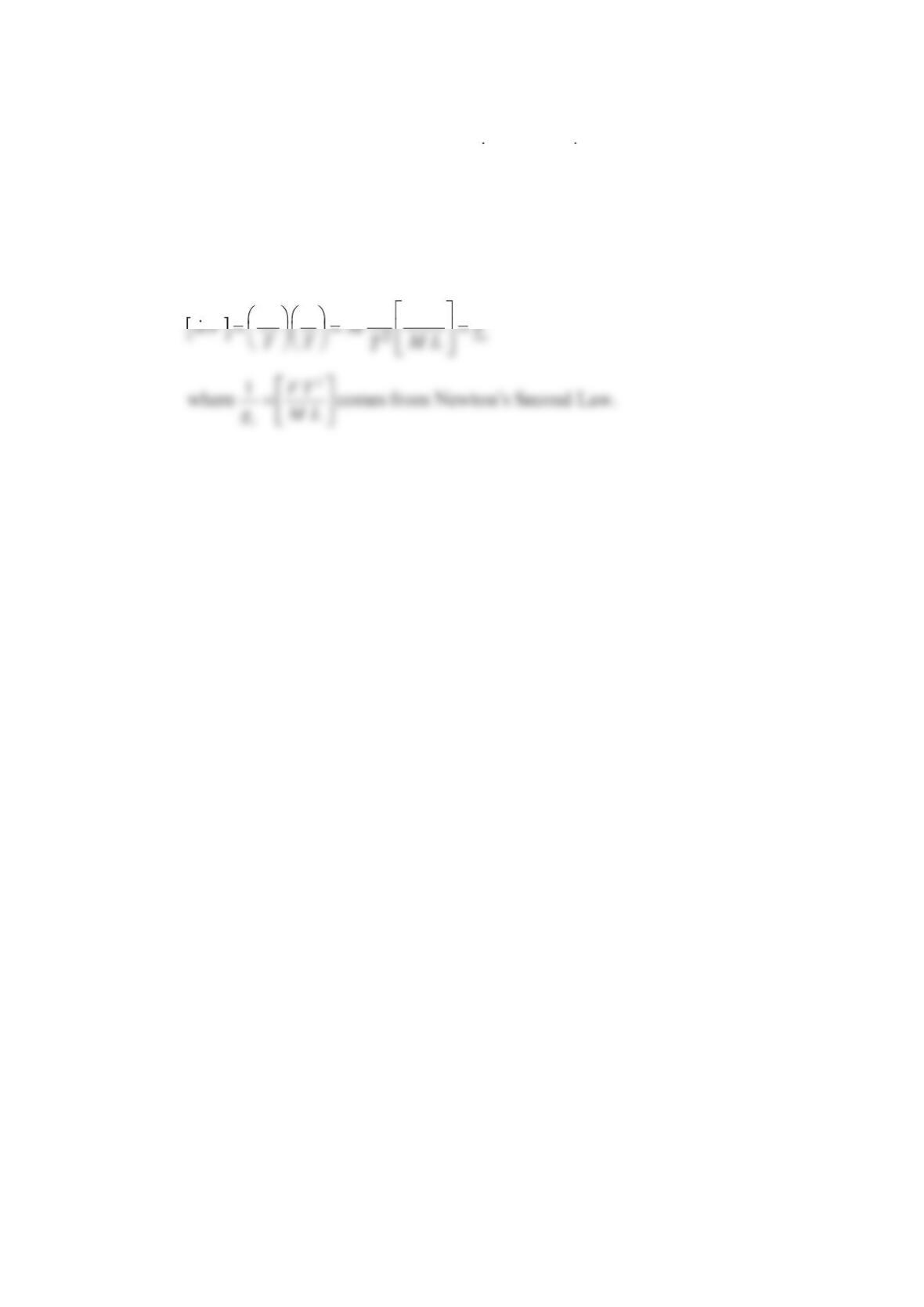
Problem 1.11
The momentum flux is given by the product mV , where m is mass flow rate and
V
is velocity.
If mass flow rate is given in units of mass per unit time, show that the momentum flux can
be expressed in units of force.
Solution 1.11
2
ML LFT
Problem 1.12
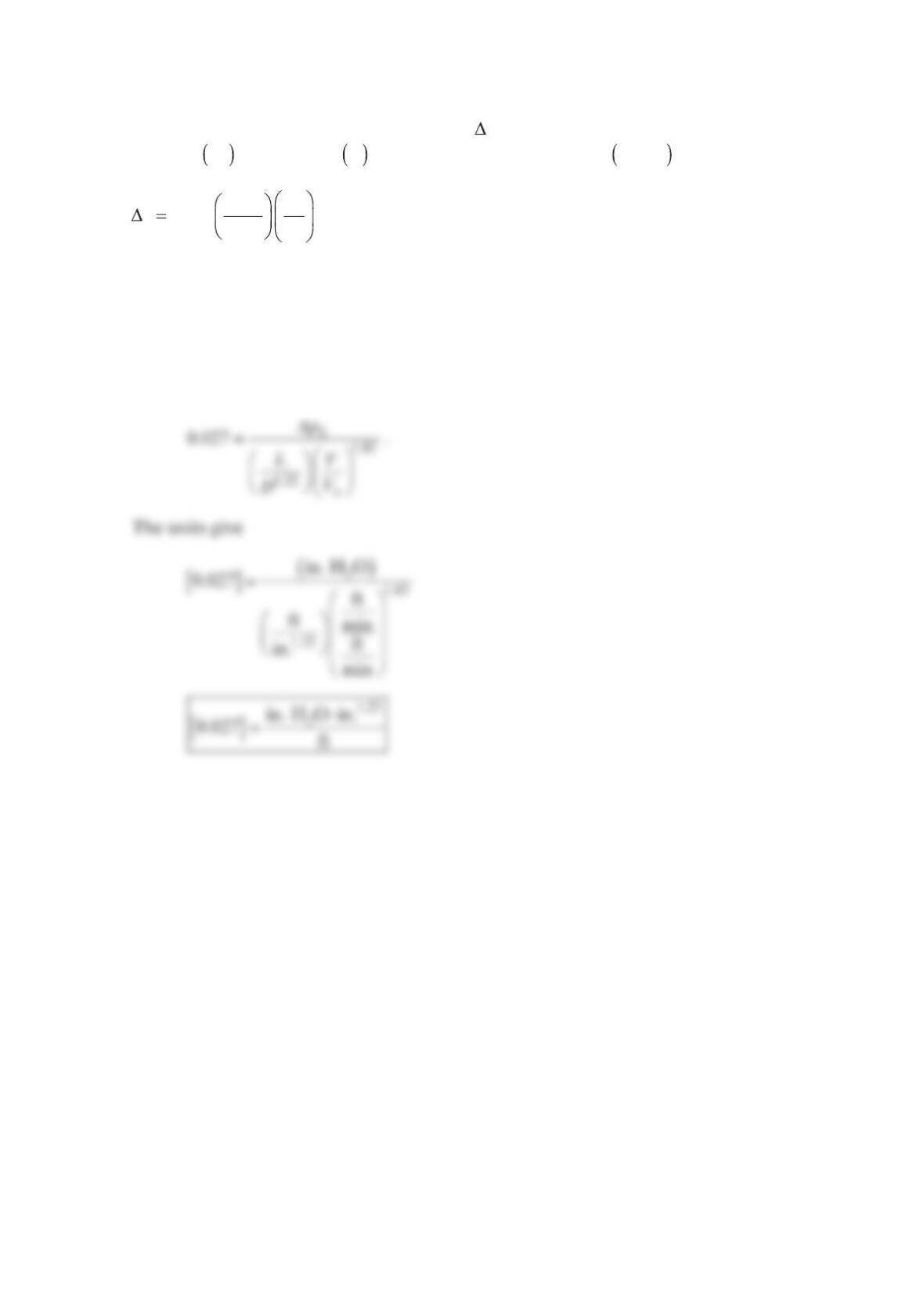
An equation for the frictional pressure loss
p
(inches H2O) in a circular duct of inside di-
ameter in.
d
and length ftL for air flowing with velocity ft/min
V
is
1.82
1.22
0.027 ,
o
LV
pV
d
where 0
V
is a reference velocity equal to
1
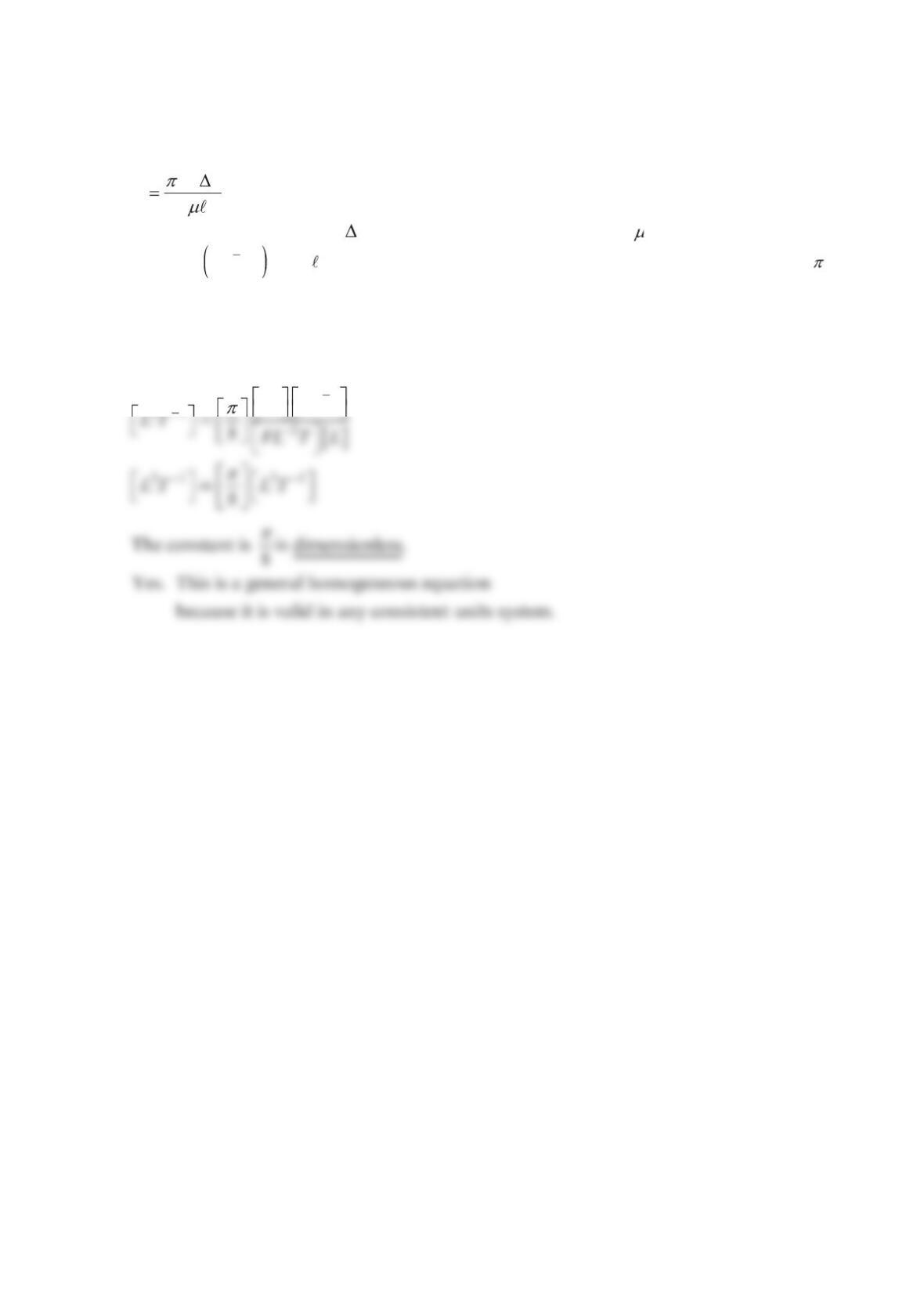
000 ft/min. Find the units of the “constant”
0
.027.
Solution 1.12
Solving for the constant gives
Problem 1.13
The volume rate of flow, Q, through a pipe containing a slowly moving liquid is given by
the equation
4
8
Rp
Q
where
R
is the pipe radius, p the pressure drop along the pipe, is a fluid property called
viscosity 2
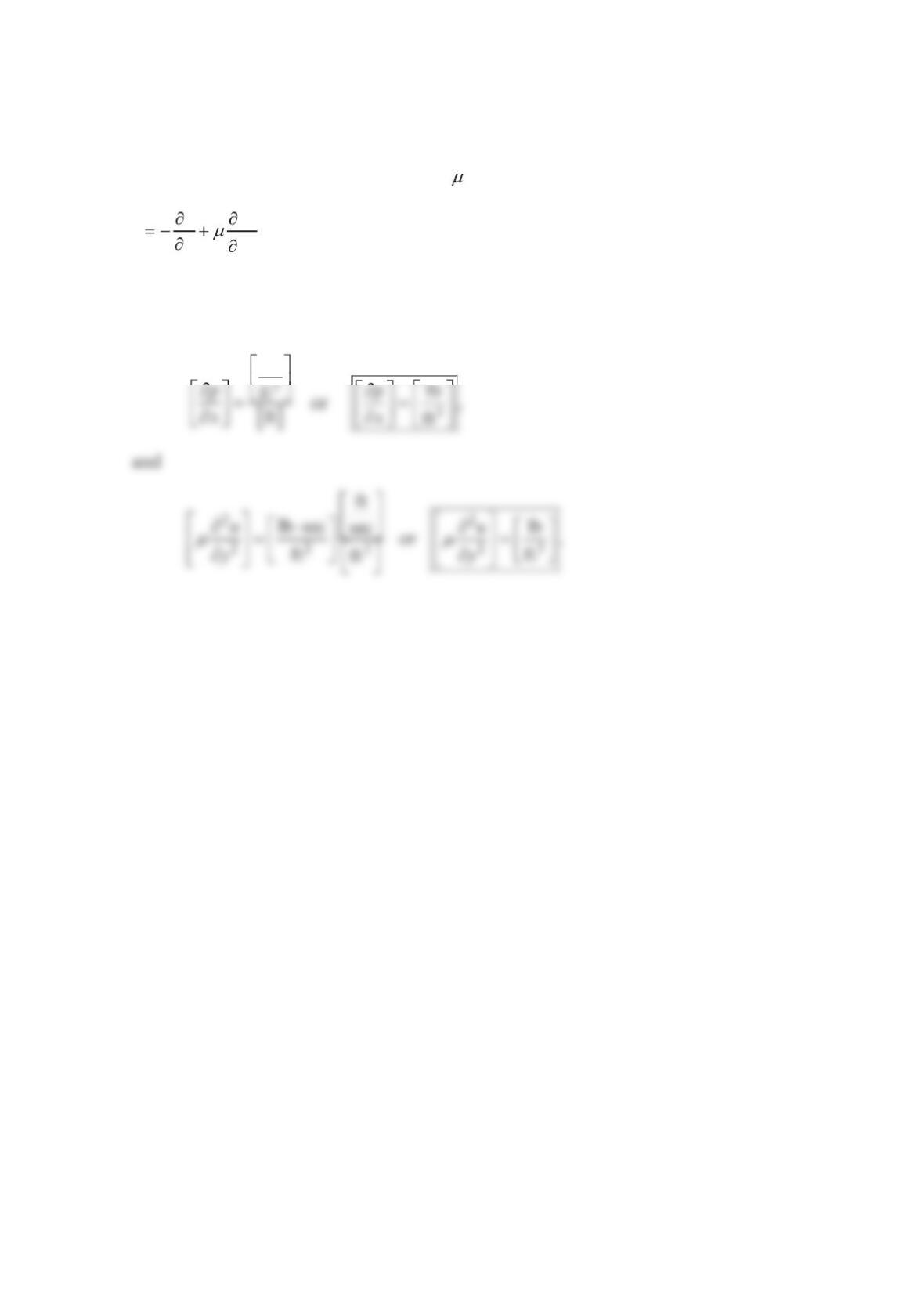
FL T , and is the length of pipe. What are the dimensions of the constant
/
8?
Would you classify this equation as a general homogeneous equation? Explain.
Solution 1.13
42
LFL
Problem 1.14
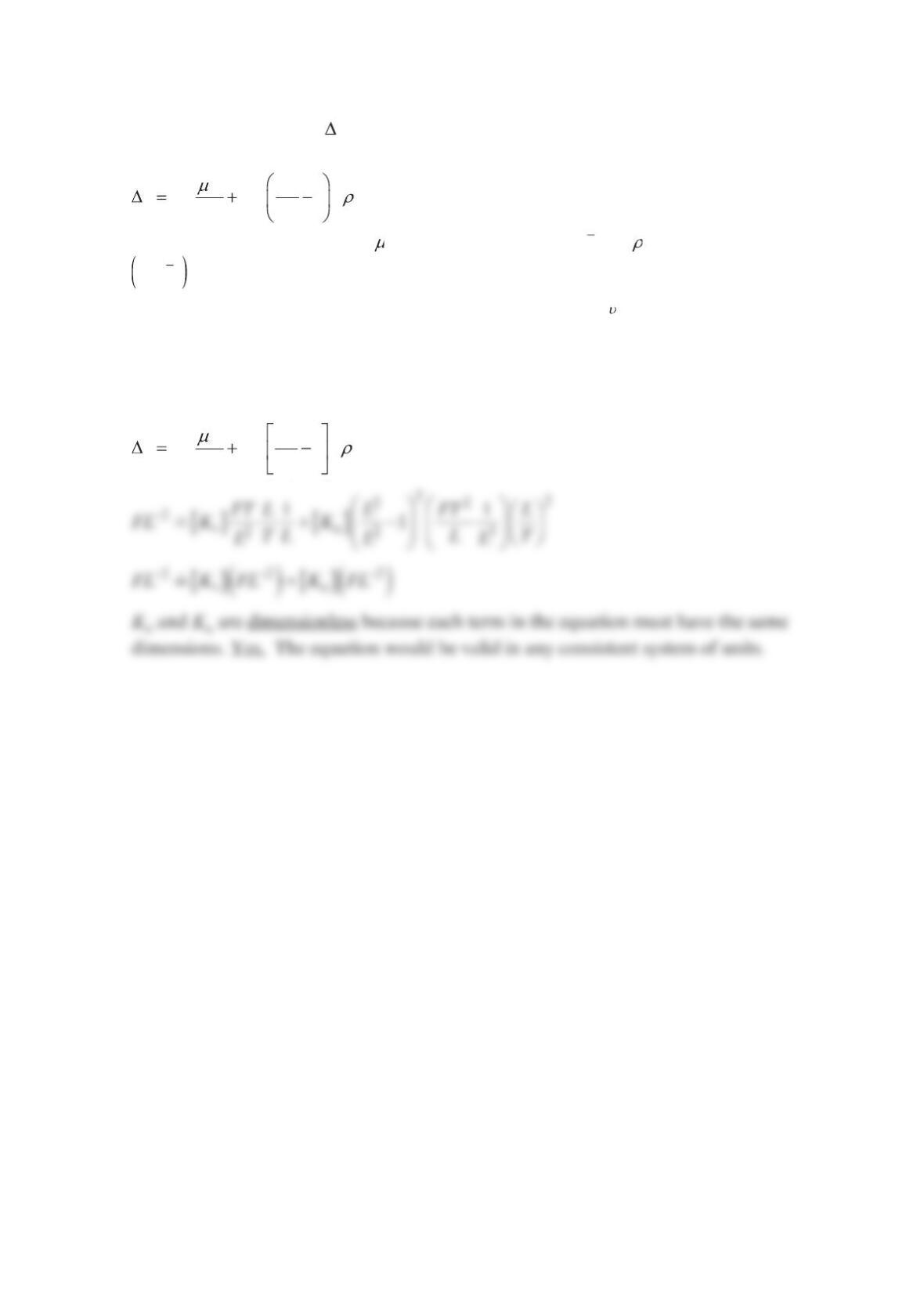
Show that each term in the following equation has units of 3
lb/ft . Consider
u
as velocity, y
as length, x as length, p as pressure, and as absolute viscosity.
2
2
0
p
u
x
y
.
Solution 1.14
lb
Problem 1.15
The pressure difference,
p
, across a partial blockage in an artery (called a stenosis) is ap-
proximated by the equation
2
2
0
1
1
vu
A
V
pK K V
DA
where
V
is the blood velocity, is the blood viscosity 2
()
FL T , is the blood density
3
ML ,
D
is the artery diameter, 0
A
is the area of the unobstructed artery, and 1
A
is the area
of the stenosis. Determine the dimensions of the constants
K
and u
K
. Would this equation
be valid in any system of units?
Solution 1.15
vu
A
V
pK K V
DA
2
2
0
1
1
K
K
Problem 1.16
Assume that the speed of sound,
c
, in a fluid depends on an elastic modulus,
E
, with di-
mensions 2
F
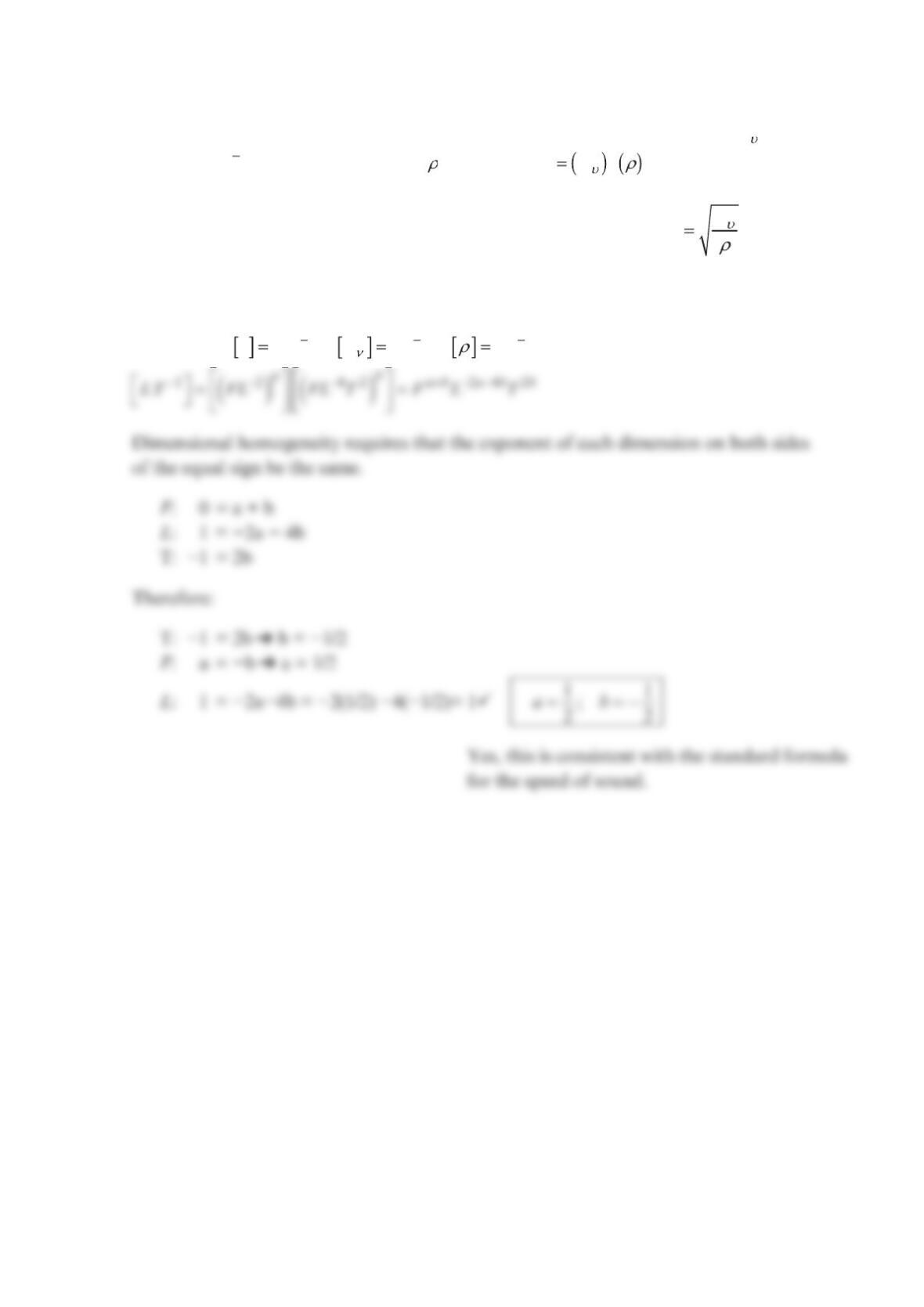
L, and the fluid density, , in the form ab
cE . If this is to be a dimen-
sionally homogeneous equation, what are the values for
a
and
b
? Is your result consistent
with the standard formula for the speed of sound? (See the equation E
c.)
Solution 1.16
1242
S
ubstituting into the equation provided yields:
c LT E FL FL T
Problem 1.17
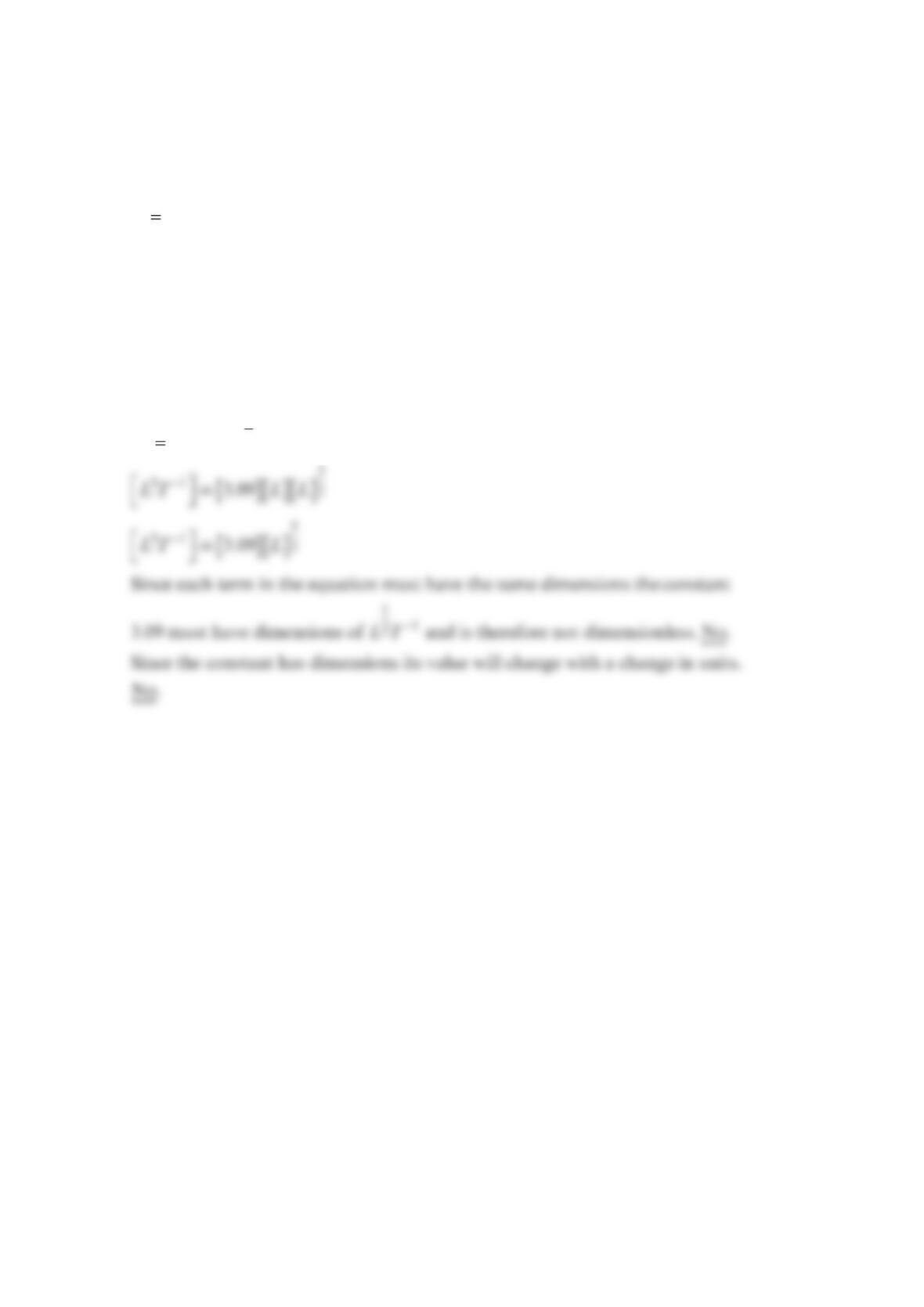
A formula to estimate the volume rate of flow, Q, flowing over a dam of length, B, is given
by the equation
3/2
3.09 QBH
where H is the depth of the water above the top of the dam (called the head). This formula
gives Q in 3
f
t/s
when B and H are in feet. Is the constant, 3.09, dimensionless? Would this
equation be valid if units other than feet and seconds were used?
Solution 1.17
3
2
3.09
QBH
Problem 1.18
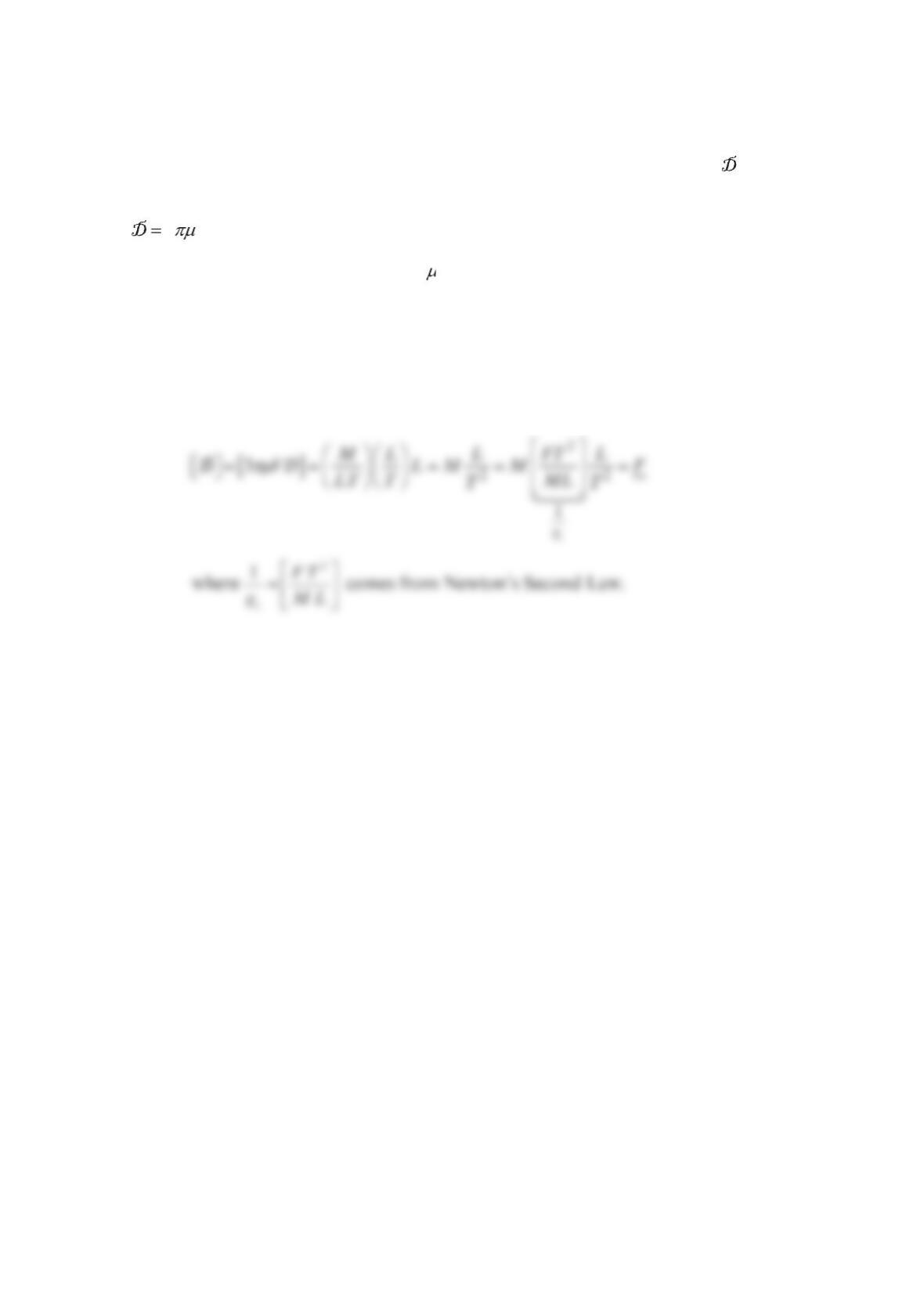
A commercial advertisement shows a pearl falling in a bottle of shampoo. If the diameter
D
of the pearl is quite small and the shampoo is sufficiently viscous, the drag on the pearl is
given by Stokes’s law,
3VD,
where
V
is the speed of the pearl and is the fluid viscosity. Show that the term on the right
side of Stokes’s law has units of force.
Solution 1.18
Problem 1.20
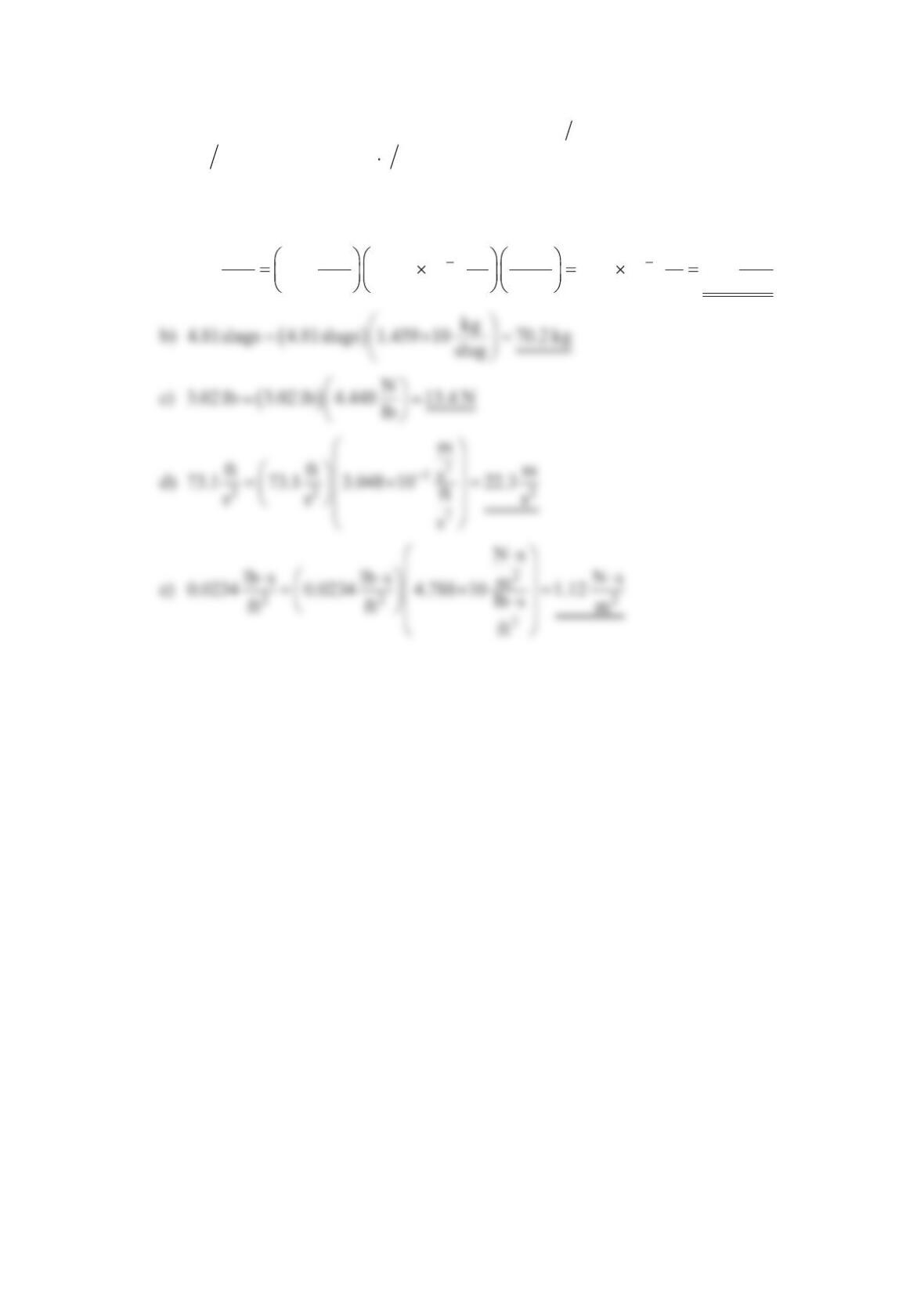
Express the following quantities in SI units: (a)
1
0.2 in. mi
n
, (b) 4.81 slugs, (c)
3
.02 lb,
(d) 2
7
3.1 ft s , and (e) 2
0.0234 lb s ft .
Solution 1.20
a) 23
in. in. m 1min m mm
1
0.2 10.2 2.540 10 4.32 10 4.32
min min in. 60 s s s
Problem 1.21
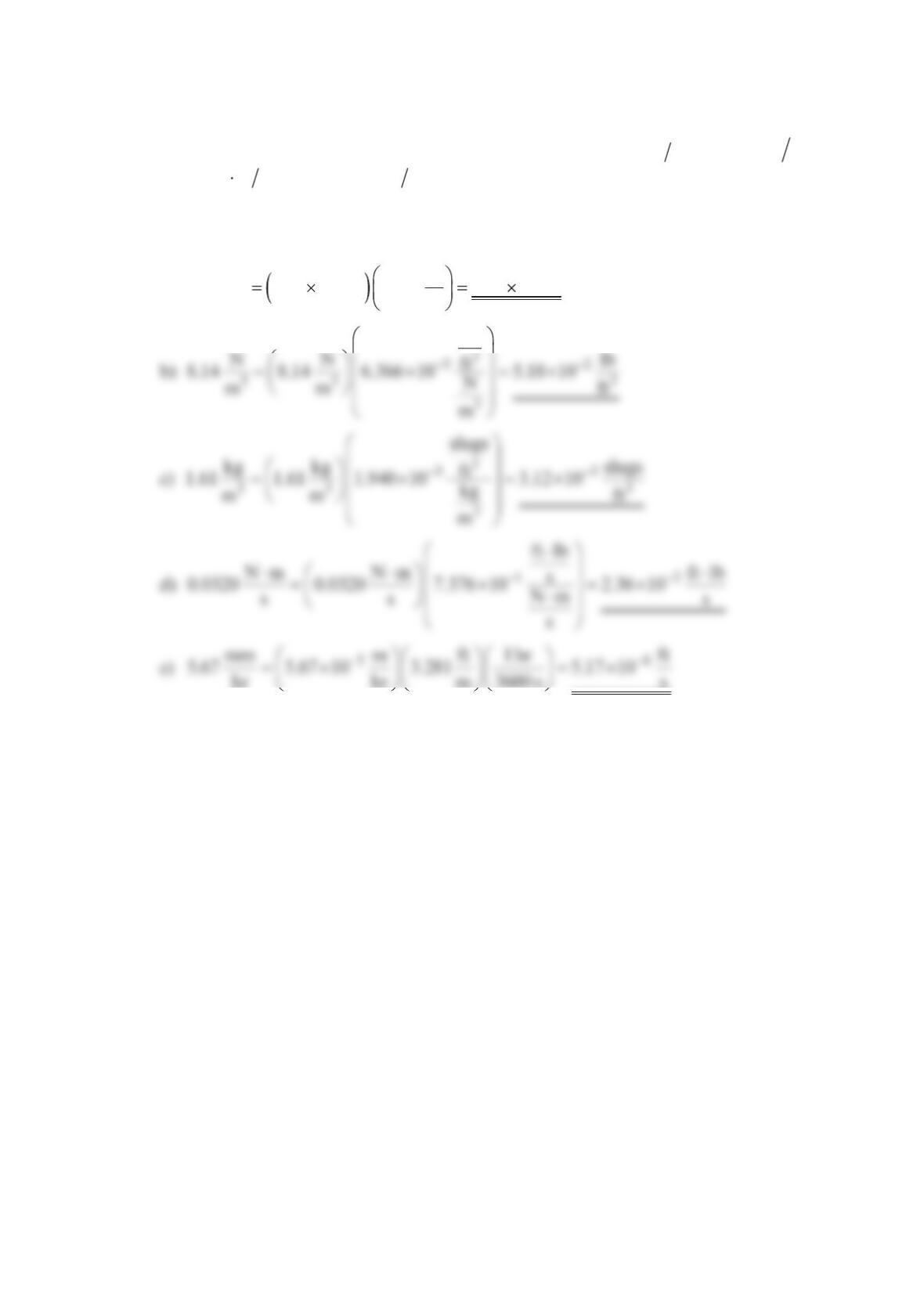
Express the following quantities in BG units: (a)
1
4.2 km, (b) 3
8
.14 N m , (c) 3
1
.61kg m ,
(d) 0.0320 N m s, and (e) 5.67 mm hr.
Solution 1.21
a) 34
ft
1
4.2 km 14.2 10 m 3.281 4.66 10 ft
m
lb
1