PROBLEM 1.33
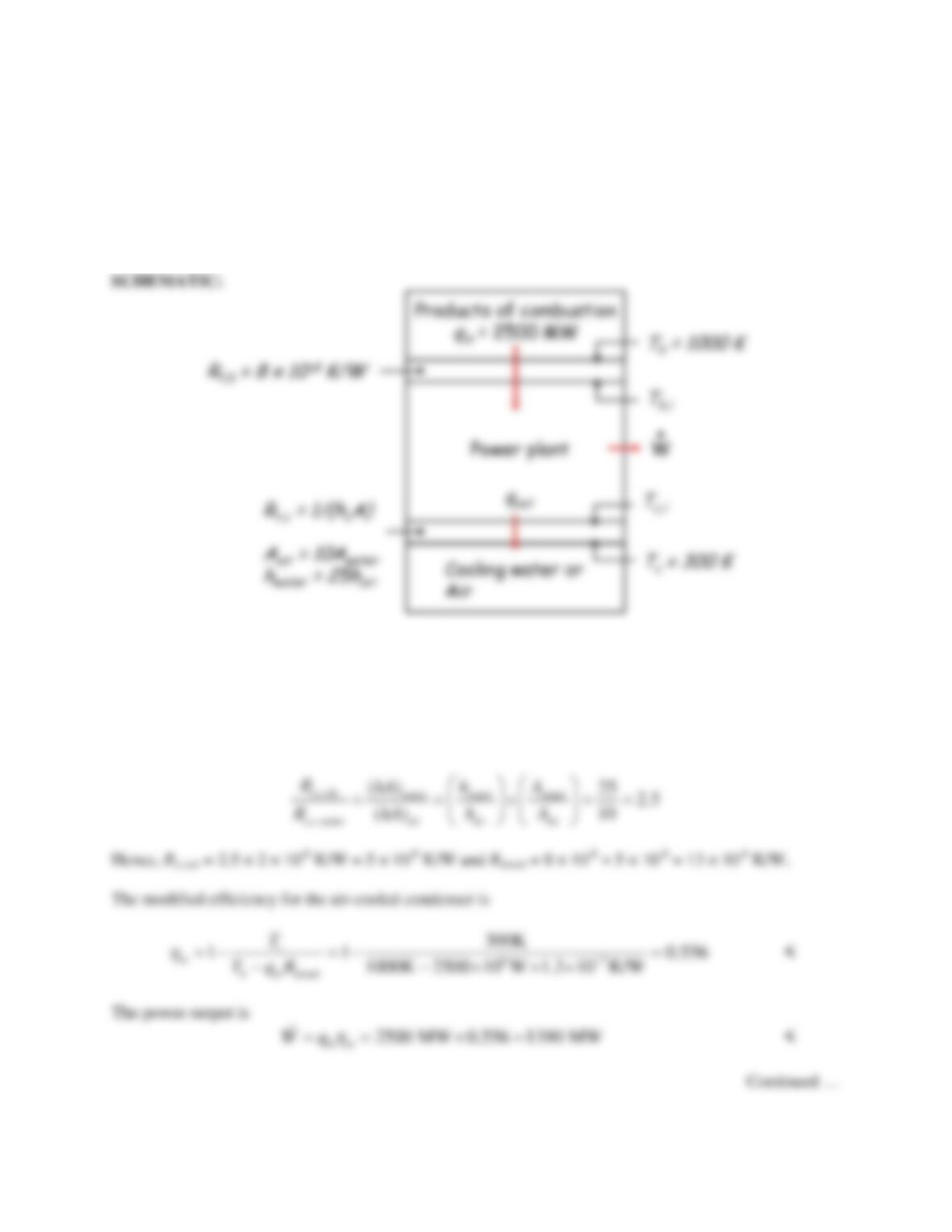
KNOWN: Power plant and operating conditions of Example 1.7. Change in cold-side heat transfer
surface area and convection heat transfer coefficient.
FIND: Modified efficiency and power output.
ASSUMPTIONS: (1) Steady–state conditions, (2) power plant operates as an internally reversible heat
engine, (3) clean operating conditions.
ANALYSIS: The cold–side thermal resistance for water cooling (for design conditions) is provided in
Example 1.7 and is Rt,c = 2 × 10⁻⁸ K/W. The cold side thermal resistance is given by Rt,c = 1/(hcA),
therefore

PROBLEM 1.33 (Cont.)
The air-cooled condenser is both (1) more expensive and (2) leads to a lower plant efficiency and power
output relative to the water-cooled condenser of Example 1.7.
COMMENT: The diminished performance and higher cost of the air-cooled condenser, relative to the
PROBLEM 1.34
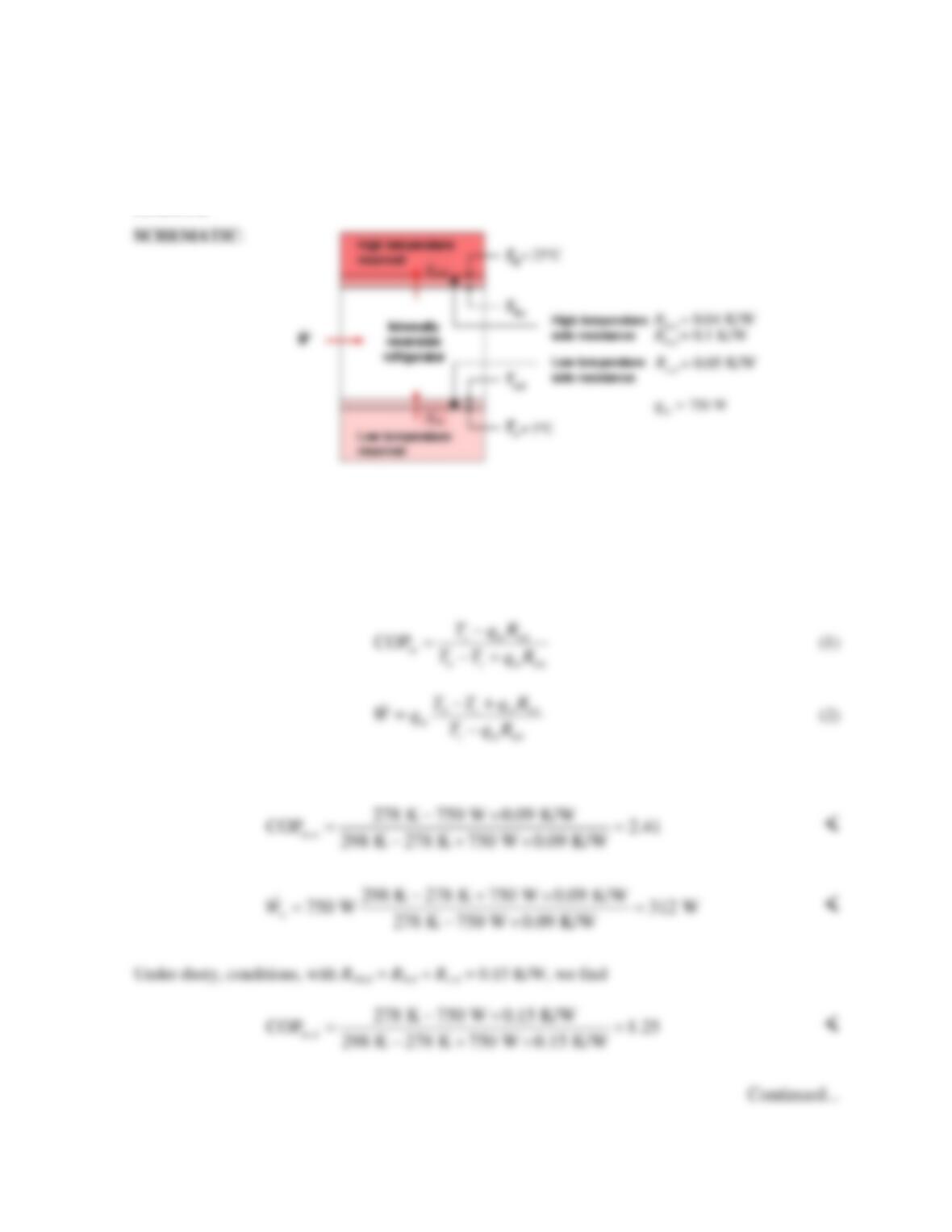
KNOWN: Hot and cold reservoir temperatures of an internally reversible refrigerator. Thermal
resistances between refrigerator and hot and cold reservoirs under clean and dusty conditions. Desired
cooling rate.
FIND: Modified Coefficient of Performance and power input of refrigerator under clean and dusty
conditions.
ASSUMPTIONS: (1) Refrigerator is internally reversible, (2) Steady–state operation, (3) Cold side
thermal resistance does not degrade over time.
ANALYSIS: According to Problem 1.32, the modified Coefficient of Performance and power input
are given by
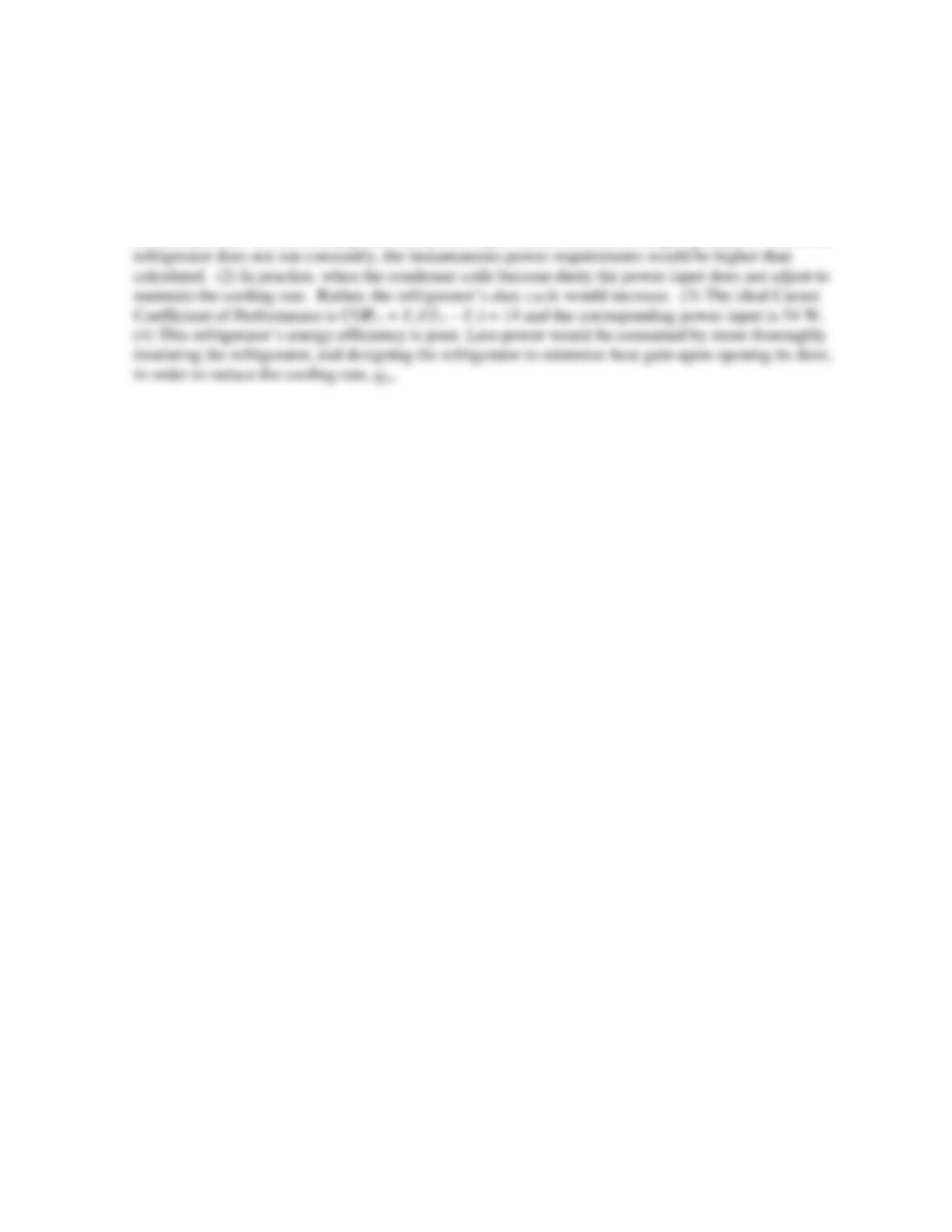
Under new, clean conditions, with Rtot,n = Rh,n + Rc,n = 0.09 K/W, we find
PROBLEM 1.34 (Cont.)
298 K 278 K 750 W 0.15 K/W
750 W 600 W
278 K 750 W 0.15 K/W
d
W−+ ×
= =
−×
<
COMMENTS: (1) The cooling rates and power input values are time–averaged quantities. Since the
PROBLEM 1.35
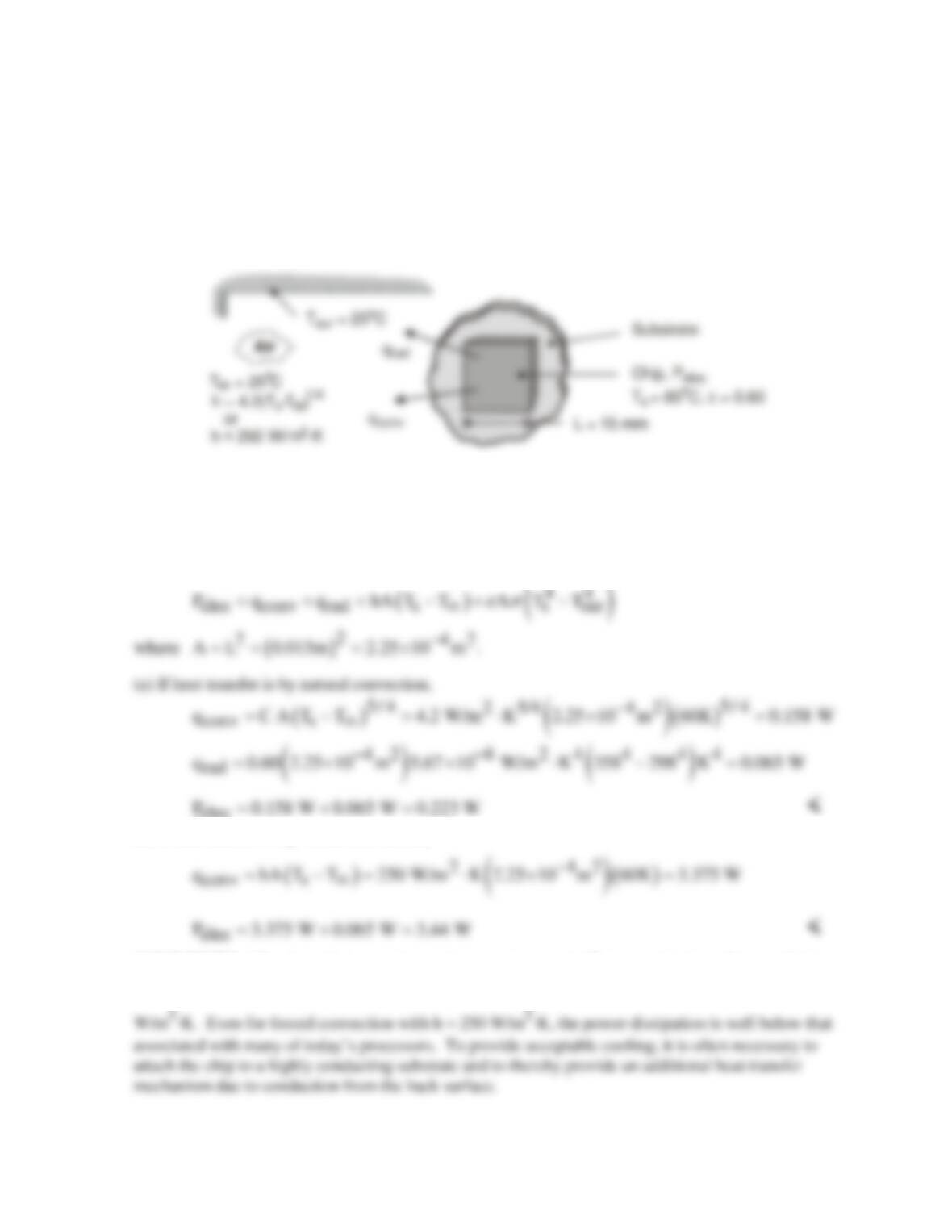
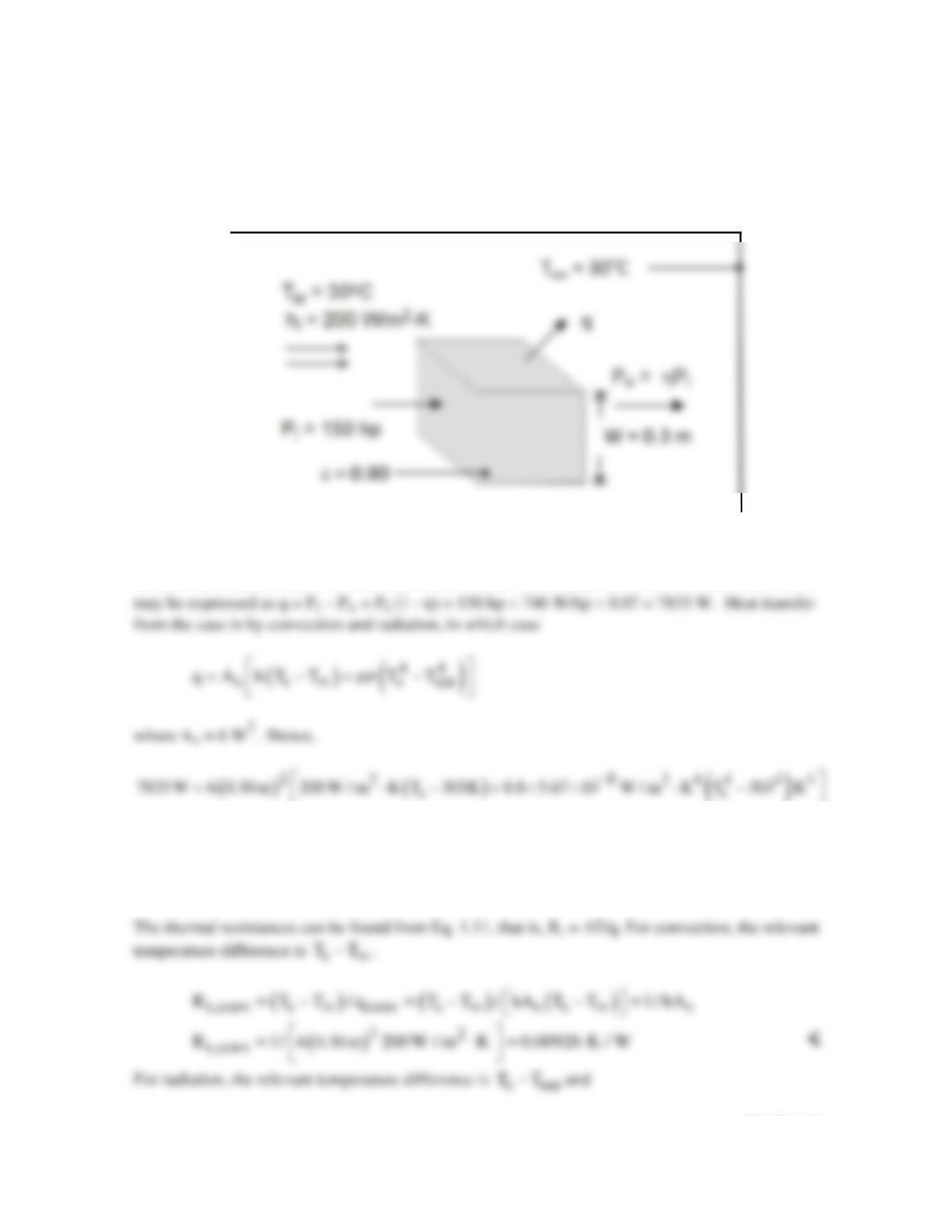
KNOWN: Width, surface emissivity and maximum allowable temperature of an electronic chip.
Temperature of air and surroundings. Convection coefficient.
FIND: (a) Maximum power dissipation for free convection with h(W/m2⋅K) = 4.2(T – T∞)1/4, (b)
Maximum power dissipation for forced convection with h = 250 W/m2⋅K.
SCHEMATIC:
ASSUMPTIONS: (1) Steady-state conditions, (2) Radiation exchange between a small surface and a
large enclosure, (3) Negligible heat transfer from sides of chip or from back of chip by conduction
through the substrate.
ANALYSIS: Subject to the foregoing assumptions, electric power dissipation by the chip must be
balanced by convection and radiation heat transfer from the chip. Hence, from Eq. (1.10),
elec =+=
(b) If heat transfer is by forced convection,
elec =+=
COMMENTS: Clearly, radiation and natural convection are inefficient mechanisms for transferring
heat from the chip. For Ts = 85°C and T∞ = 25°C, the natural convection coefficient is 11.7
PROBLEM 1.36
KNOWN: Width, input power, and efficiency of a transmission. Temperature and convection
coefficient for air flow over the casing. Emissivity of casing and temperature of surroundings.
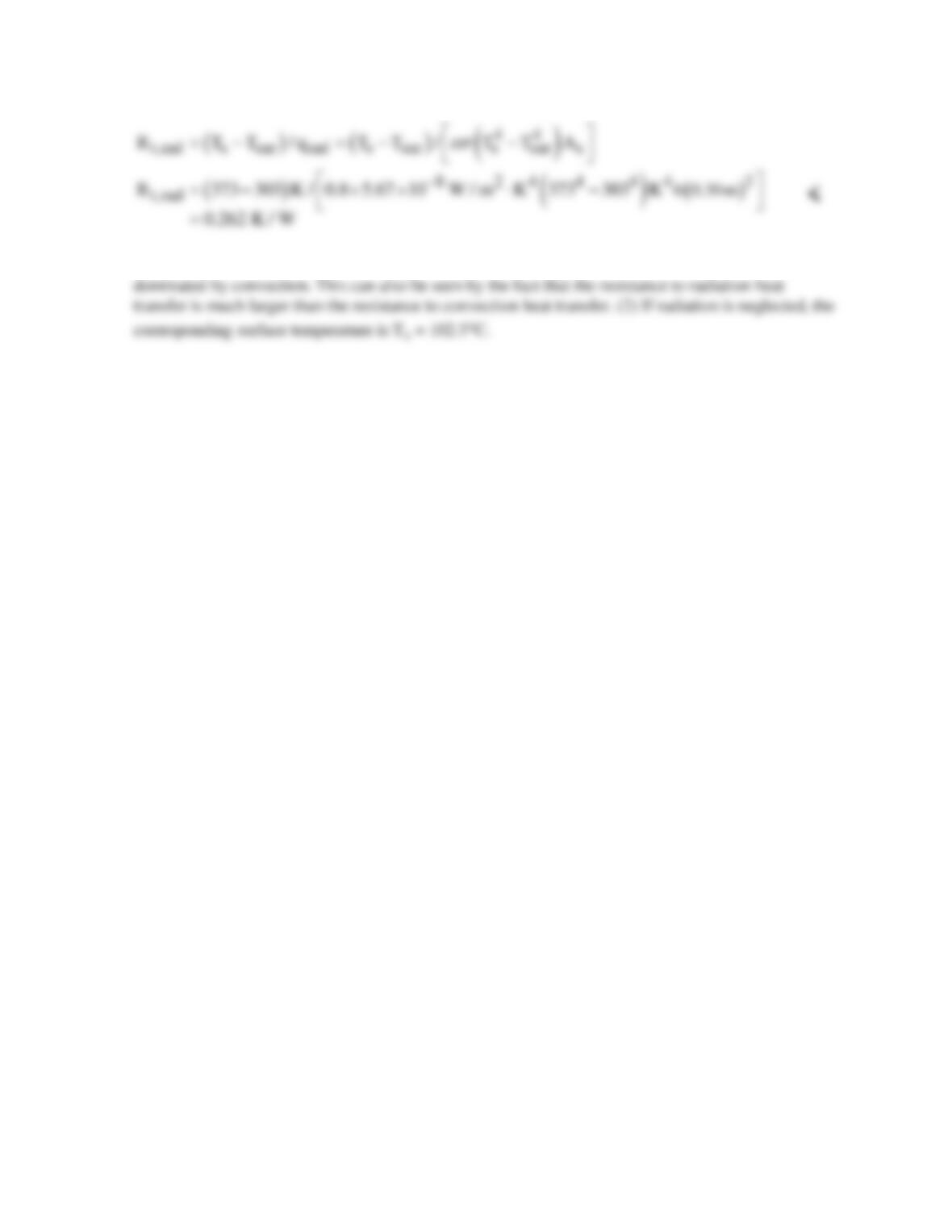
FIND: Surface temperature of casing. Resistances due to convection and radiation.
SCHEMATIC:
ASSUMPTIONS: (1) Steady state, (2) Uniform convection coefficient and surface temperature, (3)
Radiation exchange with large surroundings.
ANALYSIS: Heat transfer from the case must balance heat dissipation in the transmission, which
A trial–and-error solution yields
s
T 373K 100 C≈=°
<
Continued …
PROBLEM 1.36 (Cont.)
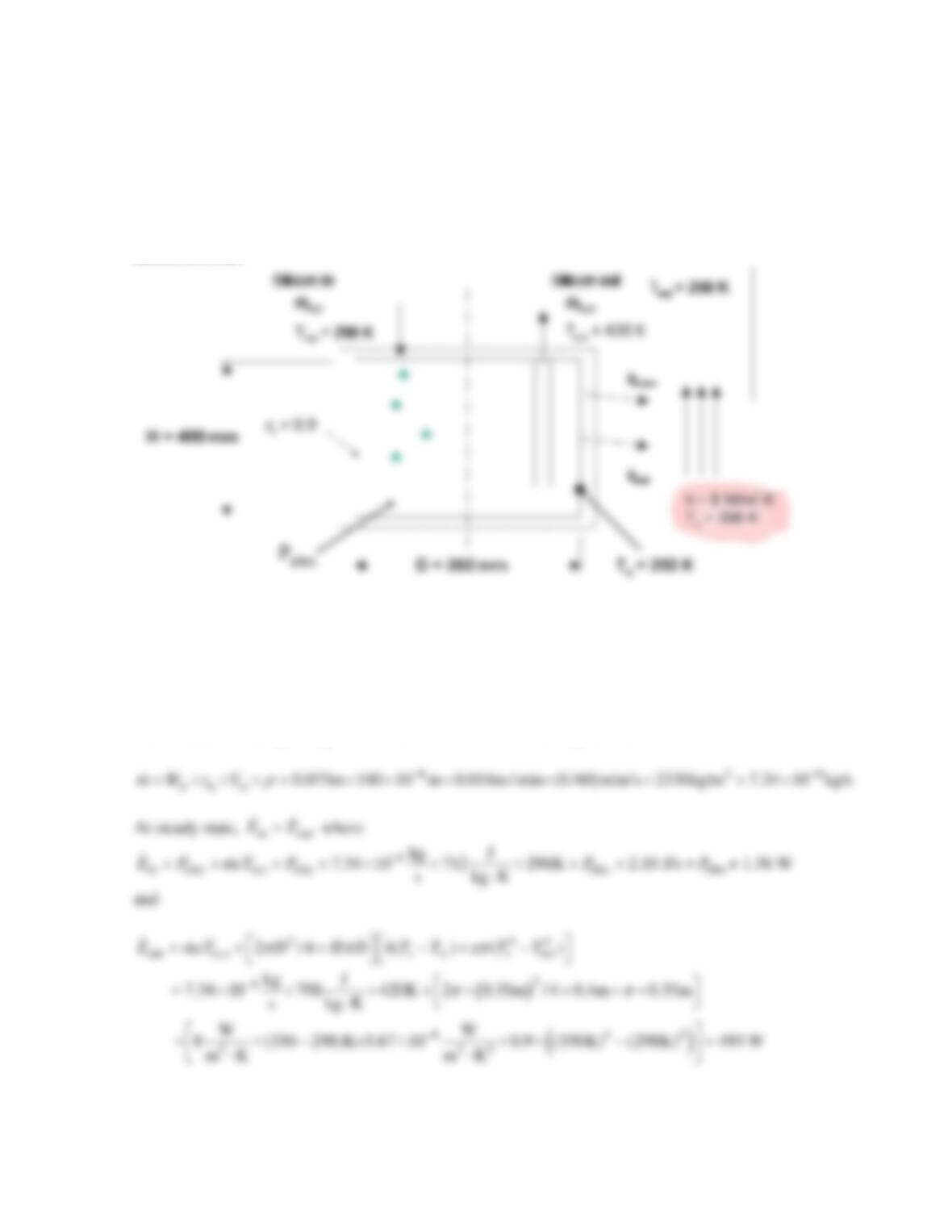
COMMENTS: (1) For Ts ≈ 373 K, qconv ≈ 7,560 W and qrad ≈ 270 W, in which case heat transfer is
PROBLEM 1.37
KNOWN: Process for growing thin, photovoltaic grade silicon sheets. Sheet dimensions and velocity.
Dimensions, surface temperature and surface emissivity of growth chamber. Surroundings and
ambient temperatures, and convective heat transfer coefficient. Amount of time–averaged absorbed
solar irradiation and photovoltaic conversion efficiency.
FIND: (a) Electric power needed to operate at steady state, (b) Time needed to operate the
photovoltaic panel to produce enough energy to offset energy consumed during its manufacture.
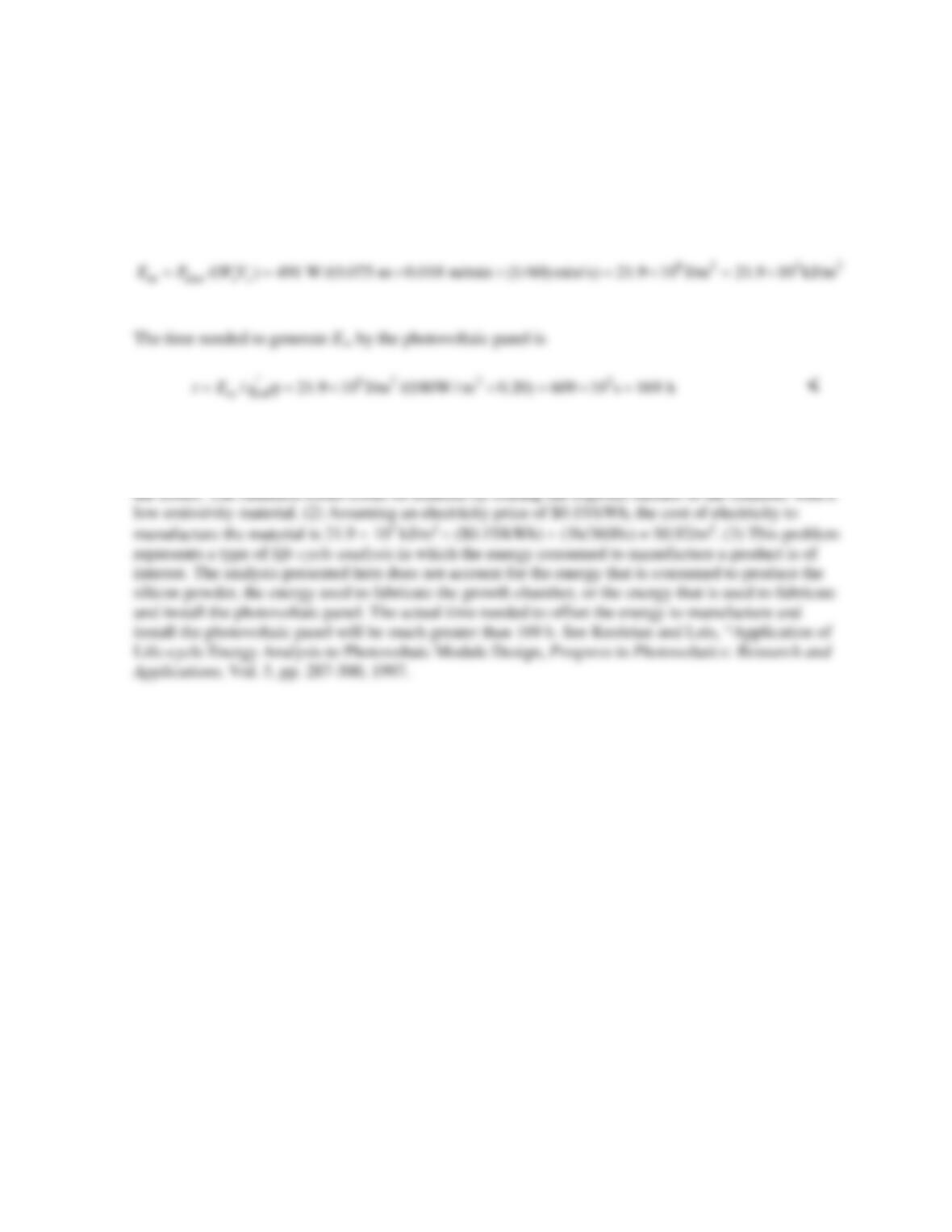
SCHEMATIC:
ASSUMPTIONS: (1) Steady-state conditions, (2) Large surroundings, (3) Constant properties, (4)
Neglect the presence of the strings.
PROPERTIES: Table A-1, Silicon (T = 300 K): c = 712 J/kg⋅K,
r
= 2330 kg/m3, (T = 420 K): c =
798 J/kg⋅K.
ANALYSIS: (a) At steady state, the mass of silicon produced per unit time is equal to the mass of
silicon added to the system per unit time. The amount of silicon produced is
Therefore,
Continued…
PROBLEM 1.37 (Cont.)
elec
493 W 1.56 W 491 WP=−=
<
(b) The electric energy needed to manufacture the photovoltaic material is
COMMENTS: (1) The radiation and convection losses are primarily responsible for the electric
power needed to manufacture the photovoltaic material. Of these, radiation is responsible for 47% of
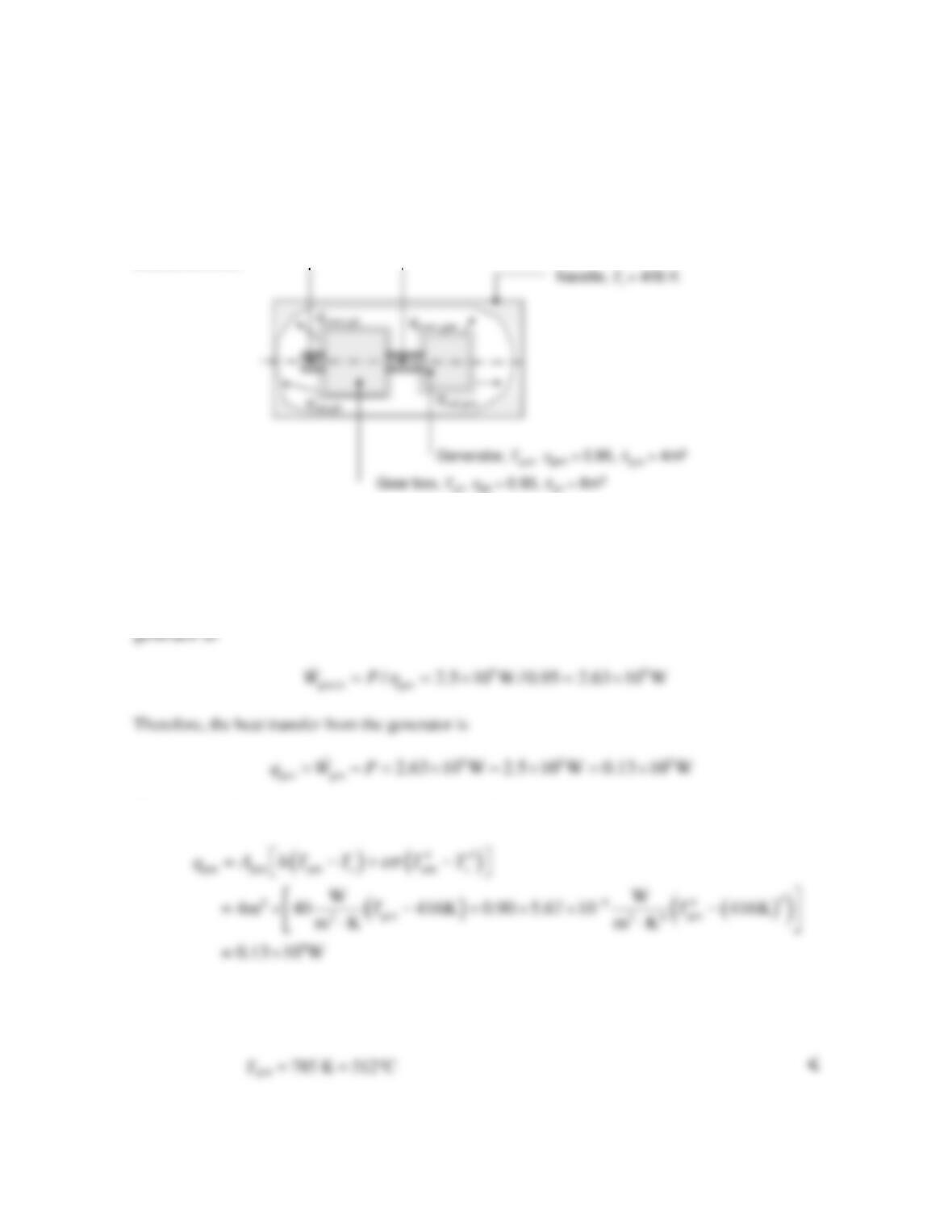
PROBLEM 1.38
KNOWN: Surface areas, convection heat transfer coefficient, surface emissivity of gear box and
generator. Temperature of nacelle. Electric power generated by the wind turbine and generator
efficiency.
FIND: Gear box and generator surface temperatures.
SCHEMATIC:
ASSUMPTIONS: (1) Steady-state conditions, (2) Interior of nacelle can be treated as large
surroundings, (3) Negligible heat transfer between the gear box and the generator.
ANALYSIS: Heat is generated within both the gear box and the generator. The mechanical work into
the generator can be determined from the electrical power, P = 2.5 × 10⁶ W, and the efficiency of the
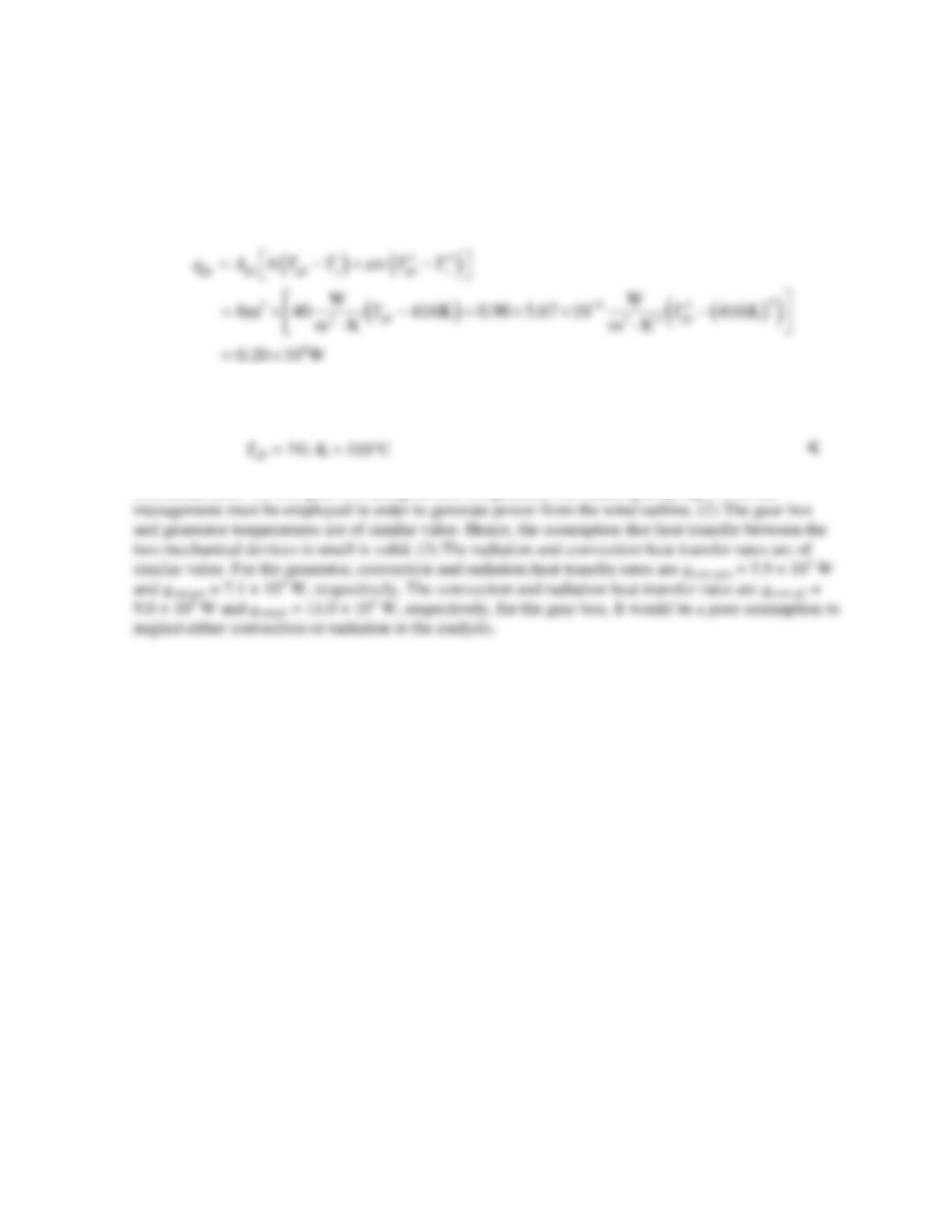
The heat transfer is composed of convection and radiation components. Hence,
The generator surface temperature may be found by using a numerical solver, or by trial-and-error,
yielding
Continued…
Wgen,in
Wgb,in
∙ ∙
PROBLEM 1.38 (Cont.)
Heat is also generated by the gear box. The heat generated in the gear box may be determined from
knowledge of the heat generated cumulatively by the gear box and the generator, which is provided in
Example 3.1 and is q = qgen + qgb = 0.33 × 10⁶ W. Hence, qgb = q – qgen = 0.33 × 10⁶W – 0.13 × 10⁶W
= 0.20 × 10⁶W and
which may be solved by trial-and-error or with a numerical solver to find
COMMENTS: (1) The gear box and generator temperatures are unacceptably high. Thermal
PROBLEM 1.39
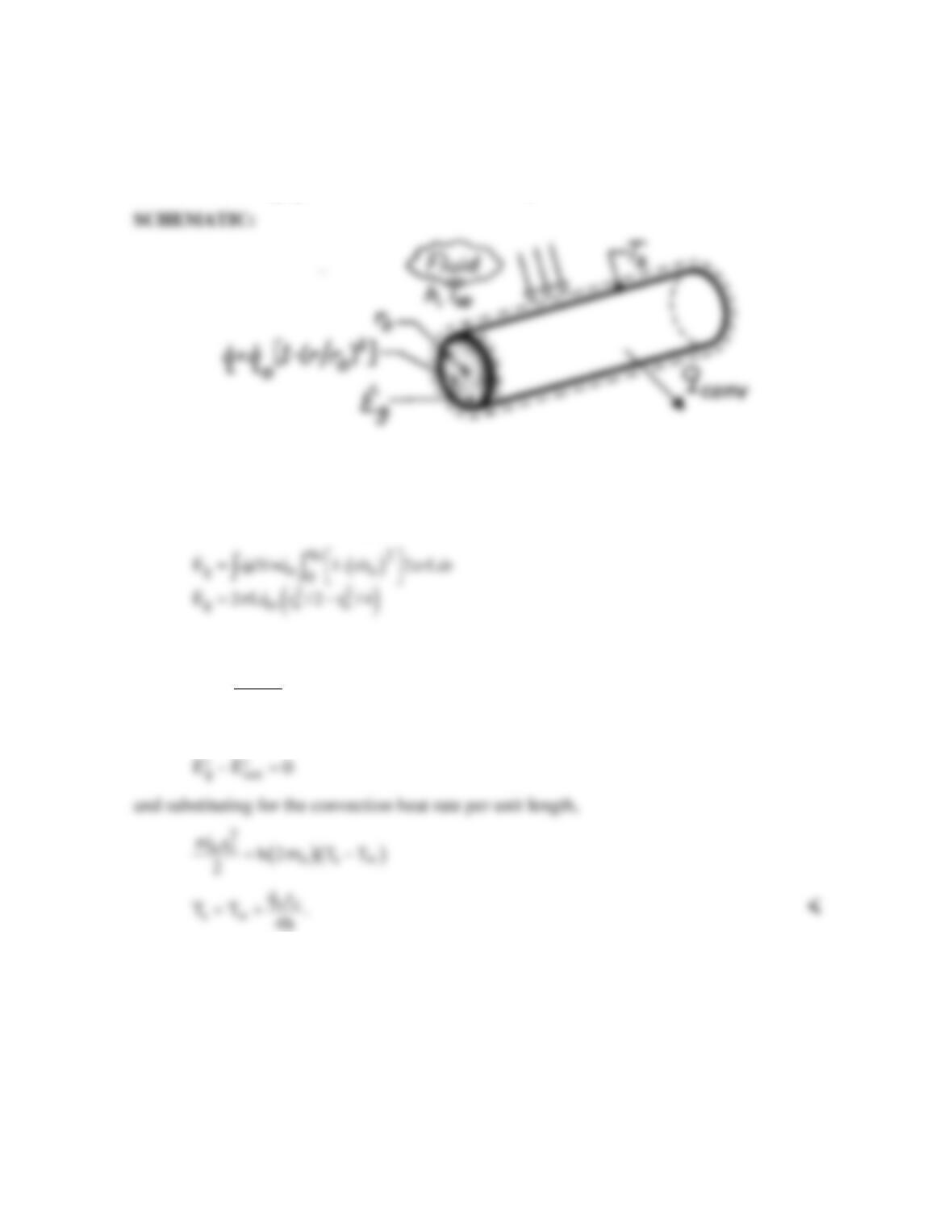
KNOWN: Radial distribution of heat dissipation in a cylindrical container of radioactive
wastes. Surface convection conditions.
FIND: Total energy generation rate and surface temperature.
ASSUMPTIONS: (1) Steady–state conditions, (2) Negligible temperature drop across thin
container wall.
ANALYSIS: The rate of energy generation is
or per unit length,
.
′=Eq r
2
go o
2
p
<
Performing an energy balance for a control surface about the container yields, at an instant,
COMMENTS: The temperature within the radioactive wastes increases with decreasing r
from Ts at ro to a maximum value at the centerline.
PROBLEM 1.40
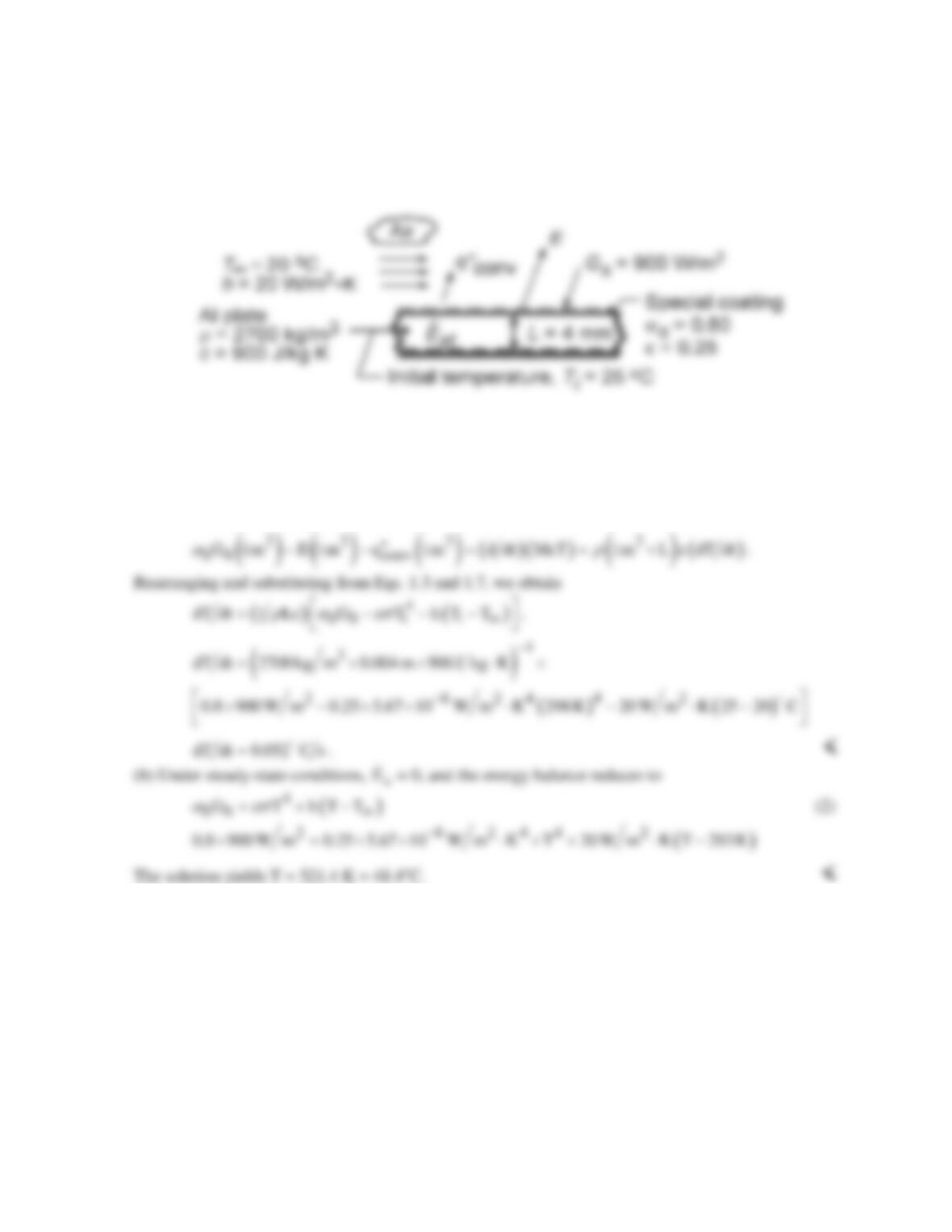
KNOWN: Thickness and initial temperature of an aluminum plate whose thermal environment is
changed.
FIND: (a) Initial rate of temperature change, (b) Steady–state temperature of plate.
SCHEMATIC:
ASSUMPTIONS: (1) Negligible end effects, (2) Uniform plate temperature at any instant, (3)
Constant properties, (4) Adiabatic bottom surface, (5) Negligible radiation from surroundings, (6) No
internal heat generation.
ANALYSIS: (a) Applying an energy balance, Eq. 1.12c, at an instant of time to a control volume
about the plate,
in out st
EE E−=
, it follows for a unit surface area.
COMMENTS: The surface radiative properties have a significant effect on the plate temperature,
which would decrease with increasing ε and decreasing aS. If a low temperature is desired, the plate
coating should be characterized by a large value of ε/aS. The temperature would also decrease with
increasing h.
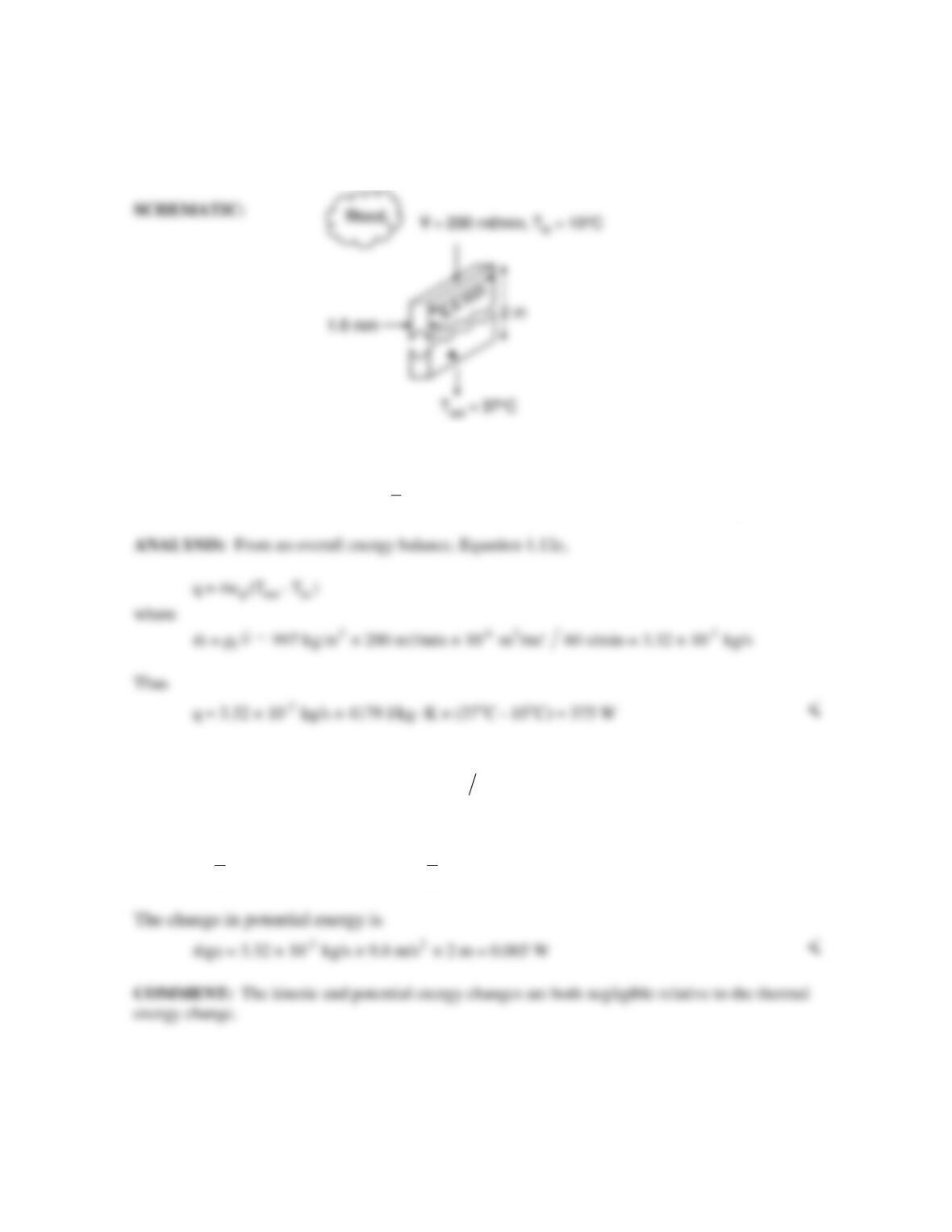
PROBLEM 1.41
KNOWN: Blood inlet and outlet temperatures and flow rate. Dimensions of tubing.
FIND: Required rate of heat addition and estimate of kinetic and potential energy changes.
ASSUMPTIONS: (1) Steady–state conditions, (2) Incompressible liquid with negligible kinetic and
potential energy changes, (3) Blood has properties of water.
PROPERTIES: Table A.6, Water (
T
≈ 300 K): cp,f = 4179 J/ kg∙ K, ρf = 1/vf = 997 kg/m3.
q = 3.32 × 10 kg/s × 4179 J/kg K × (37 C – 10 C) = 375 W⋅
The velocity in the tube is given by
-6 3 -3 -3
c
V = /A = 200 m /min × 10 m /m (60 s/min × 6.4 × 10 m × 1.6 × 10 m)= 0.33 m/s∀
The change in kinetic energy is
2 -3 2 -4
11
22
m( V – 0) = 3.32 × 10 kg/s × × (0.33 m/s) = 1.8 × 10 W
<
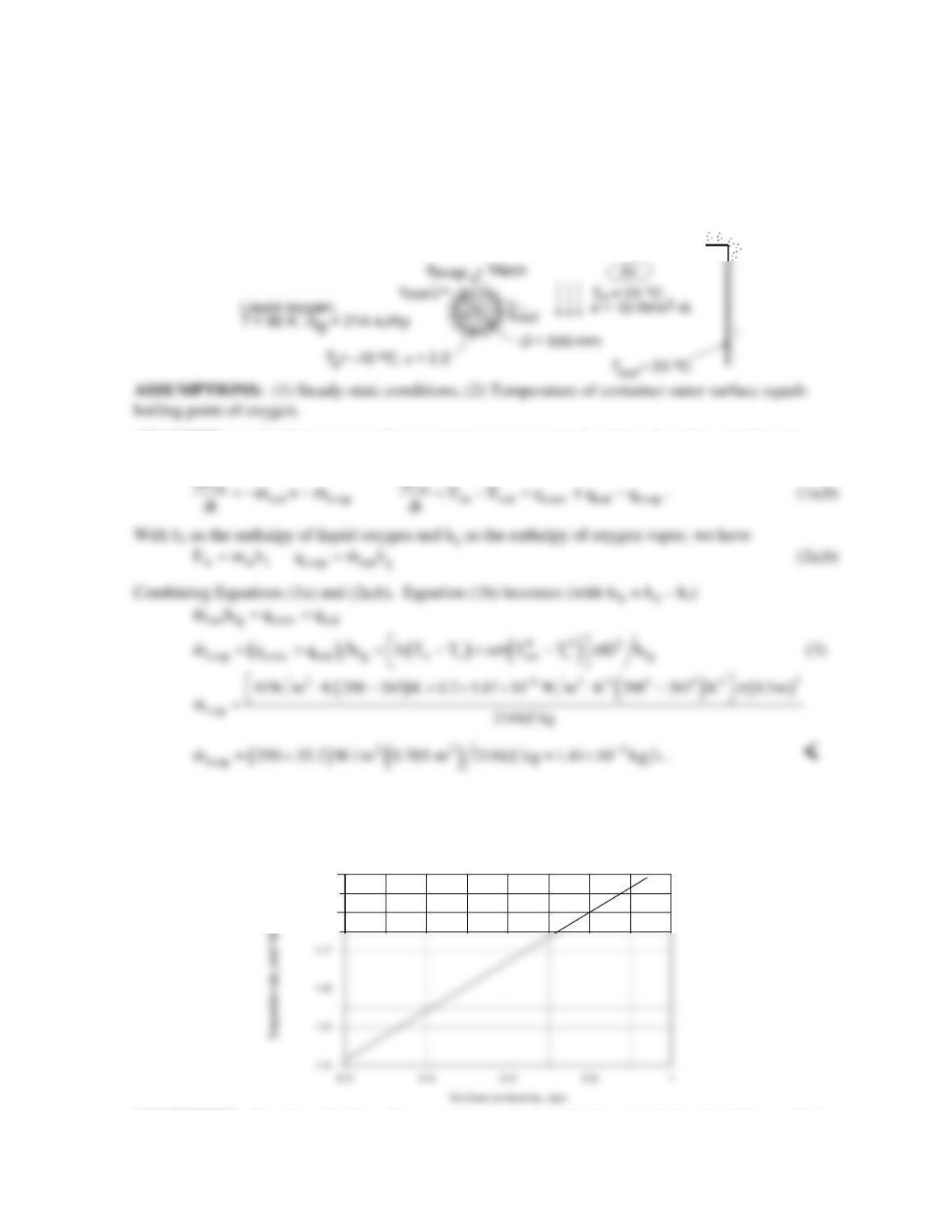
PROBLEM 1.42
KNOWN: Boiling point and latent heat of liquid oxygen. Diameter and emissivity of container.
Free convection coefficient and temperature of surrounding air and walls.
FIND: Mass evaporation rate.
SCHEMATIC:
ANALYSIS: (a) Applying mass and energy balances to a control surface about the container, it
follows that, at any instant,
(b) Using Equation (3), the mass rate of vapor production can be determined for the range of
emissivity 0.2 to 0.94. The effect of increasing emissivity is to increase the heat rate into the
container and, hence, increase the vapor production rate.
1.8
1.9
COMMENTS: To reduce the loss of oxygen due to vapor production, insulation should be applied
to the outer surface of the container, in order to reduce qconv and qrad . Note from the calculations in
part (a), that heat transfer by convection is greater than by radiation exchange.
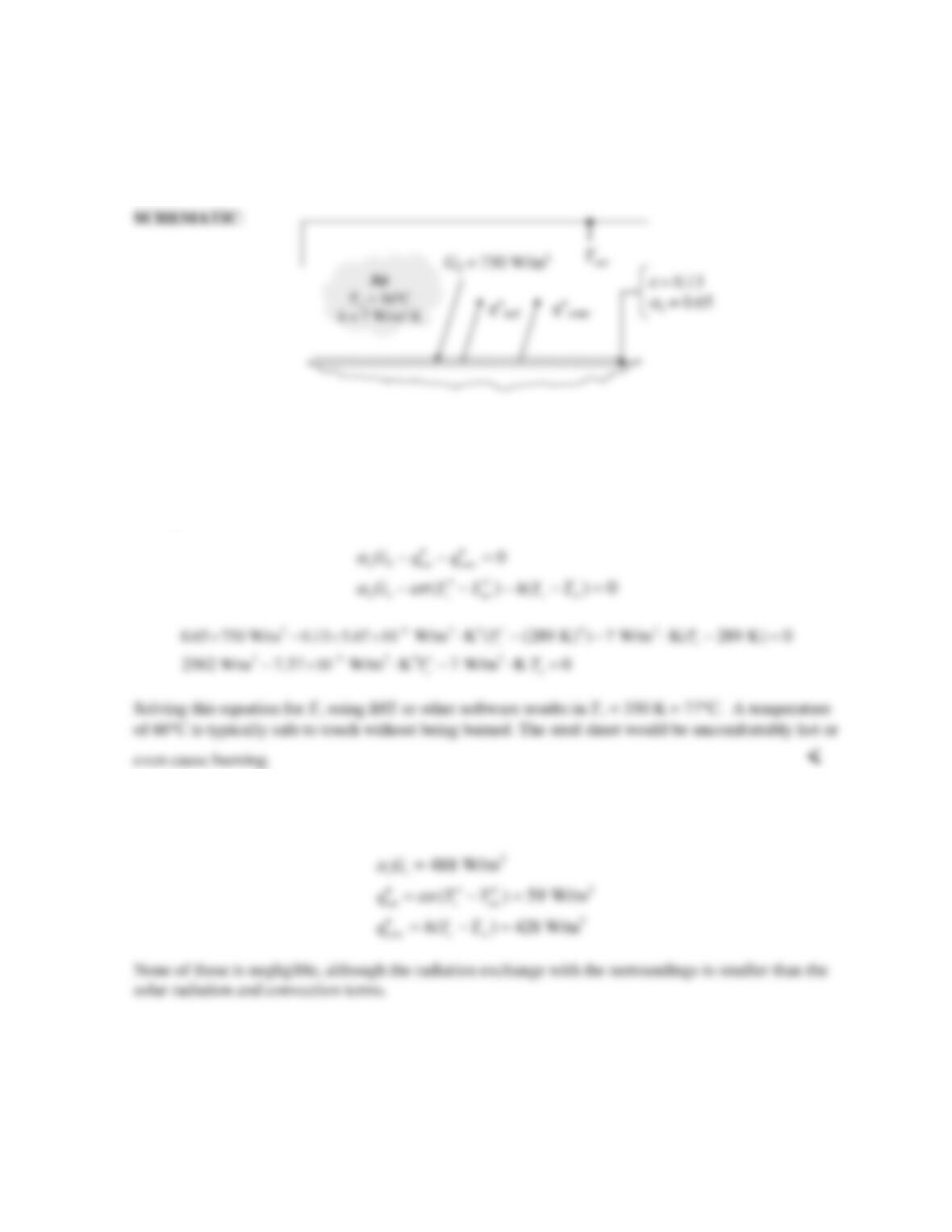
PROBLEM 1.43
KNOWN: Emissivity and solar absorptivity of steel sheet. Solar irradiation, air temperature and
convection coefficient.
FIND: Temperature of the steel sheet to determine cat comfort.
ASSUMPTIONS: (1) Steady-state conditions, (2) Bottom surface of steel is insulated, (3) Radiation
from the environment can be treated as radiation from large surroundings, with
a
=
ε
, (4) Tsur = T∞.
ANALYSIS: Performing a control surface energy balance on the top surface of the steel sheet gives
(on a per unit area basis)
COMMENTS: The individual heat flux terms are
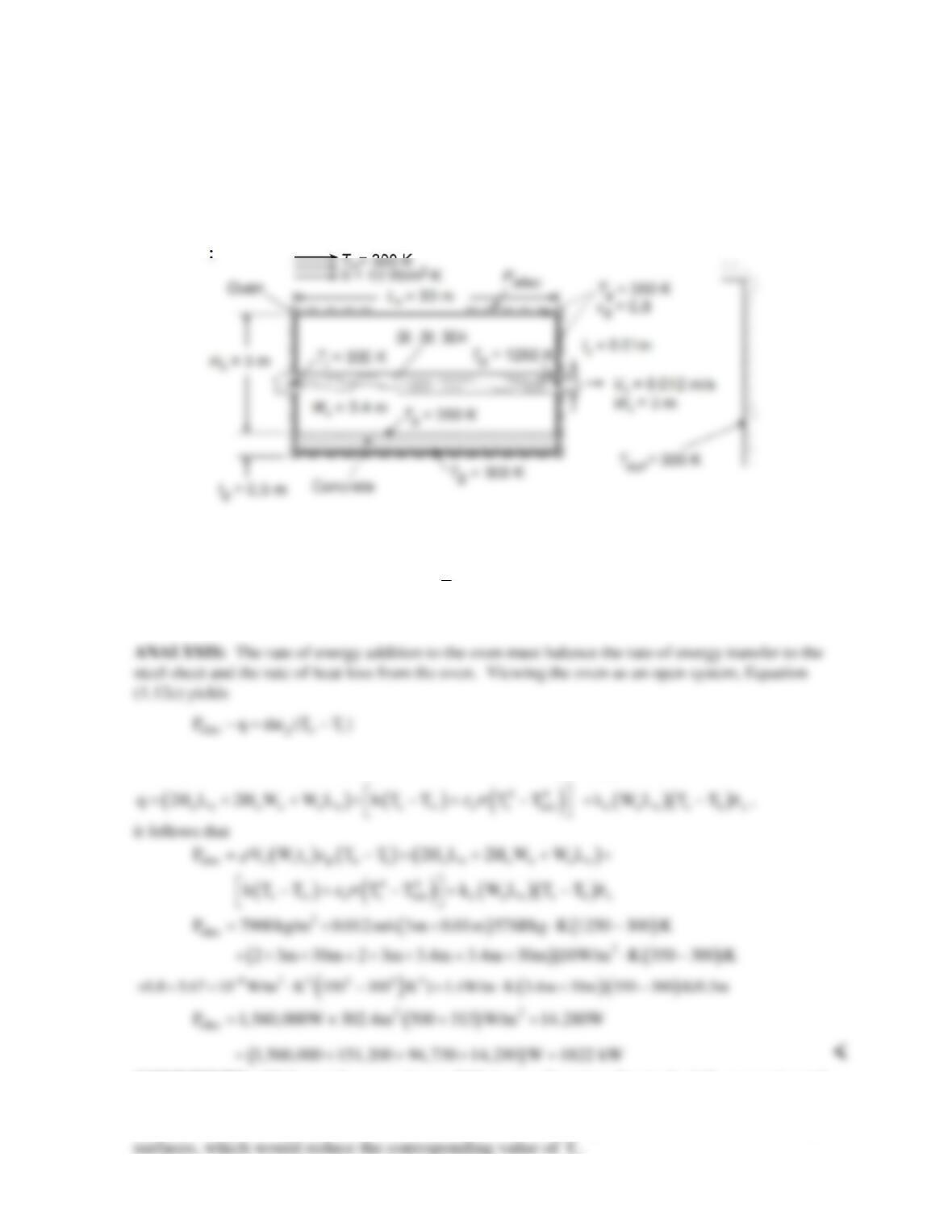
PROBLEM 1.44
KNOWN: Speed, width, thickness and initial and final temperatures of 304 stainless steel in an
annealing process. Dimensions of annealing oven and temperature, emissivity and convection
coefficient of surfaces exposed to ambient air and large surroundings of equivalent temperatures.
Thickness of pad on which oven rests and pad surface temperatures.
FIND: Oven operating power.
SCHEMATIC:
ASSUMPTIONS: (1) steady–state, (2) Constant properties, (3) Negligible changes in kinetic and
potential energy.
PROPERTIES: Table A.1, Stainless 304
( )
( )
io
T T T /2 775K=+=
: r = 7900 kg/m3,
c
p
= 578
J/kg⋅K; Table A.3, Concrete, T = 300 K:
kc
= 1.4 W/m⋅K.
where q is the heat transferred from the oven. With
( )
s ss
m V Wt
r
=
and
COMMENTS: Of the total energy input, 86% is transferred to the steel while approximately
10%, 5% and 1% are lost by convection, radiation and conduction from the oven. The
convection and radiation losses can both be reduced by adding insulation to the side and top
Ts
PROBLEM 1.45
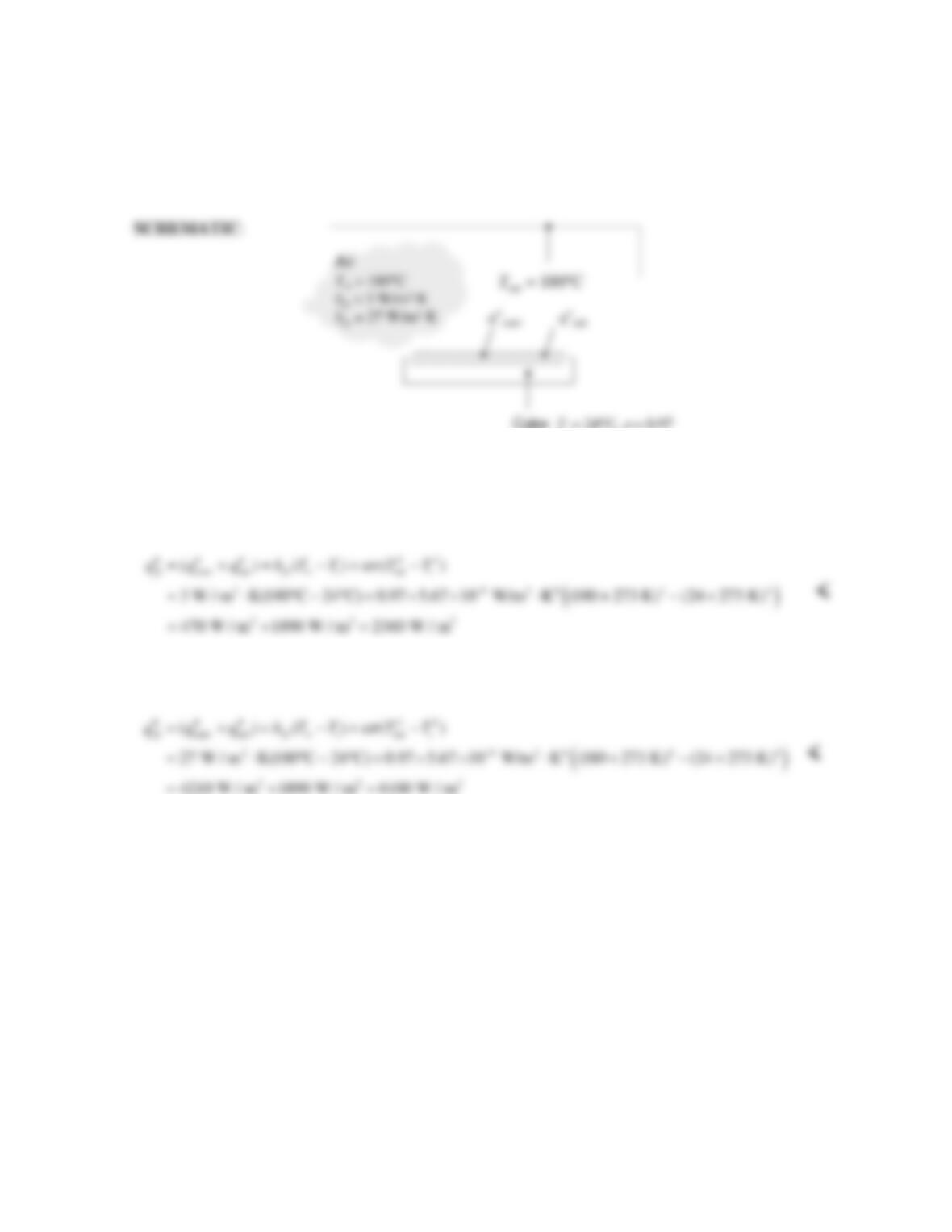
KNOWN: Temperatures of small cake as well as oven air and walls. Convection heat transfer
coefficient under free and forced convection conditions. Emissivity of cake batter and pan.
FIND: Heat flux to cake under free and forced convection conditions.
ASSUMPTIONS: (1) Large surroundings.
ANALYSIS: The heat flux to the cake pan and batter is due to convection and radiation. With the
surface temperature equal to Ti, when the convection feature is disabled,
When the convection feature is activated, the heat flux is
4210 W / m 1890 W / m 6100 W / m
=+=
COMMENTS: Under free convection conditions, the convection contribution is about 20% of the
total heat flux. When forced convection is activated, convection becomes larger than radiation,
accounting for 69% of the total heat flux. The cake will bake faster under forced convection
conditions.
Cake Ti= 24°C,
ε
= 0.97
PROBLEM 1.46
KNOWN: Silicon wafer positioned in furnace with top and bottom surfaces exposed to hot and cool
zones, respectively.
FIND: (a) Initial rate of change of the wafer temperature corresponding to the wafer temperature
w,i
T 300 K,=
and (b) Steady-state temperature reached if the wafer remains in this position. How
significant is convection for this situation? Sketch how you’d expect the wafer temperature to vary as
a function of vertical distance.
SCHEMATIC:
ASSUMPTIONS: (1) Wafer temperature is uniform, (2) Transient conditions when wafer is initially
positioned, (3) Hot and cool zones have uniform temperatures, (3) Radiation exchange is between
small surface (wafer) and large enclosure (chamber, hot or cold zone), and (4) Negligible heat losses
from wafer to mounting pin holder.
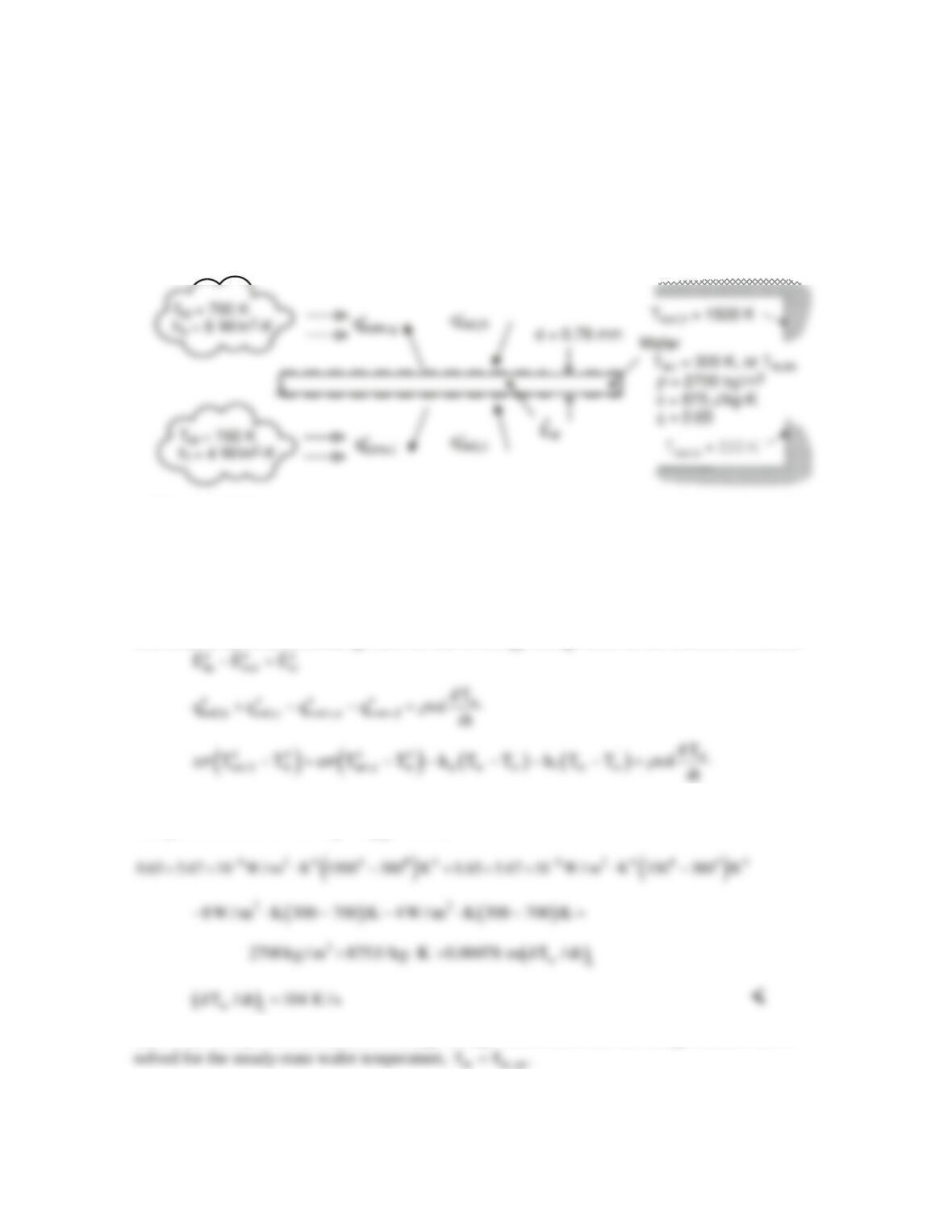
ANALYSIS: The energy balance on the wafer illustrated in the schematic above includes convection
from the upper (u) and lower (l) surfaces with the ambient gas, radiation exchange with the hot– and
cool-zone (chamber) surroundings, and the rate of energy storage term for the transient condition.
(a) For the initial condition, the time rate of temperature change of the wafer is determined using the
energy balance above with
w w,i
T T 300 K,= =
(b) For the steady-state condition, the energy storage term is zero, and the energy balance can be
Continued …..
PROBLEM 1.46 (Cont.)
w,ss
To determine the relative importance of the convection processes, re–solve the energy balance above
ignoring those processes to find
( )
w w,ss
i
d T / dt 101 K / s and T 1262 K.= =
We conclude that the
radiation exchange processes control the initial time rate of temperature change and the steady–state
temperature.
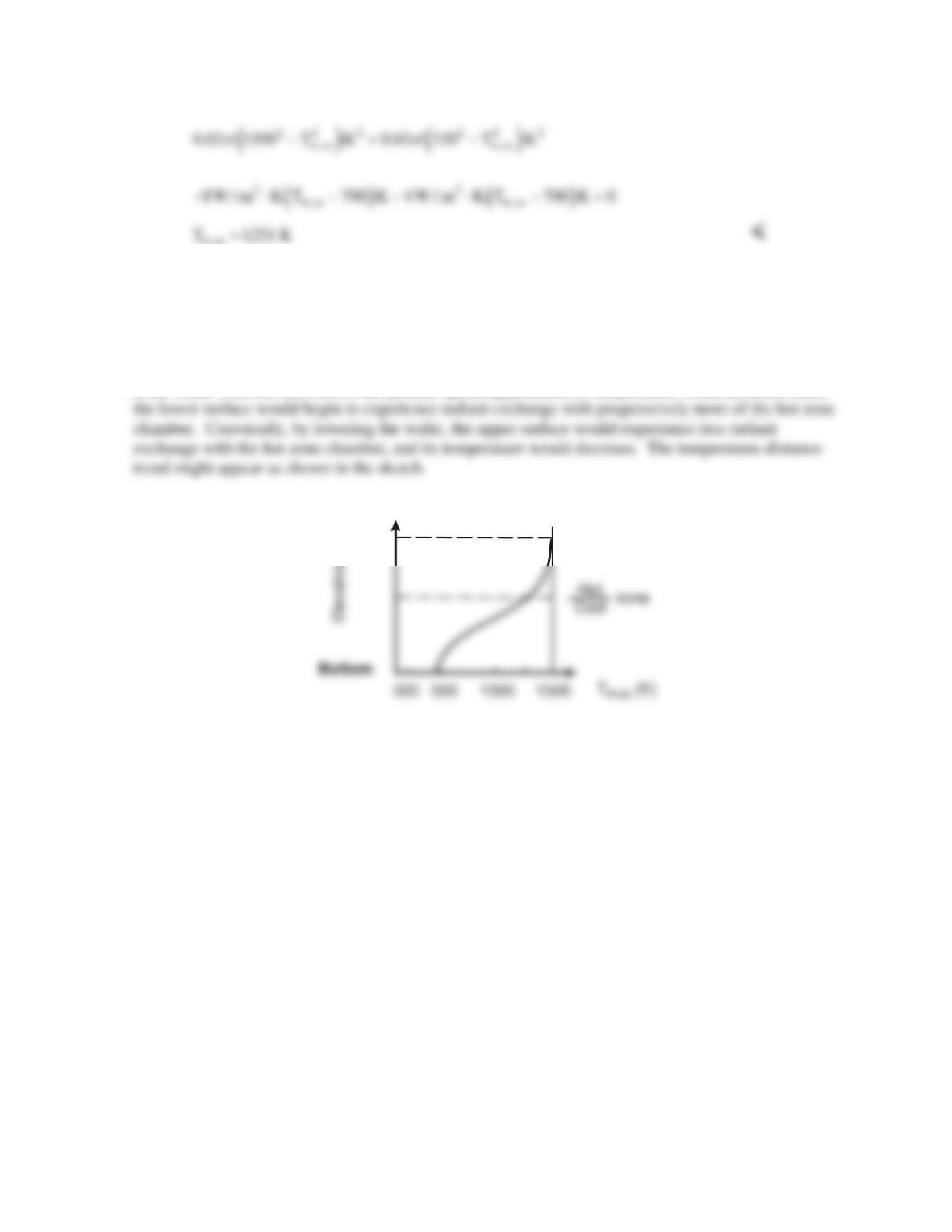
If the wafer were elevated above the present operating position, its temperature would increase, since
Top