Problem 1.119
A soda straw with an inside diameter of
0
.125 in. is inserted into a pan of water at
6
0 °F. The
water in the straw rises to a height of
0
.150 in. above the water surface in the pan. Determine
the value of , the contact angle of the water with the straw (see the figure below).
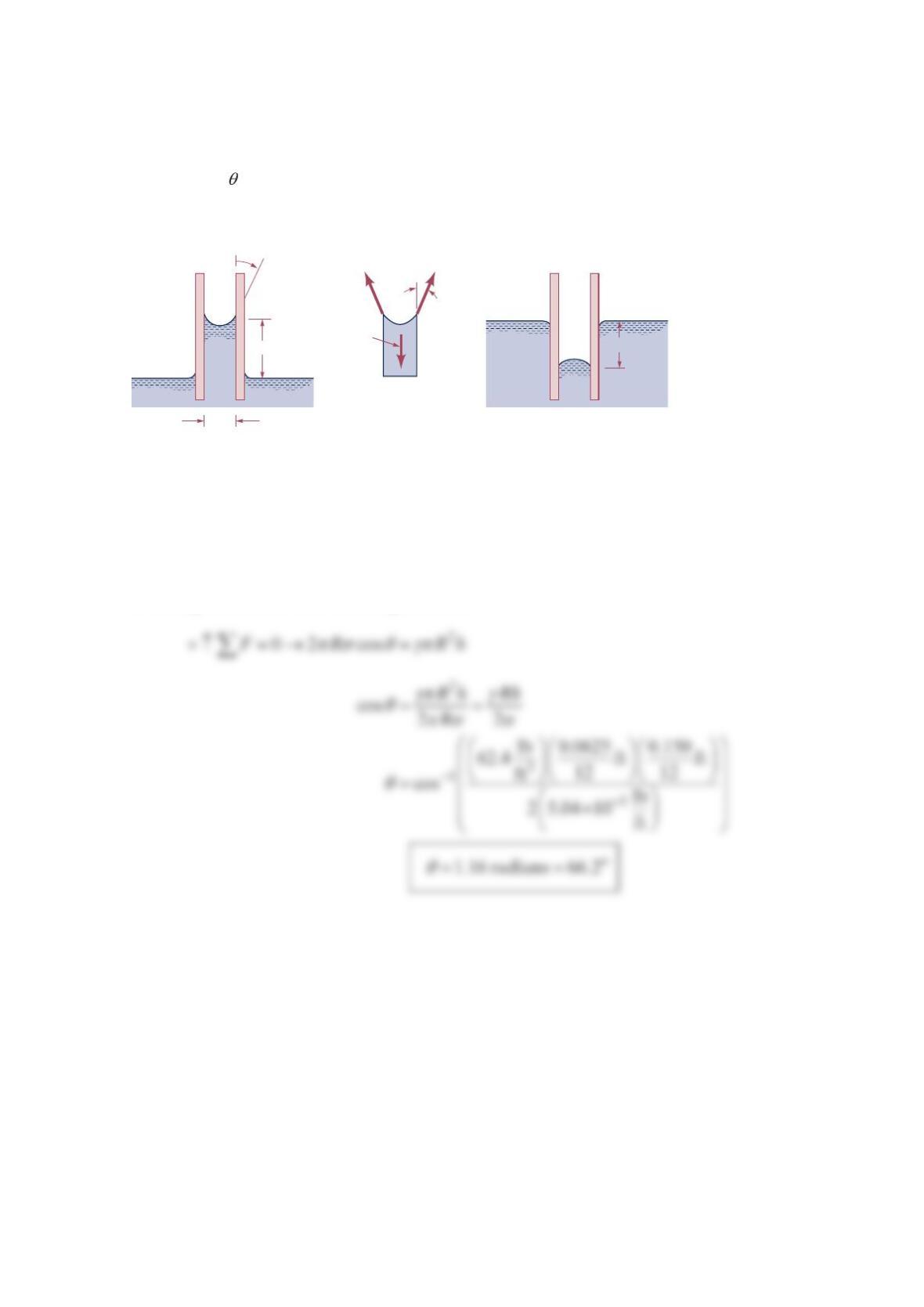
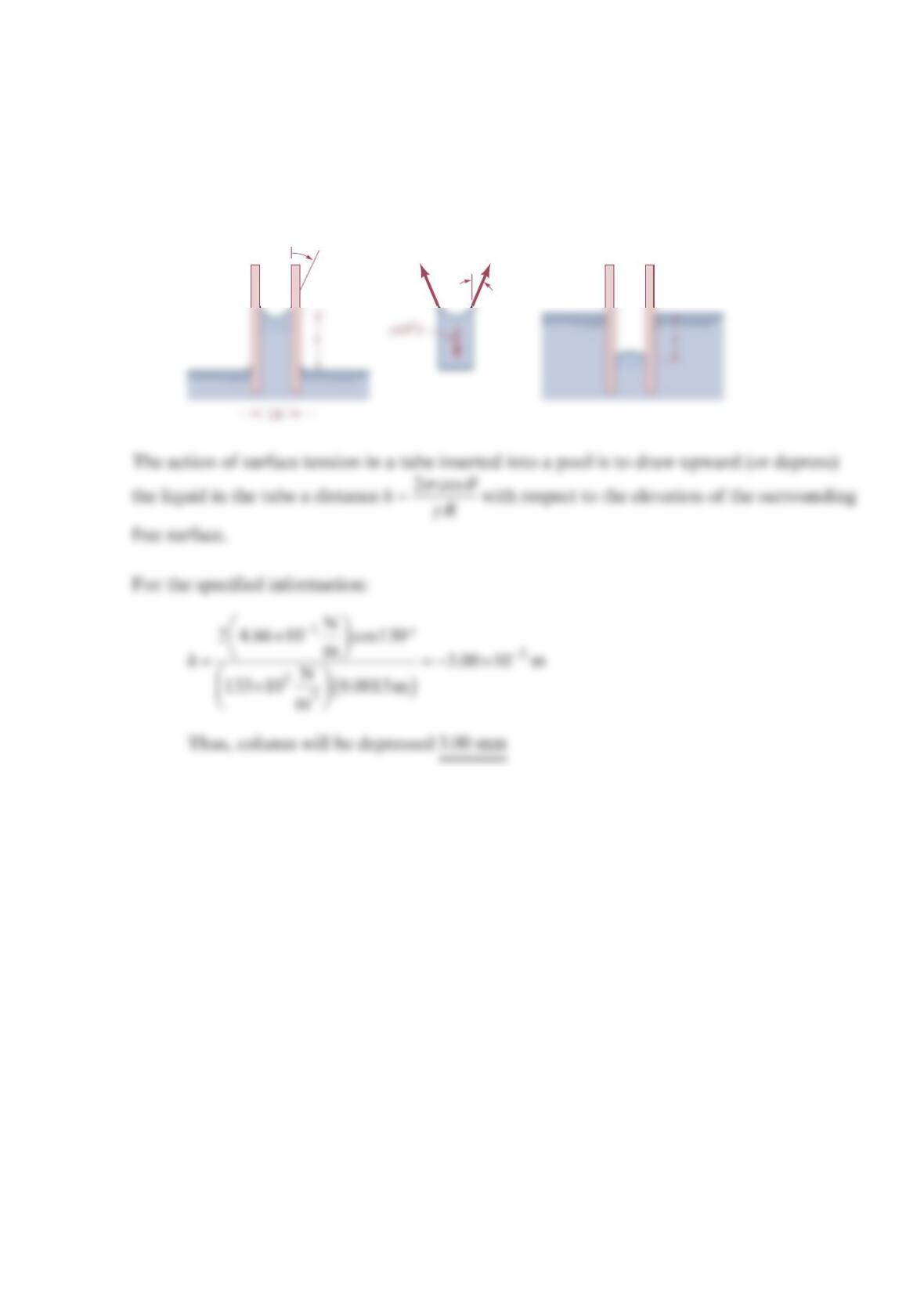
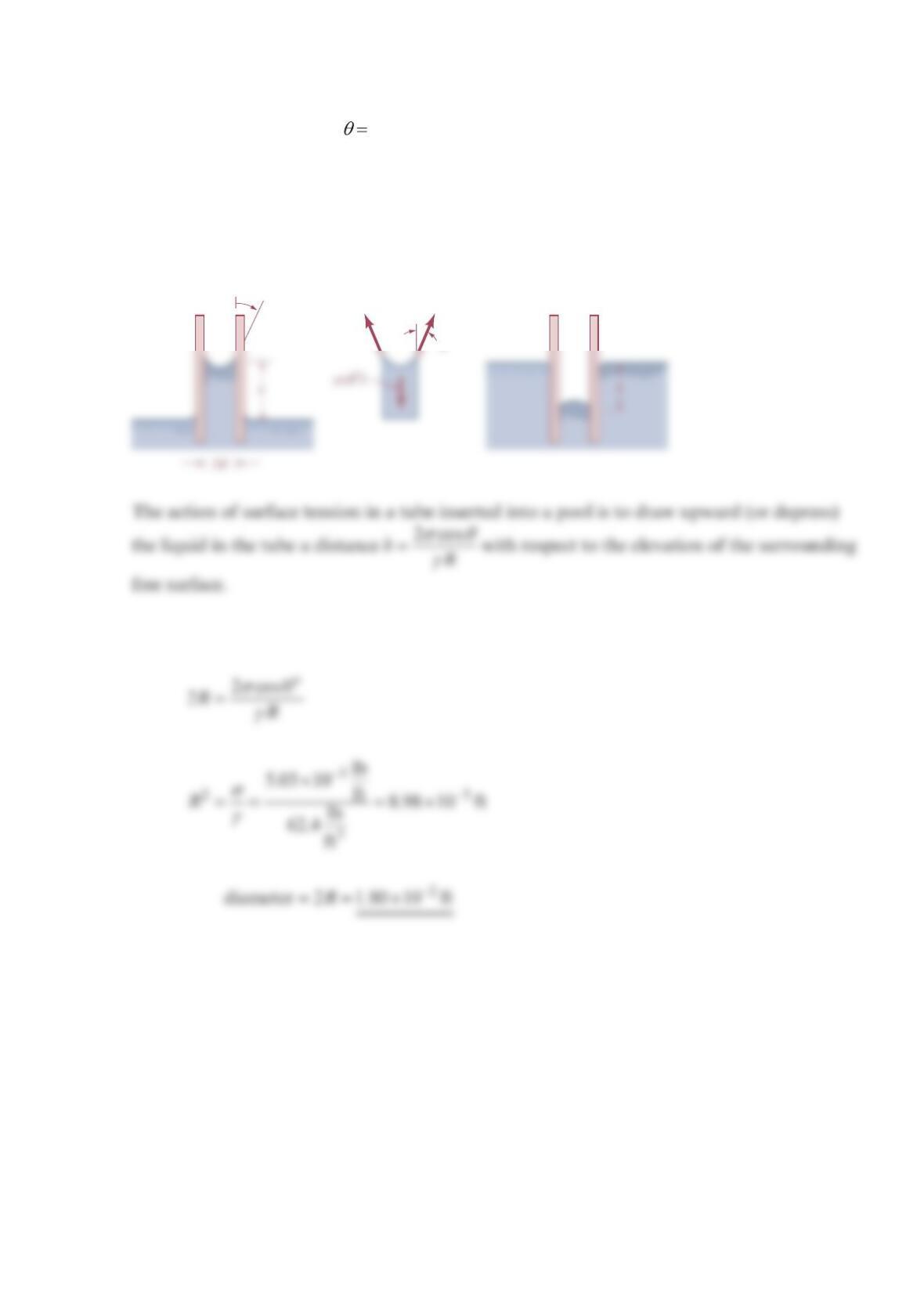
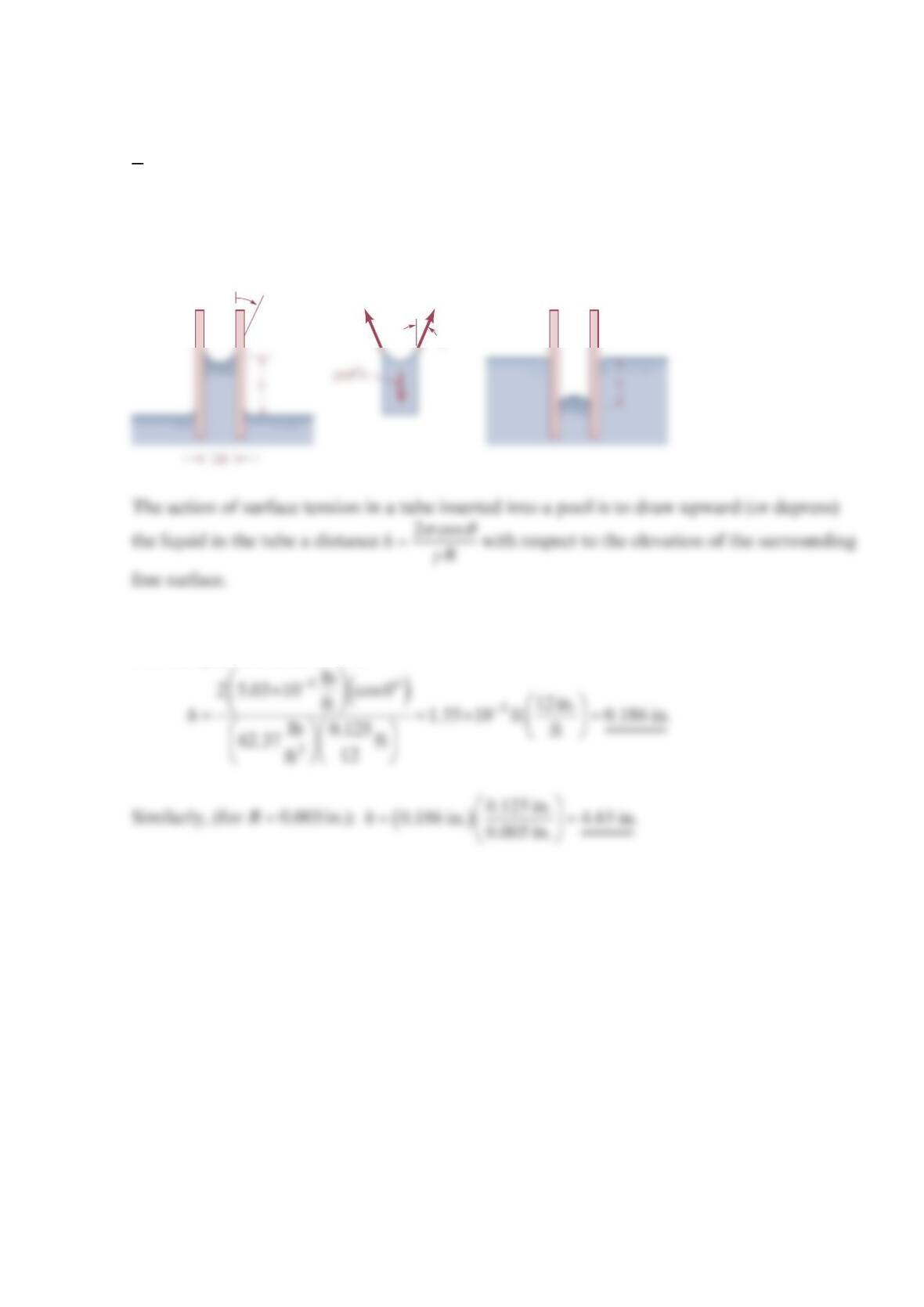
Effect of capillary section in small tubes. (a) Rise of column for a liquid that wets the tube, (b) Free-body diagram
for calculating column height. (c) Depression of column for a nonwetting liquid.
Solution 1.119
Consider the free body diagram of the liquid column inside the tube as shown in the figure.
If the liquid column is in static equilibrium:
h
R
2
h
2
R
θ
2
R
θ
(
a
)(
b
)(
c
)
γπ
πσ
h
Problem 1.120
Small droplets of carbon tetrachloride at 68
°
F are formed with a spray nozzle. If the aver-
age diameter of the droplets is 200 m, what is the difference in pressure between the inside
and outside of the droplets?
Solution 1.120
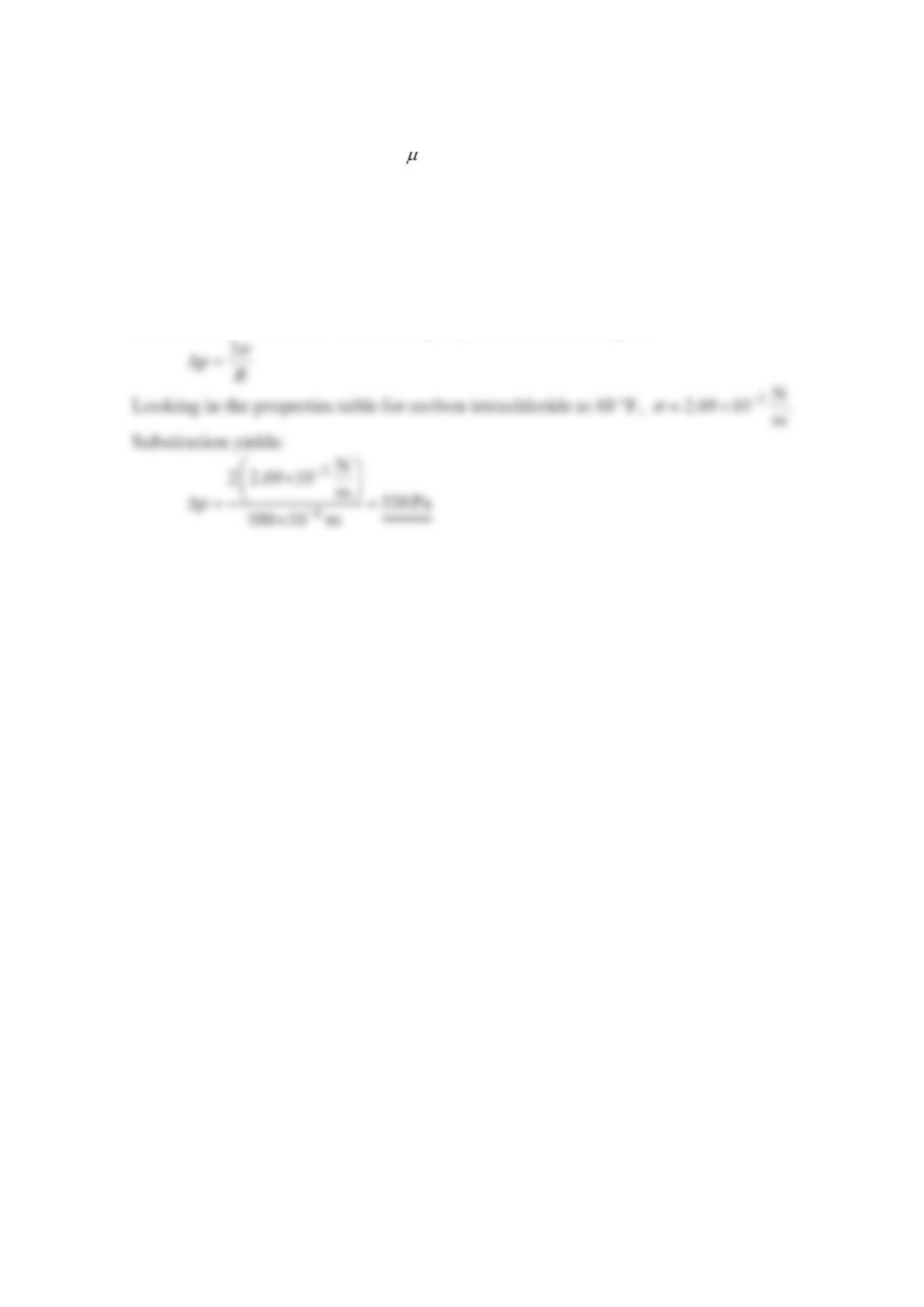
From the force balance on a half-droplet presented in the chapter:
Problem 1.121
A 12-mm-diameter jet of water discharges vertically into the atmosphere. Due to surface
tension, the pressure inside the jet will be slightly higher than the surrounding atmospheric
pressure. Determine this difference in pressure.
Solution 1.121
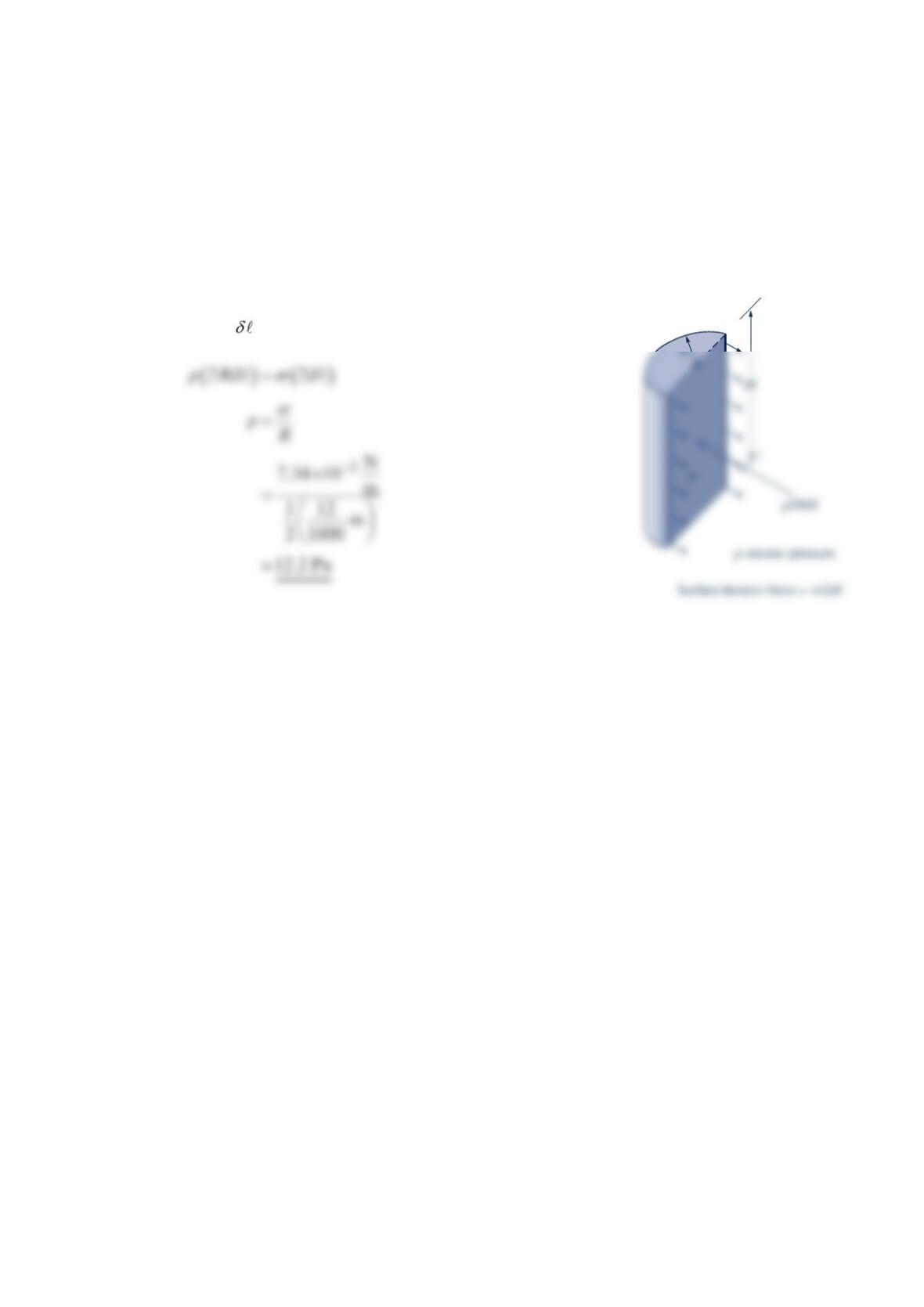
Considering the free body diagram of one half of a short
length of jet, , equilibrium requires:
Problem 1.122
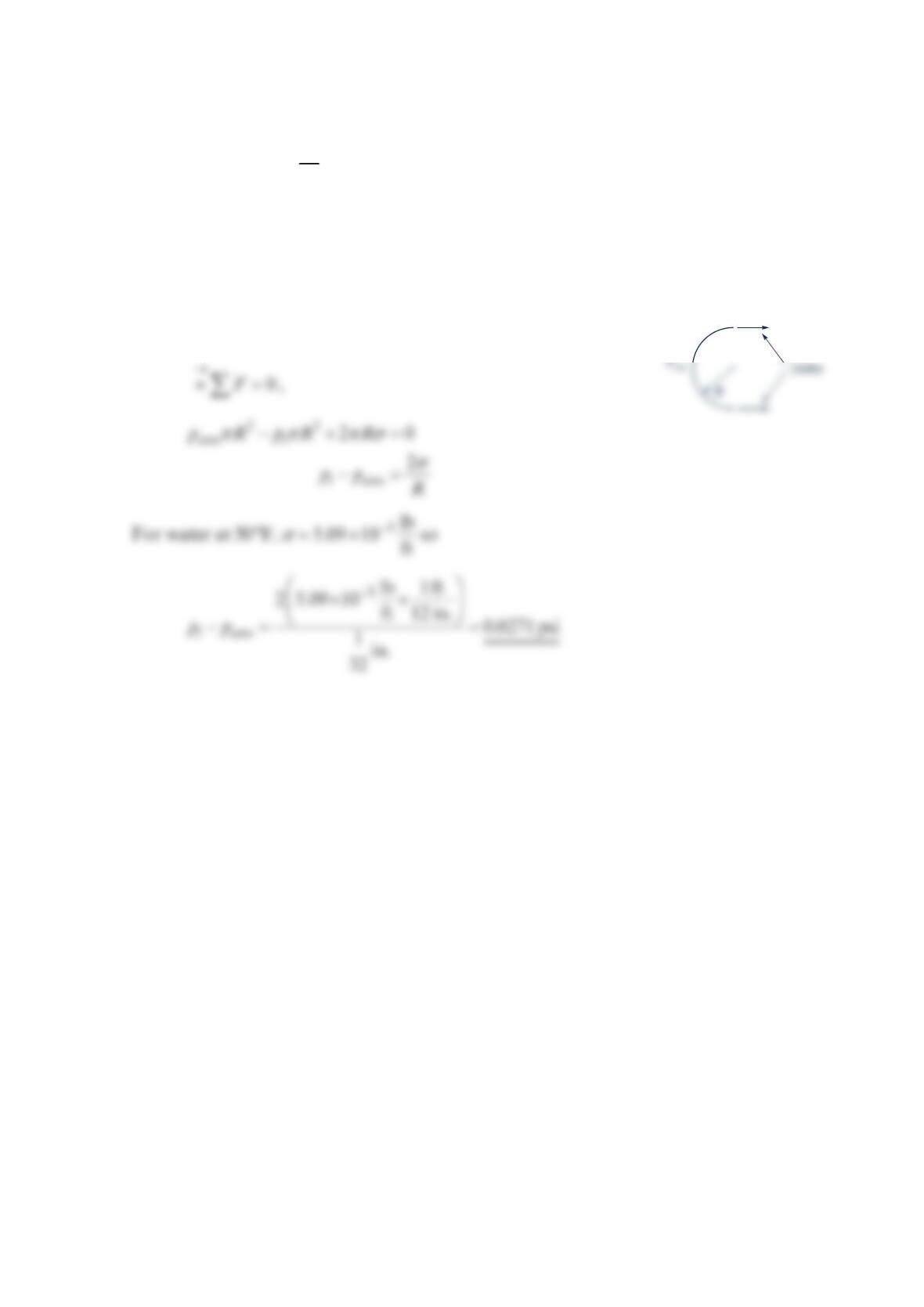
A method used to determine the surface tension of a liquid is to determine the force neces-
sary to raise a wire ring through the air–liquid interface, as shown in the figure below. What
is the value of the surface tension if a force of 0.015 N is required to raise a
4
-cm–diameter
ring? Consider the ring weightless, as a tensiometer (used to measure the surface tension)
“zeroes” out the ring weight.
Solution 1.122
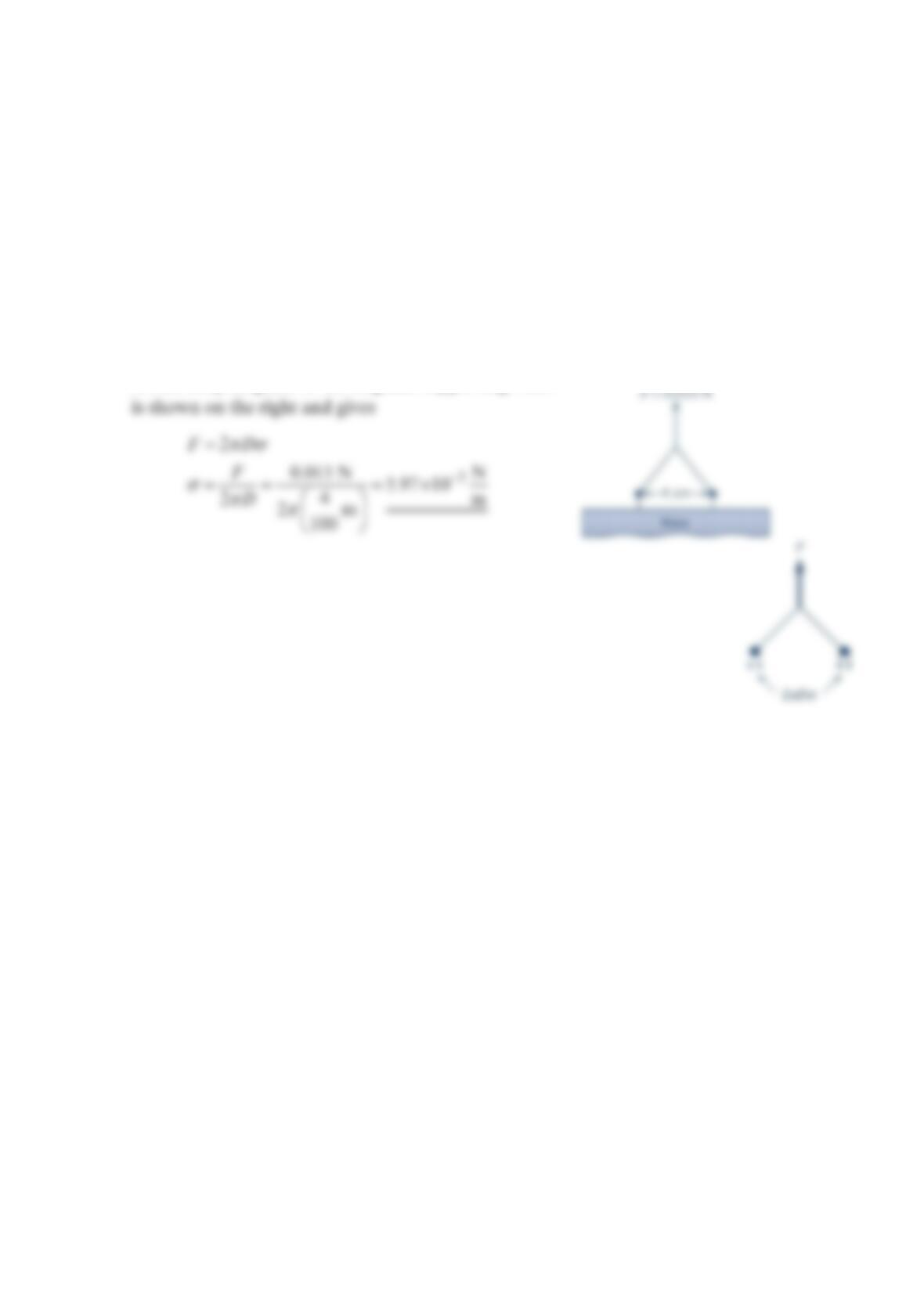
A free body diagram of the ring and supporting wires
Problem 1.123
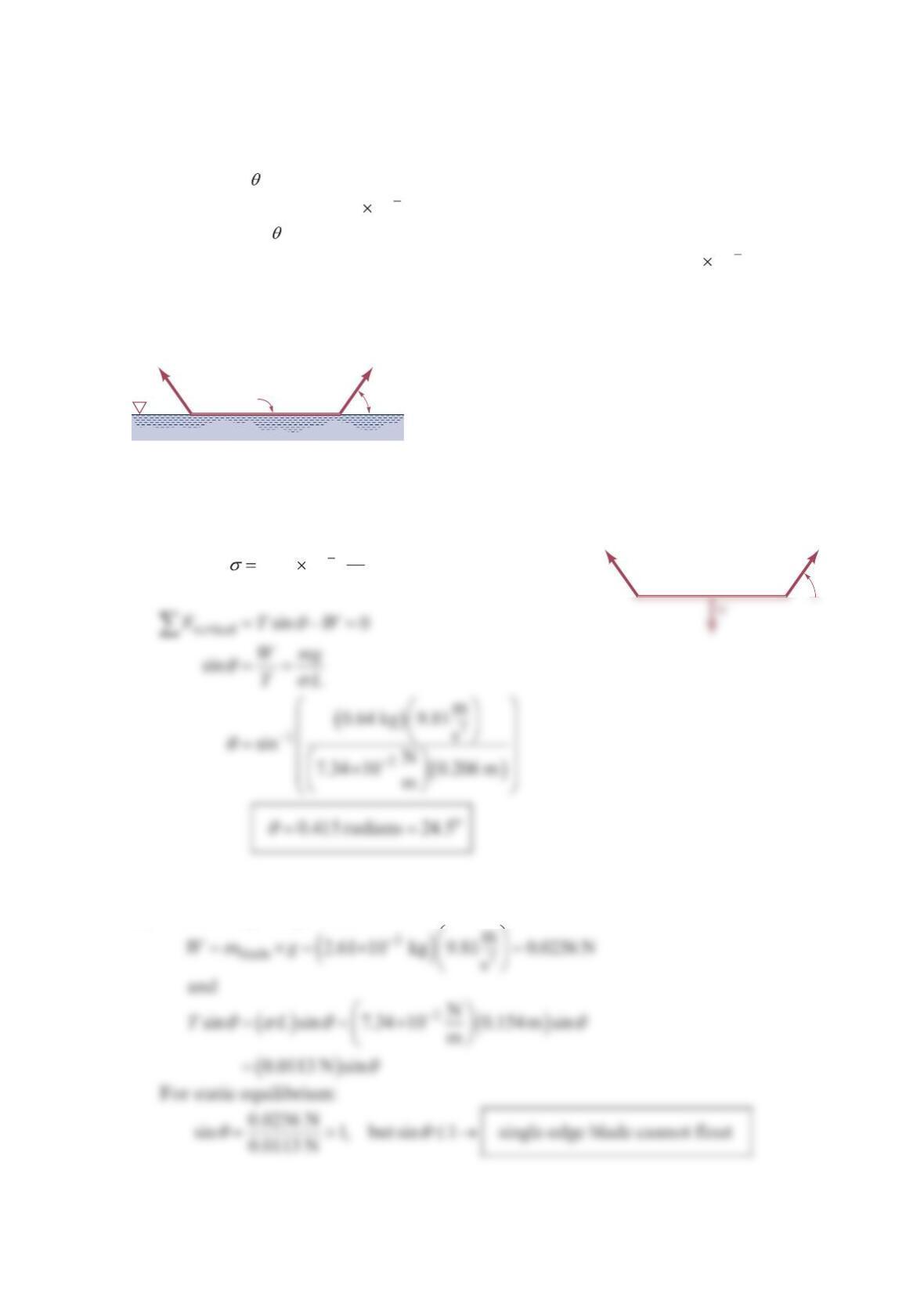
Calculate the pressure difference between the inside and outside of a spherical water droplet
having a diameter of 1in.
32 and a temperature of 50°
F
.
Solution 1.123
A force balance on the outside surface of the drop gives
p
i
F
Problem 1.124
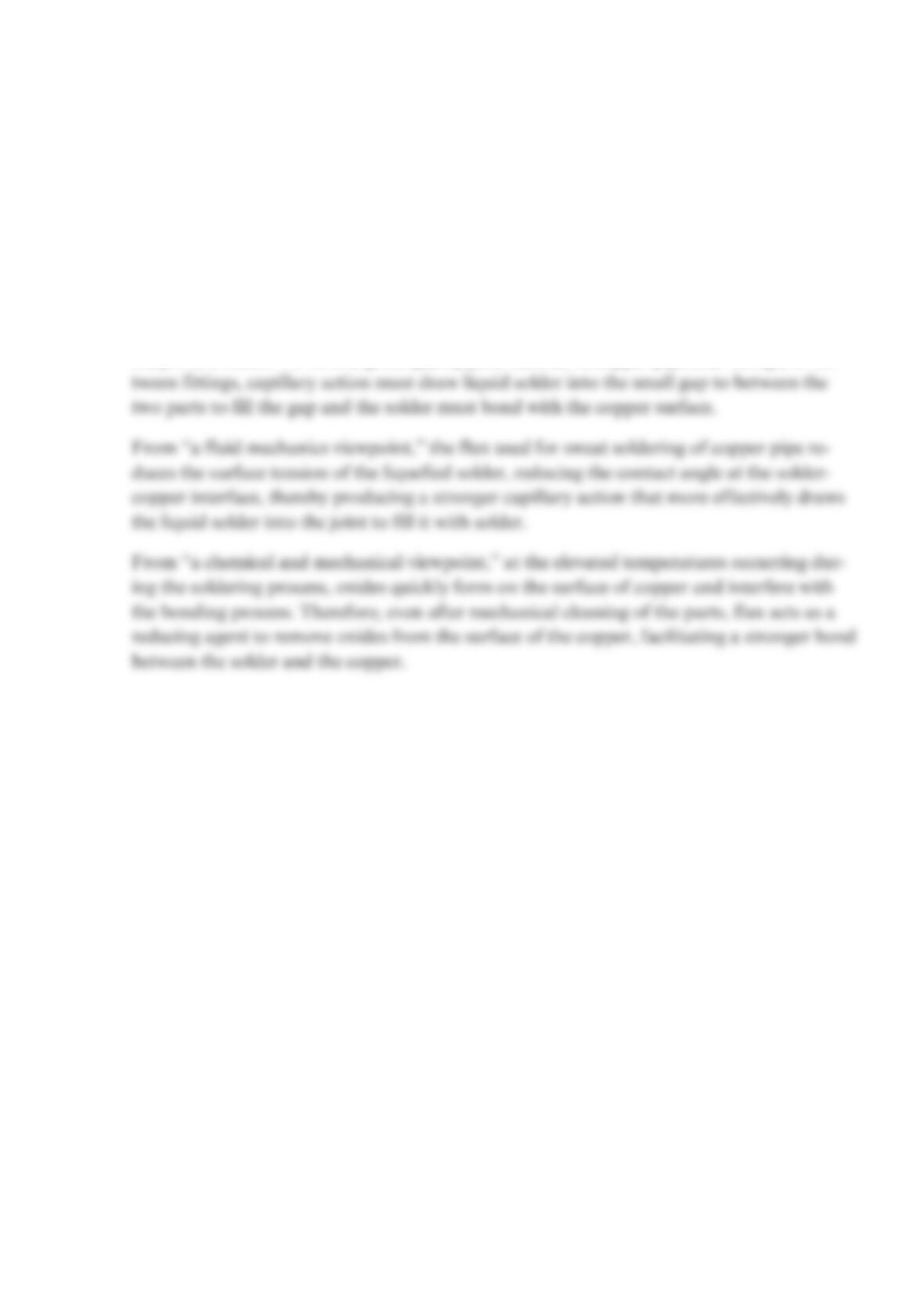
Surface tension forces can be strong enough to allow a double-edge steel razor blade to
“float” on water, but a single-edge blade will sink. Assume that the surface tension forces
act at an angle relative to the water surface as shown in the figure below. (a) The mass of
the double-edge blade is 3
0.64 10 kg, and the total length of its sides is 206
m
m. Deter-
mine the value of required to maintain equilibrium between the blade weight and the re-
sultant surface tension force. (b) The mass of the single-edge blade is 3
2
.6 10 kg, and the
total length of its sides is 154
m
m. Explain why this blade sinks. Support your answer with
the necessary calculations.
Solution 1.124
(a) water ➔ 2N
7.34 10 m
(b) For the single-edge blade
Surface tension
force
Blade
θ
T
T
θ
Problem 1.125
Explain how sweat soldering of copper pipe works from a fluid mechanics viewpoint.
Solution 1.125
Solder for sweat soldering copper pipe is an alloy with a melting point below that of copper.
The copper parts are typically heated using a gas torch to a temperature below the melting
point of copper but above the melting point of the solder. When the solder is “touched” to
the joint, it melts. To form a good quality joint between a copper pipe and fittings, or be-
Problem 1.126
Under the right conditions, it is possible, due to surface tension, to have metal objects float
on water. Consider placing a short length of a small diameter steel ( 3
490 lb ft ) rod on a
surface of water. What is the maximum diameter that the rod can have before it will sink?
Assume that the surface tension forces act vertically upward. Note: A standard paper clip
has a diameter of 0.036 in. Partially, unfold a paper clip and see if you can get it to float on
water. Do the results of this experiment support your analysis?
Solution 1.126
In order for rod to float, (see free body diagram):
σ
ℓ
σ
ℓ
Problem 1.127
An open, clean glass tube, having a diameter of 3
m
m, is inserted vertically into a dish of
mercury at 20
°
C. How far will the column of mercury in the tube be depressed?
Solution 1.127
2
R
θ
θ
πσ
Problem 1.128
An open, clean glass tube ( 0°C) is inserted vertically into a pan of water. What tube di-
ameter is needed if the water level in the tube is to rise one tube diameter (due to surface
tension)?
Solution 1.128
For the specified information:
2
R
θ
θ
πσ
Problem 1.129
Determine the height that water at 60
°
F will rise due to capillary action in a clean,
1-in.-diameter
4 tube. What will be the height if the diameter is reduced to 0.01 in.?
Solution 1.129
For the specified information:
2
R
θ
θ
πσ
Problem 1.130
Two vertical, parallel, clean glass plates are spaced a distance of 2
m
m apart. If the plates
are placed in water, how high will the water rise between the plates due to capillary action?
Solution 1.130
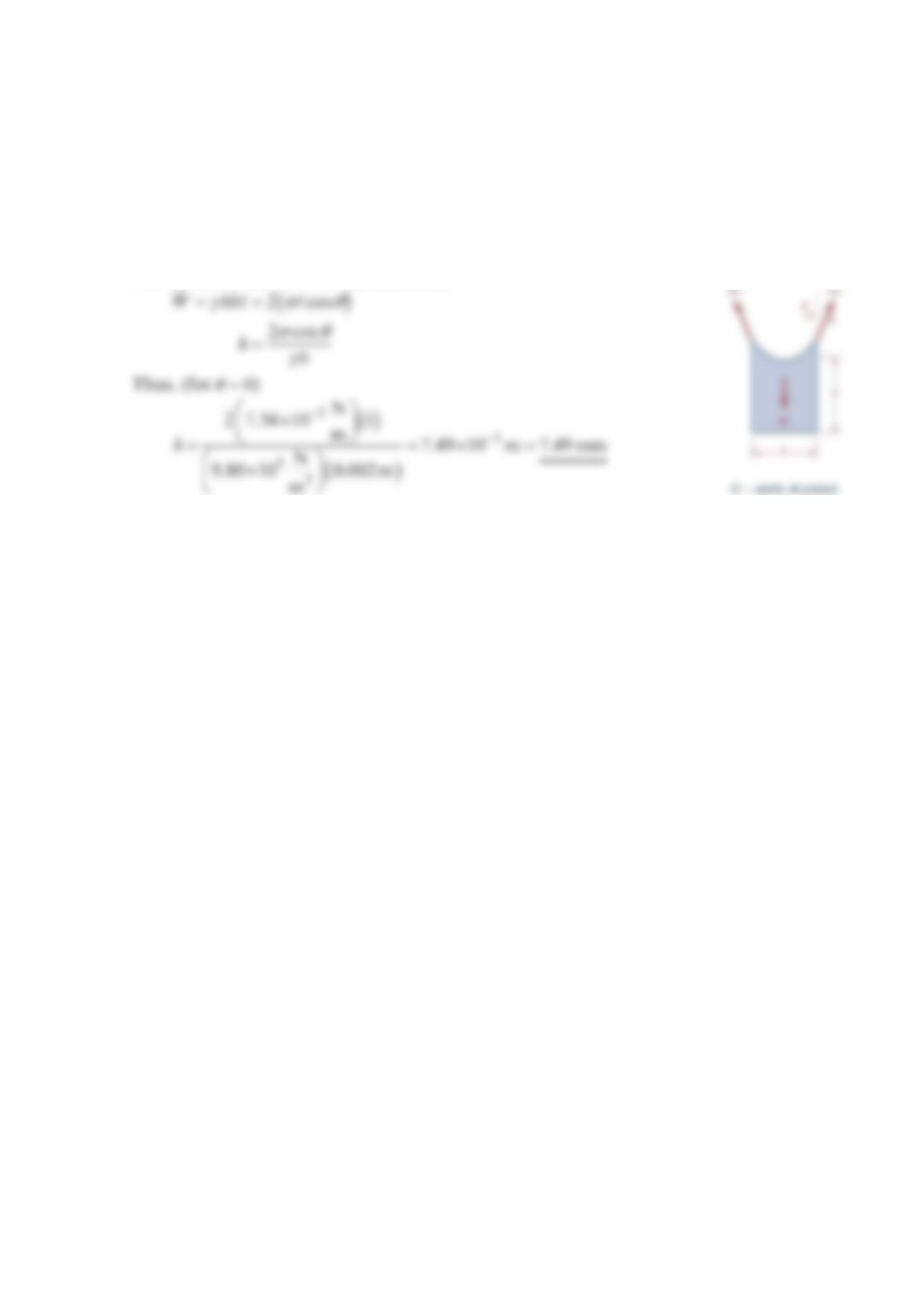
For equilibrium in the vertical direction,
Problem 1.131
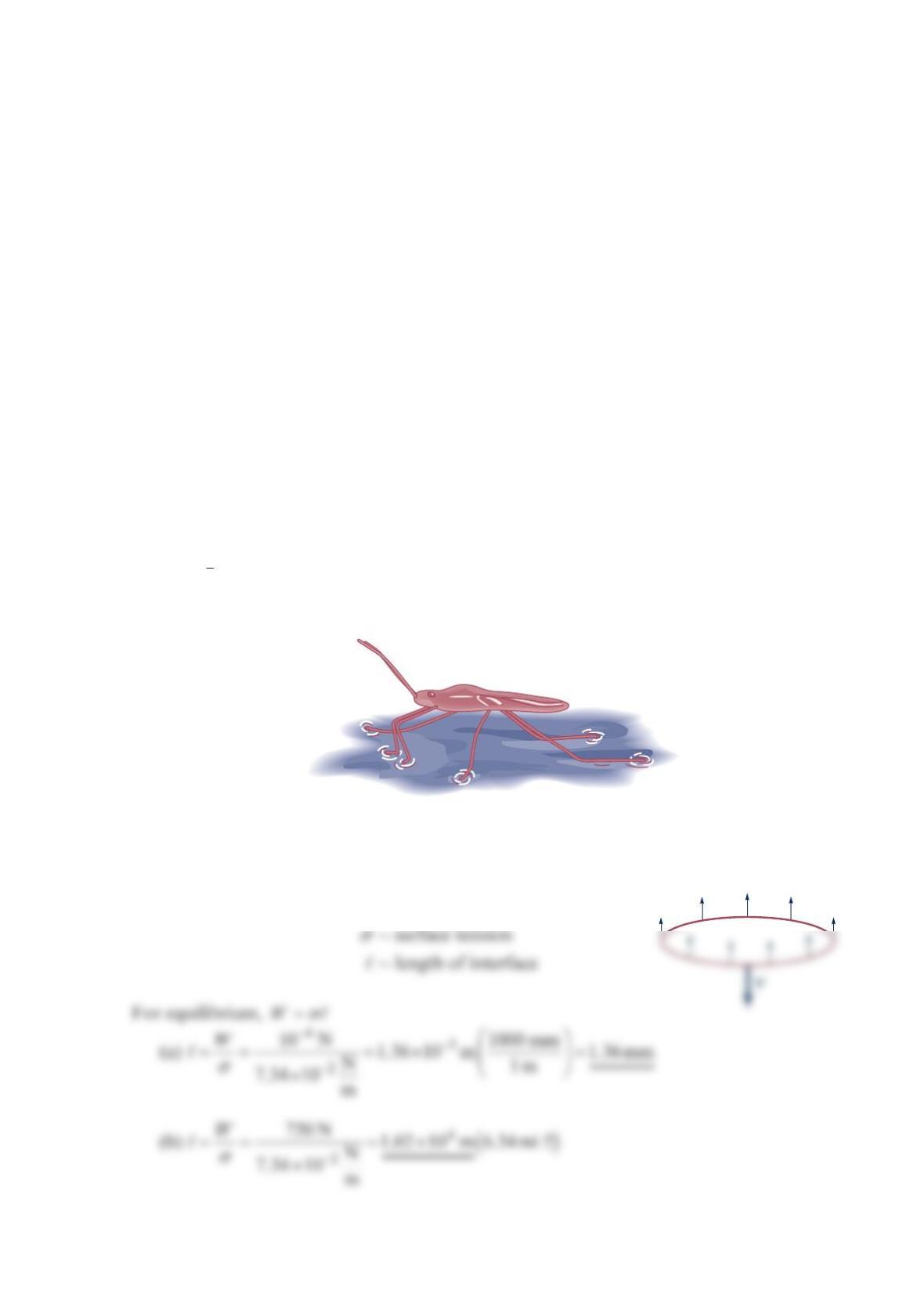
Walking on water Water striders are insects commonly found on ponds, rivers, and lakes
that appear to “walk” on water. A typical length of a water strider is about 0.4 in., and they
can cover 100 body lengths in one second. It has long been recognized that it is surface ten-
sion that keeps the water strider from sinking below the surface. What has been puzzling is
how they propel themselves at such a high speed. They can’t pierce the water surface or
they would sink. A team of mathematicians and engineers from the Massachusetts Institute
of Technology (MIT) applied conventional flow visualization techniques and high-speed
video to examine in detail the movement of the water striders. They found that each stroke
of the insect’s legs creates dimples on the surface with underwater swirling vortices suffi-
cient to propel it forward. It is the rearward motion of the vortices that propels the water
strider forward. To further substantiate their explanation, the MIT team built a working
model of a water strider, called Robostrider, which creates surface ripples and underwater
vortices as it moves across a water surface. Waterborne creatures, such as the water strider,
provide an interesting world dominated by surface tension. (See Problem 1.131.)
(a) The water strider bug shown in the figure below is supported on the surface of a pond
by surface tension acting along the interface between the water and the bug’s legs. Deter-
mine the minimum length of this interface needed to support the bug. Assume the bug
weighs 4
1
0N
and the surface tension force acts vertically upwards. (b) Repeat part (a) if
surface tension were to support a person weighing 750
N
.
Solution 1.131
weight
W
σ
ℓ