PROBLEM 1.19
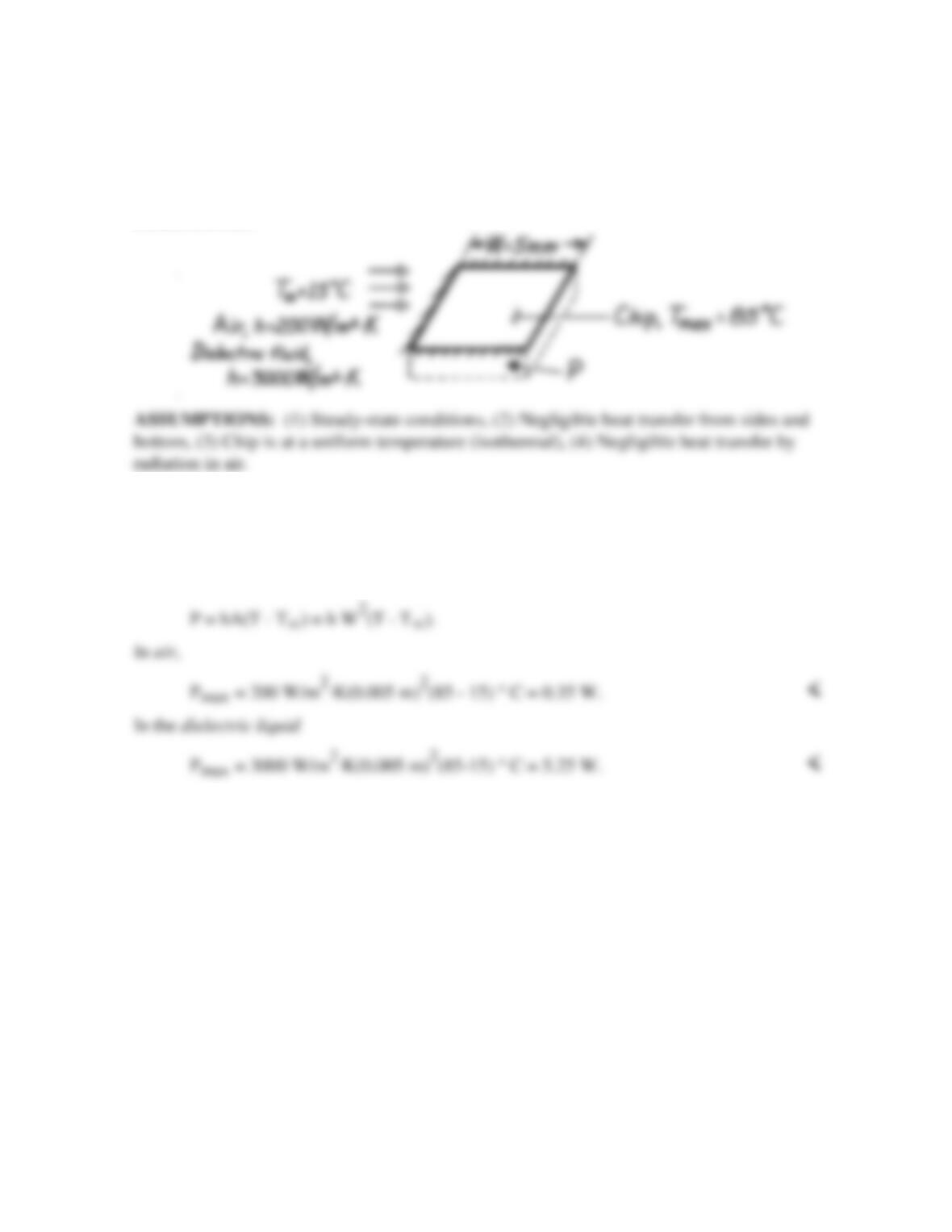
KNOWN: Chip width and maximum allowable temperature. Coolant conditions.
FIND: Maximum allowable chip power for air and liquid coolants.
SCHEMATIC:
ANALYSIS: All of the electrical power dissipated in the chip is transferred by convection to
the coolant. Hence,
P = q
and from Newton’s law of cooling,
COMMENTS: Relative to liquids, air is a poor heat transfer fluid. Hence, in air the chip can
dissipate far less energy than in the dielectric liquid.
PROBLEM 1.20
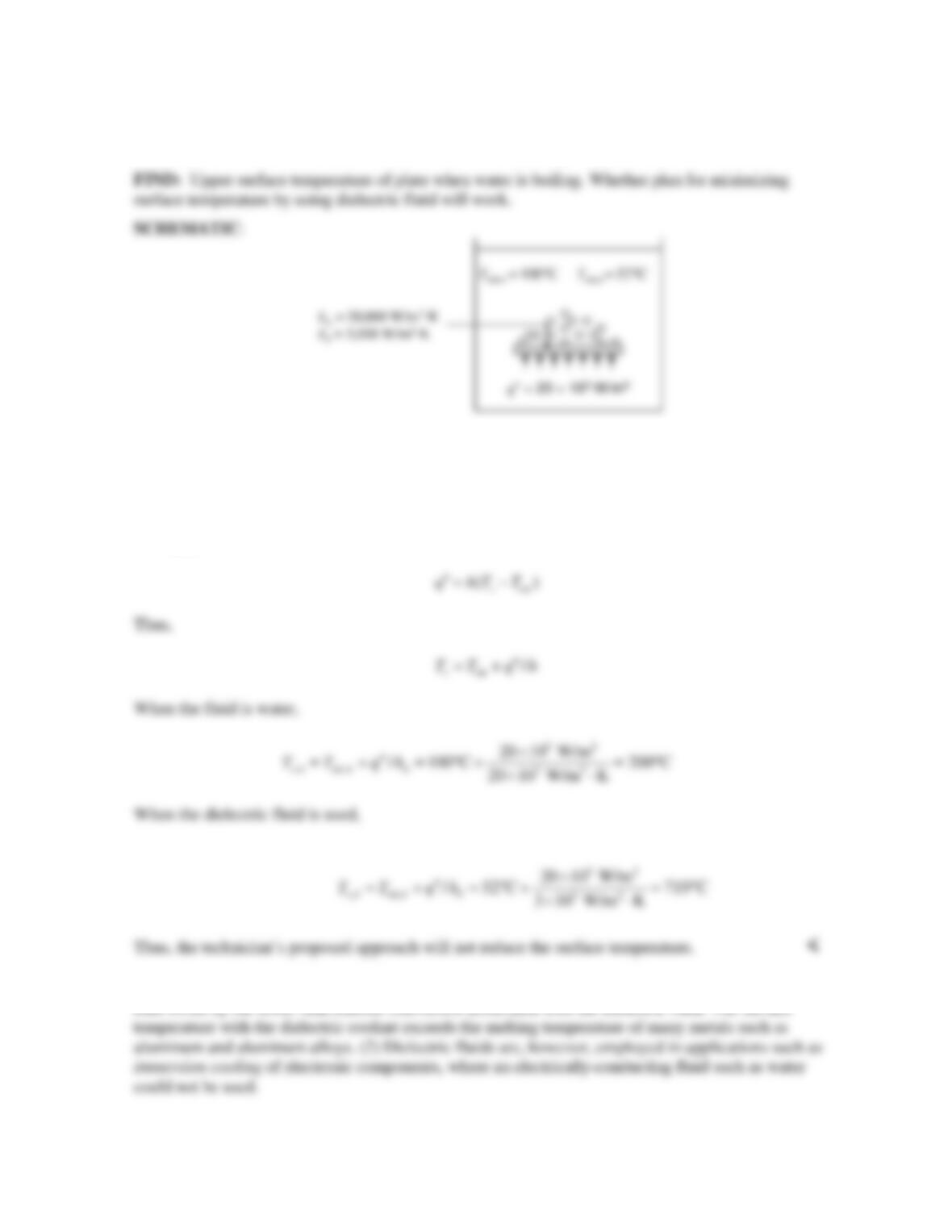
KNOWN: Heat flux and convection heat transfer coefficient for boiling water. Saturation
temperature and convection heat transfer coefficient for boiling dielectric fluid.
ASSUMPTIONS: Steady-state conditions.
PROPERTIES: Tsat,w = 100°C at p = 1 atm.
ANALYSIS: According to the problem statement, Newton’s law of cooling can be expressed for a
boiling process as
COMMENTS: (1) Even though the dielectric fluid has a lower saturation temperature, this is more
PROBLEM 1.21
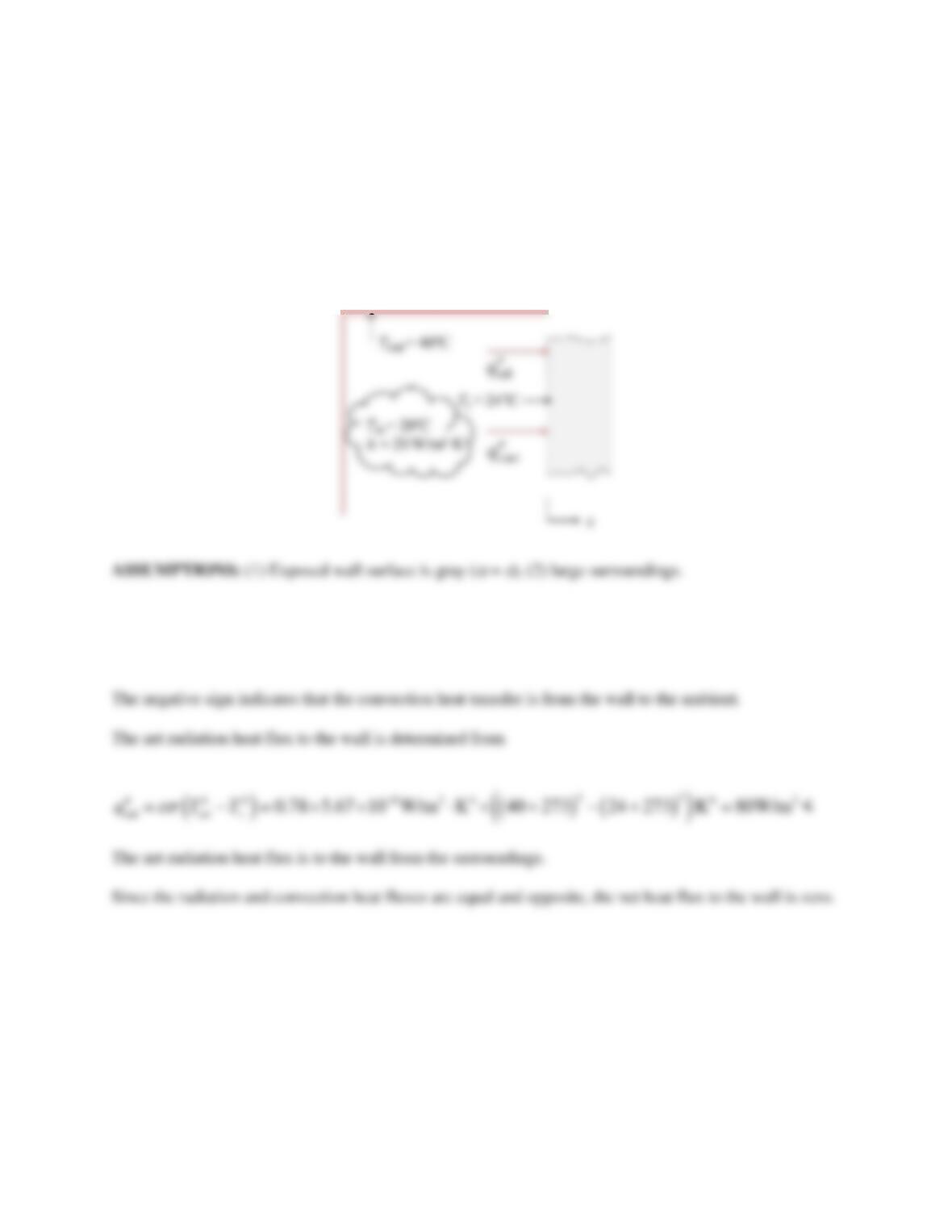
KNOWN: Ambient, surface, and surroundings temperatures, convection heat transfer coefficient, and
absorptivity of a plane wall.
FIND: Convective and radiative heat fluxes to the wall at x = 0.
SCHEMATIC:
ANALYSIS: The convection heat flux to the wall is described by Newton’s law of cooling,
22
conv 1
( ) 20W/m K (20 C 24 C) 80 W/mq hT T
∞
′′ = − = ⋅ × °− ° =−
<
COMMENTS: (1) If the wall is constructed of a thermally–insulating material, its thermal conductivity
will be small, and the conduction heat flux inside the wall will also be small. This situation leads to the
requirement that the sum of the convective and net radiative fluxes at x = 0 be small, such as the case
here. (2) Note the importance of converting the temperatures to kelvins when solving for the radiation
heat flux.
PROBLEM 1.22
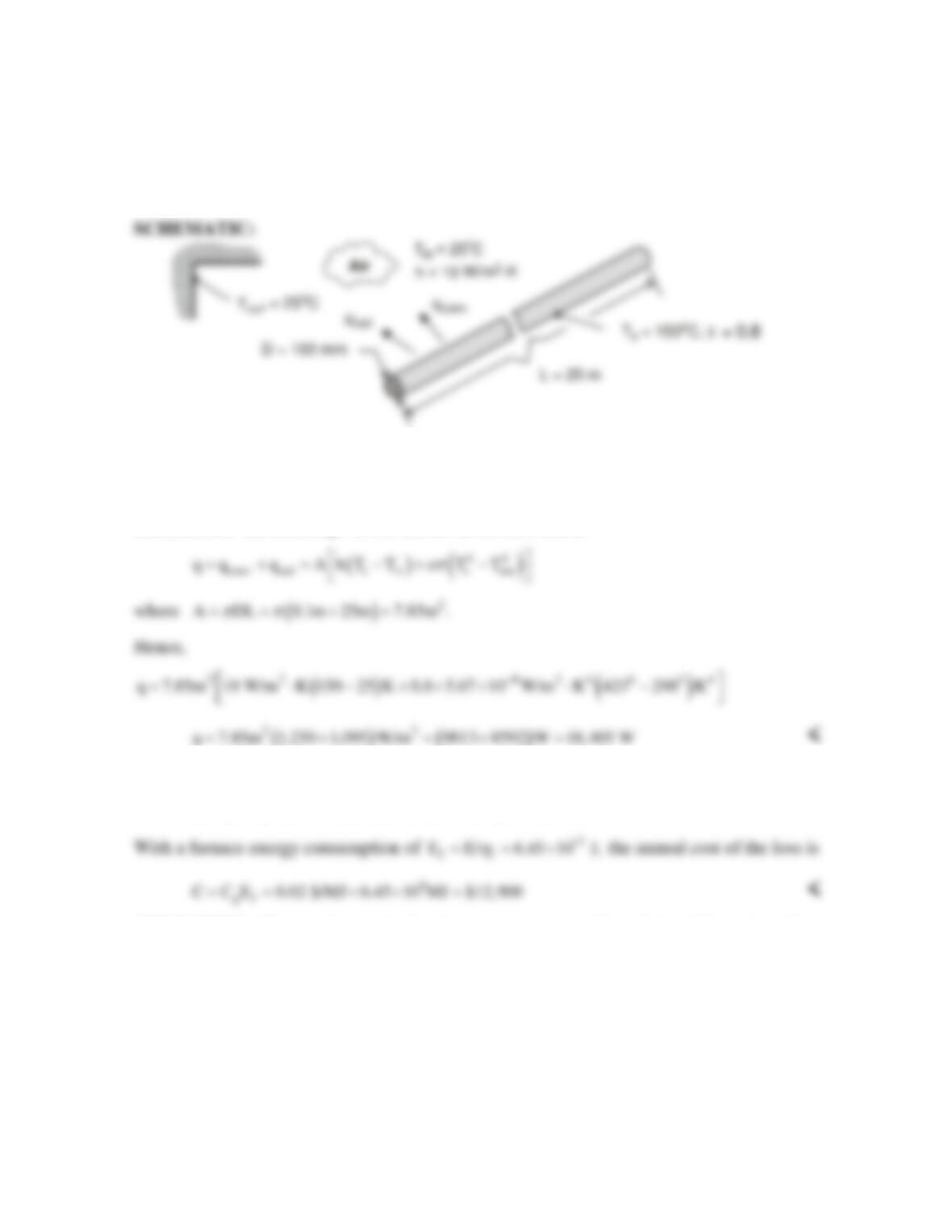
KNOWN: Length, diameter, surface temperature and emissivity of steam line. Temperature
and convection coefficient associated with ambient air. Efficiency and fuel cost for gas fired
furnace.
FIND: (a) Rate of heat loss, (b) Annual cost of heat loss.
ASSUMPTIONS: (1) Steam line operates continuously throughout year, (2) Net radiation
transfer is between small surface (steam line) and large enclosure (plant walls).
ANALYSIS: (a) From Eqs. (1.3a) and (1.7), the heat loss is
(b) The annual energy loss is
11
E qt 18,405 W 3600 s/h 24h/d 365 d/y 5.80 10 J== × ×× =×
COMMENTS: The heat loss and related costs are unacceptable and should be reduced by
insulating the steam line.
PROBLEM 1.23
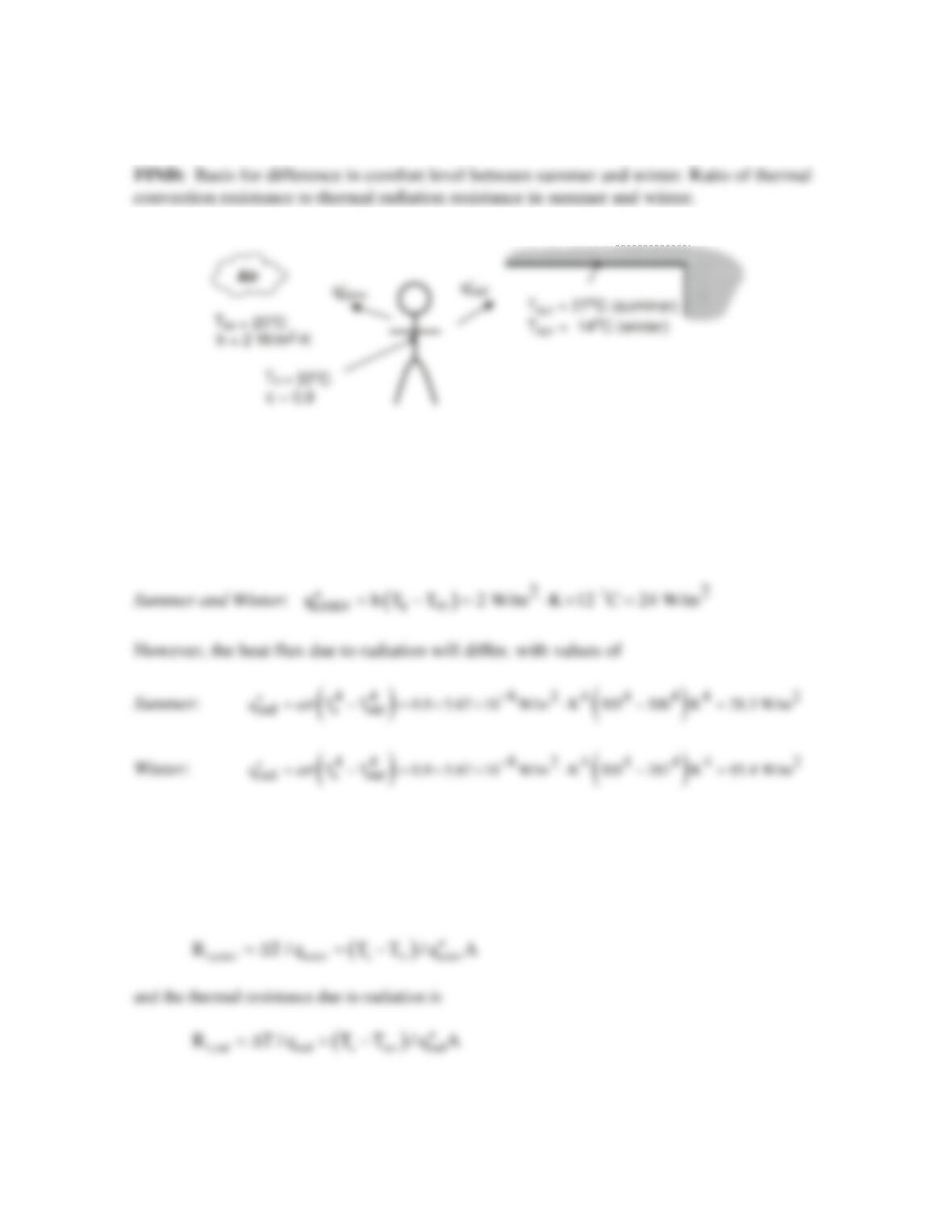
KNOWN: Air and wall temperatures of a room. Surface temperature, convection coefficient
and emissivity of a person in the room.
SCHEMATIC:
ASSUMPTIONS: (1) Person may be approximated as a small object in a large enclosure.
ANALYSIS: Thermal comfort is linked to heat loss from the human body, and a chilled
feeling is associated with excessive heat loss. Because the temperature of the room air is
fixed, the different summer and winter comfort levels cannot be attributed to convection heat
transfer from the body. In both cases, the convection heat flux is
There is a significant difference between winter and summer radiation fluxes, and the chilled
condition is attributable to the effect of the colder walls on radiation. <
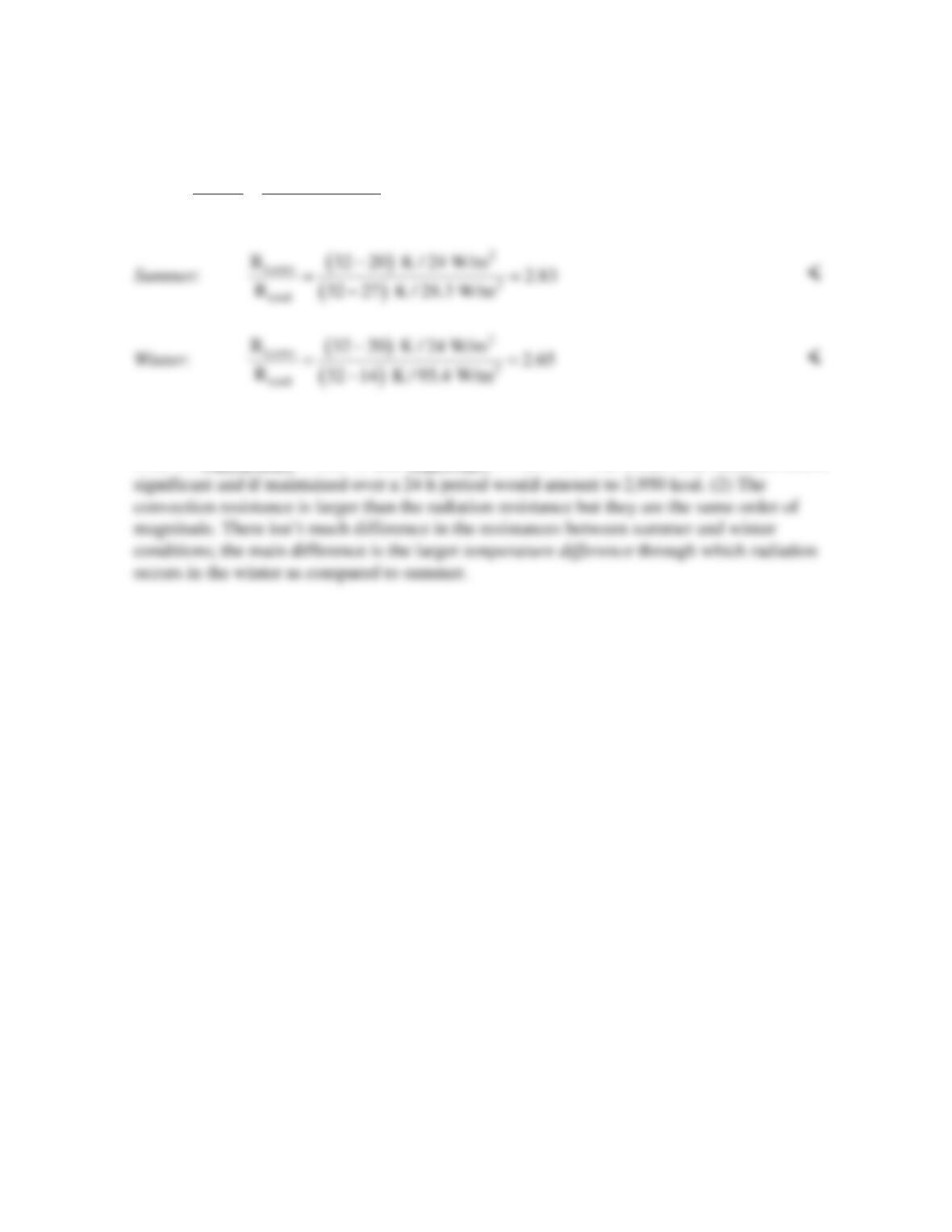
From Eq. 1.11, the thermal resistance due to convection is
Continued…
PROBLEM 1.23 (Cont.)
Thus the ratio of resistances is
( )
( )
t,conv s conv
t,rad s sur rad
RT T /q
R T T /q
∞′′
−
=′′
−
COMMENTS: (1) For a representative surface area of A = 1.5 m2, the heat losses are qconv
= 36 W, qrad(summer) = 42.5 W and qrad(winter) = 143.1 W. The winter time radiation loss is
PROBLEM 1.24
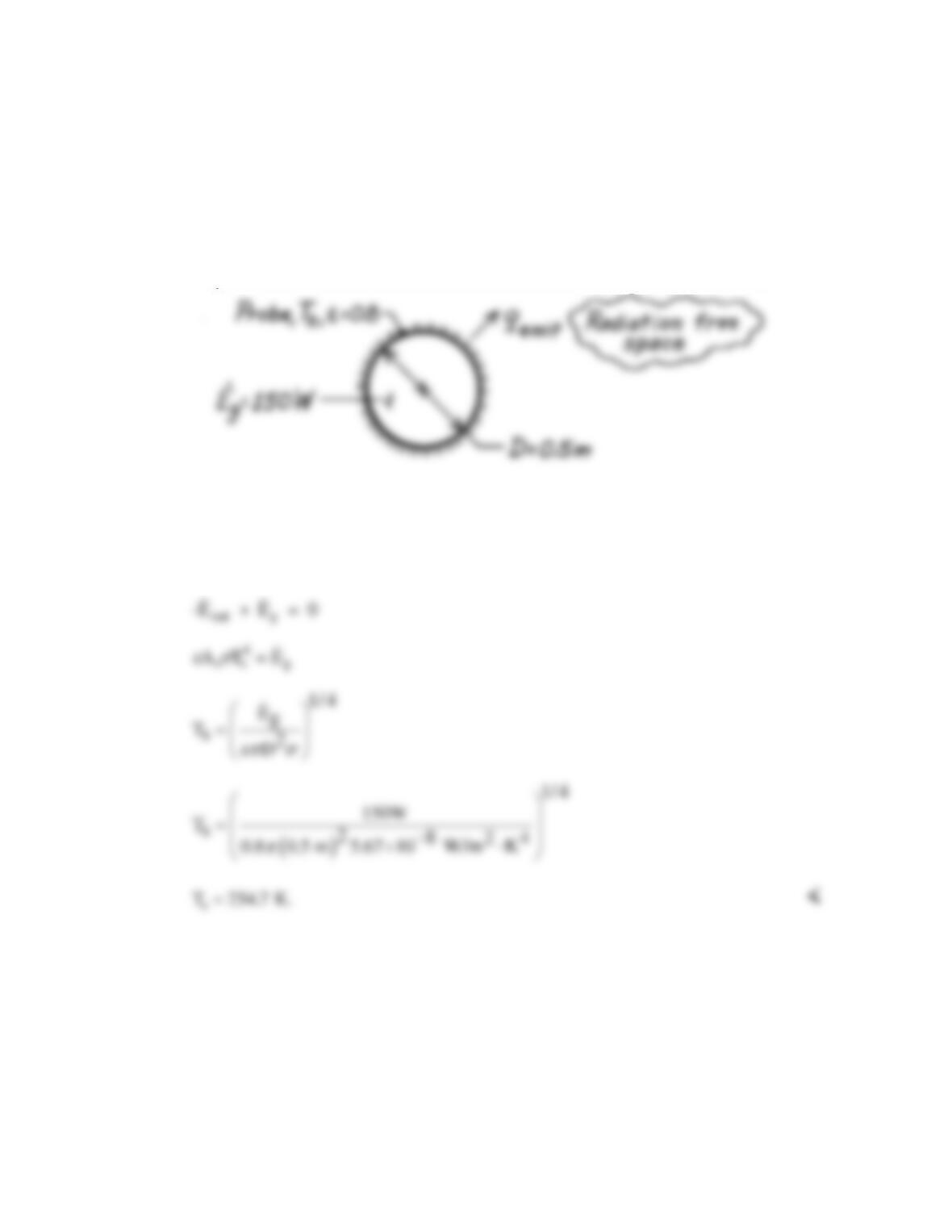
KNOWN: Diameter and emissivity of spherical interplanetary probe. Power dissipation
within probe.
FIND: Probe surface temperature.
SCHEMATIC:
ASSUMPTIONS: (1) Steady-state conditions, (2) Negligible radiation incident on the probe.
ANALYSIS: Conservation of energy dictates a balance between energy generation within the
probe and radiation emission from the probe surface. Hence, at any instant
COMMENTS: Incident radiation, as, for example, from the sun, would increase the surface
temperature.
PROBLEM 1.25
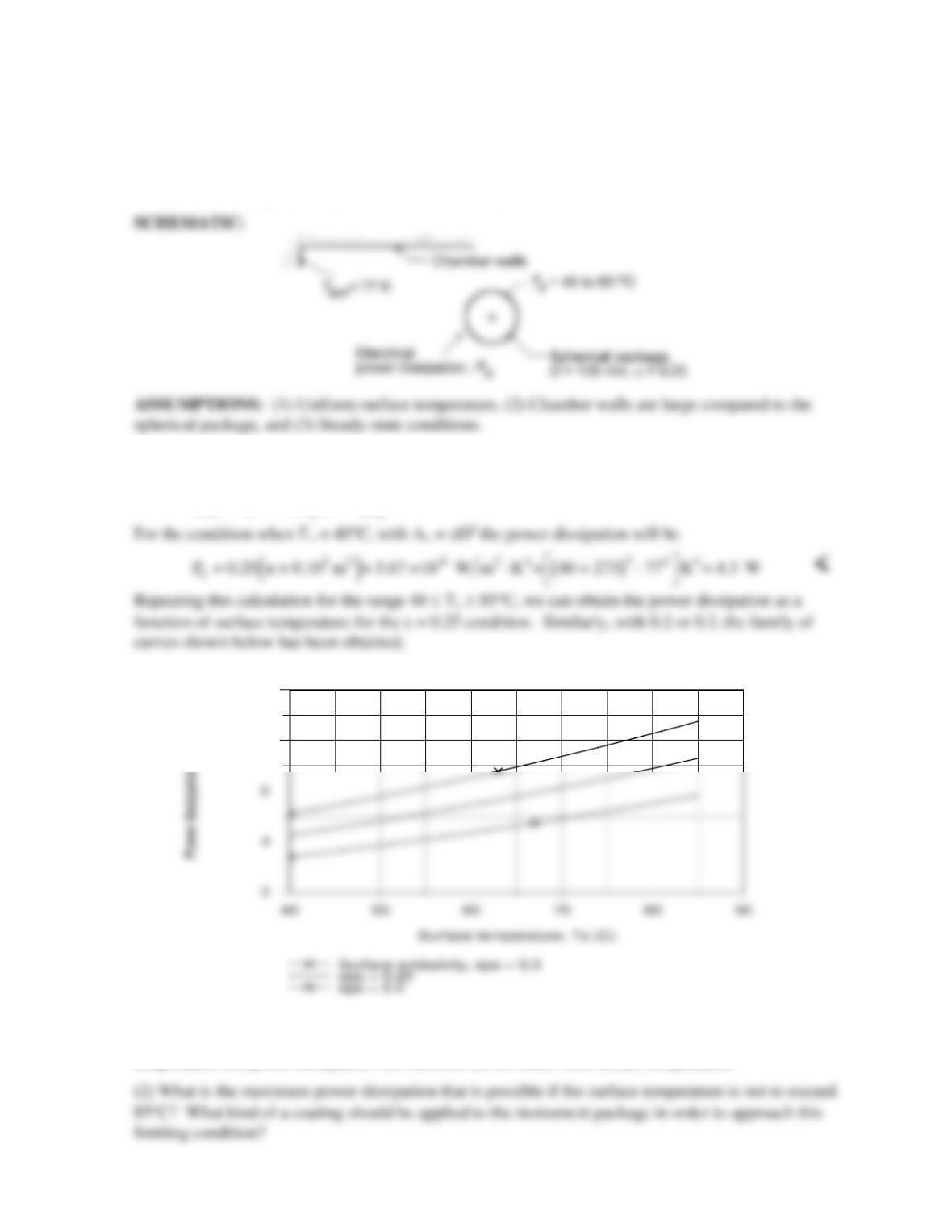
KNOWN: Spherical shaped instrumentation package with prescribed surface emissivity within a
large space–simulation chamber having walls at 77 K.
FIND: Acceptable power dissipation for operating the package surface temperature in the range Ts =
40 to 85°C. Show graphically the effect of emissivity variations for 0.2 and 0.3.
ANALYSIS: From an overall energy balance on the package, the internal power dissipation Pe will
be transferred by radiation exchange between the package and the chamber walls. From Eq. 1.7,
( )
44
rad e s s sur
q = P = εA σ T – T
8
10
COMMENTS: (1) As expected, the internal power dissipation increases with increasing emissivity
and surface temperature. Because the radiation rate equation is non–linear with respect to
temperature, the power dissipation will likewise not be linear with surface temperature.
PROBLEM 1.26
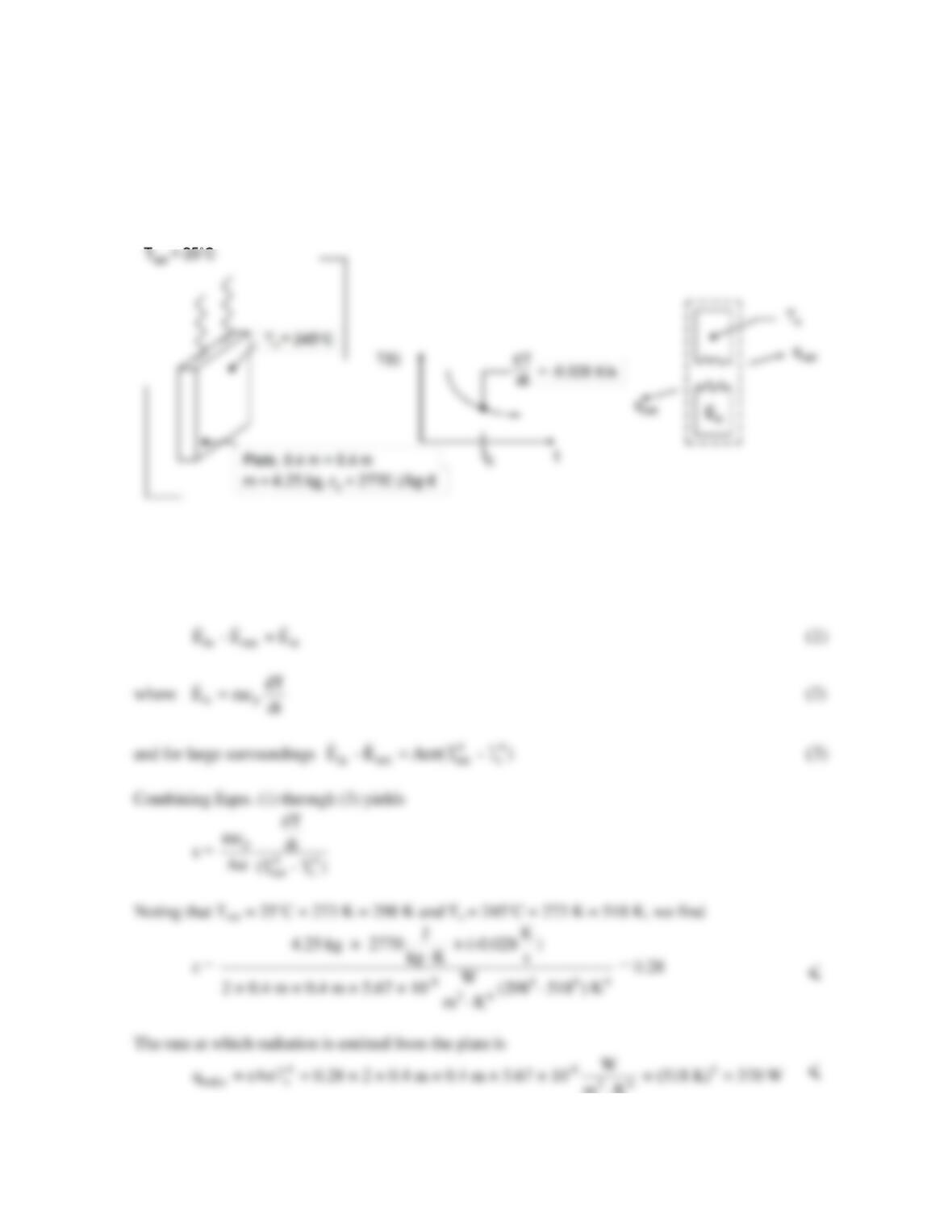
KNOWN: Hot plate suspended in vacuum and surroundings temperature. Mass, specific heat, area
and time rate of change of plate temperature.
FIND: (a) The emissivity of the plate, and (b) The rate at which radiation is emitted from the plate.
SCHEMATIC:
ASSUMPTIONS: (1) Plate is isothermal and at uniform temperature, (2) Large surroundings, (3)
Negligible heat loss through suspension wires.
ANALYSIS: For a control volume about the plate, the conservation of energy requirement is
mK⋅
COMMENTS: Note the importance of using kelvins when working with radiation heat transfer.
PROBLEM 1.27
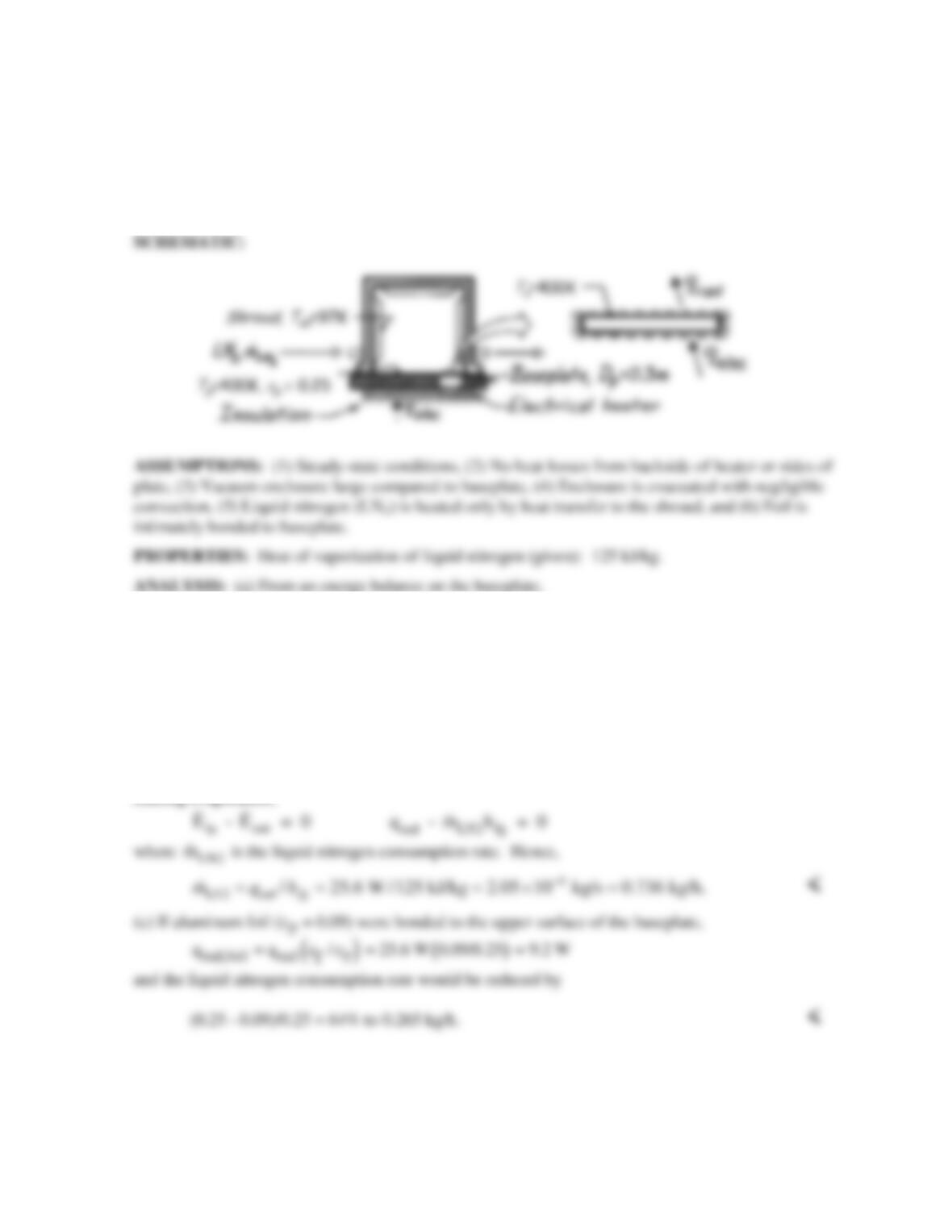
KNOWN: Vacuum enclosure maintained at 97 K by liquid nitrogen shroud while baseplate is
maintained at 400 K by an electrical heater.
FIND: (a) Electrical power required to maintain baseplate, (b) Liquid nitrogen consumption rate, (c)
Effect on consumption rate if aluminum foil (ep = 0.09) is bonded to baseplate surface.
E – E = 0 q – q = 0
in out elec rad
and using Eq. 1.7 for radiative exchange between the baseplate and shroud,
( )
p44
pp
elec sh
q = A T – T .
es
Substituting numerical values, with
( )
2
pp
A = D / 4 ,
π
find
( )
( )
()
28 24 4 44
elec
q = 0.25 0.3 m / 4 5.67 10 W/m K 400 – 97 K 25.6 W.
π
−
×⋅ =
<
(b) From an energy balance on the enclosure, radiative transfer heats the liquid nitrogen stream
PROBLEM 1.28
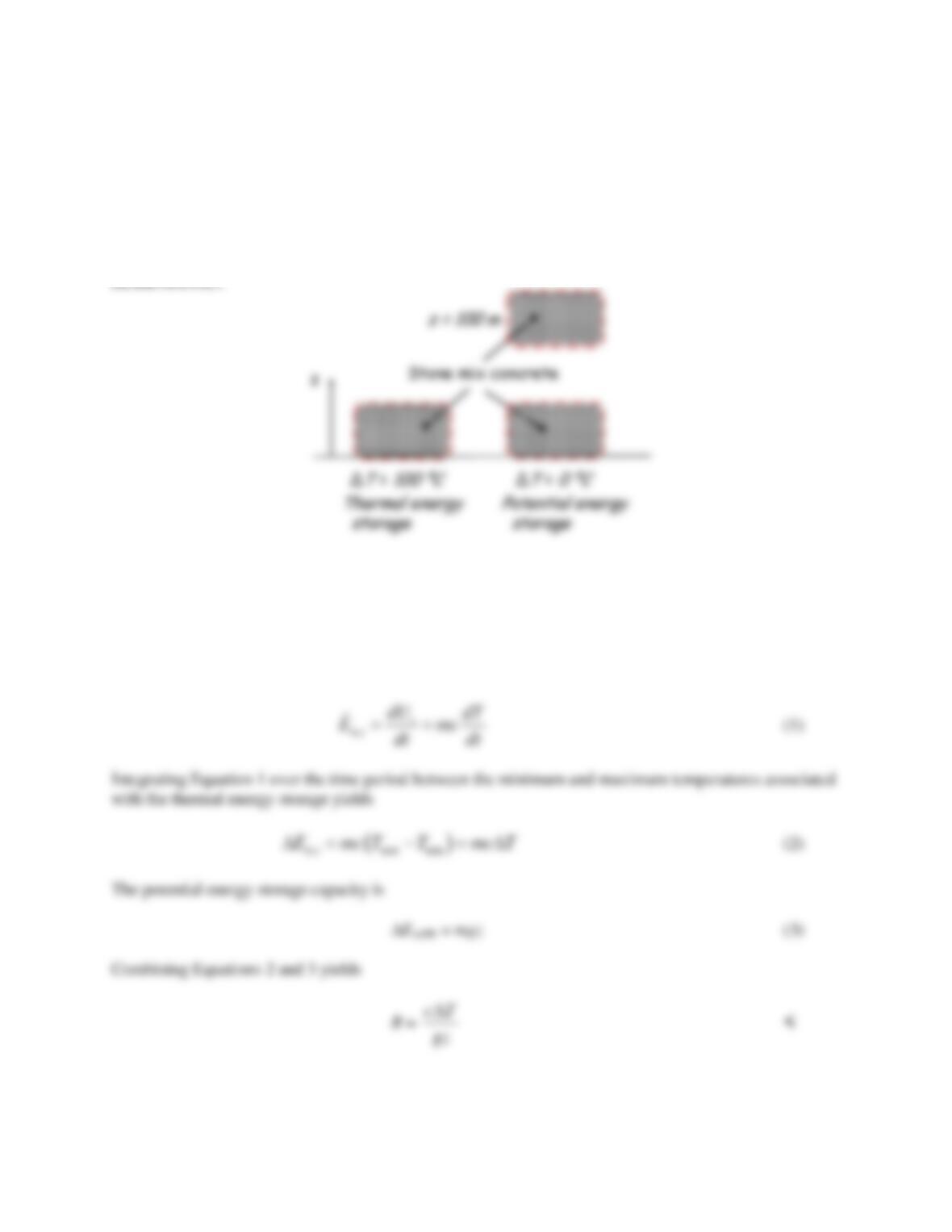
KNOWN: Storage medium, minimum and maximum temperatures for thermal energy storage, vertical
elevation change for potential energy storage.
FIND: Ratio of sensible energy storage capacity to potential energy storage capacity.
ASSUMPTIONS: (1) Constant properties, (2) Uniform minimum and maximum temperatures.
PROPERTIES: Table A.3, stone mix concrete (300 K): cp = c = 880 J/kg·K.
ANALYSIS: The change in sensible thermal energy storage is due to the temperature change, thus
Continued …
PROBLEM 1.28 (Cont.)
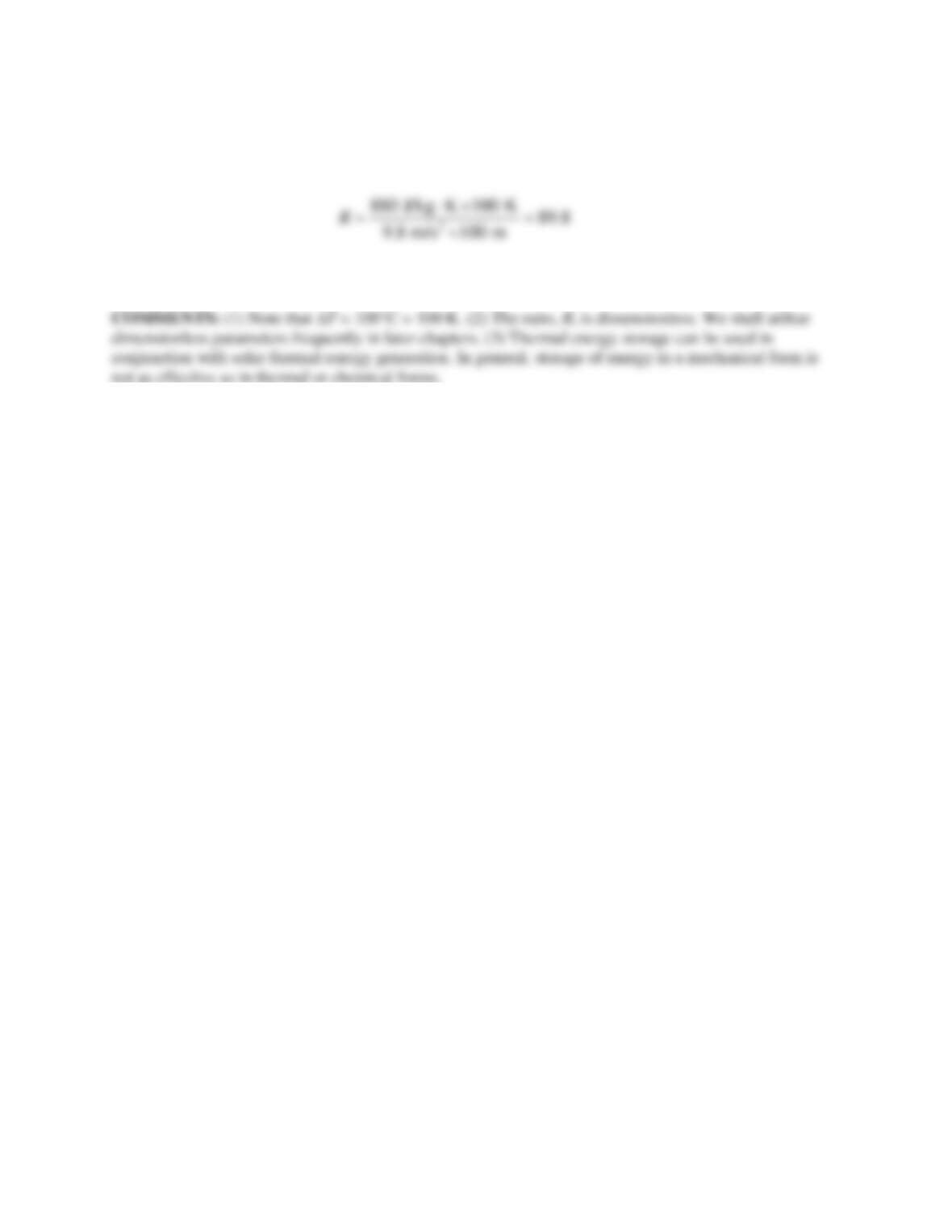
For stone mix concrete with ∆T = 100°C and z = 100 m,
Since R >> 1, thermal energy storage is more effective for the parameters of this problem. <
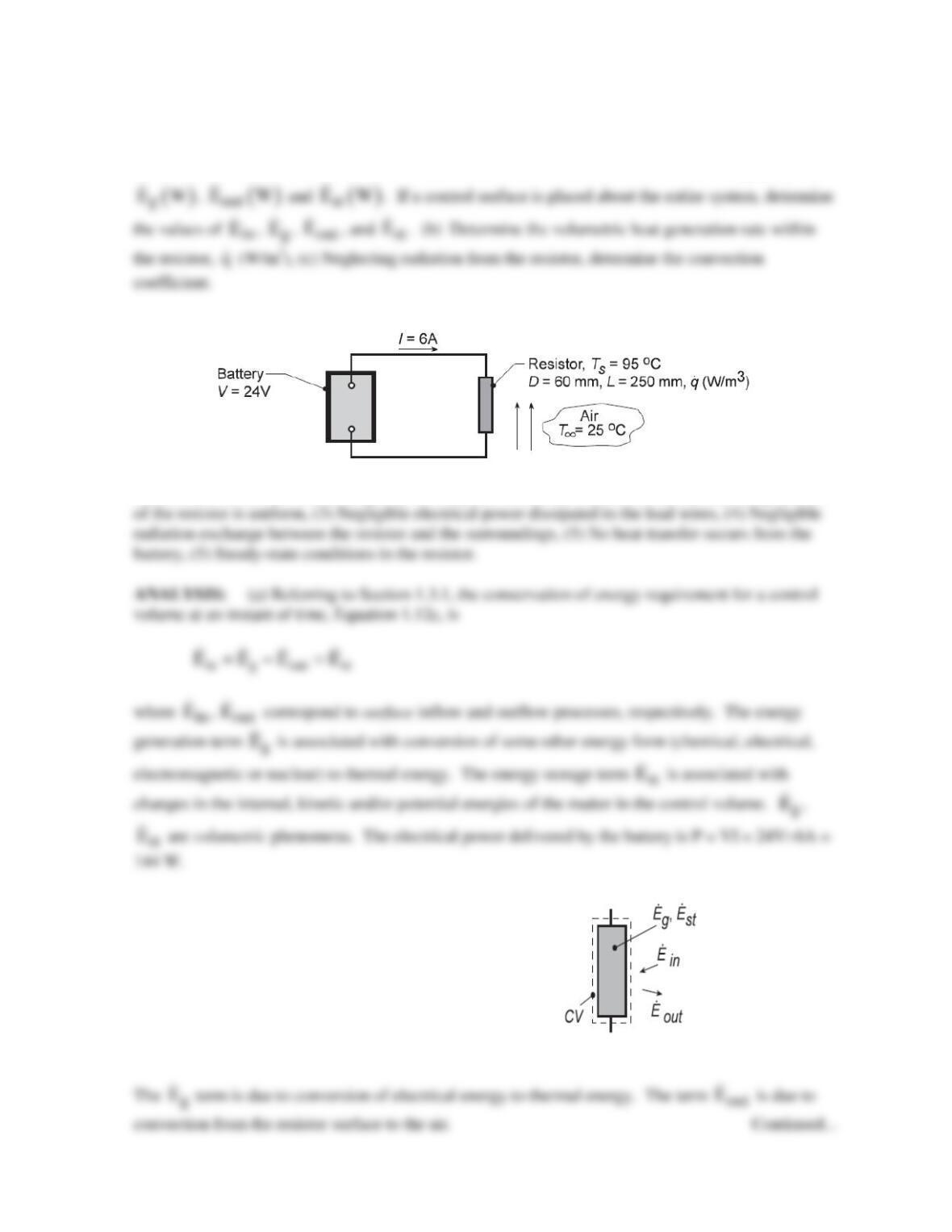
PROBLEM 1.29
KNOWN: Resistor connected to a battery operating at a prescribed temperature in air.
FIND: (a) Considering the resistor as the system, determine corresponding values of
( )
in
EW
,
SCHEMATIC:
ASSUMPTIONS: (1) Electrical power is dissipated uniformly within the resistor, (2) Temperature
Control volume: Resistor.
g st
E 144 W E 0= =
in out
E 0 E 144 W= =
<
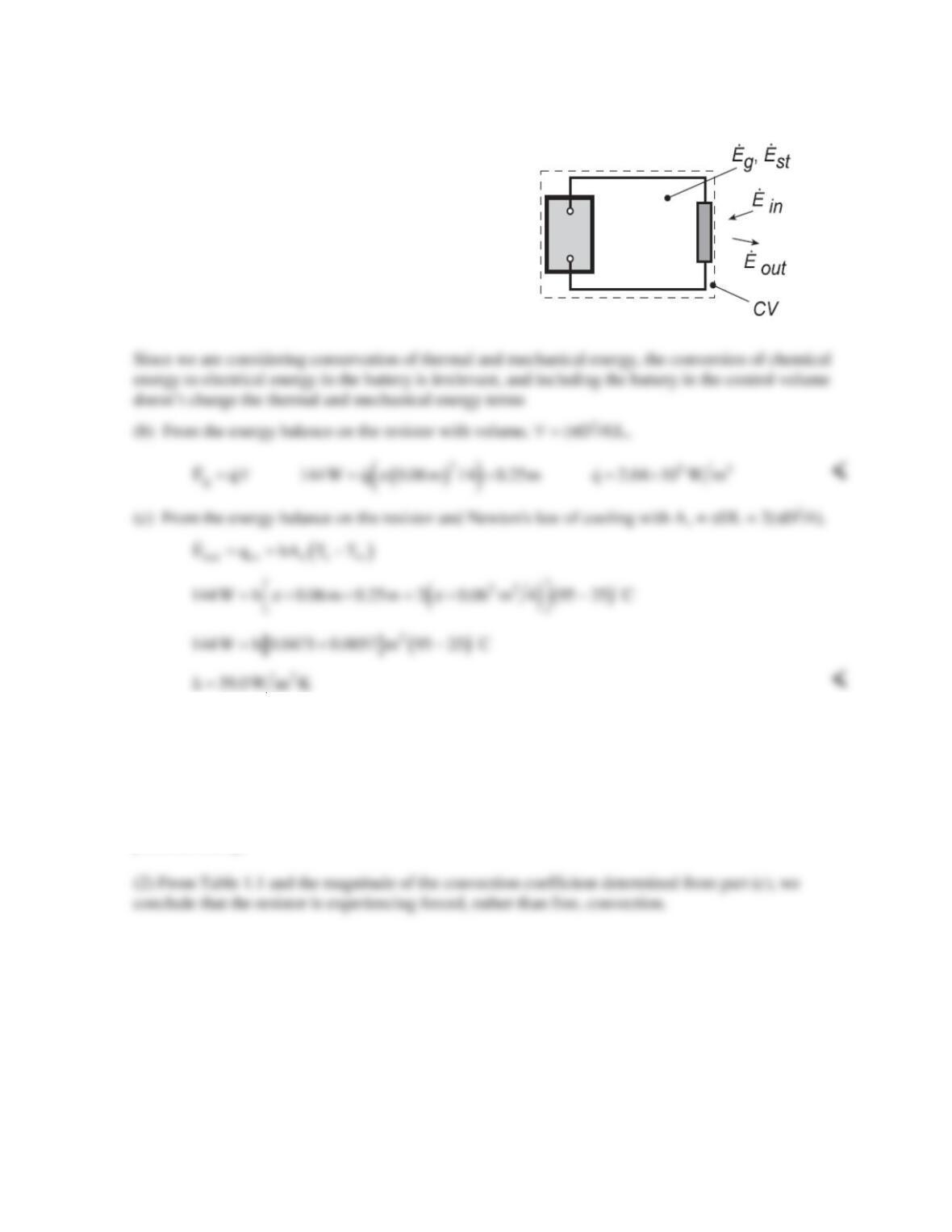
PROBLEM 1.29 (Cont.)
Control volume: Battery-Resistor System.
in out
E 0 E 144 W= =
<
g st
E 144W E 0= =
COMMENTS: (1) In using the conservation of energy requirement, Equation 1.12c, it is important
to recognize that
in
E
and
out
E
will always represent surface processes and
g
E
and
st
E
, volumetric
processes. The generation term
g
E
is associated with a conversion process from some form of
energy to thermal energy. The storage term
st
E
represents the rate of change of internal kinetic, and
potential energy.
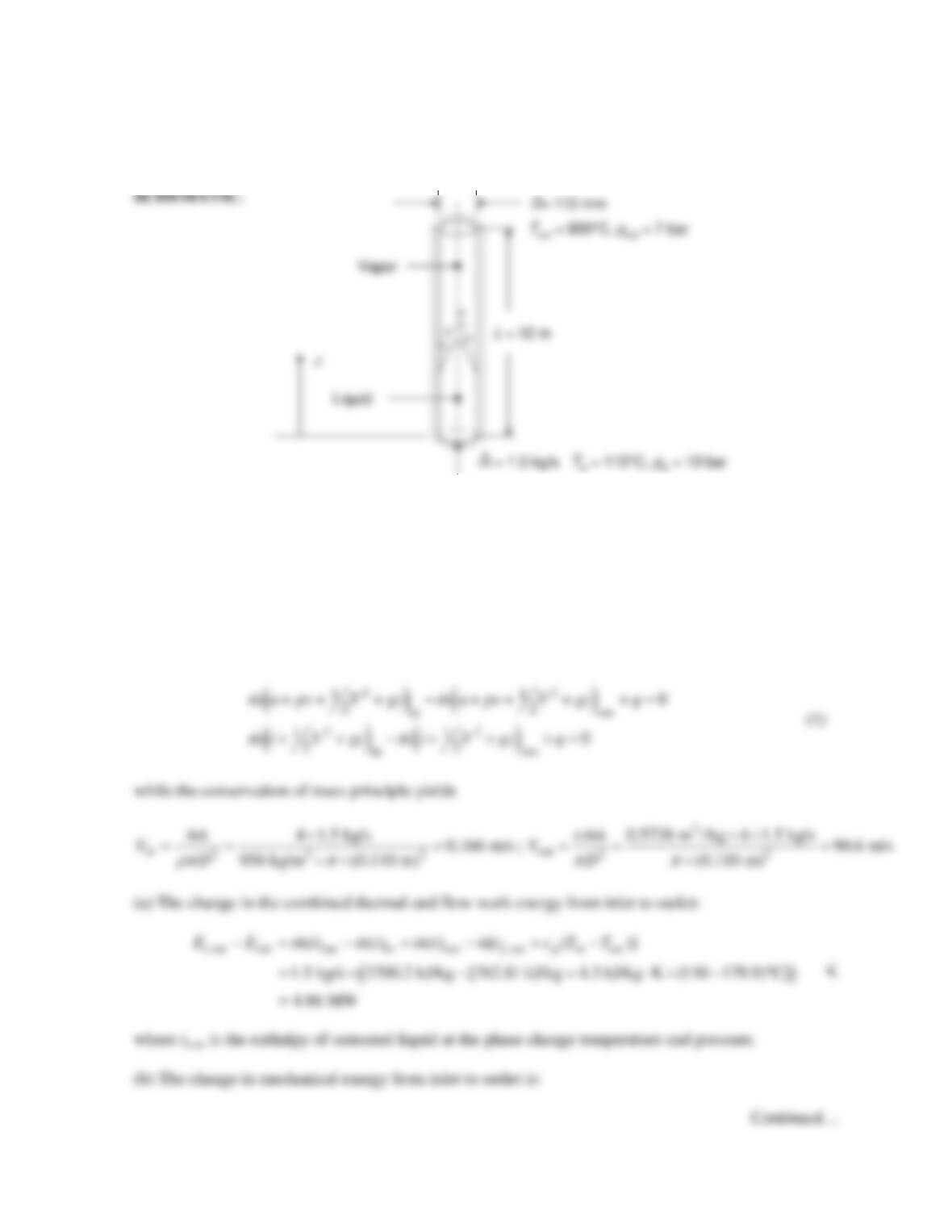
PROBLEM 1.30
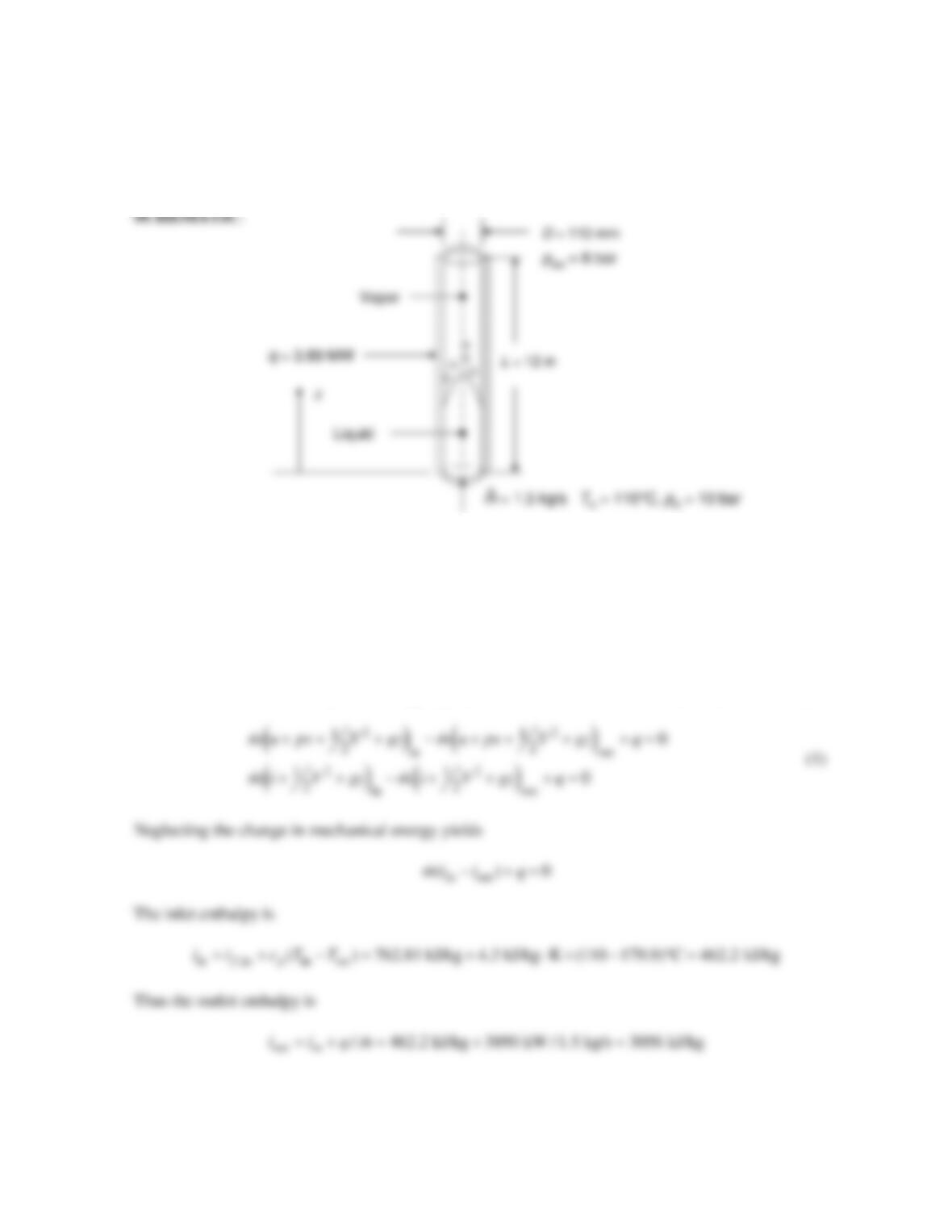
KNOWN: Inlet and outlet conditions for flow of water in a vertical tube.
FIND: (a) Change in combined thermal and flow work, (b) change in mechanical energy, and (c)
change in total energy of the water from the inlet to the outlet of the tube, (d) heat transfer rate, q.
ASSUMPTIONS: (1) Steady–state conditions, (2) Uniform velocity distributions at the tube inlet and
outlet.
PROPERTIES: Table A.6 water (T = 110°C):
ρ
= 950 kg/m3, (T = (179.9°C + 110 °C)/2 = 145°C):
cp = 4300 J/kg⋅K,
ρ
= 919 kg/m3. Other properties are taken from Moran, M.J. and Shapiro, H.N.,
Fundamentals of Engineering Thermodynamics, 6th Edition, John Wiley & Sons, Hoboken, 2008
including (psat = 10 bar): Tsat = 179.9°C, if = 762.81 kJ/kg; (p = 7 bar, T = 600°C): i = 3700.2 kJ/kg,
u
= 0.5738 m3/kg.
ANALYSIS: The steady–flow energy equation, in the absence of work (other than flow work), is
PROBLEM 1.30 (cont.)
(c) The change in the total energy is the summation of the thermal, flow work, and mechanical energy
change or
COMMENTS: (1) The change in mechanical energy, consisting of kinetic and potential energy
components, is negligible compared to the change in thermal and flow work energy. (2) The average
heat flux at the tube surface is
2
“ /( ) 4.87MW /( 0.110 m 12 m) 1.17 MW/mq q DL
ππ
= = × ×=
, which
is very large. (3) The change in the velocity of the water is inversely proportional to the change in the
density. As such, the outlet velocity is very large, and large pressure drops will occur in the vapor
region of the tube relative to the liquid region of the tube.
PROBLEM 1.31
KNOWN: Flow of water in a vertical tube. Tube dimensions. Mass flow rate. Inlet pressure and
temperature. Heat rate. Outlet pressure.
FIND: (a) Outlet temperature, (b) change in combined thermal and flow work, (c) change in
mechanical energy, and (d) change in total energy of the water from the inlet to the outlet of the tube.
ASSUMPTIONS: (1) Steady–state conditions, (2) Negligible change in mechanical energy. (3)
Uniform velocity distributions at the tube inlet and outlet.
PROPERTIES: Table A.6 water (T = 110°C):
ρ
= 950 kg/m3, (T = (179.9°C + 110 °C)/2 = 145°C):
cp = 4300 J/kg⋅K,
ρ
= 919 kg/m3. Other properties are taken from Moran, M.J. and Shapiro, H.N.,
Fundamentals of Engineering Thermodynamics, 6th Edition, John Wiley & Sons, Hoboken, 2008
including (psat = 10 bar): Tsat = 179.9°C, if = 762.81 kJ/kg; (p = 8 bar, i = 3056 kJ/kg): T = 300°C,
u
=
0.3335 m3/kg.
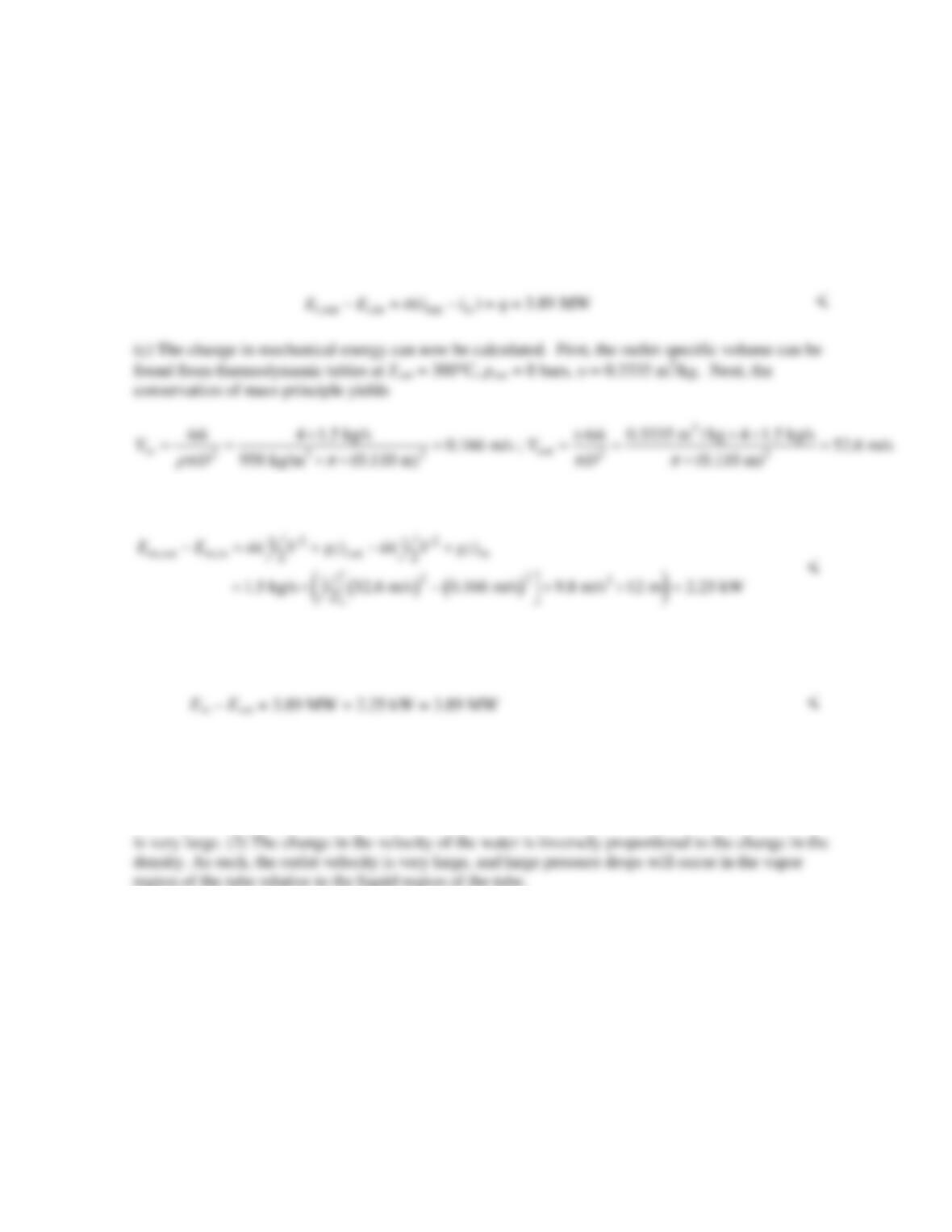
ANALYSIS: (a) The steady–flow energy equation, in the absence of work (other than flow work), is
Continued…
PROBLEM 1.31 (cont.)
and the outlet temperature can be found from thermodynamic tables at p = 8 bars, i = 3056 kJ/kg, for
which
Tout = 300°C <
(b) The change in the combined thermal and flow work energy from inlet to outlet:
The change in mechanical energy from inlet to outlet is:
(d) The change in the total energy is the summation of the thermal, flow work, and mechanical energy
change or
COMMENTS: (1) The change in mechanical energy, consisting of kinetic and potential energy
components, is negligible compared to the change in thermal and flow work energy. (2) The average
heat flux at the tube surface is
2
“ /( ) 3.89 MW /( 0.110 m 12 m) 0.94 MW/mq q DL
ππ
= = × ×=
, which
PROBLEM 1.32
KNOWN: Hot and cold reservoir temperatures of an internally reversible refrigerator. Thermal
resistances between refrigerator and hot and cold reservoirs.
FIND: Expressions for modified Coefficient of Performance and power input of refrigerator.
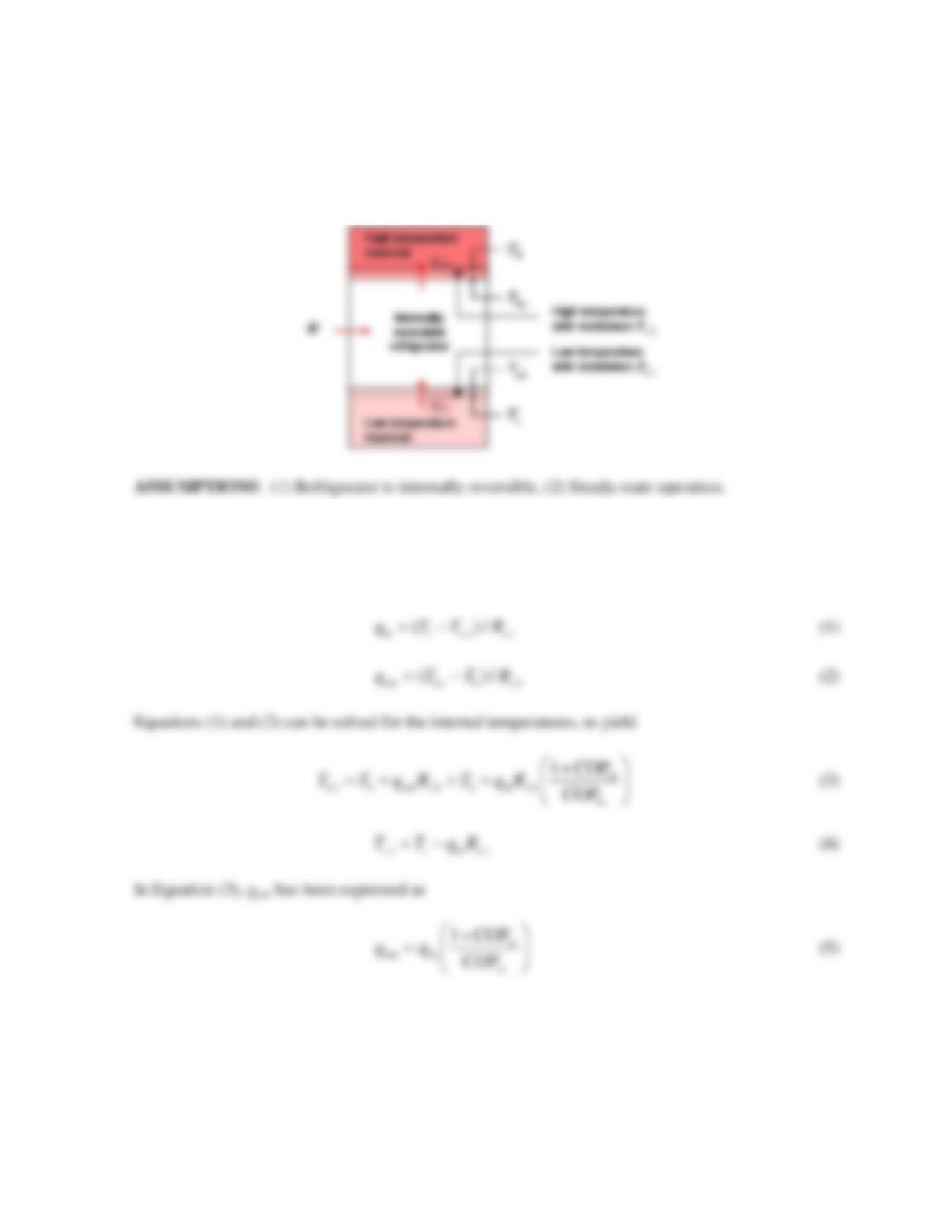
SCHEMATIC:
ANALYSIS: Heat is transferred from the low temperature reservoir (the refrigerated space) at Tc to
the refrigerator unit, through the resistance Rt,c, with Tc > Tc,i . Heat is rejected from the refrigerator
unit to the higher temperature reservoir (the surroundings), through the resistance Rt,h, with Th,i > Th.
The heat input and output rates can be expressed in a manner analogous to Equations 1.18a and 1.18b.
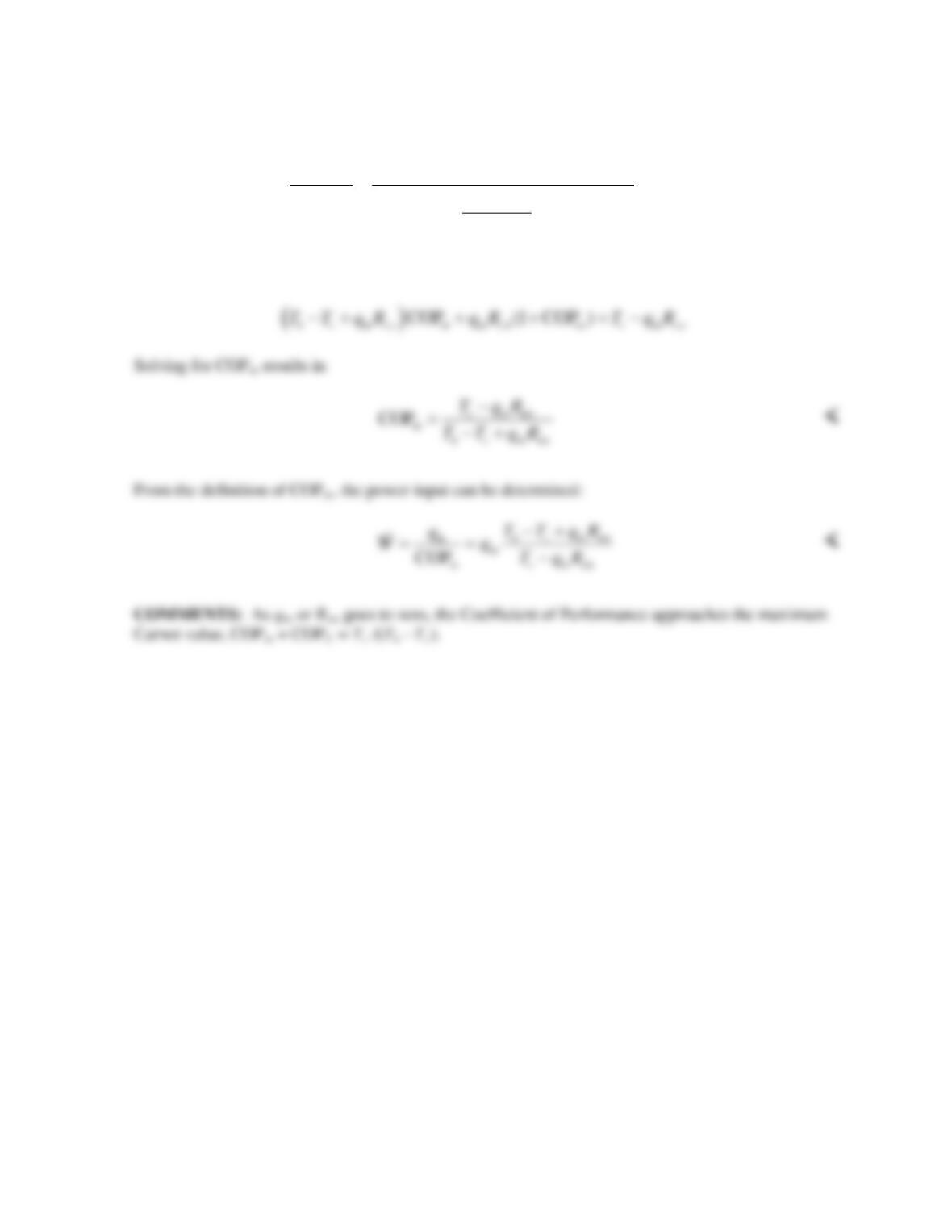
using the definition of COPm given in the problem statement. The modified Coefficient of
Performance can then be expressed as
Continued…
PROBLEM 1.32 (Cont.)
, in ,
,,
in , in ,
COP 1 COP
COP
ci c tc
m
hi ci m
h th c tc
m
T T qR
TT T qR T qR
−
= =
−
+
+ −+
Manipulating this expression,