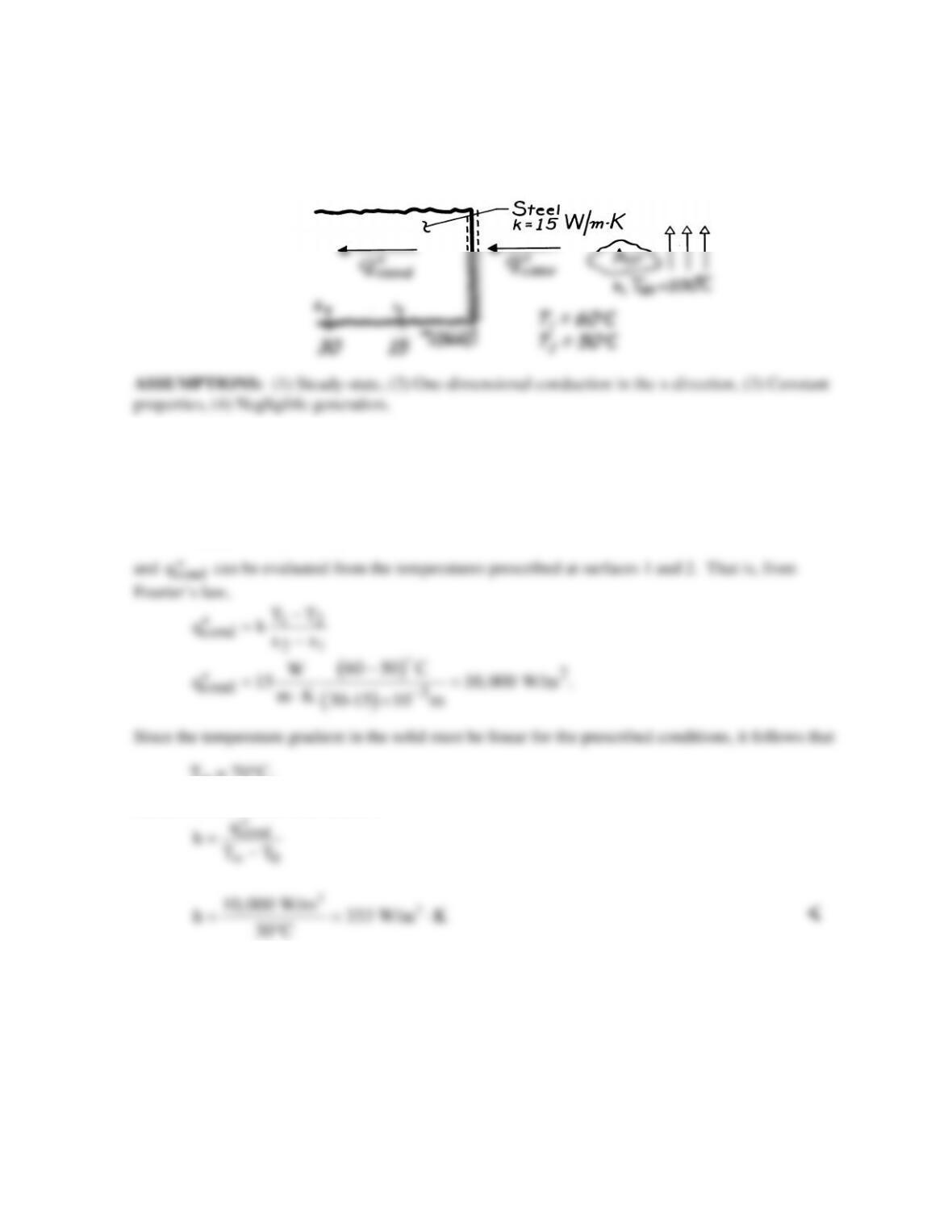
PROBLEM 1.58
KNOWN: Temperatures at 15 mm and 30 mm from the surface and in the adjoining airflow for a
thick stainless steel casting.
FIND: Surface convection coefficient, h.
SCHEMATIC:
ANALYSIS: From a surface energy balance, it follows that
′′ =′′
q q
cond conv
where the convection rate equation has the form
( )
0
conv
q h T T ,
∞
′′ = −
To = 70°C.
Hence, the convection coefficient is
COMMENTS: The accuracy of this procedure for measuring h depends strongly on the validity of
the assumed conditions.
PROBLEM 1.59
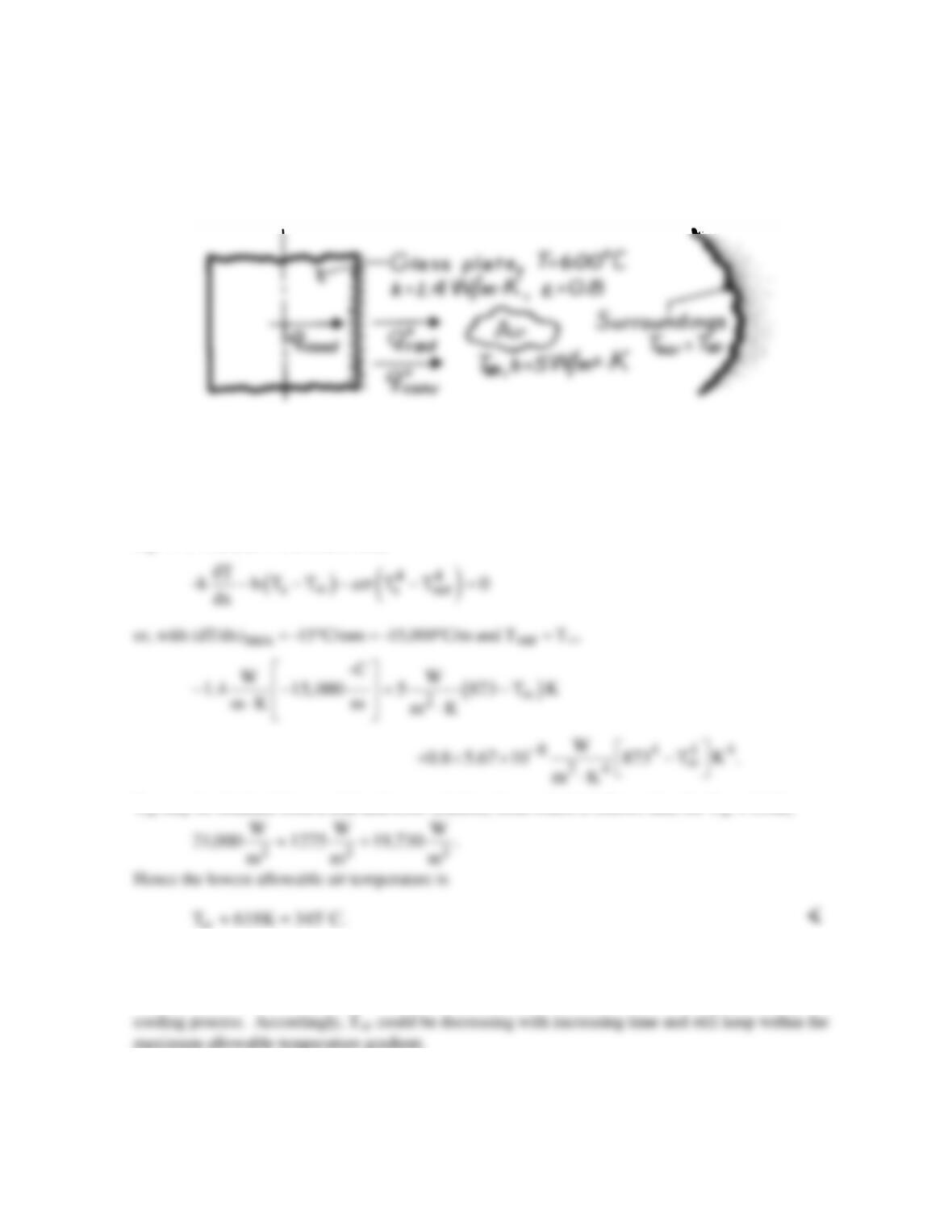
KNOWN: Conditions associated with surface cooling of plate glass which is initially at 600°C.
Maximum allowable temperature gradient in the glass.
FIND: Lowest allowable air temperature, T∞.
SCHEMATIC:
ASSUMPTIONS: (1) Surface of glass exchanges radiation with large surroundings at Tsur = T∞,
(2) One-dimensional conduction in the x-direction.
ANALYSIS: The maximum temperature gradient will exist at the surface of the glass and at the
instant that cooling is initiated. From the surface energy balance, Eq. 1.13, and the rate equations,
Eqs. 1.1, 1.3a and 1.7, it follows that
T∞ may be obtained from a trial-and-error solution, from which it follows that, for T∞ = 618K,
∞
COMMENTS: (1) Initially, cooling is determined primarily by radiation effects.
(2) For fixed T∞, the surface temperature gradient would decrease with increasing time into the
PROBLEM 1.60
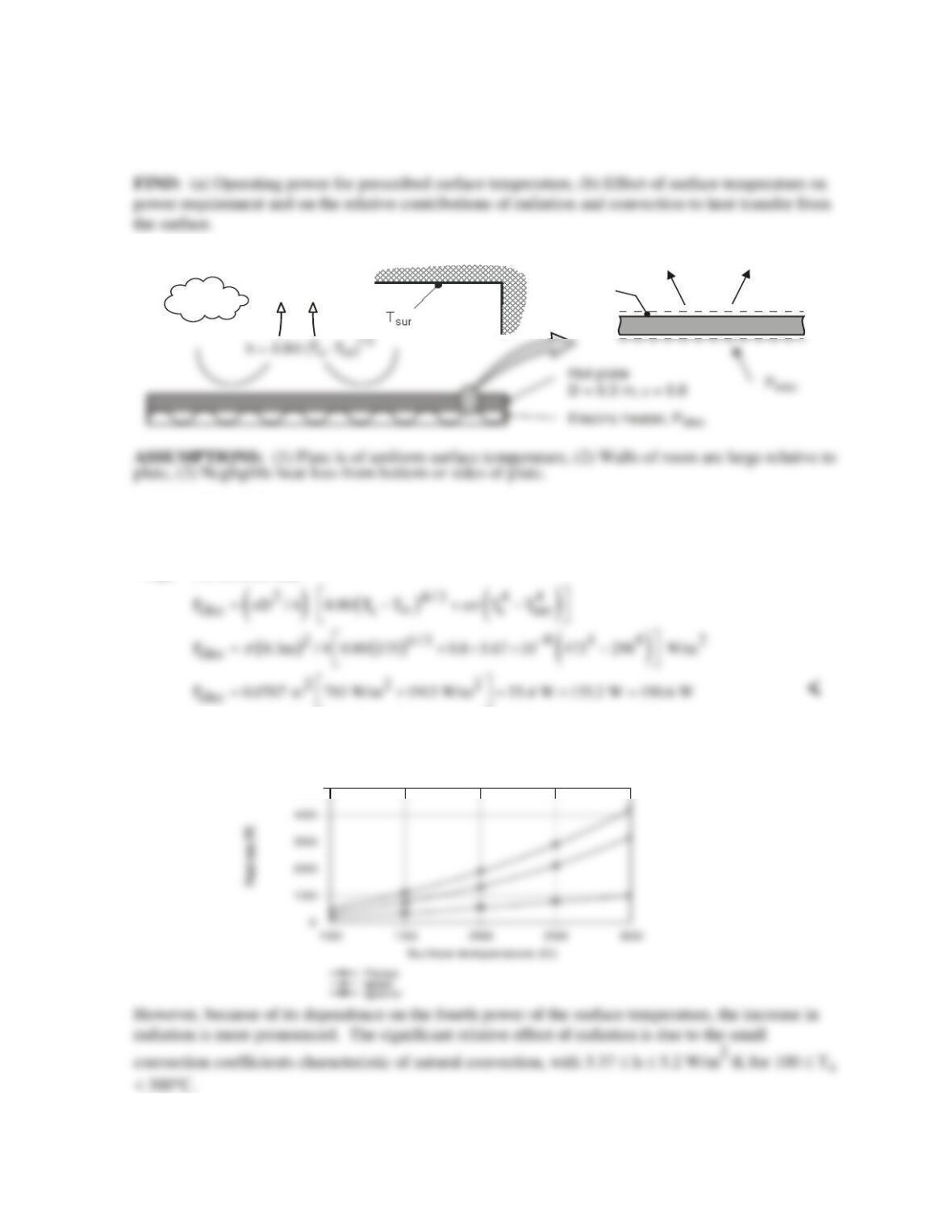
KNOWN: Surface temperature, diameter and emissivity of a hot plate. Temperature of surroundings
and ambient air. Expression for convection coefficient.
SCHEMATIC:
ANALYSIS: (a) From an energy balance on the hot plate, Pelec = qconv + qrad = Ap
( )
conv rad
q q.
′′ ′′
+
Substituting for the area of the plate and from Eqs. (1.3a) and (1.7), with h = 0.80 (Ts
– T∞)1/3, it follows that
(b) As shown graphically, both the radiation and convection heat rates, and hence the requisite electric
power, increase with increasing surface temperature.
COMMENTS: Radiation losses could be reduced by applying a low emissivity coating to the
surface, which would have to maintain its integrity over the range of operating temperatures.
Effect of surface temperature on electric power and heat rates
500
T
s
q
rad
q
conv
Air
T
sur
T
s
q
rad
q
conv
Air
T
sur
PROBLEM 1.61
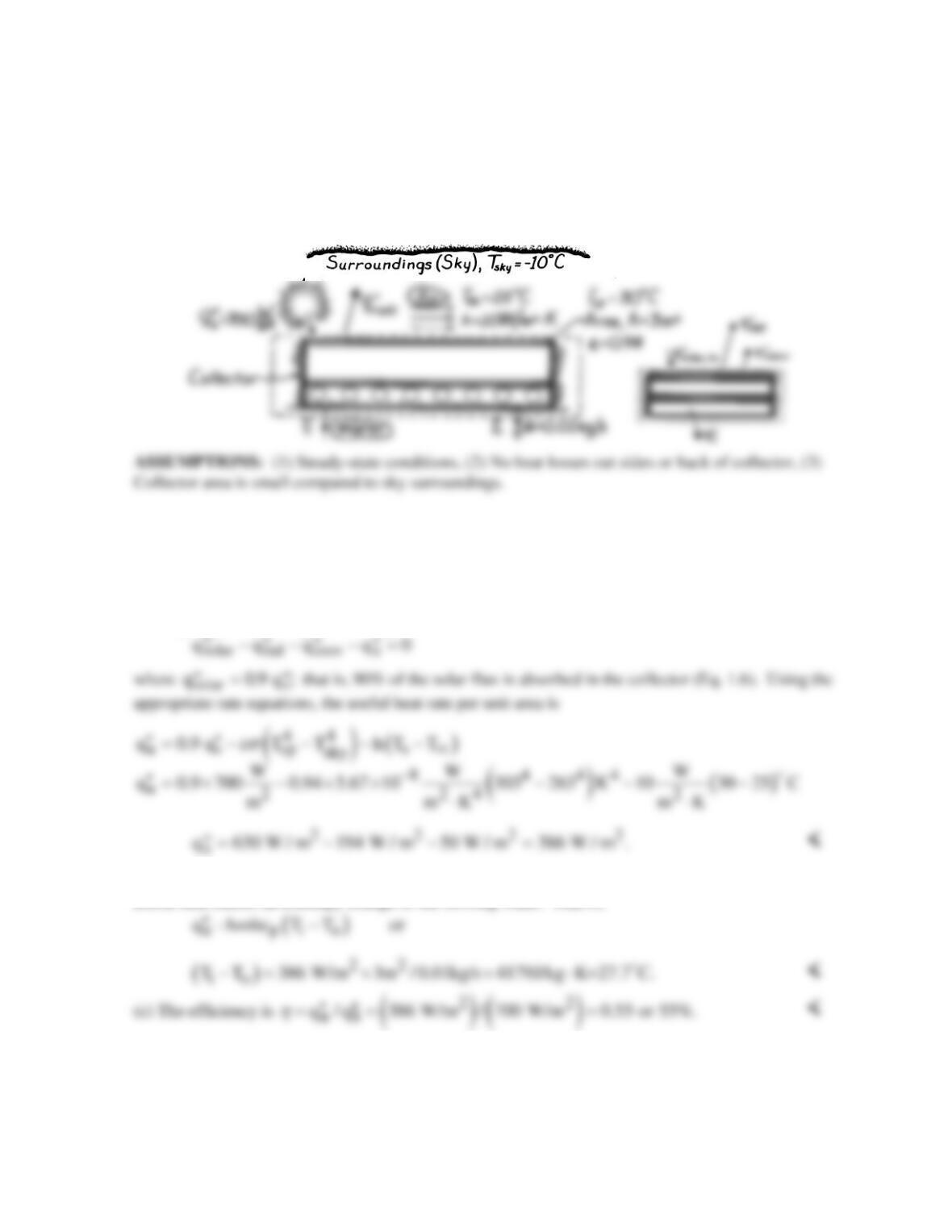
KNOWN: Solar collector designed to heat water operating under prescribed solar irradiation and
loss conditions.
FIND: (a) Useful heat collected per unit area of the collector,
′′
qu,
(b) Temperature rise of the water
flow,
T T
o i
−,
and (c) Collector efficiency.
SCHEMATIC:
PROPERTIES: Table A.6, Water (300K): cp = 4179 J/kg⋅K.
ANALYSIS: (a) Defining the collector as the control volume and writing the conservation of energy
requirement on a per unit area basis, find that
.E E E E
in out gen st
− + =
Identifying processes as per above right sketch,
(b) The total useful heat collected is
′′ ⋅qA.
u
Defining a control volume about the water tubing, the
useful heat causes an enthalpy change of the flowing water. That is,
COMMENTS: Note how the sky has been treated as large surroundings at a uniform temperature
Tsky.
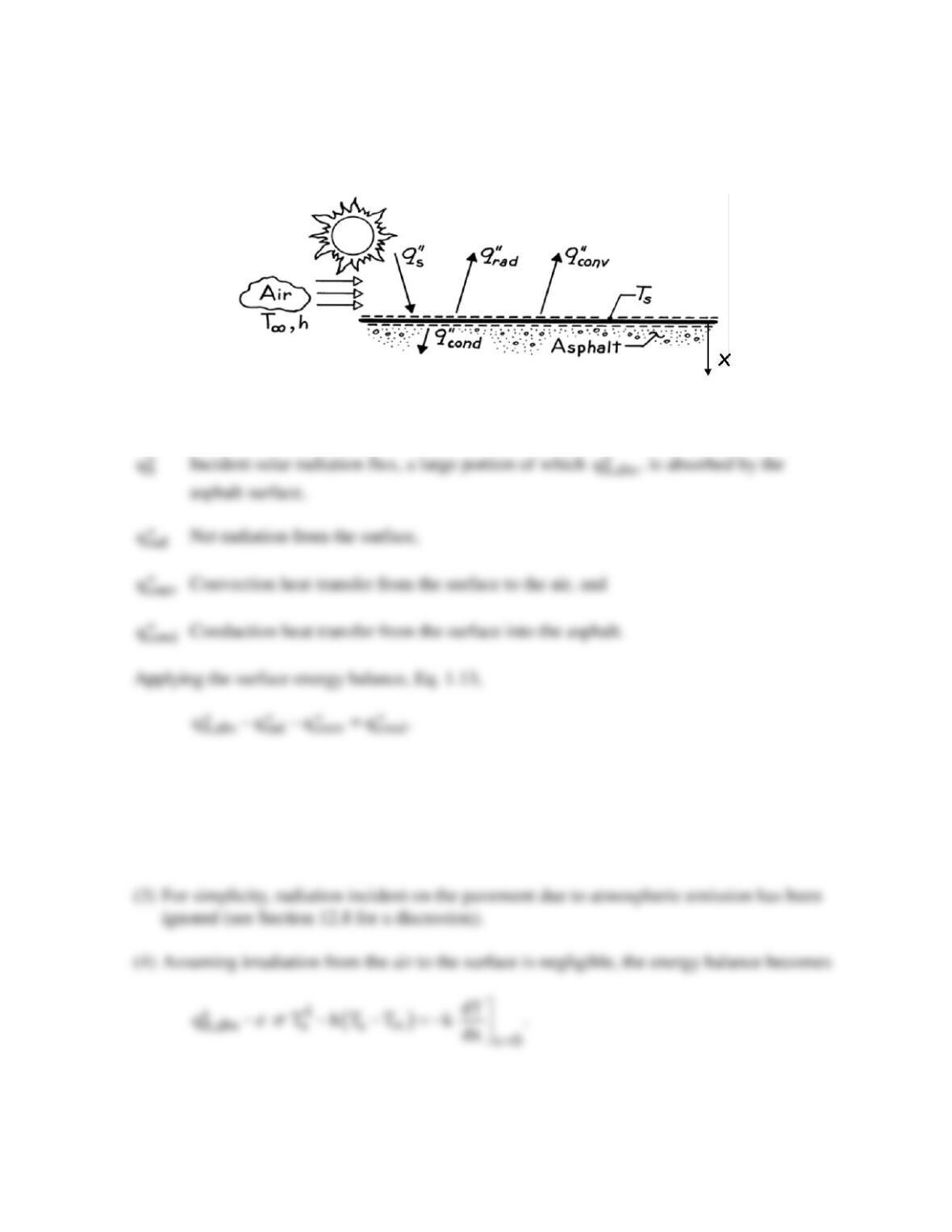
PROBLEM 1.62(a)
KNOWN: Solar radiation is incident on an asphalt paving.
FIND: Relevant heat transfer processes.
SCHEMATIC:
The relevant processes shown on the schematic include:
COMMENTS: (1)
′′
q
cond
and
′′
q
conv
could be evaluated from Eqs. 1.1 and 1.3, respectively.
(2) It has been assumed that the pavement surface temperature is higher than that of the
underlying pavement and the air, in which case heat transfer by conduction and convection
are from the surface.
′′
′′
conv
′′
cond
PROBLEM 1.62(b)
KNOWN: Physical mechanism for microwave heating.
FIND: Comparison of (i) cooking in a microwave oven with a conventional radiant or
convection oven and (ii) a microwave clothes dryer with a conventional dryer.
(i) Microwave cooking of food that contains water molecules occurs as a result of volumetric
thermal energy generation throughout the food, without heating of the food container or the
(ii) In a microwave dryer, the microwave radiation would heat the water, but not the fabric,
directly (the fabric would be heated indirectly by thermal energy transfer from the water). By

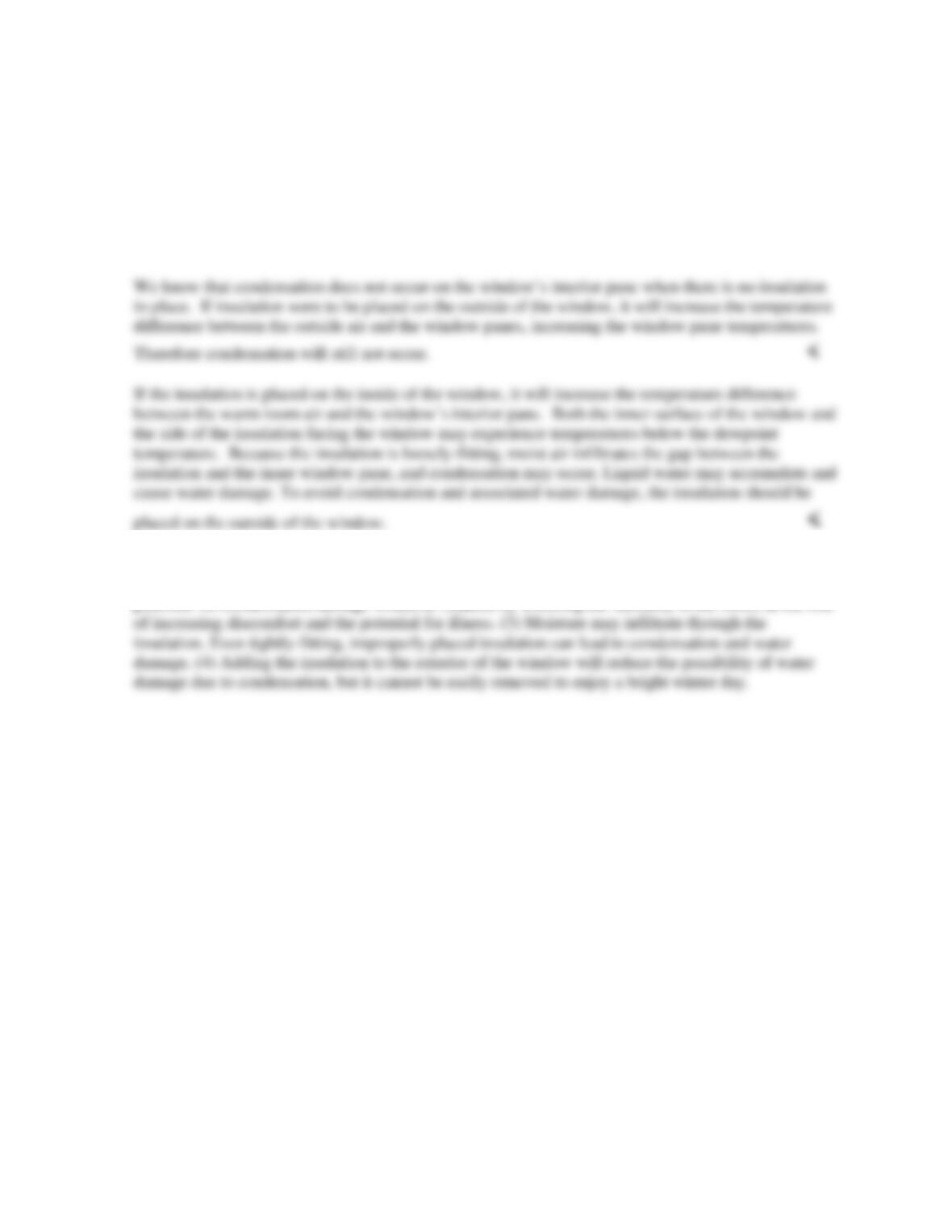
PROBLEM 1.62(c)
KNOWN: Double-pane windows with foamed insulation inside or outside. Cold, dry air outside and
warm, moist air inside.
FIND: Identify heat transfer processes. Which configuration is preferred to avoid condensation?
SCHEMATIC:
Insulation on inside of window.
ASSUMPTIONS: (1) Steady–state conditions, (2) One–dimensional heat transfer through window
and insulation.
ANALYSIS: With the insulation on the inside, heat is transferred from the warm room air to the
Cold, dry
night air
Cold, dry
night air
Exterior
pane
Warm, moist
room air
Interior
pane
Insulation
Air gap Air gap
q
conv,1
q
rad,1
q
rad,4
q
conv,4
q
cond,1
q
cond,2
q
cond,3
q
conv,2
q
conv,3
q
rad,2
q
rad,3
Moist air
Cold, dry
night air
Cold, dry
night air
Warm, moist
room air
Air gapAir gap
PROBLEM 1.62(c) (Cont.)
Condensation may occur on any surface that is exposed to moist air if the surface temperature is below
the dewpoint temperature. Condensation causes an additional heat transfer mechanism because when
water vapor condenses it releases the enthalpy of vaporization (qcondense ), which heats the surface on
which condensation is occurring. For example, if condensation occurs on the inside surface of the
window, this will increase the temperature of that surface and the rate of heat transfer through that
window pane. The condensation heat transfer processes are not shown on the schematics.
COMMENTS: (1) The potential water damage is not caused by window leakage. Any condensation
problem would be exacerbated by adding more insulation to the inside of the window. (2) The
potential for condensation damage would be reduced by lowering the humidity in the room, at the risk
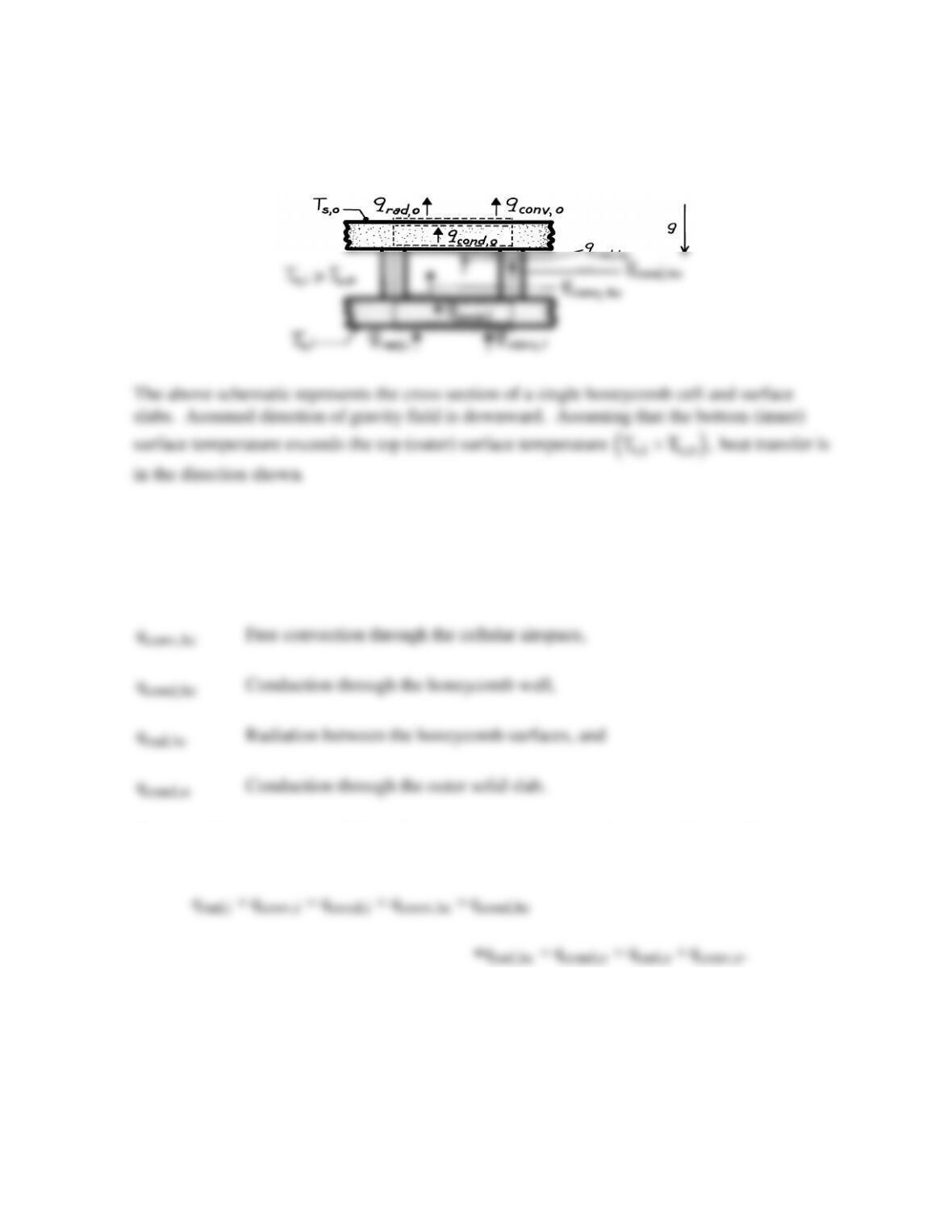
PROBLEM 1.62(d)
KNOWN: Geometry of a composite insulation consisting of a honeycomb core.
FIND: Relevant heat transfer processes.
SCHEMATIC:
Heat may be transferred to the inner surface by convection and radiation, whereupon it is
transferred through the composite by
qcond,i
Conduction through the inner solid slab,
Heat may then be transferred from the outer surface by convection and radiation. Note that
for a single cell under steady state conditions,
COMMENTS: Performance would be enhanced by using materials of low thermal
conductivity, k, and emissivity, ε. Evacuating the airspace would enhance performance by
eliminating heat transfer due to free convection.
PROBLEM 1.62(e)
KNOWN: A thermocouple junction is used, with or without a radiation shield, to measure
the temperature of a gas flowing through a channel. The wall of the channel is at a
temperature much less than that of the gas.
FIND: (a) Relevant heat transfer processes, (b) Temperature of junction relative to that of
gas, (c) Effect of radiation shield.
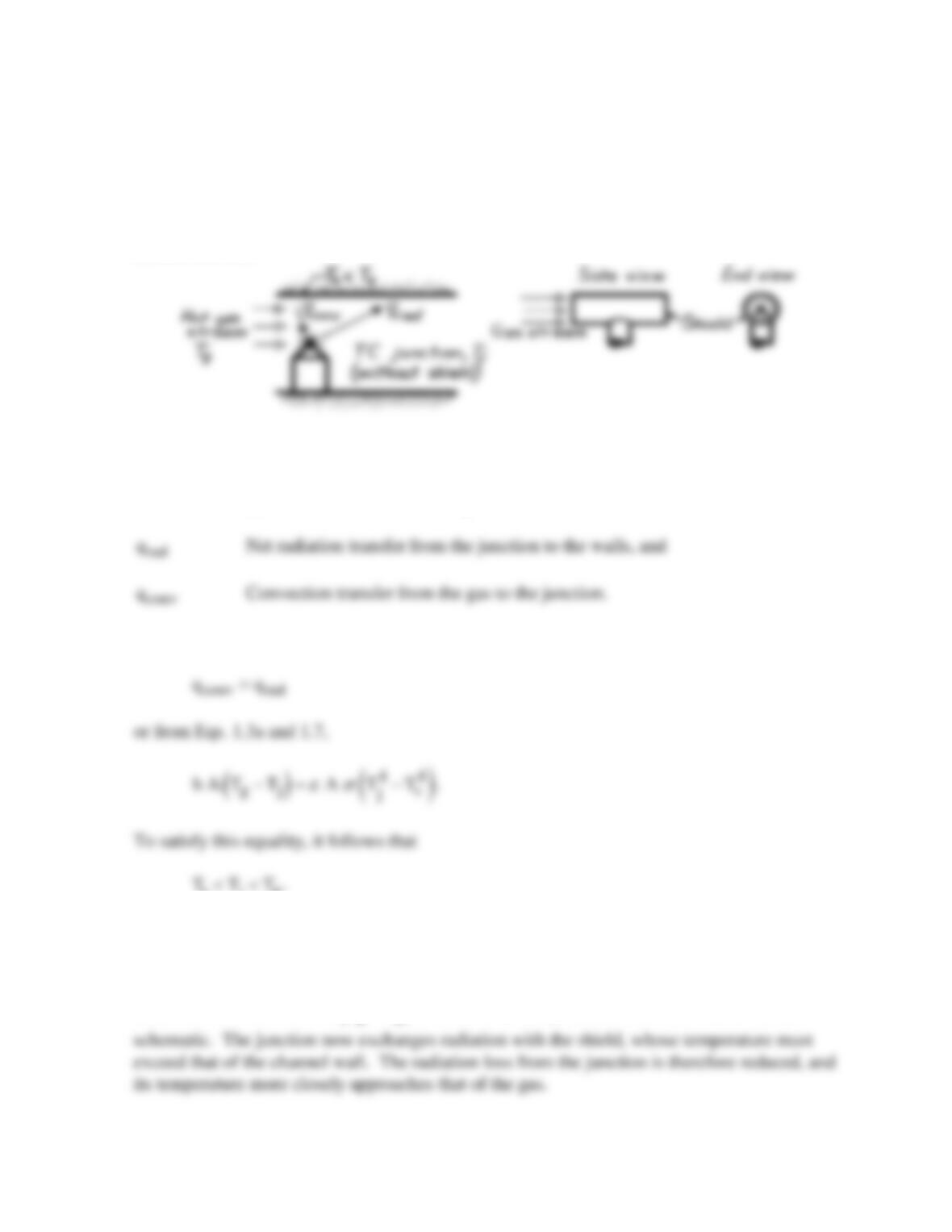
SCHEMATIC:
ASSUMPTIONS: (1) Junction is small relative to channel walls, (2) Steady–state conditions,
(3) Negligible heat transfer by conduction through the thermocouple leads.
ANALYSIS: (a) The relevant heat transfer processes are:
(b) From a surface energy balance on the junction,
s j g
That is, the junction assumes a temperature between that of the channel wall and the gas,
thereby sensing a temperature which is less than that of the gas.
(c) The measurement error
( )
gj
TT−
is reduced by using a radiation shield as shown in the
PROBLEM 1.62(f)
KNOWN: Fireplace cavity is separated from room air by two glass plates, open at both ends.
FIND: Relevant heat transfer processes.
SCHEMATIC:
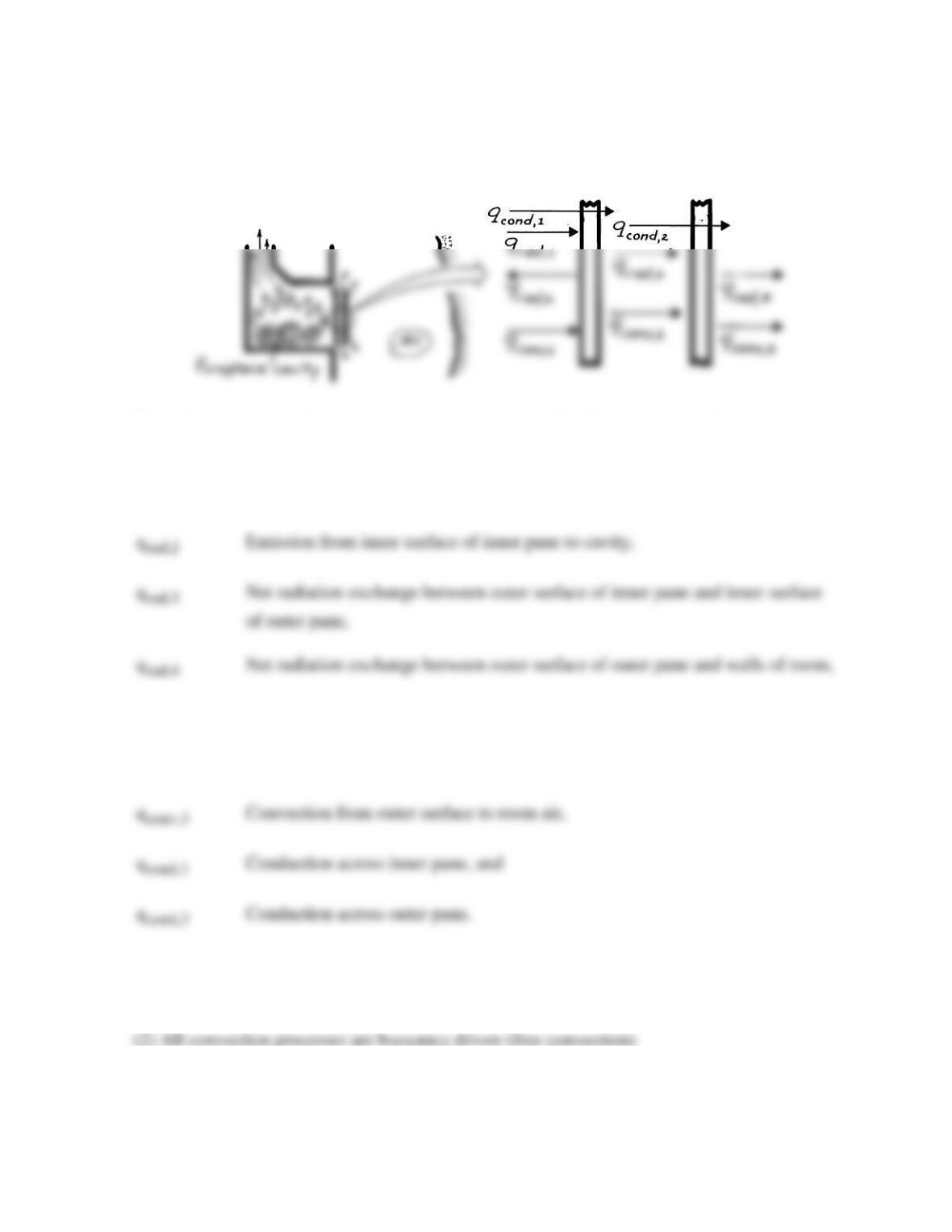
The relevant heat transfer processes associated with the double-glazed, glass fire screen are:
qrad,1
Radiation from flames and cavity wall, portions of which are absorbed and
transmitted by the two panes,
qrad,3
qconv,1
Convection between cavity gases and inner pane,
q
conv2
Convection across air space between panes,
qconv,3
qcond,1
qcond,2
COMMENTS: (1) Much of the luminous portion of the flame radiation is transmitted to the
room interior.

PROBLEM 1.62(g)
KNOWN: Thermocouple junction held in small hole in solid material by epoxy. Solid is hotter than
surroundings.
FIND: Identify heat transfer processes. Will thermocouple junction sense temperature less than,
equal to, or greater than solid temperature? How will thermal conductivity of epoxy affect junction
temperature?
SCHEMATIC:
ANALYSIS: Heat is transferred from the solid material through the epoxy to the thermocouple
junction by conduction, qcond,1 . Heat is also transferred from the junction along the thermocouple
wires and their sheathing by conduction (qcond,2 and qcond,3 ), and from there to the surroundings by
convection (qconv) and radiation (qrad). Thus, the junction is heated by the solid and cooled by the
surroundings, and its temperature will be between the solid temperature and the temperature of the
cool gases.
The junction temperature will be less than the solid temperature. <
Under steady-state conditions, the rate at which heat is transferred to the junction from the solid
COMMENTS: (1) High thermal conductivity epoxies are formulated specifically for the purpose of
affixing thermocouples. Their thermal conductivity is increased by adding small particles of high
Thermocouple
Hot solid
PROBLEM 1.63(a)
KNOWN: Room air is separated from ambient air by one or two glass panes.
FIND: Relevant heat transfer processes.
SCHEMATIC:
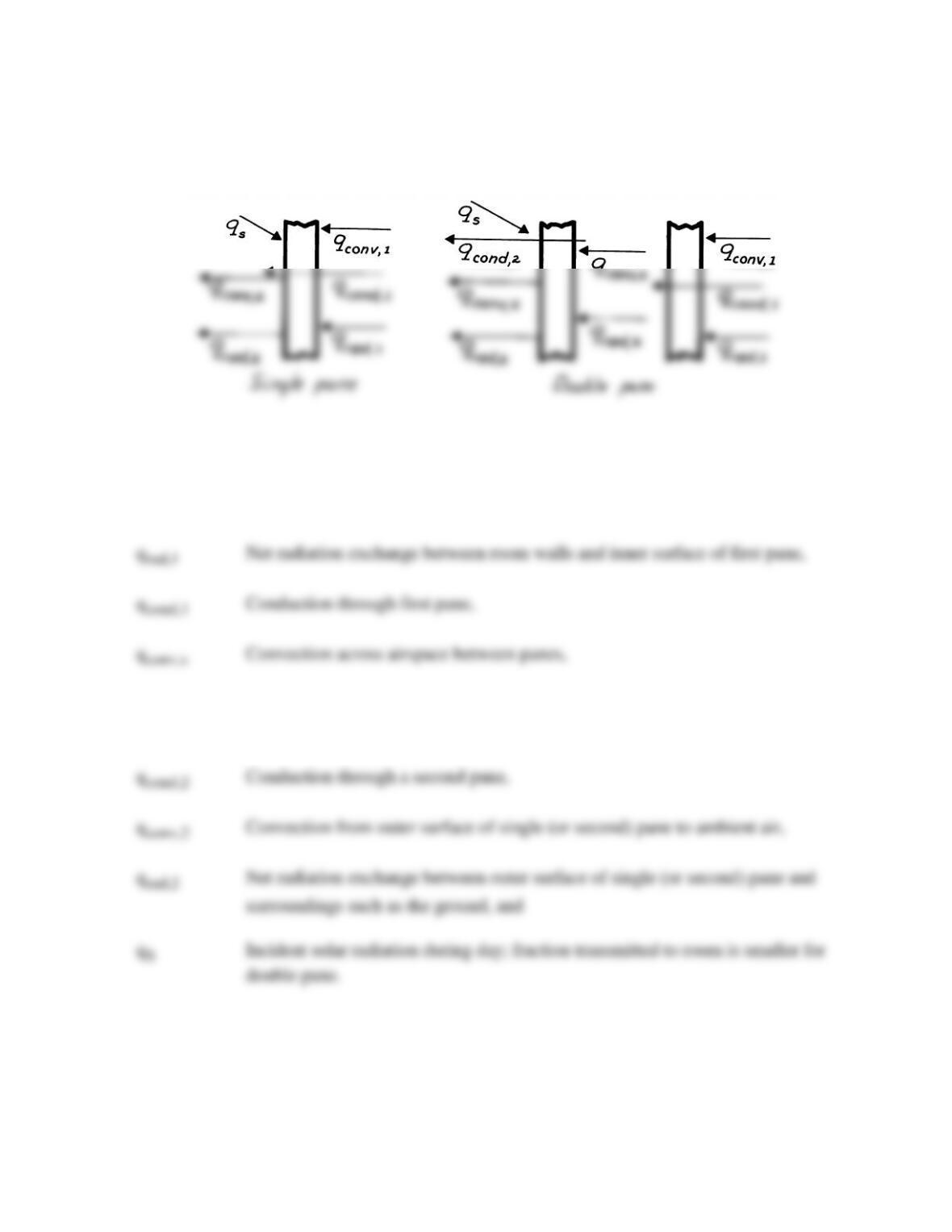
The relevant processes associated with single (above left schematic) and double (above right
schematic) glass panes include.
qconv,1
Convection from room air to inner surface of first pane,
qrad,1
qcond,1
qrad,s
Net radiation exchange between outer surface of first pane and inner surface of
second pane (across airspace),
qcond,2
qconv,2
COMMENTS: Heat loss from the room is significantly reduced by the double pane
construction.
PROBLEM 1.63(b)
KNOWN: Configuration of a flat plate solar collector.
FIND: Relevant heat transfer processes with and without a cover plate.
SCHEMATIC:
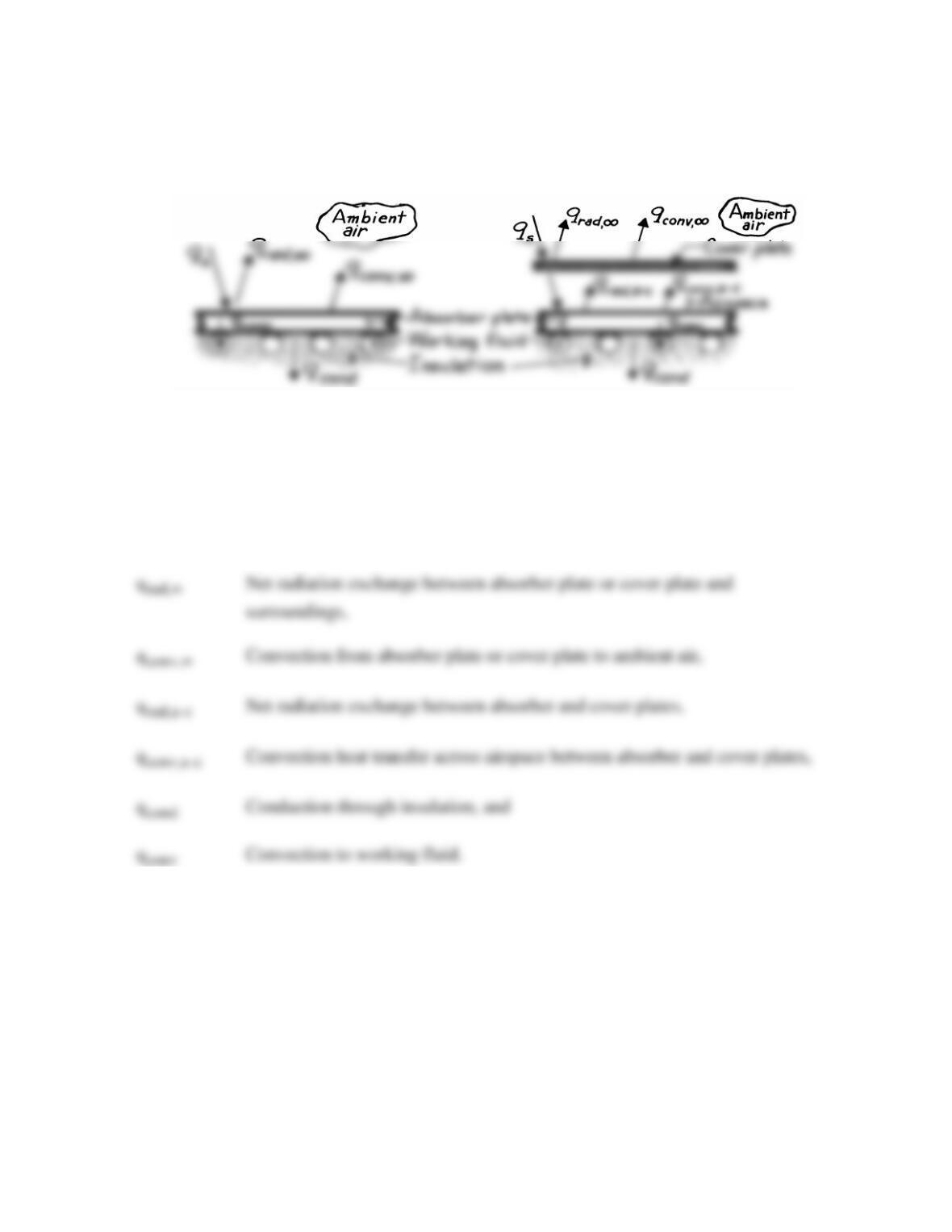
The relevant processes without (above left schematic) and with (above right schematic)
include:
q
S
Incident solar radiation, a large portion of which is absorbed by the absorber
plate. Reduced with use of cover plate (primarily due to reflection off cover
plate).
COMMENTS: The cover plate acts to significantly reduce heat losses by convection and
radiation from the absorber plate to the surroundings.
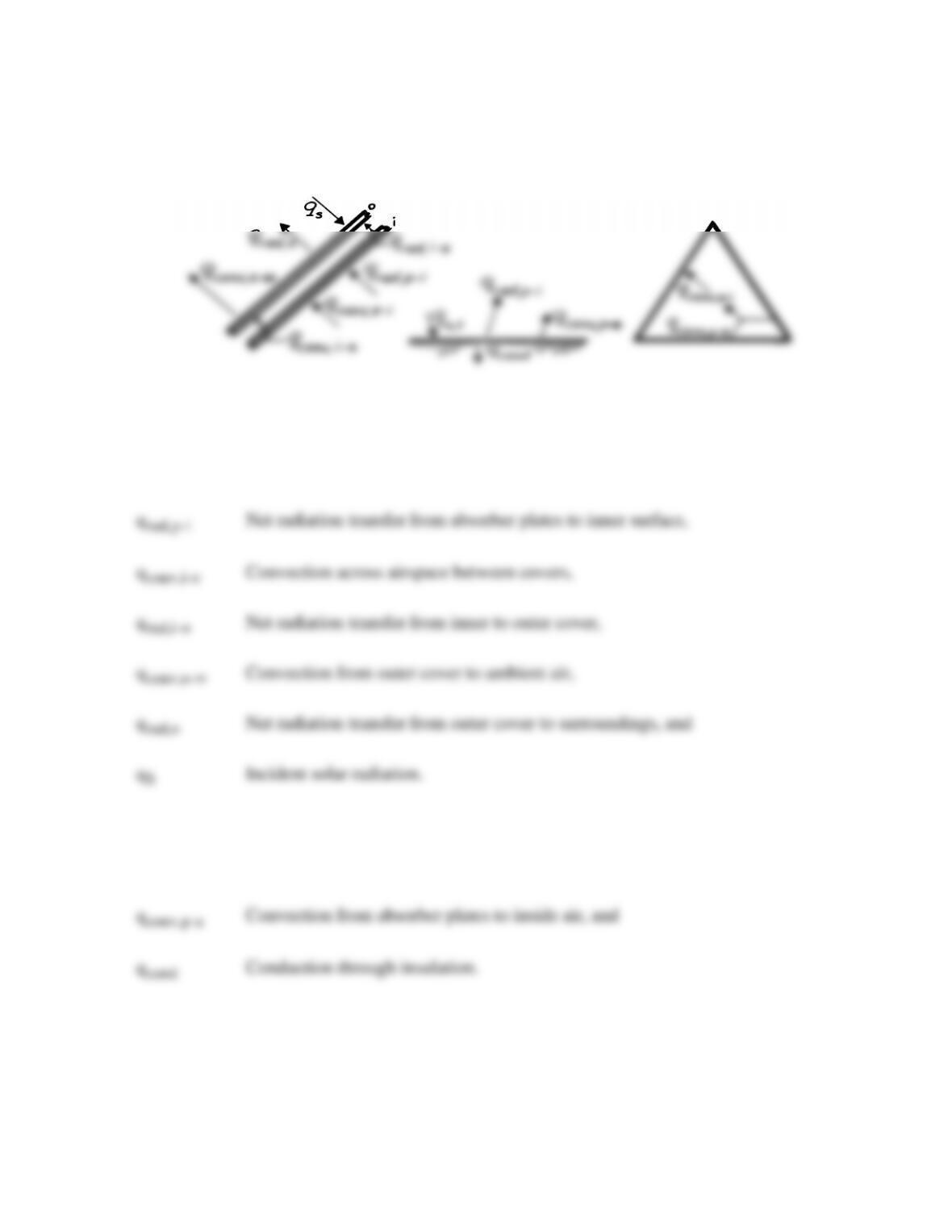
PROBLEM 1.63(c)
KNOWN: Configuration of a solar collector used to heat air for agricultural applications.
FIND: Relevant heat transfer processes.
SCHEMATIC:
Assume the temperature of the absorber plates exceeds the ambient air temperature. At the
cover plates, the relevant processes are:
q
conv,a–i
Convection from inside air to inner surface,
Additional processes relevant to the absorber plates and airspace are:
q
S,t
Solar radiation transmitted by cover plates,
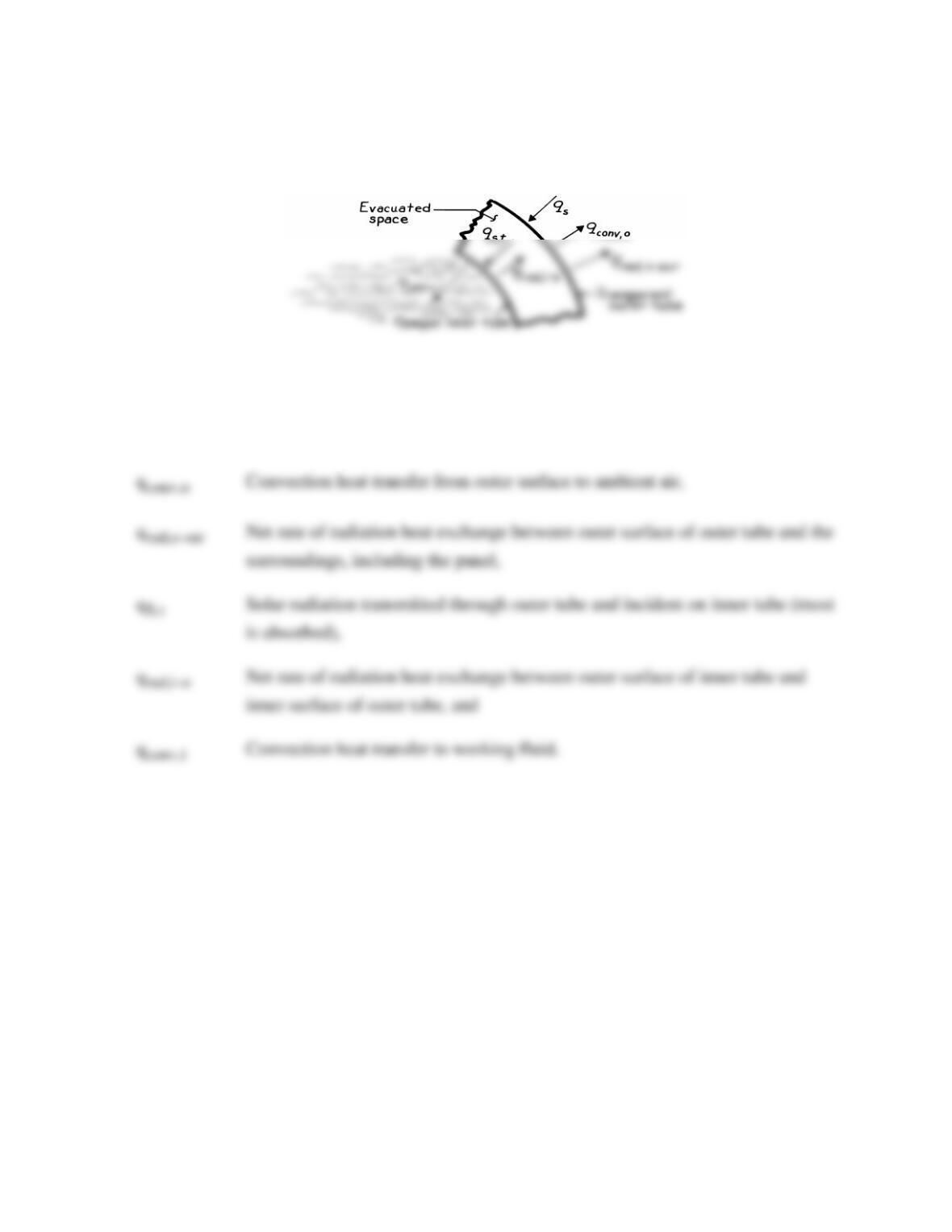
PROBLEM 1.63(d)
KNOWN: Features of an evacuated tube solar collector.
FIND: Relevant heat transfer processes for one of the tubes.
SCHEMATIC:
The relevant heat transfer processes for one of the evacuated tube solar collectors includes:
qS
Incident solar radiation including contribution due to reflection off panel (most
is transmitted),
There is also conduction heat transfer through the inner and outer tube walls. If the walls are
thin, the temperature drop across the walls will be small.