Section 1.1
Chapter 1
Section 1.1
1.1.1x+ 2y= 1
2x+ 3y= 1 −2×1st equation →x+ 2y= 1
−y=−1÷(−1) →
x+ 2y= 1
y= 1 −2×2nd equation →x=−1
y= 1 , so that (x, y) = (−1,1).
1.1.32x+ 4y= 3
3x+ 6y= 2 ÷2→x+ 2y=3
2
3x+ 6y= 2 −3×1st equation →x+ 2y=3
2
0 = −5
2.
So there is no solution.
1.1.52x+ 3y= 0
4x+ 5y= 0 ÷2→x+3
2y= 0
4x+ 5y= 0 −4×1st equation →
x+3
2y= 0
−y= 0 ÷(−1) →x+3
2y= 0
y= 0 −3
2×2nd equation →x= 0
y= 0 ,
so that (x, y) = (0,0).
1
Chapter 1
1.1.9
x+ 2y+ 3z= 1
3x+ 2y+z= 1
7x+ 2y−3z= 1
−3(I)
−7(I)
→
x+ 2y+ 3z= 1
−4y−8z=−2
−12y−24z=−6
÷(−4) →
x+ 2y+ 3z= 1
y+ 2z=1
2
−12y−24z=−6
−2(II)
+12(II)
→
x−z= 0
y+ 2z=1
2
0 = 0
This system has infinitely many solutions: if we choose z=t, an arbitrary real number, then we get x=z=t
and y=1
2−2z=1
2−2t. Therefore, the general solution is (x, y, z) = t, 1
2−2t, t, where tis an arbitrary real
number.
1.1.11 x−2y= 2
3x+ 5y= 17 −3(I)→x−2y= 2
11y= 11 ÷11 →x−2y= 2
y= 1 +2(II)→x= 4
y= 1 ,
so that (x, y) = (4,1). See Figure 1.1.
1.1.12 x−2y= 3
2x−4y= 6 −2(I)→x−2y= 3
0 = 0
Section 1.1
Figure 1.2: for Problem 1.1.12.
1.1.13 x−2y= 3
2x−4y= 8 −2(I)→x−2y= 3
0 = 2 , which has no solutions. (See Figure 1.3.)
1.1.14 The system reduces to
x+ 5z= 0
y−z= 0
0 = 1
, so that there is no solution; no point in space belongs to all three
planes.
Compare with Figure 2b.
1.1.17 x+ 2y=a
3x+ 5y=b−3(I)→x+ 2y=a
−y=−3a+b÷(−1) →x+ 2y=a
y= 3a−b−2(II)
Chapter 1
1.1.19 The system reduces to
x+z= 1
y−2z=−3
0 = k−7
.
1.1.20 The system reduces to
x−3z= 1
y+ 2z= 1
(k2−4)z=k−2
1.1.21 Let x,y, and zrepresent the three numbers we seek. We set up a system of equations and solve systematically
(although there are short cuts):
Section 1.1
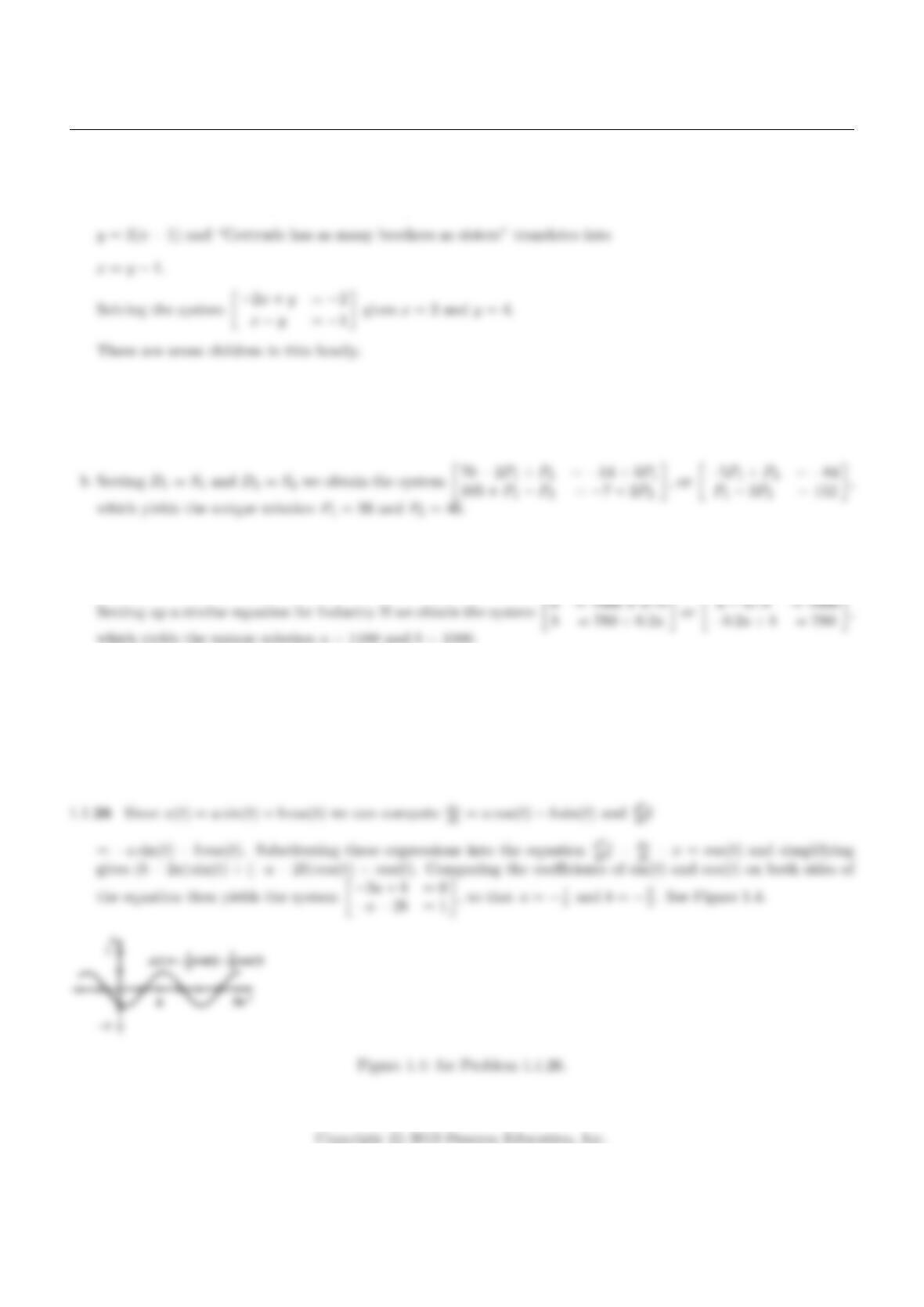
1.1.22 Let x= the number of male children and y= the number of female children.
Then the statement “Emile has twice as many sisters as brothers” translates into
1.1.23 a Note that the demand D1for product 1 increases with the increase of price P2; likewise the demand D2
for product 2 increases with the increase of price P1. This indicates that the two products are competing; some
people will switch if one of the products gets more expensive.
1.1.24 The total demand for the product of Industry A is 1000 (the consumer demand) plus 0.1b (the demand from
Industry B). The output amust meet this demand: a= 1000 + 0.1b.
1.1.25 The total demand for the products of Industry A is 310 (the consumer demand) plus 0.3b(the demand from
Industry B). The output amust meet this demand: a= 310 + 0.3b.
Setting up a similar equation for Industry B we obtain the system a= 310 + 0.3b
b= 100 + 0.5aor a−0.3b= 310
−0.5a+b= 100 ,
which yields the solution a= 400 and b= 300.
5
Chapter 1
1.1.27 a Substituting λ= 5 yields the system
7x−y= 5x
−6x+ 8y= 5yor 2x−y= 0
−6x+ 3y= 0 or 2x−y= 0
0 = 0 .
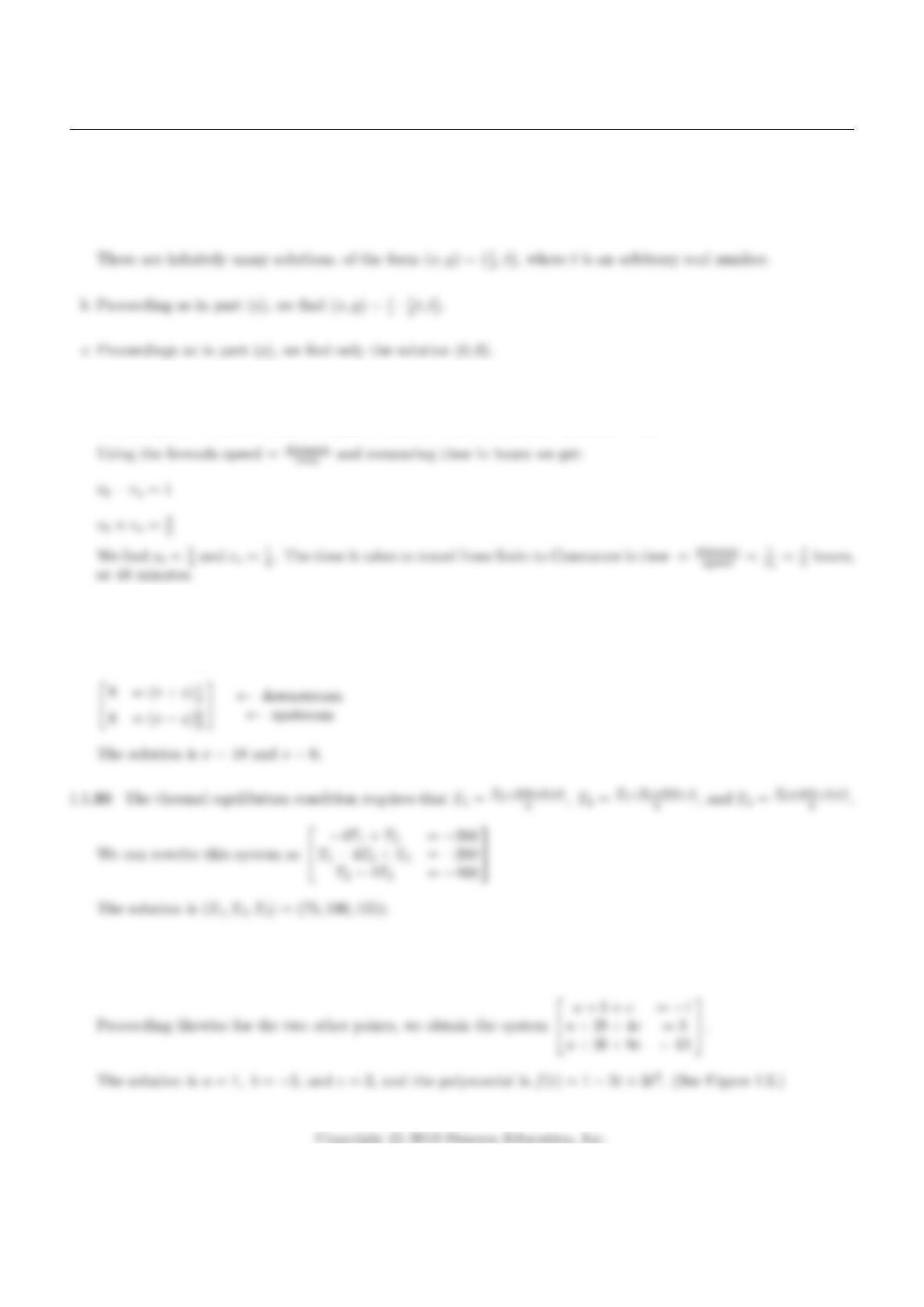
1.1.28 Use the distance from Stein to Schaffhausen (and from Stein to Constance) as the unit of length.
Let the speed of the boat and the speed of the river flow be vband vs, respectively.
1.1.29 Let vbe the speed of the boat relative to the water, and sbe the speed of the stream; then the speed of the
boat relative to the land is v+sdownstream and v−supstream. Using the fact that (distance) = (speed)(time),
we obtain the system
1.1.31 To assure that the graph goes through the point (1,−1), we substitute t= 1 and f(t) = −1 into the equation
f(t) = a+bt +ct2to give −1 = a+b+c.
6
Section 1.1
1.1.32 Proceeding as in the previous exercise, we obtain the system
a+b+c=p
a+ 2b+ 4c=q
a+ 3b+ 9c=r
.
The unique solution is
a= 3p−3q+r
b=−2.5p+ 4q−1.5r
c= 0.5p−q+ 0.5r
.
Only one polynomial of degree 2 goes through the three given points, namely,
f(t) = 3p−3q+r+ (−2.5p+ 4q−1.5r)t+ (0.5p−q+ 0.5r)t2.
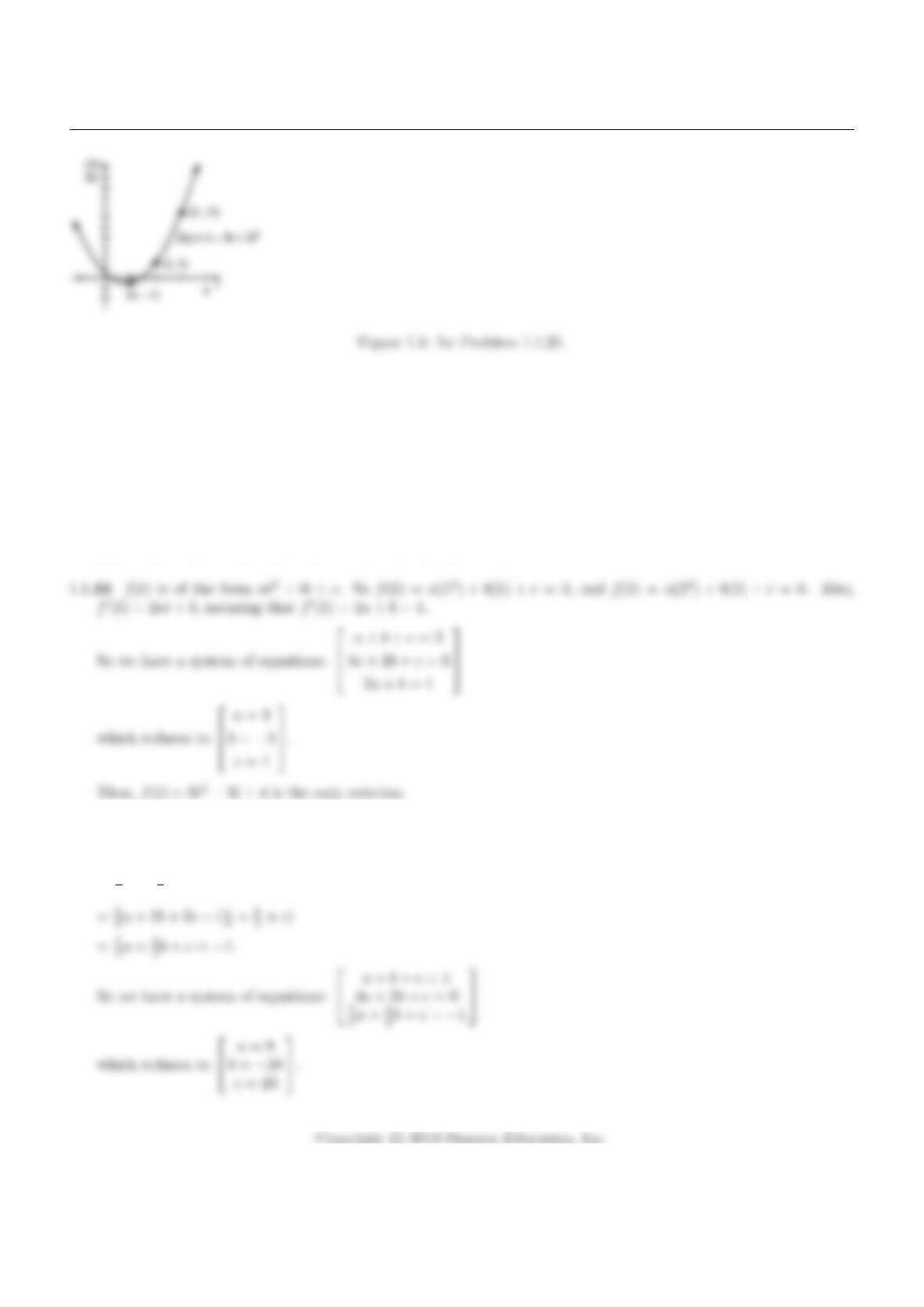
1.1.34 f(t) is of the form at2+bt +c. So, f(1) = a(12) + b(1) + c= 1 and f(2) = 4a+ 2b+c= 0. Also,
R2
1f(t)dt =R2
1(at2+bt +c)dt
=a
3t3+b
2t2+ct|2
1
7
Chapter 1
Thus, f(t) = 9t2−28t+ 20 is the only solution.
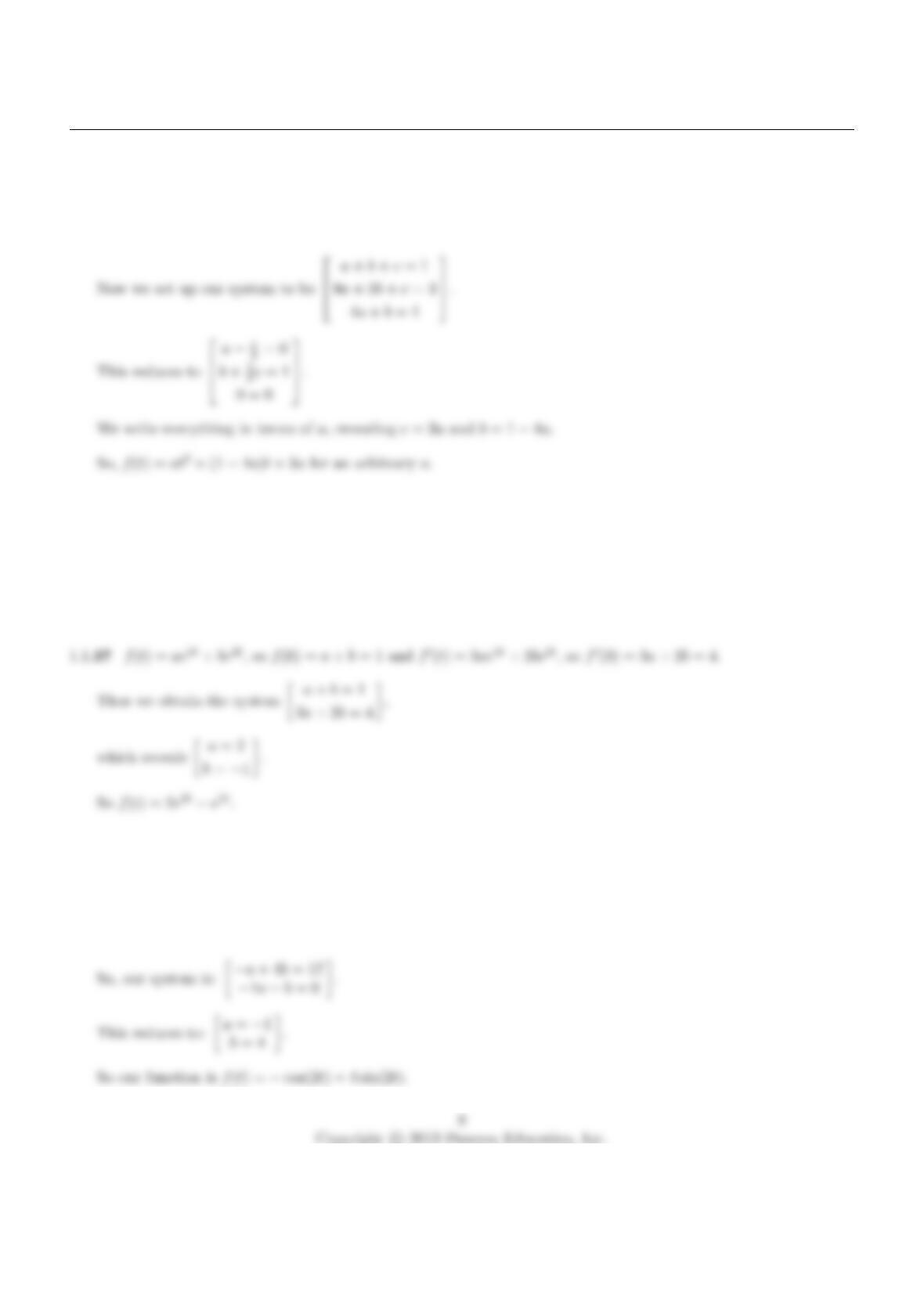
1.1.35 f(t) is of the form at2+bt +c.f(1) = a+b+c= 1, f(3) = 9a+ 3b+c= 3, and f′(t) = 2at +b, so
f′(2) = 4a+b= 1.
1.1.36 f(t) = at2+bt +c, so f(1) = a+b+c= 1, f(3) = 9a+ 3b+c= 3. Also, f′(2) = 3, so 2(2)a+b= 4a+b= 3.
Thus, our system is
a+b+c= 1
9a+ 3b+c= 3
4a+b= 3
.
When we reduce this, however, our last equation becomes 0 = 2, meaning that this system is inconsistent.
1.1.38 f(t) = acos(2t) + bsin(2t) and 3f(t) + 2f′(t) + f′′ (t) = 17 cos(2t).
f′(t) = 2bcos(2t)−2asin(2t) and f′′ (t) = −4bsin(2t)−4acos(2t).
So, 17 cos(2t) = 3(acos(2t) + bsin(2t)) + 2(2bcos(2t)−2asin(2t)) + (−4bsin(2t)−4acos(2t)) = (−4a+ 4b+
3a) cos(2t) + (−4b−4a+ 3b) sin(2t) = (−a+ 4b) cos(2t) + (−4a−b) sin(2t).
Section 1.1
1.1.39 Plugging the three points (x, y) into the equation a+bx +cy +x2+y2= 0, leads to a system of linear
equations for the three unknowns (a, b, c).
The solution is a= 3/20, b =−9/40, c = 13/40. This is the ellipse (3/20)x2−(9/40)xy + (13/40)y2= 1.
1.1.42 ax1=−3
x2= 14 + 3x1= 14 + 3(−3) = 5
x3= 9 −x1−2x2= 9 + 3 −10 = 2
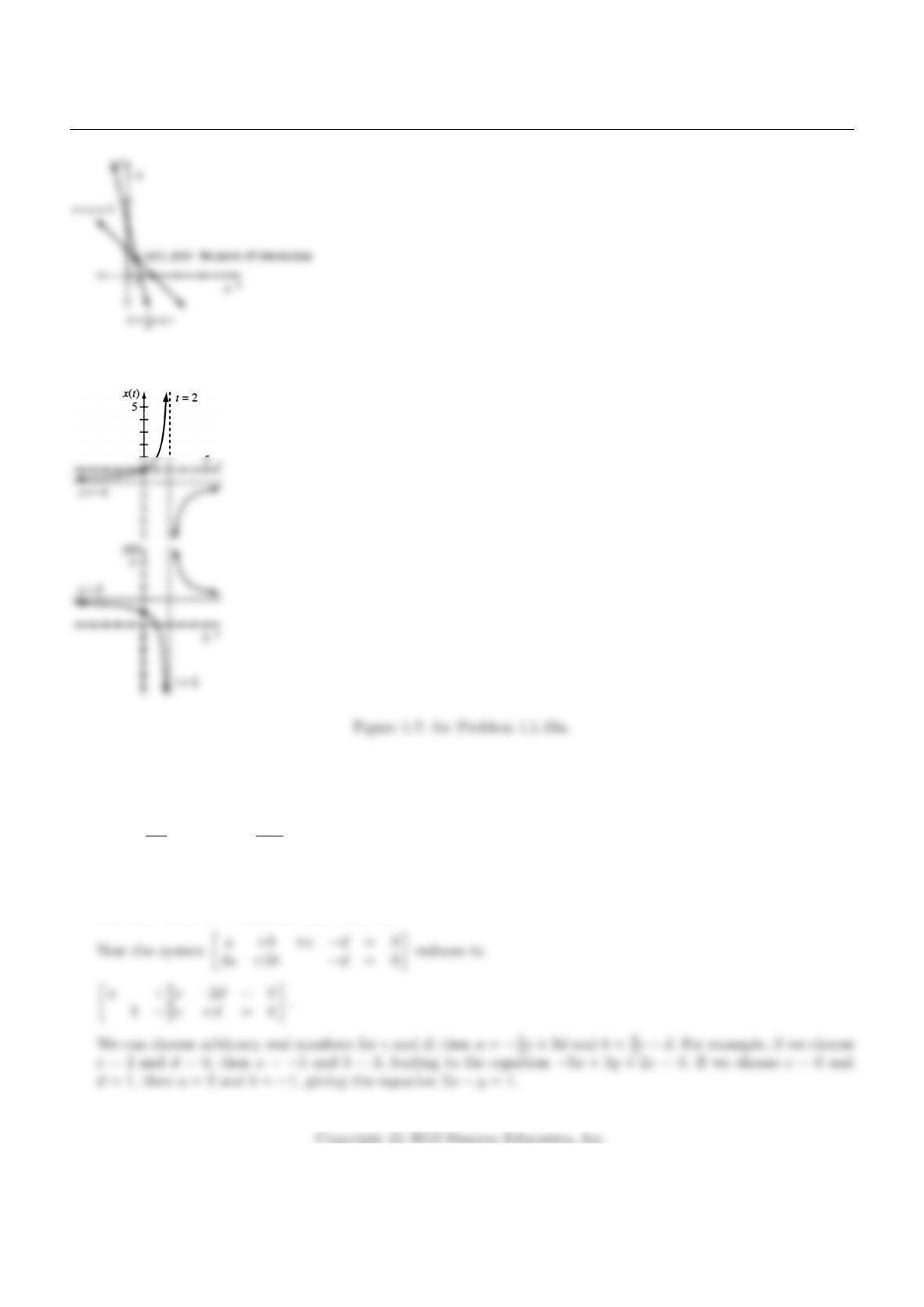
1.1.43 a The two lines intersect unless t= 2 (in which case both lines have slope −1).
To draw a rough sketch of x(t), note that
limt→∞ x(t) = limt→−∞ x(t) = −1the line x+t
2y=tbecomes almost horizontal
and
limt→2−x(t) = ∞, limt→2+x(t) = −∞.
9
Chapter 1
Figure 1.6: for Problem 1.1.43a.
Also note that x(t) is positive if tis between 0 and 2, and negative otherwise.
Apply similar reasoning to y(t). (See Figures 1.6 and 1.7.)
bx(t) = −t
t−2, and y(t) = 2t−2
t−2.
1.1.44 We can think of the line through the points (1,1,1) and (3,5,0) as the intersection of any two planes through
these two points; each of these planes will be defined by an equation of the form ax +by +cz =d. It is required
that 1a+ 1b+ 1c=dand 3a+ 5b+ 0c=d.
10
Section 1.1
1.1.45 To eliminate the arbitrary constant t, we can solve the last equation for tto give t=z−2, and substitute
z−2 for tin the first two equations, obtaining x= 6 + 5(z−2)
y= 4 + 3(z−2) or x−5z=−4
y−3z=−2.
This system does the job.
1.1.47 Let us start by reducing the system:
1.1.48 a We set up two equations here, with our variables: x1= servings of rice, x2= servings of yogurt.
So our system is: 3x1+12x2= 60
30x1+20x2= 300 .
1.1.49 Let x1= number of one-dollar bills, x2= the number of five-dollar bills, and x3= the number of ten-dollar
bills. Then our system looks like: x1+x2+x3= 32
x1+ 5x2+ 10x3= 100 ,
1.1.50 Let x1, x2, x3be the number of 20 cent, 50 cent, and 2 Euro coins, respectively. Then we need solutions to
the system: x1+x2+x3= 1000
.2x1+.5x2+2x3= 1000
11
Chapter 1
Section 1.2
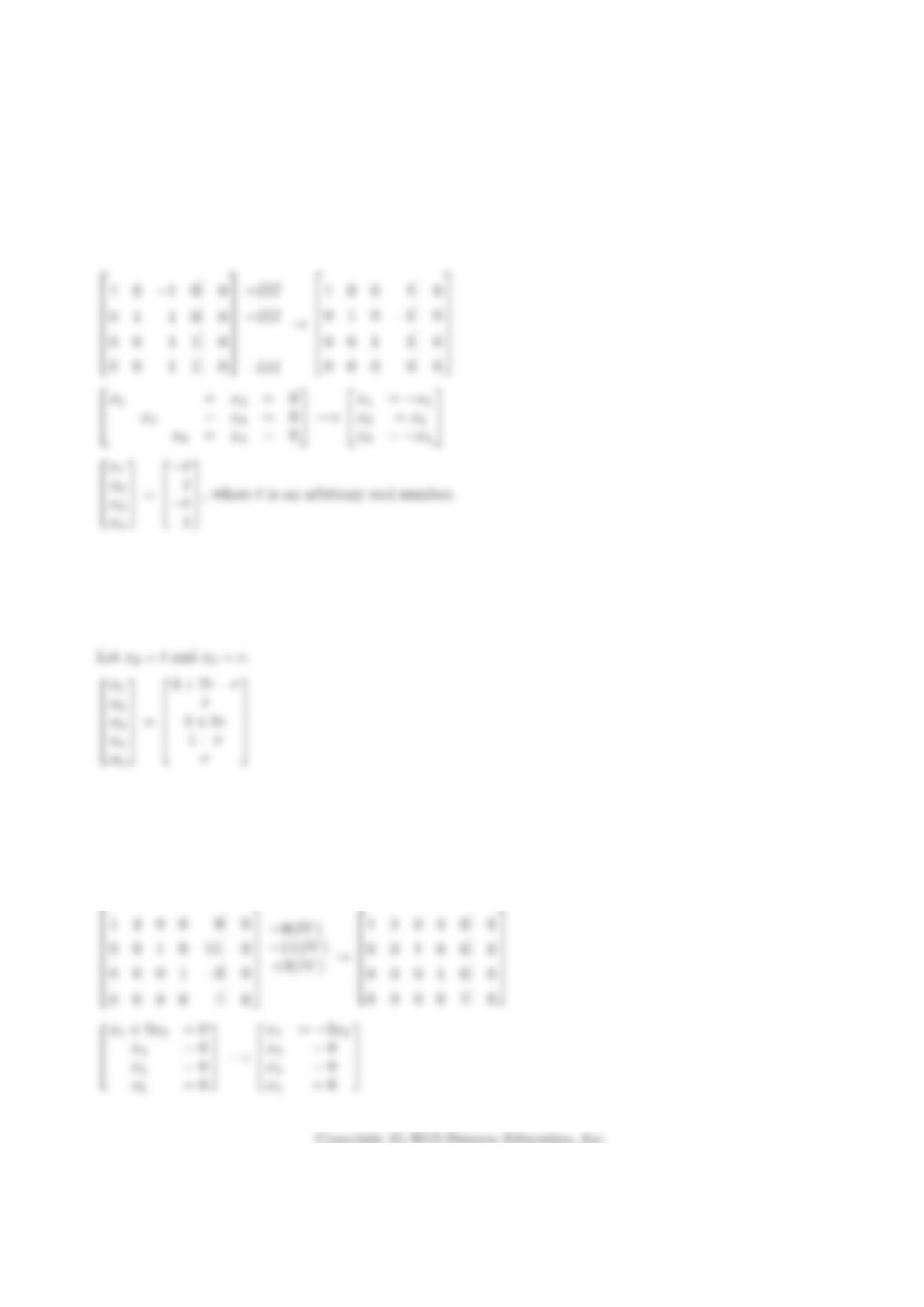
1.2.1
1 1 −2.
.
. 5
2 3 4.
.
. 2
−2(I)→
1 1 −2.
.
. 5
0 1 8.
.
.−8
−II →
1 0 −10.
.
. 13
0 1 8.
.
.−8
1.2.2
3 4 −1.
.
. 8
6 8 −2.
.
. 3
÷3→
14
3−1
3
.
.
.8
3
6 8 −2.
.
. 3
−6(I)
→
14
3−1
3
.
.
.8
3
0 0 0.
.
.−13
This system has no solutions, since the last row represents the equation 0 = −13.
1.2.4
1 1.
.
. 1
2−1.
.
. 5
3 4.
.
. 2
−2(I)
−3(I)
→
1 1.
.
. 1
0−3.
.
. 3
0 1.
.
.−1
÷(−3) →
1 1.
.
. 1
0 1.
.
.−1
0 1.
.
.−1
−II
−II
→
12
Section 1.2
1.2.5
0 0 1 1.
.
. 0
0 1 1 0.
.
. 0
1 1 0 0.
.
. 0
1 0 0 1.
.
. 0
swap :
I↔III →
1 1 0 0.
.
. 0
0 1 1 0.
.
. 0
0 0 1 1.
.
. 0
1 0 0 1.
.
. 0
−I
→
1 1 0 0.
.
. 0
0 1 1 0.
.
. 0
0 0 1 1.
.
. 0
0−1 0 1.
.
. 0
−II
+II
→
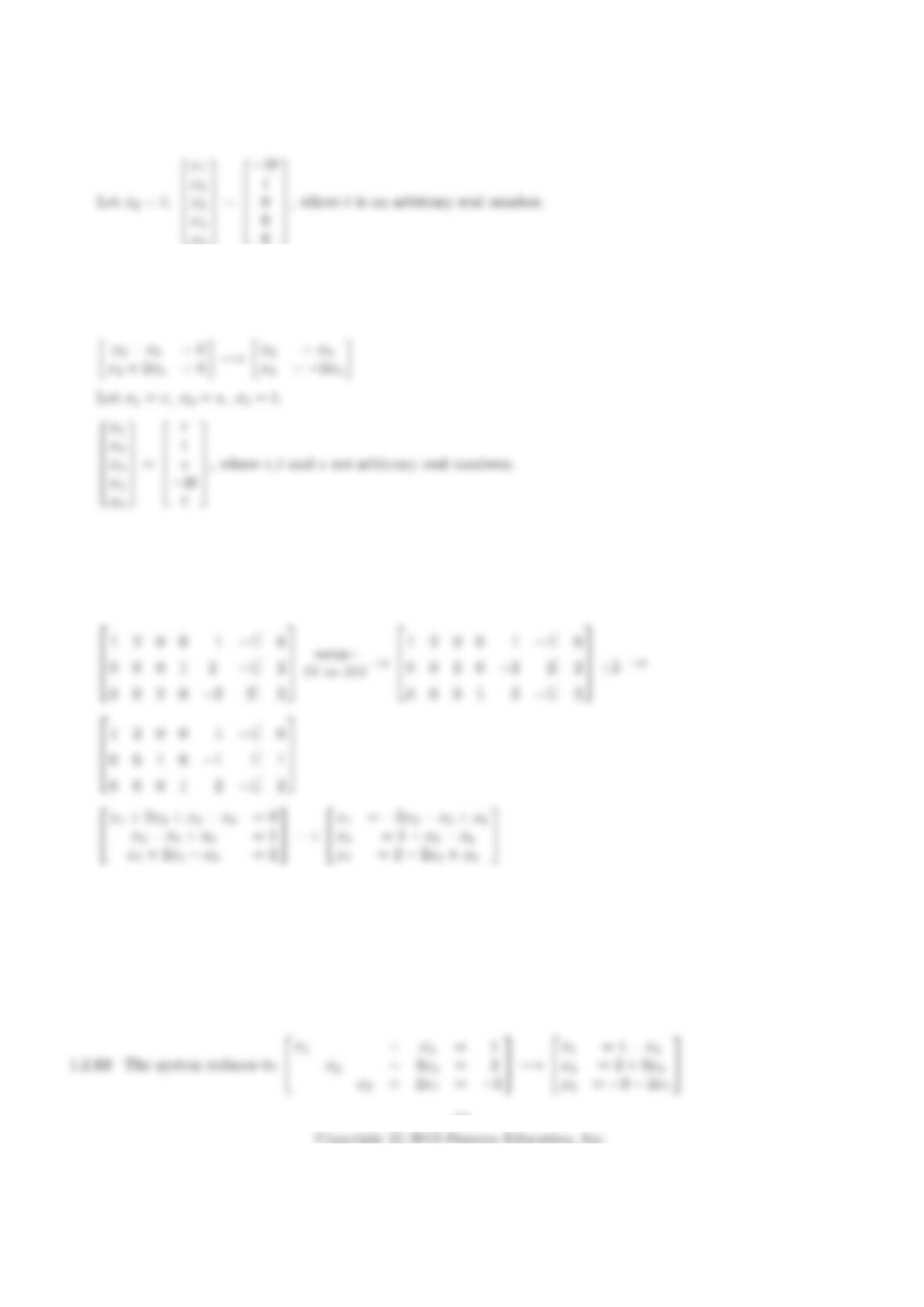
1.2.6The system is in rref already.
x1= 3 + 7x2−x5
x3= 2 + 2x5
x4= 1 −x5
1.2.7
1 2 0 2 3.
.
. 0
0 0 1 3 2.
.
. 0
0 0 1 4 −1.
.
. 0
0 0 0 0 1.
.
. 0
−II
→
1 2 0 2 3.
.
. 0
0 0 1 3 2.
.
. 0
0 0 0 1 −3.
.
. 0
0 0 0 0 1.
.
. 0
−2(III)
−3(III)→
13
Chapter 1
1.2.8“0 1 0 2 3.
.
. 0
0 0 0 4 8.
.
. 0 #÷4→“01023.
.
. 0
00012.
.
. 0 #−2(II)
0 1 0 0 −1.
.
. 0
0 0 0 1 2.
.
. 0
1.2.9
0 0 0 1 2 −1.
.
. 2
1 2 0 0 1 −1.
.
. 0
1 2 2 0 −1 1.
.
. 2
swap :
I↔II →
1 2 0 0 1 −1.
.
. 0
0 0 0 1 2 −1.
.
. 2
1 2 2 0 −2 1.
.
. 2
−I
→
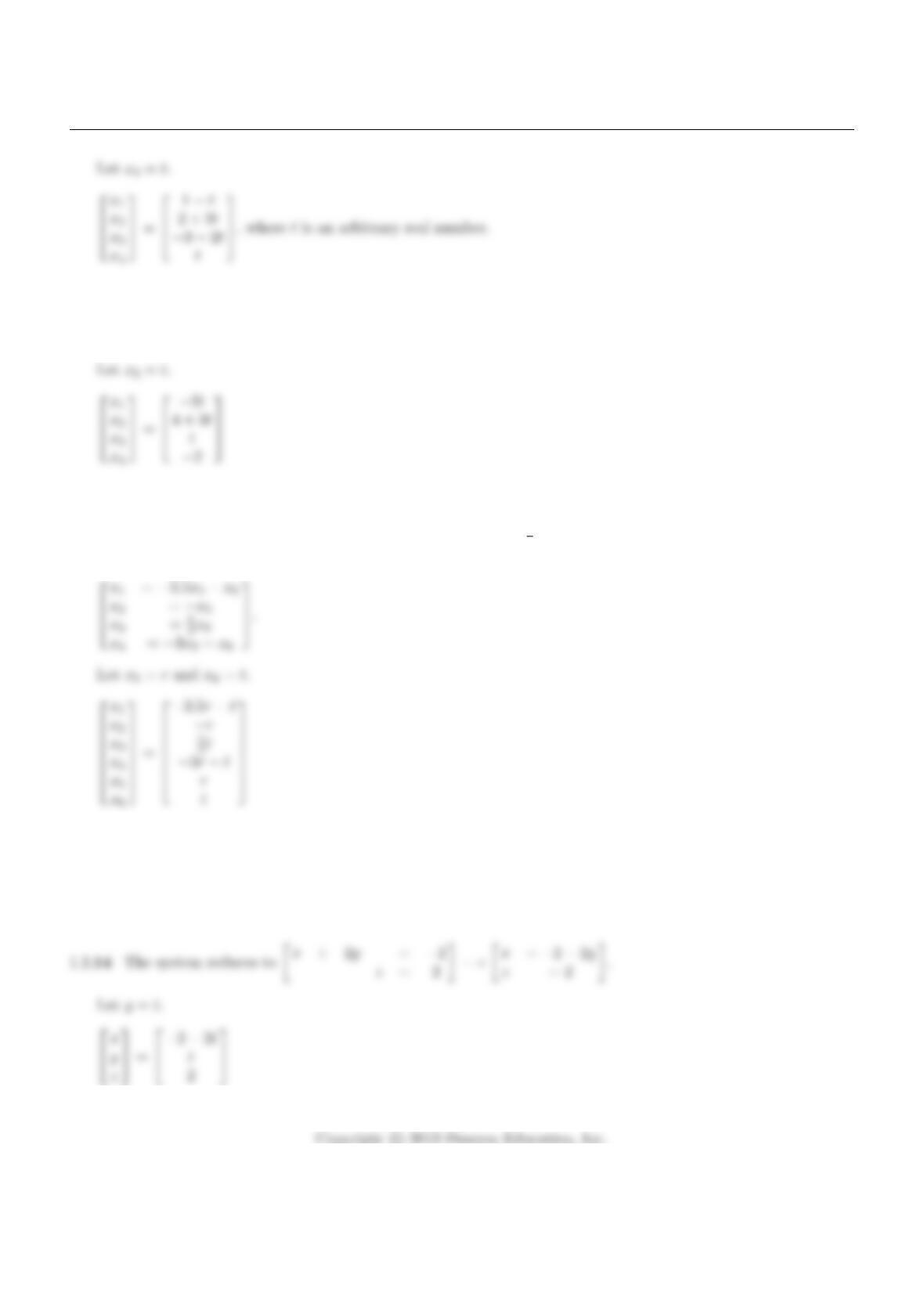
Let x2=r, x5=s, and x6=t.
x1
x2
x3
x4
x5
x6
=
−2r−s+t
r
1 + s−t
2−2s+t
s
t
, where r, s and tare arbitrary real numbers.
14
Section 1.2
1.2.11 The system reduces to
x1+ 2x3= 0
x2−3x3= 4
x4=−2
−→
x1=−2x3
x2= 4 + 3x3
x4=−2
.
1.2.12 The system reduces to
x1+ 3.5x5+x6= 0
x2+x5= 0
x3−5
3x6= 0
x4+ 3x5+x6= 0
−→
1.2.13 The system reduces to
x−z= 0
y+ 2z= 0
0 = 1
.
There are no solutions.
15
Chapter 1
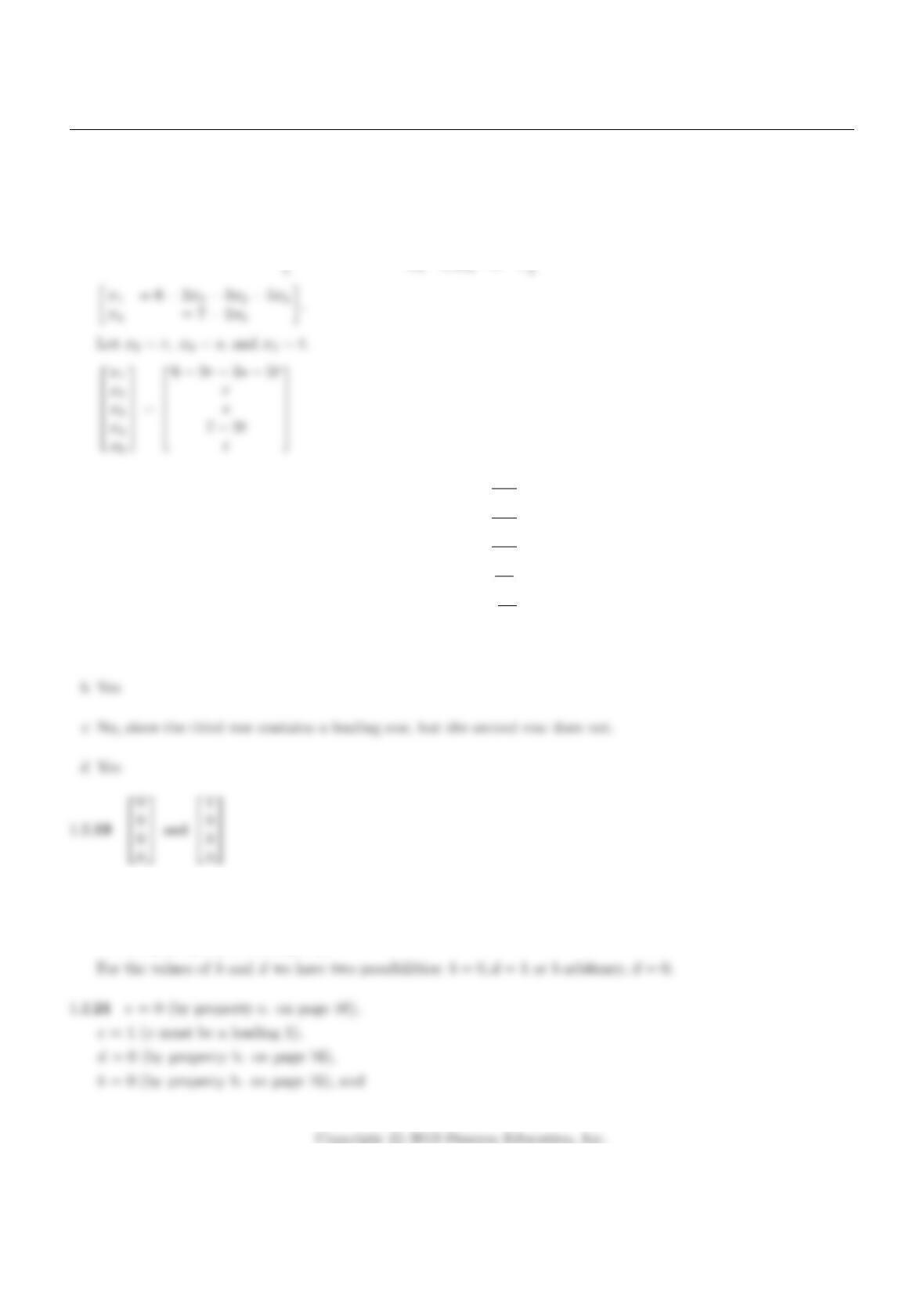
1.2.15 The system reduces to
x= 4
y= 2
z= 1
.
1.2.16 The system reduces to x1+ 2x2+ 3x3+5x5= 6
x4+2x5= 7 −→
1.2.17 The system reduces to
x1=−8221
4340
x2=8591
8680
x3=4695
434
x4=−459
434
x5=699
434
.
1.2.18 a No, since the third column contains two leading ones.
1.2.20 a= 1 (by property a. on page 16),
c= 0 (by property b. on page 16), and
e= 0 (by property c. on page 16).
16
Section 1.2
ais arbitrary.
1.2.22 Four, namely 0 0
0 0 ,1k
0 0 ,0 1
0 0 ,1 0
0 1 (kis an arbitrary constant.)
1.2.25 The conditions a, b, and c for the reduced row-echelon form correspond to the properties P1, P2, and P3
given on Page 13. The Gauss-Jordan algorithm, summarized on Page 15, guarantees that those properties are
satisfied.
1.2.26 Yes; each elementary row operation is reversible, that is, it can be “undone.” For example, the operation of
row swapping can be undone by swapping the same rows again. The operation of dividing a row by a scalar can
be reversed by multiplying the same row by the same scalar.
1.2.30 Suppose (c1, c2,…,cn) is a solution of the system
a11x1+a12x2+···+a1nxn=b1
a21x1+a22x2+···+a2nxn=b2
………
.
To keep the notation simple, suppose we add ktimes the first equation to the second; then the second equation
1.2.31 Since the number of oxygen atoms remains constant, we must have 2a+b= 2c+ 3d.
17
Chapter 1
Considering hydrogen and nitrogen as well, we obtain the system
2a+b= 2c+ 3d
2b=c+d
a=c+d
or
1.2.32 Plugging the points into f(t), we obtain the system
a= 1
a+b+c+d= 0
a−b+c−d= 0
a+ 2b+ 4c+ 8d=−15
with unique solution a= 1, b = 2, c =−1, and d=−2, so that f(t) = 1 + 2t−t2−2t3. (See Figure 1.8.)
1.2.33 Let f(t) = a+bt +ct2+dt3+et4. Substituting the points in, we get
a+b+c+d+e= 1
a+ 2b+ 4c+ 8d+ 16e=−1
1.2.34 The requirement f′
i(ai) = f′
i+1(ai) and f′′
i(ai) = f′′
i+1(ai) ensure that at each junction two different cubics
fit “into” one another in a “smooth” way, since they must have the same slope and be equally curved. The
requirement that f′
1(a0) = f′
n(an) = 0 ensures that the track is horizontal at the beginning and at the end. How
18
Section 1.2
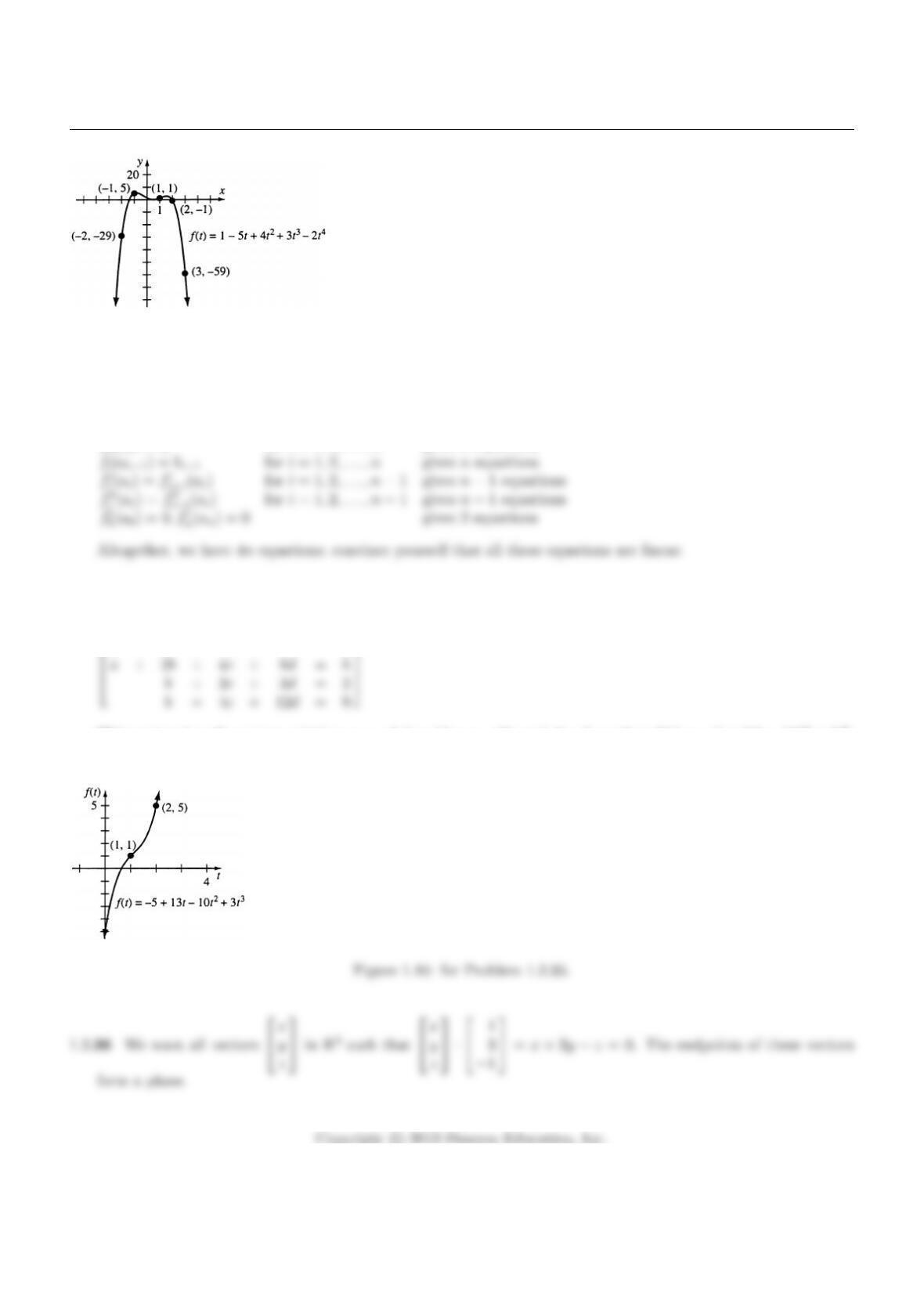
Figure 1.9: for Problem 1.2.33.
many unknowns are there? There are npieces to be fit, and each one is a cubic of the form f(t) = p+qt+rt2+st3,
with p, q, r, and sto be determined; therefore, there are 4nunknowns. How many equations are there?
fi(ai) = bifor i= 1,2,…,n gives nequations
1.2.35 Let f(t) = a+bt +ct2+dt3, so that f′(t) = b+ 2ct + 3dt2.
Substituting the given points into f(t) and f′(t) we obtain the system
a+b+c+d= 1
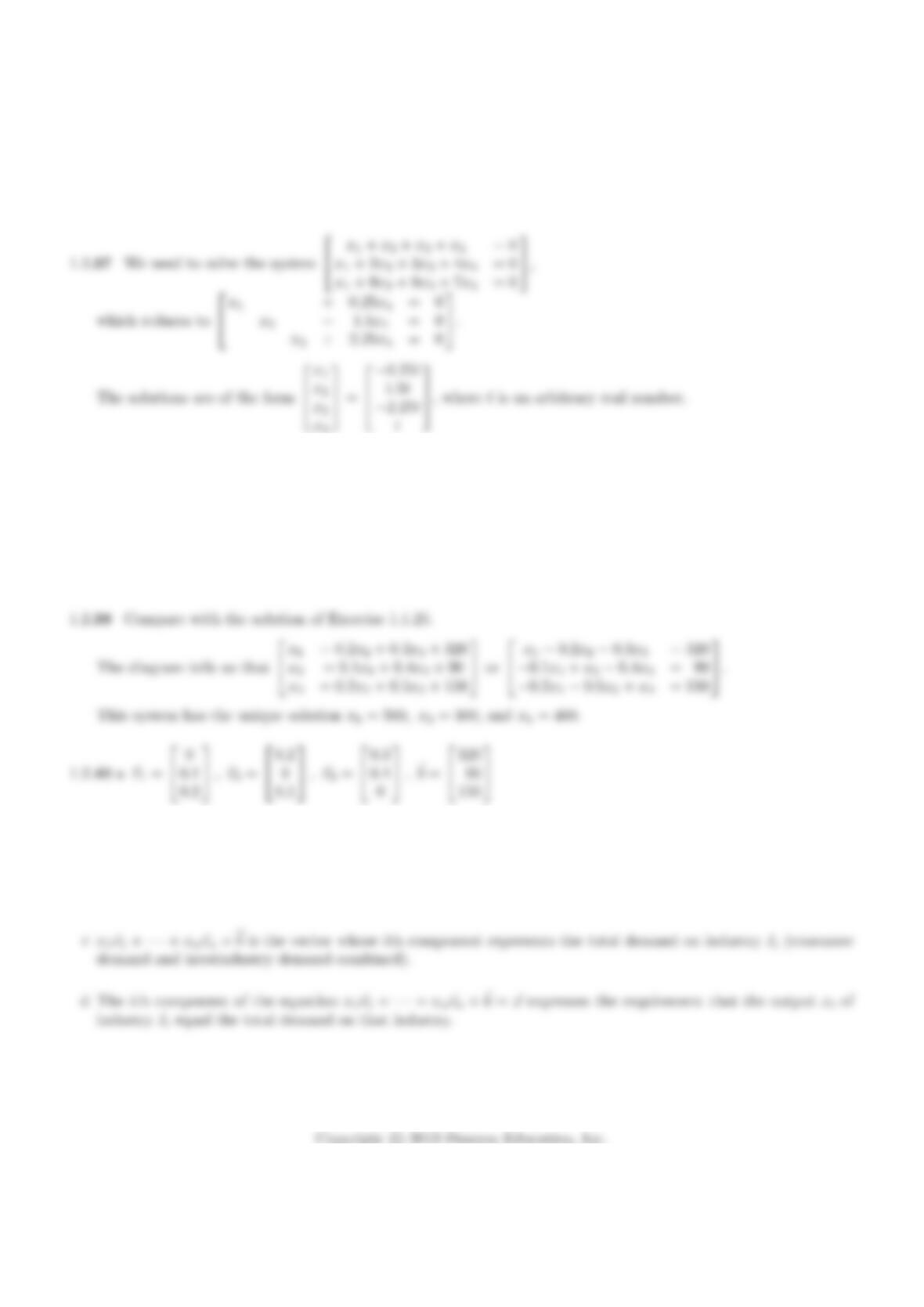
This system has the unique solution a=−5, b = 13, c =−10, and d= 3, so that f(t) = −5 + 13t−10t2+ 3t3.
(See Figure 1.10.)
19
Chapter 1
These vectors are of the form
x
y
z
=
−3r+t
r
t
, where rand tare arbitrary real numbers.
1.2.38 Writing the equation ~
b=x1~v1+x2~v2+x3~v3in terms of its components, we obtain the system
x1+ 2x2+ 4x3=−8
4x1+ 5x2+ 6x3=−1
7x1+ 8x2+ 9x3= 9
5x1+ 3x2+x3= 15
The system has the unique solution x1= 2, x2= 3, and x3=−4.
b Recall that xjis the output of industry Ij, and the ith component aij of ~vjis the demand of Industry Ijon
industry Ijfor each dollar of output of industry Ij.
Therefore, the product xjaij (that is, the ith component of xj~vj), represents the total demand of industry Ijon
Industry Ii(in dollars).
1.2.41 a These components are zero because neither manufacturing not the energy sector directly require agricultural
products.
20