Section 1.2
b We have to solve the system x1~v1+x2~v2+x3~v3+~
b=~x or
1.2.42 We want to find m1, m2, m3such that m1+m2+m3= 1 and
1
1m11
2+m22
3+m34
1=2
2, that is, we have to solve the system
1.2.43 We know that m1~v1+m2~v2=m1~w1+m2~w2or m1(~v1−~w1) + m2(~v2−~w2) = ~
0
3m2.
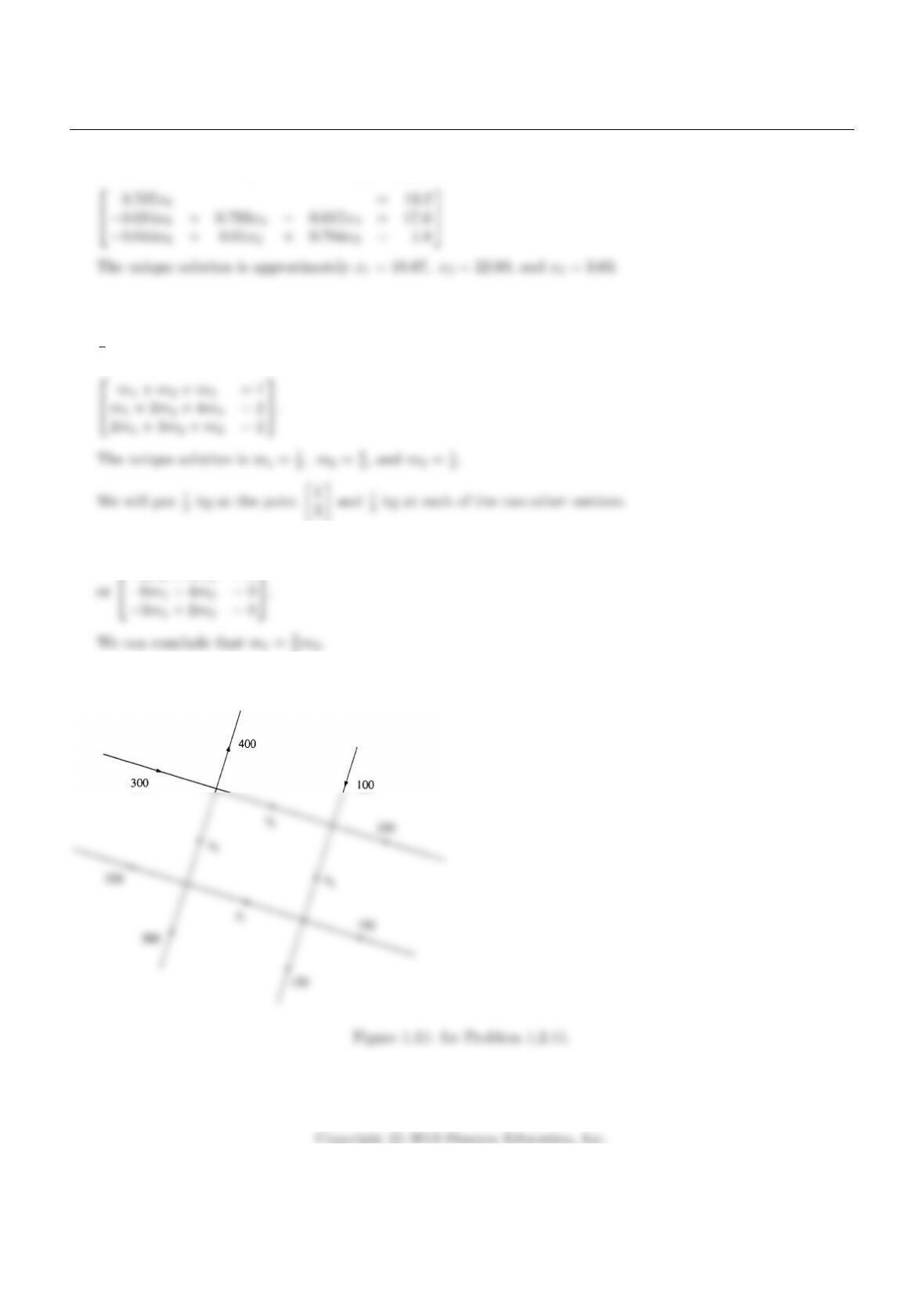
1.2.44 Let x1, x2, x3, and x4be the traffic volume at the four locations indicated in Figure 1.11.
We are told that the number of cars coming into each intersection is the same as the number of cars coming out:
21
Chapter 1
x1+ 300 = 320 + x2
x1−x2= 20
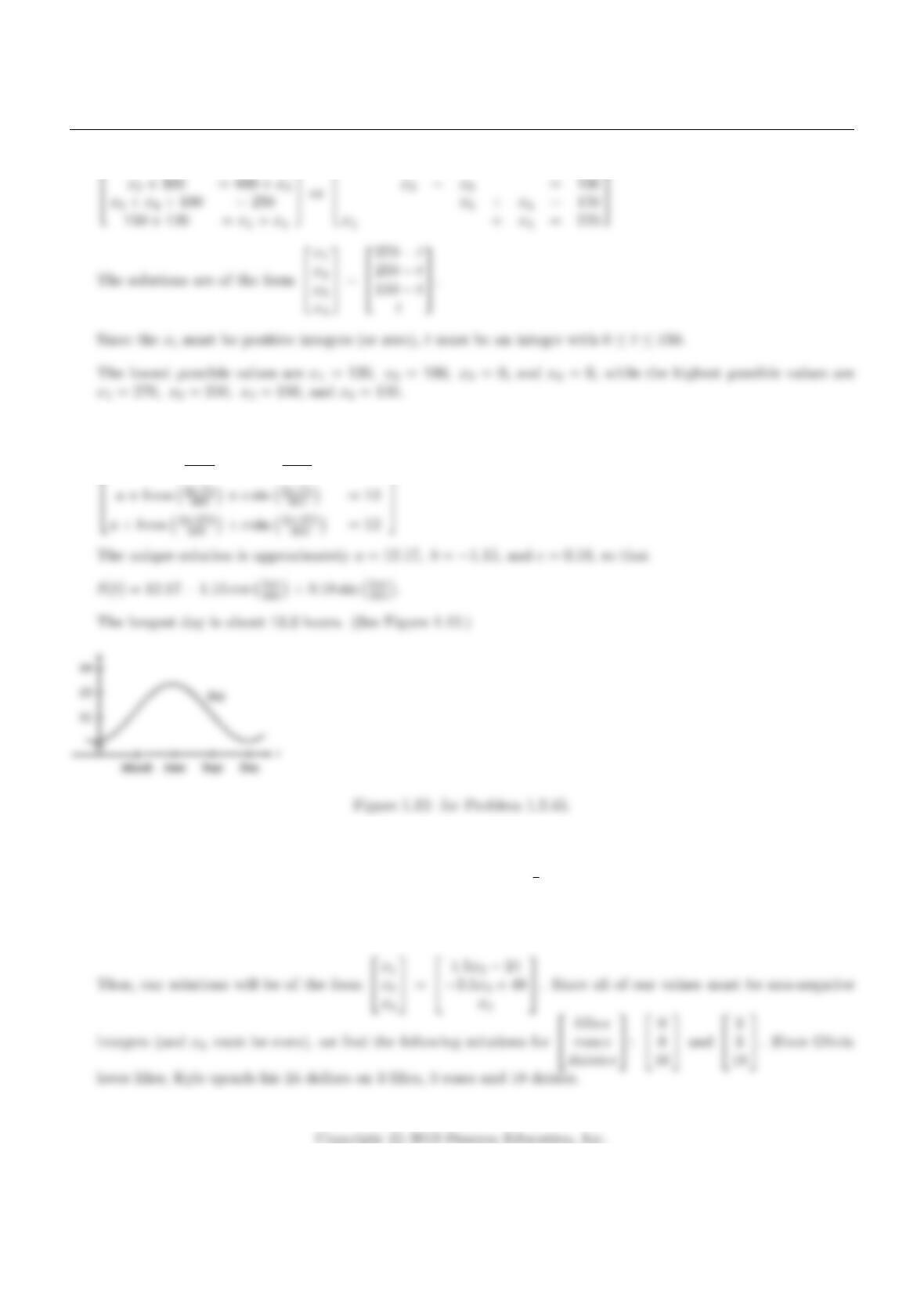
1.2.45 Plugging the data into the function S(t) we obtain the system
a+bcos 2π·47
365 +csin 2π·47
365 = 11.5
1.2.46 Kyle first must solve the following system: x1+x2+x3= 24
3x1+2x2+1
2x3= 24 .
This system reduces to x1−1.5x3=−24
x2+2.5x3= 48 .
22
Section 1.2
1.2.47 a When k6= 1 and k6= 2, we can see that this will continue to reduce to a consistent system with a unique
solution.
1.2.48 a We reduce our matrix in the following steps:
0 1 2k.
.
. 0
1 2 6 .
.
. 2
k0 2 .
.
. 1
swap :
I↔II →
1 2 6 .
.
. 2
1 2 6 .
.
. 2
−2(II)
We see that there will be a unique solution when the 2(2k−1)(k−1) term is not equal to zero, when 2k−16= 0
and k−16= 0,or k6=1
2and k6= 1.
b We will have no solutions when the term 2(2k−1)(k−1) is equal to zero, but the term −(2k−1) is not. This
occurs only when k= 1.
c We will have infinitely many solutions when the last row represents the equation 0 = 0. This occurs when
2k−1 = 0, or k=1
2.
1.2.50 It is required that xk=1
2(xk−1+xk+1),or 2xk=xk−1+xk+1,or xk−xk−1=xk+1 −xk. This means that
the difference of any two consecutive terms must be the same; we are looking at the finite arithmetic sequences.
Thus the solutions are of the form (x1, x2, x3,…,xn) = (t, t +r, t + 2r,…,t+ (n−1)r),where tand rare
arbitrary constants.
23
Chapter 1
1.2.51 We begin by solving the system. Our augmented matrix begins as:
2 1 0.
.
.C
0 3 1.
.
.C
1 0 4.
.
.C
1.2.52 f(t) = a+bt +ct2+dt3and we learn that f(0) = a= 3, f(1) = a+b+c+d= 2, f(2) = a+ 2b+ 4c+ 8d= 0.
Also,
Z2
0
f(t)dt =at +1
2bt2+1
3ct3+1
4dt4|2
0= 2a+ 2b+8
3c+ 4d= 4.
the simplest form of Simpson’s Rule. For polynomials f(t) of degree ≤3, Simpson’s Rule gives the exact value
of the integral. Thus, for the f(t) in our problem,
Z2
0
f(t)dt =2
6(f(0) + 4f(1) + f(2)) = 1
3(3 + 8 + 0) = 11
3.
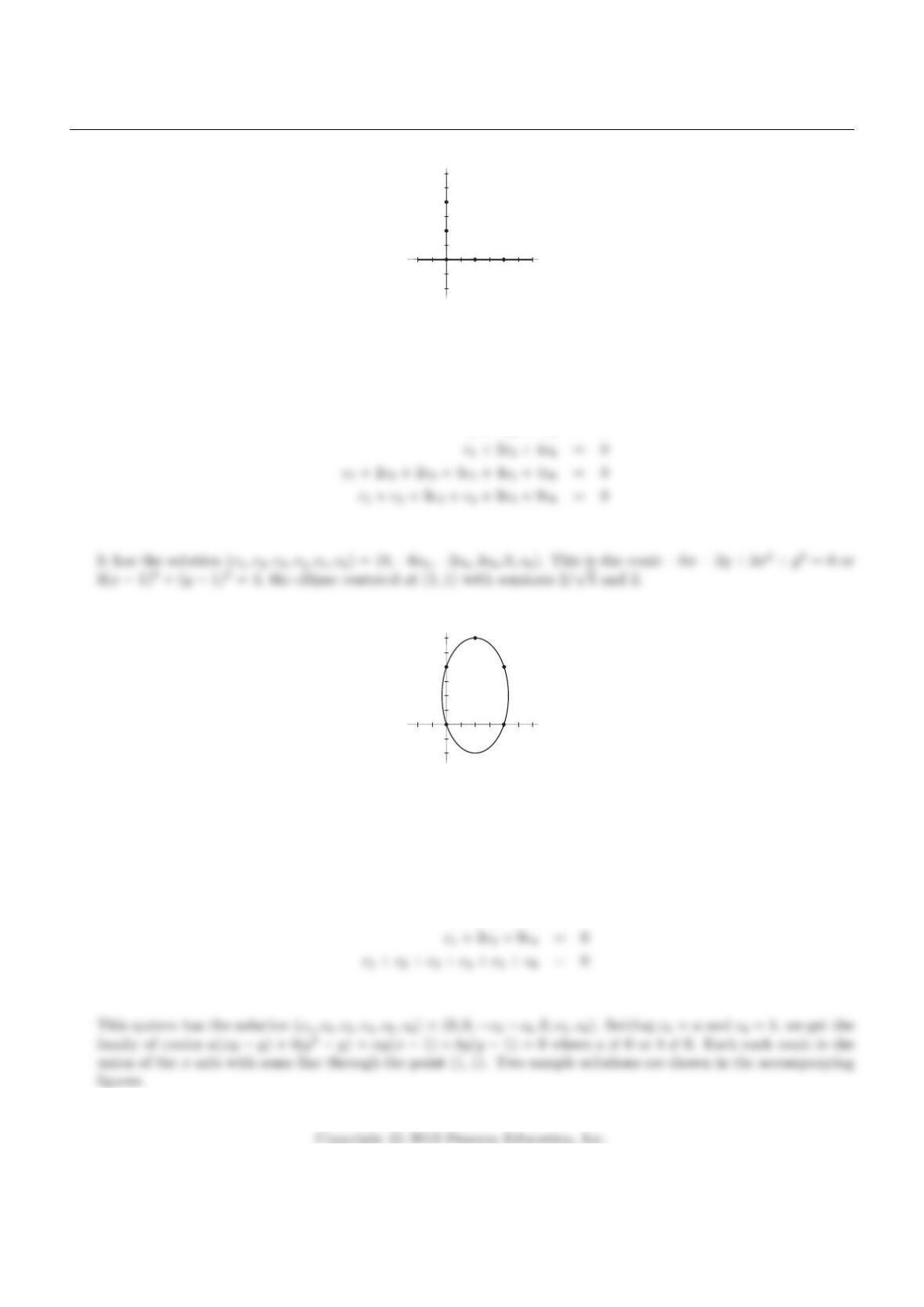
1.2.53 The system of linear equations is
c1= 0
c1+c2+c4= 0
24
Section 1.2
-1
-1
3
2
1
321
x
y
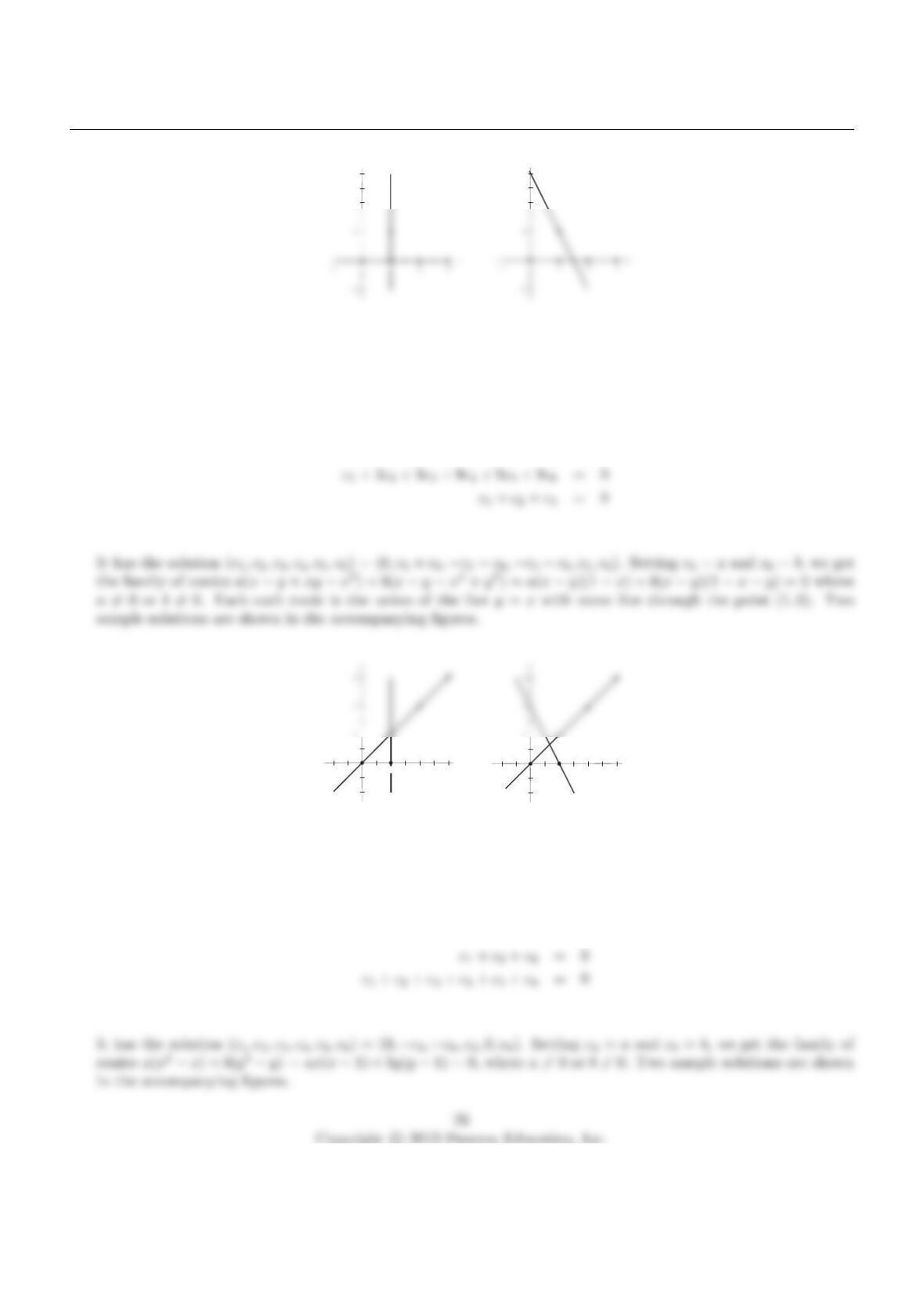
1.2.54 The system of linear equations is
c1= 0
c1+ 2c2+ 4c4= 0
-1
-1
3
2
1
321
x
y
1.2.55 The system of linear equations is
c1= 0
c1+c2+c4= 0
c1+ 2c2+ 4c4= 0
25
Chapter 1
3
2
y
3
2
y
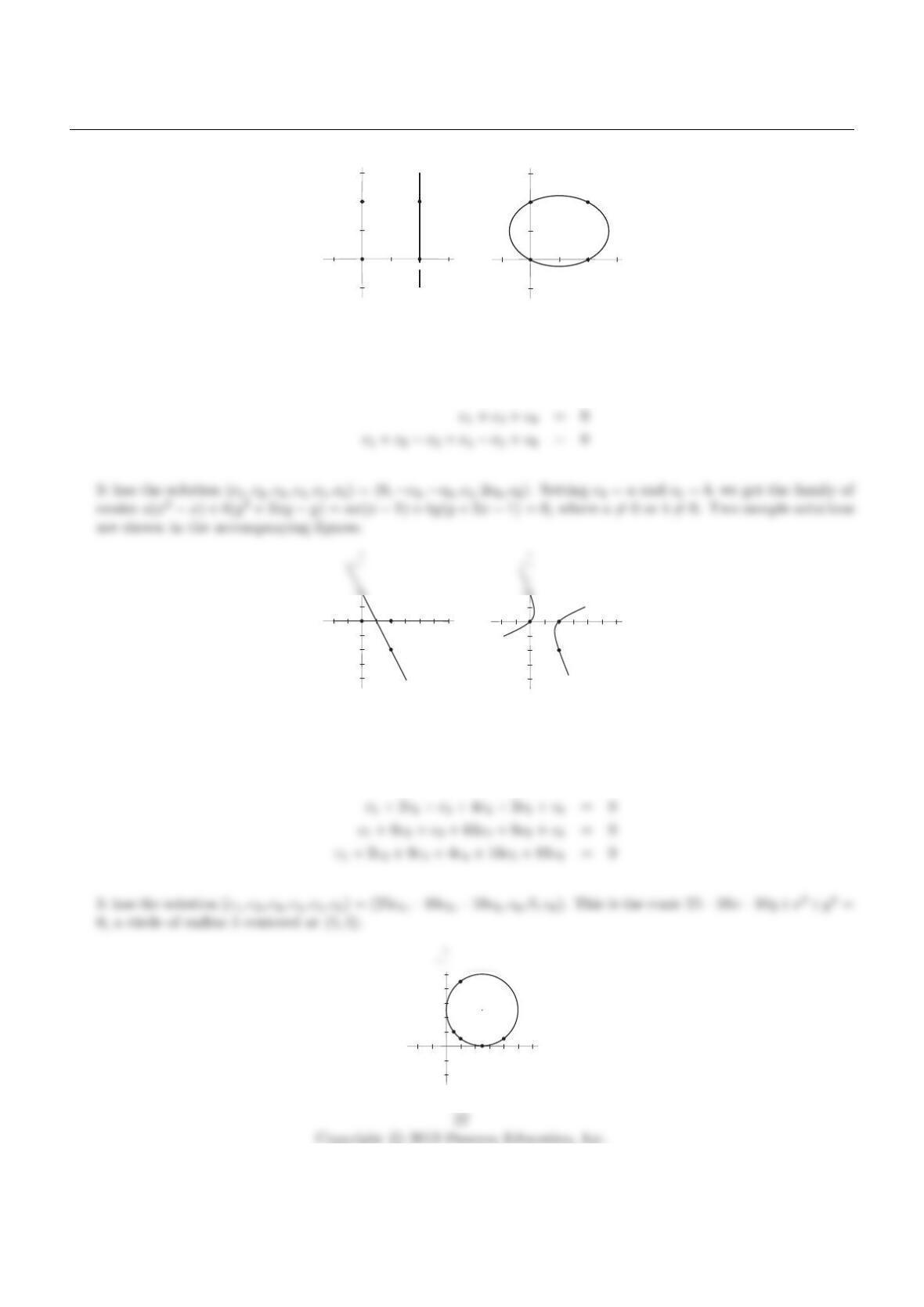
1.2.56 The system of linear equations is
c1= 0
c1+c2+c3+c4+c5+c6= 0
c1+ 2c2+ 2c3+ 4c4+ 4c5+ 4c6= 0
-1
-1
321
x
-1
-1
321
x
1.2.57 The system of linear equations is
c1= 0
c1+c2+c4= 0
Section 1.2
1
x
y
1
1
x
y
1
1.2.58 The system of linear equations is
c1= 0
c1+c2+c4= 0
-1
-2
-1
31
x
2
-1
-2
-1
31
x
2
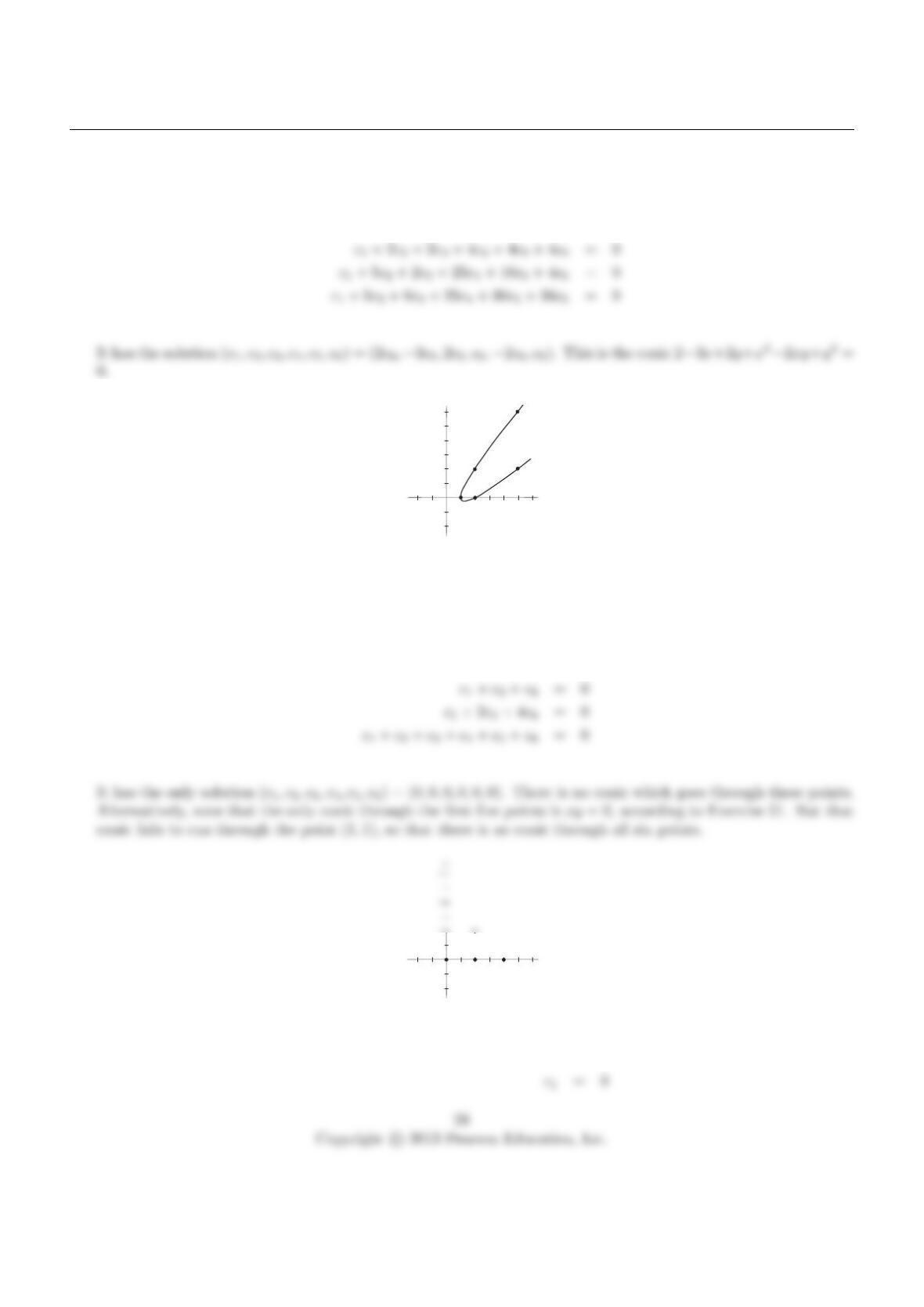
1.2.59 The system of linear equations is
c1+ 5c2+ 25c4= 0
c1+c2+ 2c3+c4+ 2c5+ 4c6= 0
-4
-4
8
4
1284
x
(5,5)
Chapter 1
1.2.60 The system of linear equations is
c1+c2+c4= 0
c1+ 2c2+ 4c4= 0
-2
-2
6
4
2
642
x
y
1.2.61 The system of linear equations is
c1= 0
c1+c2+c4= 0
c1+ 2c2+ 4c4= 0
3
2
1
y
-1
-1
321
x
1.2.62 The system of linear equations is
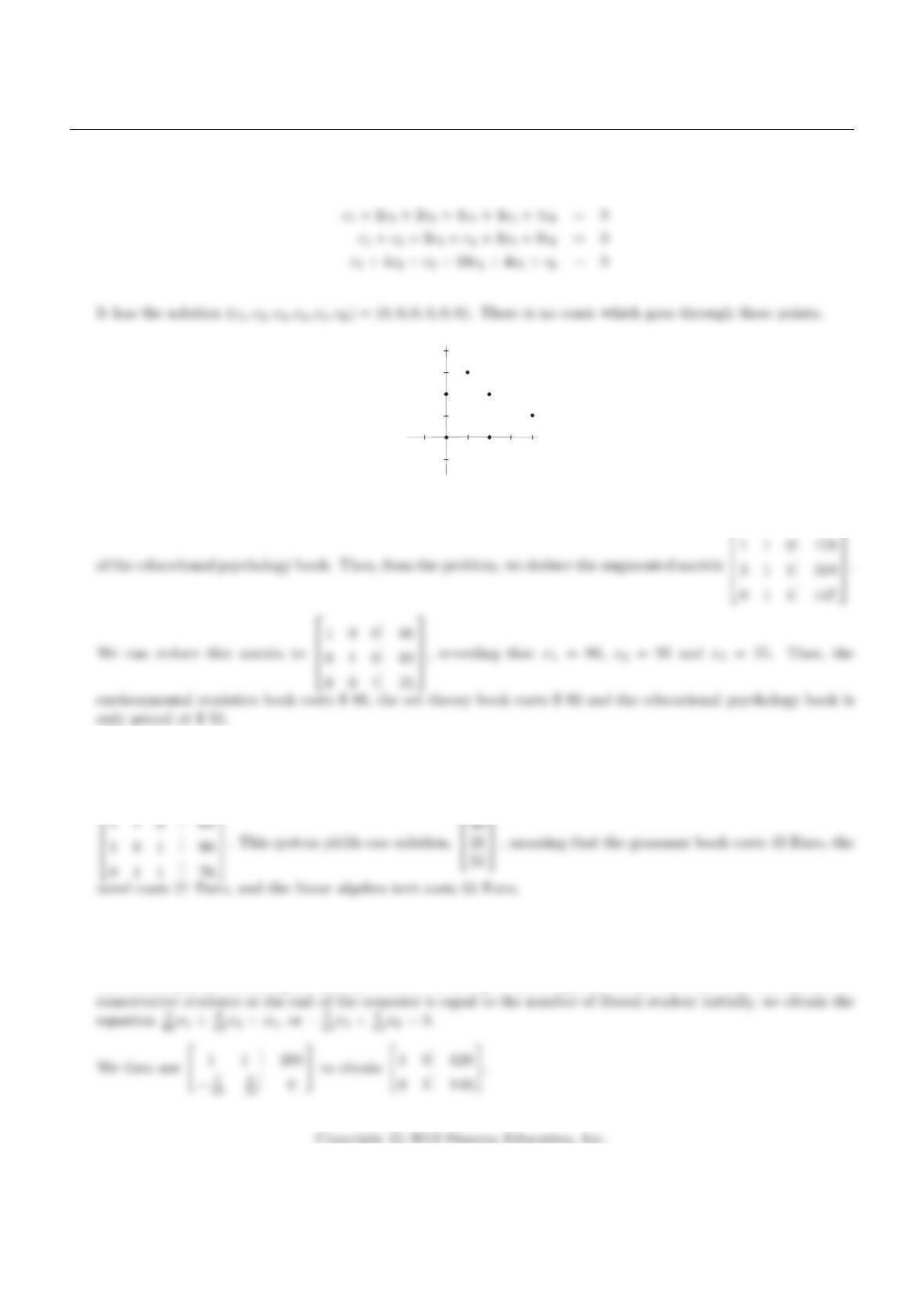
Section 1.2
c1+ 2c2+ 4c4= 0
c1+ 2c3+ 4c6= 0
-1
3
4
2
432
x
y
1-1
1
1.2.63 Let x1be the cost of the environmental statistics book, x2be the cost of the set theory text and x3be the cost
1.2.64 Let our vectors
x1
x2
x3
represent the numbers of the books
grammar
W erther
LinearAlg.
.Then we can set up the matrix
.
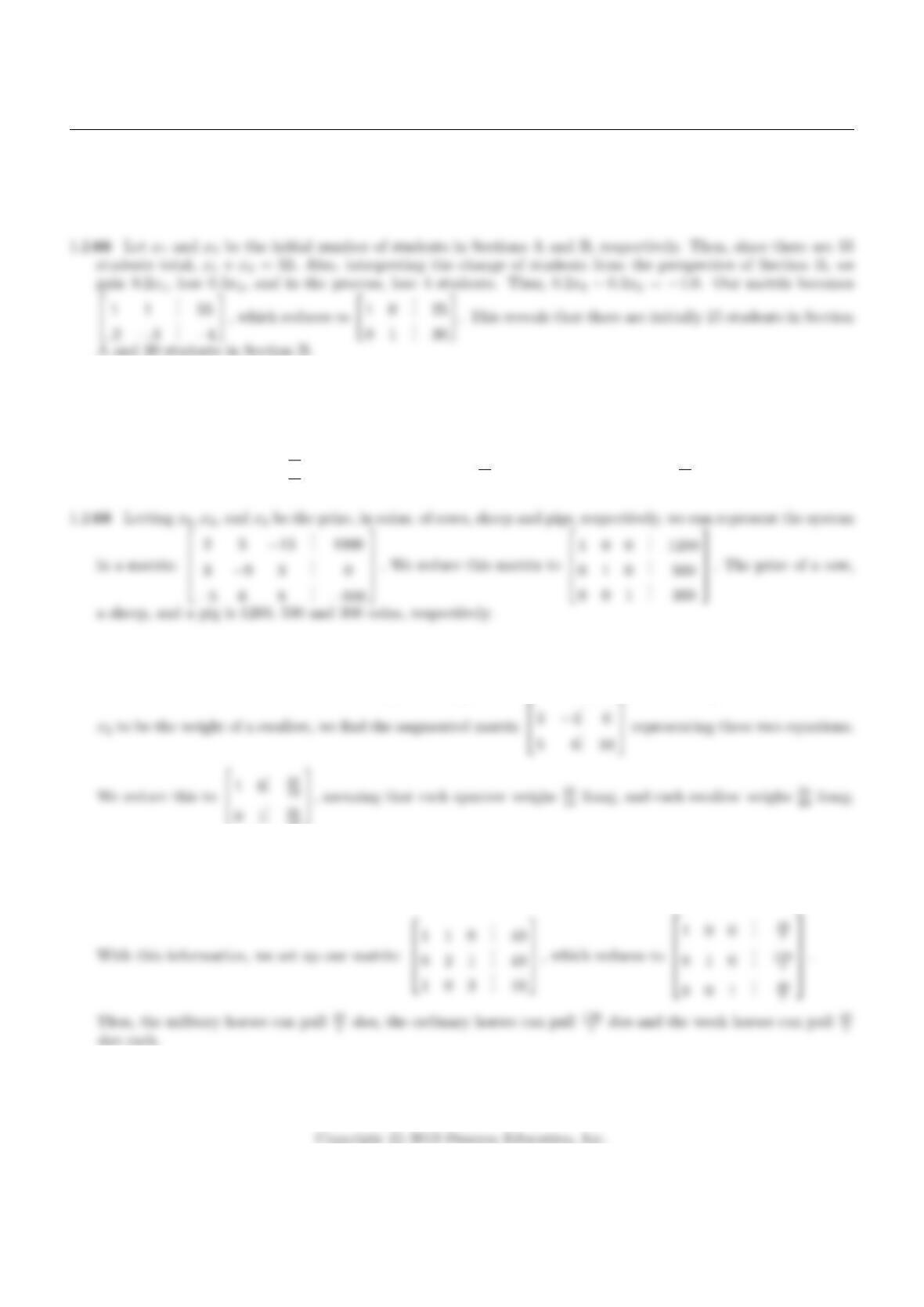
1.2.65 The difficult part of this problem lies in setting up a system from which we can derive our matrix. We
will define x1to be the number of “liberal” students at the beginning of the class, and x2to be the number of
“conservative” students at the beginning. Thus, since there are 260 students in total, x1+x2= 260. We need
one more equation involving x1and x2in order to set up a useful system. Since we know that the number of
29
Chapter 1
Thus, there are initially 120 liberal students, and 140 conservative students. Since the number of liberal students
initially is the same as the number of conservative students in the end, the class ends with 120 conservative
students and 140 liberal students.
1.2.67 We are told that five cows and two sheep cost ten liang, and two cows and five sheep cost eight liang of silver.
So, we let Cbe the cost of a cow, and Sbe the cost of a sheep. From this we derive 5C+2S= 10
2C+5S= 8 .
This reduces to C=34
21
S=20
21 which gives the prices: 34
21 liang silver for a cow, and 20
21 liang silver for a sheep.
1.2.69 The second measurement in the problem tells us that 4 sparrows and 1 swallow weigh as much as 1 sparrow
and 5 swallows. We will immediately interpret this as 3 sparrows weighing the same as 4 swallows. The other
measurement we use is that all the birds together weigh 16 liang. Setting x1to be the weight of a sparrow, and
19
1.2.70 This problem gives us three different combinations of horses that can pull exactly 40 dan up a hill. We
condense the statements to fit our needs, saying that, One military horse and one ordinary horse can pull 40 dan,
two ordinary and one weak horse can pull 40 dan and one military and three weak horses can also pull 40 dan.
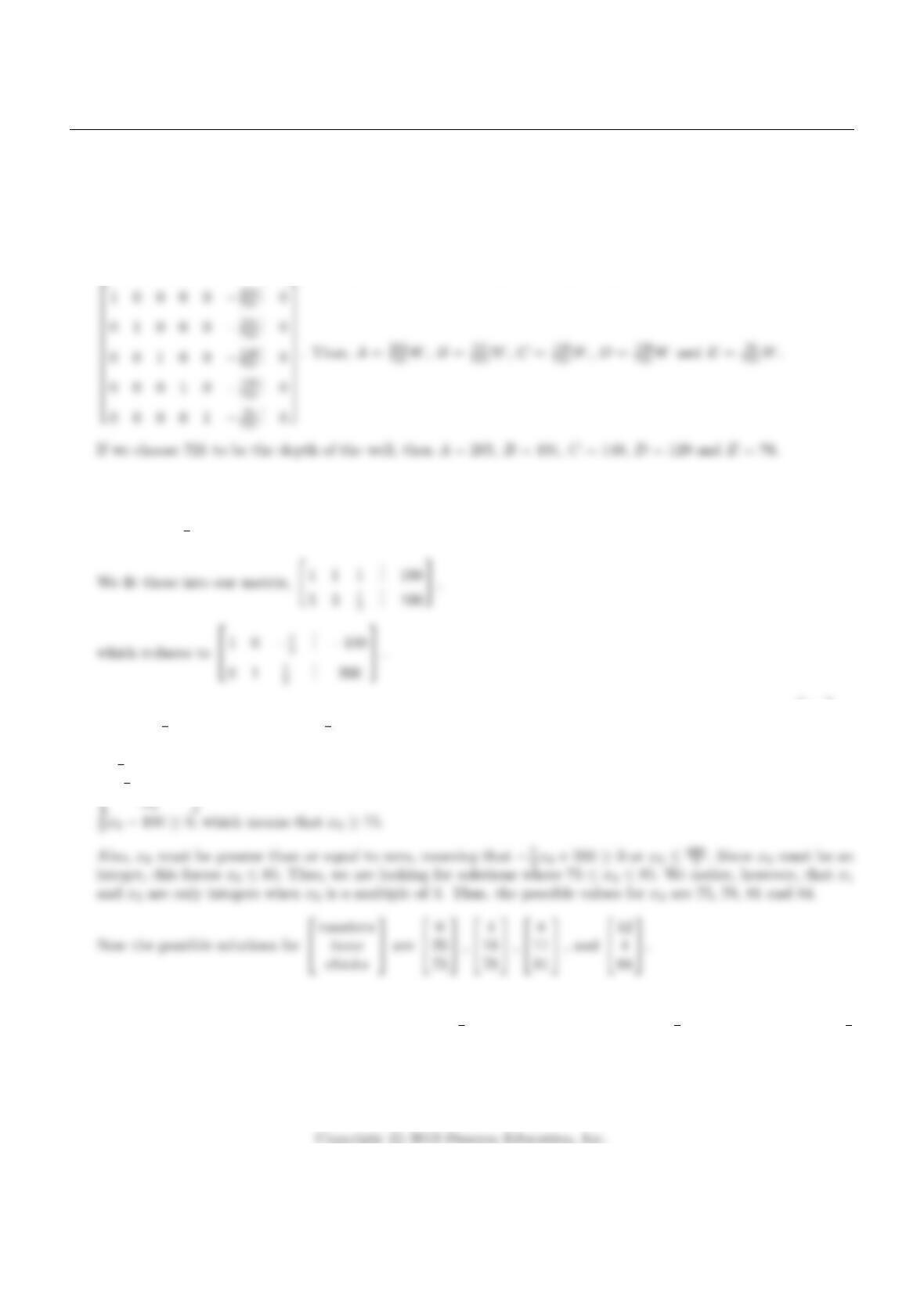
1.2.71 Here, let Wbe the depth of the well.
30
Section 1.2
Then our system becomes
2A+B−W= 0
3B+C−W= 0
4C+D−W= 0
5D+E−W= 0
A+6E−W= 0
.
We transform this system into an augmented matrix, then perform a prolonged reduction to reveal
1.2.72 We let x1, x2and x3be the numbers of roosters, hens and chicks respectively. Then, since we buy a
total of a hundred birds, and spend a hundred coins on them, we find the equations x1+x2+x3= 100 and
5x1+ 3x2+1
3x3= 100.
So, x1−4
3x3=−100,and x2+7
3x3= 200.Now, we can write our solution vectors in terms of x3:
x1
x2
x3
=
4
3x3−100
−7
3x3+ 200
. Since all of our values must be non-negative, x1must be greater than or equal to zero, or
1.2.73 We let x1, x2, x3and x4be the numbers of pigeons, sarasabirds, swans and peacocks respectively. We first
determine the cost of each bird. Each pigeon costs 3
5panas, each sarasabird costs 5
7panas, the swans cost 7
9
panas apiece and each peacock costs 3 panas. We use these numbers to set up our system, but we must remember
to make sure we are buying the proper amount of each to qualify for these deals when we find our solutions (for
example, the number of sarasabirds we buy must be a multiple of 7).
31
Chapter 1
We determine the possible solutions by choosing combinations of x3and x4of the correct multiples (9 for x3, 3 for
x4) that give us non-negative integer solutions for x1and x2. Thus it is required that x1=5
9x3+ 20x4−250 ≥0
and x2=−14
9x3−21x4+ 350 ≥0.
Solving for x3we find that 225 −27
2x4≥x3≥450 −36x4.
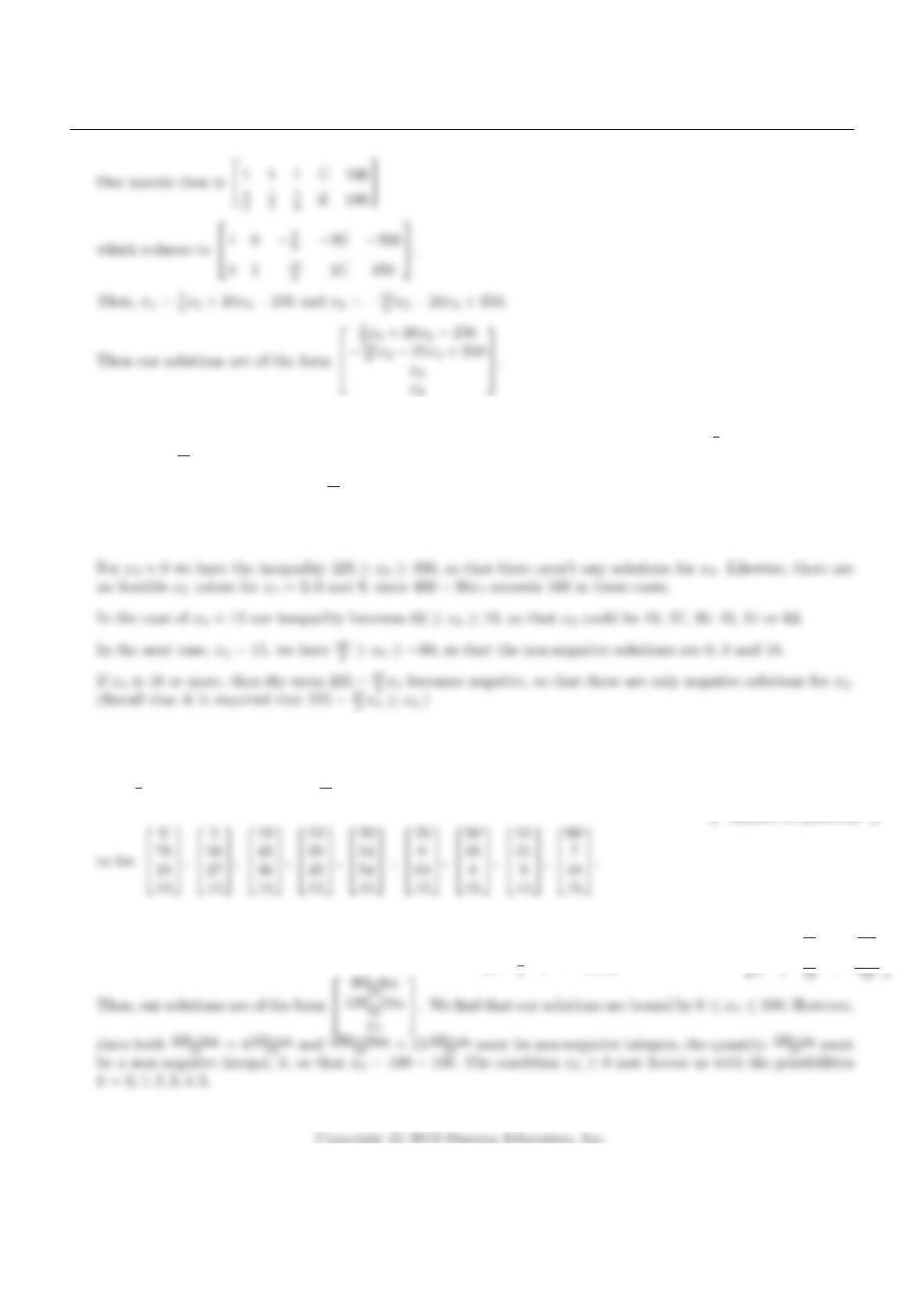
To find all the solutions, we can begin by letting x4= 0, and finding all corresponding values of x3. Then we
can increase x4in increments of 3, and find the corresponding x3values in each case, until we are through.
We have found nine solutions. If we compute the corresponding values of
x1=5
9x3+20x4−250 and x2=−14
9x3−21x4+350, we end up with the following vectors for:
number of pigeons
number of sarasabirds
number of swans
number of peacocks
1.2.74 We follow the outline of Exercise 72 to find the matrix “111.
.
. 100
41
.
. 100 #,which reduces to
1 0 4
19
.
.
.400
19
0 1 15
.
.
.1500
.
32
Section 1.2
Thus, we find our solutions for
ducks
sparrows
roosters
:
0
0
100
.
4
15
81
,
8
30
62
,
12
45
43
,
16
60
24
and
20
75
5
.
1.2.75 We let x1be the number of sheep, x2be the number of goats, and x3be the number of hogs. We can then
use the two equations 1
2x1+4
3x2+7
2x3= 100 and x1+x2+x3= 100 to generate the following augmented matrix:
1
2
4
3
7
2
.
.
. 100
111.
.
. 100
1.2.76 This problem is similar in nature to Exercise 72, and we will follow that example, revealing the ma-
trix: “1 1 1 .
.
. 100
3 2 1
2
.
.
. 100 #. We reduce this to
1 0 −3
2
.
.
.−100
0 1 5
2
.
.
. 200
,which yields solutions of the form
3
2x3−100
−5
2x3+ 200
. Since all the values must be positive (there are at least one man, one woman and one child),
1.2.77 Rather than setting up a huge system, here we will reason this out logically. Since there are 30 barrels, each
son will get 10 of them. If we use the content of a full barrel as our unit for wine, we see that each brother will
get 15
3= 5 barrel-fulls of wine. Thus, the ten barrels received by each son will, on average, be half full, meaning
that for every full barrel a son receives, he also receives an empty one.
33
Chapter 1
2
8
0
,
2
6
2
,
2
4
4
,
2
2
6
,
2
0
8
,
0
10
0
,
0
8
2
,
0
6
4
,
0
4
6
,
0
2
8
and
0
0
10
.
As we stated before, the number of full and empty barrels is dependent on the number of half-full barrels. Thus,
each solution here translates into exactly one solution for the overall problem. Here we list those solutions, for
first son
second son
third son
, using triples of the form (full barrels, half-full barrels, empty barrels) as our entries:
(0,10,0)
(5,0,5)
(5,0,5)
,
(1,8,1)
(4,2,4)
(5,0,5)
,
(1,8,1)
(5,0,5)
(4,2,4)
,
(2,6,2)
(3,4,3)
(5,0,5)
,
(2,6,2)
(4,2,4)
(4,2,4)
,
(2,6,2)
(5,0,5)
(3,4,3)
,
1.2.78 We let x1be the amount of gold in the crown, x2be the amount of bronze, x3be the amount of tin and
x4be the amount of iron. Then, for example, since the first requirement in the problem is: “Let the gold and
bronze together form two-thirds,” we will interpret this as x1+x2=2
3(60).We do this for all three requirements,
and use the fact that all combined will be the total weight of the crown as our fourth. So we find the matrix
1.2.79 Let xibe the number of coins the ith merchant has. We interpret the statement of the first merchant, “If
I keep the purse, I shall have twice as much money as the two of you together” as x1+ 60 = 2(x2+x3), or
−x1+2x2+2x3= 60. We interpret the other statements in a similar fashion, translating this into the augmented
−122.
.
. 60
34
Section 1.3
1.2.80 For each of the three statements, we set up an equation of the form
(initial amount of grass) + (grass growth) = (grass consumed by cows),or
(#offields)x+ (#offields)(#ofdays)y= (#ofcows)(#ofdays)z.
Section 1.3
1.3.1a No solution, since the last row indicates 0 = 1.
b The unique solution is x= 5, y = 6.
c Infinitely many solutions; the first variable can be chosen freely.
1.3.5ax1
3+y2
1=7
11
b The solution of the system in part (a) is x= 3, y = 2. (See Figure 1.13.)
1.3.6No solution, since any linear combination x~v1+y~v2of ~v1and ~v2will be parallel to ~v1and ~v2.
35