1-1
CHAPTER 1
THE ENVIRONMENT OF FINANCIAL REPORTING
CONTENT ANALYSIS OF CASES
Number
Content
Time Range
(minutes)
C1-1
Pronouncements. Matching a list of descriptive statements
with a list of pronouncements establishing or related to
generally accepted accounting principles.
5-10
C1-6
Organization of the FASB. Summarize the structure of the FASB,
its documents (GAAP pronouncements), and its operating
procedures.
10-20
C1-7
GAAP and the AICPA. Summarize the GAAP-related
documents published by the AICPA.
5-10
C1-11
Ethical Dilemma. Discuss steps to take in an ethical dilemma
(“misplaced” book in library).
10-20
ANSWERS TO QUESTIONS
Q1-1 Primary markets are those capital markets where the exchanges of stocks and bonds
Q1-2 The users of financial information can be divided into two major categories: external
users and internal users. These two groups do not have the same decision making
information needs because of their differing relationships with the company providing
Q1-3 Financial accounting is the information accumulation, processing, and
communication system designed to provide investment and credit decision-making
information for external users of accounting information. Financial accounting
Q1-4 Financial reporting is the process of communicating financial accounting information
Q1-5 The three major financial statements of a company and what they show are: (1) the
balance sheet (or statement of financial position) which shows the company’s
Q1-6 Generally accepted accounting principles (GAAP) are the guidelines, procedures,
and practices that a company is required to use in recording and reporting the
Q1-7 There are four categories of GAAP in the hierarchy of sources of GAAP. The
pronouncements included in Category A are FASB Statements of Financial
Q1-8 The CAP was the Committee on Accounting Procedure. This group issued
pronouncements on accounting procedures and practice. These pronouncements
were published as Accounting Research Bulletins. The CAP was replaced by the APB
Q1-9 Before issuing a Statement of Concepts or Standards, the FASB generally completes a
multistage process as follows:
(1) identifies topic
Q1-10 The FASB issues five types of pronouncements:
1. Statements of Financial Accounting Standards. These pronouncements are
releases indicating the methods and procedures required on specific
1-4
Q1-10 (continued)
Q1-11 The organizations other than the FASB that have had an impact on the
Q1-12 The IASB is the International Accounting Standards Board. The IASB has 12 full-time
members (and 2 part-time members) from various countries. It issues International
Q1-13 The professional organizations that play an important role in the accounting
Q1-14 The Code of Professional Conduct is a document published by the AICPA to help
(4) objectivity and independence, (5) due care, and (6) scope and nature of
services.
Q1-15 The steps a person should follow to determine whether an action is ethical include:
(1) gathering the facts (e.g., who are the “stakeholders,” what are my
Q1-16 Creative thinking is the process of finding new relationships or ideas among items of
information that potentially can be used to solve a problem. It involves using
1-5
Q1-17 Critical thinking is the process of testing new relationships or ideas in order to
determine how well they will work. It involves the use of inductive or deductive
Q1-18 The FASB and the IASB entered into the “Norwalk Agreement” to work toward the
Q1-19 The four related long-term convergence projects of the FASB and IASB deal with
Q1-20 The SEC is considering requiring U.S. companies to use IFRS in preparing their
ANSWERS TO CASES
C1-1
C1-2
C 1. Committee on Accounting Procedure (CAP)
C1-3
Three organizations primarily have been responsible for the establishment of generally
accepted accounting principles in the private sector of the U.S. These organizations are
1-6
C1-3 (continued)
accepted accounting principles unless specifically superseded or amended by other
authoritative bodies.
In 1959, the APB was formed by the AICPA as an attempt to (1) alleviate the criticism of the
methods of formulating accounting principles, and (2) create a policy-making body
C1-4 (AICPA adapted solution)
1. The term “accounting principles” in the auditor’s report includes not only accounting
principles but also practices and the methods of applying them. Though the term quite
naturally emphasizes the primary or fundamental character of some principles, it includes
2. Generally accepted accounting principles are those principles (whether or not they have
only limited usage) that have substantial authoritative support. Whether a given principle
1-7
C1-4 (continued)
2. (continued)
Pronouncements of the FASB, APB, AICPA, and SEC, if there are any on the subject in
question, would be given greater weight than other single sources. Pronouncements of
the FASB, APB, and AICPA constitute substantial authoritative support, and the evidence
would tend to be conclusive if the SEC has issued an affirmative opinion on the same
C1-5 (CMA adapted)
Financial accounting standards inspire or encourage political action and social
involvement during the standard setting process because the effects of accounting
standards are wide-ranging and impact many varying groups. The setting of accounting
standards is a social decision and the user groups play a significant role and have
C1-6
The Financial Accounting Foundation is the parent organization of the FASB. It is governed by a
14 to 18-member Board of Trustees appointed from the memberships of eight organizations (the
AICPA, Financial Executives Institute, Institute of Management Accountants, CFA Institute,
assists the FASB by handling library, publications, personnel, and other activities.
The FASB issues several types of pronouncements:
1. Statements of Financial Accounting Standards. These pronouncements establish generally
accepted accounting principles. They indicate the methods and procedures required on
specific accounting issues.
2. Interpretations. These pronouncements provide clarification of conflicting or unclear issues
relating to previously issued FASB Statements of Standards, APB Opinions, or Accounting
C1-6 (continued)
Before issuing a statement of concepts or standards, the FASB generally completes a multistage
process, although the sequence and numbers of steps may vary. Initially, a topic or project is
identified and placed on the FASB’s agenda. This topic may be the result of suggestions from
the FASAC, the accounting profession, industry, or other interested parties. On major issues a
C1-7
The AICPA publishes numerous documents that may be considered as sources of GAAP. For
example, Industry Audit Guides and Industry Accounting Guides are publications designed to
C1-8
The first five principles of the AICPA’s Code of Professional Conduct are as follows:
1. Responsibilities: In carrying out their responsibilities as professionals, members should
2. The Public Interest: Members should act in a way that will serve the public interest, honor
the public trust, and demonstrate a commitment to professionalism. When a member
C1-8 (continued)
3. Integrity: To maintain and broaden public confidence, members should perform all
4. Objectivity and Independence: A member should be objective and be free from conflicts
of interest in discharging professional responsibilities. A member in public practice should
5. Due Care: A member should observe the profession’s technical and ethical standards,
strive continually to improve competence and the quality of standards, strive continually to
C1-9
The “rules” for financial accounting are called generally accepted accounting principles.
Generally accepted accounting principles (GAAP) are the guidelines, procedures, and
practices that a company is required to use in recording and reporting the accounting
information in its audited financial statements. GAAP define accepted accounting
1-11
C1-9 (continued)
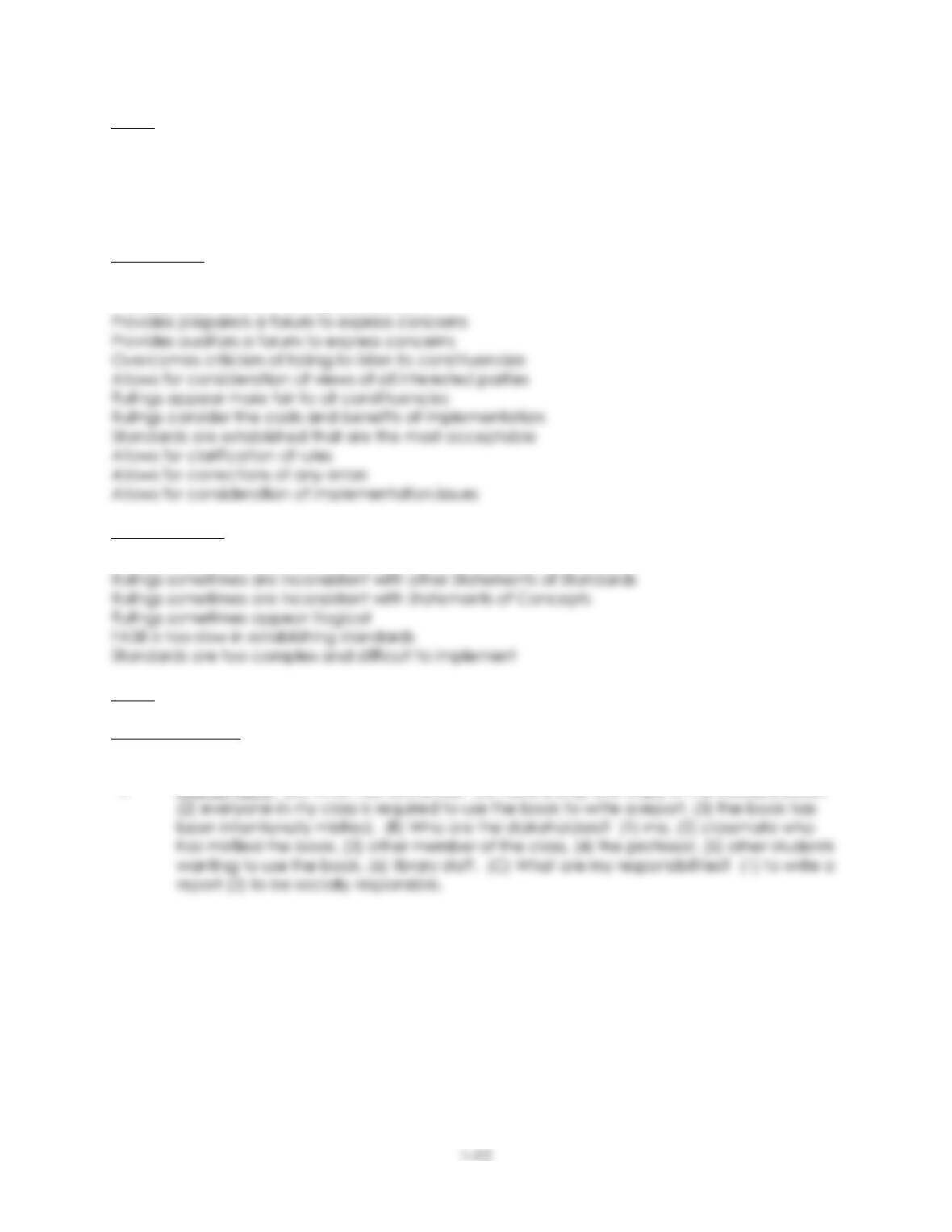
The following is a “hierarchy” of four categories of GAAP and the authoritative sources
applicable to each category for companies:
Categories Authoritative Sources (Pronouncements)
A
FASB Statements of Financial Accounting Standards and
Interpretations, FASB Statement 133 Implementation Issues,
FASB Staff Positions, and APB Opinions and CAP (AICPA)
Accounting Research Bulletins not superceded by actions of
the FASB (as well as SEC releases such as Regulation S-X,
Financial Reporting Releases, and Staff Accounting Bulletins
for companies that file with the SEC)
*”Cleared” means that the FASB does not object to the pronouncement’s issuance.
These categories are listed in descending order of importance, with Category A as the most
important. Companies must follow the GAAP established by the pronouncements in this
C1-10
On balance, most people would agree that it is a good idea for the FASB to allow written
comments and oral presentations in which interested parties can lobby for a particular ruling.
However, there are both pros and cons to allowing interested parties to provide input to its
deliberation process. They include:
Advantages
Enables FASB to get input from different perspectives
Provides users a forum to express concerns
Disadvantages
Rulings sometimes appear to be biased in favor of certain user group
C1-11
Note to Instructor: Listed below are some possible findings that students may discuss at each
step in the moral reasoning process:
I. Gather facts: (A) What has occurred? (1) there is only one copy of the needed book,
1-13
C1-11 (continued)
II. Ask whether the action (my classmate misfiling the book) is acceptable according to
three ethical criteria: (A) Utility: Does the action optimize the satisfactions of all
stakeholders? (1) the classmate who misfiled the book can satisfactorily use the book
without having to wait his turn, (2) I am unable to use the book to finish my report,
(3) the rest of the class cannot use the book to finish their reports, (4) the professor
III. Consider whether there are any overwhelming factors affecting criteria: In this situation,
there do not appear to be overwhelming factors but students may bring up issues like:
IV. Decide what ethical action to take: Students may decide on a number of alternative
courses of action, including: (1) doing nothing, (2) discussing with classmate, (3)
C1-12
Note to Instructor: Listed below are some possible findings that students may discuss at each
step in the moral reasoning process:
I. Gather facts: (A) What has occurred? (1) my friend copied an answer, (2) she
C1-12 (continued)
II. Ask whether the action (my friend’s cheating) is acceptable according to three ethical
criteria: (A) Utility: Does the action optimize the satisfaction of all stakeholders? (1) her
copying led to a short-term satisfaction in the form of an A. However, in the long-run,
this A may prove to be harmful to her if she views the A as a reward for cheating and
continues to cheat in the future, (2) my receipt of a lower grade puts her at an unfair
advantage over me, (3) others in the class who received the same grade as her had to
III. Consider whether there are any overwhelming factors between criteria: In this situation,
there do not appear to be overwhelming factors but students may bring up issues like:
IV. Decide what ethical action to take: Students may decide on a number of alternative
courses of action, including: (1) doing nothing, (2) discussing with friend, (3) discussing
C1-13
Currently, U.S. corporations are subject to the accounting “rules” or accounting
standards (called U.S. GAAP) established by the Financial Accounting Standards Board
(FASB), while foreign corporations are subject to international standards called IFRS
1-15
C1-13 (continued)
would address concurrently. Finally, they agreed to continue working on joint projects
they were currently undertaking. This overall collaboration is sometimes referred to as
the convergence or harmonization of accounting standards.
The FASB believes that the ideal result of cooperative international standard setting
IASB member on site at the FASB offices.
The FASB and the IASB have been cooperating for several years on four long-term joint
convergence projects. These include: (1) business combinations, (2) revenue
accounting changes, and (4) earnings per share.
The progress of the FASB and the IASB has been slow and very few converged
accounting standards have been issued in regard to both the long-term major joint
The movement by more foreign companies to using IFRS has created two potential
problems for U.S. companies using U.S. GAAP (“regulated companies”) and that
operate globally. First, their financial statements are likely to be different from the
foreign companies with which they are competing for capital, creating difficulties for
C1-13 (continued)
(1) Many U.S. companies (particularly smaller ones) filing with the SEC do not operate
globally so they would not see any advantage to using IFRS. If IFRS were required, it
would likely be very costly for them to switch from U.S. GAAP to IFRS, thereby
affecting their profitability during the conversion period.
(5) High-quality, international auditing standards and practices would have to be
developed to ensure that the IFRS are rigorously interpreted and applied.
(6) Accountants and auditors would have to be trained and/or retrained to
understand the impact of IFRS on the preparation of financial statements and the
related audits of companies using IFRS. Larger auditing firms with more resources for
training may be at a competitive advantage over smaller auditing firms.
1-17
C1-13 (continued)
The FASB has indicated that it favors the required use of IFRS by all U.S. firms in
preparing their financial statements. However, it advocates an “improve and adopt”
approach to implementing IFRS. It also sees the need for a transition plan, or certain