PROBLEM 1.1
KNOWN: Temperature distribution in wall of Example 1.1.
FIND: Heat fluxes and heat rates at x = 0 and x = L.
SCHEMATIC:
PROPERTIES: Thermal conductivity of wall (given): k = 1.7 W/m·K.
ANALYSIS: The heat flux in the wall is by conduction and is described by Fourier’s law,
Hence, the heat flux is constant throughout the wall, and is
PROBLEM 1.2
KNOWN: Thermal conductivity, thickness and temperature difference across a sheet of rigid
extruded insulation.
FIND: (a) The heat flux through a 3 m × 3 m sheet of the insulation, (b) the heat rate through
the sheet, and (c) the thermal conduction resistance of the sheet.
SCHEMATIC:
ASSUMPTIONS: (1) One-dimensional conduction in the x-direction, (2) Steady-state
conditions, (3) Constant properties.
ANALYSIS: (a) From Equation 1.2 the heat flux is
COMMENTS: (1) Be sure to keep in mind the important distinction between the heat flux
(W/m2) and the heat rate (W). (2) The direction of heat flow is from hot to cold. (3) Note that
a temperature difference may be expressed in kelvins or degrees Celsius. (4) The conduction
thermal resistance for a plane wall could equivalently be calculated from Rt,cond = L/kA.
A = 4 m2
A = 4 m2
9 m
2
A = 4 m2
A = 4 m2
9 m
2
PROBLEM 1.3
KNOWN: Thickness and thermal conductivity of a wall. Heat flux applied to one face and
temperatures of both surfaces.
FIND: Whether steady–state conditions exist.
ANALYSIS: Under steady–state conditions an energy balance on the control volume shown is
2
in out cond 1 2
( ) / 12 W/m K(50 C 30 C) / 0.01 m 24,000 W/mq q q kT T L
′′ ′′ ′′
= = = − = ⋅ °− ° =
Since the heat flux in at the left face is only 20 W/m2, the conditions are not steady state. <
PROBLEM 1.4
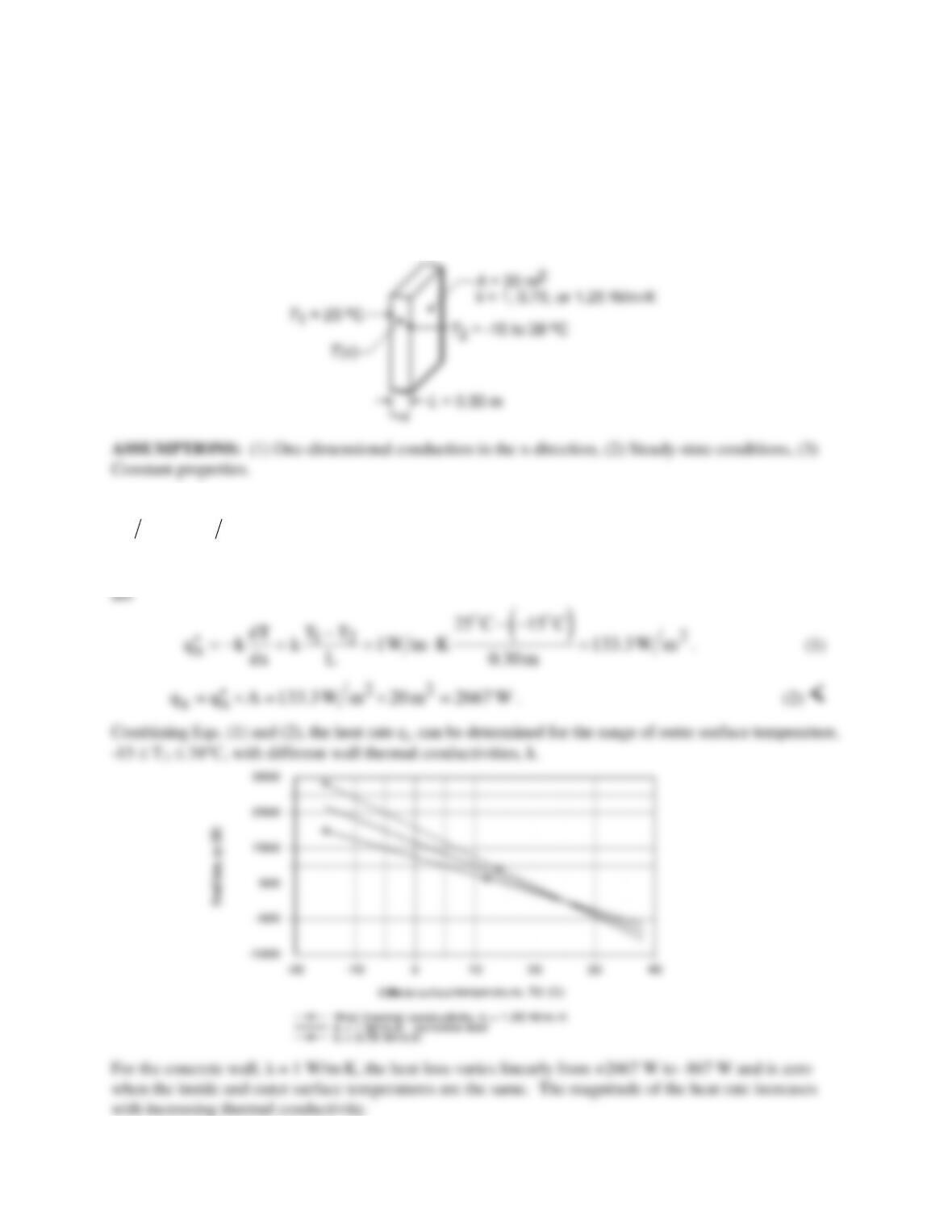
KNOWN: Inner surface temperature and thermal conductivity of a concrete wall.
FIND: Heat loss by conduction through the wall as a function of outer surface temperatures ranging
from -15 to 38°C.
SCHEMATIC:
ANALYSIS: From Fourier’s law, if
x
q′′
and k are each constant it is evident that the gradient,
x
dT dx q k
′′
= −
, is a constant, and hence the temperature distribution is linear. The heat flux must be
constant under one-dimensional, steady-state conditions; and k is approximately constant if it depends
only weakly on temperature. The heat flux and heat rate when the outside wall temperature is T2 = –15°C
COMMENTS: Without steady-state conditions and constant k, the temperature distribution in a plane
wall would not be linear.
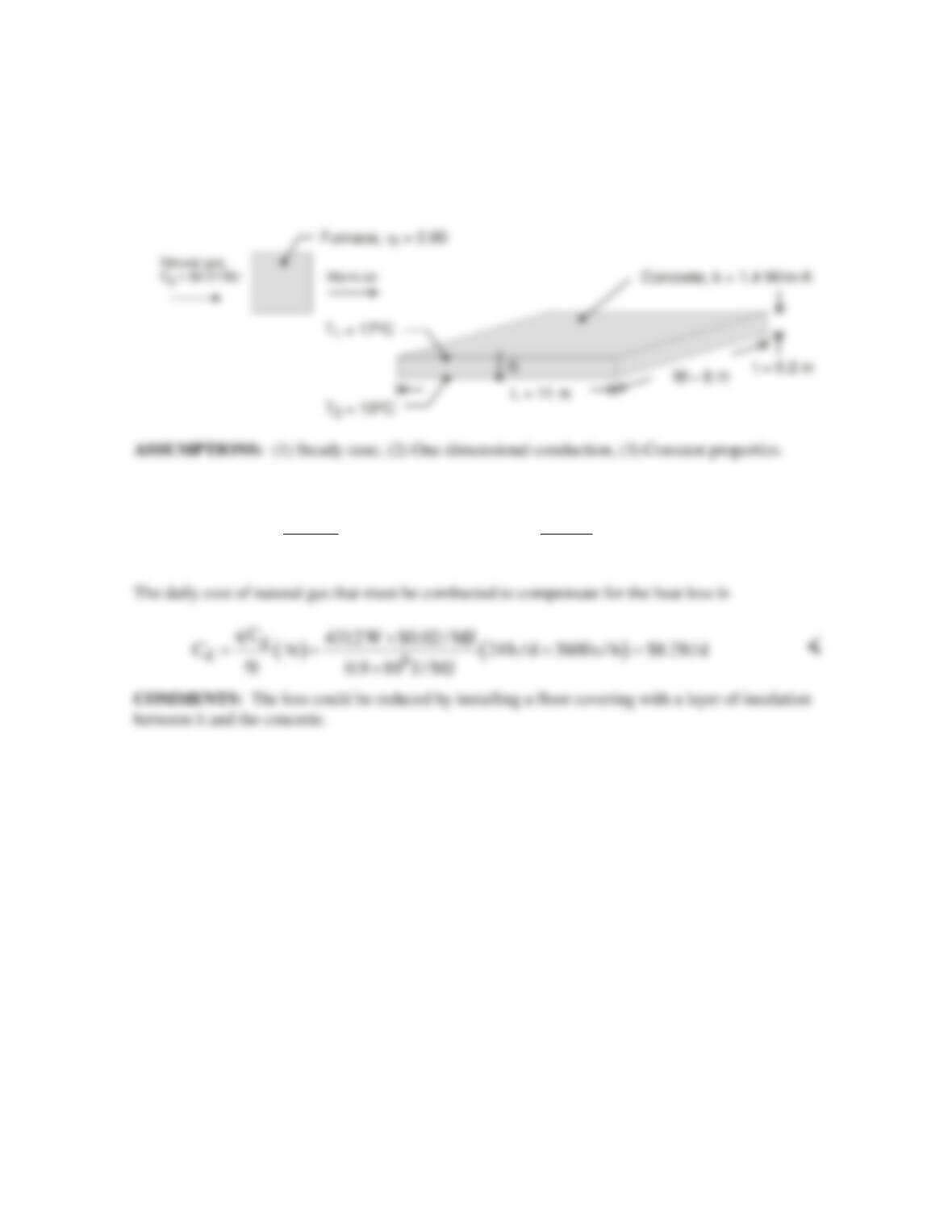
PROBLEM 1.5
KNOWN: Dimensions, thermal conductivity and surface temperatures of a concrete slab. Efficiency
of gas furnace and cost of natural gas.
FIND: Daily cost of heat loss.
SCHEMATIC:
ANALYSIS: The rate of heat loss by conduction through the slab is
( ) ( )
12
T T 7C
q k LW 1.4 W / m K 11m 8m 4312 W
t 0.20 m
−°
= = ⋅× =
<
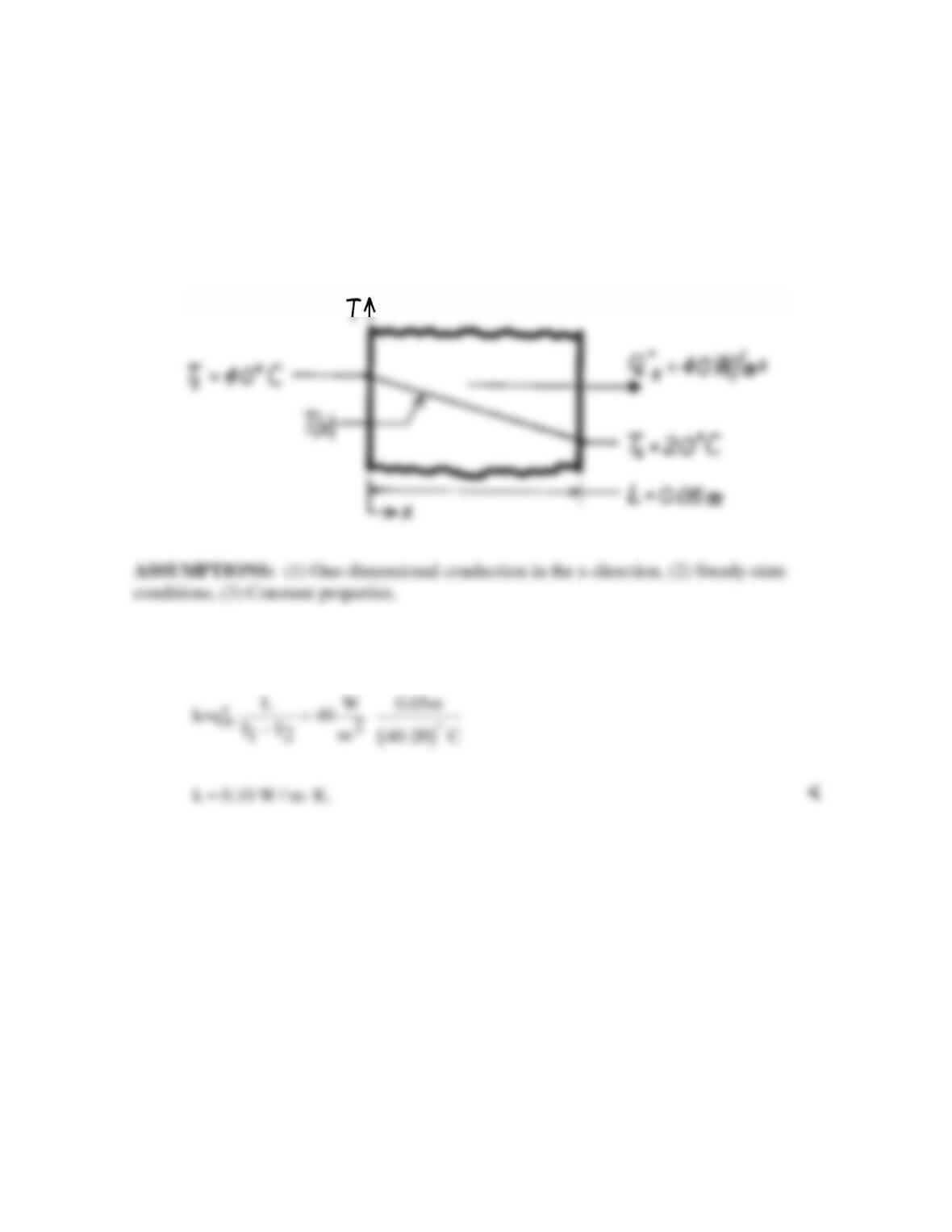
PROBLEM 1.6
KNOWN: Heat flux and surface temperatures associated with a wood slab of prescribed
thickness.
FIND: Thermal conductivity, k, of the wood.
SCHEMATIC:
ANALYSIS: Subject to the foregoing assumptions, the thermal conductivity may be
determined from Fourier’s law, Eq. 1.2. Rearranging,
COMMENTS: Note that the °C or K temperature units may be used interchangeably when
evaluating a temperature difference.
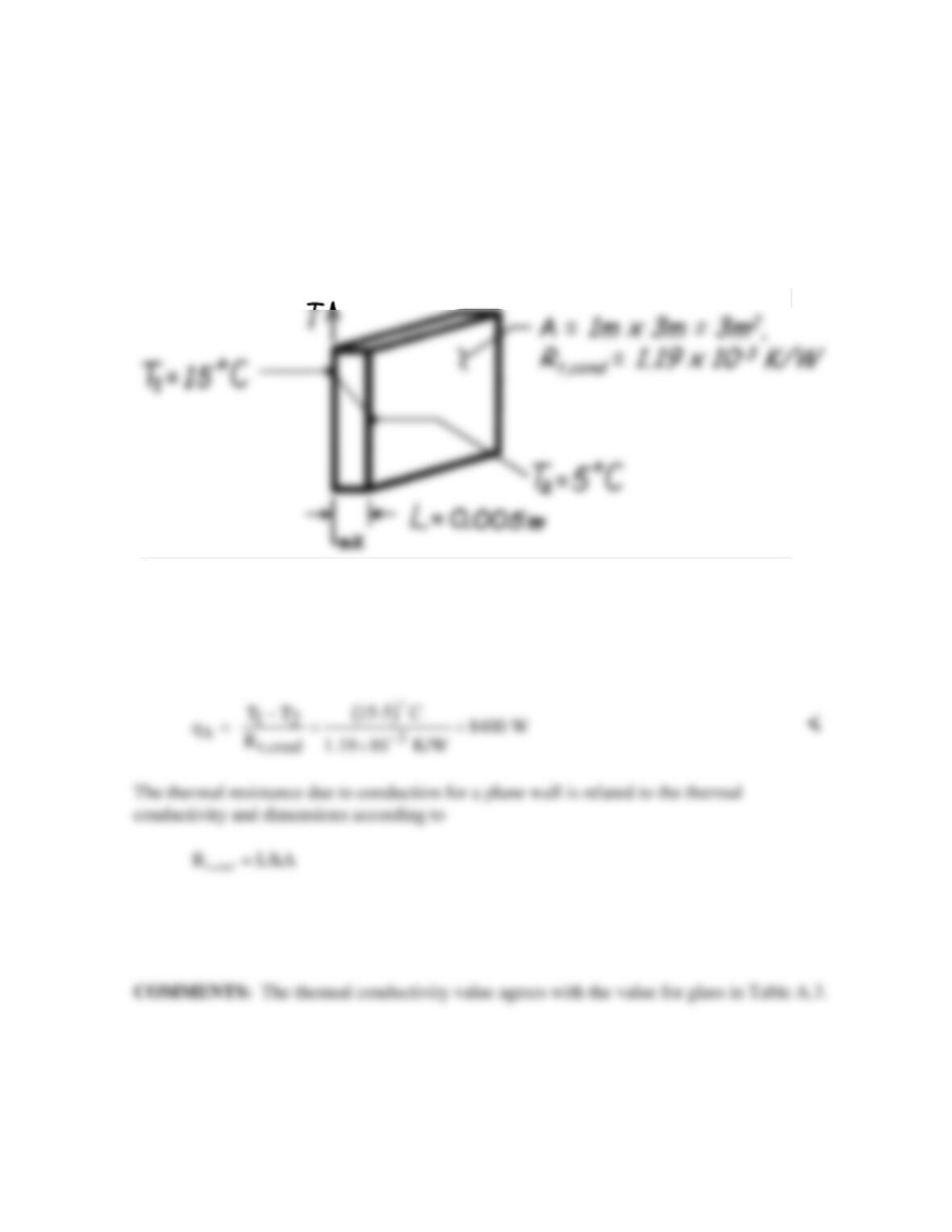
PROBLEM 1.7
KNOWN: Inner and outer surface temperatures and thermal resistance of a glass window of
prescribed dimensions.
FIND: Heat loss through window. Thermal conductivity of glass.
SCHEMATIC:
ASSUMPTIONS: (1) One-dimensional conduction in the x-direction, (2) Steady–state
conditions, (3) Constant properties.
ANALYSIS: From Eq. 1.11,
Therefore
32
t,cond
k L/(R A) 0.005 m / (1.19 10 K/W 3 m ) 1.40 W/m K
−
= = × ×= ⋅
<
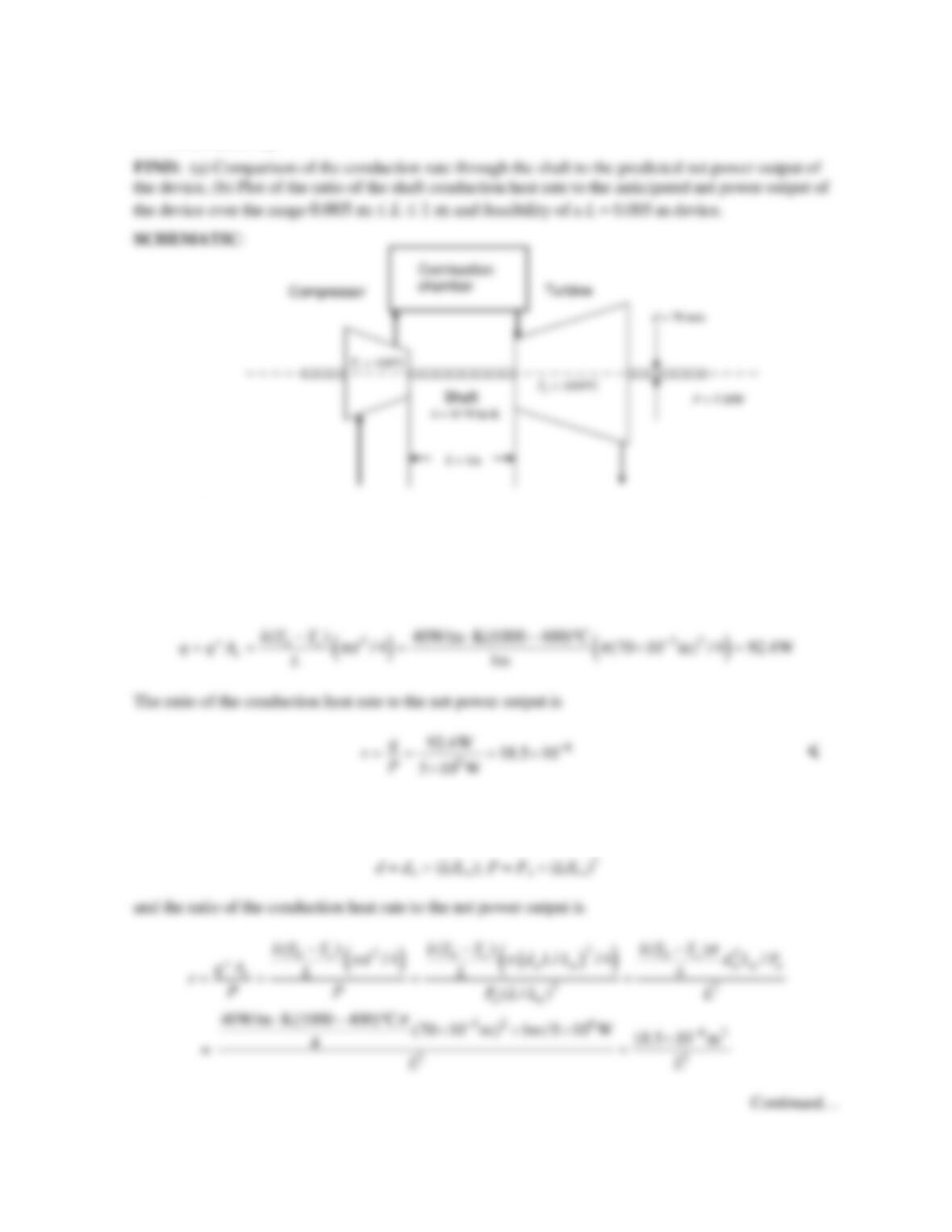
PROBLEM 1.8
KNOWN: Net power output, average compressor and turbine temperatures, shaft dimensions and
thermal conductivity.
ASSUMPTIONS: (1) Steady-state conditions, (2) Constant properties, (3) Net power output is
proportional to the volume of the gas turbine.
PROPERTIES: Shaft (given): k = 40 W/m⋅K.
ANALYSIS: (a) The conduction through the shaft may be evaluated using Fourier’s law, yielding
(b) The volume of the turbine is proportional to L3. Designating La = 1 m, da = 70 mm and Pa as the
shaft length, shaft diameter, and net power output, respectively, in part (a),
PROBLEM 1.8 (Cont.)
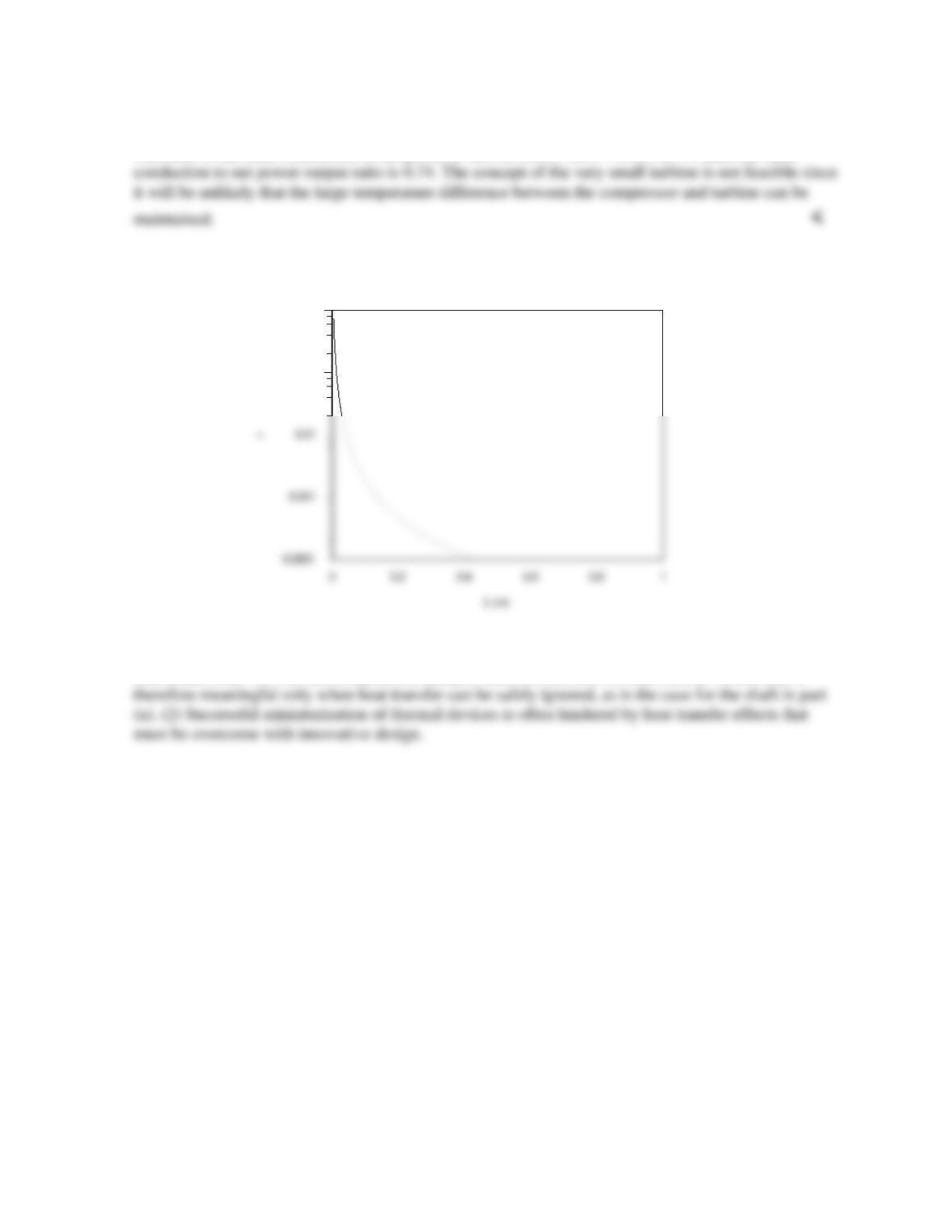
The ratio of the shaft conduction to net power is shown below. At L = 0.005 m = 5 mm, the shaft
COMMENTS: (1) The thermodynamics analysis does not account for heat transfer effects and is
Ratio of shaft conduction to net power
0.1
1
PROBLEM 1.9
KNOWN: Heat flux at one face and air temperature and convection coefficient at other face of plane
wall. Temperature of surface exposed to convection.
FIND: If steady–state conditions exist. If not, whether the temperature is increasing or decreasing.
SCHEMATIC:
ASSUMPTIONS: (1) One–dimensional conduction, (2) No internal energy generation.
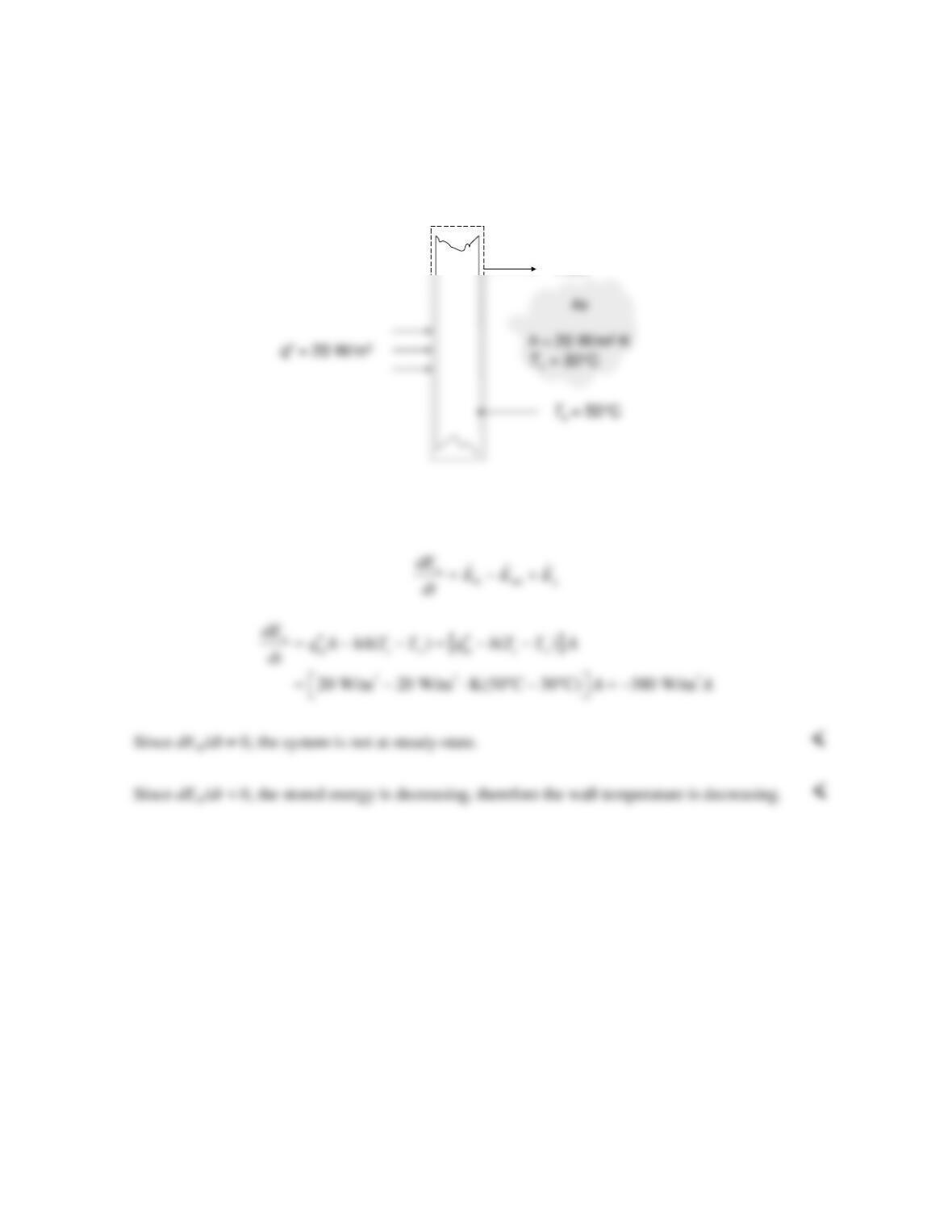
ANALYSIS: Conservation of energy for a control volume around the wall gives
COMMENTS: When the surface temperature of the face exposed to convection cools to 31°C, qin =
qout and dEst/dt = 0 and the wall will have reached steady–state conditions.
q”
conv
PROBLEM 1.10
KNOWN: Expression for variable thermal conductivity of a wall. Constant heat flux.
Temperature at x = 0.
FIND: Expression for temperature gradient and temperature distribution.
SCHEMATIC:
ASSUMPTIONS: (1) One–dimensional conduction.
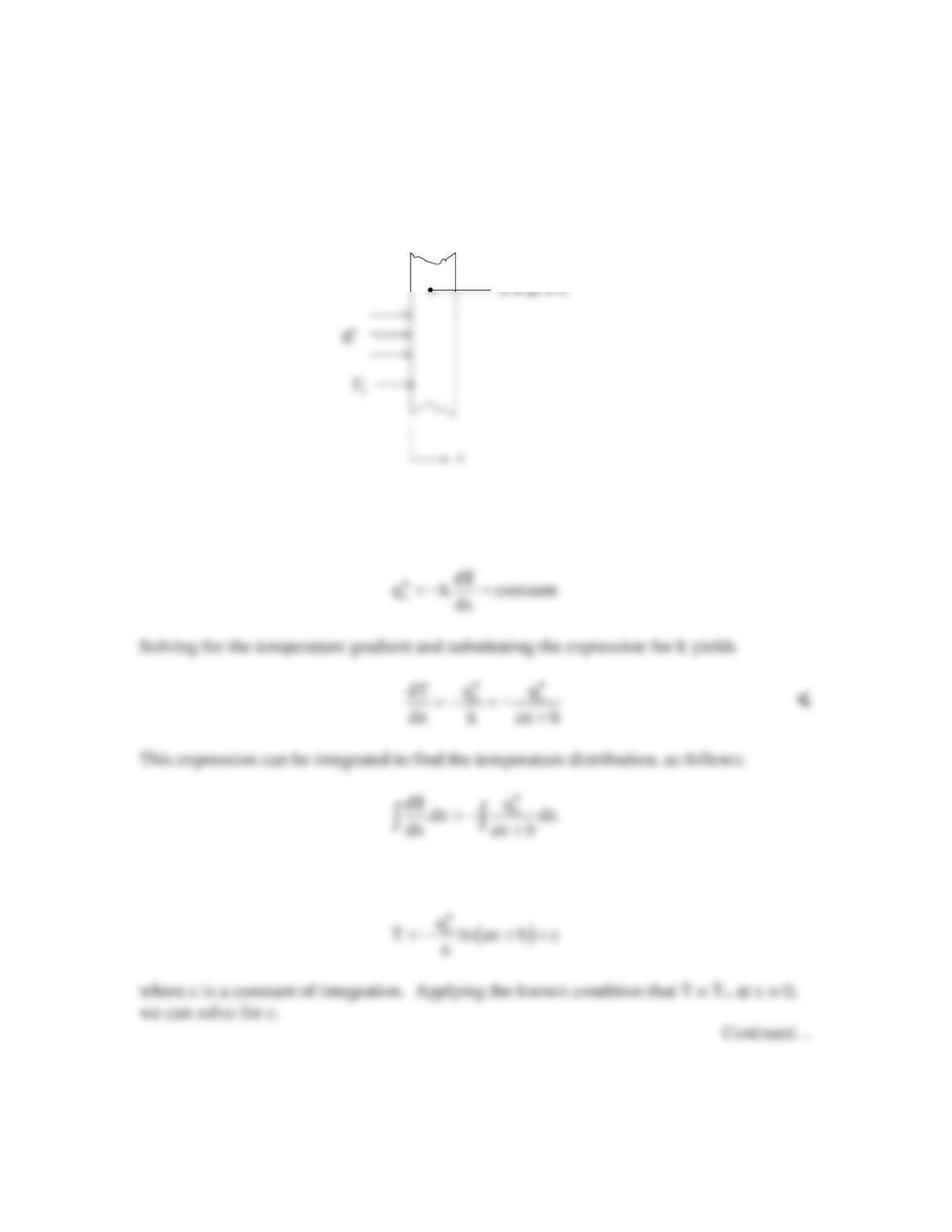
ANALYSIS: The heat flux is given by Fourier’s law, and is known to be constant, therefore
Since
x
q constant
′′ =
, we can integrate the right hand side to find
PROBLEM 1.10 (Cont.)
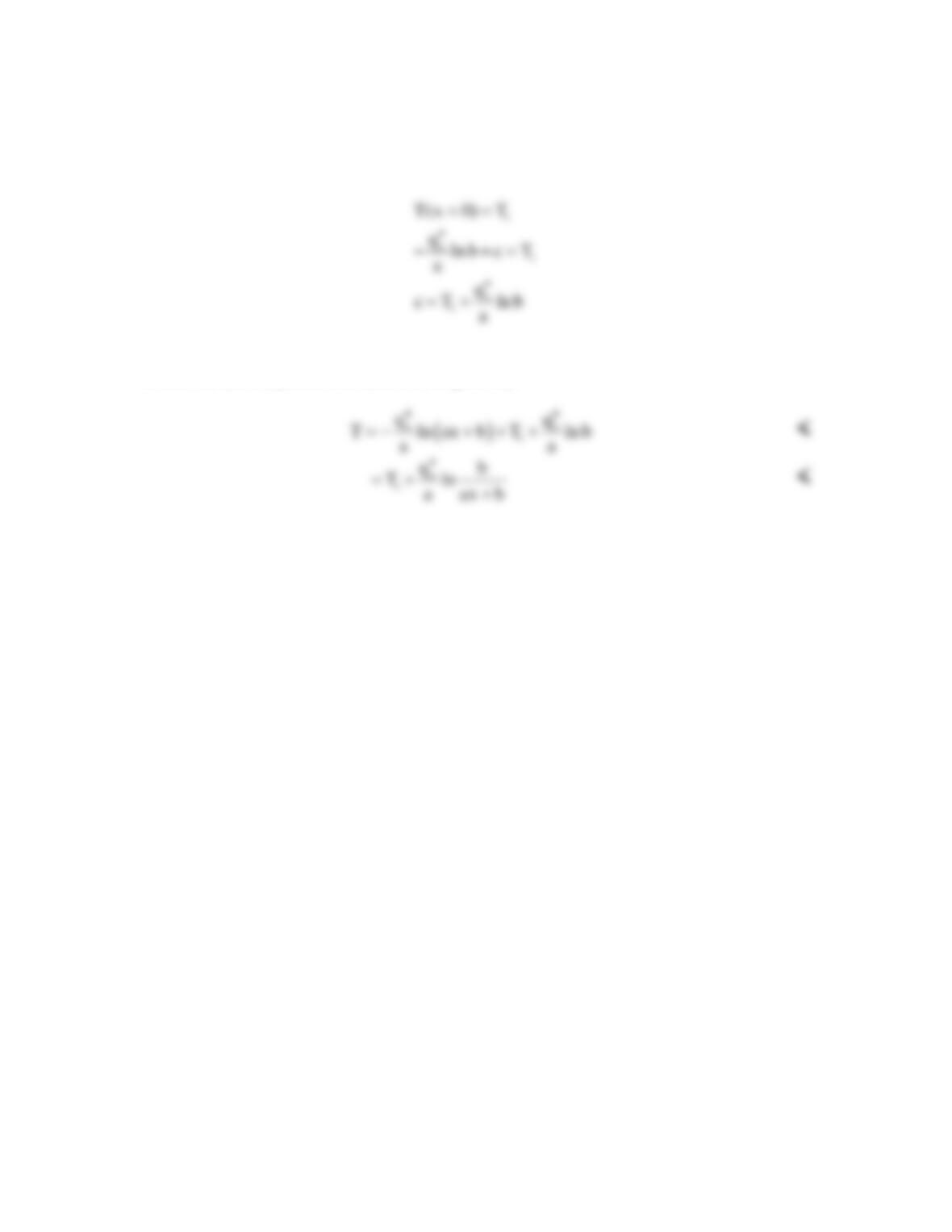
Therefore, the temperature distribution is given by
COMMENTS: Temperature distributions are not linear in many situations, such as when the
thermal conductivity varies spatially or is a function of temperature. Non-linear temperature
distributions may also evolve if internal energy generation occurs or non-steady conditions exist.
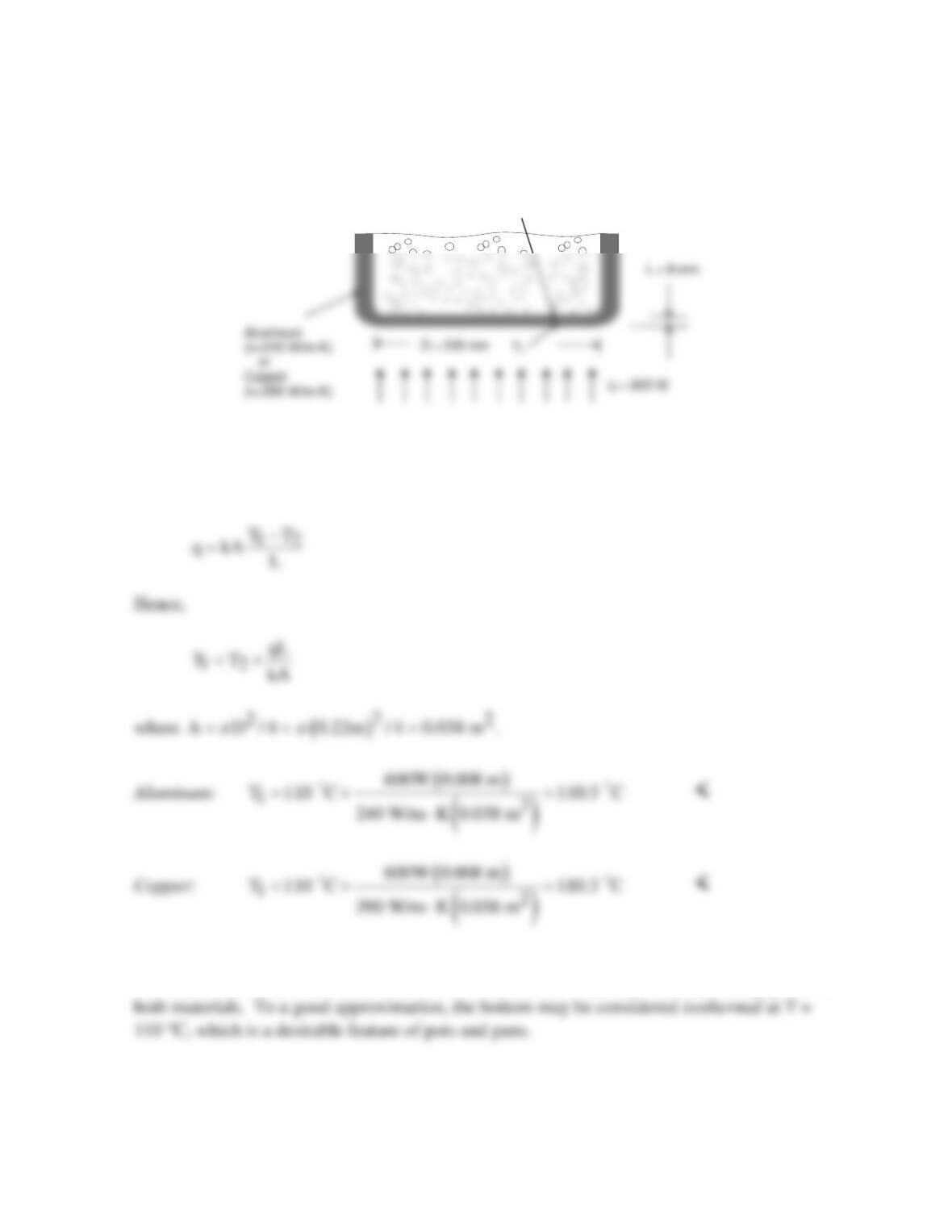
PROBLEM 1.11
KNOWN: Thickness, diameter and inner surface temperature of bottom of pan used to boil
water. Rate of heat transfer to the pan.
FIND: Outer surface temperature of pan for an aluminum and a copper bottom.
SCHEMATIC:
ASSUMPTIONS: (1) One-dimensional, steady-state conduction through bottom of pan.
ANALYSIS: From Fourier’s law, the rate of heat transfer by conduction through the bottom
of the pan is
COMMENTS: Although the temperature drop across the bottom is slightly larger for
aluminum (due to its smaller thermal conductivity), it is sufficiently small to be negligible for
T = 110C
2o
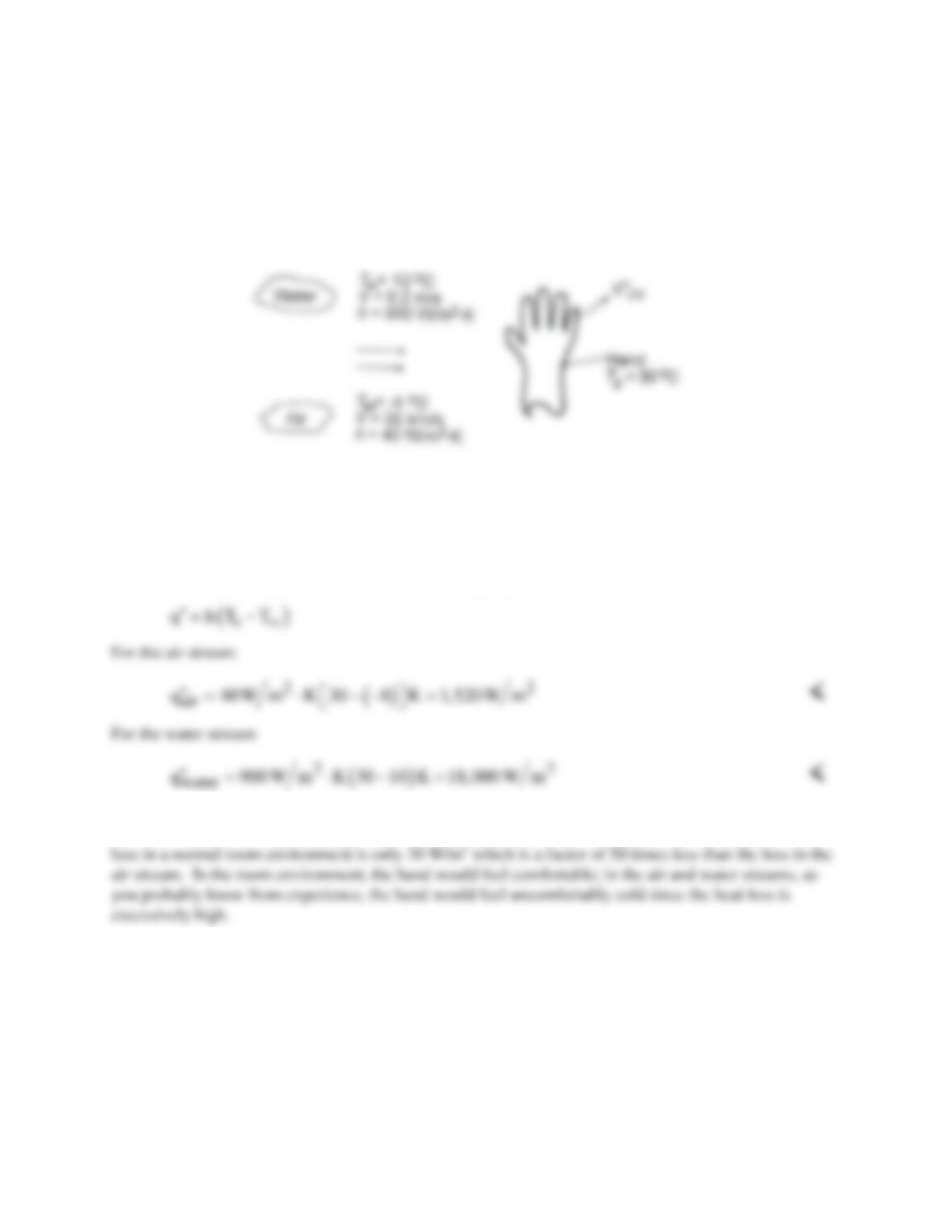
PROBLEM 1.12
KNOWN: Hand experiencing convection heat transfer with moving air and water.
FIND: Determine which condition feels colder. Contrast these results with a heat loss of 30 W/m2 under
normal room conditions.
SCHEMATIC:
ASSUMPTIONS: (1) Temperature is uniform over the hand’s surface, (2) Convection coefficient is
uniform over the hand, and (3) Negligible radiation exchange between hand and surroundings in the case
of air flow.
ANALYSIS: The hand will feel colder for the condition which results in the larger heat loss. The heat
loss can be determined from Newton’s law of cooling, Eq. 1.3a, written as
COMMENTS: The heat loss for the hand in the water stream is an order of magnitude larger than when
in the air stream for the given temperature and convection coefficient conditions. In contrast, the heat
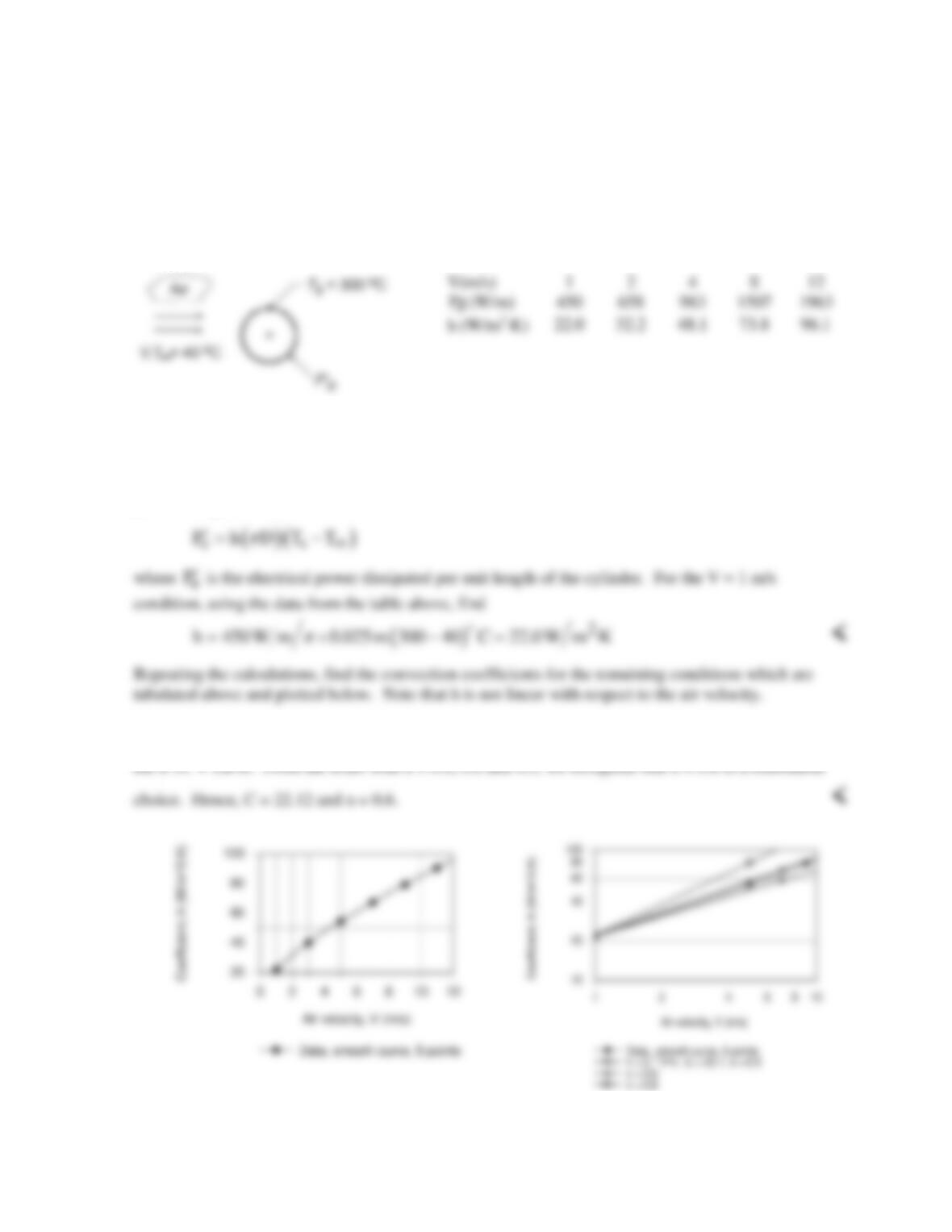
PROBLEM 1.13
KNOWN: Power required to maintain the surface temperature of a long, 25-mm diameter cylinder
with an imbedded electrical heater for different air velocities.
FIND: (a) Determine the convection coefficient for each of the air velocity conditions and display
the results graphically, and (b) Assuming that the convection coefficient depends upon air velocity as
h = CVn, determine the parameters C and n.
SCHEMATIC:
ASSUMPTIONS: (1) Temperature is uniform over the cylinder surface, (2) Negligible radiation
exchange between the cylinder surface and the surroundings, (3) Steady-state conditions.
ANALYSIS: (a) From an overall energy balance on the cylinder, the power dissipated by the
electrical heater is transferred by convection to the air stream. Using Newton’s law of cooling on a
per unit length basis,
(b) To determine the (C,n) parameters, we plotted h vs. V on log-log coordinates. Choosing C =
22.12 W/m2⋅K(s/m)n, assuring a match at V = 1, we can readily find the exponent n from the slope of
COMMENTS: Radiation may not be negligible, depending on surface emissivity.
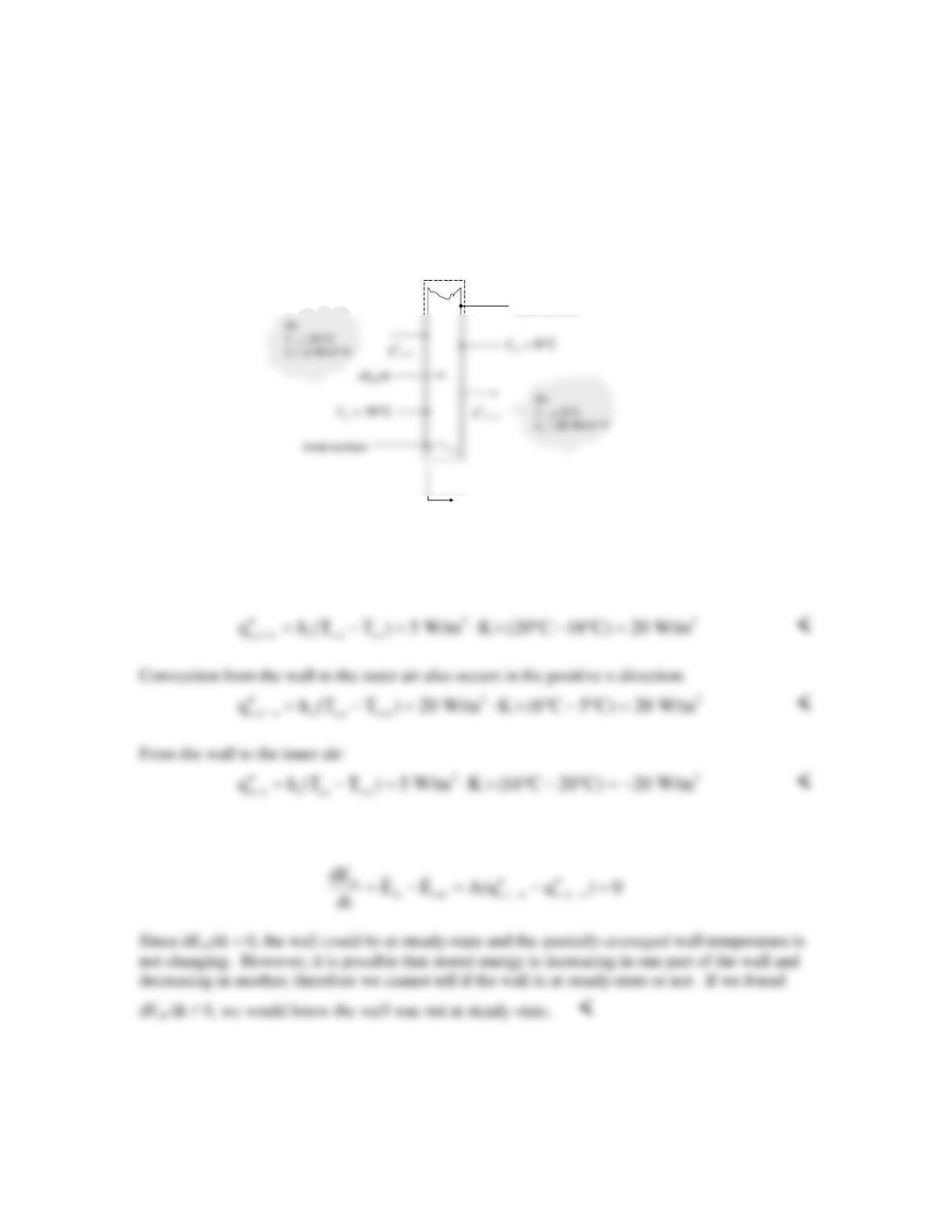
PROBLEM 1.14
KNOWN: Inner and outer surface temperatures of a wall. Inner and outer air temperatures and
convection heat transfer coefficients.
FIND: Heat flux from inner air to wall. Heat flux from wall to outer air. Heat flux from wall to
inner air. Whether wall is under steady-state conditions.
SCHEMATIC:
ASSUMPTIONS: (1) Negligible radiation, (2) No internal energy generation.
ANALYSIS: The heat fluxes can be calculated using Newton’s law of cooling. Convection
from the inner air to the wall occurs in the positive x–direction:
An energy balance on the wall gives
COMMENTS: The heat flux from the wall to the inner air is equal and opposite to the heat
flux from the inner air to the wall.
x
Outer surface
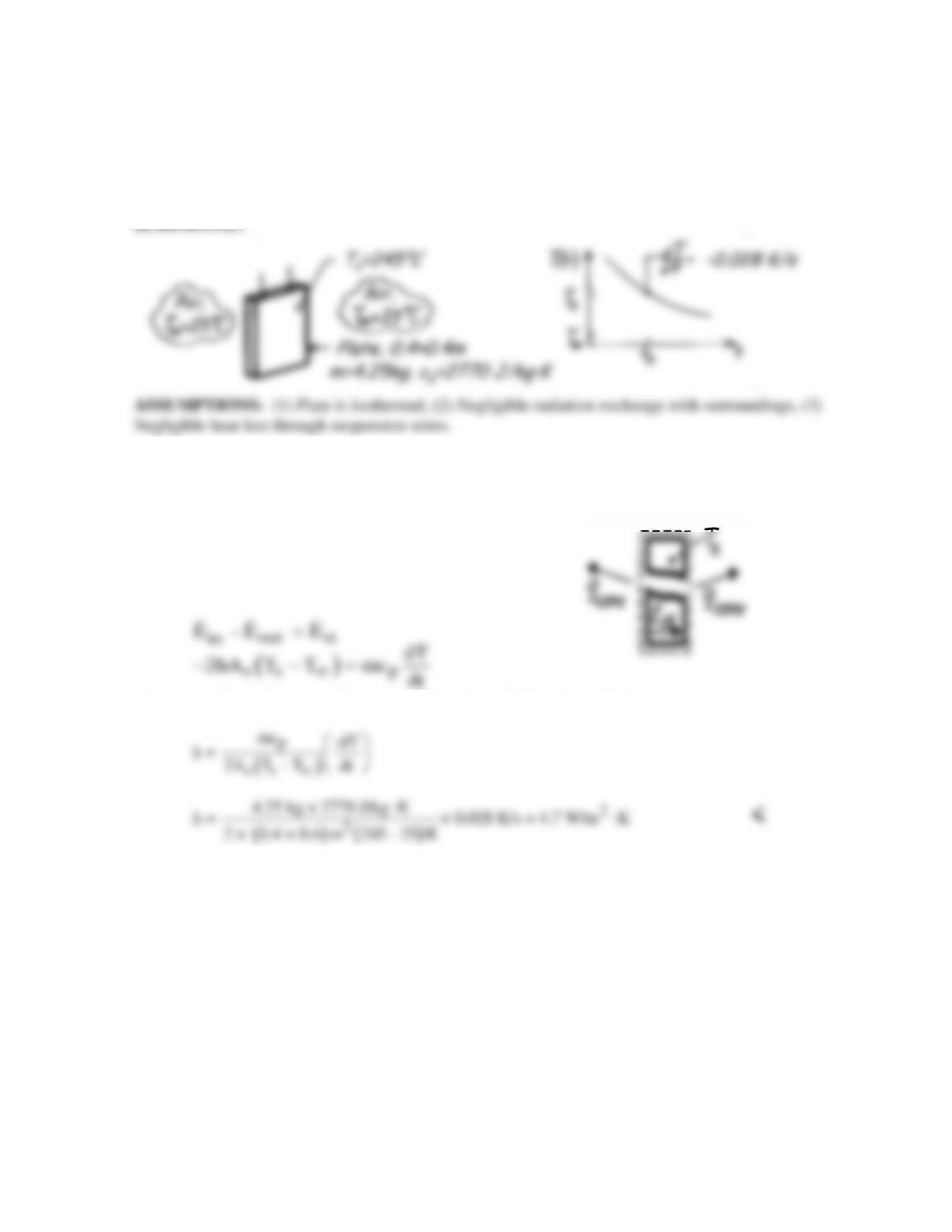
PROBLEM 1.15
KNOWN: Hot vertical plate suspended in cool, still air. Change in plate temperature with time at
the instant when the plate temperature is 245°C.
FIND: Convection heat transfer coefficient for this condition.
ANALYSIS: As shown in the cooling curve above, the plate temperature decreases with time. The
condition of interest is for time to. For a control surface about the plate, the conservation of energy
requirement is
where As is the surface area of one side of the plate. Solving for h, find
COMMENTS: (1) Assuming the plate is very highly polished with emissivity of 0.08, determine
whether radiation exchange with the surroundings at 25°C is negligible compared to convection.
(2) We will later consider the criterion for determining whether the isothermal plate assumption is
reasonable. If the thermal conductivity of the present plate were high (such as aluminum or copper),
the criterion would be satisfied.
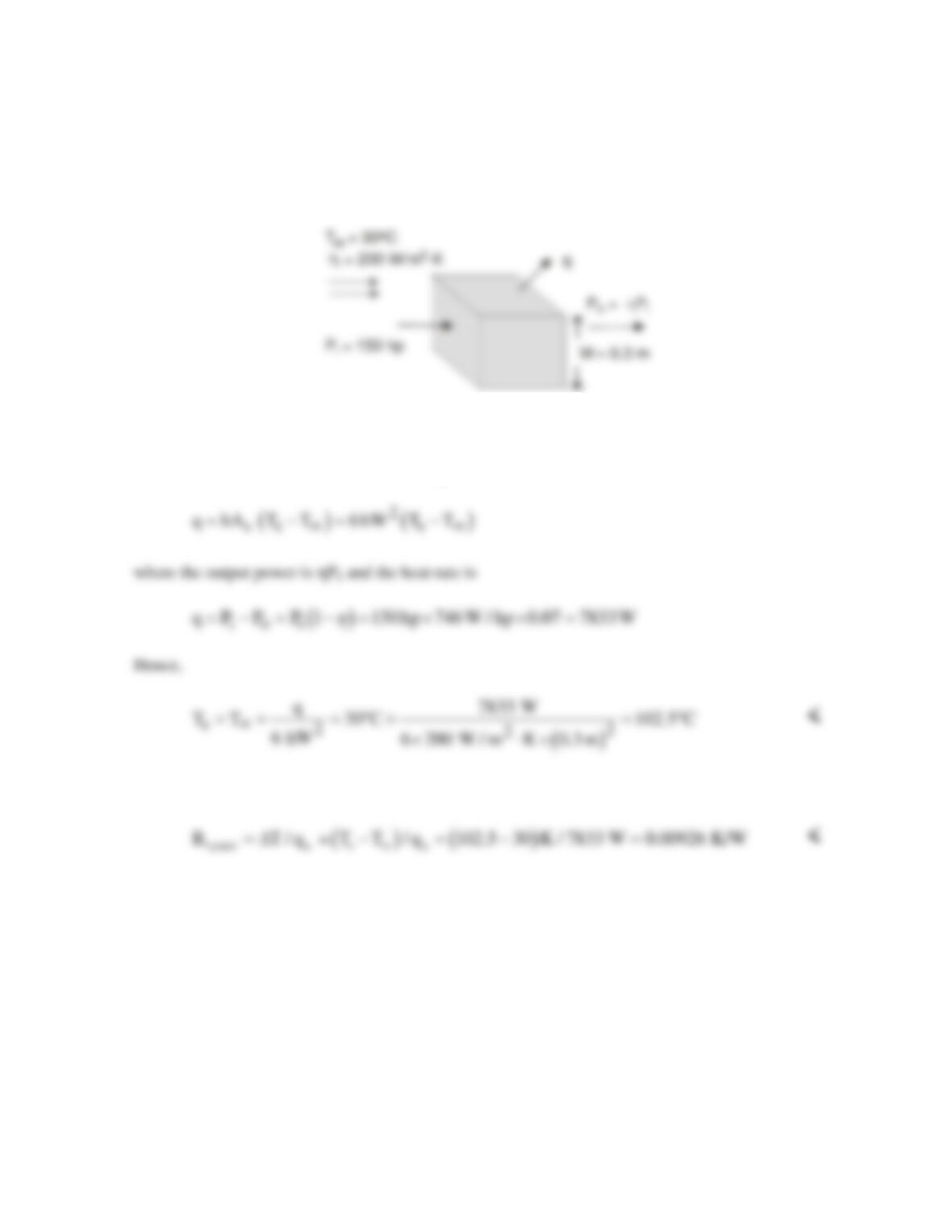
PROBLEM 1.16
KNOWN: Width, input power and efficiency of a transmission. Temperature and convection
coefficient associated with air flow over the casing.
FIND: Surface temperature of casing. Thermal convection resistance.
SCHEMATIC:
ASSUMPTIONS: (1) Steady state, (2) Uniform convection coefficient and surface temperature, (3)
Negligible radiation.
ANALYSIS: From Newton’s law of cooling,
From Eq. 1.11, the thermal resistance due to convection is
COMMENTS: (1) There will, in fact, be considerable variability of the local convection coefficient
over the transmission case and the prescribed value represents an average over the surface. (2) The
convection thermal resistance could equivalently be calculated from Rt,conv = 1/hA.
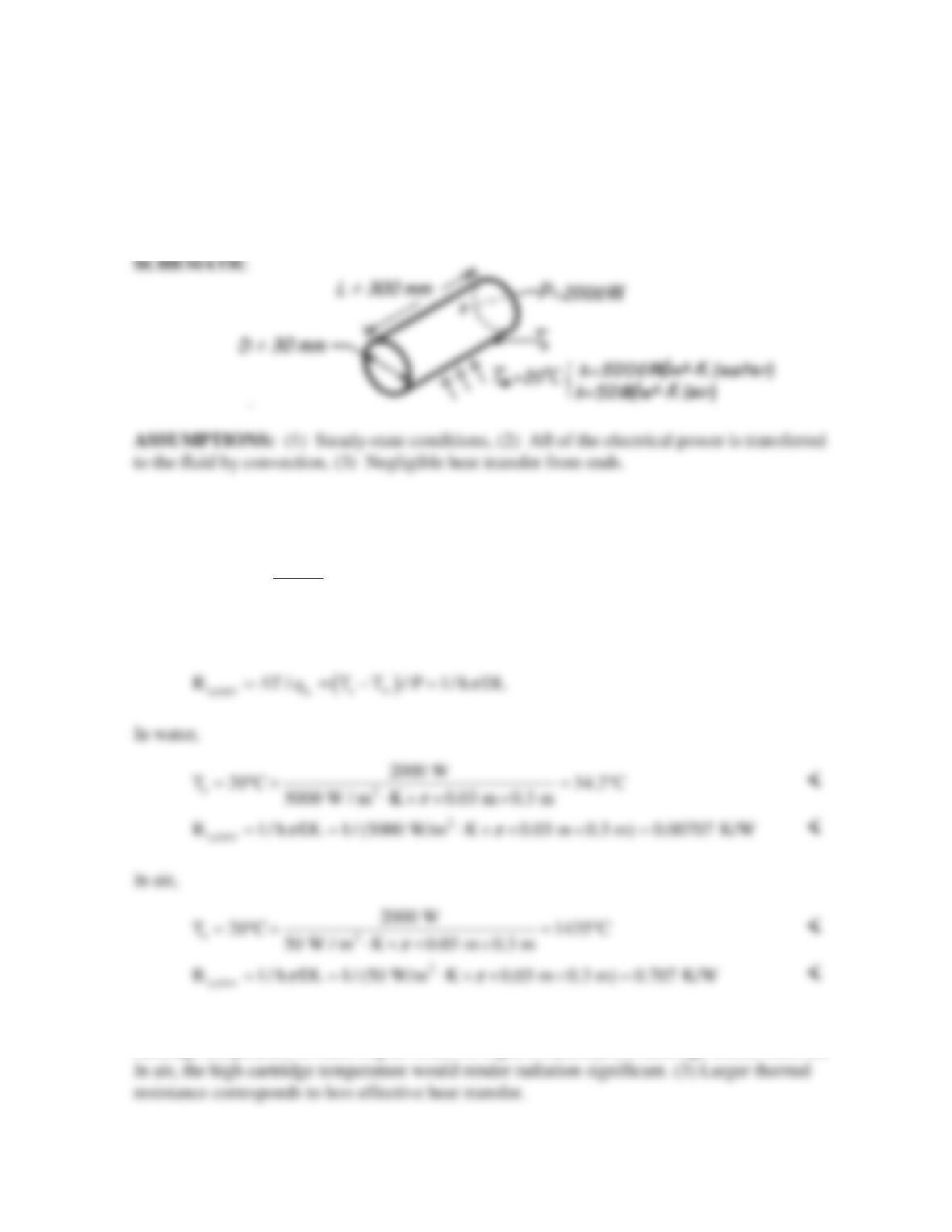
PROBLEM 1.17
KNOWN: Dimensions of a cartridge heater. Heater power. Convection coefficients in air
and water at a prescribed temperature.
FIND: Thermal convection resistance and heater surface temperatures in water and air.
ANALYSIS: With P = qconv, Newton’s law of cooling yields
( ) ( )
P=hATT hDLTT
P
TT .
h DL
ss
s
π
π
−= −
= +
∞∞
∞
From Eq. 1.11, the thermal resistance due to convection is given by
COMMENTS: (1) Air is much less effective than water as a heat transfer fluid. Hence, the
cartridge temperature is much higher in air, so high, in fact, that the cartridge would melt. (2)
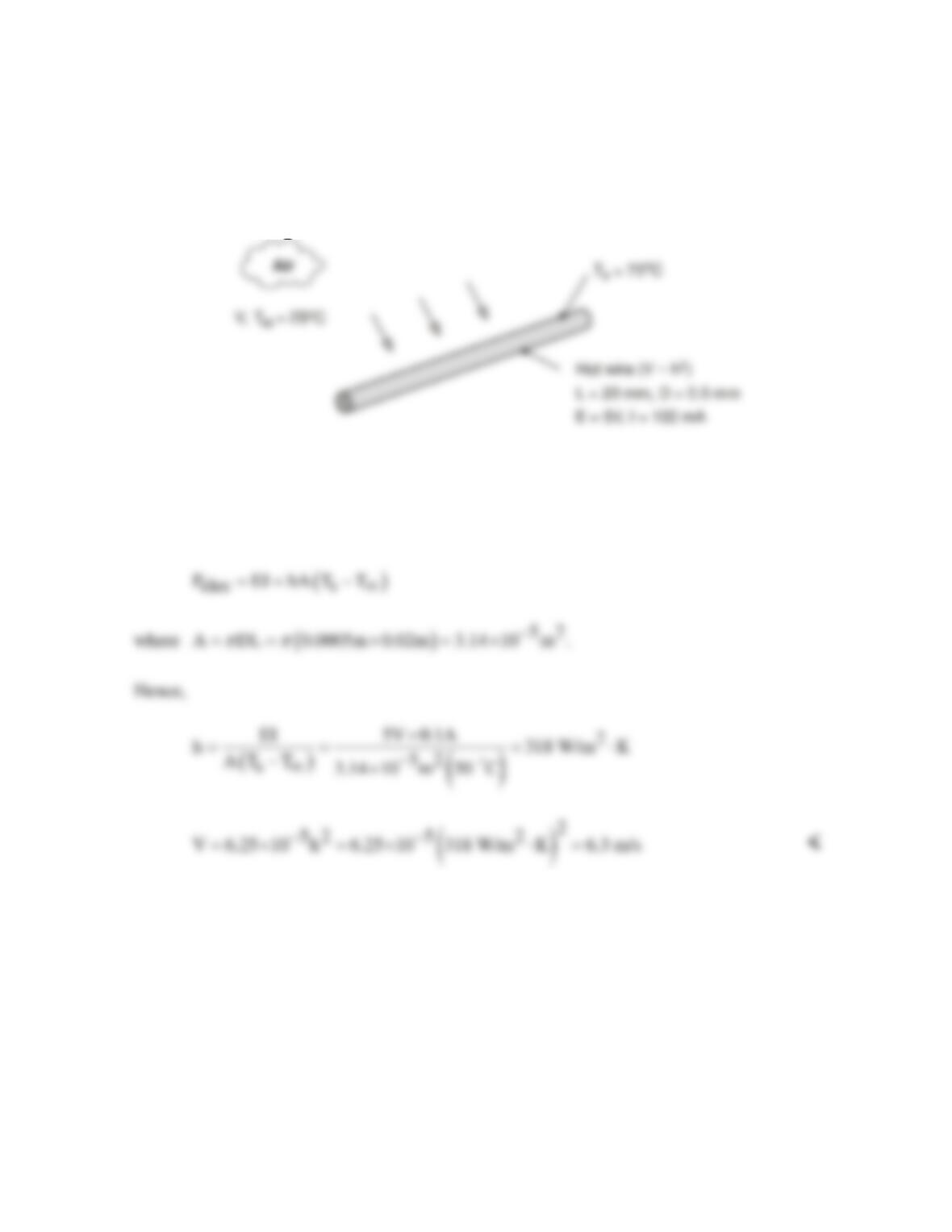
PROBLEM 1.18
KNOWN: Length, diameter and calibration of a hot wire anemometer. Temperature of air
stream. Current, voltage drop and surface temperature of wire for a particular application.
FIND: Air velocity
SCHEMATIC:
ASSUMPTIONS: (1) Steady-state conditions, (2) Negligible heat transfer from the wire by
natural convection or radiation.
ANALYSIS: If all of the electric energy is transferred by convection to the air, the following
equality must be satisfied
COMMENTS: The convection coefficient is sufficiently large to render buoyancy (natural
convection) and radiation effects negligible.